Category Archives: race

Denying Racism Has an Evidence Problem

Several years before I wrote an educational biography of Lou LaBrant for my doctoral dissertation, Jeanne Gerlach and Virginia Monseau published Missing Chapters: Ten Pioneering Women in NCTE and English Education for the National Council of Teachers of English (NCTE, 1991).

Their important volume included a chapter on LaBrant by England and West, but the project also produced a recorded interview of LaBrant when she was 100, a gold mine for my biographical work.

Jeanne and I became good friends because of our love of English teaching, history, and the people who have created that history. But one of our frequent conversations was about a claim by LaBrant in the interview: LaBrant was adamant that during her life that spanned the 1880s into the 1990s she had never once experienced sexism.

LaBrant, Jeanne and I agreed, was so determined and assertive as a person that this claim was both a perfect example of who LaBrant was and completely unbelievable.

So when I read Charles Blow’s Op-Ed on Clarence Thomas denying racism—in the 1960s and today—I thought of LaBrant.

Thomas’s assertion about racism reminds me of LaBrant’s about sexism, but it also strikes a cord about the pervasive responses I receive to much of my public writing about race, class, and poverty.

Two comments recur: (1) Why does it always have to be about race?, and (2) I agree with most of what you’re saying, but I think the problem is class, not race.

The first comment tends to prompt me to want to say, Why is it never about race? But I suspect people who offer that first response are unlikely to listen to anything.

Thus, it is the second response where I believe raising a few questions has the potential for helping people who deny racism today see that they have a serious evidence problem.

Let me start by returning to Blow’s central thesis when responding to Thomas:

One thing that I will submit, however, is that the emphasis must shift from discussions of interpersonal racism — which I would argue are waning as they become more socially unacceptable — to systemic and institutional biases, which remain stubbornly infused throughout the culture.

Interpersonal incidents of racism are easy to identify and condemn, particularly as their prevalence dwindles. We do hear too much about these at the expense of discussions about the systemic and institutional biases that are harder to see — it’s the old “can’t see the forest for the trees” problem — and that rarely have individual authors. This bias is obscured by anecdote but quite visible in the data sets.

The evidence, I acknowledge, supports Blow’s assertion that “interpersonal racism” is “waning” but that “systemic and institutional” racism remains powerful and must be confronted.

My caveat to waning interpersonal racism is that overt racism certainly suffers much greater public scorn than in the fairly recent past, but as the Richard Sherman “thug” incident (and the Michael Dunn shooting of Jordan Davis prompted by “thug music”) shows, racism on the interpersonal level still persists beneath more socially accepted codes.

Systemic and institutional racism, however, poses a greater evidence problem for racism deniers.

For those who insist that racism no longer exists, even at the systemic or institutional level, I have a series of questions that must be answered:

  1. Please read Michelle Alexander’s The New Jim Crow. Why are African Americans arrested and incarcerated for drug use at rates much higher than whites, even though African Americans and whites use drugs at similar rates? Why do police target African American neighborhoods for drug sweeps, and not college dorms?
  2. Please examine the prison incarceration data by race. White males outnumber African American males in the U.S. about 6 to 1, but per 100,000 people in each racial group, 2207 African Americans to 380 whites (nearly an inverse proportion of 6 to 1) constitute that prison population (2010 data). Since there are also more whites in poverty than African Americans (about 2 to 1, 2011-2012 data), what accounts for the inequity of these numbers by race? If incarceration is a function of class and not race, the prison population should be about 2 whites to 1 African American.
  3. Please examine data on discipline rates, access to courses and teachers, and retention rates in U.S. schools; for example, “African-American students represent 18% of students in the CRDC sample, but 35% of students suspended once, 46% of those suspended more than once, and 39% of students expelled.” Why such inequity by race in schools, inequities that foreshadow the incarceration inequities?

Are issues related to race different in 2014 when compared to the 1960s? Yes, in many ways, some of the more overt aspects of blatant racism have been confronted—although the consequences of that development have also masked racism—and racism no longer finds refuge in statutes.

To answer the questions above is to confront the evidence and then to offer answers that I suspect racism deniers simply do not want to admit—despite the inevitable conclusion that racism remains a powerful marker for inequitable consequences throughout society and within institutions.

Blow ends his Op-Ed with: “Simplistic discussions about race — both those that are history-blind and those that give insufficient weight to personal choices — do nothing to advance understanding. They obscure it.”

To that I add, denying racism does not end it, but that denial obscures it as well.

Saying something doesn’t exist will not make that true; it is a sort of word magic that reinforces the unacknowledged status quo.

The evidence shows systemic and institutional racism persists and is powerful. To end racism, we must first name it.

Recommended

The Good, Racist People, Ta-Nehisi Coates

Leonard Pitts Jr.: How ‘thug’ has become a ‘safe’ racial slur

The Bias Against Black Bodies, Charles Blow

See Also

Race Inequality in America by Graph, from Crime Sentencing to Income

Recalling 1947 in 2014

I had never felt more than a passing interest in 42: The Jackie Robinson Story because I expected a film biography of Robinson to pale too much against his life. As someone who admires the life and career of Muhammad Ali, I felt the same reservations about Ali.

It seems likely that some people, some lives are simply too big, too grand on their own for recreation.

But the universe can be a funny thing. 42 was on cable the other night so I gave the film a chance. There is much power in the story, and despite the film slipping as many film biographies and movies about sports do, I was glad to have watched since it prompted me to look closer at Robinson’s life.

More importantly, though, I watched this film on Robinson in the context of two other situations—just weeks after the Richard Sherman controversy and just hours before Marcus Smart, an Oklahoma State basketball player, stumbled into the crowd at a game resulting in his pushing a fan who taunted Smart.

As the title of the Robinson film highlights, in sports, numbers mean a great deal.

While exploring how the media and public responded to Sherman, I noted that while Sherman is not Ali, the life and responses to Ali certainly should inform how we recognize racist threads running through calling Sherman a “thug” and attempts to justify Sherman through his academic achievements, such as his GPA. Even as we tried to embrace Sherman, we erased his blackness by honoring codes of his whiteness, codes that blind.

Marcus Smart is no Jackie Robinson; nor will he have that opportunity because Robinson lived in a time of monumental shifts that cannot be recreated.

But the incidents surrounding Sherman and Smart—both talented young African American men—are important moments for America to look in the mirror, and it may be equally important that we make sure pictures of Robinson and Ali hang on the wall behind us so their faces remain in that mirror frame while we pause, look, and reflect.

In 1947, Jackie Robinson was closer to Sherman’s age than Smart’s. Robinson had attended college and served in the military by the time he played baseball in the Negro League before being invited to play minor and then major league baseball for the Brooklyn Dodgers.

But what could prepare a man for standing at the plate to play a baseball game while the manager for the opposing team stood outside the dugout yelling racial slurs?

As I watched the film recreation of Philadelphia Phillies manager Ben Chapman shouting at Robinson, I was enraged. I was enraged, hundreds of levels removed from Robinson by my privilege, my race, my spot in history, my safe couch.

And then I saw Smart stumble into the stands after hustling down the court on defense. I saw him push a fan. I read Smart’s lips as his teammates pushed him away. And I knew Smart had lost in a way that Robinson had been warned about thousands of times.

It is a different type of anger, but I was immediately angry about that fact. I knew Smart would apologize (I was surprised the fan made his admission, though). I expected Smart to be suspended (and he was). I knew Smart would be compelled to express remorse for how he portrayed himself as a potential NBA prospect, as a member of the Oklahoma State team, as a young man.

I suspect there now will be some discussion of just what the fan shouted—as if “piece of crap” somehow lessens the incident.

We can’t have a fan shouting a racial slur but we can have a fan shouting “piece of crap” because we are not going to examine why that fan felt justified in the taunt?

Right, as with the Sherman controversy, it can’t be about race. And if anyone suggests otherwise, the usual “Why does everything have to be about race?” will be trotted out as a defense.

Mostly by white people. Mostly by white males in power who live outside a racist gaze, who are insulated from living every moment on the razor-thin threat of collapse brought about not by the content of one’s character but by the simple fact of one’s skin color.

It is 2014 and there is no longer a race barrier stopping African American males from excelling in professional athletics.

But, if the film 42 is accurate at all, young African American males must live on the same egg shells Robinson did when they are challenged, literally, by a white male.

Smart lost the minute he asserted himself in defense of his own dignity as a human—just a Robinson would have lost if he hadn’t remained at the plate while Chapman harassed him.

You see, civil society wants African American males with numbers on their chests to assert a certain kind of manhood on the court, the field, or the diamond, but those same African American males must not assert their manhood when it is about human dignity. Decades removed from Robinson’s life, codes of knowing one’s place remain.

The public and media gaze for the Smart incident will remain on Smart. He will carry the brunt of responsibility for the entire incident even though he was simply playing the game, even though he stumbled into the crowd, and even though the fan felt justified in shouting at the young man for no other reason than the jersey and number on his chest.

Marcus Smart should never have been placed in that situation, however, and then Smart would not have been the one holding a press conference and apologizing.

And as far as gazes go, let’s not forget that Robinson broke a barrier other people created.

It is 2014, and we need fewer press conferences and more time looking in the mirror.

Please read:

10 Points About College Hoops All-American Marcus Smart’s Pushing a ‘Fan’ by Dave Zirin

Toni Morrison, the White Gaze, Race, and Writing

If Charlie Rose or Bill Moyers sat down with Tolstoy, do you imagine they’d ask him if he could write a book and not deal with race?

I invite you to view several clips of Toni Morrison, and others, exploring the white gaze, race, and writing. Very illuminating (and reminds me of those people who shout “why is it always about race” when it is—as in the Richard Sherman case).

The “Grit” Narrative, “Grit” Research, and Codes that Blind

The answer to Grant Lichtman’s Does “Grit” Need Deeper Discussion? appears to be an unequivocal yes—based on the exchange in the blog post comments, the Twitter conversations, and comments at my blogs on “grit.”

Those conversations have been illuminating for me; therefore, I want here to address several excellent ideas that have been generated.

First, I want to make a distinction that I think I have failed to make so far: We need to distinguish between the “grit” narrative and “grit” research. My concerns and most of my writing rejecting “grit” are addressing the “grit” narrative—one that is embedded in and co-opted by the larger “no excuses” ideology.

The “grit” narrative is central to work by Paul Tough as well as a wide range of media coverage of education, education reform, and specifically “no excuses” charter schools such as KIPP. In other words, the “grit” narrative is how we talk about what qualities lead to success (in life and school), what qualities children have and need, and how schools and teachers can and should inculcate those qualities.

In order to understand my cautions about the term “grit” as a narrative, I recommend that you consider carefully the responses to Richard Sherman’s post-game interview with Erin Andrews—responses that included calling Sherman a “thug” and racial slurs.

As Sherman has confronted himself, “thug” is “the accepted way of calling somebody the N-word nowadays.”

In other words, “thug” and GPA, as I have examined, are codes that blind because they are socially acceptable words and metrics that mask racial and class biases and prejudices.

The “grit” narrative is also a code that blinds since it perpetuates and is nested in a cultural myth of the hard-working and white ideal against the lazy and African American (and Latino/a) stereotype.

We must acknowledge that the “grit” narrative is primarily directed at—and the “no excuses” ideologies and practices are almost exclusively implemented with—high-poverty African American and Latino/a populations of students. And we must also acknowledge that the popular and misguided assumption is that relatively affluent and mostly white students and schools with relatively high academic achievement data are distinguishable from relatively impoverished and mostly African American and Latino/a students because of the effort among those populations (as well as stereotypes that white/affluent parents care about education and AA/Latino/a parents do not care about education)—instead of the pervasive fact that achievement data are more strongly correlated with socioeconomic status than effort and commitment.

Whether consciously or not, “grit” narratives and “no excuses” polices are classist and racist—again demonstrably so because neither are associated with white students in middle-class and affluent communities and schools.

The “grit” narrative states and implies that schools need to inculcate in impoverished African American and Latino/a students that same “grit” at the root of affluent and white student excellence (see the same stereotyping of teaching impoverished children the middle-class code in the flawed and discredited work of Ruby Payne)—misreading the actual sources of both the achievement and the lack of achievement (see below about scarcity and slack).

In fact, part of the “grit” narrative includes the assumption that successful students and people (read “white”) are successful primarily because they work hard; they earn their success. The flip side of this “grit” narrative is that unsuccessful students and people (read “African American” and “Latino/a”) are unsuccessful because they simply do not try hard enough. At its worst, the “grit” narrative is a socially acceptable way of expressing the lazy African American stereotype, just as Sherman exposed about “thug” as a socially acceptable racial slur.

The “grit” narrative is a racialized (and racist) cousin of the rugged individual myth that remains powerful in the U.S. The factual problem with the “grit” narrative and the rugged individual myth can be found in some powerful evidence that success is more strongly connected to systemic conditions than to the content of any individual’s character. Please consider the following:

  • Using data from Pew’s Economic Mobility Project, Matt Bruenig exposes the reality that ones privilege of birth trumps educational achievement (effort and attainment):

So, you are 2.5x more likely to be a rich adult if you were born rich and never bothered to go to college than if you were born poor and, against all odds, went to college and graduated. The disparity in the outcomes of rich and poor kids persists, not only when you control for college attainment, but even when you compare non-degreed rich kids to degreed poor kids!

Therefore, the answer to the question in the title is that you are better off being born rich regardless of whether you go to college than being born poor and getting a college degree.

  • In ScarcityMullainathan and Shafir present a compelling case that the same individual behaves differently in conditions of scarcity and slack. Scarcity occurs in impoverished lives and accounts for behaviors often misread by society as lazy, careless, or self-defeating. Slack is the space afforded by privilege and wealth, providing the context within which many people thrive and, ironically, within which behaviors described a “grit” can be valuable. In the “grit” narrative as well as in “no excuses” and high-stakes environments, scarcity is both ignored and intensified, creating contexts within which demanding “grit” is harmful and likely unproductive. Then seeking and creating slack for students (in their lives and in their schooling) instead of or preceding focusing on “grit” must occur if we genuinely support the component behaviors classified as “grit” (in the “grit” research).
  • Both the “grit” narrative and the rugged individualism myth focus an accusatory and evaluative gaze on the individual, leaving systemic forces that control individual behavior unexamined. The consequences of this misplaced attention—individuals and not system—are that students will learn not to try.

The above better characterizes why I reject the term “grit” as part of the “grit” narrative, but this now leaves us with the “grit” research, about many people reading the “grit” debate Lichtman’s blog have offered impassioned defenses.

Is it possible that the “grit” research has valuable and non-biased applications in classrooms for all types of students? Yes.

However, I believe our first step in rescuing the “grit” research is dropping the term. In my view, “grit” must go.

Next, we must shift when we privilege the component behaviors called “grit” and insure that our practices do not inadvertently teach students to avoid making deep and powerful efforts that are likely to fail.

As noted above, once students are afforded slack, and the playing field is leveled, “grit” may be a suitable focus for young people. This pursuit of slack requires that social policies address directly poverty and inequity in the lives of children.

This pursuit also means that high-stakes environments must end. Increasing pressure and raising demands in learning are counter to the slack necessary for any child to perform at high levels of engagement with the necessary risk and experimentation for deep learning to occur. Children must be physically and psychologically safe, and children need expert and loving encouragement that acknowledges the inherent value in effort (not linked to prescribed outcomes) in challenging and rich experiences.

The harsh and dehumanizing environments and policies in “no excuses” schools, then, as well as the high-stakes environments occurring in almost all K-12 public schooling are self-defeating (because they create scarcity and eliminate slack) for both raising student achievement and fostering the very “grit” many claim they are seeking in children.

Let me offer a brief anecdote from my years teaching high school in the 1980s and 1990s, well before anyone uttered the word “grit” (adding that I grew up in a home with a stereotypical 1950s father who was a hardass, no-excuses parent).

One day I heard students talking about failing a pop quiz in the class before mine. One student said he had read and even studied the night before, but failed the pop quiz. He then announced what he had learned from the experience: If he was going to fail any way, he declared, he wasn’t going to waste his time reading the assignment next time.

And here is where the “grit” narrative and “grit” research collide.

As long as the “grit” narrative is perpetuated and thus effort and engagement are idealized as key to certain outcomes and then as long as the real world proves to children and young adults that achievement is not the result of their effort, but linked to conditions beyond their control, the “grit” research creates a counterproductive dynamic in the classroom, one that frustrates and dehumanizes students and their teachers.

The real world in the U.S. today is no meritocracy. Confronting the rugged individual myth, instead of perpetuating it, then, allows teachers and students to feel purpose and agency in the need to continue seeking that meritocracy.

Further, once we decouple effort and the related behaviors associated with “grit” from predetermined outcomes, we can offer in school opportunities for students to discover the inherent value in effort itself, the inherent value in taking risks and committing ones self to an activity even though the outcome may be a failure.

The great irony is that we must slay the “grit” narrative (and discontinue the term) in order to honor a pursuit of equity and slack for all children so that what we know from the “grit” research can inform positively how we teach all children every day.

Until this happens, however, “grit” as a narrative within the “no excuses” ideology remains a code that blinds—masking the racialized and racist assumptions that “grit” implies about who is successful and why.

Richard Sherman’s GPA and “Thug” Label: The Codes that Blind

Three aspects of the public and media focus on Richard Sherman after the NFC championship game on January 19, 2014, are notable.

First, the images of Sherman tend to be like this one.

Next, after his much replayed and discussed post-game interview with Erin Andrews, Sherman was labeled a “thug,” as well as directly slurred with overt racist labels throughout social media such as Twitter.

And then, most of the mainstream efforts to explain the so-called real Sherman include his GPA, such as this caption in a photograph:

A student at Dominguez High, where Richard Sherman compiled a 4.2 grade-point average and played football and ran track. 

Or this from Getting to Know Richard Sherman:

Classroom Superstar

In 2005, Sherman’s excellence in the classroom was the centerpiece of a profile by Eric Sondheimer of the Los Angeles Times. Compton gained a national reputation as the epicenter of Los Angeles’ gang and crime problems in the 1980s and 1990s, and the state ran the failing school district from 1993 to 2001. Sherman, though, knew he had the ability to excel in the classroom—and that his teammates did too.

“I’m trying my best to get them where I’m going, to the college level,” Sherman told Sondheimer. “I’m helping them study for the SAT. A lot of people come in blind in what they need to know, not knowing one day they could be a top college prospect.”

Sherman talked the talk and walked the walk, telling his teammates to “quit making excuses” for poor academic performance while posting a 4.1 GPA—more than good enough to be accepted into Stanford, the first Dominguez player in over 20 years to be good enough athletically and academically to earn an invite there.

While media hype certainly plays a role in the lingering focus on Sherman after the on-field interview, the responses offer important moments to consider.

There is some comfort, I think, in a growing recognition that responses to Sherman have been at least fueled by racism—including the coincidence of Justin Bieber’s arrest and the resulting confrontation of how Sherman has been labeled a “thug” while Bieber’s wealth and white/male status shield him from a number of verbal and legal consequences that African American males experience daily.

And beginning a dialogue on the use of “thug” as code for racial slurs and racism also adds to a social effort to reach race and class equity in the U.S.

But I haven’t seen yet any consideration of using GPA to justify Sherman; his GPA has become a reflexive association, especially among mainstream, white, middle-class media.

Sherman did well in high school. (And he grew up in Compton.)

Sherman went to Stanford. (And he grew up in Compton.)

Sherman had a high GPA in high school and Stanford. (And he grew up in Compton.)

And while I haven’t heard or read it, I imagine Sherman has been discussed with the standard, “He speaks so well. (And he grew up in Compton.)”

Each time these justifications are used, I recognize a level of racism and condescension not unlike the use of “thug”—not toward Sherman, but toward a hushed suggestion of those real thugs (he grew up in Compton) with whom Sherman is being unfairly confused. You know, those others who do poorly in school. His GPA becomes a tool in wink-wink-nod-nod public discourse that is just as poisonous as the use of “thug.”

For me, Sherman is a highly skilled athlete in a sport filled with other highly skilled athletes—many of whom happen to be African American.

Setting aside the slurs aimed at him, Sherman is also triggering a social taboo (grounded in racialized norms) against a certain type of bravado. Sherman isn’t Muhammad Ali, but it seems fair to note how white mainstream America responded to Ali—not for the substance of his vision, not for the power of his athleticism, not for his eloquence and showmanship, but for his bravado.

Having been born and raised in the South, I am old enough to recognize the warnings in negative responses to bravado by African American men—a warning about being uppity, a nastiness of lingering racism.

So when many rush to justify Sherman by his GPAs, I see the same white faces explaining how Barry Sanders and Jim Brown did it the right way, meaning they displayed an understated character on the field. No spiking the ball after a touchdown, no thumbs to the name on the back of the jersey, no chest thumping.

And it all sounds to me like praising the other for knowing his place, a place decided for him.

Let’s not allow the conversation about “thug” being code for a racial slur disappear behind the next wave of media hype, but let’s also unmask the many other codes being used to justify Sherman—such as branding him with the confirmation of GPA and attending the right university.

Richard Sherman is a highly skilled athlete, competing in a sport made up of highly skilled athletes.

That isn’t simple, or even meant to be simplistic, but there are credible ways to praise Richard Sherman for the content of his character without taking veiled swipes at those people we continue to marginalize as Others.

Yes, there are codes behind words, but there are codes behind numbers as well. GPA (and SAT scores) may be waved to justify an athlete unfairly slurred, but those numbers are also masking how GPA and SAT serve to perpetuate privilege and gate-keep—a mask of objectivity that hides racial, class, and gender biases in those numbers.

No one should be justified by a number, in fact. Thus numbers must not continue to carry the weight of such justifications, the false veneer that they are objective or fair.

We have much left to do, including uncovering the codes that blind, both the words and the numbers.

Civil Rights Issue of Our Time?

While the credibility of challenges leveled at the current education reform agenda—such as commitments to Common Core or the rise of “no excuses” charter schools—is often called into question throughout social and mainstream media, I see little to no questioning of political mantras of education crisis, utopian expectations for schools, and the consistent refrain of education reform being the civil rights issue of our time.

In fact, even reports coming from the USDOE show that if education reform is the civil rights issue of our time, the policies are certainly not doing what is needed to combat the demonstrable failures of the public school system.

Problem #1: Discipline in schools remains incredibly inequitable by race:

Disparate Discipline Rates and Arrests and Referrals to Law Enforcement

[click to enlarge]

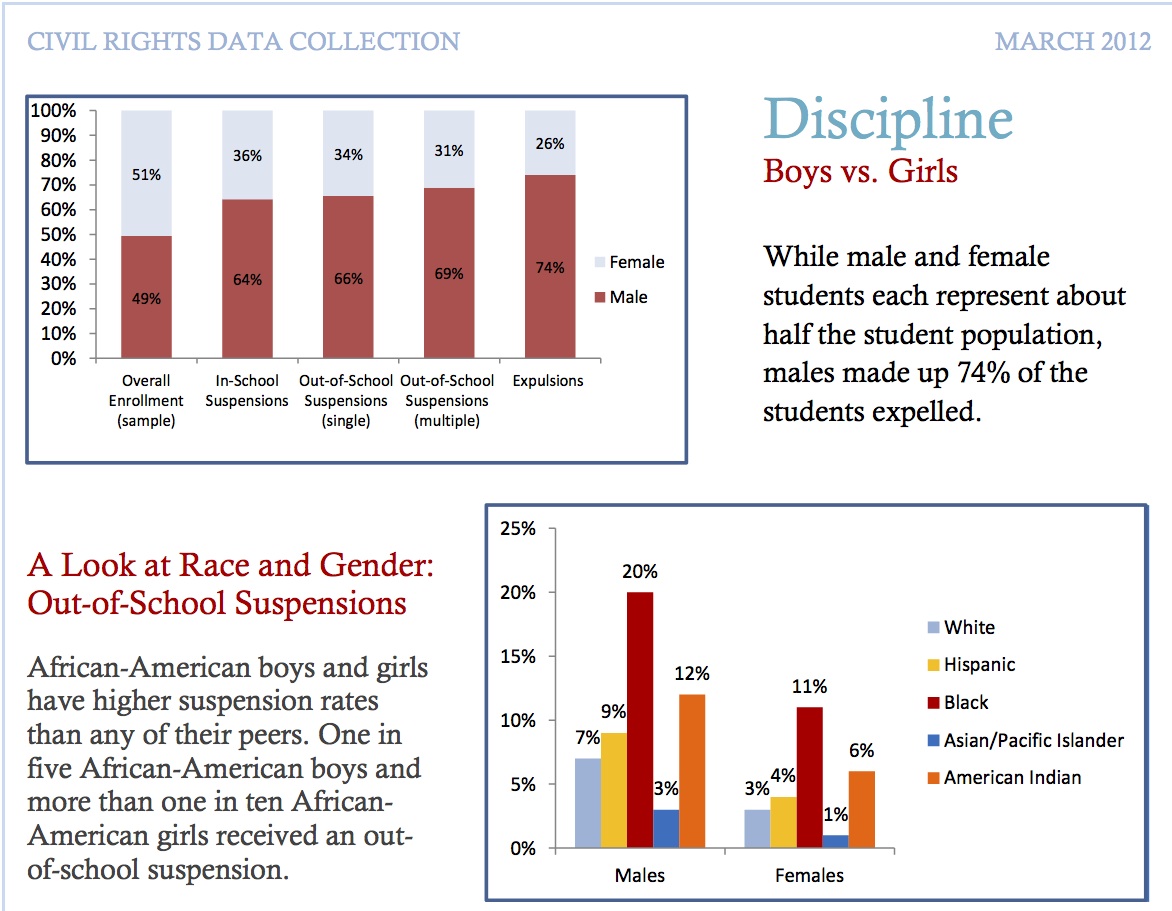
Problem #2: Discipline in schools is inequitable by gender, complicating inequity by race:

Discipline Boys vs. Girls and A Look at Race and Gender: Out-of-School Suspensions

[click to enlarge]

Problem #3: Access to advanced courses and retention rates are inequitable by race:

GandT.suspension
Access to Gifted and Talented Education (GATE) Programs and Retention Rates

[click to enlarge]

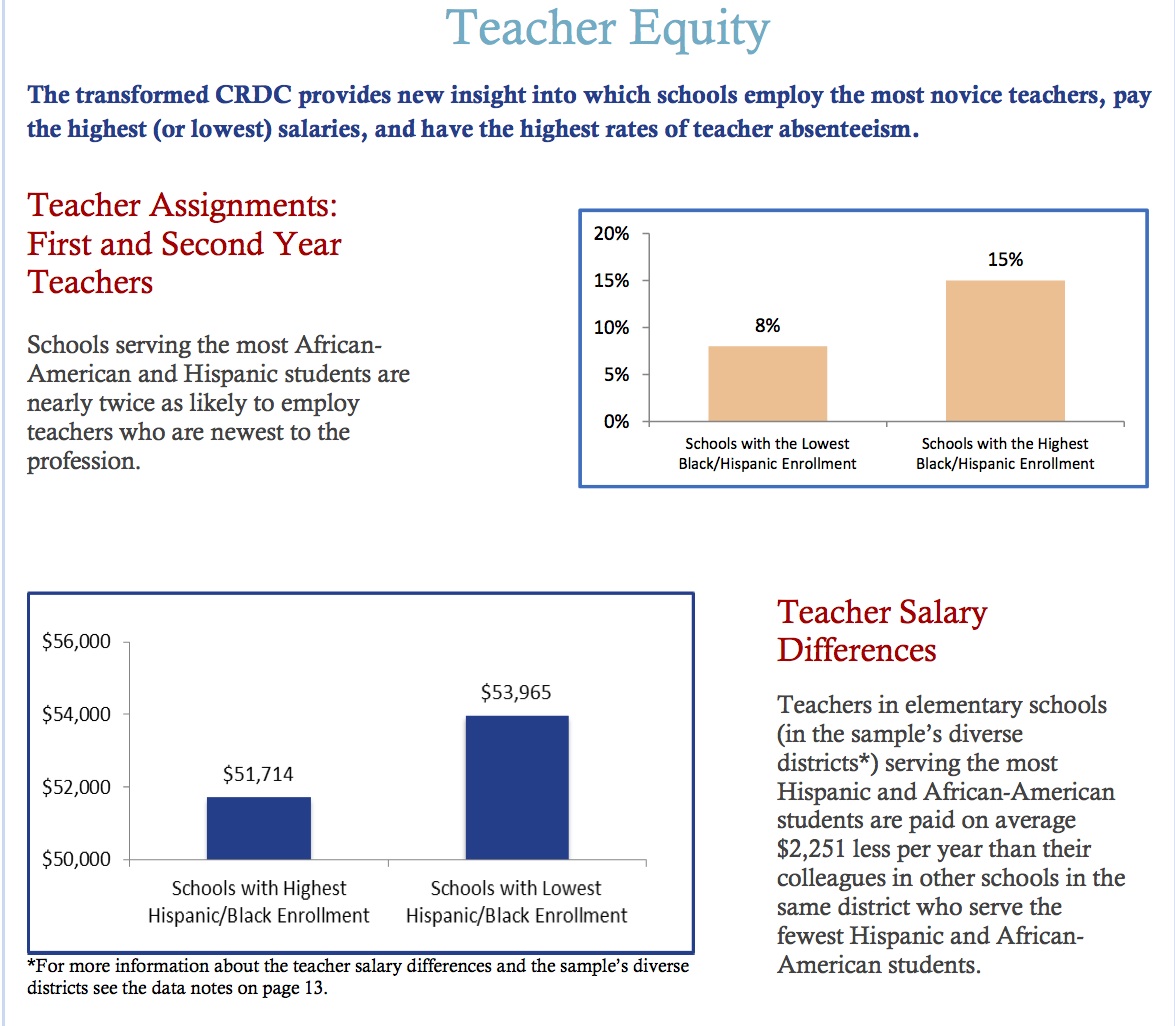
Problem #4: Teacher assignment and compensation are inequitable by race:

Teacher Assignments: First and Second Year Teachers and Teacher Salary Differences

[click to enlarge]

Problem #5: School discipline policies such as zero tolerance policies are racially inequitable and parallel to the current era of mass incarceration disproportionately impacting African American males:

There is abundant evidence that zero tolerance policies disproportionately affect youth of color. Nationally, black and Latino students are suspended and expelled at much higher rates than white students. Among middle school students, black youth are suspended nearly four times more often than white youth, and Latino youth are roughly twice as likely to be suspended or expelled than white youth. And because boys are twice as likely as girls to receive these punishments, the proportion of black and Latino boys who are suspended or expelled is especially large.  Nationally, nearly a third (31 percent) of black boys in middle school were suspended at least once during the 2009–10 school year. Part of this dynamic is that under-resourced urban schools with higher populations of black and Latino students are generally more likely to respond harshly to misbehavior. (p. 3)

As I have stated before, if education reform is the civil rights issue of our time, federal and state reform agendas would end zero tolerance policies, eradicate “no excuses” ideologies, and stop retention practices—as well as address the measurable inequities by race, class, and gender marring public schools in the U.S.

End Zero-Tolerance Policies: A Reader

What do zero-tolerance policies, “no excuses” practices, and grade retention have in common?

They all negatively and disproportionately impact children from poverty, minority children, English language learners, and boys; and nearly as disturbing, all are discredited by large bodies of research.

Is the tide turning against at least zero-tolerance policies? Lizette Alvarez reports:

Faced with mounting evidence that get-tough policies in schools are leading to arrest records, low academic achievement and high dropout rates that especially affect minority students, cities and school districts around the country are rethinking their approach to minor offenses.

Zero-tolerance policies, “no excuses” practices, and grade retention have something else in common: they should all be eradicated from our schools. And thus, here is a reader to help support calls for ending these practices and policies:

Police in the Hallways: Discipline in an Urban High School, Kathleen Nolan

Review: Police in the Hallways: Confronting the “Culture of Control,” P. L. Thomas

The School-to-Prison Pipeline, Journal of Educational Controversy (vol. 7, issue 1, Fall/2012-Winter 2013)

Hope Against Hope: Three Schools, One City, and the Struggle to Educate America’s Children, Sarah Carr

New Schools, Old Problems [Review: Hope Against Hope], P. L. Thomas

Education Reform in the New Jim Crow Era

Truthout TV Interviews P.L. Thomas About the New “Jim Crow” Era of Education Reform

Just Say No to Just Read, Florida, South Carolina [includes retention research]

Implementing Policies to Reduce the Likelihood of Preschool Expulsion, Walter S. Gilliam, PhD

Prekindergarteners Left Behind: Expulsion Rates  in State  Prekindergarten Programs, Walter S. Gilliam, PhD

Henry Giroux on the “School to Prison Pipeline”

The Mis-education of the Negro, Carter Godwin Woodson

Arresting Development • Zero Tolerance and the Criminalization of Children, Annette Fuentes

Secretary Duncan and the Politics of White Outrage

Social media and even mainstream media appear poised to leap on Secretary Arne Duncan with both feet due to his swipe at white suburban moms.

The nearly universal sweeping outrage—some with a level of glee that must not be ignored—calls for close consideration itself.

First, rejecting Duncan’s comments about white suburban moms and Common Core critics is completely valid. I join hands with the education community in rejecting Duncan’s claims, his discourse, and his efforts to discredit a significant, credible, and growing resistance to CC that should not be trivialized and marginalized as Duncan does.

However, I find the magnitude and swiftness of the responses to this “white suburban moms” incident disappointing in the larger context of Duncan’s entire tenure as Secretary of Education.

In the first moments of Obama’s administration, Duncan has personified and voiced an education agenda that disproportionately impacts black, brown, and poor children in powerfully negative ways. And the entire agenda has been consistently cloaked in discourse characterizing these policies as the Civil Rights issue of the day.

As well, Duncan has perpetuated and embraced “no excuses” narratives while directly and indirectly endorsing education reform and policies that target and mis-serve high-poverty students, African American and Latina/o students, and English Language learners—charter schools, Teach for America, accountability based on standards and high-stakes testing.

Public commentary that highlights that education reform under Obama and Duncan fails the pursuit of equity in the context of race and class in the U.S. tends to fall on deaf ears. The same urgency witnessed in the responses to Duncan’s “white suburban moms” contrasts significantly from the silence surrounding challenges to Duncan’s discourse and policies that are classist and racist, policy designed for “other people’s children.”

The problem is not that educators and scholars have failed to identify that education reform under Obama and Duncan have continued and increased federal and state education policy creating two inequitable education systems—one for the white and affluent, another for minorities and the impoverished—because these important messages have been raised.

The problem is that rejecting education reform discourse and policy based on race and class concerns doesn’t resonate in the U.S.

As I have asked numerous times, what would the political and public support for TFA be if the organization was providing recent college graduates with no degrees in education and only five weeks of training to teach Advanced Placement or International Baccalaureate classes filled with affluent white students? (A similar question about KIPP raises the same issue.)

Indirectly, from the response to Duncan’s “white suburban moms” comments, now we know.

The measure of a people must not come from how we flinch when the privileged suffer; the measure of a people must come from how we tolerate (or ignore) the conditions that impact the impoverished and the powerless.

If white outrage is the only outrage that counts in the U.S., any victory won from that outrage is no victory at all.

For Further Reading

First They Came For Urban Black and Latino Moms (For Arne Duncan), Jose Vilson

“the archeology of white people”

Ali: “You must listen to me”

1972

James Baldwin declared in his No Name in the Street:

The truth is that the country does not know what to do with its black population now that the blacks are no longer a source of wealth, are no longer to be bought and sold and bred, like cattle; and they especially do not know what to do with young black men, who pose as devastating a threat to the economy as they do to the morals of young white cheerleaders. It is not at all accidental that the jails and the army and the needle claim so many, but there are still too many prancing around for the public comfort. Americans, of course, will deny, with horror, that they are dreaming of anything like “the final solution”—those Americans, that is, who are likely to be asked: what goes on in the vast, private hinterland of the American heart can only be guessed at, by observing the way the country goes these days. (Baldwin, 1998, pp. 432-433) [1]

George Carlin opened one of his best routines singing Muhammad Ali’s name as part of his album Class Clown (“Muhammad Ali – America the Beautiful”), explaining about Ali’s exile for refusing to fight in Vietnam:

He said, “No, that’s where I draw the line. I’ll beat ’em up, but I don’t want to kill ’em.” And the government said, “Well, if you won’t kill people, we won’t let you beat ’em up.”

1967-1970

From March 1967 to October 1970, Muhammad Ali lived in America the Beautiful, not as a free man, but as the embodiment of Baldwin’s declaration in 1972. Ali as African American and Black Muslim was trapped between the rule of law and his own code of ethics—which he explained as alternatives:

I have two alternatives: either go to jail or go to the army. But I would like to say that there is another alternative: and that alternative is justice.

This Ali in a suit and tie behind a microphone, glancing down to read from his prepared statement, stood in stark contrast to the Ali draped in a towel and swarmed in the boxing ring where he declared, “I shook up the world!”

1968

John Carlos and Tommy Smith stood, fists raised at the Summer Olympics.

Ali sat for an interview:

Black people actually’ve been in jail for 400 years, we’ve been here in America….They can’t believe that I’m this strong. They thought they would weaken me and put fear in me by threatening to go to jail and taking my earning power. And they won’t let me work in America…

2013

My colleague, Scott Henderson, and I are currently editing a volume on James Baldwin, and during the review of the draft chapters for the collection, I began to see ads for a film about Muhammad Ali produced by HBO, Muhammad Ali’s Greatest Fight. The ads called to me in the same way I am always moved when I hear Carlin singing Ali’s name: “Muhammad Ali, Muhammad Ali, Muhammad Ali, it’s a nice musical name, Muhammad Ali.”

So I found myself watching the HBO film, at first not yet clear if it was a documentary (my hope) or a fictional film; I was certain I wasn’t interested in watching someone portray Ali. I wanted Ali.

And there he was, Muhammad Ali, archival footage to open the film, and then, despite the film focusing on the Supreme Court and the all-white crew of young men working at the Court, Ali appears throughout the story again and again. The real Ali—each time I could not stop myself from smiling at his bravado and his ability to float like a butterfly and sting like a bee outside the boxing ring.

But there is a subtext to this film focusing on the Supreme Court dominated by old white men. There is a subtext in 2013 about why now—why now is Ali’s fight with the government about his refusal to fight in Vietnam being recognized and validated?

Ali, once again, is pushed to the background in the HBO film, a work that becomes in many ways a layered narrative of privilegewhite privilege and male privilege.

Some of those layers can be found in the book that provides the basis for HBO’s film.

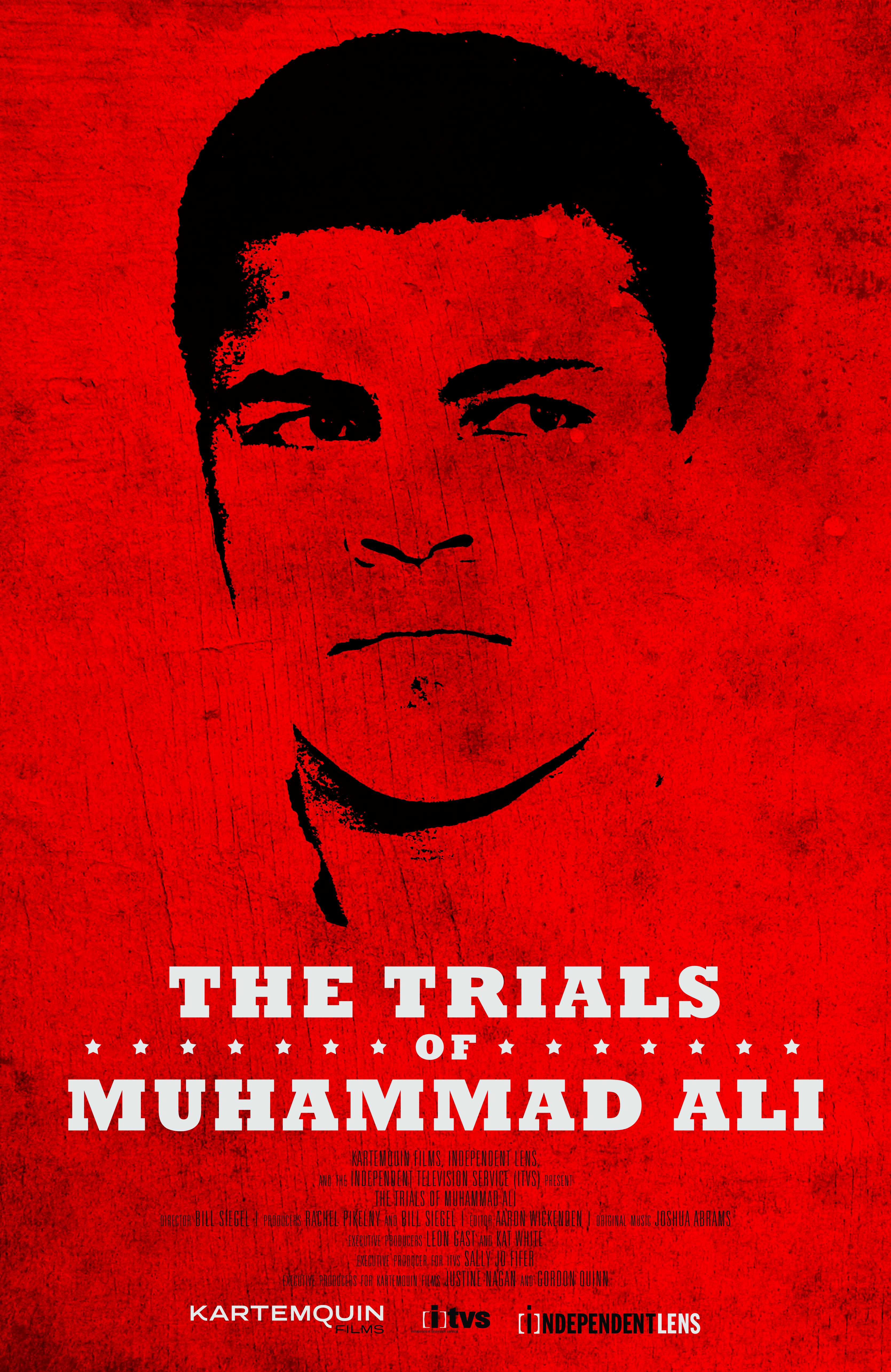
Some of those layers can be found in the documentary that doesn’t appear to share the privileged status of an HBO production: The Trials of Muhammad Ali.

ali_v01_11x17

Privilege is a closed space.

That space is behind a wall that provides the privileged their perch of authority as well as a walling out those Others.

Ali, Carlos, Smith, and Malcolm X lived outside the wall, and still remain under the gaze of privilege—to be acknowledged and explained when the time is right, when those with privilege see fit.

Ali remains mostly cartoon in America, reduced to his athletic bravado (“I am the Greatest!”) in the same way Martin Luther King, Jr. is tolerated as a passive radical, but not as the voice of protest and action that complimented Ali’s anti-war convictions:

We must move past indecision to action. We must find new ways to speak for peace in Vietnam and for justice throughout the developing world, a world that borders on our doors. If we do not act, we shall surely be dragged down the long, dark, and shameful corridors of time reserved for those who possess power without compassion, might without morality, and strength without sight.

1933

Carter Godwin Woodson confronted The Mis-education of the Negro:

[T]he educational system as it has developed both in Europe and America [is] an antiquated process which does not hit the mark even in the case of the needs of the white man himself….The so-called modern education, with all its defects, however, does others so much more good than it does the Negro, because it has been worked out in conformity to the needs of those who have enslaved and oppressed weaker people….The same educational process which inspires and stimulates the oppressor with the thought that he is everything and has accomplished everything worth while, depresses and crushes at the same time the spark of genius in the Negro by making him feel that his race does not amount to much and never will measure up to the standards of other peoples. The Negro thus educated is a hopeless liability of the race. (pp. 4-5) [2]

1963

Baldwin asked, “Who is the nigger?”:

1966

And then Baldwin wrote in The Nation:

This is why those pious calls to “respect the law,” always to be heard from prominent citizens each time the ghetto explodes, are so obscene. The law is meant to be my servant and not my master, still less my torturer and my murderer. To respect the law, in the context in which the American Negro finds himself, is simply to surrender his self-respect….

These things happen, in all our Harlems, every single day. If we ignore this fact, and our common responsibility to change this fact, we are sealing our doom. Here is the boy, Daniel Hamm, speaking—speaking of his country, which has sworn to bung peace and freedom to so many millions. “They don’t want us here. They don’t want us—period! All they want us to do is work on these penny-ante jobs for them—and that’s it. And beat our heads in whenever they feel like it. They don’t want us on the street ’cause the World’s Fair is coming. And they figure that all black people are hoodlums anyway, or bums, with no character of our own. So they put us off the streets, so their friends from Europe, Paris or Vietnam—wherever they come from—can come and see this supposed-to-be great city.”

There is a very bitter prescience in what this boy—this “bad nigger”—is saying, and he was not born knowing it. We taught it to him in seventeen years. He is draft age now, and if he were not in jail, would very probably be on his way to Southeast Asia. Many of his contemporaries are there, and the American Government and the American press are extremely proud of them. They are dying there like flies; they are dying in the streets of all our Harlems far more hideously than flies. A member of my family said to me when we learned of the bombing of the four little girls in the Birmingham Sunday school, “Well, they don’t need us for work no more. Where are they building the gas ovens?” Many Negroes feel this; there is no way not to feel it.

Privilege is a spider’s web.

Where is the space for Ali to speak for Ali? When will that space exist, and how?

I agree with Carlin that there is music in Ali’s name, but the song remains bittersweet—too hard to swallow in 2013.

I cannot disentangle the web of history that remains attached to all of us, regardless of how hard we try to pull the invisible strings from our faces, our clothes, and our skin.

That web we cannot free ourselves from is privilege—and privilege demands only two alternatives.

But as Ali explained, there is a third alternative and “that alternative is justice.”

It is time, we must listen to Ali.

[1] Baldwin, J. (1998). James Baldwin: Collected essays. New York, NY: The Library of America. Originally published in 1972, No Name in the Street.

[2] Woodson, C. G. (1933). The mis-education of the negro. New York, NY: Tribeca Books.

—–

For Further Viewing and Reading

To Jimmy (and Jose), with Love: I Walk Freely among Racism

James Baldwin (Aug. 2, 1924 – Dec. 1, 1987)

“The Deliberately Silenced, or the Preferably Unheard”

What Would James Baldwin Do (Say, Write)?

A Report from Occupied Territory, James Baldwin (1966)

Knocked the Hell Out by ‘The Trials of Muhammad Ali’, David Zirin

The Trials of Muhammad Ali 

U.S. Needs Moratorium on (Privileged) White Men Pontificating on Race, Class, Gender

Most  (privileged) white men are wrong about race, class, and gender—and while Mike Petrilli isn’t unique, he does represent how and why:

Second, the reason the overwhelming majority of children are born poor is that they are born to young single mothers without much education or many job prospects. These mothers will struggle mightily to provide the kind of home environment that is necessary to help children get off to a good start in life and in school. To put it bluntly, they tend to be bad parents. (Not “bad” in a moral sense but “bad” as in “ineffective”; with their brains literally maxed out with basic survival, it’s easy to understand why.)

While it is embarrassing enough that Petrilli thinks putting “bad” in quote marks and offering a parenthetical qualification are enough to counter the essential condescension and marginalization in his mischaracterization of people who happen to be trapped in poverty, the larger problem is that Petrilli represents, speaks for, and speaks to a cultural attitude toward the poor (and the affluent/privileged) that guarantees the U.S. remain inequitable, and likely will continue to grow more inequitable: people in poverty are lazy and deserve their poverty while the affluent are hard-working and deserve their achievements.

Before I continue, let me clarify that my calling for a moratorium on white men pontificating on race, class, and gender would include me. And if I am successful in this call, I am eager to comply.

The president/governor Bush clan in the U.S. has rightfully been accused of including several men born on third base who all believe they hit triples. If that characterization is accurate, and I think it is, then I am privileged by being white and male, but compared to the Bushes, my working-class background probably put me solidly at first.

Along with race and gender, I happen to have the sort of mathematical and verbal intelligence that schools and society honor—as well as a sort of Type-A work ethic that tends to be rewarded as well.

In fact, I have worked extremely hard at being a teacher and writer for about 30 years now, achieving a fairly high level of success.

I have earned that success, but let me be very clear that I do not deserve it.

I do not deserve the relative affluence and all the advantages of that while other people are being denied access that I was afforded through no effort on my part. Yes, I have worked hard, but the foundation of my success was pure and simply dumb luck.

Consider Shaquille O’Neal, LeBron James, George W. Bush, Bill Gates, and Mike Krzyzewski. What if these five men had lived in the early to mid 1800s? How would their lives have manifested themselves in that era?

It is without a doubt that two of these men would have had quite different lives—and not because of their talents, character, or determination.

Social norms are powerful and are primary when considering the individual talents of people.

And that leads us back to my call for a moratorium and my claim that most white men are typically wrong about race, class, and gender.

White men have built Western culture (often on the backs of others) and the exact privilege that appears transparent to them.

“Normal” to the privileged constitutes all the forces that assure their privilege and in turn create the poverty and disadvantage of others.

As a result, Petrilli can and does classify single, poor mothers as “bad parents”—and does so while believing himself and hearing from others that Mike is an essentially nice guy.

Yes, Petrilli is a nice guy—in the rarified air of privileged white men in the U.S.

His blogs appear civil and almost reasonable in fact.

But there is nothing civil or reasonable about a privileged class speaking about and for people in disadvantage, as long as that holding forth refuses to acknowledge privilege and the social dynamics that create poverty.

The powerful in the U.S. either create or tolerate whatever conditions exist in the U.S.

The powerless cannot and do not create or tolerate those conditions.

The U.S. is experiencing some of the highest child poverty rates and levels of inequity ever seen in contemporary times. White men still reap the benefits of those inequities while also being primarily the ones with the power and money to control this country.

It isn’t working—except for them.

I suspect the imbalances of inequity will remain for a while, but in the mean time, wouldn’t it be wonderful that where we currently have white-mansplaining, we could have for at least a while just silence that could be filled by those who have been spoken about and for?