Category Archives: race

Why Poverty and Mass Incarceration Do Not Matter in the U.S.

Ever wonder why poverty and mass incarceration do not matter in the U.S.?

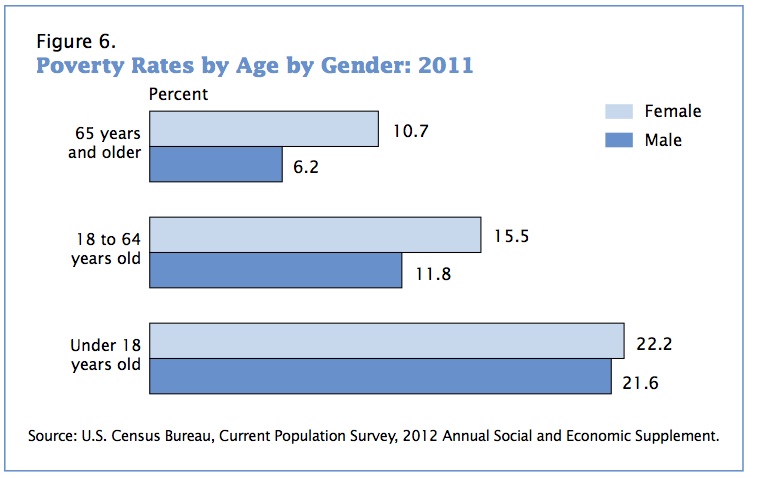
Poverty disproportionately impacts women and children (see p. 15):

Povertygenderage

[click image to enlarge]

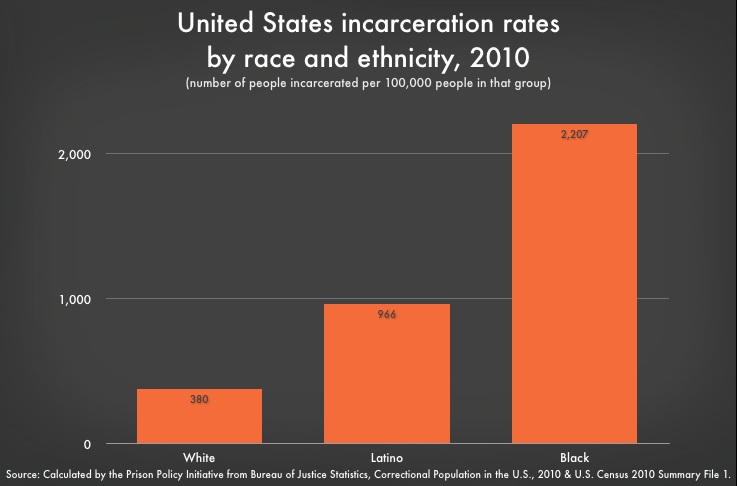
Mass incarceration disproportionately impacts African American males. While white males outnumber AA males about 5 to 1 in society, AA males outnumber white makes about 6 to 1 in prison:

—–

Government and business in the U.S. remains dominated either by privileged white males or the norms associated with privileged white males.

Our leaders have no empathy.

Our leaders have wealth, privilege, child care, health care, food security, and job security—and they all believe they have earned it all. They also believe those who haven’t are lazy—also deserving their poverty.

Our leaders cannot and will not acknowledge their privilege.

Leadership without empathy is tyranny.

If poverty and mass incarceration were white male problems, we’d be working to end both.

Who Benefits from Ignoring Poverty and Race?

In his spring 2013 commencement address at Morehouse College, Barack Obama offered a compelling message:

Obama said he was lucky to have his mother and grandparents, who raised him, and said that under different circumstances, he could have ended up in prison or unemployed.

‘I might have been in prison. I might have been unemployed. I might not have been able to support a family — and that motivates me,’ he said.

While he urged graduates to not use race as an excuse for their failures, he acknowledged that the ‘bitter legacy’ of discrimination still exists in America.

‘At some point in life as an African American you have to work twice as hard as anyone else if you want to get by,’ he said.

Coming from the first African American president in the U.S., this call for personal grit and refusing to make excuses speaks to a central narrative found in the current education reform debate.

Bill Cosby has offered a similar message, prompting even supporters of Cosby to raise concerns:

There are some obvious concerns with Cosby’s rhetoric. First is the justifiable, and quite accurate concern that his critiques ignore structural inequality and place too much emphasis on individual responsibility. Then there is the fear that such commentary might be used as weaponry for conservatives in ways that both blacks and whites, conservatives and liberals, have historically used black deviance to achieve ideological and policy goals. Indeed, when conservative mogul Rupert Murdoch (chairman of the News Corporation, which owns the New York Post that Cosby published in) cosigned with Cosby’s comments, you know it’s not a good look.

However, messages of grit and “no excuses” remain prominent among advocates of education reform committed to charter schools and other market-based policies as well as the growing standards and high-stakes components of the accountability era.

For example, Steve Perry continues to attack teachers unions as “roaches” and relentlessly tweets his message of grit, “no excuses,” and claims of his own success as an educator (although these claims have been debunked, challenged as side-show, and exposed as misleading). Perry’s Twitter feed (@DrStevePerry), in fact, represents well the dominant themes running through the most widely embraced attitudes about race and poverty in the U.S., beliefs that have been driving education reform for three decades:

If America’s ed failures were just about ‘poverty’ then why is the entire country at the bottom of international competition?

I’m tired of this solutionless dribble… Poverty, waaa.. Privitaization.. waaa Corportaions, waaa Since when do you work for free!

Poverty has been w use since beginning of recorded history. Yet then as now ppl make it out thru education. Good education = end 2 poverty.

If you believe poverty is stopping your students from learning please turn in your letter of resignation today before the end of business.

I believe that Dr. King’s dream and Prez Obama’s hope are one in the same. We can overcome because we do overcome. Education is the key.

The only people who believe that poverty can’t be overcome are people who have never overcome poverty.

Great educators don’t whine when parents expect that they’ll deliver an education. They don’t blame poverty. They accept responsibility.

Stop saying poverty is more important than good teachers. You’re wrong & you sound nuts. There’s NO causal relationship.

The rhetoric is compelling, but are the claims accurate?

Is the U.S. at the bottom of international comparisons, and if so, is poverty irrelevant to those rankings? Carnoy and Rothstein have shown:

In a new EPI report, What do international tests really show about U.S. student performance?, we disaggregate international student test scores by social class and show that the commonplace condemnation of U.S. student performance on such tests is misleading, exaggerated, and in many cases, based on misinterpretation of the facts. Ours is the first study of which we are aware to compare the performance of socioeconomically similar students across nations….

Yet a careful analysis of the PISA database shows that the achievement gap between disadvantaged and advantaged children is actually smaller in the United States than it is in similar countries. The achievement gap in the United States is larger than it is in the very highest scoring countries, but even then, many of the differences are small….

The share of disadvantaged students in the U.S. sample was larger than their share in any of the other countries we studied. Because test scores in every country are characterized by a social class gradient—students higher in the social class scale have better average achievement than students in the next lower class—U.S. student scores are lower on average simply because of our relatively disadvantaged social class composition [emphasis added].

In 2010, Mel Riddile exposed the same flawed rankings that ignore poverty, concluding:

Truthfully, you and I know all too well that Secretary Duncan, who led schools in Chicago, is aware of the relationship between poverty and student achievement, but he doesn’t trust us enough to tell us the truth. He is afraid that we will use poverty as an excuse and that we will forget about our disadvantaged students. Ironically, by not acknowledging poverty as a challenge to be overcome, Duncan is forgetting about our disadvantaged students. Duncan needs to deliver the message that all our students deserve not only access to an education, but access to an excellent education. He needs to repeatedly remind us that, when it comes to school improvement, it’s poverty not stupid.

Which is a more powerful influence on measurable student outcomes, poverty or teacher quality? Di Carlo explains about the evidence:

But in the big picture, roughly 60 percent of achievement outcomes is explained by student and family background characteristics (most are unobserved, but likely pertain to income/poverty). Observable and unobservable schooling factors explain roughly 20 percent, most of this (10-15 percent) being teacher effects. The rest of the variation (about 20 percent) is unexplained (error). In other words, though precise estimates vary, the preponderance of evidence shows that achievement differences between students are overwhelmingly attributable to factors outside of schools and classrooms (see Hanushek et al. 1998Rockoff 2003Goldhaber et al. 1999Rowan et al. 2002Nye et al. 2004).

Is poverty destiny in the U.S.? As I have examined before, research from 2012, “A Rotting Apple” (Schott Foundation for Public Education) and “Housing Costs, Zoning, and Access to High-Scoring Schools” (Brookings), confirms that the socioeconomic status of any child’s home is a strong predictor of that child’s access to high- or low-quality schools. While not a politically appealing statement, in the U.S., poverty is destiny—and so is race.

Is education the ticket out of poverty? Based on Pew’s Economic Mobility Project, Matt Bruenig has concluded:

So, you are 2.5x more likely to be a rich adult if you were born rich and never bothered to go to college than if you were born poor and, against all odds, went to college and graduated. The disparity in the outcomes of rich and poor kids persists, not only when you control for college attainment, but even when you compare non-degreed rich kids to degreed poor kids!

Therefore, the answer to the question in the title is that you are better off being born rich regardless of whether you go to college than being born poor and getting a college degree.

Yet, President Obama has committed to arguing that African Americans must work twice as hard to succeed, while his Secretary of Education Arne Duncan offers this about the rise of segregation in U.S. schools:

So whatever we can do to continue to increase integration in a voluntary way—I don’t think you could force these kinds of things—we want to be very, very thoughtful and to try to do more in that area quite frankly.

Duncan, as the very public face and voice of Obama’s education agenda, has echoed that school reform is the civil rights issue of our time, and Duncan tends to pepper his education talks with civil rights rhetoric. But in the end, even as the federal government does force many policies onto states, the Secretary is careful to note “I don’t think you could force these kinds of things.”

Ultimately—even when messages come from prominent African American leaders, entertainer, and educators—the “no excuses” effort to ignore race and poverty serve only the interests of politicians and the affluent. How?

If poverty is the result of individual laziness and thus can be overcome by simply doubling down on effort, then the responsibility of overcoming poverty lies entirely in people who are poor.

Politicians and the affluent, then, are absolved of their culpability in the existence of poverty or their need to be proactive in eradicating poverty. Political, cultural, and educational leaders can continue to float on the breeze of rhetoric and never stoop to confronting the evidence they are wrong or that they need to act in any way.

Another powerful message beneath ignoring race and poverty is that the affluent deserve their affluence just as the impoverished deserve their poverty, as detailed by Chris Arnade:

When you’re wealthy you make mistakes. When you are poor you go to jail.

Yes, it is like comparing apples and oranges. That is the point though. We have built two very different societies with two very different sets of values. Takeesha [prostitute, drug addict] was born into a world with limited opportunities, one where the black market has filled the void. In her world transgressions are resolved via violence, not lawyers. The law as applied to her is simple and stark, with little wiggle room.

Mr one-glove [Wall Street trader] was born into a world with many options. The laws of his land are open for interpretation, and with the right lawyer one can navigate in the vast grey area and never do anything wrong. The rules are often written by and for Mr one-glove and his friends.

The successful and affluent, regardless of race, must preserve the myth that success in the U.S. is earned, that the U.S. has achieved meritocracy.

If Clarence Thomas, as an African American, can achieve his position as a Supreme Court judge, that is all the proof we need that effort trumps race (and that we no longer need affirmative action)—goes the twisted logic.

And finally, the “don’t force it” message is bowing to the allure in the U.S. of the Invisible Hand of the market and skepticism about the intrusive government.

Again, however, this message ignores evidence. Left to market forces, charter schools have increased the exact rise in segregated schools that is currently also plaguing traditional public schools.

The Invisible Hand is not an ethical force, and issues such as segregation, economic equity, and racial equity are ethical issues—requiring ethical (and thus social) forces and solutions.

Let’s return to Obama’s commencement speech:

During the address, the president rallied against the racism of the 1940s and 50s and the Jim Crow laws.

He told the graduates that despite the obstacles, people like Dr King were able to learn how to be ‘unafraid’.

He said: ‘For black men in the forties and fifties, the threat of violence, the constant humiliations, large and small, the gnawing doubts born of a Jim Crow culture that told you every day you were somehow inferior, the temptation to shrink from the world, to accept your place, to avoid risks, to be afraid, was necessarily strong.

‘And yet, here, under the tutelage of men like Dr. Mays, young Martin learned to be unafraid.  He, in turn, taught others to be unafraid.’

Here, again, like Duncan’s talks on education, rhetoric that directly mentions the inequities associated with race and class—a similar pattern found in Perry’s outbursts—are designed to mask and ignore the lingering corrosive influence of race and class in the lives and schools of a growing population of people and children in the U.S.

We must ask who it benefits to raise a fist against the Jim Crow Era while ignoring that the New Jim Crow Era of mass incarceration is destroying the lives of African American males, that urban schools serving disproportionately impoverished African American and Latino/a children are increasingly school-to-prison pipelines and schools-as-prisons, and that the rise of charter schools in abandoned cities like New Orleans are segregating schools and providing “other people’s children” schools unlike the schools for privileged children.

Certainly it doesn’t benefit the victims of cultural and institutional racism and classism that remain in the U.S.

The Lingering Legacy of Segregation

As we approach 60 years since U.S. Supreme Court’s 1954 Brown v. Board of Education decision and stand in the wake of a 50-year anniversary of the March on Washington, Richard Rothstein details:

Today, many black children still attend schools in racially and economically isolated neighborhoods, while their families still reside in lonely islands of poverty: 39 percent of black children are from families with incomes below the poverty line, compared with 12 percent of white children (U.S. Census Bureau(a)); 28 percent of black children live in high-poverty neighborhoods, compared with 4 percent of white children (Casey 2013).

Reports from 2012 also highlighted the growing resegregation of schools in the South and across the U.S. Concurrent with the re-segregation of public schools—along with the ignored reality that children’s ZIP codes tend to determine their access to high- or low-quality schools, which reflect the affluence/poverty of the community—a growing commitment to charter schools ignores that charter schools fail to achieve academic success distinguishable from traditional public schools (both formats of schooling produce a range of outcomes) but tend to segregate children by race and class.

Rothstein recognizes a historical link between burying the Coleman report from the mid-1960s and the rise of “no excuses” reform today:

The fear of education reformers today, that discussion of social and economic impediments to learning will only lead to “making excuses” for poor teaching (Rothstein 2008), mirrors fears in 1966 that similar discussion would undermine support for federal aid to education.

A few important lessons lie beneath these historical and current patterns.

First, continuing to refuse to confront, discuss, and address directly race, class, segregation, and inequity guarantees that none of these contexts will ever be overcome.

Next, continuing to focus on bureaucratic and political answers to complex social and educational issue is the central failure we associate with “government.” When government is primarily political and bureaucratic, it is impotent or even corrosive.

For democracy and government to work, then, we must re-envision government as a mechanism for democratic goals. That will require lessening our faith in the free market and the Invisible Hand while increasing our faith in the Commons.

Segregation itself is ugly but so is its recent history in the U.S.

Since the mid-1950s, the U.S. has nearly eradicated blatant and legal segregation. But that structural shift forced segregation to go underground.

A second wave of segregation developed and has existed in public schools for decades—schools within schools. The persistent use of  tracking and the gate-keeping mechanisms that create Advanced Placement and International Baccalaureate “schools” within the “other” schools where mostly black and brown children living in poverty sit in overcrowded classes with inexperienced and un-/under-certified teachers have institutionalized a masked segregation that we still mostly ignore.

Upon that second wave of insidious and tacit segregation we are now confronted with a third frontier of segregation that almost no one seems to find offensive—represented by Knowledge Is Power Program (KIPP) charter schools and their copy-cat “no excuses” charters (see the story of New Orleans for a vivid picture).

Public education is a mirror of U.S. society. Our schools do not change society; they mimic and perpetuate our society.

The school-choice-option of the day, charter schools, is yet more of the great bureaucratic failure of government—investing precious public funds to build a system of schools that are indistinguishable from the schools we claim are failing, replete with the worst public education has to offer.

If segregation is a scar on a free people (and it is), then segregation cannot be tolerated in any form in our public institutions.

Commitments to new standards, next-generation high-stakes tests, charter schools, and Teach for America are not only failed education reform mechanisms, but also tragic re-investments in segregation that remains separate and unequal.

The rich get richer, and fewer, while everyone else frantically competes for the little that is left over.

Rothstein ends his report by confronting public policy:

It is inconceivable to think that education as a civil rights issue can be addressed without addressing residential segregation—a housing goal of the March on Washington. Housing policy is school policy; equality of education relies upon eliminating the exclusionary zoning ordinances of white suburbs and subsidizing dispersed housing in those suburbs for low-income African Americans now trapped in central cities.

By stressing integration as the most important goal of education improvement, the March on Washington had it right. It is appropriate not only to commemorate this resolve, but to renew it.

Saying education is the civil rights issue of our time, as President Obama and Secretary Duncan do, is a hollow political act. To continue that refrain while embracing policies that increase inequity and segregation tarnishes daily the brave and bold words and actions that held such promise at mid-twentieth century.

Racial Inequity Undeniable in U.S.

About the historical approaches to addressing poverty, Martin Luther King, Jr., wrote in 1967:

In addition to the absence of coordination and sufficiency, the programs of the past all have another common failing — they are indirect. Each seeks to solve poverty by first solving something else.

I am now convinced that the simplest approach will prove to be the most effective — the solution to poverty is to abolish it directly by a now widely discussed measure: the guaranteed income.

Earlier in this century this proposal would have been greeted with ridicule and denunciation as destructive of initiative and responsibility. At that time economic status was considered the measure of the individual’s abilities and talents. In the simplistic thinking of that day the absence of worldly goods indicated a want of industrious habits and moral fiber.

We have come a long way in our understanding of human motivation and of the blind operation of our economic system. Now we realize that dislocations in the market operation of our economy and the prevalence of discrimination thrust people into idleness and bind them in constant or frequent unemployment against their will. The poor are less often dismissed from our conscience today by being branded as inferior and incompetent. We also know that no matter how dynamically the economy develops and expands it does not eliminate all poverty.

We have come to the point where we must make the nonproducer a consumer or we will find ourselves drowning in a sea of consumer goods. We have so energetically mastered production that we now must give attention to distribution. Though there have been increases in purchasing power, they have lagged behind increases in production. Those at the lowest economic level, the poor white and Negro, the aged and chronically ill, are traditionally unorganized and therefore have little ability to force the necessary growth in their income. They stagnate or become even poorer in relation to the larger society.

The problem indicates that our emphasis must be two-fold. We must create full employment or we must create incomes. People must be made consumers by one method or the other. Once they are placed in this position, we need to be concerned that the potential of the individual is not wasted. New forms of work that enhance the social good will have to be devised for those for whom traditional jobs are not available.

In 2013, when poverty is discussed by President Barack Obama, speaking as the leader of the free world and a bi-racial man, the emphasis remains on indirect, and ineffective, strategies:

The stubborn persistence of racial inequality has left policymakers at odds over what to do, and President Obama has resisted targeted efforts to erase racial economic disparities. Instead, he has pushed policies, such as increasing college access and broadening health-care coverage, aimed at lifting the fortunes of all middle- and working-class Americans. He has said that approach will have a disproportionate and positive effect on black Americans….

Obama has said that closing gaps in educational achievement will go a long way toward closing racial inequalities.

Others are not so sure.

“I’d love to run the president’s experiment,” said Darity, the Duke professor. “We really have to face up to the fact that there is a persistence of discrimination that explains a lot about income and employment gaps.”

However, racial inequity persists:

[R]acial economic disparities are mostly unchanged and in some cases are growing. In 1963, blacks families earned 55 cents for every dollar earned by whites. In 2011, blacks earned 66 cents for every dollar earned by whites. The black unemployment rate averaged 11.6 percent between 1963 and 2012, more than double the white jobless rate over that time.

The black poverty rate of 55.1 percent was just over three times the white rate in 1959. It dropped to 32.2 percent in 1972. But since then, progress has been slow. In 2011, 27.6 percent of black households were in poverty — nearly triple the 9.8 percent white rate, according to the Census Bureau….

Darity called the evidence of discrimination irrefutable. He noted that the 12.1 percent jobless rate for blacks with some college education was higher in 2012 than the 11.4 percent rate for white workers who have not finished high school. He also pointed to work by Princeton University researcher Devah Pager, who found that a black job applicant with no criminal history got a callback or job offer about as often as a white applicant with a felony conviction.

With race and class deeply intertwined, the racial inequity in the U.S. both feeds and is intensified by economic inequity, as Matt Bruenig explains about his titular question “What’s more important: a college degree or being born rich?”:

So, you are 2.5x more likely to be a rich adult if you were born rich and never bothered to go to college than if you were born poor and, against all odds, went to college and graduated. The disparity in the outcomes of rich and poor kids persists, not only when you control for college attainment, but even when you compare non-degreed rich kids to degreed poor kids!

Therefore, the answer to the question in the title is that you are better off being born rich regardless of whether you go to college than being born poor and getting a college degree.

The path that leads to the end of racial and economic inequity must be one built on direct strategies to eradicate poverty, as King implored:

We are likely to find that the problems of housing and education, instead of preceding the elimination of poverty, will themselves be affected if poverty is first abolished. The poor transformed into purchasers will do a great deal on their own to alter housing decay. Negroes, who have a double disability, will have a greater effect on discrimination when they have the additional weapon of cash to use in their struggle.

Class Grades

Since I am quick to criticize the media for its role in the failures of the current education reform movement—such as PBS, The Charleston Post and Courier, and Education Week—I must also recognize when a media outlet provides much needed insight into education policy that has clearly run off the tracks, such as the so-called Florida miracle and the enduring practice of assigning letter grades to schools.

In “Low-income schools struggle under state’s grading system” (Miami Herald, August 10, 2013), Michael Vasquez and David Smiley offer a clear but disturbing picture of accountability in Florida:

With dozens of changes in just the past three years, the formula behind Florida’s A-to-F school grading system has been criticized as a confusing mess. But there’s been at least one constant in Miami-Dade and Broward results: The wealthiest schools never get Fs, and schools with high populations of poor students face an uphill battle to even get a C.

The trend is visible through a decade-plus of school grade results, dating back to the first grades issued in 1999.

Vasquez and Smiley, along with the Miami Herald, represent a needed aspect of journalism addressing education reform: Recognizing large and compelling patterns, and thus the consequences of education policy.

The analysis of assigning letter grades to schools in Florida exposes some important conclusions:

•  Although high poverty rates don’t necessarily doom a school to a subpar grade, D and F schools are overwhelmingly serving students from poor neighborhoods, and the few schools that do overcome poverty to achieve an A are outliers. (There were nine such schools this year, all in Miami-Dade).

•  Of the 209 schools in Miami-Dade and Broward with at least 90 percent of students receiving free or reduced lunch, 78 percent received a grade of C or worse. Roughly 39 percent of these high-poverty schools received a D or F.

•  Of the 43 local schools with much lower poverty rates (30 percent or fewer students receiving free or reduced lunch), 86 percent received an A, and none received a D or F.

Despite efforts to identify educational quality among schools by focusing on growth models, data used in accountability policies remain primarily a reflection of out-of-school factors. Further, the schools that sit outside the typical patterns are rightfully identified by Vasquez and Smiley as “outliers.”

This analytical report on letter grades for schools in Florida is a strong example of quality journalism that seeks out and presents complex and detailed evidence, placing that data in the broader context of the many factors that impact not only the evidence we gather on our schools but also what conclusions we draw as well as how we draw those conclusions.

In the article, Miami-Dade Superintendent Alberto Carvalho explains, “‘Just as much as poverty can’t be an excuse, the exclusion of poverty as a factor is immoral.'”

Rare is the news article that allows a perspective this complex.

No Child Left Behind (NCLB) ushered in several grand promises in 2001, such as closing the achievement gap, but one of the central requirements of the legislation—the use of scientifically based research—is now poised to dismantle the entire accountability movement, including policies such as labeling schools with letter grades based primarily on test scores.

The evidence is clear that thirty years of accountability built on standards and high-stakes testing has failed. The next step is composing and sharing a unified message of that fact, while also building a coalition to reset the reform agenda so that we address poverty, equity, and opportunity in the lives of children and their families as well as in the schools those children attend.

Made in America: Segregation by Design

“The woman in the gold bracelets tells her friend:,” begins a poem by Barbara Kingsolver from her collection Another America/Otra America. A careful reading notices “gold bracelets,” suggesting more than affluence, opulence. The poem continues:

I had to fire another one.
Can you believe it?
She broke the vase
Jack gave me for Christmas.
It was one of those,
you know? That worked
with everything. All my colors.
I asked him if he’d mind
if I bought one again just like it.
It was the only one that just always worked.

Her friend says:
Find another one that speaks English.
That’s a plus.

The woman in the gold agrees
that is a plus.

The two women speak interchangeably about the fired domestic worker and the vase, both reduced to “one,” and “worked” is repeated about only the broken vase, an object for decoration and a Christmas gift. “It” and “colors” also haunt the conversation. In this brief poetic scene, the callousness of two affluent women about the value of an ornament over a worker (one who apparently is not a native speaker of English, and as suggested by the Spanish/English versions of all the poems and title of the collection, likely Latino/a) is couched in a larger context found in the poem’s title, “What the Janitor Heard in the Elevator.”

This flippant conversation is overheard by another worker, a janitor (who do you see as the “janitor”?), standing essentially unseen, unacknowledged beside these women (who do you see as these women?), trapped momentarily in an elevator.

Kingsolver’s stark and vivid poem captures, as does Kingsolver’s entire collection, the existence of two Americas, a slogan trivialized by politicians and ignored like the janitor by much of the public in the U.S.

The two Americas include the few and affluent, mostly white, who have virtually all the power and, as the poem shows, a voice in the nation and the remaining many, disproportionately middle-class, working-class, working poor, and poor as well as African American and, increasingly, Latino/a.

Let’s consider for a moment what students may be asked to do if presented with this poem in a public high school in the U.S., specifically in this expanding era of accountability and the encroaching specter of Common Core and the concurrent new high-stakes tests.

Based on my having been an educator during the entire past thirty years of the accountability era, I would suggest that this poem would be reduced to mechanistic analysis, in much the same way we have treated F. Scott Fitzgerald’s The Great Gatsby for decades.

While many are rightfully concerned that the Common Core will significantly decrease the focus on fiction and poetry in schools, we have yet to address that even if we maintain great poetry and fiction in the education of our children, we do them or that literature little service to allow those works to be reduced only to their literary parts, mere interchangeable fodder for identifying lination, stanzas, diction, symbolism, narration, characterization, setting, and the endless nuts and bolts deemed worthy of dispassionate analysis in school.

How many generations of students, for example, have examined at length the symbolism of the green light at the end of Daisy’s dock and Gatsby’ yellow car? How many students have been guided through the technical precision of Fitzgerald’s novel while never confronting his vivid challenge to the American Dream?

Have students been asked to look carefully at the corpses of Myrtle and George (the wrong kind of people, George a mere worker and Myrtle left like roadkill in the middle of the road) as well as Gatsby (the wrong kind of rich) floating dead in his pool? Have students been asked why Tom and Daisy (the right kind of rich) go on vacation in the wake of these deaths, seemingly untarnished because of the Teflon coating of their affluence?

Have students been asked to consider carefully why Tom hits Myrtle but bends to Daisy’s taunts?

These are distinctions of analysis—suggesting that Common Core and curriculum are trivial debates if we do not address what happens in the classroom and for whom.

Made in America: Segregation by Design

The technical approach to literature that ignores critical literacy is a subset of the larger technical debate about education and education reform that focuses policy and public attention on the details of schooling (public versus charter and private, Common Core, high-stakes testing, value added methods of evaluating teachers) and ignores the substance of schooling like a janitor trapped in an elevator with two wealthy women.

The substance of schooling today is a stark contrast to the moment of cultural consciousness stretching from the early 1950s into the 1970s when separate but equal was confronted and rejected. As society in the U.S. wrestled with integration of institutions, the cancer of segregation was merely shifted from separate schools to schools-within-schools: White and affluent students tend to sit in Advanced Placement, International Baccalaureate, and honors classes with experienced and qualified teachers and low student-teacher ratios while AA/ Latino/a and impoverished students tend to sit in remedial, test-prep, and tech-prep classes with new and unqualified teachers (in the twenty-first century that means often Teach for America recruits as temporary workers) and high student-teacher ratios.

In-school segregation has been driven by affluent parents, who use their privilege to insure that their children get theirs, and damn the rest. But segregation by design has now been joined by two powerful and corrosive mechanisms—charter schools and segregated higher education access.

Charter schools (see Charter Schools: A Primer and Current Education Reform Perpetuating, Not Curbing, Inequity) have failed to achieve the academic miracles proponents have promised, but charter schools have exposed the most predictable outcome of choice, segregation. As Sarah Carr has shown, New Orleans is a disturbing record of the charter schools flood, the role disaster capitalism plays in destroying equity and opportunity for “the deliberately silenced, or the preferably unheard,” African Americans and people trapped in poverty.

While schools-within-schools and charter schools highlight K-12 segregation by design in the U.S., as troubling is the entrenched privilege of affluence found in higher education, augmenting Matt Bruenig’s conclusion: “you are better off being born rich regardless of whether you go to college than being born poor and getting a college degree.”

Carnevale and Strohl have identified the separate and unequal access to higher education that constitutes the full picture of segregation by design in the U.S.:

The postsecondary system mimics the racial inequality it inherits from the K-12 education system, then magnifies and projects that inequality into the labor market and society at large….

Whites have captured most of the enrollment growth at the 468 most selective and well-funded four-year colleges, while African Americans and Hispanics have captured most of the enrollment growth at the increasingly overcrowded and under-resourced open-access two- and four-year colleges….

These racially polarized enrollment flows have led to an increasing overrepresentation of whites at the 468 most selective four-year colleges….

At the same time, African Americans and Hispanics are increasingly underrepresented at the most selective 468 four-year colleges….

At the same time, African Americans and Hispanics are increasingly underrepresented at the most selective 468 four-year colleges…. (Executive Summary, pp. 3, 6, 10, 12)

The inequitable access to elite higher education mirrors the inequitable access to quality K-12 education and to experienced and qualified teachers. Inequitable access, then, creates inequitable outcomes:

[H]igh-scoring African Americans and Hispanics are far more likely to drop out of college before completing a credential….

Among high-scoring students who attend college, whites are far more likely to complete a BA or higher compared to African Americans or Hispanics….

Each year, there are 111,000 high-scoring African-American and Hispanic students who either do not attend college or don’t graduate.

About 62,000 of these students come from the bottom half of the family income distribution….

Racial inequality in the educational system, paired with low social and economic mobility in the United States, produces enormous differences in educational outcomes: Whites are twice as likely as African Americans and three times as likely as Hispanics to complete a BA or higher…. (Carnevale and Strohl, 2013, Executive Summary, pp. 24, 26, 28, 37)

Despite the meritocracy myth at the heart of the American Dream, then, Carnevale and Strohl conclude: “In the United States, parents’ education determines the educational attainment of their children” (Executive Summary, p. 38).

The cruel irony of education in the U.S. includes that most privileged children will find themselves in classrooms where color imagery (the gold bracelet in Kingsolver’s poem, the green dock light and yellow car in The Great Gatsby) will be the key to the already unlocked door leading to college and secure, high-paying jobs while AA and Latino/a as well as impoverished students are shown quite a different door.

All the while, the colors that matter—black, brown, white, and green—remain invisible and unspoken under the veneer of the American Dream of meritocracy that is less credible than any work of fiction soon to be dropped from the school day.

“The Deliberately Silenced, or the Preferably Unheard”

No rhetorical sleight of words should mask that Trayvon Martin was a son. He had parents.

No rhetorical sleight of words should allow us to ignore that any child is everyone’s child.

Trayvon Martin was killed in part because he was reduced to a stereotype, and after his death, Trayvon was again reduced—often by well-meaning people—to an icon, the hoodie.

In his death, as well, Trayvon has been spoken about, spoken for—and I am compelled to argue that he has also been rendered voiceless.

But, as Arundhati Roy has explained, “We know of course there’s really no such thing as the ‘voiceless’. There are only the deliberately silenced, or the preferably unheard.”

I am also compelled to speak beyond Trayvon, about “the deliberately silenced, or the preferably unheard” Others, African American males.

At mid-twentieth century, as the US was fighting against its racist heritage, African American males demanded to be heard—Martin Luther King Jr., Malcolm X, Ralph Ellison, James Baldwin, Richard Wright and many others took the stage as artists, public intellectuals, and civic leaders.

Wright’s Black Boy and Ellison’s Invisible Man represent in fictional narrative a powerful and disturbing image of the African American male; for Ellison, the guiding metaphor of that narrative is invisibility. The killing of Trayvon and the subsequent trial may suggest that African American males no longer suffer from invisibility but from how they are seen, how they are silenced, and how they are unheard: Trayvon seen (and reduced) as black male, thus necessarily a thug, a threat, and then Trayvon, the hoodie, the icon of the disposable African American male.

The fact of being seen and reduced as African American males are too often results in violent deaths and prison. And the intersection of race, class, and gender with education has paralleled the rise of mass incarceration over the past thirty-plus years.

Just as Wright’s and Ellison’s fiction captures the African American male experience at mid-twentieth century, continuing to speak to the complex and entrenched conditions that contributed to Trayvon’s killing, Ellison’s and Baldwin’s concerns about the failure of education to see clearly and holistically—and humanely—African American males remain ominous and powerful messages in 2013.

In 1963, Ellison spoke to teachers:

At this point it might be useful for us to ask ourselves a few questions: what is this act, what is this scene in which the action is taking place, what is this agency and what is its purpose? The act is to discuss “these children,” the difficult thirty percent. We know this very well; it has been hammered out again and again. But the matter of scene seems to get us into trouble.

Ellison recognized the stigma placed on African American students, a deficit view of both an entire race and their potential intelligence (marginalized as insufficient language skills):

Some of us look at the Negro community in the South and say that these kids have no capacity to manipulate language. Well, these are not the Negroes I know. Because I know that the wordplay of Negro kids in the South would make the experimental poets, the modern poets, green with envy. I don’t mean that these kids possess broad dictionary knowledge, but within the bounds of their familiar environment and within the bounds of their rich oral culture, they possess a great virtuosity with the music and poetry of words. The question is how can you get this skill into the mainstream of the language, because it is without doubt there. And much of it finds its way into the broader language. Now I know this just as William Faulkner knew it. This does not require a lot of testing; all you have to do is to walk into a Negro church.

But Ellison rejected this deficit perspective: “Thus we must recognize that the children in question are not so much “culturally deprived” as products of a different cultural complex”:

As we approach the dropouts, let us identify who we are and where we are. Let us also have a little bit of respect for what we were and from whence we came. There is a bit of the phony built into every American. This is inevitable in a conscious society that has developed as swiftly as ours has. We are faced with endless possibilities for change, for metamorphosis. We change our environment, our speech, our styles of living, our dress, and often our values. So, in effect, we become somebody else–or so we are tempted to believe–and often we act as though we have no connection with our past. We are all tempted to become actors, and when we forget who we are and where we are from, our phony selves take command.

Finally, Ellison demanded that the human dignity of all children be honored:

I don’t know what intelligence is. But this I do know, both from life and from literature: whenever you reduce human life to two plus two equals four, the human element within the human animal says, “I don’t give a damn.” You can work on that basis, but the kids cannot. If you can show me how I can cling to that which is real to me, while teaching me a way into the larger society, then I will not only drop my defenses and my hostility, but I will sing your praises and help you to make the desert bear fruit.

Baldwin addressed teachers in that same year, 1963: “Let’s begin by saying that we are living through a very dangerous time.  Everyone in this room is in one way or another aware of that.  We are in a revolutionary situation, no matter how unpopular that word has become in this country.  The society in which we live is desperately menaced, not by Khrushchev, but from within.”

Then, Baldwin unmasked the cruel tension between the promise of universal public education and the inequity found in the lives of African American children:

Now, if what I have tried to sketch has any validity, it becomes thoroughly clear, at least to me, that any Negro who is born in this country and undergoes the American educational system runs the risk of becoming schizophrenic.  On the one hand he is born in the shadow of the stars and stripes and he is assured it represents a nation which has never lost a war.  He pledges allegiance to that flag which guarantees “liberty and justice for all.”  He is part of a country in which anyone can become president, and so forth.  But on the other hand he is also assured by his country and his countrymen that he has never contributed anything to civilization – that his past is nothing more than a record of humiliations gladly endured.  He is assumed by the republic that he, his father, his mother, and his ancestors were happy, shiftless, watermelon-eating darkies who loved Mr. Charlie and Miss Ann, that the value he has as a black man is proven by one thing only – his devotion to white people.  If you think I am exaggerating, examine the myths which proliferate in this country about Negroes….

The point of all this is that black men were brought here as a source of cheap labor.  They were indispensable to the economy.  In order to justify the fact that men were treated as though they were animals, the white republic had to brainwash itself into believing that they were, indeed, animals and deserved  to be treated like animals.  Therefor it is almost impossible for any Negro child to discover anything about his actual history.  The reason is that this “animal,” once he suspects his own worth, once he starts believing that he is a man, has begun to attack the entire power structure.  This is why America has spent such a long time keeping the Negro in his place.  What I am trying to suggest to you is that it was not an accident, it was not an act of God, it was not done by well-meaning people muddling into something which they didn’t understand.  It was a deliberate policy hammered into place in order to make money from black flesh.  And now, in 1963, because we have never faced this fact, we are in intolerable trouble.

Ultimately, education, for Baldwin, is revolutionary, an act of social justice:

I began by saying that one of the paradoxes of education was that precisely at the point when you begin to develop a conscience, you must find yourself at war with your society.  It is your responsibility to change society if you think of yourself as an educated person.  And on the basis of the evidence – the moral and political evidence – one is compelled to say that this is a backward society.  Now if I were a teacher in this school, or any Negro school, and I was dealing with Negro children, who were in my care only a few hours of every day and would then return to their homes and to the streets, children who have an apprehension of their future which with every hour grows grimmer and darker, I would try to teach them –  I would try to make them know – that those streets, those houses, those dangers, those agonies by which they are surrounded, are criminal.  I would try to make each child know that these things are the result of a criminal conspiracy to destroy him.  I would teach him that if he intends to get to be a man, he must at once decide that his is stronger than this conspiracy and they he must never make his peace with it.  And that one of his weapons for refusing to make his peace with it and for destroying it depends on what he decides he is worth.  I would teach him that there are currently very few standards in this country which are worth a man’s respect.

No rhetorical sleight of words should mask that Trayvon Martin was a son. He had parents.

No rhetorical sleight of words should allow us to ignore that any child is everyone’s child.

However if the killing of Trayvon does not haunt us, if the killing of Trayvon slips beneath the next tragedy-of-the-moment—as the Sandy Hook shooting has beneath the Zimmerman trial—then society and schools will continue to be mechanisms that shackle “the deliberately silenced, or the preferably unheard.”

And I suppose that is ultimately the cruel paradox, rendering Trayvon a ghost in this American house he was never allowed to enter, invisible again as Ellison’s unnamed narrator.

What Would James Baldwin Do (Say, Write)?

My future son-in-law is black. My daughter is white. And we live in the South where, despite their (possibly naive) idealism, interracial relationships still matter, often in negative ways.

I have been deeply concerned about race, class, and literacy for my 30-year career as a teacher, writer, and scholar, but I must confess that their relationship increases the poignancy of those issues for me because on the day the Trayvon Martin murder became the focus of the media, my future son-in-law left my house in a hoodie covering his dreadlocks. It was nighttime, and I wrestled with telling him to be careful in a way that had nothing to do with the perfunctory “be careful” people often use to say good-bye.

Their relationship has also colored my watching the documentary The Loving Story, and purchasing Loving v. Virginia in a Post-Racial World: Rethinking Race, Sex, and Marriage.

Over the past couple of years, as well, I have been exploring the work of James Baldwin, notably his non-fiction, leading to my co-editing a new volume on Baldwin.

As a white child of the redneck South, I am, then, wrestling with the not guilty verdict in the shooting of Trayvon Martin on many levels—personal, scholarly, existentially. And I find myself at a loss.

One enduring rock I continue to seek—a place to stand or even hold on to—is the work of James Baldwin. In fact, What would James Baldwin do (say, write)? echoes in my mind.

I imagine Baldwin, not on the Dick Cavett Show, but on Oprah, righteous and angry:

I imagine Baldwin responding to the smug inhumanity of Rush Limbaugh:

And I envision his words, 57 years later, still titled “A Report from Occupied Territory“:

On April 17, 1964, in Harlem, New York City, a young salesman, father of two, left a customer’s apartment and went into the streets. There was a great commotion in the streets, which, especially since it was a spring day, involved many people, including running, frightened, little boys. They were running from the police. Other people, in windows, left their windows, in terror of the police because the police had their guns out, and were aiming the guns at the roofs. Then the salesman noticed that two of the policemen were beating up a kid: “So I spoke up and asked them, ‘why are you beating him like that?’ Police jump up and start swinging on me. He put the gun on me and said, ‘get over there.’ I said, ‘what for?’”

An unwise question. Three of the policemen beat up the salesman in the streets. Then they took the young salesman, whose hands had been handcuffed behind his back, along with four others, much younger than the salesman, who were handcuffed in the same way, to the police station.

Nearly two decades before Ronald Reagan initiated the mass incarceration of African American males and almost six decades before Michelle Alexander declared this The New Jim Crow (asking, for example, why drug sweeps target poor and mostly black neighborhoods but not college dorms), Baldwin declared black neighborhoods “occupied territory”:

As a result of the events of April 17, and of the police performance that day, and because Harlem is policed like occupied territory, six young Negro men, the oldest of whom is 20, are now in prison, facing life sentences for murder. Their names are Wallace Baker, Daniel Hamm, Walter Thomas, Willie Craig, Ronald Felder and Robert Rice. Perhaps their names don’t matter. They might be my brothers, they might also be yours.

Haunting this passage from Baldwin is the ugly underbelly of who we identify with, and how we create some groups of people (black males) as “others.” George Zimmerman’s jurors, all white females, appear to have identified with Zimmerman, and seem not to have viewed Trayvon Martin as someone’s son, and thus everyone’s child.

Do race and racial stereotypes over-ride our human dignity? Can we not listen to our possibilities as parents and the fact that all humans are at their core children?

Where is our empathy, the appeal to basic human dignity in Baldwin’s words?

Today, I seek Baldwin’s words, as well, because he spoke from his own life:

This means that I also know, in my own flesh, and know, which is worse, in the scars borne by many of those dearest to me, the thunder and fire of the billy club, the paralyzing shock of spittle in the face, and I know what it is to find oneself blinded, on one’s hands and knees, at the bottom of the flight of steps down which one has just been hurled. I know something else: these young men have been in jail for two years now. Even if the attempts being put forth to free them should succeed, what has happened to them in these two years? People are destroyed very easily. Where is the civilization and where, indeed, is the morality which can afford to destroy so many?

In the wake of the Civil Rights movement, blacks in the US learned lessons we continue to witness today:

Furthermore, the Negro’s education, North and South, remains, almost totally, a segregated education, which is but another way of saying that he is taught the habits of inferiority every hour of every day that he lives. He will find it very difficult to overcome these habits. Furthermore, every attempt he makes to overcome them will be painfully complicated by the fact that the ways of being, the ways of life of the despised and rejected, nevertheless, contain an incontestable vitality and authority. This is far more than can be said of the middle class which, in any case, and whether it be black or white, does not dare to cease despising him….

The children, having seen the spectacular defeat of their fathers—having seen what happens to any bad nigger and, still more, what happens to the good ones—cannot listen to their fathers and certainly will not listen to the society which is responsible for their orphaned condition.

What must children be learning now—Trayvon Martin dead, drug tested, vilified, reduced to an iconic hoodie; Zimmerman freed, exonerated, justified?

Baldwin speaks to those lessons:

This is why those pious calls to “respect the law,” always to be heard from prominent citizens each time the ghetto explodes, are so obscene. The law is meant to be my servant and not my master, still less my torturer and my murderer. To respect the law, in the context in which the American Negro finds himself, is simply to surrender his self-respect….

These things happen, in all our Harlems, every single day. If we ignore this fact, and our common responsibility to change this fact, we are sealing our doom. Here is the boy, Daniel Hamm, speaking—speaking of his country, which has sworn to bung peace and freedom to so many millions. “They don’t want us here. They don’t want us—period! All they want us to do is work on these penny-ante jobs for them—and that’s it. And beat our heads in whenever they feel like it. They don’t want us on the street ’cause the World’s Fair is coming. And they figure that all black people are hoodlums anyway, or bums, with no character of our own. So they put us off the streets, so their friends from Europe, Paris or Vietnam—wherever they come from—can come and see this supposed-to-be great city.”

There is a very bitter prescience in what this boy—this “bad nigger”—is saying, and he was not born knowing it. We taught it to him in seventeen years. He is draft age now, and if he were not in jail, would very probably be on his way to Southeast Asia. Many of his contemporaries are there, and the American Government and the American press are extremely proud of them. They are dying there like flies; they are dying in the streets of all our Harlems far more hideously than flies. A member of my family said to me when we learned of the bombing of the four little girls in the Birmingham Sunday school, “Well, they don’t need us for work no more. Where are they building the gas ovens?” Many Negroes feel this; there is no way not to feel it.

Baldwin’s last comment—”Many Negroes feel this; there is no way not to feel it”—likely remains true, but shouldn’t we by now be able to say about the death of Trayvon Martin, “Everyone recognizes the injustice; there is no way not to feel it”?

First Name and then Act

If we cannot even name the reality we claim we want to change, then we will never change that reality.

—–

There are two points that I make in my scholarship and public writing that are certain to prompt reactions from both friends and foes that suggest I may have just run down someone’s grandmother with a bus:

Let me try once again to clarify both that these claims are true and necessary to name in order to change.

“Poverty is destiny” is a normative [1] fact of the United States. For most children, the social class they are born into predicts the trajectory of their lives, independent of their self-worth, effort, and all sorts of other factors we are more likely to associate with the individual child.

That this is a normative statement includes a concession that outliers exist (some people fall out of and rise above the social class of their births), but outliers do not discredit a normative statement just as we must caution against making an outlier status the rubric for normalized behavior. In other words, that African American men have scaled to the presidency and supreme court stands as outliers against the disproportionate number of AA men incarcerated in our country:

Michelle Alexander has embodied the need to name in order to change by confronting the normative facts of mass incarceration as well as the indisputable fact that mass incarceration is the New Jim Crow, thus racist.

And Sean Reardon has now offered a powerful case that “poverty and affluence are destiny”:

Here’s a fact that may not surprise you: the children of the rich perform better in school, on average, than children from middle-class or poor families. Students growing up in richer families have better grades and higher standardized test scores, on average, than poorer students; they also have higher rates of participation in extracurricular activities and school leadership positions, higher graduation rates and higher rates of college enrollment and completion….

In the 1980s, on an 800-point SAT-type test scale, the average difference in test scores between two such children would have been about 90 points; today it is 125 points. This is almost twice as large as the 70-point test score gap between white and black children. Family income is now a better predictor of children’s success in school than race….

We are still talking about this despite decades of clucking about the crisis in American education and wave after wave of school reform.Whatever we’ve been doing in our schools, it hasn’t reduced educational inequality between children from upper- and lower-income families….

The income gap in academic achievement is not growing because the test scores of poor students are dropping or because our schools are in decline….

It may seem counterintuitive, but schools don’t seem to produce much of the disparity in test scores between high- and low-income students. We know this because children from rich and poor families score very differently on school readiness tests when they enter kindergarten, and this gap grows by less than 10 percent between kindergarten and high school. There is some evidence that achievement gaps between high- and low-income students actually narrow during the nine-month school year, but they widen again in the summer months….

The more we do to ensure that all children have similar cognitively stimulating early childhood experiences, the less we will have to worry about failing schools. This in turn will enable us to let our schools focus on teaching the skills — how to solve complex problems, how to think critically and how to collaborate — essential to a growing economy and a lively democracy.

Alexander and Reardon are naming normative facts—ones that many all along the ideological spectrum not only refuse to do themselves, but rush to silence others who do name in order to change.

If the patterns of mass incarceration and “no excuses”/”zero tolerance” schools and policies even impacted privileged white males proportionately in the U.S., the outcry would be deafening.

The current and historical racially disproportionate and negative patterns of the U.S. penal and judicial systems and the rise of highly segregated “no excuses” charter schools and “zero tolerance” urban public schools must be named and then we must act t change that which is racist, that which is classist, that which is sexist.

Refusing to name, refusing to act guarantees poverty will remain destiny and the current education reform movement will continue to mirror the New Jim Crow of mass incarceration.

If you are uncertain about the messages our culture sends about race, view the video below:

This Is The Worst Thing I Have Ever Heard A Child Say

[1] “Normative” is being expressed as “typical,” that which can fairly be called “normal” in the sense of mode and/or more than half of a population exists in that condition.

Baldwin and Woodson: Lingering Legacy of Failing Education System

I am currently drafting a chapter on schools as prisons (a product of zero tolerance and “no excuses” ideologies and policies), and along with the words of James Baldwin being relevant today—

The truth is that the country does not know what to do with its black population now that the blacks are no longer a source of wealth, are no longer to be bought and sold and bred, like cattle; and they especially do not know what to do with young black men, who pose as devastating a threat to the economy as they do to the morals of young white cheerleaders. It is not at all accidental that the jails and the army and the needle claim so many, but there are still too many prancing around for the public comfort. Americans, of course, will deny, with horror, that they are dreaming of anything like “the final solution”—those Americans, that is, who are likely to be asked: what goes on in the vast, private hinterland of the American heart can only be guessed at, by observing the way the country goes these days. (Baldwin, 1998, pp. 432-433) [1]

—so are the words of Carter Godwin Woodson:

[T]he educational system as it has developed both in Europe and America [is] an antiquated process which does not hit the mark even in the case of the needs of the white man himself….The so-called modern education, with all its defects, however, does others so much more good than it does the Negro, because it has been worked out in conformity to the needs of those who have enslaved and oppressed weaker people….The same educational process which inspires and stimulates the oppressor with the thought that he is everything and has accomplished everything worth while, depresses and crushes at the same time the spark of genius in the Negro by making him feel that his race does not amount to much and never will measure up to the standards of other peoples. The Negro thus educated is a hopeless liability of the race. (pp. 4-5) [2]

[1] Baldwin, J. (1998). James Baldwin: Collected essays. New York, NY: The Library of America. Originally published in 1972, No Name in the Street.

[2] Woodson, C. G. (1933). The mis-education of the negro. New York, NY: Tribeca Books.