Category Archives: race

Punch Line

Beyond my face-to-face life, few people have impacted my development more than comedian George Carlin. Along with Richard Pryor (and indirectly, Lenny Bruce), Carlin entered my consciousness while I was a teenager in the 1970s, a redneck mired in the racist provincialism of rural upstate South Carolina.

Of course, teachers and writers—along with a wide array of artists, thinkers, etc.—shaped my Self and my mind, but Carlin and Pryor were essential doorways into critical thought. Notably, Carlin and Pryor taught me the importance of language and its relationship to power, foundational concepts that would in many ways lead to Paulo Freire as well as my careers as a teacher and writer.

So when Carlin was trending recently—a video clip of him talking on Larry King with many people connecting Carlin’s comments about comedian Andrew Dice Clay to the current controversies around Dave Chappelle—I felt I had to explore the Tweets and how people were navigating Carlin today:

First, I believe it is important to stress that Carlin clearly begins these comments by supporting Andrew Dice Clay’s right to be the sort of comedian who people found to be deeply offensive, offensive in ways that were not funny (homophobia and misogyny, specifically). Carlin is weighing in but distinguishing between “can” and “should.”

As well, Carlin checked King about “we” laughing at Clay, suggesting that Carlin did not find Clay funny even as he supported something like free speech for comedians.

In many ways, Carlin was way ahead of his time and this on-air discussion fits well into the larger “cancel culture” debate among comedians (see the Jerry Seinfeld/Bobcat Goldthwait situation, for example); but of course, Carlin’s tempered comments also match perfectly the Chappelle controversy.

The world of the comedian is filled with violent-adjacent language—”punch line” and the common claim that comedians “kill” when jokes or sets work really well. (Carlin has brilliant, early jokes from the 1970s about replacing “kill” with “fuck” in movie dialogue, highlighting the essential violent nature of American culture.)

But Carlin makes a case for the importance that comedians punch up, using comedy to challenge power, and that Clay tended to punch down, specifically at the expense of marginalized groups such as homosexuals and women.

I think, as many on Twitter claimed, that Carlin’s comments are relevant to Chappelle even as some try to justify Chappelle’s trans-phobic rants as attacks on outsized influence by what Chappelle and his supporters see as misguided trans-rights activists. Chappelle apologists, then, seem to believe Chappelle is punching up.

That argument is nonsense, missing a bigger point, one also made by Carlin but somewhat glossed over.

At its core, the problem with Clay and Chappelle is less with them, and more with their audience. One common justification expressed for Chappelle’s recent comedy special is that his garbled perspective on trans people is embraced by his audience and that those he criticizes (trans-rights activists) are the ones out of the mainstream.

Chappelle apologists argue that the court of public opinion supports Chappelle, and thus Chappelle is justified, if not right.

As Carlin notes, Clay had an audience, many white males who, as Carlin notes, were deeply insecure and prone to a wide array of bigotry (that likely would have included anti-semitism, Carlin adds since Clay is Jewish).

If we set aside whether or not Clay and Chappelle crafted funny jokes, if we set aside whether or not Chappelle is punching down or up, we cannot set aside that Chappelle is speaking into and directly fueling environments of hate and exclusivity.

Trans people live delicate lives and their margins are frail, thin, and Chappelle is being cavalier and calloused, placing his right to free speech (in wrong-headed ways) above the lives and rights of marginalized and oppressed people.

Chappelle is certainly aware that there was a fairly recent world where white comedians made their livelihoods on racist jokes and the most aggressive and offensive use of racial slurs; maybe they had the right to that language, and yes, they certainly had audiences who agreed.

But mainstream acceptance of racist jokes and racial slurs were contributing to environments of hate that directly impacted Black people in negative and horrible ways.

Clay and Chappelle should be bright and perceptive enough not to need these comparisons to their own potential frailties, but these points do highlight that comedy is not in some sort of joke vacuum; there are consequences for jokes told and the laughter that often occurs about the Others used in the pursuit of those jokes.

Chappelle’s doubling down on trans-phobia isn’t funny and it isn’t inconsequential.

Finally, while I do support Carlin’s video clip going viral, and I do agree Carlin’s perceptive analysis of punching up and the audience for comedy is directly applicable to the Chappelle debate as well as the current discourse around “cancel culture” (where I side with Goldthwait, not Seinfeld), I have a huge caveat for the added belief that we need Carlin alive today since he would be a solid and powerful voice in this situations.

As much as it pains me to write this, I am certain that given time and space, Carlin would, in fact, disappoint us now. There is a bittersweet advantage to having the ability to cherry pick from Carlin’s brilliance (a real thing, in my opinion) and to ignore that as he grew older, Carlin lived up to his standard less and less.

The Carlin of my teen years, the 1970s, is a sort of peak Carlin, one I tend to idealize; the Carlin of the King interview is the mostly sober and mature Carlin of 1990 (Carlin was being interviewed, not on stage performing).

Carlin tended to devolve into the angry old man, and his comedy content and targets became sloppier and sloppier even as his delivery and craft remained impressive.

I think Carlin alive now would slip and fall on his face right before us—similar to the recent crumbling of the ways some of us have idealized Margaret Atwood.

Carlin’s comments on Clay are worth highlighting, and his analysis speaks to how we can and should navigate Chappelle and cancel culture.

But this is also a lesson in the dangers of idealizing and idolizing.

In my own way, I love Carlin and am eternally grateful for his contribution to my mind.

Carlin was, ultimately, a man, a human, frail and flawed. He occasionally said some really stupid shit.

We don’t need him alive now to recognize that he is right about the direction of punch lines. And we would all be better off if we simply used his words from 1990 to recognize the importance of everyone’s humanity.

There is no punch line more valuable than our collective humanity—and about that, even if he would fail us today, I feel certain Carlin would agree if he were still alive.


See Also

Comedy Is Not Pretty: In Black and White

Canceled?: The Day Comedy Died

“I’m Just an Old Fart, Leave Me Alone”: On Kurt Vonnegut and George Carlin
Beware the Roadbuilders 2021

I entered the classroom as a high school English teacher in Upstate South Carolina in the fall of 1984, coinciding with the start of the high-stakes accountability movement in my home state as well as across the U.S.

Many people identify the Nation at Risk report under Ronald Reagan as ground zero for the accountability movement that entrenched patterns of school reform lasting until today—ever-changing standards, ever-changing high-stakes tests, and a never-ending refrain that schools are failing.

George W. Bush brought state-level education reform/accountability to the federal level with the bi-partisan No Child Left Behind, and then Barack Obama doubled down on the same basic concepts and approaches despite decades of accountability measures not working.

As a result, when I entered the world of blogging and public commentary during Obama’s administration, I found two enduring and powerful metaphors for the essential flaws of the accountability/education reform movement.

One is from Oscar Wilde: “But their remedies do not cure the disease: they merely prolong it. Indeed, their remedies are part of the disease.”

And the other is inspired by a scene from Alice Walker’s The Color Purple, detailed in a letter from Nettie to Celie:

The first thing I should tell you about is the road. The road finally reached the cassava fields about nine months ago and the Olinka, who love nothing better than a celebration, outdid themselves preparing a feast for the roadbuilders who talked and laughed and cut their eyes at the Olinka women the whole day. In the evening many were invited into the village itself and there was merrymaking far into the night. I think Africans are very much like white people back home, in that they think they are the center of the universe and that everything that is done is done for them. The Olinka definitely hold this view. And so they naturally thought the road being built was for them [emphasis added]. And, in fact, the roadbuilders talked much of how quickly the Olinka will now be able to get to the coast. With a tarmac road it is only a three-day journey. By bicycle it will be even less. Of course no one in Olinka owns a bicycle, but one of the roadbuilders has one, and all the Olinka men covet it and talk of someday soon purchasing their own.

Well, the morning after the road was “finished” as far as the Olinka were concerned (after all, it had reached their village), what should we discover but that the roadbuilders were back at work. They have instructions to continue the road for another thirty miles! And to continue it on its present course right through the village of Olinka. By the time we were out of bed, the road was already being dug through Catherine’s newly planted yam field. Of course the Olinka were up in arms. But the roadbuilders were literally up in arms. They had guns, Celie, with orders to shoot!

It was pitiful, Celie. The people felt so betrayed! They stood by helplessly—they really don’t know how to fight, and rarely think of it since the old days of tribal wars—as their crops and then their very homes were destroyed. Yes. The roadbuilders didn’t deviate an inch from the plan the headman was following. Every hut that lay in the proposed roadpath was leveled. And, Celie, our church, our school, my hut, all went down in a matter of hours. Fortunately, we were able to save all of our things, but with a tarmac road running straight through the middle of it, the village itself seems gutted.

Immediately after understanding the roadbuilders’ intentions, the chief set off toward the coast, seeking explanations and reparations. Two weeks later he returned with even more disturbing news. The whole territory, including the Olinkas’ village, now belongs to a rubber manufacturer in England. As he neared the coast, he was stunned to see hundreds and hundreds of villagers much like the Olinka clearing the forests on each side of the road, and planting rubber trees. The ancient, giant mahogany trees, all the trees, the game, everything of the forest was being destroyed, and the land was forced to lie flat, he said, and bare as the palm of his hand.

The Color Purple

From this, I drew a conclusion that has served as a guiding metaphor for my criticism of the education reform movement and the title of one of my books, Beware the Roadbuilders: Literature as Resistance (Garn Press): “Beware the roadbuilders. They are not here to serve you, they are on their way to bulldoze right over you.”

I have come back to this metaphor as both ongoing criticism and confirmation that accountability is a failed approach to education reform.

One element of the tension between the accountability/education reform movement and those of us committed to education and social reform grounded in equity (and not accountability) is the shared acknowledgement that universal public education has a long history of failing marginalized and oppressed populations of students, reflecting the larger failures of communities, states, and the broader U.S. to serve marginalized and oppressed people.

It is 2021, and in my home state of SC, the metaphor I have depended on is being vividly and callously brought to reality:

The dismantling of Black communities for state and federal highways is not just a thing of the past. It’s happening now a few miles north of Charleston with the proposed West I-526 Lowcountry Corridor, at a time when President Biden and his transportation secretary have vowed to stop it.

South Carolina is proposing to sweep aside dozens of homes, and potentially hundreds of people, to widen a freeway interchange choked with traffic in this booming coastal region. The $3 billion project is expected to begin about two years after the plan becomes final. …

Under the state’s preferred proposal for the interchange upgrade, 94 percent of people and structures that would be displaced live in environmental justice communities mostly composed of Black and Brown residents.

Black people are about to be swept aside for a South Carolina freeway — again

It is 2021, and I must reach the same conclusion I drew in 2014: Beware the roadbuilders. They are not here to serve you, they are on their way to bulldoze right over you.


Recommended

‘White Men’s Roads Through Black Men’s Homes’: Advancing Racial Equity Through Highway Reconstruction, Deborah N. Archer

Abstract

Racial and economic segregation in urban communities is often understood as a natural consequence of poor choices by individuals. In reality, racially and economically segregated cities are the result of many factors, including the nation’s interstate highway system. In states around the country, highway construction displaced Black households and cut the heart and soul out of thriving Black communities as homes, churches, schools, and businesses were destroyed. In other communities, the highway system was a tool of a segregationist agenda, erecting a wall that separated White and Black communities and protected White people from Black migration. In these ways, construction of the interstate highway system contributed to the residential concentration of race and poverty, and created physical, economic, and psychological barriers that persist.

Today, the interstate highway system is on the verge of transformational change as aging highways around the country are crumbling or insufficient to meet growing demand and must be rebuilt or replaced. The possibility of significant infrastructure development offers an opportunity to redress some of the harm caused by the interstate highway system, to strengthen impacted communities, and to advance racial equity. Still, there is a risk that federal, state, and local highway builders will repeat the sins of the past at the expense of communities of color whose homes, businesses, and community institutions again stand in the path of the bulldozers. Moreover, there is reason to believe that traditional civil rights laws, standing alone, are insufficient to redress the structural and institutional racism that shaped the interstate highway system and continues to threaten communities of color as the highways are rebuilt.

This Article is the first in the legal literature to explore in depth the racial equity concerns and opportunities raised by modern highway redevelopment. It also builds upon the work of legal scholars who advocate for addressing systemic racial inequality by requiring that policymakers conduct a thorough and comprehensive analysis of how a proposed action, policy, or practice will affect racial and ethnic groups. The Article concludes by proposing a way forward for highway redevelopment projects: requiring jurisdictions to complete comprehensive racial equity impact studies prior to any construction. Racial equity impact studies have been used or proposed in various contexts to reform racialized institutions and structures. This Article argues that highway redevelopment projects should join this growing list.

Archer, Deborah N., ‘White Men’s Roads Through Black Men’s Homes’: Advancing Racial Equity Through Highway Reconstruction (February 18, 2020). 73 Vanderbilt Law Review 1259 (2020), NYU School of Law, Public Law Research Paper No. 20-49, Available at SSRN: https://ssrn.com/abstract=3539889

Indoctrination by Omission

While attacks on Critical Race Theory (CRT) by Republicans and conservatives have many different claims, one consistent element of these attacks is misinformation.

One of those false associations can be found at the persistently misleading Discovery Institute (infamous for stoking the evolution debate): Critical Race Theory – The Marxist Trojan Horse writes Walter Myers III for the “institute.”

Recently I gave a presentation for a learning in retirement session at my university—The 1619 Project:  Should we “reframe” our country’s history to include the consequences of slavery?”

In the opening of the presentation I explain what CRT is, focusing on the Big Lie of the attacks by assuring everyone that CRT is not taught in K-12 schools.

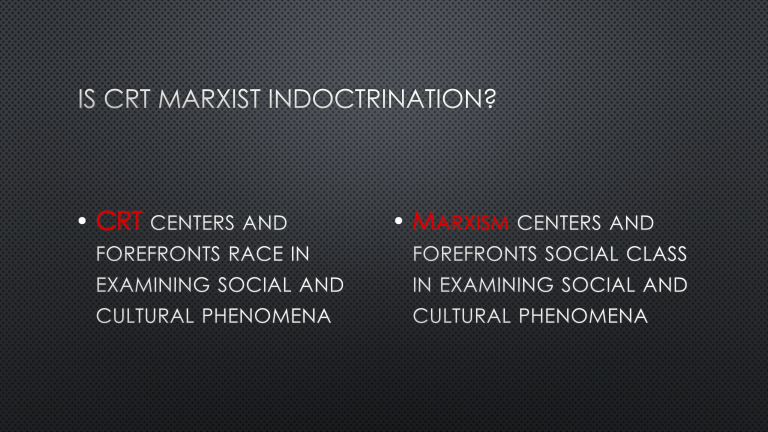
But I also focused on the claim that CRT is Marxist indoctrination:

While some overlap does exist among CRT scholars and Marxist scholars, there often is considerable tension between the focus on centering race and centering social class.

While this slide sparked some important dialogue among the audience, I had begun the presentation (not planned) by noting that the session began with a short video that included a dramatic reading that included the phrase “black-on-black crime.”

I noted that while crime in the U.S. is overwhelmingly within race—the white-on-white crime rate is about the exact same as the black-on-black rate—media, public, and political discourse only utters “black-on-black crime.”

This is indoctrination by omission, and this phenomenon in education raises an important question:

Similar to what I have raised before—Who’s indoctrinating whom?—”Are we worried about ideology or just one ideology?” is an important question to confront, and we are left with only one real answer.

Conservatives are seeking ways to indoctrinate students within the parameters of their ideology; therefore, the attacks on CRT and the 1619 Project are not calls for academic freedom, the marketplace of ideas, or even “both sides.”

Republicans and conservatives are seeking indoctrination by omission.

As I responded to the Tweet above, I noted that since I teach many students with private religious K-12 schooling, I regularly am asked to “go over” evolution because these very bright and high-achieving students were never taught evolution in biology while attending private religious schools.

Whether its our schooling or our political, media, or public discourse, what is not spoken is just as powerful as what is spoken.

Poet Adrienne Rich writes in her “Arts of the Possible,” the eponymous essay of her 2001 collection of essays:

The matrix of a poet’s work consists not only of what is there to be absorbed and worked on, but also of what is missing, desaparecido, rendered unspeakable, thus unthinkable. It is through these invisible holes in reality that poetry makes it way—certainly for women and other marginalized subjects and for disempowered and colonized peoples generally, but ultimately for all who practice art at any deep levels. The impulse to create begins—often terribly and fearfully—in a tunnel of silence.

On Lies, Secrets, and Silence: Selected Prose 1966-1978

In the Bizarro world of conservative thought, simply exposing students to ideas that do not conform to a narrow conservative ideology is a type of indoctrination.

Republicans are trying to control K-12 and higher education in ways that honor mythologizing/idealizing the past and speaking of U.S. history and day-to-day realities of the U.S. through aspirational language—from “Founding Fathers” to “the U.S. is not a racist country.”

Ultimately, what offends Republicans/conservatives about academic freedom and critical approaches to history, literature, etc., is that being critical is inherently a challenge to power and a rejecting of indoctrination.

There is no such thing as objective history, no such thing as de-politicized “facts.”

Contemporary historians are well aware that history tends to be written by the winners, by those with power and authority, and that these versions of history are in the interests of those with that power and authority.

Current attacks on CRT have included direct attacks on the work of Howard Zinn, who popularized seeing history from the perspectives of the losers and marginalized.

Returning to the Tweet above, conservatives are not angry that Zinn’s history is ideological, but that Zinn’s history challenges their singular ideology of mythologizing, idealizing, and aspiring to the detriment of marginalized populations in the U.S.

If we in the U.S. genuinely value individual freedom, each child and young adult deserves education grounded in academic freedom, and academic freedom requires that we attend to not only what is taught but also what is omitted.

K-12 and higher education are not indoctrinating children and teens, certainly not into Marxist ideology, but Republicans/conservatives are endorsing indoctrination by omission—something that if we want to be aspirational is not very American.


Recommended

Conceptualizing color-evasiveness: using dis/ability critical race theory to expand a color-blind racial ideology in education and society

Republicans Embrace “Three Kinds of Lies: Lies, Damned Lies, and Statistics”

Misattributed quotes can still be valid, and such is the case with the often repeated, “There are three kinds of lies: lies, damned lies, and statistics,” typically associated with Mark Twain (possibly the first person to attribute the saying to the wrong person).

Statistics are a powerful kind of lie because data allow people to state factually true statistics that still mislead or distort the topic being addressed.

Republicans and conservatives have used the statistical lie often as a dog whistle for their racist base. Two of those issues are fatal police shootings and black-on-black crime.

Let’s look at how these statistical lies work.

Republicans and conservatives are apt to note the raw numbers on fatal police shootings broken down by race:

Yes, police shoot and kill more white people per year than Black people, but a statistical fact of this data is that there are about 5 times as many white people in the U.S. as there are Black people; therefore, for this data set to be equitable, about 5 times more white people would be killed than Black people (note that the difference is only about twice as many).

Thus, a better statistic is the rate of fatal police killings by race:

Therefore, fatal police shootings are racially imbalanced (Black people shot and killed at about 2.5 times higher rate than white people), if not racist.

In the case of fatal police shootings, then, the raw data are both accurate and misleading when trying to understand racial inequity.

A much more insidious use of statistics is the overuse of black-on-black crime in media, public, and political discourse.

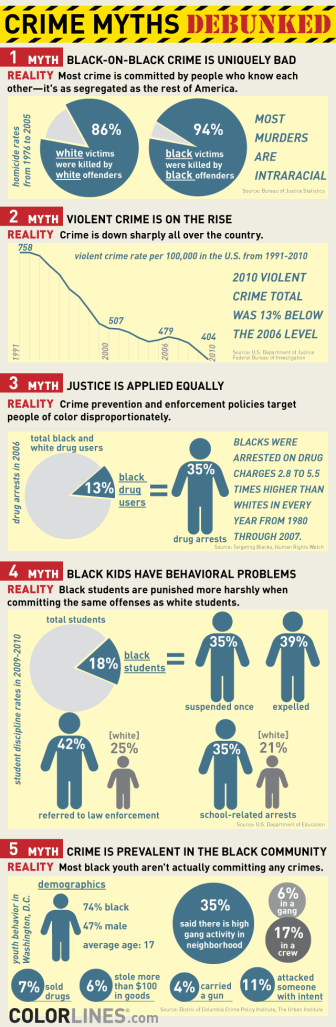
Black-on-black crime rates are extremely high, often at a 90%+ rate.

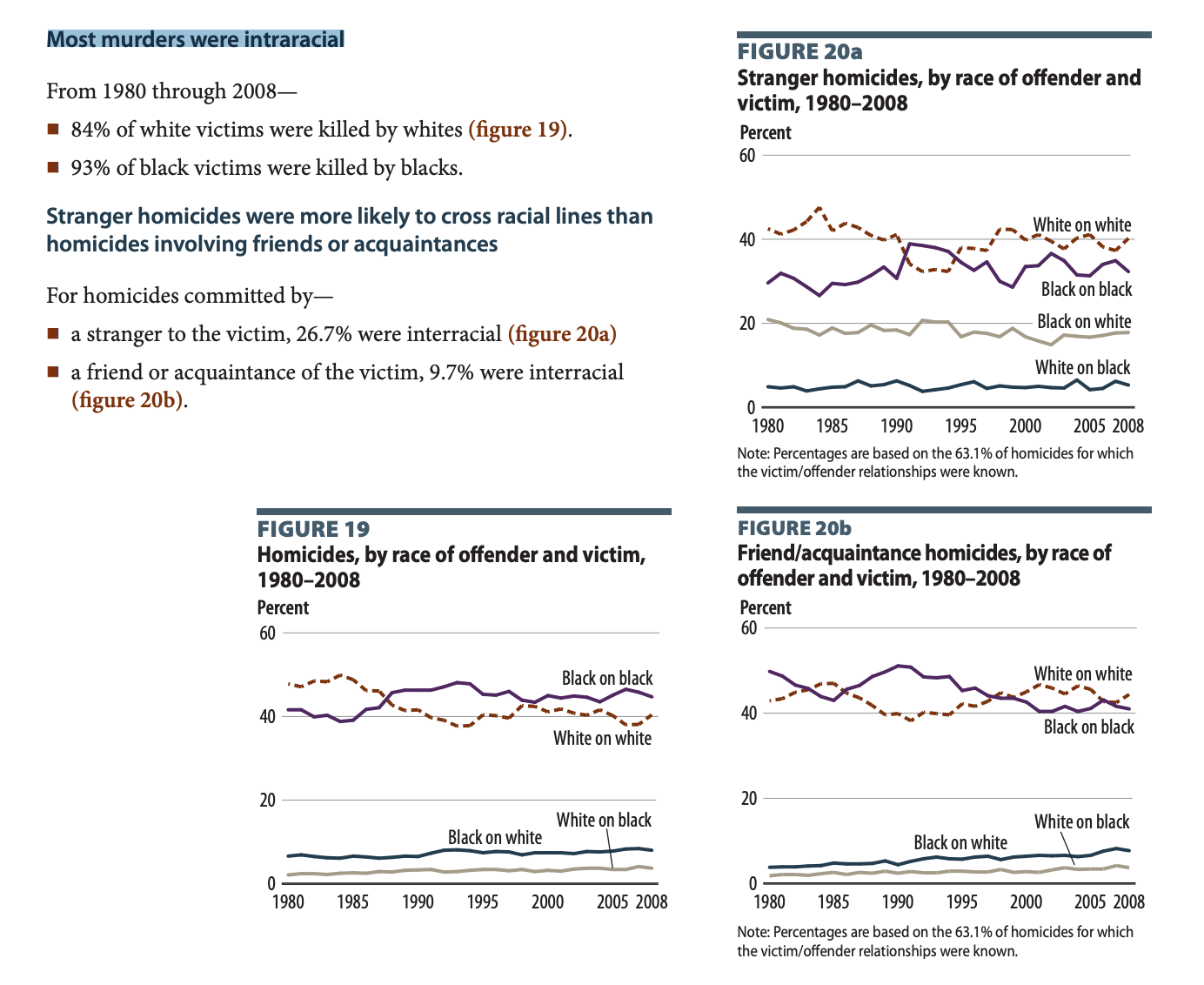
But there is almost no media, public, or political rhetoric around the white-on-white crime rate, which is about statistically the same (high 80% rate). [1]

Crime rates are almost entirely within races in the U.S. (see p. 13 from the U.S. Department of Justice [2]) because the country is still strongly racially and economically stratified.

While highlighting the very high black-on-black crime rate is factually correct, omitting that most crime is intraracial makes that emphasis misleading, and another dog whistle for racists.

But Republicans aren’t stopping there; consider the Lt. Governor of Texas who has now blamed Black Texans for being unvaccinated and causing the newest Covid spike:

However, as you may suspect, there are problems with this claim:

Once again, Republicans are using the statistical lie as a dog whistle for racist constituents.

Many racial groups are under-vaccinated, and there certainly is a significant issue with vaccine hesitancy and resistance among Black Americans, but the sheer numbers in Texas make Patrick’s careless and racist claim more than preposterous.

Further, raw data on low vaccination rates among races also ignore causes for those rates. Black Americans are disproportionately poor and live in areas were vaccine access has been weak or even suppressed.

There is ample evidence that political leaders have always cherry-picked statistics and data to promote agendas, but there is also ample evidence that Republicans target statistics as part of their larger strategy to court their racist base.

Patrick’s most recent egregious use of the statistical lie is further proof that Trump did not create the Republican Party as a party of lies, but he certainly helped the strategy gain momentum.


[1] See data here:

crime_myths

[2] See:

Stranger Things: The Eternal Whiteness of the Pop Culture Mind

South Park has Token, and Stranger Things has Lucas Sinclair.

Having come (very) late to Stranger Things, this was one of my first thoughts when Lucas sets off on his own to find the gate (S1E6).

Since Stranger Things is a pop culture referential series, my experience includes immediately thinking of WandaVision (also referential and driven by pastiche) and how Stranger Things includes more than a passing debt to superhero narratives, along with gaming culture as well as the broader 1980s TV and movie references.

I am a child of the 1960s and 1970s, but the love affair Stranger Things has for the 1980s speaks to vivid elements of my young adulthood spent navigating marriage, fostering a career, and fathering my only child in 1989.

The power of this series and the enduring elements of pop culture in the U.S. have been confirmed for me as I continue to make asynchronous connections (Stranger Things as the child of The X-Files and Mayor of Easttown).

Even though I haven’t watched the show until mid-2021 (I just began Season 2), I do have a good deal of fringe knowledge about the series and essential spoiler knowledge that likely dulls some of the tension created in the show when watched in real time.

I know, for example, certain characters persist even when they are put in serious danger in the first season. In S1E6 mentioned above, whether the show’s creators intended this or not, having a lone Black character placed in danger triggers one of the worst aspects of pop culture, linked to Star Trek (redshirt characters) and the use of “throw-away” characters that are too often Black and other racial minorities.

Lucas isn’t sacrificed, however (Barbara isn’t so lucky).

And like Mare of Easttown, Stranger Things represents a much larger problem in the U.S.—the eternal whiteness of the pop culture mind.

Also like Mare of Easttown, Stranger Things has a white people gaze that is strongly linked to white people dysfunction and the ever-creeping danger surrounding children (mostly white).

Eleven is remarkably frail (the camera work shifting from her intense face to her full-bodied spindly self is excellent), and fantastically powerful (at great expense to herself).

Stranger Things but true: the US Department of Energy does human  experiments, searches for The Upside Down

But the white problem in Stranger Things (Indiana) also sits beside the superhero genre obsession with white Middle America (see also the whiteness of South Park in Colorado and Mare in Pennsylvania).

Superhero narratives in the world of comic books are grounded in (and recursively obsessed with) origin stories, and the origin story of the superhero narrative serves an important purpose as I navigate Stranger Things.

Michael Chabon beautifully fictionalizes who and how superhero comics came to be in his The Amazing Adventures of Kavalier & Clay.

I was a comic book collector throughout my teen years, the 1970s, and although the rise of the MCU is relatively recent, I have always felt comic book narratives have been incredibly important contributors to and reflective of pop culture in the U.S.

Those original creators, as Chabon dramatizes, were often Jewish and/or immigrants (Joseph Shuster and Jerry Siegel [Superman], Jack Kirby and Stan Lee [Marvel], Joe Simon [with Kirby, Captain America], and Bob Kane [Batman], for example).

These origins are steeped in a singular American Dream by men of aspirational backgrounds, and they seem to have chosen white Middle America as their only template; just think of Superman, an alien expelled from his home planet and landing in the Great Farm Land (Smallville) to be raised by an earnest working class white couple.

Kurt Vonnegut—a pop culture icon referenced in Stranger Things—writes on the first page of Mother Night:

This is the only story of mine whose moral I know. I don’t think it’s a marvelous moral; I simply happen to know what it is: We are what we pretend to be, so we must be careful about what we pretend to be. (p. v)

Mother Night, Kurt Vonnegut

I think Vonnegut has a point not only for anyone (especially children and teens) existing in the so-called “real world,” but especially for those imagined worlds, the ones that seem struck in time and place—and race.

The many powerful themes of Stranger Things driven by the stellar acting must not be reduced to the simplistic “universal” praise—although childhood and the dangers of being a child or teen are shared among viewers regardless of race, etc.

Nancy Wheeler, for example, is yet another spindly white girl/young woman (like Eleven) who directly personifies Vonnegut’s warning; Jonathan Byers confronts her about pretending to be someone she isn’t in Season 1.

Her experiences are valid, and even compelling—although they pale beside Eleven’s.

Ultimately, I am left uncomfortable that Stranger Things has fallen into the well-worn rut (from Superman to Mare of Easttown) because too many people continue to believe the viewing public has empathy primarily for the frailty of whiteness.

“Racial Discomfort” in an Era of Erasing Curriculum

My neighboring state of North Carolina has filed copy-cat legislation being proposed across the U.S. by Republicans as part of the manufactured Critical Race Theory (CRT) crisis.

As Justin Parmenter explains, “Among other things, the bill would make it illegal for teachers to promote feelings of racial discomfort and would require schools to prominently post information about diversity training on their websites for public review.”

Republicans and conservatives have launched a campaign grounded primarily in several false claims, including a drastic misrepresentation of what CRT is (a graduate-level theoretical lens primarily found in law schools) and that CRT exists in any significant way in K-12 public education (it doesn’t).

Since the public and political rhetoric is both misleading and false, and since the legislation is written in coded ways, those of us who recognize that this movement is an insidious lie (political leaders claiming to be protecting academic freedom by banning CRT from academic spaces) must now call Republicans on their bluff, specifically addressing the concept of “racial discomfort.”

As an educator for almost 40 years, I find no real evidence that white third graders across the U.S. are being told in schools that they are personally culpable for racism and slavery simply because they are white.

And as a scholar who understands and embraces CRT, I also know if CRT were being practiced with children across the U.S. in public school, that theoretical lens focuses on systemic racism, not individual racism. In other words, white students in U.S. public education would be well served by CRT that emphasizes the role of systemic racism regardless of individual beliefs.

CRT is one way to raise everyone’s awareness of racism and inequity so that we can all behave in ways that lead the country toward equity and meritocracy.

The only blame anyone should suffer (in the context of CRT) is a refusal to recognize systemic racism and then a refusal to behave in ways that are equitable.

Republican legislation is prescribing, then, that students remain ignorant, and ironically, passively complicit in systemic racism.

But the primary unwritten/unspoken given in the claimed concern about “racial discomfort” is that the term addresses only white racial discomfort—as if being white is somehow a greater burden, for example, than being Black and actually experiencing racism.

Is hearing or reading “n—–” not a form of racial discomfort?

Is being told you are “articulate” while Black not a form of racial discomfort?

Is being asked “Can I touch your hair?” while Black not a form of racial discomfort?

Is being paid less even though you the same educational attainment while Black not a form or racial discomfort?

Since this movement is ambiguous on the surface, we must call their bluff by acknowledging “racial discomfort” among all races.

Black students, for examples, must not be asked to read The Adventures of Huckleberry Finn, To Kill a Mockingbird, Of Mice and Men, or The Great Gatsby.

Imagine being a Black teenager in a room filled with white peers and a white teacher, reading from Gatsby [1]:

“Civilization’s going to pieces,” broke out Tom violently. “I’ve gotten to be a terrible pessimist about things. Have you read The Rise of the Colored Empires by this man Goddard? … Well, it’s a fine book, and everybody ought to read it. The idea is if we don’t look out the white race will be – will be utterly submerged. It’s all scientific stuff; it’s been proved … This fellow has worked out the whole thing. It’s up to us, who are the dominant race, to watch out or those other races will have control of things … The idea is that we’re Nordics. I am, and you are, and … And we’ve produced all the things that go to make civilization – oh, science and art, and all that. Do you see?”

The Great Gatsby, F. Scott Fitzgerald

Or the repeated use of “n—–” in Huck Finn, Mockingbird, and Of Mice and Men.

And let’s not stop there.

Shakespeare is filled with sexism, bigotry, and racism It must go. No more Shakespeare because children and teens might feel discomfort.

And honestly, who didn’t feel discomfort when confronted with the Pythagorean Theorem.

It must go also.

In the context of the legislation being proposed and passed, we must demand that all texts and topics causing anyone (regardless of race) “racial discomfort” be removed from the curriculum.

The logical extension of this nonsense is the total erasure of curriculum; there simply is nothing left to teach if we mobilize and demand that legislation be applied evenly for everyone.

It shouldn’t be on the shoulders of minoritized peoples to call this bluff, but a widespread effort to take this legislation to its logical conclusions would cause the movement to collapse under its own dishonesty.

Republicans and conservatives do not care about everyone’s discomfort, let’s note. How trans students feel has been repeatedly disregarded, for example.

Legislation aimed at CRT is a Great White Lie, but if we call them on their bluff, that lie will be exposed when we find ourselves with a total erasure of the curriculum.


[1] See When W. E. B. Du Bois Made a Laughingstock of a White Supremacist

The Politics of Childhood in an Era of Authoritarian Education

While on vacation, a friend and I were discussing the paradox of parenting.

A parent often feels a tension between fostering and supporting a child to be the person they want to be as that contrasts with dictating what is best for the child (knowing as adults do that children, teens, and young adults often make decisions necessarily without the context of experience that would certainly change many decisions).

That paradox, that tension has existed for me as a teacher/professor, parent, grandparent, and coach.

I am constantly checking myself in roles of authority to determine if I am imposing my authority onto children and young people (authoritarian) or if I am mentoring and fostering those humans in the cone of my authority in ways that support their own autonomy and development along lines they actively choose for themselves (authoritative).

This is a dichotomy examined by Paulo Freire [1], and a central concern for any critical educator.

The current misguided attacks on anything “critical” is particularly frustrating for critical educators since these attacks are designed to fulfill the demands of authoritarian systems, partisan politics and formal education.

It has occurred to me recently that I have been in roles of authority for a very long time, beginning with working as a lifeguard in my mid- to late teens. My role of authority literally began, then, with the expectations that I would guard human life—any human life that came into the sphere of the pool where I was charged with monitoring swimming and the safety of not only individual swimmers but all of the people in the pool.

I was a very good and capable swimmer, and for a teen, I was reasonably responsible (although I cringe thinking about being a head lifeguard when only 17 or so). But having the level of authority and responsibility that being a lifeguard entails was quite likely asking far more of me that I deserved.

Those days of lifeguarding set me on course for being the responsible person for the next 40-plus years, exacting a significant toll on me psychologically and emotionally.

Maintaining a critical authoritative pose when in positions of authority is extremely hard, much harder than being authoritarian.

Way back in the 1980s and 1990s, I was practicing in many ways the sort of critical teaching that is coming under attack in 2021, even resulting in a teacher in Tennessee being fired:

At issue was Hawn assigning the essay “The First White President” by Ta-Nehisi Coates to students in his Contemporary Issues class in February, and later in March, playing a video of “White Privilege,” a spoken word poem by Kyla Jenée Lacey to the same students.

A Tennessee teacher taught a Ta-Nehisi Coates essay and a poem about white privilege. He was fired for it

Many conservatives see the work of Coates, for example, as radical, while those of us on the left would argue Coates’s work is quite mainstream and accessible—but far from radical. This is the same dynamic around Barack Obama, for example; Obama is a moderate and an incrementalist, but certainly not a radical leftist or Marxist (as conservatives like to suggest).

While I taught high school English in the very conservative rural South, I was mostly allowed to teach texts with only occasional complaints from parents. What looks quite odd now is that I included Howard Zinn in my classes for many years without a peep from anyone (Zinn is a key target of the ant-CRT movement now).

But I also included Joseph Campbell’s comparative mythology in my classes in order to help students navigate metaphorical approaches to narratives (a key skill needed in the Advanced Placement course I taught and as preparation for college).

Including Campbell did cause problems since his work complicated the literalism many of students experienced in their religious lives. Fundamentalist Christianity was the background of nearly all my students, and Campbell’s casual claims that all religions and mythologies told similar archetypal stories stepped on the toes of arguments that accepting Jesus was the only way into heaven.

I aroused similar complaints by including Gandhi in my Emerson/Thoreau/MLK unit.

The parental challenges to Campbell and Gandhi were grounded in a type of insecurity that had never been examined critically by those parents, all of which was the result of having been raised in authoritarian environments.

I did have my students interrogate that Sunday school and preaching were not places where they were encouraged to ask questions or challenge any of the “lessons” they received.

So in 2021, I cannot stress too much that the Republican attack on critical race theory and how history is taught is simply a battle for the integrity of the mind of children, teens, and young adults.

Learning and knowledge—especially if we genuinely believe in human autonomy and democracy—are not simply about accumulating facts determined to be true or important by some authority, but are about learning how to know what we believe is true and why.

Human freedom is most threatened by unexamined beliefs, not by the act of questioning itself.

Authority doesn’t just resist questioning, but entirely rejects it as an act.

Republicans and the conservatives drawn to authoritarianism do not trust human agency, do not believe in the free exchange of ideas, and do not believe in the essential power of questioning, especially when the questions are aimed at their authority.

Nothing is as simple as “both sides,” and certainly we should never fall into traps of “only know this.”

There can never be free people, however, without free minds cultivated in the guarantee of academic freedom.

And the free exchange of ideas will never be spaces without discomfort, which now seems to be a smokescreen used by Republicans in their pursuit of securing authority.

Suddenly, Republicans are concerned about uncomfortable white students, but seem oblivious to the discomfort, for example, of thousands and thousands of Black students experience reading The Adventures of Huckleberry Finn or To Kill a Mockingbird.

Teachers must now tip-toe around the uncomfortable texts and conversations about race and racism because of the possibility of white discomfort (note that Black discomfort about Huck Finn has been repeatedly swept aside under the guise of “classic literature”)—a stance once again disregarding the daily discomfort of Black children experiencing racism.

Intellectual discomfort (what texts and discussions prompt in formal schooling) is often necessary for learning, but existential discomfort (what targets of racism and sexism experience) are not necessary and are essentially harmful.

Authoritarian education is willing to sacrifice the existential comfort of marginalized children in order to shield some children from intellectual discomfort.

Even more disturbing, however, is that what is really being protected is the frailty of those students’ parents and those people in authority who are not willing to risk being challenged or questioned in any way.


[1] Paulo Freire and Peace Education, Lesley Bartlett:

Freire’s early call for a “horizontal” relationship generated a staggering amount of debate over the teacher’s role in a democratic classroom. In his later writings, Freire refined his notion of directivity and the teacher-student relationship. In Pedagogy of Hope, he explained: “Dialogue between teachers and students does not place them on the same footing professionally; but it does mark the democratic position between them” (Freire, 1994, p. 116-117). In his “talking” books of the 1980s and 90s, Freire distinguished between authoritative and authoritarian teachers:

“I have never said that the educator is the same as the pupil. Quite the contrary, I have always said that whoever says that they are equal is being demagogic and false. The educator is different from the pupil. But this difference, from the point of view of the revolution, must not be antagonistic. The difference becomes antagonistic when the authority of the educator, different from the freedom of the pupil, is transformed into authoritarianism. This is the demand I make of the revolutionary educator. For me, it is absolutely contradictory when the educator, in the name of the revolution, takes power over the method and orders the pupil, in an authoritarian way, using this difference that exists. This is my position, and therefore it makes me surprised when it is said that I defend a nondirective position. How could I defend the fact that the nature of the educational process is always directive whether the education is given by the bourgeoisie or the working class” (Freire 1985, p. 76).

Dear Parents, Your Children’s K-12 Education Is Already Very Conservative

I entered public education in the fall of 1984, a naive and idealistic first-year English teacher vividly aware of the literary significance of that year.

Of course, I was not yet aware that I was completely wrong about the essential purposes of public education because I had been gifted parents who trusted not only my intellect but the foundational good of knowledge and academic freedom.

My parents were wrong about quite a lot, it turns out, but they were magnificent in the freedom they allowed my mind and the support they gave to my often wonderful teachers.

The first few years of my teaching career included a series of visits to the principal’s office to discuss complaints from parents. It was something akin to the hazing period people experience when joining fraternities.

One of the earliest clashes I had with parents—and I should note that my students were often deeply appreciative of my classes, supportive of the work I was doing—centered on complaints about my assigning John Gardner’s Grendel to my advanced tenth graders (students on track to take Advanced Placement their senior year).

Grendel is a retelling of the Beowulf epic poem in novel form, and it does include a few graphic scenes and some so-called adult language. But these were 15 and 16 year olds planning to go to college, and unbeknownst to their parents, many of these students were sexually active and used language that was far more profane that the few “offensive” words in the novel. (Treating young adults as intellectual children when they are asserting adult behavior in their lives outside of school is inexcusable, I think.)

Yet, a few (maybe only two) parents launched a campaign to teach this new teacher a lesson about what parents expected from their children’s teachers.

Of course, the short version of this is that the novel was removed from my required list (although I left copies on my shelf and many students continued to choose the novel along with many other commonly banned works).

This pattern continued for several years: I was challenging my students intellectually, often seeking ways to prepare them for college, and parents here and there asserted disproportionate influence on whether or not I was allowed to do my work as an educator.

A key moment in those first years was me sitting once again in the principal’s office listening to Mr. Simpkins (also the man who was principal when I attended this school and father of two of my childhood friends) chastise me about crossing lines parents created; these sessions were also punctuated with not-so-subtle threat that my teaching career could be ended at any moment (South Carolina is a right-to-work state, by the way).

One time, exasperated, I responded with, “Mr. Simpkins, I am simply trying to teach these students to think.”

With a half-smile and without hesitation, Mr. Simpkins replied, “Paul, some parents don’t want their children to think.”

It is important to emphasize here that his comment carried the implication “and thus, we have no right to make those students think.”

Fast forward almost 40 years, over which I have been in education in SC the entire time, and consider that those experiences I encountered in the mid-1980s are now how the entire nation is dealing with K-12 education in the U.S.

Republicans are creating a false narrative about public schools indoctrinating students in leftwing ideologies (often mislabeled as Critical Race Theory or Marxism) and whipping up parental anger at their local schools.

And the paradox, of course, is that Republicans are passing and signing legislation that is designed to indoctrinate:

Florida Gov. Ron DeSantis announced new state programs for students Tuesday that will require civics and patriotism education as well as CPR training.

“Once students graduate high school, some will go to college, some of them will do other things…whatever you do, this civics is gonna be relevant because you are going to be a citizen,” DeSantis said at an afternoon news briefing in Fort Myers.

It will also require high school students to learn about “the evils of communism and totalitarian ideologies.”

Florida will require schools to teach civics and ‘evils of communism’

Currently, about 25 states are doing something similar to Florida—mandating what and how schools teach about race, racism, and history.

Two points need to be made about these efforts.

First, K-12 public education in the U.S. has always been and remains very conservative.

Let me emphasize that my experience noted above is common for new teachers, who quickly learn to self-censor and avoid parental complaints and administrative reprimands.

As I have written about before, I taught with a wonderful young teacher, himself a well-known and well-loved active Christian in the church just across the street from the high school, who taught geography. He found himself “in trouble” because he taught Middle East geography, including how the countries were aligned with different religions.

One parent was outraged, and asked that his son be moved to another teacher because the parent didn’t want his son to know there were religions other than Christianity.

What did the principal do? Moved the student to a geography class taught by a coach (a very conservative man who taught in ways that would likely thrill Republicans).

This leads to a second point: Conservatives are deeply confused about indoctrination and education.

And a great example of that misconception comes from an unlikely place, a brilliant response from chairman of the Joint Chiefs of Staff, Gen. Mark Milley, about charges by Republicans that the military is “woke” (another misuse of a term designed by conservatives to be a criticism):

“I’ve read Mao Zedong. I’ve read Karl Marx. I’ve read Lenin. That doesn’t make me a communist. So what is wrong with understanding — having some situational understanding about the country for which we are here to defend?” Milley said.

He continued brusquely: “And I personally find it offensive that we are accusing the United States military, our general officers, our commissioned, noncommissioned officers of being, quote, ‘woke’ or something else, because we’re studying some theories that are out there.”…

“I want to understand white rage, and I’m white, and I want to understand it,” he said. “So what is it that caused thousands of people to assault this building and try to overturn the Constitution of the United States of America? What caused that? I want to find that out.”

Top General Defends Studying Critical Race Theory In The Military

Gen. Milley understands—like my parents—that knowledge, reading, and awareness are powerful, but that simply being exposed to an idea doesn’t mean anyone is immediately indoctrinated by those ideas.

Most of us have studied the Holocaust, and we know the ideology of Hitler and the Nazis. Yet, most people decide to reject those ideas and beliefs.

I also want to emphasize that Gen. Milley is defending academic freedom, the essential nature of an academic institution and the sacredness of the human mind.

These are concepts entirely lost on Republicans who seek ways to use schools to decide for students what they learn and what they believe.

I want to end by returning to the central point everyone should understand, especially parents: U.S. K-12 public education is extremely conservative.

A vivid example of that is the enduring ways that children are taught about Hellen Keller, through the play The Miracle Worker.

Keller has been and remains a tool of educational indoctrination aimed at inculcating into children a belief in rugged individualism; if a person such as Keller can overcome her many sensory challenges, the message goes, then anyone can pull themselves up by the bootstraps.

But just like the mis-teaching of Martin Luther King Jr. in public schools (the overemphasis on his “I Have a Dream” speech and the de-contextualizing of his “content of their character” assertion), Keller of The Miracle Worker is not the full and complicated (or even accurate) story of this woman.

Keller was a socialist and political activist—something I am certain most students never hear in a K-12 classroom.

The Miracle Worker is the sort of “safe” text that most teachers default to, like King’s “I Have a Dream,” in order to avoid the relentless interference of parents and administrators.

K-12 public education is mostly conservative because teachers learn to self-censor, to tip-toe around anything that the most extreme parents may complain about.

Critical Race Theory and liberal indoctrination simply do not exist in K-12 public schools in the U.S.

But there is a problem parents should be concerned about; your children are often being cheated out of knowledge and awareness because academic freedom died a long time ago when the first administrator defaulted to parental complaints at the expense of any student’s right to read and think widely and openly.

Understanding Critical Race Theory: A Reader for Educators

[Note: Access a PP of this material and more HERE]

Update 22 February 2022: What is critical race theory?

UPDATE: Understanding the Attacks on Critical Race Theory (NEPC)

While Republicans continue to claim the U.S. “is not a racist country” and passing legislation directly and indirectly banning critical race theory (CRT) and the 1619 project, the recent comments by former VP Mike Pence capture the real message behind these events:

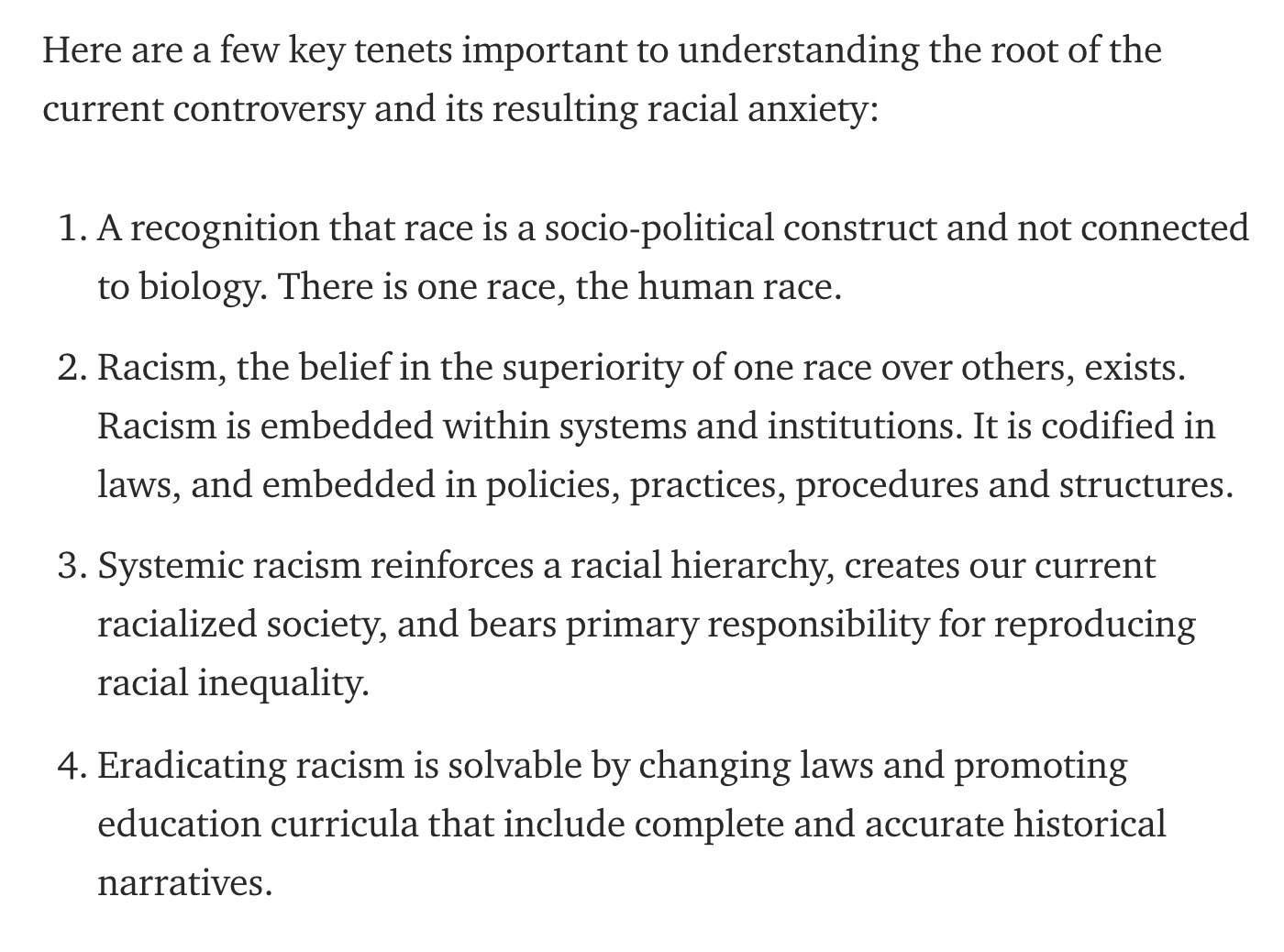
For Republicans and conservatives who reject systemic racism as a “left-wing myth,” there remains a significant challenge: How can we explain the tremendous racial gaps (see below) that exist in the U.S. between Black and white Americans?

These attacks are directly effecting K-12 and higher education; therefore, educators must be well informed about these issues. Here are valuable resources for understanding CRT, the 1619 Project, and systemic racism:

Critical Race Theory

Why Critical Race Theory (CRT) is Controversial

A Lesson on Critical Race Theory

Perspective | Trump calls critical race theory ‘un-American.’ Let’s review.

Critical Race Theory

74 Interview: Researcher Gloria Ladson-Billings on Culturally Relevant Teaching, the Role of Teachers in Trump’s America & Lessons From Her Two Decades in Education Research

But That’s Just Good Teaching! The Case for Culturally Relevant Pedagogy, Gloria Ladson-Billings

Academic Who Brought Critical Race Theory To Education Says Bills Are Misguided

Code of Conduct: A Guide to Responsive Discipline

OPINION: Using critical race theory to understand the backlash against it

The Conspicuous Absence of Derrick Bell—Rethinking the CRT Debate, Part 1

What’s Really Behind the 1619 Backlash? An Interview With Nikole Hannah-Jones and Ta-Nehisi Coates

Watch “Critical Race Theory & Culturally Responsive Teaching: An Open Conversation About What the Right Gets Wrong” on #Vimeo

What Critical Race Theory Is, and What It Means for Teachers

Critical Race Theory: A Brief History

Critical Race Theory: What It Is. And What It Is Not. A Q&A with Adrienne Dixson (NEPC)

Busting Anti-Racist Education Myths, Rick Wormeli

The 1619 Project

1619 Project

What History Professors Really Think About ‘The 1619 Project’

Systemic Racism

7 Ways We Know Systemic Racism Is Real

Rate of fatal police shootings in the United States from 2015 to May 2021, by ethnicity

Risk of being killed by police use of force in the United States by age, race–ethnicity, and sex

The Essence of Innocence: Consequences of Dehumanizing Black Children

The social category “children” defines a group of individuals who are perceived to be distinct, with essential characteristics including innocence and the need for protection (Haslam, Rothschild, & Ernst, 2000). The present research examined whether Black boys are given the protections of childhood equally to their peers. We tested 3 hypotheses: (a) that Black boys are seen as less “childlike” than their White peers, (b) that the characteristics associated with childhood will be applied less when thinking specifically about Black boys relative to White boys, and (c) that these trends would be exacerbated in contexts where Black males are dehumanized by associating them (implicitly) with apes (Goff, Eberhardt, Williams, & Jackson, 2008). We expected, derivative of these 3 principal hypotheses, that individuals would perceive Black boys as being more responsible for their actions and as being more appropriate targets for police violence. We find support for these hypotheses across 4 studies using laboratory, field, and translational (mixed laboratory/field) methods. We find converging evidence that Black boys are seen as older and less innocent and that they prompt a less essential conception of childhood than do their White same-age peers. Further, our findings demonstrate that the Black/ape association predicted actual racial disparities in police violence toward children. These data represent the first attitude/behavior matching of its kind in a policing context. Taken together, this research suggests that dehumanization is a uniquely dangerous intergroup attitude, that intergroup perception of children is underexplored, and that both topics should be research priorities.

Journal of Personality and Social Psychology, 2014, Vol. 106, No. 4, 526 –545

Characteristics of Public School Teachers

Figure 2. Percentage distribution of teachers in public elementary and secondary schools, by race/ethnicity: School years 1999–2000 and 2017–18

The Civil Rights Project: School Discipline

Stop the School-to-Prison Pipeline

When the Best isn’t Good Enough: The Racial Representation Gap in Education

Discretion and Disproportionality: Explaining the Underrepresentation of High-Achieving Students of Color in Gifted Programs

Students of color are underrepresented in gifted programs relative to White students, but the reasons for this underrepresentation are poorly understood. We investigate the predictors of gifted assignment using nationally representative, longitudinal data on elementary students. We document that even among students with high standardized test scores, Black students are less likely to be assigned to gifted services in both math and reading, a pattern that persists when controlling for other background factors, such as health and socioeconomic status, and characteristics of classrooms and schools. We then investigate the role of teacher discretion, leveraging research from political science suggesting that clients of government services from traditionally underrepresented groups benefit from diversity in the providers of those services, including teachers. Even after conditioning on test scores and other factors, Black students indeed are referred to gifted programs, particularly in reading, at significantly lower rates when taught by non-Black teachers, a concerning result given the relatively low incidence of assignment to own-race teachers among Black students.

https://doi.org/10.1177/2332858415622175

What We Get Wrong About Closing the Racial Wealth Gap

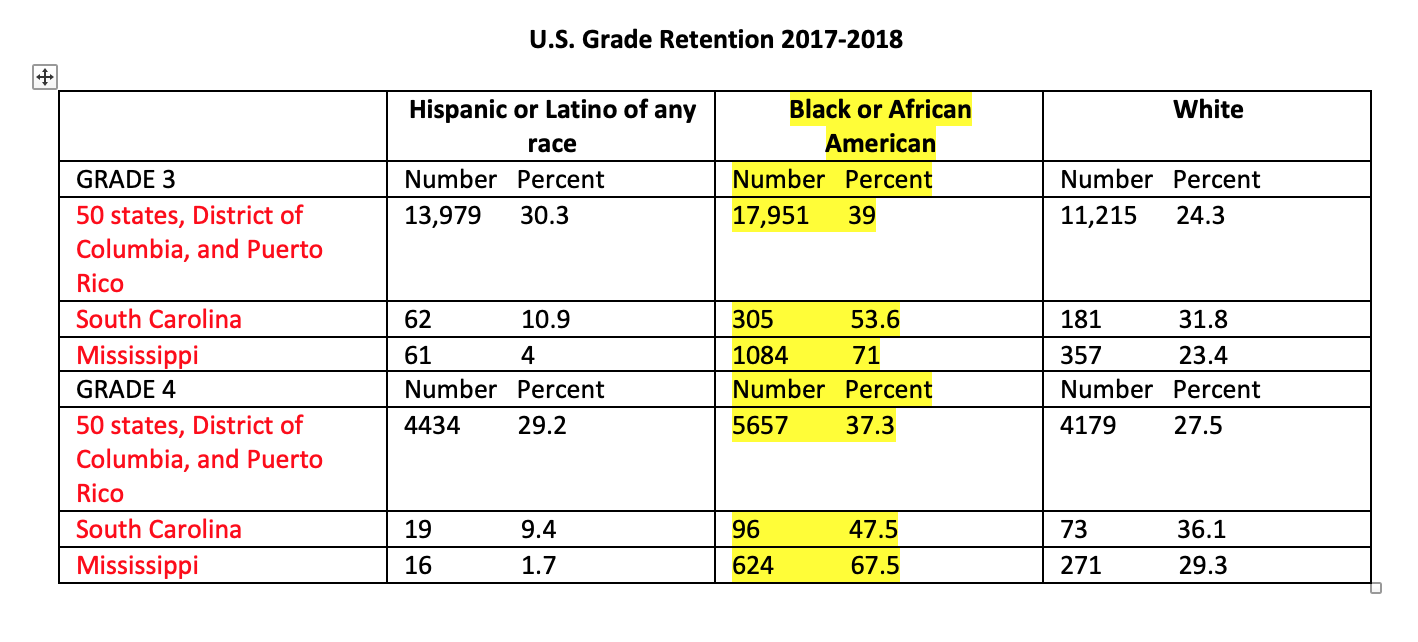
Grade Retention and Expulsions/Suspensions: Black students disproportionately retained (grades 3 and 4) and expelled (USDOE/Office of Civil Rights) – Data 2017-2018

Schools, black children, and corporal punishment

Racial disparities in school-based disciplinary actions are associated with county-level rates of racial bias

There are substantial gaps in educational outcomes between black and white students in the United States. Recently, increased attention has focused on differences in the rates at which black and white students are disciplined, finding that black students are more likely to be seen as problematic and more likely to be punished than white students are for the same offense. Although these disparities suggest that racial biases are a contributor, no previous research has shown associations with psychological measurements of bias and disciplinary outcomes. We show that county-level estimates of racial bias, as measured using data from approximately 1.6 million visitors to the Project Implicit website, are associated with racial disciplinary disparities across approximately 96,000 schools in the United States, covering around 32 million white and black students. These associations do not extend to sexuality biases, showing the specificity of the effect. These findings suggest that acknowledging that racial biases and racial disparities in education go hand-in-hand may be an important step in resolving both of these social ills.

https://doi.org/10.1073/pnas.1808307116

Re-Imagining School Discipline: A Plea To Education Leaders

How Non-Zero Tolerance Policies Better Support Our Students: Part II

Should South Carolina Ban Critical Race Theory and the 1619 Project?

[UPDATE: See published version here: MY TURN: Should South Carolina cancel Critical Race Theory?]

“In total, lawmakers in at least 15 states have introduced bills that seek to restrict how teachers can discuss racism, sexism, and other social issues,” reports Sarah Schwartz for Education Week.

South Carolina (H630) has joined Republicans across the U.S. challenging Critical Race Theory (CRT) and the 1619 Project.

The key problem with this copycat legislation is CRT isn’t implemented in K-12 education and the 1619 Project is not adopted curriculum.

CRT is rare in higher education, reserved for some graduate programs (specifically among legal scholars), but CRT provides a way to examine systemic racism, not simply the actions of individual racists.

For example, CRT is an academic process for trying to understand why police kill Black people disproportionately to white people. According to CRT, the killing of Tamir Rice is rooted in systemic racism (viewing Black boys as older than their biological age) that does not require the officer being consciously a racist individual.

Ultimately, legislation aimed at CRT or the 1619 Project is misleading, a threat to academic freedom and the education of students in SC. As Eesha Pendharker reports in Education Week: “[E]xperts say the laws ultimately will unravel years of administrators’ fitful efforts to improve educational opportunities and academic outcomes for America’s children of color, who today make up the majority of the nation’s student body.”

What, then, is occurring in SC K-12 education in terms of race and racism?

  • Diversity, equity, and inclusion (DEI) training that covers implicit bias, systemic racism and racial privilege, and microaggressions. This training is now common for educators and students, but worth monitoring because DEI training is often not effective and can serve as superficial distractions allowing schools to avoid harder diversity work.
  • Diversifying faculty and the curriculum. Public school teachers are about 80% white, less diverse than society and the population of students in public schooling (increasingly Black and brown). Also, for many years, a greater representation of Black and brown voices and history have been included in what students are taught (typically in English/ELA and history/social studies). Diversifying the curriculum has prompted controversial legislation by Republicans, however.
  • Implementing culturally relevant teaching. The work of Gloria Ladson-Billings has gained momentum in K-12 education. Culturally relevant teaching, as she defines it, is “a threefold approach to ensuring that all children are successful. That approach requires a focus on students’ learning, an attempt to develop their cultural competence, and to increase their sociopolitical or critical consciousness.” This focus seeks to honor all children while acknowledging that differences remain among students by race, gender, culture, etc.
  • Adopting responsive discipline. Decades of research have revealed racially inequitable discipline in schools, popularly known as the school-to-prison pipeline. Many schools have begun to reconsider inequitable practices such as zero-tolerance policies and expulsion/suspension, for example.
  • Expanding educational access and improving educational quality for children of color. Black and brown students are under-represented in advanced programs (such as Advanced Placement and gifted programs), and often are taught by teachers with the least experience, who are under-/un-certified, and sit in classrooms with the highest student/teacher ratios. Public schools are not the “great equalizers” politicians claim, and often reflect and perpetuate inequity.

State legislation and the Superintendent of Education targeting CRT and the 1619 Project is political theater, a solution in search of a problem. Race and racism remain a significant part of life as well as education in SC. Republicans are poised to ruin the very good and needed, but incomplete, work identified above.

It is critical that teachers and students are free to examine the truth of our past and our present so that we can create the future we believe is possible.