Category Archives: race

Understanding the Conservative Backlash against Critical Race Theory (and Diversity, Equity, and Inclusion Initiatives)

I was recently asked on Twitter if there can be any valid criticisms of Critical Race Theory (CRT), and that question was couched in a belief that everyone challenging CRT was being broadly (and unfairly) painted as racists.

In my own posts about CRT, I have in fact noted that a foundational part of anything “critical” is the essential and perpetual challenging of assumptions; the paradox of CRT and critical pedagogy is that to be critical one must continually step back to challenge the very thing being used to interrogate the world.

Simply put, CRT scholars are as apt to reconsider CRT as anything and everything else. Those of us working under the mantle “critical” are vigilant about identifying and avoiding indoctrination—or else we are not being critical.

However, since I have repeatedly noted the CRT is essentially non-existent in K-12 public education and extremely rare in higher education (mostly at the fringes of some graduate programs such as law, education, and sociology), I pushed against the question by asking for specific examples of CRT being misused, and thus deserving criticism.

What followed confirmed part of what I expected but also something I could not have predicted: CRT is under attack in expensive private schools, specifically in New York.

The example shared with me focuses on one parent whose charges about the misuse of CRT has gone viral.

First, let me stress that I still have had no one prove that CRT is common or even present in how K-12 public school students are taught (more about this below), but this example is fraught with problems since all I can find is conservative sensationalistic media covering what parents are claiming their children have told them.

Next, these examples of backlash in very expensive private schools does prove one of my point offered in another post: people take personal and individual offense when systems are challenged.

From the New York Post, for example, consider this:

“First and foremost, neither I, nor my child, have ‘white privilege,’ nor do we need to apologize for it,” Goldman wrote last September. “Suggesting I do is insulting. Suggesting to my 9-year-old child she does is child abuse, not education.”

Inside the growing underground network of parents fighting ‘anti-racism’ in NYC schools

Using this private-school based backlash as a basis, then, let’s unpack what is going on in order to understand the conservative perspective of CRT.

The most important aspect of trying to understand this controversy is recognizing that the challenges to CRT are not about CRT specifically (since CRT is a theoretical lens and not a program—and since CRT simply doesn’t exist in K-12 schooling). Conservatives are misusing the term “CRT” as a marker for any and all diversity, equity, and inclusion (DEI) initiatives or any and all lessons addressing race and racism in schools.

However, a central tenet of CRT proposes that racism in the U.S. is systemic, built into many (if not most) laws, policies, and unconscious behaviors of everyone in the country.

Here is the great irony of the attack on CRT: Since racism is systemic (built into the system), anti-racism practices are designed to reform those systems (not to attack individual people), and as I noted in a previous post, for example about Tamir Rice, “A police officer shooting and killing a Black boy, then, does not have to be a consciously racist individual to have acted in a way that is driven by systemic racism.”

Two components of anti-racism efforts trigger conservatives—asserting the fact of systemic racism and acknowledging the reality of white privilege (see the parent’s comment above).

Again, conservatives see these assertions as blaming and condemning them personally and all white people broadly.

Setting aside that DEI programs and teaching about race/racism often are not directly driven by CRT, in order to understand the conservative backlash against CRT, we must unpack the concept of “blame” in terms of racism and white privilege.

In 2021, systemic inequity based on race (and gender) are incredibly hard to refute. White people earn more than Black people even when they have the same level of education, do the same work; this holds true for the pay gap between men and women.

Using the lens of CRT, we can conclude from those race gaps that systemic racism impacts human behaviors even when individuals are not actively or consciously racist; again, this actually alleviates automatic individual blame for a racist society.

At the core of this backlash is that conservatives view simply acknowledging systemic racism and white privilege as a direct attack on the fact of “whiteness”; to conservatives DEI initiatives and teaching about race and racism feel like a personal assault on their identity and not their behavior.

Conservatives in the U.S. are strongly individualistic so much of this tension is grounded in the conservative belief in individualism and rejecting of collectivism (systemic forces).

This explains the parent above adamantly proclaiming that he and his child do not have white privilege and his adding, “we [don’t] need to apologize for [being white].”

Further, this also explains why Republicans are successful when they proclaim the U.S. is not a racist country, despite the overwhelming evidence of racial inequity.

Finally, then, we must confront the problem of blame and culpability, which I think falls into these broad categories:

  • Individual racists. Some people in the U.S. are genuinely and openly racist, and of course, they actively perpetuate systemic racism and deserve blame, and condemnation.
  • Racism/white privilege deniers. As demonstrated in the NYP article above, some people strongly reject that systemic racism and white privilege exist; they are likely to believe that the U.S. is a meritocracy and that success/failure are rooted in individual effort and capacity. In other words, they believe rich people deserve to be rich and poor people deserve to be poor. Many of these people genuinely believe they are not racist and freely espouse that no one race is superior to the other; however, since the data overwhelming show racial inequities in terms of success and failure in the U.S., this position implies patterns of stereotypes (racism and sexism) that are hard to ignore (i.e., Black people and poor people are lazy). Racism and white privilege denial perpetuates racism, and thus, that denial (not simply being white) deserves blame.
  • People who are “color blind” MLK “race neutralists.” NRP has reported that “[n]early half of the speakers at the Republican news conference in May invoked Martin Luther King Jr., expressing their desire to be judged ‘by the content of their character, not the color of their skin.'” It is common to hear among people who reject CRT/DEI that they “do not see race.” While this is a compelling argument, especially when paired with the MLK quote oversimplified and taken out of context, race neutrality is another form of racism denial that perpetuates racism. The problem is not seeing race, but having negative (and racist) responses to acknowledging race. The irony here is that King was clearly speaking to conservative American values (“content of their character” is the language of rugged individualism and meritocracy), but its rhetorical value can be oversimplified and, as the current climate proves, manipulated for the exact opposite effect King intended. Race neutrality (not simply being white) also deserves blame.
  • People who act on their awareness of systemic racism/white privilege. The goal of teaching about race and racism as well as DEI programs is to create the very meritocracy conservatives already believe the U.S. has attained. These lessons and programs are designed to raise awareness about how to behave differently, how to contribute to bringing an end to inequity (racism and white privilege). What is required, I suspect, is empathy, a willingness to listen to other people’s experiences and value them as much as your own. Conservatives often express a contradictory rugged individualism that inhibits that empathy, especially when confronted with concepts such as micro-aggressions. “X doesn’t bother me so I don’t see why X would bother anyone else,” they exclaim. For those who are willing to listen and then willing to act (even when they are white), they have found the road to not being blamed. And another irony because this isn’t about the color of your skin, but about the content of your character and your individual behavior.

CRT is not the problem, but it has become a powerful code for conservatives who are nearly permanently inward looking, unable to hear and see the very systemic problems that CRT helps us identify in order to change.

CRT and DEI programs can, of course, be misused, and then, would deserve criticism. But that isn’t what is in front of us or the parents at elite private schools.

The problem is us even though it isn’t every single one of us.
Unpacking Nonsense: Knowledge as Commodity

Make your money with a suit and tie
Make your money with shrewd denial
Make your money expert advice…
You can lie
As long as you mean it

“King of Comedy,” R.E.M.

The school choice debate, reaching back into the twentieth century, tends to be framed around either/or concepts such as the free market (the Invisible Hand) versus public institutions (the Commons). But school choice that pits universal public education against private schools, charter schools, and homeschooling (as well as unschooling) is at its core a debate about the autonomy and humanity of children and teens along with a rarely interrogated idealism about parents and parental choice.

The U.S. has a long history of struggling badly with childhood and exactly when a human is an autonomous adult—from child labor to the garbled array of ages at which teens and young adults are allowed to behave as full adults (15-16 for driving, 18 for voting and joining the military, 21 for alcohol, and dozens of conflicting ages and laws across the country governing sexual autonomy, etc.).

If anyone clings to the foundational commitment to universal public education (often associated with the arguments posed by Thomas Jefferson) as necessary for creating and preserving a democracy, a so-called free people, then we must admit that a public education grounded in knowledge that is critically interrogated must be preserved against the forces of indoctrination.

Education is about asking, What do we know? How do we know it? And who does this knowledge benefit (or leave out)?

This final point is one of the tensions with religious education or church-grounded schools. I have taught in a graduate program that included teachers from a nearby Christian school where every lesson taught had to be linked directly to passages from the Bible.

Regardless of your faith or lack thereof, this is a necessarily distorted education—one that is being presented to children and teens as facts or t/Truth.

I have taught many students at my university, also, who came from religious schooling and noted that they had never been taught evolution (for example) or, when we covered evolution in my foundations course, they explained that their education had presented the scientific concept significantly differently than what we examined.

Whether we call what students learn in school “knowledge” or “content” or “curriculum,” we always must be aware that what students are taught is always chosen by someone for some reason; in other words, there is no politically, ethically, or intellectually neutral “knowledge.”

In fact, every classroom is by its nature of humans interacting with different levels of power a political space.

All of this lies beneath the current attack from conservatives and Republicans on Critical Race Theory (CRT) and the 1619 Project (what we teach in U.S. history).

The reasons these attacks on public schooling are relevant to the school choice debate are, as I recently noted, that all alternatives to universal public schooling (private schools, charter schools, homeschooling, and unschooling) benefit from a discredited (and demonized) public education system.

Now one of the natural consequences of the rightwing attack on schooling is waving the “For Sale” sign:

Let me note here that this isn’t parody, but a very real addition to the school choice/homeschooling movement.

Elements of this “anti-woke” version of U.S. history are stunning, although predictable.

First, Anzaldua frames herself as an early career high school history teacher, who “was not just a leftist, but a full-blown socialist, intersectional feminist, and ‘antiracist’.” She adds (seemingly unaware of the irony) that her own anti-woke wokeness can be attributed to one of the most discredited academics of our time, Jordan Peterson.

But more importantly, the course that is being advertised as “fact based history” has several supporting links that perpetuate misinformation—scary uses of red and imagery linking CRT to “communism!” and CRT resources that are simply a list of links to misinformation and more scare tactics.

From “communism” and “socialism” to “CRT” and any use of the term “critical,” conservatives are uniformly misinformed [1], and thus, all of their arguments are invalid since they start with a false premise—the most significant of which is that essentially no one in public education is teaching history/social studies from a CRT lens.

Even in higher education, CRT is rare.

Setting aside that the exact people accusing public education of being politicized by the Left are themselves politicizing the teaching of history, what is wrong with this entry into the market place of ideas for education children and young adults in the U.S.?

How about considering the textbook choice—published in 1888!

Here is a fundamental problem with the long history of debates about the teaching of history in the U.S., a complete misunderstanding about what history is, how history is always biased and evolving.

Conservatives are often some of the loudest about combating the “rewriting of history” (consider the debates about statues and memorials to Confederate generals and the Civil War)—as if there is anything other than the perpetual rewriting of history.

In other words, history is the writing and rewriting of history.

Offering seventh graders a textbook 133 years old is educational malpractice; it is making a conscious decision to deny children (who have no political power and very little intellectual autonomy) the wealth of historical thinking that has occurred in the century-plus.

Consider that in 1888, women could not vote and the U.S. existed under Jim Crow laws of segregation.

So a U.S. history course grounded in a textbook from 1888 can be yours (or your children’s) for a mere $900.

While many (too many) culture war debates in the U.S. are overly simplistic—Us v. Them—a reasonable person can recognize that some aspects of human existence are well suited for the free market while others are not (the military or legal system working for the highest bidder).

This brings us back to the Commons. Tax-funded roads and highway systems are some of the most powerful and important contributions to the free market thriving, for example, and thus, evidence that the free market and the Commons are not in competition, but symbiotic.

But just as essential are public schools, and I would argue, universal healthcare.

As this homeschooling course proves, knowledge can be a commodity—truth determined by the consumer (and even for the consumer).

But knowledge must not be a mere commodity if we value learning and a well-informed citizenry, populated continually by children growing through adolescence into whatever moment we deem them adults.

Counter to the cartoon version of critical educators (as Leftist, Marxist indoctrinators), all aspects of critical education are in fact committed above all else to this: “Critical pedagogy wants to know who’s indoctrinating whom.”

Critical educators are invested in helping foster critical students; these are acts of interrogating knowledge, not indoctrinating anyone.

While the attacks from conservatives and Republicans are both an affront to the discipline of history and the founding principles of teaching and learning, this is another example of idealizing parental choice over the autonomy of children, adolescence, and young adults.

I have explained often that I was raised in a home and community that taught me directly and indirectly incredibly harmful “knowledge” as t/Truth (much of it racism, and a great deal of it sexist). I am biased about the value of universal public education because my school and teacher experiences were opportunities for me to discover knowledge and embrace my own intellectual autonomy that was corrupted and even stunted by the choices made by my parents and community.

As a career-long educator, a critical educator, I must tell you when it comes to “anti-woke, pro-American, and fact based history education,” don’t buy it.


[1] Consider that Anzaldua identifies as a “freethinker,” a term that has a meaning I suspect she is completely unaware exists: “freethinking is most closely linked with secularism, atheism, agnosticism, humanism, anti-clericalism, and religious critique.”

What Do White Folk Fear?

Consider this description of public schools in the U.S.:

[P]ublic schools … [are] a “dragon … devouring the hope of the country as well as religion.” Secular public education … [is filled with] “Socialism, Red Republicanism, Universalism, Infidelity, Deism, Atheism, and Pantheism—anything, everything, except religion and patriotism.”

Freethinkers: A History of American Secularism, Susan Jacoby, (pp. 257-258)

Some of this language is archaic, but the attack on public schools here is little different than the current climate in the U.S. where Republicans in several states are taking aim at Critical Race Theory (CRT) and the 1619 Project, as Sarah Schwartz reports:

In total, lawmakers in at least 15 states have introduced bills that seek to restrict how teachers can discuss racism, sexism, and other social issues.

The legislation, all introduced by Republican lawmakers, uses similar language as an executive order former President Donald Trump put in place to ban diversity training for federal workers. The order has since been rescinded by President Joe Biden.

Supporters of these laws say they’re designed to get schools to stop teaching critical race theory, an academic framework that examines how racism has shaped the U.S. legal system. The Idaho legislation specifically mentions critical race theory by name. Lawmakers claim that teachers have adopted its tenets, and are teaching about race, gender, and identity in ways that sow division among students.

Four States Have Placed Legal Limits on How Teachers Can Discuss Race. More May Follow

The current conservative attack on confronting racism in the U.S. is little different than the opening condemnation of public schools, which comes from John Hughes, Catholic bishop in New York in the mid-1800s. Hughes was known as the “‘father of Catholic education,'” Susan Jacoby adds, and if we dig deep enough, this attack on public schools had little basis in facts but was a market response to the creeping threat of public schools to Catholic education.

For well over 150 years, then, conservatives in the U.S. have been launching false claims that public schooling is liberal indoctrination, home to socialism, communism, and anti-religious bigotry. The recent attacks on CRT and the 1619 Project are nothing new, except now public schools are accused of being anti-white (despite about 80% of public school teachers being white).

While simplistic, provocative messaging is effective because it triggers an emotional response, the truth about K-12 public education in the U.S. is that it has always been and is now extremely conservative.

I make this claim in several important contexts: I have been an educator for 37 years (18 years as a public school teacher and another 19 years as a teacher educator at a private university, both in South Carolina), and my scholarly background is rooted in the history of public education.

But here is the most important element of my background; I am a critical educator. Critical pedagogy and CRT (among many other critical lenses) do inform my teaching.

Until the Trump-inspired attack on CRT, however, almost no one outside of graduate programs in the U.S. had even heard of CRT, much less were implementing it in any way in K-12 schools.

Certainly, in recent years concurrent with the increased media and public awareness of police killing Black Americans at a disproportionate rate—and with the rise of the Black Lives Matter movement—K-12 and higher education has begun to adopt programs and teaching that address diversity, equity, and inclusion.

The rabid assault on CRT is mostly a solution in search of a problem; however, many schools have adopted, for example, concepts such as culturally relevant teaching (the work of Gloria Ladson-Billings) and have sought ways to diversity the field of teaching and the curriculum.

All of this is also occurring as the U.S. becomes more racially diverse—less white—and as public schools have become majority-minority populations (more Black and brown than white students).

So we have a problem. Again, CRT essentially doesn’t exist in K-12 education, and the 1619 Project is not an adopted curriculum, although some teachers (probably very few) likely have used the materials as a resource for teaching history.

That means something else is behind these efforts to control what is taught in schools—just as the attack by a Catholic bishop in the 1800s was more about turf than any real moral failure (or creeping socialism) in public schools.

What is behind the current attack on public schools addressing racism? In other words, what do white folk fear?

As I recently wrote, the attacks on CRT and the 1619 Project are grounded in white people (notably those with the most power and wealth) fearing a loss of the white privilege they claim doesn’t exist (in the same way they claim the U.S. isn’t a racist country):

White privilege is a system of advantage that benefits all white people (or to be more clear, all people who are perceived of as white).

That racial privilege, however, is no guarantee of success or shield of protection for some individual people who are white. White people fail, white people suffer inequity and disadvantages (such as poverty), and white people in some individual cases are substantially worse off than individual Black people.

Racism is a system of power and race that disadvantages all Black people in the U.S. (or to be more clear, all people who are perceived of as Black).

Racism is not a universal barrier to success or happiness or achievement, but it is a pervasive burden that tints every aspect of living for any Black person.

Black people are typically more starkly aware of racism (nearly moment by moment) than white people are of white privilege; white privilege works in an invisible way for white people while racism is a blunt object for Black people. …

To be blunt, reaching a state of equity and equality in the U.S. would be a material change in the lives of white people. Change is terrifying to those who are born into a state of advantage.

Equity and meritocracy realized, then, in the U.S. is a threat to white privilege.

A Case for Critical Race Theory, and More

On Busted Pencil with Tim Slekar this week, we confronted that fear by noting that the conservative attack on teaching about race and racism is an effort to avoid facing the reality than many wealthy and powerful white people in the U.S. in fact did not earn that power and wealth by their superior effort and character; they may not even deserve that power and wealth.

White people in power are afraid of other people recognizing that the U.S. is not a meritocracy, and that if we work toward true equity and meritocracy, many of the elite will no longer be among the elite.

The game is rigged in the U.S. in the favor of white and male Americans, resulting in this reality:

New Study Confirms That American Workers Are Getting Ripped Off

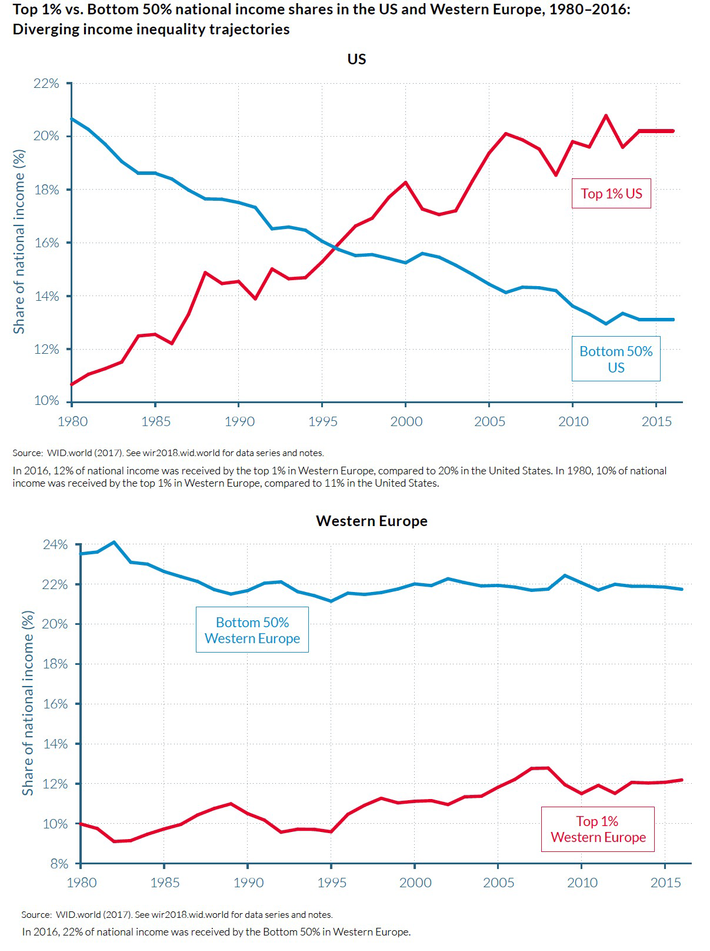
The rich (mostly white) is getting richer while everyone else (increasingly Black and brown) is being cheated by the rich.

Much of this tension has been increased during Covid because the shut downs highlighted just which workers in the U.S. are essential—the least well paid (such as service workers) and those living in the most vulnerable conditions (hourly laborers without guaranteed insurance or retirement).

If all the service workers in the U.S. did not go to work tomorrow, the country would shut down; if all the CEOs stayed home, no one would notice.

White people are afraid of losing their unfair advantage of simply being white, and that fear is driven by a changing world, a changing country.

Attacks by Republicans on CRT and the 1619 Project are crass fear-mongering and a distraction, driven by white fear.

CRT and the 1619 Project are not any significant part of K-12 schooling, and white students are not being taught they are inherently evil because they are white.

White folk perpetuating these lies are doing so because they are afraid; they are afraid of what they see in any mirror they face.

A Case for Critical Race Theory, and More

White privilege is a system of advantage that benefits all white people (or to be more clear, all people who are perceived of as white).

That racial privilege, however, is no guarantee of success or shield of protection for some individual people who are white. White people fail, white people suffer inequity and disadvantages (such as poverty), and white people in some individual cases are substantially worse off than individual Black people.

Racism is a system of power and race that disadvantages all Black people in the U.S. (or to be more clear, all people who are perceived of as Black).

Racism is not a universal barrier to success or happiness or achievement, but it is a pervasive burden that tints every aspect of living for any Black person.

Black people are typically more starkly aware of racism (nearly moment by moment) than white people are of white privilege; white privilege works in an invisible way for white people while racism is a blunt object for Black people.

Race, however, is not biological; race is a social construction that has very real consequences because of the systems of white privilege and racism.

Conservative white men with power, political power, have launched a campaign against their own distorted and purposefully misleading characterization of critical race theory (CRT), a narrow and complicated legal and academic term and concept.

First, CRT is not practiced or implemented in the vast majority of K-12 schools, and is rare in higher education. I am speaking as someone who has taught about 20 years each in K-12 and higher education while being a critical educator.

Critical educators are rare, and at best, we are tolerated; but being a critical educator has professional negative consequences because being “critical” is a commitment to challenging systemic forces.

As the attack on CRT shows, people take personal and individual offense when systems are challenged.

Even though white people in the U.S. on average earn more and hold disproportionate positions of power than Black people, white people perceive anti-racism efforts (which are designed to dismantle white privilege) as an attack; white people perceive a creeping loss of their privilege even as they deny that privilege exists.

To be blunt, reaching a state of equity and equality in the U.S. would be a material change in the lives of white people. Change is terrifying to those who are born into a state of advantage.

Equity and meritocracy realized, then, in the U.S. is a threat to white privilege.

Anti-racism efforts, which include concepts such as CRT, are not some sort of reverse racism, not a blanket condemnation of white people.

Again, white privilege and racism are systemic, as CRT argues, built into the fabric of most if not all institutions in the U.S. including policing and the judicial system (which CRT specifically addresses). But white privilege and racism are also built into formal education and, as the 1619 Project proposes, into the very core of capitalism and the U.S. economic system.

Anti-racism efforts, including those found in K-12 and higher education, ask educators and students to consider how racism happened (historically) and to examine critically how white privilege and racism remain in our contemporary daily lives in the U.S.

The backlash against CRT has had some high-profile consequences, including Nikole Hannah-Jones being denied tenure at the University of North Carolina through a process that is overtly partisan politics—the same conservatives decrying CRT punishing the most prominent face of the 1619 Project, which sits at the center of this storm.

That politically partisan denial of tenure occurred around the birthday of Malcolm X, who I think serves an important point here.

Malcolm X was considered during his life a radical, in today’s language “critical,” and despite his careful and powerful rhetoric when positioned in the mainstream media of his day, he was demonized as the exact embodiment of racial threat that white Americans were openly embracing in the 1960s.

To understand racism in the U.S., consider this from Malcolm X: “History proves that the white man is a devil.”

For knee-jerk conservatives, this is proof of Malcolm X himself being racist.

But read in its full and clear language, the comment is not racist since it is grounded in “history proves.” Malcolm X is drawing a valid generalization about white people based on Black people living in the reality of active individual and systemic racism in the U.S.—from slavery to Jim Crow, from separate bathrooms and water fountains to segregated schools, from lynchings and the rise of the KKK to interracial marriage being illegal until the mid-1960s.

Racism is a set of race-based generalizations based on stereotypes, not evidence. I won’t list them here, but white racism toward Black people includes the very ugliest of claims about Black people that have no basis in fact, no historical, biological, or sociological evidence.

Part of the backlash against CRT is simply denial and racial discomfort, but that backlash is also a profound misconception about the fact of racism. Conservatives are apt to claim that the U.S. is not a racist country, and that any racism in the U.S. is merely a thing of the past.

Let me offer here two examples of why CRT and anti-racism efforts are valid, and must be central to formal education.

First, CRT argues that our current systems have racism baked into them because they were designed and created when, in fact, being virulently racist was not only socially and politically acceptable, but often a social and political advantage.

For example, Ben Tillman had a long successful political career in South Carolina (1890-1918), as governor and U.S. Senator. Tillman is something of an extreme example, but he was one of may white men who were racist and creating the laws that govern this county.

Detailed at Historic Columbia are some of the key elements of Tillman as racist politician who helped created our current systemic racism:

In a 1909 speech at the Red Shirt Reunion in Anderson, SC, Tillman boasted about his role in the 1876 murder of six Black militia members, whom he called “negro thugs.” White leaders celebrated the “Hamburg Riot” as a key victory of the 1876 Red Shirt paramilitary campaign, which successfully intimidated Black voters and stuffed ballot boxes to ensure the election of Wade Hampton III, and with it, the end of Reconstruction. Today, these murders are known as the Hamburg Massacre, one of the earliest lynchings in South Carolina.

Although he began as a perpetrator, Tillman later used his platform as governor and senator to serve as an instigator of and advocate for racial violence. Perhaps his most well-known pronouncement occurred in an 1892 speech, when, as governor [emphasis added], he vowed that “I would lead a lynching”–a claim carried by the state’s leading newspapers. His election to the governorship in 1890 unleashed what human rights activist Modjeska Monteith Simkins later called “an era of lynching.” By the end of the decade, at least 53 men, 51 of whom were Black, were lynched in South Carolina.

Yet, Tillman was most proud of his role in the Constitutional Convention of 1895, which introduced an “understanding clause” and poll tax as barriers to the vote, designed to eradicate Black participation in government. In a speech to his fellow United States Senators [emphasis added] five years later, he reminded them that, “We [South Carolinians] did not disfranchise [sic] the negroes until 1895. Then we had a constitutional convention convened which took the matter up calmly, deliberately, and avowedly with the purpose of disenfranchising as many of them as we could under the fourteenth and fifteenth amendments….” This speech affirmed a sentiment repeated throughout his career on the national stage about the role of African Americans in American democracy:

“We of the South have never recognized the right of the negro to govern white men, and we never will. We have never believed him to be the equal of the white man, and we will not submit to his gratifying his lust on our wives and daughters without lynching him.”

Historic Columbia

Today, we all live in a country under systems intentionally designed to be racist—some as overt as Tillman but others far more subtle (consider the sentencing differences between powder and crack cocaine and racial disparities in police shootings).

CRT and anti-racism efforts ask us to consider how these racial disparities came to be, how they continue to exist in today’s society, and what we can do to dismantle the inequities.

Denial and neutrality allow racism and racial inequity to remain; only naming, exploring critically, and confronting racism can erase racism.

Consider this second example, drawn from headlines within the last decade.

How did the killing of Tamir Rice by a police officer occur?:

“Shots fired, male down,” one of the officers in the car called across his radio. “Black male, maybe 20 [emphasis added], black revolver, black handgun by him. Send E.M.S. this way, and a roadblock.”

But the boy, Tamir Rice, was only 12. Now, with the county sheriff’s office reviewing the shooting, interviews and recently released video and police records show how a series of miscommunications, tactical errors and institutional failures by the Cleveland police cascaded into one irreversible mistake.

In Tamir Rice Case, Many Errors by Cleveland Police, Then a Fatal One

A racist stereotype (Black males are inherently dangerous and violent) combined with implicit bias (Black children are viewed as much older and more mature than their biological ages) led to the death of Rice. This tragic event is a real-life manifestation of what CRT argues, systemic forces with material consequences for Black people.

A police officer shooting and killing a Black boy, then, does not have to be a consciously racist individual to have acted in a way that is driven by systemic racism.

As further evidence, just a few years later, Kyle Rittenhouse, then 17, shot and killed two people during protests in Wisconsin. The same conservatives attacking CRT refer to Black boys as “men” and Rittenhouse as a “boy.”

Attacks on CRT and anti-racism initiatives are embarrassing and offensive caricatures; these attacks are themselves racist and provide the evidence proving why CRT and anti-racism practices remain necessary.

We are now facing a paradox because the misleading attacks on CRT are justification for increasing CRT and other anti-racism efforts in K-12 and higher education.

CRT is incredibly rare in any formal education setting. More K-12 and higher education situations are incorporating (often begrudgingly) anti-racism practices and examinations (which may or may not have elements informed by CRT).

Diversity, equity, and inclusion experiences for children are not blaming all white people or white students simply for being white; but those discussions are designed, as noted above, to critically explore how evidence-based racial disparities came to be, how they continue to exist in today’s society, and what we can do to dismantle the inequities.

Being white is not a crime, but denying racism is itself an act of racism.

To take a stand against anti-racism (against CRT) is taking a stand for racism.

In this case, we can say “not all white people,” but clearly identify those people white or Black who are to blame when they seek ways to deny and perpetuate the racism that remains in our daily lives.

Welcome to South Carolina: A State of Denial

In the United States of America, the stated law of the land is “innocent until proven guilty.”

However, police in the U.S. shoot and kill about 1000 people a year, denying them due process, acting as judge, jury, and executioner instead of the claimed role of “protect and serve.”

The U.S. is experiencing a mild reckoning, specifically linked to the killing of George Floyd but broadly connected to how policing and the legal system continue to be racially inequitable—or as many conservatives and the media refuse to state, racist.

A vocal and likely substantial portion of the U.S.—mostly white and often white men with power—have decided that naming racism is more harmful and offensive than actual racism.

Police killing citizens must also be put in the context that the U.S. stands out among peer nations in terms of gun violence.

It is mid-2021, and the world is suffering more than a year in a global pandemic.

It is mid-2021, and the guilty verdict of Minneapolis police Officer Derek Chauvin still lingers in the news.

Yet, Republican leaders in South Carolina have decided that a pressing issue is the death penalty—voting to reinstate the firing squad.

South Carolina, the home of one of the most horrific mass shootings targeting Black people sitting in church, has Republicans who are choosing to give the state the right to shoot and kill convicted prisoners in a legal and prison system that disproportionately convicts Black people.

Conservatives and Republicans in South Carolina—again, it is 2021—continue to wave the Confederate flag in one hand while thumping the Bible in the other—are endorsing gun violence by the state.

Very Christian.

Christian, that is, in the tradition of the KKK.

As reprehensible as this move is by Republicans, it simply isn’t the only evidence that white men with power are the most fragile people in the U.S.

Republicans in South Carolina have jumped on the white-washing of history bandwagon, prompted in the final days of Trump.

Republicans in South Carolina have ended federal unemployment benefits.

Republicans in South Carolina seek open carry, finding any and every way to appease their gun fantasies.

But possibly the most stark example of denial and white fragility is bill H630, which ends with this jumbled nonsense:

1.105. (SDE: Partisanship Curriculum) For the current fiscal year, of the funds allocated by the Department of Education to school districts, no monies shall be used by any school district or school to provide instruction in, to teach, instruct, or train any administrator, teacher, staff member, or employee to adopt or believe, or to approve for use, make use of, or carry out standards, curricula, lesson plans, textbooks, instructional materials, or instructional practices that serve to inculcate any of the following concepts: (1) one race or sex is inherently superior to another race or sex; (2) an individual, by virtue of his race or sex, is inherently racist, sexist, or oppressive, whether consciously or unconsciously; (3) an individual should be discriminated against or receive adverse treatment solely or partly because of his race or sex; (4) an individuals moral standing or worth is necessarily determined by his race or sex; (5) an individual, by virtue of his race or sex, bears responsibility for actions committed in the past by other members of the same race or sex; (6) an individual should feel discomfort, guilt, anguish, or any other form of psychological distress on account of his race or sex; (7) meritocracy or traits such as a hard work ethic are racist or sexist, or were created by members of a particular race to oppress members of another race; and (8) fault, blame, or bias should be assigned to a race or sex, or to members of a race or sex because of their race or sex. Nothing contained herein shall be construed as prohibiting any professional development training for teachers related to issues of addressing unconscious bias within the context of teaching certain literary or historical concepts or issues related to the impacts of historical or past discriminatory policies.

Part 1B SECTION 1 – H630 – DEPARTMENT OF EDUCATION
2021-2022 As passed by the Senate

Republicans across the U.S. are simultaneously know-nothings and people with disproportionate power to impose that lack of understanding not simply on public policy but on the very education of the children who will inherit the country.

This senseless passage at the end of bill H630 is the exact language being used in several states and it grows out of the fear-mongering around critical race theory.

Please take the 8 minutes to watch Marc Lamont Hill interview Dr. Imani Perry about the Big Lie around critical race theory now spreading across the country:

And as Victor Ray, professor of sociology (University of Iowa), explains:

Critical race theory arose to explain why structural racism endures. Given the racial conflicts roiling American politics, scholarly analysis of the causes and consequences of racial inequality may be more important now than at its inception….

Despite internal disagreements, critical race theorists have documented a stunning (and disturbing) array of racial inequalities that can’t be explained by the acts of individual racists. 

Perspective | Trump calls critical race theory ‘un-American.’ Let’s review.

But let’s return to the exchange between Hill and Perry.

As they note, this Republican attack on critical race theory is mostly a lie since those attacking it do not know what the term means, and, this is important, critical race theory simply isn’t being taught in the vast majority of schools in the U.S.; as Hill notes, it is a solution in pursuit of a problem.

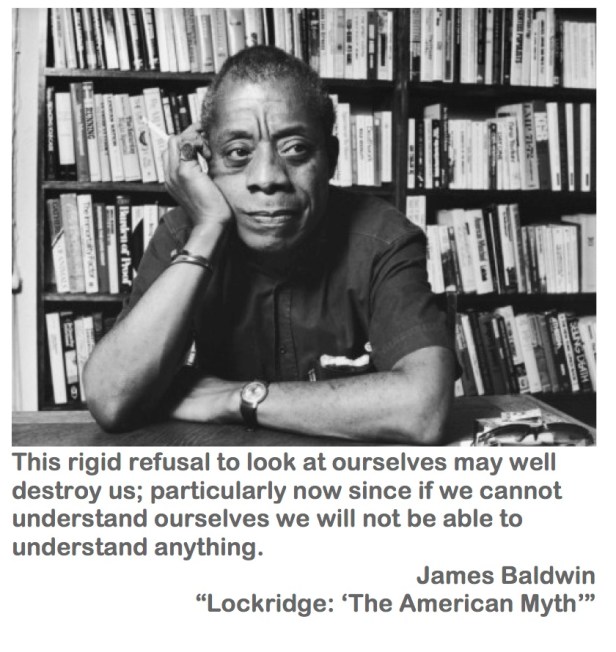
Republican leaders and those who support them persist to prove James Baldwin correct:

rigid refusal

Lies and deception are the foundational strategies of Republicans, reaching back to William F. Buckley.

They can’t handle the truth—a truth that, once again, Baldwin asserted:

Every white person in this country—and I do not care what he or she says—knows one thing. They may not know, as they put it, “what I want,” but they know they would not like to be black here. If they know that, then they know everything they need to know, and whatever else they say is a lie.

On Language, Race and the Black Writer, James Baldwin (Los Angeles Times, 1979)

The Big Lies of the Republican Party are really not about denying racism, but about protecting their white advantages.

Thus, as Perry implores, “We cannot be held to their terms because their terms are deceptive.”

The Falcon and the Winter Soldier: A Reader on Race and Superhero Comics

Should We Marvel at a Black Captain America?

“It’s a Bird … It’s a Plane … It’s … A Comic Book in the Classroom?”: Truth: Red, White, and Black as Test Case for Teaching Superhero Comics, Sean P. Connors (In Science Fiction and Speculative Fiction)

Thomas, P.L. (2017). Can superhero comics defeat racism?: Black superheroes “torn between sci-fi fantasy and cultural reality.” In C.A. Hill (ed.), Teaching comics through multiple lenses: Critical perspectives (pp. 132-146). New York, NY: Routledge.

O Captain America! Our Captain America!

Recommended: Adilifu Nama’s Super Black

Super Black: American Pop Culture and Black SuperheroesAdilifu Nama

Black Goliath: “Some Black Super Dude,” Osvaldo Oyola

Black Lightning Always Strikes Twice! – Double-Consciousness as a Super-PowerOsvaldo Oyola

Black Communities of the 30th Century: Racial Assimilation and Ahistoricity in Superhero ComicsOsvaldo Oyola

The Man Who Lived Twice! (If You Can Call That Living): Marvel’s Brother VoodooOsvaldo Oyola

Humanity Not Included: DC’s Cyborg and the Mechanization of the Black Body, Robert Jones, Jr.

The Captain White America NeedsOsvaldo Oyola

There Can Be No Equity without Community and Empathy

[D]espite overwhelmingly good intentions, most of what passes for intercultural education practice, particularly in the US,
accentuates rather than undermines existing social and political hierarchies.

Paul Gorski, Good intentions are not enough: a decolonizing intercultural education

A split second of awareness kept me from stepping into my apartment’s elevator, the floor covered in vomit, recently.

I thought about this moment yesterday while standing in that same elevator filled with an unpleasant smell as I also noticed a new orange-brown stain on the floor.

A week or so ago, I was unloading two bicycles from my car rack, going up and down the elevator and walking through the enclosed garage of the complex a couple of times. I encountered twice a women with her small dog on a lease, and in both cases, she paused while the dog urinated on a steel beam in the garage.

It isn’t uncommon to see dog droppings scattered down the hallway carpet in this complex either.

Having lived almost four decades in my own homes before becoming an apartment dweller, these experiences are new but not shocking, and they remind me of the general lack of concern for others I experienced in dorm life in college. I also recognize these behaviors are typical of the American character, one grounded in rugged individualism and lacking any real sense of community.

It is the trash carelessly tossed out of car windows or dropped on the sidewalk.

It is the “I got mine so you get yours!” ethos of the good ol’ U.S. of A.

As I stepped out of the elevator yesterday, I was thinking about #TransDayofVisibility and about why people are so antagonistic about diverse sexualities and races, about gender fluidity and transexuality.

A type of awareness for me that helped move me past the bigotry and intolerance of my upbringing was coming to peace with my own self-awareness, being able to articulate that I did not make choices about my gender identification or sexuality but that I came to recognize my gender identification and sexuality.

To be blunt, I cannot fathom denying other people that recognition because I want my awareness to be honored. I also had to come to terms with differences being simply different and having nothing to do with right or wrong, or normal or abnormal.

What is “right” or “normal” for me is not in any way a template or commentary on anyone else, and vice versa.

While this may not be uniquely American, it is certainly true of Americans that we have a fatal lack of community and empathy.

And that “we” is statistically white Americans who exist in a sort of fear that if the “normal” white America has constructed isn’t the only way of being then maybe it isn’t “right.”

Rugged individualism is a significant part of the enduring presence of racism, sexism, homo-/trans-phobia, and all sorts of bigotry in the U.S.

But the negative consequences of rugged individualism are more than the narcissism inherent in racism and other types of bigotry (the provincialism that leads a person to see themselves as “right” and “normal” and people unlike them as “Other”).

What may be worse is that a society that centers the individual maintains inequity even when trying to expand diversity, equity, and inclusion (DEI) if the centering remains.

I have been involved in DEI initiatives at my university for many years, and since I actively incorporate anti-racism/anti-bias elements in my scholarly and public work, I find myself regularly confronting the misguided “good intentions” of my colleagues, my progressive white colleagues.

My first rude awakening about DEI in colleges and universities came early on when I discovered that my department and DEI structures across campus used the strongly debunked “framework of poverty” promoted by Ruby Payne.

Payne’s work is steeped in racist and classist stereotyping, and it suffers from the centering of whiteness and an idealized middle-class “normal.” When I challenged using Payne’s workbooks, I also encountered the other level of centering: “But it works,” I was told, “with our population of students.”

“Our population of students” happens to privileged and white.

Almost twenty years later, I faced the same situation and same justification again.

An event was held for students examining the storming of the U.S. Capitol in January 2021. The featured speaker was a former white nationalist. When I raised concerns about centering a former white nationalist, I heard the exact same justification I heard in my first weeks of coming to my university—but our (white) students.

What if we created opportunities for growth in DEI by centering those people experiencing the unfair weight of inequity? What if we considered a Black student sitting in the audience while a former white nationalist was given center stage and honored as an authority?

If we were organizing an event on sexual assault would we invite a former rapist to speak to that audience? If not, I imagine some of that decision is grounded in considering those people who have experienced sexual assault.

I included the central point from Gorski above this blog because I am disheartened by DEI efforts; I am witnessing Gorski’s recognition that “good intentions” often still perpetuate inequity by refusing to confront it, not resisting the urge to center whiteness and privilege.

While I no longer see Payne’s materials around campus, many still eagerly guide students through poverty simulations, poverty tours, and “pretend to be a minority” activities; these are all dehumanizing and offensive approaches that are grounded in stereotyping while continuing to center the sensibilities of the “normalized” group.

No one needs to pretend to be poor or minoritized is they are willing and eager to listen to people with lived experiences in poverty or being a minority.

Days ago I avoided stepping into that elevator because I was looking beyond myself instead of assuming the world was centered on me.

That elevator would have been clean and safe to enter, however, if everyone else lived with a sense of community and empathy.

Being an American, Christian, or Both: A Fundamental Problem of “Can” v. “Should”

March is a harbinger of spring.

March 2021 has also been an harbinger for some sort of return to normal after a year of living through a pandemic in the U.S. and across the world.

Mid-March now may force us to reconsider what we have wished for since the return to normal in U.S. includes two mass shootings in a week—8 murdered around Atlanta, GA followed by a mass shooting at a grocery store in Boulder, CO leaving 10 dead.

Mass shootings are so normal in the U.S. that they very much define what it means to be “American,” what it means to be a “Christian Nation,” routinely and darkly emphasized after every bloody event: ‘No Way To Prevent This,’ Says Only Nation Where This Regularly Happens.

After the Atlanta shooting and the predictable debates about racism, hate crimes, and gun control, one meme proclaimed “You can’t be a Christian if” by detailing the contradictions between racism and Christian values.

The problem with this claim is that many people in the U.S. do in fact identify as Christian while also actively expressing racism or passively ignoring and allowing racism (see the history of the KKK and Southern Baptists).

The Boulder shooting prompted a similar refrain; “You can’t be pro life and be pro gun,” some posted.

Again, of course you can since the people who identify as “pro life” (a stance that is actually anti-abortion and pro forced birth) are often the exact same people who are pro gun rights.

And here is a fundamental problem in the U.S. that is often lost behind the partisan and angry debates over guns as well as reproductive rights.

Anti-abortion and pro-gun advocates are typically joined, not by ethics or logic, but by fundamentalism—a simplistic and black-and-white approach to issues grounded in authoritarianism.

Trying to unpack or refute this ideological marriage through logic, then, is doomed to failure.

Fundamentalism demands that beliefs remain simple: All life matters, and gun ownership is essential for individual freedom.

That simplicity need not be internally consistent or even consistent from issue to issue. Pro-life advocates do not extend that slogan to plants or animals, and often support the death penalty; thus, their embracing guns as fundamental to individual freedom is not illogical within their fundamentalism.

“All life” and “all guns” are fundamentalism at its core—both in the lack of logic and lack of ethical consistency between the two.

Anti-abortion advocates and pro-gun defenders fetishize the fetus and guns; it then is the fundamentalism that becomes the problem since it necessarily lifts the fundamental truths above everything or anything else.

As fundamentalists, anti-abortion and pro-gun advocates are not motivated at all, ironically, by policies and practices that would actually protect life or improve living. All that matters are the black-and-white causes that have become ends unto themselves.

Banning abortion, for example, doesn’t decrease abortions or unwanted pregnancies; but that ban does erode women’s health and even the lives and living of unborn fetuses.

Those facts are far too complex for fundamentalists, and thus, this never serves as a compelling argument to change their minds. No legal abortions becomes the singular goal regardless of the impact of that law on lives or living.

The same holds for gun regulation. Logic fails against the singular belief that gun ownership of any or all guns is essential for individual freedom.

Guns do not serve as protection (home invasions are incredibly rare, and people are quite bad at using guns, even trained police officers); good guys with guns rarely save the day (a policeman, good guy with a gun, died in the Boulder shooting); and the U.S. is unique in the world for mass shootings although all countries have citizens with mental illness, have access to violent pop culture, and have all types of racism, homophobia, and sexism present in the U.S.

Mass shootings in the U.S. are very clearly most strongly connected to the amount and types of guns available and the ease of access to those guns, especially in terms of the types of guns available (such as the AR-15). Countries that have addressed these situations with policies have greatly reduced and eradicated mass shootings.

But in the U.S., gun fundamentalism prevents a reasonable discussion of gun control.

Like the too often reposted The Onion articles on mass shootings, the ugly truth is that you can be an American, a Christian, or both and act in ways that completely contradict the ideal of either.

We are left with the often fruitless task of arguing that people shouldn’t live contradictions to aspirational ideals (the American Dream, Christian love).

Fundamentalism corrupts entirely everything it touches because fundamentalism becomes its own purpose, self-righteous blinders that shield too many in the U.S. from the bodies piling up around them.

The Crumbling Facade of “No Excuses” and Educational Racism

Sarah Karp offers a long overdue and somewhat surprising opening lede for WBEZ Chicago, home to a number of charter school chains:

Chicago’s largest charter school network sent a letter to alumni this week admitting that its past discipline and promotion policies were racist and apologizing for them. The apology is notable not just as an acknowledgment of misguided policies, but as a repudiation of the “no-excuses” philosophy adopted by many charter schools during the 2000s.

Top Chicago Charter School Network Admits A Racist Past

“No excuses” ideologies and practices have been a foundational staple of charter schools disproportionately serving Black students, Hispanic students, and poor students well back into the 1990s but blossoming in the 2000s since both political parties jumped on the charter school bandwagon. By the late 2000s, mainstream media and the Obama administration were all-in on charter schools as “miracles.”

There were always two problems with the charter school mania and propaganda—data never supported the “miracle” claims (see my “Miracle School Myth” chapter), and worse of all, “no excuses” ideology has always been racist, shifting the blame and gaze onto students and teachers in order to ignore systemic inequity and racism.

“No excuses” schools always began with the assumption that Black, Hispanic, and poor students are fundamentally “broken” and must be “fixed”—an ugly and racist version of deficit thinking.

Almost a decade ago, I spoke at the University of Arkansas after the publication of my book on poverty and education; in that work and talk, I directly challenged “no excuses” ideologies and charter chains as harmful and, yes, racist.

In the wake of that talk, I was discounted and mis-characterized in Education Next, along with an equally unfair swipe at another KIPP critic, Jim Horn: “critics fear that disadvantaged parents do not know enough to choose wisely, or else do not have their children’s best interest at heart.”

Neither Horn nor I hold those views, and our criticisms were firmly and clearly grounded in arguing that “no excuses” is essentially racist and classist.

As I have documented, when I contacted the article authors about the false narrative they created around Horn and me, Maranto both admitted the framing was unfair and claimed the article would be updated; it never was.

The Noble charter chain mea culpa is likely too little, too late, but it is a serious crack in the facade perpetuated by “no excuses” advocates over the last two decades, included so-called “scholars” at the Department of Educational Reform (University of Arkansas) where Maranto works.

Many years ago, in fact, after dozens of blog posts and talks, I co-edited a volume refuting “no excuses” and proposing social context reform instead.

Jim Horn has an excellent volume confronting and dismantling the many problems with KIPP charter schools, Work Hard, Be Hard: Journeys Through “No Excuses” Teaching.

Our work, along with many other scholars and educators committed to equity and anti-racism, has been ignored and often directly attacked, primarily because we dare to name racism as “racism.”

While I am not suggesting that Noble’s confession trumps our scholarship and work that has spanned multiple decades, I do want anyone concerned about education, education reform, and educational equity to step away from assumptions and see clearly how harmful “no excuses” ideologies and practices have been for students and their teachers.

“No excuses” ultimately fails for many reasons—being trapped in “blame the victim” approaches that normalize an unspoken white and affluent standard against which marginalized populations of students are judged, and harmed.

“No excuses” has been compelling because in the U.S. we are prone to seeing all problems as individual and not systemic. But it has also been compelling because education reform has always been tragically drawn to silver-bullet solutions and the shiny mirages seen as “miracles.”

Let me stress here that currently “no excuses” has quite a number of equally racist and flawed practices entrenched all across K-12 schooling: “grit,” growth mindset, word gap, Teach for America, grade retention, and the poverty workshops of Ruby Payne.

K-12 education in the U.S. is mostly a reflection of the communities schools serve; our schools tend to house and perpetuate our social inequities, but schools do very little to overcome racism, sexism, classism, etc.

Education reform has for nearly four decades refused to acknowledge systemic inequity, choosing instead to punish students, teachers, and schools. The many policies and fads of education reform over those decades have been themselves racist and classist, ultimately doing more harm than good to students, teachers, and education.

Karp includes an important realization by Jennifer Reid Davis, chief equity officer for Noble:

“It’s important to own it,” she said. “I think you have to say it, I think you have to be honest. Part of what it truly means to be anti-racist is to be honest about the circumstances in which you are in and or created.”

Top Chicago Charter School Network Admits A Racist Past

The list is quite long still of those who need “to own it” and allow confronting racism to be the first step to ending racism in our schools and our society.