Category Archives: race

MLK and “the Guaranteed Income”

[Header Photo by Katie Harp on Unsplash]

“President-elect Joe Biden will seek to increase the federal minimum wage to $15 an hour as part of his relief bill,” reported Alina Selyukh for NPR.

Across social media, people began doing calculations of what $15/hour translates into for annual salaries, and here are a couple responses from white Christian conservatives:

McChristian, personifying the relationship between a McNugget and real chicken, seems to be aware that teachers are underpaid, but lacks any Christian compassion for other workers also being underpaid (such as minimum-wage workers often constituting the working poor and living without healthcare or retirement—or job security).

Rachel, hollow mouthpiece for the equally vapid TPUSA, doesn’t just lack compassion; she also lacks any grasp of basic facts, embodying not only the hypocrisy of the Christian conservative movement but also the complete misunderstanding of how the free market works.

Note that “[r]aising wages for fast-food workers to $15 an hour would lead to a noticeable but not substantial increase in food prices, according to a new study by Purdue University’s School of Hospitality and Tourism Management,” as reported by Sally French at Market Watch.

Social media, as well, was quick to point out that in areas such as DC and the San Francisco Bay, where the minimum wage is already $15 and above, Taco Bell burritos remain below $4 at the most expensive.

In the U.S., we are well beyond the point of needing to acknowledge that there is nothing Christian or honest about the conservative movement in the U.S.

And few times a year are more likely to expose that than Martin Luther King Jr. Day—when those on the Right scramble to cherry-pick one or two quotes from MLK to wave in front of their hypocrisy and lies.

The debate about the $15/hour minimum wage (as well as college debt relief and universal healthcare) is an ideal opportunity to examine the MLK that almost everyone in mainstream America chooses to ignore.

brown concrete statue during daytime
Photo by Clay Banks on Unsplash

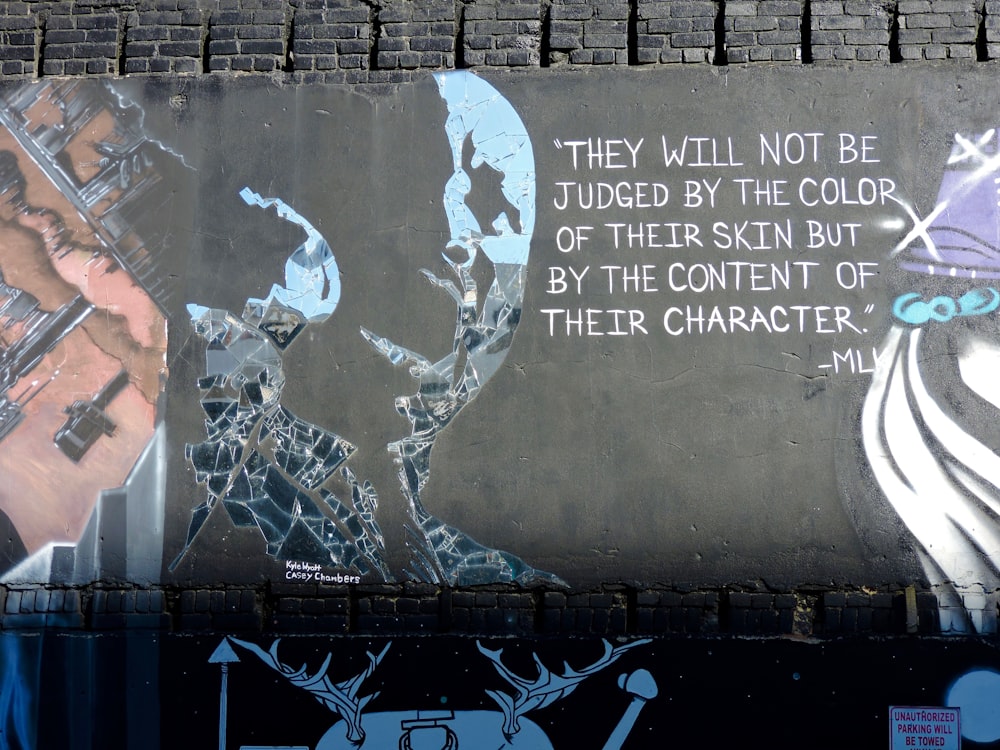
A couple favorite mis-uses and distortions of appropriating MLK is, first, characterizing King as a “passive radical” in order to violence-shame groups or paint a distorted “both sides” false equivalency between right-wing white nationalism and social justice advocates focusing on race and racism, and second, plastering the “content of their character” quotes everywhere to perpetuate the colorblind argument that, in fact, is itself racist.
text
Photo by LeeAnn Cline on Unsplash

Rare is the reference to King who strongly rejected the Vietnam War, but almost entirely absent from the public consciousness in the U.S. is King’s 1967 work, Where Do We Go from Here: Chaos or Community?

Here, King offers his criticism of the standard approach to eradicating poverty (approaches that persist in 2021):

Up to recently we have proceeded from a premise that poverty is a consequence of multiple evils:

• lack of education restricting job opportunities;

• poor housing which stultified home life and suppressed initiatives;

• fragile relationships which distorted personality development.

The logic of this approach suggested that each of these causes be attacked one by one. Hence a housing program to transform living conditions, improved educational facilities to furnish tools for better job opportunities, and family counseling to create better personal adjustments were designed. In combination these measure were intended to remove the causes of poverty.

Wealth and Want

King was confronting that U.S. political will could only admit indirect ways to address poverty—despite, as King pointed out, that more whites than Black people suffered under the weight of economic inequity.

“In addition to the absence of coordination and sufficiency, the programs of the past all have another common failing — they are indirect. Each seeks to solve poverty by first solving something else,” King noted, adding: “I am now convinced that the simplest approach will prove to be the most effective — the solution to poverty is to abolish it directly by a now widely discussed measure: the guaranteed income.”

Not only did King call for a guaranteed income, he asserted the essential need to be direct:

We are likely to find that the problems of housing and education, instead of preceding the elimination of poverty, will themselves be affected if poverty is first abolished. The poor transformed into purchasers will do a great deal on their own to alter housing decay. Negroes, who have a double disability, will have a greater effect on discrimination when they have the additional weapon of cash to use in their struggle.

Wealth and Want

Unlike McChristian and Rachel above, MLK as a progressive, as a Leftist (often slurred as a “communist”), understood the foundational need in a capitalist society that all people have capital:

Beyond these advantages, a host of positive psychological changes inevitably will result from widespread economic security. The dignity of the individual will flourish when the decisions concerning his life and in his own hands, when he has the assurance that his income is stable and certain, and when he know that he has the means to seek self-improvement. Personal conflicts between husband, wife and children will diminish when the unjust measurement of human worth on a scale of dollars is eliminated.

Wealth and Want

But King was profoundly aware of the problems with “minimum” wages, arguing about the guaranteed income:

Two conditions are indispensable if we are to ensure that the guaranteed income operates as a consistently progressive measure.

• First, it must be pegged to the median income of society, not the lowest levels of income. To guarantee an income at the floor would simply perpetuate welfare standards and freeze into the society poverty conditions.

• Second, the guaranteed income must be dynamic; it must automatically increase as the total social income grows. Were it permitted to remain static under growth conditions, the recipients would suffer a relative decline. If periodic reviews disclose that the whole national income has risen, then the guaranteed income would have to be adjusted upward by the same percentage. Without these safeguards a creeping retrogression would occur, nullifying the gains of security and stability.

Wealth and Want

King makes a purely Christian argument about economic policy in a capitalist democracy that should and could center human dignity and equity over greed:

The curse of poverty has no justification in our age. It is socially as cruel and blind as the practice of cannibalism at the dawn of civilization, when men ate each other because they had not yet learned to take food from the soil or to consume the abundant animal life around them. The time has come for us to civilize ourselves by the total, direct and immediate abolition of poverty.

Wealth and Want

The Right is wrong about what it means to be Christian.

The Right is wrong about what makes democracy and capitalism work for people and not against human dignity.

And the Right over the next few days will once again be offensively wrong about MLK.
One-Time
Monthly
Yearly

Make a one-time donation

Make a monthly donation

Make a yearly donation

Choose an amount

$5.00
$15.00
$100.00
$5.00
$15.00
$100.00
$5.00
$15.00
$100.00

Or enter a custom amount

$

Your contribution is appreciated.

Your contribution is appreciated.

Your contribution is appreciated.

DonateDonate monthlyDonate yearly

MLK Jr. Day Reader 2021

Photo by History in HD on Unsplash

From 1984 until 2002, 18 years, I taught high school English in the town and school where I grew up and graduated, moving into the classroom of my high school English teacher, Lynn Harrill, where I had sat as a student just six years earlier.

My first few years were overwhelming and at times terrifying; I taught five different preparations—managing fifteen different textbooks—and several of the classes were filled to capacity, 35 students packed into the room.

Throughout those two decades spanning the 1980s and past the 1990s, I was a student-centered teacher who had a wonderful relationship with my students—lots of mutual love and respect. However, there was always some tension between me and white redneck boys.

Again, these white redneck boys were who I had been growing up, and even the least aware among them likely sensed deep down inside that I knew who they were.

One of the worst days of my teaching career—sitting among having to confront a student gunman and returning to school after three children burned down the school building—included the actions of one white redneck boy.

A significant sub-unit of my nine-week non-fiction unit included walking students through the concept of civil disobedience, starting with Emerson and Thoreau but spending far more time on a mini-unit in Black history grounded in ideas and texts by Marcus Garvey, Booker T. Washington, W.E.B. Du Bois, Malcolm X, and Martin Luther King Jr.

We capped off that unit with Gandhi, but the grounding text of this nine weeks was always King’s “Letter from Birmingham City Jail” paired with different excerpts from Malcolm X.

One day as I was passing out King’s “Letter” (I always provided students their own copies of texts to annotate and keep), a white redneck boy slapped the handout off his desk and announced, “I ain’t reading that [N-word].”

In many ways, this was a defining moment for me as a teacher and a human. I was very aware that I had Black students in the room and that this teenager was much larger and angrier than was safe for me or the classroom of students.

I calmly returned the handout to the desk, my hand firmly on the paper while I leaned toward the student, and I said without hesitation that he would read the essay and that he would never utter that word in class again.

It seems odd to me now, but that is exactly what happened as I continued handing out the essay before we began reading and discussing the essay as a class.

This is no after-school special, and I never had any sort of deep conversation with that student—and I suspect he never changed his beliefs, except keeping his bigotry to himself, at least in my class.

I do suspect that for him and others in the classroom, I was the first white man to take a stand against racism and racist language that they had ever experienced.

It is embarrassing to admit, but that unit was a huge risk for me throughout my 18 years teaching. It even prompted not-so-veiled attacks from local preachers during sermons that my students attended on Sunday mornings (oddly, Southern Baptists seemed very offended by students studying Gandhi, who they dismissed as “not a Christian”).

There are many things I would change about my first two decades of teaching, being charged with the learning of hundreds of teenagers; there are many things I did inexcusably wrong, things for which I remain embarrassed and wish I had the power to return to those moments in order to make amends.

But that sub-unit, and specifically how I taught MLK and what works of his I exposed students to, is important still to me because we did not read “I Have a Dream,” and we did not mythologize MLK as a passive radical, rejecting the whitewashing far too common with King’s ideas and life.

I also exposed students to a wide range of Black writers and thinkers, emphasizing the importance of recognizing Malcolm X and taking his arguments seriously.

None the less, I could have done better—and even today in 2021, King’s life and legacy are woefully mis-served, especially in classrooms (as well as crossing the lips of politicians who cannot even for one day practice an iota of the ideals of King).

Here, then, is a reader for serving King better and expanding the voices and ideas with which we invite our students to engage:

Martin Luther King Jr., “The Drum Major Instinct” Sermon

Final Words of Advice/ “Where do we go from here?” (1967), Martin Luther King Jr.

The Trumpet of Conscience, Martin Luther King Jr.

“Letter from Birmingham City Jail,” Martin Luther King Jr.

Read This Before Co-Opting MLK Jr., Jose Vilson

The Revisionist’s Martin Luther King Jr., “I Have A Dream For Most Of Us,” Jose Vilson

Harlem, Langston Hughes

Let America Be America Again, Langston Hughes

The Forgotten, Radical Martin Luther King Jr., Matt Berman

James Baldwin: “the time is always now”

“Every white person in this country…knows one thing,” James Baldwin (1979) (incl. What Can a Sincere White Person Do? Malcolm X)

James Baldwin from “The Negro and the American Promise”

They Can’t Turn Back, James Baldwin

A Report from Occupied Territory, James Baldwin

“Peculiar Benefits,” Roxane Gay

You Want a Confederate Monument? My Body Is a Confederate Monument, Caroline Randall Williams

Lockridge: “The American Myth,”James Baldwin

If Black English Isn’t a Language, Then Tell Me, What Is? James Baldwin

“The Baldwin Stamp,” Adrienne Rich

Black Body: Rereading James Baldwin’s “Stranger in the Village,” Teju Cole

The Transformation of Silence into Language and Action, Audre Lorde

Bayard Rustin (March 17, 1912 – August 24, 1987): A Reader

The Mis-Education of the Negro, Carter Godwin Woodson

Nina Simone on the Role of the Artist

One-Time
Monthly
Yearly

Make a one-time donation

Make a monthly donation

Make a yearly donation

Choose an amount

$5.00
$15.00
$100.00
$5.00
$15.00
$100.00
$5.00
$15.00
$100.00

Or enter a custom amount

$

Your contribution is appreciated.

Your contribution is appreciated.

Your contribution is appreciated.

DonateDonate monthlyDonate yearly
Being White Is a Handout

My 4.5 year journey as an undergraduate and the first five years teaching high school English were spent mostly in the Reagan era.

While this was many decades before terminology such as “fake news” or “post-truth,” I literally lived during those years a painful and now embarrassing conversion from white denial and ignorance (believing in reverse discrimination, for example) to racial awareness and seeking a life dedicated to racial equity grounded in my own awareness of white privilege.

I had been raised in racism and white denial that pervaded my home and community so when I returned to my hometown high school to teach, I felt compelled to help my students make a similar conversion as mine but not have to endure the stress of experiencing that growth as late as I did.

Reagan in part depended on bogus American Myths (such as bootstrapping and a rising tide lifting all boats) and thinly veiled racist stereotypes, such as the infamous welfare queen myth evoked by Reagan and Republicans with great effect.

No one called this fake news then, but I invited my students to investigate and interrogate these overstated and unfounded claims as we examined race through nonfiction in the first quarter of my American literature course.

That unit began with canonical American thinkers—Ralph Waldo Emerson, Henry David Thoreau, and Margaret Fuller—contextualized with Howard Zinn’s confrontation of the Christopher Columbus myth of discovering America. From there, we moved to race in the U.S. by reading and discussing texts by Martin Luther King Jr., Malcolm X, W.E.B. DuBois, Marcus Garvey, and Booker T. Washington in order to emphasize the diversity of thought among Black leaders throughout the early and mid-twentieth century.

The culmination of the unit was anchored by a consideration of the life of Gandhi (linked to Thoreau and King).

What was my agenda in this unit?

The writing goal was to explore nonfiction writing, specifically argumentation. But I also asked my students to begin to form their beliefs about the world based on credible evidence and not cultural myths and stereotypes.

One brief activity I used, and continue to use, is to have students brainstorm what percentage of the U.S. they believed to be classified as white before asking them to identify what percentage of the world was classified as white.

In the 1980s, students living in rural upstate South Carolina tended to wildly miss these statistics in their guesses; then, about 70% of the U.S. was white, with about 12% constituting Black Americans. The world statistic really forced them to rethink race, and whiteness, since I had found a chart that portrayed about 1 in 10 people in the world being white.

These statistics created a great deal of disorientation for students even as I helped them recognize that about 4-5 out of 10 people in the world were Chinese or Indian (a context they had never considered).

One of the most memorable moments of these lessons over the years was a Black student who grew livid with me, calling me racist, because she entirely rejected that only 12% of the U.S. was Black.

Her anger was grounded in a similar experience I was highlighting for students in general; for many people, the U.S. looked then very white ( a gaze that allows people not to see that the world is not as white), but this Black student believed that the U.S. was fare more Black than it was because she was hyper-focused on SC, where 25-30% of the citizens were Black (significantly disproportionate to the entire country).

The anger and disorientation grew for my students as I asked them to research data on welfare; they discovered that the average person on welfare was white and that people on welfare tended to have fewer children than the general population—all of which contradicted the myths they had lived by, heard from their parents, and witnessed in the political propaganda of the Reagan era.

These teaching experiences with mostly rural white and Black students very much like me are now about three decades behind me, but I think about this teaching often—and it is discouraging.

It is discouraging because I watched and listened as Lindsey Graham and others refused to extend jobless benefits during the pandemic because he framed that as a handout, a disincentive for working.

It is discouraging because I am watching the move to forgive student loans begin to crumble against a similar mantra about fairness and the usual “handout” rhetoric.

There are two ways that people (mostly white) need to investigate the handout myth, just as my students confronted race and racism in the 1980s.

First, the arguments against student debt relief are grounded in misinformation and racism in similar ways that arguments against welfare have been since Reagan (and including the Bill Clinton era).

Just as antagonism against welfare by white people was rooted in false perceptions that it was a handout to Black people with lots of children, the specter of student loan relief being a handout to Black people cannot be ignored in white rhetoric against that relief:

According to the Department of Education, Black college graduates have nearly twice as much student loan debt as the typical white grad. The National Center for Education Statistics reports that the typical Black borrower owes 114 percent of their original student loan debt 12 years after graduating with a bachelor’s degree. White students, on the other hand, usually owe 47 percent of their original debt.

Not only is this crisis exacerbated by higher Black unemploymentwage disparities and the racial wealth gap, but loan companies charge Black students higher interest rates. So, Black grads have less money before they attend college; earn less money after college and have to pay back loans at higher interest rates.

Second, as Harriot adds, “There’s no such thing as a ‘government handout.'”

Student debt relief would address a failure of public funding, a lack of political will that decides how tax money is spent.

There is no shortage of money in the U.S. for social programs such as fully publicly funding K-16 education for all, but there is a lack of political will to allocate money for the common good as opposed, for example, more military spending or militarizing the police forces across the country.

Allocated tax money is not a handout since it is the pooled money of all Americans that then must be designated in ways that serve those Americans.

A final point that cannot be emphasized enough, however, is that those most enraged by anything they deem as a “handout” are mostly White conservatives who like my students before our lessons on race and racism have failed to interrogate the truth about their white privilege: Being white is a handout.

The white handout looks like this:

And these:

Closing the Race Gap
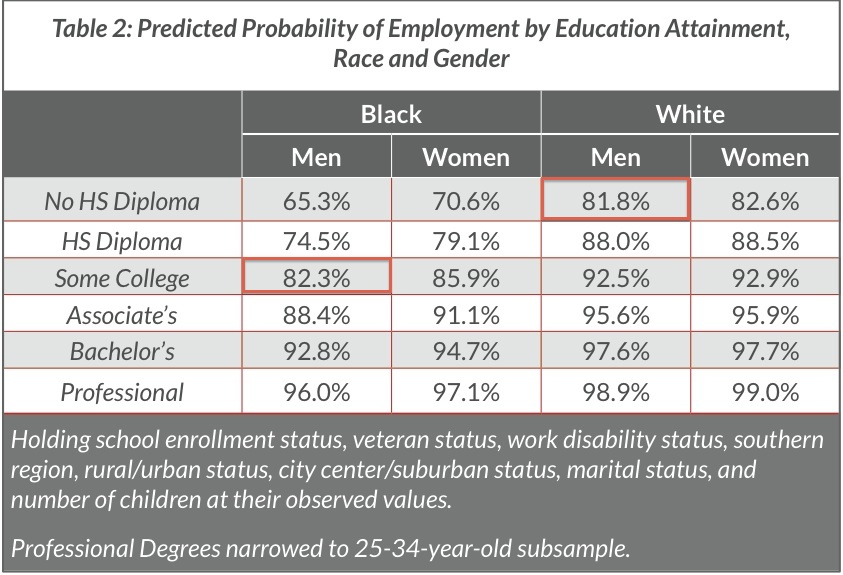
black unemployment
Black unemployment is significantly higher than white unemployment regardless of educational attainment | Economic Policy Institute
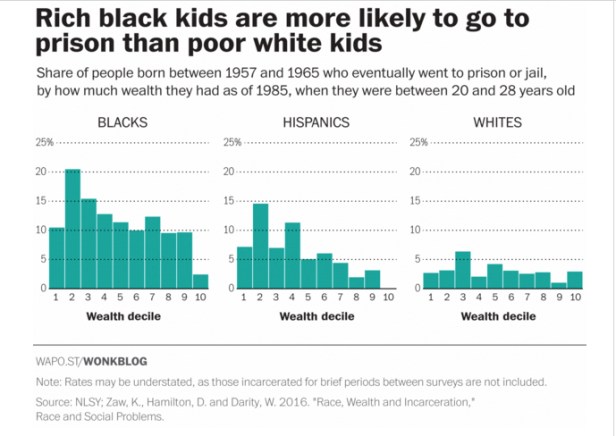
rich black poor white prison
Poor white kids are less likely to go to prison than rich black kids
racial-wealth-gap
The Asset Value of Whiteness: Understanding the Racial Wealth Gap

The anti-handout beliefs and rhetoric from white Americans is a painful paradox exposing the lack of awareness and active denial among white people.

Privilege is an unearned advantage, starkly displayed in the data above. But for many white Americans that handout of being white is invisible since they cannot experience life in any way other than white.

White privilege, the handout, is no guarantee of success or a perfect shield against pain and suffering (or even inequity), but struggling while white is almost always less severe than struggling while Black.

This discussion here, however, is not white bashing; I understand that white people have not asked for that advantage, but I also recognize that a great deal of white anger is grounded in an unexamined fear of losing the handout, of having to live in a world of racial equity—ultimately a fear of achieving the meritocracy many whites falsely believe exists.

If in fact handouts erode people’s work ethic, the ultimate paradox is that for the white people who believe that their white privilege, that handout, must be eradicated.

I, again, think about the hard lessons my white and Black students wrestled with in rural SC throughout the 1980s and 1990s; they often grew into smarter and kinder people. They always gave me hope.

That hope is weakening for me however under the weight of 70-plus million Americans choosing the myths, the lies, and refusing to investigate the evidence.

If handouts aren’t good or fair for America, then it is well past time to end the greatest handout of all, white privilege.

Diversity Hiring and the White Lie of “Most Qualified Candidate”

As the news has spread about my university being the latest case of white faculty claiming false diverse identities, I have seen on social media one of the negative consequences I anticipated from this situation—people criticizing diversity hiring.

I expected this sort of backlash because every time the issue of needing to hire a more diverse faculty has been raised among faculty, one of the first responses is, “We should always hire the most qualified candidate.”

The person voicing that position is always a white man.

And each time a new hire turns out to be a white man (again) even though the final 2 or 3 candidates include diverse people, the response is, “We hired the best candidate.”

The problem with this claim and even commitment is that white men constitute only about a third of the population, but are the majority in many fields—and almost always the majority in positions of power.

If mostly white men are making hiring decisions, there is a significant likelihood that these white men see “best candidate” in people who look like them.

With wealth and power disproportionately and historically pooled among white people, hiring has long been skewed toward white bias, cronyism, and nepotism.

If we are gong to be honest, in all fields, positions are flush with mediocre white men who have been hired for many reasons other than being the “most qualified candidate.”

And even though there is abundant evidence that white men have huge advantages in almost all fields—even ones that are predominantly Black, such as professional sports—there is a history of imposters there also.

Take the case of George O’Leary from 2001, in the world of high-level football coaching which is disproportionately made up of white men who are recycled through jobs at a mind-numbing rate:

Five days after naming George O’Leary its new head football coach, the University of Notre Dame announced today that O’Leary had resigned suddenly after admitting to falsifying parts of his academic and athletic background.

For two decades, O’Leary, 55, formerly the coach at Georgia Tech, exaggerated his accomplishments as a football player at the University of New Hampshire and falsely claimed to have earned a master’s degree in education from New York University. Those misstatements followed him on biographical documents from one coaching position to another until finally reaching Notre Dame, one of the most coveted and scrutinized jobs in college football.

Does anyone recall the rush to end the hiring of male football coaches due to high-profile cases of fraud?

Anyone calling to curb or end diversity hiring due to the rash of imposters in academia in recent years is simply grasping at a convenient and misleading reason to hide their real efforts to cling to white privilege.

“Most qualified” and “best fit” are white lies aimed at preserving the status quo.

Here are some harsh truths that must be stated:

White male exceptionalism is a lie, and white male mediocrity is extremely common across all fields.

Diversity hiring remains necessary, and hiring candidates primarily for their diversity is not only acceptable, it is in fact preferable to counter-balance countless decades of white people being hired purely for being white and connected.

Daily, mediocre white men are hired while diverse candidates are expected to be exceptional and compete among themselves for ever decreasing positions in fields such as higher education.

The fear that a candidate may not be the “most qualified” in higher education—where almost all candidates have achieved a doctorate—is particularly ridiculous.

Certainly among academic doctorates and even medical degrees, there is a range of quality, but that range is already at an advanced level. For people with academic doctorates, there is also substantial evidence that even so-called weaker candidates have significant capacities to grow, learn, and improve.

Systemic racism and sexism still make diversity hiring very challenging, and as recent cases have revealed, higher education is likely very susceptible to the sort of fraud uncovered among white women posing as diverse candidates and scholars.

But hasn’t all hiring been prone to fraud and poor hires throughout history?

Curbing or ending diversity hiring would be yet another case of demanding perfection among diverse candidates and the hiring process while having never demanded perfection in the good ol’ boy system.

Recent cases of academic imposters are not signs that diversity hiring is a problem, but a few high-profile cases of fraud cannot be allowed to pause the already very slow progress being made to create faculty in higher education who look and live more like all of the U.S.

Diversity hiring remains a necessity, and “most qualified” is a white lie designed to derail those goals.

Imposter: Whitewashing “By Any Means Necessary”

Every white person in this country—and I do not care what he or she says—knows one thing. They may not know, as they put it, “what I want,” but they know they would not like to be black here. If they know that, then they know everything they need to know, and whatever else they say is a lie.

James Baldwin, On Language, Race and the Black Writer (Los Angeles Times, 1979)

I have these very deep feelings that white people who want to join black organizations are really just taking the escapist way to salve their consciences. By visibly hovering near us, they are “proving” they are “with us.”

Malcolm X, “What Can a Sincere White Person Do?”

I grew up among oafish racists in my white family and community. This was upstate South Carolina in the 1960s and 1970s.

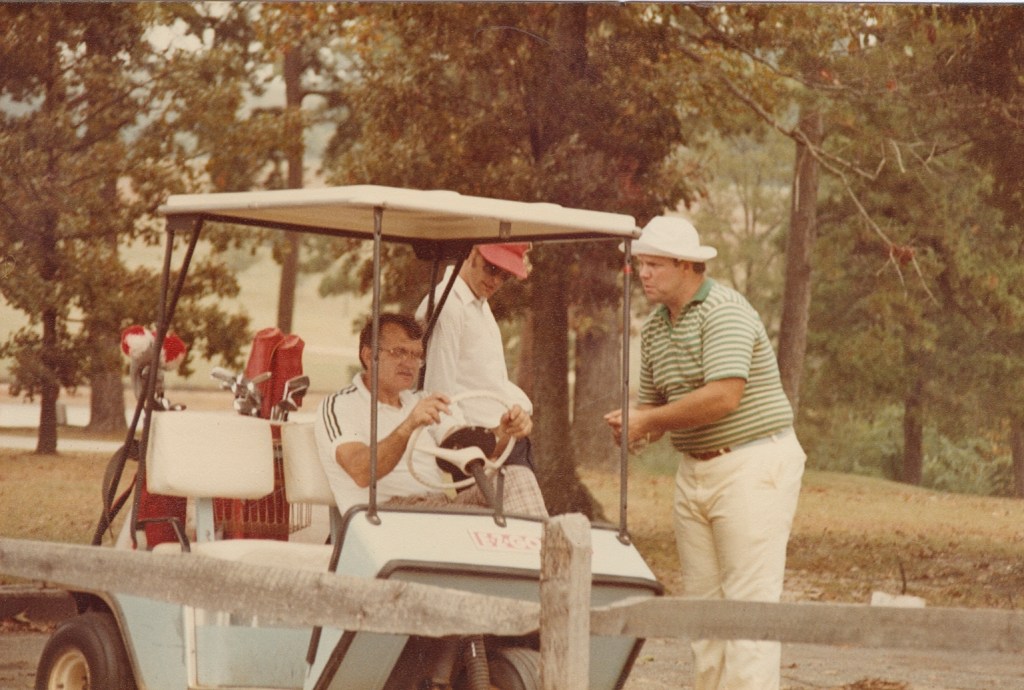
As a teenager, I stood in the pro shop of the golf course where I worked while one of the grounds crew carefully explained to me that once Cain was banished from the Garden of Eden, he mated with apes and that’s how we have Black people.

This horrific moment aside, one of the most stark lessons I learned living among people with grossly simplistic views of race was that any person’s relationship with race is incredibly complicated.

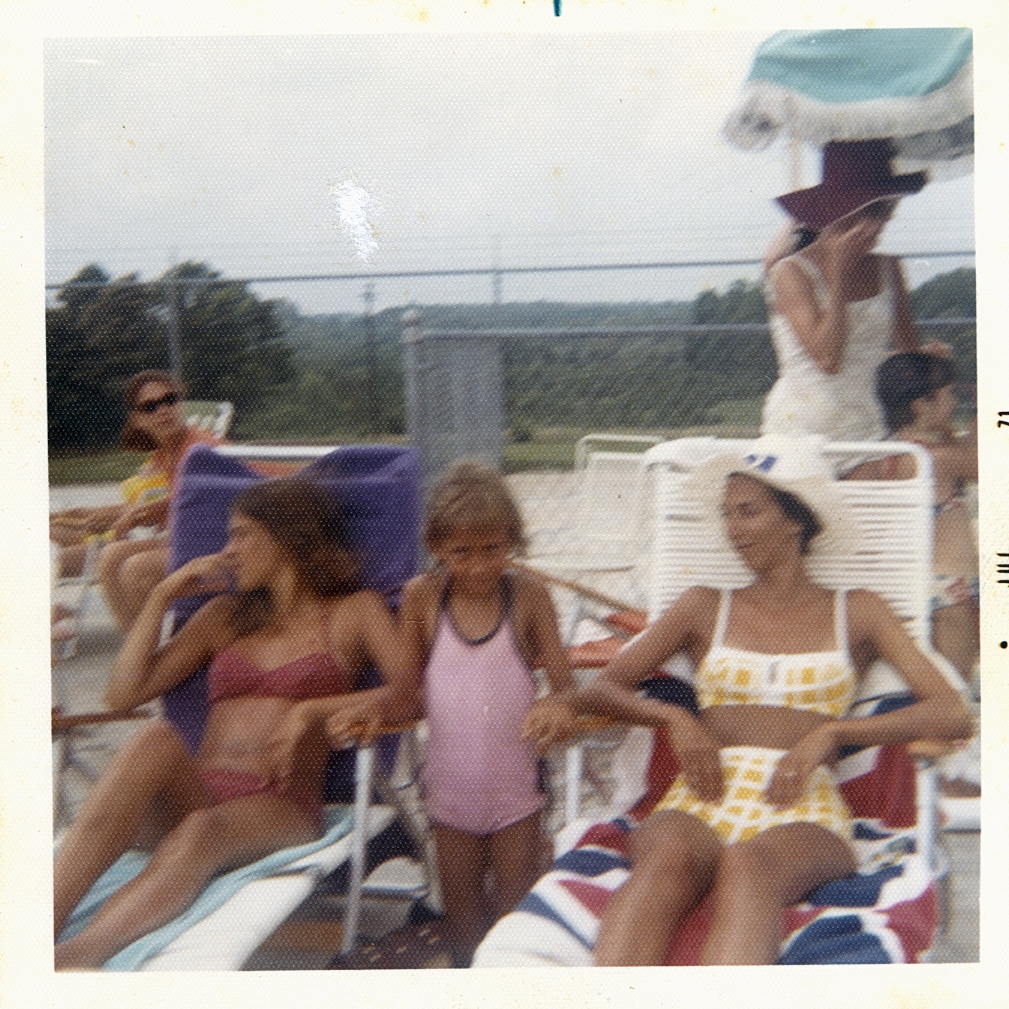
Each summer as a teenager, I moved from working in the pro shop to working as an attendant and then a lifeguard at the country club’s pool. There, white Southern women arrived daily, many with unnaturally bleached-blond hair piled high, and rubbed themselves down with baby oil to sun bath from midmorning until mid-afternoon.

These women were as blatantly racist as their husbands routinely were on the golf course—a white person’s sanctuary that explicitly banned Black people from joining.

I have a very vivid memory of one woman, a wife of a long-time employee of the golf course. She had the most cartoonish bleached hair, maybe the tallest, but she also was tanned to beyond brown; with the lathering of baby oil, her stomach glistened black.

And my mother often joined these women. She also sunbathed in our yard when not at the pool. Like her father who sat outside barefoot in only cut-off blue jean shorts any sunny day, she was olive complexioned and tanned deeply.

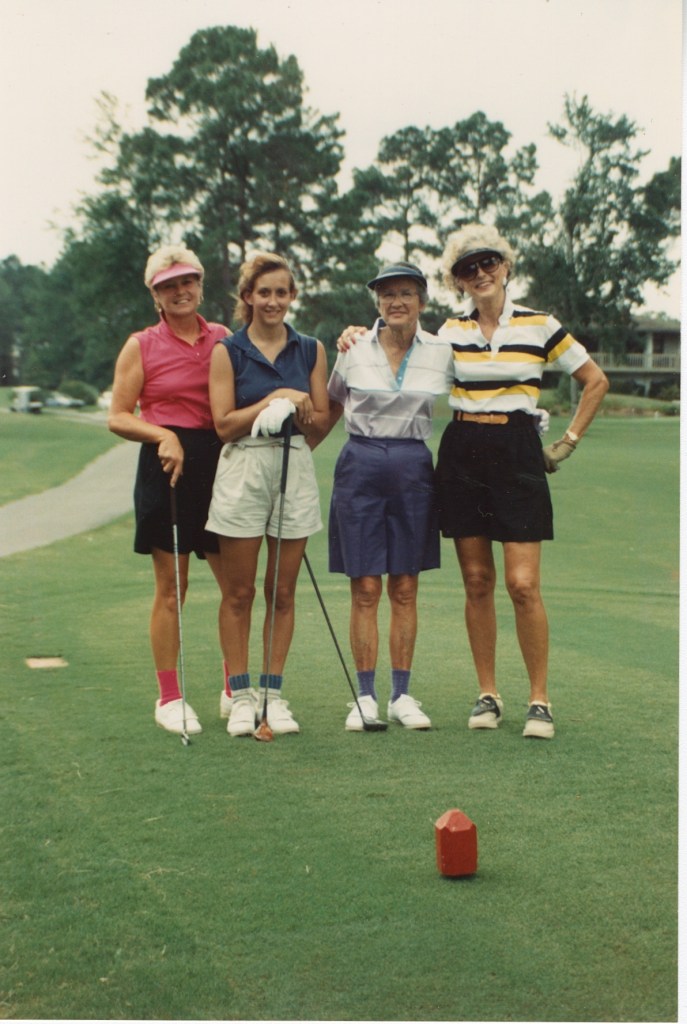
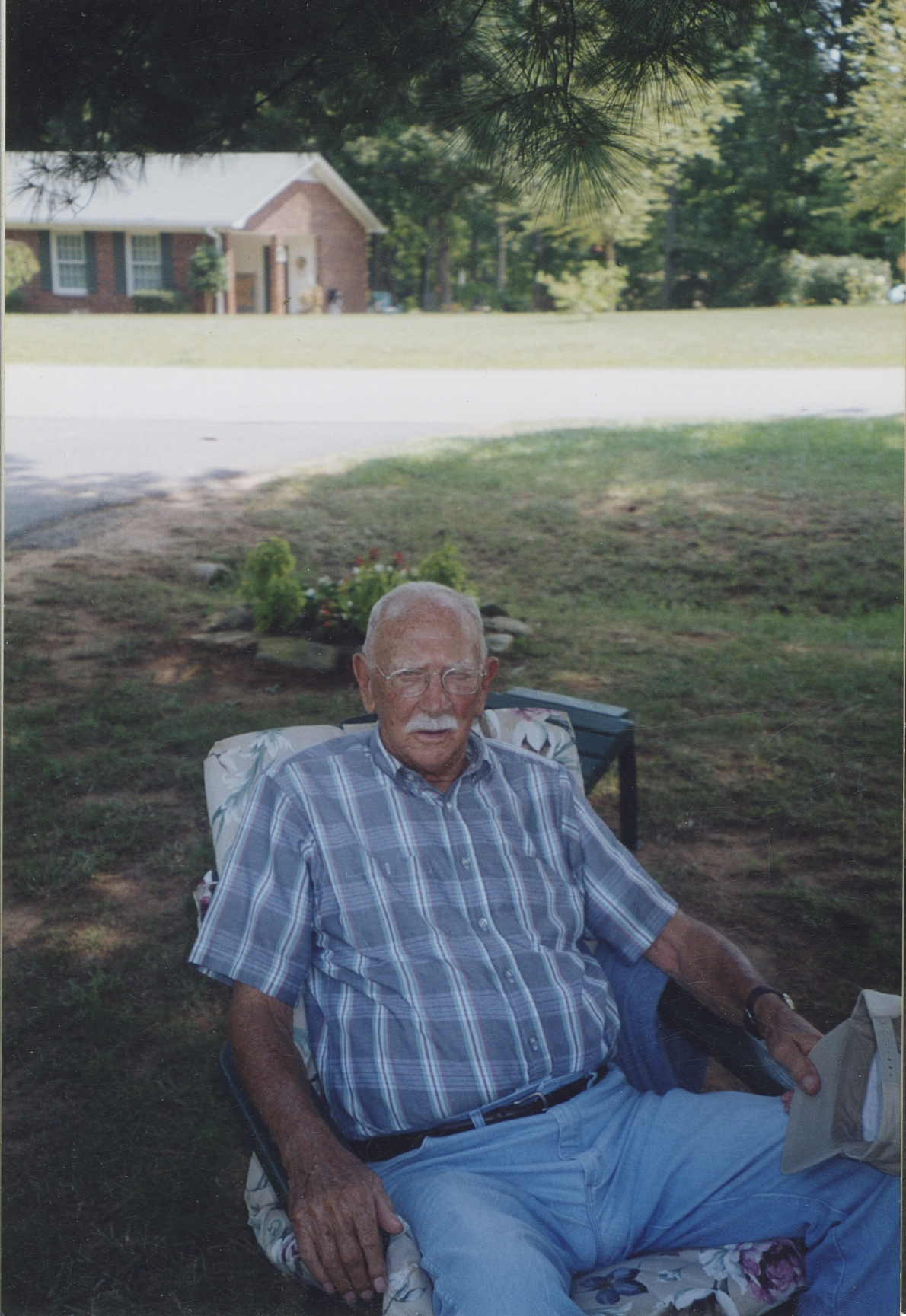
Harold Sowers, my maternal grandfather, was my Tu-Daddy; here, in his later years, he sat outside fully clothed and in the shade.

What compelled these white women who so openly loathed Black and brown people to render themselves dark every summer?

This, I think, is the complexity of anyone’s relationship with race—especially when white and especially when trapped in baseless, simplistic views of race that serve the interests of white people.

In the first six years of my life, before we moved to the golf course, I remember vividly that my mother often suggested she had some Indian heritage; with hindsight, I suspect she spoke with something like a garbled romantic longing because she had exoticized the Lumbee Tribe of North Carolina from briefly living in Lumberton, North Carolina growing up.

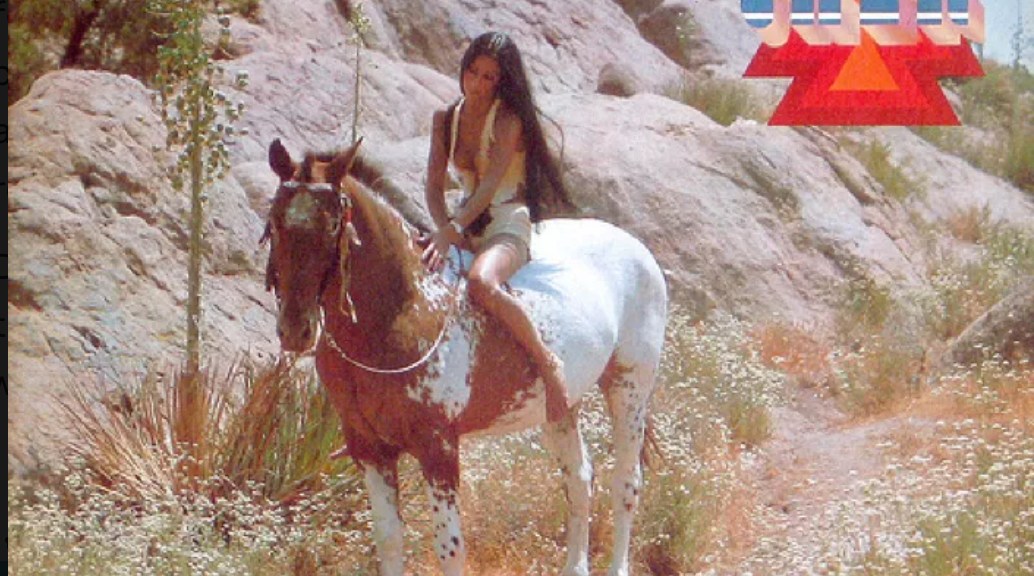
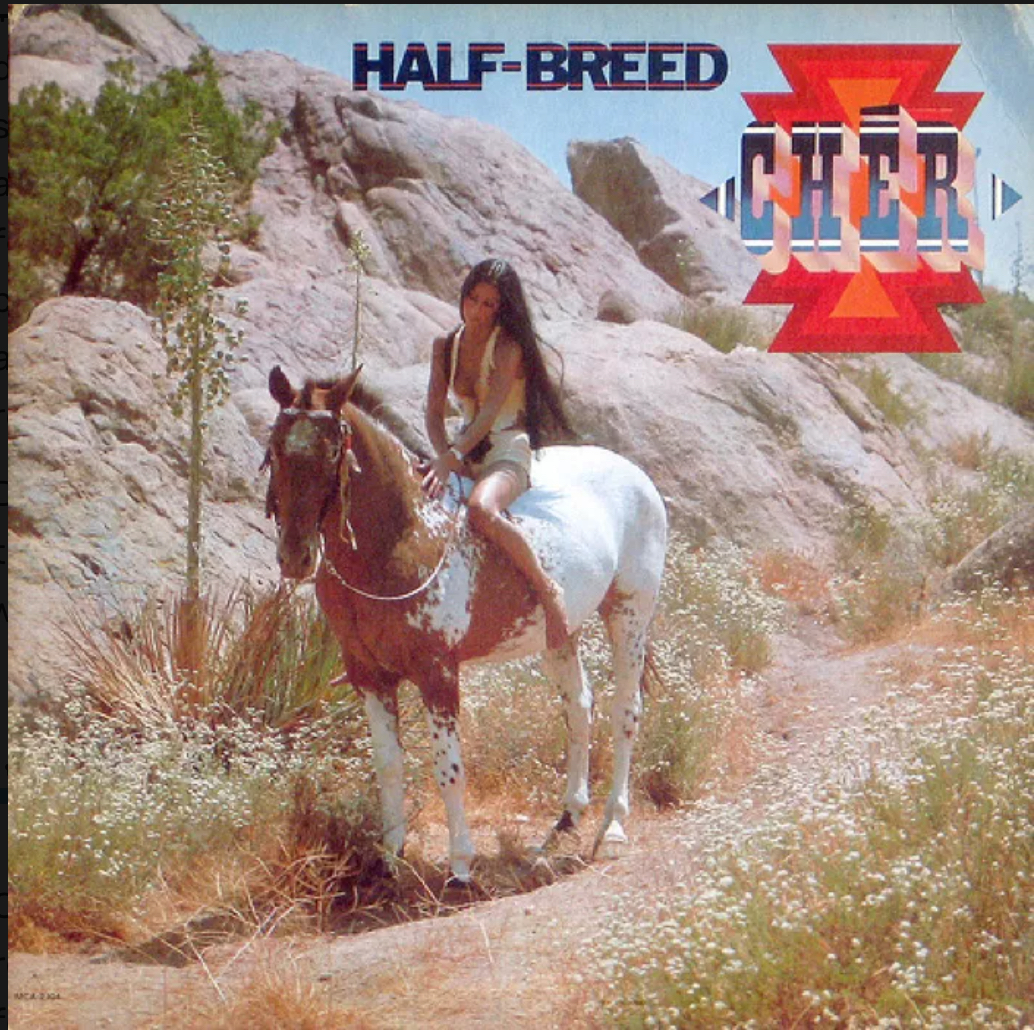
My mother also adored Cher, whose own jumbled heritage and flourishes of cultural appropriation helped fuel the very worst aspects of my mother’s racism.

Wikipedia offers how complex race and celebrity are (not the used of “claimed”): “Cher was born Cherilyn Sarkisian in El Centro, California, on May 20, 1946.[3] Her father, John Sarkisian, was an Armenian-American truck driver with drug and gambling problems; her mother, Georgia Holt (born Jackie Jean Crouch), was an occasional model and bit-part actress who claimed Irish, English, German, and Cherokee ancestry.”

These white women tanning and my mother’s fantasy of having Lumbee blood somewhere in her veins are my first experiences with white women imposters, who are increasingly being exposed in higher education:

This year alone has seen the unmasking of a handful of white academics who have posed as nonwhite: BethAnn McLaughlinJessica Krug, C. V. Vitolo-Haddad and Craig Chapman.

Whereas Chapman and McLaughlin impersonated women of color online only, Krug and Vitolo-Haddad wove their false ethnicities into their personal and professional identities day in and day out. This kind of living a lie is perhaps most infamously exemplified by Rachel Dolezal, former head of the NAACP in Tacoma, Wash., and part-time professor of African American studies at Eastern Washington University. Dolezal identified herself as Black but was revealed to be white in 2015.

White women passing as not white has become a multi-layered offensive whitewashing of “by any means necessary,” since this act of being an imposter seems designed to manipulate a genuine problem in academia, the lack of diversity.

The paradoxical aspect of these layers includes that women are one of the areas of need in many universities dedicated to increasing diversity and inclusion and that white women suffer the negative consequences of being women even as that is tempered by their proximity to white men’s privilege (something that we have abundant evidence a majority of white women will cultivate, notably that more white women voted for Trump in 2016 than for a white woman, Hillary Clinton).

White imposters of race who are women are not only doing harm by taking away the very small spaces afforded Black and brown faculty candidates, but by spitting in the face of the very real and very harmful effects of imposter syndrome often experienced by minoritized people.

As a faculty member on our presidential committee for diversity and inclusion, I have spent many years specifically serving on and chairing a committee that participates in the hiring process so that the university implements best practice to increase diversity among our faculty (which is deeply underrepresented by race as well as gender).

Since my university has now faced a recently hired faculty member accused of being a race imposter, I am witnessing in proximity (as I did with my mother) that this deception has many negative consequences, mostly suffered by the people this event has impacted directly (the department, students, etc.) and indirectly (candidates not hired), but also impacting the process of recruiting and hiring diverse faculty.

Academia is a complicated environment, even culture, in which many things must not be spoken while other things are discussed to the point of no return (with no action).

Legal restrictions and tradition have created circumstances whereby universities seeking diverse faculty can discuss diversity needs and set up policies and practices aimed at increasing diversity, but not explicitly address any candidate’s race, culture, gender, etc.

There are also spaces in academia (not all of them) where everything works under a veil of good faith, but the sort of good faith that has existed forever among the privileged, the sort of wink-wink-nod-nod that existed among the all-white members of the golf course of my youth.

Higher education is not the world of Leftist indoctrination imagined by conservatives, but it is populated by progressives with good intentions who are more than counter-balanced by a willful naivete that comes with being the white progressives Martin Luther King Jr. warned about.

As I mentioned above, academia can often be more words than action. I do not doubt that many who speak often and eloquently about the need for diversity and inclusion are genuine in their rhetoric and their intellectual commitment; but I also know for a fact that most who offer the rhetoric balk at taking any actual steps on the road to equity.

Don’t want to step on any of the wrong toes.

There are few places where “talk is cheap” (and safe) is more telling and complicated than higher ed.

Academia, then, is ripe for deception by those who are willing to whitewash “by any means necessary” even at the expense of people who have no choice but to live lives tinted every moment with racism, sexism, homophobia, transphobia, etc.

My life has transitioned from the oafish racism of my childhood—good country people—to the elegant racism of higher education—well-educated people with good intentions.

Each faculty member unmasked for being a race imposter sends me back in time to my mother playing Cher records or sun bathing with the regulars at the golf course pool.

I have been reminded in recent days that people with grossly simplistic views of race reveal that any person’s relationship with race is incredibly complicated—and ultimately dangerous.

Bully Politics, Eugenics, and the Last Days of American Pretense

If the American character included the ability to admit that the country’s founding was deeply flawed but aspirational—life, liberty, and the pursuit of happiness as goals we are still trying to achieve for all, not just some—we would not have to admit in 2020 that much of what America believes is simply lies.

Instead, the American character is often trapped in James Baldwin‘s “rigid refusal to look at ourselves,” now disturbingly embodied by the Trump/Pence administration and their bully politics.

Of the many lies at the founding of the U.S. that continue to poison our aspirations for individual liberty and robust democracy, possibly the most disturbing and immediately damning is that people fled England in pursuit of religious liberty.

For some frustrating reason, throughout my 18 years of teaching high school English, students were bombarded by American literature focusing on the Puritans, specifically reading/viewing both Nathaniel Hawthorne’s The Scarlet Letter and Arthur Miller’s The Crucible.

Students tended to recognize after these works that those first Puritans were not so much interested in religious freedom for all, but fled England in order to be no longer the oppressed, but the oppressor.

Chillingly, Hester Prynne and an assortment of women condemned as witches suffer religious tyranny that sends a powerful message to students about the role of religion in misogyny and sexism.

A novel written mid-nineteenth century and a play written mid-twentieth century (during the McCarthy Era), both set in seventeenth century North America, serve in 2020 as stark reminders that religious liberty in the U.S. is not something we aspire to but a bald-faced lie.

That bald-faced lie has no better representative than Mike Pence on the stage with Kamal Harris for the only vice presidential debate of the 2020 election.

Pence pandering for Trump and their white evangelical base evoked a false narrative that Christian faith works as a disadvantage in the U.S.—now embodied by the nomination of Amy Coney Barrett.

This flipping of the oppressor as the oppressed parallels the white nationalist message embraced by Trump; angry white Americans are emboldened under Trump because he echoes and speaks to the lie that being white in the U.S. is some sort of disadvantage.

While a great deal of evidence has supported the idea that mainstream (“moderate”) Democrats and Republicans are nearly impossible to distinguish from each other, the election of Trump has not only exposed a difference but also spurred the last days of American pretense.

If we look carefully at the nomination of Amy Coney Barrett, for example, Trump/Pence and the Trump-led Republican Party are pushing a distinctly minority agenda; 60%+ of Americans support waiting to fill Ruth Bader Ginsberg’s seat until after the election, and nearly 70% of Americans support maintaining Roe v. Wade (one of the goals of the rush to confirm Barrett is allowing states to ban abortion).

Next, consider, for example, legalizing/decriminalizing marijuana, gay marriage, trans rights, laws protecting separation of church and state (such as those governing forced prayer in public schools).

All of these expand religious and individual liberty; and notably, Republicans reject all of these while Democrats support them.

Also consider the #BlackLivesMatter movement as it has been confronted by white nationalists, neo-Nazis, and mostly white self-proclaimed militia.

Here a strong and important distinction is needed. #BlackLivesMatter is a call for extending life, liberty, and the pursuit of happiness to Black Americans—not a claim that Black people are superior to white people, not a call to take life, liberty, and the pursuit of happiness from white people.

#BlackLivesMatter, in fact, has some strong similarities with the Black Nationalist movement of the mid-twentieth century that, again, is distinct from white nationalism.

White nationalism (not only but the worst of which includes the KKK and neo-Nazis) argues for white exceptionalism and white purity. These are the vestiges of eugenics, parroted by Trump’s nod to “good genes” in his supporters and his belief in his own superior genes.

Black Nationalism and the #BlackLivesMatter movement are not about Black people being superior, but about a recognition that assimilation and equity among races have been and are currently being resisted by white Americans.

Over the past couple weeks, the country has been confronted with the Trump/Biden and Pence/Harris debates; of the four people on those stages, only Harris has displayed the highest standards of preparedness, poise, and respect for the offices, the aspirations of the U.S., and the American people.

Of those four people only Harris has had the highest bar for her performance.

Mediocre white men, Trump and Pence have been uniquely dishonest, even in the context of mainstream U.S. politics.

Like the iron-fisted tyranny of the Puritans, Trump/Pence are poised to use bully politics to impose the minority tyranny of evangelical whites on the U.S. while waving the Bible in one hand and wrapped in the American flag—a warning so compelling that we evoke it like a fact that can’t be confirmed.

We may or may not be witnessing the fall of U.S. democracy, but we are staring directly into the last days of American pretense.

And possibly the greatest pretense of all—or at least the one that best illustrates the anti-democratic aims of the Trump-led Republican Party—is that there is a pro-life movement.

“Pro-life” sloganism is not just a veneer for anti-abortion, but for forced pregnancy and birth.

Overturning Roe v. Wade and denying women reproductive rights are efforts to impose religious dogma above national ideology, an admission that religious tyranny is the goal of the Right in the U.S.—not religious or individual freedom.

Four more years of Trump/Pence may close the door to American aspirations, but it certainly will toss aside American pretense to expose what America is willing to allow for some at the expense of others, once again.

You’re on Your Own (But You Don’t Have to Be)

During the recent U.S. Senate debate in South Carolina, Jaime Harrison and Lindsey Graham seemed determined to one-up each other about their overcoming hardships in their lives.

Harrison, as a Black South Carolinian, sounded quite similar, in fact, to Republican senator Tim Scott—both sending strong messages about rugged individualism that can easily be viewed by those denying racism as proof anyone can make it in the U.S. with enough grit and the right mindset.

The U.S. has long loved rags-to-riches stories, ignoring both that these stories are compelling because they are incredibly rare and that these stories are often lies.

Rugged individualism is not just an idealistic mythology, but a deforming lie that helps mask that most success in the U.S. comes from privileges and connections linked to family wealth, race, and gender; wealth begets wealth just as privilege begets privilege.

Bootstrapping myths have existed nearly as long as the U.S., and seem grounded in a belief that without these stories to incentivize people, the country would crumble due to inherent human laziness.

Certainly the real and mythologized stories of the U.S. are mostly about exceptional individuals (almost all white men) and the power of competition to drive the demands of capitalism and consumerism.

Bootstrapping and rugged individualism myths fail for several reason, however. One is that rags-to-riches stories are by their nature outlier events; it is both illogical and harmful to treat outlier phenomena as “normal,” as the foundational expectation for everyone.

But the greatest harm in these myths are grounded in the lies. Research, in fact, shows that cooperation, collaboration, and community are far more productive than competition.

Just a bit of critical examination into anyone claiming to be a “self-made” success exposes that many factors played a role in that success, notably connections, collaboration and community hidden beneath the individual, and even luck (despite the problems with Malcolm Gladwell’s work, Outliers serves well to reveal those patterns).

What business can prosper without the publicly funded roads and highways systems?

For many in the U.S., Harrison and Scott as successful Black men prove that there is not a systemic problem in the country, but a failure of individuals who can be “fixed” through a more demanding education system and a more punitive police state and legal system.

Again, these beliefs are contradicted by evidence, such as that Mullainathan and Shafir detail in Scarcity: Why Having Too Little Means So Much. Individuals tend to behave in ways that reflect their environments.

Mullainathan and Shafir offer two contexts—slack and scarcity, which we can loosely frame as wealth and poverty but understand it is more complex than that.

When people live in slack, they tend to behave in ways that seem rational and productive, in part because of lower stress and wider margins for error. While this is paradoxical, having more than enough money tends to allow people to be better with money (such as saving or spending more carefully, including having greater access to wealth through loans that tend to be lower interest for those who are wealthier).

Living paycheck to paycheck or living without adequate finances creates a level of stress that tends to result in greater financial hardship—falling behind on payments or accumulating insurmountable debt.

Despite the mythologies and beliefs of many in the U.S., these differences can be traced to the circumstances of people’s lives and not to flaws in individuals.

In fact, living in slack allows for individual flaws since making mistakes or bad decisions have much lower stakes.

Having a car break down when you are a salaried employee with a strong savings account and a high credit score has a much different consequence than when you are a single parent working two part-time jobs with hourly wages and no savings account as well as a low credit score.

Despite our knee-jerk urge as a country to blame individuals for their situations and applaud success as the result of individual effort, the evidence is clear that systemic forces are far more powerful than individual qualities for most people.

The ultimate irony here is that while the American Dream tends to be a message of rugged individualism, bootstrapping, and having the grit and proper mindset to succeed, the more robust and humane version of that Dream requires a culture shift in our collective mindset.

Instead of celebrating individuals who overcome inequity, poverty, racism, and sexism, what if as a people we committed to making sure no one has those challenges to begin with? What if we genuinely committed to the possibility of life, liberty, and the pursuit of happiness we claimed all people to be endowed with at birth?

Why must any child earn a full and dignified life in the richest and most powerful country in the history of humanity?

While it feels cliche to mention, Martin Luther King Jr. serves well here to demonstrate the great failures of the American culture bound to individualism to the exclusion of community—what John Dewey identified as either/or thinking that misleads people into thinking the needs of the individual are in conflict with the needs of the community.

King, well after his assassination, has been added to the pantheon of celebrated individuals, reduced to a passive radical and quoted or invoked mostly in ways that confirm the very system King was, in fact, rejecting.

The American Myth requires a King who is a unique individual who overcame, and his messages are only useful when they can be woven into the existing fabric of individual responsibility, respectability politics, and (maybe worst of all) a colorblind society.

That is the “content of character” King, often more prop than the person and radical King became near the end of his life.

However, King called for setting aside “fragmentary and spasmodic reforms [that] have failed to reach down to the profoundest needs of the poor” because “the programs of the past all have another common failing — they are indirect. Each seeks to solve poverty by first solving something else.”

Ultimately, then, King concluded: “I am now convinced that the simplest approach will prove to be the most effective — the solution to poverty is to abolish it directly by a now widely discussed measure: the guaranteed income” because:

We are likely to find that the problems of housing and education, instead of preceding the elimination of poverty, will themselves be affected if poverty is first abolished. The poor transformed into purchasers will do a great deal on their own to alter housing decay. Negroes, who have a double disability, will have a greater effect on discrimination when they have the additional weapon of cash to use in their struggle.

Many decades before the research offered by Mullainathan and Shafir, King recognized that shifting to systemic solutions instead of “fixing” or punishing individuals would allow the sort of individualism that need not be rugged in order to be fully human—and a contributing individual to the larger economy and democracy.

Consider the shift in perception of individuals by a systemic change—decriminalizing and legalizing marijuana creating entrepreneurs where we once saw criminals.

The American Dream is a damning dream, a hoax, a lie—as long as it remains a story of bootstrapping and a celebration of manufactured individuals overcoming.

The Harrison and Graham debate was more than one-upsmanship about who had the hardest path to the stage.

One is a pause, a possibility for turning toward the sort of community at the center of King’s final message; the other is clinging to the very worst of the country that has resulted in each of us being on our own—unless we were lucky enough to be born into the sort of wealth and privilege that allows us to fail and try again.

In 2020, during an international pandemic while living in the richest and most powerful country in the world, you are on your own.

But you don’t have to be.

Uncritical Erase Theory Seminars: Presented by Trump University and Khan Academy [Satire]

It has come to the President’s attention that Executive Branch agencies have spent millions of taxpayer dollars to date “training” government workers to believe divisive, anti-American propaganda….

The President has a proven track record of standing for those whose voice has long been ignored and who have failed to benefit from all our country has to offer, and he intends to continue to support all Americans, regardless of race, religion, or creed. The divisive, false, and demeaning propaganda of the critical race theory movement is contrary to all we stand for as Americans and should have no place in the Federal government.

Memorandum, Russell Vought, Director

Col Jessup: You want answers?!

LTJG Kaffee: I want the truth!

Col Jessup: You can’t handle the truth!

“A Few Good Men” (1992)


Partially funded by a Freedom Grant, and in conjunction with the U.S. Department of Education, the following seminars are now available in an effort to correct years of damage done by diversity and anti-racism training that included Critical Race Theory.

The seminars are available live through Trump University via Zoom (https://trumpu.zoom.us/djt/06141946666) each Tuesday at 4 PM EST or available through recorded on-demand via the Khan Academy.

Register for individual seminars ($189 and include access to the recorded seminar for an additional $29) or for the entire series ($1799 and include access to recorded seminars for an additional $69).

Concurrently, book clubs are also available and will be conducted via Zoom throughout the month designated. Register for book clubs for $139 (participants must purchase their own book copies).

Seminars

Slavery: A Necessary Evil

Presenter: Tom Cotton, Senator (Arkansas)

Canceling “Cancel Culture” and Reverse Racism

Presenter: Herman Cain (via Twitter)

It’s Just a Joke: Reclaiming Comedy in Trump’s America

Presenters: Louis CK and Bill Cosby

America: Land of Racial Harmony (Except for Our Stories of Overcoming)

Presenters: Nikki Haley and Tim Scott with a special recorded message from Ben Carson

The Law Is Colorblind: Beyond Affirmative Action

Presenter: Clarence Thomas

Policing: Overcoming the Dangers of Black Boys and Black Men’s Backs

Presenter: Roland Fryer

Put American Workers First

Presenter: Melania Trump and Ivanka Trump

Returning Women’s Reproductive Roles through Household Voting

Presenter: Abby Johnson

All Lives Matter: Standing Our Ground

Presenter: George Zimmerman

Why Can’t I Use the N-Word?: Language Fairness in Trump’s America

Presenter: Sgt. Chad Walker

Book Club

October 2020

John Howard Griffin’s Black Like Me

Facilitators: Jessica A. Krug and Rachel Dolezal

BONUS: Movie Marathon (Free)

November 2, 2020 / 8 AM EST thru November 3, 2020 / 8 AM

The Help (2011)

Hosted by Netflix

Measuring the Unmeasurable: Racism by the Numbers

Several years ago, women faculty at my university raised concerns about gender inequity across hiring, retention, and pay. The data suggested those concerns were valid so the university brought in an outside team to examine if gender inequity, in fact, existed at the university.

The university faculty was composed of fewer than 40% women (well below the percentage of women in society) and women faculty had been leaving the university at a higher rate than men faculty for several years. Although the university culture discouraged the sharing of salaries, women faculty were able to establish that women did in fact make less than men—in part, because there was also inequity of rank by gender.

These gender imbalances are common across higher education in the U.S. as well.

The external review gathered more data, mostly interviewing across campus different stakeholders in the university. That report confirmed gender inequity and offered reform strategies to address the imbalances.

Almost immediately upon its release, white male faculty questioned the review on the grounds that it did not meet the high standards of scientific inquiry (quantitative experimental/quasi-experimental research).

This scenario is playing out nationally in a similar way, but focusing on racial inequity (racism) in policing, specifically in the use of deadly force by police officers.

First, it is important to start a consideration of statistic and quantitative data by clarifying language. At the crux of a statistical analysis of gender inequity or racism (incredibly complex phenomena), we must distinguish between equality and equity.

For example, equality as a goal would dictate that universities hire the exact same number of men and women, maintain the same number of men and women at each rank, and pay men and women the exact same at those steps. Equality (in a much darker view of the world) would mean that police officers shoot and kill the same number of white citizens as black citizens (note that such a quantitative approach fails the ethical issue of whether or not police offices should kill any citizens).

Equality, however, is the wrong standard since it fails to acknowledge proportionality; this is especially important when trying to measure racism in the U.S.

Race demographics in the U.S. are significantly imbalanced since there are about 5-6 times more white people than Black people. Here is the importance of starting an investigation of racism in policing with equity.

The data on policing and race, then, become extremely complicated since police do kill more white people than Black people, but that measurement is also inequitable since the imbalance falls well below the race imbalance in society; as Bronner explains: “That’s how you get studies that show 96 out of 100,000 Black men and boys will be killed by police over the course of their lifetimes, compared to 39 out of 100,000 white men and boys — a risk that is 2.5 times higher.”

Two statistical facts (police kill more white people than Black people and police killing are racially inequitable) are simultaneously true, seem to discredit racism in policing for some people, and prove racial inequity. This last point is incredibly important and at the root of the problem with measuring racism in policing.

Once there is credible evidence of inequity (data on gender inequity at my university or policing in the U.S.), the challenge of conducting research on that inequity is identifying why the inequity exists and then establishing if that inequity is justifiable or if that inequity can and should be eradicated.

Another paradox of conducting so-called high quality research on inequity is that experimental and quasi-experimental research (designed to isolate and capture causal relationships between factors) often finds no causal significance in the data, but that doesn’t necessarily mean that the condition doesn’t exist.

This brings me to the work of Roland Fryer, who I first encountered through his research on education (charter schools and teacher quality). Measuring teaching and learning has similar problems to measuring inequity since teaching and learning are highly complex and pose real challenges for isolating relationships among factors.

Fryer’s research on education garnered a great deal of uncritical media and political attention since that research reinforced uninformed and overly simplistic views of teaching and learning among the media, the public, and political leaders.

Bruce Baker, for example, noted about Fryer’s work in education: “But, each of these studies suffers from poorly documented and often ill-conceived comparisons of costs and/or marginal expenditures.”

Here is a pattern that is essential to understand: Experimental/quasi-experimental research fails to show a causal relationship in an examination of inequity, the media rush to cover the research by misrepresenting the conclusion (“didn’t find” doesn’t mean that something doesn’t exist), and public/political biases are triggered and reinfocred.

Fryer, who seems to revel in having surprising outcomes to his research, has recently shifted to studying policing and racism, but the pattern has remained intact.

Recently, Fryer promoted a surprising study that seemed to fail to show racism in police killings of citizens, and the media jumped on board despite the research not yet being peer reviewed.

A paradox of research on inequity is that as long as a culture is inequitable all evidence that seems to disprove inequity benefits from that inequity and even the most intentionally “unbiased” research is likely tainted by that inequity.

Once other scholars, most of whom have more expertise in race and policing than Fryer, began to interrogate Fryer’s research, the “surprise” in his conclusion fell apart—in similar ways as his research on charter schools and teacher quality.

Two aspects of scholarly challenges to Fryer’s research on policing and racism are important to highlight.

First, once Fryer was challenged, he responded in a way that clearly discredits the media interpretation of his findings; Fryer wrote a rebuttal to his critics and concluded:

The time has come for a national reckoning on race and policing in America. But, the issues are thorny and the conclusions one can draw about racial bias are fraught with difficulty. The most granular data suggest that there is no bias in police shootings (Fryer (forthcoming)), but these data are far from a representative sample of police departments and do not contain any experimental variation [emphasis added]. We cannot rest. We need more and better data. With the advances in natural language processing and the increased willingness of police departments to share sensitive data, we can make progress.

Once again, probably due to the use of a non-representative sample, Fryer did not find causal proof of racism in fatal policing, but that is a statistical fact that cannot and should not be used to claim that racism does not exist in policing or in fatal police interactions with citizens.

In a response to Fryer’s response, in fact, Ross, Winterhalder, and McElreath conclude in a review of Fryer and other research that seem to fall outside the standard view that racism does impact policing:

We establish that: (1) the analyses of Ross (2015) and Fryer (2016) are in general agreement concerning the existence and magnitude of population-level anti-black, racial disparities in police shootings; (2) because of racial disparities in rates of encounters and non-lethal use-of-force, the encounter-conditional results of Fryer (2016) regarding the relative frequency of the use of lethal force by police are susceptible to Simpson’s paradox. They should probably not be interpreted as providing support for the idea that police show no anti-black bias or even an unexpected anti-white bias in the use of lethal force conditional on encounter [emphasis added]; and, (3) even if police do not show racial bias in the use of lethal force conditional on encounter, racial disparities in encounters themselves will still produce racial disparities in the population-level rates of the use of lethal force, a matter of deep concern to the communities affected.

A more fair response to Fryer (and others) is that his work—despite its weaknesses—raises challenges about the complexity of systemic racism when trying to determine how racism does or does not impact policing.

Systemic racism pervades virtually every aspect of U.S. society, therefore, teasing out and isolating racism may be nearly impossible to do (see Fryer’s emphasis on “granular data” which allows a scientist to focus on a grain of sand while ignoring the beach and the nearby ocean).

Ultimately, a more disturbing paradox may be that interrogating racism by the numbers will never allow us to consider the importance of human witnessing.

The lived experiences of women and of Black people can be silenced when numbers are allowed to trump the complexities of inequity.

“Granular data” and rigorous experimental research are neither fool-proof nor inconsequential. Scientific inquiry isn’t the problem.

The problem is there is inequity entrenched in the type of “science” that is allowed to count, and that is a cycle that itself maintains the inequity that is often nearly impossible to measure.

Fryer’s research along with the media, public, and political engagement with that research does prove one very troubling thing—a confirmation of Audre Lorde‘s warning: “[T]he master’s tools will never dismantle the master’s house.”

For Further Reading

Why Statistics Don’t Capture The Full Extent Of The Systemic Bias In Policing

To “Be” or Not To “Be”: Moving Beyond Correctness and Stigmatized Language

ESPN radio has recently shaken up their on-air personalities across the daily schedule, notably replacing the morning slot held for many years by Mike & Mike (and a recent fractured version after Mike Greenberg left) with a clear signal toward diversity— as reported by Andrew Marchand:

And now, look who is moving into the predominantly white sports-radio neighborhood beginning Monday. It’s Keyshawn, Jay Williams & Zubin Mehenti….

How will it be different?

“First of all, we are three minorities,” Keyshawn said. “That is No. 1. There haven’t been three minorities that I know of on a morning national sports show.”

One of the traditional areas where radio and television in the U.S. has had a strict lack of diversity is the use of language; talking heads—even late-night talk show hosts—practice something of a radio voice (lacking distinct regional pronunciations) and so-called “standard English.”

While listening to the new and more diverse morning radio show on ESPN, I heard Keyshawn Johnson say about a river they were discussing that people “be jet-skiing” in it. The trio’s reactions made it clear this waterway was not safe for recreation.

Since it is early in my first-year writing seminars, I am still helping students re-orient their attitudes and assumptions about reading, writing, and language. A foundational re-orientation for my courses is moving away from seeing language use as “correct” or “incorrect” (as well as rejecting terms such as “standard English” and “non-standard dialect”) and cautioning students not to stigmatize language use as some distinct flag for intelligence or moral/ethical character.

Johnson’s use of “be” to capture a continuous “presentism” of an action along with the omission of “to be” verbs (“Keyshawn home all day”) are often markers for what some call “Black English” (I was taught about Black English through the work of Dillard in the 1970s, but “Ebonics” and “AAVE” have also been used to designate this language usage pattern).

Few people are likely to recognize that ESPN’s new line up is more than racial or cultural diversity; Johnson embodies the importance of language use diversity as well—and he also embodies my cautions to students about “correctness” and stigmatizing language.

While there are people who may have flinched and drawn unfair and racist conclusions about Johnson’s verb usage, I suspect that there will be no professional consequences for Johnson’s language usage.

As I noted to my class, everyone listening knew the meaning of Johnson’s usage, and thus, the primary value of language—clear and precise communication—was completely achieved.

Writing from France in 1979, James Baldwin explained: “The argument concerning the use, or the status, or the reality, of black English is rooted in American history and has absolutely nothing to do with the question the argument supposes itself to be posing. The argument has nothing to do with language itself but with the role of language.”

A few paragraphs later, Baldwin elaborated, focusing on French:

What joins all languages, and all men, is the necessity to confront life, in order, not inconceivably, to outwit death: The price for this is the acceptance, and achievement, of one’s temporal identity. So that, for example, thought it is not taught in the schools (and this has the potential of becoming a political issue) the south of France still clings to its ancient and musical Provençal, which resists being described as a “dialect.” And much of the tension in the Basque countries, and in Wales, is due to the Basque and Welsh determination not to allow their languages to be destroyed. This determination also feeds the flames in Ireland for many indignities the Irish have been forced to undergo at English hands is the English contempt for their language.

It goes without saying, then, that language is also a political instrument, means, and proof of power. It is the most vivid and crucial key to identify: It reveals the private identity, and connects one with, or divorces one from, the larger, public, or communal identity. There have been, and are, times, and places, when to speak a certain language could be dangerous, even fatal. Or, one may speak the same language, but in such a way that one’s antecedents are revealed, or (one hopes) hidden.

In her work to move teachers of English away from “correctness” and the “error hunt,” Connie Weaver has highlighted Baldwin’s point about language usage being about power and that some forms of language usage have social, economic, and political consequences (often grounded in inequity such as racism, classism, etc.).

Often the use of “status marking” in language usage is accompanied by an uncritical acceptance of “standard English” and the inherent context that some language usage (“She is home”) is more complete and “better” than other language usage (“She home”) (see Pullum).

And language usage as status marking (some threat of observable consequences) is used to justify teaching students about code switching instead of stigmatizing any form of language usage.

The code switching argument has stood for many years as a progressive way to teach language that avoids “correctness” and appears to avoid stigma (which it doesn’t).

Again, Baldwin’s key point—”People evolve a language in order to describe and thus control their circumstances, or in order not to be submerged by a reality that they cannot articulate”—is simply side-stepped when we teach disenfranchised and marginalized young people to code switch because that approach allows us to avoid discussing the larger issues of power and inequity that govern the status marking.

Johnson’s use of “be” comes in a time of high social unrest over race, but also intersects with another harsh reality about language and teaching language: Language use is always in a state of flux, and the loose conventions that structure different groups of language usage are tenuous at best.

“People evolve a language in order to describe and thus control their circumstances, or in order not to be submerged by a reality that they cannot articulate,” Baldwin acknowledges. Language change, then, is also about power, not necessarily who has power but the dormant or repressed power of marginalized humans (children and teens manufacturing slang to build a linguistic wall between them and adults or racial minorities reshaping and reappropriating language as defiance and to claim power denied).

Although language can be racist, homophobic, misogynistic, etc., language also can shift toward equity. For example, many publications have now embraced “they” as a gender-neutral singular pronoun. Although some people are pulling out their hair in protest, that usage of “they” is centuries old in the English language because it fills a need left vacant in so-called “standard English.”

This door opened to “they” as singular and gender-neutral is in part about diversity, of course, and we can imagine that some racialized usages of language will walk through a similar door.

Language change is often very slow; it seems to happen organically, and then those with power eventually and some times reluctantly acknowledge a thing that has existed for decades or even centuries.

If this were a case for communication and standardization in the name of that communication, we may find the reluctance more compelling.

But Baldwin’s 1979 confrontation of Black English remains true in 2020 when the world and our language usages are all tinted by racism.

Because all teaching is political, and the very best teaching is activism, re-orienting students’ understanding of language does not have to be slow or organic, as demonstrated by The Conference on College Composition and Communication (CCCC):

We DEMAND that:

  1. teachers stop using academic language and standard English as the accepted communicative norm, which reflects White Mainstream English!
  2. teachers stop teaching Black students to code-switch! Instead, we must teach Black students about anti-Black linguistic racism and white linguistic supremacy!
  3. political discussions and praxis center Black Language as teacher-researcher activism for classrooms and communities!
  4. teachers develop and teach Black Linguistic Consciousness that works to decolonize the mind (and/or) language, unlearn white supremacy, and unravel anti-Black linguistic racism!
  5. Black dispositions are centered in the research and teaching of Black Language!

In K-16 formal education, language usage still falls on a continuum from correctness/standard English at one end and encouraging code switching at the other; the radical dismantling of language usage as status marking is rare, but some evidence exists that culturally we are ready for it.

This demand by CCCC is not simply about equity and authentic diversity, however, because the 5 demands are more linguistically sound than traditional approaches to framing language usage as “correct” or “wrong.”

Once again, Baldwin remains painfully true as he ends his essay:

The brutal truth is that the bulk of white people in American never had any interest in educating black people, except as this could serve white purposes. It is not the black child’s language that is in question, it is not his language that is despised: It is his experience. A child cannot be taught by anyone who despises him, and a child cannot afford to be fooled. A child cannot be taught by anyone whose demand, essentially, is that the child repudiate his experience, and all that gives him sustenance, and enter a limbo in which he will no longer be black, and in which he knows that he can never become white. Black people have lost too many black children that way.

And, after all, finally, in a country with standards so untrustworthy, a country that makes heroes of so many criminal mediocrities, a country unable to face why so many of the nonwhite are in prison, or on the needle, or standing, futureless, in the streets–it may very well be that both the child, and his elder, have concluded that they have nothing whatever to learn from the people of a country that has managed to learn so little.

Those of us who teach language usage have a moral obligation to refuse the norm of “correctness” and to dismantle the stigmatizing of language usage. Otherwise we are abdicating our own agency in the service of inequity and at the expense of our students.