A recurring theme running through my blog posts—one that could be addressed daily—is that education journalism is almost always significantly misleading and way too often completely inaccurate.
Mainstream media and journalists are trapped in false but compelling narratives about schools, learning and teaching, children, poverty, and race. Journalism itself fails education as a field because of a simplistic “both sides” to a rather cartoonish “objective” journalism.
As I have detailed too often, media coverage of education includes primarily voices and perspectives of people with no or very little experience or expertise in education, but when a few contrary perspectives are offered, those are typically framed as “some critics”—with no effort to establish which claims are credible or not.
Sadly, the best unmasking of the essential failure of the media has been by one of our faux-media comedians, John Oliver, who highlighted that even if there are two sides to an issue, one can be overwhelmingly credible while the other is mostly baseless; therefore, placing them as one-versus-one misleads the public on the weight of the arguments.
So when I received yet another email from the Education Writers Association (EWA)—who is extremely proud of itself—announcing their top award for education reporting, I wondered: How good is the best edujournalism?
The EWA Fred M. Hechinger Grand Prize for Distinguished Education Reporting was awarded for Failure Factories (The Tampa Bay Times), written by Cara Fitzpatrick, Lisa Gartner and Michael LaForgia. The series includes the following:
Without question, this series is comprehensive and it confronts some incredibly important issues about public schooling: the significant relationship between race/poverty and student achievement; the plague of segregation and resegregation in public institutions such as schools; and the huge inequities of education faced by racial minorities and impoverished students such as teacher assignments, school safety, funding, and discipline practices.
And while the series does a solid job of raising these issues, my first response is that these are all old news—I mean very old news.
That our public schools have failed poor and black/brown students is a recurring message over the last century—little different before or after the Civil Rights movement.
Therein lies a real problem with even the so-called best edujournalim—journalists without a historical lens afforded those with expertise in a field are ripe to fall prey to the lens of a novice.
One such failure of this series and then how the EWA praised the series can be found in the quoted judge’s comment:
Bravo to this team and the paper for taking an all-too-common story (low achievement in a high-poverty area) and digging past the excuses to reveal a shameful history of indifference and, most troubling, willful neglect. I was awed by the dogged reporting, the sheer volume of interviews and data-crunching, and the courageous analysis that put the blame exactly where it needed to be. But the true brilliance of this work is found in the stories of the children who were robbed of an education they deserved. How many other school districts in America might have the same story to tell?
The series title “Failure Factories” is but one of many triggers for the pervasive and ugly “no excuses” narrative that is all the rage in the U.S.
You see, once again, this series oversimplifies the story of educating vulnerable populations of students: racism and classism are merely excuses for the schools charged with high concentrations of vulnerable students.
And as the judge notes above, this is all about “blame”—and keeping the focus on those damn failing schools.
The shame is that without this corrosive and ugly framing, there is an incredible amount of work in this series that does deserve praise. We should be asking: Why do we need yet anther round of test scores to admit and confront race and class inequity—especially when high-stakes standardized testing itself is racist and classist?
The truth is that schools in the U.S. have never been, are not now, and never will be anything other than reflections of our society—unless we do things different in both our social and educational policy.
Yes, public schools almost entirely reflect and perpetuate the race, class, and gender inequities that remain powerful in our wider society, and much of that is embedded in the very reforms being championed in the media and among political leaders: accountability, standards, high-stakes testing, grade retention, zero tolerance policies, “no excuses” practices, charter schools, school choice, Teach For America, school report cards, value-added methods of teacher evaluation, and the worst of the worst—”grit.”
That is not simply a fact of the schools targeted by this series. That is a fact about public education across the entire country.
And many educators as well as education scholars have been yelling that for decades; that’s right—decades.
Possibly the most telling problem with the series is the end, where the condemnations of Arne Duncan and John King are treated as if they are somehow credible.
If this weren’t so tragic, it would be laughable—nearly rising to the level of an article in The Onion.
Therefore, here is a little message about the best of edujournalism.
Dear EWA:
Public schools have been reflecting and perpetuating the worst aspects of our society for over 100 years. People in power really don’t care, and politicians in the last three to four decades have learned that education policy is a powerful political football.
Since the Reagan administration, public schools have failed students even more significantly because of inane obsessions with accountability, standards, and tests.
Duncan and King are the personifications of all that is wrong with education policy: lots of soaring rhetoric masking policy cures that are part of the disease; thus, the accountability movement is intensifying race, class, and gender inequity—not overcoming it.
Racism, classism, sexism, and homophobia are never excuses, but facts, and these burdens are more than micromanaged and technocratic in-school only policies can address.
Yes, we need much more equitable school practices and polices—but none of what politicians are doing now meets those standards—and those alone will never accomplish what we seem to want without concurrent changes to public policy that also addresses equity.
Edujournalism, as well, is part of the problem because it remains trapped in false narratives, committed to simplistic “both sides” frames of issues, and unwilling to listen to the voices of the practitioners and scholars in the field of education.
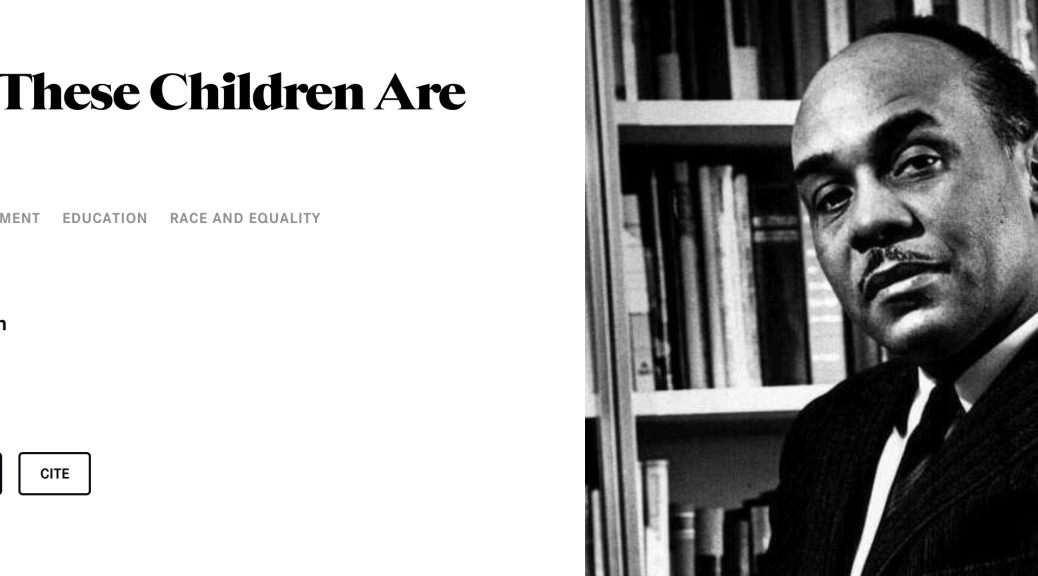
Nearly everything addressed in “Failure Factories” was raised by novelist Ralph Ellison in a 1963 speech to teachers. Your best journalism is old news wrapped in a false frame and too often fumbled badly with good intentions.
I remain concerned that education-bashing journalism has become so lucrative for your flailing field that it is in fact as pressing that we address the journalism crisis as we do the need to significantly reform our public schools.
As agents of the public good, journalists and educators have a great deal in common that is being squandered; neither can afford as a field or in the name of that public good to remain the tools of those who have interests other than the public good.
I am participating as a discussion leader and speaker for a day on diversity at the University of South Carolina 14 April 2016. Below are my notes which may be of value to some addressing race and class in both social and educational contexts.
In his famous dissent in Plessy v. Ferguson, Justice John Marshall Harlan argued that in the United States, there was “no caste here.” Justice Harlan was rejecting the idea that American society operated to assign preordained outcomes to individuals based upon classifications, including racial classifications. This Article questions whether Justice Harlan’s aspirational assertion accurately reflects contemporary American education. Identifying: (1) multiple classification mechanisms, all of which have disproportionate racial effects, and (2) structural legal, political, and practical impediments to reform, the Article argues that the American education system does more to maintain the nation’s historical racial hierarchy than to disrupt it. This is so, the Article suggests, despite popular agreement with the casteless ideal and popular belief that education can provide the opportunity to transcend social class. By building the framework for a broad structural critique, the Article suggests that a failure to acknowledge and address structural flaws will preclude successful comprehensive reform with more equitable outcomes.
Speaking in Savannah, Georgia, March 21, 1861, in his “Corner Stone” Speech, Alexander H. Stephens, Vice President of the Confederate States of America, carefully enumerated the justification for secession among Southern states.
At length, Stephens addressed slavery: “The new [Confederate] constitution has put at rest, forever, all the agitating questions relating to our peculiar institution African slavery as it exists amongst us the proper status of the negro in our form of civilization.”
The Confederacy, instead, embraced “the great truth that the negro is not equal to the white man; that slavery subordination to the superior race is his natural and normal condition.” Stephens chastised the North because “[t]hey assume that the negro is equal, and hence conclude that he is entitled to equal privileges and rights with the white man.”
Stephens called on the triple bedrocks of authority in his statement of the inequality of the races—science, law, and religion:
This, our new government, is the first, in the history of the world, based upon this great physical, philosophical, and moral truth. This truth has been slow in the process of its development, like all other truths in the various departments of science….
With us, all of the white race, however high or low, rich or poor, are equal in the eye of the law. Not so with the negro. Subordination is his place. He, by nature, or by the curse against Canaan, is fitted for that condition which he occupies in our system.
=
While apologists for Southern heritage remain unable or unwilling to confront the blatant racism of the Confederacy, many today remain nearly universal in our inability or unwillingness to recognize and then confront racism, classism, and sexism in the form of deficit thinking.
Deficit thinking, as Stephens represented, is imposing onto groups or individuals deficits as the primary characteristics of their humanity. In education, deficit thinking is pervasive and the foundational mechanism for formal schooling as an institution that reflects and perpetuates bigotry, inequity, and marginalization of people based on status instead of merit.
Some deficit thinking appears nearly harmless because of its common-place use—for example, the term and concept of “remediation.”
Remediation as a normalized deficit concept is at the heart of the third-grade retention movement masquerading as reading policy.
Remediation is built on several flawed assumptions: (i) learning is predictably linear and sequential, (ii) so-called skills such as reading can be accurately quantified (as in “grade level”), and (iii) some “types” of learning (associated with rates and/or biological ages of the students) are lesser than others (basic skills versus higher-order thinking skills, for example).
Remediation also fails a basic point of logic: If remediation is teaching a student something that student doesn’t know, isn’t all teaching remediation?
Remediation, then, is deficit thinking because we must first establish “third grade reading” and then test children in order to label them deficient—and thus the ultimate flaw of grade retention is allowing that seemingly scientific but biased quantifying to represent the entirety of any student.
=
Many key ideologies and practices in the education reform movement, as well, are masks for deficit thinking: culture of poverty, “grit,” the “word gap,” and “no excuses.”
As deficit thinking, all of these are driven by and contribute to unacknowledged racism and classism (often among those claiming to be fighting bias and inequity).
To say “poverty is not an excuse” or that student success depends on “grit” is to “blame the victim” since the focus of these slogans and the educational practices built on them highlight the students as deficient and thus needing to be “fixed.”
The lineage from the bald-faced racism of Stephens to the paternalistic and coded racism/classism of “grit,” “no excuses,” and the “word gap” is deficit thinking.
The racism of the Confederacy did not hide behind code, but more than 150 years later, we are faced with finding the will to decode and debunk the deficit thinking that is just as corrosive to individuals and society as corner-stone speeches.
Remediation, grade retention, lessons in “grit,” “no excuses” charter schools, strategies to end the “word gap”—these all disproportionately target black, brown, and poor children.
Those ideologies and practices, however, do not validate claims of deficient children, but expose a deficit of basic humanity among those in positions to honor the dignity of all children, but instead continue to choose otherwise.
=
About 100 years after Stephens’s racist declaration of secession, author Ralph Ellison concluded in “What These Children Are Like”: “I’m fascinated by this whole question of language.”
“The great body of Negro slang–that unorthodox language–exists,” Ellison explained:
precisely because Negroes need words which will communicate, which will designate the objects, processes, manners and subtleties of their urban experience with the least amount of distortion from the outside. So the problem is, once again, what do we choose and what do we reject of that which the greater society makes available? These kids with whom we’re concerned, these dropouts, are living critics of their environment, of our society and our educational system, and they are quite savage critics of some of their teachers.
Ellison’s lecture to teachers was an extended confrontation of deficit thinking, a powerful refuting of seeing black children and anyone’s language as deficient. His talk ended with a stirring plea:
I don’t know what intelligence is. But this I do know, both from life and from literature: whenever you reduce human life to two plus two equals four, the human element within the human animal says, “I don’t give a damn.” You can work on that basis, but the kids cannot. If you can show me how I can cling to that which is real to me, while teaching me a way into the larger society, then I will not only drop my defenses and my hostility, but I will sing your praises and help you to make the desert bear fruit.
Deficit thinking in its many forms is fruitless for its indignity.
This was a period, the 1870s, wherein scientific method, with its supposed objectivity and neutrality to values, was thought to be the answer to all problems. There is no better example of the confusion and opportunism springing from this false assumption than the relation of American social science to the Negro problem. And let us make no easy distinctions here between Northern and Southern social scientists; both groups used their graphs, charts and other paraphernalia to prove the Negro’s biological, psychological, intellectual and moral inferiority, one group to justify the South’s exploitation of Negroes, and the other to justify the North’s refusal to do anything basic about it. Here was a science whose role, beneath its illusionary non-concern with values, was to reconcile the practical morality of American capitalism with the ideal morality of the American Creed.
And:
The most striking example of this failure is to be seen in the New Deal administration’s perpetuation of a Jim Crow army, and the shamefaced support of it given by the Communists. It would be easy—on the basis of some of the slogans attributed to Negro people by the Communists from time to time, and the New Deal’s frequent retreats on Negro issues—to question the sincerity of these two groups. Or, in the case of the New Deal, to attribute its failure to its desire to hold power in a concrete political situation, while the failure of the Communists could be laid to “Red perfidy.” But this would be silly. Sincerity is not a quality that one expects of political parties, not even revolutionary ones. To question their sincerity makes room for the old idea of paternalism, and the corny notion that these groups have an obligation to “do something for the Negro.”
Below is a draft proposal for an edited volume. I am seeking possible co-editor(s) as well as potential contributors. Please contact me at paul.thomas@furman.edu if you are interested in either co-editing or contributing. Once I have interest and a revised proposal, I will seek a publisher and then post a formal call for chapter proposals.
—
Invisible Young Men: 21st Century Reports from Occupied Territory
P.L. Thomas, editor
Publisher: TBD
With his Invisible Man, Ralph Ellison’s narrator announced on the first page: “I am invisible, understand, simply because people refuse to see me.” Ellison was soon embraced by the mainstream world of literary fiction at mid-twentieth century, but he also created tensions among those identifying with left-leaning African American arts and civil rights movements—especially among the radicals.
Now at one hundred years since Ellison’s birth and more than fifty years since Invisible Man was published, the rich paradox of the invisible black man in the U.S. at mid-twentieth century must be viewed through the lens of Martin Luther King Jr.’s and Malcolm X’s assassinations—and the more recent controversies surrounding the shootings of Trayvon Martin, Jordan Davis, and Michael Brown as well as the controversies surrounding Richard Sherman and Marcus Smart.
Ellison’s invisible man recognized that mainstream (and white) America refused to see him, but African American males in the second decade of the twenty-first century are now faced with another reality of being mis-seen as “thugs”—criminals by their very existence.
African American males know this reality of being mis-seen as soon as they enter school or walk the streets. In his 1966 “A Report from Occupied Territory,” James Baldwin confronted the African American experience for young men—a confrontation that echoes across the U.S. today:
This is why those pious calls to “respect the law,” always to be heard from prominent citizens each time the ghetto explodes, are so obscene. The law is meant to be my servant and not my master, still less my torturer and my murderer. To respect the law, in the context in which the American Negro finds himself, is simply to surrender his self-respect….
These things happen, in all our Harlems, every single day. If we ignore this fact, and our common responsibility to change this fact, we are sealing our doom. Here is the boy, Daniel Hamm, speaking—speaking of his country, which has sworn to bung peace and freedom to so many millions. “They don’t want us here. They don’t want us—period! All they want us to do is work on these penny-ante jobs for them—and that’s it. And beat our heads in whenever they feel like it. They don’t want us on the street ’cause the World’s Fair is coming. And they figure that all black people are hoodlums anyway, or bums, with no character of our own. So they put us off the streets, so their friends from Europe, Paris or Vietnam—wherever they come from—can come and see this supposed-to-be great city.”
There is a very bitter prescience in what this boy—this “bad nigger”—is saying, and he was not born knowing it. We taught it to him in seventeen years. He is draft age now, and if he were not in jail, would very probably be on his way to Southeast Asia. Many of his contemporaries are there, and the American Government and the American press are extremely proud of them. They are dying there like flies; they are dying in the streets of all our Harlems far more hideously than flies. A member of my family said to me when we learned of the bombing of the four little girls in the Birmingham Sunday school, “Well, they don’t need us for work no more. Where are they building the gas ovens?” Many Negroes feel this; there is no way not to feel it. Alas, we know our countrymen, municipalities, judges, politicians, policemen and draft boards very well. There is more than one way to skin a cat, and more than one way to get bad niggers off the streets. No one in Harlem will ever believe that The Harlem Six are guilty—God knows their guilt has certainly not been proved. Harlem knows, though, that they have been abused and possibly destroyed, and Harlem knows why—we have lived with it since our eyes opened on the world. One is in the impossible position of being unable to believe a word one’s countrymen say. “I can’t believe what you say,” the song goes, “because I see what you do”—and one is also under the necessity of escaping the jungle of one’s situation into any other jungle whatever. It is the bitterest possible comment on our situation now that the suspicion is alive in so many breasts that America has at last found a way of dealing with the Negro problem. “They don’t want us—period!” The meek shall inherit the earth, it is said. This presents a very bleak image to those who live in occupied territory. The meek Southeast Asians, those who remain, shall have their free elections, and the meek American Negroes—those who survive—shall enter the Great Society.
In these historical and contemporary contexts, this volume seeks to gather a wide range of voices addressing the following:
Racial inequity in formal education disproportionately impacting African American males—expulsion and suspension, teacher quality access, course access.
African American males and the allure of sports as a “way out.”
Mass incarceration and the African American male.
Additional?
References
Alexander, M. (2012). The new Jim Crow: Mass incarceration in the age of colorblindness (Rev. ed.). New York, NY: New Press.
Miron, G., Urschel, J. L., Mathis, W, J., & Tornquist, E. (2010). Schools without Diversity: Education management organizations, charter schools and the demographic stratification of the American school system. Boulder, CO and Tempe, AZ: Education and the Public Interest Center & Education Policy Research Unit. Retrieved from http://epicpolicy.org/publication/schools-without-diversity
Nolan, K. (2011). Police in the hallways: Discipline in an urban high school. Minneapolis, MN: University of Minnesota Press. [Kindle edition]
January 1, 2000, exposed a truly baffling phenomenon about most humans: A silly fascination with numbers that end in zero that completely renders those humans irrational. In the land of the arbitrary where people fear that arbitrary dates can spawn the Apocalypse, the irrational can’t even manage those arbitrary dates as January 1, 2001 (not 2000), was the turning point of the millennium.
And so we now witness a flurry of articles about James Baldwin, mostly ignored over the past few decades, because August 2, 2014, would have been Baldwin’s 90th birthday—somehow signifying he is more important now than when he would have turned 89.
As someone who has come to cherish Baldwin the essayist and Baldwin the public intellectual, I welcome this sudden burst of sunlight on one of the most daring and perceptive voices ever among writers in the U.S. I cannot stress enough in print that I find Baldwin as valuable today as ever, and often feel deeply inadequate as a writer and would-be public intellectual against the power of Baldwin.
To join in with this celebration, I want to recommend primarily that Baldwin’s voice be read and viewed/heard—that we do not allow all being said and written about him to suffice. And on August 2, 2014, we have so much of Baldwin before us, so much that we have failed to embrace, to consider carefully, to allow these words to complete their unmasking:
No rhetorical sleight of words should mask that Trayvon Martin was a son. He had parents. No rhetorical sleight of words should allow us to ignore that any child is everyone’s child.[i]
Trayvon Martin was killed February 26, 2012, in part because he was reduced to a stereotype, and after his death, Trayvon was again reduced—often by well-meaning people—to an icon, the hoodie. In his death, as well, Trayvon has been spoken about, spoken for—and I am compelled to argue that he has also been rendered voiceless. But, as Arundhati Roy (2004) has explained, “We know of course there’s really no such thing as the ‘voiceless.’ There are only the deliberately silenced, or the preferably unheard” (n.p.).
In this introduction to a volume on the work of James Baldwin, I, like Roy, am compelled to speak beyond Trayvon about “the deliberately silenced, or the preferably unheard”—about those Others: African American males.
At mid-twentieth century, as the U.S. was fighting against its racist heritage, African American males demanded to be heard—Martin Luther King Jr., Malcolm X, Ralph Ellison, James Baldwin, Richard Wright and many others took the stage as artists, public intellectuals, and civic leaders. Wright’s Black Boy and Ellison’s Invisible Man represent in fictional narrative a powerful and disturbing image of the African American male; for Ellison, the guiding metaphor of that narrative is invisibility. The killing of Trayvon and the subsequent trial may suggest that African American males no longer suffer from invisibility but from how they are seen, how they are silenced, and how they are unheard: Trayvon seen (and reduced) as black male, thus necessarily a thug, a threat, and then Trayvon, the hoodie, the icon of the disposable African American male.
The fact of being seen and reduced as African American males too often result in violent deaths and prison. And the intersection of race, class, and gender with education has paralleled the rise of mass incarceration (Thomas, 2013) over the past thirty-plus years. While Wright’s and Ellison’s novels continue to capture the African American male experience—including the entrenched conditions that contributed to Trayvon’s killing—Ellison’s and Baldwin’s concerns about the failure of education to see clearly and holistically—and humanely—the plight of African American males continue to send an ominous and powerful message today (see Chapter 9 for a fuller discussion).
In 1963, Ellison (2003) spoke to teachers:
At this point it might be useful for us to ask ourselves a few questions: what is this act, what is this scene in which the action is taking place, what is this agency and what is its purpose? The act is to discuss “these children,” the difficult thirty percent. We know this very well; it has been hammered out again and again. But the matter of scene seems to get us into trouble. (p. 546)
Ellison recognized the stigma placed on African American students, a deficit view of both an entire race and their potential intelligence (marginalized because of non-standard language skills). But Ellison rejected this deficit perspective: “Thus we must recognize that the children in question are not so much ‘culturally deprived’ as products of a different cultural complex” (p. 549). Ultimately, Ellison demanded that the human dignity of all children be honored.
Baldwin (1998) addressed teachers in that same year, 1963:
Let’s begin by saying that we are living through a very dangerous time. Everyone in this room is in one way or another aware of that. We are in a revolutionary situation, no matter how unpopular that word has become in this country. The society in which we live is desperately menaced, not by Khrushchev, but from within. (p. 678)
Then, Baldwin unmasked the cruel tension between the promise of universal public education and the inequity found in the lives of African American children. Education, for Baldwin, must be revolutionary, an act of social justice. In Baldwin’s words, I hear a refrain: No rhetorical sleight of words should mask that Trayvon Martin was a son. He had parents.No rhetorical sleight of words should allow us to ignore that any child is everyone’s child.
However, if the killing of Trayvon does not haunt us, if the killing of Trayvon slips beneath the next tragedy-of-the-moment—as the Sandy Hook school shooting (December 14, 2012) has beneath the George Zimmerman trial—then society and schools will continue to be mechanisms that shackle “the deliberately silenced, or the preferably unheard.” And I suppose that is ultimately the cruel paradox, rendering Trayvon a ghost in this American house he was never allowed to enter, invisible again as Ellison’s unnamed narrator.
To Jimmy (and Jose), with Love
When teacher and blogger Jose Vilson[ii] posts a blog, I read carefully and don’t multitask. Why? I am a privileged, white male who has lived his entire life in the South where racism clings to the region like the stench of a house razed by fire.
And as a result, I walk freely among racism because I am white. So when Vilson (2013) posted “An Open Letter From The Trenches [To Education Activists, Friends, and Haters],” I listened, and I recognized:
Anger isn’t a title we parade around like doctorates, followers, and co-signers; it’s the feeling before, during, and after we approach things with love and earnest….
However, for anyone to say that racial insults are “no big deal” speaks volumes to the sorts of work people of color and anyone who considers themselves under the umbrella have to do in order to make things right. As colleague Kenzo Shibata once said, “You can’t build a movement by making allies feel unwelcome and telling them to get over it.” I’d take it one step further and say that we can’t build coalition if we continue to think we have to build a movement under one or two people’s terms. I refuse to believe that we can’t coalesce around building a better education system for all children, regardless of background.
How can you say you care about children of color, but ostracize adults of color with the same breath?…
Adults, on the other hand, don’t get excuses. The privilege is in the hopes and dreams we have for our students, not in the ways we act towards our fellow man or woman. The privilege, to convert the anger over how our kids are treated in the system into a passion for student learning, remains at the forefront. (n.p.)
I have learned to read and listen to Jose as I do with New York Times columnist Charles Blow and writer Ta-Nehisi Coates, as I do with Martin Luther King Jr., Malcolm X, Ralph Ellison, and now more than ever, James Baldwin, who is the focus of this volume.
I have learned daily—I continue to learn today—that America the Beautiful has failed an entire race of people, specifically African American males. I have learned daily, I continue to learn today that in my half-century-plus life, the most hateful people I have encountered have been white men—yet, daily brown and black faces smile at me (even or especially when we are strangers) and speak with kindness and joy when we approach each other on the street, in restaurants, and where we all work and live. I have learned daily, I continue to learn today that in my half-century-plus life, the most beautiful humans—and the greatest reason to live on this planet—are children of every possible shade. They laugh and sing and dance and run with the beauty of life that has nothing at all to do with race or the supreme and inexcusable failures of the adults in whose care they reside.
America the Beautiful created a minority class out of a race of people who are as rich, vibrant, and beautiful as anybody else. America the Beautiful has also created a criminal class out of African American men, building a new Jim Crow system (Alexander, 2012) with mass incarceration masked as a war on drugs. America the Beautiful created a dropout class and future criminal class out of African American young men, building school-to-prison pipelines and schools-as-prisons as zero-tolerance schools imprisoning urban communities (Nolan, 2011).
These are not angry and hyperbolic claims about the soot-stained American past; these are claims about the roots that continue to thrive and bear bitter fruit. Baldwin (1998), in “A Report from Occupied Territory” (originally published in The Nation, July 11, 1966), confronted an “arrogant autonomy, which is guaranteed the police, not only in New York, by the most powerful forces in American life” (p. 737) and the corrosive deficit view of race it is built upon: “‘Bad niggers,’ in America, as elsewhere, have always been watched and have usually been killed”:
Here is the boy, Daniel Hamm, speaking—speaking of his country, which has sworn to bring peace and freedom to so many millions. “They don’t want us here. They don’t want us—period! All they want us to do is work on these penny-ante jobs for them—and that’s it. And beat our heads in whenever they feel like it. They don’t want us on the street ’cause the World’s Fair is coming. And they figure that all black people are hoodlums anyway, or bums, with no character of our own. So they put us off the streets, so their friends from Europe, Paris or Vietnam—wherever they come from—can come and see this supposed-to-be great city.”
There is a very bitter prescience in what this boy—this “bad nigger”—is saying, and he was not born knowing it. We taught it to him in seventeen years [emphasis added]. He is draft age now, and if he were not in jail, would very probably be on his way to Southeast Asia. Many of his contemporaries are there, and the American Government and the American press are extremely proud of them…. (pp. 737-738)
These realities of racism from 1966 linger today—the scar of racism cloaked, as Baldwin recognized, with claims of justice:
This is why those pious calls to “respect the law,” always to be heard from prominent citizens each time the ghetto explodes, are so obscene. The law is meant to be my servant and not my master, still less my torturer and my murderer. To respect the law, in the context in which the American Negro finds himself, is simply to surrender his self-respect. (p. 734)
And thus, Baldwin’s conclusion about the Harlem Six rings true still:
One is in the impossible position of being unable to believe a word one’s countrymen say. “I can’t believe what you say,” the song goes, “because I see what you do”—and one is also under the necessity of escaping the jungle of one’s situation into any other jungle whatever. It is the bitterest possible comment on our situation now that the suspicion is alive in so many breasts that America has at last found a way of dealing with the Negro problem. “They don’t want us—period!” The meek shall inherit the earth, it is said. This presents a very bleak image to those who live in occupied territory. The meek Southeast Asians, those who remain, shall have their free elections, and the meek American Negroes—those who survive—shall enter the Great Society. (p. 738)
Today, racism is thinly masked, and many refuse to see it.
In 1853, Frederick Douglass recognized what would 100 years later be portrayed as invisibility by Ralph Ellison:
Fellow-citizens, we have had, and still have, great wrongs of which to complain. A heavy and cruel hand has been laid upon us.
As a people, we feel ourselves to be not only deeply injured, but grossly misunderstood. Our white fellow-countrymen do not know us. They are strangers to our character, ignorant of our capacity, oblivious of our history and progress, and are misinformed as to the principles and ideas that control and guide us as a people. The great mass of American citizens estimate us as being a characterless and purposeless people; and hence we hold up our heads, if at all, against the withering influence of a nation’s scorn and contempt. (qtd. in Alexander, 2012, p. 140)
Douglass’s charges are echoed in Baldwin’s (1998) “No Name in the Street,” which points a finger at the entrenched American problem with race:
The truth is that the country does not know what to do with its black population now that the blacks are no longer a source of wealth, are no longer to be bought and sold and bred, like cattle; and they especially do not know what to do with young black men, who pose as devastating a threat to the economy as they do to the morals of young white cheerleaders. It is not at all accidental that the jails and the army and the needle claim so many, but there are still too many prancing around for the public comfort. Americans, of course, will deny, with horror, that they are dreaming of anything like “the final solution”—those Americans, that is, who are likely to be asked: what goes on in the vast, private hinterland of the American heart can only be guessed at, by observing the way the country goes these days. (pp. 432-433)
America doesn’t know what to do, but it is startlingly clear that we should know what not to do: Don’t suspend and expel young black men without just cause, don’t incarcerate young black men without just cause, don’t lure and then send young black men to war, and without a doubt, don’t allow anyone to demonize anyone else with racial slurs.
Maybe, in the end, racism remains a cancer on America the Beautiful because we will not face it or unmask it—and because we have become so cynical that the solution seems trite: As Jose stated, as King repeated, and as James (“Jimmy”) Baldwin demanded, the solution is love. Love everyone, but be vigilant about loving the least among us—children, the impoverished, the imprisoned, the hungry, the sick, the elderly—and do so color-blind.
As stated above, I offer these words because I walk freely among racism and because I, like Vilson (2013), refuse to believe “that we can’t coalesce around building a better education system for all children, regardless of background” (n.p.). Or, as Baldwin (1998) himself said: “‘I can’t believe what you say,’ the song goes, ‘because I see what you do’” (p. 738)—and we all must hear what everyone else says—especially the words they choose—never offering excuses for the racism of policy, the racism of action, or the racism of language.
James Baldwin: Challenging Authors
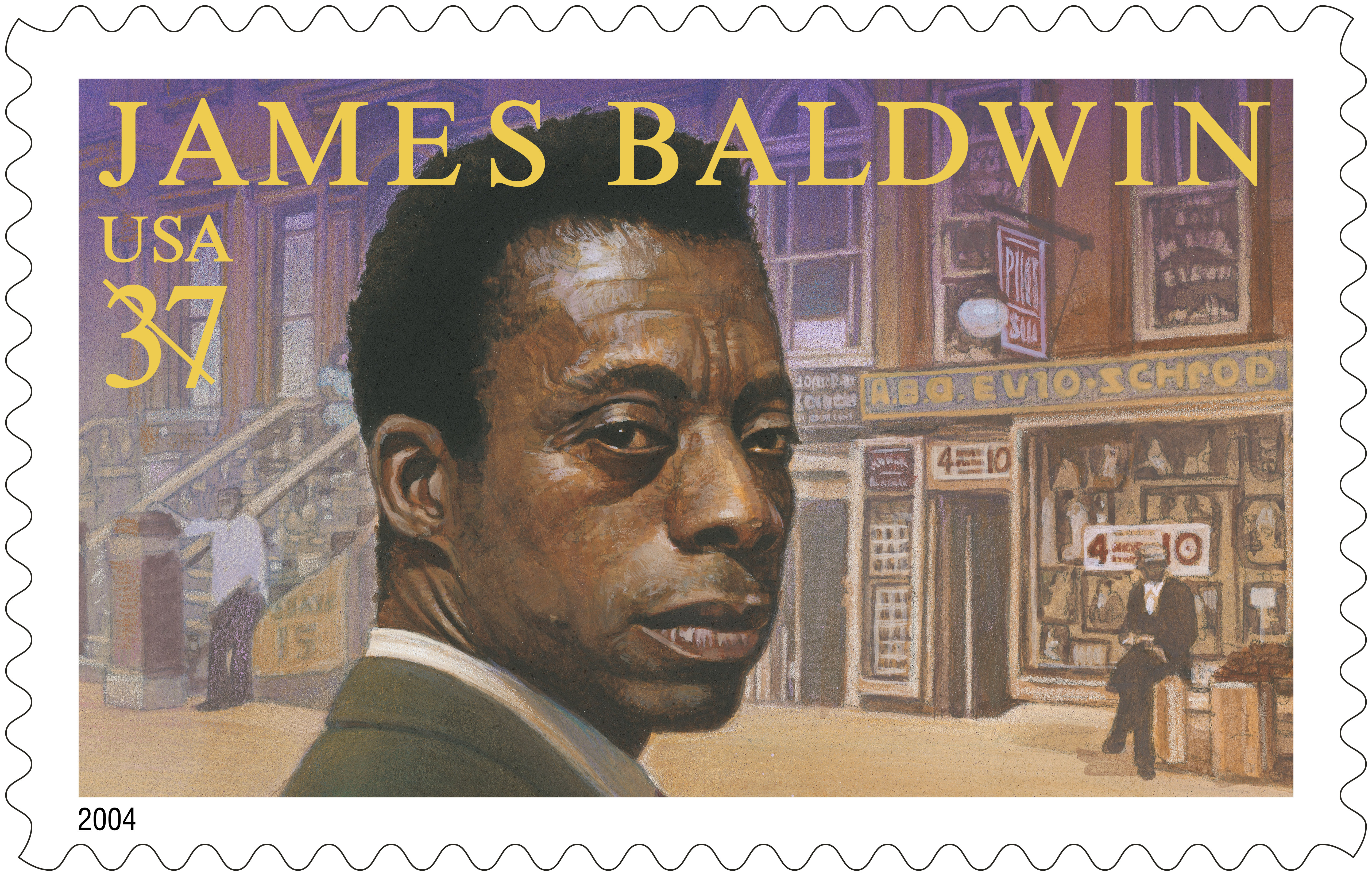
In 2004, poet Adrienne Rich (2009) wrote about a postage stamp bearing the face of American ex-patriot writer James Baldwin: “the stamp commemorates Baldwin’s birthday, August 2: he would have been eighty that year” (p. 49). This volume appears in 2014, the year that Baldwin would have turned ninety.
Rich’s essay reads as the journey of one writer’s experience embracing the other, but Rich also highlights what this volume seeks to address as well—the lack of attention that Baldwin receives in the twenty-first century U.S. Why, Rich asks, does a country still laboring under the same issues of race continue to ignore a powerful voice, as Americans certainly did when Baldwin spoke of racism?
Quoting from “Lockridge: ‘The American Myth,’” Rich (2009) includes the following:
The gulf between our dream and the realities that we live with is something that we do not understand and do not wish to admit. It is almost as though we were asking that others look at what we want and turn their eyes, as we do, away from what we are. I am not, as I hope is clear, speaking of civil liberties, social equality, etc., where indeed strenuous battle is yet carried on; I am speaking instead of a particular shallowness of mind, an intellectual and spiritual laxness….This rigid refusal to look at ourselves may well destroy us; particularly now since if we cannot understand ourselves we will not be able to understand anything. (p. 52; Baldwin, 1998, p. 593)
Baldwin’s challenge here should haunt us because it remains the challenge before us—“[t]his rigid refusal to look at ourselves.”
The following chapters—based on both scholarly and experiential perspectives—make significant contributions to the astonishingly slim amount of research and discussion that exists on one of the twentieth century’s most important public intellectuals. They provide key insights into Baldwin’s literary skills, his political views, and the impact his life and work had on historic, as well as ongoing, policy debates. They reveal a complicated, often tormented, and always provocative individual who confronted racism, imperialism, and homophobia as a black, gay pacifist. It should therefore come as little surprise that his work maintains its relevance as American society continues to grapple with racial, social, and political challenges.
[ii] Vilson offers about himself at his blog, The Jose Vilson (http://thejosevilson.com/): “José Luis Vilson is a math educator for a middle school in the Inwood / Washington Heights neighborhood of New York, NY. He graduated with a bachelor’s degree in computer science from Syracuse University and a master’s degree in mathematics education from the City College of New York. He’s also a committed writer, activist, web designer, and father. He co-authored the book Teaching 2030: What We Must Do For Our Students and Public Schools … Now and In The Future with Dr. Barnett Berry and 11 other accomplished teachers. He currently serves as the president emeritus of the Latino Alumni Network of Syracuse University, as a board member on the Board of Directors for the Center for Teaching Quality, and has been a part of the Acentos Foundation, LATinos In Social Media (LATISM), the Capicu Poetry Group, BlogCritics, and the AfroSpear.”
With his Invisible Man, Ralph Ellison’s narrator announced on the first page: “I am invisible, understand, simply because people refuse to see me.”
And with this novel, the ironies become so layered that “irony” likely isn’t sufficient.
Many see only Invisible Man when they hear Ellison’s name. And Ellison’s entry into the exclusive and mostly white and male world of the American literature canon is not without controversy since that entry has much to do with modernist (and thus a certain type of traditional, a certain level of normative) expectations for what makes literature high-quality.
Invisible Man, Ralph Ellison
As Ellison was being embraced by the mainstream world of literary fiction at mid-twentieth century, he was also creating tensions among the more left-leaning African American arts and civil rights movement—especially among the radicals.
Now at one hundred years since Ellison’s birth and more than fifty years since Invisible Man was published, the rich paradox of the invisible black man in the U.S. at mid-twentieth century must be viewed through the lens of Martin Luther King Jr.’s and Malcolm X’s assassinations.
Ellison’s invisible man recognized that mainstream (and white) America refused to see him, but African American males in the second decade of the twenty-first century are now faced with another reality of being misseen as “thugs”—criminals by their very existence.
African American males know this reality of being misseen as soon as they enter school.
Maybe one hundred years after Ellison’s birth, we have in the U.S. moved away from refusing to see African Americans, but I fear that our gained sight is not what Ellison envisioned.
There is much still to be mined in the words of Ellison, and on the occasion of his 100th birthday, I offer some places to read—and urge that we all use such occasions to close our eyes in order to open them anew and to re-vision the world.
“I am an invisible man,” begins Ralph Ellison‘s enduring modern classic Invisible Man, which transforms a science fiction standard into a metaphor for the African American condition in the U.S.
More than 50 years ago, Ellison was asked to speak about “‘these children,’ the difficult thirty percent,” the disproportionate challenges facing African American children in U.S. schools. Ellison’s discussion of language among African Americans, especially in the South, offers a powerful rejection of enduring cultural and racial stereotypes:
Some of us look at the Negro community in the South and say that these kids have no capacity to manipulate language. Well, these are not the Negroes I know. Because I know that the wordplay of Negro kids in the South would make the experimental poets, the modern poets, green with envy. I don’t mean that these kids possess broad dictionary knowledge, but within the bounds of their familiar environment and within the bounds of their rich oral culture, they possess a great virtuosity with the music and poetry of words. The question is how can you get this skill into the mainstream of the language, because it is without doubt there. And much of it finds its way into the broader language. Now I know this just as William Faulkner knew it. This does not require a lot of testing; all you have to do is to walk into a Negro church….
But how can we keep the daring and resourcefulness which we often find among the dropouts? I ask this as one whose work depends upon the freshness of language. How can we keep the discord flowing into the mainstream of the language without destroying it? One of the characteristics of a healthy society is its ability to rationalize and contain social chaos. It is the steady filtering of diverse types and cultural influences that keeps us a healthy and growing nation. The American language is a great instrument for poets and novelists precisely because it could absorb the contributions of those Negroes back there saying “dese” and “dose” and forcing the language to sound and bend under the pressure of their need to express their sense of the real. The damage done to formal grammar is frightful, but it isn’t absolutely bad, for here is one of the streams of verbal richness….
I’m fascinated by this whole question of language because when you get people who come from a Southern background, where language is manipulated with great skill and verve, and who upon coming north become inarticulate, then you know that the proper function of language is being frustrated.
The great body of Negro slang–that unorthodox language–exists precisely because Negroes need words which will communicate, which will designate the objects, processes, manners and subtleties of their urban experience with the least amount of distortion from the outside. So the problem is, once again, what do we choose and what do we reject of that which the greater society makes available? These kids with whom we’re concerned, these dropouts, are living critics of their environment, of our society and our educational system, and they are quite savage critics of some of their teachers.
What Ellison is rejecting is a deficit view of language as well as a deficit view of people living in poverty that blurs with racial prejudices. This deficit view is not some remnant of history, however; in fact, a deficit view of language and impoverished people is one of the most resilient and often repeated claims among a wide range of political and educational ideologies [1].
We know that low-SES kids tend to come to school with smaller vocabularies and less ‘schema’ than affluent kids, and both of these are correlated with (and probably caused by) poverty. Low-SES kids have heard far fewer words and enjoyed few to no opportunities for enrichment.
How about the seminal research outlined in Hart & Risley’s “Meaningful Differences”? Their research showed that there were significant differences in how low-SES parents and high-SES parents verbally interacted with their children + that the low-SES parents’ interactions were generically inferior, not just reflective of different vocabularies. The low-SES parents spoke less often to their children, used fewer words, used fewer different words, initiated fewer interactions, responded less frequently to the child’s attempt to initiate an interaction, used fewer encouraging words, and used more prohibitive words.
Two important points must be addressed about deficit views of language among impoverished people: (1) Ellison’s argument against a deficit view from 1963 is strongly supported by linguists, anthropologists, and sociologists, but (2) the flawed Hart and Risley study remains compelling, not because the research is credible (it isn’t), but because their claims match cultural assumptions about race and class, assumptions that are rooted in prejudices and stereotypes.
One powerful example of the popularity of a deficit view of language and poverty is the success of Ruby Payne’s framework of poverty books and teacher training workshops—despite a strong body of research refuting her claims and despite her entire framework lacking any credible research [2].
To understand the problems associated with deficit views of language and poverty, the Hart and Risley study from 1995 must be examined critically, as Dudley-Marling and Lucas published in 2009 [3].
Hart and Risley: Six African American Families on Welfare in Kansas City
Dudley-Marling and Lucas reject the deficit view of poverty and language, calling instead for an asset view. They note that deficit views place an accusatory gaze on impoverished parents, and thus, blaming those parents reinforces stereotypes of people in poverty and allows more credible sources of disproportionate failure by students in poverty and minority students to be ignored.
Since the political, social, and educational embracing of deficit views is commonly justified by citing Hart and Risley (1995) [4], Dudley-Marling and Lucas carefully detail what the study entails and how the claims made by Hart and Risley lack credibility.
First, Hart and Risley
studied the language interactions of parents and children in the homes of 13 upper-SES (1 Black, 12 White), 10 middle-SES (3 Black, 7 White), 13 lower-SES (7 Black, 6 White), and 6 welfare (all Black) families, all from Kansas City. Families were observed for one hour each month over a period of 2 1/2 years, beginning when children were 7–9 months old. (p. 363)
Dudley-Marling and Lucas stress:
What is particularly striking about Hart and Risley’s data analysis is their willingness to make strong, evaluative claims about the quality of the language parents directed to their children….
Many educational researchers and policy makers have generalized the findings about the language and culture of the 6 welfare families in Hart and Risley’s study to all poor families. Yet, Hart and Risley offer no compelling reason to believe that the poor families they studied have much in common with poor families in other communities, or even in Kansas City for that matter. The primary selection criterion for participation in this study was socioeconomic status; therefore, all the 6 welfare families had in common was income, a willingness to participate in the study, race (all the welfare families were Black), and geography (all lived in the Kansas City area). (pp. 363, 364)
In other words, Hart and Risley make causational claims based on a very limited sample, and those claims are widely embraced because they speak to the dominant culture’s assumptions about race and class, but not because the study’s data or claims are valid. Dudley-Marling and Lucas explain:
Conflating correlation with causation in this way illustrates the “magical thinking” that emerges when researchers separate theory from method (Bloome et al., 2005). Hart and Risley make causal claims based on the co-occurrence of linguistic and academic variables, but what’s missing is an interpretive (theoretical) framework for articulating the relationship between their data and their claims….
The discourse of “scientifically based research,” which equates the scientific method with technique, has led to a body of research that is resistant to meaningful (theoretical) critique. Hart and Risley’s conclusions about the language practices of families living in poverty, for example, are emblematic of a discourse of language deprivation that “seems impervious to counter evidence, stubbornly aligning itself with powerful negative stereotypes of poor and working-class families. It remains the dominant discourse in many arenas, both academic and popular, making it very difficult to see working-class language for what it is . . . or to be heard to be offering a different perspective.” (Miller, Cho, & Bracey, 2005b, p. 153)…
[T]hey are establishing a norm thoroughly biased in favor of middle- and upper-middle-class children. This common-sense rendering of the data pathologizes the language and culture of poor families, reflecting harmful, long-standing stereotypes that hold the poor primarily responsible for their economic and academic struggles (Nunberg, 2002). (p. 367)
The accusatory blame, then, focusing on impoverished parents is a powerful and detrimental consequence of deficit views of poverty and language, as Dudley-Marling and Lucas add:
Blaming the poor for their poverty in this way leaves no reason to consider alternative, systemic explanations for poverty or school failure. There is, for example, no reason to wonder how impoverished curricula (Gee, 2004; Kozol, 2005; Oakes, 2006), under-resourced schools (Kozol, 1992), and an insufficiency of “high-quality” teachers in high-poverty schools (Olson, 2006) limit the academic performance of many poor students. Nor is there any reason to consider how the conditions of poverty affect children’s physical, emotional, and neurological development and day-to-day performance in school (Books, 2004; Rothstein, 2004). Recent research in neuroscience, for example, indicates that the stresses of living in poverty can impair children’s brain development (Noble, McCandliss, & Farah, 2007). But most Americans do not easily embrace systemic explanations for academic failure. In our highly individualistic, meritocratic society, it is generally assumed that academic underachievement is evidence of personal failure (Mills, 1959). (p. 367)
That deficit views of language and poverty remain compelling is yet another example of a research base being discounted because cultural beliefs offer pacifying blinders:
Rolstad (2004) laments that “linguistically baseless language prejudices often underlie [even] well-designed, well-conducted studies” (p. 5). Linguistic research conducted within theoretical and anthropological linguistics and sociolinguistics that demonstrates the language strengths of children from non-dominant groups “has had virtually no impact on language-related research elsewhere” (Rolstad, 2004, p. 5). The deficit-based research of Hart and Risley, with all of its methodological and theoretical shortcomings, has been more persuasive than linguistic research that considers the language of poor families on its own terms (e.g., Labov, 1970; Heath, 1983; Michaels, 1981; Gee; 1996; see also Michaels, 2005), perhaps because Hart and Risley’s findings comport with long-standing prejudices about the language of people living in poverty (Nunberg, 2002). (pp. 367-368)
Continuing, then, to cherry-pick one significantly flawed study in order to confirm cultural stereotypes reveals far more about society and education in the U.S. than it does about children living and learning in poverty.
Despite many well-meaning educators embracing this deficit view as well as Hart and Risley’s flawed study, seeking to help students from impoverished backgrounds acquire the cultural capital associated with the dominant grammar, usage, and vocabulary is actually inhibited by that deficit view:
Finally, Hart and Risley draw attention to a real problem that teachers encounter every day in their classrooms: children enter school with more or less of the linguistic, social, and cultural capital required for school success. However, we take exception to the characterization of this situation in terms of linguistic or cultural deficiencies. Through the lens of deficit thinking, linguistic differences among poor parents and children are transformed into deficiencies that are the cause of high levels of academic failure among poor children. In this formulation, the ultimate responsibility for this failure lies with parents who pass on to their children inadequate language and flawed culture. But, in our view, the language differences Hart and Risley reported are just that—differences. All children come to school with extraordinary linguistic, cultural, and intellectual resources, just not the same resources. (p. 369)
A larger point we must confront as well is that all efforts to describe and address any social class as monolithic is flawed: Neither all affluent nor all impoverished children are easily described by what they have and don’t have. In fact, social classifications and claims about a culture of poverty are equally problematic as deficit views of poverty and language [5].
Just as Ellison confronted, U.S. society and schools remain places where minority and impoverished children too often fail. Much is left to be done to correct those inequities—both in society and in our schools—but blaming impoverished and minority parents as well as seeing impoverished and minority children (no longer invisible) as deficient stereotypes behind a false justification of research has never been and is not now the path we should take.
“I don’t know what intelligence is,” concludes Ellison in his lecture:
But this I do know, both from life and from literature: whenever you reduce human life to two plus two equals four, the human element within the human animal says, “I don’t give a damn.” You can work on that basis, but the kids cannot. If you can show me how I can cling to that which is real to me, while teaching me a way into the larger society, then I will not only drop my defenses and my hostility, but I will sing your praises and help you to make the desert bear fruit.
Continuing to embrace a deficit view of poverty and language is to embrace a desert that will never bear fruit.
[1] The source of this blog post is a comment on a post at Education Week, but deficit views of language by social class, notably the standard claim that children in poverty speak fewer words than children in middle-class and affluent homes, are common and not unique to the blog post identified here.
The truth is that the country does not know what to do with its black population now that the blacks are no longer a source of wealth, are no longer to be bought and sold and bred, like cattle; and they especially do not know what to do with young black men, who pose as devastating a threat to the economy as they do to the morals of young white cheerleaders. It is not at all accidental that the jails and the army and the needle claim so many, but there are still too many prancing around for the public comfort. Americans, of course, will deny, with horror, that they are dreaming of anything like “the final solution”—those Americans, that is, who are likely to be asked: what goes on in the vast, private hinterland of the American heart can only be guessed at, by observing the way the country goes these days. (Baldwin, 1998, pp. 432-433) [1]
He said, “No, that’s where I draw the line. I’ll beat ’em up, but I don’t want to kill ’em.” And the government said, “Well, if you won’t kill people, we won’t let you beat ’em up.”
1967-1970
From March 1967 to October 1970, Muhammad Ali lived in America the Beautiful, not as a free man, but as the embodiment of Baldwin’s declaration in 1972. Ali as African American and Black Muslim was trapped between the rule of law and his own code of ethics—which he explained as alternatives:
I have two alternatives: either go to jail or go to the army. But I would like to say that there is another alternative: and that alternative is justice.
This Ali in a suit and tie behind a microphone, glancing down to read from his prepared statement, stood in stark contrast to the Ali draped in a towel and swarmed in the boxing ring where he declared, “I shook up the world!”
Black people actually’ve been in jail for 400 years, we’ve been here in America….They can’t believe that I’m this strong. They thought they would weaken me and put fear in me by threatening to go to jail and taking my earning power. And they won’t let me work in America…
2013
My colleague, Scott Henderson, and I are currently editing a volume on James Baldwin, and during the review of the draft chapters for the collection, I began to see ads for a film about Muhammad Ali produced by HBO, Muhammad Ali’s Greatest Fight. The ads called to me in the same way I am always moved when I hear Carlin singing Ali’s name: “Muhammad Ali, Muhammad Ali, Muhammad Ali, it’s a nice musical name, Muhammad Ali.”
So I found myself watching the HBO film, at first not yet clear if it was a documentary (my hope) or a fictional film; I was certain I wasn’t interested in watching someone portray Ali. I wanted Ali.
And there he was, Muhammad Ali, archival footage to open the film, and then, despite the film focusing on the Supreme Court and the all-white crew of young men working at the Court, Ali appears throughout the story again and again. The real Ali—each time I could not stop myself from smiling at his bravado and his ability to float like a butterfly and sting like a bee outside the boxing ring.
But there is a subtext to this film focusing on the Supreme Court dominated by old white men. There is a subtext in 2013 about why now—why now is Ali’s fight with the government about his refusal to fight in Vietnam being recognized and validated?
Ali, once again, is pushed to the background in the HBO film, a work that becomes in many ways a layered narrative of privilege—white privilege and male privilege.
Some of those layers can be found in the documentary that doesn’t appear to share the privileged status of an HBO production: The Trials of Muhammad Ali.
•
Privilege is a closed space.
That space is behind a wall that provides the privileged their perch of authority as well as a walling out those Others.
Ali, Carlos, Smith, and Malcolm X lived outside the wall, and still remain under the gaze of privilege—to be acknowledged and explained when the time is right, when those with privilege see fit.
We must move past indecision to action. We must find new ways to speak for peace in Vietnam and for justice throughout the developing world, a world that borders on our doors. If we do not act, we shall surely be dragged down the long, dark, and shameful corridors of time reserved for those who possess power without compassion, might without morality, and strength without sight.
[T]he educational system as it has developed both in Europe and America [is] an antiquated process which does not hit the mark even in the case of the needs of the white man himself….The so-called modern education, with all its defects, however, does others so much more good than it does the Negro, because it has been worked out in conformity to the needs of those who have enslaved and oppressed weaker people….The same educational process which inspires and stimulates the oppressor with the thought that he is everything and has accomplished everything worth while, depresses and crushes at the same time the spark of genius in the Negro by making him feel that his race does not amount to much and never will measure up to the standards of other peoples. The Negro thus educated is a hopeless liability of the race. (pp. 4-5) [2]
This is why those pious calls to “respect the law,” always to be heard from prominent citizens each time the ghetto explodes, are so obscene. The law is meant to be my servant and not my master, still less my torturer and my murderer. To respect the law, in the context in which the American Negro finds himself, is simply to surrender his self-respect….
These things happen, in all our Harlems, every single day. If we ignore this fact, and our common responsibility to change this fact, we are sealing our doom. Here is the boy, Daniel Hamm, speaking—speaking of his country, which has sworn to bung peace and freedom to so many millions. “They don’t want us here. They don’t want us—period! All they want us to do is work on these penny-ante jobs for them—and that’s it. And beat our heads in whenever they feel like it. They don’t want us on the street ’cause the World’s Fair is coming. And they figure that all black people are hoodlums anyway, or bums, with no character of our own. So they put us off the streets, so their friends from Europe, Paris or Vietnam—wherever they come from—can come and see this supposed-to-be great city.”
There is a very bitter prescience in what this boy—this “bad nigger”—is saying, and he was not born knowing it. We taught it to him in seventeen years. He is draft age now, and if he were not in jail, would very probably be on his way to Southeast Asia. Many of his contemporaries are there, and the American Government and the American press are extremely proud of them. They are dying there like flies; they are dying in the streets of all our Harlems far more hideously than flies. A member of my family said to me when we learned of the bombing of the four little girls in the Birmingham Sunday school, “Well, they don’t need us for work no more. Where are they building the gas ovens?” Many Negroes feel this; there is no way not to feel it.
•
Privilege is a spider’s web.
Where is the space for Ali to speak for Ali? When will that space exist, and how?
I agree with Carlin that there is music in Ali’s name, but the song remains bittersweet—too hard to swallow in 2013.
I cannot disentangle the web of history that remains attached to all of us, regardless of how hard we try to pull the invisible strings from our faces, our clothes, and our skin.
That web we cannot free ourselves from is privilege—and privilege demands only two alternatives.
But as Ali explained, there is a third alternative and “that alternative is justice.”
It is time, we must listen to Ali.
[1] Baldwin, J. (1998). James Baldwin: Collected essays. New York, NY: The Library of America. Originally published in 1972, No Name in the Street.
No rhetorical sleight of words should mask that Trayvon Martin was a son. He had parents.
No rhetorical sleight of words should allow us to ignore that any child is everyone’s child.
Trayvon Martin was killed in part because he was reduced to a stereotype, and after his death, Trayvon was again reduced—often by well-meaning people—to an icon, the hoodie.
In his death, as well, Trayvon has been spoken about, spoken for—and I am compelled to argue that he has also been rendered voiceless.
But, as Arundhati Roy has explained, “We know of course there’s really no such thing as the ‘voiceless’. There are only the deliberately silenced, or the preferably unheard.”
I am also compelled to speak beyond Trayvon, about “the deliberately silenced, or the preferably unheard” Others, African American males.
At mid-twentieth century, as the US was fighting against its racist heritage, African American males demanded to be heard—Martin Luther King Jr., Malcolm X, Ralph Ellison, James Baldwin, Richard Wright and many others took the stage as artists, public intellectuals, and civic leaders.
Wright’s Black Boy and Ellison’s Invisible Manrepresent in fictional narrative a powerful and disturbing image of the African American male; for Ellison, the guiding metaphor of that narrative is invisibility. The killing of Trayvon and the subsequent trial may suggest that African American males no longer suffer from invisibility but from how they are seen, how they are silenced, and how they are unheard: Trayvon seen (and reduced) as black male, thus necessarily a thug, a threat, and then Trayvon, the hoodie, the icon of the disposable African American male.
Just as Wright’s and Ellison’s fiction captures the African American male experience at mid-twentieth century, continuing to speak to the complex and entrenched conditions that contributed to Trayvon’s killing, Ellison’s and Baldwin’s concerns about the failure of education to see clearly and holistically—and humanely—African American males remain ominous and powerful messages in 2013.
At this point it might be useful for us to ask ourselves a few questions: what is this act, what is this scene in which the action is taking place, what is this agency and what is its purpose? The act is to discuss “these children,” the difficult thirty percent. We know this very well; it has been hammered out again and again. But the matter of scene seems to get us into trouble.
Ellison recognized the stigma placed on African American students, a deficit view of both an entire race and their potential intelligence (marginalized as insufficient language skills):
Some of us look at the Negro community in the South and say that these kids have no capacity to manipulate language. Well, these are not the Negroes I know. Because I know that the wordplay of Negro kids in the South would make the experimental poets, the modern poets, green with envy. I don’t mean that these kids possess broad dictionary knowledge, but within the bounds of their familiar environment and within the bounds of their rich oral culture, they possess a great virtuosity with the music and poetry of words. The question is how can you get this skill into the mainstream of the language, because it is without doubt there. And much of it finds its way into the broader language. Now I know this just as William Faulkner knew it. This does not require a lot of testing; all you have to do is to walk into a Negro church.
But Ellison rejected this deficit perspective: “Thus we must recognize that the children in question are not so much “culturally deprived” as products of a different cultural complex”:
As we approach the dropouts, let us identify who we are and where we are. Let us also have a little bit of respect for what we were and from whence we came. There is a bit of the phony built into every American. This is inevitable in a conscious society that has developed as swiftly as ours has. We are faced with endless possibilities for change, for metamorphosis. We change our environment, our speech, our styles of living, our dress, and often our values. So, in effect, we become somebody else–or so we are tempted to believe–and often we act as though we have no connection with our past. We are all tempted to become actors, and when we forget who we are and where we are from, our phony selves take command.
Finally, Ellison demanded that the human dignity of all children be honored:
I don’t know what intelligence is. But this I do know, both from life and from literature: whenever you reduce human life to two plus two equals four, the human element within the human animal says, “I don’t give a damn.” You can work on that basis, but the kids cannot. If you can show me how I can cling to that which is real to me, while teaching me a way into the larger society, then I will not only drop my defenses and my hostility, but I will sing your praises and help you to make the desert bear fruit.
Baldwin addressed teachers in that same year, 1963: “Let’s begin by saying that we are living through a very dangerous time. Everyone in this room is in one way or another aware of that. We are in a revolutionary situation, no matter how unpopular that word has become in this country. The society in which we live is desperately menaced, not by Khrushchev, but from within.”
Then, Baldwin unmasked the cruel tension between the promise of universal public education and the inequity found in the lives of African American children:
Now, if what I have tried to sketch has any validity, it becomes thoroughly clear, at least to me, that any Negro who is born in this country and undergoes the American educational system runs the risk of becoming schizophrenic. On the one hand he is born in the shadow of the stars and stripes and he is assured it represents a nation which has never lost a war. He pledges allegiance to that flag which guarantees “liberty and justice for all.” He is part of a country in which anyone can become president, and so forth. But on the other hand he is also assured by his country and his countrymen that he has never contributed anything to civilization – that his past is nothing more than a record of humiliations gladly endured. He is assumed by the republic that he, his father, his mother, and his ancestors were happy, shiftless, watermelon-eating darkies who loved Mr. Charlie and Miss Ann, that the value he has as a black man is proven by one thing only – his devotion to white people. If you think I am exaggerating, examine the myths which proliferate in this country about Negroes….
The point of all this is that black men were brought here as a source of cheap labor. They were indispensable to the economy. In order to justify the fact that men were treated as though they were animals, the white republic had to brainwash itself into believing that they were, indeed, animals and deserved to be treated like animals. Therefor it is almost impossible for any Negro child to discover anything about his actual history. The reason is that this “animal,” once he suspects his own worth, once he starts believing that he is a man, has begun to attack the entire power structure. This is why America has spent such a long time keeping the Negro in his place. What I am trying to suggest to you is that it was not an accident, it was not an act of God, it was not done by well-meaning people muddling into something which they didn’t understand. It was a deliberate policy hammered into place in order to make money from black flesh. And now, in 1963, because we have never faced this fact, we are in intolerable trouble.
Ultimately, education, for Baldwin, is revolutionary, an act of social justice:
I began by saying that one of the paradoxes of education was that precisely at the point when you begin to develop a conscience, you must find yourself at war with your society. It is your responsibility to change society if you think of yourself as an educated person. And on the basis of the evidence – the moral and political evidence – one is compelled to say that this is a backward society. Now if I were a teacher in this school, or any Negro school, and I was dealing with Negro children, who were in my care only a few hours of every day and would then return to their homes and to the streets, children who have an apprehension of their future which with every hour grows grimmer and darker, I would try to teach them – I would try to make them know – that those streets, those houses, those dangers, those agonies by which they are surrounded, are criminal. I would try to make each child know that these things are the result of a criminal conspiracy to destroy him. I would teach him that if he intends to get to be a man, he must at once decide that his is stronger than this conspiracy and they he must never make his peace with it. And that one of his weapons for refusing to make his peace with it and for destroying it depends on what he decides he is worth. I would teach him that there are currently very few standards in this country which are worth a man’s respect.
No rhetorical sleight of words should mask that Trayvon Martin was a son. He had parents.
No rhetorical sleight of words should allow us to ignore that any child is everyone’s child.
However if the killing of Trayvon does not haunt us, if the killing of Trayvon slips beneath the next tragedy-of-the-moment—as the Sandy Hook shooting has beneath the Zimmerman trial—then society and schools will continue to be mechanisms that shackle “the deliberately silenced, or the preferably unheard.”
And I suppose that is ultimately the cruel paradox, rendering Trayvon a ghost in this American house he was never allowed to enter, invisible again as Ellison’s unnamed narrator.
educator, public scholar, poet&writer – academic freedom isn't free






 dr. p.l. (paul) thomas