Category Archives: reading

Centering Students in Novel and Play Study

Student knowledge and beliefs about literacy and literature are necessarily a reflection of their teachers’ knowledge and beliefs about literacy and literature.

I teach first-year writing at the university level; much of my work is helping students unlearn and reconsider that knowledge and those beliefs they brings from K-12 education.

Teacher posts on social media are often windows into the misconceptions those students bring to college. I recently fretted for a few days after seeing Advanced Placement teachers refer to book-length nonfiction as “novels,” which triggered a recurring situation when I ask students what novels they read in high school.

The answers often include The Crucible and Shakespeare as well as more recently Between the World and Me—prompting me to note that none of those are novels. Students have mis-learned to call any book assigned and studied in school a “novel,” the seeds of having weak or even flawed understanding of genre (see also here), medium, and mode in reading and writing.

Before I could spend any time on that social media post, however, I came across this:

I agree with both challenges here, but think Anger’s post is way more than a “bad take.” Here are a couple reasons why before a fuller discussion of how to center students in novel and play study.

First, I have little experience that assigning a single novel/play for all students to study under the guidance of the teacher is somehow mostly absent from high school literature classes.

Second, whole class study of novels and plays centers the teacher’s authority (the teacher guides the students through the work and then assesses students on that teacher’s framing of the work) and acquisition of knowledge about a singular work (essentially trivia).

Dropping the whole-class study of assigned novels/plays is not only a needed shift in literature study with students, but also a better approach to fostering student autonomy and healthier beliefs and deeper knowledge about literacy and literature.

One instructional and assessment shift is fostering students’ skills at text analysis instead of knowledge acquisition about a specific text. Traditionally, we assign The Scarlet Letter, walk students through the novel page-by-page, and then test students on knowledge they have retained about that novel.

Instead, we should be giving students multiple experiences interrogating texts and then putting them in new text situations to assess their ability to analyze texts. For example, we can do whole-class instruction on a short text by Hawthorne as preparation for having students analyze a text by Hawthorne students haven’t read before.

The key is not knowing facts about Hawthorne’s canonical novel, but fostering their ability to analyze a text better because they are familiar with that author and have context for anticipating those new texts.

The assigned whole-class novel/play is appealing, I think, because it allows greater control of instruction and, again, centers authority in the teacher and the work being studied. None of that, however, is fostering the sort of autonomy, knowledge, and beliefs students need, and deserve.

In the late 1990s when I was teaching high school AP Literature, I made the switch from assigning whole class novels and plays to complete student choice in the major works my students studied in preparation for the AP Literature exam.

I documented that first experience in English Journal because I learned some key lessons the hard way.

First, this shift requires purposeful and direct instruction that supports students’ ability to choose novels and plays. My students taught me that over a decade of being assigned what to read had failed them as skilled or even eager consumers of works.

Teachers disproportionately do way too much for students (see also the problem with rubrics and writing prompts) and inculcate compliance over agency and autonomy.

Finally, let’s consider how making the shift away from whole-class assigned novels and plays can be navigated by teachers despite the valid challenges that poses.

Novel/play knowledge and instructional strategies are often the two most pressing concerns for teachers accustomed to traditional novel/play study.

Yes, I have had students choose novels/plays I had not read (but often read eventually because students chose them) but that in no way hindered my ability to offer instruction or assess their work. In fact, when students are allowed to be the authority on a text, they often are more fully engaged in both reading and understanding the work.

Next, allowing students tethered choice in texts can fit into traditional practices.

The primary structure of novel/play study grounded in student choice and agency is that I designed thematic units within which students chose their works (tethered choice).

For example, one unit was Black writers and the lives of Black Americans. Students had to choose and justify a novel within that theme (we focused on works that helped prepare them for the AP exam, for example, but in any class the purpose must be established for studying the work—understanding American literature or preparation for college, etc.).

Next, for each work the student chooses, they had to build a resource folder on that work by doing searches in the library; these resource folders had literary analysis and author material that supported the student’s study but also gave me access to knowledge if I had not read the work.

Now, I think this is the key for teachers concerned about how to conduct instruction.

We still had whole-class discussions around the thematic element, but each student was invited to share their journey through their chosen text. All students, then, were encouraged to connect and contrast as the discussions unfolded.

For example, one student would note the use of flying motifs drawn from African mythology in Toni Morrison’s Song of Solomon, prompting other students to share the use of flying motifs in other works.

These organic connections were much more engaging than when I orchestrated page-by-page analysis of a shared novel or play.

These class discussions were embedded in reading workshop structures that allowed students time in class to read and research as well as conference with me and other students (especially when students chose the same work).

Using these approaches, students read more, were more deeply engaged, and gained much healthier beliefs and richer knowledge.

As teachers, we must constantly interrogate when our commitments are grounded in retaining power and authority versus fostering the autonomy and agency of our students as well as the integrity of our fields of literacy and literature.

Despite social media protestations, I doubt whole-class novel/play study has disappeared from high school literature classes, but I also certain that making the shift away from that and toward student agency would be one of the best developments for those students.

The Zombie Politics of Marketing Phonics: “There Is a Sucker Born Every Minute”

Consider the following claims about reading proficiency in students and the teaching of reading in the US:

  • No one teaches phonics.
  • There is a phonemic awareness crisis.
  • Direct, systematic, and sequential phonics is the only way to go.
  • Decodable texts are important.

I suspect that most people concerned about education and reading who pay even a modicum of attention to mainstream media will find these claims not only applicable to the current state of reading but also true.

However, there is a problem, which prompted this post from Rachael Gabriel:

As Richard Allington details, these claims are simply not scientific, ironically, even as advocates of the “science of reading” repeat claims that have been standard but misleading arguments for decades.

Since at least the 1940s, these phonics-centered claims have been compelling for the media, the public, and more recently political leaders; yet, “there is no indisputable evidence of a national crisis in reading, and even if there were a crisis, there is no evidence that the amount of phonics in classrooms is necessarily the cause or the solution,” as shown by David Reinking, George G. Hruby, and Victoria J. Risko.

At the core of the phonics frenzy is market, and as Allington noted in the late 1990s, “There is a sucker born every minute.”

I recommend reading Allington’s piece in full and the following reader for context and much more complex and accurate understanding of reading proficiency and the teaching of reading:

LNL: The Debate Over Grade-Level Reading

LNL: The Debate Over Grade-Level Reading

See Also

A Critical Examination of Grade Retention as Reading Policy (OEA)

Grade Retention Advocacy Fails by Omission

Gaming the System with Grade Retention: The Politics of Reading Crisis Pt. 3

Grade Retention Harms Children, Corrupts Test Data, But Not a Miracle: Mississippi Edition

Beware Grade-Level Reading and the Cult of Proficiency

What Do We Really Know about Reading Proficiency in the US?

Understanding and Reforming the Reading Proficiency Trap

ILEC Response: The Right to Read: The greatest civil rights issue of our time.

International Literacy Educators Coalition

ILEC Vision: To promote literacy learning practices that enable all children and youth to realize their full potential as literate, thinking human beings.

Download a PDF of the response.


ILEC Response: The Right to Read: The greatest civil rights issue of our time.

The Right to Read connects reading instruction, civil rights, and full participation in society by asserting that there is only one approach to teaching reading. The film provides few specific details about the research that supports this stance, and there is little to no discussion about other aspects of teaching and learning that impact student achievement.

Also, there are the repeated examples of what Maren Auckerman refers to as “Errors of Insufficient Understanding”or “errors that reflect inadequate grasp of the field.” Auckerman’s examples include:  a weak connection to actual research, misrepresenting research findings and over-relying on a narrow slice of research. The narrators assert: “We know what works” without citing research to back up this claim.  The film repeatedly uses wording that illustrates Auckerman’s points such as: “proven,” “what’s working,” “what’s not working,” “evidence-based”, “all research indicates,” “research”, and “consensus.”[1]

As we watched the film, Rachael Gabriel’s words continue to resonate: “Even as debates roiled about approaches to reading instruction, it was clear that individual teacher decisions were important for optimizing students’ opportunities to learn. If teacher decision-making is of paramount importance, then so is a teacher’s individual knowledge base for teaching” (Chapter 7, p. 173).[2]

Positive Aspects of the film:

  1. The film highlights the racialized achievement gap and asserts that solutions are possible.
  2. It emphasizes all people have the right to learn to read to attain a successful life.
  3. The film stresses the critical roles of research and family members in literacy education.

ILEC Concerns:

  1. There is no mention of culturally responsive, research-based practices or research-based practices for multilingual learners.
  2. The film claims there is one right way to teach reading to all students, excluding all other research-based approaches.
  3. The film includes false claims such as: “The root of the problem is that children are being taught in a way that is not working” and “When you tell me that you are choosing not to follow the research….”
  4. The film endorses an approach that takes away teacher agency and decision making while ignoring the importance of ongoing professional learning and the value of teacher experience. 
  5. Relying on anecdotes, the film focuses on the story of one “rookie” teacher to make sweeping general claims about a specific reading curriculum.
  6. The film ignores many aspects of literacy such as writing instruction, comprehension, or the joy of reading.

[1] Aukerman, M. (2022) The Science of Reading and the Media: Does the Media Draw on High-Quality Reading Research? Literacy Research Association Critical Conversations. CC BY 4.0 license; Aukerman, M. (2022). The Science of Reading and the Media:  How Do Current Reporting Patterns Cause Damage? Literacy Research Association Critical Conversations. CC BY 4.0 license.

[2] How Education Policy Shapes Literacy Instruction: Understanding the Persistent Problems of Policy and Practice Edited by Rachael Gabriel (1st Ed 2022, Palgrave Macmillan).

Deja Vu All Over Again: The Never Ending Pursuit of “Scientific” Instruction

Writing in NCTE’s Elementary English (known as Language Arts since 1975), Lou LaBrant offered a bold proclamation that resonates still today: “This is not the time for the teacher of any language to follow the line of least resistance, to teach without the fullest possible knowledge of the implications of his medium” (1947, p. 94).

LaBrant entered the classroom in 1906, and after experiencing forced retirement in her 60s, she found ways to remain in the field at historically Black colleges, finally retiring fully in 1971 from Dillard University. This impressively long career sits at the center of an impressively long life, living until she was 102 after writing her memoir at 100.

The embodiment of Deweyian Progressivism, LaBrant was equally demanding of herself as she was of others—particularly educators. Her high standards and blunt speaking and writing style make her appealing and often intimidating.

Her piece from 1947 also includes other statements I have repeated in my public and scholarly work:

A brief consideration will indicate reasons for the considerable gap between the research currently available and the utilization of that research in school programs and methods…. (p. 87)

It is not strange, in view of the extensive literature on language, that the teacher tends to fall back upon the textbook as authority, unmindful of the fact that the writer of the text may himself be ignorant of the basis for his study. (pp. 88-89)

LaBrant, L. (1947, January). Research in languageElementary English, 24(1), 86-94. http://www.jstor.org/stable/41383425

Seventy-six years later, LaBrant could just as easily be speaking into the current “science of reading” (SOR) debate that centers research (“science”) and the imbalance of authority often conceded to reading programs.

Some, in fact, may be compelled to assume LaBrant would be an outspoken advocate for SOR. However, LaBrant’s scholarship and practice offer a window into why the SOR movement is misguided and misleading, specifically about the central role of pursuing “scientific” instruction.

To understand that the current SOR is a misuse of the term “scientific” we should reach back a bit farther in LaBrant’s career to 1931:

The cause for my wrath is not new or single. It is of slow growth and has many characteristics. It is known to many as a variation of the project method; to me, as the soap performance. With the project, neatly defined by theorizing educators as “a purposeful activity carried to a successful conclusion,” I know better than to be at war. With what passes for purposeful activity and is unfortunately carried to a conclusion because it will kill time, I have much to complain. To be, for a moment, coherent: I am disturbed by the practice, much more common than our publications would indicate, of using the carving of little toy boats and castles, the dressing of quaint dolls, the pasting of advertising pictures, and the manipulation of clay and soap as the teaching of English literature. (p. 245)

LaBrant, L. (1931, March). MasqueradingThe English Journal, 20(3), 244-246. http://www.jstor.org/stable/803664

In the first couple decades of the 1900s, John Dewey practiced and developed a progressive approach to teaching and learning that was grounded in his call for scientific instruction and holistic approaches to education. Many associate Dewey with “learning by doing,” a relatively fair summary but one that is ripe for misapplication.

Similar to what has been repeated in educational practice for at least a century, William Heard Kilpatrick seized onto Dewey’s concept but packaged it as the Project Method, the source of LaBrant’s “wrath” in 1931.

Dewey’s progressive education philosophy has a very odd history that includes progressivism routinely being blamed for educational failure even though public education in the US being historically and currently deeply traditional and conservative (read Kohn on this paradox).

Two dynamics are at play.

First, formal public education in the US has mostly grounded practice in efficiency since the 1920s—packing as many students per teacher into the classroom as possible and structuring curriculum and instruction around commercial programs and standardized testing.

Second, progressive “scientific” is much more complex and nuanced than current and narrow uses of “scientific” in the SOR movement.

Dewey and LaBrant were advocates for teacher autonomy and authority, which rested on the expectation that teachers know the current evidence base (the “science”) of their filed of literacy but in the context of their day-to-day classroom practice. Both, for example, would strongly reject teaching reading through a commercial reading program of any kind.

Dewey’s progressivism, then, is tethered to the real world in front of the teacher—student behaviors and classroom dynamics.

Philosophy and theory (based on evidence, some of which is generated by the scientific process) provide the teacher with a place to start instruction; however, the evidence in front of the teacher during the act of teaching perpetually shapes practice.

Dewey advocated for “scientific” teaching as an ongoing experiment, not teaching grounded to a template derived from a narrow body of experimental and quasi-experimental research.

If LaBrant were alive today, she would be writing pieces very similar to her 1931 diatribe about the project method, but targeting the SOR movement and the deeply unscientific legislation and practices that movement has spawned: testing students with nonsense words, grade retention, scripted reading programs, one-size-fits-all systematic phonics, LETRS training, NAEP data, “miracle” claims, and more.

Yes, as LaBrant lamented in 1947, public education has a long history of a “considerable gap” between research (“science”) and classroom practice, but another problem sitting between better instruction and greater learning by students is the never ending pursuit of “scientific” instruction that weaponizes “science” and fails to acknowledge the most powerful messages of Dewey’s progressivism—teaching and learning must be focused on the real students sitting in front of teachers daily.

Those unique and diverse students are best served by teachers who teach as scientists perform science—starting with informed hypotheses, implementing instructional practices, developing temporal and unique theories for each student, and adjusting practice based on that evidence for the benefit of each student.

Progressive ideas of “science” are ways to navigate the world in informed and practical ways; conversely, the SOR movement has once again reduced “scientific” to an ideological and political baseball bat used to batter anyone not conforming to their misinformation.

Although LaBrant left us over three decades ago, I can feel her wrath for the SOR movement growing somewhere in the universe, and regret we do not have her voice still to guide us—but we do have her words: “This is not the time for the teacher of any language to follow the line of least resistance, to teach without the fullest possible knowledge of the implications of his medium” (1947, p. 94).

Everything You Know Is Wrong: Reading Edition

As a teenager in the 1970s, I was turned on to The Firesign Theater, and in those days, it was listening to their extended faux radio skits on vinyl (or as we said then, “albums”). One of their album titles lingers in my mind often: Everything You Know Is Wrong.

In fact, thinking about that title inspired me to post a couple polls on social media:

The first set of questions speaks to how we are often trapped in presentism, especially in the stories told by the media and messages perpetuated by politicians.

As I document in my reading policy brief and my book on reading wars, there has not been a single moment in the history of the US since at least the 1940s that we have not in the media and by politicians lamented low reading proficiency in students; as well, no standardized measurement of reading proficiency has ever been substantially different than now.

As with all measurements of student learning, reading proficiency has never been good enough and reading test scores have always correlated strongly with poverty, race, and gender.

Therefore, crisis rhetoric around reading is another manufactured crisis that is dismantled once we step back for historical perspective.

The second poll exposes how powerful media misinformation is, and how common it is for a claim to get into the public rhetoric without ever being interrogated.

The correct answer is “unknown,” although 30-35% not at grade level proficiency can be viewed as a credible estimate.

60-70% is definitely wrong, but represents the power of media messaging (based on not understanding NAEP). In 2018, Emily Hanford established this false claim: “More than 60 percent of American fourth-graders are not proficient readers, according to the National Assessment of Educational Progress, and it’s been that way since testing began in the 1990s.”

Then in 2023, Nicholas Kristof jumped into the long line of journalists who simply repeat this misinformation without ever checking the facts: “One of the most bearish statistics for the future of the United States is this: Two-thirds of fourth graders in the United States are not proficient in reading.”

We in the US love criticism of schools, students, and teachers, and making a negative claim about any of those will likely go unchecked.

Notice anything familiar about Susan O’Hanian’s experience at the Educator Writers Association (EWA) conference in 2003?:

Kati Haycock, though, was the one who really came up to the table for No Child Left Behind, reiterating these points:

  • Colleges of education are still teaching reading the way we thought it should be taught ten years ago.
  • There’s a “scientific” way to teach reading and teachers should be trained to do it.
The Press: All the News about Public Schools They Feel Like Printing

The rhetoric and claims of those who want and need an education crisis are consistent, reaching back, again, to the 1940s, but also as recent as just 20 years ago when NCLB legislated “scientifically based” instruction and codified the National Reading Panel (NRP).

The media has taken a term, “proficiency,” and carelessly misinformed the public (because most journalists have little or no background in education, testing, statistics, etc.).

NAEP uses “proficiency” for achievement well above grade level, as is explained at the NAEP website (see also for a full explanation Loveless, 2023Loveless, 2016):

NAEP student achievement levels are performance standards that describe what students should know and be able to do. Results are reported as percentages of students performing at or above three NAEP achievement levels (NAEP Basic, NAEP Proficient, and NAEP Advanced). Students performing at or above the NAEP Proficient level on NAEP assessments demonstrate solid academic performance and competency over challenging subject matter. It should be noted that the NAEP Proficient achievement level does not represent grade level proficiency as determined by other assessment standards (e.g., state or district assessments). See short descriptions of NAEP achievement levels for each assessment subject.

Scale Scores and NAEP Achievement Levels

NAEP “basic” is closer to what states have established as “grade level proficiency”; however, to further complicate the matter, the US has no standard definition for “grade level proficient,” and most people have never confronted that we should actually be using “age level proficiency.”

Thus, 60-70% is, in fact, absolutely not how many students are not reading at grade level. If we trust NAEP basic, it may be fair to say that about 30% or so are not at grade level.

But the most accurate claim we can make is that we have no real idea because we have failed to create the structures needed to know.

Why?

To be blunt, media and politicians benefit from constant education crisis, and if we actually implemented effective education reform, the profit of perpetual reform would disappear.

More historical perspective: None of the reforms have worked over the past 40 years of high-stakes accountability.

None.

The manufactured crises were all lies, and the solutions had little to do with education.

Reading crisis?

Nope.

Once again, the crisis rhetoric is a lie and the reforms benefit almost anyone except students and teachers.

Thanks to media and political misinformation, everything you know is wrong.

EWA Doubles Down on Media Misinformation Campaign about Reading

Although the “science of reading” (SOR) is now essentially the law of the land in the US—nearly every state has passed some form of reading legislation grounded in SOR—the Education Writers Association (EWA) has decided to double down on the media misinformation campaign about reading: Covering How Students Learn to Read: Tips to Get Started.

Not surprisingly, this brief overview for journalists relies heavily on the work of Emily Hanford (whose career was significantly boosted by EWA’s support for her relentless coverage of SOR) and repeats a number of claims in the SOR movement that have been discredited by scholars of literacy (see below).

The SOR education reform movement, however, is yet another neoliberal reform movement grounded in the “bad teacher” narrative (see the second excerpt below).

Education reform since the 1980s is mostly about creating churn and crisis for the benefit of media (sensational stories attract an audience for floundering outlets such as APM), the education marketplace (out with the old and in with the new—the same entities make money off Heinemann and the “new” structured literacy programs), and political grandstanding (despite none of the education reforms ever working).

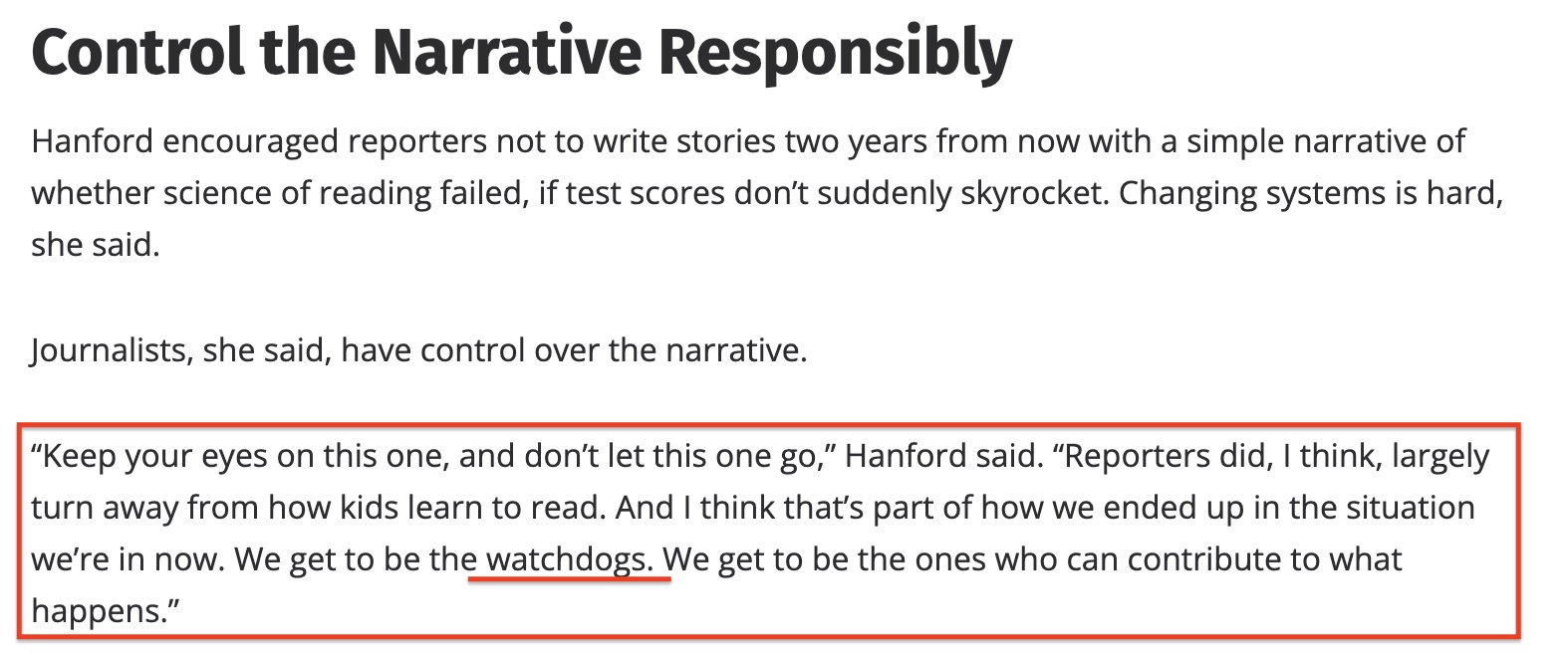
Let me draw your attention to two passages from EWA and then offer a reader that dismantles the false stories and offers the full picture of what we know (and don’t know) about teaching reading):

The research on reading is not in fact settled (see here) and this last passage exposes the fundamentally negative attitude (“watchdogs”) about teachers at the core of the SOR movement and its public and political appeal.

The media has been and seems determined to be irresponsible with their reporting about reading, students, and teachers.

For the full and complicated story, here are alternative texts:


Recommended

The Press: All the News about Public Schools They Feel Like Printing, Susan Ohanian

ILEC Response: Toward Addressing and Resolving Disparities in Reading Outcomes: A Statewide Database of Curriculum, Instruction, and Assessments in Minnesota (CAREI, University of Minnesota, June 2023), Kimberly Gibbons, Robert Richardson, Eskender Yousuf, Annie Goerdt, and Mahasweta Bose

International Literacy Educators Coalition

ILEC Vision: To promote literacy learning practices that enable all children and youth to realize their full potential as literate, thinking human beings.

Download a PDF of the response.


ILEC Response: Toward Addressing and Resolving Disparities in Reading Outcomes: A Statewide Database of Curriculum, Instruction, and Assessments in Minnesota (CAREI, University of Minnesota, June 2023), Kimberly Gibbons, Robert Richardson, Eskender Yousuf, Annie Goerdt, and Mahasweta Bose

The report asserts: “Minnesota is in dire need of comprehensive literacy reform,” raising reading crisis claims from the “science of reading” (SOR) movement. Framing reading achievement as “alarming,” the report offers an ambitious body of data related to reading programs in the state, correlations of reading achievement and curricula, assessments used for screening and monitoring, and interventions implemented.

This report on Minnesota provides a needed model for understanding reading instruction and achievement in all states, but is seriously compromised by bias related to an uncritical acceptance of SOR stories. Claims made fail standards for “scientific,” and the report relies on media stories and surveys, and selected evidence while making a narrow case for “scientific” reading preparation and instruction.

Positive Aspects of the Report:

  1. Data gathered on key aspects of reading instruction should be a model for all states.
  2. The report highlights the significant inequity challenges represented by reading achievement data.

ILEC Concerns:

  1. The report makes sweeping inaccurate claims using “crisis” rhetoric and repeating stories from the SOR movement not supported by research, specifically misrepresenting reading programs and instructional practices (such as three cueing)[1] as ineffective or not supported by SOR.
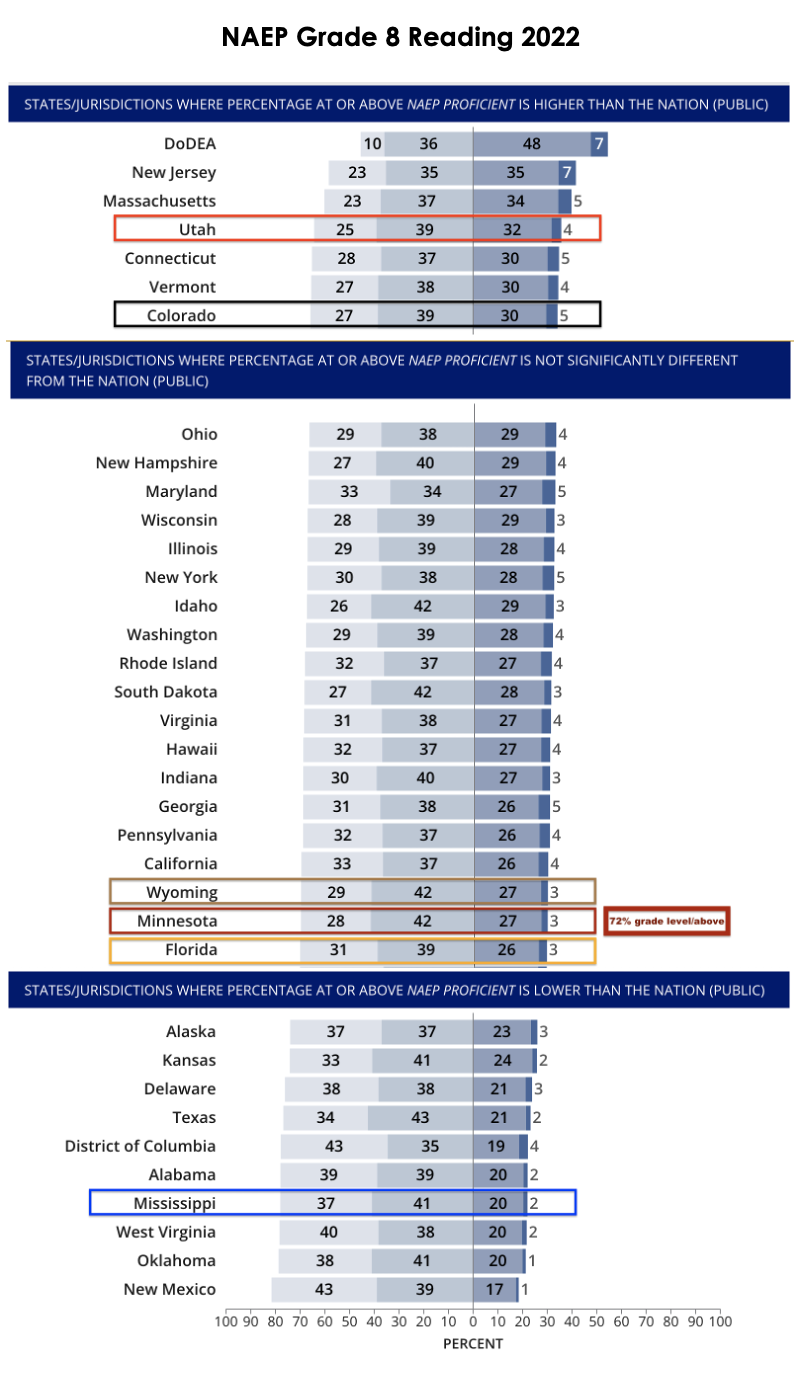
  2. The report notes MN’s stellar ACT scores and ignores that MN’s grade 8 NAEP reading scores (72% at/above grade level) are above Mississippi and comparable to FL, CO, UT, and WY while perpetuating SOR “miracle” myths. [See NAEP data below]
  3. Evidence in the report cites non-scientific sources (media) and cherry-picked research while making claims of a settled body of reading science that is never cited fully.[2]
  4. Analyses throughout the report treat correlation as causation, and thus, the analysis distorts the ambitious gathering of data through ideological claims.
  5. The report relies on outdated evidence (NRP) and endorses programs not supported by research (LETRS), for example, and thus does not practice the same standards the report expects of state reading policy decisions.
  6. Recommendations in the report are recycled approaches states have attempted for four decades without success, specifically calling for identifying effective reading programs and focusing on in-school-only reforms.
  7. Report authors have psychology and general education, not literacy, credentials: Kimberly Gibbons, Robert Richardson, Eskender Yousuf, Annie Goerdt, and Mahasweta Bose.

[1] Compton-Lilly, C.F., Mitra, A., Guay, M., & Spence, L.K. (2020). A confluence of complexity: Intersections among reading theory, neuroscience, and observations of young readers. Reading Research Quarterly, 55(S1), S185-S195. https://doi.org/10.1002/rrq.348; Mora, J.K. (2023, July 3). To cue or not to cue: Is that the question? Language Magazinehttps://www.languagemagazine.com/2023/07/03/to-cue-or-not-to-cue-is-that-the-question/

[2] See The Negative Legislative Consequences of the SOR Media Story: An Open-Access Reader  


ILEC Response: Mainstream media coverage of reading proficiency, teachers of reading, NAEP scores, and teacher preparation

International Literacy Educators Coalition

ILEC Vision: To promote literacy learning practices that enable all children and youth to realize their full potential as literate, thinking human beings.

Download a PDF of the response.


ILEC Response: Mainstream media coverage of reading proficiency, teachers of reading, NAEP scores, and teacher preparation

Mainstream media such as Education Week, the New York Times[1], APM, and Forbes persist in recycling a compelling but misleading story about reading proficiency, teachers of reading, NAEP scores, and teacher preparation that is not supported by the full body of evidence. As Aukerman explains:

From how much of the media tells it, a war rages in the field of early literacy instruction. The story is frequently some version of a conflict narrative relying on the following problematic suppositions:

  • a) science has proved that there is just one way of teaching reading effectively to all kids – using a systematic, highly structured approach to teaching phonics;
  • b) most teachers rely instead on an approach called balanced literacy, spurred on by shoddy teacher education programs;
  • c) therefore, teachers incorporate very little phonics and encourage kids to guess at words;
  • d) balanced literacy and teacher education are thus at fault for large numbers of children not learning to read well.[2]
The Science of Reading and the Media: Is Reporting Biased?, Maren Aukerman

In fact, Reinking, Hruby, and Risko concluded, “there is no indisputable evidence of a national crisis in reading, and even if there were a crisis, there is no evidence that the amount of phonics in classrooms is necessarily the cause or the solution.”

ILEC Concerns:

  1. Hoffman, Hikida, and Sailors note that “the SOR community do[es] not employ the same standards for scientific research that they claimed as the basis for their critiques.” While individual stories of parents and students are compelling, anecdotes are not scientific and do not provide valid evidence for generalizations about reading proficiency or reading instruction.
  2. Longitudinal and recent NAEP scores on reading are misrepresented by mainstream media. “Proficiency” on NAEP is well above grade level, and “basic” is a closer measure of grade level (Loveless, 2023; Loveless, 2016).
  3. Any claim of “crisis” or “miracle” in education is misleading. Specifically, the Mississippi “miracle” does not have scientific evidence to show NAEP increases are caused by instructional reform, but appear linked (as with Florida) to punitive uses of grade retention that disproportionately impact minoritized students.[3]
  4. Mainstream media misrepresents teacher education, reading programs, reading instructional practices, brain research, and the complex body of reading research to promote a compelling story that is melodramatic and anecdotal.
  5. Citing NCTQ, NRP, and surveys fails to meet the level of “scientific” that SOR advocacy requires of teachers.

[1] The NY Times Again Goes After Public Schools, Susan Ohanian

[2] See The Science of Reading and the Media: Is Reporting Biased?, Maren Aukerman; The Science of Reading and the Media: Does the Media Draw on High-Quality Reading Research?, Maren Aukerman; The Science of Reading and the Media: How Do Current Reporting Patterns Cause Damage?, Maren Aukerman

[3] A Critical Examination of Grade Retention as Reading Policy (OEA)