Category Archives: reading

No Crisis, No Miracles: The False Narratives of Education Journalism

With a sort of humility rarely found when someone of prominence speaks to or about education in the US, celebrated author Ralph Ellison (Invisible Man) found himself speaking at a teachers conference in 1963 “to discuss ‘these children,’ the difficult thirty percent,” the identified population making up the drop-out crisis of the time [1].

One of the most impressive aspects of Ellison’s talk is his emphasis on systemic influences on children and their language acquisition: “The American scene is a diversified one, and the society which gives it its character is a pluralistic society-or at least it is supposed to be,” explaining:

The education which goes on outside the classroom, which goes on as they walk within the mixed environment of Alabama, teaches children that they should not reach out for certain things. Much of the education that I received at Tuskegee (this isn’t quite true of Oklahoma City) was an education away from the uses of the imagination, away from the attitudes of aggression and courage. This is not an attack. This is descriptive, this is autobiographic. You did not do certain things because you might be destroyed. You didn’t do certain things because you were going to be frustrated. There were things you didn’t do because the world outside was not about to accommodate you….

It does me no good to be told that I’m down on the bottom of the pile and that I have nothing with which to get out. I know better. It does me no good to be told that I have no heroes, that I have no respect for the father principle because my father is a drunk. I would simply say to you that there are good drunks and bad drunks. The Eskimos have sixteen or more words to describe snow because they live with snow. I have about twenty-five different words to describe Negroes because I live principally with Negroes. “Language is equipment for living,” to quote Kenneth ’Burke. One uses the language which helps to preserve one’s life, which helps to make one feel at peace in the world, and which screens out the greatest amount of chaos. All human beings do this.

What These Children Are Like

And then Ellison goes right to the core issue about language in marginalized and minoritized populations:

Some of us look at the Negro community in the South and say that these kids have no capacity to manipulate language. Well, these are not the Negroes I know. Because I know that the wordplay of Negro kids in the South would make the experimental poets, the modern poets, green with envy. I don’t mean that these kids possess broad dictionary knowledge, but within the bounds of their familiar environment and within the bounds of their rich oral culture, they possess a great virtuosity with the music and poetry of words. The question is how can you get this skill into the mainstream of the language, because it is without doubt there. And much of it finds its way into the broader language. Now I know this just as William Faulkner knew it. This does not require a lot of testing; all you have to do is to walk into a Negro church….

Thus we must recognize that the children in question are not so much “culturally deprived” as products of a different cultural complex. I’m talking about how people deal with their environment, about what they make of what is abiding in it, about what helps them to find their way, and about that which helps them to be at home in the world. All this seems to me to constitute a culture. If you can abstract their manners, their codes, their customs and attitudes into forms of expression, if you can convert them into forms of art, if you can stylize them and give them many and subtle ranges of reference, then you are dealing with a culture. People have learned this culture; it has been transferred to them from generation to generation, and in its forms they have projected their most transcendent images of themselves and of the world.

What These Children Are Like

On social media, I had a cognitive scientist SOR-splain to me literacy in my home state of South Carolina, recommending I look at narrow assessments of reading (a popular program) to admit that SC has a reading crisis. Like Ellison, I pointed out I don’t need a test to know the truth about reading and literacy in SC, all across the South, and even in the US.

In my 39th year as a literacy educator in SC, where I was born in 1961 and attended formal education from 1967 through 1998, I have lived and witnessed firsthand a fact that the media narratives never capture, but let me ask you to help me before I explain the real story.

Here are longitudinal data for SC NAEP reading scores in grades 4 and 8 from 1992 to 2022; could you please identify where the “crisis” is?:

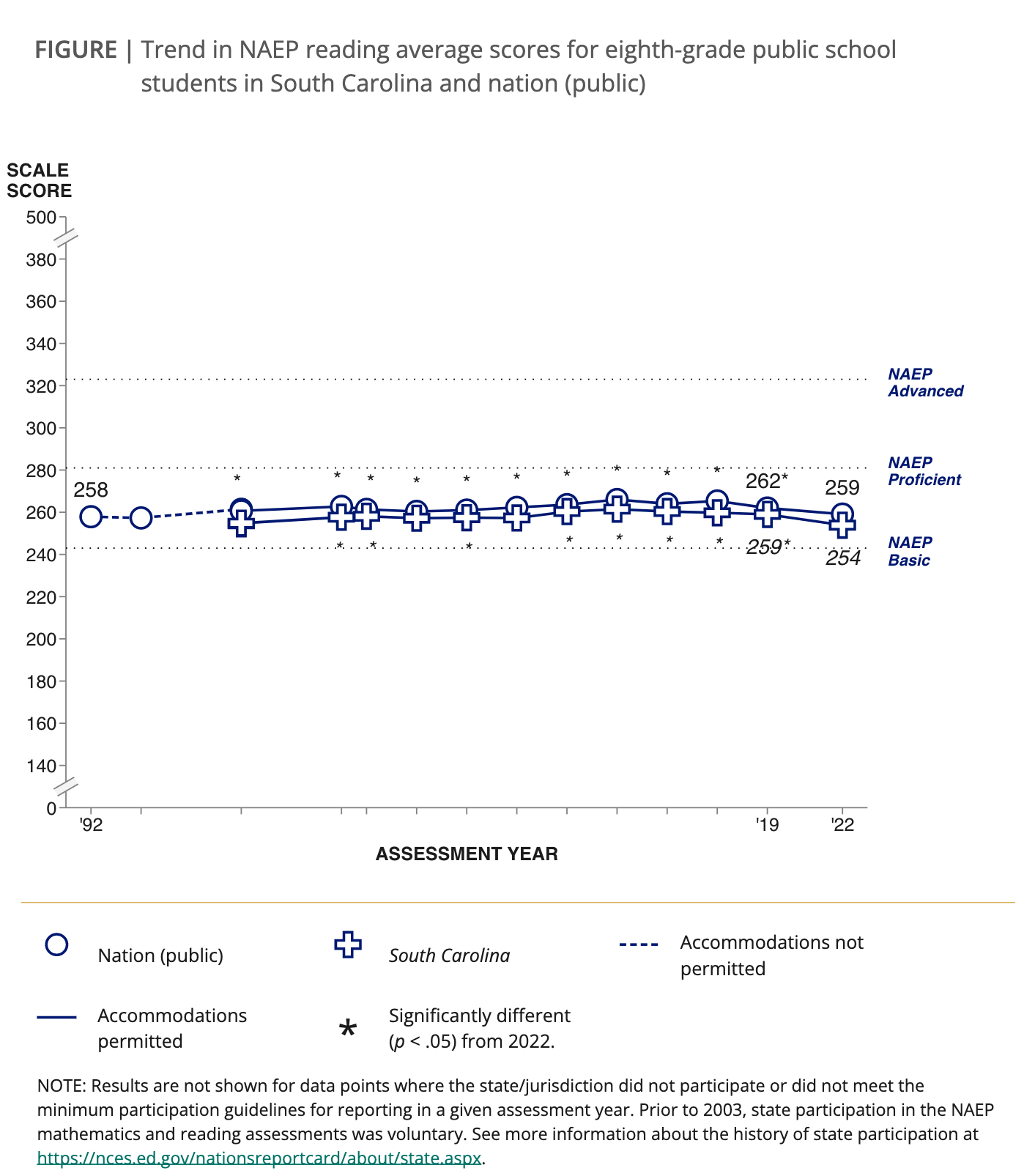
I lived, learned, and taught in the three decades before these three decades, and I can only conclude that reading achievement (whatever that is) as measured in formal testing has been about the same forever.

In my home state and across the nation, this is the real story: We have become content with a historical and current negligence about the reading acquisition of some populations (Black and brown students, poor students, special needs students, multi-lingual learners), and we lack the political will to address the systemic forces of inequity in the lives and schooling of these students to do anything about it.

Historical negligence is not a crisis; it simply is how things are, what we have come to accept as “normal.”

As I have examined in my scholarship [2], journalism in the US has only two false stories about education—crisis and miracle.

The problem is that neither narrative is true; they are anecdotal and melodramatic so they are compelling to the public, politically useful, and likely to drive reader/viewership for the media.

The US remains in a false crisis cycle begun by A Nation at Risk, and then powerfully expanded under the Obama/Duncan era of shouting education crisis while propping up the false charter school miracle machine (for example, the Harlem “miracle” celebrated by David Brooks citing the Obamas).

The crisis/miracle narrative approach from the Obama era has recently been replicated by the media obsession with SOR; Hanford’s seminal story planted both seeds by falsely claiming the US has a reading crisis and promoting a miracle school that wasn’t.

Again, please point out the crisis here:

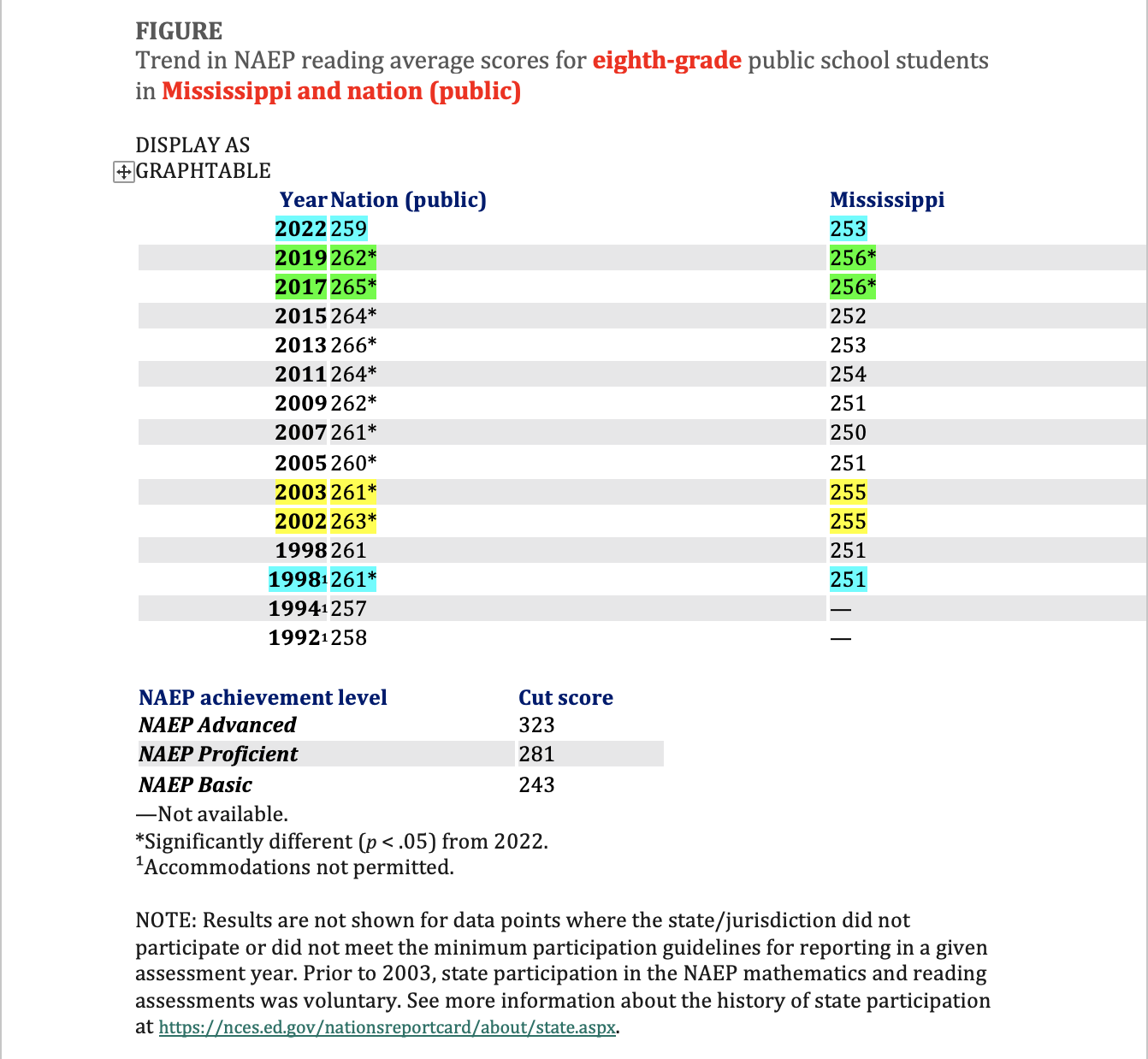
And as I have explained, the miracle of the moment, Mississippi, like all the other educational miracles, simply doesn’t exist; MS has had steady growth and some jumps, often well before any SOR reading legislation:

And MS remains below NAEP proficient and continues to have drops between grade 4 and 8:

For many years, I have had to help my students navigate the media obsession with the melodramatic—crisis! miracle!—often found in films such as Waiting for Superman (false union crisis v. charter miracles) and the compelling documentary about education in SC, Corridor of Shame (an emotionally manipulative film about the powerful connection between poverty and educational negligence in the state).

The media, public, and politicians love and benefit from the crisis/miracle rhetoric about education. But those stories do not serve the needs of children, teachers, or schools.

Ellison ends his talk powerfully:

I don’t know what intelligence is. But this I do know, both from life and from literature: whenever you reduce human life to two plus two equals four, the human element within the human animal says, “I don’t give a damn.” You can work on that basis, but the kids cannot. If you can show me how I can cling to that which is real to me, while teaching me a way into the larger society, then I will not only drop my defenses and my hostility, but I will sing your praises and help you to make the desert bear fruit.

What These Children Are Like

Education journalism has reduced education to crisis or miracle, and like the reductive formula Ellison rejects for children, I must reject this false pair of stories.

There is no reading or education crisis, and there are no miracle schools.

There is historical and current political negligence for addressing inequity in the lives and schooling of “other people’s children” in the US.

But that reality doesn’t sell or garner votes.


[1] Toward end, Ellison is scathing:

The great body of Negro slang–that unorthodox language–exists precisely because Negroes need words which will communicate, which will designate the objects, processes, manners and subtleties of their urban experience with the least amount of distortion from the outside. So the problem is, once again, what do we choose and what do we reject of that which the greater society makes available? These kids with whom we’re concerned, these dropouts, are living critics of their environment, of our society and our educational system, and they are quite savage critics of some of their teachers.

What These Children Are Like

[2] Thomas, P.L. (2016). Miracle school myth. In W.J. Mathis & T.M. Trujillo, Learning from the Federal Market-Based Reforms: Lessons for ESSA. Charlotte, NC: IAP.

Thomas, P.L. (2015). Ignored under Obama: Word magic, crisis discourse, and utopian expectations. In P. R. Carr & B. J. Porfilio (Eds.), The phenomenon of Obama and the agenda for education: Can hope (still) audaciously trump neoliberalism? (pp. 45-68). Charlotte, NC: Information Age Publishing.

Open Letter on Reading Legislation

A recent scholarly commentary by professors Reinking, Hruby, and Risko note: “Since 2015, 47 state legislatures have enacted, or are currently considering, a remarkable total of 145 bills that address reading and reading instruction in public schools.”

Many literacy and policy scholars [1] have also noted that this wave of reading legislation is often grounded in the “science of reading” (SOR) movement that has been characterized as misleading, overly simplistic, and driven by melodramatic anecdotes.

Further, the growing number of states adopting SOR-based reading legislation includes bans of reading practices and programs as well as narrow mandates for different reading practices and programs.

A 2020 policy statement warned about using the SOR movement to inform legislation, however, by:

• Failing to place the current concern for reading in a historical context.
• Overemphasizing recent test scores and outlier data instead of longitudinal data with greater context (for example, NAEP).
• Misrepresenting the “science of reading” as settled science that purportedly prescribes systematic intensive phonics for all students.
• Overstating and misrepresenting the findings of the National Reading Panel report of 2000, without acknowledging credible challenges to those findings.
• Focusing blame on K-12 teachers and teacher education without credible evidence or acknowledgement of challenging teaching and learning conditions and the impact of test-based accountability policies on practice and outcomes.
• Celebrating outlier examples of policy success (in particular, the Mississippi 2019 NAEP data) without context or high-quality research evidence for those claims.

National Education Policy Center & Education Deans for Justice and Equity (2020). Policy Statement on the “Science of Reading.” Boulder, CO: National Education Policy Center.
http://nepc.colorado.edu/publication/fyi-reading-wars

The policy statement remains an important guide for revising reading legislation in order to avoid continuing to under- and mis-serve the individual needs of all students and to de-professionalize teachers.

The recommendations remain urgent and include the following for what legislation should not/should do:

Should not fund or endorse unproven private-vendor comprehensive reading programs or materials.
Should not adopt “ends justify the means” policies aimed at raising reading test scores in the short term that have longer-term harms (for example, third-grade retention policies).
• Should not prescribe a narrow definition of “scientific” or “evidence-based” that elevates one part of the research base while ignoring contradictory high-quality research.
• Should not prescribe a “one-size-fits-all” approach to teaching reading, addressing struggling readers or English language learners (Emergent Bilinguals), or identifying and serving special needs students.
• Should not prescribe such a “one-size-fits-all” approach to preparing teachers for reading instruction, since teachers need a full set of tools to help their students.
• Should not ignore the limited impact on measurable student outcomes (e.g., test scores) of in-school opportunities to learn, as compared to the opportunity gaps that arise outside of school tied to racism, poverty, and concentrated poverty.
• Should not prioritize test scores measuring reading, particularly lower-level reading tasks, over a wide range of types of evidence (e.g., literacy portfolios and teacher assessments), or over other equity-based targets (e.g., access to courses and access to
certified, experienced teachers), always prioritizing the goal of ensuring that all students have access to high-quality reading instruction.
• Should not teacher-proof reading instruction or de-professionalize teachers of reading or teacher educators through narrow prescriptions of how to teach reading and serve struggling readers, Emergent Bilinguals, or students with special needs.
• Should not prioritize advocacy by a small group of non-educators over the expertise and experiences of K-12 educators and scholars of reading and literacy.
• Should not conflate general reading instruction policy with the unique needs of struggling readers, Emergent Bilinguals, and special needs students.

• Should guarantee that all students are served based on their identifiable needs in the highest quality teaching and learning conditions possible across all schools:
o Full funding to support all students’ reading needs;
o Low student/teacher ratios;
o Professionally prepared teachers with expertise in supporting all students with the most beneficial reading instruction, balancing systematic skills instruction with authentic texts and activities;
o Full and supported instructional materials for learning to read, chosen by teachers to fit the needs of their unique group of students;
o Intensive, research-based early interventions for struggling readers; and
o Guaranteed and extensive time to read and learn to read daily.
• Should support the professionalism of K-12 teachers and teacher educators, and should acknowledge the teacher as the reading expert in the care of unique populations of students.
• Should adopt a complex and robust definition of “scientific” and “evidence-based.”
• Should embrace a philosophy of “first, do no harm,” avoiding detrimental policies like grade retention and tracking.
• Should acknowledge that reading needs across the general population, struggling readers, Emergent Bilinguals, and special needs students are varied and complex.
• Should adopt a wide range of types of evidence of student learning.
• Should prioritize, when using standardized test scores, longitudinal data on reading achievement as guiding evidence among a diversity of evidence for supporting instruction and the conditions of teaching and learning.
• Should establish equity (input) standards as a balance to accountability (output) standards, including the need to provide funding and oversight to guarantee all students access to high-quality, certified teachers; to address inequitable access to experienced teachers; and to ensure supported, challenging and engaging reading and literacy experiences regardless of student background or geographical setting.
• Should recognize that there is no settled science of reading and that the research base and evidence base on reading and teaching reading is diverse and always in a state of change.
• Should acknowledge and support that the greatest avenue to reading for all students is access to books and reading in their homes, their schools, and their access to libraries (school and community).

National Education Policy Center & Education Deans for Justice and Equity (2020). Policy Statement on the “Science of Reading.” Boulder, CO: National Education Policy Center.
http://nepc.colorado.edu/publication/fyi-reading-wars

This current cycle of the reading wars is another example of reducing historical and current failures of reading instruction to unwarranted crisis rhetoric and then resorting to the same failed patterns of education reform enacted for nearly five decades.

The individual needs of all students as readers can only be served by autonomous teachers in educational environments that support learning and teaching—not by mandates for scripted programs that enforce a once-size-fits-all approach to learning and teaching.

Reading legislation has the potential to do great harm or great good for the children of the US and our democracy. Once again, political leaders have chosen to do great harm.


Recommended

School Reformers’ Pledge of Good Conduct

[1] See

Where Do We Go from Here?: Learning and Teaching in the SOR Era

One of the most important and too often ignored works by Martin Luther King Jr. is his Where Do We Go from Here: Chaos or Community? (see an excerpts here).

I have relied on this work for many years in the context of my public writing and scholarship addressing equity, poverty, race, and literacy (for example, see pt. 1 and pt. 2). What has always rung true and important is King’s practical call for needed direct action instead of the status quo of political indirect action.

For example, King noted that the political will in the US was to view education as a mechanism for erasing poverty, racism, and inequity (indirect action) instead of directly eradicating the forces that create poverty, racism, and inequity.

I have reached a very sobering moment in my public work addressing the “science of reading” (SOR) movement as that has informed reading legislation across the US:

Since 2015, 47 state legislatures have enacted, or are currently considering, a remarkable total of 145 bills that address reading and reading instruction in public schools.1 Many of these bills are relatively routine appropriations, procedural issues, licensures, and so forth. However, an increasing number define, endorse, and sometimes mandate instructional approaches—a legislative excursion into matters that in other fields of practice, such as medicine or law, are left to certified professionals and the standards set by their professional organizations or accrediting agencies. In that sense, the existence of such laws suggests a perception of a problem with the teaching of reading of such consequence that it demands legislative action. In so doing, it moves professional practice into the political realm, subject to all the forces and vested interests inherent to that domain.

More specifically, it moves the teaching of reading into ideological territory, at least in the narrow pragmatic sense suggested by Fine and Sandstrom (1993; see also Seliger, 1970/2019). They defined ideologies as uniting individuals around shared beliefs and offering “diagnoses of what is and is not problematic in the sociopolitical world” (p. 24). Ideologies, they say, motivate ameliorative action, create affinity by energizing emotional reactions, and set boundaries of acceptable belief, inoculating members against outside influences and helping to recruit new members. Further, ideologies, so conceived, naturally generate a dissimulating rhetoric in which “speech about topics of public controversy, including political and ‘scientific’ speech . . . is subject to slanting and shaping when those treatments seem beneficial to [ideological] groups” (p. 30).

Reinking, D., Hruby, G. G., & Risko, V. J. (2023). Legislating Phonics: Settled Science or Political Polemics? Teachers College Record125(1), 104–131. https://doi.org/10.1177/01614681231155688

In my own work about reading policy, I had cited 32 states less than a year ago, and now, I must admit, SOR reading policy has become the dominant approach to teaching reading in the US despite extensive and credibly scholarly evidence that the reading crisis; blame leveled at reading programs, balanced literacy, and teacher educators; and misrepresentation of reading science are false narratives.

Media stories, political responses, and state-level legislation have resulted in pre-service and in-service training/retraining (often LETRS) and reading programs being banned with short lists of SOR-approved programs being mandated—both of which substantially change the landscape of how children will learn to read and how teachers will be mandated to teach (often in scripted environments).

Therefore, where do we go from here?

First, we must resist fatalism, and thus, we must adopt practices and strategies for advocating for addressing individual student needs as readers and teacher autonomy as reading teachers—even as both students and teachers must adopt ways to navigate this new SOR reality.

Key concerns about SOR legislation and policy include reducing reading instruction to scripted programs (often labeled “structured literacy) that erase individual student needs and teacher professionalism.

Educators, parents, and advocates for reading must acknowledge and reinforce that reading science is not settled, even as we have decades of valuable evidence for what works when teaching children to read.

This advocacy must walk a very difficult path of honoring individual stories of parents, children, and teachers while also raising cautions that anecdotes do not equal science (credible generalizations).

Anecdotes are powerful and compelling, but they often perpetuate overly melodramatic stories that misrepresent reading and teaching reading.

Next, we must hold SOR practices and policies to the highest standards of meeting the equity and diversity needs of our students.

Early evidence suggests that SOR-labeled reading programs and materials often have the same lack of diversity that has plagued reading materials for decades.

One of the historical negative consequences of “science” (which has historically been used to support racism and sexism) is that it promotes authority grounded in claims of being objective, which allows science to often be a veneer for practices that are, in fact, inequitable and biased.

The technocratic focus of the SOR movement and policy is fertile ground for continuing to see reading and students in monolithic ways that erases their humanity. Cultural backgrounds, regional dialects, and individual experiences must all be honored and fostered in our pursuit of teaching reading and the love of literacy that all children deserve.

There simply is not one right way to become a reader, and not one right way to teach children to read.

Finally, we must begin to detail and document what learning to read and teaching reading should look like if we do in fact embrace addressing individual student needs and teacher autonomy.

As a start, that requires that everyone must resist forming reading camps (labels are our enemy) and that we shift away from adopting reading programs to teach reading and call for teaching children to read.

I don’t see what we must do next as a compromise, but as a different way forward.

At its core, the SOR movement and the legislation that has become a national norm are deja vu all over again. We have lived the reading crisis/reading reform merry-go-round for almost a century.

I remain committed to King’s vision of recognizing that status quo approaches to systematic and important problems are doomed to fail again, to feed the entrenched political cycle.

Each child is precious, and unique, and each child deserves the opportunity to love reading, to become an eager and critical reader in order to enjoy the sort of human autonomy we claim to cherish.

Too often adult pettiness stands in the way of that opportunity.

The “Science of Reading” Era: An Open-Access Reader [UPDATED]

[Header Photo by Thought Catalog on Unsplash]

[Revised and Updated]

Increasingly since around 2012, the media story around the “science of reading” has resulted in legislation that bans targeted reading instruction and mandates limited reading program options for schools, teachers, and students.

Concurrently, literacy scholars have documented that key aspects of the SOR media story are false, and thus, legislation based on the media SOR story is misguided and likely to be ineffective or harmful.

Scholars have documented that the following elements of the media SOR story are misleading or false:

  • The US has a reading crisis because of reading programs not aligned with SOR and based in balanced literacy instead.
  • SOR is settled science that is reflected in NRP reports and the simple view of reading (SVR).
  • Students have not been afforded systematic phonics instruction that must be implemented for all students before they can comprehend or even “love” to read.
  • The reading crisis includes misidentifying and under-serving students with dyslexia, who represent a large percentage of students struggling to read at grade level.
  • The evidence of a reading crisis is NAEP data.

While there is a great deal of scholarly research available, such as two targeted issues of highly regarded Reading Research Quarterly, below is a listing of open-access scholarship that refutes the media story around SOR and establishes why reading legislation based on that SOR story should be rejected or revised:

These open-access scholarly examinations of the SOR movement should be used to advocate for an accurate characterization of reading and reading instruction, to address the individual needs of all students, to support the professional autonomy of teachers, and to call for reading legislation that avoids sweeping bans, narrow mandates, and creating yet more profit for the education marketplace.

Recommended

The Balancing Act: An Evidence-Based Approach to Teaching Phonics, Reading and Writing, Dominic Wyse and Charlotte Hacking

Reading wars or reading reconciliation? A critical examination of robust research evidence, curriculum policy and teachers’ practices for teaching phonics and reading, Dominic Wyse and Alice Bradbury

Decoding, reading and writing: the double helix theory of teaching, Dominic Wyse and Charlotte Hacking


Unsettling the Science of Reading: Who Is Being Sold a Story?, Nick Covington

See Also

[4-article series at English Journal]

Thomas, P.L. (2024, March). We teach English in times of perpetual crisis: The long (and tedious) history of reading crisis. English Journal, 113(4), 21-26. https://publicationsncte.org/content/journals/10.58680/ej2024113421


Thomas, P.L. (2023, November). Everything you know is wrong: The “science of reading” era of reading legislation. Perspectives and Provocations, (11), 1-17. https://drive.google.com/file/d/12fAfLV1pCh7ZXV-UFsTftFd7y_MLSK-O/view

Compton-Lilly, C., Spence, L.K., Thomas, P.L., & Decker, S.L. (2023, November 2). Stories grounded in decades of research: What we truly know about the teaching of reading. The Reading Teacher. https://doi.org/10.1002/trtr.2258

[Update]

Compton-Lilly, C., Spence, L.K., Thomas, P.L. and Decker, S.L. (2024), A Response to our Critics: Agreements, Clarifications, and Children. Read Teach. https://doi.org/10.1002/trtr.2298

Thomas, P.L. (2023, September). NEPC review: Teacher prep review: Strengthening elementary reading instruction. Boulder, CO: National Education Policy Center. https://nepc.colorado.edu/review/teacher-prep

Thomas, P.L. (2023). The Science of Reading Era: Seeking the “Science” in Yet Another Anti-Teacher Movement. Journal of Reading Recovery, 22(5), 5-17. https://readingrecovery.org/wp-content/uploads/2023/05/JRR_22-2_spring_2023_thomas.pdf

Thomas, P.L. (2023). The “Science of Reading,” Education Faddism, and the Failure to Honor the Intellectual Lives of All Children: On Deficit Lenses and Ignoring Class and Race Stereotyping. Voices in the Middle, 30(3), 17-21. https://publicationsncte.org/content/journals/10.58680/vm202332439

Thomas, P.L. (2022). The Science of Reading movement: The never-ending debate and the need for a different approach to reading instruction. Boulder, CO: National Education Policy Center. http://nepc.colorado.edu/publication/science-of-reading

A Critical Examination of Grade Retention as Reading Policy (white paper). Prepared for the Ohio Education Association in response to Ohio’s “Third Grade Reading Guarantee,” September 15, 2022.

Simplistic View of Reading Fails Children, Reading, and Science

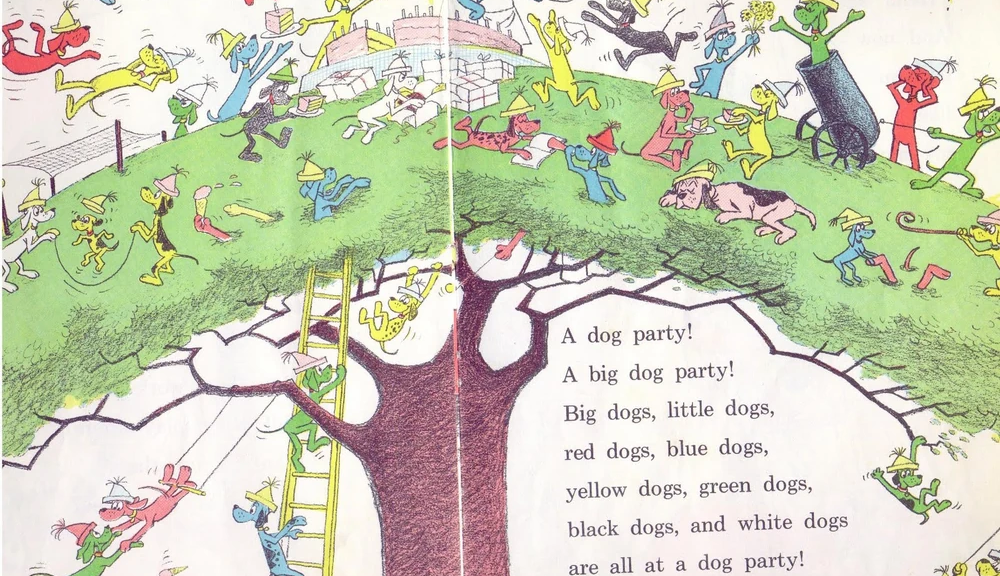
In 1967, I entered formal schooling as a first grader reading well above so-called grade level. I am 62, and I can vividly recall the books that my mother read to me and my sister—Hop on Pop, One fish two fish red fish blue fish, Green Eggs and Ham, and Go, Dog. Go!

And when I say “recall,” I mean I can see the books, the colors and images decades and decades later.

I fell in love with these books, and reading, well before I could navigate letters and words; in fact, my journey to navigating text began with falling in love with the physical books and the images.

There is a very solid line from those days in early childhood before school and my adolescent fascination with comic books that remains to this day. I continue to read whole issues of comics without ever noticing a word.

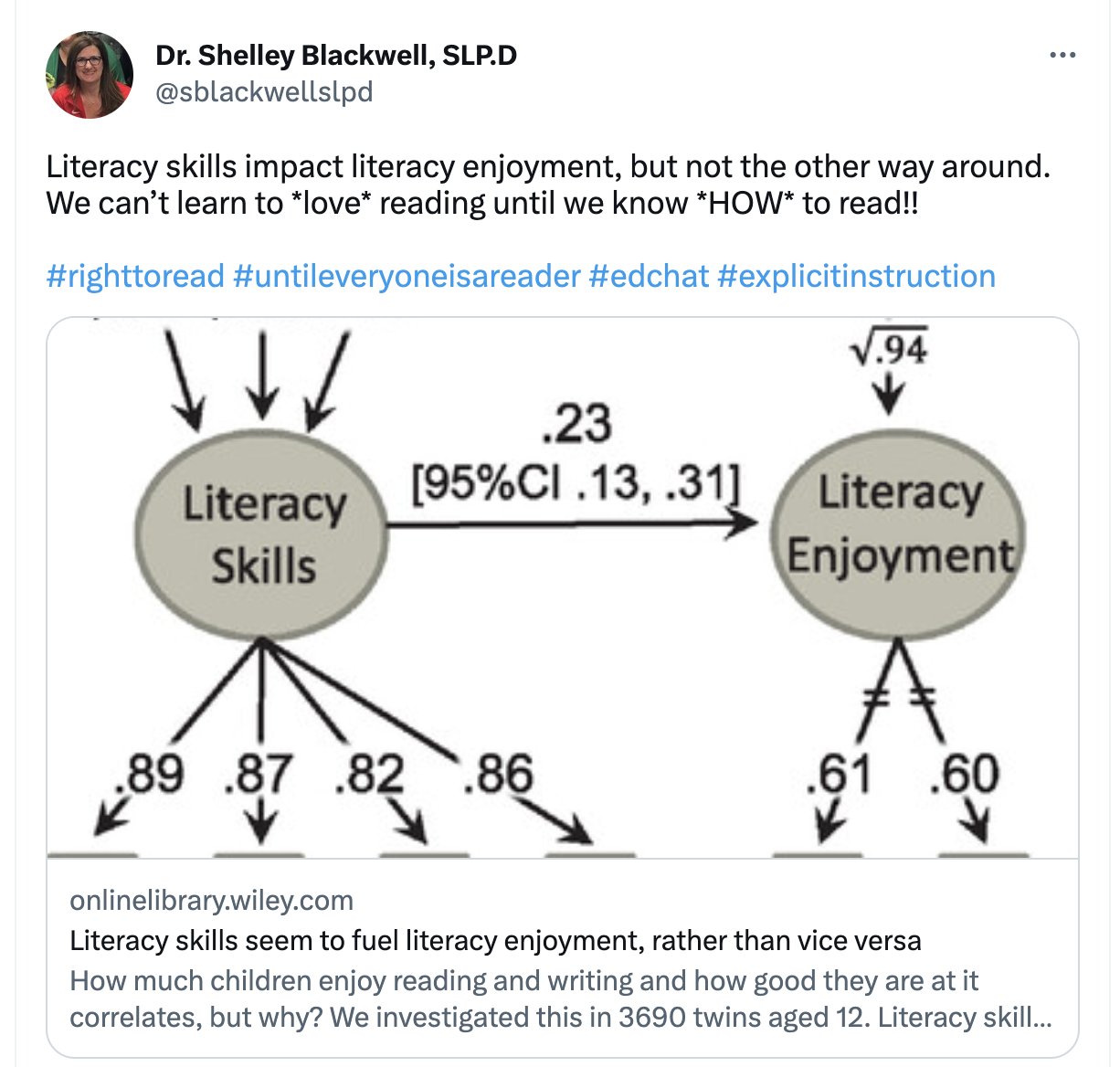
So I was filled with a particular sadness and even anger when I saw the following on Twitter:

This is maddeningly untrue about how and why children fall in love with reading, but it serves one of the central agendas of the “science of reading” movement—perpetuating a simplistic sequential view of reading that is skills-based and serves a systematic program of reading.

The SOR movement stands on a reductive claim that the science of reading is both simple and settled.

Neither is true.

More and more, elected officials are banning reading instruction practices and mandating a limited pool of reading programs schools can adopt and implement.

These natural consequences of media claiming reading science is simple and settled do not serve the needs of children or the goal of reading, but do serve political and marketing agendas.

Looking back, I am well aware that I often overcame my working-class roots because my household had plentiful picture books, a routine of reading aloud, and a culture of storytelling (my very not literary father loved to tell stories over and over).

Most of this for my sister and me fostered a love for reading and was not text-based. Our desire to read text was fueled by our love for our parents and reading—as is likely common among many children fortunate enough to have the advantages of our household.

Yes, the letter-sound-meaning dynamic is a key part of reading, but that is not primary to reading and certainly is not necessary seed of learning.

The SOR movement has evolved from misrepresenting reading science as simple and settled to reducing reading to simplistic platitudes about reading that are in no way supported by science or experience.

The cultural and ideological demonizing of whole language has also erased a key element of the holistic understanding of reading, and allowed a mechanical view of reading (and children) to feed a market for scripted programs and efficient ways to systematically assure that children will learn to hate reading and hate the schooling that ruined books for them.

SOR Endgame: The Reading Program Boondoggle

Within a year or so of the initial “science of reading” (SOR) media campaign launch in 2018, states such as Arkansas banned reading instruction (three-cueing) that effectively banned some of the most popular and demonized reading programs in the US.

This was the canary in the coal mine for one of the most powerful (but ignored) elements of the SOR movement—reading program marketing.

In order for a new reading program market place to open, the existing programs had to be vilified and then, ultimately, banned and replaced (see here and here).

The uncritical endorsement of the SOR story remains a central feature of media coverage even as the inherent problems and flaws with that story and it consequences are beginning to be acknowledged:

And the next shoe has dropped, fulfilling the logical consequences of the entire SOR movement [1] built on false and oversimplified cries of crisis and demonizing of literacy frameworks (balanced literacy) and popular programs (Fountas and Pinnell, and Calkins’s Units of Study):

Principals historically have enjoyed enormous leeway to select curriculums. Proponents argue this allows schools to stay nimble and select materials appropriate to their specific student populations. But some experts, and even the city’s own schools chancellors, have argued that the approach can lead to a tangle of instructional practices that can vary widely in quality from classroom to classroom. 

Now, officials are taking steps to rein in the city’s free-wheeling approach to curriculum. Beginning next school year, elementary schools in about half of the city’s 32 districts will be required to use one of three reading programs: Wit & Wisdom, from a company called Great Minds; Into Reading from Houghton Mifflin Harcourt; or Expeditionary Learning, from EL Education.

By September 2024, city officials are expected to require all elementary schools to use one of those three options, according to an education department official familiar with the city’s plans.

NYC schools could soon be forced to adopt a mandated reading curriculum, sources say

NYC has been a disturbing and important example of the very worst aspects of the media-driven political responses to a false story (see here and here). The city is proof that a false story has more influence than actual evidence or science.

Blaming balanced literacy and popular reading programs for a reading crisis that doesn’t exist lacks scientific research:

I am, like you, struck by the degree to which people are willing to invoke a literacy crisis, when the data do not support anything like a literacy crisis. NAEP scores, aside from the pandemic then– but NAEP scores, over the last 10, 15 years have grown– slowly, but they have gotten better in literacy. 

And it’s deeply puzzling to me why we have all of this public discourse about a literacy crisis. If I were deeply cynical, I would say it’s probably a useful technique for companies that are trying to sell their programs to get people to buy those programs, if parents and some school districts are very agitated about the so-called literacy crisis. 

Now that isn’t to say that all American children are doing wonderfully in literacy. Obviously, they aren’t. But it is to say that there’s not a new or a sudden decline in literacy performance, other than that associated with the dip that had to do with the pandemic. 

Harvard EdCast: To Weather the “Literacy Crisis,” Do What Works

As Snow notes, claiming crisis is not supported by the most common evidence cited, NAEP trends:

And many scholars have raised concerns about structured literacy (the proposed alternative to balanced literacy in the SOR movement):

We recognize that some teachers using structured literacy approaches will find ways to respond to the interests, experiences, and literacy abilities of individual students; however, we are concerned about the indiscriminate and unwarranted implementation of the following practices:

• Directive and/or scripted lessons that tell teachers what to say and do and the implementation of lesson sequences, often at a predetermined pace (Hanford, 2018)

• Privileging of phonemic awareness and phonics as primary decoding skills (Hanford, 2018, 2019; IDA,2019; Paige, 2020; Pierson, n.d.; Spear-Swerling, 2019)

• Use of decodable texts that do not engage multiple dimensions of reading (Hanford, 2018; IDA, 2019; Paige, 2020; Spear-Swerling, 2019)

• Specialized forms of reading instruction designed for particular groups of students as core literacy instruction for all students and teacher educators (Hanford, 2018; Hurford et al., 2016; IDA, 2019; Pierson, n.d.)

• Mandating structured literacy programs despite the lack of clear empirical evidence to support these programs

• Privileging the interest of publishers and private education providers over students

Particular concerns relate to the assertion that there is a consensus across the research community about the primacy of systematic phonics approaches. This supposedly undisputed consensus was severely challenged by the findings of a review of meta-analyses (Bowers, 2020).

Compton-Lilly, C.F., Mitra, A., Guay, M., & Spence, L.K. (2020). A confluence of complexity: Intersections among reading theory, neuroscience, and observations of young readers. Reading Research Quarterly, 55(S1), S185-S195. https://doi.org/10.1002/rrq.348

Further, at least one of the mandated reading programs (Into Reading from Houghton Mifflin Harcourt) for NYC, where a high percentage of diverse students are being served, has been identified as not meeting social justice and diversity goals:

1. All three curricula were Culturally Destructive or Culturally Insufficient.

2. All three curricula used superficial visual representations to signify diversity, especially skin tone and bodily presentation, without including meaningful cultural context, practices or traditions.

3. All three curricula were dominated by one-sided storytelling that provided a single, ahistorical narrative. 

4. All three curricula used language, tone and syntax that demeaned and dehumanized Black, Indigenous and characters of color, while encouraging empathy and connection with White characters.

5. All three curricula provided little to no guidance for teachers on engaging students’ prior knowledge, backgrounds and cultures; or reflecting on their own bias, beliefs and experiences.

Lessons in (In)Equity: An Evaluation of Cultural Responsiveness in Elementary ELA Curriculum

The education market churns is the actual endgame of the SOR movement. The only people likely to benefit from the SOR story are journalists, politicians, and the corporations willing to jump on the reading program branding bandwagon.

The reading problems today are little different than overt the last 80 years, and most of the causes of those problems remain outside of schools—home and community poverty and inequity—and linked to in-school issues of equity, not reading programs or reading philosophies and practices.

Yet, on the horizon, it seems, schools, teachers, and students are going to be bombarded by “structured literacy”—at least until the next unwarranted reading crisis is declared so another round of blame, ban, and adopt can start all over again.


UPDATE

See the plan here in this proposed bill in Ohio:


[1] Thomas, P.L. (2022). The Science of Reading movement: The never-ending debate and the need for a different approach to reading instruction. Boulder, CO: National Education Policy Center. http://nepc.colorado.edu/publication/science-of-reading

Recommended

What Reading Program Should Schools Adopt?

Media Coverage of SOR [access materials HERE]

Hoffman, J.V., Hikida, M., & Sailors, M. (2020). Contesting science that silences: Amplifying equity, agency, and design research in literacy teacher preparation. Reading Research Quarterly, 55(S1), S255–S266. Retrieved July 26, 2022, from https://doi.org/10.1002/rrq.353

MacPhee, D., Handsfield, L.J., & Paugh, P. (2021). Conflict or conversation? Media portrayals of the science of reading. Reading Research Quarterly, 55(S1), S145-S155. Retrieved July 26, 2022, from https://doi.org/10.1002/rrq.384

Cryonics Phonics: Inequality’s Little Helper – New Politics

[UPDATE]

The Science of Reading and the Media: Is Reporting Biased?, Maren Aukerman, The University of Calgary

The Science of Reading and the Media: Does the Media Draw on High-Quality Reading Research?, Maren Aukerman

The Science of Reading and the Media: How Do Current Reporting Patterns Cause Damage?, Maren Aukerman

Making sense of reading’s forever wars, Leah Durán and Michiko Hikida

[UPDATE]

Harvard EdCast: To Weather the “Literacy Crisis,” Do What Works

Disrupting the Disruptors: Reimagining Policy Advocacy in a Post-Truth Era, Helen Aydarova

Caught In a Web of Privatizers: Science of Reading Reforms in the State of Tennessee, Helen Aydarova

“Whatever You Want to Call It”: Science of Reading Mythologies in the Educational Reform Movement, Helen Aydarova

Even More Problems with Grade-Level Proficiency

I have explained often about the essential flaw with grade-level proficiency, notably the third-grade reading myth.

Grade level in reading is a calculation that serves textbook companies and testing, but fulfills almost no genuine purpose in the real world; it is a technocratic cog in the efficiency machine.

Now that we are squarely in the newest reading war, the “science of reading,” two other aspects of grade-level proficiency have been central to that movement—the hyper-focus on third-grade reading proficiency that includes high-stakes elements such as grade retention and the misinformation rhetoric that claims 65% of students are not reading at grade-level (the NAEP proficiency myth).

These alone are enough to set aside or at least be skeptical about rhetoric, practice, and policy grounded in grade-level proficiency, but there is even more to consider.

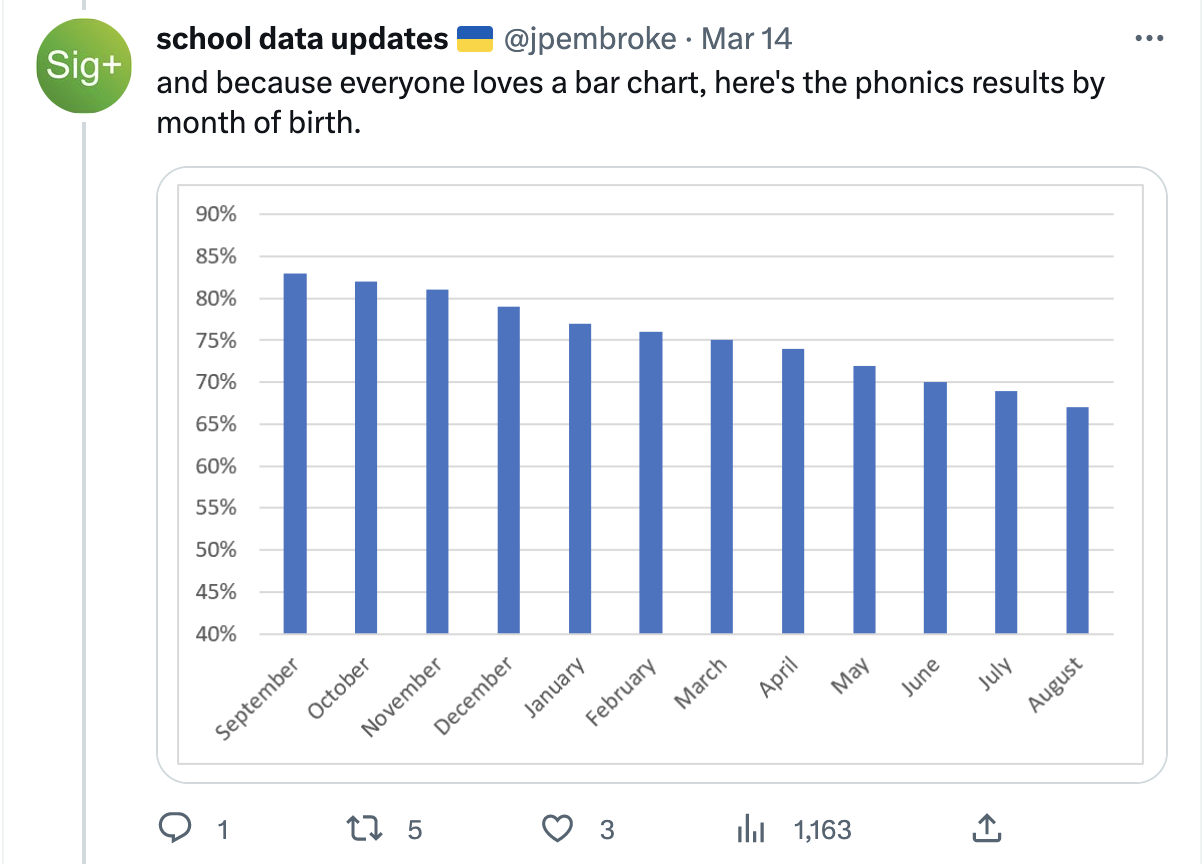
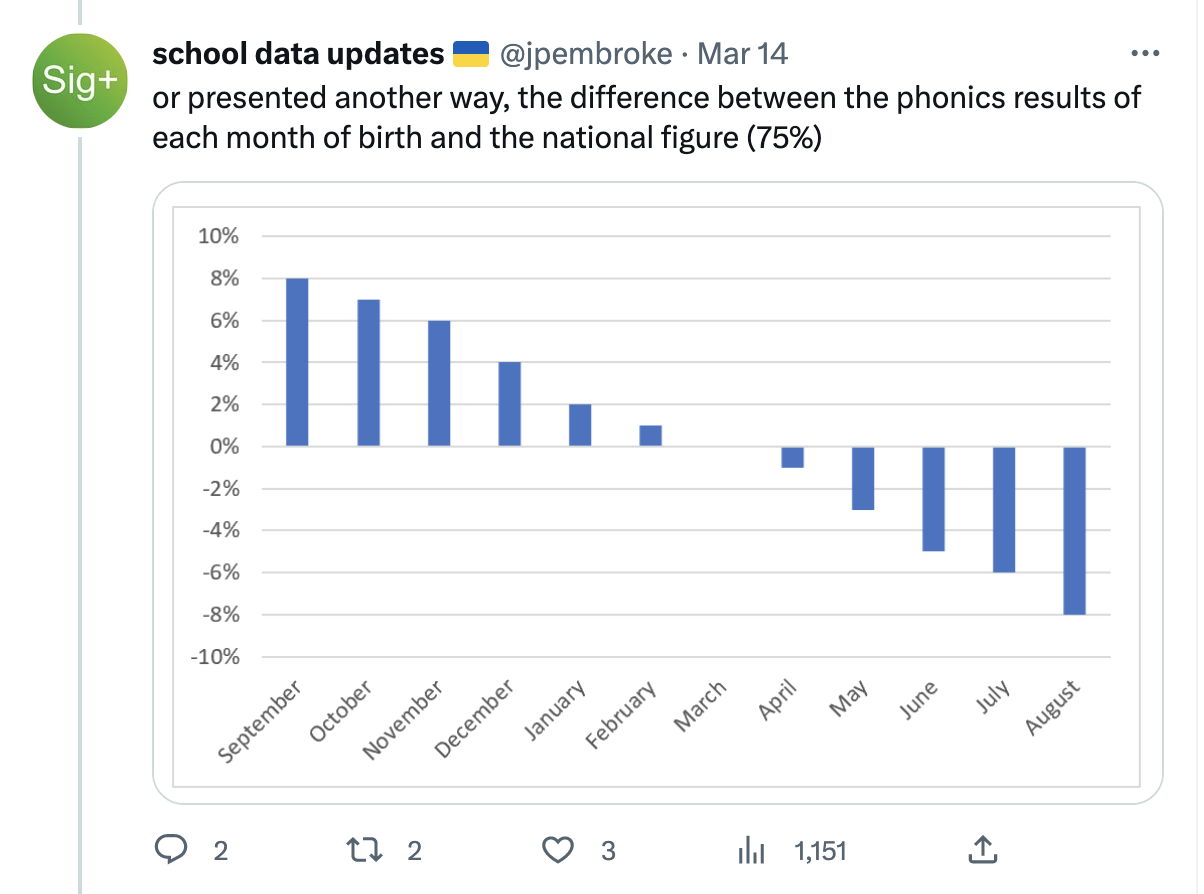
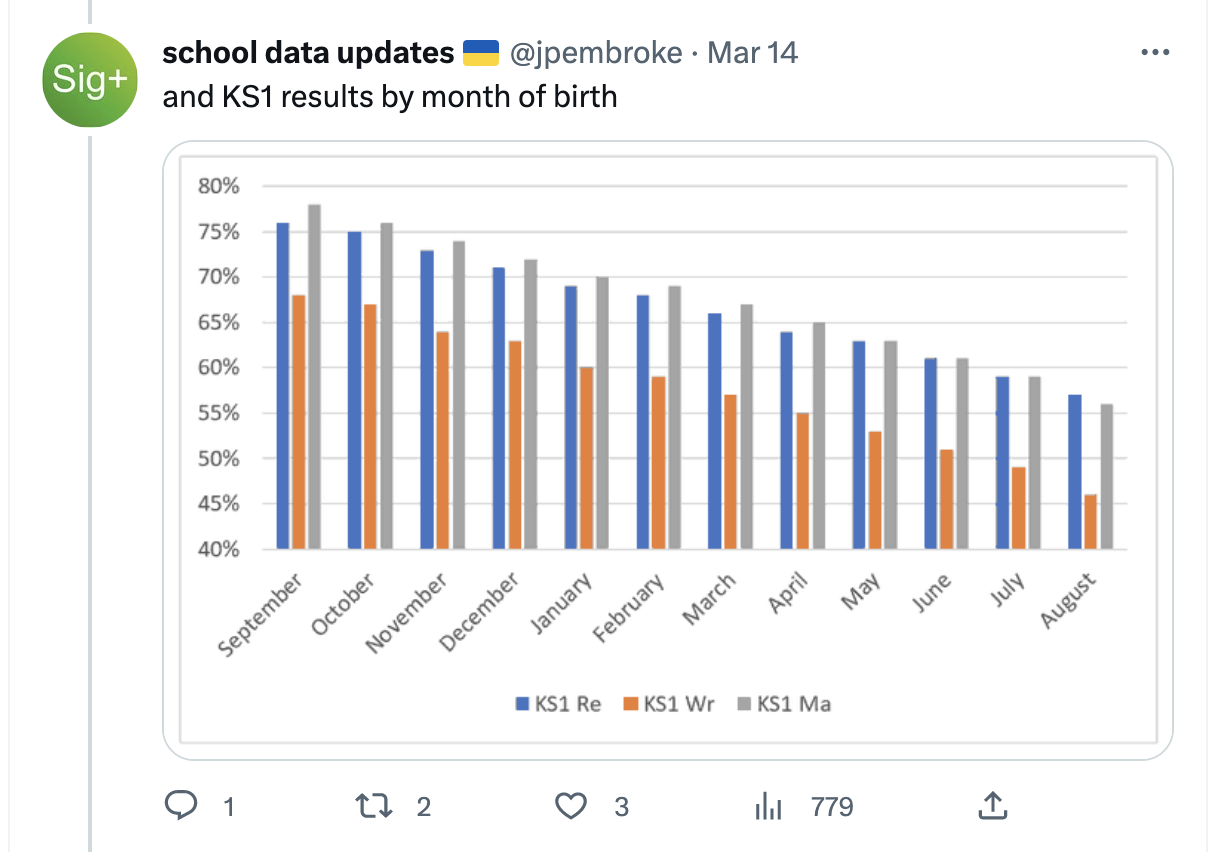
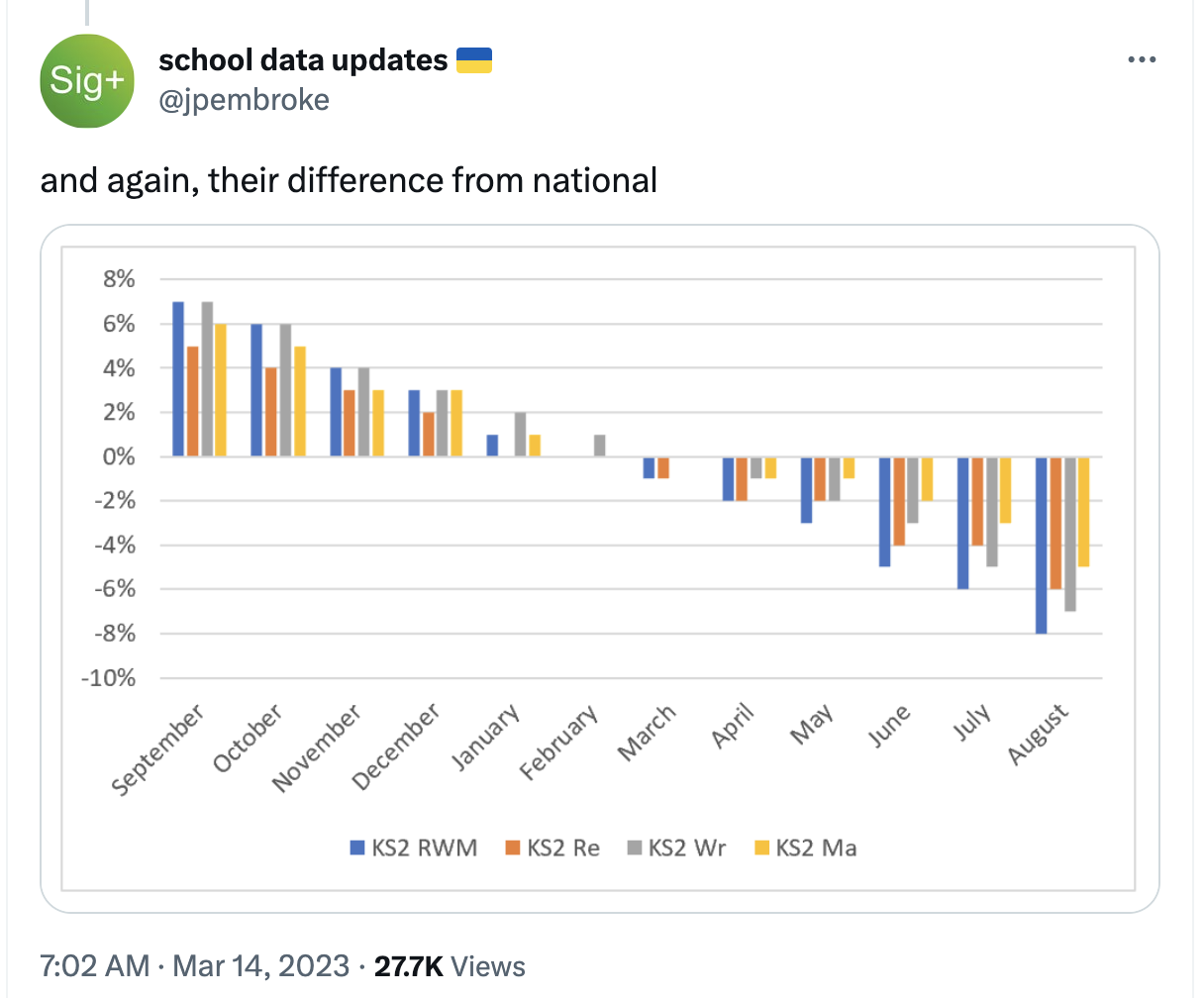
A Twitter thread examines grade-level achievement aggregated by month of birth:

The thread builds off a blog post: Age-Related Expectations? by James Pembroke.

The most fascinating aspect of this analysis thread is the series of charts provided:

As the analysis shows, student achievement is strongly correlated with birth month, which calls into question how well standardized testing serves high-stakes practices and how often standardized testing reflects something other than actual learning.

Being older in your assigned grade level is not an aspect of merit, and being older in your assigned grade seems to have measured achievement benefits that aren’t essentially unfair to younger members of a grade.

Further, this sort of analysis helps contribute to concerns raised about grade retention, which necessarily removes students most likely to score low on testing and reintroduces those students as older than their peers in the assigned grade, which would seem to insure their test data corrupts both sets of measurements.

This data above are from the UK, but a similar analysis by month/year of birth applied to retained students and their younger peers would be a powerful contribution to understanding how grade retention likely inflates test data while continuing to be harmful to the students retained (and not actually raising achievement).

There appears to be even more problems with grade-level proficiency than noted previously, and now, even more reason not to continue to use the rhetoric or the metric.

Podcast: What You Can Do: How ‘Sold a Story’ sold us a story ft Dr. Paul Thomas

How ‘Sold a Story’ sold us a story ft Dr. Paul Thomas


See Also

Which Is Valid, SOR Story or Scholarly Criticism?: Checking for the “Science” in the “Science of Reading”

The Science of Reading and the Media: Is Reporting Biased?, Maren Aukerman

The Science of Reading and the Media: Does the Media Draw on High-Quality Reading Research?, Maren Aukerman

The Science of Reading and the Media: How Do Current Reporting Patterns Cause Damage?, Maren Aukerman

The Reading Puzzle and the Media’s Caricature Blame Game

As an aging adult, I have returned with mature gusto to childhood things—comic books, Lego, and puzzles.

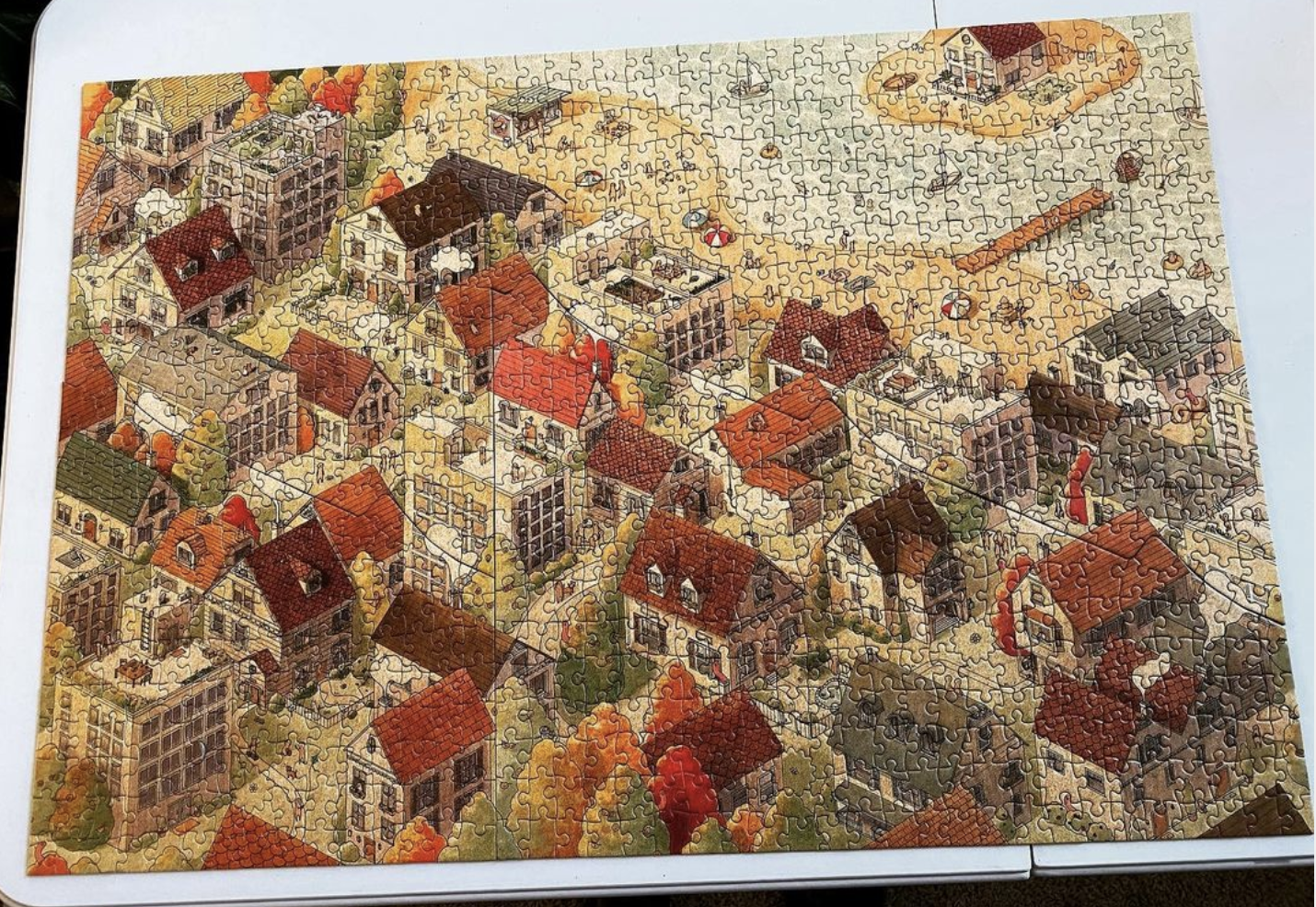
Puzzles are, like Lego, incredibly satisfying, and I have discovered a wonderful puzzle company, Magic Puzzle Company, that combines fascinating original art with its own version of “magic”; once the main puzzle is completed, you can move sections, reveal an open section in the middle, and then complete the puzzle for a big reveal:

I have a daughter and three grandchildren so I have watched child development paralleled with puzzles for many years.

Babies and small children often start with simple one-piece puzzles that challenge them with fitting that one piece into a basic shape. As the child develops, the puzzles become progressively more complex—more pieces and piece shapes more varied and unpredictable.

That sequential process is incredibly compelling for adults trying to teach children. In other words, most adults want learning to be that simple, and yes, predictable from child to child.

However, many human behaviors are not that simple even when they are linked to what we might call natural behaviors. Language is typically viewed as natural, yet reading and writing are somewhat artificial and constructed extensions of that natural inclination.

The current media-driven reading crisis, the “science of reading” movement, is fatally attracted to oversimplification, caricature, and fanning an ugly and misleading blame game.

According to journalists, student reading achievement is abysmal because teachers are trapped in balanced literacy and not the “science of reading.”

That is a one-piece puzzle view of reading and teaching reading.

If we just take one step forward, the three-piece puzzle, this caricature falls apart.

The problem at the three-piece puzzle level is that since about the 1990s, we can fairly identify three forces surrounding how reading is taught in the US.

The first piece, although not universal, is that balanced literacy (BL) has been a dominant reading philosophy (although popularly identified as a “theory”) since about the 1990s when media and public attacks on whole language, while misguided, were very effective in challenging that philosophy/framework.

However, the media version of BL is caricature (often presented as a cartoonishly incomplete reading theory or program) instead of its intent as a philosophical framing:

Next, the second piece of the puzzle, most pre-service teachers have been taught the “simple view” of reading (SVR) as the dominant reading theory over that same era (including currently). [1]

If we pause and consider the first two puzzle pieces—balanced literacy and the “simple view” of reading—the media messaging falls apart since the SOR movement has demonized BL as the core cause of reading failures, yet embraced SVR as settled science.

In the real world of teacher education, however, these two have equally informed how teachers are prepared to teach reading—although teacher prep is , in fact, highly diverse in the application of both.

And now the third puzzle piece—most teachers are required to implement reading programs once they are in the classroom, regardless of the their teacher education program.

Here the puzzle becomes incredibly complicated because despite the media’s misinformation campaign, reading programs are not all BL inspired; many of the dominant programs, in fact, assert reading philosophies and theories that are explicitly not BL.

While the media messaging is stuck in the one-piece puzzle and by moving to a three-piece puzzle the inherent logic falls apart in that oversimplification, the reality is that the reading puzzle is much more like the Magic Puzzle Company’s highly complex puzzle with moving parts and remaining work to be done:

The one-piece puzzle blame game, regretfully, is very compelling so the media message remains mostly unchallenged at the popular and political levels.

Culturally, the large and very complicated reading puzzle with moving parts may be more than we can handle, but even if we just move to the three-part puzzle, the story being told about reading proves to be a simplistic blame game.

Reading, teaching reading, and students deserve a bigger, better picture that simply isn’t easy to piece together.


[1] See the discussion of the SVR in this policy brief. Note that in this brief, BL is included in reading theories because of the popular use of the term as a theory, even as that contrasts with its original intent as a philosophical grounding, similar to whole language.

Compton-Lilly, C.F., Mitra, A., Guay, M., & Spence, L.K. (2020). A confluence of complexity: Intersections among reading theory, neuroscience, and observations of young readers. Reading Research Quarterly, 55(S1), S185-S195. https://doi.org/10.1002/rrq.348

Duke, N.K. & Cartwright, K.B. (2021). The science of reading progresses: Communicating advances beyond the simple view of reading. Reading Research Quarterly, 56(S1), S25-S44. https://doi.org/10.1002/rrq.411

Which Is Valid, SOR Story or Scholarly Criticism?: Checking for the “Science” in the “Science of Reading”

From late November of 2022 through late February 2023, I have (or will have) presented at 6 major literacy conferences, both national and state level.

Two dominant literary issues have been curriculum/book bans and the “science of reading” (SOR) movement. A few important patterns occurred with the latter.

Many teachers are overwhelmed and discouraged about the heavily negative messaging around SOR, but I also interacted with teachers not fully aware of the magnitude of this movement and remain puzzled about the controversy.

Further, the media, public, and political story around reading and teaching reading is the primary message reaching both educators and the public. The robust scholarly criticism of SOR [1] is often welcomed by teachers and administrators, but unless they are attending conferences, these critique goes unnoticed.

Scholars and educators have been backed into a corner since the SOR story is grounded in a great deal of blame, hyperbole, misinformation, and melodrama.

The media SOR story is simple to the point of being false, but simple in a way that is very compelling for people outside the field of literacy.

Here, I want to put some pieces together, and offer a place to hold the SOR movement/story to the same standards demanded by advocates of SOR (specifically The Reading League).

First, let’s start with the core of the scholarly critiques of mainstream media’s story:

Hoffman, J.V., Hikida, M., & Sailors, M. (2020). Contesting science that silences: Amplifying equity, agency, and design research in literacy teacher preparation. Reading Research Quarterly, 55(S1), S255–S266. Retrieved July 26, 2022, from https://doi.org/10.1002/rrq.353

While scholarly critiques (see note 1) are far more nuanced and substantive that this central point, this is a manageable way to interrogate whether or not the SOR story is valid based on the standards the movement itself established.

The debate, then, is well represented by conflicting evaluations of SOR and SOR criticism on social media: a literacy scholar and co-author of an SOR reading program called the scholarly criticism “stupid,” and a policy scholar not in literacy noted that the media story is “facile.”

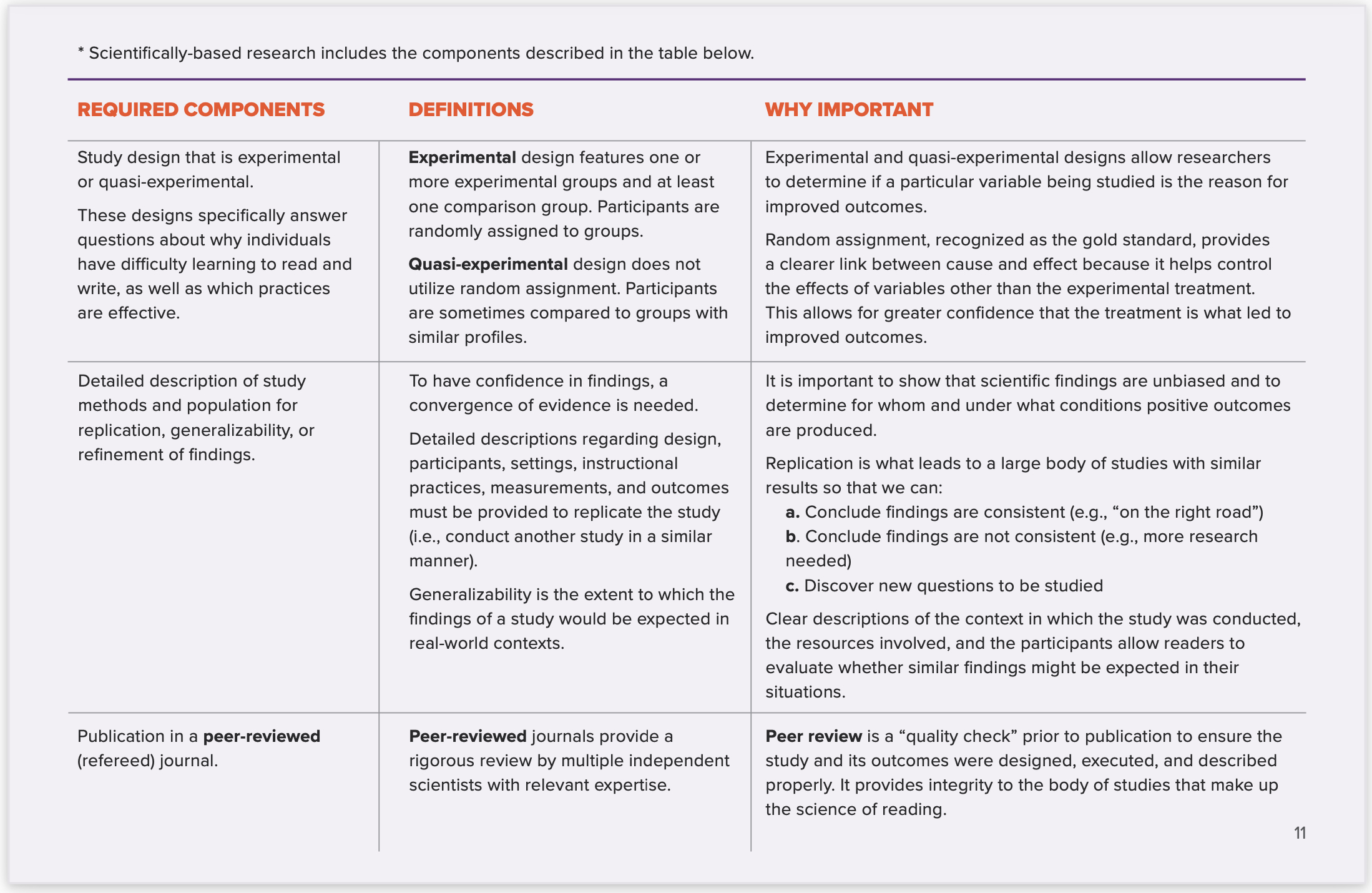
To determine which is valid—the SOR story or the scholarly criticism—that story must be checked against the standards for science established by the movement itself, here from The Reading League:

Finally, the components of the SOR story must be identified in order to check the science behind the claims and the anecdotes; consider Aukerman’s overview:

And my overview in my policy brief:

Below, I outline the SOR story and identify current scientific research, or lack thereof, limiting the evidence to TRL’s guidelines (experimental/ quasi-experimental, published in peer-reviewed journals).

1

First, for the rest of the SOR story to hold up to scientific scrutiny, we must establish whether or not there is a unique reading crisis in the last 10-20 years in which students are failing to learn to read at acceptable rates; this must be true for the blame aspects of the SOR movement to be true.

What is the status of scientific research supporting this claim? There is no current scientific research to support this claim; most scholars have identified that NAEP [2] (and other measures of reading achievement) have remained flat and achievement gaps have remained steady as well for many decades predating the key elements blamed for reading failures.

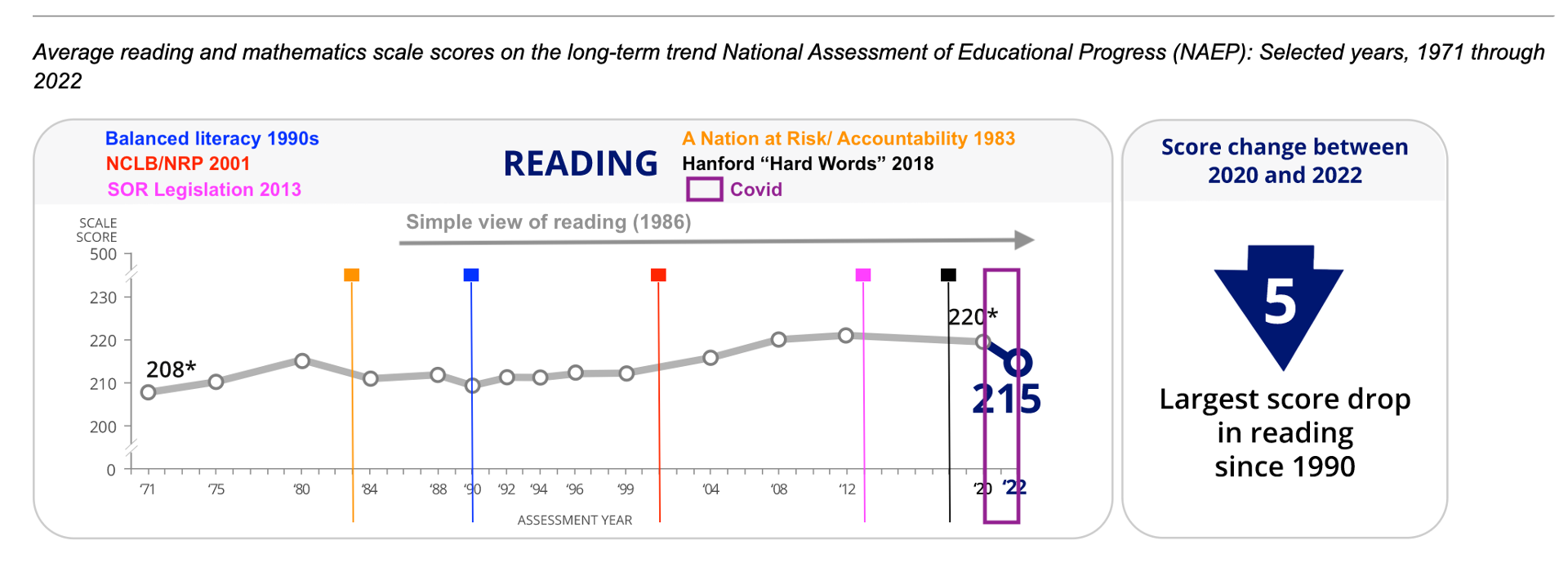
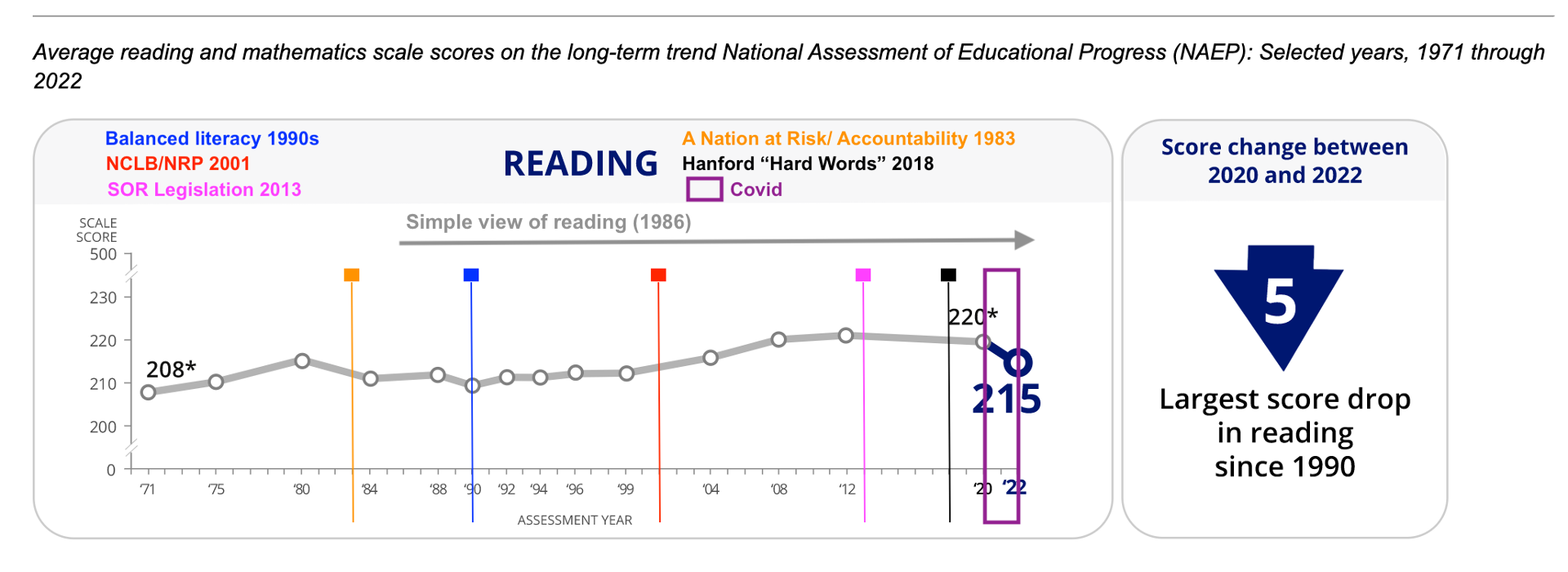
Note that the age 9 longitudinal data including actual scores appears mostly flat with some fluctuation. (Source)
NAEP age 9 reading appears mostly flat after A Nation at Risk, mostly flat with some trending upward during the 1990s BL era, increasing after the federal pressure of NCLB in 2001, and then flat since the rise of SOR legislation around 2013.

Notably the long-term NAEP data during the recent SOR era for 9 and 13 year olds is relatively flat or unchanged except for lowest performing students:

2

Next, the SOR story claims teachers are not well prepared to teach reading and teacher educators either fail to teach evidence-based methods or willfully ignore the science.

What is the status of scientific research supporting this claim? There is no current scientific research to support this claim [3] although scholars have demonstrated that credible research is available on teacher knowledge of reading and teacher education:

Hoffman, J.V., Hikida, M., & Sailors, M. (2020). Contesting science that silences: Amplifying equity, agency, and design research in literacy teacher preparation. Reading Research Quarterly, 55(S1), S255–S266. Retrieved July 26, 2022, from https://doi.org/10.1002/rrq.353

3

The media story claims the current settled reading science is the “simple view” of reading.

What is the status of scientific research supporting this claim? Scientific research refutes this claim:

Duke, N.K. & Cartwright, K.B. (2021). The science of reading progresses: Communicating advances beyond the simple view of reading. Reading Research Quarterly, 56(S1), S25-S44. https://doi.org/10.1002/rrq.411

[UPDATE]

Burns, M. K., Duke, N. K., & Cartwright, K. B. (2023). Evaluating components of the active view of reading as intervention targets: Implications for social justice. School Psychology, 38(1), 30–41. https://doi.org/10.1037/spq0000519

4

The SOR story centers a claim that systematic phonics instruction is superior to all other approaches to teaching beginning readers and thus necessary for all students.

What is the status of scientific research supporting this claim? Current scientific research refutes this claims, showing that systematic phonics is no more effective than other approaches (balanced literacy, whole language) and confirming that systematic phonics can increase early pronunciation advantages but without any gains in comprehension and with that advantage disappearing over time:

Bowers, J.S. (2020). Reconsidering the evidence that systematic phonics is more effective than alternative methods of reading instruction. Educational Psychology Review, 32(2020), 681-705. https://link.springer.com/article/10.1007%2Fs10648-019-09515-y

Wyse, D., & Bradbury, A. (2022). Reading wars or reading reconciliation? A critical examination of robust research evidence, curriculum policy and teachers’ practices for teaching phonics and reading. Review of Education10(1), e3314. https://doi.org/10.1002/rev3.3314

Testing the impact of a systematic and rigorous phonics programme on early readers and also those that have fallen behind at the end of Key Stage 2. (2022, October). Education Endowment Foundation. https://educationendowmentfoundation.org.uk/projects-and-evaluation/projects/read-write-inc-and-fresh-start

Bowers, J.S. Yes Children Need to Learn Their GPCs but There Really Is Little or No Evidence that Systematic or Explicit Phonics Is Effective: a response to Fletcher, Savage, and Sharon (2020). Educ Psychol Rev 33, 1965–1979 (2021). https://doi.org/10.1007/s10648-021-09602-z

Legislating Phonics: Settled Science or Political Polemics? David Reinking, George G. Hruby, and Victoria J. Risko

5

Mississippi has been heralded in the SOR story as a key example of the success of SOR reading policy, based on MS 2019 grade 4 reading scores.

What is the status of scientific research supporting this claim? There is no current scientific research to support this claim, and the SOR story omits that MS has had steady grade 4 reading improvement since the early 1990s (well before SOR) and that MS grade 8 have remained low, suggesting the grade 4 gains are inflated (see also other states with the grade 4 to 8 drop).

6

The source of low reading proficiency, the SOR story claims, is the dominance of balanced literacy and a core of popular reading programs.

What is the status of scientific research supporting this claim? There is no current scientific research to support this claim. In fact, some of the most criticized programs are only adopted in about 1 in 4 schools suggesting that the variety of programs and practices make these claims overly simplistic at best. Journalists also often misidentify reading programs as balanced literacy that explicitly do not claim that label.

7

Often the SOR story includes a focus on dyslexia, claiming that multi-sensory approaches (such as Orton Gillingham) are necessary for all students identified as dyslexic (and often that all students would benefit from that approach).

What is the status of scientific research supporting this claim? Current scientific research refutes this claims:

Johnston, P., & Scanlon, D. (2021). An examination of dyslexia research and instruction with policy implications. Literacy Research: Theory, Method, and Practice70(1), 107. Retrieved July 26, 2022, from https://doi.org/10.1177/23813377211024625

International Literacy Association. (2016). Research advisory: Dyslexiahttps://www.literacyworldwide.org/docs/default-source/where-we-stand/ila-dyslexia-research-advisory.pdf

Socioeconomic dissociations in the neural and cognitive bases of reading disorders, Rachel R. Romeo, Tyler K. Perrachione, Halie A. Olson, Kelly K. Halverson, John D. E. Gabrieli, and Joanna A. Christodoulou

Stevens, E. A., Austin, C., Moore, C., Scammacca, N., Boucher, A. N., & Vaughn, S. (2021). Current state of the evidence: Examining the effects of Orton-Gillingham reading interventions for students with or at risk for word-level reading disabilities. Exceptional Children87(4), 397–417. https://doi.org/10.1177/0014402921993406

Hall, C., et al. (2022, September 13). Forty years of reading intervention research for elementary students with or at risk for dyslexia: A systematic review and meta-analysis. Reading Research Quarterly. Retrieved October 17, 2022, from https://doi.org/10.1002/rrq.477


As of this post, the claims made in the SOR story are not supported by scientific research, and the criticisms offered by scholars appear valid.

The media story is overstated and oversimplified even though nearly all literacy educators and scholars agree that too many marginalized students (minoritized students, special needs students, impoverished students, MLLs) are being underserved (which is a regrettably historical fact of US education).

The SOR movement has created a predicament for the media story in that the standards being required for teachers and reading policy is an incredibly high and narrow threshold that (as I have shown above) the movement itself has not reached.

Again, scholarly criticism of the SOR story is nuanced and substantive, but at its core, that criticism is best represented by demonstrating that SOR advocates, especially the media, cannot meet the standard they propose for the field of teaching reading.

Simply put, US reading achievement is not uniquely worse now than at nearly any point in the last 80 years, and therefore, blaming balanced literacy as well as popular reading programs proves to be a straw man fallacy.

Reading instruction and achievement, of course, can and should be better. But the current SOR story is mostly anecdote, oversimplified and unsupported claims, and fodder for the education marketplace.

Media is failing students far more so than educators by perpetuating a simplistic blame-game that fuels the education market place.


[1] Media Coverage of SOR [access materials HERE]

Hoffman, J.V., Hikida, M., & Sailors, M. (2020). Contesting science that silences: Amplifying equity, agency, and design research in literacy teacher preparation. Reading Research Quarterly, 55(S1), S255–S266. Retrieved July 26, 2022, from https://doi.org/10.1002/rrq.353

MacPhee, D., Handsfield, L.J., & Paugh, P. (2021). Conflict or conversation? Media portrayals of the science of reading. Reading Research Quarterly, 55(S1), S145-S155. Retrieved July 26, 2022, from https://doi.org/10.1002/rrq.384

Cryonics Phonics: Inequality’s Little Helper – New Politics

[UPDATE]

The Science of Reading and the Media: Is Reporting Biased?, Maren Aukerman, The University of Calgary

The Science of Reading and the Media: Does the Media Draw on High-Quality Reading Research?, Maren Aukerman

The Science of Reading and the Media: How Do Current Reporting Patterns Cause Damage?, Maren Aukerman

[Aukerman three posts as PDF]

Making sense of reading’s forever wars, Leah Durán and Michiko Hikida

[2] Note that NAEP is not grade level, however:

NAEP does not report the percentage of students performing at grade level.  NAEP reports the percentage of students reaching a “proficient” level of performance.  Here’s the problem. That’s not grade level. 

In this post, I hope to convince readers of two things:

1.  Proficient on NAEP does not mean grade level performance.  It’s significantly above that.
2.  Using NAEP’s proficient level as a basis for education policy is a bad idea

The NAEP proficiency myth

[3] Media tend to cite reports from NCTQ that do not meet the standard for “scientific” established by TRL:

NEPC Review: 2020 Teacher Prep Review: Clinical Practice and Classroom Management (National Council on Teacher Quality, October 2020)

NEPC Review: 2018 Teacher Prep Review (National Council on Teacher Quality, April 2018)

NEPC Review: Learning about Learning: What Every New Teacher Needs to Know (National Council on Teacher Quality [NCTQ])