Category Archives: reading

Beware Scripted Curriculum: More Trojan Horse Education Reform

[Header Photo by José León on Unsplash, cropped]

It took a few years, but there was always a long game.

And there was a few decades of preparation along the way.

George W. Bush built the foundation for Trojan Horse education reform in the 1990s, including a false “miracle” narrative and efforts to establish scripted curriculum (a colleague and I examined that here).

Education reform, however, was never about improving learning or teaching, but about ideological agendas, conservative agendas.

The crisis/miracle cycles started with that Texas “miracle,” but included the Chicago “miracle” (to bolster Arne Duncan), the DC “miracle” (to promote Michelle Rhee’s grift), and the Harlem “miracle” (that solidly merged education reform as bi-partisan under Obama with the help of grifter Duncan).

What may prove to be the most successful (and harmful) “miracle,” however, is the media manufactured Mississippi “miracle,” grounded in 2019 NAEP scores.

Six years later, the real end game of these manufactured and false “miracles” are merging with an initial effort by W. Bush—de-professionalizing teachers with scripted curriculum. Note the connection in a recent misleading but recurring endorsement by Patrinos (from the Department of Education Reform, funded by Walton money in Arkansas) of that Mississippi “miracle”:

Teaching at the right level and a scripted lessons plan are among the most effective strategies to address the global learning crisis. After the World Bank reviewed over 150 education programs in 2020, nearly half showed no learning benefit.

And then, this disturbing piece by Korbey: Why US schools have fallen in love with scripted lessons.

After taking a swipe at NCTE, Korbey makes the same but false connection as Patrinos above:

Nearly all the states that have seen reading scores improve recently – including Mississippi, Louisiana, Tennessee and Alabama – have changed state law to encourage districts to choose from approved lists of HQIM.

Conveniently omitted in public advocacy and endorsements of scripted curriculum, is that this is a correlation; however, research has shown that curriculum, instruction, and teacher training are not the keys to increased test scores. Grade retention is:

[S]tates whose policies mandate third-grade retention see significant and persistent increases in high-stakes reading scores in all cohorts…. [T]here is no consistent evidence that high-stakes reading scores increase in states without a retention component.

And another omission is that research has shown scripted reading programs de-professionalize teachers, fail to serve the individual needs of students, and have “whitewashed” the curriculum, alienating the most under-served students in our schools [see Recommended below].

And thus, the end game:

Education reform is dedicated to perpetual education crisis for market and political goal.

Scripted curriculum, then, is not designed to improve reading proficiency, but to create one more step toward AI replacing teachers the same way self-checkout replaced cashiers in our grocery stores.

Recommended

Does the “Science of Reading” Fulfill Social Justice, Equity Goals in Education? (pt. 1)

America Dishonors MLK By Refusing to Act on Call for Direct Action (pt. 2)

Scripted Curriculum Fails Diversity, Students, and Teachers: SOR Corrupts Social Justice Goals (pt. 3)


Misreading Reading Scores (Again) [Unpublished OpEd Submission]

[This piece has been submitted to national newspapers with no responses.]

[Header Photo by Kelly Sikkema on Unsplash]

Every two years reading scores make headlines. And this year, as has been the case since COVID, the news is not good. Scores are down (again), and the causes being pointed to for the drop are also wrong (again).

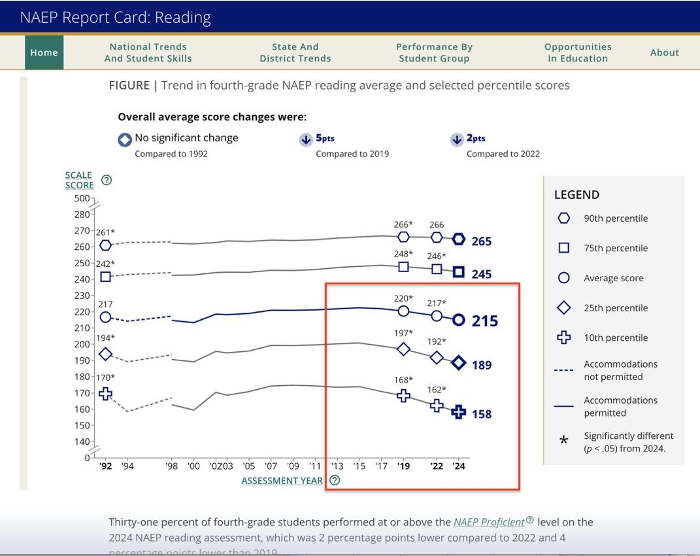
National Assessment of Educational Progress (NAEP) is the national program mandated with tracking student achievement. The 2024 results reveal that reading scores have hit their lowest point in 32 years. This decline is notable because in recent years many states have passed aggressive reading legislation, often labeled as the “science of reading” (SOR).

The SOR movement makes a few key claims: the US has a reading crisis, teachers fail to use “scientific” evidence for instruction, and educators and policymakers are making excuses by acknowledging poverty when addressing low reading proficiency.

When 2019 NAEP reading scores were released, Mississippi was proclaimed a “miracle” state for improving grade 4 reading scores despite being a high-poverty state, implying (without evidence) that those increases were caused by Mississippi implementing SOR policy. In the years that followed, the Mississippi “miracle” became the poster child for other states following the SOR legislative formula; to date 40 states and the District of Columbia have passed SOR legislation.

However, the Mississippi “miracle” story was an incomplete misreading of reading proficiency and policy.

With the average 2024 NAEP reading scores in further decline, the SOR era in reading reform appears to be failing. This is especially true for vulnerable students whose scores have dropped the most. Interpreting these scores correctly is key to forging a better path forward.

Thus, we must seek a more credible story about 2024 NAEP reading scores.

Let’s consider three sets of data from the Department of Defense schools (DoDEA), Florida, and Mississippi. These student populations include significant racial and socioeconomic diversity as well as multilingual learners and other vulnerable populations of students.

Florida and Mississippi have long been applauded for aggressive education and reading reform, and in 2024, their grade 4 reading scores remained in the top 25% of states, seemingly defying the odds. But Florida and Mississippi scored again well below top-scoring DoDEA schools.

Although many rush to ascribe this success to SOR policies, we should really be looking at a different (ultimately harmful) policy: third-grade retention based on state testing.

As education analysts John Westall and Amy Cummings concluded in a report on reading policy: “[S]tates whose policies mandate third-grade retention see significant and persistent increases in high-stakes reading scores in all cohorts…. [T]here is no consistent evidence that high-stakes reading scores increase in states without a retention component.”

In other words, by holding back the lowest performing students in third grade, grade 4 scores appear higher. Florida and Mississippi retain thousands of K-3 students annually.

Inflated scores are not learning; by eighth grade NAEP reading scores for Florida and Mississippi drop into the bottom 25% of states. The widely applauded “gains” in grade 4 are, in fact, a mirage.

Here is a different story: DoDEA schools are the top-scoring schools on NAEP tests and tell a story we’ve resisted admitting in the US. Maroun and Tieken found in 2024, replicating decades of similar research, that 60+% of student test scores are not linked to teacher quality, instruction, or programs but to out-of-school factors like socioeconomic background, home environment, and parental involvement to name a few.

While DoDEA schools have significant populations from poor and working-class backgrounds and serve diverse as well as vulnerable populations of children, these students have healthcare, food security, stable housing, and parents with stable work—and consistently high reading scores.

NAEP reading scores, again, are not a story about teacher and reading program failure or even student reading proficiency. These scores tell a complex story about a long history in the US of negligence, the lack of political will to address not only the education of all our children, but also their lives outside of school.

Media Manufactures Mississippi “Miracle” (Again) [Updated]

[Header Cropped from Photo by Miracle Seltzer on Unsplash]

I almost feel sorry for Louisiana. (See Update 2 below)

When the 2024 reading scores for NAEP were released, LA seemed poised to be the education “miracle” of the moment for the media and political leaders.

Since mainstream media seems to know only a few stories when covering education—outliers, crises, and miracles—the outlier gains by LA compared to the rest of the nation, reportedly still trapped in the post-Covid “learning loss,” was ripe for yet another round of manufacturing educational “miracles.”

However, the media is not ready to let go of the Mississippi “miracle” lie: There Really Was a ‘Mississippi Miracle’ in Reading. States Should Learn From It.

To maintain the MS “miracle” message, journalists must work incredibly hard to report selectively, and badly.

For example, Aldeman celebrates, again, MS as a outlier for for the achievement of the bottom 10% of students (carelessly disregarding that outlier data is statistically meaningless when making broad general claims):

But one state is bucking this trend: Mississippi. Indeed, there’s been a fair amount of coverage of Mississippi’s reading progress in recent years, but its gains are so impressive that they merit another look.

Next, Aldeman highlights reading gains by Black students in MS, omitting a damning fact about the achievement of Black (and poor) students in MS (which mirrors the entire nation):

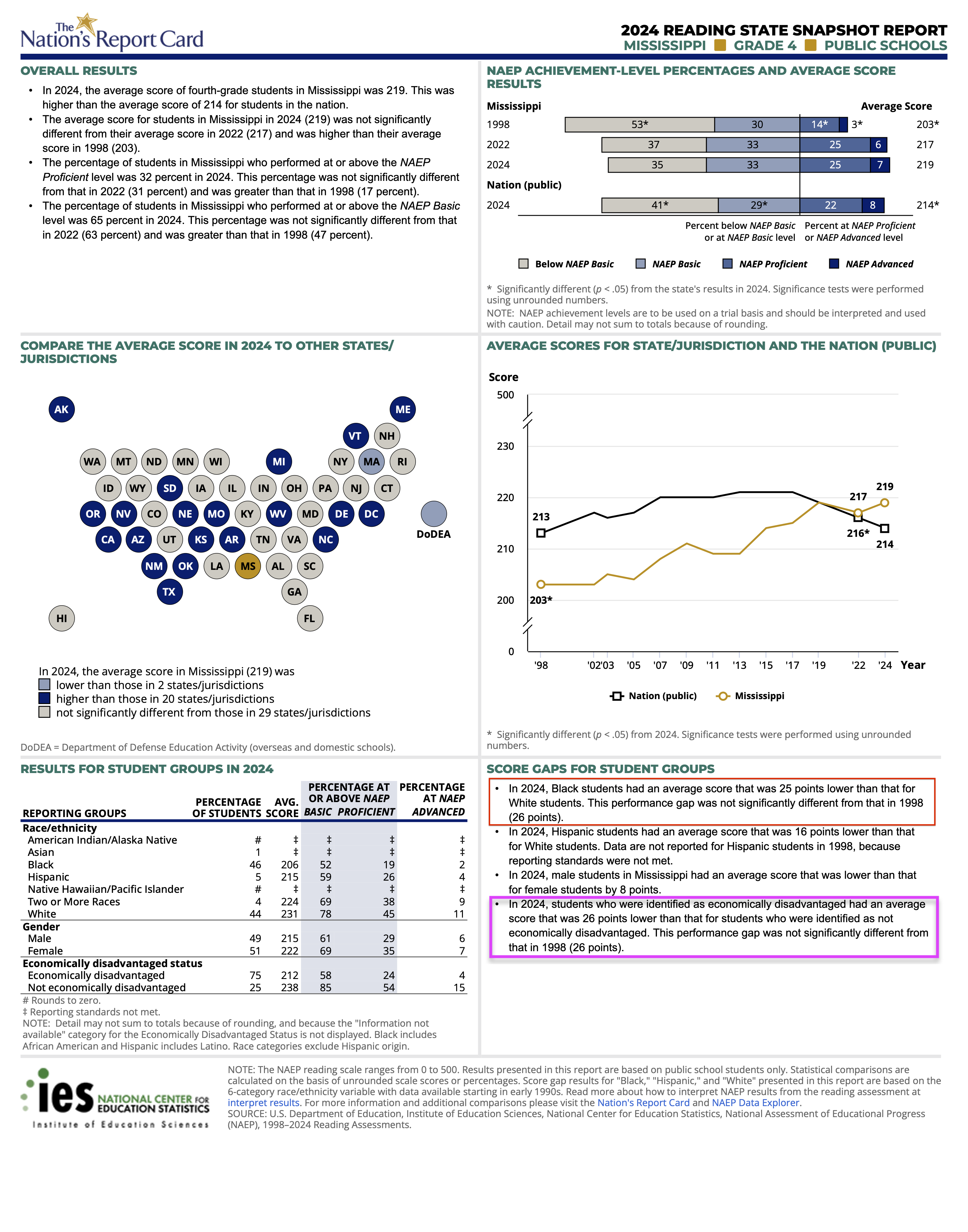
That’s right, MS has the same racial and socio-economic achievement gaps since 1998, discrediting anything like a “miracle.”

But the likely most egregious misrepresentation of MS as a reading “miracle” is Aldeman “debunking” claims that MS gains are primarily grounded in grade retention, not the “science of reading.”

Notably, Aldeman seems to think linking to the Fordham Institute constitutes credible evidence; it isn’t.

So let’s look at the full picture about grade retention and MS’s reading scores on NAEP.

First, the research on increased reading achievement has found that only states with retention have seen score increases. Westall and Cummings concluded in a report on reading policy: “[S]tates whose policies mandate third-grade retention see significant and persistent increases in high-stakes reading scores in all cohorts…. [T]here is no consistent evidence that high-stakes reading scores increase in states without a retention component [emphasis added].” [Note that Aldeman selective refers to this study late in the article, but omits this conclusion.]

The positive impact of retention on test scores has not been debunked, but confirmed. What hasn’t been confirmed is that test score gains are actual achievement gains in reading acquisition.

Next, MS (like FL and SC, for example) has risen into the top 25% of states in grade 4 reading on NAEP, but then plummets into the bottom 25% of states by grade 8 (despite their reading reform having been implemented for over a decade), suggesting those grade 4 scores are a mirage and not a miracle:

And finally, MS has consistently retained about nine thousand students each year (mostly Black and poor students) for a decade; if the state was actually implementing something that works, the number of students being retained would decrease and (according the SOR claims that 95% of students can be proficient) disappear.

A final point is that media always omits the most important story, what research has shown for decades about student achievement:

Almost 63% of the variance in test performance was explained by social capital family income variables…. The influence of family social capital variables manifests itself in standardized test results. Policy makers and education leaders should rethink the current reliance on standardized test results as the deciding factor to make decisions about student achievement, teacher quality, school effectiveness, and school leader quality. In effect, policies that use standardized test results to evaluate, reward, and sanction students and school personnel are doing nothing more than rewarding schools that serve advantaged students and punishing schools that serve disadvantaged students.

High-poverty states and states with high percentages of so-called racial minorities are not, in fact, beating the odds—again, note that states have not closed the racial achievement gap or the socio-economic achievement gap.

Yes, too often our schools are failing our most vulnerable students. But the greater failures are the lack of political will to address the inequity in the lives of children and the lazy and misleading journalism of the mainstream media covering education.


Update 1

The Mississippi “miracle” propaganda is part of a conservative Trojan Horse education reform movement.

Note this commentary from the Walton-funded Department of Education Reform (University of Arkansas): Mississippi’s education miracle: A model for global literacy reform. The key reveal is near the end of the commentary:

Teaching at the right level and a scripted lessons plan are among the most effective strategies to address the global learning crisis. After the World Bank reviewed over 150 education programs in 2020, nearly half showed no learning benefit.

The goal is de-professionalizing teachers and teaching, not improving student reading proficiency.

Updated 2

The political, market, and media hype over both MS and LA are harmful because that misrepresentation and exaggeration drive the fruitless crisis/reform cycles in education and distracts reform from the larger and more impactful causes of student achievement.

To understand better education reform, I recommend the recently released Opportunity to Learn Dashboard.

According to the press release from NEPC:

Funded and maintained by the National Center for Youth Law (NCYL) and The Schott Foundation for Public Education, the Opportunity to Learn Dashboard tracks 18 indicators across 16 states. The project seeks to provide information about factors impacting the degree to which children of different ethnicities and races are exposed to environments conducive to learning.

However, indicators directly related to schools explain only a minority of the variation in achievement-related outcomes. Therefore, the dashboard includes out-of-school factors such as access to health insurance and affordable housing, as well as within-school factors such as exposure to challenging curricula and special education spending.

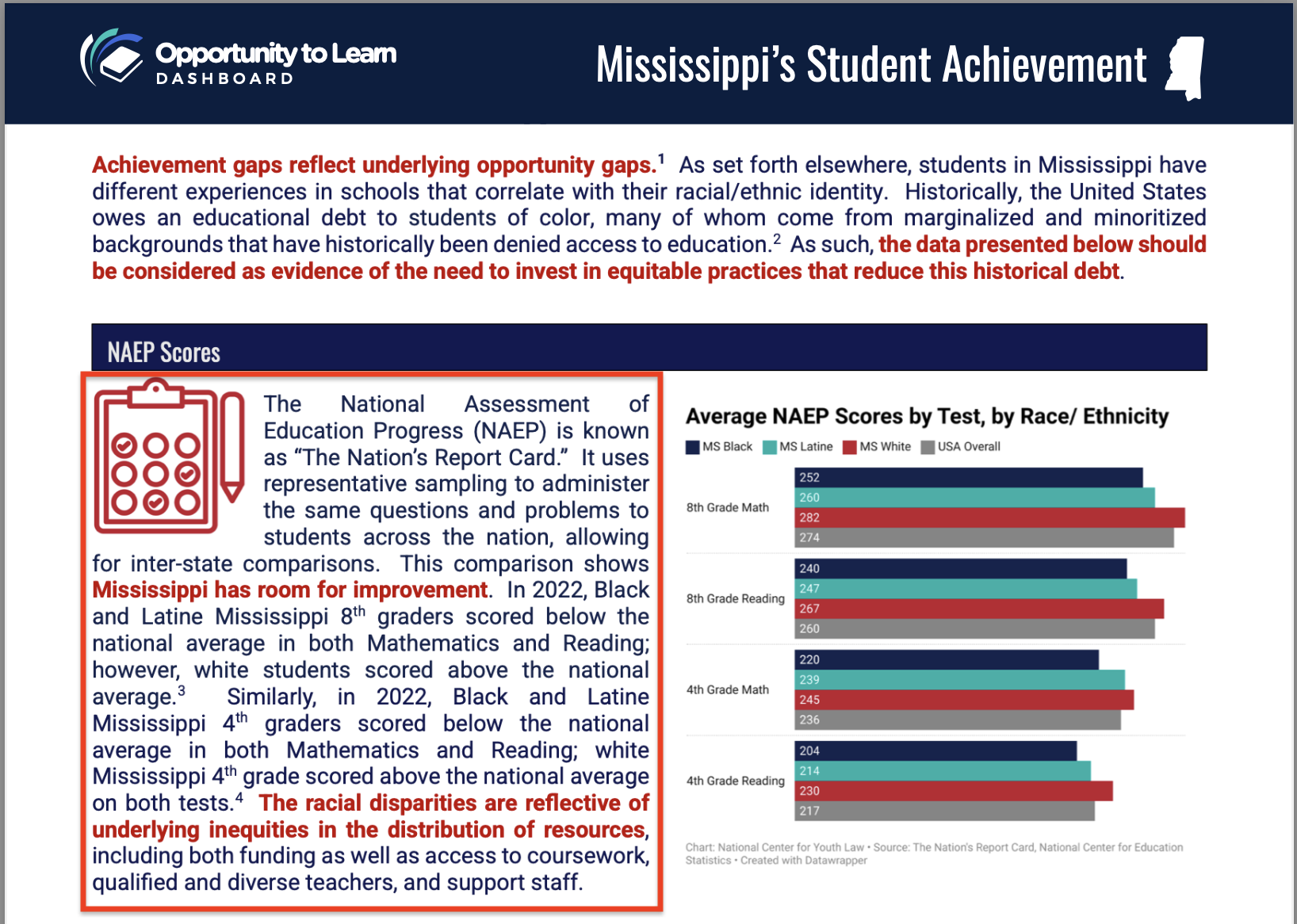
For both MS and LA, we must acknowledge the significant and robust systemic (out-of-school) disadvantages minoritized and impoverished students continue to face in both states:

Note here my points raised about lingering opportunity/achievement gaps exposed by NAEP scores in both states:

To emphasize again, NAEP scores do not reveal education “miracles” in either MS or LA. In fact, NAEP scores continue to show that education reform as usual is a failure.


Recommended

Does the “Science of Reading” Fulfill Social Justice, Equity Goals in Education? (pt. 1)

America Dishonors MLK By Refusing to Act on Call for Direct Action (pt. 2)

Scripted Curriculum Fails Diversity, Students, and Teachers: SOR Corrupts Social Justice Goals (pt. 3)

If We Are Scripted, Are We Literate? (Presentation)

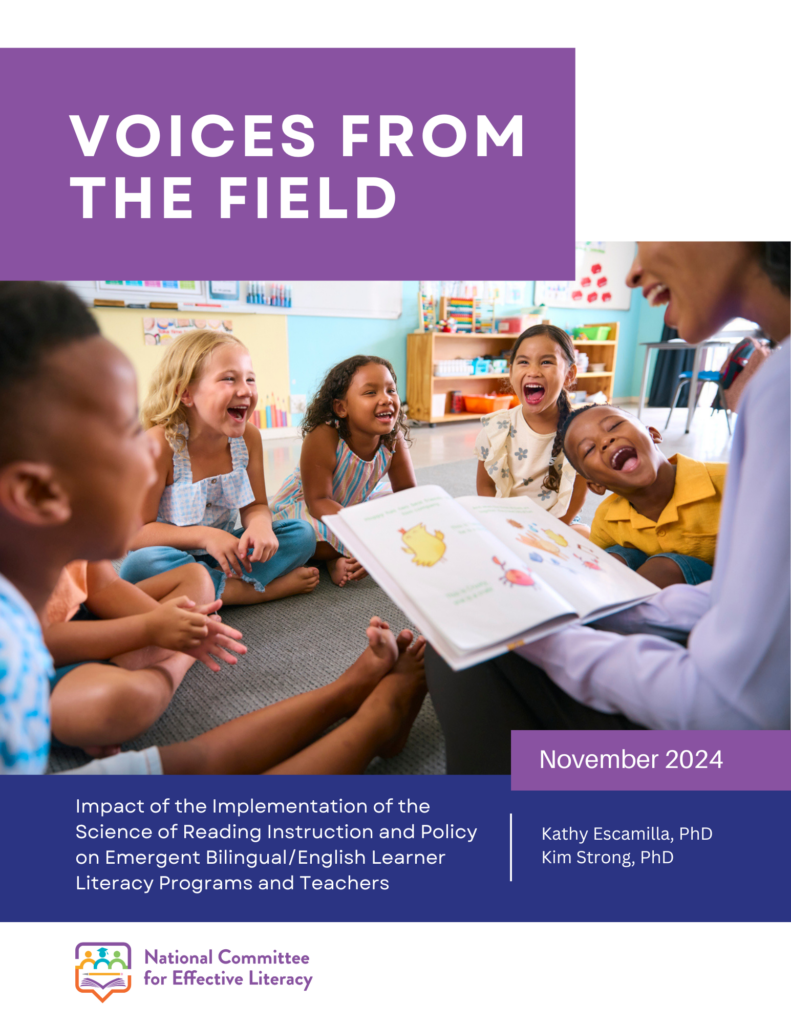
Recommended: Voices from the Field: The Impact of the Implementation of Science of Reading Instruction and Policy on Emergent Bilingual/English Learner Literacy Programs and Teachers

Voices from the Field: The Impact of the Implementation of Science of Reading Instruction and Policy on Emergent Bilingual/English Learner Literacy Programs and Teachers

This new groundbreaking report from the National Committee for Effective Literacy (NCEL), Voices from the Field: The Impact of the Implementation of Science of Reading Instruction and Policy on Emergent Bilingual/English Learner Literacy Programs and Teachers, dives deep into the real-world implementation of Science of Reading (SoR) policies. Through interviews with nearly 80 educators who work directly with emergent bilinguals and English learners (EB/EL) in schools implementing state and district SoR policies, we uncover critical insights into the challenges and opportunities for supporting EB/ELs. This study points to the need for more comprehensive understanding of the SoR and for implementation supports that directly address the needs of EB/EL students and the contexts in which they are taught.

Free Download

Manufacturing Crises to Perpetuate Stories for Ideological Agendas

[Header Photo by Ante Hamersmit on Unsplash]

Some people have recognized that Elon Musk has willfully or ignorantly misread and misrepresented data on social security to create a story to support an ideological agenda—cutting social programs in the US government.

Note this thread on X/Twitter, notably Wolfer’s final post: “When everything they say is designed to mislead, you’re left to wonder why.”

Manufacturing crises to perpetuate stories for ideological agendas is very effective (and nothing new).

Why?

“A lie can travel halfway around the world while the truth is still putting on its shoes” (a quote misattributed to Mark Twain, somewhat ironically).

Certainly, the Trump/Musk era of this strategy is an extreme moment in history; however, this is exactly how education reform has been conducted since the 1980s and how the current “science of reading” (SOR) movement is being orchestrated.

The entire education reform movement was grounded in a data lie manufactured by a political report, A Nation at Risk, to create a story of public school failure in the US in order to perpetuate Reagan’s ideological agendas (school prayer, school choice, etc.).

Now, as a subset of the manufactured education crisis, the SOR movement has misread and misrepresented NAEP data to manufacture a reading crisis in order to perpetuate a story of student literacy and “bad” teachers in order to perpetuate ideological and market agendas for teaching reading.

As Tom Mahoney concludes:

If evidence is being ignored, then it isn’t really about evidence.

It’s about ideology.

If you see through the manufactured crises of the Trump/Elon answer, you have a template for seeing through the manufactured education and reading crises.

In short, don’t buy any of it.


Note

Follow this thread:

Listen at Busted Pencils: Radical Literacy Scholarship, with Paul Thomas

Radical Literacy Scholarship, with Paul Thomas [CLICK to listen]

Returning Pencil Buster Dr. Paul Thomas joins us to help us break down the “science of reading.” This is a topic we’ve covered frequently, most recently with Dr. Nancy Carlsson-Paige this week. But Dr. Paul brings a uniquely nuanced and deep knowledge of the marketing scheme/regressive conservative political tool masquerading as a curriculum set to the show. Because Dr. Paul’s dug deep, and with his 40+ year career as a literacy educator, writer, and speaker he is one educated educator on the topic. Don’t be fooled by their talk of “science”, Dr. Paul urges us. It is a method for censorship and limiting of educators. We can do so much better. And our students deserve so much better. Yet conservative lawamakers have written laws literally banning the teaching of anything except the so-called “science of reading.” Come on, let’s not remove tools from our educators’ literacy teaching kits. That’s just foolish.

BustED Pencils: Fully Leaded Education Talk is part of Civic Media. Subscribe to the podcast to be sure not to miss out on a single episode! To learn more about the show and all of the programming across the Civic Media network, head over to https://civicmedia.us/shows. Join the conversation by calling or texting us at 608-557-8577 to leave a message!

The Outlier Story: How Education Journalism (Almost) Always Gets It Wrong

[Header Photo by Will Myers on Unsplash]

The first two decades of my career as a literacy educator were spent as a high school English teacher in rural Upstate South Carolina, the high school I had graduated from and my home town.

This began in 1984 when SC had passed sweeping education legislation that would become the standard legislative approach across the US—accountability policy grounded in state standards, high-stakes testing (grades 3 and 8 with exit exams in high school starting in grade 10), and school report cards.

SC was an early and eager adopter of the “crisis” rhetoric fueled by A Nation at Risk report released under the Reagan administration.

That high school and town were populated mostly by working-class and poor people; the town and smaller towns served by the high school were dead or dying mill towns.

Schools had far more poverty than the data showed because rural Southerners often refused to accept free and reduced meals (the primary data point for measuring poverty in schools).

However, for many years the high school ranked number 1 in the entire state for student exit exam scores in math, reading, and writing. Because of our student demographics (and notably because these students had relatively low or typical scores in grade 8 testing), we were what many people would refer to as a “high flying” or “miracle” school.

In more accurate statistical terms, we were an “outlier” data point in the state.

I have been in SC education for an ongoing five decades, and the overwhelming body of data related to student achievement in the state has matched what all data show across the US—measurable student learning is most strongly causally related to the socioeconomic status and educational levels of those students’ parents.

Further, the full story about how we achieved outlier status includes two aspects.

One is that from grade 8 to grade 10 testing, the population of students changed because of students dropping out of school (and these were among the lowest scoring students in grade 8). In fact, students were often encouraged to drop out and enroll in adult education (a two-fer win for the school because they would not be tested and enrolling in adult ed removed them from the drop-out data).

A second part of the story is that students scoring low in grade 8 were enrolled in two math and two ELA courses in grade 10. The “extra” courses were specifically designed as test-prep for state testing. We rigorously adopted a teach-to-the-test culture.

For the state writing exam, for example, we discovered that the minimum text a student could produce was an “essay” with a three-sentence introduction, a five-sentence body, and a three-sentence conclusion. Students in the “extra” ELA course wrote dozens of 3-5-3 essays in grade 10 with the teacher focusing on helping students avoid the “errors” that would flag the text as a below standard.

Many of us found the 3-5-3 approach to writing became a huge problem when students were required to write in other courses; even as students “passed” the state writing exam, they were not performing well as writers in other courses, and even refusing at times to write more than 3-5-3 essays.

For the high-stakes accountability era, we did do a great deal of good because many students across the US passed all their courses but could not receive a diploma because of exam exams. Most of our students graduated, and not because we did anything underhanded.

Yet, I must stress that how we accomplished our outlier status was likely not scalable, but more importantly, our approach should not be replicated by other schools.

Fast-forward 40 years, and education journalism has written hundreds and hundreds of stories not only in pursuit of “outlier” schools, but carelessly framing them as both proof of the on-going (permanent) education crisis and that “status quo” education refuses to implement what we know “works.”

The newest iteration of this misleading story in education is the “science of” movement grounded in the “science of reading” story first popularized by Emily Hanford, who wrote about a “miracle” school in Pennsylvania. This compelling but false story has been parlayed into an even more successful podcast as well as spawning dozens of copy-cat articles by education journalists across the country.

Media, however, never covered Gerald Coles’s careful debunking of the “miracle” school Hanford featured. Similar to my story above about the beginning of my teaching career, the full story of that school was quite different than what was covered in the media.

And as 2024 drew to a close, education journalists simply have no other lens that this: Which School Districts Do the Best Job of Teaching Math?

To be blunt, education journalists are mistakenly compelled to focus on the “exceptional” districts (outliers) while ignoring the more compelling red line that, again, shows what, in fact, is normal and what can and should be addressed in terms of educational reform—the negative impact of poverty on educational attainment.

So here is a story you likely will not read: Education journalism is failing public education, and has been doing so for decades.

Education journalists are blindly committed to the “crisis” and “outlier” stories because they know people will read and listen to them.

The “outlier” story makes for a kind of “good” journalism, I suppose, but the problem is that these stories become popular beliefs and then actual legislation and policy.

The current”science of” movement is riding a high wave because of the “science of reading” tsunami. But like all the misguided reforms since the original false education story, A Nation at Risk, this too will crash and reveal itself as a great harm to students, teachers, and our public school system.

This is boring, I know, but most outlier stories are ultimately false or they simply are not replicable or scalable, as I explained in my opening story.

If we genuinely care about student learning, teaching, and the power of public education, we need education journalists more dedicated to the full story and the not the outliers that help drive their viewing numbers.


Recommended

Big Lies of Education: A Nation at Risk and Education “Crisis”

Big Lies of Education: Reading Proficiency and NAEP
Big Lies of Education: National Reading Panel (NRP)

Big Lies of Education: Poverty Is an Excuse

Big Lies of Education: International Test Rankings and Economic Competitiveness

Big Lies of Education: Grade Retention

“Science” as Bad Faith Bullying

[Header Photo by jesse orrico on Unsplash]

The more things change, the more things stay the same.

Especially in America.

F. Scott Fitzgerald’s The Great Gatsby, set in the 1920s, centers the story on a few rich characters—Tom and Daisy Buchanan, who have “old” money, as well as Jay Gatsby, representing the nouveau riche.

At the cusp of 2024 and 2025, a century later, one page from the novel seems disturbingly relevant:

In this scene, Fitzgerald uses Buchanan to portray the rise of scientific racism in the US. The scientific racism era in the early 20th century is but one of many examples of how “science” can be used by bad faith actors to promote an ideological agenda.

It isn’t his fault, Buchanan seems to suggest, that he is among the superior white Western civilization: “‘It’s all scientific stuff; it’s been proved.'”

In recent years in the US, navigating science, proof, and science skepticism has reach a level of complexity that defies postmodern thought. Simultaneously, we may be living in the most advanced era of scientific knowledge along side a rising and powerful science-skepticism era.

Vaccination deniers, flat Earthers, and Covid conspiracy theorists have increasingly prominent voices and policy influence due to social media, and the Trump era certainly has eroded how most people understand and what counts as “proven” science.

“Science” as Bad Faith Bullying: Education Edition

Concurrent to the larger political and cultural problems with “science” and science-denial, the education reform movement grounded in the early 1980s accountability movement has adopted “science” as a bad faith bullying approach to reform.

The “science of reading” (SOR) movement [1], essentially driven by conservative ideology, exploded around 2018 under the first Trump administration, and now, SOR has spawned a series of “science of” companion movements—the “science of math,” “the science of learning,” etc.

We may have reached peak “science” as bad faith bullying, however, with a law suit against Heinemann and a few reading programs [2] disproportionately attacked and scapegoated by Emily Hanford and much of mainstream media: “The suit alleges ‘deceptive and fraudulent marketing and sale of products and services which are undermining a fundamental social good: literacy.'”

If this weren’t yet another personal attack on a few literacy leaders and potentially significant waste of time and money to navigate the nonsense of this legal move, it would be funny since the SOR movement itself is practicing exactly what the suit accuses Heinemann of doing, “fraudulent marketing and sale of products.”

Let’s start with the foundational argument among SOR advocates that teaching practices must be grounded only in practices supported by experimental/quasi-experimental research published in peer review publications, as argued by The Reading League:

While I think these standards are too narrow for real-world practice, this is in fact the basis upon which SOR advocates (and the substance of the law suit) rest sweeping and misleading claims about a range of discounted practices labeled as either whole language or balanced literacy (SOR advocates both interchange and mischaracterize these terms repeatedly along with misrepresenting other terminology such as “three cueing”).

Further, the SOR movement has adopted an old and inaccurate assertion about “science,” echoing Tom’s “‘it’s been proved.'”

Similar to the reading crisis rhetoric from 1961—when Walcutt announces: “We have said that no further ‘research’ into methods of reading instruction is necessary” (p. 141)—Hanford and Moates proclaimed SOR “settled science” in 2018 (and we must note Moates has a huge market interest in these claims as author of LETRS, see below):

However, the “science” in reading research is not settled, and the SOR movement, as I stated above, is committed to a “deceptive and fraudulent marketing and sale of products and services”; as I have shown repeatedly, the SOR movement is itself grounded in a plan from 2014 to brand “structure literacy” to “help us sell what we do so well.”

That plan has included exaggerated attacks on some reading programs, some literacy leaders, and some literacy practices while simultaneously endorsing different programs and some practices that are also not supported by SOR’s mandate for a narrow type of “science.”

For example, in a literature review of the current status of SOR from 2022, note that practices either ineffective or lacking scientific support include those rejected by SOR and those embraced by SOR; while this lit review identified “three cueing” as not supported by science as SOR advocates claims, it also lists decodable texts and multisensory approaches (such as Orton-Gillingham), practices and programs aggressively supported by SOR advocates and legislation:

That pattern is standard practice in the SOR movement, including the false attack on teacher education and teacher knowledge being used as “science” as bad faith bullying to sell LETRS.

LETRS falls into the “ineffective and currently unsupported” category as well since only a few studies exist, showing no improvement in student reading.

The SOR movement has also adopted slogans not supported by science (95% of students can be proficient readers) and practices that inflate test scores, target and harm marginalized groups of students, but are not supported by research (grade retention, which seems to be the sole SOR policy impacting test scores).

The “science of” era of education reform is not about improving instruction or student learning. The movement uses “science” as a Trojan horse for de-professionalizing teaching and teachers (selling scripted curriculum) while clearing market space for a new round of “fraudulent marketing and sale of products.”

The law suit is another example showing this “science of” education reform movement is more bad faith bullying than a credible avenue to better supporting teachers and better serving students as readers and learners.

Once again, don’t buy it.


[1] See We Teach English in Times of Perpetual Crisis: Selling a Story of Reading (and Literacy) [Webinar Companion Post]: “Also when I address the SOR movement, I am not contesting reading science or valid concerns about reading instruction or reading proficiency by students. I am challenging the media story being sold.”

[2] I reject adopting any reading programs and maintain that the reading-program-merry-go-round is the problem, not the solution to reading achievement.

Recommended

How Media Misinformation Became “Holy Text”: The Anatomy of the SOR Movement

English Journal Series: We Teach English in Times of Perpetual Crisis

Recommended: Elena Aydarova on Science of Reading Reform

Recommended: Dr. Elana Aydarova. Science of Reading Mythologies

We Teach English in Times of Perpetual Crisis: Selling a Story of Reading (and Literacy) [Webinar Companion Post]

Click here to register: https://forms.gle/mvvs7etQAg7RESxs8

See the webinar presentation HERE.

Webinar recording:


In 1947, writing in NCTE’s Elementary English (which became Language Arts), Lou LaBrant announced, “This is not the time for the teacher of any language to follow the line of least resistance, to teach without the fullest possible knowledge of the implications of his medium” (p. 94).

The 2020s have made this call even more important for teachers of language K-12 in the US because of the rise of censorship and curriculum gag orders along with legislative mandates including scripted curriculum as part of the “science of reading” (SOR) movement.

Here, I want to focus on the SOR movement as another cycle of the Reading War, one that threatens the professionalism and autonomy of all teachers at every level.

Those Reading War cycles have included:

Teachers must recognize that Reading War cycles tend to be about ideology, market concerns (reading programs), and political agendas, but not grounded in credible evidence or well focused on the needs of students or the professionalism of teachers.

Also when I address the SOR movement, I am not contesting reading science or valid concerns about reading instruction or reading proficiency by students. I am challenging the media story being sold:

Aukerman, M. (2022, November 23). The science of reading and the media: Is reporting biased? Literacy Research Association. https://literacyresearchassociation.org/stories/the-science-of- reading-and-the-media-is-reporting-biased/ 

Further, teachers at all levels must be familiar with the key issues for misleading and even inaccurate claims within the SOR movement (again distinct from reading science and a broad base of research over a century):

Despite many of the claims made in this media story being misleading or false, the story is very compelling for the public, especially parents. For example, a poll, Reading Education Messaging: Findings and Recommendations from an Online Poll of K-5 Parents in America, shows a disturbing pattern:

The media claim about reading proficiency (which is false because of the confusing categories in NAEP testing) actually changes parental opinion from positive to negative.

“Basic,” not “proficient,” in NAEP is at grade level; therefore, instead of about 2/3 of students struggling to read, the closer statistic is about 1/3 (and this has been a flat data point for 30+ years, which suggests a norm of reading proficiency and not some recent crisis):

More broadly, the phonics agenda in the Reading War is driven by the same conservative ideology as book bans.

One example is the advocacy of the Gablers in the 1980s, featured in a article in Texas Monthly:

But the Gablers also feel that even those students who learn to read through intensive phonics, memorize their ‘times tables,’ diagram sentences perfectly, and win spelling bees and math contests must still cope with an educational system that is geared to undermining their morals, their individuality, their pride in America, and their faith in God and the free enterprise system. Much of this corrosive work is accomplished through textbooks in history, social sciences, health, and homemaking.

The Gablers also targeted textbooks in their crusade similar to the book bans and misguided attacks on some reading programs:

Norma and Mel Gabler entered the field of textbook reform twenty years ago, after their son Jim came home from school disturbed at discrepancies between the 1954 American history text his eleventh-grade class was using and what his parents had taught him. The Gablers compared his text to history books printed in 1885 and 1921 and discovered differences. “Where can you go to get the truth?” Jim asked.

Since states have been moving toward reading legislation and programs labeled as SOR since around 2012, the evidence is mounting that these misleading and ideological claims of a reading crisis have not (and cannot) deliver on their promises. [1]

But possibly more troubling than the failure to improve student reading proficiency is that these legislative commitments are wasting taxpayers’ money on another baseless Reading War that serves the interests of the education marketplace: “In the first year of implementation, $100 million was allocated for the reform, with $60 million coming from CO VID-19 relief funds. Most of these resources, however, went toward covering the products and services provided by nonprofit and private-sector organizations” (Aydarova, 2023, p. 570).

The market motives behind SOR, in fact, were openly expressed a decade ago in a post by IDA, Structured Literacy: A New Term to Unify Us and Sell What We Do:

At its July 1st meeting, the IDA Board of Directors made a landmark decision designed to help market our approach to reading instruction.  The board chose a name that would encompass all approaches to reading instruction that conform to IDA’s Knowledge and Practice Standards. That name is ‘Structured Literacy.’…

If we want school districts to adopt our approach, we need a name that brings together our successes. We need one name that refers to the many programs that teach reading in the same way. A name is the first and essential step to building a brand….

The term “Structured Literacy” is not designed to replace Orton Gillingham, Multi-Sensory, or other terms in common use. It is an umbrella term designed to describe all of the programs that teach reading in essentially the same way. In our marketing, this term will help us simplify our message and connect our successes. “Structured Literacy” will help us sell what we do so well.

Structured literacy is more a marketing term than a proven way to address the manufactured reading crisis; further, structured literacy accomplishes two outcomes that are counter-educational—de-professionalizing teachers and whitewashing the reading curriculum. [2]

The SOR movement grounded in structured literacy driven by efforts to curb teacher autonomy is being admitted also by the Evidence Advocacy Center, as reported in New Initiative Is Creating Evidence-Based Guidelines for Educators:

In the EAC’s plan for the transformation of the profession into an evidence-based system, educators will relinquish certain freedoms — notably the leeway to employ ineffective practices — but will gain guidance that empowers them to fulfill their original purpose by profoundly impacting the future of students, families and communities. The alternative is to continue rearranging the deck chairs under the guise of education reform.

Since over 75% of public school teachers are women (Report on the Condition of Education 2024), all educators, regardless of content area or grade level, must recognize the threat of “relinquish certain freedoms,” eeriely similar to arguments posed to Handmaid’s in Atwood’s The Handmaid’s Tale:

There is more than one kind of freedom, said Aunt Lydia. Freedom to and freedom from. in the days of anarchy, it was freedom to. Now you are being given freedom from. Don’t underrate it….

We were a society dying, said Aunt Lydia, of too much choice. (pp. 24, 25)

While these efforts are about power and control, the SOR movement includes a harmful pattern of journalists taking on the role of “watchdogs,” as Hanford claims for the Education Writers Association.

Finally, then, the SOR movement is not just another Reading War, and the SOR movement is far more than an immediate concern for beginning reading teachers and teacher educators.

This movement is another threat to teaching as a profession, an organized agenda that seeks ways to de-professionalize teachers while serving market and political goals at the expense of teaching and learning.

Recommended

Betts, E. A., Dolch, E. W., Gates, A. I., Gray, W. S., Horn, E., LaBrant, L., Roberts, H., Smith, D. V., Smith, N. B., & Witty, P. (1942). What shall we do about reading today? A symposium. The Elementary English Review, 19(7), 225–­ 256. https://www.jstor.org/stable/41382636

Thomas, P.L. (2024, March). We teach English in times of perpetual crisis: The long (and tedious) history of reading crisis. English Journal, 113(4), 21-26. https://publicationsncte.org/content/journals/10.58680/ej2024113421

Thomas, P.L. (2024, May). Teaching English in the “science of reading” era: We teach English in times of perpetual crisis: Selling a story of reading. English Journal, 113(5), 16-22. https://publicationsncte.org/content/journals/10.58680/ej2024113516 [Access HERE until open access at EJ]

Thomas, P.L. (2024, September). We teach English in times of perpetual crisis: The media continue to misread teaching reading and literacy. English Journal, 114(1), 14-19. https://publicationsncte.org/content/journals/10.58680/ej2024114114 [Access HERE until open access at EJ]

Thomas, P.L. (2024, November). We teach English in times of perpetual crisis: For all ELA teachers, “the time is always now.” English Journal, 114(2), 21-26. TBD

Thomas, P.L. (2022). The Science of Reading movement: The never-ending debate and the need for a different approach to reading instruction. Boulder, CO: National Education Policy Center. Retrieved [date] from http://nepc.colorado.edu/publication/science-of-reading

Thomas, P.L. (2016). Miracle schools or political scam? In W.J. Mathis & T.M. Trujillo, Learning from the Federal Market-Based Reforms: Lessons for ESSA. Charlotte, NC: IAP.

Lou LaBrant: An Annotated Bibliography

Tomorrow’s Illiterates: The State of Reading Instruction Today, by Walcutt, Charles Child


Notes

[1] See for example:

  • Aydarova, E. (2023). ‘Whatever you want to call it”: Science of reading mythologies in the education reform movement. Harvard Educational Review, 93(4), 556–581, https://doi.org10.17763/1943-5045-93.4.556
  • Chaffin, M., Riesco, H.S., Hacket-Hill, K., Collet, V., Grizzle, M.Y., Y Warren, J. (2023). “Phonics monkeys” and “real life reading”: Heteroglossic views of a state reading initiative. Literacy Research and Instruction, 1–22. https://doi.org10.1080/19388071.2023.2271085
  • Reinking, D., Hruby, G.G., & Risko, V.J. (2023). Legislating phonics: Settle science of political polemic? Teachers College Record. https://doi.org/10.1177/01614681231155688
  • Thomas, P.L. (2022). The Science of Reading movement: The never-ending debate and the need for a different approach to reading instruction. Boulder, CO: National Education Policy Center. http://nepc.colorado.edu/publication/science-of-reading 

[2] See for example: