Category Archives: School choice

Don’t Trust Invested Advocates in Edureform Wars

South Carolina remains a disturbing subset of the larger education reform movement effectively dismantling but not improving pubic schools, institutions that have historically and are currently failing vulnerable student populations who need public opportunities more than anyone.

Charleston is now the battle ground over expanding charter schools and embracing the already failed turnaround or takeover models that many early adopters in other states are ending.

The public version of the debate has included the following:

Beyond the specifics of the issues of this debate about takeover policies and charter school expansion (and the implications of privatizing public schools therein), this debate highlights a very important issue for SC and the nation: Don’t trust invested advocates of education reform.

The current charter school debate, we must acknowledge, is just the latest version of the much older school choice debate. Notable about the school choice debate is that choice advocates have constantly shifted their promises, ignored when they fail to come through, and then moved on to the next carnival scam.

The debate over charter schools and takeovers in Charleston, then, is another time we must heed Why Advocacy and Market Forces Fail Education Reform.

Advocates for Meeting Street Schools are driving with vested interest expanding their model, and making dramatic claims without providing the data and evidence for disinterested parties to analyze.

Part of school choice advocacy, including the current charter push, includes making grand claims before the data are available for unmasking those claims.

SC has a large pro-charter movement that routinely falls ways short of any sort of competition model: 4 or 5 charters out of over 50 producing data better than comparable public schools, and most charters are no better and many are worse (see analysis of two years here).

These “miracle” school narratives fail on logic (outliers are irrelevant for determining typical), but as Harris has show, disinterested analysis of “miracle” schools has shown that “only 1.1 percent of high-poverty schools were identified as ‘high flyers.'”

School choice is a shell game, one resting its promises on indirect action that is necessarily no positive action at all.

The only direct action is investing fully in public education that starts with the interests of our most vulnerable students and not the promises of adults invested in their own interests.

School choice lessons for Charleston – Post and Courier

School choice lessons for Charleston – Post and Courier

Expanded version, early post: Ten Years After Katrina: Lessons from Charleston, SC

And at Truthout: Ten Years After Katrina: Lessons From Charleston, South Carolina

[included below with hyperlinks]

Mention a coastal city notable for its diverse cultural history and the twin scars of natural disasters and human-made racism and generational poverty, and most people will think New Orleans, especially during the ten-year anniversary of Hurricane Katrina.

However, Charleston fits that same complicated profile and shares with New Orleans the historical failure of public schools to serve equitably poor and black, resulting in both cities being targets of wide-scale and often reckless education reform driven by political ideology.

While I have criticized mainstream media for covering education reform uncritically, I was impressed with the detailed examination of education reform in the large school district serving the city: Left Behind: The unintended consequences of school choice.

This coverage and related data are not new to those of us having taught in SC for decades. It takes very little effort to recognize that both traditional public schools (funding, teacher assignment, student tracking, etc.) and education reform driven by accountability and market forces over the past three decades have not served well vulnerable populations of students.

Nonetheless, the Left Behind series is a rare and fertile opportunity to address that because the coverage does, despite some flaws, present the complicated challenges that face both public education and society, ones that are inextricable from racism and poverty.

One response to this series, a South Carolina Policy Council (SCPC) Op-Ed titled School choice is a solution, not a problem, fails that opportunity because reducing the lessons of Charleston public schools to a debate about school choice is a distraction that will never serve students, families, and the community well.

As I have examined on far too many occasions, free market think tanks do not represent accurately school choice because they have committed entirely to one ideological focus that trumps goals such as educational equity for black and poor children.

The Op-Ed response to Left Behind is primarily advocacy, without credible claims about either the results or promise of school choice (vouchers, tuition tax credits, public school choice, charter schools).

Having written a book-length examination of school choice, I regret the choice debate remains trapped in ideological and political squabbles while children are in fact left behind.

So what do we know about school choice? (See Bruce BakerThe Shanker Blog, and the National Education Policy Center for extensive reviews of the research.)

  • Private, public, and charter schools have about the same range of measurable student outcomes, regardless of the school type and strongly correlated with the socioeconomic status of the child’s home.
  • Research on school choice has shown mixed results at best, but even when some choice has shown promise of, for example, raising test scores for black, brown, and poor students, those increases are linked to selectivity, attrition, greater funding, and extended school days/years—not choice.
  • School choice, notably charter schools, has increased racial and socioeconomic inequity: segregationinequitable disciplinary policies and outcomes.
  • SC advocacy for charter schools as the newest school choice commitment fails to acknowledge that charter schools in the state are overwhelmingly about the same and often worse than comparable public schools, and the South Carolina Public Charter School District is among the top four worst districts in the state for racially inequitable discipline with blacks constituting about 19% of the enrollment but over 50% of suspensions/expulsions.

But don’t poor children deserve the same choices that rich children enjoy? Several problems exist within this seemingly logical assertion.

First, suggesting that affluent and mostly white affluent children are thriving because of choice is a mask for the reality that the key to their success is their wealth and privilegeBeing born into a wealthy family trumps educational attainment, and white privilege trumps educational attainment by blacks.

Further, no one should have to wait for market forces might accomplish to have access to health care, justice, safety, or education. The great irony is that for the free market to work, a people must first insure equitable public institutions.

As Martin Luther King Jr. stressed in 1967: “We are likely to find that the problems of housing and education, instead of preceding the elimination of poverty, will themselves be affected if poverty is first abolished.”

A full and robust commitment to public education is essential to the concurrent commitment to the free market. The paradox is that in order for choice of most kinds to work in a free society, some essential institutions must render choice unnecessary.

As we can witness in New Orleans, the lessons of education and education reform in Charleston are two-fold: (1) historically and currently, traditional public schools have failed/do fail vulnerable populations, specifically black and poor children, and (2) accountability-based and free-market education reform has also not alleviated the burdens of racism and poverty, but too often has exacerbated the devastating consequences of both.

Postscript

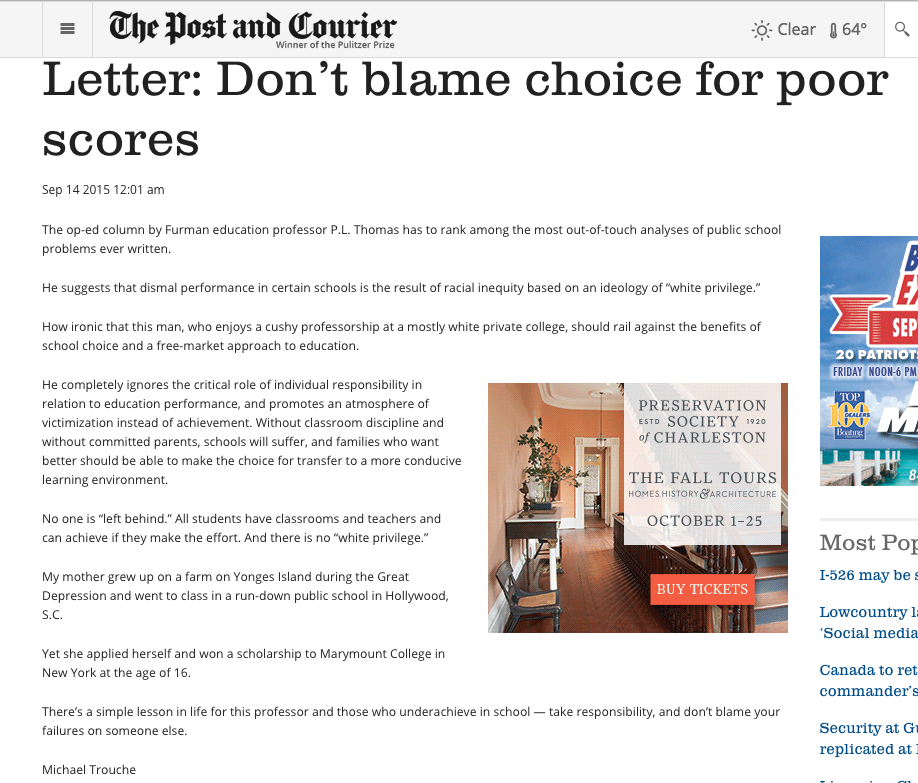
After my Op-Ed on school choice ran in the Post and Courier, the P&C ran a letter that literally states, “And there is no ‘white privilege.'” Also great and disturbing evidence of the fight we face since the writer uses every tactic imaginable except addressing the evidence—attacking me, using one example to claim a generalization:

white denial PandC

Ten Years After Katrina: Lessons from Charleston, SC

Mention a coastal city notable for both its diverse cultural history and the twin scars of natural disasters as well as the human-made cancers of racism and generational poverty, and most people across the U.S. will think New Orleans, especially now as we confront the ten-year anniversary of Hurricane Katrina and the decade of a city rebuilding itself.

However, South Carolina’s Charleston fits that same complicated and troubling profile.

Charleston also shares with New Orleans the historical failure of public schools to serve poor and black children and families, which has resulted in both cities being the target of wide-scale and often reckless education reform driven mostly by political and ideological forces.

While I have regularly criticized mainstream media for covering education and education reform carelessly, I was genuinely impressed with The Post and Courier (Charleston, SC) publishing an extensive and detailed examination of education reform in the large school district serving the city: Left Behind: The unintended consequences of school choice.

This news account and the related data are actually not new for those of us having taught in SC for decades. It takes very little effort to recognize that both traditional public schools (how they are funded, how teachers are assigned, how students are tracked, etc.) and education reform driven by accountability and market forces over the past three decades have not served well vulnerable populations of students, black and high-poverty children.

Charleston is just one example of the Corridor of Shame that has been highlighted in SC for decades, in fact, through the legal system and a widely heralded documentary.

It also isn’t news that the political leadership and even the public in SC have failed to acknowledge the problems of racial and socioeconomic inequity in any real ways that address public policy.

Nonetheless, the P&C‘s Left Behind series is a rare and fertile opportunity to change all that because the coverage does, despite some flaws, present the complicated challenges that face both public education and society, challenges that are inextricable from confronting racism and poverty.

Regretfully, one of the responses to this series is also nothing new—and entirely predictable: a South Carolina Policy Council (SCPC) Op-Ed titled School choice is a solution, not a problem.

First, I must emphasize that reducing the lessons of Charleston public schools to a narrow debate about school choice is a fatal distraction that will never serve students, families, and the community well.

Next, as I have examined on far too many occasions, free market think tanks (and think tanks masquerading as university departments) will never represent accurately school choice because they have committed entirely to one ideological focus that trumps any different or larger goals—such as educational equity for black and poor children.

On the SCPC’s web site, they clearly express their one and only position:

The South Carolina Policy Council was founded in 1986 as an independent, private, non-partisan research organization to promote the principles of limited government, free enterprise, and individual liberty and responsibility in the state of South Carolina.

The Op-Ed response to Left Behind, then, is peppered with cherry-picking, overstatements, and loaded nods to “gold-standard research,” but the claims are advocacy, and not credible conclusions about either the results or promise of school choice in its many and shifting forms (vouchers, tuition tax credits, public school choice, charter schools).

Having spent more than a year doing a book-length examination of school choice, I regret that the debate remains trapped in ideological and political squabbles while children are in fact left behind.

So what do we know about school choice? (See Bruce Baker, The Shanker Blog, and the National Education Policy Center for extensive reviews of the research on choice and charter schools.)

  • Private, public, and charter schools have about the same range of measurable student outcomes, regardless of the school type and strongly correlated with the socioeconomic status of the child’s home. (See this discussion of “charterness.”)
  • Research on school choice has shown mixed results at best, but even when some choice has shown promise of, for example, raising test scores for black, brown, and poor students, those increased scores are linked to selectivity, attrition, greater funding, and extended school days/years—none of which have anything to do with the consequences of choice and all of which expose those “gains” as false success.
  • School choice, notably charter schools, has been strongly linked with increasing racial and socioeconomic inequity: increased segregation, inequitable disciplinary policies and outcomes.
  • SC advocacy for charter schools as the newest school choice commitment fails to acknowledge that charter schools in the state are overwhelmingly about the same and often worse than comparable public schools (see analysis of 2011 and 2013 data here), and the South Carolina Public Charter School District is among the top four worst districts in the state for racially inequitable discipline with blacks constituting about 19% of the enrollment but over 50% of suspensions/expulsions.

The research on school choice does not support the claims made by SCPC, and the rhetoric is also deeply flawed.

School choice advocates often fall back on “poor children deserve the same choices that rich children enjoy.”

However, several problems exist within this seemingly logical assertion.

The greatest flaw is suggesting that affluent and mostly white affluent children are thriving because of choice is itself a lie, a mask for the reality that the key to their success is their wealth and privilege. Being born into a wealthy family trumps educational attainment, and white privilege trumps educational attainment by blacks (see here and here).

In its most disturbing form, then, school choice advocacy is a distraction from the consequences of racism and poverty, both of which are reflected in and perpetuated by the education system.

Further, arguing that we must see school choice as a solution fails for essential conditions in a democracy.

For example, no one should have to wait for the Invisible Hand of the market so they have access to health care, justice, safety, or education. The great irony is that for the free market to work, a people must first secure the foundations of public institutions.

As Martin Luther King Jr. stressed in 1967: “We are likely to find that the problems of housing and education, instead of preceding the elimination of poverty, will themselves be affected if poverty is first abolished.”

A full and robust commitment to public institutions, specifically universal public education, is essential to the concurrent commitment to the free market.The paradox is thus: In order for choice of most kinds to work in a free society, some essential institutions must render choice unnecessary in terms of health care, justice, safety, or education.

As we can witness in New Orleans, the lessons of education and education reform in Charleston are two-fold: (1) historically and currently, traditional public schools have failed/do fail vulnerable populations, specifically black and poor children, and (2) accountability-based and free-market education reform has also not alleviated the burdens of racism and poverty, but has too often exacerbated the devastating consequences of both.

Parental Choice, Magical Thinking, and the Paralysis of Indirect Solutions

Parental choice #1: Seeking a school for their white children so they will not have to attend classes with black or brown children.

Parental choice #2: Seeking a school where their wealthy children will not have to attend classes with poor children.

Parental choice #3: Seeking a school where children will be taught Intelligent Design, but not evolutionary biology.

Parental choice #4: Not allowing their children to be vaccinated.

Parental choice #5: Smoking in the house and car while children are present.

I could continue for quite some time with the hypotheticals, but let’s turn to what we know about parental choice and education.

A 2007 study by a pro-school choice organization in Wisconsin reached the following conclusions:

Taken as a whole, these numbers indicate significant limits on the capacity of public school choice and parental involvement to improve school quality and student performance within MPS. Parents simply do not appear sufficiently engaged in available choice opportunities or their children’s educational activities to ensure the desired outcomes.

This may be just as well. Relying on public school choice and parental involvement to reclaim MPS may be a distraction from the hard work of fixing the district’s schools. Recognizing this, the question is whether the district, its schools, and its supporters in Madison are prepared to embrace more radical reforms. Given the high stakes involved, district parents should insist on nothing less.

More recently, in School Choice Versus A Public System of Education: The Big Picture, Jan Resseger explains:

Promoters of school choice tout the idea that competition through choice will make everybody try harder and improve traditional and charter schools alike.  But large studies conducted in the past year in Chicago and New Orleans show that parents aren’t always looking for academic quality when they choose schools.  Instead they prize schools that are close to home or work, schools near child care, schools with good after-school programs, and high schools with strong extracurricular offerings.  Margaret Raymond of the conservative Hoover Institution, shocked a Cleveland audience in December when she declared that she does not believe that competition through school choice is driving the school improvement its defenders predicted: “This is one of the big insights for me because I actually am a kind of pro-market kind of girl, but the marketplace doesn’t seem to work in a choice environment for education… I’ve studied competitive markets for much of my career… Education is the only industry/sector where the market mechanism just doesn’t work… I think it’s not helpful to expect parents to be the agents of quality assurance throughout the state.”  (You can watch the video of Raymond’s Cleveland speech here, with the comment quoted beginning approximately 50 minutes into the video.)

In the hypothetical and real contexts above, then, I am struck by Jack Markell’s assertion: School Choice Works, Privatization Won’t—notably after rejecting vouchers, his proposal: “That means using parent choice among traditional, charter, and magnet schools to foster innovative instruction, and hold public schools accountable for giving students the best opportunities possible.” [1]

I think we must acknowledge the final point—”best opportunities possible”—while adding “all” before “students” above; however, we cannot allow the essential magical thinking about choice and idealistic framing of parental choice to go unchallenged.

Let me offer next a much broader context.

In 1967, Martin Luther King Jr. addressed “the treatment of poverty nationally” by arguing:

At no time has a total, coordinated and fully adequate program been conceived. As a consequence, fragmentary and spasmodic reforms have failed to reach down to the profoundest needs of the poor.

In addition to the absence of coordination and sufficiency, the programs of the past all have another common failing — they are indirect [emphasis added]. Each seeks to solve poverty by first solving something else.

I am now convinced that the simplest approach will prove to be the most effective — the solution to poverty is to abolish it directly [emphasis added] by a now widely discussed measure: the guaranteed income.

Choice, market forces, the Invisible Hand—these are always indirect methods, and in many cases, magical thinking. The market might accomplish goals that benefit a people, and if so, that process is slow, characterized by fits and starts, and entirely dependent on the consumers—their wants, needs, and abilities to exercise choice.

So let’s return to parental choice #4 above.

What happens to public health if vaccinations are left to the choice of parents, the market?

In other words, the sloppy and chaotic nature of the market to address the quality of cable TV or Internet providers seems something we can tolerate.

But public health?

And this question, I think, is the same for public education.

Promoting the indirect impact of parental choice to accomplish the clear and obvious responsibilities that a public institution not only can but also must fulfill [2] is a tragic failure of a people, an ethical failure.

If we genuinely as a people viewed any child as everyone’s child, we could in the course of public funding and public schooling create the sort of educational opportunities that every child deserves, but currently only the elite are guaranteed because of the dynamics of choice trumping the assurances of the Commons and the stratifying policies driving traditional schooling [3].

And thus Markell’s final bi-partisan wink-wink-nod-nod to Jeb Bush to assert “policymakers should be ‘more daring’ when it comes to education policy” rings hollow since political leaders embracing choice are in fact shirking their responsibility and obligation to act in the service of all people.

[1] Of course, there is always the nasty implication among choice/market advocates and the “no excuses” crowd that teachers and children are just not trying hard enough. And as I detail above, those exact people are supporting letting the market “work” instead of them actually working. So once again, I invoke: “I guess irony can be pretty ironic sometimes.” Commander Buck Murdock (William Shatner), Airplane 2: The Sequel.

[2] See note above, ironically, exposed by parental choice and the market: Just what are the characteristics of the elite private schools wealthy parents choose for their children—the exact political leaders who say class size doesn’t matter but their children’s school has 155 teachers for 1150 students (a 1:7.4 ratio)? And it is here that we have the “best opportunities possible” before us while political leaders remain paralyzed, unwilling to guarantee for “other people’s children” what they cede to the market since, of course, the market favors them.

[3] And let’s ponder how the system benefits the wealthy: Would the SAT and all standardized tests be so entrenched in the U.S. educational system if their gatekeeping effects denied wealthy children grade promotion, graduation, and college entrance? Hint: No.

Public School, Charter Choice: More Segregation by Design

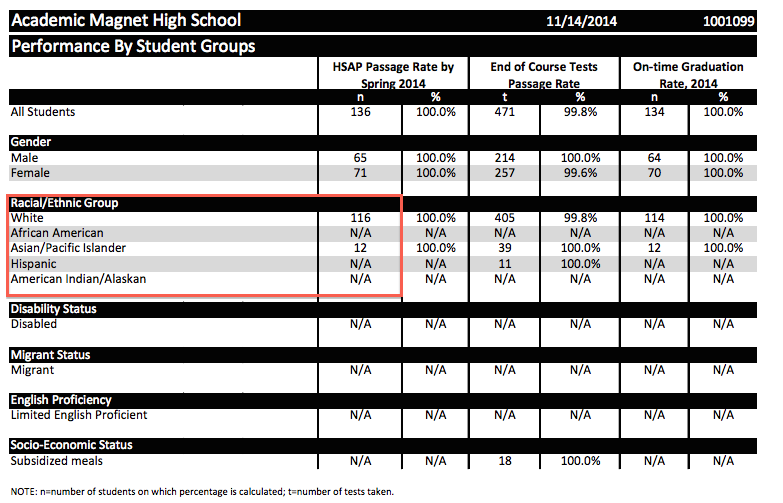
Academic Magnet High School serves the Charleston school district on the coast of South Carolina. The school functions under a choice umbrella, but requires students to submit to an admissions process.

SC is relatively more diverse than the U.S. on average in terms of white (+/- 70%)/black (+/- 30%) demographics, while less diverse in Hispanic/Latino (although those groups are growing significantly). Charleston certainly is even more diverse racially and culturally than the state.

Those realities have now prompted students at Academic Magnet to challenge the lack of diversity at their school:

Calls for a change in the admissions process at Academic Magnet High School continued Monday, with students urging the Charleston County School Board to tackle diversity issues at their school.

“Is the system that has produced an overwhelmingly white, upper-middle-class school in place of an equal opportunity magnet school for all Charleston County students fair?” asked Academic Magnet student Natalie Davidson….

Davidson said that although the school’s admissions process is “in a vacuum unbiased,” it has produced a “homogeneous” student body that is only 2 percent black in a school district that is 42 percent black.

The 2014 SC school report card for Academic Magnet shows absolute and growth ratings of excellent, but tested students included no African American or Hispanic/Latino students:

AMHS test 2014

Magnet and charter schools, however, are not the only choice mechanisms in SC since Greenville County school district offers (and aggressively markets) public school choice:

GCSD choice market

What has public school choice and charter choice produced in Greenville County?

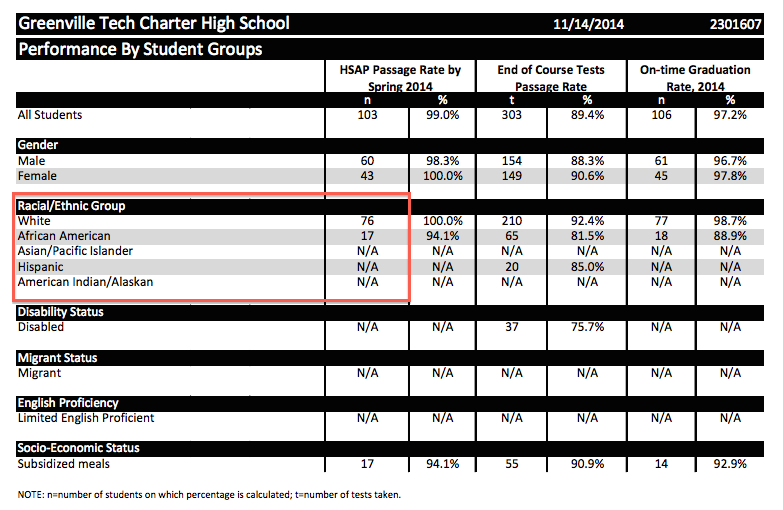
Greenville Tech Charter High School, like Academic Magnet, has 2014 school report card ratings of excellent/excellent, but just over 80% of the students tested are white with no limit English proficiency students included:

GTCHS tested 2014 race

Public school choice has also resulted in highly segregated schools within the same district.

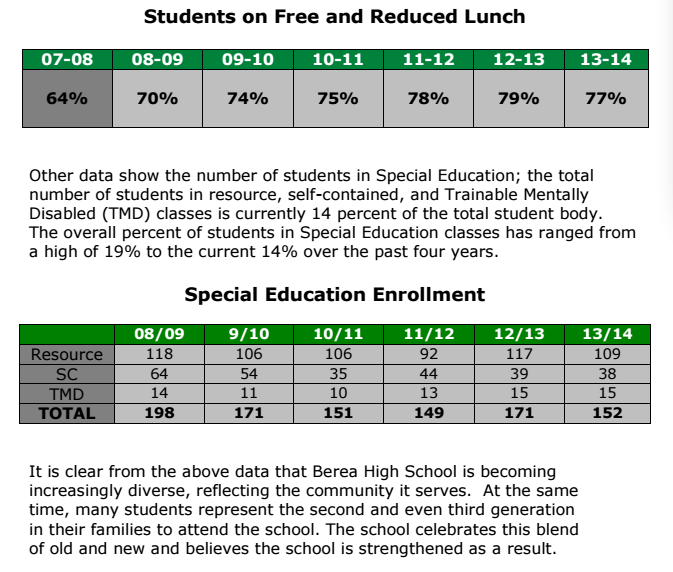
Berea High School has a consistent record of being a majority-minority school and also serves a diverse population of students by poverty and special needs:

BHS race

BHS poverty special needs

As a result, Berea High’s 2014 school report card looks quite different when compared to Academic Magnet or Greenville Tech Charter—good (absolute) and below average (growth) ratings, and a much different tested demographic of students:

BHS tested 2014

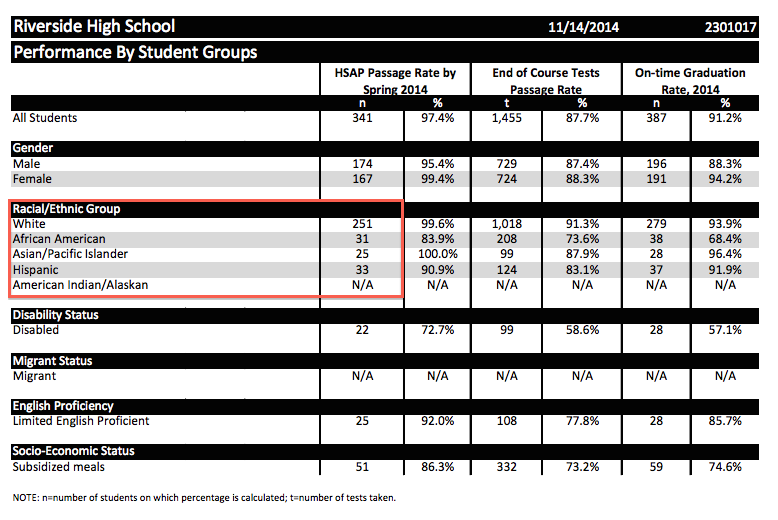
However, Riverside High School looks much more like Academic Magnet or Greenville Tech Charter—an excellent/excellent rating in 2014 and serving/testing a population 73% white:

RHS race

RHS tested 2014

Choice, then, in a variety of forms such as public school choice, charter schools, and magnet schools/academies are isolating students by race and class within highly diverse regions of a highly diverse state.

No longer vouchers or tuition tax credits, choice is now masked behind the allure of misleading labels—public, charter, magnet, academy—but ultimately resulting in one disturbing fact: choice segregates by design.

More choice will result in greater segregation and more shuffling, but market forces will never address equity and will always create winners and losers instead of establishing opportunities for all—as Academic Magnet demonstrates.

The call for fairness and diversity by students at Academic Magnet should be a call among all in SC and across the U.S.

See Also

Why Sending Your Child to a Charter School Hurts Other Children

Don’t Buy School Choice Week

When I wrote Why Advocacy and Market Forces Fail Education Reform almost four years ago, I had recently spent a great deal of time researching and writing about school choice within the focus of parental choice.

Then as well as now, the ever-growing body of evidence shows that school choice, parental choice, and market forces never achieve the outcomes advocates claim. And yet, each year we must suffer through School Choice Week, which is just a slightly heightened and compressed example of the same sort of misleading advocacy that exists every week of the year in the U.S.

Choice, we must acknowledge, in the U.S. is a sort of consumer choice: We must allow people the choice of either a Honda Accord or a Toyota Camry (but choosing not to drive shall not be on the table).

So when any school choice advocate launches into the typical blather that we must give all parents the sort of choice that wealthy parents have (one of the most insincere and distorted examples of manipulative rhetoric you’ll hear), we must not allow the debate to remain within a skewed choice-only context.

As I have stated before, democracy depends on social contracts that rise above the necessity of choice:

choice quote

Since School Choice Week slips into the wake of celebrating Martin Luther King Jr. (see also how parental choice has been manipulated in the “no excuses” charter school debate), we must also note that choice is a hollow call dedicated to the Invisible Hand and a pale hope that market forces may accomplish indirectly what a moral people can accomplish directly—as King confronted in the last days of his life:

In addition to the absence of coordination and sufficiency, the programs of the past all have another common failing — they are indirect. Each seeks to solve poverty by first solving something else.

I am now convinced that the simplest approach will prove to be the most effective — the solution to poverty is to abolish it directly by a now widely discussed measure: the guaranteed income.

Again, the evidence is overwhelming that public, charter, and private schools have about the same impact on students once we adjust measurable student learning by external factors.

Private schools appear to be better mostly because they are selective (think of judging hospitals that admit only healthy patients compared to hospitals that admit all patients), charter schools waving higher achievement fail to note that such measurable gains tend to equal the longer days/years and are not attributable to any aspect of “charterness” (my analysis of two years of charter schools in SC shows that fewer than a handful of over 50 charters outperform comparable public schools), and both private and charter schools reveal that choice often contributes to negative outcomes such as segregation, teacher and student churn, and inequitable opportunities for marginalized students such as English language learners and special needs students.

And while private schools as powerful models of what market forces produce fail to show that type of schooling impacts significantly student achievement, that parental choice advocates ignore the qualities of private schools most attractive to parents illustrates the insincerity of school choice proponents: private schools popular with the affluent have very low student/teacher ratios, yet class size is routinely discounted as important among reformers who embrace choice; private schools offer rich curricular offerings including so-called electives that are being cut and marginalized in public and “no excuses” charter schools.

School choice lacks credible evidence for advocates’ claims, and choice advocates’ constantly shifting commitments also reveal questionable credibility: vouchers, tuition tax credits, public school open enrollment, and charter schools as primary mechanisms as well as higher grades, graduation rates, and college enrollment as moving targets of “success.”

Choice in education is an ideological lie driven by an idealized faith that ignores the negative consequences of choice: some parents choose for their children to drop out of school, some parents choose to smoke with their children in the car, some parents choose to place their children in schools based on racist and classist beliefs.

School Choice Week, then, is a marketing scam. Don’t buy it.

The Public School Advantage, Christopher A. and Sarah Theule Lubienski

Parental choice?: A critical reconsideration of choice and the debate about choice

Choice

Charter schools

“School Choice Week” is a Good Time to Review the Evidence (NEPC)

Media Fail, 10,000 hours, and Grit: The Great Media-Disciplines Divide, pt. 2

In his The Danger of Delegating Education to Journalists: Why the APS Observer Needs Peer Review When Summarizing New Scientific Developments [1], K. Anders Ericsson makes several key points about how the mainstream media present disciplinary knowledge to the public, focusing on Malcolm Gladwell’s misleading but popular 10,000 hour rule.

Ericsson’s key point includes:

Although I accept that the process of writing an engaging popular article requires considerable simplification, I think it is essential that the article does not contain incorrect statements and misinformation. My primary goal with this review is to describe several claims in Jaffe’s article that were simply false or clearly misleading and then discuss how APS might successfully develop successful methods for providing research summaries for non-specialists that are informative and accurately presents the major views of APS members and Fellows. At the very least they should not contain factually incorrect statements and avoid reinforcing existing misconceptions in the popular media.

Through the Gladwell/10,000 hour rule example, Ericsson provides an important argument relevant to the current (and historical) public debate about school quality, teaching and learning, and education reform.

Much in the same way Gladwell has misrepresented research (which is typical within the media), and how that has been uncritically embraced by the media and public (as well as many if not most practitioners), a wide array of issues have received the same fate: learning styles, “grit,” collaborative learning, progressive education, charter schools, school choice, language gap, and so on.

Even when a claim or practice has a kernel of research at its source, popular oversimplification (often by journalists, but practitioners as well) and then commercialization/politicizing (creating programs and policies through publishers, “star” advocates, and legislation) significantly distort that research.

Education Has Failed Research, Historically

John Dewey represents an odd paradox in that he is possibly the most mentioned educator in the U.S. (either as the source of all that is wrong in education or idealistically cited as all that is right about how school could be), despite the reality that Dewey is mostly misunderstood and misrepresented; and thus his philosophy, progressivism, remains mostly absent in U.S. public schools.

Dewey can be blamed, in part, for this reality because he refused on principle to allow his experiments in education to be carefully catalogued because he believed no educational practice should be come a template for others.

Throughout much of the twentieth century, Lou LaBrant, a vigilant progressive educator, spent much of her career practicing and advocating for progressive literacy instruction, but LaBrant also confronted the many instances of how progressivism was misrepresented.

Broadly, and early, LaBrant recognized the public confusion about progressivism:

Two adults speak of “progressive education.” One means a school where responsibility, critical thinking, and honest expression are emphasized; the other thinks of license, lack of plans, irresponsibility. They argue fruitlessly about being “for” or “against” progressive education. (LaBrant, 1944, pp. 477-478)

But she also confronted how progressivism was mostly distorted in its application. LaBrant’s criticisms still reflect why education has failed research, and why research has not failed education.

Credible educational research-based philosophy, theory, and pedagogy are often corrupted by oversimplification.

In 1931, LaBrant published a scathing criticism of the popularity of the project method, an oversimplification of Dewey that resulted in students doing crafts in English class instead of reading or writing:

The cause for my wrath is not new or single. It is of slow growth and has many characteristics. It is known to many as a variation of the project method; to me, as the soap performance. With the project, neatly defined by theorizing educators as “a purposeful activity carried to a successful conclusion,” I know better than to be at war. With what passes for purposeful activity and is unfortunately carried to a conclusion because it will kill time, I have much to complain. To be, for a moment, coherent: I am disturbed by the practice, much more common than our publications would indicate, of using the carving of little toy boats and castles, the dressing of quaint dolls, the pasting of advertising pictures, and the manipulation of clay and soap as the teaching of English literature. (p. 245)

Credible educational research is often corrupted by commercialization/politicizing, reducing that research to misguided programs/legislation.

“[L]anguage behavior can not be reduced to formula,” LaBrant (1947) argued (p. 20)—emphasizing that literacy growth was complicated but flourished when it was child-centered and practical (for example, in the ways many privileged children experience in their homes because one or more of the parents are afforded the conditions within which to foster their children’s literacy).

By mid-twentieth century, LaBrant (1949) had identified the central failure of teaching reading: “Our language programs have been set up as costume parties and not anything more basic than that” (p. 16).

For at least 80-plus years since LaBrant fought this fight, the same patterns of media, political, public, and practitioners failing educational research have continued

Oversimplification, Commercialization/Politicizing: Recovering the Evidence

The list is incredibly long, too long to be exhaustive here, but consider the following: sloganism (“Work hard. Be nice.”), silver-bullet ideologies (“grit,” 10,000-hour rule), miracle schools (KIPP), evidence-based programs (Dibbles, 4-block, 6-traits), common sense claims and policy absent evidence (Common Core), and trendy legislation (3rd-grade retention policies as reading policy, merit pay) as well as politicized government reports (National Reading Panel).

Each of these can be traced to some kernel of research (sometimes robust bodies of research, and sometimes cherry-picked research), but all of these represent a current and historical fact: Education has failed research, but research has not failed education.

When educational research is reduced to scripts or programs/legislation, that knowledge base is invariably distorted, corrupted—as Ericsson details well above.

Journalists, politicians, and commercial education entities have all played a fundamental and crippling role in this reality; thus, as Ericsson argues, educators, scholars and researchers must not allow the fate of educational research to remain primarily in the wrong hands.

We have a public and professional obligation to confront these oversimplifications as well as the commercialization/politicizing of educational research. And we must do this through our public work that speaks to those failures and the public simultaneously.

As LaBrant and Ericsson reveal, unless we take that call seriously, we too are part of the reason education continues to fail research.

References

LaBrant, L. (1949). A genetic approach to language. Unpublished manuscript, Institute of General Semantics, Lakeville, CT.

LaBrant, L. (1947). Um-brel-la has syllables three. The Packet, 2(1), 20-25.

LaBrant, L. (1944, November). The words they know. The English Journal, 33(9), 475-480.

LaBrant, L. (1931, March). MasqueradingThe English Journal, 20(3), pp. 244-246.

For Further Reading

U.S. and Education Reform Need a Critical Free Press

My Open Letter to Journalists: A Critical Free Press, pt. 2

NPR Whitewashes “Grit” Narrative

Shiny Happy People: NPR, “Grit,” and “Myths that Deform” pt. 2

How I Learned to Distrust the Media (about Education)

My (Often Painful) Online Education

[1] See original and downloadable link to the paper here.

Idealizing, Misreading Impoverished and Minority Parental Choice

In his The Charter School Paradox, Walt Gardner asks: “If charter schools are guilty of all the sins described in the multi-part cover story, then why are there waiting lists across the country of mostly poor black and Hispanic parents who are desperate to get their children enrolled in these schools?” And then he concludes:

I continue to be a strong supporter of traditional public schools for reasons I’ve explained in this column and in other venues over the past two decades.  But I also support parental choice. I don’t see this as a contradiction in terms. Yes, parents often make mistakes in their decisions.  However, I maintain it is their right alone to decide what is best for their offspring. Charter schools are accused of increasing racial segregation, but that does not seem to bother poor black and Hispanic parents who want to enroll their children.  I wish The Nation had addressed this paradox in its cover story.  It’s too important to brush aside.

I recognized the role of parental choice in the larger school choice debate as well as how that element complicates both advocacy and rejecting a wide range of school choice initiatives, resulting in my writing an extended examination of the issue in Parental Choice?

Despite spending a great deal of time on school choice research and finding little to support advocacy for choice options such as tuition tax credits, public school choice, or charter schools, I too was baffled by the apparent appeal of charter schools, notably among impoverished and minority parents—particularly in the context of my own claim that “no excuses” ideologies are racist and my concurrent rejecting of paternalism. I was able to understand that tension, however, once I read Michelle Alexander’s The New Jim Crow, in which she confronts the same tension over mass incarceration and intensive (as well as disproportionate) policing of high-poverty minority neighborhoods.

In Education Reform in the New Jim Crow Era, I reached the following conclusion:

Since market-oriented education reform is producing evidence highlighting the ineffectiveness and even negative outcomes associated with those policies, that the agendas remain robust suggests, again like mass incarceration, education reform fulfills many of the dynamics found in the New Jim Crow.

Just as mass incarceration from the war on drugs continues institutional racism once found in slavery and Jim Crow, education reform, especially the “no excuses” charter school movement, resurrects a separate but equal education system that is separate, but certainly isn’t equal. The masked racism of mass incarceration and education reform share many parallels…

This last point—that African Americans seem to support both the war on crime and “no excuses” charter schools—presents the most problematic aspect of charges that mass incarceration and education reform are ultimately racist, significant contributions to the New Jim Crow. [emphasis added]

For example, [Sarah] Carr reports [in her Hope Against Hope] that African American parents not only choose “no excuses” charter schools in New Orleans, but also actively cheer and encourage the authoritarian policies voiced by the schools’ administrators. But Alexander states, “Given the dilemma facing poor black communities, it is inaccurate to say that black people ‘support’ mass incarceration or ‘get-tough’ policies” because “if the only choice that is offered blacks is rampant crime or more prisons, the predictable (and understandable) answer will be ‘more prisons'” (p. 210).

New Orleans serves as a stark example of how this dynamic works in education reform: Given the choice between segregated, underfunded and deteriorating public schools and “no excuses” charters—and not the choice of the school environments and offerings found in many elite private schools—the predictable answer is “no excuses” charters.

The charter school movement, specifically the “no excuses” versions, represents a skewed choice environment; again one that does not include the qualities found in many selective and expensive private schools.

We must be careful, then, not to idealize parental choice and not to misread the choices in limited contexts of impoverished and minority parents who in fact are not being offered the sorts of choices that would likely erase their apparent support for charter schools.

Well-funded, safe, and high-quality public schools would negate the need for choice, and that should be what we are pursuing, as I have detailed before:

People in poverty deserve essential Commons—such as a police force and judicial system, a military, a highway system, a healthcare system, and universal public education—that make choice unnecessary. In short, among the essentials of a free people, choice shouldn’t be needed by anyone.

No child should have to wait for good schools while the market sorts some out, no human should have to wait for quality medical care while the market sorts some out, no African American teen gunned down in the street should have to wait for the market to sort out justice—the Commons must be the promise of the essential equity and justice that both make freedom possible and free people embrace.

“Other People’s Children” v. “They’re All Our Children”

Optimism, seeing the light at the end of the tunnel—these are not my proclivities.

And while I wallow in the self-delusion that I am a Skeptic, the truth is that I have long ago slipped over into the abyss of cynicism.

There are moments, however, when I hope.

One such moment was during the Sandy Hook school shooting tragedy—when I wanted desperately to believe that President Obama’s call for seeing every child as “all our children” would resonate against the recurring din of gunfire killing children—but not only the uniquely American slaying of school children but the daily loss of mostly black and brown children and young adults to gunfire in the homes and streets of U.S. inner cities.

But that has not happened. Michael Brown was shot and killed by a police officer, Brown’s body left callously in the street—adding to the seemingly endless cataloguing of similar tragedies. And those tragedies are daily magnified by our collective refusal to see each death in the same way we would see the death of our own children, our collective refusal to see how “other people’s children” live, learn, and die is just as precious as if they were “all our children.”

So my cynicism is driven by the stark realization that if we cannot come together as a community over the shooting of “other people’s children,” how will we ever come together about the less dramatic but just as tragic conditions such as what we allow for the education of “other people’s children”?

The powerful phrase “other people’s children” comes from the work of Lisa Delpit, who confronts the inequity of educational opportunities for minority and impoverished children. Delpit highlights that marginalized students receive disproportionately test-prep and worksheet-driven instruction, unlike their white and affluent peers. While some have claimed her as a champion of traditional practice because her criticisms have included failures by progressives, Delpit counters:

I do not advocate a simplistic “basic skills” approach for children outside of the culture of power. It would be (and has been) tragic to operate as if these children were incapable of critical and higher-order thinking and reasoning. Rather, I suggest that schools must provide these children the content that other families from a different cultural orientation provide at home. This does not mean separating children according to family background [emphasis added], but instead, ensuring that each classroom incorporate strategies appropriate for all the children in its confines.

And I do not advocate that it is the school’s job to attempt to change the homes of poor and nonwhite children to match the homes of those in the culture of power [emphasis added]. That may indeed be a form of cultural genocide. I have frequently heard schools call poor parents “uncaring” when parents respond to the school’s urging, saying, “But that’s the school’s job.” What the school personnel fail to understand is that if the parents were members of the culture of power and lived by its rules and codes, then they would transmit those codes to their children. In fact, they transmit another culture that children must learn at home in order to survive in their communities.

Delpit’s call, however, must be distinguished from not only traditionalists but also popular but flawed programs such as those provided by Ruby Payne, who promotes uncritical teaching of middle class codes to impoverished students. Not grounded in research but driving professional development of teachers in many states across the U.S., Payne’s self-published workbooks and workshops speak to and perpetuate stereotypes of people in poverty and racial minorities. And as Monique Redeaux clarifies:

At first glance, this seems to be the message conveyed by Payne: poor students of color need to be explicitly taught the hidden rules or codes of the middle/upper class in order to be successful in school, work, etc. When examined more closely, this could not be further from the truth. Both terms, the “culture of poverty” (Payne) and the “culture of power” (Delpit) locate the problem in culture—but in different ways/places [emphasis added]. Although Payne and other “culture of poverty” advocates see the problem as residing with the cultural attributes of those living in poverty, the “culture of power” perspective suggests that the middle/upper class hold the power and key to institutional success, partly through their monopolization of educational skills, and that they do all they can to make sure that they and their offspring maintain that power.

When Delpit began her work on “other people’s children” she predicted that her purpose would be misunderstood. People criticized her for “vindicating” teachers who subjected students of color to isolated, meaningless, sub-skills day after day. However, what she was actually advocating when she referred to “skills-based instruction” was the “useful and usable knowledge that contributes to a student’s ability to communicate effectively in standard, generally acceptable literary forms” and she proposed that this was best learned in meaningful contexts. In other words, Delpit argued that both technical skills and critical thinking are essential: a person of color who has no critical thinking skills becomes the “trainable, low-level functionary of the dominant society, simply the grease that keeps the institutions which orchestrate his or her oppression running smoothly.” At the same time, those who lack the technical skills demanded by colleges, universities, and employers will be denied entry into these institutions. Consequently, they will attain financial and social success only within the “disenfranchised underworld.”

The key distinction between Delpit and Payne is the reason why [emphasis added] they believe students should be taught the “hidden rules.” Payne argues that their educational and economic success depend on their being able to conform to the rules of the middle/upper class. While Delpit, too, makes this argument, she does not believe that students should passively adopt an alternate code simply because it is the “way things are,” especially if they want to achieve a particular economic status. Instead, Delpit asserts that students need to know and understand the power realities of this country with the purpose of changing these realities.

We are confronted, then, with the continuing rise in programs funded by the government and supported by a wide range of political, public, and media ideologies and interests that submit only “other people’s children” to teachers produced by alternative pathways (such as Teach For America, but also copycats) and to school structures (usually charter schools, labeled “public” but functioning within a market dynamic) and policies driven by “no excuses” ideologies (such as KIPP, but also numerous copycats) demanding “grit.”

Yet, affluent children, mostly white, find themselves in classrooms with low class size, experienced and qualified/certified teachers, and rich curricula often not linked to the standards-of-the-moment or high-stakes testing—and do not find themselves disproportionately retained, suspended, expelled, or shot while unarmed walking down the street.

Our education dilemma is a subset of our greater cultural dilemma—one that pits our traditional commitments to the rugged individual, Social Darwinism, and consumerism against our potential moral grounding in community and cooperation.

No child should need to depend on the choices her/his parents make, and no parents should be faced with making choices about those foundational things that all humans deserve—one of which is access to the exact same conditions for learning and living that the privileged among us have before them.

Today, the U.S. remains a dog-eat-dog culture that perpetuates and allows one world for “other people’s children” that would never be tolerated for “my child.” A great moral lapse of our time is that we refuse to act in ways that prove “they’re all our children.”

SC, Choose OK, Not FL: Failing Students with Failed Policy

What do third-grade retention policies based on reading tests, charter schools, tracking, and parental choice have in common?

First, across the U.S., they all have a great deal of public and political support.

Second, the research base on all of these policies (among many other popular policies) has shown repeatedly that they do more to fail students than to achieve any of the lofty goals advocates claim.

My home state of South Carolina is a typical example of how education policy not grounded in the evidence continues to fail students again and again. For example, charter schools advocacy remains robust and deeply misleading:

We know that choice in education changes lives. We must work together to develop a culture in South Carolina that values education — from our families to funding at the State House. All students deserve access to a high-quality education regardless of their ZIP code, and excellent public charter schools are part of the solution in transforming South Carolina’s future.

This sort of incomplete and distorted advocacy is commonplace in SC, regretfully, but charter schools in SC have reinforced several patterns found across the U.S. but contradictory to the advocacy:

  • Charter schools contribute significantly to the re-segregation of schools, and thus to the exact inequity that plagues schools in high-poverty states such as SC.
  • Students in charter schools have measurable outcomes that are about the same or worse than comparable public schools. I have documented this in SC, but national studies of charter schools have shown that nothing about “charterness” offers advantage to students.
  • Charter schools are the newest version of the school choice movement that depends on emotional appeals to sloganism, “Parents deserve more choices,” and anecdote. Ultimately, however, parental choice has been idealized (many parents can and do make poor choices for children), and school choice remains mostly a neutral to negative influence on educational quality. Charter schools as a mechanism for competition are a distraction from the public good and harm all students, even those who claim they are thriving in selected charter schools. [1]

Charter schools and parental choice—like grade retention and tracking—are politically compelling, but neither effective nor appropriate for the essential problems facing public education.

As well, SC is also seeking to follow Florida’s third-grade retention and reading policies—which have been discredited when reviewed. However, a possible pinpoint of light may be at the end of this accountability-based education reform movement tunnel, as John Thompson details:

Oklahoma’s Republican Legislature overrode the veto of Republican Governor Mary Fallin, and overwhelmingly rejected another cornerstone of Jeb Bush’s corporate reform agenda. The overall vote was 124 to 21….

Oklahoma’s victory over the test and punish approach to 3rd grade reading is a win-win team effort of national importance. The override was due to an unexpected, grassroots uprising started by parents, joined by superintendents and teachers, organized on social media, and assisted by anti- corporate reform educators and our opposite, Stand for Children, as well as Tea Party supporters, and social service providers who are increasingly coming to the rescue of the state’s grossly underfunded schools.

The rise of grade-retention policy shares with the rise of charter schools the powerful and flawed combination of popularity and a solid research base discrediting those policies. Deborah Stipek and Michael Lombardo pose some key points about the need to reject grade-retention policy, points that should guide similar movements against charter schools, tracking, and parental choice:

  • Before policy is implemented, the problem needs to be clearly defined and then the research base on the appropriate policies for that problem must be identified by experts in the field (and not political leaders or policy advocates). If, for example, reading achievement is an identified problem in a state, what do we know about grade retention as a policy solution?

A majority of peer-reviewed studies over the past 30 years have demonstrated that holding students back yields little or no long-term academic benefits and can actually be harmful to students. When improvements in achievement are linked to retention, they are not usually sustained beyond a few years, and there is some evidence for negative effects on self-esteem and emotional well-being.

Moreover, there is compelling evidence that retention can reduce the probability of high school graduation. According to a 2005 review of decades of studies by Nailing Xia and Elizabeth Glennie: “Research has consistently found that retained students are at a higher risk of leaving school earlier, even after controlling for academic performance and other factors such as race and ethnicity, gender, socioeconomic status, family background, etc.”

  • Once we establish the problem and the evidence base on the reform, what concept should guide adopting new policy? Again, about retention, Stipek and Lombardo explain: “Instead of giving children the same treatment that failed them the first time, alternative strategies provide different kinds of learning opportunities.” In other words, policies that reinforce or replicate the identified problems must be ended, and then something different needs to be implemented.

If reading achievement is a problem, grade retention guarantees to cause more harm than good.

If public school segregation and student achievement are problems, charter schools actually fuel segregation and offer about the same student achievement (and even worse) as public schools.

If equity of opportunity is a public school problem, tracking creates inequity in schools.

In the current public and political environment that rails against failing schools and failing students, the ugly truth is that public and political support for misguided policy is failing students. Again and again.

Education policy must no longer be a popularity contest driven by sloganism and anecdotes.

If we insist on continuing a commitment to choice, we need to choose the sorts of public school policies that will insure that no child and no parent needs to choose the school best for any child.

In SC and across the U.S., we need to choose Oklahoma, not Florida.

[1] Now that New Orleans has completely replaced the public school system with charter schools, the full picture of the futility of charter schools is being revealed, as Layton explains about the results of the turnover:

White students disproportionately attend the best charter schools, while the worst are almost exclusively populated by African American students. Activists in New Orleans joined with others in Detroit and Newark last month to file a federal civil rights complaint, alleging that the city’s best-performing schools have admissions policies that exclude African American children. Those schools are overseen by the separate Orleans Parish School Board, and they don’t participate in OneApp, the city’s centralized school enrollment lottery.

John White, the state’s superintendent of education, agreed that access to the best schools is not equal in New Orleans, but he said the state is prevented by law from interfering with the Orleans Parish School Board’s operations.

“The claim that there’s an imbalance is right on the money,” White said. “The idea that it’s associated with privilege and high outcomes is right on the money.”