A society is defined by what is tolerated and for whom—and by whom.
In a country with a moral center, or at least a moral free press, this story would be a scathing exposé, spurring public denunciation.
But in the U.S., it is a story about “polarizing methods and superior results”—a gutless mess of misinformation and “fair and balanced” journalism that includes this dispassionate reporting:
At one point, her leadership resident — what the network calls assistant principals — criticized her for not responding strongly enough when a student made a mistake. The leadership resident told her that she should have taken the student’s paper and ripped it up in front of her. Students were not supposed to go to the restroom during practice tests, she said, and she heard a leader from another school praise the dedication of a child who had wet his pants rather than take a break.
What is the common characteristic of students in punitive, test-prep “no excuses” charter schools, like the one above, all across the U.S.?
While many have highlighted the school-to-prison pipeline phenomenon, we are less likely to confront the schools-as-prisons reality many high-poverty and minority children suffer; and thus, a reader:
During the past few years, teachers and police are coming under increased scrutiny in the wake of disaster capitalism’s influence how we do school and how we enforce law—significantly at the expense of children living in poverty, black and brown children, and children speaking home languages other than English.
Jose Vilson has offered a bold and critical examination of how political and public calls for greater teacher and police quality and oversight intersect, revealing, I think, that these are not simple black and white issues. Bad teachers and bad police there certainly are, but to play the flawed individual game feeds into the central problem in the U.S.: We refuse to acknowledge systemic causes (racism, sexism, homophobia) for individual situations.
Vilson builds to what I think is the crux of the matter: “To protect and to serve, and that’s something we can never turn our backs to.” Teachers and police are public servants, embodying the will of the people. As public servants, teachers and police fail their charge when they twist their service into authority over the public, instead of from or in service of.
Authoritarian (and thus “bad”) teachers and authoritarian (and thus “bad”) police are consequences of a larger reality: The U.S. is a racist and sexist nation functioning as an authoritarian state, and most of our structures serve that status quo as well as the interests of the privileged.
Democracy and meritocracy along with the ideals of life, liberty and the pursuit of happiness for everyone remain worthy of a people, but those are not what our public institutions serve in the U.S. today.
Sacrificing Democracy and “Other People’s Children” at the Alter of Authority
Well before Bill Ayers was demonized during Barack Obama’s run for president or before Ayers’s radical past was more widely recognized after his memoir in 2001, I was introduced to his wonderful To Teachwhile in my doctoral program in the mid-1990s.
Ayers offers characterizations of traditional schooling that resonated with me then and do also now:
There are a lot of quiet, passive classrooms where not much learning is taking place, and others where children’s hearts, souls, and minds are being silently destroyed in the name of good management….
In school, a high value is placed on quiet: “Is everything quiet?” the superintendent asks the principal, and the principal asks the teacher, and the teacher asks the child. If everything is quiet, it is assumed all is well. This is why many normal children—considering what kind of intelligence is expected and what will be rewarded here—become passive, quiet, obedient, dull. The environment practically demands it. (pp. 23, 64)
At nearly every level of considering education, we always come back to classroom management and discipline. And it is here I want to ask two genuinely important questions:
Why do we persist with harsh policies such as police in schools, zero-tolerance, “no excuses,” grade retention, and corporal punishment even though they are ineffective and even do more harm? [1]
Because all of these commitments do accomplish one thing that is actually the sacred element in formal schooling—authoritarian environments.
As long as we remain trapped in accountability reform and in-school authoritarian practices, we are admitting that we are not seeking universal public education in the service of life, liberty, and the pursuit of happiness—individual freedom and democracy.
Authoritarian schools feed an authoritarian state (where, for example, police are feared and teachers are disrespected).
Democracy must be fertilized with schools that practice community and collaboration.
So in our necessary and important rush to honor good teachers and good police, let’s be careful about our accusatory gazes because when teachers and police are bad, it may well be that their behavior reflects a failed system, an authoritarian system that serves the status quo and the interests of the privileged.
We need to lift our eyes and look closely at who supports accountability-based education reform and harsh in-school policies—and why.
There is the place to start toward better teachers and police who honor, as Vilson noted, their need to serve and protect as agents of the public good.
—
[1] I think in the context of these two questions, we must ask, Why are reformers convinced class size doesn’t matter (despite many enrolling their children in private schools with very low class sizes)? The answer is likely that large class size forces teachers to focus primarily on classroom management/discipline and consequently accomplishes again the main objective: authoritarian classrooms.
NOTE: HT to David Kaib for a series of Tweets recently.
Below is a draft proposal for an edited volume. I am seeking possible co-editor(s) as well as potential contributors. Please contact me at paul.thomas@furman.edu if you are interested in either co-editing or contributing. Once I have interest and a revised proposal, I will seek a publisher and then post a formal call for chapter proposals.
—
Invisible Young Men: 21st Century Reports from Occupied Territory
P.L. Thomas, editor
Publisher: TBD
With his Invisible Man, Ralph Ellison’s narrator announced on the first page: “I am invisible, understand, simply because people refuse to see me.” Ellison was soon embraced by the mainstream world of literary fiction at mid-twentieth century, but he also created tensions among those identifying with left-leaning African American arts and civil rights movements—especially among the radicals.
Now at one hundred years since Ellison’s birth and more than fifty years since Invisible Man was published, the rich paradox of the invisible black man in the U.S. at mid-twentieth century must be viewed through the lens of Martin Luther King Jr.’s and Malcolm X’s assassinations—and the more recent controversies surrounding the shootings of Trayvon Martin, Jordan Davis, and Michael Brown as well as the controversies surrounding Richard Sherman and Marcus Smart.
Ellison’s invisible man recognized that mainstream (and white) America refused to see him, but African American males in the second decade of the twenty-first century are now faced with another reality of being mis-seen as “thugs”—criminals by their very existence.
African American males know this reality of being mis-seen as soon as they enter school or walk the streets. In his 1966 “A Report from Occupied Territory,” James Baldwin confronted the African American experience for young men—a confrontation that echoes across the U.S. today:
This is why those pious calls to “respect the law,” always to be heard from prominent citizens each time the ghetto explodes, are so obscene. The law is meant to be my servant and not my master, still less my torturer and my murderer. To respect the law, in the context in which the American Negro finds himself, is simply to surrender his self-respect….
These things happen, in all our Harlems, every single day. If we ignore this fact, and our common responsibility to change this fact, we are sealing our doom. Here is the boy, Daniel Hamm, speaking—speaking of his country, which has sworn to bung peace and freedom to so many millions. “They don’t want us here. They don’t want us—period! All they want us to do is work on these penny-ante jobs for them—and that’s it. And beat our heads in whenever they feel like it. They don’t want us on the street ’cause the World’s Fair is coming. And they figure that all black people are hoodlums anyway, or bums, with no character of our own. So they put us off the streets, so their friends from Europe, Paris or Vietnam—wherever they come from—can come and see this supposed-to-be great city.”
There is a very bitter prescience in what this boy—this “bad nigger”—is saying, and he was not born knowing it. We taught it to him in seventeen years. He is draft age now, and if he were not in jail, would very probably be on his way to Southeast Asia. Many of his contemporaries are there, and the American Government and the American press are extremely proud of them. They are dying there like flies; they are dying in the streets of all our Harlems far more hideously than flies. A member of my family said to me when we learned of the bombing of the four little girls in the Birmingham Sunday school, “Well, they don’t need us for work no more. Where are they building the gas ovens?” Many Negroes feel this; there is no way not to feel it. Alas, we know our countrymen, municipalities, judges, politicians, policemen and draft boards very well. There is more than one way to skin a cat, and more than one way to get bad niggers off the streets. No one in Harlem will ever believe that The Harlem Six are guilty—God knows their guilt has certainly not been proved. Harlem knows, though, that they have been abused and possibly destroyed, and Harlem knows why—we have lived with it since our eyes opened on the world. One is in the impossible position of being unable to believe a word one’s countrymen say. “I can’t believe what you say,” the song goes, “because I see what you do”—and one is also under the necessity of escaping the jungle of one’s situation into any other jungle whatever. It is the bitterest possible comment on our situation now that the suspicion is alive in so many breasts that America has at last found a way of dealing with the Negro problem. “They don’t want us—period!” The meek shall inherit the earth, it is said. This presents a very bleak image to those who live in occupied territory. The meek Southeast Asians, those who remain, shall have their free elections, and the meek American Negroes—those who survive—shall enter the Great Society.
In these historical and contemporary contexts, this volume seeks to gather a wide range of voices addressing the following:
Racial inequity in formal education disproportionately impacting African American males—expulsion and suspension, teacher quality access, course access.
African American males and the allure of sports as a “way out.”
Mass incarceration and the African American male.
Additional?
References
Alexander, M. (2012). The new Jim Crow: Mass incarceration in the age of colorblindness (Rev. ed.). New York, NY: New Press.
Miron, G., Urschel, J. L., Mathis, W, J., & Tornquist, E. (2010). Schools without Diversity: Education management organizations, charter schools and the demographic stratification of the American school system. Boulder, CO and Tempe, AZ: Education and the Public Interest Center & Education Policy Research Unit. Retrieved from http://epicpolicy.org/publication/schools-without-diversity
Nolan, K. (2011). Police in the hallways: Discipline in an urban high school. Minneapolis, MN: University of Minnesota Press. [Kindle edition]
Optimism, seeing the light at the end of the tunnel—these are not my proclivities.
And while I wallow in the self-delusion that I am a Skeptic, the truth is that I have long ago slipped over into the abyss of cynicism.
There are moments, however, when I hope.
One such moment was during the Sandy Hook school shooting tragedy—when I wanted desperately to believe that President Obama’s call for seeing every child as “all our children” would resonate against the recurring din of gunfire killing children—but not only the uniquely American slaying of school children but the daily loss of mostly black and brown children and young adults to gunfire in the homes and streets of U.S. inner cities.
But that has not happened. Michael Brown was shot and killed by a police officer, Brown’s body left callously in the street—adding to the seemingly endless cataloguing of similar tragedies. And those tragedies are daily magnified by our collective refusal to see each death in the same way we would see the death of our own children, our collective refusal to see how “other people’s children” live, learn, and die is just as precious as if they were “all our children.”
So my cynicism is driven by the stark realization that if we cannot come together as a community over the shooting of “other people’s children,” how will we ever come together about the less dramatic but just as tragic conditions such as what we allow for the education of “other people’s children”?
The powerful phrase “other people’s children” comes from the work of Lisa Delpit, who confronts the inequity of educational opportunities for minority and impoverished children. Delpit highlights that marginalized students receive disproportionately test-prep and worksheet-driven instruction, unlike their white and affluent peers. While some have claimed her as a champion of traditional practice because her criticisms have included failures by progressives, Delpit counters:
I do not advocate a simplistic “basic skills” approach for children outside of the culture of power. It would be (and has been) tragic to operate as if these children were incapable of critical and higher-order thinking and reasoning. Rather, I suggest that schools must provide these children the content that other families from a different cultural orientation provide at home. This does not mean separating children according to family background [emphasis added], but instead, ensuring that each classroom incorporate strategies appropriate for all the children in its confines.
And I do not advocate that it is the school’s job to attempt to change the homes of poor and nonwhite children to match the homes of those in the culture of power [emphasis added]. That may indeed be a form of cultural genocide. I have frequently heard schools call poor parents “uncaring” when parents respond to the school’s urging, saying, “But that’s the school’s job.” What the school personnel fail to understand is that if the parents were members of the culture of power and lived by its rules and codes, then they would transmit those codes to their children. In fact, they transmit another culture that children must learn at home in order to survive in their communities.
At first glance, this seems to be the message conveyed by Payne: poor students of color need to be explicitly taught the hidden rules or codes of the middle/upper class in order to be successful in school, work, etc. When examined more closely, this could not be further from the truth. Both terms, the “culture of poverty” (Payne) and the “culture of power” (Delpit) locate the problem in culture—but in different ways/places [emphasis added]. Although Payne and other “culture of poverty” advocates see the problem as residing with the cultural attributes of those living in poverty, the “culture of power” perspective suggests that the middle/upper class hold the power and key to institutional success, partly through their monopolization of educational skills, and that they do all they can to make sure that they and their offspring maintain that power.
When Delpit began her work on “other people’s children” she predicted that her purpose would be misunderstood. People criticized her for “vindicating” teachers who subjected students of color to isolated, meaningless, sub-skills day after day. However, what she was actually advocating when she referred to “skills-based instruction” was the “useful and usable knowledge that contributes to a student’s ability to communicate effectively in standard, generally acceptable literary forms” and she proposed that this was best learned in meaningful contexts. In other words, Delpit argued that both technical skills and critical thinking are essential: a person of color who has no critical thinking skills becomes the “trainable, low-level functionary of the dominant society, simply the grease that keeps the institutions which orchestrate his or her oppression running smoothly.” At the same time, those who lack the technical skills demanded by colleges, universities, and employers will be denied entry into these institutions. Consequently, they will attain financial and social success only within the “disenfranchised underworld.”
The key distinction between Delpit and Payne is the reason why [emphasis added] they believe students should be taught the “hidden rules.” Payne argues that their educational and economic success depend on their being able to conform to the rules of the middle/upper class. While Delpit, too, makes this argument, she does not believe that students should passively adopt an alternate code simply because it is the “way things are,” especially if they want to achieve a particular economic status. Instead, Delpit asserts that students need to know and understand the power realities of this country with the purpose of changing these realities.
We are confronted, then, with the continuing rise in programs funded by the government and supported by a wide range of political, public, and media ideologies and interests that submit only “other people’s children” to teachers produced by alternative pathways (such as Teach For America, but also copycats) and to school structures (usually charter schools, labeled “public” but functioning within a market dynamic) and policies driven by “no excuses” ideologies (such as KIPP, but also numerous copycats) demanding “grit.”
Yet, affluent children, mostly white, find themselves in classrooms with low class size, experienced and qualified/certified teachers, and rich curricula often not linked to the standards-of-the-moment or high-stakes testing—and do not find themselves disproportionately retained, suspended, expelled, or shot while unarmed walking down the street.
Our education dilemma is a subset of our greater cultural dilemma—one that pits our traditional commitments to the rugged individual, Social Darwinism, and consumerism against our potential moral grounding in community and cooperation.
No child should need to depend on the choices her/his parents make, and no parents should be faced with making choices about those foundational things that all humans deserve—one of which is access to the exact same conditions for learning and living that the privileged among us have before them.
Today, the U.S. remains a dog-eat-dog culture that perpetuates and allows one world for “other people’s children” that would never be tolerated for “my child.” A great moral lapse of our time is that we refuse to act in ways that prove “they’re all our children.”
January 1, 2000, exposed a truly baffling phenomenon about most humans: A silly fascination with numbers that end in zero that completely renders those humans irrational. In the land of the arbitrary where people fear that arbitrary dates can spawn the Apocalypse, the irrational can’t even manage those arbitrary dates as January 1, 2001 (not 2000), was the turning point of the millennium.
And so we now witness a flurry of articles about James Baldwin, mostly ignored over the past few decades, because August 2, 2014, would have been Baldwin’s 90th birthday—somehow signifying he is more important now than when he would have turned 89.
As someone who has come to cherish Baldwin the essayist and Baldwin the public intellectual, I welcome this sudden burst of sunlight on one of the most daring and perceptive voices ever among writers in the U.S. I cannot stress enough in print that I find Baldwin as valuable today as ever, and often feel deeply inadequate as a writer and would-be public intellectual against the power of Baldwin.
To join in with this celebration, I want to recommend primarily that Baldwin’s voice be read and viewed/heard—that we do not allow all being said and written about him to suffice. And on August 2, 2014, we have so much of Baldwin before us, so much that we have failed to embrace, to consider carefully, to allow these words to complete their unmasking:
No rhetorical sleight of words should mask that Trayvon Martin was a son. He had parents. No rhetorical sleight of words should allow us to ignore that any child is everyone’s child.[i]
Trayvon Martin was killed February 26, 2012, in part because he was reduced to a stereotype, and after his death, Trayvon was again reduced—often by well-meaning people—to an icon, the hoodie. In his death, as well, Trayvon has been spoken about, spoken for—and I am compelled to argue that he has also been rendered voiceless. But, as Arundhati Roy (2004) has explained, “We know of course there’s really no such thing as the ‘voiceless.’ There are only the deliberately silenced, or the preferably unheard” (n.p.).
In this introduction to a volume on the work of James Baldwin, I, like Roy, am compelled to speak beyond Trayvon about “the deliberately silenced, or the preferably unheard”—about those Others: African American males.
At mid-twentieth century, as the U.S. was fighting against its racist heritage, African American males demanded to be heard—Martin Luther King Jr., Malcolm X, Ralph Ellison, James Baldwin, Richard Wright and many others took the stage as artists, public intellectuals, and civic leaders. Wright’s Black Boy and Ellison’s Invisible Man represent in fictional narrative a powerful and disturbing image of the African American male; for Ellison, the guiding metaphor of that narrative is invisibility. The killing of Trayvon and the subsequent trial may suggest that African American males no longer suffer from invisibility but from how they are seen, how they are silenced, and how they are unheard: Trayvon seen (and reduced) as black male, thus necessarily a thug, a threat, and then Trayvon, the hoodie, the icon of the disposable African American male.
The fact of being seen and reduced as African American males too often result in violent deaths and prison. And the intersection of race, class, and gender with education has paralleled the rise of mass incarceration (Thomas, 2013) over the past thirty-plus years. While Wright’s and Ellison’s novels continue to capture the African American male experience—including the entrenched conditions that contributed to Trayvon’s killing—Ellison’s and Baldwin’s concerns about the failure of education to see clearly and holistically—and humanely—the plight of African American males continue to send an ominous and powerful message today (see Chapter 9 for a fuller discussion).
In 1963, Ellison (2003) spoke to teachers:
At this point it might be useful for us to ask ourselves a few questions: what is this act, what is this scene in which the action is taking place, what is this agency and what is its purpose? The act is to discuss “these children,” the difficult thirty percent. We know this very well; it has been hammered out again and again. But the matter of scene seems to get us into trouble. (p. 546)
Ellison recognized the stigma placed on African American students, a deficit view of both an entire race and their potential intelligence (marginalized because of non-standard language skills). But Ellison rejected this deficit perspective: “Thus we must recognize that the children in question are not so much ‘culturally deprived’ as products of a different cultural complex” (p. 549). Ultimately, Ellison demanded that the human dignity of all children be honored.
Baldwin (1998) addressed teachers in that same year, 1963:
Let’s begin by saying that we are living through a very dangerous time. Everyone in this room is in one way or another aware of that. We are in a revolutionary situation, no matter how unpopular that word has become in this country. The society in which we live is desperately menaced, not by Khrushchev, but from within. (p. 678)
Then, Baldwin unmasked the cruel tension between the promise of universal public education and the inequity found in the lives of African American children. Education, for Baldwin, must be revolutionary, an act of social justice. In Baldwin’s words, I hear a refrain: No rhetorical sleight of words should mask that Trayvon Martin was a son. He had parents.No rhetorical sleight of words should allow us to ignore that any child is everyone’s child.
However, if the killing of Trayvon does not haunt us, if the killing of Trayvon slips beneath the next tragedy-of-the-moment—as the Sandy Hook school shooting (December 14, 2012) has beneath the George Zimmerman trial—then society and schools will continue to be mechanisms that shackle “the deliberately silenced, or the preferably unheard.” And I suppose that is ultimately the cruel paradox, rendering Trayvon a ghost in this American house he was never allowed to enter, invisible again as Ellison’s unnamed narrator.
To Jimmy (and Jose), with Love
When teacher and blogger Jose Vilson[ii] posts a blog, I read carefully and don’t multitask. Why? I am a privileged, white male who has lived his entire life in the South where racism clings to the region like the stench of a house razed by fire.
And as a result, I walk freely among racism because I am white. So when Vilson (2013) posted “An Open Letter From The Trenches [To Education Activists, Friends, and Haters],” I listened, and I recognized:
Anger isn’t a title we parade around like doctorates, followers, and co-signers; it’s the feeling before, during, and after we approach things with love and earnest….
However, for anyone to say that racial insults are “no big deal” speaks volumes to the sorts of work people of color and anyone who considers themselves under the umbrella have to do in order to make things right. As colleague Kenzo Shibata once said, “You can’t build a movement by making allies feel unwelcome and telling them to get over it.” I’d take it one step further and say that we can’t build coalition if we continue to think we have to build a movement under one or two people’s terms. I refuse to believe that we can’t coalesce around building a better education system for all children, regardless of background.
How can you say you care about children of color, but ostracize adults of color with the same breath?…
Adults, on the other hand, don’t get excuses. The privilege is in the hopes and dreams we have for our students, not in the ways we act towards our fellow man or woman. The privilege, to convert the anger over how our kids are treated in the system into a passion for student learning, remains at the forefront. (n.p.)
I have learned to read and listen to Jose as I do with New York Times columnist Charles Blow and writer Ta-Nehisi Coates, as I do with Martin Luther King Jr., Malcolm X, Ralph Ellison, and now more than ever, James Baldwin, who is the focus of this volume.
I have learned daily—I continue to learn today—that America the Beautiful has failed an entire race of people, specifically African American males. I have learned daily, I continue to learn today that in my half-century-plus life, the most hateful people I have encountered have been white men—yet, daily brown and black faces smile at me (even or especially when we are strangers) and speak with kindness and joy when we approach each other on the street, in restaurants, and where we all work and live. I have learned daily, I continue to learn today that in my half-century-plus life, the most beautiful humans—and the greatest reason to live on this planet—are children of every possible shade. They laugh and sing and dance and run with the beauty of life that has nothing at all to do with race or the supreme and inexcusable failures of the adults in whose care they reside.
America the Beautiful created a minority class out of a race of people who are as rich, vibrant, and beautiful as anybody else. America the Beautiful has also created a criminal class out of African American men, building a new Jim Crow system (Alexander, 2012) with mass incarceration masked as a war on drugs. America the Beautiful created a dropout class and future criminal class out of African American young men, building school-to-prison pipelines and schools-as-prisons as zero-tolerance schools imprisoning urban communities (Nolan, 2011).
These are not angry and hyperbolic claims about the soot-stained American past; these are claims about the roots that continue to thrive and bear bitter fruit. Baldwin (1998), in “A Report from Occupied Territory” (originally published in The Nation, July 11, 1966), confronted an “arrogant autonomy, which is guaranteed the police, not only in New York, by the most powerful forces in American life” (p. 737) and the corrosive deficit view of race it is built upon: “‘Bad niggers,’ in America, as elsewhere, have always been watched and have usually been killed”:
Here is the boy, Daniel Hamm, speaking—speaking of his country, which has sworn to bring peace and freedom to so many millions. “They don’t want us here. They don’t want us—period! All they want us to do is work on these penny-ante jobs for them—and that’s it. And beat our heads in whenever they feel like it. They don’t want us on the street ’cause the World’s Fair is coming. And they figure that all black people are hoodlums anyway, or bums, with no character of our own. So they put us off the streets, so their friends from Europe, Paris or Vietnam—wherever they come from—can come and see this supposed-to-be great city.”
There is a very bitter prescience in what this boy—this “bad nigger”—is saying, and he was not born knowing it. We taught it to him in seventeen years [emphasis added]. He is draft age now, and if he were not in jail, would very probably be on his way to Southeast Asia. Many of his contemporaries are there, and the American Government and the American press are extremely proud of them…. (pp. 737-738)
These realities of racism from 1966 linger today—the scar of racism cloaked, as Baldwin recognized, with claims of justice:
This is why those pious calls to “respect the law,” always to be heard from prominent citizens each time the ghetto explodes, are so obscene. The law is meant to be my servant and not my master, still less my torturer and my murderer. To respect the law, in the context in which the American Negro finds himself, is simply to surrender his self-respect. (p. 734)
And thus, Baldwin’s conclusion about the Harlem Six rings true still:
One is in the impossible position of being unable to believe a word one’s countrymen say. “I can’t believe what you say,” the song goes, “because I see what you do”—and one is also under the necessity of escaping the jungle of one’s situation into any other jungle whatever. It is the bitterest possible comment on our situation now that the suspicion is alive in so many breasts that America has at last found a way of dealing with the Negro problem. “They don’t want us—period!” The meek shall inherit the earth, it is said. This presents a very bleak image to those who live in occupied territory. The meek Southeast Asians, those who remain, shall have their free elections, and the meek American Negroes—those who survive—shall enter the Great Society. (p. 738)
Today, racism is thinly masked, and many refuse to see it.
In 1853, Frederick Douglass recognized what would 100 years later be portrayed as invisibility by Ralph Ellison:
Fellow-citizens, we have had, and still have, great wrongs of which to complain. A heavy and cruel hand has been laid upon us.
As a people, we feel ourselves to be not only deeply injured, but grossly misunderstood. Our white fellow-countrymen do not know us. They are strangers to our character, ignorant of our capacity, oblivious of our history and progress, and are misinformed as to the principles and ideas that control and guide us as a people. The great mass of American citizens estimate us as being a characterless and purposeless people; and hence we hold up our heads, if at all, against the withering influence of a nation’s scorn and contempt. (qtd. in Alexander, 2012, p. 140)
Douglass’s charges are echoed in Baldwin’s (1998) “No Name in the Street,” which points a finger at the entrenched American problem with race:
The truth is that the country does not know what to do with its black population now that the blacks are no longer a source of wealth, are no longer to be bought and sold and bred, like cattle; and they especially do not know what to do with young black men, who pose as devastating a threat to the economy as they do to the morals of young white cheerleaders. It is not at all accidental that the jails and the army and the needle claim so many, but there are still too many prancing around for the public comfort. Americans, of course, will deny, with horror, that they are dreaming of anything like “the final solution”—those Americans, that is, who are likely to be asked: what goes on in the vast, private hinterland of the American heart can only be guessed at, by observing the way the country goes these days. (pp. 432-433)
America doesn’t know what to do, but it is startlingly clear that we should know what not to do: Don’t suspend and expel young black men without just cause, don’t incarcerate young black men without just cause, don’t lure and then send young black men to war, and without a doubt, don’t allow anyone to demonize anyone else with racial slurs.
Maybe, in the end, racism remains a cancer on America the Beautiful because we will not face it or unmask it—and because we have become so cynical that the solution seems trite: As Jose stated, as King repeated, and as James (“Jimmy”) Baldwin demanded, the solution is love. Love everyone, but be vigilant about loving the least among us—children, the impoverished, the imprisoned, the hungry, the sick, the elderly—and do so color-blind.
As stated above, I offer these words because I walk freely among racism and because I, like Vilson (2013), refuse to believe “that we can’t coalesce around building a better education system for all children, regardless of background” (n.p.). Or, as Baldwin (1998) himself said: “‘I can’t believe what you say,’ the song goes, ‘because I see what you do’” (p. 738)—and we all must hear what everyone else says—especially the words they choose—never offering excuses for the racism of policy, the racism of action, or the racism of language.
James Baldwin: Challenging Authors
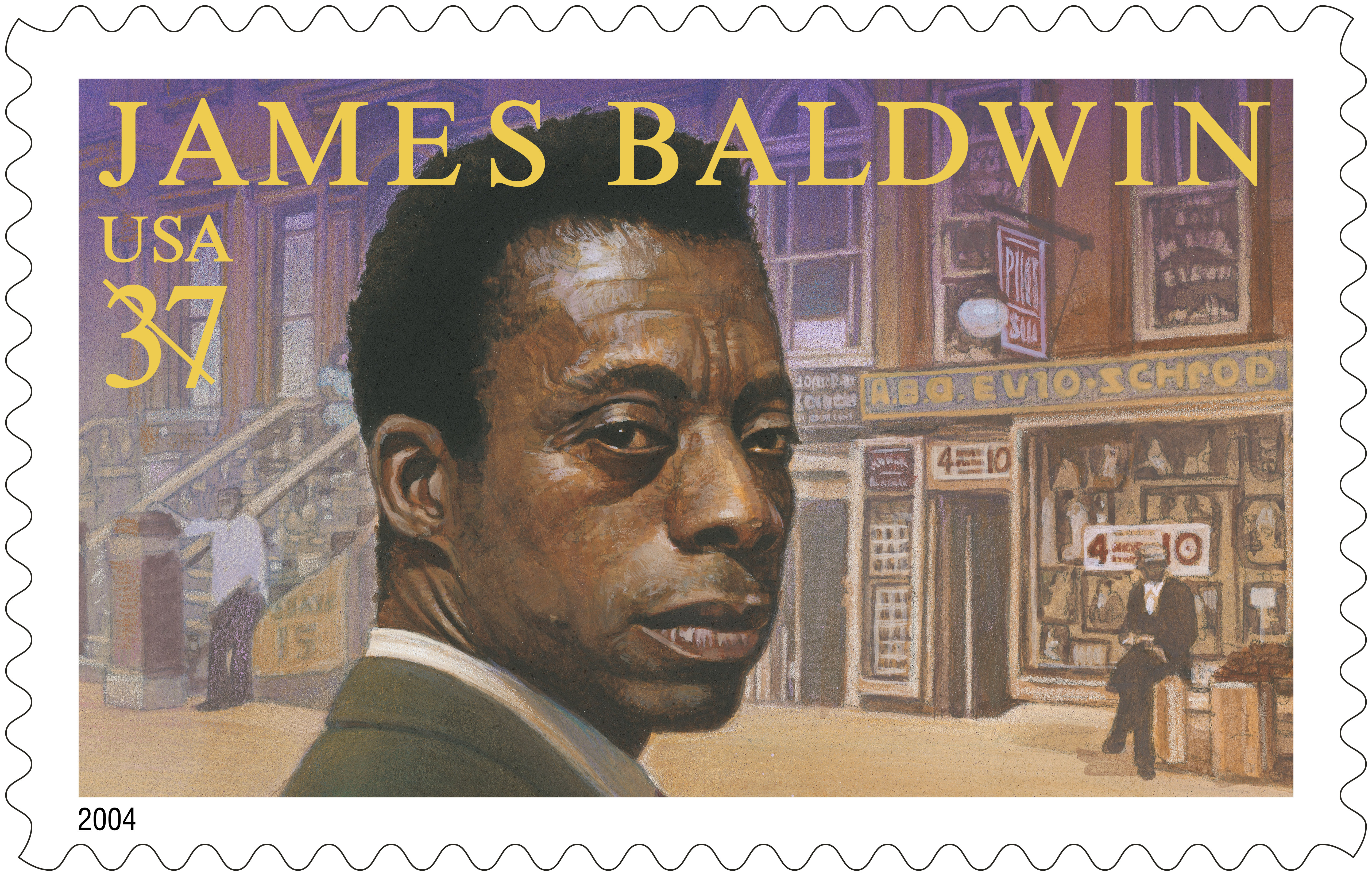
In 2004, poet Adrienne Rich (2009) wrote about a postage stamp bearing the face of American ex-patriot writer James Baldwin: “the stamp commemorates Baldwin’s birthday, August 2: he would have been eighty that year” (p. 49). This volume appears in 2014, the year that Baldwin would have turned ninety.
Rich’s essay reads as the journey of one writer’s experience embracing the other, but Rich also highlights what this volume seeks to address as well—the lack of attention that Baldwin receives in the twenty-first century U.S. Why, Rich asks, does a country still laboring under the same issues of race continue to ignore a powerful voice, as Americans certainly did when Baldwin spoke of racism?
Quoting from “Lockridge: ‘The American Myth,’” Rich (2009) includes the following:
The gulf between our dream and the realities that we live with is something that we do not understand and do not wish to admit. It is almost as though we were asking that others look at what we want and turn their eyes, as we do, away from what we are. I am not, as I hope is clear, speaking of civil liberties, social equality, etc., where indeed strenuous battle is yet carried on; I am speaking instead of a particular shallowness of mind, an intellectual and spiritual laxness….This rigid refusal to look at ourselves may well destroy us; particularly now since if we cannot understand ourselves we will not be able to understand anything. (p. 52; Baldwin, 1998, p. 593)
Baldwin’s challenge here should haunt us because it remains the challenge before us—“[t]his rigid refusal to look at ourselves.”
The following chapters—based on both scholarly and experiential perspectives—make significant contributions to the astonishingly slim amount of research and discussion that exists on one of the twentieth century’s most important public intellectuals. They provide key insights into Baldwin’s literary skills, his political views, and the impact his life and work had on historic, as well as ongoing, policy debates. They reveal a complicated, often tormented, and always provocative individual who confronted racism, imperialism, and homophobia as a black, gay pacifist. It should therefore come as little surprise that his work maintains its relevance as American society continues to grapple with racial, social, and political challenges.
[ii] Vilson offers about himself at his blog, The Jose Vilson (http://thejosevilson.com/): “José Luis Vilson is a math educator for a middle school in the Inwood / Washington Heights neighborhood of New York, NY. He graduated with a bachelor’s degree in computer science from Syracuse University and a master’s degree in mathematics education from the City College of New York. He’s also a committed writer, activist, web designer, and father. He co-authored the book Teaching 2030: What We Must Do For Our Students and Public Schools … Now and In The Future with Dr. Barnett Berry and 11 other accomplished teachers. He currently serves as the president emeritus of the Latino Alumni Network of Syracuse University, as a board member on the Board of Directors for the Center for Teaching Quality, and has been a part of the Acentos Foundation, LATinos In Social Media (LATISM), the Capicu Poetry Group, BlogCritics, and the AfroSpear.”
It’s no surprise that schools in wealthy communities are better than those in poor communities, or that they better prepare their students for desirable jobs. It may be shocking, however, to learn how vast the differences in schools are – not so much in resources as in teaching methods and philosophies of education. Jean Anyon observed five elementary schools over the course of a full school year and concluded that fifth-graders of different economic backgrounds are already being prepared to occupy particular rungs on the social ladder. In a sense, some whole schools are on the vocational education track, while others are geared to produce future doctors, lawyers, and business leaders. Anyon’s main audience is professional educators, so you may find her style and vocabulary challenging, but, once you’ve read her descriptions of specific classroom activities, the more analytic parts of the essay should prove easier to understand. Anyon is chairperson of the Department of Education at Rutgers University, Newark.
No rhetorical sleight of words should mask that Trayvon Martin was a son. He had parents.
No rhetorical sleight of words should allow us to ignore that any child is everyone’s child.
Trayvon Martin was killed in part because he was reduced to a stereotype, and after his death, Trayvon was again reduced—often by well-meaning people—to an icon, the hoodie.
In his death, as well, Trayvon has been spoken about, spoken for—and I am compelled to argue that he has also been rendered voiceless.
But, as Arundhati Roy has explained, “We know of course there’s really no such thing as the ‘voiceless’. There are only the deliberately silenced, or the preferably unheard.”
I am also compelled to speak beyond Trayvon, about “the deliberately silenced, or the preferably unheard” Others, African American males.
At mid-twentieth century, as the US was fighting against its racist heritage, African American males demanded to be heard—Martin Luther King Jr., Malcolm X, Ralph Ellison, James Baldwin, Richard Wright and many others took the stage as artists, public intellectuals, and civic leaders.
Wright’s Black Boy and Ellison’s Invisible Manrepresent in fictional narrative a powerful and disturbing image of the African American male; for Ellison, the guiding metaphor of that narrative is invisibility. The killing of Trayvon and the subsequent trial may suggest that African American males no longer suffer from invisibility but from how they are seen, how they are silenced, and how they are unheard: Trayvon seen (and reduced) as black male, thus necessarily a thug, a threat, and then Trayvon, the hoodie, the icon of the disposable African American male.
Just as Wright’s and Ellison’s fiction captures the African American male experience at mid-twentieth century, continuing to speak to the complex and entrenched conditions that contributed to Trayvon’s killing, Ellison’s and Baldwin’s concerns about the failure of education to see clearly and holistically—and humanely—African American males remain ominous and powerful messages in 2013.
At this point it might be useful for us to ask ourselves a few questions: what is this act, what is this scene in which the action is taking place, what is this agency and what is its purpose? The act is to discuss “these children,” the difficult thirty percent. We know this very well; it has been hammered out again and again. But the matter of scene seems to get us into trouble.
Ellison recognized the stigma placed on African American students, a deficit view of both an entire race and their potential intelligence (marginalized as insufficient language skills):
Some of us look at the Negro community in the South and say that these kids have no capacity to manipulate language. Well, these are not the Negroes I know. Because I know that the wordplay of Negro kids in the South would make the experimental poets, the modern poets, green with envy. I don’t mean that these kids possess broad dictionary knowledge, but within the bounds of their familiar environment and within the bounds of their rich oral culture, they possess a great virtuosity with the music and poetry of words. The question is how can you get this skill into the mainstream of the language, because it is without doubt there. And much of it finds its way into the broader language. Now I know this just as William Faulkner knew it. This does not require a lot of testing; all you have to do is to walk into a Negro church.
But Ellison rejected this deficit perspective: “Thus we must recognize that the children in question are not so much “culturally deprived” as products of a different cultural complex”:
As we approach the dropouts, let us identify who we are and where we are. Let us also have a little bit of respect for what we were and from whence we came. There is a bit of the phony built into every American. This is inevitable in a conscious society that has developed as swiftly as ours has. We are faced with endless possibilities for change, for metamorphosis. We change our environment, our speech, our styles of living, our dress, and often our values. So, in effect, we become somebody else–or so we are tempted to believe–and often we act as though we have no connection with our past. We are all tempted to become actors, and when we forget who we are and where we are from, our phony selves take command.
Finally, Ellison demanded that the human dignity of all children be honored:
I don’t know what intelligence is. But this I do know, both from life and from literature: whenever you reduce human life to two plus two equals four, the human element within the human animal says, “I don’t give a damn.” You can work on that basis, but the kids cannot. If you can show me how I can cling to that which is real to me, while teaching me a way into the larger society, then I will not only drop my defenses and my hostility, but I will sing your praises and help you to make the desert bear fruit.
Baldwin addressed teachers in that same year, 1963: “Let’s begin by saying that we are living through a very dangerous time. Everyone in this room is in one way or another aware of that. We are in a revolutionary situation, no matter how unpopular that word has become in this country. The society in which we live is desperately menaced, not by Khrushchev, but from within.”
Then, Baldwin unmasked the cruel tension between the promise of universal public education and the inequity found in the lives of African American children:
Now, if what I have tried to sketch has any validity, it becomes thoroughly clear, at least to me, that any Negro who is born in this country and undergoes the American educational system runs the risk of becoming schizophrenic. On the one hand he is born in the shadow of the stars and stripes and he is assured it represents a nation which has never lost a war. He pledges allegiance to that flag which guarantees “liberty and justice for all.” He is part of a country in which anyone can become president, and so forth. But on the other hand he is also assured by his country and his countrymen that he has never contributed anything to civilization – that his past is nothing more than a record of humiliations gladly endured. He is assumed by the republic that he, his father, his mother, and his ancestors were happy, shiftless, watermelon-eating darkies who loved Mr. Charlie and Miss Ann, that the value he has as a black man is proven by one thing only – his devotion to white people. If you think I am exaggerating, examine the myths which proliferate in this country about Negroes….
The point of all this is that black men were brought here as a source of cheap labor. They were indispensable to the economy. In order to justify the fact that men were treated as though they were animals, the white republic had to brainwash itself into believing that they were, indeed, animals and deserved to be treated like animals. Therefor it is almost impossible for any Negro child to discover anything about his actual history. The reason is that this “animal,” once he suspects his own worth, once he starts believing that he is a man, has begun to attack the entire power structure. This is why America has spent such a long time keeping the Negro in his place. What I am trying to suggest to you is that it was not an accident, it was not an act of God, it was not done by well-meaning people muddling into something which they didn’t understand. It was a deliberate policy hammered into place in order to make money from black flesh. And now, in 1963, because we have never faced this fact, we are in intolerable trouble.
Ultimately, education, for Baldwin, is revolutionary, an act of social justice:
I began by saying that one of the paradoxes of education was that precisely at the point when you begin to develop a conscience, you must find yourself at war with your society. It is your responsibility to change society if you think of yourself as an educated person. And on the basis of the evidence – the moral and political evidence – one is compelled to say that this is a backward society. Now if I were a teacher in this school, or any Negro school, and I was dealing with Negro children, who were in my care only a few hours of every day and would then return to their homes and to the streets, children who have an apprehension of their future which with every hour grows grimmer and darker, I would try to teach them – I would try to make them know – that those streets, those houses, those dangers, those agonies by which they are surrounded, are criminal. I would try to make each child know that these things are the result of a criminal conspiracy to destroy him. I would teach him that if he intends to get to be a man, he must at once decide that his is stronger than this conspiracy and they he must never make his peace with it. And that one of his weapons for refusing to make his peace with it and for destroying it depends on what he decides he is worth. I would teach him that there are currently very few standards in this country which are worth a man’s respect.
No rhetorical sleight of words should mask that Trayvon Martin was a son. He had parents.
No rhetorical sleight of words should allow us to ignore that any child is everyone’s child.
However if the killing of Trayvon does not haunt us, if the killing of Trayvon slips beneath the next tragedy-of-the-moment—as the Sandy Hook shooting has beneath the Zimmerman trial—then society and schools will continue to be mechanisms that shackle “the deliberately silenced, or the preferably unheard.”
And I suppose that is ultimately the cruel paradox, rendering Trayvon a ghost in this American house he was never allowed to enter, invisible again as Ellison’s unnamed narrator.
Let me try once again to clarify both that these claims are true and necessary to name in order to change.
“Poverty is destiny” is a normative [1] fact of the United States. For most children, the social class they are born into predicts the trajectory of their lives, independent of their self-worth, effort, and all sorts of other factors we are more likely to associate with the individual child.
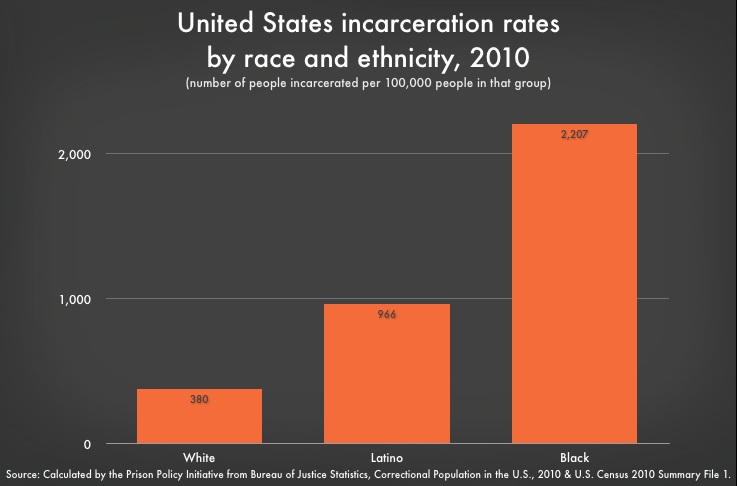
That this is a normative statement includes a concession that outliers exist (some people fall out of and rise above the social class of their births), but outliers do not discredit a normative statement just as we must caution against making an outlier status the rubric for normalized behavior. In other words, that African American men have scaled to the presidency and supreme court stands as outliers against the disproportionate number of AA men incarcerated in our country:
Michelle Alexander has embodied the need to name in order to change by confronting the normative facts of mass incarceration as well as the indisputable fact that mass incarceration is the New Jim Crow, thus racist.
Here’s a fact that may not surprise you: the children of the rich perform better in school, on average, than children from middle-class or poor families. Students growing up in richer families have better grades and higher standardized test scores, on average, than poorer students; they also have higher rates of participation in extracurricular activities and school leadership positions, higher graduation rates and higher rates of college enrollment and completion….
In the 1980s, on an 800-point SAT-type test scale, the average difference in test scores between two such children would have been about 90 points; today it is 125 points. This is almost twice as large as the 70-point test score gap between white and black children. Family income is now a better predictor of children’s success in school than race….
We are still talking about this despite decades of clucking about the crisis in American education and wave after wave of school reform.Whatever we’ve been doing in our schools, it hasn’t reduced educational inequality between children from upper- and lower-income families….
The income gap in academic achievement is not growing because the test scores of poor students are dropping or because our schools are in decline….
It may seem counterintuitive, but schools don’t seem to produce much of the disparity in test scores between high- and low-income students. We know this because children from rich and poor families score very differently on school readiness tests when they enter kindergarten, and this gap grows by less than 10 percent between kindergarten and high school. There is some evidence that achievement gaps between high- and low-income students actually narrow during the nine-month school year, but they widen again in the summer months….
The more we do to ensure that all children have similar cognitively stimulating early childhood experiences, the less we will have to worry about failing schools. This in turn will enable us to let our schools focus on teaching the skills — how to solve complex problems, how to think critically and how to collaborate — essential to a growing economy and a lively democracy.
Alexander and Reardon are naming normative facts—ones that many all along the ideological spectrum not only refuse to do themselves, but rush to silence others who do name in order to change.
If the patterns of mass incarceration and “no excuses”/”zero tolerance” schools and policies even impacted privileged white males proportionately in the U.S., the outcry would be deafening.
The current and historical racially disproportionate and negative patterns of the U.S. penal and judicial systems and the rise of highly segregated “no excuses” charter schools and “zero tolerance” urban public schools must be named and then we must act t change that which is racist, that which is classist, that which is sexist.
Refusing to name, refusing to act guarantees poverty will remain destiny and the current education reform movement will continue to mirror the New Jim Crow of mass incarceration.
If you are uncertain about the messages our culture sends about race, view the video below:
There are significant parallels between the war on drugs and market-oriented education reform, and both create an underclass – especially among African American males, according to Thomas, who traces the history.
Please read by clicking ABOVE on title.
educator, public scholar, poet&writer – academic freedom isn't free




 dr. p.l. (paul) thomas