Category Archives: Science of Reading

SOR Endgame: The Reading Program Boondoggle

Within a year or so of the initial “science of reading” (SOR) media campaign launch in 2018, states such as Arkansas banned reading instruction (three-cueing) that effectively banned some of the most popular and demonized reading programs in the US.

This was the canary in the coal mine for one of the most powerful (but ignored) elements of the SOR movement—reading program marketing.

In order for a new reading program market place to open, the existing programs had to be vilified and then, ultimately, banned and replaced (see here and here).

The uncritical endorsement of the SOR story remains a central feature of media coverage even as the inherent problems and flaws with that story and it consequences are beginning to be acknowledged:

And the next shoe has dropped, fulfilling the logical consequences of the entire SOR movement [1] built on false and oversimplified cries of crisis and demonizing of literacy frameworks (balanced literacy) and popular programs (Fountas and Pinnell, and Calkins’s Units of Study):

Principals historically have enjoyed enormous leeway to select curriculums. Proponents argue this allows schools to stay nimble and select materials appropriate to their specific student populations. But some experts, and even the city’s own schools chancellors, have argued that the approach can lead to a tangle of instructional practices that can vary widely in quality from classroom to classroom. 

Now, officials are taking steps to rein in the city’s free-wheeling approach to curriculum. Beginning next school year, elementary schools in about half of the city’s 32 districts will be required to use one of three reading programs: Wit & Wisdom, from a company called Great Minds; Into Reading from Houghton Mifflin Harcourt; or Expeditionary Learning, from EL Education.

By September 2024, city officials are expected to require all elementary schools to use one of those three options, according to an education department official familiar with the city’s plans.

NYC schools could soon be forced to adopt a mandated reading curriculum, sources say

NYC has been a disturbing and important example of the very worst aspects of the media-driven political responses to a false story (see here and here). The city is proof that a false story has more influence than actual evidence or science.

Blaming balanced literacy and popular reading programs for a reading crisis that doesn’t exist lacks scientific research:

I am, like you, struck by the degree to which people are willing to invoke a literacy crisis, when the data do not support anything like a literacy crisis. NAEP scores, aside from the pandemic then– but NAEP scores, over the last 10, 15 years have grown– slowly, but they have gotten better in literacy. 

And it’s deeply puzzling to me why we have all of this public discourse about a literacy crisis. If I were deeply cynical, I would say it’s probably a useful technique for companies that are trying to sell their programs to get people to buy those programs, if parents and some school districts are very agitated about the so-called literacy crisis. 

Now that isn’t to say that all American children are doing wonderfully in literacy. Obviously, they aren’t. But it is to say that there’s not a new or a sudden decline in literacy performance, other than that associated with the dip that had to do with the pandemic. 

Harvard EdCast: To Weather the “Literacy Crisis,” Do What Works

As Snow notes, claiming crisis is not supported by the most common evidence cited, NAEP trends:

And many scholars have raised concerns about structured literacy (the proposed alternative to balanced literacy in the SOR movement):

We recognize that some teachers using structured literacy approaches will find ways to respond to the interests, experiences, and literacy abilities of individual students; however, we are concerned about the indiscriminate and unwarranted implementation of the following practices:

• Directive and/or scripted lessons that tell teachers what to say and do and the implementation of lesson sequences, often at a predetermined pace (Hanford, 2018)

• Privileging of phonemic awareness and phonics as primary decoding skills (Hanford, 2018, 2019; IDA,2019; Paige, 2020; Pierson, n.d.; Spear-Swerling, 2019)

• Use of decodable texts that do not engage multiple dimensions of reading (Hanford, 2018; IDA, 2019; Paige, 2020; Spear-Swerling, 2019)

• Specialized forms of reading instruction designed for particular groups of students as core literacy instruction for all students and teacher educators (Hanford, 2018; Hurford et al., 2016; IDA, 2019; Pierson, n.d.)

• Mandating structured literacy programs despite the lack of clear empirical evidence to support these programs

• Privileging the interest of publishers and private education providers over students

Particular concerns relate to the assertion that there is a consensus across the research community about the primacy of systematic phonics approaches. This supposedly undisputed consensus was severely challenged by the findings of a review of meta-analyses (Bowers, 2020).

Compton-Lilly, C.F., Mitra, A., Guay, M., & Spence, L.K. (2020). A confluence of complexity: Intersections among reading theory, neuroscience, and observations of young readers. Reading Research Quarterly, 55(S1), S185-S195. https://doi.org/10.1002/rrq.348

Further, at least one of the mandated reading programs (Into Reading from Houghton Mifflin Harcourt) for NYC, where a high percentage of diverse students are being served, has been identified as not meeting social justice and diversity goals:

1. All three curricula were Culturally Destructive or Culturally Insufficient.

2. All three curricula used superficial visual representations to signify diversity, especially skin tone and bodily presentation, without including meaningful cultural context, practices or traditions.

3. All three curricula were dominated by one-sided storytelling that provided a single, ahistorical narrative. 

4. All three curricula used language, tone and syntax that demeaned and dehumanized Black, Indigenous and characters of color, while encouraging empathy and connection with White characters.

5. All three curricula provided little to no guidance for teachers on engaging students’ prior knowledge, backgrounds and cultures; or reflecting on their own bias, beliefs and experiences.

Lessons in (In)Equity: An Evaluation of Cultural Responsiveness in Elementary ELA Curriculum

The education market churns is the actual endgame of the SOR movement. The only people likely to benefit from the SOR story are journalists, politicians, and the corporations willing to jump on the reading program branding bandwagon.

The reading problems today are little different than overt the last 80 years, and most of the causes of those problems remain outside of schools—home and community poverty and inequity—and linked to in-school issues of equity, not reading programs or reading philosophies and practices.

Yet, on the horizon, it seems, schools, teachers, and students are going to be bombarded by “structured literacy”—at least until the next unwarranted reading crisis is declared so another round of blame, ban, and adopt can start all over again.


UPDATE

See the plan here in this proposed bill in Ohio:


[1] Thomas, P.L. (2022). The Science of Reading movement: The never-ending debate and the need for a different approach to reading instruction. Boulder, CO: National Education Policy Center. http://nepc.colorado.edu/publication/science-of-reading

Recommended

What Reading Program Should Schools Adopt?

Media Coverage of SOR [access materials HERE]

Hoffman, J.V., Hikida, M., & Sailors, M. (2020). Contesting science that silences: Amplifying equity, agency, and design research in literacy teacher preparation. Reading Research Quarterly, 55(S1), S255–S266. Retrieved July 26, 2022, from https://doi.org/10.1002/rrq.353

MacPhee, D., Handsfield, L.J., & Paugh, P. (2021). Conflict or conversation? Media portrayals of the science of reading. Reading Research Quarterly, 55(S1), S145-S155. Retrieved July 26, 2022, from https://doi.org/10.1002/rrq.384

Cryonics Phonics: Inequality’s Little Helper – New Politics

[UPDATE]

The Science of Reading and the Media: Is Reporting Biased?, Maren Aukerman, The University of Calgary

The Science of Reading and the Media: Does the Media Draw on High-Quality Reading Research?, Maren Aukerman

The Science of Reading and the Media: How Do Current Reporting Patterns Cause Damage?, Maren Aukerman

Making sense of reading’s forever wars, Leah Durán and Michiko Hikida

[UPDATE]

Harvard EdCast: To Weather the “Literacy Crisis,” Do What Works

Disrupting the Disruptors: Reimagining Policy Advocacy in a Post-Truth Era, Helen Aydarova

Caught In a Web of Privatizers: Science of Reading Reforms in the State of Tennessee, Helen Aydarova

“Whatever You Want to Call It”: Science of Reading Mythologies in the Educational Reform Movement, Helen Aydarova
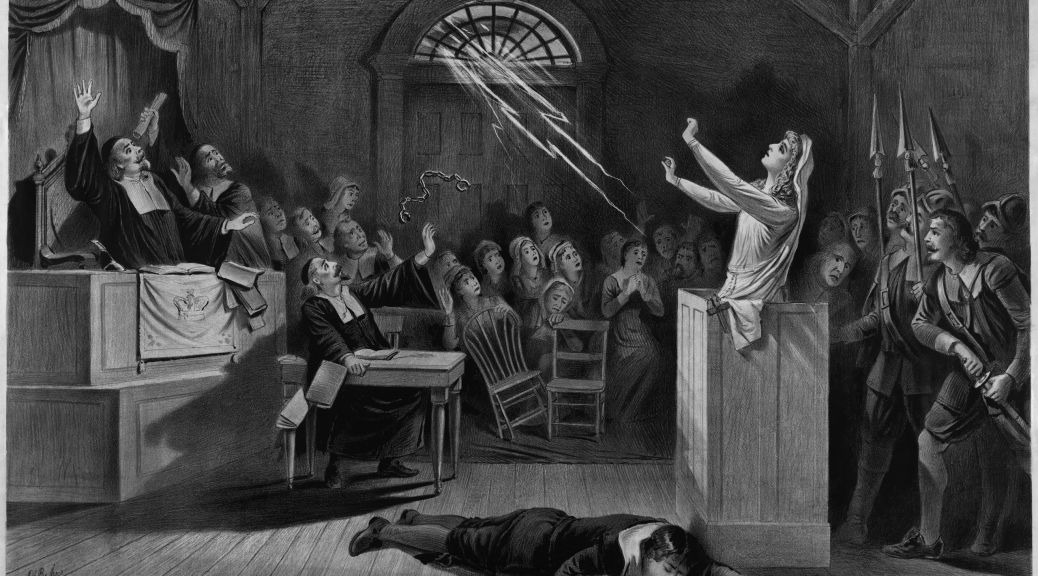
Arthur Miller’s The Crucible: 2023

Over 18 years of teaching high school English, I taught American literature for English III (mostly a course for juniors) as part of the required curriculum in South Carolina.

Our required reading list of novels and plays was quite bad, overwhelmingly white authors and so-called classic works of literature (although the “classic” was merely the entrenched modernist works common in most public schools).

Along with the overkill of white men writers and characters, I found the American literature required list inordinately obsessed with Puritanism; students were required to study both Nathaniel Hawthorne’s (god awful) The Scarlet Letter and Arthur Miller’s The Crucible.

Either one would have been more than enough, and frankly, only The Crucible should have been included, if either at all. Students barely tolerated discussing The Scarlet letter, and I think very few actually read the novel (with the entire experience confirming for most of them that they hated to read).

However, we often had a good experience with Miller’s metaphorical/historical confrontation of the McCarthy Era. Over the years, I turned The Crucible unit into a world-wind of an experience that included listening to an audio version of the play (later in the mid-1990s, we watched the film version), an opening activity using R.E.M.’s “Exhuming McCarthy,” and a closing activity centered around watching the original film version of Invasion of the Body Snatchers (1956).

What I think made The Crucible resonate with high school students in the South in the 1980s and 1990s was my effort to help them navigate how the play was designed to address patterns of human behavior that had occurred in Puritan America and then repeated in the McCarthy Era; Miller, of course, was suggesting that this pattern would continue if humans were not vigilant to recognize it.

I have always found compelling the scene when Proctor is confronted with the accusations about witches; he responds that he has not realized “the world is gone daft with this nonsense.”

That nonsense is a fatal combination of religious fever/ missionary zeal, political authoritarianism (the blurring of church and state), and an incredibly dangerous commitment to manufactured evidence.

While The Crucible dramatizes a political/ religious/ legal tragedy mostly anchored in real historical events, in 2023, it is a powerful allegory about our current political over-reaches related to schools and radiating out into our culture and personal liberties.

The same toxic combination of religious fever/ missionary zeal, political authoritarianism (the blurring of church and state), and an incredibly dangerous commitment to evidence can be seen in all of the following:

  • Anti-CRT and anti-woke legislation.
  • Book bans and censorship targeting race/racism and LGBTQ+ content and authors.
  • Anti-trans and anti-drag legislation and rhetoric.
  • Reading legislation committed to the “science of reading.”

In each case, “”the world is gone daft with this nonsense.”

The core problem we are experiencing in the US in 2023 is that religious fever/ missionary zeal among some Americans is being leveraged by Republicans to bolster their political power, skewing toward totalitarianism.

That combination corrupts the evidence being used to push these agendas.

Evidence is being reduced to whatever suits the political/authoritarian goals, and as a report out of UCLA notes regarding specifically the anti-CRT movement, the “conflict campaign thrives on caricature.”

Caricature and misinformation to drive political agendas include how “CRT,” “woke,” banned novels and authors, trans care, drag shows, and elements of reading instruction (such as three-cueing and balanced literacy) are mischaracterized in order to attack the mischaracterization.

Social media is flooded with false definitions of “woke,” for example, grounding outlandish calls for “protecting children.”

For Americans who value life, liberty, and the pursuit of happiness, we must acknowledge Miller’s message that evidence cannot survive in the context of religious fervor/ missionary zeal and totalitarian politics (the consequential inevitability in theocracies).

While there is no such thing as objective evidence, there is a value in dispassionate evidence decoupled from authority.

The US was founded in part on a recognition that the church/state dynamic was oppressive, necessarily so, and despite the many flaws of the so-called Founding Fathers, they were drawn to the Enlightenment and a move toward scientific inquiry.

Despite the continued misuse of the term, “science” rightly understood is about grounding claims and conclusions in a careful analysis of evidence regardless of who makes the claims (decoupling from authority). And science is not about dogma (fixed Truth) but about the pursuit of truth by a community.

In 2023, we are living in the same “nonsense” Proctor named because too many are willing to abdicate the sanctity of evidence for their religious fervor/ missionary zeal and because there are enough political leaders eager to use that to leverage their pursuit of power at any cost to others.

If Nero fiddled while Rome burned, we are conveniently distracted by our many screens while life, liberty, and the pursuit of happiness are reduced to ash.

Even More Problems with Grade-Level Proficiency

I have explained often about the essential flaw with grade-level proficiency, notably the third-grade reading myth.

Grade level in reading is a calculation that serves textbook companies and testing, but fulfills almost no genuine purpose in the real world; it is a technocratic cog in the efficiency machine.

Now that we are squarely in the newest reading war, the “science of reading,” two other aspects of grade-level proficiency have been central to that movement—the hyper-focus on third-grade reading proficiency that includes high-stakes elements such as grade retention and the misinformation rhetoric that claims 65% of students are not reading at grade-level (the NAEP proficiency myth).

These alone are enough to set aside or at least be skeptical about rhetoric, practice, and policy grounded in grade-level proficiency, but there is even more to consider.

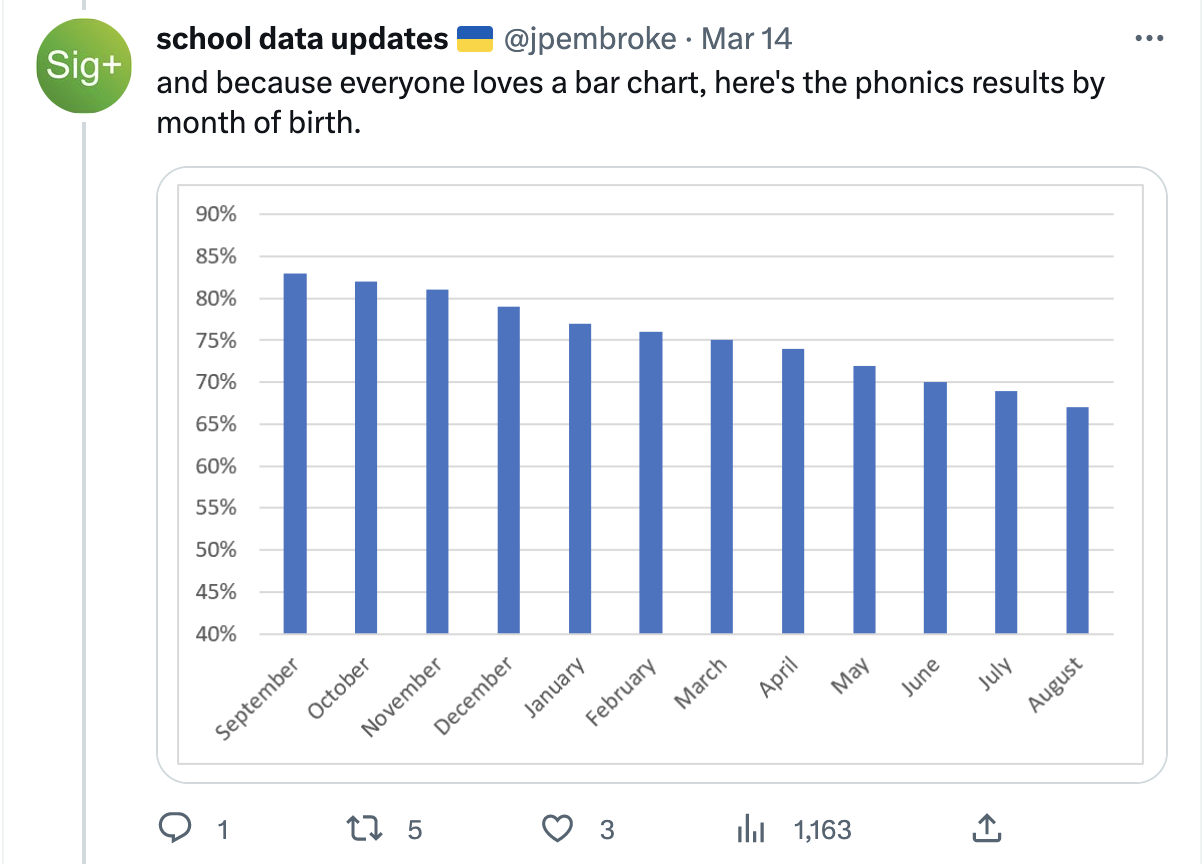
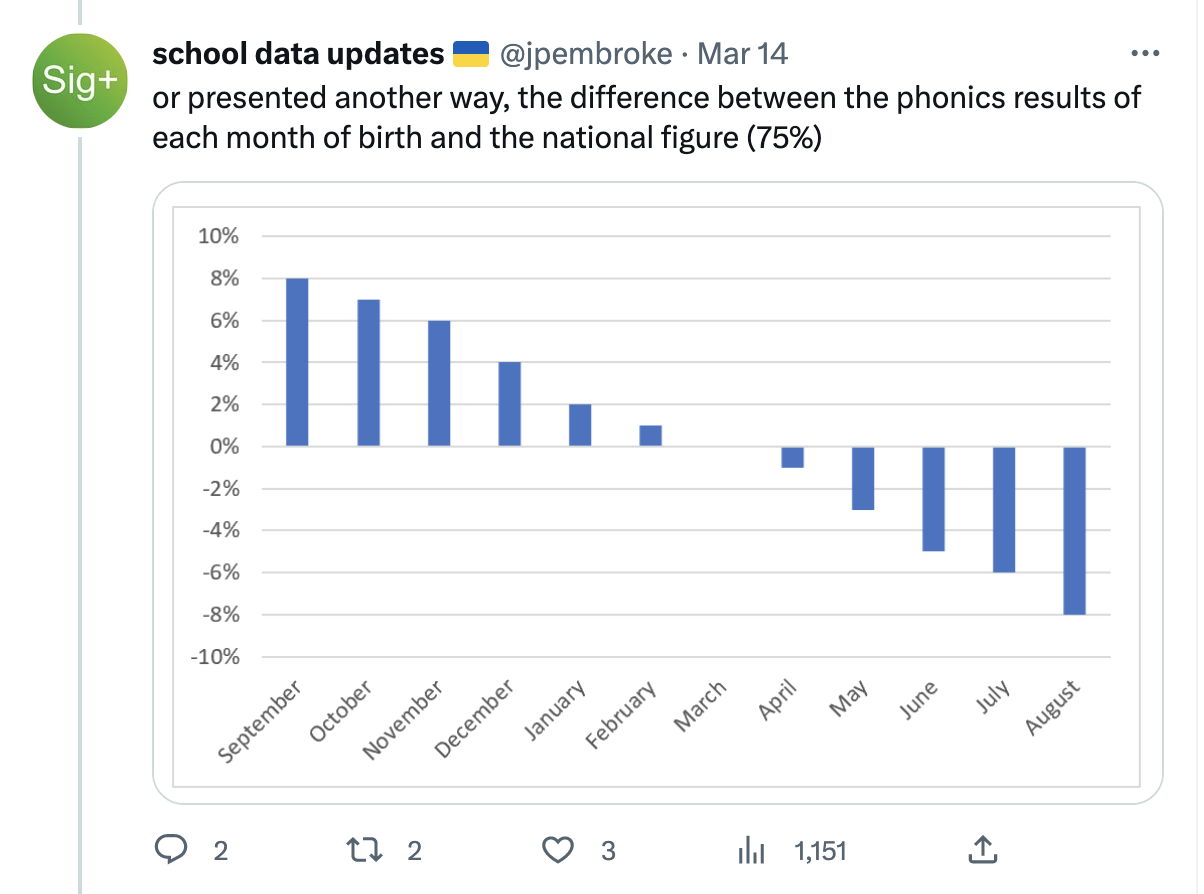
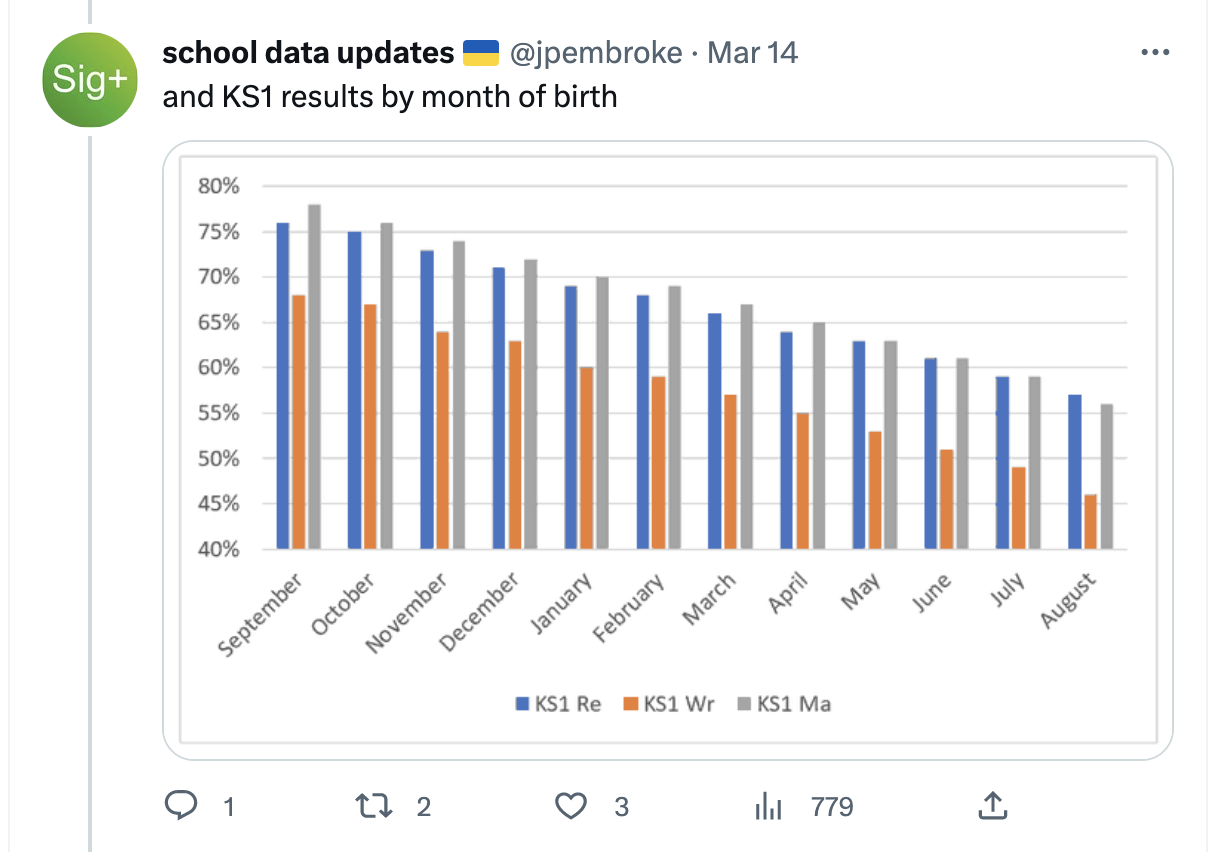
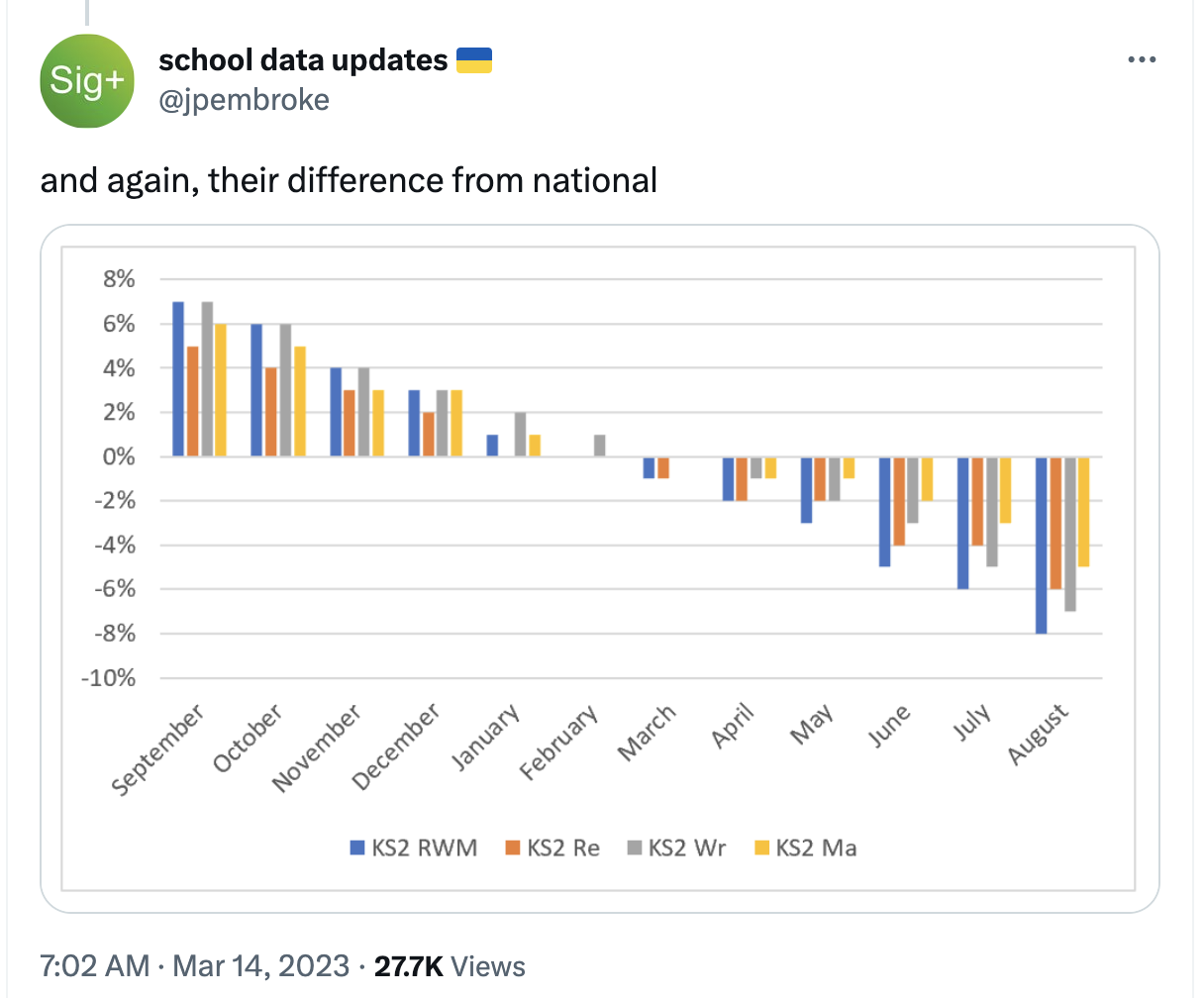
A Twitter thread examines grade-level achievement aggregated by month of birth:

The thread builds off a blog post: Age-Related Expectations? by James Pembroke.

The most fascinating aspect of this analysis thread is the series of charts provided:

As the analysis shows, student achievement is strongly correlated with birth month, which calls into question how well standardized testing serves high-stakes practices and how often standardized testing reflects something other than actual learning.

Being older in your assigned grade level is not an aspect of merit, and being older in your assigned grade seems to have measured achievement benefits that aren’t essentially unfair to younger members of a grade.

Further, this sort of analysis helps contribute to concerns raised about grade retention, which necessarily removes students most likely to score low on testing and reintroduces those students as older than their peers in the assigned grade, which would seem to insure their test data corrupts both sets of measurements.

This data above are from the UK, but a similar analysis by month/year of birth applied to retained students and their younger peers would be a powerful contribution to understanding how grade retention likely inflates test data while continuing to be harmful to the students retained (and not actually raising achievement).

There appears to be even more problems with grade-level proficiency than noted previously, and now, even more reason not to continue to use the rhetoric or the metric.

Podcast: What You Can Do: How ‘Sold a Story’ sold us a story ft Dr. Paul Thomas

How ‘Sold a Story’ sold us a story ft Dr. Paul Thomas


See Also

Which Is Valid, SOR Story or Scholarly Criticism?: Checking for the “Science” in the “Science of Reading”

The Science of Reading and the Media: Is Reporting Biased?, Maren Aukerman

The Science of Reading and the Media: Does the Media Draw on High-Quality Reading Research?, Maren Aukerman

The Science of Reading and the Media: How Do Current Reporting Patterns Cause Damage?, Maren Aukerman

The Reading Puzzle and the Media’s Caricature Blame Game

As an aging adult, I have returned with mature gusto to childhood things—comic books, Lego, and puzzles.

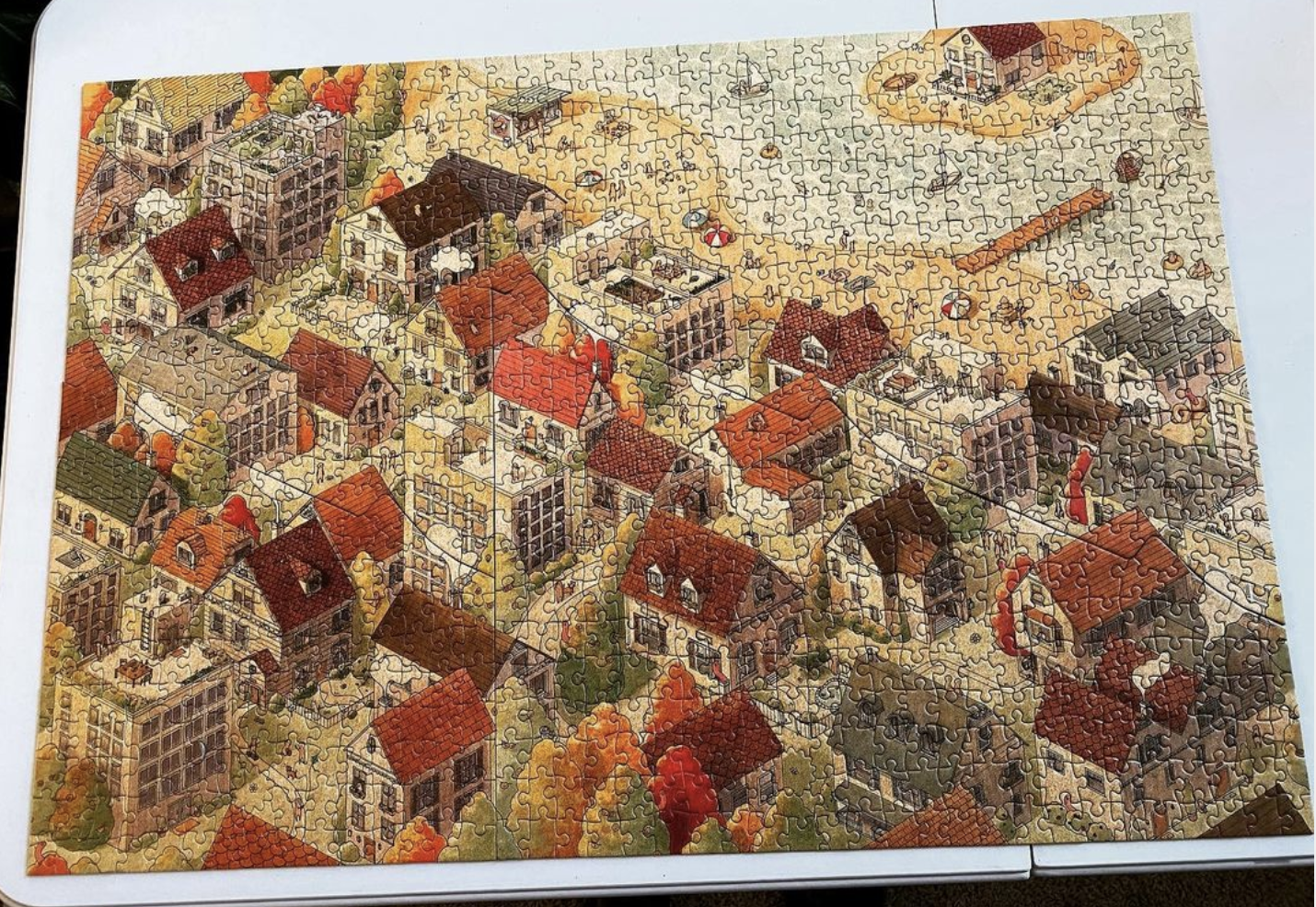
Puzzles are, like Lego, incredibly satisfying, and I have discovered a wonderful puzzle company, Magic Puzzle Company, that combines fascinating original art with its own version of “magic”; once the main puzzle is completed, you can move sections, reveal an open section in the middle, and then complete the puzzle for a big reveal:

I have a daughter and three grandchildren so I have watched child development paralleled with puzzles for many years.

Babies and small children often start with simple one-piece puzzles that challenge them with fitting that one piece into a basic shape. As the child develops, the puzzles become progressively more complex—more pieces and piece shapes more varied and unpredictable.

That sequential process is incredibly compelling for adults trying to teach children. In other words, most adults want learning to be that simple, and yes, predictable from child to child.

However, many human behaviors are not that simple even when they are linked to what we might call natural behaviors. Language is typically viewed as natural, yet reading and writing are somewhat artificial and constructed extensions of that natural inclination.

The current media-driven reading crisis, the “science of reading” movement, is fatally attracted to oversimplification, caricature, and fanning an ugly and misleading blame game.

According to journalists, student reading achievement is abysmal because teachers are trapped in balanced literacy and not the “science of reading.”

That is a one-piece puzzle view of reading and teaching reading.

If we just take one step forward, the three-piece puzzle, this caricature falls apart.

The problem at the three-piece puzzle level is that since about the 1990s, we can fairly identify three forces surrounding how reading is taught in the US.

The first piece, although not universal, is that balanced literacy (BL) has been a dominant reading philosophy (although popularly identified as a “theory”) since about the 1990s when media and public attacks on whole language, while misguided, were very effective in challenging that philosophy/framework.

However, the media version of BL is caricature (often presented as a cartoonishly incomplete reading theory or program) instead of its intent as a philosophical framing:

Next, the second piece of the puzzle, most pre-service teachers have been taught the “simple view” of reading (SVR) as the dominant reading theory over that same era (including currently). [1]

If we pause and consider the first two puzzle pieces—balanced literacy and the “simple view” of reading—the media messaging falls apart since the SOR movement has demonized BL as the core cause of reading failures, yet embraced SVR as settled science.

In the real world of teacher education, however, these two have equally informed how teachers are prepared to teach reading—although teacher prep is , in fact, highly diverse in the application of both.

And now the third puzzle piece—most teachers are required to implement reading programs once they are in the classroom, regardless of the their teacher education program.

Here the puzzle becomes incredibly complicated because despite the media’s misinformation campaign, reading programs are not all BL inspired; many of the dominant programs, in fact, assert reading philosophies and theories that are explicitly not BL.

While the media messaging is stuck in the one-piece puzzle and by moving to a three-piece puzzle the inherent logic falls apart in that oversimplification, the reality is that the reading puzzle is much more like the Magic Puzzle Company’s highly complex puzzle with moving parts and remaining work to be done:

The one-piece puzzle blame game, regretfully, is very compelling so the media message remains mostly unchallenged at the popular and political levels.

Culturally, the large and very complicated reading puzzle with moving parts may be more than we can handle, but even if we just move to the three-part puzzle, the story being told about reading proves to be a simplistic blame game.

Reading, teaching reading, and students deserve a bigger, better picture that simply isn’t easy to piece together.


[1] See the discussion of the SVR in this policy brief. Note that in this brief, BL is included in reading theories because of the popular use of the term as a theory, even as that contrasts with its original intent as a philosophical grounding, similar to whole language.

Compton-Lilly, C.F., Mitra, A., Guay, M., & Spence, L.K. (2020). A confluence of complexity: Intersections among reading theory, neuroscience, and observations of young readers. Reading Research Quarterly, 55(S1), S185-S195. https://doi.org/10.1002/rrq.348

Duke, N.K. & Cartwright, K.B. (2021). The science of reading progresses: Communicating advances beyond the simple view of reading. Reading Research Quarterly, 56(S1), S25-S44. https://doi.org/10.1002/rrq.411

The Myth of the Bad Teacher: 2023

If you are paying attention to traditional or social media, you are aware of the following stories being told about US public school teachers in 2023:

  • Elementary teachers are failing to teach reading effectively to US students.
  • That failure is “because many deans and faculty in colleges of education either don’t know the science or dismiss it,” according to Hanford.
  • Elementary, literature/ELA teachers, and history teachers are brainwashing students with CRT.
  • Elementary and literature/ELA teachers are grooming children to be gay or transgender by forcing them to read diverse books and stories.

Except for teachers themselves and some education scholars, these new bad teacher myths are both extremely compelling and almost entirely false. Writing in 2010 during a peak bad teacher movement in the US, Adam Bessie explains about the bad teacher stories represented by Michelle Rhee and perpetuated by the Obama administration and Bill Gates:

The myth is now the truth.

The Bad Teacher myth, [Bill] Ayers admits, is appealing, which is why it’s spread so far and become so commonly accepted. Who can, after all, disagree that we “need to get the lazy, incompetent teachers out of the classroom?” Even Ayers agrees that he, like all of us, “nods stupidly” along with this notion. As a professor at a community college and former high school teacher, I nod stupidly as well: I don’t want my students held back, alienated, or abused by these Bad Teachers.

This myth is also seductive in its simplicity. It’s much easier to have a concrete villain to blame for problems school systems face. The fix seems easy, as well: all we need to do is fire the Bad Teachers, as controversial Washington, DC, school chancellor superstar Michelle Rhee has, and hire good ones, and students will learn. In this light, Gates’ effort to “fix” the bug-riddled public school operating system by focusing on teacher development makes perfect sense. The logic feels hard to argue with: who would argue against making teachers better? And if, as a teacher, you do dare to, you must be “anti-student,” a Bad Teacher who is resistant to “reforms,” who is resistant to improvements and, thus, must be out for himself, rather than the students.

The Myth of the Bad Teacher

Bessie concludes, “The only problem with the Bad Teacher myth, as anyone involved with education is intimately aware of, is that problems in education are anything but simple,” and ultimately, in 2023, these myths are not supported by the evidence.

For example, as the authors of a report out of UCLA assert about anti-CRT attacks on teachers:

We put “CRT” in quotation marks throughout this report because so often the conflict campaign’s definition of “CRT” (like its description of actual K–12 practice) is a caricatured distortion by loud opponents as self-appointed “experts.” The conflict campaign thrives on caricature — on often distorting altogether both scholarship and K–12 educators’ efforts at accurate and inclusive education, deeming it (and particularly K–12 efforts to discuss the full scope of racism in our nation) wholly inappropriate for school.

The Conflict Campaign

The bad teacher myth in 2023 “thrives on caricature” and anecdotes that, as noted above, as very compelling but ultimately not only lack credible evidence [1] and logic, but also cause far more harm than good in terms of reforming education, serving student needs, or recruiting and retaining high quality teachers.

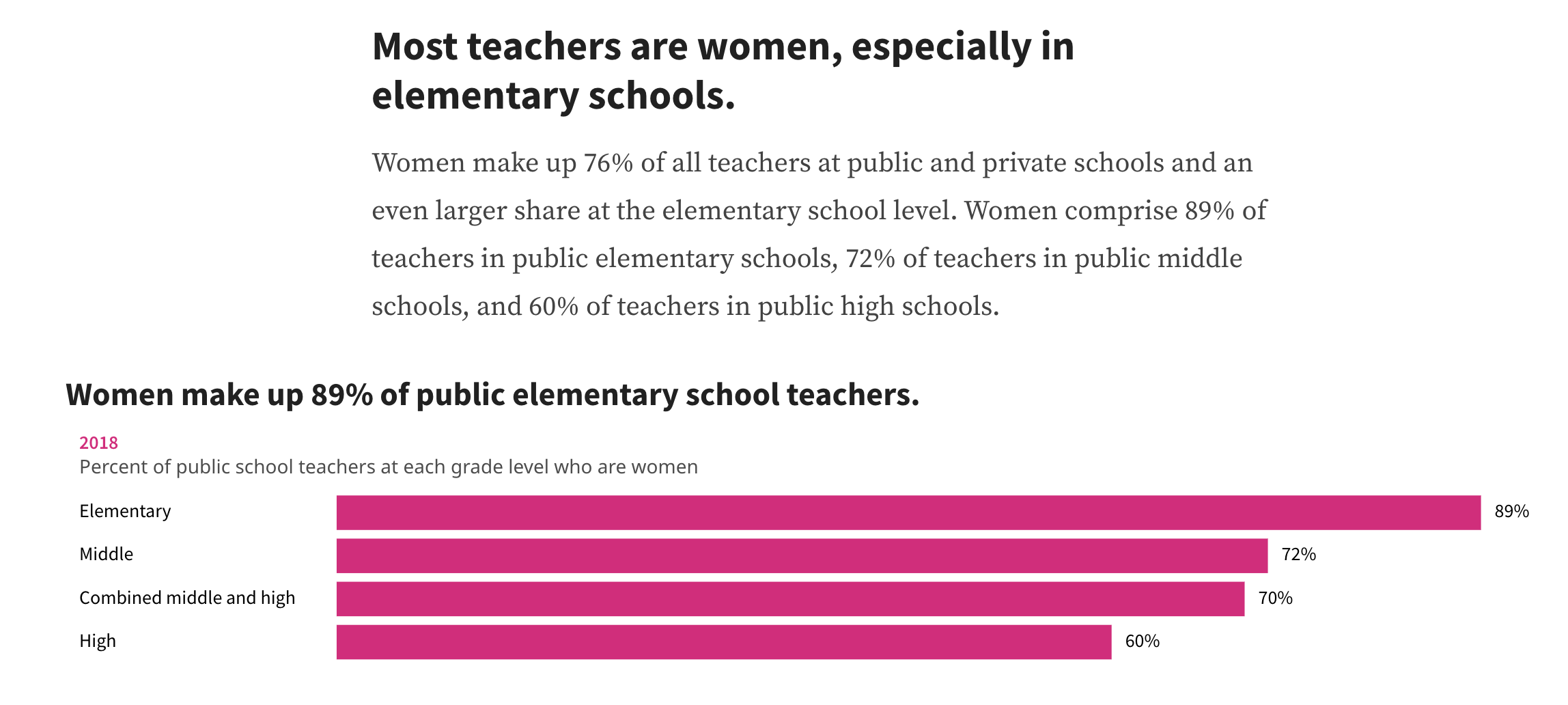
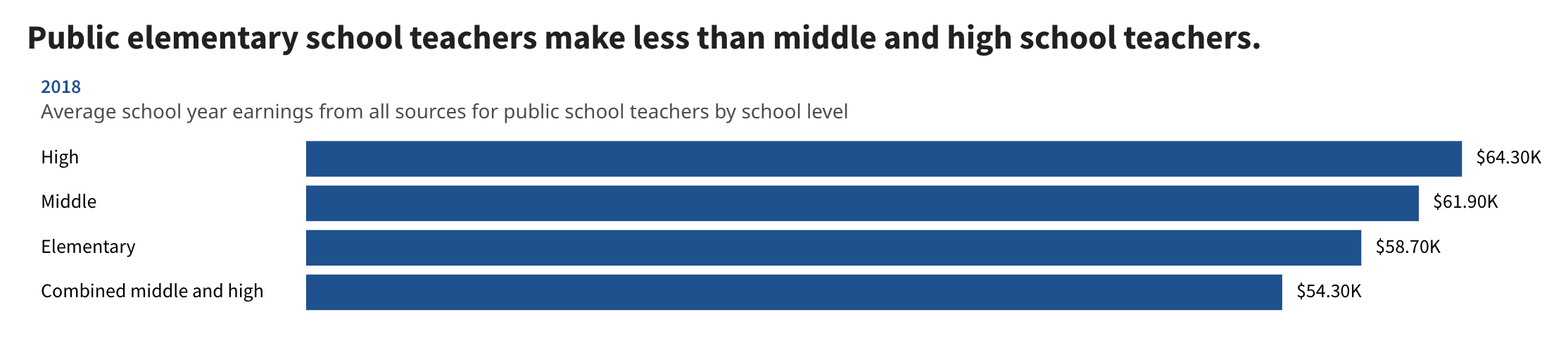
The bad teacher myth in 2023 is targeting educators who are 70-90% women, and those teachers under the most intense attacks tend to be elementary teachers who are even more disproportionately women and the lowest paid educators [2]:

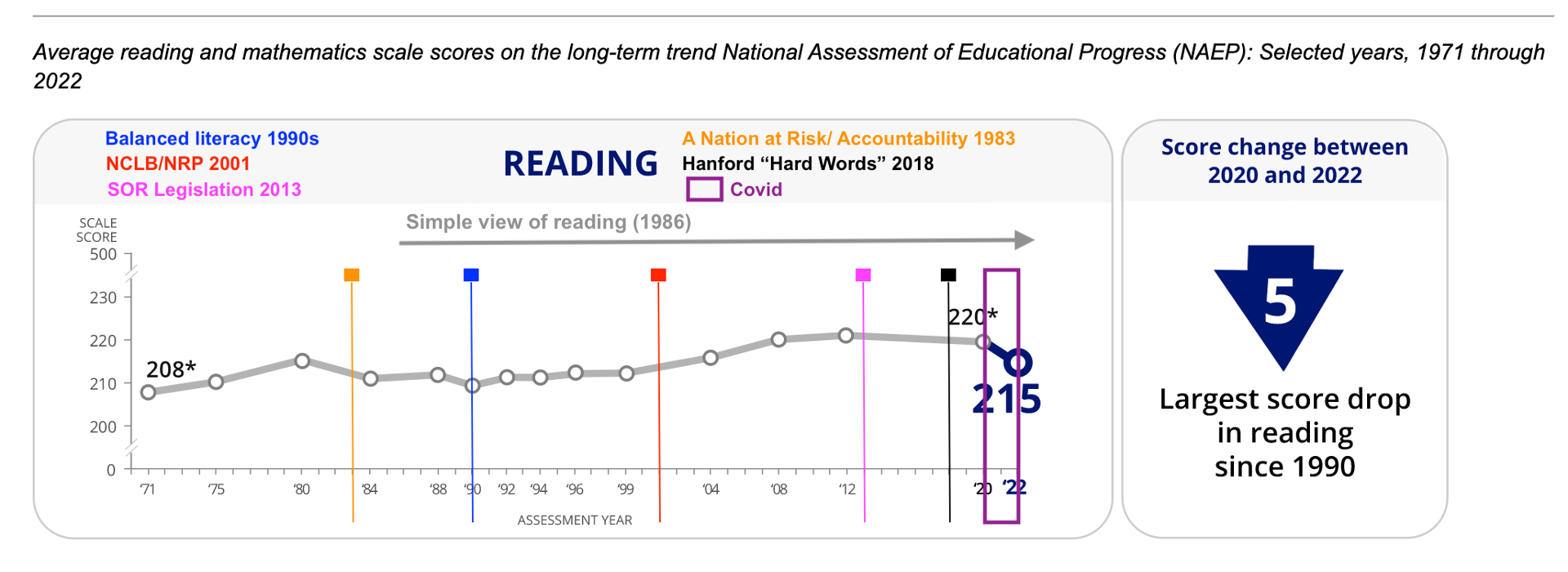
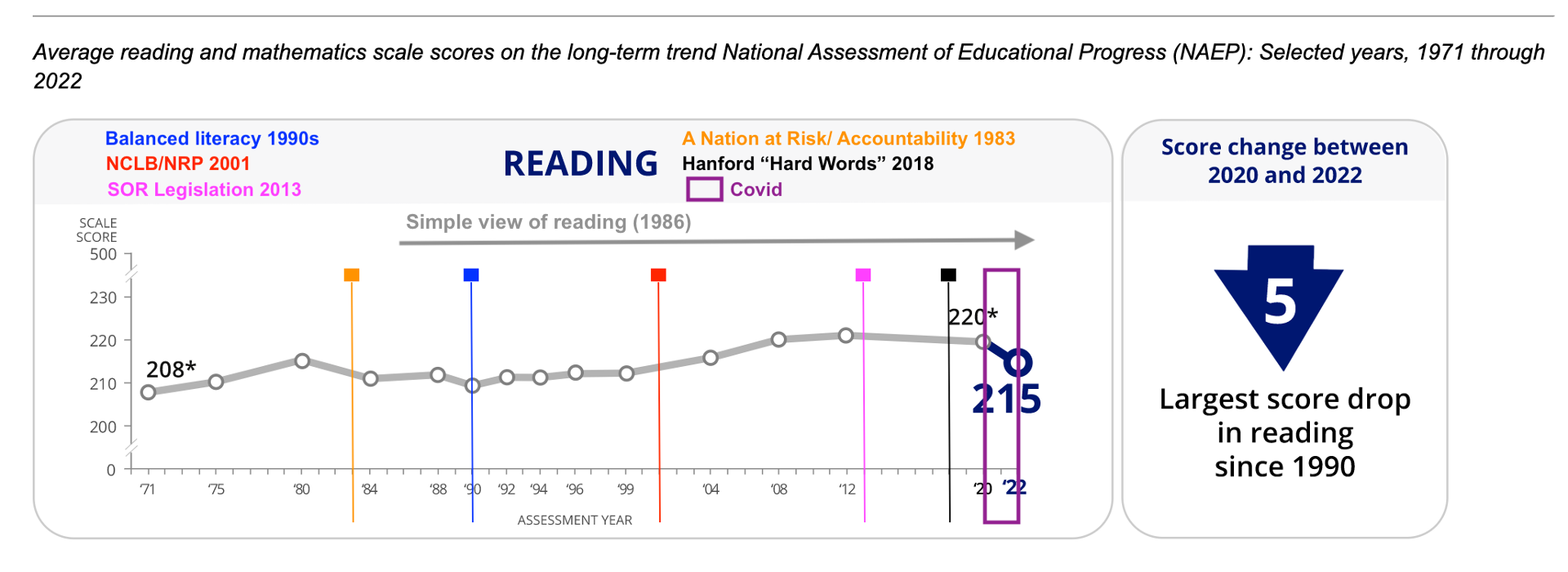
Further, there is little evidence that students today are uniquely underperforming in reading achievement, yet the bad reading teacher myth is perpetuated by misrepresenting reading achievement through misleading messages around NAEP reading data (see Hanford’s chart that ironically suggests gradual improvement, not a crisis).

Two problems with the bad reading teacher myth is that NAEP reading proficiency is not grade level reading, as Loveless examines:

NAEP does not report the percentage of students performing at grade level.  NAEP reports the percentage of students reaching a “proficient” level of performance.  Here’s the problem. That’s not grade level. 

In this post, I hope to convince readers of two things:

1.  Proficient on NAEP does not mean grade level performance.  It’s significantly above that.
2.  Using NAEP’s proficient level as a basis for education policy is a bad idea.

The NAEP proficiency myth

And the low levels of reading proficiency are historical, not a recent set of data that constitutes a reading crisis:

If we want to rely on NAEP reading scores, however flawed that metric, the historical patterns suggest a relatively flat state of reading achievement with some trends of improvement in the 1970s (which was followed by the manufactured myth of schools failing with A Nation at Risk [1983]) and steadily from about 1990 until 2012 (an era demonized as a failure due to reliance on balanced literacy).

Notably, the “science of reading” movement tends to be connected to legislation starting around 2013 and Hanford’s journalism beginning in 2018, and that NAEP data has remained relatively flat except for the Covid drop.

Again, as Bessie acknowledged over a decade ago, the real problems with education, teaching, and learning are very complex and far larger than pointing fingers at teachers as “villains.”

For most of the history of US education, student reading achievement has been described as “failing,” and vulnerable student populations (minoritized races, impoverished students, students with special needs such as dyslexia, and MLLs) have always been underserved.

The dirty little secret about teacher quality related to student reading proficiency is that those vulnerable students are disproportionately sitting in class with early-career and uncertified teachers who are struggling with high student/teacher ratios.

Are students being underserved? Yes, but this is a historical fact of US public education not a current crisis.

Are low student achievement and reading proficiency the result of bad teachers? No, but these outcomes are definitely correlated with bad teaching/learning conditions and bad living conditions for far too many students.

In 2023, just as in 2010, the myth of the bad teacher is a lie, a political and marketing lie that will never serve the needs of students, teachers, or society.

Way back in 1984 when I entered the classroom, I was excited to begin my career but quickly discovered that despite my respect and even love for my English professors and teacher educators in my undergraduate degree, I simply was not prepared well enough to do my job, notably as a teacher of writing.

I set out to learn by teaching, and do better. During the late 1980s, I was fortunate to learn further through the Spartanburg Writing Project (Nation Writing Project), where I discovered that much of my on-the-job training was misguided (thanks, Brenda Davenport).

Anyone who teaches knows that becoming an effective teacher is a journey and that those first 3, 5, or even 10 years are challenging and include a great deal of growth that cannot be accomplished in teacher certification programs.

None the less, everything surrounding teaching, and especially the teaching of reading, can and should be better.

That was true in 1940 and every decade since then.

Teacher and school bashing, shouting “crisis”—these have been our responses over and over; these are not how we create a powerful teacher workforce, and these will never serve the needs of our students who need great teachers and public education the most.

The myth of the bad teacher is a Great American Tradition that need to end.


[1] Valcarcel, C., Holmes, J., Berliner, D. C., & Koerner, M. (2021). The value of student feedback in open forums: A natural analysis of descriptions of poorly rated teachers. Education Policy Analysis Archives29(January – July), 79. https://doi.org/10.14507/epaa.29.6289

[2] See Our study found new teachers perform just as well in the classroom as their more experienced colleagues

The “Manufactured Crisis” and the Repeated Failure of Education Journalism [UPDATED]

[Header Photo by Nik on Unsplash]

For people not in the field of education, A Nation at Risk is either a hazy (or nonexistent) footnote of history or a pedestrian (and obvious) claim that didn’t need a government committee to announce—US public education is a failure.

However, for all its fanfare and eager media coverage, the real significance of the politically driven report is that it set in motion a pattern still vibrant in 2023; mainstream media is constantly fanning the flames of “manufactured crisis.”

A Nation at Risk was a media, public, and political hit, but scholars were quick to note that the claims in the report were overstated, oversimplified, and lacking any credible evidence [1].

In short, manufactured.

From the early 1980s and into the 2020s, mainstream education journalism has hopped feverishly from crisis to crisis and endorsed boondoggle after boondoggle—never once stopping to say “My bad!” or to pause, step back, and reconsider their template.

David Labaree concludes:

When the state takes the quantified depiction of schooling that educational researchers provide and uses it to devise a plan for school reform, the best we can hope for is that the reform effort will fail.  As the history of school reform makes clear, this is indeed most often the outcome.  One reform after another has bounced off the classroom door without having much effect in shaping what goes on inside, simply because the understanding of schooling that is embodied in the reform is so inaccurate that the reform effort cannot survive in the classroom ecology.  At worst, however, the reform actually succeeds in imposing change on the process of teaching and learning in classrooms.  Scott provides a series of horror stories about the results of such an imposition in noneducational contexts, from the devastating impact of the collectivization of agriculture in the Soviet Union to the parallel effect of imposing monoculture on German forests.  The problem in all these cases is that the effort to impose an abstract technical ideal ends up destroying a complex distinctive ecology that depends on local practical knowledge.  The current efforts by states across the globe to impose abstract technical standards on the educational village bear the signs of another ecological disaster.

The Lure of Statistics for Educational Researchers

As a result, a stunningly harmful pattern has emerged:

  • Amanda Ripley was wrong about Michelle Rhee.
  • Jay Matthews and Paul Tough were wrong about “no excuses” charter schools and Teach For America.
  • David Brooks was wrong about “miracle” charter schools (and everything else).
  • [Insert journalist] was wrong about Common Core and VAM.

And now, rest assured it will come to pass, Emily Hanford and Natalie Wexler are wrong about the “science of reading.”

Remember Waiting for Superman?

Sold a Story and The Truth about Reading are the same melodramatic misinformation campaign depending on an uninformed public to sell yet another educational crisis.

There will be no reckoning; there never is.

But some day (soon?) the “science of reading” histrionics will be a faint memory while everyone scrambles to the next education manufactured crisis.

The only things not to be addressed, of course, are the actual needs of students, teachers, and universal public education.


[1] See Gerald Bracey, Gerald Holton, and David Berliner and Bruce Biddle (who coined “manufactured myth”).

Which Is Valid, SOR Story or Scholarly Criticism?: Checking for the “Science” in the “Science of Reading”

From late November of 2022 through late February 2023, I have (or will have) presented at 6 major literacy conferences, both national and state level.

Two dominant literary issues have been curriculum/book bans and the “science of reading” (SOR) movement. A few important patterns occurred with the latter.

Many teachers are overwhelmed and discouraged about the heavily negative messaging around SOR, but I also interacted with teachers not fully aware of the magnitude of this movement and remain puzzled about the controversy.

Further, the media, public, and political story around reading and teaching reading is the primary message reaching both educators and the public. The robust scholarly criticism of SOR [1] is often welcomed by teachers and administrators, but unless they are attending conferences, these critique goes unnoticed.

Scholars and educators have been backed into a corner since the SOR story is grounded in a great deal of blame, hyperbole, misinformation, and melodrama.

The media SOR story is simple to the point of being false, but simple in a way that is very compelling for people outside the field of literacy.

Here, I want to put some pieces together, and offer a place to hold the SOR movement/story to the same standards demanded by advocates of SOR (specifically The Reading League).

First, let’s start with the core of the scholarly critiques of mainstream media’s story:

Hoffman, J.V., Hikida, M., & Sailors, M. (2020). Contesting science that silences: Amplifying equity, agency, and design research in literacy teacher preparation. Reading Research Quarterly, 55(S1), S255–S266. Retrieved July 26, 2022, from https://doi.org/10.1002/rrq.353

While scholarly critiques (see note 1) are far more nuanced and substantive that this central point, this is a manageable way to interrogate whether or not the SOR story is valid based on the standards the movement itself established.

The debate, then, is well represented by conflicting evaluations of SOR and SOR criticism on social media: a literacy scholar and co-author of an SOR reading program called the scholarly criticism “stupid,” and a policy scholar not in literacy noted that the media story is “facile.”

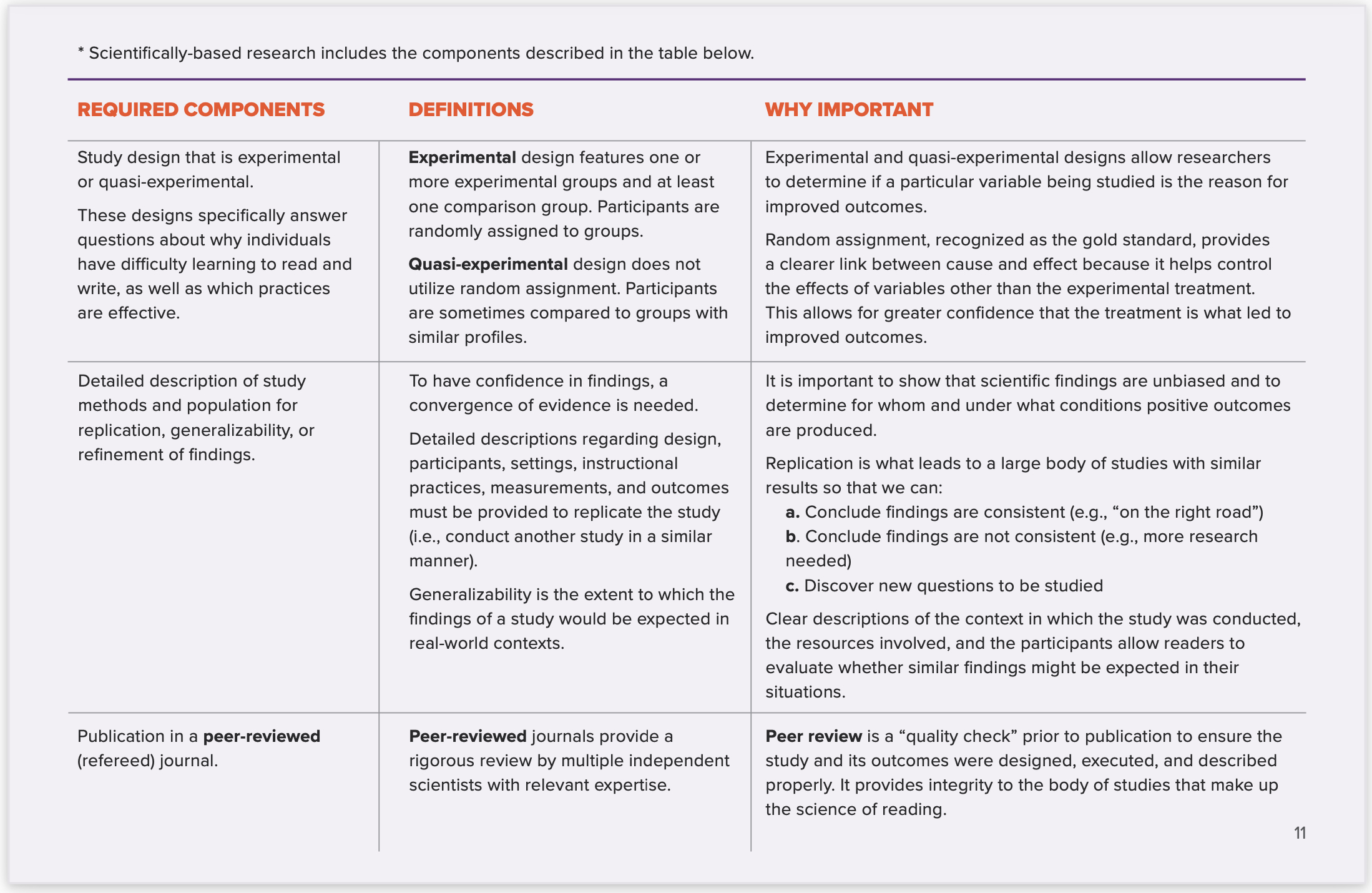
To determine which is valid—the SOR story or the scholarly criticism—that story must be checked against the standards for science established by the movement itself, here from The Reading League:

Finally, the components of the SOR story must be identified in order to check the science behind the claims and the anecdotes; consider Aukerman’s overview:

And my overview in my policy brief:

Below, I outline the SOR story and identify current scientific research, or lack thereof, limiting the evidence to TRL’s guidelines (experimental/ quasi-experimental, published in peer-reviewed journals).

1

First, for the rest of the SOR story to hold up to scientific scrutiny, we must establish whether or not there is a unique reading crisis in the last 10-20 years in which students are failing to learn to read at acceptable rates; this must be true for the blame aspects of the SOR movement to be true.

What is the status of scientific research supporting this claim? There is no current scientific research to support this claim; most scholars have identified that NAEP [2] (and other measures of reading achievement) have remained flat and achievement gaps have remained steady as well for many decades predating the key elements blamed for reading failures.

Note that the age 9 longitudinal data including actual scores appears mostly flat with some fluctuation. (Source)
NAEP age 9 reading appears mostly flat after A Nation at Risk, mostly flat with some trending upward during the 1990s BL era, increasing after the federal pressure of NCLB in 2001, and then flat since the rise of SOR legislation around 2013.

Notably the long-term NAEP data during the recent SOR era for 9 and 13 year olds is relatively flat or unchanged except for lowest performing students:

2

Next, the SOR story claims teachers are not well prepared to teach reading and teacher educators either fail to teach evidence-based methods or willfully ignore the science.

What is the status of scientific research supporting this claim? There is no current scientific research to support this claim [3] although scholars have demonstrated that credible research is available on teacher knowledge of reading and teacher education:

Hoffman, J.V., Hikida, M., & Sailors, M. (2020). Contesting science that silences: Amplifying equity, agency, and design research in literacy teacher preparation. Reading Research Quarterly, 55(S1), S255–S266. Retrieved July 26, 2022, from https://doi.org/10.1002/rrq.353

3

The media story claims the current settled reading science is the “simple view” of reading.

What is the status of scientific research supporting this claim? Scientific research refutes this claim:

Duke, N.K. & Cartwright, K.B. (2021). The science of reading progresses: Communicating advances beyond the simple view of reading. Reading Research Quarterly, 56(S1), S25-S44. https://doi.org/10.1002/rrq.411

[UPDATE]

Burns, M. K., Duke, N. K., & Cartwright, K. B. (2023). Evaluating components of the active view of reading as intervention targets: Implications for social justice. School Psychology, 38(1), 30–41. https://doi.org/10.1037/spq0000519

4

The SOR story centers a claim that systematic phonics instruction is superior to all other approaches to teaching beginning readers and thus necessary for all students.

What is the status of scientific research supporting this claim? Current scientific research refutes this claims, showing that systematic phonics is no more effective than other approaches (balanced literacy, whole language) and confirming that systematic phonics can increase early pronunciation advantages but without any gains in comprehension and with that advantage disappearing over time:

Bowers, J.S. (2020). Reconsidering the evidence that systematic phonics is more effective than alternative methods of reading instruction. Educational Psychology Review, 32(2020), 681-705. https://link.springer.com/article/10.1007%2Fs10648-019-09515-y

Wyse, D., & Bradbury, A. (2022). Reading wars or reading reconciliation? A critical examination of robust research evidence, curriculum policy and teachers’ practices for teaching phonics and reading. Review of Education10(1), e3314. https://doi.org/10.1002/rev3.3314

Testing the impact of a systematic and rigorous phonics programme on early readers and also those that have fallen behind at the end of Key Stage 2. (2022, October). Education Endowment Foundation. https://educationendowmentfoundation.org.uk/projects-and-evaluation/projects/read-write-inc-and-fresh-start

Bowers, J.S. Yes Children Need to Learn Their GPCs but There Really Is Little or No Evidence that Systematic or Explicit Phonics Is Effective: a response to Fletcher, Savage, and Sharon (2020). Educ Psychol Rev 33, 1965–1979 (2021). https://doi.org/10.1007/s10648-021-09602-z

Legislating Phonics: Settled Science or Political Polemics? David Reinking, George G. Hruby, and Victoria J. Risko

5

Mississippi has been heralded in the SOR story as a key example of the success of SOR reading policy, based on MS 2019 grade 4 reading scores.

What is the status of scientific research supporting this claim? There is no current scientific research to support this claim, and the SOR story omits that MS has had steady grade 4 reading improvement since the early 1990s (well before SOR) and that MS grade 8 have remained low, suggesting the grade 4 gains are inflated (see also other states with the grade 4 to 8 drop).

6

The source of low reading proficiency, the SOR story claims, is the dominance of balanced literacy and a core of popular reading programs.

What is the status of scientific research supporting this claim? There is no current scientific research to support this claim. In fact, some of the most criticized programs are only adopted in about 1 in 4 schools suggesting that the variety of programs and practices make these claims overly simplistic at best. Journalists also often misidentify reading programs as balanced literacy that explicitly do not claim that label.

7

Often the SOR story includes a focus on dyslexia, claiming that multi-sensory approaches (such as Orton Gillingham) are necessary for all students identified as dyslexic (and often that all students would benefit from that approach).

What is the status of scientific research supporting this claim? Current scientific research refutes this claims:

Johnston, P., & Scanlon, D. (2021). An examination of dyslexia research and instruction with policy implications. Literacy Research: Theory, Method, and Practice70(1), 107. Retrieved July 26, 2022, from https://doi.org/10.1177/23813377211024625

International Literacy Association. (2016). Research advisory: Dyslexiahttps://www.literacyworldwide.org/docs/default-source/where-we-stand/ila-dyslexia-research-advisory.pdf

Socioeconomic dissociations in the neural and cognitive bases of reading disorders, Rachel R. Romeo, Tyler K. Perrachione, Halie A. Olson, Kelly K. Halverson, John D. E. Gabrieli, and Joanna A. Christodoulou

Stevens, E. A., Austin, C., Moore, C., Scammacca, N., Boucher, A. N., & Vaughn, S. (2021). Current state of the evidence: Examining the effects of Orton-Gillingham reading interventions for students with or at risk for word-level reading disabilities. Exceptional Children87(4), 397–417. https://doi.org/10.1177/0014402921993406

Hall, C., et al. (2022, September 13). Forty years of reading intervention research for elementary students with or at risk for dyslexia: A systematic review and meta-analysis. Reading Research Quarterly. Retrieved October 17, 2022, from https://doi.org/10.1002/rrq.477


As of this post, the claims made in the SOR story are not supported by scientific research, and the criticisms offered by scholars appear valid.

The media story is overstated and oversimplified even though nearly all literacy educators and scholars agree that too many marginalized students (minoritized students, special needs students, impoverished students, MLLs) are being underserved (which is a regrettably historical fact of US education).

The SOR movement has created a predicament for the media story in that the standards being required for teachers and reading policy is an incredibly high and narrow threshold that (as I have shown above) the movement itself has not reached.

Again, scholarly criticism of the SOR story is nuanced and substantive, but at its core, that criticism is best represented by demonstrating that SOR advocates, especially the media, cannot meet the standard they propose for the field of teaching reading.

Simply put, US reading achievement is not uniquely worse now than at nearly any point in the last 80 years, and therefore, blaming balanced literacy as well as popular reading programs proves to be a straw man fallacy.

Reading instruction and achievement, of course, can and should be better. But the current SOR story is mostly anecdote, oversimplified and unsupported claims, and fodder for the education marketplace.

Media is failing students far more so than educators by perpetuating a simplistic blame-game that fuels the education market place.


[1] Media Coverage of SOR [access materials HERE]

Hoffman, J.V., Hikida, M., & Sailors, M. (2020). Contesting science that silences: Amplifying equity, agency, and design research in literacy teacher preparation. Reading Research Quarterly, 55(S1), S255–S266. Retrieved July 26, 2022, from https://doi.org/10.1002/rrq.353

MacPhee, D., Handsfield, L.J., & Paugh, P. (2021). Conflict or conversation? Media portrayals of the science of reading. Reading Research Quarterly, 55(S1), S145-S155. Retrieved July 26, 2022, from https://doi.org/10.1002/rrq.384

Cryonics Phonics: Inequality’s Little Helper – New Politics

[UPDATE]

The Science of Reading and the Media: Is Reporting Biased?, Maren Aukerman, The University of Calgary

The Science of Reading and the Media: Does the Media Draw on High-Quality Reading Research?, Maren Aukerman

The Science of Reading and the Media: How Do Current Reporting Patterns Cause Damage?, Maren Aukerman

[Aukerman three posts as PDF]

Making sense of reading’s forever wars, Leah Durán and Michiko Hikida

[2] Note that NAEP is not grade level, however:

NAEP does not report the percentage of students performing at grade level.  NAEP reports the percentage of students reaching a “proficient” level of performance.  Here’s the problem. That’s not grade level. 

In this post, I hope to convince readers of two things:

1.  Proficient on NAEP does not mean grade level performance.  It’s significantly above that.
2.  Using NAEP’s proficient level as a basis for education policy is a bad idea

The NAEP proficiency myth

[3] Media tend to cite reports from NCTQ that do not meet the standard for “scientific” established by TRL:

NEPC Review: 2020 Teacher Prep Review: Clinical Practice and Classroom Management (National Council on Teacher Quality, October 2020)

NEPC Review: 2018 Teacher Prep Review (National Council on Teacher Quality, April 2018)

NEPC Review: Learning about Learning: What Every New Teacher Needs to Know (National Council on Teacher Quality [NCTQ])

Teaching Reading and the Goldilocks’ Dilemma: A Case for Purposeful Literacy

Everyone teaching reading is confronted with the Goldilocks’ dilemma.

Using terms offered by Stephen Krashen, I see teaching children to read falling on a spectrum.

Intensive phonics (often called systematic phonics) is serving porridge that is too hot. Zero phonics is serving porridge that is too cold. But basic phonics is serving porridge that is just right.

The current reading war, the “science of reading” (SOR) movement, is little different than any of the proceeding reading wars; once again, the war is being framed as one between intensive/systemic phonics and zero phonics.

And once again, the “just right” option, basic phonics, is being left out of the rhetorical equation.

Let me be very clear. What I am doing is not a call for compromise or for a middle approach. I find the pendulum analogy to be one of the problems with the recurring reading war, in fact.

My proposal is more akin to the conclusions draw in England that showed systematic phonics has not achieved what was promised and that students would be better served with “balance.”

Of course, the word “balance” often triggers the caricature of “balanced literacy” (BL) offered in the SOR movement, a misrepresentation that erases the philosophical and theoretical framing intended in BL (teacher autonomy grounded in serving the individual needs of students).

Where people get lost, I think, and what I am proposing is that the balance isn’t about reading theories (such as balancing phonics and comprehension in instruction), but about how any teacher serves the individual needs of any student.

The balance is about balancing student needs with instructional goals, and then, making sure the teacher and student are provided the appropriate teaching and learning conditions for students to learn to read.

This sort of balance de-centers reading programs and standards, and centers students. As a result most any program or set of standards can be effective or not depending on the teacher’s ability to serve the student’s needs.

Another aspect of this dilemma, I think, is that intensive/systematic phonics will always prove to be too hot because it over-emphasizes the role of the letter-sound system. Nonsense words and decodable texts mislead students about the complexity of decoding and making meaning from text.

Students may be compelled to see phonics as a simple plug-and-play until they encounter “wind” or “dove,” two words that have differing pronunciations in different contexts.

Also consider the maze of problems when exploring the letter “C”:

Cease

Crease 

Cause

Cello

Checker 

Climb

Slime

Coach

Cat

Space

Cough

Coffee 

“C” shares sounds with “S” and “K,” but this series of words presents some satisfying patterns as well as some baffling exceptions that students could better navigate with some background in etymology and with greater experience reading (and thus building their toolbox for making meaning).

The question (which still hasn’t been fully answered by research) has never been if students need phonics, but how much, when, and how that is acquired (upfront v. by extensive reading).

Intensive/systematic phonics is too hot and misleading, I think, for the same reason that worksheet approaches to context clues are ultimately harmful. The “rules” for using context clues tend to work only in sentences designed to prove context clues strategies work.

As I have noted before, this is the training wheels versus balance bicycle dilemma.

The SOR reading war is fundamentally no different than any other reading war; see McQuillan’s debunking of the whole language reading war from the 1990s and note the similar patterns found in the current SOR movement.

Currently, the media misinformation and the misguided political response have made yet another claim that reading instruction has failed to provide systematic phonics (porridge too cold), and now state reading policy and reading program adoption are scrambling to implement structured literacy (scripted curriculum, porridge too hot).

In the US, we have never stepped back from the same old reading war rhetoric that centers all the adults and their (often petty) ideological biases.

Too often, everyone is caught up in selling their thing by demonizing other people’s things.

It is a tremendous failure of logic to shout that current popular reading programs have failed students because publishers and program creators are grabbing the cash, and therefore, we need to change to a different set of programs (with publishers and program creators who are also grabbing cash).

Again, we must stop centering adult ideologies and market interests, and start centering the students themselves and also providing teachers the resources and conditions to serve student needs.

What I propose is purposeful literacy, which has the following framing:

  • The teaching of reading begins with individual student artifacts of reading (strengths, needs, etc.)—not programs, standards, or mandates.
  • Centering the individual needs of students requires that we address the equity in their lives outside of school as well as in school.
  • The effective teaching of reading requires teacher autonomy and teaching and learning conditions that allow teachers to serve individual student needs.
  • Reading materials, programs, and standards must be tools that serve teacher instruction and not goals and frameworks for teacher accountability. The current “problem” with reading programs is not the quality of any program but that programs become the goal of teaching (fidelity, “is the teacher implementing the program” v. “is the student being served”).
  • Purposeful literacy places reading skills (such as phonics) in both the context of comprehension and critical literacy (moving beyond mere understanding to interrogating text).
  • The goal of purposeful literacy is students who are eager, independent, and critical readers.

The reading war approach to education reform is not a fairy tale; it is a horror story, and almost no one survives.

We must set aside the quest for THE program and the THE theory of reading.

Instead of centering all the adults and the concurrent pettiness, we must center the individual needs of students, which includes honoring the autonomy of teachers and providing both teachers and students the teaching and learning conditions that make a “just right” approach possible.

“Sell What We Do”: The Manufactured Crisis to Hide the Story Being Sold [Updated]

[Header Photo by Kelly Sikkema on Unsplash]

The Origin Story for the “science of reading” movement is popularly associated with a story published by Emily Hanford from 2018. And that movement has gained even more momentum by Hanford’s repackaging that initial (and deeply misleading) story as a podcast, Sold a Story.

The dirty little secret is that this story is not about the ugly underbelly of teaching reading or about creating a new and better way to teach reading. This story is cover for the selling of a different story to feast on the profitable education marketplace.

The single-minded blame-game in Sold a Story that creates reading Super Villains in the form of reading theory (balanced literacy) and reading leaders (Lucy Calkins, Fountas and Pinnell) is a tired and very old media and political strategy.

However the real Monster in the larger story is the marketplace itself, and the conveniently ignored backstory is several years before 2018.

The “science of reading” misleading and oversimplified story [1] about the teaching of reading spoke into a context that was fertile ground for misinformation to not only sprout but thrive—the dyslexia movement, specifically the Decoding Dyslexia structure [2] that was already in place in all 50 states.

Here is an interesting and revealing artifact from 2014:

At its July 1st meeting, the IDA Board of Directors made a landmark decision designed to help market our approach to reading instruction.  The board chose a name that would encompass all approaches to reading instruction that conform to IDA’s Knowledge and Practice Standards. That name is “Structured Literacy.”…

If we want school districts to adopt our approach, we need a name that brings together our successes. We need one name that refers to the many programs that teach reading in the same way. A name is the first and essential step to building a brand….

The term “Structured Literacy” is not designed to replace Orton Gillingham, Multi-Sensory, or other terms in common use. It is an umbrella term designed to describe all of the programs that teach reading in essentially the same way. In our marketing, this term will help us simplify our message and connect our successes. “Structured Literacy” will help us sell what we do so well.

Structured Literacy: A New Term to Unify Us and Sell What We Do

“If we want school districts to adopt our approach,” well, we need to clear space in the reading program marketplace, and that is exactly what the “science of reading” movement is doing with the help of media and complicit parents and political leaders.

Again, the goal announced in 2014: “‘Structured Literacy’ will help us sell what we do so well.”

The many recurring Reading Wars have been driven by people who are sincere and people with ulterior motives—and this “science of reading” movement is no different.

For those with good intentions, that simply is not enough if we are unwilling to confront all the stories being sold as well as the costs of these market wars to effective teaching and the most important outcome of all—students who are eager and critical readers.

Sold a Story [3] is a cover for another story being sold and packaged, literally, and the attacks are designed to clear market space, not support teachers or address individual student needs.

Update

If you want to understand how the education market and education reform machine overlap (or fuel each other), consider the Common Core > Great Minds > Wit & Wisdom (d)evolution as examined in the following:


[1] Media Coverage of SOR [access materials HERE]

Hoffman, J.V., Hikida, M., & Sailors, M. (2020). Contesting science that silences: Amplifying equity, agency, and design research in literacy teacher preparation. Reading Research Quarterly, 55(S1), S255–S266. Retrieved July 26, 2022, from https://doi.org/10.1002/rrq.353

MacPhee, D., Handsfield, L.J., & Paugh, P. (2021). Conflict or conversation? Media portrayals of the science of reading. Reading Research Quarterly, 55(S1), S145-S155. Retrieved July 26, 2022, from https://doi.org/10.1002/rrq.384

Cryonics Phonics: Inequality’s Little Helper – New Politics

The Science of Reading and the Media: Is Reporting Biased?, Maren Aukerman, The University of Calgary

The Science of Reading and the Media: Does the Media Draw on High-Quality Reading Research?, Maren Aukerman

The Science of Reading and the Media: How Do Current Reporting Patterns Cause Damage?, Maren Aukerman

Making sense of reading’s forever wars, Leah Durán and Michiko Hikida

[2] The Hidden Push for Phonics Legislation, Richard L. Allington, University of Tennessee

[3] Recommended: The Broken Logic of “Sold a Story”: A Personal Response to “The Science of Reading,” Tom Newkirk

Recommended

Education Week Finds Corporate Pals to Spread a Message, Susan Ohanian

Connecting Big Business with The Science of Reading: Replacing Teachers and Public Schools with Tech, Nancy Bailey