Category Archives: Science of Reading

Roundup [UPDATED December 2022]: Media, Reading, and Misinformation

The media have a long and muddled fascination with children and students reading, especially declaring that we are experiencing a reading crisis. However, even more concerning that this misguided click-bait approach to journalism is that the media more often than not promote crisis rhetoric with misinformation.

[UPDATES IV and V below]

I. Education Week

Possibly the most (un)impressive example of this is from Education Week. In just the last few weeks, EdWeek has posted a catalogue of misinformation about their favorite topic—the science of reading:
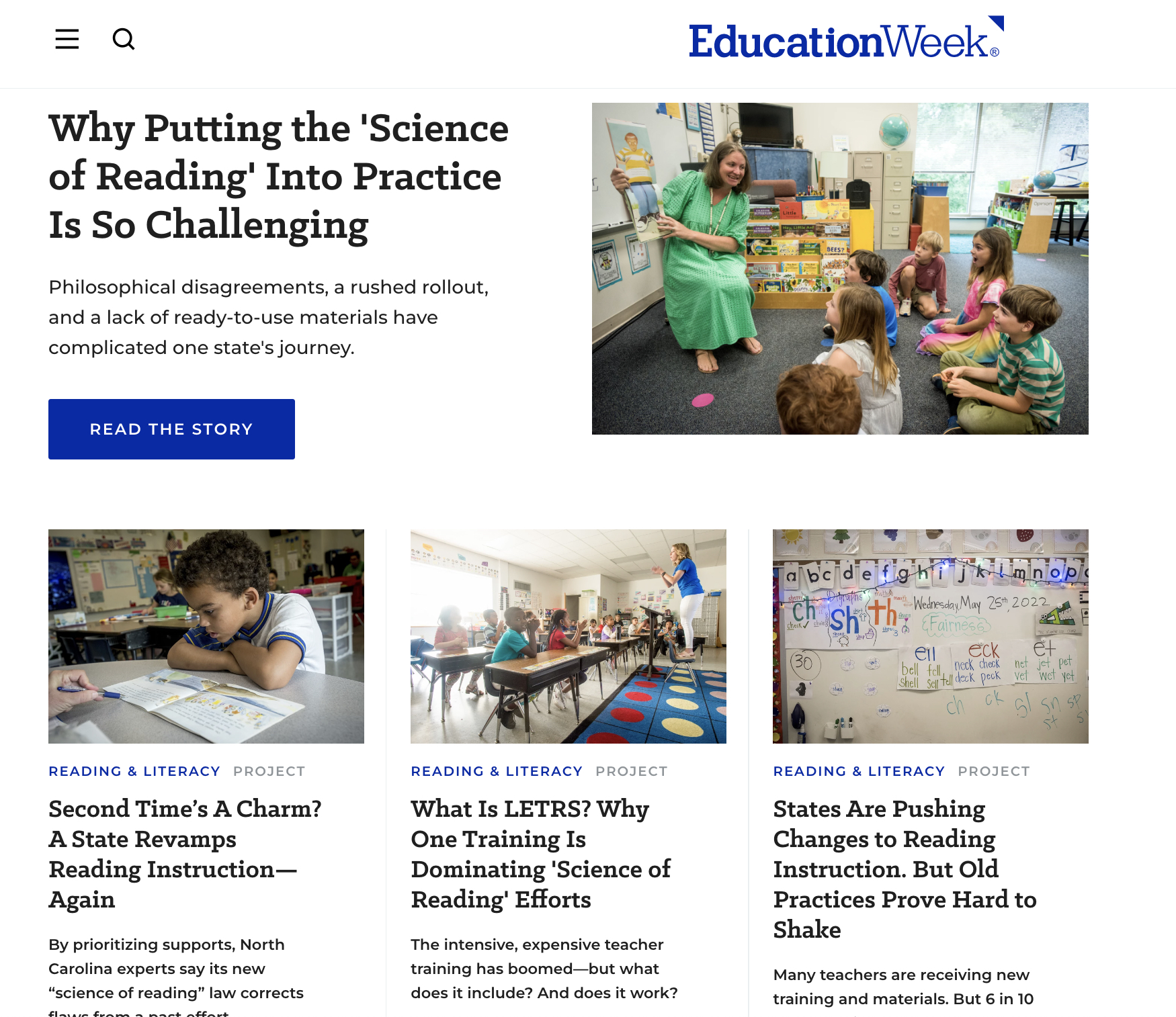
Here are a few reminders about the nonsense and misinformation that EdWeek will not set aside:

II. Newsweek

Next is a nonsense article, more misinformation, from Newsweek: Education Expert: A Love to ‘Read by Three’ Is the Answer to Success.

Consider instead this response from Stephen Krashen:

This is a response to Bethlam Forsa, “A Love to ‘Read by Three’ Is The Answer to Success.” (https://www.newsweek.com/education-expert-love-read-three-answer-success-1727222).

Published in the Newsweek Expert Forum, an “invitation-only network of influential leaders, experts, executives and entrepreneurs.” (This response was not invited.) Forsa cannot be reached by email or telephone. She is the president of Savvas, formerly Pearson K12.

It is widely believed that failure at grade 3 predicts school failure later on in school (Forsa, “A love to read by three,” 7/25/22).

If true, we should study what factors predict success by the end of grade 3.

In Lao, Lee, McQuillan and Krashen (2021), we summarized the results of three studies of ten -year old children on a test of reading comprehension, the PIRLS test, 10 year olds in 45 countries in 2006, in 57 countries in 2011 and in 61 countries in 2016. 

The number of children tested ranged from 3349 to 18,245 and was administered in the national language of the country.

In agreement with Forsa’s recommendation, the best predictor was access to reading material, represented here as the presence of a school library). High levels of poverty meant lower levels of reading competence, as did the amount of reading instruction in school and whether children had developed some reading competence before starting school. 

The clear winner: access to books. There was the most popular recommendation among the public, direct instruction in reading, was not a strong predictor. There is plenty of support for this predictor from other studies, see especially the work of Keith Curry Lance. https://keithcurrylance.com and S. Krashen (2004).

Krashen, S. 2004. The Power of Reading. Libraries Unlimited.

Lao, C., Lee, S-Y., McQuillan, J., and Krashen, S. 2021. Predicting reading ability among ten-year olds: Poverty (negative), school libraries (positive), instruction (zero), early literacy (zero). Language Magazine 20,10: 20-21. https://tinyurl.com/cn3nekc4

See also the following:

III. The New York Times

The NYT certainly is running a close second to EdWeek for misinformation (see here and here). But the newest NYT article is even worse than misinformation because it is really bad (and not surprising) news: New Reading Curriculum Is Mired in Debate Over Race and Gender.

It is important to connect the dots and recall that states have banned reading programs, as reported here:

The Arkansas Division of Secondary and Elementary Education announced in October 2019 that any curriculum that utilizes cueing strategies won’t be approved for use in the state, meaning that Calkins’ materials and another popular program, Fountas and Pinnell Classroom, are effectively banned. Colorado released a list of approved core reading curriculum, and Calkins’ programs weren’t on the list. A group outside St. Louis sent a letter signed by 216 parents, students and taxpayers to the school board asking that Calkins, and Fountas and Pinnell be dropped. The Oakland Unified School District, whose use of Calkins’ products was highlighted in the 2019 APM Reports story, announced it was forming a committee to consider adopting new curriculum. And Student Achievement Partners, a nonprofit consulting group, published a review that concluded Calkins’ curriculum materials are “unlikely to lead to literacy success for all of America’s public schoolchildren.” 

Influential literacy expert Lucy Calkins is changing her views

Republican legislation has begun to erode academic freedom among previously respected academic publishers, such as Heinemann. The combination of politics and the market is bad news for teachers, bad news for education, and bad news for students.

IV. Time [UPDATED]

Time has joined the mainstream media misinformation parade with Inside the Massive Effort to Change the Way Kids Are Taught to Read.

The expansive piece follows a now old and tired pattern of misrepresenting nearly everything about reading and teaching reading. In fact, the article almost comically fails the fact checking guidelines I developed years ago.

The post opens with a garbled defense of the reading program Open Court, blaming (of course) teachers for abandoning the program (and characterizing those teachers as driven by wokeness, not concern for students). Here is what is left out: Open Court was at the center of the Reading First scandal, and careful reviews of the program have shown that it simply does not meet the exact standards the science of reading movement calls for. (See McQuillan’s review and the review at phonics-friendly EdReports.)

Misinformation by omission.

Luscombe offers yet another, and somewhat breezy, inaccurate portrayal of whole language:

There are many schools of thought on how best to aid this process, but the main contretemps has been about whether kids need to be taught how to sound out words explicitly or whether, if you give them enough examples and time, they’ll figure out the patterns. The latter theory, sometimes known as whole language, says teaching phonics is boring and repetitive, and a large percentage of English words diverge from the rules. (Hello there, though, thought, through, trough and tough!) But if you immerse children in beautiful stories, they’ll be motivated to crack the code, to recognize each word. The counterargument is that reading is as connected to hearing as it is to sight. It begins, phonics advocates say, with speech. This understanding, and the data that supports it, has become known as the science of reading.

Massive Effort to Change the Way Kids Are Taught to Read

The goal is to frame whole language (and balanced literacy; see later in the article) as nothing more than a whim and elevate the real “science of reading.” See here for a full and accurate understanding of whole language, and here and here for balanced literacy.

Of course misinformation articles on reading must cite and greatly misrepresent the National Reading Panel (NRP). Once again, the NRP reports were deeply flawed since the panel was underfunded and understaffed; the panel also lacked any teachers and limited their review of research to narrow quantitative studies. See a fuller examination of NRP here.

The piece builds as expected to focusing on dyslexia and making a pretty huge (and inaccurate) claim:

Just as most children, no matter how many times they’ve been in a car, still need to be taught to drive, most readers benefit from being explicitly taught how sounds and letters go together. This is true not just for dyslexics (who represent about 10% of all learners) but for the majority of readers.

Massive Effort to Change the Way Kids Are Taught to Read

One of the worst aspects of the “science of reading” movement and the state legislation it has prompted is that all students are being treated as if they are dyslexic, or struggling. Not only are the movement and parent advocate misrepresenting the research on dyslexia, they are pathologizing all reading. See here and here for a more nuanced and complex understanding of dyslexia and addressing struggling readers.

And no misinformation piece on reading is complete now with the “Mississippi Miracle” propaganda. To be brief, there is no credible research showing Mississippi improved NAEP scores by using the “science of reading”; in fact, it is likely the score bumps come from excessive grade retention. See a full analysis of Mississippi’s NAEP scores here.

Part of the Mississippi and “science of reading” propaganda relies on general readers simply accepting that everything being endorsed is, well, “scientific”; however, once again, the article champions the power of LETRS, a program to train teachers in phonics and reading instruction. Another example of misinformation by omission since:

A growing number of U.S. states have funded and encourage and/or require teachers to attend professional development using Moats’s commercial LETRS program, including Alabama, Arkansas, Kansas, Mississippi, Missouri, Oklahoma, Rhode Island, and Texas. This is despite the fact that an Institute of Education Sciences study of the LETRS intervention found almost no effects on teachers or student achievement (Garet et al., 2008). (p. S259)

Hoffman, J.V., Hikida, M., & Sailors, M. (2020). Contesting science that silences: Amplifying equity, agency, and design research in literacy teacher preparation. Reading Research Quarterly, 55(S1), S255-S266. https://doi.org/10.1002/rrq.353

The article ends by praising Emily Hanford and trashing teacher education—the former has no credibility and the latter is simply more misinformation. See just one example on Hanford here, and here for teacher education.

Just like cries of reading “crisis,” the Time article offers nothing new by traveling down a well-worn path of misinformation that now seems the only direction mainstream media can see.

V. The New York Times (Again) [UPDATED]

Let’s end 2022 with some context.

I recommend this scholarly analysis of media coverage of SOR by MacPhee, Handsfield, & Paugh (2021):
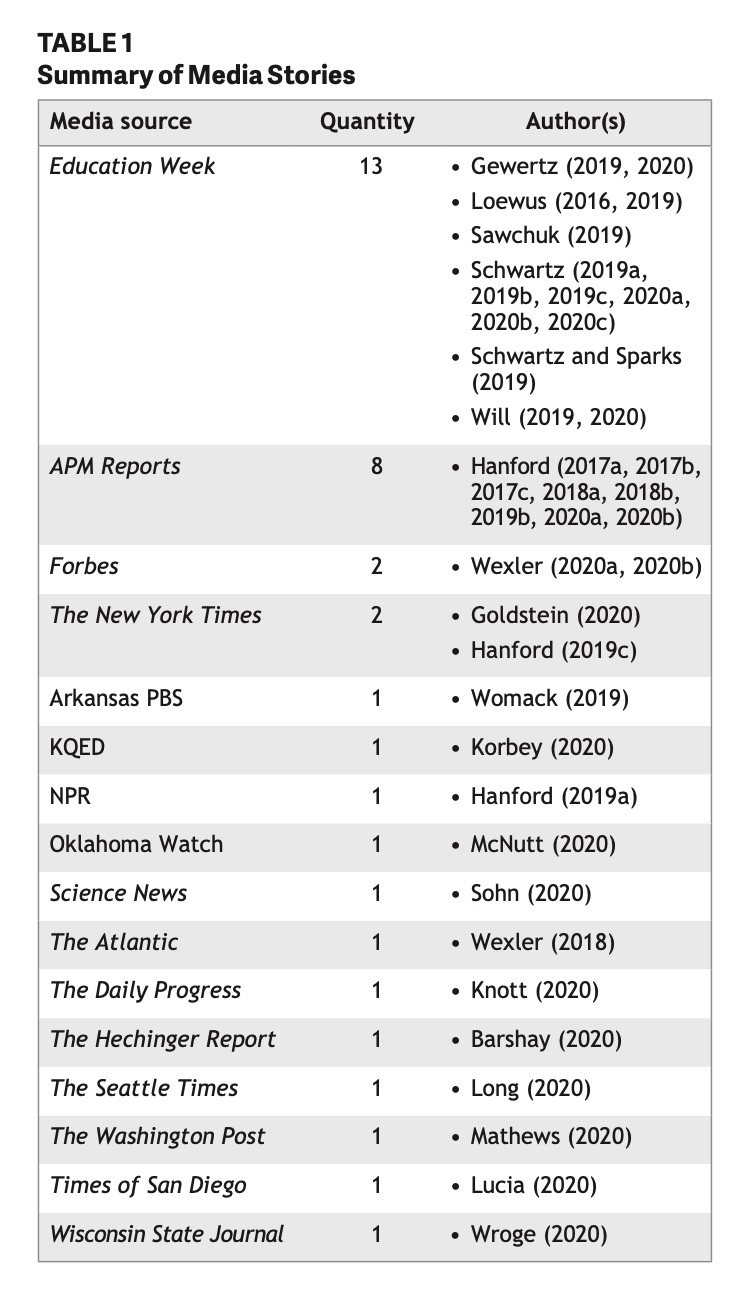
MacPhee, D., Handsfield, L.J., & Paugh, P. (2021). Conflict or conversation? Media portrayals of the science of reading. Reading Research Quarterly, 55(S1), S145-S155. https://doi.org/10.1002/rrq.384

I also recommend the series of blogs posts from Aukerman addressing media coverage of SOR (HERE, HERE, and HERE).

Now to the (potentially) last example of 2022, again from the NYT: In Memphis, the Phonics Movement Comes to High School.

This latest coverage of reading by Sarah Mervosh almost reads like parody now since the mainstream media is recycling over and over the initial and inaccurate coverage by Emily Hanford (see the links above), but this time suggesting this false narrative applies to high school.

What does this newest article get predictably wrong?

First, the uncritical acceptance of the “science of reading” movement and then of course the mischaracterization of balanced literacy:

The program in Memphis is an extension of a growing national movement to change the way younger children are taught to read, based on what has become known as “the science of reading.” And it is a sign of how sharply the pendulum has swung in the decades-long, contentious debate over reading instruction, moving away from a flexible “balanced literacy” approach that has put less emphasis on sounding out words, and toward more explicit, systematic teaching of phonics.

In Memphis, the Phonics Movement Comes to High School

Next a quick reference (no citation) to “brain research” and then a hyperlink to the out-dated and (again) misrepresented NRP report:

Brain science has shown that reading is not automatic, and longstanding research supports the need for sequenced sound-it-out instruction, along with books that build vocabulary and knowledge.

In Memphis, the Phonics Movement Comes to High School

I recommend seeing the recent and much more complex research base on brain research and phonics instruction HERE.

Tennessee like many other states have turned to retraining teachers, a market boom for education business (again):

Tennessee has aggressively pushed for statewide change. Last year, the state’s Republican legislature and governor, Bill Lee, passed a law that required all elementary schoolteachers be trained in a phonics-based approach, with optional literacy training for middle and high school teachers. More than 40,000 teachers have participated in the training so far, according to the state’s education department.

In Memphis, the Phonics Movement Comes to High School

The article returns to misrepresenting balanced literacy by linking to Hanford, a discredited article by Goldstein in the NYT, and Education Week, which routinely repackages Hanford’s narrative:

In the early to mid-2010s, when high schoolers today were in elementary school, many schools practiced — and still practice — “balanced literacy,” which focuses on fostering a love of books and storytelling. Instruction may include some phonics, but also other strategies, like prompting children to use context clues — such as pictures — to guess words, a technique that has been heavily criticized for turning children away from the letters themselves.

In Memphis, the Phonics Movement Comes to High School

The article ends by mimicking Hanford’s original article and her misleading coverage of Mississippi; here the implied “miracle” is Tennessee.

As Coles exposed in Hanford’s original coverage of Pennsylvania, don’t buy it.


The great irony facing us now is that the very worst place to read about reading is mainstream media—unless you are prepared to do the hard work journalists are not doing and interrogate the tired and relentless misinformation at the center of all the misguided crisis rhetoric around reading.


Recommended

Making sense of reading’s forever wars, Leah Durán and Michiko Hikida
Announcing: Fall 2022 through Winter 2023 Schedule

During my first 18 years as an educator, I was a high school English teacher in rural South Carolina, my hometown in fact. I never imagined doing anything else, but I did attain my doctorate in 1998, still planning to be Dr. Thomas, high school teacher, for my entire career.

It is 2022, and I just completed 20 years in higher education, where I am a full professor in education and (fortunately) also teach first-year and upper-level writing. This fall I am taking my first ever sabbatical.

However, if anything, my scholarly schedule is more packed than at any time in my career. If you are interested in my work, I invite you to join me at the following presentations/keynotes and/or look for my upcoming publications.

Fall 2022 through Winter 2023 Schedule

Publications

How to End the Reading War and Serve the Literacy Needs of All Students (2nd Ed)(2nd Edition) – IAP – [first edition]


Thomas, P.L. (2022). The Science of Reading movement: The never-ending debate and the need for a different approach to reading instruction. Boulder, CO: National Education Policy Center. Retrieved [date] from http://nepc.colorado.edu/publication/science-of-reading


A Critical Examination of Grade Retention as Reading Policy (white paper)

P.L. Thomas, Education, Furman University (Greenville, SC)

Prepared for the Ohio Education Association in response to Ohio’s “Third Grade Reading Guarantee”

September 15, 2022

[Download as PDF and supporting PP]


Presentations/Keynotes, Podcasts, Webinars

UPDATE (Supplement for Presentations below)

Update: Science of Reading Movement (PP) 2 February 2023

2022

Great Lakes Center for Education Research & Practice

September 28, 2022

Webinar

Science of Reading Policy Brief (NEPC)


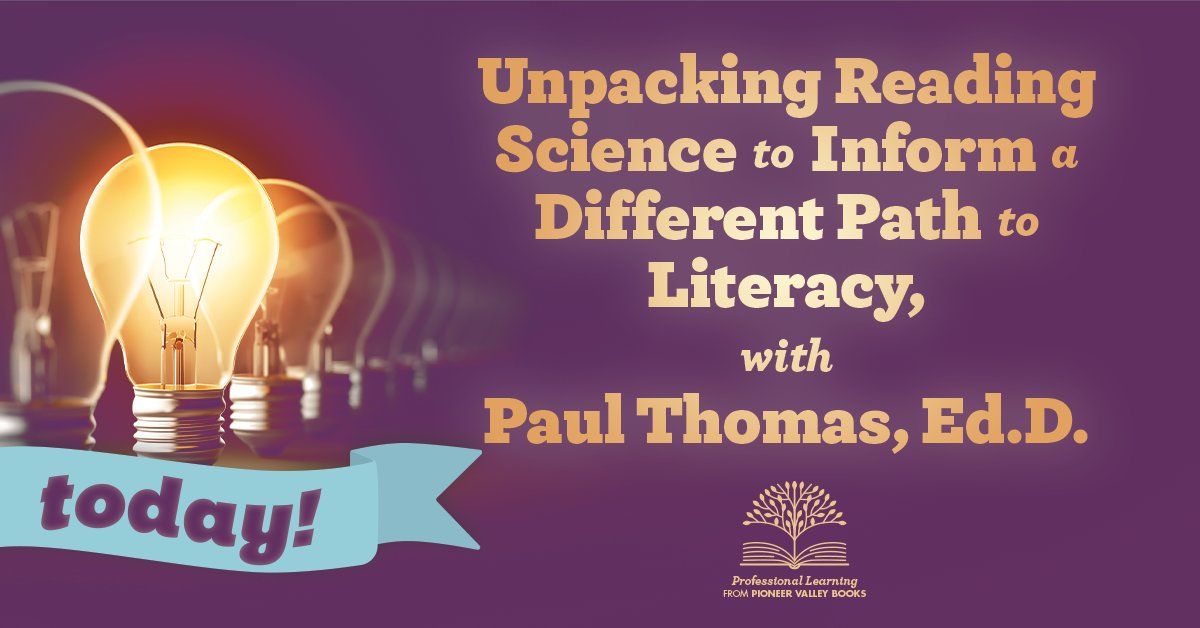
Pioneer Valley Books

October 20, 2022 – 4:00 – 5:00 pm

Webinar (view online)

PowerPoint HERE

Unpacking Reading Science to Inform a Different Path to Literacy 

The “Science of Reading” movement that began in 2018 has gained momentum and has had outsized influence on state reading policy and classroom practice. However, the SoR movement presents two negative impacts on long-term literacy education—a commitment to the “simple view” of reading (SVR) and mandates for phonics-first instruction for all beginning readers. In this webinar, Paul Thomas, Ed.D. (Professor of Education, Furman University, and author of How to End the Reading War and Serve the Literacy Needs of All Students) places the SoR movement in the context of the robust but complex current state of reading science. Come join us on October 20, 2022, at 4 p.m. as we explore what’s next in literacy education.


Ohio Education Association

Education Matters podcast; grade retention

November 10, 2022


University of Arkansas

October 24 at 6:30

The Jones Center for Families

Serving the Literacy Needs of All Students: While Resisting Another Reading War


30th annual Reading Recovery Council of Michigan Institute, Thursday, November 17, 2022, Somerset Inn, Troy, Michigan

Keynote

The “Science of Reading” Multiverse (click for PP)

Before anyone can, or should, answer “Do you support/reject the ‘science of reading’?” we must first clarify exactly what the term means. I detail the three ways the phrase currently exists since it entered mainstream media during 2018. “Science of reading” as discourse, as marketing, and as a research base.

Break-out Session

How to Navigate Social Media (and RL) Debates about the “Science of Reading” (click for PP)

Let me start with a caveat: Don’t debate “science of reading” advocates on social media. However, if you enter into a social media or real-life debate, you must keep your focus on informing others who may read or hear that debate, and be prepared with credible and compelling evidence.


NCTE 2022, November 17 – 20, 2022, Anaheim, CA 

Friday November 18, 2022

Event Title: Banned in the USA: Lighting a Fire for Reading and Not to Books (click for PP)

Cowards, Censorship, and Collateral Damage: The Other Reading War (click for PP)

Type: Roundtable Sessions

Time: 12:30 PM PST – 1:45 PM PST

Location: 264-BC


Consulting: Charleston County School District

Reading programs, “science of reading,” and potential PD for faculty and administrators

November 21, 2022


Schoolutions podcast

December 20, 2022


2023

2023 Comprehensive Literacy and Reading Recovery Conference, Chicago, IL, January 18-20, 2023 

Keynote – 8:00 – 9:00 CT January 20, 2023

Teaching Literacy in a Time of Science of Reading and Censorship

The key elements of the science of reading (SOR) movement as well as the current move the ban books and censor curriculum are outlined against historical and research-based contexts. The unique challenges facing literacy educators iden/fied with considera/on of how literacy teachers can maintain professional autonomy in the classroom and prac/ce ac/vism in pursuit of a more nuanced understanding of “science” and research as well as in support of academic freedom.

90-minute breakout sessions

Academic Freedom Isn’t Free: Teachers as Activists – 9:15 – 10:45 CT January 20, 2023

The US is experiencing one of the most significant waves of book bans and educational gag orders impacting academic freedom, access to diverse voices and history, and the safety of teachers and students. Teachers are historically required to be apolitical and avoid advocacy in and out of the classroom. This session examines the politics of calling for no politics among educators, and explore with participants both the need to advocate for their professional autonomy and academic freedom as well as for academic freedom.

Unpacking the “Science” in the Science of Reading for a Different Approach to Policy and Practice – 11:30 – 1:00 CT January 20, 2023

The science of reading (SOR) movement and the use of the “science of reading” in marketing literacy programs have had a significant impact on reading policy and practice across the US since 2018. Policy and practice related to dyslexia, adopting reading programs, teaching reading (and the role of phonics instruction), however, have too often been guided by a misleading and overly simplistic version of SOR portrayed in the media and advocated by parents and politicians. This session examines the contradictions between claims made by SOR advocates and the current research base.


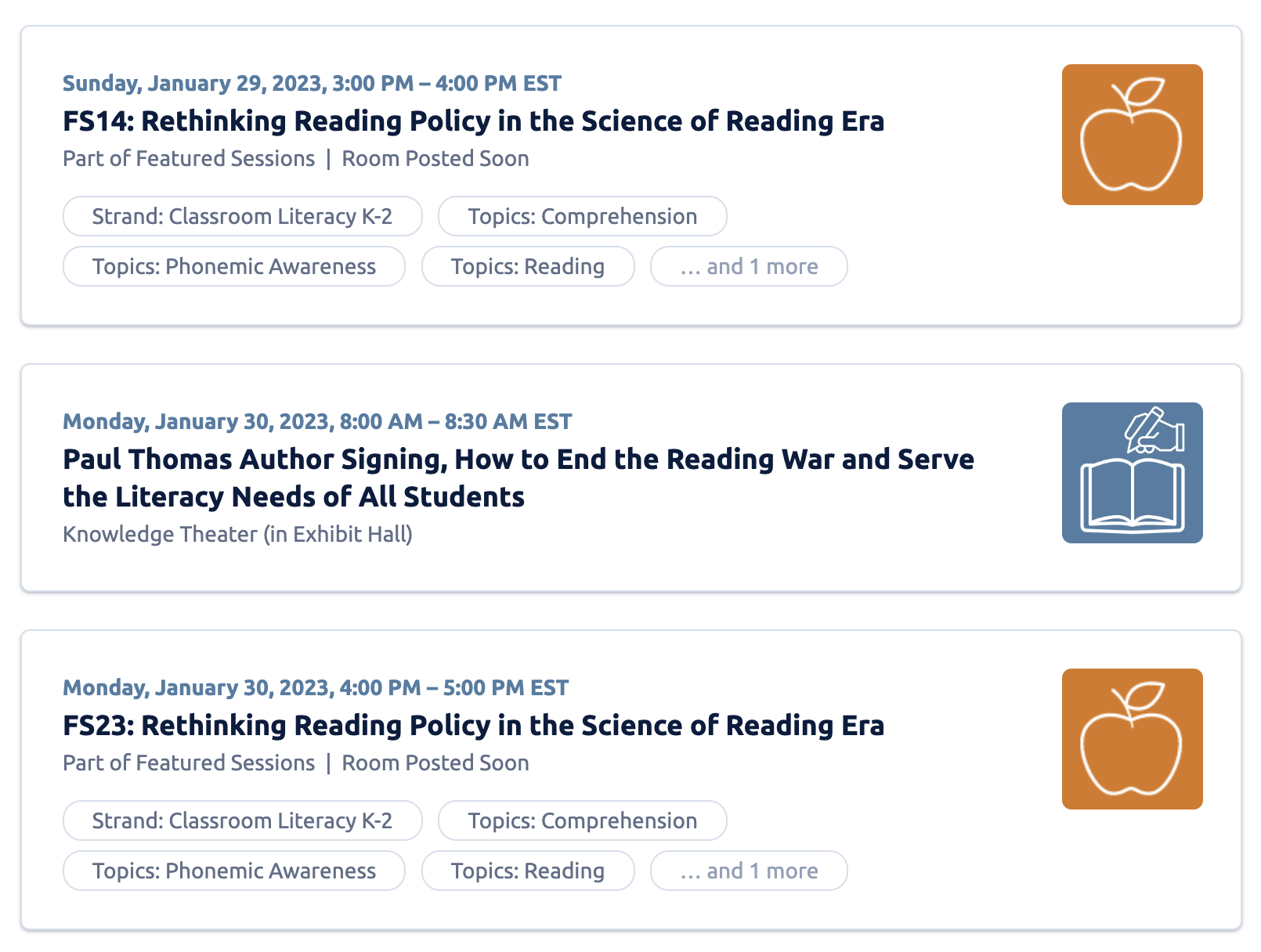
LitCon 2023, January 28 – 31, Columbus, OH

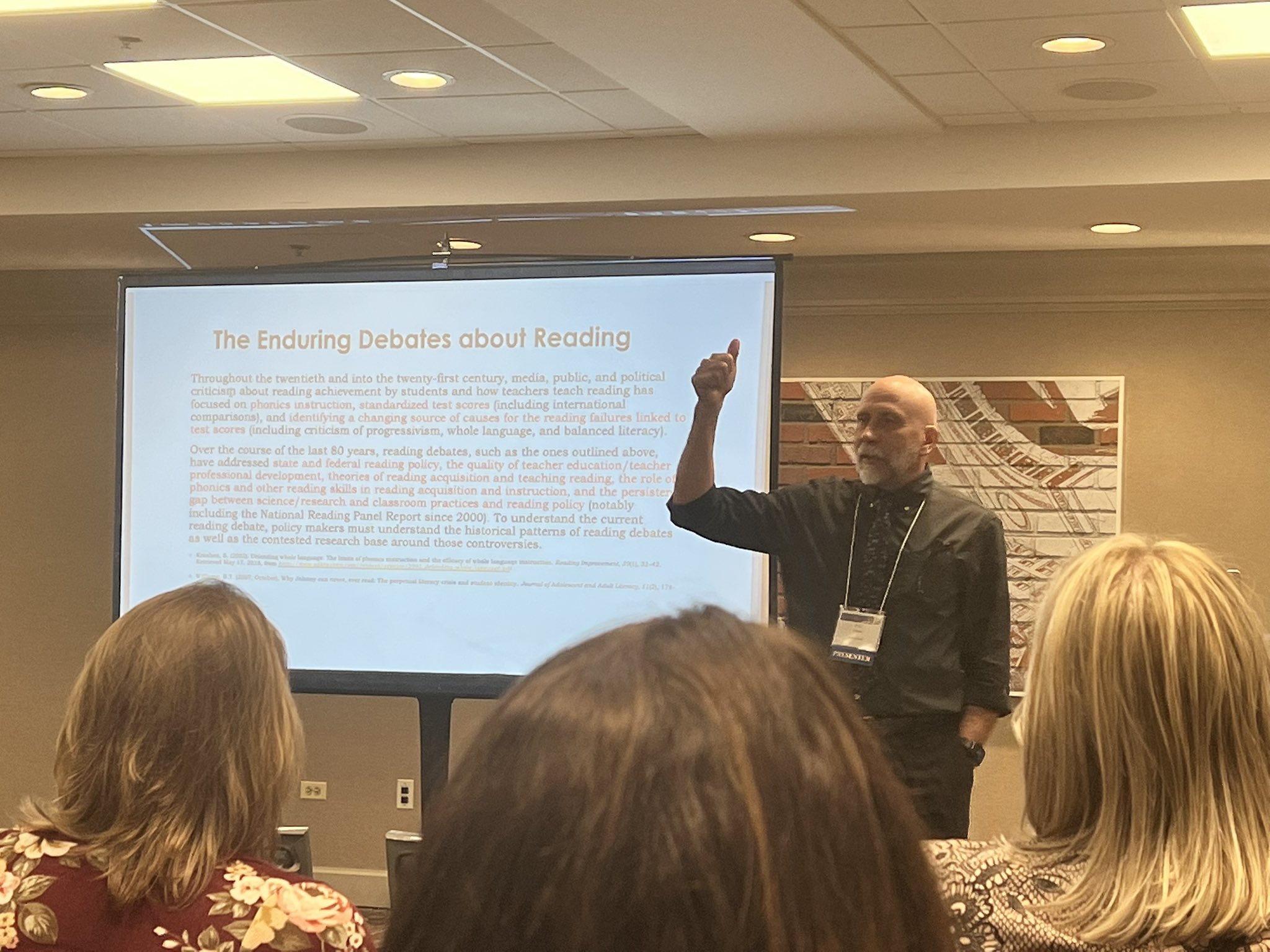
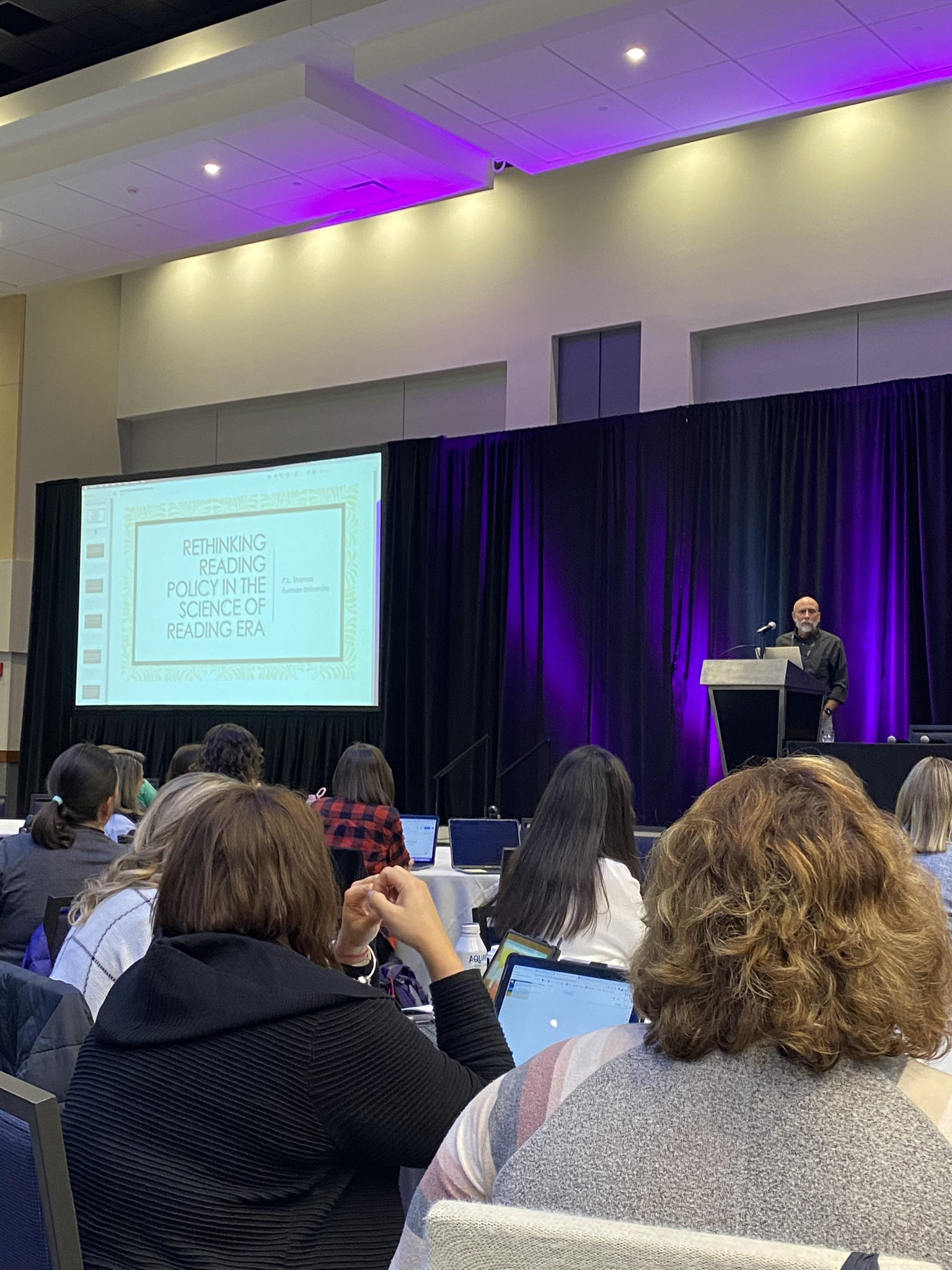
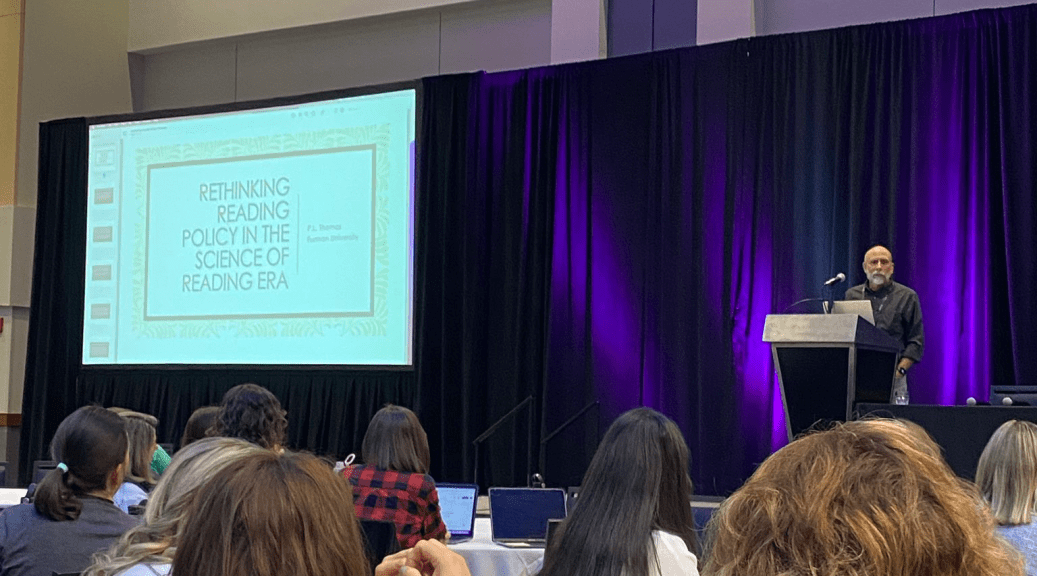
Rethinking Reading Policy in the Science of Reading Era

Sunday, January 29, 2023, 3:00 pm – 4:00 pm ET

Monday, January 30, 2023, 4:00 pm – 5:00 pm ET

Since 2018, states have been revising or adopting new reading legislation prompted by the science of reading movement. Placed in the context of several reading crises over the last 100 years, however, this movement is deja vu all over again, destined to fail and be replaced by another reading crisis in the near future. This session explains why and offers a new approach to reading policy at the state, district, and school levels.

Book signing: How to End the Reading War and Serve the Literacy Needs of All Students (2nd Ed)

Monday, January 30, from 8:00 – 8:30 am


WSRA 2023 Conference, Milwaukee, WI, February 9-11, 2023 

PROGRAM

Thursday, February 9, 11:15-12:30 B01

Creating Worlds of Possibility: Closing Our Opportunity Gaps Through Recognizing the Sciences of Literacy and Learning

Expert Panel Discussion with Dr. Annalee Good, Dr. Lara Handsfield, Dr. Carol Lee, Dr. Paul Thomas, Dr. Don Vu

Thursday, February 9, 2:00-3:15 C08

Banning Books Is Un-American

The U.S. is experiencing a wave of book censorship and educational gag orders. This session examines the historical context of censorship as it impacts the teaching of literacy and literature by focusing on writer Kurt Vonnegut’s response to censors. The session will include powerful policy and position statements supporting the rights of teachers to teach and students to learn, including The Students’ Right to Read (NCTE), Freedom to Teach: Statement against Banning Books (NCTE), and Educators’ Right and Responsibilities to Engage in Antiracist Teaching (NCTE). Participants will have an opportunity to discuss and explore how and why educators must and can seek ways to defend academic freedom and thew right to teach and learn.

Friday, February 10, 9:45-11:00 A10

The “Science of Reading” Multiverse

Since early 2018, the phrase “science of reading” has entered and often dominated media, public/parental, and political discourse around the teaching and learning of reading in the U.S. Before anyone can, or should, answer “Do you support/reject the ‘science of reading’?” we must first clarify exactly what the term means; therefore, in this session, then, I want to detail the three ways the phrase currently exists since it entered mainstream use in the media during 2018. The session will cover the research base around the SoR movement for context. Participants will be invited to discuss their experiences with these three versions as well.


PSLA Conference 2023, February 23-25, 2023

Marriott Hilton Head Resort and Spa, Hilton Head Island, South Carolina

Friday, February 24, 2023, 8:00 – 9:00

Invited Speaker: Rethinking Reading Science: Beyond the Simple View of Reading, Paul Thomas

Focusing on reading science published since 2018 addressing reading, dyslexia, and phonics, this session details a complex but robust state of reading science. Media and think-tank messaging parents, political leaders, and the public are receiving about the “science of reading” are oversimplified, cherry-picked, and contradictory to that current state of reading science. Classroom teachers deserve the autonomy to interrogate reading science, understand the individual needs of all their students, and then the teaching and learning conditions to serve those students with evidence-based practice.

Saturday, February 25, 2023, 10:15 -11:15 

Panel: Carving a Path Forward: Equity, Neuroscience, Policy Mandates and Literacy Education 

The Politics of Teaching Reading, Paul Thomas

Media and Parental Advocacy Not Credible Sources for Reading Policy

Peter Greene, former teacher and one of the best public thinkers about education today, found this Tweet “familiar” as a veteran of education reform debates:

Greene and I share long careers in education and the mind-numbing experience of rebuking education reform claims and policies over the last few decades. Education reform, in fact, has followed the exact path Richard Sever warns against in his Tweet.

While some of the larger aspects of the education reform movement that began after A Nation at Risk was released under Ronald Reagan have sputtered—charter schools, Teach For America, standards and high-stakes testing, stack ranking and value-added methods for teacher evaluation—the reform du jour is focused on reading.

Since the mid- to late 2010s—specifically 2018—the science of reading (SOR) movement has been driven by media and parental advocacy, resulting in new or revised reading legislation in dozens of states across the U.S. [1]

The problem is that political leaders are disproportionately influenced by inexpert advocacy such as Emily Hanford’s journalism and parent organizations for dyslexia (Decoding Dyslexia).

Journalists and parents often share missionary zeal for topics, especially issues related to education, but lack historical, disciplinary, and statistical expertise to see clearly both the very real failures in education and the complex solutions that are needed.

Are too many students being mis-served as emerging readers in our schools, as media claim? Yes!

Is the current education system failing to identify and serve students with reading challenges, including dyslexia, as parents claim? Yes!

None the less, media and parental evidence, claims, and demands for solutions are mostly jumbled, misleading, and not scientific.

And the really bad news is that political leaders and the public receive almost exclusively the misleading messaging from media and parent advocates, but not the high-quality scholarship that debunks the claims and offers more credible and needed solutions.

For example, Hanford’s “Hard Words” and Decoding Dyslexia’s advocacy are both compelling on the surface, especially to the general public and political leaders with no background in education or literacy.

Hanford triggered the SOR movement by highlighting the claimed outlier success of schools in Bethlehem, Pennsylvania linked to a phonics-intensive program and increased test scores, for example:

This arguments fits into the larger education reform narrative started decades ago—that poverty is an excuse (and thus the “no excuses” reform movement) and that simply changing how we teach students can increase achievement (in-school only reform absent social change).

As those of us in education have witnessed since the 1980s, this argument is very compelling to the public and political leaders, and it is completely false.

“Miracle” schools, in fact, do not exist. [2]

The problem with media covering education miracles is that the basic evidence is both accurate and deeply misleading.

Because of pressures to raise test scores during the accountability era of education, many educators and policy makers have found ways to raise scores, but those test score gains are mostly weak forms of assessment (do they really measure what they claim?) and those gains often disappear over time (see the Florida model that uses grade retention to raise scores [3]).

To the first concern—are the test scores measuring reading?—those of us in the field of literacy recognized that the test data is from DIBELS, a phonics-intensive program that teaches and then measures students’ ability to pronounce real and nonsense words.

In other words, this test defines reading as “pronunciation”—not comprehension, which intensive phonics instruction does not increase [4] and which, in most cases, is what we mean when we are concerned about “reading.”

Therefore, yes, these schools did raise pronunciation test scores among high-poverty students, but no, this is not a reading miracle.

And to the second concern—are increased test scores real, sustained learning over time?—Gerald Coles investigated and discovered:

As I noted above, follow-up studies on the effects of early phonics programs have failed to find long-term benefits on reading achievement. Therefore, I wrote to two administrators in the Bethlehem schools, asking for information about the students’ reading ability in later grades. Neither replied to my request. Consequently, I used the publicly available Pennsylvania reading/language arts tests results, which provided scores for Bethlehem schools. By these measures, the reading achievement for students in SBSL early-reading program either stayed the same as students who had not used the program in previous years or else made only very modest improvement….

[T]here is Hanover Elementary school, where only 15.6 percent of students qualify for free or discounted lunch. There the impact of students’ economic circumstances was clearly in the opposite direction: About 85 percent of its students—virtually the same percentage as lunch standards—met the reading/language arts standards both before and after the introduction of SBSL program. Similar parallels between the beginning reading skills program and literacy outcomes can be found for all other Bethlehem schools.

Cryonics Phonics: Inequality’s Little Helper

Like almost all the “miracle” claims before this—often among charter school advocates—Bethlehem, PA is a mirage, not a miracle.

But this misrepresentation is typical of media coverage of SOR in that journalists advocate for “science” but use “anecdotes” as their evidence. In short, Hoffman, Hikida, and Sailors conclude: “the SOR community do not employ the same standards for scientific research that they claimed as the basis for their critiques.”[5]

Parental advocacy has the same problems as media advocacy, as represented by the Decoding Dyslexia movement. Richard Allington has detailed that Decoding Dyslexia is both highly effective in advocating for dyslexia legislation while also being misinformed about the complexity of dyslexia, a highly contested diagnosis within the fields of literacy and special needs.

Parents advocating for struggling readers is grounded in a valid concern. However, recent overviews of the research on dyslexia and the International Literacy Association (ILA) have clearly detailed the following: (1) no clear definition for identifying dyslexia exists, (2) no one instructional approach is appropriate for all students identified with dyslexia (including Orton-Gillingham phonics or systematic phonics for all students), (3) universal screen for dyslexia is likely to cause more harm than good, and (4) teacher expertise and autonomy are essential for teaching any students struggling to read.

Yet, parents advocating for dyslexia endorse policy and practices counter to that research while also likely greatly overestimating the number of students who should be identified as dyslexic.

The irony of the SOR movement promoted by media and parental advocacy is that it is significantly out of touch with the evidence, the research, and the science.

The media and parents certainly can and should play a role in monitoring how well our education system teaches reading and serves the needs of all students. But neither the media or parents are credible advocates for identifying either the problems or the solutions around reading achievement.

Media and parents demonstrate both the hubris Richard Sever warned about in his Tweet and the tragic flaw of hubris portrayed in literature for eons. The expertise and humility that come with understanding the complexity of science and research, it seems, is far more important than good intentions and the sort of arrogance that comes from never having thought long and deeply about an issue.


[1] Cummings, A. (2021). Making early literacy policy work in Kentucky: Three considerations for policymakers on the “Read to Succeed” act. Boulder, CO: National Education Policy Center. Retrieved May 18, 2023, from https://nepc.colorado.edu/publication/literacy

Cummings, A., Strunk, K.O., & De Voto, C. (2021). “A lot of states were doing it”: The development of Michigan’s Read by Grade Three law. Journal of Educational Change. Retrieved April 28, 2022, from https://link.springer.com/article/10.1007/s10833-021-09438-y

Collet, V.S., Penaflorida, J., French, S., Allred, J., Greiner, A., & Chen, J. (2021). Red flags, red herrings, and common ground: An expert study in response to state reading policy. Educational Considerations, 47(1). https://doi.org/10.4148/0146-9282.2241

[2] Thomas, P.L. (2016). Miracle school myth. In W.J. Mathis & T.M. Trujillo (Eds.), Learning from the Federal Market‐Based Reforms: Lessons for ESSA (pp. 223-232). Charlotte, NC: IAP.

[3] Briggs, D. (2006). Review of “Getting Farther Ahead By Staying Behind: A Second-Year Evaluation of Florida’s Policy to end Social Promotion.” Boulder and Tempe: Education and the Public Interest Center & Education Policy Research Unit. Retrieved May 18, 2023, from http://epicpolicy.org/thinktank/review-getting-farther-ahead-staying-behind-a-second-year-evaluation-floridas-policy-end-s

Huddleston, A. P. (2014). Achievement at whose expense? A literature review of test-based grade retention policies in U.S. school. Education Policy Analysis Archives, 22(18). http://dx.doi.org/10.14507/epaa.v22n18.2014

Jasper, K., Carter, C., Triscari, R., & Valesky, T. (2017, January 9). The effects of the mandated third grade retention on standard diploma acquisition and student outcome over time: A policy analysis of Florida’s A+ Plan. Policy Analysis.

[4] From Coles:

Based on the research on phonics in previous decades, cited in the Report of the National Reading Panel, these results should not be surprising. The conclusions of one study on phonics and similar word-level training represents the overall findings on intensive phonics instruction: Benefits for “reading comprehension were not significant” (Reading the Naked Truth, 92). A recent analysis by literacy researcher Jeff McQuillin drew similar conclusions from a large-scale study in England.20 Once again, “phonics instruction has a modest effect on initial literacy levels, but little to no impact on reading achievement in later grades.”

Cryonics Phonics: Inequality’s Little Helper

[5] Hoffman, J.V., Hikida, M., & Sailors, M. (2020). Contesting science that silences: Amplifying equity, agency, and design research in literacy teacher preparation. Reading Research Quarterly, 55(S1), S259. https://doi.org/10.1002/rrq.353

See also Hanford’s misleading claims about Mississippi as another false SOR “miracle.”

Understanding the Zombie Politics of the National Reading Panel in 2022

A core aspect of George W. Bush’s No Child Left Behind (NCLB) legislation in 2001 was the report from the National Reading Panel (NRP) [1].

The NRP report represents a key feature of NCLB that isn’t being interrogated fully during the current “science of reading” (SOR) movement: NCLB mandated that instructional practices must be scientifically based (similar to the call for reading instruction to be “scientific” today).

If federal legislation already mandated reading instruction must be research-based two decades ago, why are we experiencing yet another Chicken Little moment claiming that teachers and teacher educators do not know or simply refuse to implement the SOR?

First, the NRP demonstrates key problems with identifying the research base along with then finding practical ways to inform day-to-day classroom instruction with that evidence.

The best way to describe the results of the NRP, then, is that it was a highly contested report that claimed to identify the then-current state of scientific research on how children acquire reading and how best to teach reading.

When the report was issued, Joanne Yatvin, a panel member, challenged the panel for lacking classroom teachers, protested the narrow definition of “scientific” the panel used to review the then-current state of evidence on reading, and predicted (accurately) that the panel findings would be misrepresented.

See Yatvin’s work here:

The NRP findings also were challenged by scholars such as Elaine Garan; see here:

The NRP report and the debates prompted by the report are a stark lesson in the problems surrounding establishing the “science” of anything in education, but the report also demonstrates the essential problem with politicizing both research and educational policy/practice.

The NRP was a political vehicle similar to Reagan’s A Nation at Risk, and the result is not a dispassionate overview of research on reading but a distorted report driven by internal and external ideological biases.

That political element, in fact, brought the promises of the NRP and scientifically-based reading practices to its ultimate demise—a Reading First scandal grounded in federal funding and textbook adoption.

When the NRP was released and throughout the 2000s, then, the only fair way to describe the findings of the NRP was that the report was contested within the field of literacy, overly narrow, and ultimately derailed by political and ideological bias.

None the less, the NRP introduced a framework, the five pillars of reading, that remains influential today: Phonemic Awareness, Phonics, Fluency, Vocabulary, and Comprehension.

However, as Yatvin warned, what the NRP found is typically misrepresented, especially related to phonics; one extremely useful source for understanding what the NRP concluded is a teacher’s guide created by Diane Stephens in 2008:

Here, paraphrased, are the key points highlighted by Stephens (herself quoting directly from the report):

  • Phonemic Awareness: PA is a “means rather than an end”; doesn’t increase comprehension; only one of many elements needed to read independently.
  • Phonics: Minimal value in kindergarten; no conclusion about phonics beyond grade 1 for “normally developing readers”; systematic phonics instruction in grades 2-6 with struggling readers has a weak impact on reading text and spelling; systematic phonics instruction has a positive effect in grade 1 on reading (pronouncing) real and nonsense words but not comprehension; at-risk students benefit from whole language instruction, Reading Recovery, and direct instruction.
  • Fluency: The ability of students to make sense of text grammatically and with understanding of punctuation.
  • Vocabulary: Vocabulary is acquired many ways by readers; number of words acquired cannot be accomplished through direct instruction. About 1/3 of vocabulary learning in grades 3 – 8 linked to reading.
  • Comprehension: Weak evidence in report on comprehension. Emphasizes need for SBRR (scientifically based reading research) and “putting teachers in positions where their minds are the most valued educational resource.”

A short but accurate point to emphasize here is that the NRP did not (even discounting its contested process) find that systematic phonics instruction was essential for all students throughout the early years of schooling.

NRP in 2018-2022

The SOR movement has resurrected not only the NRP report and findings but also the zombie politics of misrepresenting the NRP findings.

A consistent aspect of the media messaging about the SOR has been citing NRP findings as proof that all students need systematic phonics instruction—from Hanford’s “Hard Words,” ground zero of the movement, to a recent critical piece by Goldstein on Lucy Calkins (the only research cited is the NRP report [2]).

One of the important ironies and contradictions of the SOR movement is that findings from the NRP are now twenty years old, and a robust body of research has both expanded and contested those findings. Notably, since SOR advocates often cite the NRP, many scholars have revisited and carefully detailed the flaws and misunderstandings surrounding the report

  • Seidenberg, M.S., Cooper Borkenhagen, M., & Kearns, D.M. (2020). Lost in translation? Challenges in connecting reading science and educational practice. Reading Research Quarterly, 55(S1), S119– S130. https://doi.org/10.1002/rrq.341
  • Bowers, J.S. (2020).Reconsidering the evidence that systematic phonics is more effective than alternative methods of reading instruction. Educational Psychology Review, 32(2020), 681–705. https://link.springer.com/article/10.1007%2Fs10648-019-09515-y
  • Collet, V.S., Penaflorida, J., French, S., Allred, J., Greiner, A., & Chen, J. (2021). Red flags, red herrings, and common ground: An expert study in response to state reading policy. Educational Considerations, 47(1). https://doi.org/10.4148/0146-9282.2241

Important to note is that even Seidenberg (a cognitive scientist strongly endorsing the SOR) concludes with Borkenhagen and Kearns: “[T]he main point is that the report was not a sufficient basis for designing an effective reading curriculum, but that is how it is frequently taken—today.”

Further, Bowers offers a solid clarification about drawing conclusions from the NRP reports on phonics:

In sum, rather than the strong conclusions emphasized the executive summary of the NRP (2000) and the abstract of Ehri et al. (2001), the appropriate conclusion from this meta-analysis should be something like this:

“Systematic phonics provides a small short-term benefit to spelling, reading text, and comprehension, with no evidence that these effects persist following a delay of 4–12 months (the effects were not reported nor assessed). It is unclear whether there is an advantage of introducing phonics early, and there are no short- or long-term benefit for majority of struggling readers above grade 1 (children with below average intelligence). Systematic phonics did provide a moderate short-term benefit to regular word and pseudoword naming, with overall benefits significant but reduced by a third following 4–12 months.”

Bowers, J.S. (2020).Reconsidering the evidence that systematic phonics is more effective than alternative methods of reading instruction. Educational Psychology Review, 32(2020), 681–705. https://link.springer.com/article/10.1007%2Fs10648-019-09515-y

Since policy and classroom practice were significantly impacted after the NRP was released, and the NRP again is significantly influencing policy and practice today because of the SOR movement, if we genuinely are dedicating ourselves to scientific research to inform classroom practice, then we must no longer cite the NRP since it is both a politically flawed report carefully contested by literacy scholars for twenty years and since the current understanding of that science is better represented by recent scholarship (including those cited above).

Ultimately, the NRP report is merely an artifact in the history of the long and tedious reading debate that recurs every decade or so, negatively impacts classroom practices, and then recycles itself like scenes in Groundhog Day.

The media, advocates for reading, and political leaders would be better served focusing on current evidence available about how to teach reading and the complicated place of phonics instruction in that process. For example, England implemented systematic phonics mandates in 2006, and recent research has challenged that policy, concluding, once again, a need for balanced approaches to reading instruction that are student-centered and driven by teacher autonomy and expertise.

In 2022, citing the NRP is nothing more than zombie politics that erodes the credibility of anyone who continues to use those reports as proof of the SOR.


[1] See the full report, reports from the subgroups, and the minority view by panel member Joanne Yatvin.

[2] From Goldstein:

But in recent years, parents and educators who champion the “science of reading” have fiercely criticized Professor Calkins and other supporters of balanced literacy. They cite a half-century of research that shows phonics — sound it out exercises that are purposefully sequenced — is the most effective way to teach reading, along with books that build vocabulary and depth.

In the Fight Over How to Teach Reading, This Guru Makes a Major Retreat

NYT Blasts Calkins with “Science of Reading” propaganda

Just 10 days after the New York Times ran a factually misleading piece on a dyslexia program championed by Mayor Eric Adams, Dana Goldstein amplified the “science of reading” attack on Lucy Calkins and the Units of Study reading program.

Margaret Thornton (Princeton) offered on Twitter the essential problem with this mainstream media coverage:

Goldstein’s uncritical use of “science of reading” propaganda fits into a pattern of mainstream media, particularly the work of Emily Hanford, that weaponizes “science” while trafficking in anecdote and grand misrepresentations. Hoffman, Hikida, and Sailors explain:

Hanford critiqued approaches named as balanced literacy and whole language without citing any evidence around these claims. She continued with anecdotes on how a focus on the SOR has improved student performance, but there is not a single citation of evidence in support of this claim. … It is clear that the repeated critiques of literacy teacher preparation expressed by the SOR community do not employ the same standards for scientific research that they claimed as the basis for their critiques.

Hoffman, J.V., Hikida, M., & Sailors, M. (2020). Contesting Science That Silences: Amplifying Equity, Agency, and Design Research in Literacy Teacher Preparation. Reading Research Quarterly, 55(S1), S255-S266. https://doi.org/10.1002/rrq.353

The NYT’s article on Calkins has several significant problems. First, since the bar in journalism for citing evidence is much lower than in academia, the piece itself oversimplifies and misrepresents complex and important issues about reading and teaching reading, often with no citation or by cherry-picking (and misrepresenting) a single link to evidence.

Next, the fundamental problem with the article is the continued uncritical acceptance by mainstream media of the “science of reading” movement and marketing. This last point, the marketing aspect of the “science of reading,” must not be ignored since phonics-heavy programs are committed to taking market share away from current popular reading programs such as those by Calkins and Fountas and Pinnell.

And finally, the framing of the article fails to recognize, as Thornton does (as well as Hoffman, Hikida, and Sailors), that both Calkins’s programs and the “science of reading” deserve critical interrogations against research and best practice.

Goldstein’s lede begins in misrepresentation and without citation: “For decades, Lucy Calkins has determined how millions of children learn to read. An education professor, she has been a pre-eminent leader of ‘balanced literacy,’ a loosely defined teaching philosophy.”

“Balanced literacy” (BL) is not “loosely defined,” and even so, that definition is quite accessible and important to this discussion:

A balanced approach to literacy development is a decision-making approach through which the teach makes thoughtful choices each day about the best way to help each child become a better reader and writer. A balanced approach is not constrained by or reactive to a particular philosophy. It is responsive to new issues while maintaining what research has already shown to be effective. It is an approach that requires and frees a teacher to be a reflective decision maker and to fine tune and modify what he or she is doing each day in order to meet the needs of the child.

Spiegel, D. (1998). Silver bullets, babies, and bath water: Literature response groups in a balanced literacy program. The Reading Teacher, 52(2), 114-124. www.jstor.org/stable/20202025

That definition, in fact, directly contradicts the “science of reading” propaganda that phonics is rejected by BL advocates and programs. Goldstein reports without context: “But in recent years, parents and educators who champion the ‘science of reading’ have fiercely criticized Professor Calkins and other supporters of balanced literacy.”

Yes, there are critics of BL, but more often than not, those critics are simply misinformed and that criticism is misguided.

However, the false representation of BL is matched only by the skewed misrepresentation of teaching phonics: “They cite a half-century of research that shows phonics — sound it out exercises that are purposefully sequenced — is the most effective way to teach reading, along with books that build vocabulary and depth.

This link, a rare citation, refers readers to the National Reading Panel (NRP), which raises two problems. The NRP was widely discredited (see Garan) when it was released as a cornerstone of NCLB, and since that release, the findings of the NRP have been repeatedly misrepresented (See Yatvin).

The NRP found that systematic phonics was effective in grade 1 only, and that effectiveness was linked to pronunciation, and not comprehension (see Stephens).

Since the inception of “science of reading” movement, the persistent misrepresentation of systematic phonics for all students (and students with dyslexia [see ILA, 2016 and Johnston and Scanlon, 2021) is discredited by a number of studies:

  • Bowers, J.S. (2020). Reconsidering the evidence that systematic phonics is more effective than alternative methods of reading instruction. Educational Psychology Review, 32(2020), 681–705. https://link.springer.com/article/10.1007%2Fs10648-019-09515-y
  • Davis, A. (2013, December 13). To read or not to read: Decoding synthetic phonics. IMPACT No. 20. Philosophical Perspectives on Education Policy. https://doi.org/10.1111/2048-416X.2013.12000.x
  • Filderman, M. J., Austin, C. R., Boucher, A. N., O’Donnell, K., & Swanson, E. A. (2022). A meta-analysis of the effects of reading comprehension interventions on the reading comprehension outcomes of struggling readers in third through 12th grades. Exceptional Children88(2), 163–184. https://doi.org/10.1177/00144029211050860
  • Wyse, D., & Bradbury, A. (2022). Reading wars or reading reconciliation? A critical examination of robust research evidence, curriculum policy and teachers’ practices for teaching phonics and reading. Review of Review of Education10(1), e3314. https://doi.org/10.1002/rev3.3314

The last study, in fact, examines the systematic phonics mandate begun in 2006 throughout England (synthetic phonics); Wyse and Bradbury concluded:

Our findings from analysis of tertiary reviews, systematic reviews and from the SQMS do not support a synthetic phonics orientation to the teaching of reading: they suggest that a balanced instruction approach is most likely to be successful….

In addition to the importance of contextualised reading teaching as an evidence-based orientation to the teaching of reading we hypothesise the following pedagogical features that are likely to be effective. Phonics teaching is most likely to be effective for children aged five to six. Phonics teaching with children younger than this is not likely to be effective. A focus on whole texts and reading for meaning, to contextualise the teaching of other skills and knowledge, should drive pedagogy. Classroom teachers using their professional judgement to ensure coherence of the approach to teaching phonics and reading with other relevant teaching in their classroom is most likely to be effective. Insistence on particular schemes/ basals, scripted lessons, and other inflexible approaches is unlikely to be optimal. Well-trained classroom assistants, working in collaboration with their class teachers, could be a very important contribution to children’s reading development.

Wyse, D., & Bradbury, A. (2022). Reading wars or reading reconciliation? A critical examination of robust research evidence, curriculum policy and teachers’ practices for teaching phonics and reading. Review of Review of Education10(1), e3314. https://doi.org/10.1002/rev3.3314

The most recent research, then, on national mandates for systematic phonics instruction concludes the need for “balance,” and pedagogical practices that strongly match Spiegel’s original definition for BL.

One other claim lacking any link to evidence focuses on the narrow view of “science” being promoted by the “science of reading” movement: “With brain science steadily adding to that evidence, there is a sense — at least for many in the education establishment — that the debate over early reading instruction may be ebbing. Phonics is ascendant.”

Several problems exist with invoking “brain science,” as explained by Yaden, Reinking, and Smagorinsky

[W]e specifically address four limitations that we believe raise questions about the assumptions underlying, and thus conclusions reached, when the SOR is limited to the nature side of the binary and the experimental methods that typically accompany that view: (1) too heavy a reliance on a narrow conception of science claimed to be authoritative and monolithic, (2) too little accounting for environmental factors that complicate the idea that the brain functions identically across the whole of the human population, (3) an exclusive view that experimental designs and replicability are the gold standard of scientific research when other approaches have generated many useful insights, and (4) dismissal of all other conceptions of reading as unscientific and, therefore, of marginal value in generating knowledge about reading and how to teach it.

Yaden, D.B., Reinking, D., & Smagorinsky, P. (2021). The trouble with binaries: A perspective on the science of reading. Reading Research Quarterly, 56(S1), S119– S129. https://doi.org/10.1002/rrq.402

This article misreads Calkins/Units of Study and the “science of reading,” and thus, readers do not get the central message: This shift by Calkins is a market response to state legislation banning the adoption of Units of Study; this shift is not a concession that the “science of reading” is right.

Further, the result of this extended critique of Calkins and Units of Study is that the reasonable and needed challenges to this or any reading program is reduced to a propaganda vehicle for the “science of reading.”

As I have examined before, the problem with Calkins’s Units of Study and BL is how the program is implemented. Many teachers find the prescriptive and silver-bullet approaches to any program or ideology as de-professionalizing and harmful to students.

Too often, teachers are being held accountable for implementing the program, covering the standards, and preparing students for (awful) high-stakes tests.

If we need a reading revolution, and we do, the blunt solution is that we must stop teaching programs, stop teaching reading ideologies, and stop teaching reading to children.

Instead, let’s teach children to read, and to learn.

As some prominent authors of a reading program lamented recently, hit pieces on reading programs, grandstanding about the “science of reading,” and passing prescriptive and misguided reading legislation is all about the adults trying to one-up each other—and not about the students.


See Also

How to Navigate Social Media Debates about the “Science of Reading” [UPDATED]

Media and Political Misreading of Reading (Again): NYC Edition

Media “Experts” + Parental Zeal + Political Knee-jerk Legislation + Market Forces = Failing Reading, Again

Don’t Buy It: The Marketing Scam of MSM and the “Science of Reading”

Reading Programs Put Reading Last

Teaching Reading and Children: Reading Programs as “Costume Parties”

Media and Political Misreading of Reading (Again): NYC Edition [UPDATE]

NYC Mayor Eric Adams is proving to be an unreliable source on just about anything he mentions. Adams seems more interested in crying false “crisis” for political gain than doing the hard work of political leadership.

First, crime:

With context and data, Adams’s claim is more than “a very strange thing”; it is simply false, political fearmongering:

Next, reading and dyslexia:

Mayor Eric Adams announced Thursday the details of a plan to turn around a literacy crisis in New York City and, in particular, to serve thousands of children in public schools who may have dyslexia, an issue deeply personal to the mayor, who has said his own undiagnosed dyslexia hurt his academic career.

Mayor Adams Unveils Program to Address Dyslexia in N.Y.C. Schools

Unfortunately, neither Adams nor the NYT will receive the sort of public correcting for the nonsense in this article, but Lola Fadulu’s coverage of Adams’s dyslexia program is just as much political fearmongering as Adams’s misrepresentation of crime.

In fact, media, parents, and political leaders have been following a similar and misleading playbook for several years now—one that Fadulu and Adams demonstrate so perfectly it could read as parody:

Currently, there is a well-organized and active contingent of concerned parents and educators (and others) who argue that dyslexia is a frequent cause of reading difficulties, affecting approximately 20% of the population, and that there is a widely accepted treatment for such difficulties: an instructional approach relying almost exclusively on intensive phonics instruction. Proponents argue that it is based on “settled science,” which they refer to as “the science of reading” (SOR). The approach is based on a narrow view of science and a restricted range of research focused on word learning and, more recently, neurobiology, but pays little attention to aspects of literacy like comprehension and writing or dimensions of classroom learning and teacher preparation.

An Examination of Dyslexia Research and Instruction With Policy Implications, Peter Johnston and Donna Scanlon

That misleading playbook includes the following:

  • “School officials plan to screen nearly all students for dyslexia.” Universal screening for dyslexia is a crisis response to a false crisis. Johnston and Scanlon explain: “Good first instruction and early intervention for children with a slow start in the word reading aspect of literacy reduces the likelihood they will encounter serious difficulty. Thus, early screening with assessments that can inform instruction is important. Screening for dyslexia, particularly with instructionally irrelevant assessments, offers no additional advantage [emphasis added].”
  • “School leaders are requiring school principals to pivot to a phonics-based literacy curriculum, which literacy experts say is the most effective way to teach reading to most children.” Systematic phonics for all students, and specifically for students identified with dyslexia, is an old and false solution for students struggling with reading, per Johnston and Scanlon: “Evidence does not justify the use of a heavy and near-exclusive focus on phonics instruction, either in regular classrooms or for children experiencing difficulty learning to read (including those classified as dyslexic [emphasis in original].”
  • “New York is facing a literacy crisis: Fewer than half of all third to eighth graders and just 36 percent of Black and Latino students were proficient on the state reading exams administered in 2019, the most recent year for which there is data.” The NYT helped fuel the newest round of “reading crisis” in the U.S. with an over-reaction to 2019 NAEP reading scores, but the cold hard truth is that marginalized students have never been equitably served in NYC schools or anywhere in the U.S. as any point in history. (See how the reading crisis around NAEP is misrepresented HERE.)
  • “It is difficult to say how many children have dyslexia in the city because the department hasn’t been able to systematically identify them, said Carolyne Quintana, the deputy chancellor for teaching and learning. But she noted that national figures estimate that one in five children have dyslexia.” Dyslexia advocacy and political responses to dyslexia are misrepresenting dyslexia by overstating how common dyslexia is (some credible experts suggest dyslexia isn’t even a credible label for reading, in fact), and are ignoring that no common definition for dyslexia exists. “Definitions of dyslexia vary widely, and none offer a clear foundation—biological, cognitive, behavioral, or academic—for determining whether an individual experiencing difficulty with developing word reading skill should be classified as dyslexic,” Johnston and Scanlon conclude.
  • “Naomi Peña said she has four children with dyslexia, and is one of several parents who helped launch the Literacy Academy Collective, an advocacy group.” Parental advocacy groups addressing dyslexia have had direct impact on reading and dyslexia policy across the U.S.; however, that impact has overwhelmingly prompted misguided legislation and policy. Writing about similar political responses to dyslexia in Tennessee, Allington raises a key concern: “What I find most disturbing about the recent Tennessee dyslexia law is the absence of any input from the Literacy Association of Tennessee (LAT) as well as the absence of members of the Dyslexia Advisory Council drawn from the membership of LAT.”
  • “The additional support includes more intensive instruction steeped in the Orton-Gillingham approach [1], which teaches reading with more hands-on methods that break down words into smaller, more digestible parts.” While the larger push for systematic phonics instruction for all students is misguided, advocates for dyslexia often focus on Orton-Gillingham specifically. Yet, as the International Literacy Association (ILA) shows: “As yet, there is no certifiably best method for teaching children who experience reading difficulty (Mathes et al., 2005). For instance, research does not support the common belief that Orton-Gillingham–based approaches are necessary for students classified as dyslexic (Ritchey & Goeke, 2007; Turner, 2008; Vaughn & Linan-Thompson, 2003).”
  • “Under the new plan, school officials will require principals, who can choose their curriculums, shift toward a reading program that is based in reading science. Many currently use one developed by Lucy Calkins, an academic at Teachers College, Columbia University, that has repeatedly come under fire.” The dyslexia movement is part of a larger “science of reading” movement that overemphasizes the role of systematic phonics but also attacks popular reading programs across the U.S. See How to Navigate Social Media Debates about the “Science of Reading” [UPDATED] for a thorough examination of the flaws with misusing the term “science.” See also A Response to EdReports’ Assessment of Units of Study for Teaching Reading, Writing and Phonics.

Media and political leaders as well as parent advocates are trapped in a false belief about reading and dyslexia—paralleling the public misunderstanding about crime rates.

Do students struggling to read, especially marginalized students, deserve to be better served in our schools? Absolutely, whether they are diagnosed with dyslexia or not.

But NYC’s plan is political fearmongering, not good policy or practice.

Political leaders would be well served to heed Johnston and Scanlon’s guidelines, including these:

Although there are likely heritable dimensions to reading and language difficulties, there is no way to translate them into implications for instructional practice….

Legislation (and district policies) aligned with the SOR perspectives on dyslexia will necessarily require tradeoffs in the allocation of resources for teacher development and among children having literacy learning difficulties. These tradeoffs have the potential to privilege students experiencing some types of literacy learning difficulties while limiting instructional resources for and attention available to students whose literacy difficulties are not due (exclusively) to word reading difficulties.

An Examination of Dyslexia Research and Instruction With Policy Implications, Peter Johnston and Donna Scanlon

[1] Current research does not support O-G as more effective than other, and less expensive, methods; see here and these recent studies/overviews:

Johnston, P., & Scanlon, D. (2021). An examination of dyslexia research and instruction with policy implications. Literacy Research: Theory, Method, and Practice70(1), 107. Retrieved July 26, 2022, from https://doi.org/10.1177/23813377211024625

International Literacy Association. (2016). Research advisory: Dyslexia. Retrieved July 26, 2022, from https://www.literacyworldwide.org/docs/default-source/where-we-stand/ila-dyslexia-research-advisory.pdf

Hall, C., et al. (2022, September 13). Forty years of reading intervention research for elementary students with or at risk for dyslexia: A systematic review and meta-analysis. Reading Research Quarterly. Retrieved October 17, 2022, from https://doi.org/10.1002/rrq.477

Stevens, E. A., Austin, C., Moore, C., Scammacca, N., Boucher, A. N., & Vaughn, S. (2021). Current state of the evidence: Examining the effects of Orton-Gillingham reading interventions for students with or at risk for word-level reading disabilities. Exceptional Children87(4), 397–417. https://doi.org/10.1177/0014402921993406

Recommended

Policy Statement on the “Science of Reading” (NEPC)

Fact Checking the “Science of Reading”: A Quick Guide for Teachers

Thomas, P.L. (2020). How to end the Reading War and serve the literacy needs of all students: A primer for parents, policy makers, and people who careCharlotte, NC: Information Age Publishing.

“Science of Reading” Media Advocacy Continues to Mislead

Here is something you will never see:

But here is an actual headline:

Both studies (not-yet peer reviewed reading recovery study here, and peer-reviewed UK study here), by the way, are extremely important to anyone genuinely concerned about reading instruction. As a matter of fact, Reading Recovery has issued a thoughtful response to the research in the second, real, headline.

Since Emily Hanford established herself as the “science of reading” journalist in 2018, one would imagine that she would be fully invested in the full story of research on teaching reading. And of course, one would be wrong.

The “science of reading” movement is an ideological movement, not concerned about evidence or even reading achievement by students. There are phonics programs to sell and careers to boost.

When people complain about bias, one aspect of bias often ignored is that all media determine what to cover and what not to cover (Hanford covers anything that seems to further the “science of reading” propaganda, and ignores anything that challenges it). In the case above, the research on reading recovery is easy to twist into the “science of reading” agenda, but the research from the UK is a whole different matter.

To be fair, both studies raise some important questions, but probably do not prove any agenda conclusively. Why is reading achievement in the UK stagnant despite mandating systematic phonics for all students since 2006? Why do students receiving reading recovery intervention seem to score lower than other students over time (in similar ways to grade retention outcomes) in longitudinal studies?

These are damn good questions. And simply asking them is a step in the right direction—recognizing there are no simple answers to teaching or learning how to read.

Yet, they are questions that media and political leaders are unlikely to ask much less answer. Because too many people are invested in the “science of reading” propaganda machine, including Hanford.

Her recent co-authored piece, New research shows controversial Reading Recovery program eventually had a negative impact on children, follows a predictable pattern found in her New York Times mis-reporting on Mississippi’s 2019 NAEP scores: Make an overstated implication about the “science of reading” while including a slight hedge in the article after the Big Claim. See my unmasking here.

We can learn a few lessons from all this.

One is that if you have to lie or distort, you may not have a credible argument (see Hanford’s “science of reading” propaganda).

But a more valuable lesson is that we must have a much more nuanced and complex awareness about what it means to teach and learn reading. While I think many reading recovery teachers are doing important and effective work, we cannot have a simplistic faith that something with the “reading recovering” stamp is universally perfect.

As much as we would hope otherwise, there is no silver bullet.

That realization, however, should temper our understanding of the “science of reading” movement, an agenda that is paralyzed by its missionary zeal—and its persistent misinformation campaign that puts its agenda ahead of real concerns about effective teaching and learning.

Media advocates for the “science of reading,” Hanford and Natalie Wexler, for example, are doing far more harm than good because of their blind advocacy.

Journalists and politicians should not be determining how children learn to read. However, the public is often mislead by sensationalistic media coverage, such as that by Hanford—Mississippi Miracle! (well, “There’s no way to know for sure”), and Reading Recovery is a failure! (but … who knows?).

Here is a lesson: Don’t believe everything you read.

Here is a much harder lesson: Worry about what you don’t get to read.

The Politics of Reading Proficiency (and Charter Schools)

It seems almost quaint now, except for the racism, but in 2009, Representative Joe Wilson (R-SC) shouted “You lie” at Barack Obama. Post-Obama, the issue of political lies intensified dramatically, however, with Donald Trump building his presidential campaign on an extreme practice of lies that was well outside the norm of the sorts of lies people tend to expect from politicians.

In the wake of Trump, political lies have maintained the new low bar set by Trump; however, as I have detailed, there is a long history now of political leaders building their political careers on education reform, recently reading legislation, and that strategy in part depends on politicians, not educators, having the power to mandate standards, high-stakes testing, and most important of all, what counts as “proficiency” for reading achievement (currently, by the way, “proficiency” is set by each state with no federal oversight [see explanation here]—despite the stated goals of the Common Core movement to address that).

Many elements of the education reform movement begun in the early 1980s have served a similar political function, especially charter schools; the Obama administration, for example, solidified charter school expansion as a bi-partisan political strategy.

Since the release of the 2019 NAEP data on reading and after high-profile media coverage, a key example of politicians using reading achievement as political capital is Mississippi. The so-called “Mississippi Miracle” (a haunting cousin of the “Texas” and “Harlem” miracles that proved to be lies) is easily unmasked as a mirage (a lie) once the data is contextualized.

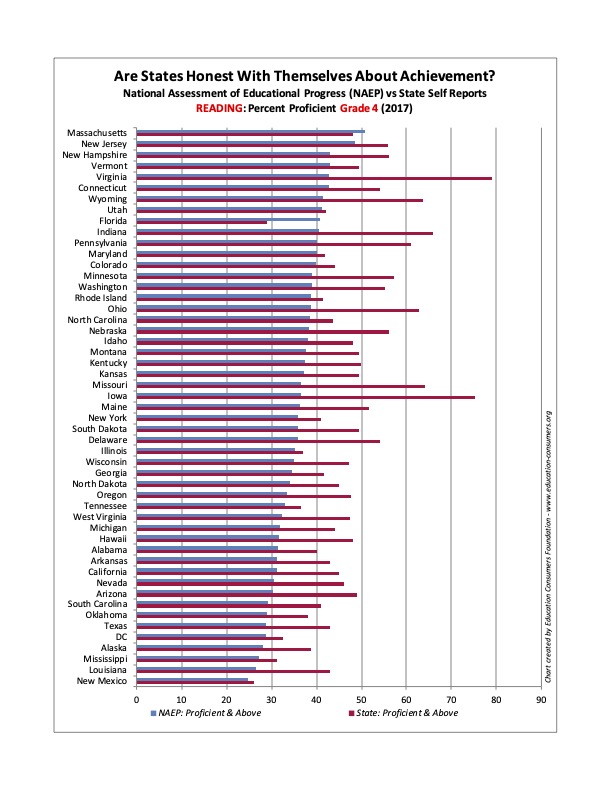
While Mississippi’s 2019 NAEP reading scores for 4th grade were heralded as an aspirational outlier, Mississippi is not alone in its effective political game of smoke and mirrors using reading proficiency scores; see the following comparison of state proficiency scores compared to national NAEP data:

Most states have some degree of lower standards for proficiency than NAEP, but the issue is not that NAEP is a credible measure of reading (it isn’t); the issue is that state-level reading proficiency is a political tool of elected officials.

While the media and political leaders in Mississippi have claimed “miracle” for the state, the data show otherwise:

As the scatterplot suggests, Mississippi has a fairly normal strong correlation between socioeconomic status and reading achievement (low poverty correlated with high scores and high poverty correlated with low scores). Yes, Mississippi has had a long pattern of raising reading scores since the 1998 while not closing key achievement “gaps” (see NAEP longitudinal data), but the state is not somehow miraculously serving high-poverty students (because of the “science of reading”) in a way that is superior to other states (whose failures are being falsely attributed to an absence of the “science of reading”).

While a perverse way to say it, Mississippi reading achievement isn’t a “miracle” (and there currently is no scientific evidence that reading achievement gains are caused by a switch to the so-called “science of reading”) but is mostly “normal” in terms of producing measurable student achievement that is more a reflection of socioeconomic status (and race) that actual achievement.

In short, if you look at the data from all states, you will find a pattern of political hype (lies) not matching the data.

Similar to Mississippi, my home state of South Carolina tends toward that normal, but since this tool allows adding charter schools, please note how charter school (red dots) achievement (as I have documented before) mostly matches traditional publics schools (TPS), with a few outperforming and several underperforming when compared based on similar demographics:

The key to charter school analysis is to compare charter and traditional public schools with similar demographics (in the scatterplot above, that is the vertical axis); note that most charter schools cluster with TPS, but several fall lower on achievement when compared to TPS.

None the less, a great deal of political capital has been and is currently being spent on claiming the “science of reading” has created “miracles” (a lie) and that charter schools save children in poverty and Black/brown students (another lie).

Reading achievement is once again a hot media and political topic, but that discourse and legislation coming from it, are mostly lies that are serving the needs of political leaders and not students.

The “Science of Reading” Multiverse

Published in 1947 in The Elementary English Review, a flagship journal of the National Council of Teachers of English (NCTE) that later became Language Arts, “Research in Language” is one of the most cited pieces by Lou LaBrant in my scholarship and public writing about education and literacy.

LaBrant served as president of NCTE in the 1950s, and along with being an active and influential literacy scholar, LaBrant was a practitioner over a staggering 65 years of teaching.

LaBrant made two incisive claims in this article:

A brief consideration will indicate reasons for the considerable gap between the research currently available and the utilization of that research in school programs and methods. (p. 87)

It is not strange, in view of the extensive literature on language, that the teacher tends to fall back upon the textbook as authority, unmindful of the fact that the writer of the text may himself be ignorant of the basis for his study. (pp. 88-89)

LaBrant, L. (1947, January). Research in language. Elementary English, 24(1), 86-94. http://www.jstor.org/stable/41383425

Having written an educational biography of LaBrant for my doctoral dissertation, I am vividly aware that LaBrant taught and wrote as a complex progressive who used the term “research” in broad Deweyan terms that included everything from gold-standard experimental research to the daily observations made by classroom teachers.

I cite her because as a practitioner and scholar I also embrace a very complicated understanding of “research,” “evidence,” and the word of the moment, “science.” I am also deeply skeptical of textbooks and programs.

Since early 2018, the phrase “science of reading” has entered and often dominated media, public/parental, and political discourse around the teaching and learning of reading in the U.S.

Almost for as long—I discovered the movement a few months after it began—I have been waving a red flag, advocating for skepticism and extreme caution about that discourse, the media, public/parental, and political rhetoric. For that reason, I persist in placing the phrase in quote marks since I am specifically criticizing the discourse.

If anything, my criticism is having far too little impact on the consequences of the “science of reading” discourse that is driving many states to adopt new reading legislation. And on social media, I am routinely attacked, often quite aggressively, as a science denier and someone intent on hurting children (although I have been a life-long educator across five decades as both a K-12 classroom teacher and a college professor).

I am also often discredited and told that journalists, parents, and politicians understand my own field better than I do.

Part of the problem with debating the “science of reading” movement is the term itself, one that has at least three different meanings, a multiverse if you will (although absent, darn it, Doctor Strange or Wanda).

Before anyone can, or should, answer “Do you support/reject the ‘science of reading’?” we must first clarify exactly what the term means; therefore, here, then, I want to detail the three ways the phrase currently exists since it entered mainstream use in the media during 2018.

“Science of Reading” as Media, Public/Parental, and Political Discourse. Beginning with Emily Hanford and then perpetuated by mainstream media (Education Week and the New York Times, notably), the “science of reading” is a narrative that claims teachers are not teaching students to read using the “science of reading” because teacher educators have failed to teach the “science of reading” in teacher prep programs. Concurrently, this discourse also blames low student reading achievement on the dominance of balanced literacy reading programs (often erroneously) since, as advocates claim, balance literacy is not grounded in the “science of reading.” This version of the “science of reading” maintains that primarily (or even only) cognitive science research is the “science” that counts and that the “simple view” of reading is the one valid theory of reading supported by the “science of reading.” [Note: This is the version of the “science of reading” that most of my scholarly and public writing challenges as misguided and harmful; see here, here, and here.]

“Science of Reading” as Marketing and Branding. Since the “science of reading” advocacy identified above has been extremely effective, states are adopting new reading legislation, some of which directly bans popular reading programs and then narrowly mandates the use of materials and programs that meet the narrow characterization above. This means education companies, especially ones focusing on literacy, have begun to brand and rebrand their materials as programs with the “science of reading.” For example:

As a market response to legislation, as well, some popular reading programs have responded to this version of the phrase. This marketing dynamic is very common in education. Many years ago, I attended a state-level literacy conference where Smokey Daniels spoke. Daniels is one of the top literacy scholars associated with the term “best practice”; however, he warned then that the term had been quickly co-opted by textbook publishers and that there was no mechanism for insuring that something labeled “best practice” was, in fact, demonstrating those concepts (the same problem exists for “whole language” and “balanced literacy”).

“Science of Reading” as Shorthand for the Research Base for Teaching Reading. This is what LaBrant referred to as the “research currently available” in 1947. The irony in this use of the phrase is that many people have been using some form of this phrase for a century—”research,” “science,” “evidence.” And of course, scholars and practitioners are often aware of and practicing many aspects of that “science”—even though science, research, and evidence are all necessarily in a state of flux (and thus, LaBrant’s nod to “currently available”). To be blunt, no reasonable or informed person would reject this use of the “science of reading.” However, I must note that this use is almost entirely absent in public discourse; it remains used almost exclusively among researchers and some practitioners. Another irony, in fact, is that the first use of the phrase above is itself a gross mischaracterization of this complex and broad use.

Because of these different and often conflicting uses of the “science of reading,” we are experiencing incredibly jumbled and even nonsensical outcomes such as teachers being required to attend training in programs that are not supported by research (LETRS) and states adopting reading legislation that implement practices that are not supported by research (grade retention).

So, if you return to LaBrant’s claims above, you may notice an eerie similarity between her valid assertions and the current “science of reading” discourse that is not credible even as it is highly effective.

The problem is that teaching, learning, and literacy are extremely complex human behaviors that resist simple labels or explanations—and also defy efforts to prescribe templates that will magically fulfill the urge for “all students must.”

Alas, in this multiverse there is no magic.


Recommended

Dr. Paul Thomas on the Multiverse that is the Science of Teaching Reading

Paul Thomas How to End the Reading War and Serve the Literacy Needs of All Students

Don’t Buy It: The Marketing Scam of MSM and the “Science of Reading”

Since 2018, Education Week has published a steady stream of click-bait press-release journalism promoting the “science of reading” (SoR).

So the latest scare-article is not surprising: More Than 1 in 3 Children Who Started School in the Pandemic Need ‘Intensive’ Reading Help. Now let’s look at the details:

That’s according to a new study by the testing group Amplify, based on data from more than 400,000 students in kindergarten through 5th grades who participated in the Dynamic Indicators of Basic Early Literacy Skills, which Amplify administers. The research, released late Wednesday, shows that though students have begun to recover lost academic ground in the last year, big holes remain in students’ fundamental reading skills.

Researchers compared students’ reading achievement from 2019 through 2022 on DIBELS, one of the most commonly used diagnostic assessments for reading.

More Than 1 in 3 Children Who Started School in the Pandemic Need ‘Intensive’ Reading Help

That’s right Amplify and DIBELS have found that students urgently need … their products.

Imagine a publication called Medical Week in decades long ago when the tobacco industry did “research” and found no link between smoking and cancer. Imagine MedWeek publishing pro-smoking articles grounded in the tobacco industry’s “research.”

Well, you don’t have to imagine with EdWeek.

EdWeek and mainstream media have been complicit for almost four years now in the SoR marketing scam that uses “science” like a baseball bat to disorient the public and political leaders so non-scientific products and policies are slipped into the education system.

SoR cites NCTQ, an organization that releases “reports” that are not peer-reviewed (and third-party reviews discredit all of them). [1]

SoR legislation overwhelmingly includes grade retention, a practice refuted by decades of research for being harmful to students.

And SoR is in bed with phonic-intensive programs that are not supported by science; for example, phonics-heavy training for teachers, LETRS:

A growing number of U.S. states have funded and encourage and/or require teachers to attend professional development using Moats’s commercial LETRS program, including Alabama, Arkansas, Kansas, Mississippi, Missouri, Oklahoma, Rhode Island, and Texas. This is despite the fact that an Institute of Education Sciences study of the LETRS intervention found almost no effects on teachers or student achievement (Garet et al., 2008). (p. S259)

Hoffman, J.V., Hikida, M., & Sailors, M. (2020). Contesting science that silences: Amplifying equity, agency, and design research in literacy teacher preparation. Reading Research Quarterly, 55(S1), S255-S266. https://doi.org/10.1002/rrq.353

DIBELS is a widely refuted screening tool that narrowly defines reading around decoding (including an emphasis on nonsense words, which are completely absent comprehension measures).

The public and political leaders must resist the marketing scam being promoted by mainstream media around reading. But there is a common thread.

EdWeek? Nonsense.

DIBELS? Nonsense.

SoR? Nonsense.

LETRS? Nonsense.

Don’t buy it.


[1] See How to Navigate Social Media Debates about the “Science of Reading” [UPDATED] for all the ways SoR is connected to policies and practices not supported by science/evidence.