Category Archives: Science of Reading

RECOMMENDED: The Language of Literacy Education (Brill, 2021)

Public and media debate as well as public policy driven by those debates is too often driven by misuse and misunderstanding of key terms and concepts, especially for the field of education.

Two such terms—Critical Race Theory and the “science of reading” (SoR)—have demonstrated that phenomenon over the past few years.

SoR debates have resulted in many states adopting harmful reading policy (often including practices not supported by research, such as grade retention and citing discredited sources such as the National Reading Panel and NCTQ).

With reading and literacy a high-priority focus of the media and state-level legislation, understanding and using terms and concepts around reading and literacy correctly and clearly are urgently needed. Therefore, I strongly recommend a new volume, Language of Literacy Education, edited by Vicki S. Collet, Associate Director, NWA Writing Project, and Associate Professor, CIED, University of Arkansas.

The volume offers research-based explanations for literacy terms [1], such as SoR, the simple view of reading, etc., that often contrast with the way these terms are used in public and media discourse as well as in state-level legislation debates and policy.

For example, the volume’s definition for SoR is how the term should be used and understood:

Science of reading, broadly defined, is research results from a variety of fields and methodologies, including basic and applied science, related to reading and reading instruction. The science of reading is supported by ongoing research with a “dynamic interplay among methods, theories, and findings” (Pearson, 2020). Examining this full range of science “can be a helpful policy guide to initiatives that seek to improve students’ reading ability and appetite” (Collet et al., 2021)….

Because of the complexity of reading and the differences among learners and contexts, no single instructional approach has been found to be effective in teaching all students to read (Compton-Lily et al, 2020; International Dyslexia Association, 2018; Malloy et al., 2019).

Collet, V.S. (2021). Science of reading. In V.S. Collet (Ed.), The language of literacy education (p. 66).  Brill Publishers.

While I strongly endorse the full definition provided here for a nuanced and robust understanding of SoR and how people learn to read over their entire lifetime, I find the inclusion of the current problems with the misuse of SoR as compelling:

Some instantiations of the “science of reading” are narrowly construed to emphasize basic research from cognitive psychology, neuroscience, and linguistics that describe how the brain learns to read in the early years. Public discourse sometimes focuses on the alphabet principle (Liberman et al., 1989) and a simple view of reading (Gough & Tunmer, 1986). This overly-restrictive view “is being used to shape public policy and silence other perspectives” (Hoffman et al., 2020, p. S258) and to narrow curricula (Compton-Lily et al., 2020; Vaughn et al., 2020) and should not be confused with the body of scientific studies of reading, which includes an interdisciplinary store of knowledge about “reading-related skills, processes, antecedents, and outcomes” (Alexander, 2020, p. S90). A “cautionary disposition to avoid drawing unwarranted inferences about the efficacy of pedagogical alternatives that have not themselves been rigorously examined” (Cervetti et al., 2020, p. S168) is needed. In contrast, research on reading instruction and the preparation of literacy teachers is robust, extensive, and useful for guiding reform efforts (Hoffman et. al, 2020).

Collet, V.S. (2021). Science of reading. In V.S. Collet (Ed.), The language of literacy education (p. 66).  Brill Publishers.

Ultimately, Collett reaches an important conclusion that should be driving our understanding of reading, teaching reading, and reading policy: “At times controversial, the science of reading is an ongoing body of research, ‘an area for inquiry rather than a foregone conclusion’ (Woulfin et al., 2020, p. S111).”

Parents, the media, politicians, and anyone advocating for better literacy instruction must have this volume at their side in order to navigate this debate in ways that could benefit our teachers and their students.

Misinformation and misusing terms result in harmful debates and ultimately extremely harmful educational policy.


See Also

Thomas, P.L. (2020). How to end the Reading War and serve the literacy needs of all students: A primer for parents, policy makers, and people who careCharlotte, NC: Information Age Publishing.

Fact Checking the “Science of Reading”: A Quick Guide for Teachers

Policy Statement on the “Science of Reading” (NEPC)

Making Early Literacy Policy Work: Three Considerations for Policymakers Based on Kentucky’s “Read to Succeed” Act (NEPC)

Red Flags, Red Herrings, and Common Ground: An Expert Study in Response to State Reading Policy

[1] Terms included:

Annotation
Argumentative Writing
Assessment
Background Knowledge
Biliteracy
Close Reading
Comprehension
Comprehension Strategies
Comprehensive Literacy Instruction
Construction-Integration (CI) Model
Context
Contextual Reading Model
Critical Literacy and Critical Media Literacy
Cueing Systems
Culturally Responsive Instruction
Decoding
Diffferentiation
Digital Literacies
Direct Instruction
Disciplinary Literacy
Discourse Analysis
Discussion
Dyslexia
Embodied Literacies
Emergent Literacy
Fluency
Four-Part Mental Processor
Genre
Gradual Release of Responsibility
Grammar and Mechanics
Graphic Organizers
Guided Reading/Writing
Independent Reading/Writing
Informational text Integrated Instruction
Intervention
Language Development
Learning Progressions
Literacy/Literacies
Literary Devices
Mentor Texts
Miscue Analysis
Modeling
Morphology
Motivation
Multicultural Literature
Multimodality
Narrative Text
New Literacies
Peer Response
Perspective and Point of View
Phonics
Phonological and Phonemic Awareness
Pragmatic Knowledge
Question Answer Relationship
Read Aloud
Readability
Reading Recovery
Reading-Writing Relationships
Reciprocal Teaching
Rhetorical Factors and Devices
Running Record
Scafffolding
Science of Reading
Semantics
Sentence Frames
Shared Reading/Writing
Sight Words
Simple View of Reading
Small-Group Instruction
Sociocultural Perspective
Standards
Story Elements/Story Grammar
Text Structures and Text Features
Theme
Thesis
Think Aloud
Transactional Theory
Translanguaging
Understanding
Vocabulary Instruction
Voice
Workshop (Reading & Writing)
Writing Process
Zone of Proximal Development
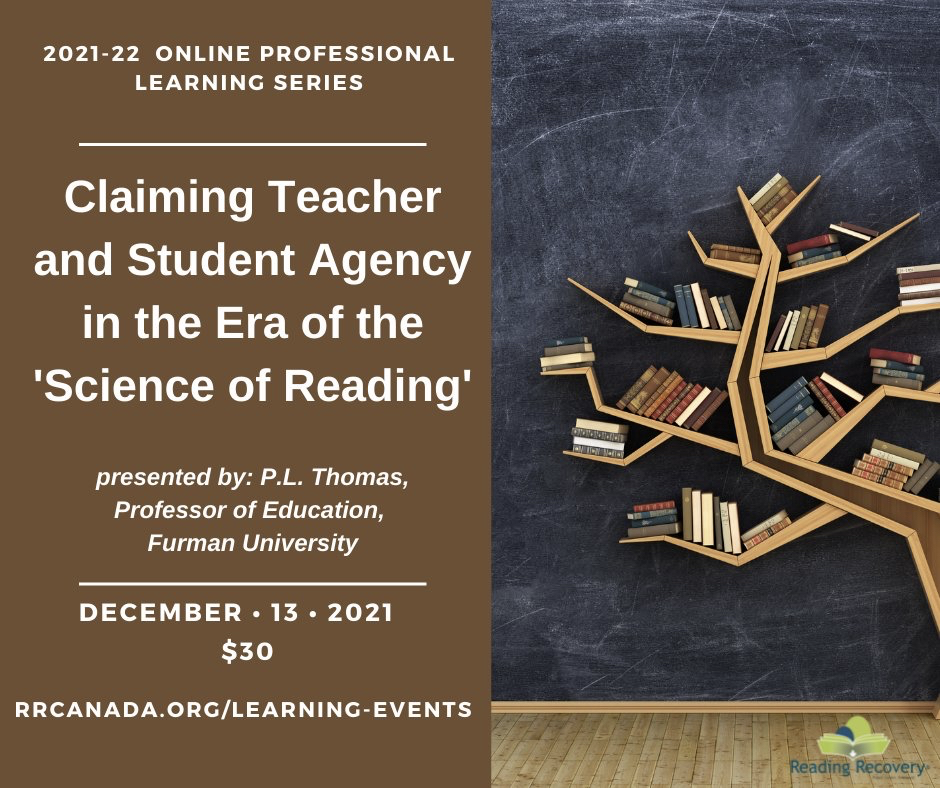
Claiming Teacher and Student Agency in the Era of the “Science of Reading” (RRC)

Reading Recovery Canada

Claiming Teacher and Student Agency in the Era of the “Science of Reading” –  presented by Dr. P L Thomas, Professor of Education
December 13 2021 – 6:30pm (eastern time) – session will be recorded for repeat viewing until August 31, 2022

The “science of reading” movement has direct roots in a U.S. media narrative starting about 2018, but the Science of Reading now drives reading and education decisions in many states and provinces. The decisions and legislation often includes policies and practices not supported by research (for example, grade retention) and further de-professionalizes teachers. This session places the Science of Reading movement in historical context and disrupts the “evidence-based” claims of Science of Reading advocates. The goal of the session is to provide teachers the evidence and support needed to assert their professional autonomy in support of their students’ needs and agency.

Access presentation PP HERE

Moving from “All Students Must” to “Each Student Deserves”

Since publishing my book, How to End the Reading War and Serve the Literacy Needs of All Students, that examines the current “science of reading” (SoR) version of the Reading War, I have given several interviews and presentations on that work.

I have also continued to blog about the movement, and in all of these experiences, I am forced to rethink and think more complexly through what I know and understand about the SoR movement as well as how to teach reading and literacy.

The most recent interview, by literacy expert Sam Bommarito, proved to be an enlightening experience on several levels.

First, Sam’s experience and expertise in the field of literacy were a welcomed change from being interviewed by generalists and journalists because his questions dove directly into the core of the issues surrounding SoR and those questions challenged me to think more deeply and carefully.

Our exchange between people with similar levels of expertise on the subject allowed (or even required) us to focus on how best to offer any viewers nuanced but clear explanations of a deeply complex topic; as I noted (and emphasize often now), the evidence on teaching reading is not simple, and not settled.

But the larger take-away for me after the interview was that Sam’s third question—Does it make any sense to effectively ban selected practices found in balanced approaches to reading, e.g., reading recovery, workshop teaching or guided reading?—prompted me to explain in greater detail a core concept that grounds a fundamental reason I reject the SoR movement.

Whether I am addressing literacy specifically or teaching pedagogy broadly, I have relied for many years on the best practice concepts expressed by Zemelman, Daniels, and Hyde.

Each chapter in their book (now in its fourth edition) ends with a chart that suggests instructional practices that teachers should increase or decrease; for example, on writing instruction (download sample here):

Key to note is that best practice is grounded in broad and diverse bodies of research on teaching and learning, and that best practice philosophy neither requires nor bans any specific instructional approach; whether a teacher uses any pedagogy is directly linked to student need (not a prescription form some authority such as standards or an adopted program).

When SoR advocates call for “all students must” (for example, systematic intensive phonics for all students and universal screening for dyslexia), they are misrepresenting what we know about teaching and learning: There is no universal silver bullet for “all students.”

Best practice structures promote research and evidence as a spectrum, a range of practices for every teacher’s toolbox; best practice also recommends that instruction begin with individual students, their demonstrated known, unknown, and misconceptions.

If we think carefully about decoding and direct instruction in phonics and phonemic awareness, teachers will face a wide diversity of students in any class in terms of where they are in their reading development; in short, there simply is no situation where “all students must” serves students well.

Literacy is not simple, and literacy development is not linear, sequential, or systematic.

For example, most people do not accumulate vocabulary in order to be able to read, but develop their vocabulary by reading.

Context (in terms of so-called literacy skills) and engagement are extremely important when students are developing their literacy; regretfully, many misguided movements during the history of the Reading War have eroded an essential aspect of literacy that must be honored—literacy as holistic.

Here, we must address a fundamental paradox in the SoR movement.

Several different kinds of advocacy are fueling the SoR movement—from parents advocating for greater awareness of dyslexia to Black and poor parents advocating for under-/un-served populations of students to advocates for the needs of emerging bilingual students.

The common denominator here is a genuine concern for the under-/un-served student, a pervasive belief that for a number of reasons, too many students are being failed by the system itself (although some elements of the SoR movement are also directly blaming teachers and teacher educators for those failures).

The paradox is that the aggressive advocacy behind the SoR movement is driving an all-or-nothing silver-bullet approach to teaching reading, which will mis-serve students as much or more than the current conditions of teaching and learning in U.S. public schools.

So this leads me to Sam’s effort to bridge the divisions in the Reading War (something I am far more skeptical about, as I address in Sam’s question 5: Cambourne and Crouch recently said we should stop using the Reading Wars metaphor and replace it with the metaphor of the Reading Quilt- with different “sides” adding different pieces to the quilt. Do you see any hope for that point of view? Do you see hope for an end to the divisive discourse?  Do you see hope for ending the reading wars? [13:20]).

I am no fan of compromise (as I explain in the interview) but I think we do have common ground in terms of two beliefs: (1) Far too many students are being under-/un-served in our current K-12 public school system (notably in their literacy), and (2) the under-/un-served are disproportionately marginalized and vulnerable populations of students (Black students, poor students, emerging bilinguals, students with special needs).

Not a compromise, but my modest proposal is that all of us concerned with reading and literacy among K-12 students need to set aside the “all students must” mandate and commit instead to “each student deserves.”

“All students must” be screened for dyslexia is a guaranteed disaster for students (consider the over-diagnosing of ADHD as one example), but “each student deserves” access to ample books and other texts in their homes and schools fulfills what we know about literacy development without being overly simplistic or harmful.

Each student deserves whatever teaching and learning experiences they need and want in order to grow and develop at the rate unique to them (not some manufactured and artificial “grade level” proficiency).

This commitment shifts our instruction and assessment gaze away from compliance to a reading program or to a set of prescribed standards and toward the demonstrated needs and wants of each student who enters any classroom.

The ultimate irony here is that the whole language (WL), reading/writing workshop, and balanced literacy (BL) movements (all falsely demonized since the 1990s) offer that exact commitment along with very high standards for teacher expertise (each of us in charge of any student must have a very complex toolbox for teaching and also must be prepared to individualized instruction).

Again, as I stated in the interview, WL, workshops, and BL did not fail our students, but we have certainly failed the core commitment of those movements—serving the learning needs of each student.

What we know about teaching reading is not simple or settled, but I think we can and must all agree that instead of falling prey to the overly simplistic and harmful “all students must,” a better way forward is a resolute commitment to “each student deserves.”


LitCon 2022: The State of the Reading War: Not Simple, Not Settled [UPDATE]

Announcement

LitCon: National K-8 Literacy & Reading Recovery Conference (January 29 – February 5, 2022, Columbus, OH)

Session Type: Spotlight Continued Engagement Session

Schedule:  Thurday, February 3, 2022, 4:00 pm – 4:45 pm est

Session Strand:  Reading Recovery

Session Title:  TBD

Description:  

Topics: 

Presenters:  Sam Bommarito and Paul Thomas


Featured Speaker

The State of the Reading War: Not Simple, Not Settled

Download PP HERE

P.L. Thomas

Session Type: Featured Session

Schedule:  Thursday, February 3, 2022, 5:00 pm – 6:00 pm est

Session Strand:  Leadership in Literacy

Session Title:  FS21 – The State of the Reading War: Not Simple, Not Settled

Description:  A new round of the Reading War embraces the “simple” view of reading, arguing that the “science of reading” is settled. This session interrogates the “science of reading” movement by placing it in historical context and refuting its central claims based on a more complex view of reading and science.

Topics: Equity in Education, Literacy Leadership, Reading

Presenters:  Paul Thomas

Recommended Reading

Science Supports Balance, Not Intensive Phonics, for Teaching Reading

Fact Checking the “Science of Reading”: A Quick Guide for Teachers [Updated]

How to Navigate Social Media Debates about the “Science of Reading”

Reading as Comprehension and Engagement: On the Limitations of Decoding

Podcast: Educational Movements and Trends

Talking Points: A Conversation with Paul Thomas

The “Science of Reading”: A Reader for Educators

How Do We Know?: Not Simple, Not Settled

Dismantling the “Science of Reading” and the Harmful Reading Policies in its Wake [UPDATED]

Understanding the “Science of Reading” Movement and Its Consequences: A Reader

Policy Statement on the “Science of Reading” (NEPC)

How to End the Reading War and Serve the Literacy Needs of All Students

Reading as Comprehension and Engagement: On the Limitations of Decoding

About a year ago, a friend and I introduced my grandchildren to gaming; soon after I bought them a Nintendo Switch.

My granddaughter, Skylar, was immediately drawn to Animal Crossing because she loved that the game allows players to visit each other’s world. But the game also requires a great deal of reading so her initial experiences meant she had to play with someone who could read with comprehension to help and guide her.

Today, Skylar is starting second grade.

Happy for day 1 of grade 2.

Recently, when Skylar was visiting, she immediately wanted to play Animal Crossing with my friend. As they played, Skylar was reading aloud incredibly well, only occasionally stumbling over words that would typically be classified as “above her grade level” (a concept I reject).

Despite Skylar’s ability to decode with speed and accuracy, we noticed something really important.

After reading through the text, Skylar would pause and ask my friend what she was supposed to do. Of course, the text in the game is designed to guide what the player does so my friend patiently explained that Skylar needed to re-read but pay attention to meaning (comprehension).

With that guidance and attention to the need to decode with comprehension and purpose, Skylar began to play the game with more agency (a few days later, she Facetimed my friend to continue having someone to mentor and guide her; in other words, she didn’t magically become an independent reader).

Skylar is 7 years old, my grandson, Brees, is 4 (about to turn 5 in a few weeks).

Watching them navigate gaming as well as learning to read is fascinating for several reasons.

First, Skylar clearly prefers communal gaming. Even as she is developing the ability to read with comprehension and engagement independently, she desperately wants to play the game with someone else.

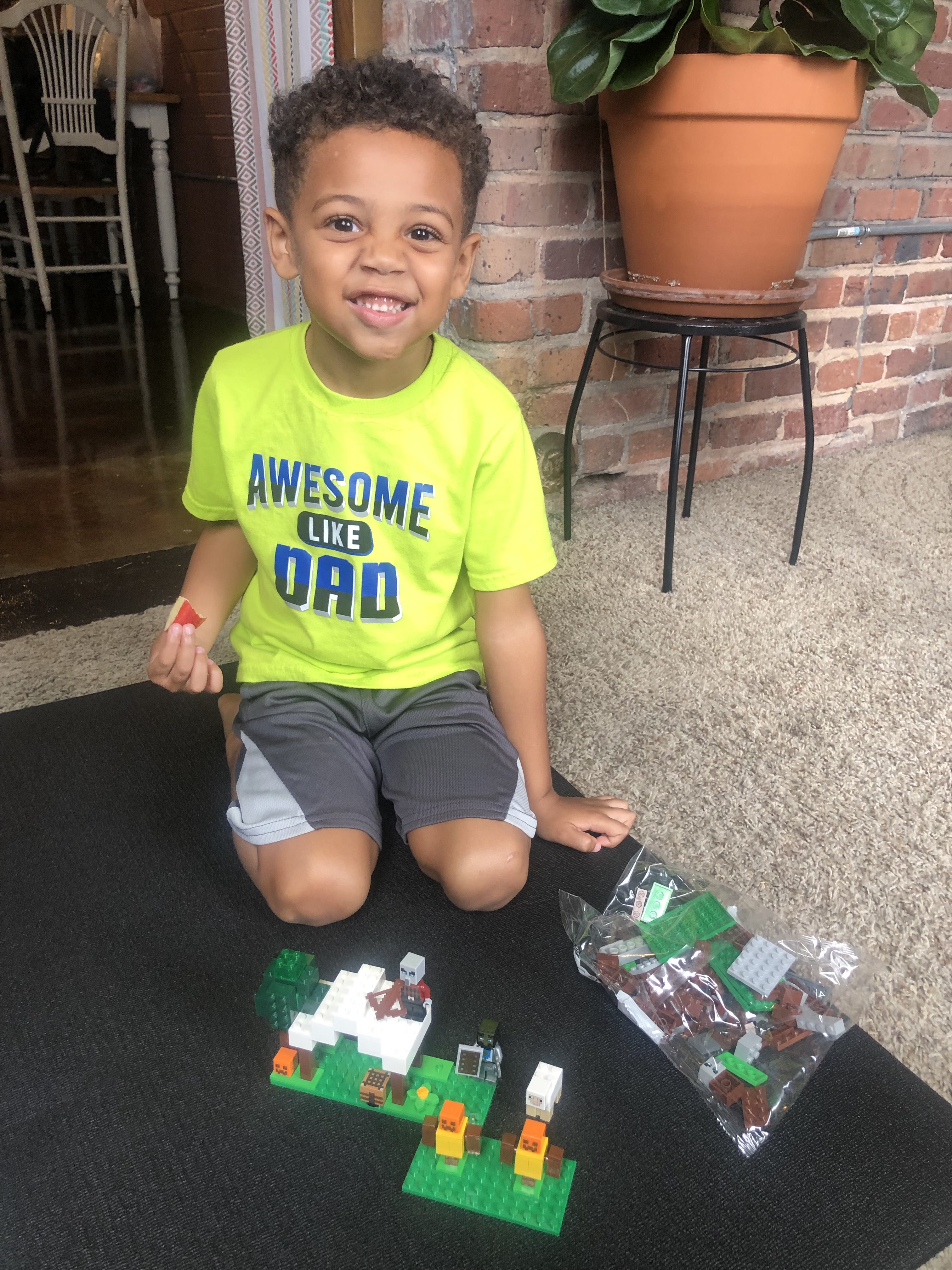
Brees, who has chosen Minecraft [1] as his go-to gaming, is a solitary gamer. While they were over for a pool day, Brees took a break and happily lay on a lounge chair playing Minecraft on his iPad.

Minecraft mania extends to Lego as well.

Second, Skylar’s gaming and reading journey dramatically reveals the limitations of decoding—notably the danger of assuming that proficiency at reading aloud (words pronounced quickly and clearly) results in comprehension and engagement.

Here I want to stress that without Animal Crossing and an expert mentor (both at the game and reading), Skylar could well have remained at the level of “going through the motions” of reading aloud.

She didn’t hesitate to re-read and work toward comprehension so that she could fully engage in the game.

In other words, literacy is ultimately about autonomy, but it is also a profoundly important aspect of community.

During the Facetime session, Skylar was seeking a mentor to confirm the decisions she was making. Even though she was decoding with comprehension, she kept asking for confirmation that she was navigating the game the right way (or more accurately, a right way).

Before I go further, I want to stress that Skylar clearly has acquired some very powerful decoding strategies based in what most people call “phonics,” but when she is in the real world of gaming, she often comes to situations when those blunt decoding skills are not only inadequate but distracting from the flow of the complicated act of reading and acting on the comprehension.

I also want to stress that watching a 7-year-old play a reading-intensive video game complicates the simplistic and misleading faith placed in “grade level” texts. Like almost all real-world texts, Animal Crossing simply uses words (no concern for “grade level” and no “context clues”), often very common words mixed in with exact vocabulary that is uncommon.

Overly simplistic views of reading and vocabulary tend to conflate the “easy/hard” binary for vocabulary with “common/uncommon.”

Uncommon words that Skylar could not decode, and often has never encountered before, were not “hard” since with a mentor to pronounce and explain the word, Skylar very quickly adapted and with repetition in the game, those words became common to her (and thus, “easy”).

Finally, this experience with my grandchildren, at different stages of development and reading, helps personify some of the significant problems with the “science of reading” (SoR) movement that advocates for the “simple view” of reading and for systematic intensive phonics for all students.

Decoding is a necessary but small aspect of the reading, which ultimately must be an act of comprehension with engagement.

But the SoR movement also will fail our students because it centers systematic programs, silver-bullet thinking, and a misguided emphasis on decoding (and blunt decoding strategies).

However, what all students need and deserve are real-world experiences with and reasons to read.

Those experiences include activities too many people still stigmatize as “bad” for children—comic books, gaming, and even Lego.

Skylar as an emerging independent reader has had some wonderful traditional school experiences, and loving teachers. But her journey to reading is much larger than that, including her current fascination with Animal Crossing.

My beautiful and eager grandchildren are powerful examples that when it comes to teaching reading, nothing is settled and nothing is simple.

Reading is comprehensions and engagement, and as Skylar demonstrates, reading is about community, a shared purpose that is filled with pleasure and the joy of creating without a finish line.


[1] Writing as a Minecrafter: Exploring How Children Blur Worlds of Play in the Elementary English Language Arts Classroom

by Cassie J. Brownell – 2021

Background/Context: Educators have considered how Minecraft supports language and literacy practices in the game and in the spaces and circumstances immediately surrounding gameplay. However, it is still necessary to develop additional conceptualizations of how children and youth’s online and offline worlds and experiences are blurred by and through the games. In this study, I take up this call and examine how the boundaries of the digital were blurred by one child as he wrote in response to a standardized writing prompt within his urban fourth-grade classroom.

Purpose/Objective/Research Question/Focus of Study: Through snapshots of Jairo’s writing, I illuminate how he muddled the lines between his physical play experiences and those he had in the virtual world of Minecraft. In doing so, I argue that he carried over his personal interest as a fan of Minecraft into the writing curriculum through creative language play. As Jairo “borrowed” his physical play experiences in the virtual world of Minecraft to complete an assigned writing task, he exemplified how children blur playworlds of physical and digital play in the elementary ELA classroom.

Research Design: Drawing on data generated in an 18-week case study, I examine how one child, Jairo, playfully incorporated his lived experiences in the virtual world of Minecraft into mandated writing tasks.

Conclusions/Recommendations: My examination of his writing is meant to challenge writing scholars, scholars of play, and those engaged in rethinking media’s relation to literacy. I encourage a rethinking of what it means for adults to maintain clear lines of what is digital play and what is not. I suggest adults might have too heavy a hand in bringing play into classrooms. Children already have experiences with play—both physical and digital. We must cultivate a space for children to build on what was previously familiar to them by offering scaffolds to bridge these experiences between what we, as adults, understand as binaries. Children do not necessarily see distinctions between “reality” and play worlds, or between digital and physical play. For children, play worlds and digital worlds are perhaps simply worlds; it is we as adults who harbor a desire for clear boundaries.

Teachers College Record Volume 123 Number 3, 2021, p. –
https://www.tcrecord.org ID Number: 23622, Date Accessed: 9/18/2021 7:46:35 AM

See Also

Misreading the Main Idea about Reading

Podcast: Educational Movements and Trends

Educational Movements and Trends

How can historical perspective help direct teaching and learning?

​When trying to solve problems, humans are prone to looking for a “silver bullet” which often bypasses the learning process. Educational trends prove this theory. The hot teaching movement today may not have solid research behind it. History shows us that we are not good at being patient students throughout life’s journey.​

Our guests Dr. Michele Dufresne, President and founder of Pioneer Valley Books and Dr. Paul Thomas at Furman University share that while K-12 education may be a basic right, not everyone has equal access to it. If every child is capable of learning and no one progresses at the same rate, then how can teachers better support student growth? Having an educated society impacts all facets of our communities.

Episode 1

Educational Trends part 2

The “Science of Reading”: A Reader for Educators

How to End the Reading War and Serve the Literacy Needs of All Students: A Primer for Parents, Policy Makers, and People Who Care, P.L. Thomas

Fact Checking the “Science of Reading”: A Quick Guide for Teachers

Historical Context

What Shall We Do About Reading Today?: A Symposium ( November 1942, The Elementary English Review, National Council of Teachers of English)

LaBrant, L. (1947, January). Research in language. Elementary English, 24(1), 86-94. Stable URL: http://www.jstor.org/stable/41383425

Lou LaBrant on reading

Doing What Matters Most: Investing in Quality Teaching, Linda Darling Hammond (1997)

Whole Language and the Great Plummet of 1987-92: An Urban Legend from California, Stephen Krashen

Silver Bullets, Babies, and Bath Water: Literature Response Groups in a Balanced Literacy Program, Dixie Lee Spiegel (The Reading Teacher, 1998)

Literacy Crises: False Claims and Real Solutions, Jeff McQuillan

National Reading Panel (NRP)

The Federal Government Wants Me to Teach What?: A Teacher’s Guide to the National Reading Panel Report, Diane Stephens (NCTE, 2008)

Beyond the Smoke and Mirrors: A Critique of the National Reading Panel Report on Phonics, Elaine M. Garan (2001) https://journals.sagepub.com/doi/abs/10.1177/003172170108200705

Babes in the Woods: The Wanderings of the National Reading Panel, Joanne Yatvin, The Phi Delta Kappan, Vol. 83, No. 5 (Jan., 2002), pp. 364-369 https://www.jstor.org/stable/20440142

I Told You So! The Misinterpretation and Misuse of The National Reading Panel Report, Joanne Yatvin (Education Week)

My Experiences in Teaching Reading and Being a Member of the National Reading Panel

“Science of Reading”

Policy Statement on the “Science of Reading” (NEPC)

The Critical Story of the “Science of Reading” and Why Its Narrow Plotline Is Putting Our Children and Schools at Risk

Perspective | Is there really a ‘science of reading’ that tells us exactly how to teach kids to read?

The Trouble With Binaries: A Perspective on the Science of Reading, David B. Yaden Jr., David Reinking, and Peter Smagorinsky

Where Is the Evidence? Looking Back to Jeanne Chall and Enduring Debates About the Science of Reading, Peggy Semingson and William Kerns

The Sciences of Reading Instruction, Rachael Gabriel (Educational Leadership)

The Science of Reading Progresses: Communicating Advances Beyond the Simple View of Reading, Nell Duke and Kelly B. Cartwright

Science of Reading Advocates Have a Messaging Problem, Claude Goldenberg (Education Week)

MacPhee, D., Handsfield, L.J., & Paugh, P. (2021). Conflict or conversation? Media portrayals of the science of reading. Reading Research Quarterly, TBD. https://doi.org/10.1002/rrq.384

Bowers, J. S., & Bowers, P. N. (2021, January 22). The science of reading provides little or no support for the widespread claim that systematic phonics should be part of initial reading instruction: A response to Buckingham. https://doi.org/10.31234/osf.io/f5qyu

Reading Policy

Making Early Literacy Policy Work: Three Considerations for Policymakers Based on Kentucky’s “Read to Succeed” Act (NEPC)

Red Flags, Red Herrings, and Common Ground: An Expert Study in Response to State Reading Policy

Phonics

Phoney Phonics: How Decoding Came to Rule and Reading Lost Meaning (TCR)

The Phonics Debate: 2004, Stephen Krashen

Defending Whole Language: The Limits of Phonics Instruction and the Efficacy of Whole Language Instruction, Stephen Krashen

Does Phonics Deserve the Credit for Improvement in PIRLS?, Stephen Krashen

Reconsidering the Evidence That Systematic Phonics Is More Effective Than Alternative Methods of Reading Instruction, Jeffrey S. Bowers (2020)

To read or not to read: decoding Synthetic Phonics, Andrew Davis

Cryonics Phonics: Inequality’s Little Helper, Gerald Coles

Grade Retention

UPDATED: Grade Retention Research https://radicalscholarship.wordpress.com/2014/09/04/grade-retention-research/

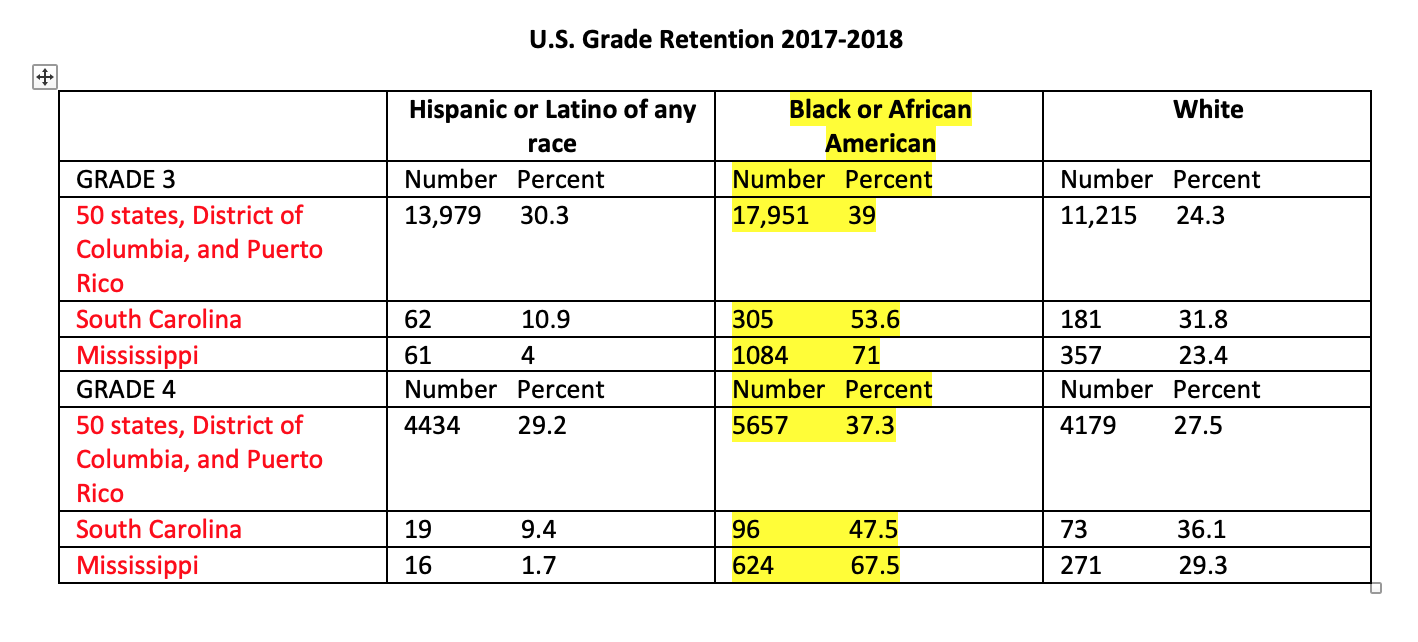
Grade Retention:

Black students disproportionately retained (grades 3 and 4)

(USDOE/Office of Civil Rights) – Data 2017-2018

Dyslexia

An Examination of Dyslexia Research and Instruction, with Policy Implications, Peter Johnston and Donna Scanlon

Research Advisory: Dyslexia (ILA) (2016)

Emerging Bilinguals

Caught in the Crosshairs: Emerging Bilinguals and the Reading Wars (NEPC)

NCTQ

NEPC reviews of NCTQ reports

NCTQ on States’ Teacher Evaluation Systems’ Failures, Again

Measuring Up: The National Council on Teacher Quality’s Ratings of Teacher Preparation Programs and Measures of Teacher Performance

Mississippi

UPDATED: Mississippi Miracle or Mirage?: 2019 NAEP Reading Scores Prompt Questions, Not Answers

Mississippi rising? A partial explanation for its NAEP improvement is that it holds students back

Chicken Little Journalism Fails Education (Again and Again): Up Next, the Science of Science?

Often education journalism is disturbing in its “deja vu all over again“: Why Other Countries Keep Outperforming Us in Education (and How to Catch Up).

Criticizing U.S. public education through international comparisons is a long-standing tradition in the U.S. media, reaching back at least into the mid-twentieth century.

This is one of many crisis approaches to covering education—Chicken Little journalism—that makes false and misleading claims about the quality of U.S. education (always framed as a failure) and that because of the low status of the U.S. in international comparisons of education, the country is doomed, economically and politically.

Oddly enough, as international rankings of education have fluctuated over 70-plus years, some countries have risen and fallen in economic and political status (even inversely proportional to their education ranking) while the U.S. has remained in most ways the or one of the most dominant countries—even as we perpetually wallow in educational mediocrity.

Yet, this isn’t even remotely surprising as Gerald Bracey (and many others) detailed repeatedly that international comparisons of educational quality are essentially hokum—the research is often flawed (apples to oranges comparisons) and the conclusions drawn are based on false assumptions (that education quality directly causes economic quality).

Media coverage, however, will not (cannot?) reach for a different playbook; U.S. public education is always in crisis and the sky is falling because schools (and teachers) are failing.

Next up? I am betting on the “science of science.”

Why? You guessed it: The Latest Science Scores Are Out. The News Isn’t Good for Schools. As Sarah D. Sparks reports:

Fewer than 1 in 4 high school seniors and a little more than a third of 4th and 8th graders performed proficiently in science in 2019, according to national test results out this week.

The results are the latest from the National Assessment of Educational Progress in science. Since the assessment, known as “the nation’s report card,” was last given in science in 2015, 4th graders’ performance has declined overall, while average scores have been flat for students in grades 8 and 12.

“The 4th grade scores were concerning,” said Peggy Carr, the associate commissioner of the National Center for Education Statistics, which administers NAEP. “Whether we’re looking at the average scores or the performance by percentiles, it is clear that many students were struggling with science.”

The Latest Science Scores Are Out. The News Isn’t Good for Schools

And it seems low tests scores mean that schools once again are failing to teach those all-important standards:

Carr said the test generally aligned with the Next Generation Science Standards, on which 40 states and the District of Columbia have based their own science teaching standards. Georgia, Massachusetts, and New Hampshire are developing new science assessments under a federal pilot program.

But it is even worse than we thought: “These widening gaps between the highest- and lowest-performing students, particularly in grade 4, mirror similar trends seen in national and global reading, math, and social studies assessments.”

Yep, U.S. students suck across all the core disciplines compared to the rest of the world!

And what makes this really upsetting, it seems, is we know how to teach science (you know, the “science of science”) because there is research: Effective Science Learning Means Observing and Explaining. There’s a Curriculum for That. Not only is there research, but also there are other countries doing it better and there are, again, those standards:

Organizing instruction around phenomena is a key feature of many reforms aimed at meeting the Next Generation Science Standards, an ambitious set of standards adopted or adapted by 44 states in 2013. Phenomena are also an organizing feature of instructional reforms in countries outside the United States, like high-performing Finland. But what is phenomenon-based learning, and what evidence is there that it works?…

Our study found that students exposed to the phenomenon-based curriculum learned more based on a test aligned with the Next Generation standards than did students using the textbook. Importantly, the results were similar across students of different racial and ethnic backgrounds.

William R. Penuel

Up next, of course, is the media trying to understand why science scores are so abysmal (like reading and math), assigning blame (schools, teachers, teacher education), and proposing Education Reform. What should we expect?

Well, since fourth-grade scores are in the dumpster, we need high-stakes science testing of all third-grade students and to impose grade retention on all those students who do not show proficiency in that pivotal third-grade year.

We also should start universal screening of 4K students for basic science knowledge (or maybe use “science” to screen fetuses in utero).

Simultaneously, states must adopt legislation mandating that all science curricula are based on research, the “science of science.”

Of course, teachers need to be retrained in the “science of science” because, you know, all teacher education programs have failed to teach the “science of science” [insert NCTQ report not yet released].

And while we are at it, are we sure Next Generation Science Standards are cutting it? Maybe we need Post-Next Generation Science Standards just to be safe?

Finally, we must give all this a ride, wait 6-7 or even 10 years, and then start the whole process over again.

The magical thing about Chicken Little journalism is that since the sky never falls, we can always point to the heavens and shout, “The sky is falling!”