Category Archives: sexism

Woody Allen, Hollywood, and the Monsters of Capitalism: “I thought it was funny at the time”

The Woody Allen dilemma, now resurrected in the wake of Harvey Weinstein being exposed as a serial sexual predator, confronts us on two levels.

Level one is an enduring debate about Allen himself: Is Allen merely attracted to young women in his personal and creative lives, a proclivity that pushes at the boundaries of social norms for consent and age-appropriate relationships? Or is Allen a sexual predator, one who has sexually abused a child?

Level two involves how this remains a debate, how keeping alive arguments about who Allen is provides a shield behind which Allen continues to produce films, accumulating wealth and power, and to remain mostly unscathed—much as Weinstein did for years: When women accuse men of sexual harassment, sexual assault, or sexual abuse, men raise the specter of false accusations—Allen himself responding to the Weinstein scandal by cautioning against a witch hunt in Hollywood.

If we return to level one, we must be willing to acknowledge the tension between consent and women’s (especially young women’s) autonomy and human agency.

Consider for example, a parallel situation involving another powerful and celebrated artist, J.D. Salinger, who courted young women; at 18, Joyce Maynard made a decision:

At Salinger’s urging, I left college — left the world, more or less — to be with him. I will state plainly: This was a choice I made, of my own volition, with as much understanding of the world as an 18-year-old may possess.

Maynard forefronts her autonomy, but we must also admit her decision to be with Salinger was prior to his exposing himself as a monster. In other words, a young woman’s autonomy and consent need not be erased, and must not be demonized, if we keep our focus where it belongs—on the men who are monsters.

So that brings us back to level two and why the most damning possibility about Allen—he is a man who sexually abused a child—remains only a possibility, a rumor, because shouting “Witch hunt!” maintains the accusatory gaze on the victims—imbued with their possibility of being false witnesses.

But the false witness argument is at least a distraction if not a lie:

The majority of sexual assaults, an estimated 63 percent, are never reported to the police (Rennison, 2002). The prevalence of false reporting cases of sexual violence is low (Lisak, Gardinier, Nicksa, & Cote, 2010), yet when survivors come forward, many face scrutiny or encounter barriers. For example, when an assault is reported, survivors may feel that their victimization has been redefined and even distorted by those who investigate, process, and categorize cases.

The valid fear, then, about sexual assault includes the following:

Research shows that rates of false reporting are frequently inflated, in part because of inconsistent definitions and protocols, or a weak understanding of sexual assault. Misconceptions about false reporting rates have direct, negative consequences and can contribute to why many victims don’t report sexual assaults (Lisak et al., 2010). To improve the response to victims of sexual violence, law enforcement and service providers need a thorough understanding of sexual violence and consistency in their definitions, policies and procedures.

We must add that men who assault also perpetuate the “frequently inflated” narrative because treating outliers as some sort of rampant phenomenon allows the monsters to survive without scrutiny or consequences.

Despite Courtney Love in 2005 and, apparently, Family Guy for years—the open secret of sexual abuse in Hollywood has remained closeted, from Weinstein to Kevin Spacey and dozens (hundreds?) of men including Allen and Roman Polanski.

Another hint about the open secret, Lana Del Rey’s “Cola,” serves as a powerful entry into the root cause of the Allen dilemma narrowly and the sexual abuse reality broadly:

“When I wrote that song, I suppose I had a Harvey Weinstein/Harry Winston-type of character in mind,” Del Rey told MTV of the “Cola.” “I envisioned, like, a benevolent, diamond-bestowing-upon-starlets visual, like a Citizen Kane or something. I’m not really sure. I thought it was funny at the time, and I obviously find it really sad now. I support the women who have come forward. I think they’re really brave for doing that.”

Del Rey, like Allen, has strong personal and artistic connections with relationships between young women and older men, but Del Rey personifies how gender shapes the consequences of those experiences and themes for women:

This kind of reversal has cemented LDR’s legend: Caught between misogynist dismissal of her art and feminist critiques of same, she appears coolly immune to both forms of attack, which boil down to a common shame over heterosexual cliché. Each camp argues that she presents a superficial, even damaging view of womanhood, minus the talent or veneer of commentary to carry it off. Where Taylor Swift and Katy Perry will belt a breakup anthem as a call to arms, Lana has the audacity to stew in her nihilism and laugh ruefully at the men who mistreat her. Gendered, negative responses just feed into her enveloping aura.

Here, however, let’s pause at “I thought it was funny at the time.”

Comedian and film maker Louis CK has released I Love You, Daddy, a poorly timed film by another man with rumors that linger without any real consequences.

This film is either an homage or garbled analysis of Allen, a work that is blunt pastiche that may ultimately be 21st-century fan fiction—seemingly an artistic extension of Allen’s “witch hunt” mantra.

With Del Ray’s mea culpa in mind about her art, a brief moment in Louis CK’s film trailer is telling:

Louis C.K.’s character is not sure he is ok with his beautiful and carefree daughter dating a man three times her age, and at one point reiterates to Malkovich’s character that she is a minor, to which he responds “a minor what?”

Let’s extrapolate Del Ray’s response to her own song: Maybe Allen seemed funny “at the time,” and maybe Louis CK thinks his Being Woody Allen is funny now—but this was never funny because monsters in real life are never funny.

Hollywood has made billions on fictional monsters, but we must now admit Hollywood has made billions by monsters as well—and they continue by the dozens.

“The evil that men do” (here, the sexism of Shakespeare language is prescient), however, is not a Hollywood real-life story alone; the monsters are everywhere, and if we look carefully at the Hollywood cesspool, we see the root of all evil—”the love of money” that empowers the shield behind which monsters thrive.

Weinstein and Allen, although not alone or unique, depended on their power and wealth to make or break the careers of young women—megalomaniacs who disregarded the humanity of their victims.

I have argued before that Tom and Daisy Buchanan in F. Scott Fitzgerald’s The Great Gatsby are the “careless people,” the wealthy who are themselves monsters, who best represent who America truly is as a country—a people poisoned by capitalism, materialism, and consumerism.

The real world of Hollywood, in fact, trumps Fitzgerald’s fictional unmasking of the America Dream, but nothing can surpass the actual Trump clan now lording over the U.S.

The national indignity of Donald Trump being elected president after being exposed on video as a sexual predator himself is something the country can never erase, or even explain—adding to our long history of propping up men-who-are-monsters as heroes and honorable men.

But we should be just as disgusted by Donald Trump Jr. who recently continued the Trump family tradition of stealing other people’s ideas when he Tweeted (like father, like son) on Halloween, our national celebration of fictional heroes:

Like Allen’s “witch hunt” response to Weinstein, Junior is playing the diversion game in order to maintain the shield behind which the Trumps scuttle along as the monsters they are.

Many have noted that Junior appears clueless about both socialism and his dear capitalism, his shield. Framing socialism as some sort of monster itself is a diversion from how capitalism creates monsters and perpetuates them.

Advocates of amoral systems, capitalism, must hide that socialism is, in fact, a moral system—a people consenting to community and cooperation so that everyone has essential needs that support basic human dignity and agency.

Explaining socialism, Oscar Wilde argued: “It is immoral to use private property in order to alleviate the horrible evils that result from the institution of private property. It is both immoral and unfair”:

Socialism, Communism, or whatever one chooses to call it, by converting private property into public wealth, and substituting co-operation for competition, will restore society to its proper condition of a thoroughly healthy organism, and insure the material well-being of each member of the community….

Private property has crushed true Individualism, and set up an Individualism that is false. It has debarred one part of the community from being individual by starving them. It has debarred the other part of the community from being individual by putting them on the wrong road, and encumbering them….The industry necessary for the making money is also very demoralising. In a community like ours, where property confers immense distinction, social position, honour, respect, titles, and other pleasant things of the kind, man, being naturally ambitious, makes it his aim to accumulate this property, and goes on wearily and tediously accumulating it long after he has got far more than he wants, or can use, or enjoy, or perhaps even know of.

Wilde concludes ( with more prescient sexist language), “The evolution of man is slow. The injustice of men is great.”

The deplorables laugh at Junior’s ignorant Tweet because they think it is funny.

What now? Will we allow “I thought it was funny at the time” to appear on the gravestones of the women and children sacrificed in our quest for the all mighty dollar?

Or like Del Ray can we finally admit it isn’t funny.

It was never funny.

“But this is the way the world has always worked for me”

In his recurring role as White Man Who Doesn’t (Can’t?) Get It, Mike Golic held forth on ESPN’s Mike & Mike the morning after the Texans NFL team nearly unanimously knelt in protest of their owner comparing NFL players to prisoners.

Golic became impassioned about today’s political correctness and gushed that he just didn’t take the “inmates” comment as offensive.

What Golic doesn’t (can’t?) see, of course, is that the NFL is about 70% black professional athletes, and the mass incarceration system of the U.S.—the exact one initially protested by Colin Kaepernick—reflects a disturbing parallel: “Nearly three-quarters of federal inmates, 71.4%, are either of African American or Latino descent. That’s 37.6% and 33.8% respectively. The problem with this is that these two groups collectively only make up 21.3% of the entire population.”

What Golic doesn’t (can’t?) hear is that billionaire owner McNair’s analogy is just a thin veil for “can’t let the slaves run the plantation.”

This is the consequence of white male privilege that blinds and deafens.

During an otherwise casual afternoon, Mary* told a few friends about her experience as a babysitter when she was a few years away from 18. She travelled with a couple for whom she was their regular sitter to watch their child on their vacation.

Mary noted that the husband had been somewhat flirtatious, but she was mostly around the couple together. On this trip, however, Mary experienced her first time being drunk, but the husband’s flirtations in front of his wife while Mary was inebriated sparked a harsh reaction from the wife—while making Mary feel even more vulnerable than usual.

She added that because of the husband’s behavior, she was fired from the babysitting position.

“Huh,” Mary punctuated her story, “sexual assault”—thinking, it seemed, for the first time about the gravity of the incident.

A few years later, Mary found herself with a boyfriend who was physically violent, and she stayed in the relationship for a while after the abuse.

Despite her privileges of race and socioeconomic status, Mary suffered the consequences of being a woman; this story parallels the one by NFL player Michael Bennett, who personifies how race inequity trumps his financial privilege and celebrity.

In response to her experiences, Mary explained: “But this is the way the world has always worked for me. For most women.”

At 18, Joyce Maynard made a decision:

At [J.D.]Salinger’s urging, I left college — left the world, more or less — to be with him. I will state plainly: This was a choice I made, of my own volition, with as much understanding of the world as an 18-year-old may possess.

However, as she detailed in a confessional memoir, that relationship with a celebrity reclusive author 35 years older than her turned abusive:

I name two experiences of damage here — damage, and abuse. Equally painful as what happened when I was 18 is what took place when I was 44 — when, after maintaining silence about my time with Salinger for 25 years, I published a book that told what happened.

As dramatized in Adrienne Rich’s “Rape,” Maynard has experienced the double-abuse of being abused directly by a powerful man and then suffering under the weight of how the world responds to confessing that abuse.

After being vilified for her 1998 memoir, Maynard acknowledges:

Cut to the present. I am 63 years old — the author of 16 books and perhaps a thousand essays. I would like to say things are different now. But 20 years after I published the story of that young experience, my chief identity remains, in the eyes of many, as that of the woman who slept with Salinger 45 years ago.

“But this is the way the world has always worked for me. For most women,” Mary’s matter-of-fact response.

Maynard’s experiences, as well, speak to the opening story:

Many of those same arbiters of culture and political correctness who eviscerated me for telling the story of what happened when I was young, with a man of great power, now express outrage at the years in which Hollywood turned a blind eye to the routine behavior of Harvey Weinstein towards young women in whom he took an interest.

From Maynard’s critics, to Bennett being called a liar by the Las Vegas police department, to Mary losing her babysitting job, to Golic’s bluster about overreacting to the “inmates” comparison—the wider silencing of marginalized and abused people recurs daily at the hands of men, often powerful, often white.

Men who otherwise may appear to be relatively harmless or normal—because, of course, these powerful men have created all the rules about what counts as harm, what is normal, and whose voice matters.

Moment by moment, Arundhati Roy‘s “We know of course there’s really no such thing as the ‘voiceless’. There are only the deliberately silenced, or the preferably unheard” is played out with men as arbiters.

If race and gender equity are genuinely our goals, men who silence and who refuse to hear must themselves be silent and must begin to listen so that they can take action.

The Texans are not overreacting and Maynard has not overshared—as she details:

Let’s consider that term, and what it implies. In my case, it would appear, “oversharing” refers to telling the truth about what happened to us, refusing adherence to a set of unwritten but longstanding rules suggesting that (for a woman, at least; these charges are seldom leveled at men) there is something not simply unseemly but reprehensible about speaking honestly about one’s sexual history, one’s body, the examination of one’s own imperfect self.

To tell the truth, then, must be afforded women who remain victims to men just as it must be afforded to blacks who remain victims to racial discrimination.

“But our voices matter,” argues Breana Stewart, sharing her own #metoo story that resonates with Mary’s “But this is the way the world has always worked for me. For most women.”

With each #metoo story that seems endless, I am haunted by the “worked for me”—words of survival.


* Name and some details have been changed to honor the privacy of the person, but the story is in essence accurate. The person also gave permission to blog about this and was shown a draft for full consent.

Men, Power Must Change

Along the arc of horrors, where we place the abuses of men and power seems a trivial enterprise, as if horrors can be quantified, compared by degrees.

In her 1992 novel, Possessing the Secret of Joy, Alice Walker fictionalized one of those horrors, female genital mutilation; this ritual may seem barbaric, foreign, and somehow not of us to many in the U.S.

However, the expanding spotlight on powerful men who are sexual abusers and predators—Bill Cosby, Harvey Weinstein, Bill O’Reilly—belongs on that same arc of horrors—even if we choose to categorized George H.W. Bush’s behaviors are “harmless” or continue to qualify accusations about Woody Allen and Louis CK because, you know, art.

Reviewing Walker’s novel, Janette Turner Hospital explains:

“Possessing the Secret of Joy” is about the “telling” of suffering and the breaking of taboos. And when taboos are broken, new forms and modes of discourse must evolve to contain that which has previously been unspeakable. Predictable outrage — moral, political, cultural and esthetic — ensues, and the breakers of taboos are both vilified and deified. Alice Walker tackles all these developments head-on in a work that is part myth, part polemic, part drama. It is a work that sits uneasily within the category of “the novel,” though the breakers of taboos must always redefine the terms and the rules of the game. Indeed, Ms. Walker’s book is a literary enterprise whose ancestry runs closer to the Greek chorus and the medieval miracle play than to the modern novel. Its subject matter is ritual clitoridectomy and the genital mutilation of young women.

As James Baldwin witnessed, “the time is always now.” Even though Cosby seems to have survived, and the U.S. elected Donald Trump despite boasting about his own life as a sexual predator, there appears a possibility that we are seeing a crack in the damn behind which men and men with power have ensconced themselves forever.

If Walker’s novel was an attempt to break taboos and prompt change, then now is a moment in the wake of that clarion call about the horrors awaiting all women and girls simply because men are men, and because men are too often too powerful.

Simply stated: How men fundamentally interact with the world must change; how power manifests itself in the world must change. Incremental change is not enough. No longer can men be centered just for being men, and all power must be dispersed, no longer concentrated.

Immediately men must stop placing themselves on the arc of horrors in ways that frame them as somehow not a monster, and therefore, not complicit.

All men are to blame, and all power is corrupt.

We can no longer discount the inherent flaws of men and power as somehow not all men, not all power; and we cannot allow the horrors to be mere celebrity and entertainment—as Joe Berkowitz confronts in a review of Louis CK’s new film (a thinly veiled examination of Woody Allen) despite his own refusal to address years of rumors about his offensive behavior toward women:

In making a case for not believing certain rumors, Louis CK is making a case for not believing women. Bill Cosby is a free man because people didn’t believe women. Donald Trump is the president because people didn’t believe women. Nobody might have believed the case against Harvey Weinstein if not for audio proof of him being disgusting to women. A policy of disregarding these kinds of rumors only protects the powerful men who stand accused. The real Woody Allen is surely aware of how dangerous it is for him if people start believing women. While prominent actors and directors publicly flagellate themselves for not speaking out about Weinstein sooner, even though they knew about his crimes, this man is worried that the avalanche of Weinstein accusers will lead to “a witch hunt.”

William_Powell_Frith_The_Witch_Trial
The Witch Trial by William Powell Frith (1848)

Not believing women as victims is the abuse that compounds the abuse—as Adrienne Rich captures in “Rape”: “You have to confess/to him, you are guilty of the crime/of having been forced.”

After Trump’s election, at the very least a “boot in the face” of all women and human decency, Maggie Smith’s “Good Bones” resonated with many. Two lines—”The world is at least/fifty percent terrible”—now resonate well beyond her likely intended meaning, or even why the poem spoke to may then.

Men, the “fifty percent terrible,” stand now exposed, hands raised against the widening spotlight as the crack in the dam expands.

Women and Children Last

I am always hesitant to suggest anything is unique to now, as if history isn’t right there for us to recognize our enduring human failures. So I will refrain from evoking “unique,” but I am convinced this is distinctly relevant for the now of 2017: In the U.S., the real and the satirical seem nearly indistinguishable.

Take for example Monologue: Dad of Newborn Girl Explains the Importance of Women’s Issues to a Table of Women at a Coffee Shop, a piece as brilliantly satirical as it is disturbing when revisited in the wake of revelations about Harvey Weinstein among a people who elected Donald Trump president.

On social media, I witnessed some misread the McSweeney’s article, missing the satire, and concurrently watched as many confronted the exact phenomenon occur in response to Weinstein’s sexual violence grounded in his wealth and power: Men expressing how they understand women’s issues because they are sons, fathers, or husbands.

Possibly my greatest existential angst as a white man is grounded in the weight of how often men have failed women and children through physical violence and sexual coercion and assault.

Weinstein has triggered my own discomfort and anger at Hollywood, personified for me by Woody Allen, and a powerful problem I have been wrestling with my entire adult life: the tension between the work of art (Can it still be “great”?) and the horribly flawed artist.

Several films, for example, remain burned into my soul because of this:

Cinematic rape and the killing of children—these films are nearly unwatchable for me, even when I appreciate their artistic value.

I have written about a similar tension when watching True Detective (HBO).

And I anticipate the same sort of discomfort I feel each time I watch Blade Runner (the aggressive kissing scene) when I eventually watch Blade Runner 2049, confronted for whether or not it portrays futuristic sexism or simply is sexist.

But this tension about art and artist as a problem, a question, is in no way concurrent in the reality of men as violent, as sexual predators.

There simply is no room for equivocation, as Allen and Oliver Stone, among many others, have offered.

There simply is no room to suggest these abuses are more about power than the men who are abusers.

The fact is that men have a default position of power over women and children; men as violent, as sexual predators and rapists, exist regardless of social status of those men.

Poor men hit their children, abuse their women partners, and poor men rape.

Only two facts exist with any credibility here.

First, as Arundhati Roy has explained, “We know of course there’s really no such thing as the ‘voiceless.’ There are only the deliberately silenced, or the preferably unheard.”

Therefore, the voices of women and children matter first, foremost, as the targets of violence by men.

Second, this is a problem nested in men and perpetuated by the social norms created by and maintained by men.

Therefore, only men can end rape culture, toxic masculinity, and the abuse of children.

Laurie Penny, in a piece that should be read fully, confronts the ways in which terms such as “consent” as well as a woman’s right to her sexuality are used in ways that are themselves oppressive even when they appear to be otherwise:

The first thing you need to understand about consent is that consent is not, strictly speaking, a thing. Not in the same way that teleportation isn’t a thing. Consent is not a thing because it is not an item, nor a possession. Consent is not an object you can hold in your hand. It is not a gift that can be given and then rudely requisitioned. Consent is a state of being. Giving someone your consent — sexually, politically, socially — is a little like giving them your attention. It’s a continuous process. It’s an interaction between two human creatures. I believe that a great many men and boys don’t understand this. I believe that lack of understanding is causing unspeakable trauma for women, men, and everyone else who is sick of how much human sexuality still hurts.

And while I have examined the importance of intimacy, privacy, and consent—not as well as Penny, however—I am more fully aware of the inherent flaws with the seeming chivalry of “women and children first,” a concept grounded in paternalism that acknowledges a sort of comparative vulnerability between women/children and men.

The real world, however, paints a different picture—women and children last.

Men who view the world, including women and children, as their spoils, to do with as they please.

Again, speaking as a man, we are the problem, and we must be the solution.


See Also

Hollywood and Academia: Is the problem the same?

The Horizon of Desire

Intimacy, Privacy, and Consent

Innovative Deception: The Charter Scam Chronicles Continue

The school choice movement has its roots in mid-twentieth century, and was bolstered by some ugly truths about racism in the U.S. during the Civil Rights movement and public school integration.

While school choice advocacy has maintained some foundational catch phrases such as “innovation” and relied on appeals to uncritical faith in market forces over “the damned government,” school choice has also maintained two key patterns: (1) promises associated with school choice advocacy have mostly failed, and thus, (2) “choice” has morphed repeatedly into new versions to stay ahead of all the bad news about outcomes falling short of those promises.

The last decade, however, has revealed a school choice gold mine in the charter school movement that appears to blend the public’s support for public schools with the allure of parental choice.

However, on balance, charter school advocacy has proven to be mostly rhetoric and absent evidence in ways similar to the larger school choice movement.

Public and charter schools, for example, are currently plagued with rising segregation, and both embrace policies that can fairly be labeled racist and classist—leading the NAACP to maintain a strongly skeptical position about the credibility of charter schools.

And when charter schools appear to succeed where public schools do not, a careful analysis nearly always reveals that what is too good to be true is, in fact, not true.

School choice innovation, including charter school innovation, actually has little to do with education and more to do with keeping ahead of the evidence in order to maintain political and public support for finding yourself in a hole and continuing to dig.

For a glimpse into how the charter movement seeks mostly to keep itself afloat, often at the expense of children and their families, consider Paul Bowers’s Erskine College’s new role as charter school gatekeeper could change landscape of public education.

Bowers hits a key point in the following:

Across the U.S., the National Association of Charter School Authorizers has been sounding the alarm about a trend it calls “authorizer shopping,” which it calls “a growing threat to overall charter school quality.”

“Authorizer shopping happens when a charter school chooses an initial authorizer or changes authorizers specifically to avoid accountability,” the group said in a 2016 report. “A low-performing school may shop for a new authorizer to avoid closure, or reopen under a new authorizer after closure.”

Also important to highlight is, as Bowers notes, how this new phase of charter expansion linked to less or no accountability is appealing to the least effective forms of charter schools:

Two of the first schools to express an interest in the new public charter school sponsor, the Charter Institute at Erskine College, are the S.C. Virtual Charter School and Cyber Academy of South Carolina. The two schools enrolled more than 4,000 students combined in kindergarten through 12th grade last school year.

The hard truths about educating children in a free society in order to create a more perfect union, to reach and sustain an equitable democracy, are that public education has mostly failed the children who need it most because the U.S. is plagued by political cowardice and that schemes labeled “education reform” are mostly even worse alternatives (including school choice and charter schools) to the mismanaged public system.

Near the end of his life, Martin Luther King Jr. called for addressing poverty directly and thus eradicate related social inequities and empower public institutions:

In addition to the absence of coordination and sufficiency, the programs of the past all have another common failing — they are indirect. Each seeks to solve poverty by first solving something else.

I am now convinced that the simplest approach will prove to be the most effective — the solution to poverty is to abolish it directly by a now widely discussed measure: the guaranteed income. …

We are likely to find that the problems of housing and education, instead of preceding the elimination of poverty, will themselves be affected if poverty is first abolished. The poor transformed into purchasers will do a great deal on their own to alter housing decay. Negroes, who have a double disability, will have a greater effect on discrimination when they have the additional weapon of cash to use in their struggle.

King’s plea has been repeatedly justified since the claims that education is the great equalizer never materializes. For example, in Equal Pay Day for African-American Women, By the Numbers Emily Crockett confronts:

African-American women only earn 64 cents to every dollar earned by non-Hispanic white men, according to the NWLC analysis; the figure for women overall is 77 cents. That’s based on the average earnings of female and male full-time, year-round workers taken from Census data.

The pay gap for Black women varies based on age and industry. Older Black women have it the hardest—the pay gap is only 82 cents on the dollar for 15-year-old to 24-year-old Black women compared to white men, but the gap widens to 67 cents and 59 cents, respectively, for Black women ages 25-to-44 and 45-to-64.

As for industries, Black women working as physicians and surgeons—a high-wage and male-dominated occupation—make only 52 cents for every dollar paid to their white male counterparts. Black women fared slightly better in lower-paid occupations, making 86 cents on the dollar in male-dominated, mid-wage construction industries and 85 cents on the dollar working as low-wage, mostly female personal care aides. …

The fact that Black women are overrepresented in low-wage jobs doesn’t help, the analysis said. Black women make up 14 percent of low-wage workers and 6 percent of the overall workforce.

Education levels don’t make much of an impact on the high wage gap between Black women and non-Hispanic white men. While more education corresponds with higher wages for both Black women and white men, Black women still make between 61 and 66 cents on the dollar compared to their counterparts at every education level [emphasis added]. African-American women have to have at least a Bachelor’s degree to make as much as white men who didn’t finish college.

This equity gap along race and gender lines is a lingering and powerful fact in the U.S.

Education reform, then, especially under the guise of school choice/charter schools, is once again failing to address directly the root causes of why we believe public education needs reform in the first place.

The only real innovation among the charter school advocates is how many ways they can avoid the hard truths about reforming schools and the impotence of education to overcome social inequity and injustice.

More on White Men of Academia: Student and Self Evaluation Follies [Updated September 2019]

“Higher education too can make a fetish out of ‘objectivity’ and ‘rationality,'” observes John Warner, confronting specifically The Pitfalls of “Objectivity” in teaching composition.

Warner’s argument is a subset, however, of the larger problem with the white men of academia, as I have examined recently: Concepts and terms such as “objectivity,” “scientific,” “valid,” “reliable,” and “rationality” prove to be extremely powerful in academia and scholarship, yet the great irony of that power is that these concepts and terms are veneer for maintaining white male power—inequity grounded in the racism and sexism that academics are prone to refute in their rhetoric while maintaining in their practices.

“Objectivity,” for example, frames a white male subjectivity as the norm (thus “objective”), rendering racialized (non-white) and genderized (non-male) subjectivity as the “other,” as lacking credibility.

Explore the history of what research paradigms count, and you confront the bias in favor of quantitative (experimental and quasi-experimental) research (paradigms created by and maintained by men) over qualitative research (paradigms championed by women and racial minorities)—the former is “hard,” “scientific,” and “objective” while the latter is “soft,” “personal,” and “(merely) anecdotal.”

In an institution created by white men, academia, where their claim is that everything is based on empirical evidence filtered through the rarified lens of objectivity, we run into a real conflict when unpacking the evidence—for example, the annual/bi-annual self-evaluation process linked to promotion, tenure, and merit as well as the embedded key element of student evaluations of faculty.

As a tenured full professor, I am currently drafting my bi-annual self-evaluation, a process I have been using as a political document to confront the inherent inequity in both the faculty evaluation process and the traditional use of student opinion surveys.

The self-evaluation is flush with traditional norms about what counts as excellence—peer-reviewed publications, for example, but not public intellectual work. And as is the case at many colleges and universities, student evaluations are central evidence in the entire faculty evaluation process.

We are directed in our self-evaluations to “include numerical results from student opinion survey forms”—the double whammy of quantitative and the ubiquitous student evaluations. The narrative at my small selective liberal arts university is that of the three areas of evaluation—teaching, scholarship, and service—teaching remains primary; therefore, I make my strongest advocacy case (nearly equaled by my argument for valuing my public intellectual writing) about how we determine faculty teaching quality.

My opening to my teaching effectiveness self-evaluation begins, then:

My teaching effectiveness has exceeded [our] high standards for teaching over the past two academic years. As evidence below, I will not refer to student opinion surveys because they have been shown to be biased (against women and faculty of color) and poor indicators of student learning [1]. Since I strongly support concerns raised in our Gender Equity study and FU’s Diversity and Inclusion initiative, I believe use of the student opinion surveys are contradictory to those goals.

If, I argue, our university has gender equity and diversity/inclusion initiatives, then using student opinion surveys contradicts those goals because the evidence is overwhelming that these student surveys are gender and race biased; they serve the interests of white male academics.

Here, then, are some key readings and research to support rejecting and resisting student evaluations of faculty:

As a white man in academia, if my claimed scholarly focus and agenda are grounded in equity, social justice, and not only naming but also dismantling racism, sexism, and white privilege, then I am beholden to both word and action in those pursuits.

In the ideal, yes, academia has the potential to be a model for equity and justice; in reality, academia is more often than not a white man’s world with garnishes of elevated rhetoric.

As Warner concludes in his interrogation of “objectivity,” students deserve a commitment to their “agency that allows them to make space for their ideas in the world,” adding what we can and must extrapolate to all of academia:

In this context, “objectivity” is not a value, but a pose, and one that’s usually sussed out by students as phony. They easily recognize it as a confidence game because it’s a game they’d previously been trying to practice, and during that practice they knew it was a pose.

Too often this pose in higher education is that of a gatekeeper, a position garnered through privilege but flaunted as merit.

If it were only phony, maybe we could brush it aside, but this pose of white male academics is determinant—it shapes, defines, and controls the careers and lives of everyone.

Changing academia in the pursuit of equity must be the work of white men, and two ways to begin that shift is to reimagine faculty evaluations and to end the use of student evaluations of faculty in that process.

See Also

Gendered Language in Teacher Reviews


[1] The footnote I provide includes the bulleted research and links above.

Toxic Masculinity, Predatory Men, and Male Paralysis

How can anybody know
How they got to be this way?

“Daughters of the Soho Riots,” The National

This is my sixth decade as a human, as a white, straight male.

Here I want to attempt confession, possibly seeking greater understanding, but fully aware of the huge complexities of making these claims, raising these personal struggles in the context of my many privileges.

I am treading lightly but committed to rise above the problematic satire of Ben Folds’ “Rockin’ the Suburbs”—which both speaks to me and makes me cringe:

Let me tell y’all what it’s like
Being male, middle-class, and white
It’s a bitch, if you don’t believe
Listen up to my new CD

My formative years over the 1960s and 1970s were spent in the redneck South. Just as I was reared to be a racist, I was taught very clearly to objectify women, even as that was tempered in my immediate family by direct and indirect messages about respecting and loving women/girls.

Growing up, I was a Mama’s boy, I was very close to my sister (my only sibling), and I had strong and warm relationships with aunts and my maternal grandmother.

As a so-called pre-sexual boy, then, I genuinely learned to feel deep and healthy affection for women/girls—to whom I have always been drawn more strongly than any male bonds.

As a teen, however, I was significantly enculturated into objectifying women, sowing the seeds for potentially behaving in ways that fed into and participated in predatory masculinity and even the various degrees of rape culture.

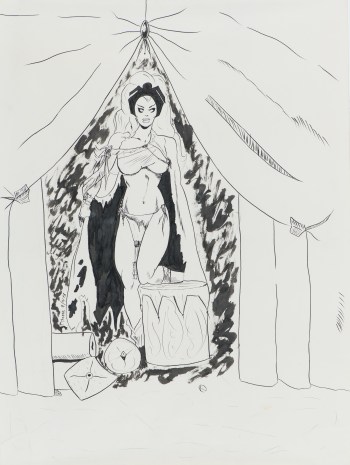
My classroom was, at first, superhero comic books and then soft-core pornography (such as Playboy and Penthouse)—but the wider popular culture was always reinforcing the worst possible models for how men treat women.

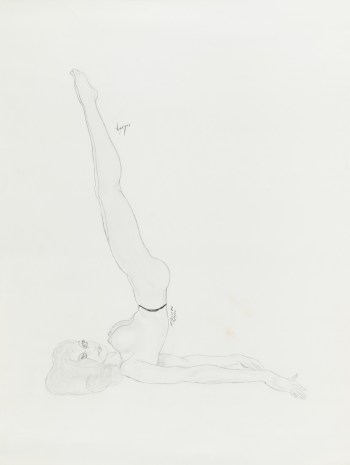
But as all this colored my attempts to be a sexual person, seeking out romantic relationships throughout high school and college, I was also being shaped in how I interacted with the world aesthetically, notably in that I was actively teaching myself visual art by drawing from both comic books and nude photography in the euphemistically named men’s magazines.

One can see a theme in my adolescent artwork:

Storm
Storm from the X-Men
Vargas
I shifted from comic books to men’s magazines and copying the objectifying artwork of Alberto Vargas, popularized in Playboy.

As a teen and young man, I was certainly trapped in very unhealthy but subtle patterns that could only be overcome by gaining critical awareness over my mid-20s into and my mid-30s (when I completed my doctoral program).

Some of that critical awareness was powerfully acquired through my commitment to learning from and teaching important literature such as Alice Walker’s The Color Purple and Margate Atwood’s The Handmaid’s Tale as well as poetry units I taught on Adrienne Rich, Anne Sexton, and Sylvia Plath.

Ultimately, writing an educational biography grounded in feminist theory stands in hindsight as the crowning experience as I approached 40 for a healthy awakening into fully appreciating toxic masculinity, predatory men, objectifying women, the male gaze, and rape culture.

Just as I would explain about my racial awareness, my sexual and gender awareness remains a journey, and as such, I find myself often paralyzed because, as a man, I represent still the potential for abuse through my status, the threat men pose for women in a society that continues to objectify and marginalize females—especially in terms of failing to listen to women who risk telling of their experiences with predatory men and rape culture.

My adult life has been spent as a partner, friend, parent, grandparent, teacher, and coach—all requiring me to monitor my status of power granted by being male and by my professional and familial positions in relationship with females.

As a coach and teacher, I have been (and continue) to be prone to call young women “darling” in casual moments—rightfully prompting some of my closest friends and colleagues who are women to call me on the language, the positioning.

I remain aesthetically drawn to photography and artwork of women nudes—entirely unsure if I can disentangle my toxic past from what I consider non-objectifying appreciation of art.

And so, as I noted above, I stumble toward 60, a man with good intentions who understands that is never enough; I am often reduced to paralysis in how to navigate the world in ways that are equitable and healthy for everyone regardless of race, gender, sexuality, or class.

I am genuinely terrified of ever making any woman/girl feel discomfort because of my masculine presence, my inadvertent gaze, my language, or the implicit threat of my status in relationship to her.

Often these days, I must confront these tensions as I snuggle with my granddaughter who I dearly want to grow up with healthy views of gender and sexuality, who I want to avoid any sort of predatory world.

My daughter was raised without corporal punishment, and now her children have been gifted that same dignity.

I work hard to practice what I preach and feel I make contributions small and even large to a kinder and more compassionate world—a world in which women and children need not ever fear men.

But even the best men walk in the wake of the worst men have given this world—the worst men continue to give to this world, and the women and children who must suffer for that.

Each man must moment by moment examine how he is culpable, where and how he stands in this world in relationship to women and children.

The dilemma of navigating the world as a man is couched in the unearned privilege, the potential for an abuse of unearned power that shouts out “First, do no harm.”

For a man committed to that, however, how does he live a full life without being paralyzed by the worst of being a man, behaviors that often go unpunished and even masked to protect some men from consequences.

How does any man avoid paralysis reading about the Stanford rape case or the stories of women as victims of predatory men?

This remains a rhetorical question for any man with an ethical imperative for his life—not a question for any woman or any child to offer their compassion.

For any man, for each man, this is ours to confront, to answer, and to act.

As long as men hold most of the power that shapes the world, it is ours to build a consensual environment in which human dignity supersedes the brute force of power.

Between acquiescing to the basest of male behaviors and paralysis is the true way, about which Franz Kafka wrote: “The true way is along a rope that is not spanned high in the air, but only just above the ground. It seems intended more to cause stumbling than to be walked upon.”

Pause. Listen. Look carefully before taking any step.


For Further Reading

Experts in the FieldBonnie Nadzam

Roxane Gay, Aimee Bender, and More on Assault and Harassment

The Predatory Men of Academic Creative Writing, John Warner

“He knows, or thinks he knows”: It’s Still a Man’s (Hostile) World

True Detective: It’s Still a Man’s (Hostile) World, pt. 2

Doubling Down (Again) on the White Man’s World

“Gravity”: The Unbearable Lightness of Being a Woman

In the U.S., Where the Female Nipple Is More Dangerous Than a Gun

South Carolina Ranks First in Political Negligence

Based on a U.S. News & World Report ranking, The Post and Courier (Charleston, SC) announced South Carolina ranks last in education.

South Carolina also ranks first in women being murdered by men.

Rankings are popular in the U.S., but more often than not, terrible ways to understand what is being ranked as well as distracting fodder for both the media and politicians.

Ranking itself is problematic since the act itself requires finding data that supports that ranking, and then by ranking we are ascribing both a range of quality as well as some degree of blame for the relative status.

When saying SC is last in education and first in violence toward women, we must take greater care in clarifying what these rankings mean and where the accountability lies for both outcomes and the causes for those outcomes.

I suspect many would fault SC public schools for the education ranking, but almost no one would blame heterosexual domestic relationships for the inordinate rate of men’s violence toward women in the state.

But even more important here is that both of these rankings reveal something in common nearly entirely ignored: political negligence in SC.

The U.S. News ranking of education is far less about education, in fact, than about socio-economics.

Three of the six data categories to rank states by education are test scores (ACT and NAEP math and reading), and the other three are graduation rates as well as Pre-K quality and preschool enrollment.

At least 60% of test scores prove time and again to be correlated with out-of-school factors. In short, what we routinely label as “education” is in fact more significantly a reflection of poverty and wealth.

And thus, if we are compelled to say SC is last in education, we are actually saying that SC’s social and education policy are utter failures. The key here is that this ranking is about policy, a direct reflection of political will, political negligence.

And SC is easily in competition for elite status in political negligence of education as shown in the twenty years it took for the courts to address the Corridor of Shame, finally admitting that high-poverty schools serving high-poverty communities result in students being doubly disadvantaged by their lives and their school opportunities.

For comparison, consider SC’s violence toward women ranking and the state being one of 13 states that treat marital rape differently than rape of a non-spouse:

Men or women raped by a spouse have just 30 days to report the incident to authorities. For the rape to count, it must have involved “the use or the threat to use a weapon … or physical violence of a high and aggravated nature.” The offense is treated as a felony but has a maximum sentence of 10 years, whereas rape of a non-spouse has a maximum sentence of 30 years.

In both rankings, then, we must ask how policy creates the environments reflected in measurable outcomes—such as test scores and graduation rates or incidences of violence toward women.

There is a political advantage to keep media and public focus on schools with educational rankings; that focus, however, is akin to blaming hospitals for housing the sick.

Schools in SC and across the U.S. reflect the inequities of our communities, the failures of our policies, and as a result, they are ineffective as mechanisms of change.

While we have known for decades that poverty and inequity are the greatest hurdles for children learning, we have committed to decades of changing standards and testing students—and we appear poised to waste time and funding next on school choice scheme.

None of this addresses the root causes of the outcomes we continue to use to rank educational quality, a process that masks, misinforms, and guarantees to maintain the status quo.

Ranking invariably proves to be much ado about nothing because it tends to misrepresent and misinform, especially in terms of why conditions exist and what reforms would improve those conditions.

Policy is at the core of both any state’s educational outcomes and what threatens the safety of women.

Policy reflects what truly matters, and in SC, our rankings in terms of education and violence toward women are commentaries on who we are as a people, who we are willing to ignore and who we are willing to protect.

Ultimately, both of these rankings expose that SC ranks first in political negligence, negligence of equity in the lives and education of children, negligence in the safety of women.

“Something Like Scales”

Immediately, something like scales fell from Saul’s eyes, and he could see again.

Acts 9:18 (NIV)

The existential crisis of my youth was my embarrassment and shame for having been raised in ignorance. My redneck past erupted from my mouth in the first weeks of college, and I exposed myself an arrogant fool.

Racist, sexist, brash, and incredibly insensitive to human dignity—I had no sense of community, no humility, little compassion, and no room for anything to replace the incredible callousness that filled my mind, my heart, and my soul.

Many years later in my doctoral program, I discovered Lou LaBrant and was immediately drawn to her warnings about word magic and provincialism, and her faith in progressive education as a path out of ignorance and bigotry:

The English class does not differ from other classes in responsibility for social situations which militate against prejudice and intolerance. Classifications which result in racial or cultural segregation, encouragement of small cliques, avoidance of crucial issues-all of these may be evils in the English classes as in others. Indeed, many of our classifications, built on results of reading tests, tend to promote rather than to destroy the kind of antisocial situation just mentioned….The question is briefly: Do the very words we use and our attitudes toward them affect our tendency to accept or reject other human beings? (p. 323)

In my mid-30s, I had already made significant strides along the journey captured by LaBrant, a journey that was deeply indebted to my reading black and women writers who shook the scales from my eyes and pointed me to the light leading away from the provincialism of my youth.

Concurrent to my passion for fiction and literature was my self-taught commitment to reading existential philosophy, which also resonated with me as I had become aware that every human is a prisoner of her/his own Being.

It was not that I came to know the world through my being white, male, heterosexual, and a non-believer; it was that I made the error of not recognizing those lenses, falling into the trap expressed by Claudia Rankine and James Baldwin.

That trap was to ignore my whiteness and to fail to understand that anything that defines any individual is inseparable from the world around that individual; as Baldwin explains:

White Americans find it as difficult as white people elsewhere do to divest themselves of the notion that they are in possession of some intrinsic value that black people need, or want. And this assumption—which, for example, makes the solution to the Negro problem depend on the speed with which Negroes accept and adopt white standards—is revealed in all kinds of striking ways, from Bobby Kennedy’s assurance that a Negro can become President in forty years to the unfortunate tone of warm congratulation with which so many liberals address their Negro equals. It is the Negro, of course, who is presumed to have become equal—an achievement that not only proves the comforting fact that perseverance has no color but also overwhelmingly corroborates the white man’s sense of his own value.

The existential crisis of my first three years of college did not bring me to some miraculous enlightenment. Neither did my doctoral experience in my mid-30s.

As I stumble toward 60, the crisis remains, and the journey continues.

My most recent leg of that journey has been grounded in social media, where I have gathered (especially on Twitter) connections that allow me to listen beyond myself about race, social class, gender, sexuality, ablism, and a whole host of contexts that, as LaBrant confronted, address “our tendency to accept or reject other human beings.”

Over the past few years when I have increased my public writing as well as my presence on social media, I have learned two important lessons.

First—although it has taken me decades to recognize and come to understand better my own struggles with anxiety and introversion—I am a lifelong outsider, a non-joiner.

However, I have experienced a few vicious (and unfounded) attacks directed at me either through a virtual connection only or about my role as a public intellectual.

In these cases, the conflict was grounded entirely (again as LaBrant noted) in how the other person was naming me, especially in terms of how that naming associated me with allegiances I do not have (to organizations, to known personalities, to acquiring financial benefits).

My non-joiner Self has always been rooted in my fidelity to ideas and ideals, not people or organizations. I am perpetually checking if people and organizations share that fidelity, but I cannot pledge allegiance to anyone or any organization.

These conflicts happened, it is important to stress, with both people I consider allies and those who are clearly in different camps than I am.

Just as a broad example, I have felt tension from union members and advocates because, I think, I hold an odd stance of never having been in a union (living my entire life in a right-to-work state) and of criticizing strongly both of the major teachers’ unions and their leaders—all the while being an unapologetic advocate for unionization.

I have also been discounted and discredited among my narrow field of teaching ELA because many within the field misunderstand blogging and academic publishing (neither of which is about making money, by the way).

This first lesson, then, is about how we label each other through association, and as a result, create fractures, angry divisions—much of which is inaccurate, or at least misleading.

Commitments to people and organizations to the exclusion of the ideals those people and organizations claim to be working toward are ultimately counterproductive.

But my second lesson moves beyond the personal and to the wider chasms of the U.S. as a people.

As a perpetual stranger, I am a critical observer, and I have witnessed a powerful and corrosive dynamic captured by the story of Saul’s conversion: “something like scales fell from Saul’s eyes, and he could see again.”

What I have witnessed is about power and privilege as the scales that blind the powerful and privileged.

From the Bernie Sander’s campaign to Hillary Clinton’s campaign to the accountability education reform resistance—and many other contexts—I have watched as white people with some degree of privilege and power have squandered their good intentions, alienating marginalized people by not listening.

The worst of which has been the tone deaf All Lives Matter (and Blue Lives Matter) response to Black Lives Matter.

In a recent post about rescuing education reform from post-truth, I highlighted that both the reform mindset that public education is a failure and the counter-resistance (that often says public education is not the problem because poverty is) are equally flawed—the latter because it spits in the face of the vulnerable students (black, brown, English language learners, special needs students) who are in fact being cheated by an inadequate K-12 public school system.

I think ultimately the second lesson is about missionary zeal, the bleeding-heart liberal urge to save the world, an urge that ignores (as Baldwin challenges) the arrogance of privilege, the condescension of privilege.

And thus, even as I have framed this with a sight metaphor, when the scales drop from our eyes—when we resist viewing the world through our provincialism, through our necessarily personal biases (and bigotry)—we are freed to listen and to hear with compassion and awareness so that our worlds expand.

Freedom and equity no longer appear to be a zero-sum game.

Ending racism is the responsibility of whites. Ending sexism is the responsibility of men. Ending economic inequity is the responsibility of the wealthy.

Privilege and power control how the U.S. works, for whom it works as well as over whom it plows.

Our country is in desperate need of a conversion such as Saul’s, the scales dropping from our eyes so that we may listen, understand, and act in the service of those we have too long failed to see or hear.

Half of a Yellow Sun: Adichie’s Historical Parable of Race, Class, and Politics

In her Author’s Note for Half of a Yellow Sun, Chimamanda Ngozi Adichie recognized scholars, her parents, and other family members for helping her fictionalize the Nigeria-Biafra War of 1967-70; telling, I think, is this: “In particular, Chukwuemeka Ike’s Sunset at Dawn and Flora Nwapa’s Never Again were indispensable in creating the mood of middle-class Biafra.”

Powerful throughout Adichie’s gripping and sharp novel is her weaving together the significance of race, class, and politics—tribalism and race, race and class, and then intellectualism in the context of both race and class.

All of this as well is wrapped in examinations of the power of both language and dialect.

Adichie soars in her deft handling of characterization and narrative against her historical and political purposes.

But the West and especially the U.S. are now probably mostly ignorant of this bloody conflict, although my entry into it is rooted in Kurt Vonnegut’s New Journalism, “Biafra: A People Betrayed,” originally published in April 1970 for McCall’s and then collected in Wampeters, Foma & Granfalloons.

Vonnegut tells a story of Biafra as a witness, a white ally of sorts angry in the opening of his piece at slights such as calling Biafra “a tribe” and recognizing how Nigeria/Biafra were pawns in international games:

Biafra lost its freedom, of course, and I was in the middle of it as all its fronts were collapsing. I flew in from Gabon on the night of January 3, with bags of corn, beans, and powdered milk, aboard a blacked out DC6 chartered by Caritas, the Roman Catholic relief organization. I flew out six nights later on an empty DC4 chartered by the French Red Cross. It was the last plane to leave Biafra that was not fired upon.

Despite Vonnegut’s romanticizing, his self-centered report on Biafra carries a recognition of Nigerians and Biafrans as sophisticated people in the way the West likely assumed they were not. But his story is ripe with contradiction:

I admire Miriam, though I am not grateful for the trip she gave me. It was like a free trip to Auschwitz when the ovens were still going full blast. I now feel lousy all the time.

I will follow Miriam’s example as best I can. My main aim will not be to move readers to voluptuous tears with tales about innocent black children dying like flies, about rape and looting and murder and all that. I will tell instead about an admirable nation that lived for less than three years.

There is always something unnerving about Vonnegut’s flippant and darkly humorous tone and his subject matter; in this way, despite his being a white Westerner of privilege, Vonnegut reporting on Biafra seems about right as that circumstance can.

Vonnegut’s WWII bitterness fits the horrors of this civil war: “The Fathers are now being deported forever. Their crime: compassion in time of war.”

As a primer for reading Adichie, Vonnegut’s essay confronts children suffering from kwashiorkor, General Odumegwu Ojukwu, the politics of oil, and “the arrogance of Biafra’s intellectuals.”

Also as in Adichie’s novel, Vonnegut highlighted the light against the dark.

This:

A more typical Biafran family might consist of a few hundred souls. And there were no orphanages, no old people’s homes, no public charities and, early in the war, there weren’t even schemes for taking care of refugees. The families took care of their own, perfectly naturally.

The families were rooted in land. There was no Biafran so poor that he did not own a garden.

Against this:

Palm oil, incidentally, was one of two commodities that had induced white men to colonize the area so long ago. The other commodity was even more valuable than palm oil. It was human slaves.

Think of that: slaves….

What did we eat in Biafra? As guests of the government, we had meat and yams and soups and fruit. It was embarrassing. Whenever we told a cadaverous beggar “No chop,” it wasn’t really true. We had plenty of chop, but it was all in our bellies.

Vonnegut had two agendas, common in his fiction and nonfiction: decry war without being simplistic or naive and champion his great Idealistic dream of large communities, families.

Chimamanda Ngozi Adichie as Nigerian, a woman, and a writer has agendas also.

Unlike Vonnegut’s paternalistic outsider witnessing, Adichie dramatizes her witnessing as James Baldwin envisioned, a lived witnessing as well as a writer’s witnessing to raise the voice of the unheard.

The servant Ugwu framed against the scholar/intellectual Odenigbo and Olanna, from wealth and privilege, draw the reader into the realities and horrors of race, social class, and personal as well as partisan politics.

As in Roxane Gay’s An Untamed State and Lidia Yuknavitch’s The Small Backs of Children, Adichie demonstrates that even in the pursuit of good and freedom, the world is mostly hellish for children and women—violent, rapacious, indiscriminate.

Half of a Yellow Sun works as a parable, then, as it works as a historical novel; this story is an enduring and damning story about human failure, the flaws of men and the wars they demand, the addictive and corrosive influence of power and the frailty of the weak in the path of that power.

Along with Gay’s and Yuknavitch’s novels, Half of a Yellow Sun sits well also with Barbara Kingsolver’s The Poisonwood Bible, Paul Theroux’s The Mosquito Coast, and Alice Walker’s The Color Purple and The Temple of My Familiar—all resonating as parables and historical witnessing.

Beware war and good intentions, these writers implore.

Words matter, they also intone.

Humans are a mess of pain and suffering, they ultimately lament.

I feel no need to walk through Adichie’s novel here, but I do want to stress that along with its historical significance, Half of a Yellow Sun speaks eerily to now for those of us in the U.S.

Adichie recognizes the chasm between intellectuals and so-called common people while she is deft at exposing the hypocrisy and foolishness found in all people; she does not demonize or idealize any of the many ways people are distinct in this novel, how people truly were separated in the years of the war: within and among races, educated and superstitious, idealistic and cynical.

As I often do now, as I read Adichie I heard James Baldwin’s warning about the great human failure:

This rigid refusal to look at ourselves may well destroy us; particularly now since if we cannot understand ourselves we will not be able to understand anything.

Adichie’s novel is bursting with “refusals”—political propaganda, interpersonal dishonesty and infidelity, and self-delusion—all of which confront today an already free people who are careless with that freedom and insensitive to suffering on our own soil and throughout the world.

I do not here wish to cross the line Vonnegut may well have crossed, making the plight of Biafra about him.

Adichie’s novel deserves your time as a novel, it deserves your time as a powerful unmasking of an ignored moment in history, but it also can serve you as you navigate the U.S. in the present.

After almost dying as a conscripted soldier, Ugwu exclaims to another servant: “‘There is no such thing as greatness.'”

Damning and bitter, yes, but a warning we should heed none the less.