Category Archives: sexism

Rethinking “A monolithic and stereotypical understanding of rural identity” (Melissa Range, poet)

Separated by about a 2-3 hour drive on I-26 through South Carolina, North Carolina, and Tennessee, but also by about 10 years, Joe Kincheloe and I were born in the rural South, both destined to become aliens in our home land.

Joe proved to be a key person in my scholarly life quite by accident when a colleague at the university where I found myself after almost twenty years teaching high school English was working on a book for Joe and asked me to write a response for her to include.

From that, Joe offered me my first academic book contract, leading to co-authoring a volume with Joe as well as a now-long list of scholarly books and a career as a writer I was certain would never happen for me.

My relationship with Joe is bittersweet since we never crossed paths in person and had only a few phone calls, the first of which elicited from Joe when I spoke, “Why you are from the South, aren’t you!”

Laughing his words revealed a joy and kindness that were who Joe was in his soul, in his bones.

I recalled this phone call as I was reading On Poverty, Justice, and Writing Sonnets of the South, an interview with poet Melissa Range:

This sudden interest in so-called “rural identity” is amusing and frustrating to me, honestly, because I don’t think most of the country actually has much real interest in rural people. They just are horrified (as am I, as are more than a few rural people I know) about the election results. Had the election gone another way, would the non-rural parts of the country be seeking to know the “rural mind”—whatever that is? I don’t think so.

I say this as a card-carrying bleeding heart pacifist leftie socialist who comes from working class white rural people who didn’t have the opportunity to go to college, most of whom have always voted for Democrats, or not voted at all. Yes, my dad voted for Trump. He always votes Republican no matter how I try to convince him to do otherwise. My old aunts and my mom have been stumping for Clinton since 2008. My brother-in-law, another one of those “white males without a college degree,” is repulsed by Trump, is on disability, has PTSD from his time in Bosnia, is an accomplished cook, hunts and gardens, and reads the Qur’an in his free time. My sister, who is 41 years old, never went to college, and has lived in the same place her whole life, doesn’t understand what the big deal is about transgender bathrooms in North Carolina. We were driving around in Boone, NC, this past spring when I was visiting her, and I remember her exclaiming, “Why can’t those who make the law just let people do as they please? Who cares what bathroom anybody uses? They ought to be ashamed for passing that law.” You can find rural people with these beliefs, with sophisticated conspiracy theories about UFOs, with unexamined beliefs about race and gender, with a passionate commitment to union organizing and to environmental activism. You can find rural people who are passionately pro-life and just as passionately pro-choice, who love their guns and who don’t believe in guns. In other words, rural perspectives are diverse, like perspectives of people everywhere. There are so many kinds of rural people. And I would like to add that they’re not all white and not all poor and not all working-class and not all intolerant. Of course some are intolerant. Of course some are resistant to change—like people everywhere. There are a lot of rural spaces in America, and everyone who lives outside of cities isn’t the same. A monolithic and stereotypical understanding of rural identity is nothing new, but it’s as false now as it ever was.

I can’t and don’t want to speak for all rural people, but my people, at least, in East Tennessee, don’t expect the government to care about them and don’t expect the rest of the country to care about them, either. What they expect, and what they typically get, is either derision or dismissal. I’ve been hearing educated, liberal people throw around terms like “white trash” and “redneck” and “hillbilly” ever since I left East Tennessee. They say these words to my face as if they are not insulting my people and me. How can liberals and progressives forget that class exists? Maybe they just like having someone else to foist some blame on. I will say that my part of the country (I call it that even though I haven’t lived there in 25 years) has an inordinate number of people who are truly beaten down. In my hometown, there used to be textile factories that employed hundreds of people, and now there aren’t. One shut down in the 1970s, another in the 90s. Nothing much has come in to replace them except meth and other drugs, so there’s a lot of poverty and a lot of substance abuse and not much industry. Poverty and despair go hand in hand; it’s not hard to imagine this (and obviously this isn’t just a rural phenomenon). And when you see yourself on television and in movies being stereotyped and mocked, well, it doesn’t make you feel any better.

I can imagine Range joining in with Joe and me—aliens of academia and the literary world. Also reading Range’s comments, I thought about how often we Southerners are stereotyped as illiterate, in many ways because of how we sound (which is what tipped Joe off to my Southern roots).

The South is, from my lived experience, a heaping mess of social class, race, and god-awful mangling of the English language—all wrapped in the flag and lots of bible thumping.

But none of that is as simple as people want to believe, want to claim.

As Ralph Ellison confronted in 1963 when speaking to teachers:

Some of us look at the Negro community in the South and say that these kids have no capacity to manipulate language. Well, these are not the Negroes I know. Because I know that the wordplay of Negro kids in the South would make the experimental poets, the modern poets, green with envy. I don’t mean that these kids possess broad dictionary knowledge, but within the bounds of their familiar environment and within the bounds of their rich oral culture, they possess a great virtuosity with the music and poetry of words. The question is how can you get this skill into the mainstream of the language, because it is without doubt there. And much of it finds its way into the broader language. Now I know this just as William Faulkner knew it. This does not require a lot of testing; all you have to do is to walk into a Negro church.

But if you want to feel particularly out of place, out of kilter, academia can be that for you if you are working class or from the working poor. As Vitale and Hurst explain [1]:

Both academia and the DNC have a class problem. They don’t know anything about the working class because they have isolated themselves from working-class people. We have been struggling for years to change this within academia….

Discussion of social class has always been relegated to the margins of academia. In turn, public discourse about class is muted. By denying the opportunity for social class to be a valid academic subject in itself, or to be considered an authentic form of social identity, educated folks (academics, pundits, campaign managers, and journalists) didn’t just silence the voices of the poor and working-class, they also denied the possibility of critically engaging the problem of affluence.

Rurality, being working class or working poor—these have become another form of marginalization in many contexts, and with the rise of Trumplandia, the mischaracterization and fetishizing of working class/working poor whites have accelerated, as noted by Range and seen in the popularity of J.D. Vance’s Hillbilly Elegy.

However, the mainstream media’s misreading working class/working poor white angst is ironically reflected in Vance’s deeply flawed work, as noted by Sarah Jones:

Elegy is little more than a list of myths about welfare queens repackaged as a primer on the white working class. Vance’s central argument is that hillbillies themselves are to blame for their troubles. “Our religion has changed,” he laments, to a version “heavy on emotional rhetoric” and “light on the kind of social support” that he needed as a child. He also faults “a peculiar crisis of masculinity.” This brave new world, in sore need of that old time religion and manly men, is apparently to blame for everything from his mother’s drug addiction to the region’s economic crisis.

Vance’s thinly veiled conservatism and simplistic “aw shucks” cashing in on his background feels very similar to an experience I had years ago when my university chose Timothy B. Tyson’s Blood Done Sign My Name as the incoming first-year students’ common book, which faculty also read to discuss with those students.

From Tyson’s work to Vance’s and currently with all the bluster about working class whites across the rural U.S., I cringe at the ways in which many people treat any sort of Other as if they are visiting a zoo—oh-ing and ah-ing at the exotic, but keeping their distance all the while.

There is an insensitivity of distance that Henry Giroux, an academic from a working class background, has identified:

Being an academic from the working class is, of course, impacted by many registers, extending from ideology and cultural capital to politics….

My father had just died of a heart attack, and I had returned to the campus after attending his funeral. My Dean at the time was a guy named Bob Dentler, an Ivy-League educated scholar. I ran into him on the street shortly after my father’s death and he said to me, “I am sorry to hear about your father. It must have been difficult settling his estate?” Estate? My father left a hundred dollars in an envelope taped behind a mirror. That was his estate. I was immediately struck by how out of touch so many academics are with respect to those others who are not replicas of themselves. But as I began to understand how class was mapped onto academia, I was determined not to play the role of the subservient, aspiring-to-be-middle-class professional. I had no intention of letting myself morph into a golf-playing suburbanite living a politically irrelevant academic life. I viewed myself as being on the left, and my politics provided me with the tools to be not only self-reflective but also critical of the cultural capital that dominated the academy and passed itself off as entirely normalized. I had no interest in narrowly-defined, almost-choking specializations, stifling forms of professionalism, appeals to positivism or a politics that largely removed the university from the broader society.

But just as academia as well as mainstream media, politicians, and the public have garbled a romanticizing of working class whites, there are in these dynamics much uglier problems concerning stigmatizing and reducing any Other.

Political hand wringing about working class whites has, once again, ignored black and brown marginalization—including excluding working class black and brown people from that debate.

But the most corrosive aspect of the rush to appease working class whites is that the carelessness of this discussion has served only to further divide through race those among whom race is a commonality.

Recognizing that the poor, the working poor, and the working class have more interests in common than differences due to race is actively muted by those sharing class and race privilege.

We need ways to reject “monolithic and stereotypical understanding of rural identity,” as Range notes.

But that is a public and political conversation too often ignored in academia (increasingly as we seek ways not to upset students-as-customers) and possibly too complicated for the world beyond the walls of the Ivory Tower.

Yes, white working class and working poor angst is real, but those groups still benefit from white privilege—and many white working class/poor do not want to hear that while they are suffering.

And too often, among these groups of whites racism, sexism, and xenophobia remain too common, too powerful, and working class/poor whites certainly do not want to hear any of that.

Let us, then, not fetishize working class/poor whites, and not demonize black and brown people; let us not romanticize rurality or poverty, and not ignore the very real plight of rurality and poverty.

When Range writes about “our kind/of people,” I hear and see from my lived experience in an often self-defeating South.

It’s a complicated mix of love and embarrassment that Joe and I shared—one echoed in Range and Giroux.

I remain troubled, then, by how we can see and how we can listen, without the poisoned ways that have gotten us where we are now.


[1] See also A.L. Hurst & S.K. Nenga (Eds.), Working in class: recognizing how social class shapes our academic work.
What Trumplandia Confirms about Republican Party, Christian Right, and White America

I just want to ask a question:
Who really cares, to save a world in despair?
Who really cares?

“Save the Children,” Marvin Gaye

I was born and have lived my entire life in the cesspool of hypocrisy that is the Bible Belt—where conservative Republicanism and Christian values are thin veneer for hatred, bigotry, sexism, gun-lust, and enduring racism.

That hypocrisy failed me and then as a young adult and throughout my life I have been taught critical love and kindness by great writers and thinkers: Kurt Vonnegut, Eugene V. Debs, Alice Walker, Toni Morrison, Langston Hughes, and the greatest witness of all, James Baldwin.

With the election of Donald Trump as the U.S. president, the entire nation has before it this reality: Trumplandia confirms that the Republican Party, Christian Right, and white America have abdicated all rights to any moral authority.

First, despite efforts by mainstream media and pundits to argue otherwise, Trump and his rhetoric are continuations of central efforts by the Republican Party reaching back at least to Reagan: “tough on crime” as code for racist beliefs about blacks and Latinx, “build a wall” as just more xenophobia, and anti-government ranting as code for denying “free” offerings to the “lazy” people of color and “illegal immigrants.”

Trump’s Republicanism is directly in line with Reagan Republicanism. The only real difference is Trump’s outlandish and brash admissions aloud of the very worst of the Republican Party, such as calling Mexicans rapists and murderers. Traditional Republicans only hint at such.

Even more important is that the overwhelming support for Trump by the Christian Right is stunningly damning:

For eight years, Barack Obama and his family—despite a history of being practicing Christians, despite Obama himself offering several eloquent and Christian speeches and hymns in times of tragedy, and despite Obama and his family living essentially good (read: Christian) lives—the Christian Right, and Trump, have refuted Obama’s Christianity and used accusations of his being a Muslim as a slur.

Yet, Trump’s hedonism, adultery, sexual assault, profane discourse, hate speech, sexism, and rapacious behavior as a business man and pseudo-billionaire [1], for the Christian Right, prove to be just fine.

Trumplandia has exposed there is nothing “Christian” or “right” about the Christian Right.

Finally, however, the most damning and least addressed consequence of Trumplandia is what it has exposed about white America, who overwhelmingly supported Trump:

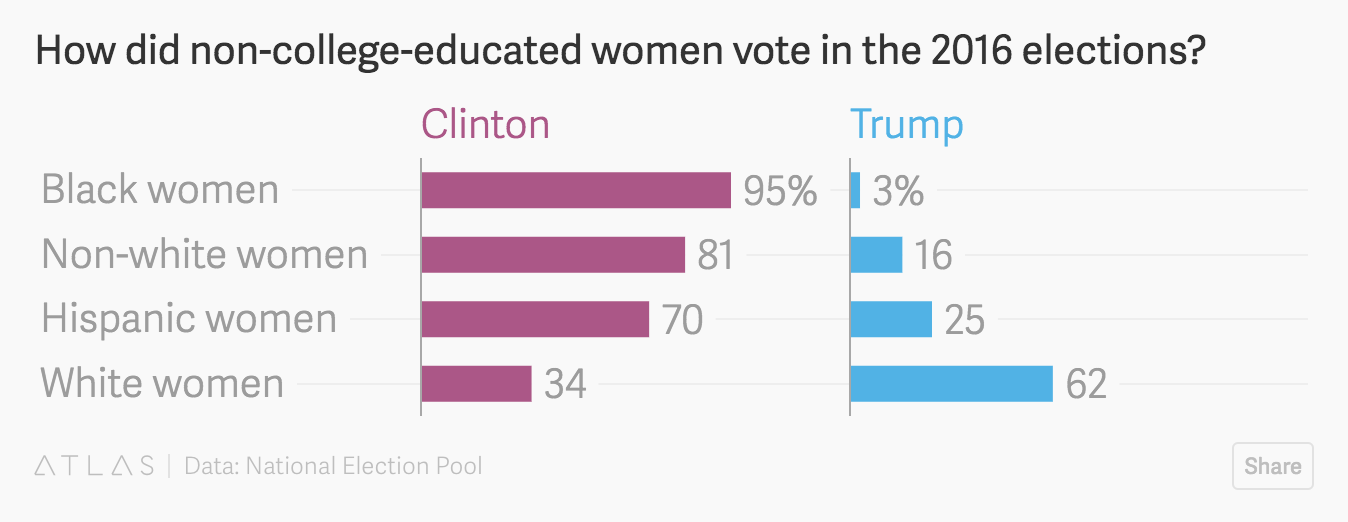
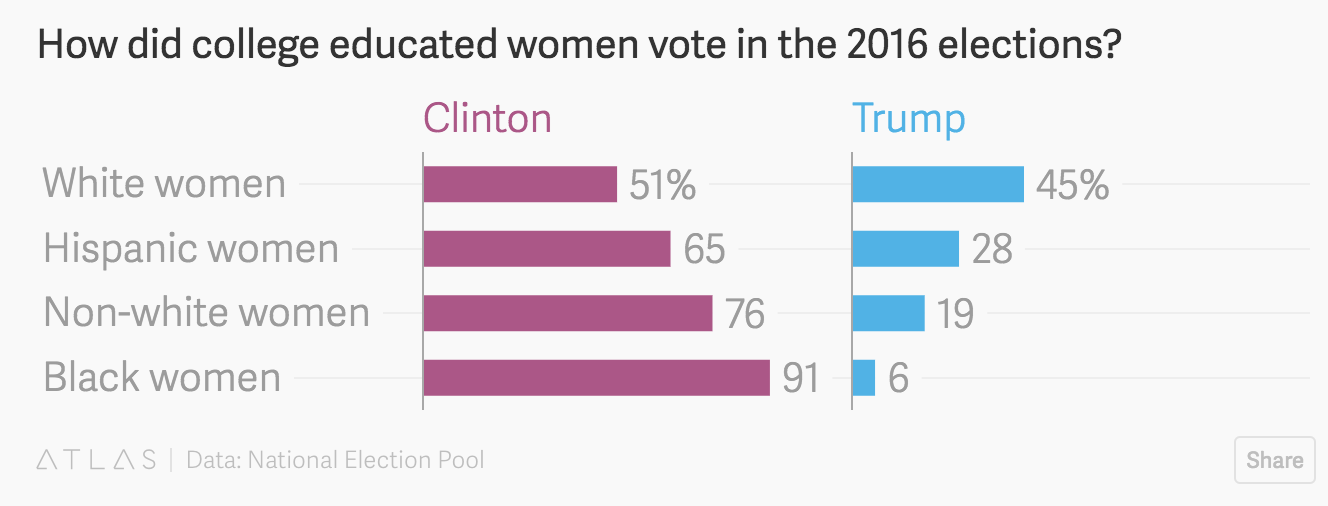
As expected, Trump did best among white voters without a college degree, beating Clinton by the enormous margin of 72 percent to 23 percent. Trump also won among white, non-college women 62 to 34 percent and white college-educated men, 54 to 39 percent. Among white voters, Clinton only won among women with a college degree by a 51 to 45 percent margin. Interestingly, among white voters, there is no evidence in the exit poll that income affected the likelihood that they supported Trump.

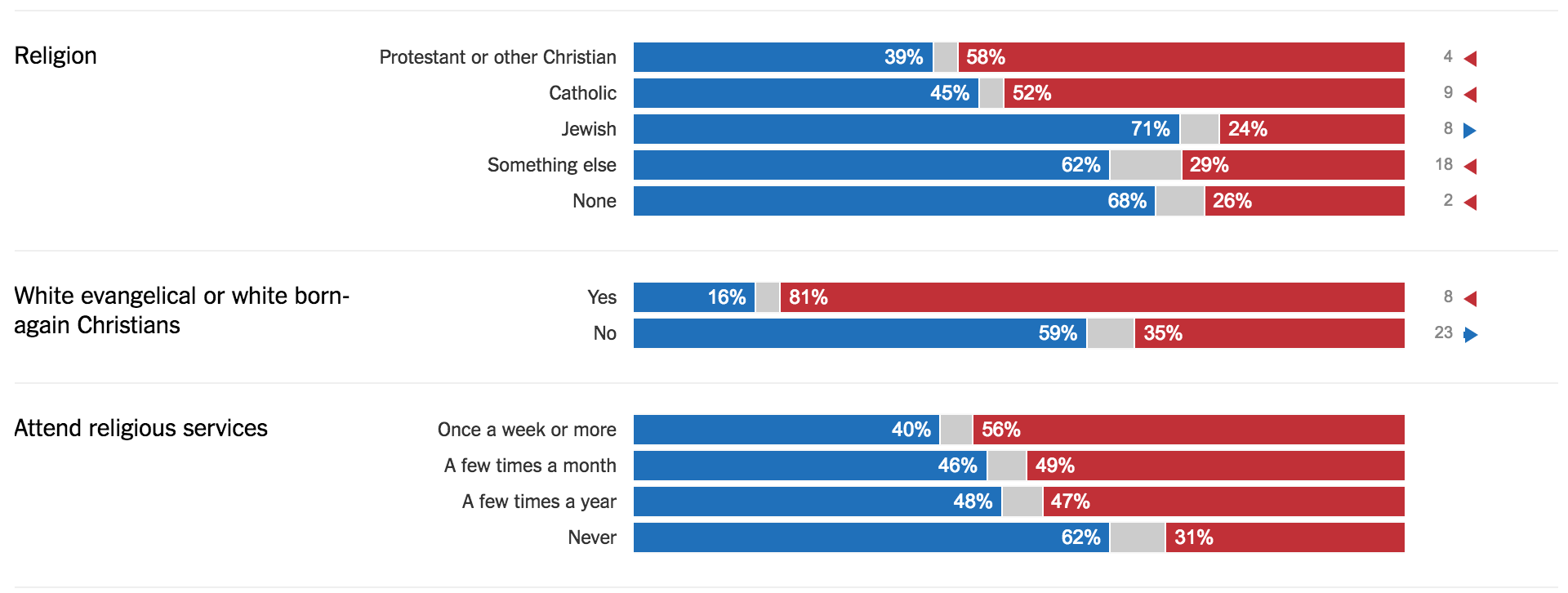
The conventional wisdom being promoted by whitewashed mainstream media is that the working and middle class have been abandoned by Democrats and the U.S. government; yet, exit polls show that the two lowest income categories chose Clinton by a slim majority (certainly skewed, however, by people of color over-represented in these groups, revealing how the media is mostly worried about “working class” and “middle class” only as that relates to whites):

Both sets of exit data from CBS and NYT, then, suggest that Trump’s support has more to do with race than disgruntled working class whites being ignored and disenfranchised.

Actually, mainstream media has its argument backward because Trumplandia confirms that white America has abandoned commitments to equity for all—not that any political party or the U.S. government has abandoned white America.

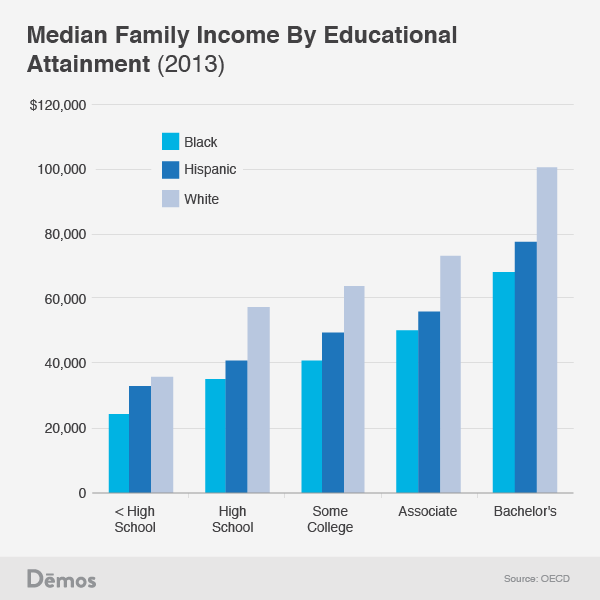
The problem with the hurting working/middle class white argument is that this is racially inequitable America:

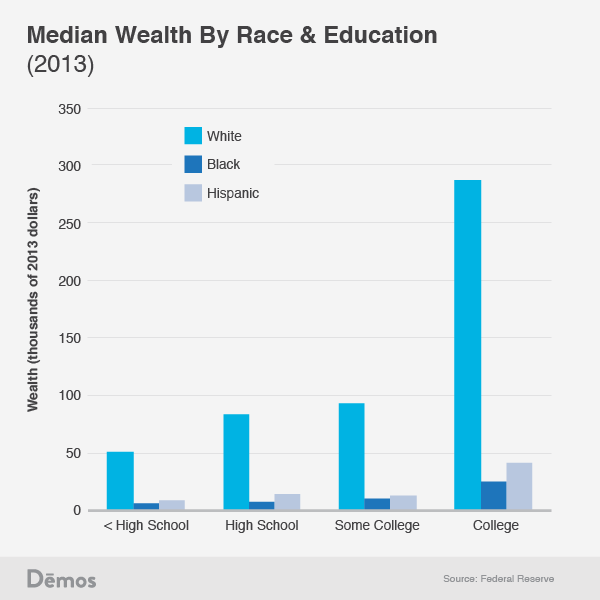
And this is racially inequitable America:

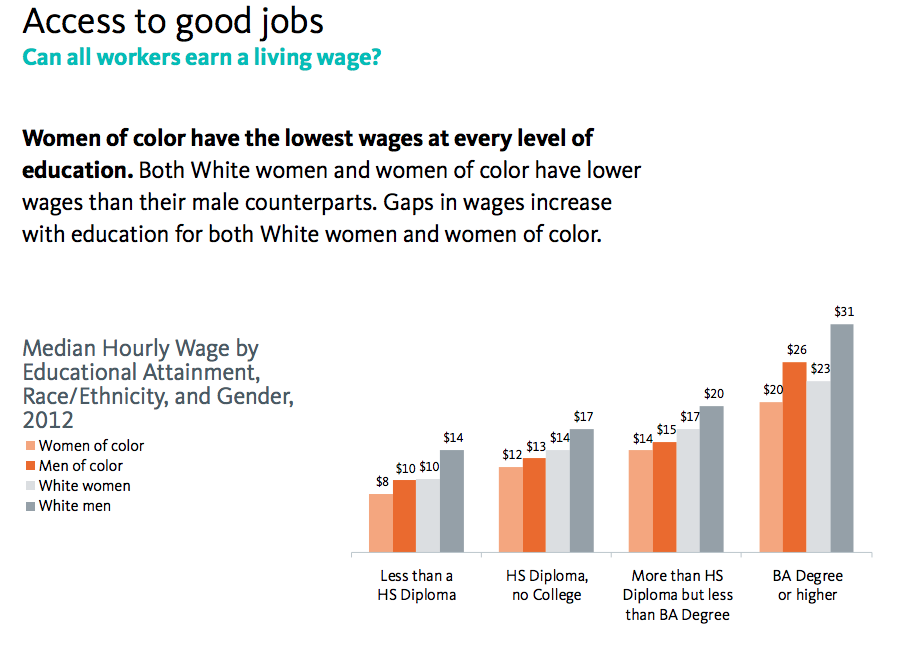
The America where race and gender create exponential inequity:

As a powerful contrast to the white male and female support to Trump, note that black women were by far least likely to vote for Trump—and they have the greatest reason to be disenfranchised (the lowest wages at every level of education, above):

The ultimate problem with the suffering working and middle class white argument for Trump’s rise is twofold: (1) white suffering may exist, but by comparison to black/brown suffering and gender suffering, white suffering remains relatively less significant, and (2) if whites are hurting, that fact should have spurred solidarity with historically marginalized groups, not the antagonism being heard from white America.

If white America ever really believed in the melting pot, believed in a country of immigrants, believed in equity for all, that may have existed in some distant and idealized past when white America saw that pot melting disparate whites into one homogenous white: equity for all who look like us (white).

Trumplandia is a white response (whitelash), not from working and middle class suffering, but against rising demands by oppressed groups (#BlackLivesMatter, Colin Kaepernick, gender neutral restrooms, marriage equity, immigration reform, etc.) for equity for all.

The only thing whites are poised to lose is their unearned privilege, but the rise of white support of Trump confirms that whites see their privilege as more important to preserve than equity for all is to attain.

“Make America Great Again” is slogan-as-code for maintaining white (and male) privilege.

#

In the tumultuous world faced by Marvin Gaye—especially war torn—he sang:

But who really cares?
Who’s willing to try?
To save our world
To save our sweet world
To save a world
That is destined…to die

Trumplandia is a defiant “Not us” from white America—and efforts to whitewash that callousness as economic angst is further proof that the dirtiest word in the U.S. to utter is “racism” because of the delicate sensibilities of the most powerful people in the country.


[1] Matthew 19:24: Again I tell you, it is easier for a camel to go through the eye of a needle than for someone who is rich to enter the kingdom of God.

“History proves that the white man is a devil”

The public career and life of Malcolm X are fraught with contradictions and controversy—often complicated by the Nation of Islam and its discredited leader Elijah Muhammad.

Malcolm X’s infamy—as it contrasts with the idealizing and misrepresentation of Martin Luther King Jr. as a passive radical—lies often in his sloganized “By any means necessary” and “History proves that the white man is a devil.”

While Malcolm X himself confronted some of his more controversial and confrontational stances, in 2016, the U.S. is faced with the prescience in what seemed to be hyperbole and racial anger; however, there is much to consider about the evil capacity often behind the face of white men.

Living just across the highways from my neighborhood, Todd Kohlhepp has confessed to vicious murders after police found a woman chained in a storage container for two months.

Kohlhepp represents to a disturbing degree the classic profile of serial killers and sex offenders, central of which is being a white male.

At the University of Wisconsin:

The 20-year-old student, Alec Cook, has been arrested and appeared in court on Thursday, charged with 15 crimes against five women, including sexual assault, strangulation and false imprisonment. His modus operandi, according to police and prosecutors, was to befriend fellow students and eventually entrap and viciously attack them, while keeping notebooks detailing his alleged targets.

Kohlhepp and Cook, white males of relative affluence, are no outliers. Yet, political leaders and the media persist in characterizing for the U.S. public much different images of who to fear: Mexicans, black males, Muslims.

Daily violence—including sexual aggression and assault—is a real threat in a way nearly opposite of these political and media messages; each of us should fear people who look like us, and family, friends, and acquaintances deserve nearly equal scrutiny.

Political race-baiters and the mainstream media rarely stray from the black-on-black crime message, but also always fail to add a key fact: crime is almost entirely intra-racial as the white-on-white crime rate (86%) is nearly identical to the black-on-black crime rate (94%).

Malcolm X’s rhetoric may still seem inflammatory, but James Baldwin’s more measured charges confront the same racial masking and tension:

White Americans find it as difficult as white people elsewhere do to divest themselves of the notion that they are in possession of some intrinsic value that black people need, or want. And this assumption—which, for example, makes the solution to the Negro problem depend on the speed with which Negroes accept and adopt white standards—is revealed in all kinds of striking ways, from Bobby Kennedy’s assurance that a Negro can become President in forty years to the unfortunate tone of warm congratulation with which so many liberals address their Negro equals. It is the Negro, of course, who is presumed to have become equal—an achievement that not only proves the comforting fact that perseverance has no color but also overwhelmingly corroborates the white man’s sense of his own value.

White men control the political and media narratives, and thus, white males are bathed in the compassionate light of the white male gaze of power—everyone else becomes the feared Other.

The hatred spewed by Donald Trump is not solely what should be feared in this context, but that he personifies and speaks to “the white man’s sense of his own value” that seeks to erase that Other, as Astra Taylor reported from a Trump rally in North Carolina:

A few months ago Trump had rallied in Wilmington, North Carolina, the site of America’s only and largely forgotten coup. In 1898, in the waning days of Reconstruction, rioting white supremacists overthrew a multiracial progressive “fusion” government, deposing democratically elected leaders of both races and killing black citizens mercilessly. After that, populism in North Carolina, as in the South more broadly, was a white affair. At his rally near the site of that historic, shocking savagery, Trump suggested “the Second Amendment people” do something about Hillary.

The Trump narrative is essentially racist, and almost entirely false, Jason Stanley explains:

The chief authoritarian values are law and order. In Trump’s value system, nonwhites and non-Christians are the chief threats to law and order. Trump knows that reality does not call for a value-system like his; violent crime is at almost historic lows in the United States. Trump is thundering about a crime wave of historic proportions, because he is an authoritarian using his speech to define a simple reality that legitimates his value system, leading voters to adopt it. Its strength is that it conveys his power to define reality. Its weakness is that it obviously contradicts it.

And thus, Trump has public support from the KKK and Nazi groups for a reason; and that support is distinct from public support for any of the other presidential candidates, none of which draw hate groups into the light.

In A Dialogue between James Baldwin and Nikki Giovanni, Baldwin argues, “The reason people think it’s important to be white is that they think it’s important not to be black”:

It’s not the world that was my oppressor, because what the world does to you, if the world does it to you long enough and effectively enough, you begin to do to yourself. You become a collaborator, an accomplice of your own murderers, because you believe the same things they do. They think it’s important to be white and you think it’s important to be white; they think it’s a shame to be black and you think it’s a shame to be black. And you have no corroboration around you of any other sense of life.

Yes, we must be vigilant about the white gaze and the male gaze, both of which, as Baldwin witnessed, corrupt the agent and object of that gaze, but we must be as vigilant about the white male accusatory finger designed to keep everyone else’s gaze somewhere other than where the most power, and too often, the most evil reside.

The False Cult of Effort, the Gender Gap, and K-12 Teacher-Bashing

While the U.S. presidency is rarified air, the presidential election often reflects the best and worst of the American character.

As the country sits in the cusp of the end of the first black president’s administration and the likelihood of electing the first female president, what does the current election show about the lingering privilege of being white, male, and straight in the U.S.?

Being black, brown, female, gay, or transgender requires perfection while being white, male, and heterosexual allows any transgression to be excused.

Hillary must be perfect (her email controversy is oddly identical to millions of erased emails from private servers under George W. Bush, although that is of no real concern to the public or the media, for example), but Trump’s admitted behavior as a sexual predator is swept aside as just a man being one of the boys.

Yes, the glorious sanctity of the office of president must not be sullied—although the Republican Party has elected Richard Nixon, Ronald Reagan, and W. Bush, a who’s who of unethical personal and political behaviors?

And in this dynamic of privilege we find the cult of effort—the implication that all these powerful white males are in power because of effort, because they deserve the success, earned the success.

Recall that Trump built this off the pittance of an inherited few million. …

On a smaller scale, then, is the K-12 teacher, a profession trapped in the cult of effort and the gender gap.

Having spent my career in part as a K-12 public school teacher and now as a tenured full professor, I have witnessed first-hand a powerful and ugly dynamic.

First, let me work backward.

My university has only about 30% female faculty, which reflects a male norm (linked with a white norm) of university professors:

profs-gender

Few professions have greater professional autonomy that being a professor. I can assure you that rarely do people even bother telling a professor what to do—and among those few, virtually none have any real influence.

The profession of being a professor is a white, male world of autonomy and significant prestige.

As above, there is also a false cult of effort among professors—the professorate, so goes the message, is mostly white and male because of the hard work of those white men.

And if you doubt that, listen carefully to the white male response to initiatives for increasing the diversity of professors: We must maintain our rigorous standards for hiring! they shout.

The cult of effort, the cult of rigor—these are codes for maintaining privilege.

The inverse of this dynamic is at the K-12 level of teaching, a work force still dominated by women:

k-12-teachwrs-gender-2

For K-12 teachers, historically and especially over the past two or three decades, the cult of effort has imposed on the American public that schools are failing primarily because of a slack teacher force (read: a mostly female teacher force), and the way to reform that lazy work force is to raise standard! and demand more!

Let us imagine for a moment that gender divide between the supreme autonomy of mostly male professors and the nearly absent professional autonomy and ridiculous accountability leveled at mostly female K-12 teachers.

The entirely inexcusable “no excuses” model implemented in high-poverty schools serving mostly black and brown students has also become the default environment of being a K-12 teacher: high demand, nearly superhuman demand that erases all professional autonomy and most of the human dignity of teaching.

Yes, teaching K-12 is very hard, but the cult of effort is mostly a lie, and the current high-stakes accountability paradigm is a central cause for driving away teachers.

The accountability era has intensified the historical marginalizing of K-12 teaching as just a woman’s profession; the stakes have been artificially increased while teacher autonomy has been even further eroded.

As a result, K-12 teachers have their work scripted and then are badgered for poor outcomes from the practices they didn’t even choose to implement.

The public and in-school environments for K-12 teachers are toxic—unprofessional and dehumanizing. Administrators who can go to the restroom any time they please demand teachers remain at their doors between classes and never leave a class unattended—relegating basic bodily functions to 20-minute lunch periods (if they are free of students) and planning time.

This reality cannot be disentangled from the gender gap reflected between professors in higher education and K-12 teachers—as well as the current presidential campaign.

K-12 teacher bashing is nested in sexism—assumptions that women are unable and unwilling to make the effort needed to educate children; and thus, K-12 teachers need to be scripted and held to high standards of accountability.

In the political and educational worlds, however, those demanding that accountability and driving the criticism are often far above the standards they espouse.

And that is the ugly truth about women, so-called racial minorities, and gay/transgendered people who must be perfect while white, straight men are forgiven for any and every transgression.

Our democracy suffers under that inequity of privilege and the profession of K-12 teaching is on life support because of the essentially nasty environment surrounding day-to-day teaching.

Democracy and K-12 teaching both require and deserve an atmosphere of patience, compassion, and kindness—traits marginalized by toxic masculinity and white privilege in order to maintain the unearned status of power in the U.S.

At the very least, no one should have to be perfect or everyone should have to be perfect.

Immediately, then, let’s confront how terribly flawed white, straight male leadership has been and is currently—disturbingly personified by Trump himself.

Next, the false cult of effort must end, replaced by the acknowledgement of privilege as central to who has power and why.

With the false cult of effort unmasked, the gender gap can then be erased as well.

From political leadership to the teaching of children in K-12 schools, we will all benefit greatly from the rich diversity of who can and will lead and teach us—especially if that leadership and teaching are rooted in patience and kindness, especially if basic human dignity and autonomy are promised to all.

It’s Just How Men Talk—And That’s the Problem

In the friendly banter scene from Notting Hill, several men are sitting at a restaurant having a lewd and boisterous conversation about Meg Ryan and then Anna Scott, the fictional world-famous actress featured in the romantic comedy and who coincidentally is sitting out of sight but nearby with William Thacker:

The scene is intended to match the mostly humorous but semi-critical subtext of the film about the pressures of being a celebrated actress in Hollywood: being famous isn’t all it’s cracked up to be, especially if you are a woman.

However, the scene isn’t funny at all, but it is a reflection of how men talk—of the normalized culture all Western men have been raised in and tolerate and/or participate in, which is the male gaze and the objectifying discourse that is an extension of the male gaze.

This has allowed Donald Trump to brush off his 1995 hot-mic bragging about physical and sexual assault (we have no way to know if he is exaggerating, but he has never disavowed his story) as “locker room talk”—it’s just how men talk.

However, like much of the 2016 presidential campaign, allowing this excuse is yet more false equivalence.

Trump’s language and the behavior it represents are rape culture, not merely objectifying discourse from the male gaze.

This distinction proves to be as unsatisfying as the false equivalence because the male gaze/objectifying discourse as normal is the context within which rape culture thrives.

Many men sit just as the men in the Notting Hill scene do—with a jovial tone no less—sexualizing women, especially women who are famous, and women who dress in a way that men have deemed sexual.

The male gaze and the objectifying discourse grounded in that gaze, probably, rarely extends to assault—but even among men who consider themselves good people, many men, if not most men, have also coerced sex with women they considered just an opportunity for sport sex, a one-night stand, and even with significant others, lovers, and spouses.

And even among men who consider themselves good people, many men, if not most men, have also made women feel uncomfortable, threatened, because all women live with the prevalent awareness of not only the male gaze but the capacity for male physical and sexual aggression.

And thus, it is a real but ultimately pointless line between “friendly banter” (male gaze, objectifying discourse) and rape culture because it isn’t a line; rape culture is a very real and very horrible subset of friendly banter.

As in all situations within which some have power over others, it is the responsibility of men to confront and end both the male gaze/objectifying discourse and rape culture.

Those men who participate cavalierly in the male gaze and “friendly banter”—most if not all men—have an urgent responsibility to name and reject the uglier rape culture represented with disgusting glee by Trump and by serial celebrity rapists such as Bill Cosby.

But men must also begin to disassemble the falsely characterized “friendly banter” culture as well.

It is entirely valid for those men who believe themselves to be good men to claim they are not Trump, his bravado and predatory behavior are not them, and to admit their own culpability in the culture that has bred and allowed Trump and other predatory men to exist.

Trump’s language and predatory behavior—that is not just how men talk and act, but in the grand scheme of things, that distinction really doesn’t matter because how men talk does create a world in which women’s lives too often do not matter beyond their being objectified, sexualized, and reduced to their relationship statuses.

Most men, I hope, do not want to be or be considered a monster, a predator. Trump has outed himself as a predator, a part of rape culture, an active and cavalier aggressor.

Among many other examples, these facts of his true self disqualify him for being a serious candidate for any credible position in society.

Men must and can distance themselves from rape culture, but that must not be used as a shield for the many ways in which men are uncritical and unconscious participants in the male gaze and “friendly banter.”

Yes, it is urgent for everyone to reject rape culture, and the newest face on that, Trump, but it is well past time to admit that the male gaze and objectifying discourse strip women of their human dignity and sully every man’s humanity as well.


See Also

Emily Ratajkowski: Baby Woman

Deplorables Unmasked

Something deplorable happened on the way to claiming the U.S. is a Christian nation of free people where everyone regardless of race, creed, religion, or gender has the same opportunities at life, liberty, and the pursuit of happiness.

And it wasn’t Donald Trump. Or better expressed, it wasn’t only Donald Trump.

Once Trump secured the nomination for president of the Republican Party, many scrambled to caution about condemning Trump’s supporters, not painting them with too broad and negative a brush.

Especially in the mainstream media, few, nearly none, would venture to utter words such as “racist,” “sexist,” “xenophobe,” or even “lie.”

Trump and his running mate have skated along literally piling lies on top of lies—including lies about not saying provable things, including Trump opening his most recent apology with lies.

But what is truly deplorable is Trump both represents and has unmasked the ugly truth about the U.S.: we are a nation of deplorables, not as outliers, but as a substantial population of our country.

As I was driving down I-85 in South Carolina on the morning after the suddenly shocking* recording of Trump being exactly who he has always been, I saw a large, black SUV in front of me with this bumper sticker:

deplorable

It has become conventional wisdom to brush off Trump’s obnoxious bravado as part of his reality show persona, while adding that his supporters are more nuanced in their support for his candidacy.

But the harsh truth is that Trump is deplorable and so are his supporters—and so are many so-called decent Americans.

Cliches become cliches often because they are true, and one truism seems quite important at this moment: when someone shows you who they really are, be sure to pay attention.

And people often reveal who they really are when they think they are in private, when they think they are among their own kind.

Men hanging out with other men often sound like the Trump comments being rebuked now as if this isn’t common language and attitudes.

Having been born, grown up, and now living in the South, I can assure you when whites are in seemingly safe environs, the racism rears its ugly head in subtle and blunt ways.

But it is even worse than that.

Now that we have yet more evidence of who Trump is, who his enablers are, the carefully prepared political backpedaling tells us just as much as any hot mic:

“I am sickened by what I heard today,” [Paul] Ryan said through a spokesman, about five hours after The Washington Post published a 2005 recording of Trump boasting of groping women and trying to have sex with a married woman. “Women are to be championed and revered, not objectified. I hope Mr. Trump treats this situation with the seriousness it deserves and works to demonstrate to the country that he has greater respect for women than this clip suggests.

Gross, pig sexist being chastised by his more well-groomed but equally clueless sexist—as part and parcel of who the Republican Party has always been, as part and parcel of who many in the U.S. remain to be:

When Trump vilified Mexicans and Muslims, when Trump repeatedly stirs racism and caters to openly racist groups, the mainstream political response remains trapped in respecting human dignity only by close association—currently the hot take in the mainstream press is to speak with reverence about mothers and daughters.

A people has no moral compass, no ethical grounding if the only way anyone can respect human dignity is by association.

If you have to know or be related to people with other statuses than yours to care about their human dignity, you are deplorable.

Some may now try to burn at the stake the Frankenstein’s monster, Donald Trump, but to do so without acknowledging Dr. Frankenstein is misguided and shallow political theater.

Trump as bogus billionaire entrepreneur, as con-man reality star is the white male prototype of what it means to be an American: America built this.

And, as much as we wish to deny it, we are America.

The America who tells Colin Kaepernick not to sully our sacred football with politics—while failing to see that opening every football game with the National Anthem is political.

The America who responds to #BlackLivesMatter with All Lives Matter—while refusing to admit that guns matter more than any lives.

The America that polices how some people raise their fists—while “land of the free and home of the brave” proves to be false on both counts.

Something deplorable happened on the way to claiming the U.S. is a Christian nation of free people where everyone regardless of race, creed, religion, or gender has the same opportunities at life, liberty, and the pursuit of happiness.

Something deplorable is right there in the mirror.


* One must ask, I think, why now? See More Than 150 Republican Leaders Don’t Support Donald Trump. Here’s When They Reached Their Breaking Point.

Misogyny 2016

No, this isn’t the easy blog attacking Donald Trump as a misogynist.

In fact, the warranted attacks on Trump’s many flaws are often incomplete by omission: Trump’s racism, xenophobia, Islamophobia, misogyny, et al, are ours.

But the presidential race has exposed misogyny 2016:

And let us not ignore the misogyny and sexism in how Hillary Clinton is portrayed and vilified.

Bates, I believe, sums up the mess perfectly in her closing:

To tear down wives and daughters as if they are empty vessels of family honour is dangerous and demeaning. But it also distracts us from the real issues. Most political men offer ample opportunities for criticism, all by themselves.

In many, too many, ways, the Trump monster is the ugly manifestation and reflection of who we are. In our finger pointing, let’s recognize how many fingers are turned back at us.

The Everyday Crimes of Race and Class

Consider carefully the U.S. when children were subjected to horrific labor.

Were the children culpable for that abuse? Did children have the physical or political power to end the abuse?

Or were the adults responsible—the only agents of that process capable of ending child labor?

These may seem to be silly questions with obvious answers, but when racism, classism, and sexism are confronted in the U.S., many shift the accusatory finger to the victims, calling for the victims themselves to right the wrongs leveled against them.

Black and brown people in the U.S. did not create racism, do not perpetuate racism, and cannot end racism. Poor people do not cause poverty, and despite what pandering conservatives believe, cannot “think [their] way out of poverty.” And women are not the cause of rape culture, inequitable pay, and domestic abuse; they cannot end them either.

Change ultimately lies with those who have power—physical, political, financial, ideological.

And there isn’t a damn thing fair about who has power in the U.S.—or who does not.

And while the U.S. has mostly eradicated child labor through laws, we are still confronted with Tamir Rice—a boy, a child shot and killed by a police officer sworn to protect and serve.

Tamir Rice was a child.

For the most part, those people with power don’t give a real damn about Rice’s tragic story. There is some passing rhetoric, but there is no action to prove otherwise.

Philando Castile lies before us now. His tragic story also means almost nothing to those with power, but the lessons are dark and powerful:

“What Mr. Castile symbolizes for a lot of us working in public defense is that driving offenses are typically just crimes of poverty,” says Erik Sandvick, a public defender in Ramsey County, which includes St. Paul and its suburbs….

Nicole Gonzalez Van Cleve, a professor in the Department of Criminal Justice at Temple University and the author of Crook County, which documents the problems in the criminal justice system of Chicago, said Castile was the “classic case” of what criminologists have called “net widening,” or the move of local authorities to criminalize more and more aspects of regular life.

“It is in particular a way that people of color and the poor are victimized on a daily basis,” Gonzalez Van Cleve said.

Rice and Castile were criminalized—rendered by the mere facts of race and class.

Being black or brown, poor, or female are burdens from which people cannot take a vacation. Because of systemic racism, classism, and sexism, the condition of scarcity “leaves citizens with no good choices — having to pick, for instance, whether to pay a fine or pay for car insurance,” as Castile represents.

Interpreting Tamir Rice as older than his age and violent, dangerous was nested in the police officer—not Rice.

That officer was an agent of systemic racism that justifies excessive use of force, racial profiling, and a whole host of criminalizing practices by the state.

From school-based discipline polices to zero tolerance, we have ample evidence that formal schooling creates criminals in the same ways policing creates criminals in some neighborhoods (read poor and black, brown).

But as we ignore the tragic stories and lessons of Rice and Castile—among so many others—we also ignore who controls the game.

One day, marijuana possession and sales are crimes, and then, the next, marijuana possession and sales are good ol’ business. In the first case, criminalizing disproportionately black and poor people, and in the second case, making monied white folk wealthier.

There is nothing inherently right or wrong about using or selling marijuana; only who controls the right and wrong matters.

Racism targeting blacks in the U.S. suggests the problems lie in blacks themselves. Classism in the U.S. blames laziness among the poor for poverty. Sexism deems women inferior to men and the cause of their own sexual abuse.

All of this, however, is as obvious as the opening questions.

Brock Turner—privileged, white, and drunk—and Judge Aaron Persky—white, male, and drunk on privilege—are the problems to be addressed.

The even uglier reality is that the power to admit these problems of white privilege and to do something about it rests in people just like Turner and Persky.

The Butthurt Right, Or, An Outbreak of the White-Man Vapors

…so feared by a patriarchal world…

Audre Lorde

But their remedies do not cure the disease: they merely prolong it.
Indeed, their remedies are part of the disease.

Oscar Wilde, “The Soul of Man under Socialism”

Let’s start with a fact that few are willing to acknowledge:

Despite endless debates between and about the Right and the Left in the U.S., there is no substantial Left in the U.S.—a country that is solidly right of center and distinctly so when compared to Canada or European countries with a vibrant Left.

The U.S. Left is Obama and the Clintons—neoliberals who nudge at the left edge of capitalism and a country in perpetual war.

The U.S. Left is a sort of polite progressivism of rhetoric that sees almost no fruition in action of any kind.

The U.S. Left is a compromising incrementalism that sustains the disease; it is Tyrion.

The U.S. Left meekly raises it hand and whispers: “Might we consider how we could be a tad bit less sexist, racist, and homophobic—and if that isn’t too much trouble, a little less violent?”—before shrinking away for fear of the response.

And those whispers—or God forbid a direct shout—are met with what we have now in the U.S., a newly butthurt Right, an outbreak (dare I say “epidemic”) of white-man vapors.

Nicholas Kristof—nice-guy, cardboard “progressive”—thinks the nasty Left in the U.S. has excluded the Right from academia (and we all know how powerful academia is in the U.S., right? nudge nudge), and the education reform movement (a bi-partisan assault on public education that is entirely a rightwing enterprise) is all atwitter because of the contentious Left/Right divide (Gosh, they are fuming, if those nasty BLM folk don’t settle down, all the Righties will flee the reform movement!).

All of this butthurt on the Right is very much reflected in both the rise of Trump in the wake of Black Lives Matter and the silliness of Kristof and edureform butthurt.

The white-man vapors are triggered by Michelle Alexander’s relatively moderate confrontation of the New Jim Crow, the polite left-of-center Ta-Nehisi Coates, and the Norman Rockwell Obama family just as they are accelerated by BLM, Cornel West, and Supreme Court Justice Sonia Sotomayor.

And the butthurt messages come from faux-progressives (Kristof) as much as they come from the rabid Right—political leaders, religious leaders, and law enforcement publicly stating that gays slaughtered in Orlando deserved the massacre or calling on gun owners to shoot black protesters at Trump rallies and the Republican convention.

The polite and articulate butthurt punditry on the Right, like Michael Petrilli trying to shame BLM for having the audacity to name racism “racism,” is very little different from the bully racism of Trump; in fact, they are an inseparable part of the U.S.’s conservative nature reflected in the necrophilic South.

In fact, the U.S. once chided the South for its backwardness, its illogical Bible thumping and gun toting, but we stand today in a U.S. where the essence of the entire country is just like that South.

The white-man vapors are upon us, but we must not fall prey to the same-old faux-liberal solution to yelping Rightwingers; we must not shrink against the fears of the most powerful people in the country who see their ill-gained fortunes and power slipping away.

No, the butthurt Right is a sign that women, black and brown people, the LGBT+ community, and people of all faiths and nationalities are demanding to be heard, are standing on the right side of history, which is ironically on the Left.

Higher education does not need a diversity of thought that includes traditional bigotry, misogyny, and a blind faith in disaster capitalism.

And let’s hope the neoliberals (self-identified as both Right and Left) throw up their hands and exit stage right the education reform movement—which has rained terror on the vulnerable populations of students who need our public schools the most.

James Baldwin wrote in The Nation (July 11, 1966), “The law is meant to be my servant and not my master, still less my torturer and my murderer.”

He was naming racism “racism,” both in the acts of specific police officers and as a systemic reality of the U.S. codified in the judicial system.

Baldwin was not being impolite. He was not ostracizing the Right or shaming white male patriarchy.

Baldwin was speaking necessary truth to power—and it resonates to this day because the butthurt Right slips into the vapors every time they are held accountable for the wreck of the ship they built and captained.

The barely audible Left in the U.S. has pushed the door slightly open to the House White Male Privilege built.

The owners are clutching their pearls as they lean against that door chastising the intruders to please simmer down.

We must not step back. We must push the door open, throw out the Masters, and start anew.

Drowning

The boot in the face, the brute
Brute heart of a brute like you.

“Daddy,” Sylvia Plath

When people declare “He literally lost his mind” or when TV and radio ad after ad announces “Not available in all states,” I cringe because the chosen phrasing makes a claim that is opposite of what is intended.

As a writer and English teacher, I am possibly more attuned to language than the average person, but I also recognize that careless language is often related to careless thinking—the words and phrasings we choose and use have a symbiotic relationship with how we frame and view the world.

As a chronically anxious person, I recognize that language is one way in which I can negotiate with my anxiety—write about it or simply have someone with whom I can share the intricate details of my irrational self.

Writing and talk—language—help me recognize through naming what I am facing; language is liberating, I believe, because it is essentially human.

Without language, with our language monitored, or with our language censored, our voices silenced, we are rendered less human; as Arundhati Roy has explained, “We know of course there’s really no such thing as the ‘voiceless’. There are only the deliberately silenced, or the preferably unheard.”

And so I find myself turning to language—reading, writing, and talking—when faced with the monstrosity of the Brock Turner rape case, a calloused boot in the face once again entrenching the power of privilege over basic human dignity—both racialized and genderized.

The most powerful words I have found about this act of violence and miscarriage of justice have been about words themselves:

rape

From this, my mind raced to Stevie Smith’s poem “Not Waving but Drowning,” in part:

Nobody heard him, the dead man,
But still he lay moaning:
I was much further out than you thought
And not waving but drowning.

The coincidence of the word “drowning” is bolstered by this poem’s message about communication; this is a darkly ironic poem, prompting an uncomfortable smile about the dire consequences of misreading a desperate person’s efforts to be heard, to be recognized.

Codified by the criminal justice system, represented by a judge, Turner’s raping of an unconscious woman has been deemed about how this act of violence impact’s Turner’s privileged life.

His rape victim conveniently marginalized—she is a real-world parallel of the dead man in Smith’s poem, her humanity resting on her own words of rebuttal to the miscarriage of justice spawned by the fraternal bond between two Stanford males.

Like the rape victim in Adrienne Rich’s poem, Turner’s victim has been assaulted twice; Rich’s victim realizes the assault has rendered her victim and criminal:

…You have to confess
to him, you are guilty of the crime
of having been forced.

Turner’s victim has been pronounced less than Turner—the consequences of his violence more important for him than for her, the judgment asserted.

Sexism, like racism, is systemic—both the result of individuals and an essential element of the collective, how the system works.

So it may appear merely academic to focus on words, how we talk about this world.

But it isn’t trivial at all.

We must begin to dismantle a dehumanizing culture by naming that which is dehumanizing. We are confronted by the fact that there is only sex or rape just as we know there is only swimming or drowning.

Words matter, and basic human dignity is not waving to us on the shore; it is drowning, and we aren’t paying attention.