
Category Archives: sexism

Doubling Down (Again) on the White Man’s World

A decade ago, I was confronted with an incredibly uncomfortable situation when my first-year English class overwhelmingly believed the Duke lacrosse team was innocent and the woman accusing them of sexual assault was fraudulent.

There was a significant mixture of irony in the tension resulting from my trusting that the class—atypically majority male at a university consisting of mostly privileged and white students—was biased by their collective and individual privilege as that conflicted with the eventual revealing that the Duke lacrosse team was in most ways innocent (although I would argue that is a simplistic conclusion supported by technicalities of law): the irony, of course, being that I—white, male, and privileged—was proven wrong about my claims of the U.S. being, in the language of today, a country in which white male lives matter most.

Just this May, another class included, again atypically, about a third black students, some of whom were eager to argue for corporal punishment and then several of the black male students felt compelled to speak up for males wrongly accused of sexual assault.

At that, I asserted that in the U.S. today it remains easier to be a male wrongly accused of sexual assault than to be a woman actually raped or sexually assaulted.

But I could not have anticipated both the Baylor University scandal and then the Brock Turner rape judgment and sentence, which has been followed by a disturbing pair of commentaries by Turner’s father and a female childhood friend.

The light sentence of Turner, by a judge who like Turner attended Stanford University, was justified because of the consequences this rape would have on Turner’s life. Turner’s victim has rebuked this decision in her own statement.

Both the Turner sentence and the Baylor scandal returned me to my examination of The Martian, an unintended allegory of the hyperbolic concern in the U.S. for the white male at the expense of women and people of color.

Having been raised in the sexist and racist South, I have spent my adult life—going on four decades—working against my privilege and learned bigotries.

I am aware of and fearful of whitesplaining and mansplaining, the white gaze and the male gaze in every interaction I have in both the real and virtual worlds. I shudder to think, on social media especially, how often I creep toward the line crossed by vicious male trolls, how often women and people of color see in my words the very things I abhor.

As a writer, I am hyper-aware that my one-more-white-man’s voice is crowding out space for women and people of color; we simply do not need more white male perspectives.

As a scholar and academic, now full professor and tenured with a significant body of published works, I am equally hyper-aware I continue to do the same in academia.

Much of my work has been devoted to calling out racism, but I have also addressed misogyny and mansplaining often. In both cases, I have tried to confront the inevitable “yes, but” from men and whites.

But I look at the one picture of Turner, and I see me—white male. I think about the judge in the case, and I am among the disproportionate number of white males in power in the U.S.

What woman would trust me, especially from a distance? Why would black and brown people believe my solidarity?

And while I am writing about me, this is not about me; this is about the daily doubling down in the U.S., proving that white male lives matter most—and the corrosive consequences for everyone.

That fact—the light sentence for Turner, the failure to hold police officers accountable for taking black lives—sustains a hostile world for everyone; we are pitted daily against each other because the greatest threat to power is solidarity.

I will continue to name misogynyracism, and child abuse—even as that work pushes my voice farther the margins.

As a privileged white male, I am insulated enough that I can offer these observations that remain mostly about my own minor inconveniences that are devastating realities for vulnerable populations and people oppressed because of race, gender, sexuality, or age. As a privileged white male, I seek to use my privilege to eradicate privilege.

But most of all, my greatest act of solidarity remains my role as a student—I listen, I read, I heed.

And even then, I fall short.

I have failed enough women, children, and people of color to last a dozen life times—and “I’m sorry” seems trivial against that.

White male privilege has created a vicious world that needs to be dismantled, and in its place, we must imagine something better, a world brought forth from the mouths and minds of those rendered less human and thus more aware of the beauty and grandeur of being human.

As Adrienne Rich offers, “the sea is another story/ the sea is not a question of power.”

Most people know “Power tends to corrupt and absolute power corrupts absolutely,” but the Turner verdict and sentencing remind us of what Lord Acton offered next: “Great men are almost always bad men.”

Daily, this is proven true as we watch white males double down again and again on white male lives mattering most.
How Good Is the Best Edujournalism?

A recurring theme running through my blog posts—one that could be addressed daily—is that education journalism is almost always significantly misleading and way too often completely inaccurate.

Mainstream media and journalists are trapped in false but compelling narratives about schools, learning and teaching, children, poverty, and race. Journalism itself fails education as a field because of a simplistic “both sides” to a rather cartoonish “objective” journalism.

As I have detailed too often, media coverage of education includes primarily voices and perspectives of people with no or very little experience or expertise in education, but when a few contrary perspectives are offered, those are typically framed as “some critics”—with no effort to establish which claims are credible or not.

Sadly, the best unmasking of the essential failure of the media has been by one of our faux-media comedians, John Oliver, who highlighted that even if there are two sides to an issue, one can be overwhelmingly credible while the other is mostly baseless; therefore, placing them as one-versus-one misleads the public on the weight of the arguments.

So when I received yet another email from the Education Writers Association (EWA)—who is extremely proud of itself—announcing their top award for education reporting, I wondered: How good is the best edujournalism?

The EWA Fred M. Hechinger Grand Prize for Distinguished Education Reporting was awarded for Failure Factories (The Tampa Bay Times), written by Cara Fitzpatrick, Lisa Gartner and Michael LaForgia. The series includes the following:

Without question, this series is comprehensive and it confronts some incredibly important issues about public schooling: the significant relationship between race/poverty and student achievement; the plague of segregation and resegregation in public institutions such as schools; and the huge inequities of education faced by racial minorities and impoverished students such as teacher assignments, school safety, funding, and discipline practices.

And while the series does a solid job of raising these issues, my first response is that these are all old news—I mean very old news.

That our public schools have failed poor and black/brown students is a recurring message over the last century—little different before or after the Civil Rights movement.

Therein lies a real problem with even the so-called best edujournalim—journalists without a historical lens afforded those with expertise in a field are ripe to fall prey to the lens of a novice.

One such failure of this series and then how the EWA praised the series can be found in the quoted judge’s comment:

Bravo to this team and the paper for taking an all-too-common story (low achievement in a high-poverty area) and digging past the excuses to reveal a shameful history of indifference and, most troubling, willful neglect. I was awed by the dogged reporting, the sheer volume of interviews and data-crunching, and the courageous analysis that put the blame exactly where it needed to be. But the true brilliance of this work is found in the stories of the children who were robbed of an education they deserved. How many other school districts in America might have the same story to tell?

The series title “Failure Factories” is but one of many triggers for the pervasive and ugly “no excuses” narrative that is all the rage in the U.S.

You see, once again, this series oversimplifies the story of educating vulnerable populations of students: racism and classism are merely excuses for the schools charged with high concentrations of vulnerable students.

And as the judge notes above, this is all about “blame”—and keeping the focus on those damn failing schools.

The shame is that without this corrosive and ugly framing, there is an incredible amount of work in this series that does deserve praise. We should be asking: Why do we need yet anther round of test scores to admit and confront race and class inequity—especially when high-stakes standardized testing itself is racist and classist?

The truth is that schools in the U.S. have never been, are not now, and never will be anything other than reflections of our society—unless we do things different in both our social and educational policy.

Yes, public schools almost entirely reflect and perpetuate the race, class, and gender inequities that remain powerful in our wider society, and much of that is embedded in the very reforms being championed in the media and among political leaders: accountability, standards, high-stakes testing, grade retention, zero tolerance policies, “no excuses” practices, charter schools, school choice, Teach For America, school report cards, value-added methods of teacher evaluation, and the worst of the worst—”grit.”

That is not simply a fact of the schools targeted by this series. That is a fact about public education across the entire country.

And many educators as well as education scholars have been yelling that for decades; that’s right—decades.

Possibly the most telling problem with the series is the end, where the condemnations of Arne Duncan and John King are treated as if they are somehow credible.

If this weren’t so tragic, it would be laughable—nearly rising to the level of an article in The Onion.

Therefore, here is a little message about the best of edujournalism.

Dear EWA:

Public schools have been reflecting and perpetuating the worst aspects of our society for over 100 years. People in power really don’t care, and politicians in the last three to four decades have learned that education policy is a powerful political football.

Since the Reagan administration, public schools have failed students even more significantly because of inane obsessions with accountability, standards, and tests.

Duncan and King are the personifications of all that is wrong with education policy: lots of soaring rhetoric masking policy cures that are part of the disease; thus, the accountability movement is intensifying race, class, and gender inequity—not overcoming it.

Racism, classism, sexism, and homophobia are never excuses, but facts, and these burdens are more than micromanaged and technocratic in-school only policies can address.

Yes, we need much more equitable school practices and polices—but none of what politicians are doing now meets those standards—and those alone will never accomplish what we seem to want without concurrent changes to public policy that also addresses equity.

Edujournalism, as well, is part of the problem because it remains trapped in false narratives, committed to simplistic “both sides” frames of issues, and unwilling to listen to the voices of the practitioners and scholars in the field of education.

Nearly everything addressed in “Failure Factories” was raised by novelist Ralph Ellison in a 1963 speech to teachers. Your best journalism is old news wrapped in a false frame and too often fumbled badly with good intentions.

I remain concerned that education-bashing journalism has become so lucrative for your flailing field that it is in fact as pressing that we address the journalism crisis as we do the need to significantly reform our public schools.

As agents of the public good, journalists and educators have a great deal in common that is being squandered; neither can afford as a field or in the name of that public good to remain the tools of those who have interests other than the public good.

We both can and should do better.

Day on Diversity at the University of South Carolina

I am participating as a discussion leader and speaker for a day on diversity at the University of South Carolina 14 April 2016. Below are my notes which may be of value to some addressing race and class in both social and educational contexts.

University of South Carolina

April 14 1:30 pm

Svec. M., & Thomas, P.L. (2016). The classroom crucible: Preparing teachers from privilege for students of poverty. In A.L. Hurst & S.K. Nenga (Eds.), Working in class: recognizing how social class shapes our academic work. Landham, MD: Rowman & Littlefield Publishers.

http://www.heinemann.com/blog/wp-content/uploads/2015/12/Confronting-Privilege-to-Teach-About-Privilege.pdf

https://radicalscholarship.wordpress.com/2014/11/13/my-redneck-past-a-brief-memoir-of-twos/

https://radicalscholarship.wordpress.com/2015/12/20/i-dont-belong-heremy-otherness-my-privilege/

April 14 6 pm

“How do we look at systemic issues of equity in institutional settings?”

20 minutes

Scarcity: The New Science of Having Less and How It Defines Our Lives, Sendhil Mullainathan and Eldar Shafir

For White Folks Who Teach in the Hood… and the Rest of Y’all Too: Reality Pedagogy and Urban Education, Chris Emdin

Police in the Hallways: Discipline in an Urban High School, Kathleen Nolan

Hope Against Hope, Sarah Carr

Reaching and Teaching Students in Poverty: Strategies for Erasing the Opportunity Gap, Paul Gorski

No Caste Here? Toward a Structural Critique of American Education, Daniel Kiel

Abstract:

In his famous dissent in Plessy v. Ferguson, Justice John Marshall Harlan argued that in the United States, there was “no caste here.” Justice Harlan was rejecting the idea that American society operated to assign preordained outcomes to individuals based upon classifications, including racial classifications. This Article questions whether Justice Harlan’s aspirational assertion accurately reflects contemporary American education. Identifying: (1) multiple classification mechanisms, all of which have disproportionate racial effects, and (2) structural legal, political, and practical impediments to reform, the Article argues that the American education system does more to maintain the nation’s historical racial hierarchy than to disrupt it. This is so, the Article suggests, despite popular agreement with the casteless ideal and popular belief that education can provide the opportunity to transcend social class. By building the framework for a broad structural critique, the Article suggests that a failure to acknowledge and address structural flaws will preclude successful comprehensive reform with more equitable outcomes.

Privilege

Racism, classism

deficit perspectives (word gap, achievement gap, grit)

Paternalism

Accountability v. equity — academics and discipline policies

https://radicalscholarship.wordpress.com/2014/12/04/grit-education-narratives-veneer-for-white-wealth-privilege/

https://radicalscholarship.wordpress.com/2016/04/06/are-racially-inequitable-outcomes-racist/

https://radicalscholarship.wordpress.com/2016/03/29/race-and-education-a-reader/

https://radicalscholarship.wordpress.com/2014/02/11/what-these-children-are-like-rejecting-deficit-views-of-poverty-and-language/

https://radicalscholarship.wordpress.com/2014/05/01/revisiting-james-baldwins-black-english/

https://radicalscholarship.wordpress.com/2016/03/29/race-and-education-a-reader/

https://radicalscholarship.wordpress.com/2015/06/12/recommended-reaching-and-teaching-students-in-poverty-paul-c-gorski/

https://radicalscholarship.wordpress.com/2016/03/22/a-crack-in-the-dam-of-disaster-capitalism-education-reform/

https://radicalscholarship.wordpress.com/2016/01/23/understanding-poverty-racism-and-privilege-again-for-the-first-time/

https://radicalscholarship.wordpress.com/2014/12/30/bearing-witness-hypocrisy-not-ideology/

https://radicalscholarship.wordpress.com/2014/12/31/responsibilities-of-privilege-bearing-witness-pt-2/

http://www.heinemann.com/blog/wp-content/uploads/2015/12/Confronting-Privilege-to-Teach-About-Privilege.pdf

https://radicalscholarship.wordpress.com/2014/11/20/thomas-race-matters-in-school-discipline-and-incarceration-opinion-columns-the-state/

https://radicalscholarship.wordpress.com/2015/09/03/criminalizing-black-children-begins-in-our-schools/

https://radicalscholarship.wordpress.com/2014/11/30/creating-crime-criminals-to-justify-deadly-force/

http://cedar.wwu.edu/cgi/viewcontent.cgi?article=1184&context=jec

A Poem about a Painting about a Myth: The Female as Allegory

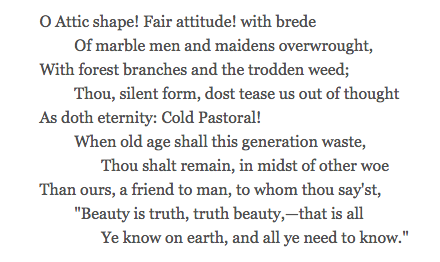
Grecian Urn

“Ode on a Grecian Urn,” John Keats

As an undergraduate, I fell in love with the British Romantics—in part, I think, because of their melodramatic bombast about Art! and Poetry! and Beauty!

“I fall upon the thorns of life! I bleed!” writes Percy Bysshe Shelley, who I must confess I preferred among the lot.

And all this stuff about art and beauty has not left me as both a poet/writer and a teacher because I do believe in art for art’s sake as well as art as activism.

Between the two, however, I have grown to recognize a serious tension that is problematic for my critical consciousness. The art-for-art’s-sake crowd has always pressed and continues to press, both consciously and unconsciously, I think, for the possibility of art that is somehow apolitical—to which I say poppycock.

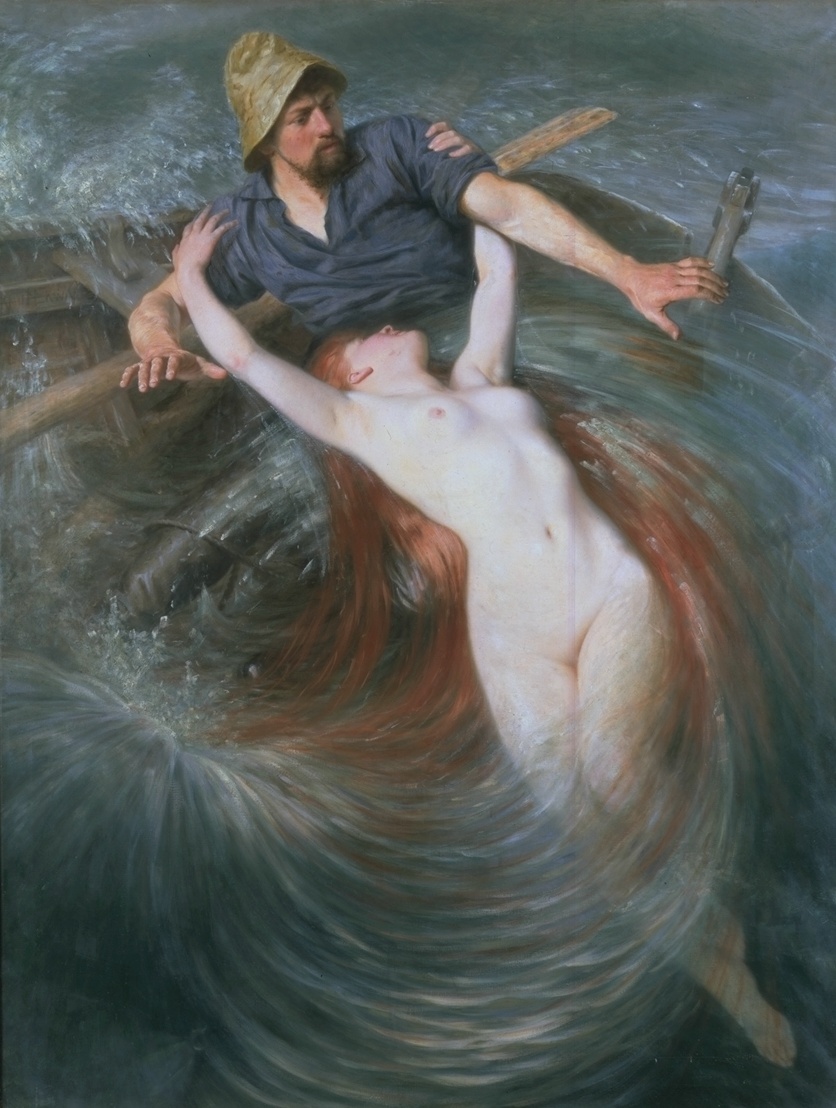
So as I was reposting a poem of mine about a Knut Ekwall painting, which is itself a rendering of mythology, I was drawn again to the painting that depicts a fisherman flailing against the clutches of a prominently nude siren who is pulling him quite literally into the vortex of her seduction:

knut_ekwall_fisherman_and_the_siren
Knut Ekwall (Swedish, 1843-1812) A Fisherman engulfed by a Siren, c. 1860s, oil on canvas, 194 x 149 cm, private collection. (Source)

And here we are confronted with aesthetic beauty, the question of whether it can exist in something like an objective context. The siren of Ekwall’s painting is but one of uncountable thousands of such representations of women in literature as well as visual art—Pandora, the sirens, Eve—that reduce the female to seductress and centers that seduction in her nudity.

The female nipple has been tabooed to such a degree in contemporary Western culture that we are now more frightened of the exposed female nipple than gun violence. But while Ekwall’s nude siren is from a much different era, viewing this painting today must also recognize the role of taboo in defining beauty, must confront the very white representation of the siren and beauty as well.

The female as allegory—whether Hester in The Scarlet Letter, Eve in the Garden of Eden myth, or a tempting but unnamed siren in a realistic painting—persists in so-called serious art but also in pop art. Our films in the U.S. remain an endless stream of functional females serving the needs of the white male savior: the fetishized Eastern woman; the white, blonde, young Girl-as-Trophy.

So in 2016, we can have a painting of this siren, nipples and all, yet women cannot by choice post pictures on Instagram that include their nipples, even if the photographs are deemed art—the first, of course, proclaimed as art by a man, and in the case of social media, let us not honor a woman’s right to choose if and how the world views her own body.

In 2016, as well, we are witnessing the demise of nudity in Playboy, that perversely sophisticated publication of objectifying an incredibly sterilized and idealized female as allegory. Some have noted that Playboy‘s no-nude policy has simply shifted how the publication panders to fetishes that continue to dehumanize women by reducing them to mechanisms of those fetishes.

The Internet has neutered the tabooing of nudity and graphic sex so Playboy has had to shift its game plan—but it is the same old game plan rendered in a really thin veneer (likely often to be quite literally a really thin veneer).

As a critical white male, I am confronted, then, by the world of art and the world of pop art as they have shaped my perception of females, from the female form to the fully realized female as a real person walking this planet.

That is my vortex, I believe, and thus, my poem sought to wrestle from the painting and the myth some balance that may occur between two lovers, caught in their love and desire but also trapped in a wider vortex that shapes them as unequal.

Love and desire, like art, are never apolitical—as Laurie Penny recognizes in her musing about Valentine’s Day:

Buried under the avalanche of hearts and flowers is an uncomfortable fact: romantic partnership is, and always has been, an economic arrangement. The economics may have changed in recent decades, as many women have gained more financial independence, but it’s still about the money. It’s about who does the domestic labour, the emotional labour, the work of healing the walking wounded of late capitalism. It’s about organising people into isolated, efficient, self-reproducing units and making them feel bad when it either fails to happen or fails to bring them happiness.

And in her Drawing Blood, Molly Crabapple connects the dots:

Artists are not supposed to care about commerce. The lies told to artists mirror the lies told to women: Be good enough, be pretty enough, and that guy or gallery will sweep you off your feet, to the picket-fence land of generous collectors and 2.5 kids. But make the first move, seize your destiny, and you’re a whore.

My poet/writer Self, my teacher Self, and my authentic Self as a man have always recoiled in fear that none of us can ever pull free of the very real vortex that is patriarchy, that casts and recasts the female as allegory—to be worshipped, to be owned, to be guarded.

But it is my poet/writer Self who continues to believe that “Beauty is truth, truth beauty,” and hopes there is love and desire that can honor lovers as equals who rise above the larger failures of humanity.

My Romantic side persists—despite all the evidence to the contrary.

See Also

Emily Ratajkowski: Baby Woman