Category Archives: social justice

Weekend Quick Takes June 25-26

Read Julian Vasquez Heilig’s What other universities should learn from UT, and note especially this:

Not discussed in the current ruling, but I believe relevant, is that Fisher did not fall below a bright line by which whites were rejected and minorities admitted. As reported in The Nation, UT-Austin offered admission “to some students with lower test scores and grades than Fisher. Five of those students were Black or Latino. Forty-two were white.” Additionally, “168 black and Latino students with grades as good as or better than Fisher’s who were also denied entry into the university that year.”

It is unfortunate that Fisher believed wrongly, in spite of factual evidence and data to the contrary, that she was discriminated against because she was white. In fact, by pursuing a case where the data was very clear on this point, she continued the insecurity and insidiousness of racial prejudice that has unfortunately permeated our society for centuries.

Also see his co-authored Actuating equity?: Historical and contemporary analyses of African American access to selective higher education from Sweatt to the Top 10% Law


There may be many cracks in Maintaining the Charter Mirage: Progressive Racism, including Paul Hewitt’s A modest proposal for charter schools; consider this:

Now that I have established myself as an opponent of charter schools I have a proposal for the Walton family and charter school proponents everywhere. I propose that you go against my friend’s admonition that we need public schools for charters to succeed. If charter schools are so good, let’s make every school in the current school district a charter school. Let’s dissolve the traditional school board and have them become trustees of school facilities. Let’s take all the existing school facilities and have charter school groups nationwide bid through proposals to take over and run that school. State law may need to be altered a little for this grand experiment. For example, no student living in the current school boundaries could transfer to a school in another neighboring school district. This would ensure that the charters serve all students in the community including the special education, English language learners, and at-risk children to ensure that no child could be “pushed out.”

Just imagine, every school would be a charter school and parents could have their choice of schools for their child. The traditional lottery system would be used at each school, and if the parent wasn’t lucky enough to get their first choice they could go to their second or third. Because the population of the entire school district would be involved there could be no discrimination and all students, even the at-risk, would be served. The traditional creaming of top students that is the major criticism of charters would be eliminated. This would be a completely free-market school choice system.

The double irony to this confrontation as (mostly) satire is that transforming all public schools into charter schools has already occurred—in New Orleans; see Endgame: Disaster Capitalism, New Orleans, and the Charter Scam.

And while edureformers continue to mislead political leaders and the public about such turnover/turnarounds, New Orleans is but one example of how these market-based reforms have proven to be utter failures.


In 1949, former NCTE president and English teacher/educator Lou LaBrant argued: “Our language programs have been set up as costume parties and not anything more basic than that” (p. 16).

In 2016, former NCTE president and esteemed educator and activist Joanne Yatvin confronts the same disturbing dynamic in her Too Little and Too Late.

Regretfully, Yatvin’s powerful refuting of the National Reading Panel, at the base of No Child Left Behind, was mostly ignored by political leaders and the public. Yet, she is once again ringing a bell that must be heard:

To the Editor:

As a retired educator, still deeply involved with the teaching of reading and writing, I was dismayed to read that the Portland Public schools are still tied to one-size-fit all commercial materials for teaching reading and considering combining pieces from several of them to make a new program. By this time experienced teachers should have learned that each child learns to read in his own time frame and in his own way, and that real literature and non-fiction are far better tools than anything concocted by commercial publishers.

Learning to read is not all that difficult when children are given interesting and well-written books for group activities and allowed to choose books that appeal to them to read on their own. It also helps when adults read aloud interesting books with illustrations on a regular basis. That is how children learn vocabulary and begin to understand the world outside their own homes and neighborhoods. Reading poetry helps too, because of the repeated word sounds and lines.

Over all, we should remember that reading and writing have been around for many centuries, and that the people who wanted and needed to use those skills found them easy to learn– often without a teacher, and certainly without any breakdown into separate skills, workbook exercises, or tests.

Sincerely yours,
Joanne Yatvin

The entire accountability reform movement driven by ever-new standards and ever-new high-stakes tests benefits mostly the education market—not students, not teachers.

In fact, as my current graduate literacy course has revealed to me, teachers both recognize the negative impact of required reading programs and materials and feel powerless to set those materials aside in order to implement what their children actually need.


I entered the field of education fueled by the belief that traditional schooling needed to be reformed. I am a public school advocate, but I also recognize that traditional public schools have served white middle-class and affluent children well (even though, as I can attest, that population often excels in spite of traditional schooling) while mostly failing vulnerable populations of students, specifically black, brown, and poor children.

My fellow pro-public school friends have been proudly sharing Jack Schneider’s America’s Not-So-Broken Education System.

While both Schneider and those sharing his piece are, I am certain, driven by good intentions, I must caution that such defenses of public schools suffer from whitewashing—a not-so-subtle middle-class lens that fails to adequately emphasize the racist and classist policies entrenched in public schools.

Public education as a social reform mechanism has not happened; public schools more often than not reflect and perpetuate the very worst aspects of our society.

If I may, I believe those of us who are adamant about supporting public education are committed to the potential, the promise that public education could be or should be something better, at the very least a model of equity if not a lever for equity.


Related to the above concern, access to experienced and certified teachers is a key aspect of both how our public schools have failed and how we are currently committed to the very worst aspects of education reform (for example, Teach For America and value-added methods for teacher evaluation).

Derek Black has compiled a powerful and important examination of Taking Teacher Quality Seriously.

See the abstract:

Although access to quality teachers is one of the most important aspects of a quality education, explicit concern with teacher quality has been conspicuously absent from past litigation over the right to education. Instead, past litigation has focused almost exclusively on funding. Though that litigation has narrowed gross funding gaps between schools in many states, it has not changed what matters most: access to quality teachers.

This Article proposes a break from the traditional approach to litigating the constitutional right to education. Rather than constitutionalizing adequate or equal funding, courts should constitutionalize quality teaching. The recent success of the constitutional challenge to tenure offers the first step in this direction. But the focus on teacher tenure alone is misplaced. Eliminating tenure, without addressing more important fundamental challenges for the teaching profession, may just make matters worse. Thus, this Article argues for a broader intervention strategy. When evaluating claims that students have been deprived of their constitutional right to education, courts should first ensure that states equally distribute existing quality teachers, regardless of the supply. Courts should then address state policies that affect the supply of teachers, which include far more than just salaries. When those remedies still prove insufficient to ensure access to quality teachers, courts must ensure that the removal of ineffective teachers is possible.


And a perfect companion for your weekend reading comes from 1969: “Bullshit and the Art of Crap -Detection” by Neil Postman.

Here’s just a taste:

Thus, my main purpose this afternoon is to introduce the subject of bullshit to the NCTE. It is a subject, one might say, that needs no introduction to the NCTE, but I want to do it in a way that would allow bullshit to take its place alongside our literary heritage, grammatical theory, the topic sentence, and correct usage as part of the content of English instruction. For this reason, I will have to use 15 minutes or so of your time to discuss the taxonomy of bullshit. It is important for you to pay close attention to this, since I am going to give a quiz at the conclusion.

Questions for the P&C about School Closure, Takeover

The Post and Courier (Charleston, SC) has taken an editorial stand in favor of closing a high-poverty, majority-minority school and a private takeover of public schools in Charleston (see a history of the debate here).

Now, a P&C editorial asks more questions:

How many classes of children should come up through the school’s failing system before the district makes some big changes?

Another question: Don’t those children deserve to try an educational approach that has proven to be far more successful?

Since turn about is fair play, let’s investigate those questions and ask a few in return.

At the very least, these questions are loaded, and as a result, misleading.

Burns Elementary (to be closed) is framed again as “failing,” and the Meeting Street Academy, “successful.”

As I have documented, many problems exist with the “good”/”bad” school labeling.

But in this case, we must be extra skeptical because all of the praise for the “successful” and the promises of even more success in “closing the achievement gap” for poor and mostly black students rest on the claims of the private entities invested in this process.

So there are actually some very important questions that the editors at the P&C are failing to ask:

  • Why have some students been allowed ever to languish in school conditions that are subpar when compared to vibrant schools and opportunities for other students in the same city? Burns Elementary with a poverty index of 96 is but one school that represents a long history in SC of how negligent we have been as a state in terms of providing anything close to equity in the opportunities poor and racial minority children are afforded.
  • Why does any public school board need a private partnership to do what is needed to offer these students the sort of school all children deserve? If what is needed is so obvious, and so easy to do (which is a subtext of the editorial), the truth is that the school board simply does not have the political will to do what is right for some children.
  • And this is very important: What third party, not invested in the Meeting Street Academy, has examined the claims of academic success in the so-called “successful” schools that are being promised as fixes for Burns? I cannot find any data on test scores (setting aside that test scores aren’t even that good for making these claims), but I have analyzed claims of “miracle” charter schools in SC—finding that these claims are always false. Always. I do not trust that Meeting Street is going to prove to be the first actual miracle school in a long line of those that have been unmasked before.

This last question cannot be overemphasized because the political process has proven time and again that political leadership can be easily bamboozled by glitzy claims but routinely fail to examine the evidence that would guide well our educational policy, as Christopher Lubienski, Elizabeth Debray, and Janelle Scott have revealed:

But what was perhaps most interesting was the degree to which research played virtually no part in decision making for policymakers, despite their frequent rhetorical embrace of the value of research. While many interviewees spoke of the importance of research evidence, nearly all were unable to point to an instance where research evidence shaped their position on an instrumentalist issue.

SC political leaders have pushed for school choice, charter schools, VAM evaluations of teachers, ever-new standards and high-stakes testing, exit exams, third-grade retention, and now takeover policies for so-called “failing schools”—yet all of these have no basis for policy in the body of research refuting the effectiveness of each one.

For the editors of the P&C, as well as our political leaders and the public, the real questions are why do we persist in ignoring the stark realities of our inequitable society, why do we then continue to play politics with our schools that are just as inequitable as our society, and then why do we refuse to consider the evidence about addressing social and educational inequity directly in our policies?

Again, as I have stated many times, the answer is that the people with the power to change things simply do not really care about change because any change can threaten their perches of power.

Closing schools, renaming schools, shuffling students—these are the practices of those who are invested in the status quo regardless of the consequences for “other people’s children.”

Cinco de Mayo 2016: A Reader

Let us hope we can resist the urge to trivialize and appropriate the wonderful history, traditions, and people of Mexico because of the silliness that is making a holiday another way to churn up crass commercialism (a redundant term). [Also, lost in the shuffle, today is the birthday of Karl Marx.]

So below, please read a gathering of important articles, somewhat loosely connected because they have crossed my path.

First, let me note that since I have relentlessly criticized edujournalism of late (and it is well deserved criticism), I start with an edujournalism unicorn—a very good piece on NAEP.

Read on:

The simple truth is that NAEP is not designed to provide causal explanations. It’s a test given every two years to a representative sample of students who happen to be in fourth, eighth, or twelfth grade that particular year. It does not follow students over time, so it’s impossible to say that a policy or practice “caused” the results….

Put together, the findings paint a picture of unequal opportunities to learn challenging content. Low-performing students spend less time explaining their reading or doing projects, and more time on test prep. Once again, these are correlations: they do not suggest that these patterns caused the low performance. But why do they exist? What can be done about them? That’s the challenge for educators and policy makers.

Clinton has been a card-carrying feminist for decades, she started her career doing advocacy for children and women, she’s famous for her UN speech about women’s rights are human rights, she’s been reliably pro-choice and so on. So if that all fits into this sort of recognition side, she’s been there, and in a more explicit, and front-and-center way than Sanders. But, on the other hand, What kind of feminism is this? Clinton embodies a certain kind of neoliberal feminism that is focused on cracking the glass ceiling, leaning in. That means removing barriers that would prevent rather privileged, highly educated women who already have a high amount of cultural and other forms of capital to rise in the hierarchies of government and business. This is a feminism whose main beneficiaries are rather privileged women, whose ability to rise in a sense relies on this huge pool of very low-paid precarious, often racialized precarious service work, which is also very feminized that provide all the care work

It’s called the American Dream because you have to be asleep to believe it.

Black students will always underachieve when they are perceived as needing fixing.

The irony is that black students aren’t the ones who need fixing.

Deficit thinking corrupts the potential effectiveness of even the most competent teachers.

White folk must unlearn their negative expectations. That’s the only way we’re ever going to change the structures that really hold students back.

And now, a musical extra:

https://youtu.be/Cl4jJF1-HV4

Outliers Never Evidence of Normal in Education

In Money, Race and Success: How Your School District Compares, the NYT, like most of mainstream media, is begrudgingly coming to admit that race and class inequity in the U.S. has a profound impact on the education of children—and that simply tinkering (badly) with school policy is not enough to change that reality:

We’ve long known of the persistent and troublesome academic gap between white students and their black and Hispanic peers in public schools.

We’ve long understood the primary reason, too: A higher proportion of black and Hispanic children come from poor families. A new analysis of reading and math test score data from across the country confirms just how much socioeconomic conditions matter.

Children in the school districts with the highest concentrations of poverty score an average of more than four grade levels below children in the richest districts.

But then there is this:

The data was [sic] not uniformly grim. A few poor districts — like Bremen City, Ga. and Union City, N.J. — posted higher-than-average scores. They suggest the possibility that strong schools could help children from low-income families succeed.

“There are some outliers, and trying to figure out what’s making them more successful is worth looking at,” said Mr. Reardon, a professor of education and lead author of the analysis.

Well, no, if we find outliers—and virtually all data have outliers in research—we should not waste our time trying to figure out how we can make outliers the norm.

The norm is where we should put our efforts in order to confront what is, in fact, not “puzzling” (used earlier in the article) at all; the data are very clear:

What emerges clearly in the data is the extent to which race and class are inextricably linked, and how that connection is exacerbated in school settings.

Not only are black and Hispanic children more likely to grow up in poor families, but middle-class black and Hispanic children are also much more likely than poor white children to live in neighborhoods and attend schools with high concentrations of poor students.

Our great education reform failure is one of failing to rethink our questions and our goals.

Let’s stop trying to find the “miracle” in a rare few schools where vulnerable students appear to succeed despite the odds against them. With time and careful consideration, we must admit, those appearances almost always are mirages.

Let’s instead put our energy in eradicating the poverty, racism, and sexism that disadvantages some students, vulnerable populations easily identified by race and social class, so that we can educate all students well.

And while we are making efforts at social policy, let’s end the in-school policies that we know “exacerbate” inequity: tracking, teacher assignments (and TFA), high-stakes testing, grade retention, discipline policies grounded in zero tolerance and “no excuses,” and segregation through school choice (including charter schools).

Education reform, as was highlighted in the original court case examined in the South Carolina documentary The Corridor of Shame, is obsessed with playing the hero by seeing who can pull the most babies out of the river.

And then examining the ones who survive the potential drowning in order to “make” all babies survive the trauma of being cast down stream.

But no one seems interested in walking upstream to stop babies being thrown in.

Life and learning do not need to be something children survive—and we must confront that we have decided that this is exactly what we are willing to accept for “other people’s children.”

It would not be so if we believed and acted upon that “they’re all our children.”


The Allegory of the River

Even Technocrats with Good Intentions Sustain Classroom Colonialism

Kassie Benjamin offers a powerful confession at Jose Vilson’s blog. Benjamin—like many educators including myself—became an educator firmly holding to the belief that education is the great equalizer, the lever that changes people’s lives and society for the better.

However, Benjamin explains: “Slowly, I came to the belief I have today: education is assimilation. Still.”

In his For White Folks Who Teach in the Hood…and the Rest of Y’all Too, Chris Emdin names the assimilation Benjamin confronts as “classroom colonialism” (p. 14), and clarifies earlier in his Preface:

What I am suggesting is that it is possible for people of all racial and ethnic backgrounds to take on approaches to teaching that hurt youth of color….

I argue that there must be a concerted effort…to challenge the “white folks’ pedagogy” that is being practiced by teachers of all ethnic and racial backgrounds. (pp. viii-ix)

Emdin points a finger at urban “no excuses” charter schools as contemporary versions of traditional schooling created to “fix” Native Americans. For example, Joanne Golann explains about her extensive research embedded at a “no excuses” charter serving mostly black and poor students:

In a tightly regulated environment, students learned to monitor themselves, hold back their opinions, and defer to authority. These are very different skills than the ones middle-class kids learn—to take initiative, be assertive, and negotiate with authority. Colleges expect students to take charge of their learning and to advocate for themselves. One of the students I talk about in the article learned to restrain herself to get through, to hold herself back and not speak her mind. She ended up winning the most-improved student award in 8th grade for her changed behavior.

Golann also makes connections similar to Emdin’s:

Bowles and Gintis wrote this famous study where they were looking at the history of mass public education in the US. They argue that schooling expanded in large part to quell social unrest. You had these immigrant populations coming into the cities in the mid-nineteenth century, and Bowles and Gintis basically make the argument that factory owners and the professional class wanted a docile workforce. They wanted people who would be obedient and man these factories, and so they used schools as a way to socialize children to follow rules and show deference. Looking at the school I studied, I found the same behaviors but with a very interesting twist. In a new era of accountability, instead of creating workers for the factories, schools are creating *worker-learners* to close the achievement gap. Schools are emphasizing obedience because they need to create order to raise test scores and they see that as the way to social mobility. It’s the same behaviors but for a different purpose.

But we should also look at a number of policies that are thinly veiled mechanisms for assimilation/colonialism.

Just as one example, tracking remains a robust practice in U.S. education, I believe, because it appears to help the so-called top students (mostly white and relatively affluent) even though a great deal of evidence shows tracking hurts the so-called struggling students (mostly black/brown and impoverished).

Further, like Benjamin and Emdin, Zoé Samudzi argues We Need A Decolonized, Not A “Diverse”, Education because “diversity agendas are hindrances rather than stepping stones to justice and equity.”

Policy makers, administrators, and teachers promoting and implementing practices, then, who are in effect perpetuating classroom colonialism may often have good intentions.

Charlotte Danielson provides us here an ironic and important model as she confronts teacher evaluation:

The idea of tracking teacher accountability started with the best of intentions and a well-accepted understanding about the critical role teachers play in promoting student learning. The focus on teacher accountability has been rooted in the belief that every child deserves no less than good teaching to realize his or her potential.

Danielson, of course, continues to criticize the recent push for extended accountability, standards, and high-stakes testing into how we evaluate, retain, and pay teachers (popularly known as VAM, for using “value added methods”).

The irony comes as Danielson slips into what I believe is the central problem driving much of the classroom colonialism challenged by Benjamin, Emdin, Samudzi, and Paul Gorski: Danielson’s alternative to the failed good intentions of teacher evaluation is just another technocratic version of teacher evaluation.

Colonialism in traditional schooling survives because education is a reflection of our society. Schools will never be transformative at the social level until formal education is unlike our inequitable social structures—until formal schooling serves our vulnerable students’ needs first by honoring them as fully human instead of framing them through deficit lenses.

School discipline begins and reflects the racially inequitable mass incarceration of the wider society. Tracking reflects and perpetuates our class stratifications.

Nearly every aspect of school policy and practice is a mechanism for assimilation—not transformation.

Education and education reform are trapped in a technocratic vision that can only replicate our society.

Education reform and the commodification of education are bound by the mantra “My technocratic vision is better than your technocratic vision.”

It isn’t about standards, but the new and better standards.

It isn’t about high-stakes testing, but the new and better high-stakes tests.

And not once, not once, has the promise of the new been realized in any ways that serve impoverished students, black/brown students, or English language learners.

However, nearly always, the policies and practices in place have served well (or at least not impeded) the whitest and wealthiest.

Emdin invokes the metaphor of invisibility throughout his dismantling of “white pedagogy” and call for “reality pedagogy.” But I am drawn to my English teacher and existential roots by the concluding image of Albert Camus’s The Stranger: the guillotine.

Camus’s main character Meursault describes that “the guillotine looked like such a precision instrument, perfect and gleaming….[T]he machine destroyed everything: you were killed discretely , with a little shame and with great precision” (p. 112).

The efficiency of the technocratic mind, the guillotine, that served the interests of the ruling elites at the expense of anyone else who did not conform, assimilate.

The technocrats, even with good intentions, maintain a classroom colonialism that honors “assimilate or die.”


Day on Diversity at the University of South Carolina

I am participating as a discussion leader and speaker for a day on diversity at the University of South Carolina 14 April 2016. Below are my notes which may be of value to some addressing race and class in both social and educational contexts.

University of South Carolina

April 14 1:30 pm

Svec. M., & Thomas, P.L. (2016). The classroom crucible: Preparing teachers from privilege for students of poverty. In A.L. Hurst & S.K. Nenga (Eds.), Working in class: recognizing how social class shapes our academic work. Landham, MD: Rowman & Littlefield Publishers.

http://www.heinemann.com/blog/wp-content/uploads/2015/12/Confronting-Privilege-to-Teach-About-Privilege.pdf

https://radicalscholarship.wordpress.com/2014/11/13/my-redneck-past-a-brief-memoir-of-twos/

https://radicalscholarship.wordpress.com/2015/12/20/i-dont-belong-heremy-otherness-my-privilege/

April 14 6 pm

“How do we look at systemic issues of equity in institutional settings?”

20 minutes

Scarcity: The New Science of Having Less and How It Defines Our Lives, Sendhil Mullainathan and Eldar Shafir

For White Folks Who Teach in the Hood… and the Rest of Y’all Too: Reality Pedagogy and Urban Education, Chris Emdin

Police in the Hallways: Discipline in an Urban High School, Kathleen Nolan

Hope Against Hope, Sarah Carr

Reaching and Teaching Students in Poverty: Strategies for Erasing the Opportunity Gap, Paul Gorski

No Caste Here? Toward a Structural Critique of American Education, Daniel Kiel

Abstract:

In his famous dissent in Plessy v. Ferguson, Justice John Marshall Harlan argued that in the United States, there was “no caste here.” Justice Harlan was rejecting the idea that American society operated to assign preordained outcomes to individuals based upon classifications, including racial classifications. This Article questions whether Justice Harlan’s aspirational assertion accurately reflects contemporary American education. Identifying: (1) multiple classification mechanisms, all of which have disproportionate racial effects, and (2) structural legal, political, and practical impediments to reform, the Article argues that the American education system does more to maintain the nation’s historical racial hierarchy than to disrupt it. This is so, the Article suggests, despite popular agreement with the casteless ideal and popular belief that education can provide the opportunity to transcend social class. By building the framework for a broad structural critique, the Article suggests that a failure to acknowledge and address structural flaws will preclude successful comprehensive reform with more equitable outcomes.

Privilege

Racism, classism

deficit perspectives (word gap, achievement gap, grit)

Paternalism

Accountability v. equity — academics and discipline policies

https://radicalscholarship.wordpress.com/2014/12/04/grit-education-narratives-veneer-for-white-wealth-privilege/

https://radicalscholarship.wordpress.com/2016/04/06/are-racially-inequitable-outcomes-racist/

https://radicalscholarship.wordpress.com/2016/03/29/race-and-education-a-reader/

https://radicalscholarship.wordpress.com/2014/02/11/what-these-children-are-like-rejecting-deficit-views-of-poverty-and-language/

https://radicalscholarship.wordpress.com/2014/05/01/revisiting-james-baldwins-black-english/

https://radicalscholarship.wordpress.com/2016/03/29/race-and-education-a-reader/

https://radicalscholarship.wordpress.com/2015/06/12/recommended-reaching-and-teaching-students-in-poverty-paul-c-gorski/

https://radicalscholarship.wordpress.com/2016/03/22/a-crack-in-the-dam-of-disaster-capitalism-education-reform/

https://radicalscholarship.wordpress.com/2016/01/23/understanding-poverty-racism-and-privilege-again-for-the-first-time/

https://radicalscholarship.wordpress.com/2014/12/30/bearing-witness-hypocrisy-not-ideology/

https://radicalscholarship.wordpress.com/2014/12/31/responsibilities-of-privilege-bearing-witness-pt-2/

http://www.heinemann.com/blog/wp-content/uploads/2015/12/Confronting-Privilege-to-Teach-About-Privilege.pdf

https://radicalscholarship.wordpress.com/2014/11/20/thomas-race-matters-in-school-discipline-and-incarceration-opinion-columns-the-state/

https://radicalscholarship.wordpress.com/2015/09/03/criminalizing-black-children-begins-in-our-schools/

https://radicalscholarship.wordpress.com/2014/11/30/creating-crime-criminals-to-justify-deadly-force/

http://cedar.wwu.edu/cgi/viewcontent.cgi?article=1184&context=jec

MLK Day 2016: A Reader

In the US in 2016—and specifically for educators—the need to confront racism must remain central to all efforts to overcome inequity and injustice. Among the privileged—white-, male-, heterosexual-skewed—there is no room for “yes, but,” although there remains ample room for stepping back, being silent, and then listening as first steps to offering solidarity in the action needed to confront the false narratives of “meritocracy” and “rugged individualism,” and then to overcome the irrefutable inequities linked to race, class, gender, and sexuality.

One commitment is to resist the whitewashing of Martin Luther King Jr. as a passive radical. So here, I offer some readings, varied and important, but pathways to honoring the radical MLK and to resisting the lingering dream deferred.

Final Words of Advice/ “Where do we go from here?” (1967), Martin Luther King Jr.

MLK poverty

The Trumpet of Conscience, Martin Luther King Jr.

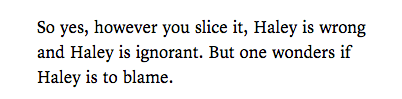
Leonard Pitts Jr.: Haley’s fairy tale ignores our history

haleyEnslaved Africans of George Washington Depicted as ‘Happy and Joyful’ in New Children’s Book

The Forgotten, Radical Martin Luther King Jr., Matt Berman

Martin Luther King, Jr.: Christian Radical—And Saint, Elizabeth Stoker Bruenig

Read This Before Co-Opting MLK Jr., Jose Vilson

The Revisionist’s Martin Luther King Jr., “I Have A Dream For Most Of Us,” Jose Vilson

Harlem, Langston Hughes

Let America Be America Again, Langston Hughes

The white man pathology: inside the fandom of Sanders and Trump, Stephen Marche

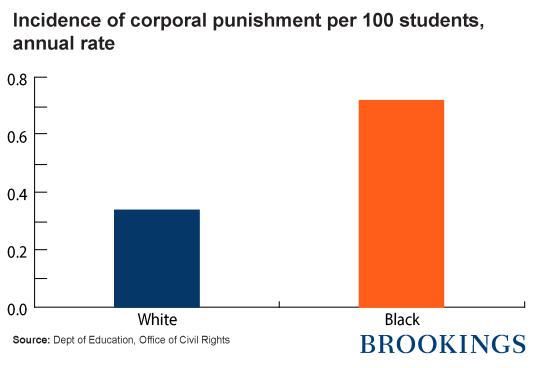
Schools, black children, and corporal punishment, Dick Startz

figure-1

“Please—a little less love, and a little more common decency.”

The Causal Effects of Cultural Relevance: Evidence from an Ethnic Studies CurriculumThomas Dee, Emily Penner

Questioning Payne | Teaching Tolerance

Toolkit for “Questioning Payne” | Teaching Tolerance

50 Years After Selma, White Lives Still Matter More, Stacey Patton

The Oscars’ Racist Refusal to Honor Modern Black Heroes, Stereo Williams

Should We Marvel at a Black Captain America?

The Martian: Allegory of Whose Lives Matter

Nicolas Sparks and the Allegory of Pretty White People Who Struggle until Everything Works Out

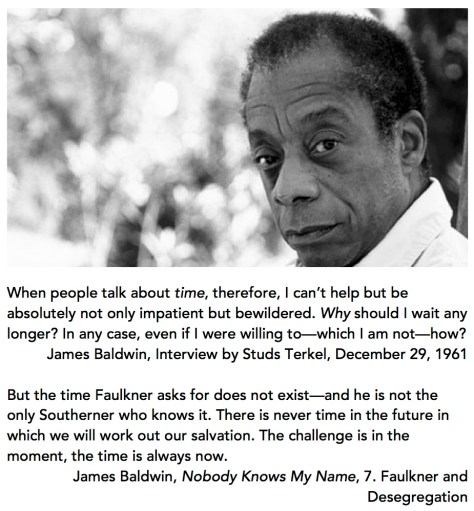
James Baldwin: “the time is always now”

the-time-is-always-now

Confronting Privilege in the New Year: “when you’ve been used to privilege, equality feels like prejudice”

A former student and current wonderful early-career teacher texted me yesterday because someone had shared with her the inane “I’m not going to apologize for my white privilege” article that is all the rage among white privilege deniers.

Nearly as disturbing as the pervasive and corrosive influence of racism is the reality that the more whites are confronted with evidence of white privilege and racism, the more likely whites are to cling to their denial. Research from 2015 confirms:

What happens when people are faced with evidence that their group benefits from privilege? We suggest such evidence will be threatening and that people will claim hardships to manage this threat. These claims of hardship allow individuals to deny that they personally benefit from privilege, while still accepting that group-level inequity exists. Experiments 1a and 1b show that Whites exposed to evidence of racial privilege claim to have suffered more personal life hardships than those not exposed to evidence of privilege.

Throughout 2015, I have been cataloguing the overwhelming evidence of white privilege and racism, but I am discouraged about both the abundance of that evidence and the ineffectiveness of presenting it to those clinging fervently to their white denial.

Humans are drawn to patterns, both the recognition of patterns and the creation of patterns. Maybe anthropologists and sociologists would argue that in part that attraction is about survival and comfort. I suspect this pattern fetish in humans is also at the root of seeking out others like us (see any school lunch room where students are allowed to sit where they please), and I fear it is also the foundation for the very worst of humans—our racism, sexism, classism, and seething anger at the Other.

This is not some historical low point of human history—U.S. slavery, the Holocaust, the Japanese internment—but a seemingly credible point of debate among presidential hopefuls and their supporters who are calling from banning Muslims from U.S. soil.

And as the hashtags have continued to increase (#BlackLivesMatter, #TamirRice, and then too, too many to list) so has the backlash, the denial—just as the research above confirms.

We stand at the cusp of one of our greatest pattern urges, the arbitrary designating of the passing of time. Soon a new year will be upon the West (yes, even the calendar is a force of privilege, a way to mask subjectivity as objective, universal), and at least one voice has suggested there is hope: “I believe – I hope – that a great rewriting is slowly, surely underway,” writes Laurie Penny.

Penny’s examination of the latest Star Wars film offers a much more detailed and powerful investigation than my own look at The Martian, but we do tread similar ground; notably Penny explains:

The people who are upset that the faces of fiction are changing are right to worry. It’s a fundamental challenge to a worldview that’s been too comfortable for too long. The part of our cultural imagination that places white Western men at the centre of every story is the same part that legitimises racism and sexism. The part of our collective mythos that encourages every girl and brown boy to identify and empathise with white male heroes is the same part that reacts with rage when white boys are asked to imagine themselves in anyone else’s shoes.

I struggle to share Penny’s optimism—because of the horrifying specter of the unfathomable nastiness in both our presidential politics and our pop culture, both of which expose the “white interpretive horizon.”

Yet, I think Penny makes a powerful observation that may be the key to believing change is upon us:

Let’s not get carried away here. These stories and retellings are still exceptions. Women are still paid less, respected less and promoted less at almost every level of every creative industry. For every Jessica Jones there’s a Daredevil, whose female characters exist solely to get rescued, provide the protagonists with some pneumatic exposition, or both. For every Orphan Black there’s Mr Robot and Narcos and you know, sometimes I wonder if perhaps I watch too much television. The point is that what we have right now isn’t equality yet. It’s nothing like equality. But it’s still enough to enrage the old guard because when you’ve been used to privilege, equality feels like prejudice. [emphasis added]

White privilege is an iceberg; very little is visible above the surface, and for those of us with that privilege, it is ours to interrogate what lies beneath in order to understand and dismantle it.

“I came to explore the wreck,” explains the speaker of Adrienne Rich’s “Diving into the Wreck”:

the thing I came for:
the wreck and not the story of the wreck
the thing itself and not the myth

As Penny explains when unpacking “[t]he rage that white men have been expressing, loudly, violently”:

Like a screaming toddler denied a sweet, it becomes more righteous the more it reminds itself that after all, it’s only a story.

Only a story. Only the things we tell to keep out the darkness. Only the myths and fables that save us from despair, to establish power and destroy it, to teach each other how to be good, to describe the limits of desire, to keep us breathing and fighting and yearning and striving when it’d be so much easier to give in. Only the constitutive ingredients of every human society since the Stone age.

Only a story. Only the most important thing in the whole world.

This is our wreck, a story of a people blinded by the myth of meritocracy while steering the ship headlong into the iceberg we pretend isn’t there.

We must write better stories, fictional and real. A new year is arbitrary, yes, but it serves us well to listen to the refrain “the time is always now.”

See Also

What to do when you’re not the hero any more, Laurie Penny

On Nerd Entitlement, Laurie Penny

Hello from the same side, Robin James

The horrifying lesson of Tamir Rice: White America will use “objectivity” to justify the murder of black children, Brittney Cooper

Confronting Privilege to Teach about Privilege

Bearing Witness: Hypocrisy, Not Ideology

Responsibilities of Privilege: Bearing Witness, pt. 2

White Denial

High Cost of White Denial (Updated)


Government Fails When It Fails to Be Government

Let’s start with a little game.

Fill in the blanks:

Government interventions over the past four decades have yielded a cascade of perverse incentives, bureaucratic diktats, and economic pressures that together are forcing [_____] to sacrifice their independent professional [_____] judgment, and their integrity. The consequence is clear: Many [_____] from my generation are exiting the field. … Governments and [_____] administrators hold all the power, while [_____]—and worse still, [_____]—hold none.

Now take a look at the original:

Government interventions over the past four decades have yielded a cascade of perverse incentives, bureaucratic diktats, and economic pressures that together are forcing doctors to sacrifice their independent professional medical judgment, and their integrity. The consequence is clear: Many doctors from my generation are exiting the field. Others are seeing their private practices threatened with bankruptcy, or are giving up their autonomy for the life of a shift-working hospital employee. Governments and hospital administrators hold all the power, while doctors—and worse still, patients—hold none.

I am a 30-plus-year educator, therefore, this paragraph jumped out at me since many of my professional complaints match this almost perfectly, leading to my version:

Government interventions over the past four decades have yielded a cascade of perverse incentives, bureaucratic diktats, and economic pressures that together are forcing [teachers] to sacrifice their independent professional [education] judgment, and their integrity. The consequence is clear: Many [teachers] from my generation are exiting the field. … Governments and [school] administrators hold all the power, while [teachers]—and worse still, [students]—hold none.

But there is an irony to all this: The paragraph is in a piece at The Cato Institute and the doctor penning the complaint cites Ayn Rand toward the end; thus, it is intended to be a slam against Big Bad Guv’ment.

The flaw is that in the piece itself, the real problem is not government, but that government fails to be government—”perverse incentives, bureaucratic diktats, and economic pressures.”

In the U.S., we have a quasi-Libertarian but mostly flawed idealism toward wealth, capitalism, and the misleading free market that has twisted “government” to mean something akin to totalitarianism (in the 12-year-old sort of way Rand fumbles in her garbled attempt at fiction writing and populist philosophy).

As a stark comparison facing us now, police are meant to protect and serve, but when a policeman shoots and kills a 12-year-old or a policeman strangles to death an unarmed man selling cigarettes, we do not have evidence that justice is a flawed pursuit, but that the current system fails justice.

Government as a hand of the market and government as bureaucracy—that dynamic is crippling medicine and education in the U.S. However, the reality is that government in the U.S. is mostly a servant of the rich and powerful, and not a mechanism of the public good—the potential purpose of democratic government because we are the government, not some dictatorial tyrant.

Public funding should be a pooling of resources by a people in order to insure the life, liberty, and pursuit of happiness of each individual; it is not a competition between society and each individual (the Romanticism of Emerson and Thoreau) but a symbiotic relationship between the two (John Dewey): by contributing to the public good, I also contribute to my own individual liberty.

The free market (“perverse incentives,” “economic pressures”) and bureaucracy (“bureaucratic diktats”) have never and will never achieve equity. The market creates inequity, and bureaucracy paralyses most everything, notably the pursuit of equity.

Government rightly functioning would insure that experts (such as doctors and teachers) who serve the public good are free to practice that expertise—not bound to the whims of the market, not fettered by bureaucratic mandates.

Publicly funded must precede (not supplant) all other commitments of a free people—public education, universal health care, highway system, just legal system, etc. Demonizing government (we the people), idealizing the market—both are insuring that the U.S. will never achieve equity, never reach the promise of democracy and freedom.

Government fails when it fails to be government, and people governed fail that government when they fail to understand that government is their collective will.

Testing the Education Market, Cashing In, and Failing Social Justice Again

On Black Friday 2014—when the U.S. officially begins the Christmas holiday season, revealing that we mostly worship consumerism (all else is mere decoration)—we are poised to be distracted once again from those things that really matter. Shopping feeding frenzies will allow Ferguson and Tamir Rice to fade away for the privileged—while those most directly impacted by racism and classism, poverty and austerity remain trapped in those realities.

History is proof that these failures have lingered, and that they fade. Listen to James Baldwin. Listen to Martin Luther King Jr.

But in the narrower education reform debate, we have also allowed ourselves to be distracted, mostly by the Common Core debate itself. As I have stated more times that I care to note, that Common Core advocates have sustained the debate is both a waste of our precious time and proof that Common Core has won.

As well, we are misguided whenever we argue that Common Core uniquely is the problem—instead of recognizing that Common Core is but a current form of a continual failure in education, accountability built on standards and high-stakes testing.

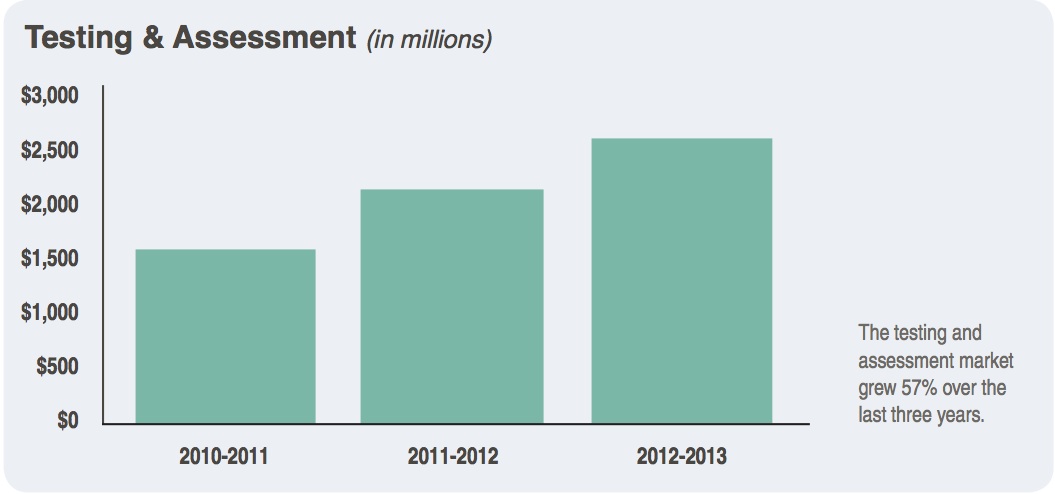
With the release of Behind the Data: Testing and Assessment—A PreK-12 U.S. Education Technology Market Report*, we have yet another opportunity to confront that Common Core is the problem, not the solution, because it is the source of a powerful drain on public resources in education that are not now invested in conditions related to racial and class inequity in our public schools.

Richards and Stebbins (2014) explain:

The PreK-12 testing and assessment market segment has experienced remarkable growth over the last several years. This growth has occurred in difficult economic times during an overall PreK-12 budget and spending decline….

Participants almost universally identified four key factors affecting the recent growth of the digital testing and assessment market segment:

1) The Common Core State Standards are Changing Curricula

2) The Rollout of Common Core Assessments are Galvanizing Activity….

(Executive Summary, pp. 1, 2)

testing and assessment 57 percent
(Richards & Stebbins 2014).

So as I have argued before, Common Core advocacy is market-driven, benefiting those invested in its adoption. But we must also acknowledge that that market success is at the expense of the very students who most need our public schools.

And there is the problem—not the end of cursive, not how we teach math, not whether the standards are age-appropriate.

Common Core is a continuation of failing social justice, draining public resources from needed actions that confront directly the inexcusable inequities of our schools, inequities often reflecting the tragic inequities of our society:

As the absence or presence of rigorous or national standards says nothing about equity, educational quality, or the provision of adequate educational services, there is no reason to expect CCSS or any other standards initiative to be an effective educational reform by itself. (Mathis, 2012, 2 of 5)

Who will be held accountable for the cost of feeding the education market while starving our marginalized children’s hope?

Reference

Richards, J., & Stebbins, L. (2014). Behind the Data: Testing and Assessment—A PreK-12 U.S. Education Technology Market Report. Washington, D.C.: Software & Information Industry Association.

* Thanks to Schools Matter for posting, and thus, drawing my attention to the study.