Category Archives: socialism

1 November 2016 Reader: “Matters of power, state violence, extreme poverty, institutional racism”

The rise of Trumpism and how to fight it, Dorian Bon

Even leaving aside the possibility of marauding, right-wing poll-watchers, other questions will have come up for readers of this website: Why is Donald Trump’s bigotry and aggressive chauvinism finding such a large audience? How can so many millions of people who don’t have millions in their bank accounts be planning to vote for him after everything we know?

More generally: Where is the momentum on the far right coming from? Where is it going? And what can be done to stop it?

Trump’s Inconvenient Racial Truth, Nikole Hannah-Jones

To be clear, I am not arguing that the man who called for the execution of the since-exonerated Central Park Five (and who still insists on their guilt) and who seeks nationwide implementation of the stop-and-frisk program ruled unconstitutional in New York City, and who warns that voting in heavily black cities is rigged, is a racial progressive who will enact policies that will help black communities. Nor am I saying black voters should buy what Trump is selling. (And they aren’t: A poll released last week by The New York Times Upshot/Siena College of likely voters in Pennsylvania found that “no black respondent from Philadelphia supported Mr. Trump in the survey.”)

What I am saying is that when Trump claims Democratic governance has failed black people, when he asks “the blacks” what they have to lose, he is asking a poorly stated version of a question that many black Americans have long asked themselves. What dividends, exactly, has their decades-long loyalty to the Democratic ticket paid them? By brushing Trump’s criticism off as merely cynical or clueless rantings, we are missing an opportunity to have a real discussion of the failures of progressivism and Democratic leadership when it comes to black Americans.

Dont Walk That Line! Why Schools Need To Create And Measure Positive Climates, Andre Perry

As researchers on positive school climate note, the “personality” of a school is an expression of how teachers, students, family members and community perceive the milieu.

In other words, a school doesn’t have to be mean to be good. Treating students with care and respect increases academic performance among students from low socioeconomic backgrounds, higher than if a school placed a singular single focus on academics.

Researchers for this study pulled evidence from multiple studies from around the world to understand the relationships between socioeconomic status, school climate, and academic achievement to help academics and practitioners alike understand what a positive climate is and why ultimately it can boost academic achievement.

Why I Have No Sympathy for Angry White Men, Stacey Patton

Why isn’t anyone suggesting that these beleaguered White men respond to their relatively new “hard times” by working hard and pulling themselves up by their bootstraps? Where are the people calling on these beleaguered Whites to develop empathy and compassion for those who have long been suffering, like African-Americans and other people of color? Why do we need to understand this community? Why is the opposite never suggested as a potential option? Is it because White men are simply not willing to emerge from their bubble and acknowledge the humanity of those they deem “other?” Or is it because they are unable to see beyond their own reality?

What we’re witnessing is racist populism all over again. Trump is following a historical pattern by stoking the racism, but especially as a rich White man pitting disenfranchised poor White people against Black people and especially Black people in low-income areas, telling them to intimidate and attack them at his rallies and at the polls, much in the same way poor Whites were pitted against poor Black people by elite White people to ensure there wouldn’t be a class uprising.

“Trump is emancipating unbridled hatred” – Interview: Rina Soloveitchik, Judith Butler

Butler: What Trump is emancipating is unbridled hatred and, as we see recently, forms of sexual action that don’t even care about anybody’s consent. Since when did we have to ask women whether they are okay with being touched, or why? He does not actually say that, but that is exactly what he is indicating. It liberates people, their rage, and their hatred. And these people may be wealthy, they may be poor, they may be in the middle; they feel themselves to have been repressed or censored by the left, by the feminists, by the movement for civil rights and equality, by Obama’s presidency, which allowed a black man to represent the nation.

Unthinkable Politics and the Dead Bodies of Children, Henry A. Giroux

Matters of power, state violence, extreme poverty, institutional racism, a broken criminal justice system, the school to prison pipeline and the existence of the mass incarceration state, among other important matters, rarely if ever enter her discourse and yet these are major issues negatively affecting the lives of millions of children in the United States. And her alleged regard for children falls apart in light of her hawkish policies on global regime change, drone attacks and cyber-warfare, and her unqualified support for the warfare state. Her alleged support for children abroad does not capture the larger reality they face from when their countries are invaded, attacked by drones and subject to contemporary forms of indiscriminate violence. Rather than critique the US as a powerful engine of violence, Clinton expands its imperialist role around the globe. This is a key point in light of her defense of the rights of children, because her warmongering ideology puts children in the path of lethal violence.

Howard Zinn: “education cannot be neutral on the critical issues of our time”

[Header Photo by Ankush Minda on Unsplash]

24 August 1922—Howard Zinn was born. His life and career spanned the twentieth century and into the first decade of the twenty-first. It is his memoir, You Can’t Be Neutral on a Moving Train: A Personal History of Our Times, for me, that speaks to the enduring power of Zinn’s metaphor, particularly for teachers.

Historically and currently, teacher remain under the demand that their teaching—and even their lives—remain neutral, not political. University professors—such as Zinn—also face disciplinary and public expectations of objectivity, dispassion—their work as public intellectuals either shunned or unrecognized.

In that context, K-12 education and university education suffer the same ultimate failure found in journalism, a flawed pursuit of objectivity, the faux-neutral pose of representing both sides.

So on the day of Zinn’s birth, it continues to be important not only to read and listen to Zinn, but also to act on Zinn, for it is action, after all, that Zinn lived and called for.

“When I became a teacher,” Zinn explains in You Can’t Be Neutral on a Moving Train, “I could not possibly keep out of the classroom my own experiences”:

I have often wondered how so many teachers manage to spend a year with a group of students and never reveal who they are, what kind of lives they have led, where their ideas come from, what they believe in, or what they want for themselves, for their students, and for the world.

Does not the very fact of that concealment teach something terrible—that you can separate the study of literature, history, philosophy, politics, the arts, from your own life, your deepest convictions about right and wrong?

Concealment is a political act, and in the face of the tragedy surrounding the police shooting of Michael Brown, the educational response has been exactly that, concealment. But as poet Adrienne Rich has confronted:

The study of silence has long engrossed me. The matrix of a poet’s work consists not only of what is there to be absorbed and worked on, but also of what is missing, desaparecido, rendered unspeakable, thus unthinkable.

Instead of striking the masked political poses of neutrality, objectivity, and dispassion, Zinn called for transparency:

In my teaching I never concealed my political views: my detestation of war and militarism, my anger at racial inequality, my belief in democratic socialism, in a rational and just distribution of the world’s wealth. I made clear my abhorrence of any kind of bullying, whether by powerful nations over weaker ones, governments over their citizens, employers over employees, or by anyone, on the Right or the Left, who thinks they have a monopoly on the truth.

Having taught in rural Southern public schools for 18 years and then 13 more years in higher education, I can attest that Zinn’s argument is challenged only because of the positions he holds and not because he took positions. You see, in K-12 classrooms, especially in history classes, textbooks, curriculum, and teachers always represented positions by framing as neutral the mainstream perspectives found among them all: a blind allegiance to capitalism, representing the U.S. as a righteous military victor, whitewashing every struggle in the country’s history, celebrating the wealthy and powerful while turning a blind eye to their many sins.

It has never been that our classrooms are neutral, as Zinn confronts, but that our classrooms have been passive passengers on the moving train of social and cultural indoctrination, the sort of indoctrination that benefits the few who have wealth and power built on their privilege at the expense of the many—workers, racial minorities, women, children, and the impoverished.

As Zinn recognized:

This mixing of activism and teaching, this insistence that education cannot be neutral on the critical issues of our time, this movement back and forth from the classroom to the struggles outside by teachers who hope their students will do the same, has always frightened the guardians of traditional education. They prefer that education simply prepare the new generation to take its proper place in the old order, not to question that order.

And although written well before the current education reform movement built on accountability, standards, and high-stakes testing, Zinn’s memoir has identified the Orwellian reality of that movement: Those decrying the status quo are those in service of the status quo. Education reform is the pursuit of maintaining, not reforming.

This call for teaching as activism was join by Zinn’s disciplinary challenge as well:

History can come in handy. If you were born yesterday, with no knowledge of the past, you might easily accept whatever the government tells you. But knowing a bit of history—while it would not absolutely prove the government was lying in a given instance—might make you skeptical, lead you to ask questions, make it more likely that you would find out the truth.

Here, Zinn recognizes both the power of disciplinary knowledge and the concurrent danger of codified disciplinary knowledge (prescriptive standards, curriculum). Zinn’s confrontation, then, speaks to the foundational principles expressed by critical scholar Kincheloe:

Thus, proponents of critical pedagogy understand that every dimension of schooling and every form of educational practice are politically contested spaces. Shaped by history and challenged by a wide range of interest groups, educational practice is a fuzzy concept as it takes place in numerous settings, is shaped by a plethora of often-invisible forces, and can operate even in the name of democracy and justice to be totalitarian and oppressive.

These critical principles replace the dissembling of neutrality in the classroom, as Kincheloe explains:

Recognition of these educational politics suggests that teachers take a position and make it understandable to their students. They do not, however, have the right to impose these positions on their students [emphasis in original]….

In this context it is not the advocates of critical pedagogy who are most often guilty of impositional teaching but many of the mainstream critics themselves. When mainstream opponents of critical pedagogy promote the notion that all language and political behavior that oppose the dominant ideology are forms of indoctrination, they forget how experience is shaped by unequal forms of power. To refuse to name the forces that produce human suffering and exploitation is to take a position that supports oppression and powers that perpetuate it. The argument that any position opposing the actions of dominant power wielders is problematic. It is tantamount to saying that one who admits her oppositional political sentiments and makes them known to students is guilty of indoctrination, while one who hides her consent to dominant power and the status quo it has produced from her students is operating in an objective and neutral manner.

“Critical pedagogy wants to know who’s indoctrinating whom,” Kincheloe concludes. Teaching and history as activism, for Zinn, were moral imperatives, and thus:

From that moment on, I was no longer a liberal, a believer in the self-correcting character of American democracy. I was a radical, believing that something fundamental was wrong in this country—not just the existence of poverty amidst great wealth, not just the horrible treatment of black people, but something rotten at the root. The situation required not just a new president or new laws, but an uprooting of the old order, the introduction of a new kind of society—cooperative, peaceful, egalitarian.

Zinn, activist, radical, speaks to us now, the “us” of any classroom, the “us” charged with the learning and lives of any child:

From the start, my teaching was infused with my own history. I would try to be fair to other points of view, but I wanted more than “objectivity”; I wanted students to leave my classes not just better informed, but more prepared to relinquish the safety of silence, more prepared to speak up, to act against injustice wherever they saw it. This, of course, was a recipe for trouble.

Today on the date of Zinn’s birth, I argue, it is a recipe we must follow.

“No new federal spending” Equals “This really doesn’t matter”

New York Times columnist Mykoto Rich‘s lede sounds promising in her Obama to Report Widening of Initiative for Black and Latino Boys:

President Obama will announce on Monday that 60 of the nation’s largest school districts are joining his initiative to improve the educational futures of young African-American and Hispanic boys, beginning in preschool and extending through high school graduation.

But the most important point comes in the fourth paragraph:

No new federal spending is attached to the initiative. The new efforts, which will also seek support from the nonprofit and private sectors, are being coordinated by the Council of the Great City Schools, which represents large urban school districts.

In the U.S., “No new federal spending” equals “This really doesn’t matter.”

Can you imagine no new federal spending being attached to any military initiative?

What about no new federal spending to bail out the banks?

Of course not. But the U.S. has made a clear choice: Fund the interests of the rich and powerful (for them, the dirty money of government isn’t so dirty) and leave the fortunes of the impoverished and victims of inequity to the Invisible Hand of the free market.

We may want to note that at least the Obama administration has made a somewhat bold move to acknowledge the crippling disadvantages faced by African American and Latino boys in the U.S.—and here we should pause and make sure we acknowledge that as the civil rights issue of our time. And because of that acknowledgement, the NYT makes a rare concession to these facts, as Rich explains late in her piece:

Black and Latino students have long experienced a pattern of inequality along racial lines in American schools. According to data from the Department of Education’s Office of Civil Rights, black and Latino students are suspended and expelled at much higher rates than white students and attend schools with less-experienced teachers. Many also attend schools that do not offer advanced math and science courses.

Boys in particular are at a disadvantage. Black and Latino boys are less likely to graduate from high school than white boys, but also less likely than African-American or Latino girls. And in elementary school, they already fall far behind their white counterparts in reading skills: According to the National Assessment of Educational Progress, a series of standardized tests administered to a random sampling of American children, only 14 percent of black boys and 18 percent of Hispanic boys scored proficient or above on the fourth-grade reading tests in 2013, compared with 42 percent of white boys and 21 percent of both black and Hispanic girls.

But without government spending, initiatives are nothing more than rhetoric and distraction—further evidence of our commitment to capitalism first and possibly to the exclusion of democracy and equity, as I have examined before:

More difficult to confront than either mendacity or foma, it appears, is the hard truth that the human pursuit of equity must come before merit can matter and that in order to achieve that possibility, the human condition must commit to a spirit of community and collaboration, not competition.

Regretfully, most in power are apt to continue to not let that cat out of the bag.

Capitalism and the free market, however, are not the domains of ethical and moral social action. The human experience in the U.S. has shown us time and again that left unfettered, that market feeds itself on the workers in order to fatten the owners.

The lives and faces of African American and Latino boys in the U.S. are the regrettable portraits of our failures as a people. We are now confronted with an option to embrace our collective power and shared humanity—that which is government, the public sphere, the Commons.

There is often a reason a cliche becomes a cliche—the wisdom of all that is True becomes repeated until we have cliche. In the U.S., our new motto should be: Put your money where your mouth is.

Until then, we remain malnourished by the empty calories of rhetoric.

NOTE: For an alternative view, please read Oscar Wilde’s The Soul of Man under Socialism.

“Click, Clack, Moo”: Why the 1% Always Wins

[Originally posted at Daily Kos and Truthout, “Click, Clack, Moo”: Why the 1% Always Wins is a powerful companion to George Saunders’s Allegory of Scarcity and Slack.]

As a high school English teacher for nearly two decades, I came to embrace a need to offer students a wide range of lenses for interacting with and learning from many different texts, but I also learned that coming to read and re-read, to write and re-write the world is both a powerful and disorienting experience for young people. So a strategy I now use and encourage other teachers to implement is reading and discussing children’s literature, picture books, while expanding the critical lenses readers have in their toolbox.

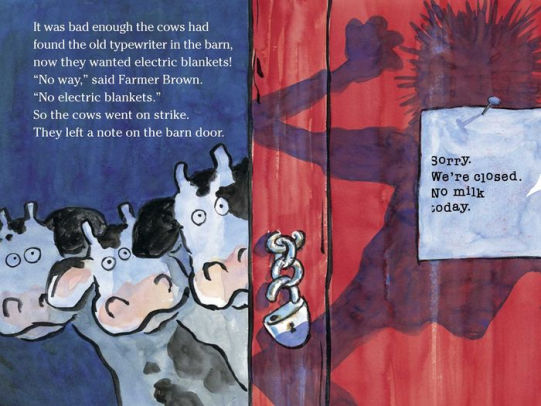
My favorite book for this activity is Click, Clack, Moo: Cows that Type. This work by Doreen Cronin with art by Betsy Lewin (view a read-aloud here) presents a clever and humorous narrative about Farmer Brown and his suddenly recalcitrant cows who, having acquired a rickety typewriter, establish a strike that inspires the chickens to join and ends with the neutral ducks aiding the revolt.

Click, Clack, Moo: Cows that Type

This story is ideal for asking teachers to consider the traditional approach to text in schools, New Criticism (a focus on text in isolation and on the craft in any story, such as characterization, plot, and theme), against Feminist and Marxist criticism, for example.

One fall, while doing the activity with a young adult literature class, I came against yet a new reading of Cronin and Lewin’s work: Why the 1% always wins.

The U.S. Public Likes Farmer Brown

As we explored Click, Clack, Moo recently, the adult members of the class told me they like Farmer Brown, with one student characterizing the striking farm animals as “mean.” And here is where I felt the need to consider how this children’s book helps us all confront the Occupy Wall Street movement or the rise in antagonism toward teachers, tenure, and unions as well as why the 1% continues to own the 99%.

One important element of the story is that the cows and chickens are female workers under the authority of the male Farmer Brown. These female workers produce for the farmer and remain compliant until the cows acquire the typewriter—both a powerful tool of literacy (the cows and chickens cannot effectively strike until they gain access to language) and a representation of access to technology (readers should note that the cows and chickens produce typewritten notes that show they find an old manual typewriter unlike the cleaner type produced by Farmer Brown on an electric typewriter, a representation of the inequity of access to technology among classes).

The cows and chickens, in effect, unionize and strike. Here, members of my classes often fail to notice the unionization, but tend to side with the farmer even when we acknowledge the protest as unionizing—particularly bristling at the duck, as a neutral party, using its access to the negotiation to acquire a diving board for the duck pond.

Like the 1%, Farmer Brown is incensed that the cows and chickens demand basic necessities for comfort, electric blankets, but he eventually secures a compromise, agreeing to give the barn animals the requested electric blankets for the return of the typewriter (the story ends with the obvious next step that the duck uses the typewriter to trade for the diving board).

What tends to be missed in this story is that Farmer Brown ultimately wins; in fact, the barn animals appear to be eager to abandon their one access to power, the typewriter, for mere material items—the electric blankets as comfort many would see as a basic right and the diving board as frivolous entertainment.

The 1% have the 99% right where Farmer Brown has the barn animals—mesmerized by the pursuit of materialism and entertainment. Consider the eager hordes of consumers lined up to buy the then-new iPhone 4S, released on the cusp of the passing of Steve Jobs, heralded as a genius for his contribution to our consumer culture.

Just give us our iPhones and we’ll be quiet, we’ll work longer and harder for the opportunity to buy what the 1% tells us we want.

And when the 1% and their compliant media inform us that the top 20% pays 64% of taxes, we slip back to our barns with our tails between our legs, shamed.

Instead, we should be noting that, yes, the top 20% income earners pay 64% of taxes because they make 59% of income.

We, the 99% who tend to remain silent and compliant, wait patiently for the next generation of technology to occupy our time, our lives reduced to work and amassing the ever-changing and out-dated things that become passe as the next-thing lures us further and further into our sheep lives.

Yes, if we remain eager to trade our voices for things, the 1% will always be the winners.

When we learn to treasure voice over things, however, the chickens may come home to roost.

George Saunders’s Allegory of Scarcity and Slack

The stories themselves, literally, are powerful and engaging or George Orwell’s 1984 and Arthur Miller’s The Crucible would not have endured as they have as literature people read again and again—and possibly should read again and again.

However, ultimately, 1984 is not about the future (especially since we have long since passed the future Orwell may have envisioned), and The Crucible is not about the past (although Miller built his play on the very real and troubling history of Puritan witchcraft hysteria). These works are about the complicated present of both authors’ worlds as that speaks to the enduring realities of the human condition.

All of that may seem weighty stuff to step into a look at what appears to be a children’s book, but the paragraphs above should be more than a hint that looks can be deceiving—and enlightening.

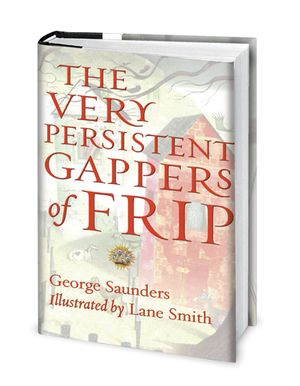
The Very Persistent Gappers of Frip, written by George Saunders and wonderfully illustrated by Lane Smith (whose It’s a Book I cannot recommend highly enough), is a fanciful and satirical tale that proves in the end to be an allegory of scarcity and slack—a perfect companion read to Ursula K. Le Guin’s allegory of privilege, “The One’s Who Walk Away from Omelas.”

The Very Persistent Gappers of Frip

Realizing that the Human Heart Is Capable

“Ever had a burr in your sock?” sets the story in motion—one sentence centered on the page over a giant question mark. It is an opening worthy of a child and all of us who cling to the wonder of childhood.

While Le Guin is often described as a science fiction writer, in her work I recognize the blurring of genres that joins science fiction, speculative fiction, and fantasy; it is that “other world” about which Le Guin and Margaret Atwood appear to argue, and it a stark but rich other world Saunders conjures and Lane pictures.

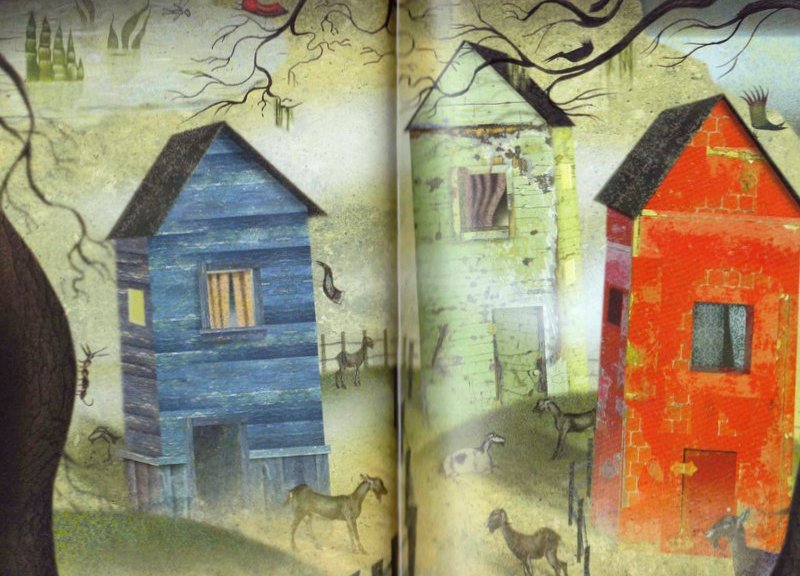
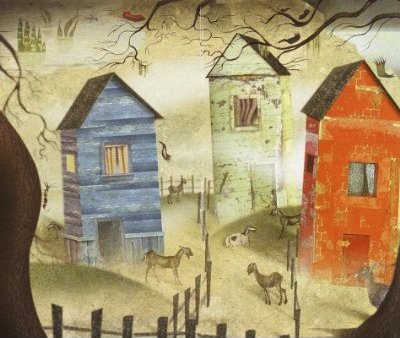
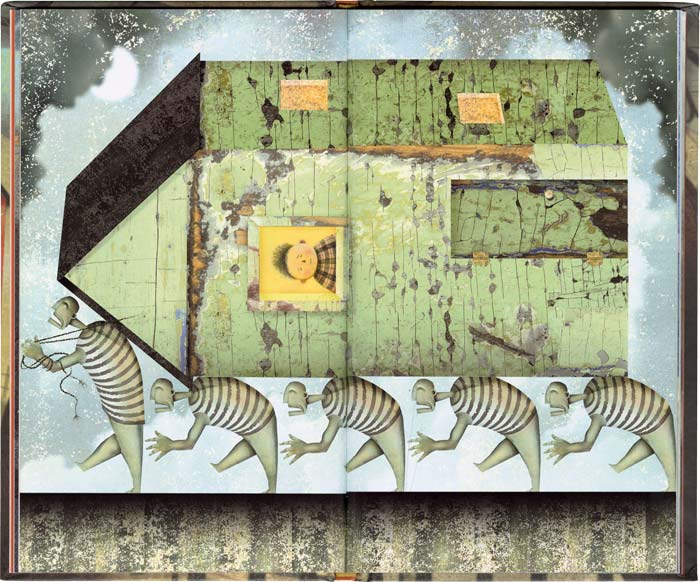
The story of Frip involves three houses for three families, all with children at the center. The houses are distinguished with primary colors—child-like blue, green, and red—but Lane’s artwork adds the ominous to Saunders’ seemingly simple narrative tinged with more than a bite of satire. The illustrations echo the haunting works about and for children found in Neil Gaiman and Tim Burton.

“Frip was three leaning shacks by the sea.” (p. 6) Artwork by Lane Smith

A child standing precariously close to the end of a slanted cliff over an angry ocean catches the eye on page 7 and then the crux of the story pulls you back to the text on page 6:

Frip was three leaning shacks by the sea. Frip was three tiny goat-yards into which eight times a day the children of the shacks would trudge with gapper-brushes and cloth gapper-sacks that tied at the top. After brushing the gappers off the goats, the children would walk to the cliff at the edge of town and empty their gapper-sacks into the sea. (p. 6)

Gappers, orange burr-like creatures with many eyes and the size of a baseball, come to represent throughout the story the power of the systemic inevitable: The presence of the gappers determines the lot of the families (and their goats), but most of the people in the tale remain unable to see beyond their own fixed and mostly misguided worldviews.

“A gapper’s like that, only bigger, about the size of a baseball, bright orange, with multiple eyes like the eyes of a potato.” (p. 2) Artwork by Lane Smith

When the gappers cling to the goats of all three families, there is an ironic appearance of equality among them. But when the fortune of one family shifts, the gappers fulfill their name by creating the gap:

So that night, instead of splitting into three groups, the gappers moved into one very large and impressive shrieking group directly into Capable’s yard. (p. 12)

Before this shift in how the gappers behave, of course, the three families are not equal because Capable is an only child living with her father and who has lost her mother. Capable works as all the children are expected to work (removing gappers in a daily Sisyphean nightmare of chores) and seeks to serve the needs of her grieving father, who along with his grief is a prisoner of nostalgia:

“I myself was once an exhausted child brushing off gappers. It was lovely! The best years of my life. The way they fell to the sea from our bags! And anyway, what would you do with your time if there were no gappers?” (p. 11)

This nostalgia masking an unnecessarily burdensome childhood, however, is but one ideology weighing on Capable because as soon as the other two families are relieved of gappers on their goats, those families reveal themselves to be very much like the people of Le Guin’s Omelas:

“It’s a miracle!” Mrs. Romo shouted next morning, when she came out and discovered that her yard was free of gappers. “This is wonderful! Capable, dear, you poor thing. The miracle didn’t happen to you, did it? I feel so sorry for you. God has been good to us, by taking our gappers away. Why? I can’t say. God knows what God is doing, I guess! I suppose we must somehow deserve it!” (p. 17)

Capable becomes the sacrificed child, and despite her misfortune, the relieved families read the events as their merit (and of course the ugly implication that Capable and her father deserve the burden of the gappers).

What follows from this shift in fate is the central story of Frip with Capable as our main character. The message becomes clear, and Saunders and Lane make the ride one you’ll want to visit again and again. If you are lucky, the book could become one of those read alouds requested by son or daughter, or by a classroom of children.

And while I will leave the rest of the story to you, I think it is necessary to note here that this allegory is both a cautionary tale about how we view children and childhood as well as a brilliant call to reconsider how we view education and education reform.

George Saunders’s Allegory of Scarcity and Slack

The U.S., like the characters (except for Capable) in Saunders’s story, is tragically blinded by a belief in cultural myths that have little basis in evidence: That we live and work in a meritocracy, that competition creates equity, that children need to be “taught a lesson” about the cold cruel world lest they become soft, and such.

As a result of these beliefs, schools often reflect and perpetuate rather harsh environments for children—or to be more accurate, schools often reflect and perpetuate rather harsh environments for other people’s children, as Capable personifies.

Here, then, I want to make the case that The Very Persistent Gappers of Frip is a powerful allegory of scarcity and slack as examined by Sendhil Mullainathan and Eldar Shafir in their Scarcity: Why Having Too Little Means So Much.

Mullainathan and Shafir detail that the conditions of poverty, scarcity, so overburden people psychologically, mentally, and physically that their behavior is often misread (poor people are lazy, poor people make bad decisions, etc.). In Saunders’s story, scarcity and its burden are portrayed by the gappers, and readers witness how the coincidence of the onslaught of the gappers changes the families involved. In other words, the behavior of people is determined by the environment, and not by the inherent goodness or deficiencies of any individual.

The Very Persistent Gappers of Frip goes further, however, by showing that one person’s scarcity (Capable) allows other person slack: privilege is built on the back of others, and those conditions are mostly arbitrary. While Mullainathan and Shafir argue that the slack enjoyed by those living in relative privilege provides the sort of cognitive space needed to excel, Saunders speaks to more than the slack enjoyed by the two families relieved of gappers and the compounding scarcity suffered by Capable (her lot in life and the addition of the gappers):

“And the men succeeded in lifting the house and moving it very very close to the third and final house in Frip, which belonged to Sid and Carol Ronsen, who stood in their yard with looks of dismay on their nearly identical frowning faces.” (p. 23) Artwork by Lane Smith
  • Capable represents a counter-narrative to claims that impoverished children lack “grit.” As her name suggests, this child is more than capable, but the world appears determined to defeat her.
  • Capable also embodies Lisa Delpit’s confrontation of “other people’s children”—that those with privilege (slack) are willing to allow one set of standards for other people’s children (often living and learning in scarcity), standards they will not tolerate for their own.

As I stated in the opening, allegory seeks to open our eyes by diversion, creating an other world that helps us see both the flaws with our now and the enduring failures of humans to embrace our basic humanity, a failure Capable teeters on the edge of making herself but cannot:

And [Capable] soon found that it was not all that much fun being the sort of person who eats a big dinner in a warm house while others shiver on their roofs in the dark.

That is, it was fun at first, but then got gradually less fun, until it was really no fun at all. (p. 70).

In the end, it is this sort of charity, this sort of recognition of the community of humanity, a call for the kindness found in Kurt Vonnegut’s similar mix of dark humor that Saunders appears to suggest we are all capable.

Companion Reads for The Very Persistent Gappers of Frip

Scarcity: Why Having Too Little Means So Much, Sendhil Mullainathan and Eldar Shafir

“The Ones Who Walk Away From Omelas,” Ursula K. Le Guin

“The Soul of Man under Socialism,” Oscar Wilde (1891)

“The Silenced Dialogue: Power and Pedagogy in Educating Other People’s Children,” Lisa Delpit

Other People’s Children: Cultural Conflict in the Classroom, Lisa Delpit

“NPR Whitewashes ‘Grit’ Narrative” 

Competition: A Multidisciplinary Analysis, Wade B. Worthen, A. Scott Henderson, Paul R. Rasmussen and T. Lloyd Benson, Eds.

Oscar Wilde on the Poor and Socialism

While I highly recommend a careful reading of Oscar Wilde’s The Soul of Man under Socialism, I also urge you to consider that this examination of the consequences of private property and how that perpetuates poverty is stunningly similar to the current education reform movement, notably: “But their remedies do not cure the disease: they merely prolong it. Indeed, their remedies are part of the disease.”

poor oscar wilde copy