Category Archives: Standards

Elite or Selective?: Reconsidering Who We Educate and How

Sharde Miller’s California teen describes his road from Compton to Harvard University offers a powerful subtext about the American Dream as well as the enduring belief in education as the “great equalizer,” embodied by Elijah Devaughn Jr.:

Devaughn grew up in a single-parent household in Compton, California, a city that has been plagued by gun violence and gang activity for decades….

“Getting accepted into a prestigious university like Harvard, I think it means the world,” Devaughn said. “It means God is able. It means that hard work pays off. It means that, you know, struggles end.”

What if we unpack the label of “prestigious” by making an important caveat: Is Harvard University elite or selective?

As a point of reference, over the past three decades of high-stakes accountability in public education, schools have been annually labeled as excelling and failing; however, once we look beneath the A-F rankings, a strong and consistent correlation persists between schools identified as excelling or failing and the socio-economic status of the students [1] (as well as the racial and language demographics).

Consider also that for every year of the SAT being administered, average scores have fallen perfectly in correlation with parental income and parental years of education [2].

My university has begun gathering data to analyze our impact on students. The university is selective, having high standards for the academic backgrounds and achievements of students.

Some initial data are telling. When students with high preparation are compared to students with low preparation, extrapolating over four years of college, high preparation students are more successful and the gap with low preparation students widens during years 2 and 3 and then never closes by year 4 (year 1 and year 4 gaps are about the same).

If we persist in suggesting that education is the great equalizer (despite ample evidence education does not, in fact, equalize) and a foundational mechanism of the American Dream, we must reconsider how and why we identify any schools as “prestigious.”

Alexander W. Astin’s Are You Smart Enough? seeks to examine if our prestigious and excelling schools are elite or merely selective. Astin exposes part of the problem with labeling colleges, for example, as “prestigious”:

The “quality” or “excellence” of a college or university is thus judged on the basis of the average test score of its entering students, rather than on how well it educates them once they enroll.

What is lost in the rush to ascribe success and failure to schools is, as Astin argues, the essential charge of any formal schooling:

On the contrary, the quality of our national talent pool depends heavily on how well colleges and university develops the students’ capacities during the college years. And this mean all students.

And thus, Astin asserts: “More parents need to be asking, ‘Why should an educational system invest the least in the students who may need the most in higher education?'”

Here, then, is the dirty little secret: “Prestigious school” (K-12 as well as colleges/universities) is a veneer for “selective,” not “elite” in terms of the educational impact but in terms of the conditions at those schools.

Public universities are less selective than private liberal arts colleges, and the former experience is distinct from the latter in, for example, faculty/student ratios, class size.

In other words, more academically successful students tend to be from more affluent and well educated parents, and then are afforded higher education experiences that are identifiably superior to relatively less successful students from lower levels of affluence and education.

Reconsidering how we label schools, the “selective” versus “elite” divide, is a first step in seeking ways to turn a tarnished myth (“education is the great equalizer”) into a reality.

Too often “prestigious” and “elite” are code for “selective,” praising a college/university for gatekeeping, and not educating; too often “excellent” and “failing” are code for student demographics, ranking K-12 schools for proximity, and not educating.

Testing, ranking, and accountability in the U.S. have entrenched social and educational inequity because, as Astin confronts, “there are two very different uses for educational assessment: (a) to rank, rate, compare, and judge the performance of different learners and (b) to enhance the learning process.”

We have chosen the former, pretending as well that those metrics reflect mostly merit although they are overwhelming markers of privilege.

Let’s return to Devaughn as a rags-to-riches story.

Late in the article we learn Devaughn attended private school before his acceptance to Harvard—again bringing us back to the issue of opportunity and what we are learning at my university about well prepared students versus less prepared students.

Devaughn’s story should not be trivialized, but carefully unpacked, it does not prove what I think it intended to show. The American Dream and claims education is the great equalizer are, in fact, deforming myths.

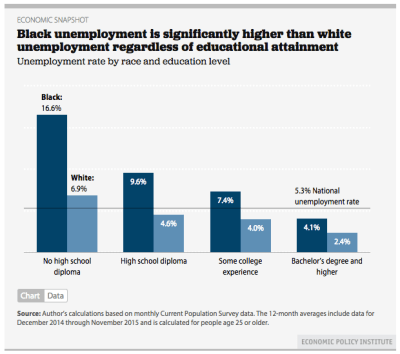
Race, gender, and the socioeconomic factors of homes and communities remain resilient causal factors in any person’s opportunities and success:

Access to good jobs
Black unemployment is significantly higher than white unemployment regardless of educational attainment | Economic Policy Institute

All schools at any level must re-evaluate who has access to the institution, and why, and then focus on what impact the educational experience has on those students. Therein must be the evidence for determining excellence and prestige.


[1] See here and here for examples in South Carolina.

[2] See The Conversation: Tests don’t improve learning. And PARCC will be no different.

Education Reform in the Absence of Political Courage: Charleston (SC) Edition

Words matter, and thus, I must apologize by opening here with a mundane but essential clarification of terms.

As I have written over and over, everything involving humans is necessarily political, even and especially teaching and learning. Therefore, no teacher at any level can truly be apolitical, objective. Taking a neutral or objective pose is a political choice, and an endorsement of the status quo.

Key to that claim is recognizing the difference between political and partisan. Partisan politics involves allegiance to and advocacy for organized political parties, notably Republicans and Democrats.

A partisan feels compelled to place party loyalty above ideology or ethics. To be political can be and should be a moral imperative.

We can avoid being partisan, even as that is political. And when many people call for education and educators to avoid being political, what they really are seeking is that education and educators not be partisan—a position that is achievable and one I endorse.

This distinction matters in public education and public education reform because all public institutions in the U.S. are by their tax-supported status at the mercy of partisan politics.

From around 1980, in fact, politicians at the local, state, and national levels have discovered that public education is a powerful and effective political football. The standard politician’s refrain is “Schools are horrible, and I can make them better!”

The current rise of the inexpert ruling class at the presidential level has been foreshadowed for more than three decades by the partisan politics around education reform—politicians and political appointees with no experience or expertise in education imposing pet reform initiatives onto public schools because these policies appeal to an equally mis-informed public.

Even with large failed crucibles such as New Orleans post-Katrina, political leaders remain committed to finding themselves in a hole and continuing to dig.

In my home state of South Carolina, infamous for our Corridor of Shame, Charleston, on the east coast and part of that corridor, continues to represent the savage inequalities that result from a combination of an inexpert ruling class and an absence of political courage.

Charleston schools reflect the most stark facts about and problems with K-12 education across the U.S.: private and gate-keeping public schools (such as academies, magnet schools, and some charter schools) that provide outstanding opportunities for some students in contrast to grossly ignored high-poverty, majority-minority public schools that mis-serve “other people’s children.”

As a result of these inequities and dramatically different student outcomes exposed by the accountability era obsession with test scores, Charleston has played the education reform game, committing to provably failed policies over and over: school choice, school closures and takeovers, school turnaround scams, overstating charter schools as “miracles,” and investing in Teach For America.

Why do all these policies fail and what ultimately is wrong with inexpert leadership? The absence of political courage to address directly the blunt causes of inequitable student outcomes in both the lives and education of students.

Currently in Charleston, the closing of Lincoln High and transferring those students to Wando High (see here and here) highlight that the gap between commitments to failed edureform and political courage to do something different persists.

The debates and controversy over how former Lincoln students are now performing at Wando offer some important lessons, such as the following:

  • The media and the public should be aware of partisan political code. A garbled reach for “the soft bigotry of low expectations” has been used to explain why Lincoln students’ grades have dropped while at Wando. The “soft bigotry” mantra is a conservative slur triggering the public’s belief in “bleeding heart liberals,” who coddle minorities. But the more damning part of the code is that it focuses blame on the administration and teachers in high-poverty, majority-minority schools and thus away from political leadership.
  • And thus, the public needs to distinguish between blaming educators at Lincoln for low expectations (again, garbled as “low standards”) and the expected consequences of high-poverty, majority-minority schools suffering with high teacher turnover, annual under-staffing, and persistent teacher workforces that are new and/or un-/under-certified. Additionally, the accountability era has unrealistic demands of these schools when compared to low-poverty, low-minority schools that have much greater percentages of experienced and certified teachers.
  • The apparent drop in student grades and test scores from Lincoln to Wando is extremely important data that deserve close scrutiny, but so far, that scrutiny has been reduced to partisan politics and deflecting blame. Dozens of reasons could explain the grade differences, including the transfer as well as the staffing differences between the two schools (neither of which is the simplistic “soft bigotry” argument used primarily to justify closing a community school).

The partisan political approaches to schools and education reform are tarnished by both willful ignorance and a confrontational blame game.

The willful ignorance of politicians and the public refuses to acknowledge huge social inequity driven by racism and white privilege; the blame game seeks ways to blame the victims of those inequities instead of confronting systemic forces.

What should political leaders be doing and what should the public be demanding that is different from the patterns identified above, than the policies already proven as failures?

  • Recognize that in-school only reform creates two serious problems: (1) unrealistic demands with high-stakes consequences produce unethical behavior among otherwise good people (see the Atlanta cheating scandal), and (2) since out-of-school factors overwhelmingly influence measurable student achievement, even the right in-school only reform is unlikely to result in measurable improvement.
  • Interrogate the proclaimed cause of low student achievement—”low expectations”—and instead seek to understand the complex reasons behind that low achievement by poor and black/brown students based on available evidence that includes carefully interviewing the administrators, teachers, and students involved.
  • Advocate for public policy that addresses serious inequity in the lives of children—policy impacting access to health care, a stable workforce, access to safe and stable housing, and high-quality food security.
  • Refuse to ignore needed in-school reform, but reject accountability-based reform for equity-based reform focusing on equitable teacher assignment for all students, articulated school funding that increases funding for schools serving struggling communities, guaranteeing the same high-quality facilities and materials for all children regardless of socioeconomic status of the communities served, and eliminating gate-keeping policies that track high-needs students into test-prep while advantaged students gain access to challenging courses such as Advanced Placement and International Baccalaureate.

Ultimately, the absence of political courage in SC and across the U.S. is where the real blame lies for inequitable student achievement along race and class lines.

Many students, the evidence shows, are doubly and triply disadvantaged by the consequences of their lives and their schools.

Trite and misleading political rhetoric, along with “soft bigotry of low expectations,” includes soaring claims that a child’s ZIP code is not destiny.

Well, in fact, ZIP code is destiny in SC and the U.S.; it shouldn’t be, but that fact will remain as long as political leadership chooses to ignore the expertise within the field of education and continues to lead without political courage.

Political courage requires direct action, even when it isn’t popular, and refuses to deflect blame, refuses to wait for what market forces might accomplish by taking the right action now.

Political courage, as James Baldwin expressed, embraces that “[t]he challenge is in the moment, the time is always now.”


For More on Political Courage

Support Betsy Devos Shoot Yourself In The Foot, Andre Perry

Black Activists Don’t Want White Allies’ Conditional Solidarity!, Stacey Patton

Measuring Proficient Teachers Codifies Bad Teaching

Maja Wilson and Alfie Kohn have found themselves in a problematic minority during the accountability era dedicated to standards, high-stakes testing, and the ever-present rubric.

Rubrics, they argue, ultimately fail complex human behaviors such as writing. While rubrics facilitate statistical aspects of measuring human behaviors (such as teaching and learning), by doing so, they also tend to erode the quality of the very behaviors being measured.

As a writing teacher, I can confirm Wilson’s and Kohn’s critiques that student writing conforming to a rubric and thus deemed “proficient” or “excellent” can be and often is quite bad writing. Rubric-based labels such as “proficient” reflect compliance to the rubric, not writing quality.

Wilson, in fact, has demonstrated this by revising a professional and beautiful piece of writing by Sandra Cisneros so that is conforms to a computer-graded system’s criteria for high-quality writing. The result was more than disturbing with the revised work substantially worse but better correlated with what the Educational Testing Service (ETS) has deemed “good.”

While Wilson’s experiment focuses on computer-graded writing, the basis of that is having a generic rubric to determine writing quality, and thus, here we begin to investigate why rubric-driven evaluation of complex human behavior always fails:

  • Rubrics reduce the unpredictable to the prescribed.
  • To be practical, rubrics often attempt to be generic enough to cover huge categories—such as writing and teaching—and thus failing the reality that poetry writing is significantly distinct from journalism or that teaching second grade is significantly distinct from teaching high school physics.
  • When rubrics use terminology that is broad enough to address those varieties, they are useless due to being too vague; when rubrics use terminology that is specific, they are useless because they are unduly prescriptive. If the learning objective is jumping rope, if proficiency is “students jump well,” we have no idea what “well” means, and if proficiency is “students jump 10 times without missing,” that 10 becomes all that matters. In other words, in both cases, complying to the rubric ultimately supersedes the actual jumping rope.
  • Rubrics replace substantive feedback conducive to learning, and in fact, stagnates learning and reduces all assessment as summative.
  • As with high-stakes testing, high-stakes rubrics connected to course grades and/or as part of state accountability systems carry the weight of authority—shifting that authority from teachers and students to the rubric itself and the bureaucracy behind it.

So this brings me back to South Carolina teacher evaluation rubric, adapted from the National Institute for Excellence in Teaching (NIET).

SC’s version of the NIET rubric, as I discussed, is marred by being unmanageable due to its length and inadequate due to the inordinate amount of terminology that is too vague (and again, if we address that vagueness, we still have a flawed instrument that is all prescription).

While going through a first session of training in the rubric, I witnessed the greatest problem with using generic rubrics to determine teacher quality: a very bad literacy lesson was pronounced at the high end of “proficient” by how it conformed to the rubric, but the lesson was in fact terribly uninspired, overly teacher-centered, and reductive—as well, it likely eroded significantly the students’ passion for and interest in reading and literacy.

Adopting and implementing a new teacher quality rubric, however, have been committed primarily to training those who will evaluate teachers so that the assessors are familiar with the rubric and the endorsed process; and then, above all else, a central goal is to produce inter-rater reliability with a rubric that NIET and others have already deemed valid.

In other words, this is a statistical enterprise—not an adventure in teaching and learning.

Lost in the technocratic orgy about validity, reliability, and the all-things scientific, we have made the mistake confronted by John Dewey:

What avail is it to win prescribed amounts of information about geography and history, to win ability to read and write, if in the process the individual loses his own soul: loses his appreciation of things worth while, of the values to which these things are relative; if he loses desire to apply what he has learned and, above all, loses the ability to extract meaning from his future experiences as they occur? (Experience and Education, p. 49)

The irony here, of course, is that Dewey is one of the seminal voices for education being scientific; however, I cannot imagine his expecting this reductive outcome.

All aspects of teaching and learning are poisoned by our misguided pursuit of a very narrow version of “scientific” that has been subsumed by the bureaucratic and turned into pseudo-science.

What avail is it to label a teacher proficient, if in the process the teaching is terribly uninspired, overly teacher-centered, and reductive, if in the process the students are rendered lifeless and uninspired as well?

Education Reform and the Eternal Failure of the Unimaginative Bureaucratic Mind

In the 2006 film Idiocracy, the U.S. five centuries into the future is suffering crippling crop shortages due to a dust bowl that the main character (a survivor of suspended animation from the present of the film’s opening, around 2005), Private Joe Bauers, discovers is human-made since the nation of idiots has been irrigating those crops with a Gatorade-like sports drink.

This science fiction satire has experienced a resurgence due to many pundits associating the rise of Trump with the film’s extrapolation about humanity becoming more and more a nation of idiots, but for those of us in education, Idiocracy speaks to the most recent era of education reform driven by accountability, standards, and testing.

The human-made dust bowl is the result of an initial false analogy: If the sports drink, they reasoned, is a powerful fluid for human hydration, then it must be an ideal solution to struggling crops needing hydration.

If we unpack this idiotic logic a bit more, we must add that even the initial idea—sports drinks filled with sugar and salt as powerful hydration fluids—is mostly a false belief based on a great deal of clever marketing and gullibility in the consumers.

Before Bauer forces this future of idiots to reimagine their problem in order to rethink their solution, the status quo of hydrating crops with sports drink continues along with the puzzlement among the idiots about why nothing is improving.

So let’s do a little thought experiment with that film in mind.

First, consider this from Rebecca Smith:

In the late 1800s, the United States was feeling the impact of the industrial revolution. Influenced by Taylorism and the desire for scientific management, statistics and measurement were evolving as objective methods used to evaluate and systematically organize information. Education was swept up in the measurement and statistical movement. Thorndike (1918), relying on his psychological work, believed scientific measurement utilized in educational settings could create efficient systems where ‘knowledge is replacing opinion, and evidence is supplanting guess-work in education as in every other field of human activity’ (p. 15). To Thorndike, the measurement of educational products was the means by which education could become scientific through rigor, reliability, and precision….

To [Thordike], the connection between science, measurement, and human behavior was clear (Cremin, 1964). Lewis Terman published the Binet-Simon IQ Test in 1916; this test provided the context for psychologists to assess abilities, explain differences in students’ performance, and improve schools (Chapman, 1988). Standardized academic tests measure performance in the areas of handwriting, maths, and reading. Data from these tests offered superintendents, teachers, parents, or pupils ‘guidance in many different sorts of decisions and actions’ including ‘the fate of pupils, the value of methods, and the achievement of school systems’ (Thorndike, 1918, pp. 19, 22). Although Thorndike used the term ‘product’ instead of ‘data’, concepts such as rigor, reliability, and precision became part of educational discourse, measuring unseen changes in human beings. Intelligence had become objectified in numbers. The quantification of children’s intelligence, demographic characteristics, and school performance resulted in columns of numbers compared, contrasted, and evaluated in the United States. As the scientific gaze turned towards children, they became classified, compared, and evaluated according to numbers (Cannella, 1997). (pp. 3, 4)

Just a decade after this film and almost a century after Thorndike, in 2016, consider this:

In the latest international comparison of student achievement, public schools in the United States ranked no better than 24th in the world. But the public schools of Massachusetts had few peers.

Perhaps Massachusetts has something to teach the rest of the nation.

Well, unless you listen to Massachusetts, where researchers determined that two-thirds of the state’s effort at education reform has been a failure:

The evidence we have gathered strongly suggests that two of the three major “reforms” launched in the wake of the 1993 law — high-stakes testing and Commonwealth charter schools — have failed to deliver on their promises.

On the other hand, the third major component of the law, providing an influx of more than $2 billion in state funding for our schools, had a powerfully positive impact on our classrooms. But we will show that, after two decades, the formula designed to augment and equalize education funding is no longer up to the task.

So what we have here is an idiocracy of education reform, a failure of imagination to reconsider the problem and then to rethink solutions.

The U.S. need not idealize Finland or Massachusetts—or let’s not forget in 1962, it was the Swiss.

And the relentless commitment to accountability based on ever-new standards and ever-new tests is no different than the idiots continuing to hydrate crops with sports drink.

Like sports drinks, testing is inherently a sham, and our refusal to step away from a paradigm that has never worked despite countless efforts at making it work is our own version of a very real and current Idiocracy.

On Education and Credentialing: “Mak[ing] a Straight-cut Ditch of a Free, Meandering Brook”

“What does education often do?” Henry David Thoreau asked in his journal, answering: “It makes a straight-cut ditch of a free, meandering brook.”

As a former high school English/ELA teacher for 18 years, as I sat in the first of two training sessions yesterday, this from Thoreau came to mind.

Over the past 15 years, I have been a teacher educator, now a full and tenured professor in my university’s Education Department. Yet, from 9-4 yesterday, as representatives from the state department of education trained our full-time and adjunct faculty on the new South Carolina teacher evaluation rubric, adapted from the National Institute for Excellence in Teaching (NIET) standards, I felt more like an elementary student because the so-called training was mostly condescending and entirely unprofessional.

But the unprofessional, I regret to acknowledge, is business as usual for teacher education, as a faux-field in higher education, and for K-12 teaching, a faux-profession.

Some of my doctoral courses for an EdD in curriculum and instruction covered educational leadership. In that work, I was always fascinated by what the research often describes as three types of leaders—authoritarian, authoritarian-light, and collegial.

The most chilling of the three is the authoritarian-light, which is a style that includes finding strategies that manipulate stakeholder buy-in by making it appear the stakeholders are making decisions even though they are actually being coerced to comply with mandates about which they have no real choice.

This is the process I suffered through yesterday as bureaucrats from the state department assured a room of professors and practitioners that the new state rubric for teacher evaluation is backed by research and that we already know and do everything therein.

Again, as a former English/ELA teacher, I am struggling with describing the experience as Orwellian, a Kafkan nightmare of reason, or both.

Training Teacher Educators to Train Teachers to Train Students

Some of the early session dynamics are worth noting upfront.

As part of the authoritarian-light strategies, the facilitators had lots of group work with large sticky paper and markers. Much laughing and chatting included references to the numerous teacher evaluation systems SC has adopted over the past three decades and how everyone in the room knew all this stuff.

We all shared our very E.D. Hirsch moment of knowing all the acronyms for the four or five systems many of us in the room have experienced.

And then the dramatic kicker: But this new rubric and system is different, better, and supported by research!

[Let’s note that no time was taken to acknowledge that this same framing occurred each time all the former systems were introduced.]

In passing, the credibility of the rubric was linked to the fact that the rubric includes footnotes (so do Ann Coulter’s books, by the way) to the incredible work of Danielson and Marzano!

However, as I found the rubric online, I noticed that neither were in the 23 footnotes.

[Let’s note that no time was taken to examine very powerful and credible counter-evidence refuting the credibility of the cult of Danielson and the cult of Marzano. Also, the cult of Hattie is in footnote 7, a hint to the hokum therein.]

Not to belabor the seven-hour training session, but a few additional points:

  • This rubric is highly touted, yet when we raised concerns about vague terms such as “most” and “some” to distinguish between “proficient” and “needs improvement,” that conversation was mostly brushed aside, except that we discovered if you look under “Description of Qualifying Measures” on page 8, you learn that “most” means “some” (though “some remains undefined). By any fair evaluation of this rubric, it fails miserably the basic parameters of high-quality rubrics (interestingly something I teach in my methods courses).
  • And then there is the rubric’s enormity: 404 bullets over 4 categories and nine pages of small Helvetica font. To navigate these bullets (and we were warned repeatedly to do so “holistically and not as a checklist” as we walked through the bullets as a checklist and not holistically) with any care at all requires nearly three hours for just one lesson, assuming about 2-minutes per bullet. Not only does the rubric fail basic expectations for clearly defined terms (just what the hell are “powerful ideas”?), but also it fails for being incredibly unwieldy and overwhelming.
  • Throughout the training, two key points were emphasized: mastery and teacher impact on student learning. As I will discuss below, we were given no opportunity to explore the serious problems with both, and no time was spent highlighting how the training itself practiced faux-science in the context of each.
  • As we explored the rubric, as well, the facilitators unpacked key factors that are not expressed in the rubric itself. Even though the language of the rubric under “proficient” references the teacher, the facilitators noted often that to move from “needs improvement” to “proficient” was dependent on students demonstrating mastery (showing “proficient”), not teacher behaviors (merely “needs improvement”).

To clarify how problematic this training proved to be, let me offer briefly the last activity, our viewing a lesson and watching the facilitators model how to use the rubric.

The lesson was a ninth-grade ELA lesson on inference, and the class was a “no excuses” charter school with black and brown children all adorned in matching purple shirts.

Here is the short version: the lesson, we were told, met the upper range of “proficient.”

Yet, what the activity highlighted was quite different than the intent.

The lesson was weak, a reductive attempt to teach inference to mastery that confuses isolated literacy skills with teaching literacy or literature. But this sort of bad lesson is necessary once you reduce teaching to mastery and teacher impact on student learning.

Instead of addressing this substantive problem and ways to conference with the teacher about focusing literacy instruction on rich texts and inviting students to explore those texts with more and more sophistication over a long period of time, the points of emphasis were on transcribing verbatim the lesson (although we could barely hear the audio) so that we could give lots of evidence for the bullet points we were not supposed to view as a checklist.

[Let’s note that no time was allowed to acknowledge that if and when teacher evaluators need detailed evidence of teaching, the video itself is superior to transcribing.]

The Big Point here is that once a rubric is codified by the state as a credentialing instrument, that rubric determines “proficient,” which may also simultaneously be a very bad, uninspiring, and reductive act of teaching.

Within that, as well, we witnessed the faux-science of claiming to embrace concepts while simultaneously contradicting them.

While only a few students out of a class of 20-plus students responded aloud during the lesson (our only potential evidence of learning), that constituted “most” and thus “proficient”—and represents in the Orwellian confines of this rubric “mastery.”

A few students offering one or two comments aloud in no reasonable way constitutes mastery, and there were no efforts to control for anything that justifies claiming this lesson by this teacher was a direct causal agent for the supposed learning. For example, those students willing to share may have come to class already capable of playing the inference game in school.

Teacher education as a bureaucratic mandate has mostly and currently functions as faux-science—adopting the language of being a certain kind of reductive behavioral psychology without taking the care and time to understand or implement the concept with fidelity.

This is a tragic consequence of the low self-esteem of the field—which becomes a vicious cycle of pretending (badly) to be a field deemed more credible (psychology) but unable to become a credible and independent field unfettered by bureaucracy.

Everything Wrong with Teacher Education Is Everything Wrong with Education

“Schools are increasingly caught up in the data/information frenzy,” concludes Rebecca Smith, adding:

Data hold elusive promises of addressing educational concerns, promising real-time personalized instruction, predicting student growth, and closing the achievement gap of marginalized students (Bernhardt, 2006; Earl & Katz, 2006; Spillane, 2012). Today collections of student data are considered a reliable and a scientific way of measuring academic growth, mobilizing school improvement, and creating accountable, qualified teachers. Influenced by policy, pedagogy, and governing school procedures, data collection has become normalized in schools. Instead of asking what we can do with data, the better questions are: How did the accepted practice of quantifying children become normalized in education? How does our interaction with data govern our thoughts, discourses, and actions? (p. 2)

And as Smith details, the historical roots are deep:

Thorndike (1918), relying on his psychological work, believed scientific measurement utilized in educational settings could create efficient systems where “knowledge is replacing opinion, and evidence is supplanting guess-work in education as in every other field of human activity” (p. 15). To Thorndike, the measurement of educational products was the means by which education could become scientific through rigor, reliability, and precision. (p. 3)

As a logical although extreme consequence of this historical pattern, Common Core represents the false allure of accountability and standards as well as the quantification of teaching and learning within the idealized promise of “common.”

Common Core was doomed from the beginning, like the many iterations of standards before because as a consequence of the accountability era the evidence is quite clear:

There is, for example, no evidence that states within the U.S. score higher or lower on the NAEP based on the rigor of their state standards. Similarly, international test data show no pronounced test score advantage on the basis of the presence or absence of national standards. Further, the wave of high-stakes testing associated with No Child Left Behind (NCLB) has resulted in the “dumbing down” and narrowing of the curriculum.

And thus:

As the absence or presence of rigorous or national standards says nothing about equity, educational quality, or the provision of adequate educational services, there is no reason to expect CCSS or any other standards initiative to be an effective educational reform by itself.

For decades and decades—and then to an extreme over the past thirty years—education and teacher preparation have been mired in doing the same thing over and over while expecting different results.

The quality of education, teaching, and learning is not in any reasonable way connected to the presence or quality of standards, to the ways in which we have chosen to measure and then quantify them.

Training education professionals to use a really bad rubric that will determine if candidates are allowed to teach “proficiently” (which I can define for you: “badly”) is insanity because within a few years, another rubric will be heralded as the greatest thing while teaching and learning are no better—and likely worse—for all the bluster, time, and money wasted.

Education and teacher education are trapped in a very long technocratic nightmare bound to a reductive behaviorism and positivism.

These false gods are useful for control and compliance, but are in no way supportive of educating everyone in a free society.

Technocrats and bureaucrats cut straight ditches; teaching and learning are meandering brooks.

Not What, But Who: Remaining Grounded as a Teacher of Students

Because she’s older and the teacher, she’s right and I’m not.

Sandra Cisneros, “Eleven”

The field experience students complete as part of my foundations of education course has this semester blended well with their reading Chris Emdin’s For White Folks Who Teach in the Hood…and the Rest of Y’all Too.

As we have discussed both during class sessions, students have been drawn to witnessing and reading as well as thinking about how teachers view and respond to their students.

Although these students have virtually no background in formal education, they have been very perceptive about the inordinate, and distracting, pressures on teachers to cover the curriculum (standards) and prepare students for testing—notably while observing and tutoring at a local majority-minority elementary school.

High student/teacher ratios have also been identified as making good classroom practice nearly impossible.

Running through our discussions has been a concern about how teachers treat students (often more harshly than my students anticipated or endorsed) and about the pervasive deficit perspective throughout the school.

Observing and tutoring in special needs classes and among Latinx students needing to acquire English have intensified how my students have responded to their field placement and their recognition of the myriad factors that impact negatively formal education.

Often unspoken, but what teachers and students share in far too many schools is a “no excuses” imperative that demands teachers perform well (even miraculously) despite being placed in circumstances that work against their efforts and that demands students somehow leave the pressures and inequities of their lives in order to excel at academics being imposed on them.

Teresa Watanabe’s Can a child who starts kindergarten with few reading or math skills catch up? is a snapshot of what my students have witnessed and what Emdin’s work challenges.

Responding to that article, Stephen Krashen, Professor Emeritus at the University of Southern California, has identified the problem that my students have observed:

But there is no evidence that tougher standards lead to more learning, and no evidence showing that the Common Core standards are better at preparing children for college and career than other standards or than no standards….

Forcing young children to study flashcards in the car and spell words during family outings in order to “master” 100 words is turning kindergarten into kindergrind.  Children who develop a love of reading will master thousands of words, without suffering.

Although political leaders and the public often view the authoritarian classroom where teachers are charged with keeping order and demanding that students learn standards and content about which they have no choice or input as the solution, it is now far past time to recognize that this is the problem with formal schooling.

Of course, what we teach is important at every level of education, and that what is becoming even more important for our democracy as we are confronted with a new post-truth media and politics.

That what needs to be the sort of truth that empowers a free people.

That what also needs to include a clear focus on the civility of learning and wrestling with ideas since our post-truth media and politics are increasing and justifying the demanding and nasty tone that is already a problem in many schools.

However, the what must remain secondary to the who—who we teach is what makes teaching an essential calling grounded in the dignity of both teachers and their students.

And the what can never be well taught or learned unless we attend to the conditions of teaching/learning and living among our teachers and students.

The authoritarian classroom, deficit thinking, “no excuses” ideologies and practices—these are corrosive elements for teaching, learning, and democracy as well as liberty.

The very long era of standardized testing and the more recent and relatively shorter era of accountability and standards have inflicted immeasurable harm on teachers and students.

And even as educator autonomy and professionalism become daily further eroded, we are morally obligated to call for and remain grounded in our role as teachers of students.

The who of teaching and learning must always come before the what.

Teacher Education and A Call to Activism

If such a thing existed, education as a profession and discipline would easily take Gold, Silver, and Bronze in the Low Self-Esteem Olympics.

Historically viewed as a woman’s profession—and thus a “second” salary—and as merely a professional discipline, education has labored under a secondary status in both the professional and academic worlds.

As a result, education chose early to be a scientific profession and discipline to counter the perception of softness—and thus, as Kliebard details, the heart and soul of education (child-centered commitments and social activism) were marginalized for the more conservative and “hard” elements (efficiency and core curriculum).

In the early decades of the twentieth century, then, a paradox developed: while many who demonized and championed education associated U.S. public schools with John Dewey, the reality was that very little progressivism was practiced but that standardized testing was established as the engine driving the education machine.

Throughout the twentieth century, IQ testing and then the SAT and similar gate-keeping standardized tests (such as the Iowa Test of Basic Skills) significantly influenced how students were labeled and then what courses students were assigned—and even if they had real access to higher education. By the early 1980s, a new era of hyper-accountability was established within which the locus of power shifted entirely to standards and high-stakes tests.

In short, teachers have been reduced to implementing the standards prescribed for them and to conducting test-prep—while the discipline of education has been almost entirely bureaucratized since education courses serve as vehicles for fulfilling certification and accreditation mandates.

In the Preface to Regenerating the Philosophy of Education (edited by Kincheloe and Hewitt, Peter Lang USA, 2011), Hewitt confesses:

Seriously. I never thought I would ever have to justify the moral importance of social foundations courses—particularly philosophy of education courses—in Ph.D. and Ed.D. programs to a committee of colleagues, all holding Ph.Ds. (p. ix)

What Hewitt and the volume are addressing, however, is the new reality about teacher education: education philosophy and foundations courses are disappearing (are gone) because more and more course work in education degrees has to fulfill demands of certification and accreditation.

No more Dewey, Greene, and Freire. But a relentless drumbeat of validity, reliability, teacher impact, and rubrics (my God, the rubrics).

Teacher educators, teacher candidates, and practitioners—all are now not in the business of investigating and building/re-building the profession and discipline of education, but are soldiers taking marching orders from bureaucrats and technocrats.

No more “What is the purpose of universal public education in a free society?” but instead “How do we raise test scores among poor and black/brown students?”

And as I have pointed out before, among those of us in teacher education—who work in higher education where many of us have tenure and are full professors“we have met the enemy and he is us.”

Teacher education has continued the most self-defeating aspects of being a low self-esteem profession and discipline by trying way too hard to prove we are like “hard” disciplines—scrambling to be like psychology while sacrificing our sociological roots, battering our majors and candidates with statistics and measurement while reducing educational philosophy to surveys at best and eliminating it entirely at worst.

And to drift a bit into irony, philosophy is extremely illustrative of the problem facing education. Gilles Deleuze explains:

We are in a generalized crisis in relation to all the environments of enclosure—prison, hospital, factory, school, family. The family is an “interior,” in crisis like all other interiors—scholarly, professional, etc. The administrations in charge never cease announcing supposedly necessary reforms [emphasis added]: to reform schools, to reform industries, hospitals, the armed forces, prisons….

In the disciplinary societies one was always starting again [emphasis added] (from school to the barracks, from the barracks to the factory), while in the societies of control one is never finished with anything—the corporation, the educational system, the armed services being metastable states coexisting in one and the same modulation, like a universal system of deformation. (pp. 3-4, 5)

Education, then, as bureaucratic and technocratic has characteristics of both societies of control and disciplinary societies—”always starting again” and “never finished with anything” as characteristics of the accountability paradigm driven by ever-new standards and ever-new high-stakes tests.

But for all the bluster about being “scientific” and the relentless mantra of “crisis,” bureaucratic and technocratic education has failed to examine the data and re-evaluate the process: after nearly a century of standardized testing and over three decades of accountability, most “problems” all of that has been fashioned to address remain the same: poverty and inequity, racism, sexism, and homophobia still plague society and the schools designed to serve and even change that society.

The short version is that bureaucratic and technocratic education has not worked—except to destroy the heart and soul of education as a profession and discipline.

At both the K-12 and higher education levels, the school year is beginning all across the U.S. We in teacher education are spending much if not most of our time as soldiers in the certification and accreditation wars—recalibrating syllabi to standards and rewriting our rubrics to meet those new standards as well.

We in teacher education are so busy complying to bureaucratic and technocratic mandates, and so-long beaten down by the demand that we avoid being political (and thus remain compliant and silent), that we are embodying the very caricature of what educators and education professors are, paradoxically, as we rush to prove our profession and discipline are “hard,” scientific: rarely scholarly, superficial, and simplistic. 

K-12 teachers are increasingly even less powerful than the profession has been forever; therefore, teacher education—where we are tenured and full professors—is the last best hope for reclaiming the heart and soul of universal public education from the bureaucrats and technocrats.

We must reclaim the coursework and the discipline—ripping off our low self-esteem and standing proudly with our philosophy, theory, history, and methodology.

As a profession, education is a human endeavor, guided by our hearts and anchored by our souls. Teaching daily is messy, unpredictable, and chaotic.

None of that is “soft,” or hedging accountability.

As a discipline, education is rich and still in a constant state of becoming.

I cannot stress enough that over a thirty-plus-year career as first a public school English teacher and now a teacher educator, I don’t need standards, I don’t need tests, and I damn well don’t need rubrics to teach.

I do need students, and I do need courses to teach.

But these are trivial matters, irrelevant, as long as teacher educators remain dedicated soldiers in the bureaucratic and technocratic education war.

Now, we do need defectors, conscientious objectors—teacher educators willing to resist, to speak up, and act out.

Especially those of us with tenure and who are full professors, we need not be the enemy—we can and should do better.


The Political Crisis Machine and Education Reform Ad Infinitum

We must imagine that if we were able to peak inside the imagination of politicians in the U.S., we would see only one scene on a loop:

Especially when our political leaders are addressing education, they cannot resist the urge to wallow in crisis discourse and to promise Utopian outcomes.

As I have documented before, the rush to declare public schools an abject failure and then offer prescriptions for bureaucratic reforms began at least in the 1890s with the Committee of Ten. Periodically, the exact same scenario repeats itself—not unlike the inevitable rebooting of superheroes that plagues the comic book industry, which can retell only the same origin stories over and over again.

In recent history, education reform experienced a Hulk-like transformation with A Nation at Risk (“We are in CRISIS!!!”) under Ronald Reagan—although it was a lie—spurring the accountability era.

Education reform over the past thirty years has been an endless parade of NEW!!! standards and NEW!!! high-stakes tests as well as a silly string of inane names for political policies that appear to have been generated by an Orwellian computer program: Goals 2000: Educate America Act, No Child Left Behind, Every Student Succeeds Act.

At their core, however, has been the same-old-same-old: Education is in CRISIS!!! but here is the reform solution (just like the last reform solution).

If politics is anything in the U.S., it is finding yourself in a hole and continuing to dig.

And thus: No Time to Lose How to Build a World-Class Education System State by State:

This first report explains why there’s no time to lose in rebuilding state education systems. However NCSL’s study group still has questions—and surely the reader does too—about how to design and implement these systemic changes in the states. Where should legislators begin—teacher recruitment or preparation, standards, assessments, early learning? How should states realign their resources? Do some of these policies fit together better into an actionable package? There is still much to learn and discover.

This report combines the CRISIS!!! we have come to expect with the breezy tone of an NPR story on education.

The opening of the Executive Summary reads like a brilliant parody from The Onion— filled with false but enduring claims:

The bad news is most state education systems are falling dangerously behind the world in a number of international comparisons and on our own National Assessment of Educational Progress, leaving the United States overwhelmingly underprepared to succeed in the 21st century economy.

Fact Check: Decades of evidence have proven that there is NO CORRELATION between measurable educational quality of a state or country and that state/country’ economic status. As well, NAEP data and all standardized testing (notably PISA, which is central to this report’s claims) has been repeatedly proven to reflect mostly socioeconomic status of those students taking the tests—not school, teacher, or standards quality.

Therefore, the grounding CRISIS!!! of this report once again suggests there is little to gain from this report.

This report is fatally flawed by crisis discourse, simplistic international comparisons based on high-stakes test scores, linking measurable education quality to economic health and workforce quality, and remaining trapped in the ignored bitter lessons from chasing better tests.

Like the 87th retelling of the Batman origin, this report is doomed by a total lack of imagination—trapped in a narrative that politicians think will change each time they tell it. But also like those superhero reboots, there are kernels of potential buried under the scrambling feet of movie goers fleeing the (manufactured) Blob as it squeezes into the theater.

So, what about the reform solutions offered here?

Let’s consider the report’s primary focus on Elements of a World-Class Education System:

  • “Children come to school ready to learn, and extra support is given to struggling students so that all have the opportunity to achieve high standards.” As linked above, and since this report highlights Ontario, Canada, this element is extremely important because the socioeconomic status of any child’s home, especially in the first years of that child’s life, powerfully predicts educational outcomes. The appropriate response to this element is calling for social reform addressing equity and then exploring education reform driven by equity and not accountability.
  • “A world-class teaching profession supports a world-class instructional system, where every student has access to highly effective teachers and is expected to succeed.” The real problem in the U.S. regarding teacher quality is equitable access by all children to experienced and certified teachers. Poor and black/brown students are disproportionately likely to be assigned to un-/under-certified and inexperienced/new teachers (see here). But we must acknowledge, even if we address (and we must) equitable student access to experienced and certified teachers, the likelihood we will see dramatic changes in test scores is very low since teacher quality accounts for only about 10-15% of measurable student learning.
  • “A highly effective, intellectually rigorous system of career and technical education is available to those preferring an applied education.” While a credible concern, the tension between academic and technical (career-oriented) education has a long and complex history (see Kliebard). Regretfully, playing the academic/technical card by political leaders and embedding that in education policy has never worked—and likely never will. This remains a tired and recycled (and renamed) part of the lack of imagination when politicians address education reform.
  • “Individual reforms are connected and aligned as parts of a clearly planned and carefully designed comprehensive system.” By this fourth element, we see the gradually erosion toward superficial political/business thought: empty change-speak. But more troubling is that the political/bureaucratic/business response to education is always driven by prescriptions and structures that ignore the essentially unpredictable and complex act of one teacher teaching a classroom of unique students.

Before returning yet again to a new round of international comparisons (o, precious Finland, Ontario, and Singapore!!! [1]), the report ends with more crisis and hyperbole:

As state legislators, it is our responsibility to provide our citizens with a world-class education. We cannot let another generation settle for anything less. Our future workforce, national defense, economic vitality and democratic foundation depend on our ability and willingness to get this done.

If we assemble the best minds in policy and practice, implement what we know works, and commit ourselves to the time, effort and resources needed to make monumental changes, we can once again be among the best education systems in the world. If they can do it, so can we. But there’s no time to lose.

No Time to Lose is yet another round of the political crisis machine—perpetually trapped in Utopian promises that have never and will never result from our blind faith in NEW!!! standards and NEW!!! high-stakes tests.

Two of the four Elements highlighted in the report offer a small promise—but I fear they cannot survive the trampling of perpetual crisis.


[1] In the early 1960s, it was the powerhouse threat of Swiss schools!!!

Adventures in Nonsense: Teaching Writing in the Accountability Era

No, it’s all nonsense, believe me.  I had no idea how much nonsense it was, but nonsense it all is.

Anna Scott, Notting Hill

Everything that is wrong with edujournalism and the teaching of writing in the accountability era can be found in Education Week: the anemic examination of the five-paragraph essay (or when edujournalists discover a field in the same way Columbus discovered America) and Lucy Calkin’s interview about the state of teaching writing (or when edugurus package and promote educommerce).

Both of these pieces frame how the teaching of writing now faces greater demands from (you guessed it) the Common Core. But neither piece admits that the Common Core is at best on life support or that this puts the cart before the horse.

You see, the teaching of writing should be driven by the field of composition—the decades of expertise that can be found in the scholarship of writers and teachers of writing as well as foundational and powerful organizations such as the National Writing Project and the National Council of Teachers of English.

The Common Core is no more than bureaucratic nonsense; these standards serve the needs of educommerce, but do not reflect the field of literacy, do not meet the needs of teachers or students.

And thus, these standards, the high-stakes tests inevitably linked to all standards, and the coverage of writing in EdWeek, as Anna Scott opined, it’s all nonsense.

A little history here: Zip back to 2005 when Thomas Newkirk detailed in English Journal that the “new” SAT writing section had already resulted in “students [being] coached to invent evidence if they were stuck.”

In other words, writing was reduced to conforming to the 25-minute, one-draft prompted assessment in one high-stakes test.

Newkirk confirmed what George Hillocks found about the accountability movement’s negative impact on writing:

[W]hen students have been subjected to this instruction for eight to ten years, they come to see the five paragraph theme and the shoddy thinking that goes with it as the solution to any writing problem. Directors of freshman English at three Illinois state universities have complained about the extent of the problem. The English department at Illinois State University publishes a manual advising their incoming freshmen that while the five para- graph essay may have been appropriate in high school, it is not appropriate in college and should be studiously avoided. It shuts down thinking.

This is a crucial time in American democracy. We are faced with problems that demand critical thinking of all citizens. We need to help students examine specious arguments and know them for what they are. Our tests encourage the opposite. They encourage blurry thinking and obfuscation. As a society, we cannot afford to spend valuable classroom time on vacuous thinking and writing. (p. 70)

So let’s consider the state of writing instruction in K-12 public schools—and let’s try looking at the overwhelming evidence as detailed by Applebee and Langer’s 2013 Writing Instruction That Works: Proven Methods for Middle and High School Classrooms.

In my review of this research, I detail both what we know about the state of teaching writing and what the roadblocks are to effective writing pedagogy:

In Chapter Two (Writing Instruction in Schools Today), Applebee and Langer (2013) lay the foundation for what becomes the refrain of the book:

“Overall, in comparison to the 1979–80 study, students in our study were writing more in all subjects, but that writing tended to be short and often did not provide students with opportunities to use composing as a way to think through the issues, to show the depth or breadth of their knowledge, or to make new connections or raise new issues…. The responses make it clear that relatively little writing was required even in English…. [W]riting on average mattered less than multiple-choice or short-answer questions in assessing performance in English…. Some teachers and administrators, in fact, were quite explicit about aligning their own testing with the high-stakes exams their students would face” (pp. 15-17)….

And those concerned about or in charge of education reform policy should use this study and analysis as a cautionary tale about the unintended and negative consequences of the current thirty-year accountability era that has failed No Child Left Behind (NCLB) and its call for scientifically based education policy (Thomas, 2013). Since the central message about the gap between best practice and the day-to-day reality of writing in U.S. middle and high schools is consistent in Applebee and Langer’s work, I want to highlight several key points and then conclude with a couple caveats that help inform teachers and policy makers:

  • Across disciplines, students are being asked to write briefly and rarely, with most writing falling within narrow templates that are unlike discipline-based or real-world writing.
  • Teachers tend to know about and embrace the value of writing to learn content, but rarely implement writing to achieve rich and complex examinations of prior or new learning.
  • Student technology savvy is high (notably related to social media), while teacher technology savvy remains low. Technology’s role in teaching and learning is detailed as, again, narrowed by high-stakes testing demands and “primarily…used to reinforce a presentational mode of teaching” (Applebee & Langer, 2013, p. 116). These findings call into question advocacy for greater investments in technology absent concern for how it is implemented as well as raising yet another caution about ignoring research showing that technology (especially word processing) has the potential to impact writing positively if implemented well.
  • While English language learners (ELLs) tend to be one category of students targeted by education reform and efforts to close achievement gaps, high-stakes testing and accountability stand between those students and the potential effectiveness of extended process writing in writing workshop experiences.
  • Like ELL students, students in poverty suffer the same fate of disproportionately experiencing narrow learning experiences that focus on test-prep and not best practice in writing instruction:

“By far the greatest difference between the high poverty and lower poverty schools we studied stemmed from the importance that teachers placed and administrators placed on high-stakes tests that students faced. In the higher poverty schools, fully 83% of teachers across subject areas reported state exams were important in shaping curriculum and instruction, compared with 64% of their colleagues in lower poverty schools” (Applebee & Langer, 2013, p. 149).

  • One important counter-narrative to the education reform focus on identifying top teachers is that Applebee and Langer (2013) note that when teachers have autonomy and implement best practice, high-poverty students outperform comparable high-poverty students in classrooms “with more traditional approaches to curriculum and instruction,” driven by test-prep (p. 148).

The problem with teaching writing is not that teachers lack knowledge of good writing pedagogy (although that certainly is a concern), but that accountability and high-stakes testing (read: Common Core and whatever the next wave is) have supplanted teacher autonomy and the expertise in the field of teaching writing.

The five-paragraph essay was never good writing pedagogy, and abdicating the field of composition to Common Core, any set of standards, any high-stakes testing, and the concurrent educommerce all that nonsense feeds is the problem with teaching writing.

Period.

Teaching Literacy, Not Literacy Skills

Through the lens of having been a teacher/professor, published writer, and recreational/competitive cyclist for over thirty years, several high school experiences are now illustrative of larger facts about the tension between teaching discrete skills versus fostering holistic performances.

In high school, I made As in math and science courses, but typically received Bs in English—and the source of that lower grade was poor scores on vocabulary tests. I balked at studying, found the process laborious and a waste of my time (better spent reading, collecting, and drawing from my comic book collection or reading the science fiction novels discouraged by my English teachers).

Throughout high school, I also worked frantically to be a good athlete, focusing on basketball. I wore ankle weights 24/7, including jumping rope hundreds of times each night with the weights on.

Despite my efforts and desire, I made the teams, but sat on the bench throughout high school.

Two aspects of that seem important: A track/football coach used to deride my ankle weight efforts by saying, “The only good those will do you is if you are in an ankle weight race”; and I could often be the best or near the best on any of my basketball teams when we had free throw shooting contests in practice.

Today, I feel safe claiming I have an unusually large vocabulary, and my career is deeply driven by by advanced literacy. In fact, I just completed teaching a graduate course in literacy.

All of this is gnawing at me because I have been watching a discussion on the NCTE Connected Community about vocabulary instruction. This thread reminds me of the recurring posts about grammar instruction.

During my graduate class, vocabulary and spelling were nearly a daily topic—along with concerns about “teaching grammar.”

Next week, I co-lead a Faculty Writing Fellows seminar for college professors who are exploring teaching writing at the university level (most of whom are outside of traditional disciplines for teaching writing). We will spend a great deal of time addressing and discussing the same concern: how to teach grammar.

As someone who loves to read and write, who lives to read and write—and as a teacher and writer—it makes my soul ache to confront how English teachers and English classes are often the sources of why children and adults loathe reading and writing.

But I also know intimately about that dynamic because in many ways that was me; I left high school planning to major in physics, only discovering I am a writer and teacher once I was in college.

And to this day I can see that damned vocabulary book we used in high school.

So when I became a high school English teacher, and faced throughout my early years what teachers continue to face today, I was determined that if I had to do vocabulary (required by the department and implicit in assigning students tax-payer-funded vocabulary books), I was going to find some way to do it as authentically as possible.

From those early years before I abandoned vocabulary instruction entirely and even accomplished as department chair having grammar and vocabulary texts not issued to students but provided as classroom sets to teachers who requested them, I recall a really important moment: A student wrote a sentence with the word “pensive” from the week’s vocabulary list—The girl’s boyfriend was very pensive when he bought her flowers.

The student was going through the motions of completing my inauthentic assignment (writing original sentences from the vocabulary list each week instead of doing the textbook exercises) that I thought was better and had simply looked at the one-word definition offered, “thoughtful.”

In fact, despite trying to make isolated vocabulary instruction authentic, I spent a great deal of time explaining to students that people didn’t use this word or that word the way the student had—although for them, the sentence seemed perfectly credible.

So what does all this mean?

Formal literacy instruction from K-5 through middle school into high school and even college is mostly failing our mission because we have fallen victim to an efficiency and analytical model of what literacy is and how to acquire so-called advanced literacy.

Two of the best examples of this skills plague are the obsession with prescriptive/isolated grammar instruction and the Queen Mother of literacy scams, the “word gap.”

The “word gap” persists despite the inherent flaws in the one research study driving it because most people have been lulled into believing the literacy-skills-equal-literacy hoax. [Think the Great Hooked on Phonics Scam that lures parents into believing that reading aloud is reading.]

Reducing literacy to and teaching discrete skills has been embraced in formal education because of the cult of efficiency that won out in the early decades of the education wars. That cult of efficiency was successful because classroom management has always overshadowed pedagogy in public schooling and also because the testing and textbook industries discovered there was gold in them there hills of schools.

Textbooks, worksheets, and multiple choice tests are certainly a soma of structure for the teacher and student alike—but they ain’t literacy.

Literacy is holistic, and the skills plague kills literacy.

Here, now, I want to make two important points about the skills plague.

First, we have made a serious mistake in flipping how people acquire so-called literacy skills such as vocabulary and grammatical dexterity.

As Stephen Krashen argued on the NCTE Connected Community thread, while it is true that highly literate people have large vocabularies and often great grammatical dexterity, they have come to those skills by reading and writing a great deal, in authentic ways.

But the efficiency cult has taken the fact that highly literate people have large vocabularies, for example, and flipped that to mean that we simply need to fill up students with words (usually arcane) or train them in root words, prefixes, and suffixes to create presto! literate humans.

Let me stress here that turning the holistic-to-discrete-skills pattern around is not only hogwash but also detrimental hogwash to our goals of literacy.

And so my second point is this: Students continue to spend inordinate amounts of time on harmful skills activities that would be better spent doing the holistic acts of reading and writing—holistic acts that would in fact accomplish the skills growth we claim we are seeking.

We know, as well, that student are not writing (for example) nearly enough—neither in amount of essays or length of essays—because teachers and students are overwhelmed with accountability mandates grounded in the efficiency model.

Let me end with my graduate course.

For 24 graduate students, all teachers, who had only reading and written assignments in the course (no tests, worksheets, or textbooks), I responded to over 320 drafts of three written assignments in a four-week period.

I highlighted this for the class to note that authentic literacy instruction committed to holistic approaches to literacy is not efficient, but it is incredibly time consuming and difficult.

I am 55 and I can see the vocabulary books in high schools that I still loathe—but I don’t recall a single word from that experience.

I am 55 and I still recall the day I sat listening to R.E.M.’s “You Are the Everything,” which made me fall in love with the word “eviscerate.”

I can also picture in my mind the words I highlighted as I read—words I didn’t know or also fell in love with as a writer—even recently when I was nudged to reconsider “decimate” in World War Z.

I remain angry and sad that the work we do as English teachers continues to create classrooms in which students have their love for reading and writing eviscerated instead of celebrated.


See Also

Try It Tuesday: Cite the Research that Drives Your Practice

It’s finally time to stop correcting people’s grammar, linguist says

Accidence Will Happen: The Non-Pedantic Guide to English Usage, Oliver Kamm