
Category Archives: Standards

Weekend Quick Takes June 25-26

Read Julian Vasquez Heilig’s What other universities should learn from UT, and note especially this:

Not discussed in the current ruling, but I believe relevant, is that Fisher did not fall below a bright line by which whites were rejected and minorities admitted. As reported in The Nation, UT-Austin offered admission “to some students with lower test scores and grades than Fisher. Five of those students were Black or Latino. Forty-two were white.” Additionally, “168 black and Latino students with grades as good as or better than Fisher’s who were also denied entry into the university that year.”

It is unfortunate that Fisher believed wrongly, in spite of factual evidence and data to the contrary, that she was discriminated against because she was white. In fact, by pursuing a case where the data was very clear on this point, she continued the insecurity and insidiousness of racial prejudice that has unfortunately permeated our society for centuries.

Also see his co-authored Actuating equity?: Historical and contemporary analyses of African American access to selective higher education from Sweatt to the Top 10% Law


There may be many cracks in Maintaining the Charter Mirage: Progressive Racism, including Paul Hewitt’s A modest proposal for charter schools; consider this:

Now that I have established myself as an opponent of charter schools I have a proposal for the Walton family and charter school proponents everywhere. I propose that you go against my friend’s admonition that we need public schools for charters to succeed. If charter schools are so good, let’s make every school in the current school district a charter school. Let’s dissolve the traditional school board and have them become trustees of school facilities. Let’s take all the existing school facilities and have charter school groups nationwide bid through proposals to take over and run that school. State law may need to be altered a little for this grand experiment. For example, no student living in the current school boundaries could transfer to a school in another neighboring school district. This would ensure that the charters serve all students in the community including the special education, English language learners, and at-risk children to ensure that no child could be “pushed out.”

Just imagine, every school would be a charter school and parents could have their choice of schools for their child. The traditional lottery system would be used at each school, and if the parent wasn’t lucky enough to get their first choice they could go to their second or third. Because the population of the entire school district would be involved there could be no discrimination and all students, even the at-risk, would be served. The traditional creaming of top students that is the major criticism of charters would be eliminated. This would be a completely free-market school choice system.

The double irony to this confrontation as (mostly) satire is that transforming all public schools into charter schools has already occurred—in New Orleans; see Endgame: Disaster Capitalism, New Orleans, and the Charter Scam.

And while edureformers continue to mislead political leaders and the public about such turnover/turnarounds, New Orleans is but one example of how these market-based reforms have proven to be utter failures.


In 1949, former NCTE president and English teacher/educator Lou LaBrant argued: “Our language programs have been set up as costume parties and not anything more basic than that” (p. 16).

In 2016, former NCTE president and esteemed educator and activist Joanne Yatvin confronts the same disturbing dynamic in her Too Little and Too Late.

Regretfully, Yatvin’s powerful refuting of the National Reading Panel, at the base of No Child Left Behind, was mostly ignored by political leaders and the public. Yet, she is once again ringing a bell that must be heard:

To the Editor:

As a retired educator, still deeply involved with the teaching of reading and writing, I was dismayed to read that the Portland Public schools are still tied to one-size-fit all commercial materials for teaching reading and considering combining pieces from several of them to make a new program. By this time experienced teachers should have learned that each child learns to read in his own time frame and in his own way, and that real literature and non-fiction are far better tools than anything concocted by commercial publishers.

Learning to read is not all that difficult when children are given interesting and well-written books for group activities and allowed to choose books that appeal to them to read on their own. It also helps when adults read aloud interesting books with illustrations on a regular basis. That is how children learn vocabulary and begin to understand the world outside their own homes and neighborhoods. Reading poetry helps too, because of the repeated word sounds and lines.

Over all, we should remember that reading and writing have been around for many centuries, and that the people who wanted and needed to use those skills found them easy to learn– often without a teacher, and certainly without any breakdown into separate skills, workbook exercises, or tests.

Sincerely yours,
Joanne Yatvin

The entire accountability reform movement driven by ever-new standards and ever-new high-stakes tests benefits mostly the education market—not students, not teachers.

In fact, as my current graduate literacy course has revealed to me, teachers both recognize the negative impact of required reading programs and materials and feel powerless to set those materials aside in order to implement what their children actually need.


I entered the field of education fueled by the belief that traditional schooling needed to be reformed. I am a public school advocate, but I also recognize that traditional public schools have served white middle-class and affluent children well (even though, as I can attest, that population often excels in spite of traditional schooling) while mostly failing vulnerable populations of students, specifically black, brown, and poor children.

My fellow pro-public school friends have been proudly sharing Jack Schneider’s America’s Not-So-Broken Education System.

While both Schneider and those sharing his piece are, I am certain, driven by good intentions, I must caution that such defenses of public schools suffer from whitewashing—a not-so-subtle middle-class lens that fails to adequately emphasize the racist and classist policies entrenched in public schools.

Public education as a social reform mechanism has not happened; public schools more often than not reflect and perpetuate the very worst aspects of our society.

If I may, I believe those of us who are adamant about supporting public education are committed to the potential, the promise that public education could be or should be something better, at the very least a model of equity if not a lever for equity.


Related to the above concern, access to experienced and certified teachers is a key aspect of both how our public schools have failed and how we are currently committed to the very worst aspects of education reform (for example, Teach For America and value-added methods for teacher evaluation).

Derek Black has compiled a powerful and important examination of Taking Teacher Quality Seriously.

See the abstract:

Although access to quality teachers is one of the most important aspects of a quality education, explicit concern with teacher quality has been conspicuously absent from past litigation over the right to education. Instead, past litigation has focused almost exclusively on funding. Though that litigation has narrowed gross funding gaps between schools in many states, it has not changed what matters most: access to quality teachers.

This Article proposes a break from the traditional approach to litigating the constitutional right to education. Rather than constitutionalizing adequate or equal funding, courts should constitutionalize quality teaching. The recent success of the constitutional challenge to tenure offers the first step in this direction. But the focus on teacher tenure alone is misplaced. Eliminating tenure, without addressing more important fundamental challenges for the teaching profession, may just make matters worse. Thus, this Article argues for a broader intervention strategy. When evaluating claims that students have been deprived of their constitutional right to education, courts should first ensure that states equally distribute existing quality teachers, regardless of the supply. Courts should then address state policies that affect the supply of teachers, which include far more than just salaries. When those remedies still prove insufficient to ensure access to quality teachers, courts must ensure that the removal of ineffective teachers is possible.


And a perfect companion for your weekend reading comes from 1969: “Bullshit and the Art of Crap -Detection” by Neil Postman.

Here’s just a taste:

Thus, my main purpose this afternoon is to introduce the subject of bullshit to the NCTE. It is a subject, one might say, that needs no introduction to the NCTE, but I want to do it in a way that would allow bullshit to take its place alongside our literary heritage, grammatical theory, the topic sentence, and correct usage as part of the content of English instruction. For this reason, I will have to use 15 minutes or so of your time to discuss the taxonomy of bullshit. It is important for you to pay close attention to this, since I am going to give a quiz at the conclusion.
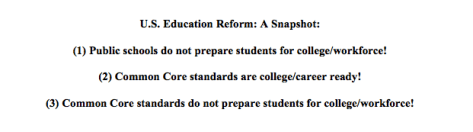

U.S. Education Reform: A Snapshot

Cycle has happened often, and now poised to happen again.

Common Core

For #3 (where we are now before jumping back to #1), see Common Core isn’t preparing students very well for college or career, new report says.

HINT:

As the absence or presence of rigorous or national standards says nothing about equity, educational quality, or the provision of adequate educational services, there is no reason to expect CCSS or any other standards initiative to be an effective educational reform by itself. (Mathis, 2012)

How Good Is the Best Edujournalism?

A recurring theme running through my blog posts—one that could be addressed daily—is that education journalism is almost always significantly misleading and way too often completely inaccurate.

Mainstream media and journalists are trapped in false but compelling narratives about schools, learning and teaching, children, poverty, and race. Journalism itself fails education as a field because of a simplistic “both sides” to a rather cartoonish “objective” journalism.

As I have detailed too often, media coverage of education includes primarily voices and perspectives of people with no or very little experience or expertise in education, but when a few contrary perspectives are offered, those are typically framed as “some critics”—with no effort to establish which claims are credible or not.

Sadly, the best unmasking of the essential failure of the media has been by one of our faux-media comedians, John Oliver, who highlighted that even if there are two sides to an issue, one can be overwhelmingly credible while the other is mostly baseless; therefore, placing them as one-versus-one misleads the public on the weight of the arguments.

So when I received yet another email from the Education Writers Association (EWA)—who is extremely proud of itself—announcing their top award for education reporting, I wondered: How good is the best edujournalism?

The EWA Fred M. Hechinger Grand Prize for Distinguished Education Reporting was awarded for Failure Factories (The Tampa Bay Times), written by Cara Fitzpatrick, Lisa Gartner and Michael LaForgia. The series includes the following:

Without question, this series is comprehensive and it confronts some incredibly important issues about public schooling: the significant relationship between race/poverty and student achievement; the plague of segregation and resegregation in public institutions such as schools; and the huge inequities of education faced by racial minorities and impoverished students such as teacher assignments, school safety, funding, and discipline practices.

And while the series does a solid job of raising these issues, my first response is that these are all old news—I mean very old news.

That our public schools have failed poor and black/brown students is a recurring message over the last century—little different before or after the Civil Rights movement.

Therein lies a real problem with even the so-called best edujournalim—journalists without a historical lens afforded those with expertise in a field are ripe to fall prey to the lens of a novice.

One such failure of this series and then how the EWA praised the series can be found in the quoted judge’s comment:

Bravo to this team and the paper for taking an all-too-common story (low achievement in a high-poverty area) and digging past the excuses to reveal a shameful history of indifference and, most troubling, willful neglect. I was awed by the dogged reporting, the sheer volume of interviews and data-crunching, and the courageous analysis that put the blame exactly where it needed to be. But the true brilliance of this work is found in the stories of the children who were robbed of an education they deserved. How many other school districts in America might have the same story to tell?

The series title “Failure Factories” is but one of many triggers for the pervasive and ugly “no excuses” narrative that is all the rage in the U.S.

You see, once again, this series oversimplifies the story of educating vulnerable populations of students: racism and classism are merely excuses for the schools charged with high concentrations of vulnerable students.

And as the judge notes above, this is all about “blame”—and keeping the focus on those damn failing schools.

The shame is that without this corrosive and ugly framing, there is an incredible amount of work in this series that does deserve praise. We should be asking: Why do we need yet anther round of test scores to admit and confront race and class inequity—especially when high-stakes standardized testing itself is racist and classist?

The truth is that schools in the U.S. have never been, are not now, and never will be anything other than reflections of our society—unless we do things different in both our social and educational policy.

Yes, public schools almost entirely reflect and perpetuate the race, class, and gender inequities that remain powerful in our wider society, and much of that is embedded in the very reforms being championed in the media and among political leaders: accountability, standards, high-stakes testing, grade retention, zero tolerance policies, “no excuses” practices, charter schools, school choice, Teach For America, school report cards, value-added methods of teacher evaluation, and the worst of the worst—”grit.”

That is not simply a fact of the schools targeted by this series. That is a fact about public education across the entire country.

And many educators as well as education scholars have been yelling that for decades; that’s right—decades.

Possibly the most telling problem with the series is the end, where the condemnations of Arne Duncan and John King are treated as if they are somehow credible.

If this weren’t so tragic, it would be laughable—nearly rising to the level of an article in The Onion.

Therefore, here is a little message about the best of edujournalism.

Dear EWA:

Public schools have been reflecting and perpetuating the worst aspects of our society for over 100 years. People in power really don’t care, and politicians in the last three to four decades have learned that education policy is a powerful political football.

Since the Reagan administration, public schools have failed students even more significantly because of inane obsessions with accountability, standards, and tests.

Duncan and King are the personifications of all that is wrong with education policy: lots of soaring rhetoric masking policy cures that are part of the disease; thus, the accountability movement is intensifying race, class, and gender inequity—not overcoming it.

Racism, classism, sexism, and homophobia are never excuses, but facts, and these burdens are more than micromanaged and technocratic in-school only policies can address.

Yes, we need much more equitable school practices and polices—but none of what politicians are doing now meets those standards—and those alone will never accomplish what we seem to want without concurrent changes to public policy that also addresses equity.

Edujournalism, as well, is part of the problem because it remains trapped in false narratives, committed to simplistic “both sides” frames of issues, and unwilling to listen to the voices of the practitioners and scholars in the field of education.

Nearly everything addressed in “Failure Factories” was raised by novelist Ralph Ellison in a 1963 speech to teachers. Your best journalism is old news wrapped in a false frame and too often fumbled badly with good intentions.

I remain concerned that education-bashing journalism has become so lucrative for your flailing field that it is in fact as pressing that we address the journalism crisis as we do the need to significantly reform our public schools.

As agents of the public good, journalists and educators have a great deal in common that is being squandered; neither can afford as a field or in the name of that public good to remain the tools of those who have interests other than the public good.

We both can and should do better.

Even Technocrats with Good Intentions Sustain Classroom Colonialism

Kassie Benjamin offers a powerful confession at Jose Vilson’s blog. Benjamin—like many educators including myself—became an educator firmly holding to the belief that education is the great equalizer, the lever that changes people’s lives and society for the better.

However, Benjamin explains: “Slowly, I came to the belief I have today: education is assimilation. Still.”

In his For White Folks Who Teach in the Hood…and the Rest of Y’all Too, Chris Emdin names the assimilation Benjamin confronts as “classroom colonialism” (p. 14), and clarifies earlier in his Preface:

What I am suggesting is that it is possible for people of all racial and ethnic backgrounds to take on approaches to teaching that hurt youth of color….

I argue that there must be a concerted effort…to challenge the “white folks’ pedagogy” that is being practiced by teachers of all ethnic and racial backgrounds. (pp. viii-ix)

Emdin points a finger at urban “no excuses” charter schools as contemporary versions of traditional schooling created to “fix” Native Americans. For example, Joanne Golann explains about her extensive research embedded at a “no excuses” charter serving mostly black and poor students:

In a tightly regulated environment, students learned to monitor themselves, hold back their opinions, and defer to authority. These are very different skills than the ones middle-class kids learn—to take initiative, be assertive, and negotiate with authority. Colleges expect students to take charge of their learning and to advocate for themselves. One of the students I talk about in the article learned to restrain herself to get through, to hold herself back and not speak her mind. She ended up winning the most-improved student award in 8th grade for her changed behavior.

Golann also makes connections similar to Emdin’s:

Bowles and Gintis wrote this famous study where they were looking at the history of mass public education in the US. They argue that schooling expanded in large part to quell social unrest. You had these immigrant populations coming into the cities in the mid-nineteenth century, and Bowles and Gintis basically make the argument that factory owners and the professional class wanted a docile workforce. They wanted people who would be obedient and man these factories, and so they used schools as a way to socialize children to follow rules and show deference. Looking at the school I studied, I found the same behaviors but with a very interesting twist. In a new era of accountability, instead of creating workers for the factories, schools are creating *worker-learners* to close the achievement gap. Schools are emphasizing obedience because they need to create order to raise test scores and they see that as the way to social mobility. It’s the same behaviors but for a different purpose.

But we should also look at a number of policies that are thinly veiled mechanisms for assimilation/colonialism.

Just as one example, tracking remains a robust practice in U.S. education, I believe, because it appears to help the so-called top students (mostly white and relatively affluent) even though a great deal of evidence shows tracking hurts the so-called struggling students (mostly black/brown and impoverished).

Further, like Benjamin and Emdin, Zoé Samudzi argues We Need A Decolonized, Not A “Diverse”, Education because “diversity agendas are hindrances rather than stepping stones to justice and equity.”

Policy makers, administrators, and teachers promoting and implementing practices, then, who are in effect perpetuating classroom colonialism may often have good intentions.

Charlotte Danielson provides us here an ironic and important model as she confronts teacher evaluation:

The idea of tracking teacher accountability started with the best of intentions and a well-accepted understanding about the critical role teachers play in promoting student learning. The focus on teacher accountability has been rooted in the belief that every child deserves no less than good teaching to realize his or her potential.

Danielson, of course, continues to criticize the recent push for extended accountability, standards, and high-stakes testing into how we evaluate, retain, and pay teachers (popularly known as VAM, for using “value added methods”).

The irony comes as Danielson slips into what I believe is the central problem driving much of the classroom colonialism challenged by Benjamin, Emdin, Samudzi, and Paul Gorski: Danielson’s alternative to the failed good intentions of teacher evaluation is just another technocratic version of teacher evaluation.

Colonialism in traditional schooling survives because education is a reflection of our society. Schools will never be transformative at the social level until formal education is unlike our inequitable social structures—until formal schooling serves our vulnerable students’ needs first by honoring them as fully human instead of framing them through deficit lenses.

School discipline begins and reflects the racially inequitable mass incarceration of the wider society. Tracking reflects and perpetuates our class stratifications.

Nearly every aspect of school policy and practice is a mechanism for assimilation—not transformation.

Education and education reform are trapped in a technocratic vision that can only replicate our society.

Education reform and the commodification of education are bound by the mantra “My technocratic vision is better than your technocratic vision.”

It isn’t about standards, but the new and better standards.

It isn’t about high-stakes testing, but the new and better high-stakes tests.

And not once, not once, has the promise of the new been realized in any ways that serve impoverished students, black/brown students, or English language learners.

However, nearly always, the policies and practices in place have served well (or at least not impeded) the whitest and wealthiest.

Emdin invokes the metaphor of invisibility throughout his dismantling of “white pedagogy” and call for “reality pedagogy.” But I am drawn to my English teacher and existential roots by the concluding image of Albert Camus’s The Stranger: the guillotine.

Camus’s main character Meursault describes that “the guillotine looked like such a precision instrument, perfect and gleaming….[T]he machine destroyed everything: you were killed discretely , with a little shame and with great precision” (p. 112).

The efficiency of the technocratic mind, the guillotine, that served the interests of the ruling elites at the expense of anyone else who did not conform, assimilate.

The technocrats, even with good intentions, maintain a classroom colonialism that honors “assimilate or die.”


Are Racially Inequitable Outcomes Racist?

Among what may seem to be marginally related policies and conditions, these all have one startling thing in common—grade retention, school discipline, NCAA athletics, incarceration, “grit,” “no excuses,” zero-tolerance, high-stakes testing (such as the SAT and ACT), charter schools and school choice—and that commonality is observable racially inequitable outcomes that are significantly negative for blacks.

My own experiences with exploring and confronting race and racism through my public writing has shown that many people vigorously resist acknowledging racism and will contort themselves in unbelievable ways to avoid accepting facts and data that show racism exists.

Common responses include “I am not a racist,” “I am sure the people who started X didn’t intend to be racist,” “White people experience racism too,” and “Everyone has the same opportunities in this country.”

And while I continue to compile a stunning list of ways in which racial inequity and racism profoundly impact negatively black people, resistance to terms such as “white privilege” and “racism” remain robust.

In the wake of the NCAA Final Four, Patrick Hruby has attempted a similar tactic I have used in order to unmask the racial inequity in college athletics by carefully working readers through the evidence in order to come to an uncomfortable conclusion about the financial exploitation of college athletes (money-making sports being disproportionately black) by the NCAA and colleges/universities (leadership and those profiting being overwhelmingly white) along racial lines:

Understand this: there’s nothing inherently racist about amateurism itself. And there’s no reason to believe that its defenders and proponents—including current NCAA president Mark Emmert—are motivated by racial animus….

And yet, while the NCAA’s intent is color-blind, the impact of amateurism is anything but. In American law, there is a concept called adverse impact, in which, essentially, some facially neutral rules that have an unjustified adverse impact on a particular group can be challenged as discriminatory….Similarly, sociologists speak of structural racism when analyzing public policies that have a disproportionately negative impact on minority individuals, families, and communities. State lottery systems that essentially move money from predominantly lower-class African-American ticket buyers to predominantly middle-and-upper-class white school districts fit the bill; so does a War on Drugs that disproportionately incarcerates young black men; so does a recent decision by officials in Maricopa County, Arizona, to drastically cut the number of presidential primary polling stations in and around Phoenix, which unnecessarily made voting far more difficult for the residents of a non-white majority city.

Big-time college sports fall under the same conceptual umbrella. Amateurism rules restrain campus athletes—and only campus athletes, not campus musicians or campus writers—from earning a free-market income, accepting whatever money, goods, or services someone else wants to give them. And guess what? In the revenue sports of Division I football and men’s basketball, where most of the fan interest and television dollars are, the athletes are disproportionately black.

And herein lies the problem with refusing to equate racially inequitable outcomes with racism.

Hruby’s detailed unmasking of the NCAA comes also during the troubling rise of Trump in presidential politics—another marker for how many scramble to find any cause other than racism.

Trump’s rise is not exclusively the result of overt and unexamined racism, but a significant amount of his success is easily traced to a wide spectrum of racism.

However, from the rise of Trump to the so-called popularity of charter schools to the school-to-prison pipeline and to the spread of third-grade retention policies, all of these and more are fueled by racism because racism, we must acknowledge, is most insidious when it isn’t overt, when the racist person or the racist act is unconscious, unacknowledged.

The impact of racism in NCAA sports, as Hruby details, is the elegant racism Ta-Nahisi Coates unpacked when Donald Sterling became the NBA’s face for oafish racism (along with Clive Bundy in popular culture).

What has occurred in the U.S. since the mid-1960s is an end to placard racism, the end of “White Only” signs on bathroom and restaurant doors.

What has not occurred in the U.S. yet is an end to seeing black boys as significantly older than their biological ages, an end to tracking black children into segregated schools and reductive courses, an end to incarcerating black men—and this is a list that could go on for several pages.

Racial (and class) equity will never occur in the U.S. until the white power structure admits that racially inequitable outcomes are in fact racist.

White privilege is a powerful narcotic that numbs white elites to the harm that privilege causes black and brown people, but it is also a powerful narcotic that pits poor whites against black and brown people because poor whites believe their whiteness gives them the chance at great wealth held by only a few.

That the NCAA maintains a structure within which black athletes produce wealth enjoyed almost exclusively by white elites is an undeniable fact and a startling example of the elegant racism eroding the soul of a free people—an elegant racism eating at the roots of public education, the judicial system, the economic system, and nearly ever aspect of the country.

Racially inequitable outcomes are racist, and this must be admitted in order to be confronted and then to be eliminated.

Reclaiming “Direct Instruction”

After I posted two blogs on authentic literacy instruction (see here and here), several readers tripped over my use of the term “direct instruction.”

Before examining the value in that term (and what it means), let me offer a couple of anecdotes.

While I was teaching high school English, a colleague teaching math had a classroom directly across from my room, separated by a court yard. With, I think, equal parts joking and judgment, that teacher used to say often, “I wish I could teach while sitting at my desk.”

Not unimportant here is the distinct pedagogical differences among math and English teachers—one that I believe we can fairly say is a tension between math teachers being teacher-centered and sequential while English teachers can lean more often toward student-centered and workshop approaches (although my caveat here is that English teachers can be some of the most traditional teachers I have ever met).

In my story above, the math teacher’s comment is an excellent example of the confusion over “direct instruction.” Yes, many people see direct instruction as lecture—thus, mostly if not exclusively teacher-centered with students relatively passive.

For this colleague, my students working in a writing workshop with me responding to drafts, conferencing, and the other purposeful elements of workshopping did not meet her definition of “teaching.”

Another illustrative story involves my daughter.

Her second grade teacher was a colleague of my wife, who teaches PE at the primary school. One day in passing my daughter’s second grade teacher told my wife that my daughter had been doing extremely well on her spelling tests until she began intensive and direct phonics instruction. Since then, she noted, my daughter’s spelling grades had suffered significantly.

This second example represents the ultimate failure of a narrow view of teaching having to be a certain limited type of direct instruction.

Now, when I use the term “direct instruction,” as one person perfectly commented about my blog post, I am addressing purposeful and structured or organized instruction, but I am not using the term as only teacher-centered practices.

To be direct, or purposeful, then, I see teaching as an act with several goals: curricular (including standards and high-stakes tests addressing those standards), disciplinary, and student-centered.

In any given class, teachers must address all three, but pedagogically, teachers often have some degree of autonomy over how to address these goals.

As I champion “direct instruction,” I am cautioning against placing curriculum and discipline above student, but I am also calling for building all instruction on some evidence of need.

Curriculum guides and standards justify a need; the discipline (ELA as literacy, literature, and composition) justifies a need; and students come to all courses with needs.

“Direct instruction,” then, is purposeful and organized teaching targeting one or all of these needs.

As a critical constructivist, I maintain that we must start with allowing students to produce artifacts demonstrating what they know, what they don’t know, and what they are confused about in the context of our curricular and disciplinary obligations.

Direct instruction is simply teaching with purpose to address those needs.

A failed view of direct instruction is grounded in covering the curriculum or the obligations of the discipline regardless of the students in the course.

Teaching algebra sequentially, likely with the textbook determining the structure, in order to document that you taught algebra; teaching a phonics program, again, in order to document that you taught reading—this is the failure of a narrow view of “direct instruction” that supplants the needs of the students with the needs of curriculum and the discipline.

If and when a child is spelling and decoding well, to go over phonics is a waste of time, but also very likely harmful—just as many studies of isolated grammar instruction show students becoming more apt to make “errors” after the instruction.

So here we can begin to unpack that the problem is not with “direct,” but with “isolated.”

The problem is with teaching the discipline, teaching a program, teaching to the standards and/or high-stakes tests instead of teaching students.

I am advocating for direct instruction built primarily on student needs—purposeful and structured lessons designed after gathering evidence of student strengths, weaknesses, and confusions.

And I must stress that my argument here is wonderfully confronted and unpacked by Lisa Delpit, who came to this debate because she recognized the other side of the coin I haven’t addressed yet: so-called student-centered practices that cheat students (mostly our vulnerable populations of students) by misunderstanding the role of direct instruction, by misreading progressive and critical practices as “naturalistic” or unstructured.

Writing and reading workshop are not about giving students free time to read and write; workshops are about time, ownership, and response that is purposeful and structured.

Student-centered practices are not about letting children do whatever the hell they want.

As Delpit has addressed, that isn’t teaching, and it certainly cheats students in similar ways that bullheaded and narrow uses of teacher-centered practices harm students.

If a teacher isn’t guided by needs and grounding class time in purpose, that teacher isn’t teaching.

But until you have a real breathing student in front of you, you cannot predict what that direct (purposeful) instruction will (should) look like.

Ultimately, I believe narrow uses of the term “direct instruction” are designed to shame student-centered and critical educators.

I refuse to play that game because I am directly (purposefully) teaching when I place the needs of my students before but not exclusive of the needs of the curriculum and the discipline.

And, yes, while I also hope someday more teachers can teach while sitting at their desks, I am more concerned about how we can come to embrace teaching as purposeful and structured without reducing it to a technocratic nightmare for both teachers and students.

More Thoughts on Feedback, Grades, and Late Work

My good friend and stellar colleague, Ken Lindblom, posted Should Students’ Grades Be Lowered for Lateness?, spurring a series of Tweets about grading late work.

Ken’s thoughtful post focuses on these foundational ideas:

As an educator, I try to base my decisions on a principle of authenticity. In other words, I try to make my decisions more on real-world norms than traditional school norms. I try to ensure that I am preparing students for the world beyond school, not for school. As a result, I try to make sure that the ways in which I assess students’ work is similar to the ways in which they would be assessed in a professional situation.

There are times when a professional can absolutely not be late: grant applications, proposals for conferences/speaking, . . . I’m not sure I can come up with a third example to make a series.

But adults can be late with almost anything else: publication deadlines, job evaluations, doctor’s appointments, taxes–even most bills have a grace period.

Here I want to tease out a few ideas related to feedback on student work (artifacts of learning), grades, and late work.

Like Ken’s concern for authenticity, I tend to work from a personal and professional aversion to hypocrisy based on 18 years teaching English in a rural South Carolina public high school and then 14-plus years in a selective liberal arts university, also in SC.

I have been practicing and refining de-grading and de-testing practices for over thirty years. Let me emphasize, since I have been challenged before, I have implemented—and thus currently advocate for—de-grading and de-testing in many school contexts, including public schools (not just at the university level).

So my path to rejecting grades and tests has many stages and elements. First, I had to confront that calculating grades bound only to averages often distorts grades unfairly for students. Mean, median, and mode are all credible ways to analyze data, and among them, in formal schooling, the mean (average) is both the norm and often the weakest.

I show students this simple example; a series of grades: 10, 10, 85, 85, 85, 85, 85, 85, 100, 100 = 730.

The average is 73, which most teachers would assign, but the mode is 85, and if we note these grades are sequential and cumulative (10 as the first grade in terms of time, and 100 the last grade), a legitimate grade assignment would be the 100.

In other words, using the same data, a teacher could assign 73, 85, or 100 to this student, and all can be justified statistically.

My conclusion has been this greatly challenges the value of assigning grades because those who control the rules, control reality.

Thus, I do not assign grades to any student artifacts of learning (and I do not give traditional tests). Instead I offer feedback that supports students as they revise and resubmit those artifacts.

However, I cannot refuse to assign students grades for courses. Therefore, another distinction I have come to appreciate is the difference between grading an assignment and determining a grade for a grading period or course.

Therein lies my approach to late work, but first, let’s consider adult hypocrisy.

In my 30-plus years as an educator at nearly every level possible, I witness daily teachers and professors who fail to meet deadlines (regularly); talk, do other things (grade papers), stare at their computers/smart phones, etc., during meetings; and behave in a number of ways that they do not tolerate by students in their classes, behaviors that negatively impact students grades.

I also drive daily with adult motorists who exceed the speed limit without any punishment—as most of us have come to realize a grace zone of staying less than ten mph over that limit. In other words, the real world of rules is much fuzzier than the rules of formal schooling.

These are the behaviors I see when I am confronted with student late work.

About late work, then, I have some clear policies. First, I would never change a grade assigned to an artifact of learning that distorts the actual quality of that artifact. A “B” essay is a “B” essay regardless of when it is submitted.

As an educator, my primary concern is student learning, and I suffer no delusions that when that happens is more important than if it happens. I also ascribed to Rick Wormeli’s dictum that fair isn’t always equal; thus, I do not allow very narrow expectations that I treat all students exactly the same override that I am there to serve each student as well as all students.

Next, I always record “lateness” and then consider that when I assign a grade for a grading period or course. If a student has one or two assignments late (clearly an outlier), I may ignore that when determining the grading period/course grade, but if there is a pattern of lateness, then the grading period/course grade must reflect this.

In other words, I believe we must separate artifact quality (the basis of grading period or course grades) from grading period/course grades.

Feedback and grades on artifacts of learning send students clear messages about what they produce (their learning), and then grading period/course grades send a message about the totality of their accomplishments as students.

So if we return to Ken’s context, we can imagine a manager telling a habitually late worker: “Your work here is excellent, but if you aren’t here on time, we will have to let you go.”

Especially in the recent thirty-plus years of standards, educators have fallen prey to standardization, and as a result, we have too often abdicated our professional autonomy and allowed technical norms to supplant our much more important goals and obligations, the human dignity and learning of each child assigned to our care.

And because most people have greater regard for medical doctors than teachers (sigh), I’ll end with an example my major professor offered in my doctoral program.

A patient is admitted to the hospital running a dangerously high temperature. After several days, during all of which the nurses record that patient’s temperature hourly, the doctor comes in, adds those temperatures, calculates the average, and refuses to release the patient, although the current temperature is 98.6.

Right, no medical doctor would allow the norm of averages to override her/his medical authority. And neither should educators.

See Also

Missing Assignments–and the Real World, Nancy Flanagan

The Perils of Late Work and How to Make It Count, Starr Stackstein

It’s Time to Ditch Our Deadlines, Ellen Boucher

Update

The claim about real-life norms is also dubious. There are times when deadlines must be strictly enforced, but for the most part, employers are typically forgiving of extensions and late work, recognizing that “assigned deadlines can be stressfully tight, compromising output quality,” according to a 2022 study, which also found that 53 percent of workplace deadlines were flexible. In fact, “deadline estimates are often overly optimistic,” and adhering to them too stringently can dramatically increase burnout.

Why the 100-Point Grading Scale Is a Stacked Deck

Students, Not Standards: Calling for Solidarity in 2016

Many years ago, I was sitting in the last class session of the capstone secondary ELA methods course as part of my M.Ed. The guest speaker that day was my high school English teacher, the man responsible for my primary career path, Lynn Harrill.

Lynn was friends with the professor, who was then working at the state department of education, I believe.

Toward the end of the class, the professor asked what we wanted our students to know when they left our classes. That question was followed by lingering silence.

Ever the eager student, I said, “I want them to know themselves,” and I caught a glimpse of Lynn smiling widely.

Of course, that is what Lynn had taught me, although most people probably assumed it was reading and writing Lynn had so expertly given his students (which, by the way, was also true).

This moment—one of a very idealistic and naive young teacher, me—comes back to me often, and despite my many failures as a teacher, that grounding goal has always guided me. Not to be simplistic, but I teach students—that’s why I teach.

While reading Four Stories That Homework Tells Children About School, Learning, & Life, I was struck by “STORY #3: School Is More Important Than Other Pursuits/Interests/Activities.”

And now I have to investigate that memory again.

Yes, Lynn Harrill changed my life by being my sophomore and junior English teacher in high school. He was gracious, kind, and encouraging to a deeply insecure and anxious teen (me) who had decided he was a math and science person—because that is what school had told me.

Junior high English classes had been mostly draconian English teachers, grammar book exercises, and diagramming sentences. The “English” content of those classes was easy (I made As), but I loathed it all, even the texts we were assigned to read (much of which we did not read).

Now, before I launch into whining, let me be clear that my story is about how school failed me—but that because of my tremendous privilege (white, male and—according to traditional schooling and standardized tests—high verbal and mathematical intelligence), the consequences of those failures were miniscule. I attended college and continued to make As (easily), leading to an MEd and EdD.

I share this, then, not to bemoan poor pitiful me (or to brag), but to highlight that schools often fail students in ways we do not acknowledge and that the consequences for those students who need schooling most are monumental.

While I was begrudgingly playing school and succeeding, at home I was engaged in a rich array of hobbies and interests that school not only ignored, but also indirectly refuted (even Lynn told me as a 10th grader I needed to stop reading science fiction [SF] and start reading real literature such as Fitzgerald).

I was collecting, reading, and drawing from thousands of Marvel comic books. I was voraciously listening to popular music and studying the lyrics. And I was doing the same with comedy albums, mostly George Carlin and Richard Pryor.

My reading life, as I noted above, was Larry Niven and Jerry Pournelle, Arthur C. Clarke, and whatever works were prompted by my mother’s SF film fascination. I fell in love with The Andromeda Strain because of the film, and much of my formative life was driven by the five Planet of the Apes films and TV’s Star Trek.

My response to the real literature endorsed by Lynn was tepid (but always the mama’s boy, I did as teachers told me to do), but my life was irrevocably changed when he also recommended writers I would never be assigned in the rural South of the 1970s—notably D.H. Lawrence.

Well, damn, I thought. This is literature?

My journey from student to teacher began in my sophomore year of high school as I began to untangle the false narratives school had taught me and came to embrace the authentic narratives of my real life, my real Self, outside of school.

More than a decade into my teaching career (in the position Lynn left at my high school) and in the same doctoral program Lynn had completed, I finally discovered critical pedagogy as the complete vision of student-centered teaching and learning I had been haphazardly practicing.

Regretfully, my entire career as an educator (18 years as a high school ELA teacher and then 14 more years, and counting, as an English educator and first-year writing professor) has occurred under the antithesis of student-centered critical education—the high-stakes accountability movement.

All of which, ironically, I have been prepared for by the very reading material school marginalized, science fiction and dystopian fiction.

Standards, high-stakes tests, and accountability fail students, fail teachers. They conspire to do exactly what homework accomplishes in story #3 above.

I cannot step away form this: I must teach those students placed in my care, and that duty requires me to find out who they are, what they know, and what they want so that we can work together so that they find who they are and who they want to be.

So, I wonder with the new year, and the allure of resolutions—who is with me in 2016? Can we make this about students and not standards, not tests?

See Also

Doubling Down (Again) by Reverting, Not Changing: The Exponential Failures of Education Legislation

Teacher Quality, Wiggins and Hattie: More Doing the Wrong Things the Right Ways

More on Evidence-Based Practice: The Tyranny of Technocrats

Beware the Technocrats: More on the Reading Wars

I Don’t Need Standards To Teach, I Need Students

Are Common Core and Testing Debates “Two Different Matters”?

UPDATED: Mainstream Media in (Perpetual) Crisis: More Education Meat Grinder

UPDATE: Note Holly Yettick’s One Small Droplet: News Media Coverage of Peer-Reviewed and University-Based Education Research and Academic Expertise; see abstract:

Most members of the American public will never read this article. Instead, they will obtain much of their information about education from the news media. Yet little academic research has examined the type or quality of education research and expertise they will find there. Through the lens of gatekeeping theory, this mixed-methods study aims to address that gap by examining the prevalence of news media citations of evidence that has undergone the quality-control measure of peer review and expertise associated with academics generally required to have expertise in their fields. Results suggest that, unlike science or medical journalists, education writers virtually never cite peer-reviewed research. Nor do they use the American Educational Research Association as a resource. Academic experts are also underrepresented in news media coverage, especially when compared to government officials [bold aded]. Barriers between the news media and academia include structural differences between research on education and the medical or life sciences as well as journalists’ lack of knowledge of the definition and value of peer review and tendency to apply and misapply news values to social science research and expertise.

“‘Only four out of ten U.S. children finish high school, only one out of five who finish high school goes to college’”: This spells doom for the U.S. economy, or to be more accurate, this spelled doom for the U.S. economy.

Except it didn’t, of course, as it is a quote in a 1947 issue of Time from John Ward Studebaker, a former school superintendent who served as U.S. Commissioner of Education (analogous to today’s Secretary of Education) in the mid-1940s.

Jump forward to 26 December 2015 and The New York TimesAs Graduation Rates Rise, Experts Fear Diplomas Come Up Short. Motoko Rich, as in the Time article, builds her case on Secretary of Education Arne Duncan, as Susan Ohanian confronts:

Here’s a front page. above-the-fold New York Times non-story that’s a perfect depiction of damning schools every-which-way. Schools with low graduation rates are depicted as failures; improve graduation rates, and then the diplomas they’re handing out are judged to have no meaning. And the Times gives the departing Secretary of Education star billing on this issue.

Quotation of the Day
The goal is not just high school graduation. The goal is being truly college and career ready.

–ARNE DUNCAN, the departing secretary of
education, on the United States 82 percent graduation rate in 2013-14, the highest on record.–New York Times, Dec. 27, 2015

Along with the meat grinder of incessantly new high-stakes accountability standards and testing over the past thirty-plus years, U.S. public education has been demonized since the mid-1900s and relentlessly framed within crisis discourse by the mainstream media for a century.

Rich’s cover piece spends an inordinate amount of energy to twist public schools into that crisis image while making no effort to investigate or challenge Duncan (a life-long appointee with no expertise in education and no credibility as a leader in education) or to unpack the stale platitudes and unsubstantiated claims about education reaching back at least to the Time article.

Duncan and Rich share, in fact, no experience or education in teaching as well as the disproportionate power of their voices in the field despite that lack of expertise.

On the other hand, I taught public high school English in rural South Carolina (not far from the school Rich highlights), have been an educator in SC over 30 years total, have a doctorate in education that emphasized the history of the field, and now am a teacher educator at a university just a couple miles from the school in Rich’s piece (I know teachers there, and have had several teacher candidates placed there for field work). As well, I taught journalism and was the faculty sponsor of the school newspaper, and have been a professional writer for about the same amount of time as I have been teaching, including writing and publishing a good deal of journalism (mostly about education).

This is not, however, an attack on Duncan or Rich—because they are not unique but typical of the mismatch of high-level voice with a lack of expertise.

Mainstream media appear fatally wed to only one version of the U.S. public education story: crisis.

And thus, journalists reach out to the same know-nothings (political leaders, political appointees, think-tank talking heads) and reproduce the same stories over and over and over [1].

Here, then, let me offer a few keys to moving beyond the reductive crisis-meme-as-education-journalism:

  • Public education has never been and is not now in crisis. “Crisis” is the wrong metaphor for entrenched patterns that have existed over a century. A jet plane crash landing into the Hudson River is a crisis; public education suffers under forces far more complicated than a crisis.
  • Metrics such as highs-takes test scores and graduation rates have always and currently tell us more about the conditions of children’s lives than to what degree public schools are effective.
  • Short-hand terms such as “college and career ready” and “grade-level reading” are little more than hokum; they are the inadequate verbal versions of the metrics noted above.
  • The nebulous relationship between the quality of education in the U.S. and the fragility of the U.S. economy simply has never existed. Throughout the past century, no one has ever found any direct or clear positive correlation between measures of educational quality in the U.S. and the strength of the U.S. economy.
  • Yes, racial and class segregation is on the rise in the U.S., and so-called majority-minority schools as well as high-poverty schools are quickly becoming the norm of public education. While demographics of race and class remain strongly correlated with the metrics we use to label schools as failing, the problem lies in the data (high-stakes tests remain race, class, and gender biased), not necessarily the students, teachers, or administrators.
  • However, historically and currently, public education’s great failures are two-fold: (1) public schools reflect the staggering social inequities of the U.S. culture, and (2) public schools too often perpetuate those same inequities (for example, tracking and disciplinary policies).

The mainstream media’s meat grinder of crisis-only reporting on public education achieves some extremely powerful and corrosive consequences.

First, the public remains grossly misinformed about public schools as a foundational institution in a democracy.

Next, that misleading and inaccurate crisis narrative fuels the political myopia behind remaining within the same education policy paradigm that has never addressed the real problems and never achieved the promises attached to each new policy (see from NCLB to ESSA).

And finally, this fact remains: Political and public will in the U.S. has failed public education; it has not failed us.

Mainstream media remain trapped in the education crisis narrative, I think, because neither the media nor the collective political/public consciousness is willing to confront some really ugly truths beneath the cultural commitment to the powerful and flawed rugged individual mythology in the U.S.: America is a classist, racist, and sexist society.

We are committed to allowing privilege beget privilege and to pretending that fruits of privilege are the result of effort and merit.

There is no crisis in education, but our democracy is being held hostage by incompetent politicians and a compliant mainstream media—all of which, ironically, would be served well by the sort of universal public education envisioned by the tarnished founding fathers’ idealistic (and hypocritical) rhetoric [2].

[1] See Educational Expertise, Advocacy, and Media Influence, Joel R. Malin and Christopher Lubienski; The Research that Reaches the Public: Who Produces the Educational Research Mentioned in the News Media?, Holly Yettick; The Media and Educational Research: What We Know vs. What the Public Hears, Alex Molnar

[2] See Thomas Jefferson’s argument for a democracy embracing education:

The object [of my education bill was] to bring into action that mass of talents which lies buried in poverty in every country for want of the means of development, and thus give activity to a mass of mind which in proportion to our population shall be the double or treble of what it is in most countries. ([1817], pp. 275-276)

The less wealthy people, . .by the bill for a general education, would be qualified to understand their rights, to maintain them, and to exercise with intelligence their parts in self-government; and all this would be effected without the violation of a single natural right of any one individual citizen. (p. 50)

To all of which is added a selection from the elementary schools of subjects of the most promising genius, whose parents are too poor to give them further education, to be carried at the public expense through the colleges and university.  (p. 275)

By that part of our plan which prescribes the selection of the youths of genius from among the classes of the Poor, we hope to avail the State of those talents which nature has sown as liberally among the poor as the rich, but which perish without use, if not sought for and cultivated. But of all the views of this law none is more important none more legitimate, than that of rendering the people the safe, as they are the ultimate, guardians of their own liberty. (p. 276)

The tax which will be paid for this purpose is not more than the thousandth part of what will be paid to kings, priests and nobles who will rise up among us if we leave the people in ignorance. (p. 278)

Doubling Down (Again) by Reverting, Not Changing: The Exponential Failures of Education Legislation

Political grandstanding about education and proposed as well as adopted education legislation make me feel trapped in something between a George Orwell dystopian novel (“WAR IS PEACE, FREEDOM IS SLAVERY, IGNORANCE IS STRENGTH) and a Firesign Theatre skit (“The Department of Redundancy Department”).

One of my most recent experiences with the political process exposed me to the horrors (real, not fictional or comical) of compromise while I witnessed people and organizations typically associated with being strong supporters of public education defer to what became the Read to Succeed act in South Carolina despite the addition of third-grade retention [1]; the justification was that the compromise brought more funding to reading in the state.

Political compromise for education legislation, I regret, results in more dystopian fiction: Ursula K. Le Guin’s allegory of privilege in which she illustrates how some prosper while knowingly sacrificing a child as the “other.”

Now after much sound and fury, public education is poised to be bludgeoned once again as the federal government has committed to doubling down (again) by reverting to state-based accountability and continuing its ominous tradition of Orwellian names for education legislation: the Every Student Succeeds Act [2].

A couple of decades of patchwork state-based accountability throughout the 1980s and 1990s convinced the feds that No Child Left Behind (NCLB) was the answer, and now about a decade and a half of NCLB-style federal accountability has failed just a miserably (mostly causing more harm than good); thus, as Alyson Klein reports, “The ESSA is in many ways a U-turn from the current, much-maligned version of the ESEA law, the No Child Left Behind Act.”

And just as I experienced in SC with Read to Succeed, those we would hope are on the right side of children, families, and public education are scrambling (as many of them did to embrace Common Core) to praise ESSA—although this newest iteration is “really about the same.”

At best, ESSA is a very slight shuffling of the test-mania element of the accountability era; however, this reverting to state-based accountability will guarantee another round of new standards and new tests—all of which will drain state and federal funding for processes that have never and will never achieve what they claim to achieve (Mathis, 2012).

ESSA will be another boondoggle for education-related corporations, but once again, that profit will be on the backs of children and underserved communities.

Yet, ESSA is not all U-turn since it has remnants of the nastiest elements of the snowballing accountability era; while some of the unsavory teacher-bashing is waning, ESSA nudges forward the dismantling of teacher education (a sneaky way to keep bashing teachers, by the way).

ESSA is finding oneself in a hole and continuing to dig. For those who jumped in, it is time to climb out. For those standing at the edge, back away.

Although now tarnished by Obama’s promises of “hope and change” (the Obama administration has been no friend of education), education legislation and policy need change, real substantive change that confronts what is truly wrong with teaching, learning, and teacher education—none of which has anything to do with accountability.

That change rejects accountability based on standards and testing (a “no excuses” ideology) and seeks social context reform that addresses equity in both the lives and schooling of children.

As I have detailed before, those new commitments should include:

  • Food security for all children and their families.
  • Universal healthcare with a priority on children.
  • Stable work opportunities that offer robust wages and are divorced from insurance and other so-called “benefits.”
  • Ending the accountability era based on standards and high-stakes testing.
  • Developing a small-scale assessment system that captures trends but avoids student, teacher, and school labeling and punitive structures.
  • Ending tracking of students.
  • Ending grade retention.
  • Insuring equitable teacher assignments (experience and certification levels) for all students.
  • Decreasing the bureaucracy of teacher certification (standards and accreditation) and increase the academic integrity of education degrees to be comparable with other disciplines.
  • Supporting teacher and school professional autonomy and implement mechanisms for transparency, not accountability.
  • Addressing the inequity of schooling based on race and social class related to funding, class size, technology, facilities, and discipline.
  • Resisting ranking students, teachers, schools, or states.
  • Reimagining testing/assessment and grades.
  • Adopting a culture of patience, and rejecting the on-going culture of crisis.

When will we tire of “finding only the same old stupid plan”?

When “[t]he lone and level sands stretch far away” where public education used to reside, it will be too late.

See Also

There’s a Way to Help Inner-City Schools. Obama’s New Education Law Isn’t It., Kristina Rizga interviews Pedro Noguera

[1] See the National Council of Teachers of English’s Resolution on Mandatory Grade Retention and High-Stakes Testing.

[2] Possibly the greatest flaw with NCLB was the requirement of 100% proficiency by 2014. We have to go no further that the ridiculous name of the act to see politicians (ironically) haven’t learned a thing: “every” is 100%.