As a teacher educator, I am fortunate to maintain professional and personal relationships with wonderful early-career educators. But here are a couple stories from one young teacher I’d rather not tell.
First, this early-career teacher has distinguished herself already; in many ways, she represents the very best of who we all want to be teaching students. But at a recent meeting about pay and benefits next year, she was informed that the slight raise she was anticipating would be negated by new retirement deductions.
Her response: “I love to teach, but I know a day is coming when the negatives outweigh the benefits, and I just won’t be able to do this any more.” She added that this moment seemed to be coming sooner rather than later, that she wasn’t going to be a martyr.
As an English teacher, she also has been struggling with her canon: the steady drip, drip, drip of male authors exposed for sexual harassment and abuse—Garrison Keillor, J.D. Salinger, Sherman Alexie.
As she has confronted these issues, and stopped assigning those writers, she has witnessed students come against a very troubling reality; one student noted in class, “Everybody we read has committed sexual harassment.”
These two moments represent the professional weight of being a teacher—issues about pay and benefits as well as pedagogy.
Now, let’s mix in something that may prove even more daunting.
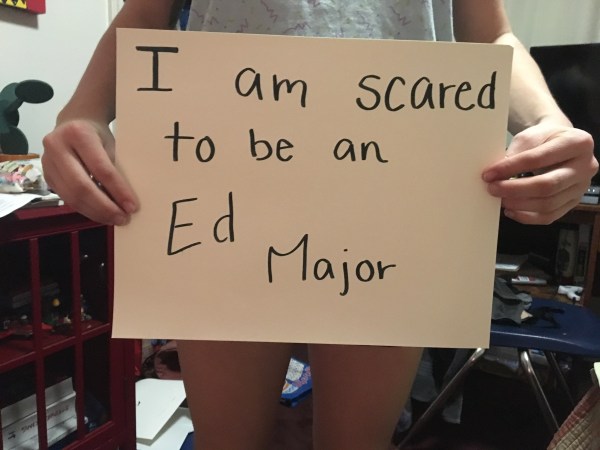
At the sparsely attended walk out on my campus, one student showed up with a sign: “I am scared to be an Ed Major.”
The very real specter of schooling as a place in which students and teachers must be vigilant about safety, about the possibility of being shot; the very real specter of calls for turning schools into fortresses, with teachers armed like prison guards.
As David Edwards reports, students increasingly see attending school not as a place of learning, but a place to survive:
“It’s really scary,” the organizer added. “This is a turning point. Things really have to change. We won’t tolerate it. We won’t tolerate being scared to come into school. We won’t tolerate having to stay out of school because we’re scared. It has to change. We can’t be hunted.”
[MSNBC’s Ron] Allen observed that “hunted” was a “powerful word” to use in this context.
“I think that it’s become obvious that we’re the victims,” the girl insisted. “That we are the ones that are going to die if this continues. So I think that we have to fight to at least say that we don’t want to die.”
For decades now, many of us in education who believe in the possibility of universal public education have feared the death of teaching and learning, but we have imagined that coming from policy, free market and accountability approaches to so-called reform.
But something more sinister is happening: Schools have always labored under the weight of the communities they serve, and teaching and learning is now dying a slow and horrible death because of America’s gun culture combined with those bureaucratic monsters many of us were mostly pointing to.
In America, our students and teachers have become martyrs for our misguided politics and ideology—from abdicating teaching and learning to the standards and testing industry, to literally sacrificing lives in the name of gun lust.
Some of us have feared the death of public schools, the death of teaching and learning. Our outcry for decades now may have seemed like hyperbole—or to some, self-interested whining.
But now we are watching both the literal and figurative death of teaching and learning, and too many think the best recourse is doubling down on all the ways this death has come about.
As more and more teachers and students declare that they will not be martyrs, what role will the rest of us take—in their defense or to their demise?
These may have seemed petty or just pet peeves to my students, but I would not tolerate this sort of framing in student essays about literature:
Emily Dickinson says, “Because I could not stop for Death – /He kindly stopped for me –.”
William Shakespeare is often quoted as saying “brevity is the soul of wit.”
In the first example, I would note that poems have speakers, some personae that may or may not be the poet. I encouraged students to take great care to identify “speaker” if a specific voice isn’t identified in the poem along with nudging them to avoid the lazy “say” verb choice.
The second example is far more vexing since it makes the same error (the line is spoken by Polonius in Hamlet, and is not Shakespeare expressing a pithy idea); however, it is far more flawed since the phrase absent the context of the character speaking and the play itself allows people to completely misrepresent the line as a truism—instead of acknowledging that it is a hollow claim of a blowhard.
What I was teaching students included a couple of broad and narrow lessons about writing: one, broad, captures the need for precision in writing that is far more nuanced than what many expect in speaking, for example, and two, narrow, teaches some of the nuances of writing in the discipline of literary analysis.
It is at that second and narrow lesson I want to focus on some of the strategies connected with helping students develop a toolbox as writers that supports them shifting gears among different disciplines.
For example, let’s think about how students must navigate (too often without explicit instruction) the conventions of the humanities (writing in English or history courses) and the conventions of the social sciences (writing in psychology, sociology, education).
Two ways we fail students in those contexts include laying almost all of writing instruction at the feet of English teachers (K-12) and first-year writing instructors (as a one-shot inoculation), and then focusing too narrowly on the mechanics of citation style sheets (MLA, APA, Chicago, etc.) instead of the broader approaches to writing in the disciplines that those styles support.
In all of my courses—first-year writing, foundations education, upper-level writing/research, graduate—I require extensive writing assignments, and students consistently demonstrate a lack of awareness about disciplinary expectations for writing. Primarily, they come to writing assignments with literary analysis and MLA “rules” that they impose on all types of writing.
Therefore, some of the nuances I must address include the following:
In the humanities, source-based writing tends to focus on textual analysis of a primary source supported by secondary sources. Writing in the social sciences rarely involves textual analysis (except when including critical discourse analysis), but asks the writer to synthesize bodies of research to address key topics or questions.
Therefore, writing in the humanities often explicitly identifies authors and titles directly in the flow of sentence and discussions: “In her ‘Vesuvius at Home,’ poet Adrienne Rich explains, ‘But of course Dickinson’s relationships with women were more than intellectual.'” As well, writers in the humanities may explore one source at a time (both primary and secondary) to make a larger case about the primary source being addressed (for example, Rich examining the poetry of Dickinson).
However, writing in the social sciences synthesizes patterns of claims and conclusions across several sources, and thus, authors and titles rarely appear in the flow of sentences with attributions mostly parenthetical or in end/footnotes: “For this volume on comic books, then, interrogating the medium in the context of race is extremely complex because comic books are a significant subset of popular culture (increasingly so with the rise of superhero films based on comic books throughout the late twentieth and into the early twenty-first centuries), which necessarily both reflects and perpetuates all aspects of the culture it serves—including bigotries such as sexism, racism, classism, jingoism, and homophobia (McWilliams, 2009; Rhoades, 2008a, 2008b; Singer, 2002; Thomas, 2010; Wright, 2001).”
In the context of the second and third bullet, then, students must confront that writing in the humanities often requires direct quoting, but writing in the social sciences prefers synthesis (often oversimplified as paraphrasing*). Here, there are disciplinary contexts for how a writer supports claims that contradicts most students’ belief that all writing requires quoting.
These problems for students as writers and for teachers of writing also complicate my argument against templates and my commitment to students choosing their type of essays and topics.
Since writing and teaching writing are extremely complicated, then, I want to end here with how I have organized my upper-level writing/research course around commitments to scaffolding assignments, student topic choices, and supporting students as writers confronted with a variety of writing modes and disciplinary expectations.
Students have three major writing assignments—annotated bibliographies (sources that serve as the foundation for their scholarly essay), a major scholarly essay on an educational topic of their choice, and a public commentary incorporating hyperlinks for support and addressing the same topic as their scholarly essay but for a lay audience.
After students gather evidence that an educational topic has been covered often in the mainstream media, they choose that topic to investigate the research base, producing 8-10 annotated bibliographies of high-quality sources. In this process, students practice evaluating sources and also refine their skills in APA formatting (focusing on the bibliographies).
After they submit the first draft of the annotated bibliographies, we discuss how social scientists write, contrasting that to their humanities/MLA assumptions (addressed above). In a class workshop format, I then ask them to revise the annotations (and edit the bibliographies) by focusing on discussing the content of the research, and not announcing authors and titles. For example, a first draft includes: “DeLeon suggests that the archetype of the “urban” criminal stems from colonial portrayals of African Americans, which sought to paint a picture of savage, uncivilized peoples.” Then revised as: “The archetype of the ‘urban’ criminal stems from colonial portrayals of African Americans, which sought to paint a picture of savage, uncivilized peoples.”
The major scholarly essay challenges them next in several ways. The recommended structure includes the following: a personal narrative or narrative opening (supported by Robert Nash’s Liberating Scholarly Writing: The Power of Personal Narrative), a section applying critical discourse analysis to several media reports on an educational topic (requiring them to analyze text and quote, similar to their humanities background), a section that is a mini-literature review of the research on the topic of choice (requiring them to write as a social scientist, synthesizing their annotated bibliographies, and practice the nuances of APA citation), and a closing (introducing them to the concept of framing, in which they return to their opening narrative in order to frame their essay focus—either that the media misrepresent or credibly represent the topic they chose).
The scholarly essay demands that students shift modes and investigate purpose as writers; the assignment is not prescriptive or narrowly prompted, but it is structured while also being demanding (although each student and I discuss how to revise that initial plan if the topic demands a different approach).
After drafting a scholarly essay using formal citation, students then condense what they have discovered into a much briefer (750-1250 words) commentary that incorporates hyperlink support and addresses a lay audience. Here, students must reconsider diction and sentence formation while also being more selective about using evidence. On that last point, we discuss the need to use individual examples that are accurate reflections of generalizations; in other words, focusing on one source but being careful that it fairly represents the body of research they have examined in their scholarly work.
This process, I think, helps represent how complex both writing and teaching writing are. Further, it shows that we serve our students best by avoiding writing assignments and instruction that oversimplifies the writing process and products (not asking students to write a narrative, but inviting them to integrate the narrative mode in service of a larger cohesive essay, genre, and discipline).
Where templates and prescription fail, we must seek ways to provide structure and scaffolding so that students can have multiple experiences shifting disciplinary gears as writers.
* Students admit that they have tended to use a passage from one source at a time and paraphrased by looking up synonyms one word at a time in that passage.
In What’s Wrong with Writing Centers, Rose Jacobs reports on Lori Salem’s “quantitative analysis of Temple University’s writing center, which she has directed since 1999. The assistant vice provost wanted to understand its role by investigating who doesn’t visit as well as who does.” Salem discovered:
[T]hat practices that are near-orthodoxy in writing centers — such as nondirective instruction, in which tutors prompt students to come up with the right answers themselves; and a resistance to focusing on grammatical errors — cater to individuals who already have a strong grounding in grammar and composition, the sort of students who never turn up. That leaves the most frequent visitors underserved: female students, minority students, and those who grew up speaking a language other than English at home.
Salem admits her study is just a beginning since it focuses on one center at one university, but as someone who has been teaching writing for almost four decades, both as a high school English teacher and a college professor of first-year and upper-level writing courses, I can confirm that many of the dilemmas uncovered by Salem ring disturbingly true.
Those two distinctly different teaching experiences have shaped me within a broader unifying way: I have mostly taught myself how to teach writing, having only one real formal experience with learning how to teach writing through the National Writing Project’s summer institute. I don’t have any degree in composition, and didn’t formally study composition in any undergraduate or graduate courses.
As a high school teacher for almost twenty years, I learned mostly by trial-and-error, and then was saved by my regional NWP affiliate, the Spartanburg Writing Project, where I also was a co-lead instructor for a few summers before heading to higher education full time.
But the last decade has been an incredibly fertile and difficult journey with how writing is taught in higher education. I have been teaching first-year writing, along with an upper-level writing course, and I briefly held a small administrative role in guiding our first-year seminars.
Over that time, my university has (finally) formalized a writing program by naming a Director of Writing Programs and seeking ways to make the writing and media lab and program more cohesive (adding the upper-level writing/research requirement to the curriculum, for example). The teaching of writing is also being more directly addressed by creating Faculty Writing Fellows, faculty who participate in a year-long seminar addressing writing instruction.
As I have participated in and witnessed these recent growing pains at my university, I can offer some anecdotal, but I think credible, observations that match well with Salem’s research:
Writing instruction at the course/class/individual faculty level suffers from a lack of purpose and cohesion without a school/college unifying mission and set of shared goals. In other words, how does any class/course contribute to some set of outcomes related to writing all students should have experiences in as integral to graduating?
Class-level writing instruction and writing centers/labs must guard against two corrosive but alluring perspectives: (1) viewing writing instruction as remediation, and (2) seeing any course or session on “how to write” as some sort of one-shot inoculation against “errors” (a deficit view).
Both learning to writing and teaching writing are journeys, and must remain grounded in clearly defined contexts. Disciplinary writing in high school and college is much different than becoming a writer of fiction or poetry. For example, composition faculty and K-12 English teachers define “writing workshop” differently than creative writing faculty (think MFA).
Teaching writing always involves tension among concerns about craft, content, and correctness. A writing program, and writing center practices, must address how these elements will be taught as well as how each is weighted (not if, but when, how, and why). Many who come to teaching writing from disciplines outside English or composition are over-concerned with correctness (teaching writing is correcting grammar, mechanics, and usage) and significantly focused on disciplinary content and the logic of student claims, evidence, and elaboration in writing.
Teaching writing is enhanced by those teachers being writers themselves, but this expectation must be navigated carefully since few faculty are writers and some may write mostly out of necessity, not out of a drive to be writers.
The inequity unmasked by Salem’s study often presents itself in the teaching of writing through which students receive what instruction. So-called reluctant or remedial students (disproportionately black, brown, and/or poor) receive instruction on correctness (grammar, mechanics, usage) often in isolation (worksheets on skills) and are allowed or required to compose very little or not at all. The so-called advanced or gifted students (disproportionately white and affluent) compose more often and are allowed to venture into “creative” writing, experimentation, and choice. These instructional choices perpetuate inequity.
Writing centers and programs, then, are necessarily integral parts of equity and academic goals in any school, college, or university. Students must be better served at the class/course level as well as over the entire school/college experience through a cohesive writing program that rejects seeing the teaching of writing as remediation or an inoculation, but embraces authentic purposeful instruction.
Just as Salem’s data show that students view writing centers as ineffectual, thus unimportant, faculty often marginalize the status of teaching writing—something to be done by someone else or not relevant to their discipline.
Writing, however, is an essential tool of not only students and academics, but also being fully human.
Learning to write and teaching writing are both being mis-served in formal education, with the shortcomings of writing centers as one example, and as a consequence, so are our students and those charged to teach them.
Teaching high school students to write, traditionally and in the era of “college and career ready,” often fails to prepare students either for college writing or real-world writing. This session will invite a conversation about how students are taught to write in high school English (highlighting AP and test-prep) in the context of disciplinary writing in college as well as so-called authentic writing beyond formal education.
Wonder Woman: Reading and Teaching Feminism with an Amazonian Princess in an Era of Jessica Jones, P. L. Thomas
[Sample excerpt from Classroom Connections section]
Women Superhero Costumes and Sexism in Student Dress Codes
“The original Wonder Woman comics included page after page of bondage imagery, scads of cross-dressing villains, and really remarkably unrepressed lesbian eroticism[i],” explains Noah Berlatsky, examining The New 52 reboot of Wonder Woman, adding: “The best Azzarello/Chiang can do, in contrast, is to have their Amazons pose like Playboy models while Eros makes sophomoric cracks about the quest for seminal mortal vessels.”[ii] The tension between the potential for a woman superhero to confront and change corrosive social norms such as sexism, misogyny, toxic masculinity, and objectifying/sexualizing women and the too-often reality of pop culture to reflect and reinforce those norms is throughout Wonder Woman, including how she is physically depicted as a superhero.
While comic books and graphic novels can be effective in classes as ways to reach beyond traditional texts, using Wonder Woman to lead into topics directly relevant to students is also recommended. Consider the controversial issue of dress codes for students as that is dramatized in depictions of Diana Prince and Wonder Woman.
In The New 52 rebooting of Wonder Woman, many have confronted the sexualizing of Wonder Woman in her costume and poses.[iii] These debates about objectification of females as well as slut shaming and body shaming can be introduced through Wonder Woman (Wonder Woman: Blood and the Meredith and David Finch runs before Rebirth), and then, students can research and debate the gender bias often found in school dress codes. Some resources for the latter include:
Shame: A Documentary on School Dress Code[iv]. This is a documentary by a 17-year-old student, available on YouTube. This could be a text in this unit or a model for documentaries created by students.
“Why School Dress Codes Are Sexist,” Li Zhou (The Atlantic).[v] This is a well-written work of journalism that covers the topic of sexism in dress codes well and serves as a strong model for public writing that uses hyperlinks as citation.
“Sexualization, Sex Discrimination, and Public School Dress Codes,” Meredith J. Harbach.[vi] Here, students can examine a scholarly approach to the issues of sexism and dress codes.
“The Unspoken Messages of Dress Codes: Uncovering Bias and Power,” Rosalind Wiseman (Anti-Defamation League).[vii] A curriculum resource and excellent overview, this can serve as a guideline for students lobbying for changes to dress codes and/or writing alternative codes that avoid bias.
“Baby Woman,” Emily Ratajkowski (Lenny).[viii] Ratajkowski is a contemporary celebrity, model and actress, who takes a strong public position as a feminist, despite her association with provocative and sexualized media (controversial music videos and TV commercials). Her personal narrative is a strong model of the genre, but it also complicates views of feminism and female sexuality as well as objectification.
Using the texts above, students can write persuasive essays, cited essays, and new dress codes; they can participate in formal or informal debates; and they can develop projects around identifying how popular media and culture objectify and shame women based on physical appearance and clothing. A unit on dress code linked to Wonder Woman is a provocative and rich unit that challenges students on many levels.
Finally, in this section on teaching through Wonder Woman, I am listing some additional resources for other units of study:
Robert Jones Jr., “Bumbling: DC Super Hero Girls and the White Racial Imagination,” The Middle Spaces.[ix]
Christopher J. Hayton, “Evolving Sub-Texts in the Visual Exploitation of the Female Form: Good Girl and Bad Girl Comic Art Pre- and Post-Second Wave Feminism,” ImageTexT: Interdisciplinary Comics Studies 4 (2014), www.english.ufl.edu/imagetext/archives/v7_4/hayton/
Charlotte E. Howell, “‘Tricky’ Connotations: Wonder Woman as DC’s Brand Disruptor,” Cinema Journal.[xi]
Mitra C. Emad, “Reading Wonder Woman’s Body: Mythologies of Gender and Nation,” The Journal of Popular Culture.[xii]
Kelli E. Stanley, “‘Suffering Sappho!’: Wonder Woman and the (Re)Invention of the Feminine Ideal,” Helios.[xiii]
In the discussion spurred by Ken Lindblom’s adding “interesting to read” to his writing rubrics, Tim Ogburn posed on the soon-to-be retired Teaching and Learning forum at NCTE’s Connected Community: “So, along with rubrics (or not), I wonder how folks use models (or not)?”
Ogburn’s question coincided with my first offering of an upper-level writing/research course at my university: Scholarly Reading and Writing in Education. After the first class meeting, I have been revising and adding to the course guidelines and materials.
Part of that work has been looking carefully at how I can use and expand my materials from my first-year writing seminar, which I have taught in various forms for about a decade now.
To answer Ogburn directly, I want to admit that my teaching writing practices are significantly grounded in using models and mentor texts. But here’s the caveat: My experience and the research base both show that using models is only a weak strategy when teaching writing.
For one example of research, Writing Next ranks using models as the tenth out of eleven effective strategies:
Study of Models (Effect Size = 0.25)
The study of models provides adolescents with good models for each type of writing that is the focus of instruction. Students are encouraged to analyze these examples and to emulate the critical elements, patterns, and forms embodied in the models in their own writing.The effects for all six studies reviewed were positive, though small. It was not possible to draw separate conclusions for low-achieving writers, as none of the studies specifically addressed this population.
None the less, I incorporate models and mentor texts while always seeking ways to increase their effectiveness.
Essay 2: Compose and draft an essay of about 1250-1500 words in blog/online format (see examples below) that offers an expository or argumentativemode for a general public audience from the perspective of expertise. Incorporate images, video, or other media.
Essay 3: Compose and draft a substantially cited essay of about 4-6 double-spaced pages that presents a discipline-based examination of a topic or poses a discipline-based argument. Citations must conform to APA style guidelines. [See “Writing for Specific Fields.”]
And then, how I have adapted that approach in an upper-level writing/research course (as embedded, noted bellow in red, in submission guidelines):
Annotated bibliographies: Submit annotated bibliographies in both the initial and final submissions (all drafts should be complete and in proper format, even when submitting “rough” or initial drafts) as Word files and attach to email with “annotated bibliographies” in the subject line. See some guidelines and a sample annotated bibliography here (note APA version). Submit each annotated bibliography as a separate Word file, and format in Times New Roman font, 12 pt., double space, with 1″ margins. Each file should be named “lastname AB#.docx” (each file numbered from 1 through 8 or 10).
Research project essay: Submit research project cited essay in both the initial and final submissions (all drafts should be complete and in proper format, even when submitting “rough” or initial drafts) as Word files and attach to email with “research project essay” in the subject line. See APA guidelines here and a sample APA essay here. Submit essay as a Word file, and format in Times New Roman font, 12 pt., double space, with 1″ margins. Each file should be named “lastname essay.docx” (as you revise and resubmit, add RW, RW2, RW3, etc., to the file name to designate multiple drafts).
Public commentary: Submit your public commentary in both the initial and final submissions (all drafts should be complete and in proper format, even when submitting “rough” or initial drafts) as Word files and attach to email with “public commentary” in the subject line. See a sample public commentary here. Submit essay as a Word file, and format in Times New Roman font, 12 pt., single space, with 1″ margins. Each file should be named “lastname OpEd.docx” (as you revise and resubmit, add RW, RW2, RW3, etc., to the file name to designate multiple drafts).
Finally, what, then, is the case for models and mentor texts—especially as ways to resist rubrics?
Authentic (published) models and mentor texts are powerful alternatives to templates and artificial writing forms such as five-paragraph essays and anchor texts for standardized testing.
Models and mentor texts are rich and engaging materials for reading like a writer and other critical reading activities, and thus, offer far more than simply teaching writing.
If resisting and not outright rejecting rubrics, teachers and students can mine models and mentor texts in order to develop rubrics and/or guiding questions for composing together.
Models and mentor texts are essential for developing genre awareness in students as well as fostering in students a greater understanding of writer purpose, audience, writing forms, conventional expectations (grammar, mechanics, and usage), etc.
As I continue to witness, teaching writing is a journey, and with that concession, using models and mentor texts to teach writing is an excellent example of how we must be neither a slave to nor ignorant of the research base and our own practiced experiences with methods. Grounding the teaching of writing in models and mentor texts proves to be both essential and in some ways inadequate, leaving us with “miles to go before [we] sleep.”
At the 2003 National Council of Teachers of English annual conference in San Francisco, I met Ken Lindblom, then a column editor for English Journal and later an outstanding editor for the same.
Ken is among an important nucleus of NCTE colleagues and friends who have enriched my professional life in ways I can never repay; I have served as a column editor for EJ under two different tenures of editors and as the Council Historian just after the centennial along with being awarded the 2013 George Orwell Award—just to name some of the personal accomplishments that I cherish as examples of the collegiality and kindness found in the NCTE community of teachers and scholars.
The central point addressed by Ken captures exactly why his post inspires me and gives me pause:
Once I was reading a stack of papers, and I remember thinking, “Man, I wish these papers were more interesting!” Then it hit me: Students will work on what’s listed on a rubric. In my next paper assignment, I added this to the rubric: “Is Interesting to Read.”
Rubrics—as Maja Wilson and Alfie Kohn deconstruct—often become the chore to fulfill when students write, and while they can provide structure and clarity in grading for both students and teachers, rubrics can often be nightmares for those same teachers when student writing flounders but fulfills the rubric or soars in ways that the rubric never addresses.
Instead of rubrics, then, I offer students guiding questions, and do agree that students need structure (see these concepts and questions [1] grounded in developing genre awareness).
Regardless of using rubrics or guiding question, I want to stress that raising student awareness of being interesting is both powerful and essential. That awareness, however, must be fostered by examining with students the many ways in which writers accomplish being interesting.
First, we must highlight that embedded in “Is Interesting to Read” is a focus on audience. In my first-year writing seminars, I stress that I want students to stop writing for me, and to develop essays with clear and real audiences in mind. This is part of my on-going goal of encouraging students to stop thinking as students and to start thinking as writers.
Some of the concrete strategies that we focus on that contribute to being interesting as a writer include the following:
Creating openings, instead of writing mechanistic introductions, that are compelling first and then focus the reader on the central purpose of the essay. We do several reading like a writer activities (here and here) throughout the semester, but focus on openings in the first few weeks.
Expanding tone beyond the faux academic pose of objectivity, and acknowledging the power of humor. Notably in our reading of Kingsolver, for example, students notice that essays are often humorous (especially in the opening), and thus, more interesting.
Emphasizing the power of narrative (and description) as a mode that creates interest. Drawing on Style, we think about nonfiction essays in terms of fiction—character, plot, and setting. Inherent in narrative, as well, is the importance of details (see Flannery O’Connor).
Allowing drafting to be an act of discovery, brainstorming. Another key aspect of resisting the traditional introduction/thesis approach is helping students recognize that the act of drafting often leads writers to their purpose; in other words, drafting as discovery opens the door to finding the interesting instead of trying to fulfill the obligation of a predetermined thesis.
Reimagining the essay form not as an introduction/thesis, body, and conclusion but as a cohesive form better served by framing—developing a few opening and closing paragraphs that share a story, detail, or compelling element that both engages and compels the reader (thus, interesting).
I remain less optimistic than Ken that rubrics can serve our goal to foster students as writers who are aware of their audience and committed to being interesting. I do believe, however, seeking ways to encourage specific strategies for being interesting as a writer is achievable, but it is also essential, as Ken argues, not simply something extra.
[1] Prompt Analysis for Genre Awareness*
To the students: As you prepare to write, revise, and edit, consider these questions, particularly if you are given a writing task in your academic classroom:
[Note: If you cannot answer these questions from the task you have been given, how do you find out the answers?]
GENRE NAME: What is this text called (its genre name)? What do you already think you know about what a text from this genre looks and ‘sounds’ like? For example, how should the text be organized? What kind of language do you need to use?
PURPOSE: What are you supposed to DO as a writer when completing this task? Are you asked to make an argument? To inform? To describe or list?
CONTEXT: If you are writing this task in, or for, a classroom, what do you know about the context? What does the discipline require for a text? Under what conditions will you be writing? For example, are you writing a timed, in-class response?
WRITER’S ROLE: Who are you supposed to BE in this prompt? A knowledgeable student? Someone else?
AUDIENCE: Is your audience specified? If it is your instructor, what are his or her expectations and interests? What goals for students does the instructor have?
CONTENT: What are you supposed to write about? Where do you find this content? In your textbook? In lectures? Are you supposed to relate what you have heard or read in some way?
SOURCES: What, and how many, sources are you supposed to draw from to write your text? Have the sources been provided in the class? Are you supposed to look elsewhere? Are the sources primary or secondary?
OTHER SPECIFICATIONS: What else do you know about the requirements for this text? How long should it be? What referencing style (MLA, APA) should you use? What font type?
ASSESSMENT: How will your paper be graded? What does the instructor believe is central to a good response? How do you know? If you don’t know, how can you find out?
MAKING THE TEXT YOUR OWN: What about the paper you write can be negotiated with the instructor? Can you negotiate the topic? The types of sources used? The text structure? If you can negotiate your assignment, it might be much more interesting to you.
I responded that it brought my first good cry of 2018, and she shared a nugget about how the poem came to be:
I’m honored that I gave you a good cry. Cheers for good cries! Originally “get wet” was not the last item in the list–it took me some time to be bold and brave enough to move it to the very end. And when I did, it completely changed the poem.
Writing poems, I think, often about finding what the poem intends and this speaks to that. How you met the intent with the perfect imagery … I am drawn to bittersweet and the concrete details, imagery … I will be using this to teach https://t.co/lFhlCuWATB
Teaching poetry can include focusing on poem analysis, using the poem as a model text for understanding poetry (what makes a poem, a poem?), or fostering poetry composing (how to write poetry).
In all of those contexts as a teacher and poet, I strive to help students unlearn their misconceptions about poetry while helping them become comfortable with the far more nuanced elements of understanding form, genre, and mode that contribute to being able to read or write well any writing form.
Skurtu’s “Morning Love Poem” is both a lovely poem and an ideal model for teaching poetry because it demonstrates the stuff of poetry that students often miss.
In an interview, Jason Reynolds confronts some of the essential aspects of that stuff of poetry:
One of my favorite poets is Countee Cullen, and he only wrote in tight form. But it’s powerful stuff. It hits you, every single one. And I think of Lucille Clifton who wrote these really short poems. She was the master of brevity. You may get five or six lines but it’s a gut punch. It may not be a particular structure like a sonnet or a sestina, but that also doesn’t mean that when structure doesn’t have a name it’s not structure. The danger in talking about free verse the way we normally do, we typically don’t complicate the structure of free verse. What it does is it strips the poet of agency and decision-making. There is a structure. That poet chose to break a line here or add a stanza. To punctuate or not punctuate. And that constitutes the structure of that piece.
About the common “fear (or intimidation) of poetry,” Reynolds explains “[i]t comes from the over-intellectualization of poetry from the classics,” adding:
It’s all over-intellectualized. But I think that the poet has always been seen as the intellect of the literary community. The poets were supposed to be the scribes of all the things. The poets were the leaders of the literary community for a very, very long time. And so, I think it just comes from the echelon this BS caste system that’s carried over. I think it’s that nonsense on top of racism, which is always there, on top of the undervaluing or de-valuing of diverse voices. The truth is Gwendolyn Brooks’ “We Real Cool” should be considered a classic. “We Real Cool” is familiar, it’s accessible. It’s interesting.
Skurtu’s poem as a model for the stuff detailed by Reynolds is a powerful way to help students as readers or writers of poetry—coming to understand and embrace that poetry comes from poet purpose and not from some mechanical analysis, the over-intellectualizing too often common in English courses.
For students, “Morning Love Poem” upon first glance probably triggers their awareness of what a poem looks like (lines and stanzas), but their student-urge likely soon hits a wall against the mechanistic ways they have been taught—looking for narrow sorts of patterns in line/stanza formation, meter, rhyme, etc.
Yes, poetry tends to be grounded in purposeful line/stanza formation, and it depends heavily on pattern. But some of the most compelling poetry is driven by voice, concision, and a poet’s craft to render the language in a way that appears simple (as if anyone could have written it). Think Lucille Clifton, Gwendolyn Brooks, and Maggie Smith. Or even William Carlos Williams.
In just 14 lines, Skurtu creates a layered story (a couple and both a dream and their reality) and powerfully explores a bittersweet and enduring thing of being human: “It’s hard to say I need you enough.”
Students are well served to contemplate that this could just as easily have been a short story, or even a short film. But Skurtu chose poem, and that makes all the difference.
The line formation and stanzas guide the reader, influence the reading, and then, her diction (word choice) drives the concision: “cracked,” “nose-dived,” “poison,” and as she noted herself “get wet” (two simple three-letter words that rhyme)
And here, I think, is where over-intellectualizing, as Reynolds argues, raises its ugly head. Students become mired in mechanical and simplistic technique-hunts, but they also have (mis)learned that poetry is hard, inaccessible, something to be solved like an arcane puzzle (5000 pieces all blue).
But even when poetry is challenging, possibly inaccessible—think Wallace Stevens—the reductive ways students have come to think about poetry fails them; consider “[if seventy were young]” by e.e. cummings (yes, challenging).
Students can begin to play with how cummings uses pattern in unexpected ways—the dashes, the teasing with rhyme (see also Emily Dickinson), space and colons, wordplay and sound.
cummings becomes more accessible, in fact, if we resist over-intellectualizing, and choose instead to play along with him as readers.
Ultimately, I want students to recognize that, for example, Skurtu’s poem is rich with story (plot, setting, and character) and that it works because of concrete details, the triggering of the senses that Flannery O’Connor called for in the writing of fiction.
In other words, we read poetry not to calculate what the poem means but to share with the poet, often, what we feel, what we intuit possibly in ways that cannot be articulated beyond recognizing that the words shaped on a page are so beautifully bittersweet (“All the moments/we stop ourselves”) that we are looking at them through spontaneous tears.
Without diminishing the significance of Rosenblatt’s contributions, I wish to reexamine and reimagine the familiar history of Rosenblatt’s rebellion against New Criticism: I will propose that Rosenblatt and the New Critics, particularly Cleanth Brooks, might be viewed as pioneers of parallel, rather than opposing, pedagogical traditions, shaped by the shared influence of I. A. Richards.
Rejan incorporates my analysis of the historical relationship between EJ and New Criticism to offer an example of what he calls the “the folly of defining and critiquing the New Critics without directly citing any of the New Critics’ actual writing.” While I find much of Rejan’s analysis important and nuanced, here he rushes to support his thesis without taking into account the purpose of my piece and he fails to note key final points I raise that fit more closely with his thesis than providing evidence of “folly”:
On one level, we owe our field of English language arts pedagogy the opportunity to reexamine the unspoken power of New Criticism as well as the reduced ways in which New Criticism has been implemented in our classes. We must consider the role reader response has played as the most frequent challenge to New Criticism in our classrooms—including the misunderstanding and misuse of Rosenblatt’s perspective as well. But we must rise above the narrow tensions among critical perspectives.
Literary analysis, then, becomes about agency—the agency in the work/text itself and the agency of the reader reading and rereading the world (Freire). The call for critical literacy does not deny or silence the potential power of New Criticism or reader response or any critical stance. Instead it calls for confronting efficiency and objectivity as questionable stances:
“We can help students read the word and the world in deeper and more profound ways. We can help students investigate the ways in which they are manipulated. They can become critically literate consumers of the media. They can engage with and focus on current issues. We can help them problematize the world so they think about their role in it and what they can do to shape its future directions.” (Michell 45)
Before highlighting how Rejan offers some very important contributions to both literary theory and how that manifests in traditional English and literature classrooms, I want to clarify a couple points about my own work cited.
First, my article is a historical overview of the relationship between teaching English in high school or college and New Criticism; and in that overview, I note that there is a gap between the pure theory in its founding and how teachers practice a reduced (and often bastardized) version best represented, I think, by the Advanced Placement English Literature and Composition [1] test.
In other words, while not as developed or explicit as Rejan’s thorough essay, I very much recognize that what passes as New Criticism in the teaching of English is not solidly grounded in the seminal work of the New Critics. In fact, I will address this more fully below, high school English teachers may have never read the New Critics and, like our students, often navigate within New Criticism without it being named or acknowledged in any way.
The commonly implemented (distorted) version of New Criticism is mostly a consequence of the goal of appearing to be objective that is driven by the primacy of assessment in teaching; in other words, literary interpretation grounded in analysis and “right/wrong” answers helped reduce New Criticism to a practical shadow of its original self—as I teased out when rejecting “close reading”:
Like the mechanistic and reductive ways in which New Criticism has been implemented in formal schooling in order to control and measure objectively how students respond to text, CC and the focus on close reading are poised to serve efficiency models of high-stakes testing while also failing students who need and deserve the complex and challenging tools afforded with critical literacy.
And to the “folly” Rejan sees my essay modeling, I would note that I spend a significant subsection of the essay, “New Criticism: Defined and Embraced, Narrowly,” arguing a similar point as Rejan’s, the reductive application of New Criticism, citing heavily from a major literary scholar, David Daiches.
Finally, as the passage from my essay highlighted above demonstrates, I was documenting the exact dynamic—the tension between New Criticism and Rosenblatt—Rejan teases out far more explicitly, and also suggesting that tension is too often reductive and fails ultimately to be sufficiently critical, in that students are rarely afforded agency in the process whether they are navigating text through New Criticism or reader response.
Setting aside that Rejan was a bit hasty in one paragraph citing my work, I want to note that Rejan offers some important take aways for how English teachers are prepared and then how we practice our crafts of literary analysis with our students.
One foundational commitment I have implemented as a college professor since my doctoral program in the mid 1990s is assigning seminal texts, not secondary texts, addressing the most prominent ideas in education and literacy. As one example, my undergraduate and graduate students read Rosenblatt’s Literature as Exploration.
And during our discussion, we address that Rosenblatt’s work is often mischaracterized and over-simplified; I typically add that a careful reading of Rosenblatt uncovers a thinker far more conservative and traditional that often acknowledged.
So, yes, Rejan’s call for reading the original work of the New Critics to understand New Criticism is a worthy call for all aspects of education, the teaching of English, and preparing teachers of English.
Rejan’s broad message about understanding literary theory also shows the importance of the “considerable gap” (LaBrant, 1947) between theory and practice too often common in English classrooms.
A former graduate student of mine and current doctoral student has been discussing by email with me Rejan’s piece as she investigates Rosenblatt. She has confessed, in fact, that she knows little about literary theory because that topic wasn’t covered well in her undergraduate English courses, leaving her with a “superficial” understanding—all of which reinforces Rejan’s central concerns.
When I have taught young adult literature, where I assign Rosenblatt, practicing teachers in the graduate section often share a similar lack of understanding when we practice literary theory with a picture book.
Ultimately, as I shared with Rejan, we are offering a similar message, although our pieces are distinct in purpose and thoroughness (EJ articles tend to be brief, and EE essays, dense and extended). I could not agree more with Rejan’s last paragraph and sentence: “I suspect that Brooks and Rosenblatt both would appreciate a closer reading of the past that might bring us closer together in the future.”
Although I must offer yet one more caveat, the central thrust of my essay—any literary theory lens is a way to investigate text, and if any becomes the way to investigate text, we have failed the ultimate goal of fostering critical literacy in our students.
That is a folly we cannot afford.
[1] I Taught AP Lit and Comp for most of my 18 years as a high school English teacher.
A former student and second-year English teacher and I (having taught high school English 18 years and then in higher education another on-going 16 years) have something in common when teaching students to write: A nearly paralyzing frustration with students’ resistance to draft and revise their essays.
While discussing this problem with the early-career teacher, I was once again reminded of how the traditional culture of grades and averaging makes the teaching of writing nearly impossible, especially for beginning teachers.
I have wrestled with the problems with grades and averaging before (here and here) and co-edited a volume on de-testing and de-grading education. But the essential problem remains: When teachers of writing are denied professional autonomy in their assessment and feedback practices, their writing pedagogy and the learning of their students are inevitably eroded.
As long as students are allowed to play the averaging game (completing assignments rendered irrelevant as long as the math produces a passing grade in the end), authentic learning and holistic outcomes are moot.
To offer an example outside of literacy and the teaching of writing, I noticed while teaching high school that many students in math courses never passed a single math test, but passed the course because they accumulated enough extra credit to have a passing final grade (through averaging) for the course.
I also had students tell me directly that they had simply taken zeroes for all their essay assignments the year before my class, but passed by making high enough grades on vocabulary, grammar, and literature tests.
This second-year teacher—as many of my former students have done once they entered the classroom—has implemented many of my strategies for encouraging students to draft: setting deadlines for drafts, linking participating in drafting to possible final grades on essays, etc.
Still, she admitted that students could skip the drafting, or even completing essays at all, and still because of school and district policies pass the course—without ever really engaging in the learning processes that the course was intended to address.
As is common with young and excellent teachers, she has taken on the bulk of the blame for this problem. “What can I do?” has become her refrain.
First, I want to stress that if and when I have been an effective teacher of writing, much of that success has been grounded in my assessment autonomy at both the secondary and university levels. While teaching high school and as a college professor, I have been afforded the professional support to require that students complete all essays and fulfill the obligation of drafting and revising those essays; if and when students do not meet those minimum requirements, they have failed.
I have always made the analogy that a sick patient must follow a doctor’s orders, including taking prescribed medicines, in order to heal. If that patient refuses to follow orders, the doctor is not responsible. (The doctor, of course, is responsible for a valid diagnosis.)
Since I cannot magically afford most teachers the sort of autonomy I have enjoyed, I want to consider below some real-world strategies for making the teaching of writing more authentic in the counter-productive culture of grades and averaging:
Seek colleague (and department) support for assessment and feedback policies that model the importance of drafting and writing essays. One aspect of the negative impact of grades and averaging is that students receive a powerful and consistent message across all their teachers and courses that playing the average game is not only all right, but what education is. Good writing pedagogy among teachers and within a department is more powerful than when any teacher works on an island.
Identify clearly for students, parents, and administrators that drafting is a primary instructional goal within the larger writing unit. This is a Sisyphean battle, but teachers of writing must create a culture in which drafting is embraced as an essential part of writing—not that drafting is some sort of option or busy work assigned by the teacher.
Design grading scales, assessment weights, rubrics, and assignments so that they all accurately reflect the primary importance of essay writing and drafting in the course. Yes, I abhor all of those traditional structures, but I also recognize they are often not negotiable for most teachers; and thus, we must manage traditional grading in a way that is least corrosive. The number of grades and the weight of grades in averaging can and should be shifted so that drafting and completing essays is essential for students to pass, or to do well.
Resist evaluating good assessment and writing practices by the “100% compliance or failure” formula. Throughout my career, I have routinely been confronted with the teacher who rejects my proposals for teaching with “Not all of my students will….” No practice need be 100% effective to be the right practice, but what is also puzzling with this argument is that traditional approaches can be dismissed with the same argument.
Periodically review teaching and assessment practices against specific writing goals. Here is a common question I pose to teachers struggling: What is your main instructional goal? Then I ask them to evaluate what they are doing against that goal—and to determine what their threshold is for standing firm on those practices and goals. If drafting is an essential student practice and instructional goal, lessons and assessment practices and policies must reflect that fact.
Ultimately all educators must have reasonable expectations for themselves, their students, and their instructional goals. It is not ours to do everything for every student, and it profits no one for any teacher to be a martyr. While I recognize the power of holistic behaviors and artifacts of learning (and am skeptical of the analysis bias of traditional schooling), I do urge a baby-steps approach to teaching and learning. Patience for the teacher and the student. Literacy broadly and writing more narrowly are journeys, not to be fixed with inoculations.
Spend as little psychological energy as possible on policies that are not negotiable. District and school policies for grading—usually entrenched traditional approaches to testing, assessment, averaging, and grades—certainly deserve critique by teachers of conscience. But that advocacy for change cannot become a constant source of fretting and self-flagellation. I wish more educators would advocate for de-testing and degrading the classroom, for rejecting averaging grades in favor of portfolios, revision, and effective teacher feedback. But day-to-day teaching must focus on the autonomy that teachers have, not what they are denied. Teaching is necessarily a tremendous psychological drain; we need not spend our energy on that over which we have no immediate control.
While teaching English and seeking to foster our students as writers, we must be concerned when students can pass or make Bs/ Cs in our courses while avoiding or refusing to draft or submit essays.
But when faced with that dilemma, we must first carefully identify the source of that possibility. A culture of grades and averaging works against us in many schools, and thus, we must then work within the autonomy we do have to make our writing pedagogy and assessment practices more closely aligned—even when we cannot achieve perfect.
educator, public scholar, poet&writer – academic freedom isn't free

![Eckard_Comic Connections_Women[1] copy](https://radicalscholarship.com/wp-content/uploads/2018/01/eckard_comic-connections_women1-copy.jpg?w=474)
 dr. p.l. (paul) thomas