
Category Archives: Teaching

On Common Terminology and Teaching Writing: Once Again, the Grammar Debate

In 1971, after years of scrounging and clawing, my parents were able to build their dream home on the largest lot at the new golf course in my home town. This was a redneck working-class vision of what it meant to achieve the American Dream.

As a consequence, I lived on and worked at this golf course (called a “country club” without a speck of irony) throughout my adolescence. Some of my formative moments, then, occurred on the golf course while I was working—including discovering that when a teen has been covertly drinking mini-bottles of liquor for hours virtually every adult can see that in about 2 seconds.

The grass on the course itself was over-seeded a couple times a year, and this required the work of all the employees and many of the club members simply volunteering, including my father.

One fall, I believe, I was told to drive around the old pickup truck used exclusively on the course. I was likely a year or so away from driving legally.

The truck was a 3-speed manual shift on the column and a transmission that worked about as well as you’d imagine for a work truck that never left the fairways of a redneck golf course.

My father hopped in the passenger seat and told me what to do, throwing around terms such as “clutch” as well as all the intricacies of column shifting. I was overwhelmed and terrified.

Within moments, he had me start the truck, and lurch forward, coaching me along the way about using the three pedals and finding the sweat spot for engaging and releasing the clutch (I would drive manual transmission cars with glee well into my late twenties when a broken ankle proved to me the practicality of automatic transmissions).

Soon I was left alone with this beast of a truck to shuttle whatever was needed all over the golf course. Within hours, I was pretty damn proficient despite the rolling berms of the fairways, the steep hills, and the idiosyncratic transmission in this truck well past its prime.

Once again on NCTE’s Connected Community’s Teaching and Learning Forum questions about teaching grammar surfaced, and as I often do, I thought about how we learn to drive cars.

Driving a car and composing are quite similar since they are holistic behaviors that require many seemingly simultaneous decisions performed in some type of “rules” environment (driving within laws and writing within conventions, what people commonly call “grammar” to encompass grammar, mechanics, and usage).

As well, I am convinced that both are best learned by actually doing the whole thing, preferably with an experienced mentor guiding the learning process.

And thus we come to a recurring and powerful question whenever the grammar debate claws its way zombie-like out of the dirt: Do teachers and students need common terminology for the teaching of writing to be effective?

This is a very practical retort to those who caution about isolated direct grammar instruction and a rules-based approach to how language works. It is a very common complaint I hear from teachers of second languages as well.

Let me return for a moment to my adventure in a 3-speed pickup truck. My hearing the term “clutch” did me no good at all in terms of engaging and releasing the clutch and actually maneuvering the truck around the golf course.

In fact, my dad immediately added “the pedal on the left.”

So my first response to the question about the importance of common (grammar) terminology in teaching writing is that we must all step back and critically examine if this is really essential.

My sense gained from teaching writing for over 30 years is that students do not need the technical language that teachers must have and that the terms students should acquire are incredibly few.

None the less, my professional concern as a teacher and a writer is not if students will acquire common terminology (they will and they should), but how and to what extent.

The grammar debate has one aspect in common with the phonics debate: too many see the argument as a yes/no dichotomy (and it isn’t).

So a foundational guiding principle for the role of grammar and common terminology in the teaching of writing is to provide students with the least direct instruction and acquisition of terminology needed for the students to be fully engaged in the whole behavior. And then during that whole behavior, students continue to build their grammatical awareness and technical terminology storehouse.

And that begins to address the how.

I learned to drive the 3-speed truck by driving the truck very badly for an extended amount of time and among a group of experienced drivers who were also incredibly patient and encouraging.

There was no pass/fail, and I never took a test on the parts of the truck or how to drive a 3-speed manual transmission.

Our students need low-stakes and extended opportunities to write by choice while receiving ample feedback from their teacher, who models the writing process and the technical terminology that helps those students learn and improve.

Ultimately, then, when our goal is to foster students as writers, let’s critically interrogate our own assumptions about what students must have to learn to write, and then let’s be vigilant about protecting that goal; in other words, prioritize the time students have to practice the full writing process in low-stakes and supportive environments over time spent on isolated and direct instruction that detracts from that foundational commitment.

I will set aside driving a truck for a final example from my teaching writing. In a first-year writing seminar, I use a text that frames effective writing in broad concepts such as cohesion and clarity.

I assign the text; students read weekly and submit response journals on key points and questions. In class and during writing conferences, I use these terms—cohesion, clarity—but we have no test and I never explicitly say they need these terms that I typically use along with some concept or analogy building on their existing schema (my father adding “pedal on the left” after “clutch”).

Regularly and often throughout the semester, students begin to say “I was trying to work on cohesion like Williams says in our book.”

Teaching writing is not well served by either/or debates, especially when warranted practice is about not if but how.

My students throughout my 18 years teaching high school (in the same redneck town when I grew up) and then at the college level have almost all acquired common terminology in context of what they do without a doubt learn—my writing classroom is about composing, and everything we do is in service to that one essential goal.

Just as the recalcitrant grammar debate spurs in me nostalgia for my formative years gaining the All-American rite of passage, driving, it also pulls me once again to my (abrasive) muse, former NCTE president Lou LaBrant, who confronted in 1953: “It ought to be unnecessary to say that writing is learned by writing; unfortunately there is need.”

In 2017, we stand on the same worn path, and I conclude here by urging us all who teach writing to keep our bearings: “writing is learned by writing,” and anything else we do must not detract from that truism.

Suggested Reading

LaBrant, L. (1953). Writing is learned by writingElementary English, 30(7), 417-420. Stable URL: http://www.jstor.org/stable/41384113

LaBrant, L. (1955). Inducing students to writeEnglish Journal, 44(2), 70-74, 116. Stable URL: http://www.jstor.org/stable/808778
Avoiding The Adjective Fallacy

Reformed to Death: Discipline and Control Eclipse Education

An enduring gift of being a student and a teacher is that these experiences often create lifelong and powerful personal and professional relationships. Reminiscing about these experiences, however, is often bittersweet because we are simultaneously reminded of the great promise of education as well as how too often we are completely failing that promise.

After writing about my two years as as a co-lead instructor for a local Writing Project summer institute, the former student I discussed called me, and we found ourselves wading deeply into the bittersweet.

She has in the intervening years been a co-facilitator in the same workshop where I taught her now more than 15 years ago; she also has worked in many capacities providing teachers professional development and serving as a mentor to pre-service teachers completing education programs and certification requirements.

As we talked, the pattern that emerged is extremely disturbing: the most authentic and enriching opportunities for teachers are routinely crowded out by bureaucratic and administrative mandates, often those that are far less valid as instructional practice.

In my chapter on de-grading the writing classroom, I outlined how the imposition of accountability ran roughshod over the rise of the National Writing Project (NWP), which embodied both the best of how to teach writing and a gold standard approach to professional development.

What is best for teachers and what is best for students, however, are mostly irrelevant in the ongoing high-stakes accountability approach to education reform, a process in which discipline and control eclipse education.

Local sites of the NWP are crucibles of how the reform movement is a death spiral for authentic and high-quality teaching and learning as well as teacher professionalism.

At the core of the NWP model is a charge that teachers must experience and become expert in that which they teach; therefore, to guide students through a writing workshop experience, teachers participate in extended summer writing workshop institutes.

While NWP site-based institutes and other programs thrived against the weight of the accountability era, that appears to be waning under the weight of accountability-based mandates that are in a constant state of reform; teachers are routinely required to seek new certification while they and their students must adapt to a perpetually different set of standards and high-stakes tests.

That bureaucracy is often Orwellian since “best practice” and “evidence-based”—terminology birthed in authentic contexts such as the NWP—have become markers for programs and practices that are aligned with standards and testing, not with the research base of the field. The logic is cripplingly circular and disturbingly misleading.

This erosion and erasing of teaching writing well and effectively is paralleled all across the disciplines in K-12 education, in fact—although how writing is particularly ruined in standards- and testing-based programs and practices remains our best marker of accountability as discipline and control, not as education.

I want to end here by staying with writing, but shifting to the sacred cow of the reform movement: evidence.

High-stakes testing of writing has been a part of state accountability and national testing (NAEP and, briefly, the SAT) for more than 30 years since A Nation at Risk ushered in (deceptively) the accountability era of K-12 public education in the U.S.

What do we know about high-stakes testing as well as the accountability paradigm driven by standards and tests?

George Hillocks has documented [1] that high-stakes testing of writing reduces instruction to training students to conform to anchor papers, template writing, and prescriptive rubrics. In other words, as I noted above, “best practice” and “evidence-based” became whether or not teaching and learning about writing conformed to the way students were tested—not if students had become in any way authentic or autonomous writers, and thinkers.

My own analysis of NAEP tests of writing [2] details that standardized data touted as measuring writing proficiency are strongly skewed by student reading abilities and significant problems with the alignment of the assessment’s prompts and scoring guides.

And now, we have yet more proof that education reform is fundamentally flawed, as Jill Barshay reports:

“(T)he use of the computer may have widened the writing achievement gap,” concluded the working paper, “Performance of fourth-grade students in the 2012 NAEP computer-based writing pilot assessment.”  If so, that has big implications as test makers, with the support of the Department of Education, move forward with their goal of moving almost all students to computerized assessments, which are more efficient and cheaper to grade.

Not only does high-stakes testing of writing fail the research base on how best to teach composition [3], but also the pursuit of efficiency [4] continues to drive all aspects of teaching and learning, effectively contradicting the central claims of reformers to be pursuing seemingly lofty goals such as closing the achievement gap.

Writing instruction and assessment are prisoners of the cult of proficiency that is K-12 education reform, and are just one example of the larger accountability machine that has chosen discipline and control over education.

Reform has become both the means and the ends to keeping students and teachers always “starting again,” “never [to be] finished with anything,” as Gilles Deleuze observed [5].

Barshay ends her coverage of the IES study on computer-based writing assessment with a haunting fear about how evidence drives practice in a high-stakes accountability environment, a fear I guarantee will inevitably become reality:

My fear is that some educators will respond by drilling poor kids in the QWERTY keyboard, when the time would be better spent reading great works of literature and writing essays and creative stories.

As long as reforming and accountability are the masters, we will continue to make the wrong instructional decisions, we will continue to be compelled to make the wrong decisions.


[1] See Hillocks’s “FightingBack: Assessing theAssessments” and The Testing Trap: How State Writing Assessments Control Learning.

[2] See 21st Century Literacy: If We Are Scripted, Are We Literate?, co-authored with Renita Schmidt.

[3] See The Impact of the SAT and ACT Timed Writing Tests – NCTE.

[4] See NCTE Position Statement on Machine Scoring.

[5] See Gilles Deleuze, Postscript on the Societies of Control:

The administrations in charge never cease announcing supposedly necessary reforms: to reform schools, to reform industries, hospitals, the armed forces, prisons….In the disciplinary societies one was always starting again (from school to barracks, from barracks to the factory), while in the societies of control one is never finished with anything—the corporation, the educational system, the armed services being metastable states coexisting in one and the same modulation, like a universal system of deformation….In the disciplinary societies one was always starting again (from school to the barracks, from the barracks to the factory), while in the societies of control one is never finished with anything.

Don’t Buy Bluster from Teacher Quality VAM-pires

The responses are predictable online and through social media any time I address teacher quality and policy focusing on teacher evaluation such as my recent commentary on Charleston adopting value-added methods (VAM).

How dare I, some respond, suggest that teacher quality does not matter!

The pattern is exhausting because most responding in indignation first misrepresent what I have claimed and then make the most extreme arguments themselves in order to derail the conversation along their own agenda, usually linked to the charter school movement grounded in teacher bashing and making unobtainable promises.

So let me state here that the central elements of what we know about teacher quality and efforts such as VAM-based teacher evaluation is that teacher quality is not an independent variable (any teacher may be effective for one student and ineffective for another, for example) and, since student high-stakes testing is not designed to measure teacher quality and is more strongly linked to out-of-school factors, VAM is both a horrible technique for identifying teacher quality and, ironically, a guaranteed process for devaluing the importance of teachers.

Teacher quality is unparalleled in importance in terms of student learning, but it is also nearly impossible to measure, quantify—especially through student scores on high-stakes standardized tests.

Teacher quality VAM-pires, then, often have agendas [1] that are masked by their bluster about teacher quality.

Trying to measure and quantify teacher quality is a mistake; linking any evaluation of teacher quality to student test scores lacks validity and reliability—and VAM discourages teachers from teaching the most challenging populations of students (high-poverty, special needs, English language learners).

Focusing on simplistic and inappropriate measures reduces teacher impact to 10-15% of what high-stakes standardized testing measures; in other words, VAM itself devalues teacher quality.

My informed argument, based on 18 years as a public school classroom teacher and 15 years as a teacher educator and scholar, then, is that we must recognize teacher quality is impacted by teacher preparation, teaching/learning conditions, student characteristics, and dozens of other factors inside and outside of schools—many of which are beyond the control of teachers or students.

As well, we must address the teacher quality issues that political and administrative leaders can control: class size, school funding, and most important of all, teacher assignment.

Just as decades of research have revealed that teacher quality accounts for no more than 10-15% of student test scores, decades of research show that affluent and white students are assigned the most experienced and certified teachers while poor and black/brown students are assigned new/inexperienced and un-/under-certified teachers.

The charter school crowd’s bluster about teacher quality is pure hokum because charter schools increase that inequity of teacher assignment by depending on new and uncertified teachers such as candidates from Teach For America.

No one is saying teacher quality does not matter—I clearly am not saying that—but dishonesty about teacher quality does lay at the feet of the edu-reformers and the VAM-pires who wave their collective arms any time we call them on their failed policies and their political agendas.


[1] See the evangelical urge of Broad-trained acolytes, the resume building and cut-and-run patterns of edu-reformers, and the post-truth practices of turn-around and charter advocacy.

Teacher Quality: A Reader in 2017

Let me start with a full disclosure: Lawrence Baines is a colleague and friend with whom I have collaborated on several book projects and presentations. So I want to offer some friendly concerns about his thoughtful When ‘Highly Qualified’ Teachers Aren’t in Education Week.

Baines open with: “Recent research confirms that America’s most vulnerable children are being taught by the least-qualified teachers.”

This is incredibly important, but let’s clarify a few points. Vulnerable students include black and brown students, high-poverty students, English language learners, and special needs students. And Baines is highlighting a truly ugly fact about unwritten policies in education: these vulnerable populations of students are assigned disproportionately new and early-career teachers as well as un-/under-certified teachers.

Dozens of studies for many years have confirmed that administrations commonly “reward” veteran teachers by assigning them “good” students and advanced courses such as AP and IB.

Add to that dynamic that the rise of charter schools linked strongly with TFA has increased the likelihood that vulnerable students will be assured a continual stream of uncertified and new teachers.

Confronting the increased bureaucratization of teacher preparation and alternative certification programs, Baines makes his central case: “The continual dumbing-down of the preparation of teachers is not without consequences.”

I would argue that the “dumbing-down” is about the false attack on “bad” teachers as the primary or even single cause of low student achievement among, specifically, vulnerable students.

And the ugly consequence of that assault has been increasing accountability over teacher certification and teacher evaluation (such as using value-added methods) and thus demonizing teachers without improving teaching or learning.

Another repeated fact of education is that measurable student learning (usually test scores) is most strongly correlated with the socioeconomic status of students’ home; see this about Arkansas, which is typical across the U.S.

So here is the teacher quality dilemma: If we demand that teacher quality is the primary mechanism for improving student achievement, and if that is a false claim (which it is), we are doomed to both destroying the profession and discouraging anyone from entering that profession.

And Baines concludes: “All of the highest-performing countries in the world require teachers to obtain advanced degrees, demonstrate pedagogical and subject-matter expertise, accumulate significant teaching experience, and show an aptitude for working with children before stepping into the classroom as full-time teachers.”

Herein we are confronted with what it means to prepare well people to teach. And how do we disentangle teacher preparation and teacher evaluation from corrosive and ill-informed bureaucracy (certification and accreditation) while also providing the context within which we can create robust and challenging teacher education as well as ongoing professional development for teachers?

My short answer is that standards, certification, and accreditation are all the problems, not the solutions. Teacher education needs to be re-envisioned as the other disciplines, which are often self-regulating and robust because of professionalism and fidelity to the discipline among members of that discipline.

Since I have written on these issues often, I offer here a reader to help confront the issues raised by Baines:

Teacher Quality, Wiggins and Hattie: More Doing the Wrong Things the Right Ways

Addressing Teacher Quality Post-NCLB

What We Tolerate (and for Whom) v. What the Rich Demand: On Teacher Quality

Teacher Quality: On Hyperbole and Anecdotes

The Fatal Flaw of Teacher Education: “We have met the enemy and he is us.”

What’s Wrong with Teacher Education?

More on Tethered Choice in the High-Stakes Classroom

A recent post, Navigating Choice Reading with High-Stakes Accountability in Mind, has resonated on several levels, although primarily among Advanced Placement teachers. I want here to continue to examine how ELA teachers in all types of courses can effectively implement choice despite high-stakes testing demands as well as other constraints of bureaucracy and programs.

My context for below is that tethered choice seeks to offer students as much choice in what they read (and write) as possible while also directly acknowledging and working within test or program constraints over which teachers and students have no real control.

A key part of this process is providing students opportunities to interrogate those constraints so that their choice is informed choice—as well as tethered.

In AP Literature, then, students should spend some time studying College Board materials and past exams to establish the types of works and which writers form the boundaries of their choices.

The central argument of this process is that over a century of research and classroom evidence shows that students are more eager and better readers when they choose their texts; therefore, tethered choice reading will likely increase student achievement in high-stakes settings such as tests.

Next, I will offer some thoughts on several questions prompted by the initial blog post.

The first question was posted on the original blog:

What would that AP Literature College Board approved syllabus look like were one seeking to pursue something like tethered choice?

Since I taught AP Literature before the College Board instituted the audit and approved syllabi, I have reached out to others, and here offer only what I can suggest as credible arguments that I do believe there is no conflict between the audit/ syllabus approval and implementing tethered choice.

Through the NCTE Connected Community, John Zoccola noted that the College Board requirements for reading selections fit well with tethered choice:

The course includes an intensive study of representative works such as those by authors cited in the AP English Course Description. (Note: The College Board does not mandate any particular authors or reading list.) The choice of works for the AP course is made by the school in relation to the school’s overall English curriculum sequence, so that by the time the student completes AP English Literature and Composition she or he will have studied during high school literature from both British and American writers, as well as works written in several genres from the sixteenth century to contemporary times. The works selected for the course should require careful, deliberative reading that yields multiple meanings.

Janet Neyer, also on the Connected Community, shared:

I see in your post that you linked to the Three Teachers Talk blog which is the site to which I would have directed your blog reader. The TTT bloggers have written and presented numerous times about the power of choice reading in AP English. The syllabus requirement from the College Board does not stipulate how literature is to be covered. In fact, one of the sample syllabi contains a choice unit. (AP Course Audit – AP English Literature And Composition). As long as a syllabus demonstrates that the course standards will be met, it should pass the audit.  In my own AP Literature classes,  I have moved toward significantly more choice, though not 100%. (I still find students in AP enjoy the ability to study a work together with a teacher asking the right questions to help them see what they miss on their own.) I think this year, my ratio is 60/40 whole class works to choice works. 

The AP Lit community is very active on Twitter under the hashtag #aplitchat – meeting every Sunday evening for a chat. A question posed to that group I am sure would yield answers from teachers who have submitted syllabi with choice as a cornerstone of their classes. (Mine was submitted long ago and I haven’t updated it.) And the companion website AP LIT HELP might be of interest as well. I believe there have been several posts from AP teachers about choice in our classes.

I feel confident that tethered and informed choice by students is not only effective but also completely manageable within the constraints of the AP audit.

To some of Janet’s comments above, let me note that tethered choice can and should be expanded beyond individual tethered choice by also placing students in small expert groups within which that group can choose a shared work for their group.

As well, tether choice can be a whole-class activity in which the class members choose a shared work for that entire class.

Both small group and whole class shared novels create a community for studying a work that can and should be augmented by students gathering resources to support their understanding of the work, such as published critical analysis. I often provided students and groups a seminal or key work of scholarship on any work they chose to study.

At all three levels—individual, small group, whole-class—increasing the autonomy and purposefulness of the students through some degree of choice is the strategy that should yield greater engagement and thus higher achievement by students.

Some other questions through Twitter pushed for more details about practice.

About classroom instruction:

Tethered choice and workshop (reading and writing) in high-stakes courses should include mini-lessons by the teacher that address the essential elements of instruction (that which constitutes the high-stakes, usually on tests).

For example, while students are all reading different (individually or within small groups) works, teachers can open classes with read-alouds and mini-lessons on text analysis (for AP Literature) that parallel the context of the AP tests.

Teachers should structure these mini-lessons around the requirements of the course and select prose passages or poems that introduce students to or reinforce about the types of texts and writers that teachers know students need to understand better.

One powerful instructional strategy I used began with a mini-lesson and modeling around a variety of analytical lenses for examining texts. First, we addressed the importance of New Criticism in formal schooling and most testing; however, I also introduced students to feminism, Marxism, New Historicism, Reader Response, and others.

As a whole-class activity, we would apply several different analytical lenses to a children’s book, usually Click, Clack, Moo, before asking students to choose elements of their selected work to apply 3-4 different analytical moves in order to share with a small group or the whole class.

Direct and guided instruction that is more teacher-centered remains in tethered choice and workshop classrooms, mostly to help students foster the expertise they need to be autonomous, to be empowered with their choices.

I have examined some of activities related to reading like a writer here and here that would help build the sorts of skills students need in tethered choice classrooms.

For whole class or small group discussions, I found tethered choice was a powerful way to help shift the entire focus of authority for the discussion away from the teacher and toward the students.

These discussions must focus on analysis and concepts, typically driven by questions such as “How does your work portray gender (or race)? What passages reinforce that, and how does writer’s craft in that passage accomplish those portrayals?”

The big picture moves I instilled in students analyzing texts such as poems, novels, short stories, and drama were to ask: What is the writer doing? How is the writer accomplishing that (writer’s craft, literary technique)? And why does that matter to the reader?

About grading, I must offer the caveat that I have been a non-grader for most of my teaching career, including when I taught AP Literature. Yet, I believe grading and giving instructional feedback are parallel, and thus, see tethered choice enhancing our assessment/feedback strategies.

The key, I believe, is that tethered choice encourages that teachers respond to larger literacy and text analysis goals, and not narrow fact acquisition of particular texts.

In other words, we should not be grading or offering feedback on what students know about a particular text but what students are able to do with any texts, particularly so-called high-quality texts (ones in which writer’s craft is more apparent).

Finally, about summer reading:

Requiring summer reading has a long and ugly history similar to assigning whole-class major texts; however, if we step back to confront why we ask students to read over summer, we come back to exactly why choice reading is effective—increasing eagerness to read produces more reading, which results in better reading skills when teachers provide coaching and mentoring.

I believe, then, that summer reading has the best chance of being effective if it is enhanced by tethered and informed, purposeful choice by students.

Instead of assigning a work for all students as an assignment for AP, gather students at the end of the academic year in order to provide them with opportunities to examine what goals they have for summer reading (AP prep, etc.) but also how to review and explore works and authors they will more likely enjoy.

Here, using amazon (the preview option online) or Goodreads is an effective strategy for helping students learn how to review and consider a work before committing fully to it.

As choice reading is added to academic year and summer reading, as well, students can be invited to suggest and review major texts for upcoming students; this dynamic creates greater and greater autonomy and authority for students as a community of readers and learners.

In fact, class or school-wide Goodreads accounts or blog sites can be used to create an ongoing repository of works students recommend to other students for both academic and pleasure reading.

These recommendations can also be effective artifacts of student learning and more authentic ways to assess reading.

Ultimately, tethered choice is one example of how teachers can make research-based practice fit into restrictive high-stakes structures—if we trust our professional judgment and the potential of our students as autonomous and eager young people when given the chance.

Education Reform in the Absence of Political Courage: Charleston (SC) Edition

Words matter, and thus, I must apologize by opening here with a mundane but essential clarification of terms.

As I have written over and over, everything involving humans is necessarily political, even and especially teaching and learning. Therefore, no teacher at any level can truly be apolitical, objective. Taking a neutral or objective pose is a political choice, and an endorsement of the status quo.

Key to that claim is recognizing the difference between political and partisan. Partisan politics involves allegiance to and advocacy for organized political parties, notably Republicans and Democrats.

A partisan feels compelled to place party loyalty above ideology or ethics. To be political can be and should be a moral imperative.

We can avoid being partisan, even as that is political. And when many people call for education and educators to avoid being political, what they really are seeking is that education and educators not be partisan—a position that is achievable and one I endorse.

This distinction matters in public education and public education reform because all public institutions in the U.S. are by their tax-supported status at the mercy of partisan politics.

From around 1980, in fact, politicians at the local, state, and national levels have discovered that public education is a powerful and effective political football. The standard politician’s refrain is “Schools are horrible, and I can make them better!”

The current rise of the inexpert ruling class at the presidential level has been foreshadowed for more than three decades by the partisan politics around education reform—politicians and political appointees with no experience or expertise in education imposing pet reform initiatives onto public schools because these policies appeal to an equally mis-informed public.

Even with large failed crucibles such as New Orleans post-Katrina, political leaders remain committed to finding themselves in a hole and continuing to dig.

In my home state of South Carolina, infamous for our Corridor of Shame, Charleston, on the east coast and part of that corridor, continues to represent the savage inequalities that result from a combination of an inexpert ruling class and an absence of political courage.

Charleston schools reflect the most stark facts about and problems with K-12 education across the U.S.: private and gate-keeping public schools (such as academies, magnet schools, and some charter schools) that provide outstanding opportunities for some students in contrast to grossly ignored high-poverty, majority-minority public schools that mis-serve “other people’s children.”

As a result of these inequities and dramatically different student outcomes exposed by the accountability era obsession with test scores, Charleston has played the education reform game, committing to provably failed policies over and over: school choice, school closures and takeovers, school turnaround scams, overstating charter schools as “miracles,” and investing in Teach For America.

Why do all these policies fail and what ultimately is wrong with inexpert leadership? The absence of political courage to address directly the blunt causes of inequitable student outcomes in both the lives and education of students.

Currently in Charleston, the closing of Lincoln High and transferring those students to Wando High (see here and here) highlight that the gap between commitments to failed edureform and political courage to do something different persists.

The debates and controversy over how former Lincoln students are now performing at Wando offer some important lessons, such as the following:

  • The media and the public should be aware of partisan political code. A garbled reach for “the soft bigotry of low expectations” has been used to explain why Lincoln students’ grades have dropped while at Wando. The “soft bigotry” mantra is a conservative slur triggering the public’s belief in “bleeding heart liberals,” who coddle minorities. But the more damning part of the code is that it focuses blame on the administration and teachers in high-poverty, majority-minority schools and thus away from political leadership.
  • And thus, the public needs to distinguish between blaming educators at Lincoln for low expectations (again, garbled as “low standards”) and the expected consequences of high-poverty, majority-minority schools suffering with high teacher turnover, annual under-staffing, and persistent teacher workforces that are new and/or un-/under-certified. Additionally, the accountability era has unrealistic demands of these schools when compared to low-poverty, low-minority schools that have much greater percentages of experienced and certified teachers.
  • The apparent drop in student grades and test scores from Lincoln to Wando is extremely important data that deserve close scrutiny, but so far, that scrutiny has been reduced to partisan politics and deflecting blame. Dozens of reasons could explain the grade differences, including the transfer as well as the staffing differences between the two schools (neither of which is the simplistic “soft bigotry” argument used primarily to justify closing a community school).

The partisan political approaches to schools and education reform are tarnished by both willful ignorance and a confrontational blame game.

The willful ignorance of politicians and the public refuses to acknowledge huge social inequity driven by racism and white privilege; the blame game seeks ways to blame the victims of those inequities instead of confronting systemic forces.

What should political leaders be doing and what should the public be demanding that is different from the patterns identified above, than the policies already proven as failures?

  • Recognize that in-school only reform creates two serious problems: (1) unrealistic demands with high-stakes consequences produce unethical behavior among otherwise good people (see the Atlanta cheating scandal), and (2) since out-of-school factors overwhelmingly influence measurable student achievement, even the right in-school only reform is unlikely to result in measurable improvement.
  • Interrogate the proclaimed cause of low student achievement—”low expectations”—and instead seek to understand the complex reasons behind that low achievement by poor and black/brown students based on available evidence that includes carefully interviewing the administrators, teachers, and students involved.
  • Advocate for public policy that addresses serious inequity in the lives of children—policy impacting access to health care, a stable workforce, access to safe and stable housing, and high-quality food security.
  • Refuse to ignore needed in-school reform, but reject accountability-based reform for equity-based reform focusing on equitable teacher assignment for all students, articulated school funding that increases funding for schools serving struggling communities, guaranteeing the same high-quality facilities and materials for all children regardless of socioeconomic status of the communities served, and eliminating gate-keeping policies that track high-needs students into test-prep while advantaged students gain access to challenging courses such as Advanced Placement and International Baccalaureate.

Ultimately, the absence of political courage in SC and across the U.S. is where the real blame lies for inequitable student achievement along race and class lines.

Many students, the evidence shows, are doubly and triply disadvantaged by the consequences of their lives and their schools.

Trite and misleading political rhetoric, along with “soft bigotry of low expectations,” includes soaring claims that a child’s ZIP code is not destiny.

Well, in fact, ZIP code is destiny in SC and the U.S.; it shouldn’t be, but that fact will remain as long as political leadership chooses to ignore the expertise within the field of education and continues to lead without political courage.

Political courage requires direct action, even when it isn’t popular, and refuses to deflect blame, refuses to wait for what market forces might accomplish by taking the right action now.

Political courage, as James Baldwin expressed, embraces that “[t]he challenge is in the moment, the time is always now.”


For More on Political Courage

Support Betsy Devos Shoot Yourself In The Foot, Andre Perry

Black Activists Don’t Want White Allies’ Conditional Solidarity!, Stacey Patton

Fair and Balanced Education and Journalism: On the Death of Democracy

Once I posted a reader for Trumplandia, based on the increased sales of George Orwell’s 1984 as well as the related thought pieces on important texts from Orwell and other writers, I was not surprised by the expected response calling for teachers and classrooms to be somehow politically neutral.

I have rejected this idea often, focusing on Howard Zinn’s brilliant metaphor of being unable to remain neutral on a moving train. Both calling for no politics in any context and taking a neutral stance are, in fact, political themselves—the former is a political strategy to deny some Others their politics while imposing your own and the latter is the politics of passively endorsing the status quo (in a society where racism and sexism, for example, continue to thrive, being neutral is an indirect endorsement of both).

Education and journalism—universal free public education and the free press—share many important and disturbing qualities: they are essential to the creation and preservation of a free and equitable people, they remain mostly unachieved in the U.S. in practice because they are often the tools of powerful people and forces who distort their ideal contributions to democracy and equity, and at the heart of that failure (we have failed them; they have not failed us) is the shared traditional code of education/teachers and journalism/journalists assuming neutral poses, being forced into a state of objectively presenting both sides in a fair and balanced way.

Particularly in the post-truth times we now find ourselves—and I argue we are here because of our failures in education and journalism—demanding that educators and journalists remain neutral is not the right goal and not actually how either functions.

In fact, education and journalism are always political, and in most contexts, educators and journalists routinely break the rule of neutrality—and thus, when anyone wags a finger and exclaims “We must be fair and balanced! Show both sides!” the truth is not that educators or journalists are being ideological or biased, but that someone in power feels that his/her politics is being challenged.

Let me illustrate in both education and journalism, starting with the media.

As I have noted before, when we compare the Ray Rice inspired public debate about domestic abuse to the Adrian Peterson motivated public debate about corporal punishment, the unbiased press myth is completely unmasked because domestic abuse (men hitting and psychologically abusing women) was entirely examined throughout the media as wrong (no pro-abuse side aired) while that same media almost exclusively presented corporal punishment as a debate with a fair and balanced presentation of both sides to adults hitting children.

What is clear here is incredibly disturbing: The media, in fact, make decisions about when to honor credible positions, when to reject or even not cover invalidated and unethical positions, and when to shrink back into the “both sides” cover.

While decades of research and the same ethical concerns about power and abuse related to rejecting domestic abuse entirely refute corporal punishment, the media have chosen to remain neutral on a moving train aimed at the health and well being of powerless children.

In other words, when media shirks its role in creating and maintaining a free and equitable people behind its tin shield of objectivity—think about always framing evolution or climate change as debates, as if “both sides” are equally credible when they are not—this is a dishonest pose because the media routinely take sides.

Finally, I want to highlight that education represents this same dishonest dynamic—claiming to be apolitical, or aspiring to be apolitical, while often taking sides.

Unless I am misreading the current mood of the country, the rise of interest in 1984 and other works of literature similar to Orwell’s is along a spectrum of concern about to fear of the rise of fascism and totalitarianism. Concurrently, with the public discussions about fake news and post-truth, we are experiencing a renaissance in examining how power and language are inseparable.

So what does it mean when teachers call for presenting both side of this debate when we bring politically charged novels by Orwell or Margaret Atwood into high school and college classes?

Before answering, let me offer a few examples from typical lessons found in high schools for virtually every student.

Both the Holocaust and slavery in the U.S. are taught as foundational content in anyone’s education; these are disturbing topics, and hard issues.

When we teach the Holocaust, notably through Night by Elie Wiesel in an English course, do we rush to have students read Hitler’s Mein Kamft to fairly represent both sides, treating each position as morally equivalent, allowing our students to choose whichever position she/he wishes?

When we teach U.S. slavery, possibly having students read Frederick Douglass, do we also find eugenicists’ and racists’ declarations demonizing blacks to fairly represent both sides, treating each position as morally equivalent, allowing our students to choose whichever position she/he wishes?

As in the media, educators at all levels routinely take sides—the answer to the two questions above reveal.

And thus, returning to the push back to my Trumplandia reader, I am lost on how or why educators would find ways to present pro-fascist ideas to balance literature study about the threats of fascism and totalitarianism.

Using Orwell and all sorts of powerful literature to help students on the cusp of or early in their roles as active participants in a democracy to better read the world and better act on that world in informed and ethical ways is the very essence of politics, one not corrupted by simplistic partisan politics of endorsing Democrats [1] or Republicans (which is worth resisting in education and journalism).

In 2017, the U.S. and even the entire world are faced with whether or not we truly believe in freedom and equity, whether or not we are willing to invest in the institutions that can leverage both that freedom and equity—institutions such as formal education and the media. And we have been here before, in the same words and the same actions. [2]

If the answer is yes, then our resolve must be linked to demanding that our teachers and journalists are grounded in taking informed and ethical stands, not the dishonest and uncritical pose of objectivity.

As I have shown above, neither is really being neutral now, but instead, pulling out the objective card only when it serves the interest of the status quo.

Critical educators and critical journalists must not serve the whims of power and money, and must be transparent in their pursuit of credible evidence and ethical behavior.

To frame everything as a debate with equally credible antithetical sides is dishonest and insufficient for the promise of life, liberty, and the pursuit of happiness.

Teachers and journalists are always political agents; both professions must choose in whose interest they are willing to work.

The neutral pose by either is to take a seat on the train, to keep eyes down, and to allow the train to rumble along as if the tracks are not leading to a cliff.

Pretending that cliff isn’t now on our horizon will not stop the train from crashing on the rocks of the coming abyss.


[1] My political work is not partisan, for example, as I have been warning about the Orwellian failures of political parties for many years; see Orwellian Educational Change under Obama: Crisis Discourse, Utopian Expectations, and Accountability Failures by Paul Thomas.

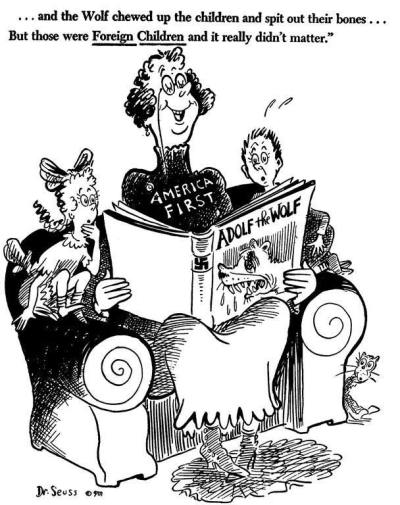
[2]

seuss-america-first

On Writing Workshop, Cognitive Overload, and Creative Writing

“The cause for my wrath is not new or single,” wrote Lou LaBrant in 1931, targeting how too often the project method engaged students in activities other than literacy.

This sharp critique by LaBrant has always resonated with me because even though I am now a teacher educator and have been a teacher for well over thirty years, I have always balked at pedagogy, instructional practices of any kind but especially those driven by technocratic zeal.

As one example, literature circles as an instructional structure represents the essential problems confronted by LaBrant about 86 years ago: the instructional practice itself requires time to teach students how to do the practice properly, and thus, “doing literature circles” becomes a goal unto itself and as a consequence subsumes and/or replaces the authentic literacy goals it claims to seek.

Further, many instructional practices border on being gimmicky because they are constructed in such a way to facilitate that anyone (regardless of expertise and experience) can implement them in the role of “teacher.”

For a while now, I have been contemplating the tension within teaching writing (composition) between those who teach writing as teachers and those who teach writing as writers.

I certainly default to the latter, and am drawn often to John Warner‘s public examinations of his teaching of writing (see below) because he also teaches writing as a writer.

Warner’s pieces about grading contracts and de-grading his first-year writing course have come when I am beginning my English/ELA methods seminar and wading into how my candidate must navigate ways to seek authentic practices in the context of the real world of teaching that often models for her teaching writing as a teacher, as a technocrat.

Here, then, I want to pull together a few concepts that I think are at their core related to LaBrant’s “wrath” and my rejecting of technocratic instruction—writing workshop, cognitive overload, and creative writing.

Warner in blog posts and on Twitter questions his commitment to writing workshop, and offered that he has abandoned the term “workshop” for “laboratory.”

In one response, I mused that this all depends on what we mean by “writing workshop.”

Teaching about and practicing writing workshop for me have always been grounded in Nancie Atwell’s use of Giacobbe—that writing workshop incorporates time, ownership, and response.

Of course, writing workshop also typically involved peer and teacher-student conferencing as well as a number of other strategies such as read alouds and examining model texts.

So, although I do not wish to put words in Warner’s mouth, I believe he and I share a skepticism about writing workshop when “doing workshop” becomes so time consuming and complex that the pursuit of workshop replaces students actually doing the very messy and unpredictable task of writing, composing.

This is again the technocratic trap of instructional strategies of all kinds.

For the teaching of writing, something Kurt Vonnegut claimed could not be done, this trap is more common than not, particularly because teachers are often under-prepared as teachers of writing and teachers who are not writers (most ELA/English teachers, I would suspect) dominate who is charged with teaching writing.

Technocrats have ruined concepts such as the writing process, conferencing, and workshop by scripting and work-sheeting them into practices anyone can implement.

The teaching of writing requires teacher expertise and a high level of teaching as a craft—but fastidious attention to doing workshop or intricate peer-conferencing or mandating students demonstrate the writing process or essay templates ultimately fails fostering young writers.

Concurrent with the problems inherent in technocratic pedagogy is failing to consider the importance of cognitive overload when students are developing complex behaviors such as writing or reading.

Each of us has a limited amount of cognition we can devote to behaviors. When something becomes “second nature,” we then free cognition space. For me in the past year or so, returning to mountain biking has exposed this dynamic since road cycling had become “natural” to me, but mountain biking demanded so much purposeful thinking, I was constantly bumbling and frustrated.

Few truisms mean more to me as a teacher of writing than paying attention to (thus, avoiding) cognitive overload when your main instructional goal is fostering students as writers.

For example, if the topic or writing form is too demanding for students, they will often devote less or nearly no energy to writing itself. Many of us as teachers have read garbled essays by students, blaming the students instead of recognizing that we have asked them to do more than they were capable of doing concurrently.

For this reason, I stress the need to use personal narrative (because the content of the writing is an area of student expertise) as one foundational way to help students focus on craft and authentic writing forms.

K-12 students and first-year undergraduates, I think, need some careful consideration of cognitive overload as they acquire writing craft, and for first-year undergraduates, as they become more adept at the nuances of disciplinary writing in academia.

Avoiding technocratic pedagogy and cognitive overload, then, share the need for the teacher to keep primary the goals of learning; if we are fostering writers, we need to be sure time and effort are mostly spent on writing—not doing a pet instructional practice, not acquiring some disciplinary knowledge.

Finally, as I was discussing avoiding cognitive overload with my ELA/English methods student, I had her reconsider her plan to have students write short stories as the composition element in her short story unit this coming spring.

Just as I balk at technocratic pedagogy, I struggle with asking K-12 students to write fiction and poetry—primarily because these are very demanding forms of writing that encroach on my concern about cognitive overload; student must have both high levels of writing craft and the ability to fabricate narratives in order, for example, to write short stories.

As a high school English teacher, I found that students often reached for derivatives of derivative fiction in order to have something for characters and plot in their original short stories; for example, a student would write about an ER doctor as a main character (he or she always committed suicide at the end), drawing from almost entirely what the student knew about ERs from the TV show ER.

I made my case about cognitive overload, and then, she and I brainstormed what to have students write instead of their own short stories during her short story unit.

First, I asked her to reconsider her definition of “creative writing” being limited to fiction and poetry. I prefer LaBrant’s definition:

For in truth every new sentence is a creation, a very intricate and remarkable product. By the term “creative writing” we are, however, emphasizing the degree to which an individual has contributed his personal feeling or thinking to the sentence or paragraph. This emphasis has been necessary because too frequently the school has set up a series of directions, to this extent limiting what we may think of as the creative contribution: the teacher names the topic, determines the length of the paper, and even sometimes assigns the form. For the purposes of this paper I shall, perhaps arbitrarily, use the term “creative writing” to include only that written composition for which the writer has determined his own subject, the form in which he presents it, and the length of the product. (p. 293)

This pulls us back to honoring the broad concepts of writing workshop above, focusing here on “creative” being linked to student choice (ownership) over what s/he writes about and what form that writing takes.

Next, we brainstormed the possibility of asking students to write personal narratives while also emphasizing that their original personal narratives would have in common with the short stories they are studying—craft elements.

Students could focus on organizational techniques in narratives, for example, while reading fiction, and then, incorporate that craft in their own personal narratives.

I have examined here ways to rethink writing workshop, cognitive overload, and creative writing so that we forefront our writing goals when teaching writing and guard against technocratic and reductive instructional strategies that can mask our own expertise and experience as writers.

From LaBrant to Warner, we can unpack that teachers of writing are often working from places of fear—fear about losing control, fear of not being adequately prepared to teach writing, fear students will not write if given choice and freedom.

However, “I have heard many teachers argue that, given a free hand, pupils will write very little,” LaBrant explained. “I can only say that has not been my observation nor my teaching experience…” (p. 299).

And then Warner: “With the de-graded contract, students are writing more, and more importantly feel free to take risks in their writing.”

Our antidote to these fears is trust, and then the willingness to honor for ourselves and our students the value in risk.

Teaching writing like writing itself is fraught with fits and starts as well as failure. Trying to control those realities results in either masking them or destroying the greater goal of fostering writers.


For Further Reading

Grading Contract Journey Part I: First-Year Writing | Just Visiting, John Warner

Grading Contract Journey Part II: Fiction Writing | Just Visiting, John Warner

Thinking Context: No More Writing, John Warner

LaBrant, L. (1931, March). Masquerading. The English Journal, 20(3), 244-246.

LaBrant, L. (1936, April). The psychological basis for creative writingThe English Journal, 25(4), 292-301.

Measuring Proficient Teachers Codifies Bad Teaching

Maja Wilson and Alfie Kohn have found themselves in a problematic minority during the accountability era dedicated to standards, high-stakes testing, and the ever-present rubric.

Rubrics, they argue, ultimately fail complex human behaviors such as writing. While rubrics facilitate statistical aspects of measuring human behaviors (such as teaching and learning), by doing so, they also tend to erode the quality of the very behaviors being measured.

As a writing teacher, I can confirm Wilson’s and Kohn’s critiques that student writing conforming to a rubric and thus deemed “proficient” or “excellent” can be and often is quite bad writing. Rubric-based labels such as “proficient” reflect compliance to the rubric, not writing quality.

Wilson, in fact, has demonstrated this by revising a professional and beautiful piece of writing by Sandra Cisneros so that is conforms to a computer-graded system’s criteria for high-quality writing. The result was more than disturbing with the revised work substantially worse but better correlated with what the Educational Testing Service (ETS) has deemed “good.”

While Wilson’s experiment focuses on computer-graded writing, the basis of that is having a generic rubric to determine writing quality, and thus, here we begin to investigate why rubric-driven evaluation of complex human behavior always fails:

  • Rubrics reduce the unpredictable to the prescribed.
  • To be practical, rubrics often attempt to be generic enough to cover huge categories—such as writing and teaching—and thus failing the reality that poetry writing is significantly distinct from journalism or that teaching second grade is significantly distinct from teaching high school physics.
  • When rubrics use terminology that is broad enough to address those varieties, they are useless due to being too vague; when rubrics use terminology that is specific, they are useless because they are unduly prescriptive. If the learning objective is jumping rope, if proficiency is “students jump well,” we have no idea what “well” means, and if proficiency is “students jump 10 times without missing,” that 10 becomes all that matters. In other words, in both cases, complying to the rubric ultimately supersedes the actual jumping rope.
  • Rubrics replace substantive feedback conducive to learning, and in fact, stagnates learning and reduces all assessment as summative.
  • As with high-stakes testing, high-stakes rubrics connected to course grades and/or as part of state accountability systems carry the weight of authority—shifting that authority from teachers and students to the rubric itself and the bureaucracy behind it.

So this brings me back to South Carolina teacher evaluation rubric, adapted from the National Institute for Excellence in Teaching (NIET).

SC’s version of the NIET rubric, as I discussed, is marred by being unmanageable due to its length and inadequate due to the inordinate amount of terminology that is too vague (and again, if we address that vagueness, we still have a flawed instrument that is all prescription).

While going through a first session of training in the rubric, I witnessed the greatest problem with using generic rubrics to determine teacher quality: a very bad literacy lesson was pronounced at the high end of “proficient” by how it conformed to the rubric, but the lesson was in fact terribly uninspired, overly teacher-centered, and reductive—as well, it likely eroded significantly the students’ passion for and interest in reading and literacy.

Adopting and implementing a new teacher quality rubric, however, have been committed primarily to training those who will evaluate teachers so that the assessors are familiar with the rubric and the endorsed process; and then, above all else, a central goal is to produce inter-rater reliability with a rubric that NIET and others have already deemed valid.

In other words, this is a statistical enterprise—not an adventure in teaching and learning.

Lost in the technocratic orgy about validity, reliability, and the all-things scientific, we have made the mistake confronted by John Dewey:

What avail is it to win prescribed amounts of information about geography and history, to win ability to read and write, if in the process the individual loses his own soul: loses his appreciation of things worth while, of the values to which these things are relative; if he loses desire to apply what he has learned and, above all, loses the ability to extract meaning from his future experiences as they occur? (Experience and Education, p. 49)

The irony here, of course, is that Dewey is one of the seminal voices for education being scientific; however, I cannot imagine his expecting this reductive outcome.

All aspects of teaching and learning are poisoned by our misguided pursuit of a very narrow version of “scientific” that has been subsumed by the bureaucratic and turned into pseudo-science.

What avail is it to label a teacher proficient, if in the process the teaching is terribly uninspired, overly teacher-centered, and reductive, if in the process the students are rendered lifeless and uninspired as well?

On Education and Credentialing: “Mak[ing] a Straight-cut Ditch of a Free, Meandering Brook”

“What does education often do?” Henry David Thoreau asked in his journal, answering: “It makes a straight-cut ditch of a free, meandering brook.”

As a former high school English/ELA teacher for 18 years, as I sat in the first of two training sessions yesterday, this from Thoreau came to mind.

Over the past 15 years, I have been a teacher educator, now a full and tenured professor in my university’s Education Department. Yet, from 9-4 yesterday, as representatives from the state department of education trained our full-time and adjunct faculty on the new South Carolina teacher evaluation rubric, adapted from the National Institute for Excellence in Teaching (NIET) standards, I felt more like an elementary student because the so-called training was mostly condescending and entirely unprofessional.

But the unprofessional, I regret to acknowledge, is business as usual for teacher education, as a faux-field in higher education, and for K-12 teaching, a faux-profession.

Some of my doctoral courses for an EdD in curriculum and instruction covered educational leadership. In that work, I was always fascinated by what the research often describes as three types of leaders—authoritarian, authoritarian-light, and collegial.

The most chilling of the three is the authoritarian-light, which is a style that includes finding strategies that manipulate stakeholder buy-in by making it appear the stakeholders are making decisions even though they are actually being coerced to comply with mandates about which they have no real choice.

This is the process I suffered through yesterday as bureaucrats from the state department assured a room of professors and practitioners that the new state rubric for teacher evaluation is backed by research and that we already know and do everything therein.

Again, as a former English/ELA teacher, I am struggling with describing the experience as Orwellian, a Kafkan nightmare of reason, or both.

Training Teacher Educators to Train Teachers to Train Students

Some of the early session dynamics are worth noting upfront.

As part of the authoritarian-light strategies, the facilitators had lots of group work with large sticky paper and markers. Much laughing and chatting included references to the numerous teacher evaluation systems SC has adopted over the past three decades and how everyone in the room knew all this stuff.

We all shared our very E.D. Hirsch moment of knowing all the acronyms for the four or five systems many of us in the room have experienced.

And then the dramatic kicker: But this new rubric and system is different, better, and supported by research!

[Let’s note that no time was taken to acknowledge that this same framing occurred each time all the former systems were introduced.]

In passing, the credibility of the rubric was linked to the fact that the rubric includes footnotes (so do Ann Coulter’s books, by the way) to the incredible work of Danielson and Marzano!

However, as I found the rubric online, I noticed that neither were in the 23 footnotes.

[Let’s note that no time was taken to examine very powerful and credible counter-evidence refuting the credibility of the cult of Danielson and the cult of Marzano. Also, the cult of Hattie is in footnote 7, a hint to the hokum therein.]

Not to belabor the seven-hour training session, but a few additional points:

  • This rubric is highly touted, yet when we raised concerns about vague terms such as “most” and “some” to distinguish between “proficient” and “needs improvement,” that conversation was mostly brushed aside, except that we discovered if you look under “Description of Qualifying Measures” on page 8, you learn that “most” means “some” (though “some remains undefined). By any fair evaluation of this rubric, it fails miserably the basic parameters of high-quality rubrics (interestingly something I teach in my methods courses).
  • And then there is the rubric’s enormity: 404 bullets over 4 categories and nine pages of small Helvetica font. To navigate these bullets (and we were warned repeatedly to do so “holistically and not as a checklist” as we walked through the bullets as a checklist and not holistically) with any care at all requires nearly three hours for just one lesson, assuming about 2-minutes per bullet. Not only does the rubric fail basic expectations for clearly defined terms (just what the hell are “powerful ideas”?), but also it fails for being incredibly unwieldy and overwhelming.
  • Throughout the training, two key points were emphasized: mastery and teacher impact on student learning. As I will discuss below, we were given no opportunity to explore the serious problems with both, and no time was spent highlighting how the training itself practiced faux-science in the context of each.
  • As we explored the rubric, as well, the facilitators unpacked key factors that are not expressed in the rubric itself. Even though the language of the rubric under “proficient” references the teacher, the facilitators noted often that to move from “needs improvement” to “proficient” was dependent on students demonstrating mastery (showing “proficient”), not teacher behaviors (merely “needs improvement”).

To clarify how problematic this training proved to be, let me offer briefly the last activity, our viewing a lesson and watching the facilitators model how to use the rubric.

The lesson was a ninth-grade ELA lesson on inference, and the class was a “no excuses” charter school with black and brown children all adorned in matching purple shirts.

Here is the short version: the lesson, we were told, met the upper range of “proficient.”

Yet, what the activity highlighted was quite different than the intent.

The lesson was weak, a reductive attempt to teach inference to mastery that confuses isolated literacy skills with teaching literacy or literature. But this sort of bad lesson is necessary once you reduce teaching to mastery and teacher impact on student learning.

Instead of addressing this substantive problem and ways to conference with the teacher about focusing literacy instruction on rich texts and inviting students to explore those texts with more and more sophistication over a long period of time, the points of emphasis were on transcribing verbatim the lesson (although we could barely hear the audio) so that we could give lots of evidence for the bullet points we were not supposed to view as a checklist.

[Let’s note that no time was allowed to acknowledge that if and when teacher evaluators need detailed evidence of teaching, the video itself is superior to transcribing.]

The Big Point here is that once a rubric is codified by the state as a credentialing instrument, that rubric determines “proficient,” which may also simultaneously be a very bad, uninspiring, and reductive act of teaching.

Within that, as well, we witnessed the faux-science of claiming to embrace concepts while simultaneously contradicting them.

While only a few students out of a class of 20-plus students responded aloud during the lesson (our only potential evidence of learning), that constituted “most” and thus “proficient”—and represents in the Orwellian confines of this rubric “mastery.”

A few students offering one or two comments aloud in no reasonable way constitutes mastery, and there were no efforts to control for anything that justifies claiming this lesson by this teacher was a direct causal agent for the supposed learning. For example, those students willing to share may have come to class already capable of playing the inference game in school.

Teacher education as a bureaucratic mandate has mostly and currently functions as faux-science—adopting the language of being a certain kind of reductive behavioral psychology without taking the care and time to understand or implement the concept with fidelity.

This is a tragic consequence of the low self-esteem of the field—which becomes a vicious cycle of pretending (badly) to be a field deemed more credible (psychology) but unable to become a credible and independent field unfettered by bureaucracy.

Everything Wrong with Teacher Education Is Everything Wrong with Education

“Schools are increasingly caught up in the data/information frenzy,” concludes Rebecca Smith, adding:

Data hold elusive promises of addressing educational concerns, promising real-time personalized instruction, predicting student growth, and closing the achievement gap of marginalized students (Bernhardt, 2006; Earl & Katz, 2006; Spillane, 2012). Today collections of student data are considered a reliable and a scientific way of measuring academic growth, mobilizing school improvement, and creating accountable, qualified teachers. Influenced by policy, pedagogy, and governing school procedures, data collection has become normalized in schools. Instead of asking what we can do with data, the better questions are: How did the accepted practice of quantifying children become normalized in education? How does our interaction with data govern our thoughts, discourses, and actions? (p. 2)

And as Smith details, the historical roots are deep:

Thorndike (1918), relying on his psychological work, believed scientific measurement utilized in educational settings could create efficient systems where “knowledge is replacing opinion, and evidence is supplanting guess-work in education as in every other field of human activity” (p. 15). To Thorndike, the measurement of educational products was the means by which education could become scientific through rigor, reliability, and precision. (p. 3)

As a logical although extreme consequence of this historical pattern, Common Core represents the false allure of accountability and standards as well as the quantification of teaching and learning within the idealized promise of “common.”

Common Core was doomed from the beginning, like the many iterations of standards before because as a consequence of the accountability era the evidence is quite clear:

There is, for example, no evidence that states within the U.S. score higher or lower on the NAEP based on the rigor of their state standards. Similarly, international test data show no pronounced test score advantage on the basis of the presence or absence of national standards. Further, the wave of high-stakes testing associated with No Child Left Behind (NCLB) has resulted in the “dumbing down” and narrowing of the curriculum.

And thus:

As the absence or presence of rigorous or national standards says nothing about equity, educational quality, or the provision of adequate educational services, there is no reason to expect CCSS or any other standards initiative to be an effective educational reform by itself.

For decades and decades—and then to an extreme over the past thirty years—education and teacher preparation have been mired in doing the same thing over and over while expecting different results.

The quality of education, teaching, and learning is not in any reasonable way connected to the presence or quality of standards, to the ways in which we have chosen to measure and then quantify them.

Training education professionals to use a really bad rubric that will determine if candidates are allowed to teach “proficiently” (which I can define for you: “badly”) is insanity because within a few years, another rubric will be heralded as the greatest thing while teaching and learning are no better—and likely worse—for all the bluster, time, and money wasted.

Education and teacher education are trapped in a very long technocratic nightmare bound to a reductive behaviorism and positivism.

These false gods are useful for control and compliance, but are in no way supportive of educating everyone in a free society.

Technocrats and bureaucrats cut straight ditches; teaching and learning are meandering brooks.