Category Archives: Teaching

Not What, But Who: Remaining Grounded as a Teacher of Students

Because she’s older and the teacher, she’s right and I’m not.

Sandra Cisneros, “Eleven”

The field experience students complete as part of my foundations of education course has this semester blended well with their reading Chris Emdin’s For White Folks Who Teach in the Hood…and the Rest of Y’all Too.

As we have discussed both during class sessions, students have been drawn to witnessing and reading as well as thinking about how teachers view and respond to their students.

Although these students have virtually no background in formal education, they have been very perceptive about the inordinate, and distracting, pressures on teachers to cover the curriculum (standards) and prepare students for testing—notably while observing and tutoring at a local majority-minority elementary school.

High student/teacher ratios have also been identified as making good classroom practice nearly impossible.

Running through our discussions has been a concern about how teachers treat students (often more harshly than my students anticipated or endorsed) and about the pervasive deficit perspective throughout the school.

Observing and tutoring in special needs classes and among Latinx students needing to acquire English have intensified how my students have responded to their field placement and their recognition of the myriad factors that impact negatively formal education.

Often unspoken, but what teachers and students share in far too many schools is a “no excuses” imperative that demands teachers perform well (even miraculously) despite being placed in circumstances that work against their efforts and that demands students somehow leave the pressures and inequities of their lives in order to excel at academics being imposed on them.

Teresa Watanabe’s Can a child who starts kindergarten with few reading or math skills catch up? is a snapshot of what my students have witnessed and what Emdin’s work challenges.

Responding to that article, Stephen Krashen, Professor Emeritus at the University of Southern California, has identified the problem that my students have observed:

But there is no evidence that tougher standards lead to more learning, and no evidence showing that the Common Core standards are better at preparing children for college and career than other standards or than no standards….

Forcing young children to study flashcards in the car and spell words during family outings in order to “master” 100 words is turning kindergarten into kindergrind.  Children who develop a love of reading will master thousands of words, without suffering.

Although political leaders and the public often view the authoritarian classroom where teachers are charged with keeping order and demanding that students learn standards and content about which they have no choice or input as the solution, it is now far past time to recognize that this is the problem with formal schooling.

Of course, what we teach is important at every level of education, and that what is becoming even more important for our democracy as we are confronted with a new post-truth media and politics.

That what needs to be the sort of truth that empowers a free people.

That what also needs to include a clear focus on the civility of learning and wrestling with ideas since our post-truth media and politics are increasing and justifying the demanding and nasty tone that is already a problem in many schools.

However, the what must remain secondary to the who—who we teach is what makes teaching an essential calling grounded in the dignity of both teachers and their students.

And the what can never be well taught or learned unless we attend to the conditions of teaching/learning and living among our teachers and students.

The authoritarian classroom, deficit thinking, “no excuses” ideologies and practices—these are corrosive elements for teaching, learning, and democracy as well as liberty.

The very long era of standardized testing and the more recent and relatively shorter era of accountability and standards have inflicted immeasurable harm on teachers and students.

And even as educator autonomy and professionalism become daily further eroded, we are morally obligated to call for and remain grounded in our role as teachers of students.

The who of teaching and learning must always come before the what.

Daring to Confront Race and Class through Poetry in Trumplandia

My mind is racing, as it always will
My hands tired, my heart aches

“Half a World Away,” R.E.M.

Writing specifically about Mark Twain’s Adventures of Huckleberry Finn and drawing on powerful words from Toni Morrison, Jocelyn Chadwick, president-elect of the National Council of Teachers of English (NCTE), argues in We Dare Not Teach What We Know We Must: The Importance of Difficult Conversations:

Our ELA classrooms take our children around the world and beyond—into past, present, and future worlds. We provide safe and trusted spaces for them where difficult conversations can and do take place. If at times teachers, at whatever level they teach, hit a roadblock, perhaps this impediment is due to or own predilections of codifying our students, stereotyping them before we even listen to them, much less get to know them….[T]he last time I checked, we teach students—not colors, not types. Perhaps it is we who need to stop and reread all of the texts we teach from the 21st-century perspective of students’ empowerment— empowerment that our literature provides….It has been some of us who have been demurring, listening to the voices of others, telling us we dare not teach what we know we must. (p. 91)

Published in English Journal in the month the U.S. elected Donald Trump, Chadwick’s confrontation of “some of us who have been demurring” and “difficult conversations” resonates in ways, I suspect, that even Chadwick may not have anticipated.

Toni Morrison’s words after the election also serve teachers of English Language Arts in the same way that Chadwick anchors her argument about our classrooms, the literature we explore, and the discussions we encourage and allow:

On Election Day, how eagerly so many white voters—both the poorly educated and the well educated—embraced the shame and fear sowed by Donald Trump. The candidate whose company has been sued by the Justice Department for not renting apartments to black people. The candidate who questioned whether Barack Obama was born in the United States, and who seemed to condone the beating of a Black Lives Matter protester at a campaign rally. The candidate who kept black workers off the floors of his casinos. The candidate who is beloved by David Duke and endorsed by the Ku Klux Klan.

In Morrison’s lament, we must recognize the weight of both race and social class on the American character. Morrison confronts white privilege and the consequences of that privilege being eroded: “These people are not so much angry as terrified, with the kind of terror that makes knees tremble.”

As teachers of ELA, it is ours to dare, to dare to teach openly against the world within which our students live and within which our classrooms exist. In the spirit of Chadwick’s call to re-read, and I would add re-teach, literature in that light, please consider how Barbara Kingsolver’s “What the Janitor Heard in the Elevator” from her collection Another America/Otra America provides “safe and trusted spaces” for investigating the increased problems with race and social class in 2016 America.

Barbara Kingsolver’s “What the Janitor Heard in the Elevator”

Kingsolver is best recognized as a novelist—notably for her The Poisonwood Bible—but she is also a brilliant essayist, a skillful poet, and an activist who lives her activism.

Her sole collection of poetry, Another America/Otra America, reflects the essential political nature characterizing all of Kingsolver’s work and is published as a bi-lingual collection of Spanish and English versions of all poems (Rebeca Cartes translates Kingsolver’s original English into Spanish).

“What the Janitor Heard in the Elevator” provides traditional opportunities to highlight the craft of writing and of poetry, including (through which I will discuss the poem more directly later):

  • The importance and power of titles.
  • Word choice, connotation, and framing/motifs.
  • Pronouns and ambiguity.
  • Character and plot in genres/modes beyond fictional narratives.

To frame the poem in the context of the world within which our students live, however, means that students should be allowed and even invited to connect Kingsolver’s craft with the tensions in public discourse about race and class after the election of Donald Trump—concerns about “deplorables” and debates about if and how to understand white anger/fear as well as the increased focus on the white working class.

The poem reads in full:

The woman in the gold bracelets tells her friend:
I had to fire another one.
Can you believe it?
She broke the vase
Jack gave me for Christmas.
It was one of those,
you know? That worked
with everything. All my colors.
I asked him if he’d mind
if I bought one again just like it.
It was the only one that just always worked.

Her friend says:
Find another one that speaks English.
That’s a plus.

The woman in the gold agrees
that is a plus.

A first reading of the poem should include asking students about the janitor in the title—Who do they see? Is that janitor they envision black or brown? What do they notice about the presence of the janitor in the poem itself?

Here, the students can see how racialized their perceptions are, and then discuss the tension between the janitor being in the elevator and the title, but invisible in the lines of the poem.

How does the poem create a space to discuss the marginalization of people by race, by profession, and by social class?

This central question is further complicated in the poem’s use of color imagery, diction, and pronouns.

In the first line “gold bracelets” triggers social class that shades the conversation between friends (again, who do students see when they imagine these women?) that is being overheard by the janitor in the elevator. Voiceless and seemingly invisible to these women with at least relative affluence, the janitor may represent those same conditions in the U.S. for people of color and people from the working class.

The comments by the “woman in the gold bracelets” are layered and coded:

  • She refers to her fired domestic help as “one” and then also refers to the broken vase as “one”—the ambiguity of the pronoun usage reducing the worker to an object.
  • Word choices such as “worked” and “colors” connote “worker” and “colored” if we extend the poem to race and social class.
  • The suggestion in her comments (“another one”) triggers the implication that the worker is expendable, replaceable, just as the vase may be, although the women appears more concerned about replacing the vase.

And then, the friend’s response forces the reader to reconsider or re-examine a first read with “one that speaks English”—more directly invoking the race and nationality of the worker and opening a door to the political and public debates about undocumented workers.

Presented with a bi-lingual collection, how many students initially see a black man as janitor, but then after the friend’s comment, rethink that assumption since the poem appears to be interrogating the tensions of race, class, and language between whites and Latinx?

The final two lines bring the reader back to “gold,” which frames the poem in color imagery that speaks to materialism and affluence as well as opulence.

#

Chadwick quotes Morrison on teaching: “Open doors, let them in, give permission, and see what happens. Students make you think. I learn faster and more when I am teaching.”

And while I am skeptical of universality, I am enamored by the enduring that is art, that is literature. Kingsolver’s poem opens doors for her readers—to the enduring tensions of race, social class, and language; to the specter of invisibility and what Arundhati Roy has explained as: “We know of course there’s really no such thing as the ‘voiceless’. There are only the deliberately silenced, or the preferably unheard”; and to debates about naming racism and racists.

All texts, all poetry, and then this poem—as Chadwick acknowledges, “we teach students” who live in a flawed and complex world not of their making.

Teachers of ELA have unique responsibilities to engage with our students and the world through the texts we choose and the texts students choose as open doors into the world that our students could build instead.

The Rights and Responsibilities of the Teacher of English Redux (2016)

“All we gotta do is be brave
And be kind”

“Baby, We’ll Be Fine,” The National

…the world is gone daft with this nonsense.

John Proctor, The Crucible, Arthur Miller

In a keynote address at the 1960 National Council of Teachers of English (NCTE) annual convention, former NCTE president Lou LaBrant asserted:

Every teacher of English exercises some rights, no matter how dictatorial the system under which [she/]he works; and every teacher carries out some responsibilities. But today we have a considerable movement in this country to curtail certain freedom—rights—of the classroom teacher, and those rights are the matter of this discussion. (p. 379)

Published as The Rights and Responsibilities of the Teacher of English in the September 1961 English Journal, this characteristic call to action from LaBrant resonates in 2016 as English teachers prepare to gather in Atlanta, Georgia for #NCTE16 with the increasingly important theme of Faces of Advocacy.

Fifty-five years ago, LaBrant advocated for teaching:

Teaching, unlike the making of a car, is primarily a thought process. A [hu]man may work on an assembly line, turning a special kind of bolt day after day, and succeed as a bolt-turner….But the teacher is something quite different from the [hu]man who turns a bolt, because the student is not like a car. Teaching is a matter of changing the mind of the student, of using that magic by which the thinking of one so bears on the thinking of another that new understanding and new mental activity begin. Obviously, the degree to which this is reduced to a mechanical procedure affects the results. (p. 380)

Most practicing teachers today work within and against political and bureaucratic forces that “[reduce teaching] to a mechanical procedure.”

And even more disturbing is LaBrant’s warning:

What I am trying to say here is that the teacher who is not thinking, testing, experimenting, and exploring the world of thought with which [she/]he deals and the very materials with which [she/]he works, that teacher is a robot [her/]himself. But we cannot expect a teacher to continue the attempt to find better means or to invent new approaches unless [she/]he knows [she/]he will have freedom to use [her/]his results. Without this freedom we must expect either a static teacher or a frustrated one. I have seen both: the dull, hopeless, discouraged teacher, and the angry, blocked, unhappy individual. (p. 380)

At mid-twentieth century, LaBrant spoke against the all-too-familiar “bad” teacher myth used in contemporary calls for accountability:

Repeatedly when capable teachers ask for freedom, someone points out that we have many lazy teachers, stupid teachers unable to think and choose, ignorant teachers; in short, bad teachers who need control. We do have some, but we encourage others to be bad. Even the weak teacher does better when [she/]he has to face [her/]his own decisions, and when [she/]he supports that decision. (p. 383)

The de-professionalizing of all teachers, then, is not something new, but a historical fact of being a teacher. However, LaBrant confronted the culpability among educators themselves:

One reason so many of us do not have our rights is that we have not earned them. The teacher who is free to decide when and how to teach language structure has an obligation to master [her/]his grammar, to analyze the problems of writing, and to study their relations to structure….But [her/]his right to choose comes only when [she/]he has read and considered methods other than [her/]his own. [She/]He has no right to choose methods or materials which research has proved ineffective….There is little point in asking for a right without preparation for its use. (p. 390)

“Throughout our country today we have great pressure to improve our schools,” lamented LaBrant. “By far too much of that pressure tends toward a uniformity, a conformity, a lock-step which precludes the very excellence we claim to desire”:

There is little consideration of the teacher as a catalyst, a changing, growing personality. Only a teacher who thinks about [her/]his work can think in class; only a thinking teacher can stimulate as they should be stimulated the minds with which [she/]he works. Freedom of any sort is a precious thing; but freedom to be our best, in the sense of our highest, is not only our right but our moral responsibility. “They”—the public, the administrators, the critics—have no right to take freedom from us, the teachers; but freedom is not something one wins and then possesses; freedom is something we rewin every day, as much a quality of ourselves as it is a concession from others. (pp. 390-391)

The Rights and Responsibilities of the Teacher of English Redux

“Evil settles into everyday life when people are unable or unwilling to recognize it,” writes Teju Cole in the wake of Donald Trump being elected president of the U.S. “It makes its home among us when we are keen to minimize it or describe it as something else.”

LaBrant wrote about the field of teaching English throughout the 1940s and 1950s with the power—both for evil and for good—of language forefront of her concerns:

Misuse of language, as Hitler demonstrated, is a terrible thing; we teachers of English can at the very least teach our students that language is a tool of thought, a tool which can be sharp and keen, but is easily blunted. (“The Individual and His Writing,” 1950, p. 265)

So we teachers of English/ELA—and all educators—sit in 2016 confronted with a “[m]isuse of language” that has given rise to a presidency built on racism, sexism, and xenophobia; therefore, as during LaBrant’s career, we teachers of English/ELA must embrace the most pressing responsibilities.

But driving Trump’s and his supporters’ bigotry has been a powerful corruption of language: blatant lies, denials of those lies, and the ugliest of coded language. In short, bullying has rewarded a political leader with the highest office in a free society.

Parody of Trump’s misuse of language cannot be taken lightly, but that misuse has real consequences on the lives of vulnerable and marginalized people, including children in the classrooms of teachers across the U.S.

Immediately, then, teachers must admit “that every dimension of schooling and every form of educational practice are politically contested spaces” (Kincheloe, 2005).

In other words, although teachers are historically and currently de-professionalized by being told not to be political, as LaBrant argued, educators cannot reinforce that mantra by calling for politics-free zones in our classrooms and in our professional spaces.

Calling for no politics is a political act of silencing that brazenly takes a masked political stand in favor of the status quo.

Teaching and learning are unavoidably “politically contested spaces,” but they are unavoidably ethically contested spaces as well.

Language is a human behavior that allows us to wrestle with and find our moral grounding; and thus, those teaching literacy have a profoundly ethical mission to work toward the Right, Good, and Decent—in the act of teaching but also as a personal model.

As philosopher Aaron Simmons argues:

It matters that we demonstrate critical thinking even while others assume that shouting louder is tantamount to evidential refutation. It matters that we think well when it seems hard to think anything at all. It matters that we care about truth because only then can lies and bullshit still be categories to avoid.

The naive stance of neutrality can no longer be who teachers are because, as I noted above, to be neutral is to support the status quo, and in the U.S., the status quo is a cancer that left untreated promises to kill us all.

As Lucas Jacob argues directly:

Calling a politician out for Islamophobia, xenophobia, racism, and misogyny is not a matter of exerting undue influence by favoring one political party over another; nor is it a matter of disrespecting the presidency. Naming Mr. Trump’s hate speech as such is, rather, a moral imperative for supporting the missions of K-12 schools, in which Islamophobic, xenophobic, racist, and misogynist words and actions are punishable offenses that can (and must) be treated as being beyond the pale.

“It goes without saying, then, that language is also a political instrument, means, and proof of power,” James Baldwin wrote in 1979 on Black English. “It is the most vivid and crucial key to identify: It reveals the private identity, and connects one with, or divorces one from, the larger, public, or communal identity.”

Just as LaBrant linked language and power, Baldwin extended that dynamic to include race—and called for using that power in the name of community instead of divisiveness.

The word “critical,” now, has taken on exponential layers of meaning.

We are in critical times, and thus, as Kincheloe explains about the political and ethical responsibilities of being critical educator who seeks for students critical literacy:

Recognition of these educational politics suggests that teachers take a position and make it understandable to their students. They do not, however, have the right to impose these positions on their students [emphasis in original]….

To refuse to name the forces that produce human suffering and exploitation is to take a position that supports oppression and powers that perpetuate it. The argument that any position opposing the actions of dominant power wielders is problematic. It is tantamount to saying that one who admits her oppositional political sentiments and makes them known to students is guilty of indoctrination, while one who hides her consent to dominant power and the status quo it has produced from her students is operating in an objective and neutral manner. Critical pedagogy wants to know who’s indoctrinating whom. (p. 11)

In its simple form, to call a lie, a lie; to name racism, racism; to reject hate as hate—these are the undeniable responsibilities of teachers, especially teachers of English/ELA.

To say “I’m neutral” in the face of a lie is to lie.

To say “I’m neutral” in the face of racism is racism, in the face of sexism is sexism, in the face of xenophobia is xenophobia.

To divorce the act of teaching from the world within which it resides is to abdicate the greatest potential of teaching and learning: to change the human experience from dark to light.

If we shun our responsibilities as teachers in 2016, we are turning our backs to the ugliest realities faced by Baldwin nearly forty years ago:

The brutal truth is that the bulk of white people in American never had any interest in educating black people, except as this could serve white purposes. It is not the black child’s language that is in question, it is not his language that is despised: It is his experience. A child cannot be taught by anyone who despises him, and a child cannot afford to be fooled. A child cannot be taught by anyone whose demand, essentially, is that the child repudiate his experience, and all that gives him sustenance, and enter a limbo in which he will no longer be black, and in which he knows that he can never become white. Black people have lost too many black children that way.

And, after all, finally, in a country with standards so untrustworthy, a country that makes heroes of so many criminal mediocrities, a country unable to face why so many of the nonwhite are in prison, or on the needle, or standing, futureless, in the streets–it may very well be that both the child, and his elder, have concluded that they have nothing whatever to learn from the people of a country that has managed to learn so little.

Writing two decades before her NCTE keynote examined above, LaBrant made a foundational request: “For these reasons my first request of every American teacher of English is that [she/]he teach in [her/]his classroom this honest use of language and an understanding of its relation to life” (p. 206).

And about “this honest use of language,” there are only two options—although remaining neutral is not one of them.

English Journal November Sneak Preview

English Journal November Sneak Preview

The following post is by Julie Gorlewski and David Gorlewski, NCTE members and editors of the English Journal and guest editors, Sean P. Connors and P.L. Thomas. 

We are delighted to invite you to preview our November 2016 issue of EJ, which—in keeping with the presidential election—is particularly provocative and compelling. In this blog post, we feature the issue editorial, composed by guest editors Sean P. Connors and P. L. Thomas, as well as the introduction to a special section on teaching Adventures of Huckleberry Finn.We hope that the issues highlighted in this month’s EJ will open conversation among English teachers everywhere. —Julie Gorlewski and David Gorlewski

NOTE: In part, this special issue was prompted by the NCTE 2014 National Convention and this blog post resulting from that: Teaching with Our Doors Open: Professional Transparency as Acts of Resistance 

“So what do I do?”

A comment posted on my recent blog, Verboden!: Autonomy and Critical Thinking in Education, deserves a careful reply:

Jill

So what do I do? I want to teach practical skills and meaningful texts. I am instead faced with 50 year old texts in the book room, a list of goals and targets (fewer than 10% failures, increased graduation rates by more than 10%, 40 standards with subets) and the fear of retribution and firing if I stray too far from the mandated curriculum. I just want to teach students to trust the power of their voices when my own voice is silenced by bureaucracy and mandates, meetings and condescending professional development that adds another target (5 phone calls home per week). I read and believe your words, but what do I do? How do I change the world? One student at a time? Another 12 hour day?

Let me offer first some context.

Although I am a tenured full professor, I taught public high school English for 18 years in a right-to-work (non-union) state, and have witnessed the powerlessness of being a teacher in that state through my role in teacher education for these on-going past 15 years.

Yes, K-12 teachers nationally are de-professionalized more and more each day, and throughout the South, where non-union states dominate, teachers are even more silenced and powerless.

However, I do believe there are many ways teachers can claim and expand their professionalism.

Broadly, teachers must resist at all costs fatalism, a call by Paulo Freire I believe is foundational to claiming educators’ professionalism.

Now, then, let me address “So what do I do?”:

  • Take stock of how much of your professional and personal energy is being spent on being a professional and how much is drained by being a martyr—and then stop being a martyr. Especially for K-12 teachers, I advocate the Henry David Thoreau dictum about ours is to do something of value, but never to do everything. Too often, teachers are compelled to martyrdom, which erases all of our energy and is a cancer on our professionalism. Every teacher must take stock of her/his professional practices, and eliminate those that are time and energy draining with little to no positive instructional outcomes. For example, marking extensively on student work, and then not requiring students to respond in some substantive way to those comments is an act of martyrdom—a waste of professional time that produces an artifact of your spending time, but doesn’t benefit either you or your students.
  • Identify and evaluate a very detailed and specific list of those obligations over which you have no control and those aspects of your teaching over which you do have control. This is a useful exercise for individual teachers, but it is even more powerful if conducted as a department or grade-level team. For example, in a graduate course once, when I rejected teachers giving spelling tests, a teacher challenged my stance because, as she explained, “I have to give a spelling grade on the report card!” I asked if any mandates existed for how she determined that grade, exposing that she did have autonomy over the how, and thus, we discussed pulling spelling grades from original student writing. To often, I fear, due to understandable feelings of fatalism, we teachers think we are powerless when we in fact have options. A detailed inventory is an effective way to make these distinctions real.
  • Forefront in your day and planning those aspects over which you have power, and then determine professional strategies for advocating change in those obligations over which you have no current power. Daily, make as your first priority your empowering work as a teacher; do that over which you have control first and give your professional self that positive daily inoculation. Designate brief blocks of time for your compliance to mandates, and stick to that schedule. And then, waste no time fretting about those things over which you have no control.
  • Brainstorm with colleagues more authentic ways to comply with inauthentic mandates. Teachers, I believe, can attack those things about which we have no control—such as standards and high-stakes testing—through stepping back from the mandates and asking if there are alternatives to how to comply. One excellent example is resisting making test-based writing the entire writing curriculum, and instead, making prompt-writing one of the ways in which we teach writing; in other words, embedding prompted, test-based writing late in a more authentic writing program so that we do prepare students for the tests, but also remain true to authentic writing and student voice/autonomy. Also, when mandates are unpacked by a department or grade level team, re-imagined by the department/grade level, and then implemented in ways endorsed by the practitioners, these mandates become tools of professionals instead of de-professionalizing teachers.
  • Cultivate communities of empowerment and advocacy for expanding your professional autonomy. Teachers have historically and are currently often victims of the divide-and-conquer approach to management. The antidote to that is community—and for teachers, even more important is professional community. Start close and move outward: department/grade level professional communities; local, state, and national professional organizations. Now, let me emphasize here that cultivating communities of empowerment must not become an act of martyrdom (see above); I am not suggesting adding on to your professional commitment, but am arguing for re-evaluating your professional time so that you commit segments of time to more professionalism but less overall time to your work day.
  • Create advocacy roles for yourself that suit your own strengths and comfort with advocacy. Many years ago while I was a co-leader for a local chapter of the National Writing Project, I mentored a beginning teacher who struggled with her administration over implementing best practice in teaching writing to her elementary students. These were tense times since the young teacher feared for her job, but believed the school mandates were ineffective and even harmful to her students’ learning. She regularly shared with her principal and colleagues the wealth of professional literature on the practices she chose over the mandates and gradually built a case for what she was doing with her students—even though parents also challenged her practice. No one model works for every teacher, and certainly some aspects of being political pose real dangers for K-12 teachers. Yet, change necessary for greater teacher professionalism and autonomy can result only from teachers who are advocates and political. From blogging and Twitter to participating in professional organizations to implementing practices in your classroom to use as models for change in your school—advocacy and being political are necessary for teacher professionalism.
  • Expand your role as teacher beyond the classroom to parents, the community, and the public. We are teachers, but our power as teachers is not restricted to the classroom. One of the best avenues for helping change our profession is through building greater understanding and support among the parents of our students, the community we serve, and the wider public. Daily conversations outside school; regular newsletters to parents about best practice; letters to the editor or Op-Eds in local, state, and national forums; blogging and other social media dedicated to our work as professional teachers—these are ways in which we can teach beyond the walls of our classrooms.
  • Check your practice and refuse to scapegoat anyone else for your practices. Ultimately, as educators, we must behave professionally, even as we are not treated as or allowed to be professional. Any practice we do is our decision to do. It is neither healthy nor professional to argue that others make us do anything. If any mandate is harmful to children, we cannot comply. Period. If we do comply, we are implying we, in fact, admit it does no harm. While there is no requirement that teachers are perfect, we must adopt the professionalism we want guaranteed us.

Daily teaching and working toward greater teacher autonomy and professionalism are all very hard work—exhausting and stressful.

The path to greater teacher professionalism is build by teachers dedicated to teaching as a professional endeavor. The suggestions above, I believe, are some powerful ways to make this happen while also not sacrificing any teacher along the way.

And so I return to Henry David Thoreau’s “Civil Disobedience” with my small edit: “A [teacher] has not everything to do, but something; and because [she/]he cannot do everything, it is not necessary that [she/]he should do something wrong.”

In my fourth decade as a teacher, I believe the suggestions above help all teachers achieve these wise words.


Verboden!: Autonomy and Critical Thinking in Education

We don’t need no education
We don’t need no thought control
No dark sarcasm in the classroom
Teachers leave them kids alone

“Another Brick in the Wall – Part 2,” Pink Floyd (Roger Waters)

Those of us who stand outside the circle of this society’s definition of acceptable women; those of us who have been forged in the crucibles of difference — those of us who are poor, who are lesbians, who are Black, who are older — know that survival is not an academic skill. It is learning how to take our differences and make them strengths. For the master’s tools will never dismantle the master’s house. They may allow us temporarily to beat him at his own game, but they will never enable us to bring about genuine change. And this fact is only threatening to those women who still define the master’s house as their only source of support.

“The Master’s Tools Will Never Dismantle the Master’s House,” Audre Lorde

During my 18 years as a public high school English teacher, I taught as an outsider—but for many of those years, I found solace in a colleague, Ed Welchel, who taught history.

Among students, parents, faculty, and administration, Ed and I were considered good, even very good teachers, but we also were viewed with skepticism, particularly the farther up the authority chain you went (parents and administrators, especially).

The high school where we taught, although a rural public school, felt in many ways like a strict private school—very harsh discipline and dress codes, palpable conservative values.

Ed and I were as unlike that environment as two people could be.

After a particularly brutal faculty meeting that stressed the need to control our students, Ed and I began a chant we would share quietly as we passed in the hall: “Beat ’em down, beat ’em down.”

After I completed my doctorate in 1998, Ed soon finished the same program, and then left for another high school before moving on to higher education before I did.

That was fifteen-plus years ago, but it stands as relevant today since many are beginning to fret in earnest about why so many K-12 teachers leave the field.

It’s pretty damn obvious, I hate to say, but many teachers leave the profession because formal schooling is incredibly dehumanizing for students and teachers; in short, in schools, autonomy and critical thinking are verboden.

sample_pic209_14

Dark Sarcasms in the Classroom

Former career music educator and blogger at Education Week/Teacher, Nancy Flanagan asks: “Who is truly afraid of genuine leadership emerging from practitioners?”

Flanagan also confronts a key distinction about what “leadership” means by examining if teacher leaders are, as Audre Lourde would say, using the Master’s tools (implementing policy as required by administration as agents of accountability mandates) or being autonomous professionals.

More optimistically than I would conclude, Flanagan suggests, “Teachers may have lost a vision of reform led by authentic, unvarnished teacher thinking, instead of teacher compliance–but we haven’t relinquished the ideas of autonomy, mastery and self-determined purpose yet.

Educator and activist, Andre Perry turns a similar focus on how school climate impacts students, particularly marginalized populations of students. Perry stresses:

As researchers on positive school climate note, the “personality” of a school is an expression of how teachers, students, family members and community perceive the milieu.

In other words, a school doesn’t have to be mean to be good. Treating students with care and respect increases academic performance among students from low socioeconomic backgrounds, higher than if a school placed a singular single focus on academics.

This rejects, for example, the racist undertones driving the popularity of “no excuses” ideology, notably among charter schools serving poor, black, and brown students. But Perry also speaks to the wider norm of formal schooling.

Historically and especially over the past thirty years of high-stakes accountability, formal education is an Orwellian institution in which “critical thinking” is about completing a worksheet so you can score well on multiple-choice questions assessing critical thinking.

But don’t actually think or act critically if you are a student or a teacher.

Teacher Education and All that Is Wrong

Ed and I left K-12 education because of the harsh environment in schools toward students and because K-12 schools are no places for autonomous professionals.

I literally left after being docked pay for presenting at a professional conference.

However, much to our chagrin, teacher education in higher education is not oasis of professional autonomy, but the most embarrassing desert in higher education.

While colleagues in English often handed out 1-2 page syllabi, mine were 15-20 pages of standards, correlating assignments to those standards, and rubrics—despite my own published stance rejecting rubrics.

The professional life of a teacher educator is mostly about complying with accreditation and certification mandates in order to make sure teacher candidates comply with accreditation and certification mandates.

Again, autonomy and critical thinking are verboden!

For example, in the same foundations course I teach where we confront slut shaming and the inherent sexism of dress codes, within one week of my students being placed in a nearby elementary school to tutor, the principal asked me to remind the female students to dress appropriately.

As well, I always begin that course, and come back to this in most of my classes, with Sandra Cisneros’s “Eleven”—highlighting the dehumanizing norm of schooling that the story captures in the eleven-year-old Rachel’s lament: “Because she’s older and the teacher, she’s right and I’m not.”

But my foundations students are left with observing that reality in their field placements while also being denied the autonomy to do anything to change it.

And while I will not bore you with more examples, the situation above is no outlier; that is what teacher education is—a perpetual state of compliance to bureaucracy that is devoid of opportunities for professional autonomy and critical thinking.

When our candidates do reach the field, they invariably come to use with these observations:

  • “I can’t do anything you taught us in methods.”
  • “This is why people leave the field.”
  • “The administration treats teachers like students.”

All aspects of the field of education, then, are about compliance to the “bureaucratizing of the mind” about which Paulo Freire warned.

#

Formal education remains a desert, and we—teachers and students—wander dutifully forward, toward the wavering mirage that somehow teaching and learning are powerful instruments for change.

2671845245_9ebfd6be7c_b

Education as change remains just that, however—a mirage.

In the halls of schools at every level, student and teacher autonomy and critical thinking are verboden.


The False Cult of Effort, the Gender Gap, and K-12 Teacher-Bashing

While the U.S. presidency is rarified air, the presidential election often reflects the best and worst of the American character.

As the country sits in the cusp of the end of the first black president’s administration and the likelihood of electing the first female president, what does the current election show about the lingering privilege of being white, male, and straight in the U.S.?

Being black, brown, female, gay, or transgender requires perfection while being white, male, and heterosexual allows any transgression to be excused.

Hillary must be perfect (her email controversy is oddly identical to millions of erased emails from private servers under George W. Bush, although that is of no real concern to the public or the media, for example), but Trump’s admitted behavior as a sexual predator is swept aside as just a man being one of the boys.

Yes, the glorious sanctity of the office of president must not be sullied—although the Republican Party has elected Richard Nixon, Ronald Reagan, and W. Bush, a who’s who of unethical personal and political behaviors?

And in this dynamic of privilege we find the cult of effort—the implication that all these powerful white males are in power because of effort, because they deserve the success, earned the success.

Recall that Trump built this off the pittance of an inherited few million. …

On a smaller scale, then, is the K-12 teacher, a profession trapped in the cult of effort and the gender gap.

Having spent my career in part as a K-12 public school teacher and now as a tenured full professor, I have witnessed first-hand a powerful and ugly dynamic.

First, let me work backward.

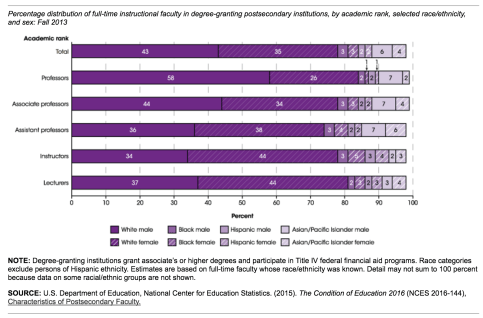
My university has only about 30% female faculty, which reflects a male norm (linked with a white norm) of university professors:

profs-gender

Few professions have greater professional autonomy that being a professor. I can assure you that rarely do people even bother telling a professor what to do—and among those few, virtually none have any real influence.

The profession of being a professor is a white, male world of autonomy and significant prestige.

As above, there is also a false cult of effort among professors—the professorate, so goes the message, is mostly white and male because of the hard work of those white men.

And if you doubt that, listen carefully to the white male response to initiatives for increasing the diversity of professors: We must maintain our rigorous standards for hiring! they shout.

The cult of effort, the cult of rigor—these are codes for maintaining privilege.

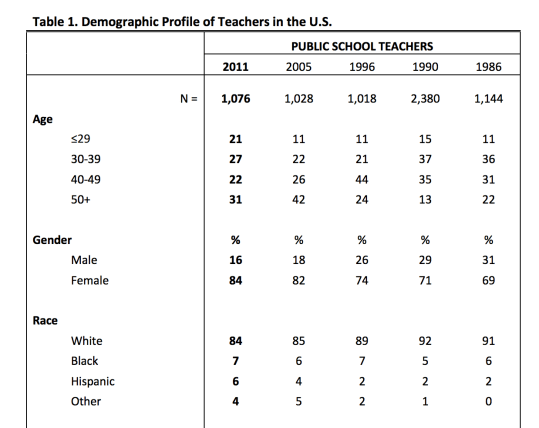
The inverse of this dynamic is at the K-12 level of teaching, a work force still dominated by women:

k-12-teachwrs-gender-2

For K-12 teachers, historically and especially over the past two or three decades, the cult of effort has imposed on the American public that schools are failing primarily because of a slack teacher force (read: a mostly female teacher force), and the way to reform that lazy work force is to raise standard! and demand more!

Let us imagine for a moment that gender divide between the supreme autonomy of mostly male professors and the nearly absent professional autonomy and ridiculous accountability leveled at mostly female K-12 teachers.

The entirely inexcusable “no excuses” model implemented in high-poverty schools serving mostly black and brown students has also become the default environment of being a K-12 teacher: high demand, nearly superhuman demand that erases all professional autonomy and most of the human dignity of teaching.

Yes, teaching K-12 is very hard, but the cult of effort is mostly a lie, and the current high-stakes accountability paradigm is a central cause for driving away teachers.

The accountability era has intensified the historical marginalizing of K-12 teaching as just a woman’s profession; the stakes have been artificially increased while teacher autonomy has been even further eroded.

As a result, K-12 teachers have their work scripted and then are badgered for poor outcomes from the practices they didn’t even choose to implement.

The public and in-school environments for K-12 teachers are toxic—unprofessional and dehumanizing. Administrators who can go to the restroom any time they please demand teachers remain at their doors between classes and never leave a class unattended—relegating basic bodily functions to 20-minute lunch periods (if they are free of students) and planning time.

This reality cannot be disentangled from the gender gap reflected between professors in higher education and K-12 teachers—as well as the current presidential campaign.

K-12 teacher bashing is nested in sexism—assumptions that women are unable and unwilling to make the effort needed to educate children; and thus, K-12 teachers need to be scripted and held to high standards of accountability.

In the political and educational worlds, however, those demanding that accountability and driving the criticism are often far above the standards they espouse.

And that is the ugly truth about women, so-called racial minorities, and gay/transgendered people who must be perfect while white, straight men are forgiven for any and every transgression.

Our democracy suffers under that inequity of privilege and the profession of K-12 teaching is on life support because of the essentially nasty environment surrounding day-to-day teaching.

Democracy and K-12 teaching both require and deserve an atmosphere of patience, compassion, and kindness—traits marginalized by toxic masculinity and white privilege in order to maintain the unearned status of power in the U.S.

At the very least, no one should have to be perfect or everyone should have to be perfect.

Immediately, then, let’s confront how terribly flawed white, straight male leadership has been and is currently—disturbingly personified by Trump himself.

Next, the false cult of effort must end, replaced by the acknowledgement of privilege as central to who has power and why.

With the false cult of effort unmasked, the gender gap can then be erased as well.

From political leadership to the teaching of children in K-12 schools, we will all benefit greatly from the rich diversity of who can and will lead and teach us—especially if that leadership and teaching are rooted in patience and kindness, especially if basic human dignity and autonomy are promised to all.

Traditional Assessment Isolates Learning, Devalues Community and Collaboration

I attended junior high well before the rise of the middle school; therefore, I did not enter high school until 10th grade.

But the greatest shift for me as a student was my sophomore English class taught by Lynn Harrill. Throughout junior high, English class has been a never-ending Sisyphean hell of grammar textbook exercises and a sentence-diagramming marathon throughout 9th grade.

I entered high school a devoted math and science student—but more importantly, I had written essentially nothing of consequence as a student, ever.

Until Mr. Harrill’s class, in which we wrote two essays that sophomore year.

My close friends were a somewhat smaller subset of the so-called “top” students who were tracked in the honors classes. We were both socially and academically close.

By my senior year, we had begun to peer-edit our essays—which we feared was cheating because the workshop approach to teaching writing was not in practice yet and we had as “good students” learned all the unspoken lessons of schooling.

From “Cover your papers” during tests to “Don’t copy your friend’s homework,” we knew that collaboration was cheating—but my close circle of friends also knew something very important: when we were collaborative, we learned, and we learned in ways that surpassed traditional teacher-centered learning.

We were each other’s spell checkers, grammar editors, and unofficial peer-teachers.

Despite the rise of the National Writing Project and the mostly widespread awareness of process writing (although it remains too often misunderstood and mischaracterized), students throughout K-12 and university education experience traditional assessment in isolation—significantly one of the least authentic aspects of traditional assessment.

Throughout my 30-plus-year career, I have advocated for and practiced de-testing and de-grading, but during the more recent 14-plus years at the university level, I have been able to experiment more fully with how this looks in the classroom.

One element of authentic assessment and feedback for students that I have explored is moving away from assessment that isolates and toward collaborative assessment, assessment opportunities that require and emphasize community.

While university professors benefit from much greater professional autonomy than K-12 teachers, university’s still require grades and mid-term/final exams; notably, these exam sessions are pretty strictly regulated in that professors need to show some use of the exam times/days for assessment.

Since I give no tests (a practice I started while a public school English teacher), I have developed mid-term sessions that are collaborative and discussion-based.

For example, each fall my first-year writing seminars and foundations of education class have assignments that build toward spending the actual mid-term exam time in small and whole group discussions.

Class discussions as mid-term exams pose several significant problems in the context of traditional schooling. First, every teacher has experienced the resistance by students and their parents to grades on group work—especially when “good” students get nicked on grades because the group had a member who didn’t pull her/his weight.

Discussion also privileges extroverted students and, just as most of traditional class structures do, disadvantages introverted students.

And as with any form of alternative assessment, students are often uncomfortable with and may fail to perform well because of different contexts for motivation and accountability.

The classroom discussion as mid-term exam originated with a foundations of education class several years ago—as we confronted the problems with traditional grades and tests, I encouraged the class to brainstorm with me how to create a more authentic mid-term experience.

Last week, I implemented the discussion as mid-term exam in both courses I am teaching.

First-year writing students choose, contact, and interview a professor in a department students are considering for a major. Each student records the interview as an artifact to prove she/he fulfilled that requirement, but then, students come to class with several key take-aways from the interview, which focuses on the professor as a scholar and writer.

The class begins with small-group (3-4 students) discussions that I casually monitor, and then we move to a whole group discussion.

I list the departments/disciplines on the board, and I help structure the discussion to focus on what scholars do and how academics write and submit work for publication (and how some disciplines do not conform to that norm, such as artists and musicians who create and perform).

In the foundations of education course, students read Paul Gorski’s Reaching and Teaching Students in Poverty: Strategies for Erasing the Opportunity Gap throughout the first half of the course, including a few class sessions for discussions of their reading.

Before the mid-term date, students submit talking points for the class discussions. I encourage those notes to be as specific as possible (quotes, page numbers).

The class session also starts with small-group discussion and then moves to whole group, but in this class, I remain entirely outside the discussions and require the students to navigate everything.

Briefly, at the end, I have a debrief about the experience.

These assessments have a few key elements in common: requiring artifacts of participation, creating small spaces for students to share if whole-group dynamics are uncomfortable, and shifting as much ownership of the learning to the students as possible.

I have been doing this for several years now, and every single one has been impressive. The actual mid-term sessions have always impressed me in a way that no traditional tests have.

In the debrief with my foundations of education class last week, I pointedly asked them to compare the mid-term discussion of a textbook reading to a standard test or individual essay.

Students were eager to argue that the discussion was far more powerful in terms of their understanding and engaging with Gorksi’s work; in fact, the whole-class discussion became extremely animated, and I witnessed students negotiating with both Gorski’s ideas on poverty and their classmates evolving awareness about poverty.

In short, the assessment was not a mere recording of learning, but a learning experience itself.

And what I learned, what the experience reinforced for me? Learning is collaborative, knowledge is the result of a community, and traditional assessment fails miserably since it isolates learners from each other and the teacher while reducing knowledge to a commodity.

As a critical educator, I continue on a journey to practice Paulo Freire’s vision of the teacher-student charged with educating students-teachers.

Assessment as collaboration and community is both something we can all practice in traditional settings and something we must do if we honor education as an act of liberation and the classroom as a space that honors human autonomy and dignity.

Teaching Writing in ELA/English: “not everything to do, but something”

A [hu]man has not everything to do, but something; and because [she/]he cannot do everything, it is not necessary that [she/]he should do something wrong.

“Civil Disobedience,” Henry David Thoreau

It is a misguided and unfair reality, but middle and high school ELA/English teachers are in many ways asked to do everything—and they cannot, of course.

Traditionally, ELA/English teachers have been charged as the primary, if not exclusive, teachers of all things literacy as well as their field of English; in other words, charged with teaching students how to read, write, speak, and listen along with covering whatever body of literature a particular grade level is assigned (and about which students may be tested in high-stakes ways).

My dissertation focus and most-times muse, Lou LaBrant was as acerbic as she was brilliant (and she was brilliant). Once when fielding questions, she chastised a teacher that if she did not know how to teach ELA/English, she should quick, learn how, and then return to the field.

Not a shining moment for LaBrant, and an attitude we must not tolerate. It is not ours to eat our own kind, and it is far past time that we allow ELA/English to be under the weight of doing everything.

This has been weighing on my mind as an 18-year high school English teacher and current English educator for 15 years and counting because of several conversations around my blog posts challenging the teaching of research papers and the 5-paragraph essay.

Maybe I was drawn to LaBrant because we share a tendency to seem strident when we are passionate—or maybe studying and writing about LaBrant so deeply infused my passion with a strident streak. Honestly, it is likely the former.

So I am guilty too often of allowing my genuine passion to come off as demanding, judgmental, and unyielding.

Shame on me.

“The Kindness of Strangers”

But I am also fortunate to be in the presence of the kindness of strangers—those who ask, prod, challenge, and join the quest.

In particular, comments by a beginning teacher and a teacher at a school that seeks to prepare students for college really hit home for me in terms of asking what ELA/English teachers are to teach in terms of writing if they abandon, as I believe they should, the traditional and scripted research paper assignment and the 5-paragraph essay.

First, I must stress that for all teachers, and particularly beginning teachers, the transition from traditional practice to warranted or best practice must be through baby steps: choosing one or a few changes to practices that are manageable, incorporating them, and then pacing over a long period of time (months, years) further changes as manageable.

I cannot stress enough, whether it is about so-called best practice, responding to student writing, or preparing students for college, we must be neither martyrs, nor missionaries.

To be a teacher of ELA/English is honorable in itself.

To move from the 5-paragraph essay/template approach to writing instruction to a workshop/authentic form approach, then, begins by identifying the components of writing workshop (time, ownership, response) in order to implement some of those components within the current traditional structure. And then gradually adding components until the traditional structure is replaced with writing workshop.

If you are not ready to release the 5-paragraph essay form, can you drop the prompt and allow student choice in topics? And can you remove some direct instruction for students to draft and collaborate on their essays during class as well as your own conferencing with students as they brainstorm and compose?

Along with baby steps, change is facilitated by purposeful abandonment of traditional practices that are discredited by evidence (both the research base and a teacher’s own practice). No teacher should try to cram in new practice along with old practice.

Incremental change and abandonment allow teachers to take the needed time to prepare themselves for teaching writing more authentically, without templates—finding, reading, and gathering mentor texts of the types of essays they believe their students should be writing, for example, along with honing their craft at guiding students through reading like a writer activities in order to build the writer’s toolbox for students.

That said, the field of ELA/English as the place where writing is primarily taught is in dire need of recalibration—as I have addressed related to research papers and the 5-paragraph essay.

The Literary Analysis Essay: “is this even necessary anymore”

Let’s go back for a moment to my opening lament about asking ELA/English teachers to do everything—and consider the opening quote from Thoreau.

ELA/English teachers must stop carrying the weight of doing everything, but they must do something, with a critical eye toward avoiding doing something wrong.

The powerful dilemma, I think, is posed in a question from Elizabeth Hall on the NCTE Connected Community: “How do I teach students to write a literary analysis essay or is this even necessary anymore?”

Teaching literary analysis essays (and the use of MLA in the traditional research project) has its roots, I am sure, in several different reasons: tradition, seeking to address English as a discipline, and preparing students for college directly and indirectly (the Advanced Placement tests).

“Because we have always done it” is a shallow reason to keep a teaching practice so I’ll set that aside.

Next, do we as English teachers have an obligation to the discipline of English? Just as we feel compelled to teach British lit or American lit, we feel compelled to teach students about literary analysis. And we are quite justified in that—although with two caveats: first, virtually none of our students will become English majors, and second, to teach literary analysis writing should still be couched in authentic writing.

Therefore, canned literary analysis is not warranted, just as remaining trapped in New Criticism (and its more recent cousin “close reading”) and perpetuating the literary technique hunt is not warranted.

Even when teaching students who needed to do well on AP tests, I started by investigating authentic mentor texts modeling literary analysis—notably Adrienne Rich’s “Vesuvius at Home,” which redefined how many viewed Emily Dickinson.

Unpacking Rich’s masterful interrogation of Dickinson, we found she begins with and depends heavily on personal narrative mode, and her analysis highlights that textual analysis requires substantial quoting of the examined texts that anchors the writer’s analysis and synthesis.

But Rich has no clunky introduction with the traditional assertive (read: overstated) thesis, and she does not spend time cataloguing Dickinson’s use of literary devices.

And here is a key point of departure: Rich comes at Dickinson through many analytical lenses, but she does not forefront New Criticism (as most ELA/English teachers do and as AP Literature and Composition exams do).

Further, our high school students, by the way, cannot write with the mastery of Rich, but they can build their toolbox of genre awareness about how professional writers do literary analysis—including being exposed to a much wider set of analytical lenses than teachers have traditionally explored (see Cody Miller’s post, for example).

One answer to Hall’s question is “yes,” because literary analysis essays can be very valuable for students as critical thinkers (to read and re-read the world, to write and re-write the world), as liberal arts grounding (students knowing the wide array of disciplinary ways of knowing), as one type of authentic writing, and as a foundation for the few students who will in fact major in English.

Another answer, however, addresses Hall’s “is this even necessary anymore.”

The truth is that first-year writing (back in the day, “freshman comp”) and so-called “college writing” have never been well served directly by ELA/English teachers assigning primarily or exclusively literary analysis essays.

Again, literary analysis essays are a part of the English discipline and very few high school teacher’s students will be English majors.

So this harder answer is about addressing the “everything” dilemma.

Each ELA/English teacher, then, must not feel compelled to prepare students for college entirely or to address the discipline of English completely. Each ELA/English teacher must be committed to doing something, guarding against doing something wrong (such as making students hate to read and write, demanding student conformity over student agency, or presenting inauthentic templates that inhibit students as readers and writers).

That something may include a literary analysis essay, but ELA/English teachers should feel far more obligated to investing time into helping students gain genre awareness and developing themselves as autonomous thinkers and writers through the reading and writing processes—reading and writing workshop grounded in mentor texts and requiring students to produce authentic texts themselves along a wide range of writing types, some of which they will be required to do in college (disciplinary writing).

Middle school teams and high school departments could very easily organize so that teachers who feel more comfortable with some types of writing than others can choose to distribute what writing experiences students have over the course of several years.

ELA/English teachers must resist isolated individual responsibility for the “everything,” something that can be approached (but never accomplished) over six or seven coordinated years as teams and departments.

None of this is easy, and I regret to offer, none of this can be scripted for any teacher.

But, while I resist suggesting changes are urgent, I do believe they are damned important.

So I return to LaBrant in a slightly less strident mood:

Teachers who follow the rule of emphasizing meaning and true communication find children eager to accept conventional form, and to choose words carefully. But the choice is then in terms of the purposes of the writer or speaker, and not in terms of artificial or superficial standards [emphasis added]….Teachers should consider carefully what they are doing with the most intimate subject in the curriculum. (p. 97)


The Irony and the Dishonesty: Revisiting 1999

First, let’s do the irony: Think outside box inside S.C. classrooms by SC’s executive director of StudentsFirstSC (a political journeyman, and never an educator) is the least outside the box commentary you can read.

The least.

Propaganda and baseless claims from a deceptive organization—this is what we face in SC:

  • “The key is developing real-world solutions to help students learn, regardless of the hurdles they face outside of the classroom.” No. This is a harmful and failed approach. We need to address inequity in children’s lives and in their schools. Asking children to pretend their real lives don’t exit while they happen to be in school is cruel.
  • “Quality teachers should have the freedom to fully use their passion to fuel innovation within their classrooms.” Hint at this sham Op-Ed: “innovation.” A hollow “business” term that means nothing.
  • “A great example of innovation is happening right here in Charleston. As recently highlighted in The Post and Courier last week, Meeting Street Elementary at Brentwood is a local, public-private partnership. In a short time, this school has achieved remarkable results—setting challenging goals for students and working to help them achieve more.” There remains no proof of these claims except by MSE advocates and those who benefit from such claims.
  • “South Carolina’s embrace of educators from Teach for America is a step in the right direction for our state.” TFA is de-professionalizing teaching, has failed as a sham organization, and has seen its popularity significantly decline because of the harm the program does to its recruits and the students they teach.
  • “Bradford Swann is executive director of StudentsFirstSC, a non-profit, membership- based organization working to ensure all students have access to great teachers and a quality education, regardless of the ZIP code in which they live.” This is a pollitical propaganda organization that has no credibility—begun by the thoroughly discredited Michelle Rhee and run by political want-to-be’s.

StudentsFirst churns out the same Op-Eds all over the U.S.—piling on lie after lie in the seemingly never-ending parade of dishonesty in education reform.

Quite disturbing, however, is that this sort of dishonesty has been refuted for decades. For example, I published a piece in 1999, predicting and addressing this exact phenomenon.

A New Honesty in Education—Positivist Measures in a Post-Modern World addressed virtually every element of the recurring Op-Eds by StudentsFirst minions and other edureform robots.

Let me catalog a few here, and, again, this is from 1999 (all directly quoted from the article, with some emphasis added):

  • The debates swirling around education never stray too far from the fore-front of key concerns for Americans. In South Carolina, for example, education grew to be a central issue of the 1998 governor’s race—the arguments centering on the lottery and video poker versus vouchers and high standards for teachers and students. Concurrent with the political season, The Atlantic ran a feature article on education—Nicholas Lemann’s “‘Ready Read!'” applauding Robert E. Slavin’s Success for All reading program. Both the South Carolina governor’s race and the Lemann article epitomize a central aspect of the current educational debate—dishonesty. That dishonesty runs through almost all the educational discourse within political arenas; such dishonesty grows from the clash inherent in the power of positivist measurements—primarily through standardized testing—within a culture that is concurrently influenced by post-modern perspectives.
  • Since the rise of Taylorism at the turn of the century, education has been driven by a belief in empirical data, the belief that we can objectively generate data from standardized tests to assess both individual students and entire educational systems (Kliebard, 1995, pp. 81-82).
  • We must be honest about textbooks and curriculum programs, we must be honest about standardized testing, we must be honest about the nature of educating, and we must be honest with our students in the classroom.
  • Gerald W. Bracey (1997) and Herbert M. Kliebard (1995), among others, have noted that throughout the 20th century, the American educational debate has been rife with dishonesty when it benefited both politicians and educators.
  • They touted higher standards for teachers (including a new testing format that would reward existing teachers with a bonus if they would take the test and would raise the score needed to gain initial certification); higher standards and a stricter, more scope-and-sequenced curriculum; and choice in education driven by vouchers.
  • Lemann clearly embraces a belief in empirical data, a belief that schools should produce workers, and a belief that teachers should get out of the way of a content-rich prescribed curriculum.
  • Soon politicians will realize (some already have) that if a test is designed first, and if that test dictates a prescribed curriculum that can be scripted, and if teachers can be forced to train students along that and only that curricular course, tests scores will increase, the public will be pleased (though horribly fooled), and the politicians’ careers will have been boosted.
  • Educators must acknowledge that we are increasingly overwhelming students, primarily because too many factions contribute to the educational mix—parents through school boards, politicians through legislation, publishers through textbooks, and educators as practitioners. Prescribed curriculum guides, statewide standards, and textbooks often create a monster too large for either teachers or students to handle.
  • A second area for educators to attack vigorously and honestly is the standardized test.
  • We must assert honestly that education is still not good enough; it never will be.
  • Students leaving third or fourth grade as independent and willing readers will benefit more from their educational experience than our current focus on third graders taking a wide range of standardized tests that do not force the students to produce anything, except merely to bubble.
  • Clinging to that which is easily transferred to the student, that which is most manageable to assess, is the most morally and educationally bankrupt behavior existing in education.

Sound familiar? These warning from almost two decades ago?

The StudentsFirst playbook is predictable, but it is also tired and thoroughly disproven.

I begged for a new honesty in education as I taught in public schools throughout the 1980s and 1990s.

When will political leaders, the media, and the public choose to listen to educators and not con artists out for their own political gain? [1]


[1] Yes, I know, a very hollow questions in the 2016 presidential election.