Category Archives: Teaching

What We Don’t Talk about When We Talk about Teacher Education

How can anybody know
How they got to be this way?

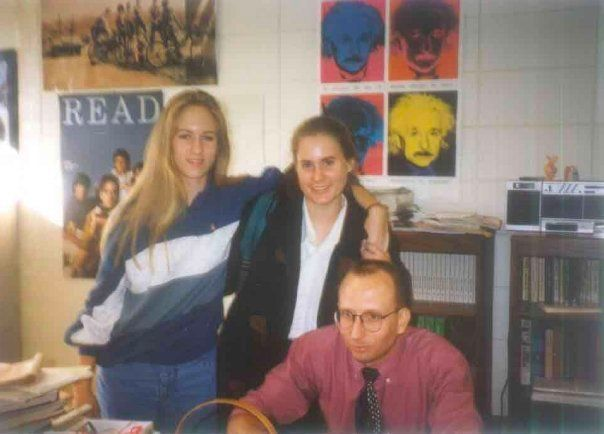
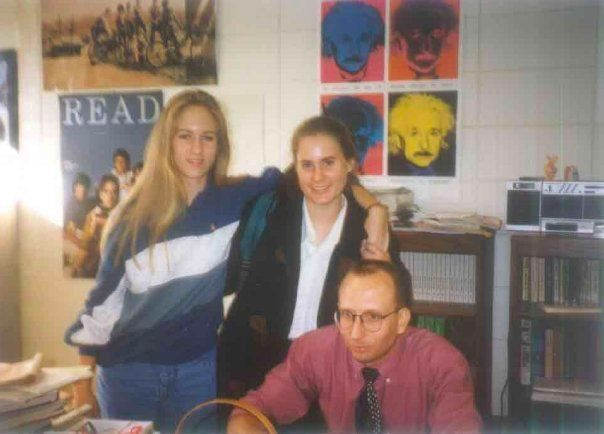
Daughters of the Soho Riots, The National

I graduated high school 8th out of 150 students and took with me a great deal of affection and respect for two life-changing teachers—Harold Scipio (chemistry/physics) and Lynn Harrill (English).

My academic success was bolstered by making mostly As in math and science courses, but I puttered along with Bs in English (resisting the drudgery of vocabulary tests and assigned novels). Therefore, I left high school intending to major in physics.

School had taught me I was good with numbers, and I learned that the field of English was grammar book exercises and diagramming sentences (junior high school) or vocabulary tests and assigned novels I had no interest in reading (high school).

Those experiences with English in school were in stark contrast to my ignored and marginalized literary life at home—collecting and reading comic books as well as reading voraciously science fiction and thriller novels.

In fact, that closeted life of reading was teaching me that genre literature was wonderful while English courses and teachers indirectly and directly told me genre writing was trash, that I should read real literature.

I entered a junior college less than thirty minutes from my home with those perceptions of school and myself as well as a youthfully distorted view of my abilities as a golfer and a want-to-be comic book artist.

There a few interesting things happened, notably linked again to teachers for whom I developed affection and respect—Steve Brannon (speech) and Dean Carter (British literature).

Mr. Brannon re-introduced me to e.e. cummings (in a speech course of all places) and sparked my first-year realization that I am a poet and writer; it was during the spring of that first year of college that I began writing seriously.

The other pivotal moment was when Dean Carter (who regularly berated me for my shoes and clothing in front of the class) approached me, asking if I’d like to start tutoring for the course. I clarified for him that I was a math and science person, not an English person.

After Dean Carter explained to me that I was the strongest student in that British literature survey class, however, I began tutoring and soon discovered that I was good at helping other students and I also enjoyed it.

Somehow I didn’t quite get it yet, and I was still mulling options for when I transferred to a four-year university, toying with architecture and pre-law.

A friend with whom I had gone to all 12 years of public school and then junior college and I were set to transfer to the main campus of the state university, but he had a paralyzing accident that summer. I panicked and chose to attend the satellite state university near my home instead of venturing to the main campus.

Having spent over 20 years now in higher education, this next part is something we rarely talk about—how people really chose their majors and how coincidental and haphazard that life-shifting decision can be.

With my friend’s accident and my late change of universities, I was rushed through registration where I was asked (as a rising junior) my major so courses could be chosen for that fall.

At that point I had no real idea but my thinking had shifted to majoring in English (still possibly as a path to law school). Coming from a working class family where neither parent had attended a four-year college, I was hyper-practical, however.

So on the spot I decided I would major in education because that would prepare me for a job and a career. When I said “education,” the advisor nudged me by asking what kind.

Having no idea what that meant, I shrugged and then was prompted with elementary or high school. I immediately said high school only to be asked what kind of high school teacher.

It was at that moment I chose secondary English education as a major; three years later, I entered as a high school English teacher the same classroom that Lynn Harrill had taught me in.

That full circle, I eventually recognized, helped me reconsider what I believed when I left high school, notably that Mr. Scipio and Mr. Harrill had set me on course to be a teacher.

Now here is what we don’t talk about when we talk about teacher education.

Once again, over the last 2.5 years of undergraduate education, I had some really influential professors.

Dr. Tom Hawkins was my secondary English advisor and teacher, and he planted the seeds of how I would eventually think about teaching and learning, specifically about grading (and he introduced me to triathlons, which set me on course to be a life-long serious cyclist).

But I was also an eager English student, taking extra English courses beyond what was required by my education certification; English professors Dr. Richard Predmore and Dr. Nancy Moore profoundly shaped me as a writer and as a potential scholar.

My student teaching was divided between two schools and two teachers, one middle school and one high school.

Here is the really complicated part.

I was greatly motivated to become a teacher so that I could create English classes unlike what most English classes were (no grammar book exercises and tests, no diagramming sentences, no vocabulary tests). And student teaching mostly proved to me all the ways in which I did not want to teach.

Once I was firmly in schooling from the teacher side, I also realized that virtually all the literature I had studied in college would never be works I could teach. In fact, I had to scramble to be prepared to teach the texts assigned and in textbooks during student teaching.

My teaching career began the fall of 1984, right at the beginning of the current 40-year accountability era sparked by the manufactured crisis of Reagan’s A Nation at Risk.

I was handed over a dozen textbooks (grammar, literature, and vocabulary texts) and the journalism course (school newspaper and literary magazine).

Now this is what people really do not want to talk about: I was almost entirely unprepared to teach that fall.

I had no background in journalism (I was a writer, sure, but I had been on the annual staff in high school and dabbled in college newspapers very slightly), and, as I noted above, I was not familiar with almost all of the required literature across four different English courses (mostly British literature) in the textbooks and the required novels/plays.

Most significantly, although my central goal for being an English teacher was to teach my students to write, I soon realized I had almost no composition pedagogy—other than I was myself an accomplished writer in school and college as well as a practicing professional writer (submitting a great deal of writing for publication without success).

Much of that first decade of teaching was spent teaching myself to teach; that journey was supported by also working through my MEd during those years.

But one of the most significant moments was entering the Spartanburg Writing Project (SWP) housed where I had received my undergraduate degree.

I had been teaching (frantically) for several years when I took the SWP summer institute, and it is there, once again, that a teacher changed my life.

The director, Brenda Davenport, essentially took me aside and set me straight, metaphorically kicked my butt.

I had been teaching myself to teach writing with a missionary zeal that had driven me down the wrong road; certainty and arrogance were quickly replaced with humility and patience.

Brenda helped me learn the one thing that we almost never talk about when talking about teacher education and teaching: teaching is learning to teach, and there is no finish line.

I spent much of my first decade of teaching trying to perfect The Way to teach. But each different Way I designed fell just as flat as the Way before.

After SWP, I embraced a true Deweyan approach, recognizing that each new class is a new experiment, informed by all the experiments before but its own different set of humans and requiring different ways of teaching and learning.

You see, there is no One Right Way to prepare people to teach (just as there is no One Right Way to teach reading, for example) because nothing can prepare a person to start teaching.

This fall I start year 40 as a teacher. It will not be like that fall in 1984 when I was first called a teacher.

But it is entirely new, and like that first fall, this is another experiment where I learn how to teach by teaching.

Critically Reconsidering Teacher Education (and NCTQ’s Shoddy Reports): A Reader

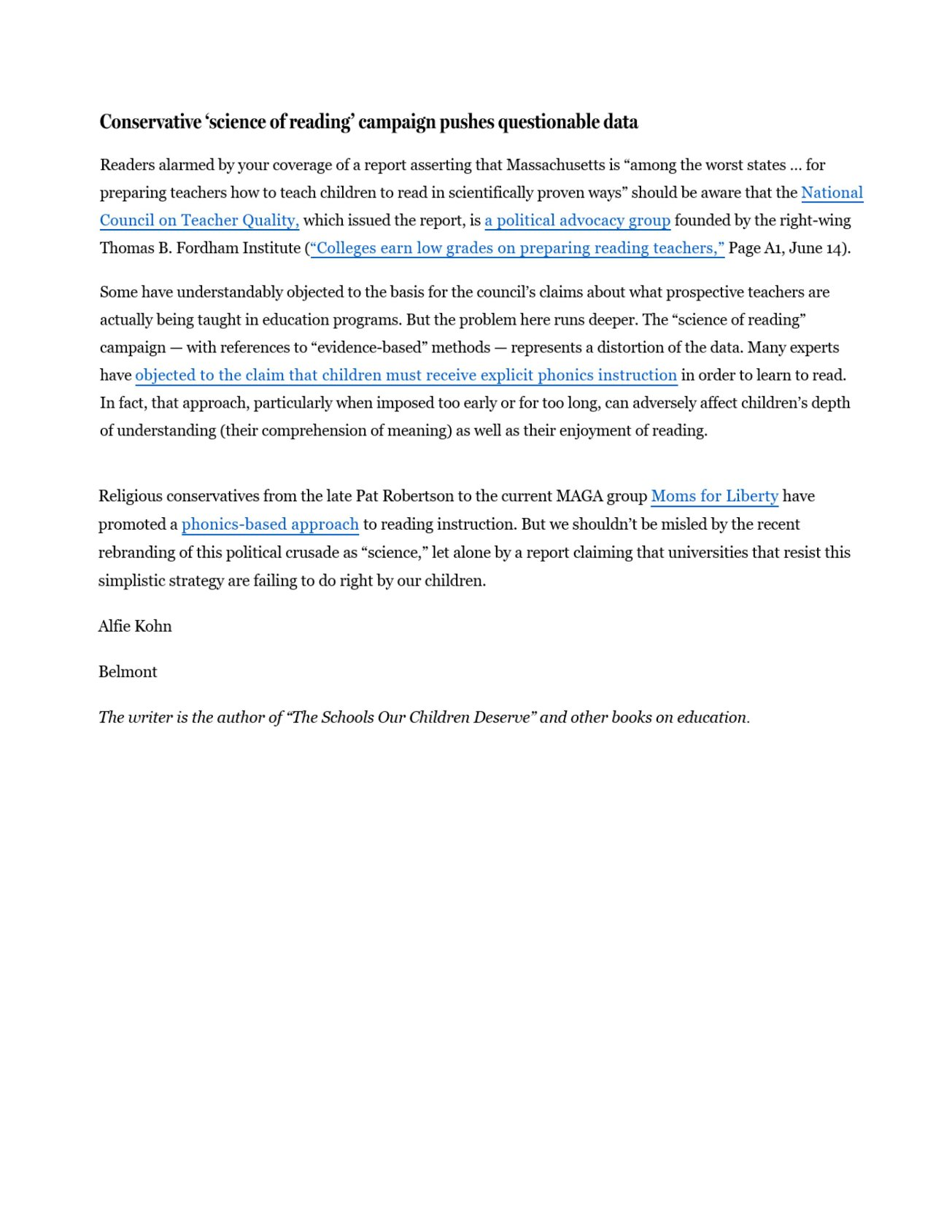
In 2018, a simplistic but compelling story was established: Teachers do not know how to teach children to read (60+% are not proficient readers!) because teacher educators have failed to teach the “science of reading” (SOR) in teacher prep programs.

These false narratives about teacher ed, NAEP data, and reading have gained momentum and now drive reading policy and legislation in practically every state in the US.

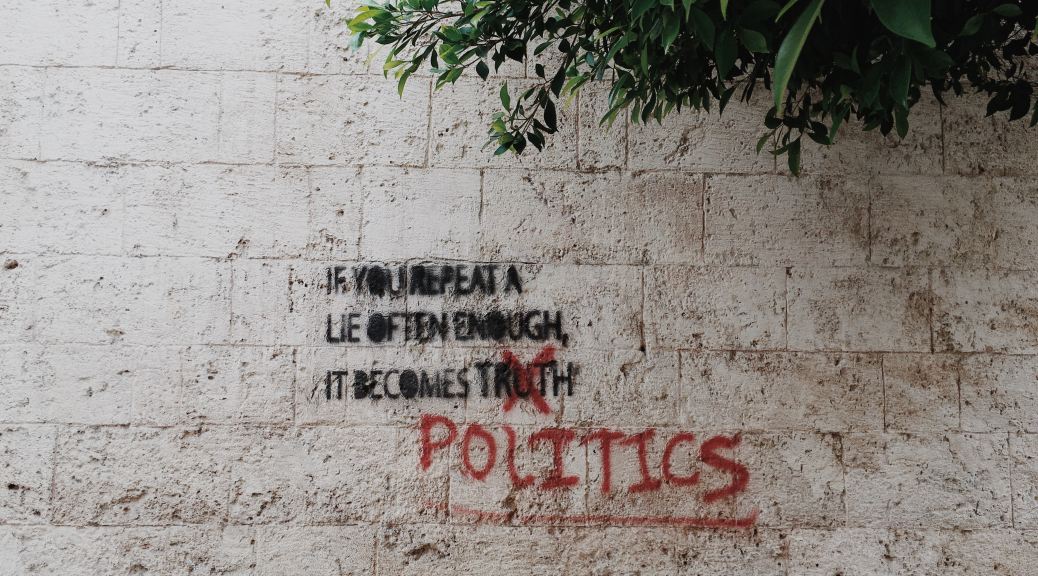
There is an ironic truism—“a lie can travel halfway around the world while the truth is still putting on its shoes”—most often misattributed to Mark Twain that certainly describes the misguided SOR movement’s central claims wrapped up in the initial mantra that SOR is both simple and settled.

Here are two complicated counter-points that are supported by the full body of evidence:

  • Reading instruction can and should be significantly reformed (in the context of addressing wider systemic inequities), but the SOR version of causes and solutions are false.
  • Teacher education can and should be significantly reformed , but the SOR version of causes and solutions are false.

I have been a strong advocate for education reform, beginning with my entering the field in 1984, and subsequently a strong advocate for teacher education reform, starting with entering higher education and teacher education in 2002.

In “Of Rocks and Hard Places—The Challenge of Maxine Greene’s
Mystification in Teacher Education
,” I wrote about teacher education: “As teacher educators, we are trapped between the expectations of a traditional and mechanistic field and the contrasting expectations of best practice guided by critical pedagogy.”

Below, then, I offer a reader about critically reconsidering teacher education and why the use of NCTQ “reports” are misguided and fail the test of scientific evidence.

Teacher Education

NCTQ


Teaching and Learning in Writing-Intensive Courses

The fall of 2023, I will be walking into my year 40 as a teacher. I started my career journey as a high school English teacher in the high school where I graduated and even the same English classroom I had sat in as a student during my sophomore and junior years.

The somewhat early years teaching high school English at Woodruff High (Woodruff, SC).

Many of the teachers had been my teachers when I was a student, and I was then (seemingly suddenly) a colleague with veteran and well-loved members of the school and my small hometown.

One of those English teachers assigned their seniors only one essay, due at the end of the academic year and never returned or commented on by that teacher. Many of those seniors were destined for college and had essentially no writing instruction their entire senior year—filled instead with weekly vocabulary tests, grammar tests, and textbook tests on British literature.

Just down the hall, I was embarking on 18 years of responding to about 4000 essays per year by my students; I was committed to teaching students to write well by having them write often and in workshop experiences.

I just completed my spring 2023 semester, which had two writing-intensive courses. This spring followed my only sabbatical experience in the fall of 2022, although I had been in higher education for 20 years.

I returned to teaching with a renewed commitment to decreasing stress and high-stakes for my students while trying to foster greater engagement by those students.

For about three-quarters of my teaching career, lowering stress and high-stakes has included de-grading and de-testing my courses, although the de-grading applied to assignments since I still had/have to assign course grades (see here about delaying grades).

However, once again, a number of students offered feedback on student evaluations that deflate significantly my enthusiasm for many of my efforts to support autonomous students.

In courses with required conferencing, some students noted that conferences should be required; this disconnect is linked to students being responsible for requesting and scheduling those conferences.

In a semester where I responded to about 200 essays over three courses and 24 total students, some students complained that I did not provide enough feedback for their work and/or that my feedback was too negative or not specific enough (see here about negative feedback).

At the core of these tensions and disconnects, I feel, is the essential paradox of who is responsible for learning.

For over twenty years now, I am teaching adults, yes, young adults, but college students are adults. My career before higher education was high school, and again, I worked with teens and young adults.

Yet, most students have experiences in formal schooling that teaches them they are passive agents in the teaching/learning dynamic. My students, particularly those who struggle in my course, think the responsibility for their learning is me, the teacher.

My teaching is grounded in critical pedagogy, and I practice an awareness that the role of the teacher is to teach with the role of the student, to learn. More nuanced is Freire’s argument that the teacher is always a teacher/student and the student is always a student/teacher.

Critical pedagogy views teaching and learning as liberatory—to learn is to become fully human, which is a state that requires autonomy.

Broadly, my role as a teacher (and mentor) is to provide the ideal context for students to learn; however, I cannot make someone learn.

As painful as this is to admit, teaching does not guarantee learning, and ultimately, learning is the role of the student (acknowledging that far too many students are in life situations that inhibit that autonomy).

My students are mostly in ideal contexts to learn, yet they often struggle even as I create courses with low stakes (no grades, no tests, no lateness penalties, etc.) and encourage high engagement; that struggle is grounded in the stress that students feel by having the responsibility for learning shifted from me to them.

Traditional and enduring practices around assigning and teaching writing prove to be barriers for student autonomy—essay prompts, rubrics, comprehensive marking of student writing, etc.

Here is another story from my first years of teaching.

A very highly regarded teacher of English moved to the high school when my district reorganized around a middle school concept and shifted ninth grader from our junior high to the high school.

I often taught that teacher’s students, and they explained to me that they would submit their essays, and then the teacher would return the papers with comments before using the overhead to show the students how to rewrite the essays.

Students dutifully followed the essay that teacher rewrote for them and resubmitted essentially identical essays.

My students today often have one of those two experiences—the negligent writing teachers who assign almost no writing or provide no real feedback or the hyper-controlling teacher who uses scripted prompts and rubrics (the enduring five-paragraph essay included) while also commenting exhaustively on submitted essays.

For those students, my classes are disorienting and often difficult to navigate.

While I have worked for decades to reduce high-stakes environments in my courses to reduce stress, students are often stressed when the responsibility for learning is shifted toward them

As I ponder how to revise further my writing-intensive courses, I continue to look for ways to increase student engagement. Currently, here are the structures I use with varying degrees of effectiveness:

  • Reducing how much I copyedit and comment on student drafts and increasing face-to-face conferencing.
  • Providing students with resources that support their learning to revise and edit their own writing.
  • Grounding writing assignments in authentic forms of writing and inviting students to explore examples of published writing to support their own awareness about forms and purposes for writing.
  • Maintaining a culture of low-stakes that includes not grading student work while in process, establishing workshop environments for students as writers, and providing structure for students without using punitive or coercive procedures.
  • Establishing minimum requirements for student engagement that include required drafting of essays as well as options for additional drafts and conferences by choice and request.

A couple years ago, I created guidelines for students to better support their own drafting, revising, and editing—How to Revise Your Essay after Receiving Feedback—and guidelines for how students should navigate my use of highlighting when providing feedback on essays—Revising Drafts with Highlighting as Feedback.

Regretfully, I am not seeing these materials being as effective as I hoped because at the core of the problem is not my structure or guidance, but that students remain committed to seeing my role not as teaching but as making them learn.

For example, I often mark needed revisions on essays and add a comment to check for the issues throughout the essay, yet most students only revise what I have marked.

That is a habit they bring to my classes, and one I find nearly impossible to break.

What I am addressing as a writing teacher, then, is a subset of how to foster learning autonomy in students.

Traditional schooling and the pervasive consequences of the Covid era are working against students’ abilities to recognize and embrace that autonomy.

And having an outlier class like mine that centers student autonomy, despite my commitment to lowering stress and high-stakes, is ironically highly stressful for my students.

And thus, I have much to ponder before walking into my classrooms for year 40 this coming fall.

Beyond Reading Skills: Phonics, Vocabulary, and Knowledge

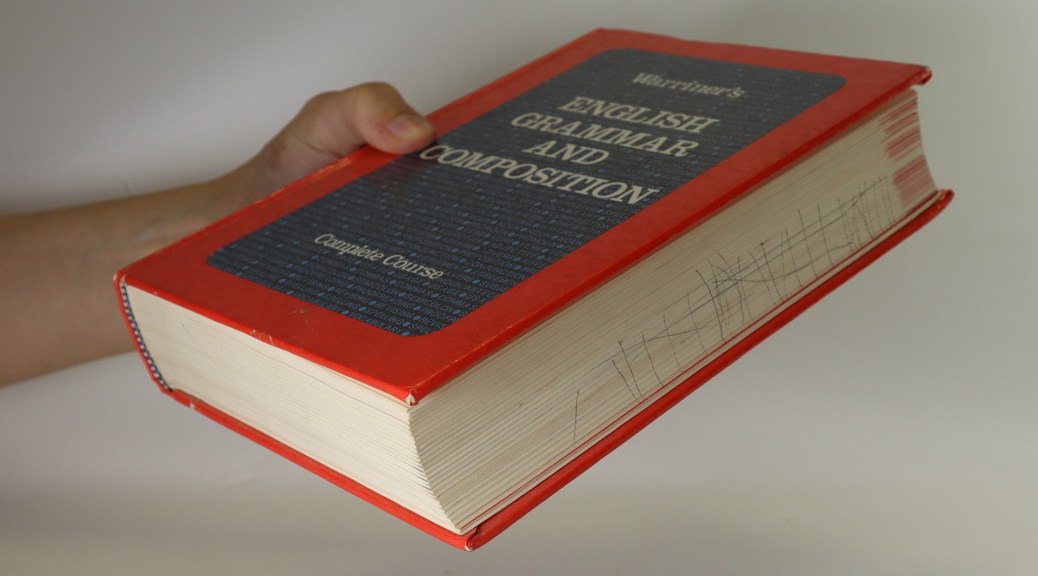
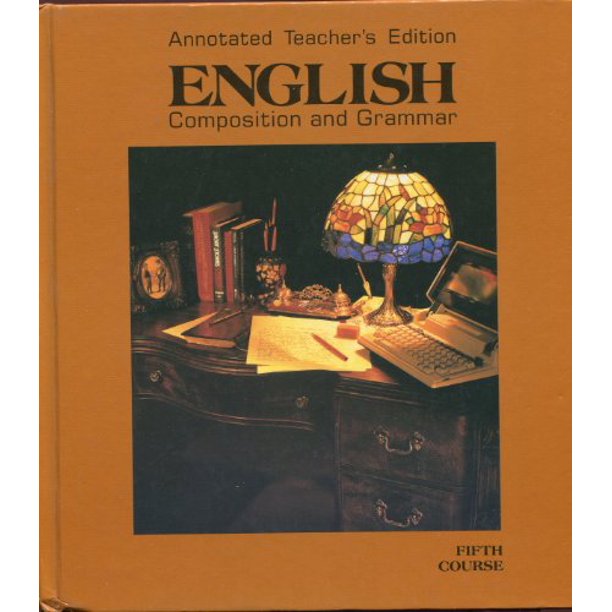
When I entered the classroom as an English teacher in 1984 at the high school where I had graduated just five years earlier, students lugged around two huge textbooks for their English courses, one of which was Warriner’s English grammar text.

Students were conveniently color coded by these texts since the publishers provided different ability and grade levels of the literature and grammar texts. And universally students hated these textbooks, the carrying and their use in the classrooms.

Since I taught different ability levels (we used and A, B, C level system for each grade) and grades, I had about 15 textbooks across my five courses because students in English also were assigned vocabulary books (the publisher we used proudly printed in bright letters that these vocabulary books prepared students for the SAT!).

At least the vocabulary books were small paperbacks.

Two important facts stand out about those first couple years teaching in the traditional expectations for English teachers at that school (mostly the same teachers who taught me as a student): first, Warriner’s regardless of grade or ability level had essentially the exact same chapters for teachers to systematically and comprehensively teach every year, and second, teachers expressed repeatedly that students never learned those grammar lessons, noting that student writing failed to improve in terms of grammar, mechanics, and usage.

Another big picture point to make here is that when I was a student, grammar texts included lessons on “shall” and “will”; that my students had to cover an entire chapter and be tested on “who” and “whom”; and both my students and I had to “learn” about pronoun/antecedent agreement (specifically the use of “they” as plural only).

Today, we must acknowledge that all of these rules and the consequences of students “not learning them” have evaporated since “shall” and “whom” have graciously disappeared and “they” has been (finally) acknowledged as a resourceful pronoun.

As a beginning teacher, I had entered education to teach writing, although, of course, I loved literature also. Yet, the grammar- and skills-centric approach to teaching English, I recognized, was failing students miserably—I mean literally because students were miserable, learning to hate English, writing, and literature.

Of course, my stories here speak to a disturbing reality in education: Lou LaBrant, writing in 1946, noted: “We have some hundreds of studies now which demonstrate that there is little correlation (whatever that may cover) between exercises in punctuation and sentence structure and the tendency to use the principles illustrated in independent writing” (p. 127). And then in 1947: “A brief consideration will indicate reasons for the considerable gap between the research currently available and the utilization of that research in school programs and methods” (p. 87).

Yet, English teachers throughout the decades kept beating their heads against the grammar and skills wall, lamenting “kids today” for not being good writers—regardless of decade, regardless of the grammar programs implemented.

This raises a current issue about “scientific” or “evidence” as the basis for how teachers teach, notably in the current reading war.

Here, I think, is an excellent overview by Jal Mehta (Harvard University) about why calling for “scientific” or “evidence” to mandate teaching literacy is just as misguided as the evidence-free practices I witnessed as a beginning teacher almost 40 years ago:

What may have started out about a decade ago as a sincere plea similar to LaBrant’s—the teaching of reading in practice often failed to be effectively evidence-based (“scientific”)—has turned into the exact sort of one-size-fits-all ideological movement that Jal warns about: scientific as a “weapon.”

The SOR movement has refueled the myth of the bad teacher, continued to perpetuate false narratives of crisis and miracle schools, profited the education marketplace, and driven deeply problematic reading legislation and policy, including inequitable grade retention.

The mistake being made is also perfectly identified by Jal: “In my experience, the best educators and leaders see lots of complexity, consider context, and artfully weave together different approaches to solve particular problems.”

Ironically, this is the exact approach grounding both whole language and balanced literacy as philosophies of teaching reading and writing; however, as we have witnessed, both WL and BL also became convenient labels for practices not following those philosophies or simply slurs ideologues use to criticize.

Instead, the SOR movement has become ideological and weaponized to create simplistic and unfounded crisis rhetoric for politicians and skills-driven reading policy and practice.

For example, no one argues that phonics, vocabulary, and knowledge are not key elements in reading. But the SOR movement demands a linear and sequential skills-first approach; teach phonics, vocabulary, and knowledge systematically before students read.

The skills-first approach is essentially authoritarian (what phonics, vocabulary, and knowledge students “need” is determined and outlined for students and teachers) and necessarily erases diversity of language and experiences by students.

The counter approach, the complex approach to reading, acknowledges the importance of elements such as phonics, vocabulary, and knowledge, but also honors that the relationship between so-called skills and reading is reciprocal, not linear or sequential.

In other words, yes, students need some direct and purposeful instruction in phonics, vocabulary, and knowledge building as they become beginning readers; however, most of a person’s acquisition of phonics, vocabulary, and knowledge comes from reading—not direct or systematic instruction.

The problem with systematic and comprehensive teaching of any literacy skills is that the goal and accountability around teaching and learning become the acquisition of the skills (phonics tests, vocabulary tests, knowledge tests) instead of the authentic goal of fostering eager, independent, and critical students who read.

Ultimately, if we genuinely want evidence-based reading instruction for children in the US, we must recognize that the most important sources of evidence are the children themselves and the most valuable person to understand what children need to read are their teachers.

However, beyond shifting to what evidence counts, we must also recognize that students and teachers cannot be successful unless we address learning and teaching conditions (the one move politicians refuse to make).

Regretfully, as Jal recognizes, students and teachers are again simply pawns in another fruitless war won by the SOR advocates “who are loudest about ‘evidence-based practices,’ [and] ironically tend to be more ideologues who have a few preferred solutions that they think can address every problem.”

The Myth of the Bad Teacher: 2023

If you are paying attention to traditional or social media, you are aware of the following stories being told about US public school teachers in 2023:

  • Elementary teachers are failing to teach reading effectively to US students.
  • That failure is “because many deans and faculty in colleges of education either don’t know the science or dismiss it,” according to Hanford.
  • Elementary, literature/ELA teachers, and history teachers are brainwashing students with CRT.
  • Elementary and literature/ELA teachers are grooming children to be gay or transgender by forcing them to read diverse books and stories.

Except for teachers themselves and some education scholars, these new bad teacher myths are both extremely compelling and almost entirely false. Writing in 2010 during a peak bad teacher movement in the US, Adam Bessie explains about the bad teacher stories represented by Michelle Rhee and perpetuated by the Obama administration and Bill Gates:

The myth is now the truth.

The Bad Teacher myth, [Bill] Ayers admits, is appealing, which is why it’s spread so far and become so commonly accepted. Who can, after all, disagree that we “need to get the lazy, incompetent teachers out of the classroom?” Even Ayers agrees that he, like all of us, “nods stupidly” along with this notion. As a professor at a community college and former high school teacher, I nod stupidly as well: I don’t want my students held back, alienated, or abused by these Bad Teachers.

This myth is also seductive in its simplicity. It’s much easier to have a concrete villain to blame for problems school systems face. The fix seems easy, as well: all we need to do is fire the Bad Teachers, as controversial Washington, DC, school chancellor superstar Michelle Rhee has, and hire good ones, and students will learn. In this light, Gates’ effort to “fix” the bug-riddled public school operating system by focusing on teacher development makes perfect sense. The logic feels hard to argue with: who would argue against making teachers better? And if, as a teacher, you do dare to, you must be “anti-student,” a Bad Teacher who is resistant to “reforms,” who is resistant to improvements and, thus, must be out for himself, rather than the students.

The Myth of the Bad Teacher

Bessie concludes, “The only problem with the Bad Teacher myth, as anyone involved with education is intimately aware of, is that problems in education are anything but simple,” and ultimately, in 2023, these myths are not supported by the evidence.

For example, as the authors of a report out of UCLA assert about anti-CRT attacks on teachers:

We put “CRT” in quotation marks throughout this report because so often the conflict campaign’s definition of “CRT” (like its description of actual K–12 practice) is a caricatured distortion by loud opponents as self-appointed “experts.” The conflict campaign thrives on caricature — on often distorting altogether both scholarship and K–12 educators’ efforts at accurate and inclusive education, deeming it (and particularly K–12 efforts to discuss the full scope of racism in our nation) wholly inappropriate for school.

The Conflict Campaign

The bad teacher myth in 2023 “thrives on caricature” and anecdotes that, as noted above, as very compelling but ultimately not only lack credible evidence [1] and logic, but also cause far more harm than good in terms of reforming education, serving student needs, or recruiting and retaining high quality teachers.

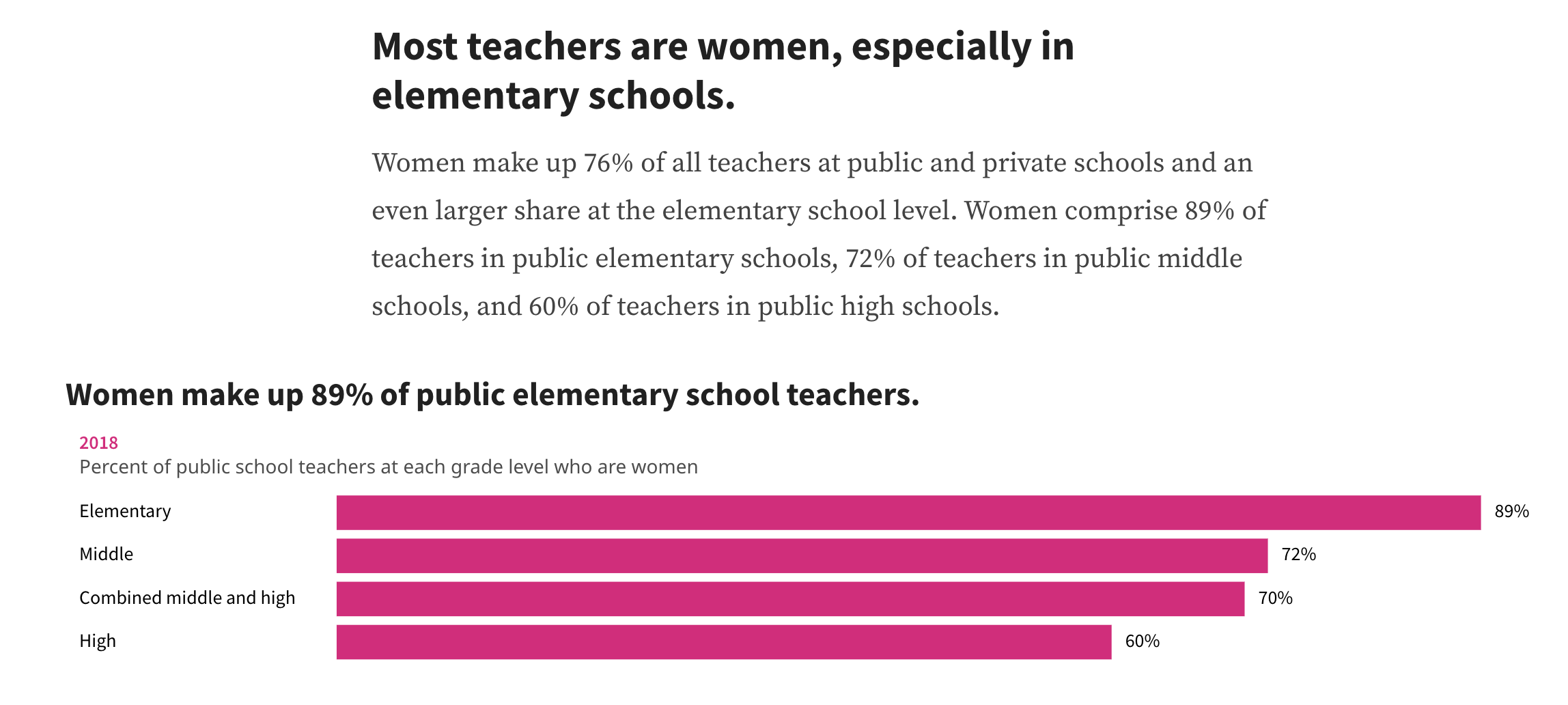
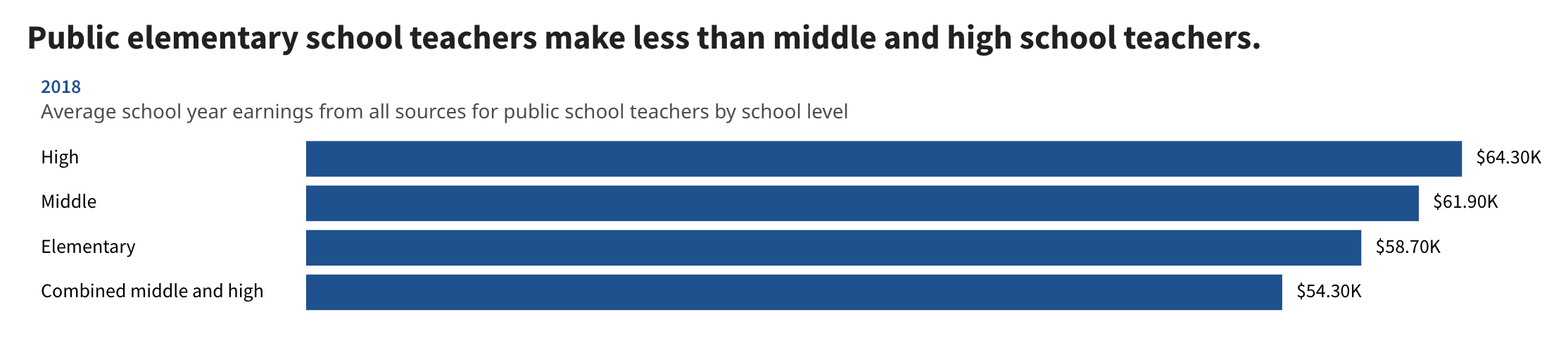
The bad teacher myth in 2023 is targeting educators who are 70-90% women, and those teachers under the most intense attacks tend to be elementary teachers who are even more disproportionately women and the lowest paid educators [2]:

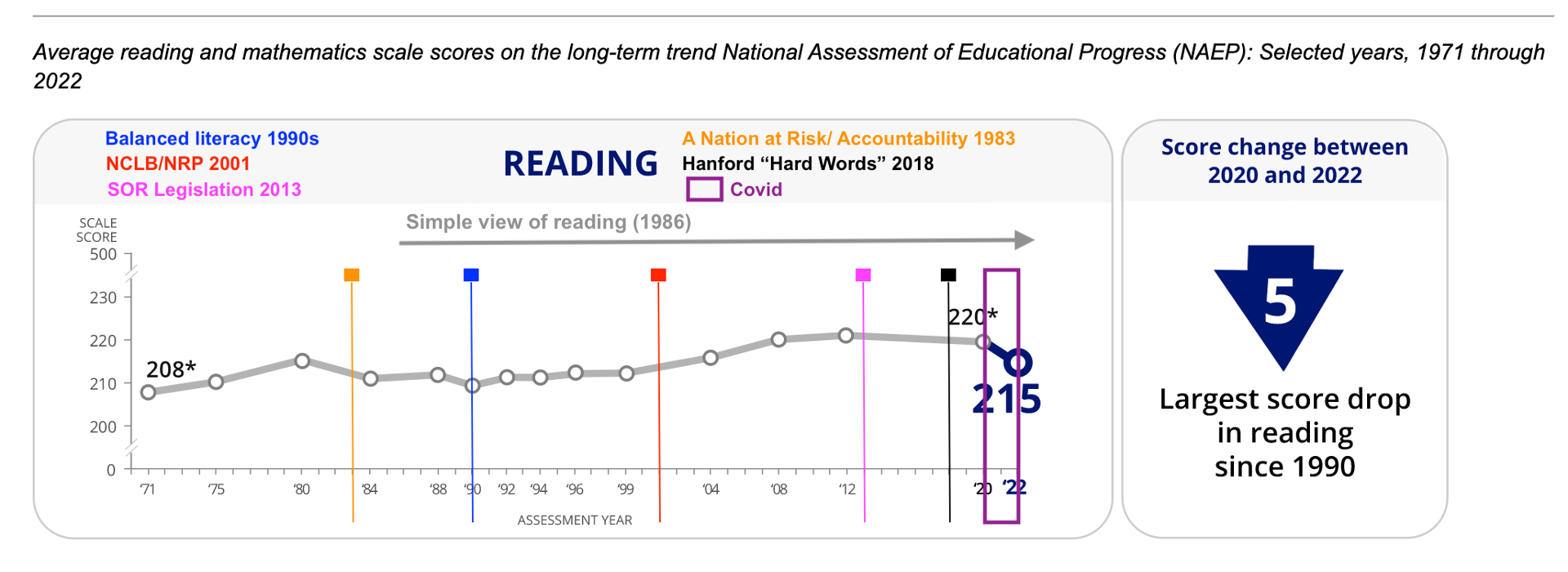
Further, there is little evidence that students today are uniquely underperforming in reading achievement, yet the bad reading teacher myth is perpetuated by misrepresenting reading achievement through misleading messages around NAEP reading data (see Hanford’s chart that ironically suggests gradual improvement, not a crisis).

Two problems with the bad reading teacher myth is that NAEP reading proficiency is not grade level reading, as Loveless examines:

NAEP does not report the percentage of students performing at grade level.  NAEP reports the percentage of students reaching a “proficient” level of performance.  Here’s the problem. That’s not grade level. 

In this post, I hope to convince readers of two things:

1.  Proficient on NAEP does not mean grade level performance.  It’s significantly above that.
2.  Using NAEP’s proficient level as a basis for education policy is a bad idea.

The NAEP proficiency myth

And the low levels of reading proficiency are historical, not a recent set of data that constitutes a reading crisis:

If we want to rely on NAEP reading scores, however flawed that metric, the historical patterns suggest a relatively flat state of reading achievement with some trends of improvement in the 1970s (which was followed by the manufactured myth of schools failing with A Nation at Risk [1983]) and steadily from about 1990 until 2012 (an era demonized as a failure due to reliance on balanced literacy).

Notably, the “science of reading” movement tends to be connected to legislation starting around 2013 and Hanford’s journalism beginning in 2018, and that NAEP data has remained relatively flat except for the Covid drop.

Again, as Bessie acknowledged over a decade ago, the real problems with education, teaching, and learning are very complex and far larger than pointing fingers at teachers as “villains.”

For most of the history of US education, student reading achievement has been described as “failing,” and vulnerable student populations (minoritized races, impoverished students, students with special needs such as dyslexia, and MLLs) have always been underserved.

The dirty little secret about teacher quality related to student reading proficiency is that those vulnerable students are disproportionately sitting in class with early-career and uncertified teachers who are struggling with high student/teacher ratios.

Are students being underserved? Yes, but this is a historical fact of US public education not a current crisis.

Are low student achievement and reading proficiency the result of bad teachers? No, but these outcomes are definitely correlated with bad teaching/learning conditions and bad living conditions for far too many students.

In 2023, just as in 2010, the myth of the bad teacher is a lie, a political and marketing lie that will never serve the needs of students, teachers, or society.

Way back in 1984 when I entered the classroom, I was excited to begin my career but quickly discovered that despite my respect and even love for my English professors and teacher educators in my undergraduate degree, I simply was not prepared well enough to do my job, notably as a teacher of writing.

I set out to learn by teaching, and do better. During the late 1980s, I was fortunate to learn further through the Spartanburg Writing Project (Nation Writing Project), where I discovered that much of my on-the-job training was misguided (thanks, Brenda Davenport).

Anyone who teaches knows that becoming an effective teacher is a journey and that those first 3, 5, or even 10 years are challenging and include a great deal of growth that cannot be accomplished in teacher certification programs.

None the less, everything surrounding teaching, and especially the teaching of reading, can and should be better.

That was true in 1940 and every decade since then.

Teacher and school bashing, shouting “crisis”—these have been our responses over and over; these are not how we create a powerful teacher workforce, and these will never serve the needs of our students who need great teachers and public education the most.

The myth of the bad teacher is a Great American Tradition that need to end.


[1] Valcarcel, C., Holmes, J., Berliner, D. C., & Koerner, M. (2021). The value of student feedback in open forums: A natural analysis of descriptions of poorly rated teachers. Education Policy Analysis Archives29(January – July), 79. https://doi.org/10.14507/epaa.29.6289

[2] See Our study found new teachers perform just as well in the classroom as their more experienced colleagues

The Anti-Teacher (and Sexist) Roots of Rejecting Teacher Autonomy

[Header Photo by Katherine Hanlon on Unsplash]

One challenge of doing public work and advocacy addressing education, education reform, and teachers/teaching is framing clear and accessible messages that avoid being simplistic and misleading.

Since I am in my fifth year of challenging the overly simplistic and misleading “science of reading” (SOR) movement, I have attempted to carefully craft some direct and brief messages, including “not simple, not settled,” “teach readers, not reading,” and my core commitments to teacher autonomy and the individual needs of all students.

One would think that those core commitments attract support even among those who disagree on other aspects of teaching and education policy. However, I face a persistent resistance to supporting teacher autonomy.

At a fundamental level, teacher autonomy is essential for teaching to be a profession, but autonomy is also essential because education is a high-accountability field.

The problematic tension in education is that teachers are routinely held accountable for mandates (not their professional decisions and practices) and how well they comply with the mandates. Since many education mandates are flawed (such as current reading legislation) and for decades have failed, teachers are then blamed for that failure even though they didn’t make the mandates and were simply the mechanisms for practices.

Most education crisis rhetoric and education reform have been grounded for decades in anti-teacher sentiments. Currently, the reading crisis movement blames reading teachers for being ill-equipped to teach reading (failing children) and teacher educators for not preparing those teachers, for example.

One of the strongest elements of rejecting teacher autonomy, in fact, is among SOR advocates who promote structured literacy, often scripted curriculum [1] that reduces teachers to technicians and perpetuates holding teachers accountable for fidelity to programs instead of supporting teacher expertise to address individual student needs.

Let me be clear that all professions with practitioner autonomy have a range of quality in that profession (yes, there are some weak and flawed teachers just as their are weak and flawed medical doctors). To reject teacher autonomy because a few teachers may not deserve it is a standard not applied in other fields.

But there may be a gender-based reason for such resistance.

K-12 teaching (especially elementary teaching) is disproportionately a woman’s career:

And while teacher pay is low compared to other professions, the pay inequity is more pronounced in areas where the proportion of women is even higher:

As a frame of reference, a more respected and better rewarded teaching profession is in higher education where professor have professional autonomy, except the gender imbalance exposes a similar sexist pattern:

While the gender balance is better in higher education than K-12, the pay and security of being a professor increases where men are a higher proportion of the field.

Autonomy, pay, and respect track positively for men and negatively for women in teaching, and the resistance to autonomy for K-12 teachers strongly correlates with the field being primarily women.

A key but ignored element of education reform must include better pay for all K-12 teachers and supporting teacher autonomy so that individual student needs can be met.

The historical and current resistance to teacher autonomy exposes the lingering sexism in how we view, treat, and reward educators.


[1] Compton-Lilly, C.F., Mitra, A., Guay, M., & Spence, L.K. (2020). A confluence of complexity: Intersections among reading theory, neuroscience, and observations of young readers. Reading Research Quarterly, 55(S1), S185-S195. https://doi.org/10.1002/rrq.348

Commentary: There’s no merit in merit pay plans for rewarding, retaining SC teachers (The Post and Courier)

Commentary: There’s no merit in merit pay plans for rewarding, retaining SC teachers

While the Editorial Staff of the Post and Courier rightfully raises cautions about newly elected Superintendent of Education Ellen Weaver, who has a history of extremely conservative positions on public education, that caution should also extend to Weaver’s plans for merit pay to address teacher needs in South Carolina.

I am in my fifth decade as an educator in SC, beginning as a high school English teacher in Upstate SC in 1984. Over that career I have witnessed one frustrating pattern: A constant state of education reform that recycles the exact same crisis rhetoric followed by the same education reforms.

Over and over again.

In fact, in very recent history, SC and the nation have experienced a high intensity focus on teacher quality, teacher evaluation, and teacher merit pay models under the Obama administration.

And just like in the so-called real world of business, merit pay models for teachers have failed.

Under Obama and then-Secretary of Education Arne Duncan, federal and state policy helped implement teacher evaluation and pay schemes modeled on Bill Gates’s use of stack ranking. Notably this value-added model of teacher evaluation and pay was famously heralded by the media when Michelle Rhee was chancellor of DC schools.

However, over time, Rhee’s tenure was unmasked as mostly a fraud but also as extremely harmful for teachers and students.

While merit pay remains a popular approach to recruiting and maintaining workers across many fields, research has consistently shown that merit pay does not work, and often has negative consequences, especially in education.

Research by Dan Pink and Alfie Kohn, for example, highlight the disconnect between what merit pay promises and how that plays out in the real world.

Gary Clabaugh challenged Obama’s merit pay polices, offering evidence that remains valid today and suggests not only caution about Weaver’s merit pay plan but also solid reasons not to try the same thing again.

Merit pay fails education, teachers, and students in the following ways:

  • Merit pay assumes workers need motivation to work harder; teachers are often overworked and their ability to be effective is not a result of how hard they are working, but the conditions under which they work.
  • Merit pay is often linked to standardized testing in education. As a result, merit pay incentivizes teaching to the tests and corrupts evaluation systems intended to measure learning.
  • Merit pay creates a culture of competition, instead of cooperation. Research also shows that competition is more harmful than cooperation, especially in the field of education where all educators should be invested in the success of all students.
  • Measurable student achievement, mostly through standardized testing, is more heavily linked to out-of-school factors (60-80%) than to in-school factors or teacher quality (10-15%). Therefore, merit pay overemphasizes direct and measurable teacher impact and often holds teachers and students accountable for factors beyond their control.

Policy makers in SC are faced with two facts: (1) Teacher pay is important to address and long overdue in the state; however, (2) merit pay is an ineffective and even harmful approach to addressing pay and teacher shortages.

Since SC has tried to use pay incentive to address teacher shortages in struggling districts already, we will better serve the needs of our students if we commit to new and different reforms.

The greatest need in SC is that elected officials directly address poverty across the state—access to healthcare, stable jobs with strong pay, and access to affordable housing.

But we can also do better with in-school reform.

If we want to bolster the teaching profession among our high-poverty districts, we must address teaching and learning conditions, which include the following:

  • Parent, community, and administrative support for teachers.
  • School facilities in good repair.
  • Fully funding teaching and learning technologies and materials.
  • Guaranteeing students who are struggling have access to experienced and certified teachers.
  • Recognizing that student success is linked to teacher quality, but that teacher quality is only one element in a complex network of forces that help children learn.

SC remains faced with a very old problem—high-poverty students struggle to achieve well enough or fast enough compared to their more affluent peers.

Those children deserve new solutions, and merit pay is a tired gimmick that has never worked and will fail children and teachers once again.


See Also

Edujournalism and Eduresearch Too Often Lack Merit

The Empty Politics of Teacher Attrition: SC Edition

Former South Carolina Governor Richard Riley, who would go on to be Secretary of Education, remains, for me, the gold standard of education governors.

Riley established education as a central agenda of a governor by launching SC’s commitment to the accountability movement linked to increasing teacher pay. My first year teaching in SC was the fall after Riley helped pass a significant teacher pay raise, in fact.

Over the next several decades, for example, George W. Bush parlayed education reform in Texas (the now discredited “Texas miracle”) into the White House and the historic No Child Left Behind (NCLB) era.

My entire career as a teacher has been in the hyper-accountability era of K-12 education grounded in accountability, standards, and high-stakes testing. I have offered critiques and advocated for finding a different way to do education because the accountability merry-go-round hasn’t served anyone well except politicians and the education market place.

Those good intentions and politically thoughtful strategies used by Riley in the early 1980s have, regretfully, devolved through W. Bush’s failed NCLB, Obama’s doubling down on accountability (focusing harsh accountability and bad science on teacher accountability and reform), and finally to today’s even more hostile environment toward teachers, who are routinely characterized as indoctrinators and groomers by Republican governors and other elected officials.

Only 14 years ago, this was the national antagonism toward teachers and teaching:

How to Fix America’s Schools, Time (8 December 2008)

The Bill Gates/Michelle Rhee era of stack ranking and value-added methods of evaluating teachers not only failed but also it further eroded the value of teaching and being a teacher.

While many of us in education felt that this had to be the low point of teacher bashing and education reform designed to dismantle education, we could not have envisioned the last few years, anchored in the final months of the Trump administration’s attack on the 1619 Project and diversity, equity, and inclusion initiatives in education.

Along with Covid, curriculum bans targeting (falsely) Critical Race Theory (CRT), book bans and attacks on libraries, and charging educators with being indoctrinators and groomers have now resulted in historic teacher shortages and likely one of the national low points for being a teacher in a country founded in part on a commitment to universal public education as a corner stone of being a vibrant democracy.

One of the more virulent anti-teacher and anti-education governors in the nation (likely just behind Gov. Abbott in Texas and the worst, Gov. DeSantis in Florida) is right here in my home state of SC, Governor Henry McMaster.

Yet, Gov. McMaster wants to have his cake and eat it to—but this will prove to be mere rhetoric and a disturbing example of how far the governorship has fallen since Riley:

Calling for a pay raise and a bonus to address the abysmal conditions of being a teacher in 2023 is yet another example of the empty politics of teacher attrition.

Should teachers be paid more?

Of course.

Is pay the root cause or even a major cause of teacher attrition?

No.

For many decades, research has shown that teachers value far above pay how they are treated professionally within the building and by parents and the public, the teaching and learning conditions within which they work, and a whole host of issues that speak to their professional autonomy and authority.

For the sake of the field of education and teaching as a profession, we must stop taking politicians seriously who are unserious about education and teaching.

McMaster followed Abbott’s playbook early on by calling for book bans and suggesting teachers and schools use literature to groom children

McMaster speaks into the ugly and false narrative that teachers are “woke” indoctrinators who have infiltrated K-12 schools with CRT.

Waving a few dollars in one hand while stabbing people in the back with the other isn’t political leadership, and it certainly is not a solution for teacher attrition.

Beleaguered Speaker of the House Kevin McCarthy didn’t take even a few breaths before declaring that his Congress will end woke indoctrination in schools; McMaster and most Republicans have committed entirely to that playbook filled with lies and distortions.

I do hope teachers receive significant pay raises, but that will not save teaching or education.

Political assaults on curriculum, libraries and books, and teacher professionalism must stop immediately.

Political and public narratives accusing falsely teachers of being indoctrinators and groomers must stop immediately.

Teachers deserve first and foremost in 2023 a huge public apology by the Republican Party, and then, teachers deserve a commitment to teacher professionalism and autonomy as well as a different approach not grounded in accountability but in reforming teaching and learning conditions so teachers can teach better and students can learn more.

Political leaders must

  • address poverty and inequity in our children’s lives,
  • fully fund public education,
  • reject school choice and other schemes that divert from public schools,
  • address in-school inequities such as class size and access to courses and programs,
  • and start education reform with teachers, not political fads and boondoggles.

There is a bit more than irony to Republicans who have historically been politically negligent with the refrain “You can’t just throw money at it” but who can’t imagine anything past a meager pay raise and a bonus to address teaching and education—especially when they have been the key architects in their destruction.

We can do better. We should do better. We must do better.

How we treat and support teachers is how we treat and support students; teaching conditions are learning conditions.

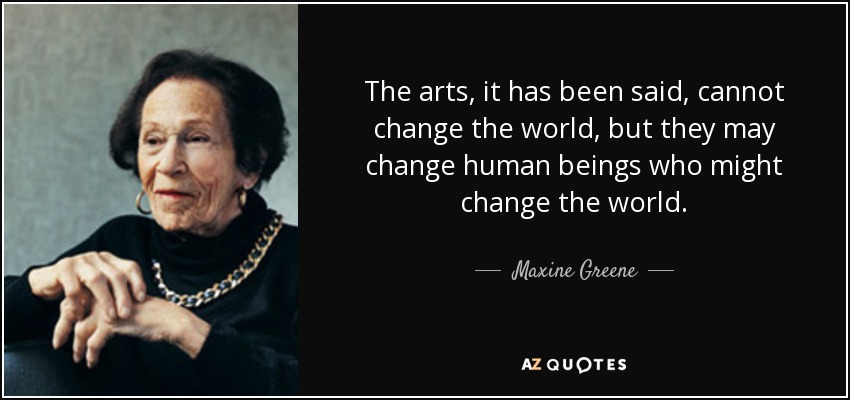
Maxine Greene has implored us in her Releasing the Imagination: “Community cannot be produced simply through rational formulation nor through edict,” Greene recognizes (p. 39), adding:

Community is not a question of which social contracts are the most reasonable for individuals to enter. It is a question of what might contribute to the pursuit of shared goods: what ways of being together, of attaining mutuality, of reaching toward some common world. (p. 39)

Releasing the Imagination

Yes, teachers are the key to public education, which is the key to democracy and freedom. But Greene’s call now stands as the opposite of the education system being created by Republicans

This brings me back to my argument that we teachers must make an intensified effort to break through the frames of custom and to touch the consciousness of those we teach. It is an argument stemming from a concern about noxious invisible clouds and cover-ups and false consciousness and helplessness. It has to do as well with our need to empower the young to deal with the threat and fear of holocaust, to know and understand enough to make significant choices as they grow. Surely, education today must be conceived as a model of opening the world to critical judgments by the young and their imaginative projections and, in time, to their transformative actions. (p. 56)

Releasing the Imagination

Republicans are unserious about teaching, teachers, and education. We cannot afford to continue to take them seriously.

What Reading Program Should Schools Adopt?

[Header Photo by Thought Catalog on Unsplash]

The TL;DR answer is “none.”

The conventional wisdom answer of the day is “one that is proven effective by independent scientific research.”

The reason the first answer is correct is that this is the wrong question, and wrong approach that has plagued the teaching of reading for most of modern education.

Yes, the conventional wisdom answer sounds compelling, but it is fool’s gold because there can never be a program “proven effective” since teaching and learning to read are quite complex and dependent on individual student strengths and challenges (as well as a whole host of contexts in any student’s home or school).

The reading program adoption merry-go-round is doing the same thing over and over while expecting different results.

Every reading program replaced was promised effective in the same ways as the one replacing it. (See also the constant changing of standards.)

Schools should take at least one long step backward and start with having teachers identify what is working, what isn’t working, and how typical populations of students being taught in that school present identifiable needs that teachers must address.

The source of decisions about teaching reading materials must begin with populations of students being served and teacher expertise on both reading and that unique population.

Reading material needs in the rural South are never going to be the same as reading material needs in the urban Midwest.

Keeping reading programs central to teaching reading creates several key flaws that are insurmountable:

  • Adopting reading programs results in focusing teaching accountability on how well the program is being implemented and not on student progress and struggles.
  • Reading programs feed a silver-bullet, one-size-fits-all mentality.
  • Reading programs shift the locus of authority to the program and not the teacher.
  • Reading programs are driven by market propaganda that distorts the evidence about effectiveness.

While I remain committed to the “none” answer, that genuinely is not a practical answer at the moment.

Schools will in all likelihood continue to adopt reading programs (or continue using the currently adopted program); therefore, here are some practical guidelines that merges my ideal (“none”) and the reality of day-to-day teaching:

  • As noted above, schools must do an assessment of their current student population, their current status of programs/materials, and their practical goals for improving student progress as readers.
  • That assessment must then guide analysis of the current program (how well and poorly it is meeting needs) or provide the framework for selecting a new program.
  • Schools must critically and even skeptically address that adopting new programs often always incurs excessive costs that may not be effective use of funding since teachers with autonomy may be able to make almost any program or set of materials work.
  • Reading program adoption must not be seen as all-inclusive of the school’s reading program, but as part of the entire reading materials package and as resources for teacher implementation.
  • Schools must resist scripted programs, period.

Ultimately, schools must shift their focus away from programs-based reading instruction and toward student-need-based reading instruction.

That shift would create space to maintain the teaching/learning of reading as the goal of accountability and move reading program fidelity out of the equation since programs and materials serve the expertise of the teacher guided by student needs.

As I have noted before, historically and currently, reading programs put reading last.

If we are genuinely dedicated to teaching all students to read better, we have to (finally) do things differently.

A good start would be recognizing that “What reading program should schools adopt?” is the wrong question and then stepping back to ask bigger and better questions grounded in the students being taught and the teachers charged with a better reading program.


See Also

Lessons in (In)Equity: An Evaluation of Cultural Responsiveness in Elementary ELA Curriculum

The Unnecessary Collateral Damage in the Misguided Reading Programs War

Reading Programs Put Reading Last

Teaching Reading and Children: Reading Programs as “Costume Parties”