Category Archives: Teaching

Conditions v. Outcomes: More on What’s Wrong with Teacher Education (and Accountability)? pt. 2

After posting What’s Wrong with Teacher Education?, I received comments and responses that are fairly represented in the comments at the original post from Peter Smyth and psmagorinsky (Peter Smagorinsky). For full disclosure, these two Peters are acquaintances that I respect a great deal, and thus, take their comments quite seriously.

To Peter Smyth’s concern (voiced by a few others offering feedback), I can clarify that my original post is a rejection of certification and a call for the need for rich and deep education degrees; thus, my argument in no way endorses Teach for America or other alternative certification programs that inherently avoid and marginalize education degrees (which are in fact the antithesis of my argument).

Peter Smagorinsky’s comment—notably “At the same time, I think that if we are constructed as being against being accountable for our teaching, we not only lose the PR battle, we are dodging responsibility for the end result of our teacher education”—requires a bit more explanation so I ask that you allow me to offer a series of personal anecdotes to make my case.

The summer of 1975 was traumatic for me and my family since I was diagnosed with scoliosis, requiring my parents to pay for and me to wear an elaborate and expensive back brace. This ordeal lasted from my 9th through my 12th grades.

Setting aside the personal angst from wearing a large back brace during my gangly and painfully self-conscious teen years, I have detailed that this experience with scoliosis became the breeding ground for my extensive comic book collection as well as many hours and years spent teaching myself to draw.

Since the brace made sitting nearly impossible, I began to stand at the end of the long bar that separated my family’s kitchen and living room. There I at first traced my favorite comic book superheroes from my collection; soon I began drawing freehand. Eventually, I was drawing large portraits of entire comic book panels and dramatic scenes—first carefully creating the artwork in pencil and then inking the works reflecting the comic book process (I even did some coloring over the years, again mimicking the comic book industry).

Over about 5 or 6 years, I became a fairly accomplished artist, branching our beyond comic book artwork to realistic pencil drawings (often from photography). For the purposes of this blog post, I want to emphasize that at no point did I ever have any formal courses, no teacher of any kind related to being a visual artist.

I read and studied comic books, I researched how comic book art was created, and I bought a few art books, mostly large books of sketches to use as practice.

Overlapping my teenage years spent collecting comic books, teaching myself to draw, and contemplating a career as a comic book artist, I grew up on a golf course, where I worked (both in the club house as an assistant and at the pool as a lifeguard). I also spent many hours of my life hitting range balls (often 300 at a time) and playing 18-27 holes of golf many days each week.

Yes, I also contemplated the life of the professional golfer.

While in college, I secured an assistant pro job at a different golf course, where I spent a good deal of time talking with two professional golf instructors. These men gave golf lessons on the course driving range and sometimes on the course itself.

One golf pro had never had a career as a touring pro, and I was able to shoot scores similar to his. The other had briefly played on the tour in the Ben Hogan era, but his promise of a tour career was cut short by a car accident.

From talking with these two golf instructors and watching their work and their students, I recognized something incredibly important: Most of the people taking the lessons essentially stayed about the same in their ability to score on the golf course. The older golf instructor often said directly to me that he could teach anyone the proper grip and motions in a golf swing, but that beyond that, the outcomes of how any person played golf was really not something he could teach or control.

With learning to play golf, technique, physical aptitude, practice, and such were all intricately intertwined. Few people practiced or played as much golf as I did in those years, and I was never going to be a touring professional. Never. (Likely too, I was never going to be a professional comic book artist.)

About twenty years after those teen and early 20s years, I had become a public school English teacher; my life was steeped in reading and writing (now traceable to those comic books I was also reading voraciously along with science fiction).

A few years after receiving my EdD, I was fortunate to be the lead instructor for the Spartanburg Writing Project in their summer institutes for teachers. In that first summer, a beginning teacher, Dawn Mitchell (who would go on to teach and work for SWP as well as adjunct where I now work in teacher education), and I began working on her efforts to write poetry. Dawn was a wonderful teacher, a gifted writer of prose, and an eager as well as frequent reader.

When I read her poem drafts, however, I felt she had not attained the same genre/form awareness about poetry that she displayed about prose.

I had been writing poetry since my freshman year of college, had published a fair number of poems (see “horea,” “Mary (sea of bitterness),” and “quilting”), and had been teaching high school students to write poetry for almost twenty years. Four of my high school students’ poems were included in one of my earliest articles in English Journal, in fact (see Ashley Mason and Leigh Hix here; Lauren Caldwell and Kris Harrill here).

The summer institute workshop format allowed Dawn and me an ideal opportunity for examining how to develop poetic sensibilities. And Dawn’s work as a poet soon rose to the fine level of her prose.

While Dawn was growing as a writer and poet, I too was learning to hone my craft not as a poet, but as a teacher of writing poetry—developing the ability to mine craft from reading poetry and helping writers transfer those craft lessons into their original work.

Of the many things I teach, I remain convinced teaching someone to write poetry is possibly my most refined skill.

That said, I cannot claim ever that I can produce a poet from that teaching as acts themselves that must be viewed as their own evidence of quality.

What does all this have to do with what’s wrong with teacher education, broadly, and Smagorinsky’s concern, narrowly?

First, teachers and formal teaching are important, but not necessary or easily defined, aspects of learning, especially as that learning manifests itself in some observable outcomes—as my learning to draw is but one example.

Thus, seeking to identify direct, isolated, and causational relationships among teachers, teaching, learning, and observable learning outcomes is simplistic and a fundamental misrepresentation of each of these.

No teacher can be involved when a learner produces outstanding outcomes. A poor teacher can be involved when a learner produces outstanding outcomes. And a brilliant teacher can be involved when a learner produces weak outcomes.

Why?

Because a teacher of anything has control only over the conditions of the learning experience—as my second and third example are offered as evidence.

Golf instructors and teachers of writing poetry can never promise skilled golfers or brilliant poets. Many other elements besides the teachers or the teaching are involved—and such is the case with all teaching and learning.

And therein lies my essential disagreement with continuing to focus on learner outcomes when seeking accountability for teachers and teaching.

How did I teach myself to draw? All of the conditions necessary were provided or occurred—incredibly supportive parents who bought the comic books and art supplies, my own unfortunate situation with scoliosis, my fortuitous discovery of a proclivity for visual art, and my own intrinsic motivation that fueled my hours and hours of practice. (By the way, I think I would have benefited greatly from a professional teacher, but the conditions in which I taught myself are evidence of how important conditions are in contrast to a teacher.)

In the larger picture, however, elite golfers, visual artists, and poets cannot be taught to be elite. A substantial number of unpredictable elements are involved, and direct teaching and teachers are important but not even necessary.

Learner outcomes are simply not credible artifacts for teacher or teaching quality.

Teacher education (and teaching accountability) must set aside that paradigm of accountability, and begin to focus on the conditions of teaching instead.

Admitting that teacher education cannot guarantee teacher quality from their programs is not a cop-out. It is the same as the golf instructor who despite his best efforts cannot guarantee golfer quality, the teacher of poetry who cannot guarantee a poet.

By continuing to pretend that teacher quality is the most important element in student learning, we are in fact devaluing and misrepresenting the importance of teachers and teaching.

Talk about the Passion

The best lack all conviction, while the worst
Are full of passionate intensity.

All across the upstate of South Carolina recently, yard signs have been appearing: Stop Common Core (see the one held in the photo below):

Stop Common Core from Stop Common Core in South Carolina

For those of us who have rejected the Common Core movement from the beginning, however, these signs are more a message about the “passionate intensity” of the worst and that “the best lack all conviction”:

A rally to Stop Common Core

The most fervent and vocal Common Core challengers, as the organization and signs above represent, are people making baseless claims: Common Core standards were written by Bill Ayers (they weren’t), Common Core standards are a communist plot by Obama (they are the product of the National Governors Association), and the list goes on—just search Michelle Malkin or Glenn Beck on Common Core.

While the misinformed are galvanized and passionate in their efforts to stop Common Core, the vast majority of educators have committed themselves to doing as they are told—scrambling as best they can to implement Common Core.

The reasons to reject Common Core are important and relatively clear—reasons based in the research base that shows no correlation between the presence or quality of standards and student outcomes, that shows no correlation between standards and achieving equity, and that shows the enormous costs of implementing new standards and new high-stakes tests are unlikely to produce returns to justify those costs.

And the irony is that the uninformed and misinformed movement against Common Core—a rabid group that appears to see Common Core as a harbinger of the Apocalypse, worthy of Yeats’s “The Second Coming” or Robert Frost’s “Fire and Ice”—is evidence itself that “passionate intensity” trumps reason, research, expertise, and experience—notably when those armed with reason, research, expertise, and experience “lack all conviction.”

To paraphrase Einstein, the Common Core debate shows us that knowledge without passion is lame, passion without knowledge is blind.

For teachers, it is well past time to talk about the passion.

Combien de temps?

“Talk About The Passion”

R.E.M., Murmur

Empty prayer, empty mouths, combien reaction
Empty prayer, empty mouths, talk about the passion
Not everyone can carry the weight of the world

Talk about the passion

Empty prayer, empty mouths, combien reaction
Empty prayer, empty mouths, talk about the passion
Combien, combien, combien de temps?

Not everyone can carry the weight of the world
Combien, combien, combien de temps?

Talk about the passion
(repeat)

What’s Wrong with Teacher Education?

I belong to two communities that are central to my life—educators and cyclists.

So when a cyclist and friend sent me an article on the importance of how cyclists conduct themselves as groups on the roads, I was struck by the opening quote included by the writer, Richard Fries:

“We have met the enemy and he is us.”  —Walt Kelly, Pogo

Immediately, the spirit of the article—many times motorist antagonism toward cyclists can be traced to cyclist behavior—resonated with me as someone who has been cycling seriously for about 30 years, including a great deal of time and effort spent posting and leading group rides. But the sentiment of this piece on group cycling also spoke to me as a teacher and teacher educator because when I ponder what is wrong with teacher education, I notice that the enemy is often us—teachers and teacher educators.

Gerardo M. Gonzalez, dean of the school of education at Indiana University Bloomington, examines the current state as well as the political and public perception of teacher education in Defining Teacher-Prep Accountability:

Much has been written and discussed of late about the debate over the best method of assessing teacher-preparation programs. As the dean of the school of education at Indiana University Bloomington, I understand that meaningful assessment of teacher preparation requires a multifaceted approach based on a robust research methodology and focused on program outcomes. A sound study, as researchers know, begins with a viable research question. The design and method of data collection then flow from that question. Moreover, the scientific validity of conclusions reached on the basis of the data depends on the ethical application of research principles and, where appropriate, validation of results through peer review and replication.

Two important aspects of Gonzalez’s commentary occur in the opening: He acknowledges the impact and influence of National Council on Teacher Quality (NCTQ) and then takes a firm stand against NCTQ’s reports and methodologies.

NCTQ’s reports have received essentially free passes by the mainstream press, but have been discredited in detail among researchers, educators, and bloggers. That dynamic is a powerful picture of the larger context of what is wrong with teacher education.

First, teacher education (like public schools and public school teachers) is not failing in the ways claimed by NCTQ—or other think tanks, political leaders and appointees, and the mainstream media.

Second, the noise created by NCTQ and others promoting misinformation masks the very real ways in which teacher education is failing (and, again, this parallels a similar pattern found in education reform more broadly; see An Alternative to Accountability-Based Education Reform).

While I applaud Gonzalez and Indiana University for taking a politically unpopular but credible and evidence-based stance against NCTQ (too few in teacher education did take that stand), the last part of Gonzalez’s commentary reveals just what is wrong with teacher education.

In the outline offered by Gonzalez, accountability based on standards and outcomes is, once again, reinforced:

If I were to design a study to hold preparation programs accountable for their graduates’ performance, as the group Teach Plus Indianapolis has challenged me to do, I would start with the question of whether a given teacher-preparation program produces graduates who can work effectively in school classrooms to increase student learning and achieve other valued educational outcomes. Then, I would select or create appropriate measures of student learning and related educational outcomes, as well as ways to assess teacher effectiveness on the impact of those measures.

And therein lies the problem.

What’s wrong with teacher education? In brief, the problem with teacher education is the maze of bureaucracy that constitutes certification and accreditation.

And that maze of standards (and the perpetual changing of those standards) feeds a misguided overarching paradigm: accountability linked to outcomes.

In both education reform and teacher education, accountability is misguided and it causes more harm than good—notably because the traditional accountability paradigm seeks to hold one agent accountable for the outcomes of other agents, whether that be teachers accountable for student test scores or colleges/departments of education accountable for the student test scores of their candidates.

That accountability fails because the focus is on outcomes, and those outcomes are outside the control of the agent being held accountable.

Additionally, since that accountability is flawed, those agents being held accountable are reduced to documenting meticulously that they have served the standards as a defense against their inability to control the outcomes.

The result is dysfunctional because too much of both teacher educator’s and educator’s time is spent correlating their lessons and assessments with standards (and not enough time preparing by studying the content of their field and the needs of their students), and then wasting a tremendous amount of time completing the external mandates related to certification and accreditation.

Gonzalez mentions the Council for the Accreditation of Educator Preparation (CAEP)—which ironically represents the fundamental flaw with the entire accreditation process since this organization is a new version of two earlier accreditation organizations. Accreditation (like certification) is a minefield of every-moving targets, a bureaucratic process for the sake of being bureaucratic. In fact, the only constant in the worlds of certification and accreditation is that both perpetually change—always in pursuit of the right (or next) standards.

CAEP will no better serve teacher education than Common Core will save K-12 public education. We have decades of evidence that these processes have never worked, and we have no evidence that anything different will happen this time around (except the new elements, such as VAM, are guaranteed to increase the harm).

Again, the failure of teacher education is in the bureaucracy of accountability, standards, and focusing on outcomes. The solution, then, would be for teacher education to embrace the foundational aspects of the disciplines.

I have stated this before, but it is worth repeating: Every moment I have spent achieving certification has been a waste of my time; every moment spent in rich and engaging education courses and programs has been infinitely valuable. For example, the road to certification as an undergraduate was disappointing (except for some excellent professors), and that contrasts strongly with my doctoral program (including no certification requirements), which was the single most important element in my path to being an educator.

As an undergraduate, I learn to be a bureaucrat; as a graduate student, I learned to be a scholar.

I think even the best among us in the field of education remain trapped in a low self-esteem mindset: we are afraid, because we know this is what other disciplines say about education, that we are in fact not a real field of study; therefore, we manufacture the most complex systems imaginable to make our field seem valuable, “rigorous,” professional. And thus:

“We have met the enemy and he is us.”  —Walt Kelly, Pogo

Certification and accreditation are mind-numbingly complicated, I fear, as a sort of low-self-esteem theater. The maze of standards, rubrics, data charts, and reports surely proves that we are a complex field, that we are working hard?

Two things about that are nonsense: (1) all the bureaucracy of certification and accreditation confirms the worst slurs against education as a field, and (2) the field of education is a rich and credible discipline, if only we’d trust that and embrace it.

So allow me to end with an anecdote.

As an 18-year teacher of high school English, I entered higher education and teacher education. Soon afterward, I asked if I could be spared to teach an occasional freshman composition course (my first love). Although the politics of an education professor (with an EdD, no less) teaching in the English department were more treacherous than I anticipated, I was finally allowed one section.

When I met with the English department chair to discuss the course, I asked to see a sample syllabus. The chair, at first, seemed puzzled, but he did shuffle through his desk and around his office until he found a couple.

One syllabus was the front of one page, and the other, the front and part of the back of one page.

My syllabus for the introductory education course I taught was 17 pages.

The field of education—including teacher education—I fear, is mired in bureaucracy because we do not trust ourselves; we do not trust ourselves in the way that the disciplines do in chemistry and English and history right on our campuses all across higher education.

We are our own worst enemies when we persist down the accountability road, demanding standards, rubrics, data charts, and the external review of bureaucratic agencies to whom we abdicate the responsibility of bestowing certification on candidates and accreditation on departments and colleges because we do not trust our field or ourselves.

Recommended

“We Brought It Upon Ourselves”: University-Based Teacher Education and the Emergence of Boot-Camp-Style Routes to Teacher Certification, Daniel Friedrich

Teaching Students, Missionary Zeal, and the Cult of Personality

As a teacher educator, I now spend much of my spring visiting schools and observing my seniors who are learning to teach in extended field experiences (my university’s version of student teaching).

What I have learned over more than a decade of making these visits and providing new teachers productive feedback is that one aspect of becoming and being a teacher is a complex but clear combination of teacher persona/presence, teacher awareness of students, and teacher engagement with those students during the flow of instruction.

My most direct and simple way to share this with my teachers-to-be is to note that they appear to be teaching the lesson and not their students. I have seen this phenomenon as I walk the halls of my university where professors are prone to lecture, and have noted on some occasions, I fear that if all the students were to leave the class, the professor would simply continue to hold forth.

Central to this aspect of teaching for me is the problem with lesson planning as it contrasts with being prepared to teach. I have noticed that the traditional emphasis on lesson planning and the older god of behavioral objectives (how I was trained to teach) and the newer god of backward design (teaching with the assessment in mind) both fail many teachers by forcing so much investment in planning that teachers feel consciously and unconsciously obligated to implement the plan and assessments prepared regardless of what learning is taking place. (The last thirty years’ focus on high-stakes standards-based teaching has only intensified this problem of teacher time inappropriately invested in planning and aligning and not preparing the what and how of each day’s lesson based in part on all the lessons that have come before.)

The result is lesson plans and tests done to students with the outcomes often misleading and counter-educational (this rigid and mechanical process can raise test scores and mask that learning never occurred).

Plans, tests, and all sorts of prescriptions of learning and teaching are far less important, I believe, than teacher expertise (yes, a teacher must know everything about which she/he is to teach, and then almost everything else—this is the critical authoritative imperative) and teacher awareness of her/his teacher persona as well as engagement with students during the flow of instruction.

This in-class concern about teaching is a subset of a larger problem related to missionary zeal and the cult of personality.

Often when I am teaching graduate courses in education, veteran teachers will respond to questions about their teaching by simply saying “I teach four block” or “I use Marzano”—programs and education gurus.

While “missionary zeal” is often invoked about and as a positive aspect of Teach for America and its recruits, “missionary zeal” can be seen in nearly blind commitments to phonics instruction, group work, Nancie Atwell’s workshop method, literature circles, understanding by design, and a list too long to identify here and not bound to any end of the ideological spectrum.

I’ve written about this before, and while it is a personal anecdote, I argue this is representative of the problem.

My daughter worshipped her second-grade teacher and my wife taught at the primary school my daughter attended. One day my wife and my daughter’s teacher were talking, and that teacher noted that my daughter had been making really high grades on her spelling tests, until the class began some direct phonics instruction marking my daughter’s grades dropping.

When we teach a lesson, a plan, or a program, and when we become so narrowly focused on the cult of personality behind what we teach and how, students are often lost in that missionary zeal, often mis-served.

As a literacy educator for over thirty years, I watch and hear the exhausting grammar and phonics debates refuse to die. These debates are exhausting because they often rest on a false premise, the straw man—that there are teachers who are against teaching grammar and phonics (none exist, by the way)—and devolve into what is most wrong with teaching, the missionary zeal to teach a skill as if it is the ends desired.

Grammar and phonemic awareness are aspects of composing/writing and reading, but when we become bound and determined to teach grammar and phonics without regard to a student’s writing or reading as well as that student’s developing eagerness to write and read, we are no longer teaching students, but appeasing our petty agendas to prove that our way is right and someone else is wrong.

That, simply put, is not teaching.

Teaching must begin in the classroom with what students know, what students don’t know, and what students misunderstand, placing all of that in the context of what students are interested in and what students need.

Teachers then must be prepared to implement a wide array of strategies to foster the outcomes that fulfill those student interests and needs.

If teaching grammar directly and in isolated ways raises student test scores on isolated grammar tests, but students write rarely and many come to hate writing, we have slain the authentic need of students on the alter of teaching grammar for grammar’s sake.

If conducting literature circles creates a well managed classroom, but students come to hate reading and have almost no opportunities to read by choice, we have slain the authentic need of students on the alter of teaching literature circles for literature circles’ sake.

We teach students—not lesson plans, not skills, not programs, not to-the-test, not Common Core or any standards of the moment, not flipped classrooms, not Core Knowledge or cultural literacy, not the teaching bible of the day or the teaching guru of the moment.

We teach students.

Smagorinsky on Authentic Teacher Evaluation

At mid-nineteenth century, public schools were under attack by the Catholic church; Bishop John Hughes “described the public schools as a ‘dragon…devouring the hope of the country as well as religion'” (Jacoby, pp. 257-258). Throughout the twentieth century, the political and public messages were about the same: public education was a failure.

Ironically, the rhetorical math has never added up: U.S. prosperity and international competitiveness depend on world-class public schools + U.S. public schools are failures = the U.S. dominates the world economically and/or “U.S.A. is number 1!”

As the school accountability era began in the early 1980s, the “public school as failure” mantra began to focus on low-performing schools and underachievement by students—as the early wave of accountability focused primarily on schools (including school report cards for the public) and exit exams as well as increased high-stakes testing for students.

The twenty-first century has added to the accountability target a new focus on the “bad” teacher. As a result, teachers; educational historians, scholars, and researchers; and public school advocates have been forced into a corner, reduced to nearly a monolithic reactionary voice of rebuttal.

That position of reaction has drawn fire—charges of inappropriate tone, defense of the status quo, masked self-interest, and a failure to offer alternatives.

That last point is important, especially in the debate over teacher evaluation that has seen a rise in value-added methods (VAM) of teacher evaluation and a resurgence in merit pay policies despite both practices being at least tempered if not refuted by a growing body of research.

Peter Smagorinsky’s “Authentic Teacher Evaluation: A Two-Tiered Proposal for Formative and Summative Assessment” (English Education, 46(2), 165-185) offers an important place to acknowledge that the field of education, in fact, has numerous evidence-based alternatives to the reform agenda and highlight the reasons why those alternatives remain mostly absent from the public debate.

First, I highly recommend reading Smagorinsky’s entire piece, but that raises an important aspect about why evidence-based reform policies coming from educators, scholars, and researchers tend to carry little weight in the political and public debate about schools: high-quality, peer-reviewed scholarly work tends to be inaccessible except to fellow researchers and subscribers to relatively obscure journals.

Thus—as Smagorinsky notes himself in this essay about his increased public work as an academic—I want to touch on some of the most important points offered as an authentic alternative to teacher evaluation below.

Teacher Evaluation, Much More than What We Can Measure

Smagorinsky begins by noting the inherent failure of focusing heavily on measurable teaching and learning, an argument well supported by research but which appears to fall on deaf ears among politicians and the public.

Key in his proposal is refuting a false narrative, notably coming from Eric Hanushek, that teachers reject being held accountable. This is a powerful and important point that must be clearly understood.

The current approach to accountability in education includes holding teachers responsible for external mandates and teaching conditions that they have not created as well as measurable outcomes (student scores on high-stakes standardized tests) that are mostly out of their control (teacher impact on measurable student outcomes is about 10%, dwarfed by the influence of out-of-school factors, between about 60-80%).

As Smagorinsky notes, educators are rejecting that flawed approach to accountability and calling instead for professional accountability, which begins with teacher autonomy and includes holding teachers accountable for only that over which they have control (which is not measurable student outcomes).

If teacher evaluation policies, he explains, focused more on the conditions of teaching and learning—increasing the likelihood that both teachers and students can succeed—and less on punitive practices (such as firing the bottom X% based on VAM rankings, as Hanushek and Bill Gates have proposed), many of the goals for improved teacher quality and student achievement could be met.

Another key shift suggested by Smagorinsky is lessening significantly the amount of high-stakes testing (every 3-5 years, for example) included in teacher evaluations both as a recognition of the inordinate cost associated with testing (we rarely note that fully implemented VAM-like teacher evaluations would require pre-/post-tests of every student in every class taught in order to be fair and consistent among all teachers) and of the validity and reliability concerns that remain for VAM-based evaluations. This is a similar compromise to the one offered by Stephen Krashen, who has argued for not implementing Common Core and the so-called next-generation high-stakes tests, but to use the sampling process already in place with NAEP.

Teaching is a social activity within and for a community, and Smagorinsky envisions teacher evaluation that is more than a number, including a wide range of stakeholders. This point reminds me of the use of the SAT in college admissions. When discussing the weight of SAT scores with a dean of admissions, he pointed out that even when SAT scores are weighted less in admissions formulas, most of the other categories cancel each other out (as they are similar) and SAT, although a lower proportion in the formula, essentially remains the gatekeeping data point.

Any percentage of VAM, then, can prove to be powerful in teacher evaluations that are not aggressively nuanced and multi-faceted, including expanding the input of most if not all stakeholders in the teaching of children.

While much of Smagorinsky’s discussion includes the complex details that should be involved in teacher evaluations (and thus, I recommend reading his essay in its entirety), a few key points can serve to conclude this consideration:

  • Teacher evaluations should be designed as “some form of mediated discussions, with artifacts from teaching serving as the basis of the conversation” (p. 171). Important here is a process that sets aside hierarchy for dialogue, seeks teacher growth instead of ranking and punishing, and builds a consensus on a rich body of evidence (artifacts) instead of reductive metrics.
  • Teacher evaluations should address the entire spectrum of teacher influence, not restricted to classroom and content only. In short, Smagorinsky highlights that being a teacher is more than lessons presented to her/his students.
  • Implicit in Smagorinsky’s discussion, I would add, is that teacher evaluation should not continue the assumption that teacher impact is solely between one teacher and one student. Learning results from the input of many people in a child’s life; teacher evaluations should acknowledge collaboration as well as individual competence and impact.

“I again return,” Smagorinsky notes toward the end, “to the idea that what matters is how well a teacher can justify an instructional approach and relate it to student work”—and I would add, demonstrated student need (p. 182). Teacher quality should not be about teachers fitting a prescribed mold, but about the professional efficacy of a teacher’s practices in the context of the field and students that the teacher teaches.

While I recommend Smagorinsky’s proposal because he emphasizes that “[t]eaching and learning are human pursuits” (and thus, likely unmeasurable in any meaningful way), I also want to stress that this essay is but one piece of evidence that the field of education already knows what to do.

Common Core, VAM-style teacher evaluation, and the entire array of education reform are ultimately misguided because they are commentaries based on flawed assumptions about the field of education.

Despite the education bashing that has occurred in the U.S. for over 100 years, we in fact know what to do—if only politicians, pundits, and bureaucrats could see fit to get out of the way and allow the opportunity to prove it.

Until that happens, we educators must begin to make our case for alternative to misguided reform, and in ways that are accessible to all stakeholders in public schools.

Capitalism, Silencing Women, Silencing Teachers

A central aspect of my blog about Classroom Teaching Experience and Whose Voice Matters highlights that the silencing of teachers is a subset of the silencing of women. That post followed my claim that teaching is an invisible profession.

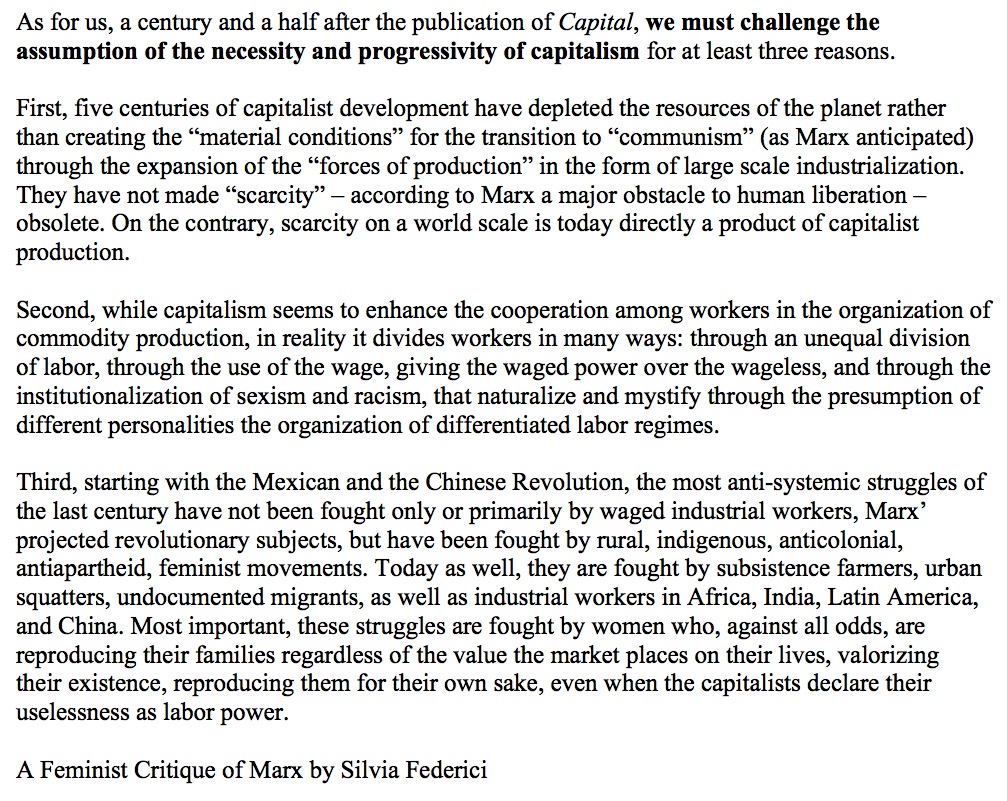
Since posting that blog, I have read A Feminist Critique of Marx by Silvia Federici, which in part asserts the invisibility of women in Marx’s analysis of capitalism:

At the center of this critique is the argument that Marx’s analysis of capitalism has been hampered by his inability to conceive of value-producing work other than in the form of commodity production and his consequent blindness to the significance of women’s unpaid reproductive work [her emphasis] in the process of capitalist accumulation. Ignoring this work has limited Marx’s understanding of the true extent of the capitalist exploitation of labor and the function of the wage in the creation of divisions within the working class, starting with the relation between women and men.

And then:

Federici

[click above to enlarge]

From the above, Federici’s first point about scarcity invites a reading of Scarcity (Sendhil Mullainathan and Eldar Shafir) as well as considering how scarcity in the lives of people trapped in poverty as a consequence of a market economy that pools wealth in a small number of people at the top impacts every aspect of their lives, including their ability to learn.

Seeking gender, race, and class equity cannot be separated from the need for wholesale workers’ solidarity—a solidarity that requires teachers to envision themselves as workers and to embrace the status of worker as a noble possibility for free people.

Conditions of Teaching Are Conditions of Learning: On Students

I’m not prone to New Year’s resolutions, but I have decided that with the arbitrary designation of a new calendar year, I have a way to focus on new commitments, specifically in how I interact in the virtual world. So when I read a derogatory comment on one of my blog posts (describing my post with “stupidest” and then making a word choice error or typo), I resisted the urge to comment, but posted how painful it was not to do so on Facebook.

Many of my wonderful former students commented, leading to two threads and many comments that genuinely made my day and evening—justifying my decision not to interact with the person leaving the comment.

From that exchange, I wrote Classroom Teaching Experience and Whose Voice Matters because I began to think about my 18 years teaching high school English as well as how I both failed my students and served them well (by the way, my former students tend to be stunningly kind and recall our days and years together with a fondness that makes my heart enlarge like the final scene of How the Grinch Stole Christmas).

The reason my exchange with former students spurred a blog about teacher autonomy and classroom experience is that, upon reflection, I believe when I was at my best as a high school teacher, I was functioning at an autonomous level—doing what I knew to be best for what any one of my students needed (especially when that meant listening to them while they struggled under the weight of crying about a boyfriend or girlfriend)—and when I was at my worst, I was complying with mandates I felt were at least misguided.

So as I blogged about the need for listening to teachers’ voices, for honoring classroom experiences not solely but initially, I was making a case about the conditions of teaching—a case that I failed to connect to the conditions of learning and how teacher autonomy is inextricable from student autonomy.

While I remain, frankly, stunned at the antagonism expressed when I call for teacher autonomy and voice, I am equally dismayed that we tend to render both teachers and students essentially invisible and mute.

Two comments on pieces of mine, then, need to be highlighted.

On my teacher invisibility post included at The Answer Sheet, StudentsLast added: “If teachers are invisible to policy makers, what then are students? Non-existent?”

To which I must respond, yes.

And responding to Classroom Teaching Experience and Whose Voice Matters, Martha Kennedy highlighted:

Something I have never seen brought into this conversation is the fact that many people look at teachers through the lens of their own experience in school. I don’t think most people liked school. Judging from my university students, the teacher is viewed as an adversary, classes are obstacles, it’s all just “hoops to jump.” I think as long as this is true, teachers will have a hard time with “the public.” There’s also the fallacy that if a kid hasn’t learned, the teacher hasn’t taught. Judging from my students, many don’t even really understand WHAT the teacher is teaching. This is a larger problem since the advent of NCLB where students are taught to pass exams. Students are conditioned to find a discrete answer to every question. This pretty much steals from questions their intrinsic interest.

The first point above is extremely important: How often are the actions of teachers inculcating in students negative associations with not only school but also teachers? How often are those actions the result of misguided mandates imposed on those teachers? How might all teachers embrace their autonomy so as to avoid these conditions in the classroom?

So as I return to my blog post about honoring teacher voice and classroom experience, I must emphasize that calling for a reconsideration of how we view teachers, how we honor (or don’t) teacher autonomy, and whose voice matters, I must stress that the conditions of teaching are the conditions of learning.

And how teachers feel as well as how students feel about those conditions matters in ways that must not be ignored, must not be marginalized against a normalized rational view of the world.

As we become more and more entrenched in “an age of infinite examination” where teachers and students are “never finished with anything,” we must begin to ask new questions and then seek different answers. And as we seek ways in which teachers and workers can embrace a new solidarity, let’s not forget our solidarity with the students in our care.

Classroom Teaching Experience and Whose Voice Matters

For about two decades from my early 20s into my early 40s, my first (and I believed only) career was public high school English teacher. Around 2002, I moved to higher education where I am primarily a teacher educator but also maintain in part a role as a teacher/director of writing in our first year seminar program—meaning I have been a teacher now for 31 years.

Throughout my time as a K-12 public school teacher, I was most of those years a department chair, a position for which I received no stipend and no release time. Along with being a full-time doctoral student for 3 years and adjunct instructor at local colleges while remaining a full-time high school English teacher in the mid-1990s, I spent the last third of my K-12 teaching career also coaching soccer (at first, as head coach of both the girls and boys teams, and then as boys head coach). My coaching stipend, by the way, after taxes, added about $70 a month to my check, and I remained an uncompensated department chair throughout those years.

My first years teaching high school included five courses in a six-class-period school day (with a planning period and including my role as faculty sponsor/teacher of the journalism class) of about 30 (occasionally 35) students per class; each class required a separate prep (different courses with different textbooks for each class, totaling about 15 vocabulary, grammar, and literature textbooks I had to juggle along with learning to teach). From my first day teaching English, as well, I considered my primary responsibility to be the teaching of writing.

Since I kept a record of my work as a teacher of writing, I can attest that over those 18 years, I read and responded to about 4000 original multiple-draft essays as well as about 6000 journal-type single-draft writing assignments each academic year.

While teaching and coaching, my day went something like this:

I’d arrive at school between 7 and 7:30 a.m., rushing into the athletic offices to put my teams’ uniforms in the washing machine. After my first period class (class change time was five minutes), I would run down the hall, back to the athletic offices to move those uniforms into the dryer. Between second and third periods, I’d run back to the athletic offices to take the uniforms out of the dryer. My planning period was spent folding and sorting the uniforms, placing them in the players’ cubbies for the next match.

On more than one occasion, I was reprimanded by administration because I wasn’t stationed at my door, shirking my hall duties.

My lunch period was about 20 minutes; I ate in my room, responding to essays essentially every day.

During soccer season, I rushed directly to practice or matches as soon as the school day ended—my work day concluding around 6 p.m. when we practiced and 10 or 11 p.m. on match days.

What’s my point? My point is that this is a typical day for K-12 public school teachers. We almost never pause, and we are being watched by students and administrators virtually non-stop (there is a psychological weight to this that few people other than teachers understand). And along with our responsibilities to know our content and to teach our students, we are also responsible as adults for the safety of other people’s children.

My atypical days, by the way, included coming home with my clothes splattered with the blood of two young men I separated fighting in study hall when I was passing by on my way to the restroom. My atypical days included walking out of my room and bumping into a student gunman (someone I was teaching). My atypical days included receiving a call that the school building in which I was teaching (and where I had attended high school) had burned to the ground.

My point, however, is not that my story is some herculean feat worthy of praise. Again, my story is replicated and exceeded daily by thousands and thousands of K-12 public school teachers—many doing so three and four decades, not just my two.

Over about 150 years, the more-or-less modern public school teacher has worked in ways I describe above, and mostly, they have done so without having much voice in how their profession is administered and what policies mandate their practices.

Since public schools are government agencies, policies are mostly designed by elected officials (and in unionized states, influenced by unions, but that influence has dwindled while many teachers work in right-to-work states, where we have almost no power or voice), with virtually none having classroom teaching experience. Historically, even school-based administrators rise to their positions with minimal time teaching day-to-day; administrators (mostly men) teach and coach 3 or so years, and then become assistant principals, and then principals, district office officials, and superintendents.

Teaching as a mostly voiceless and powerless profession must not be separated from the reality that teaching has disproportionately been the work of women. Where educators have had the most power (and highest salaries), you find, again disproportionately, men.

So, now, let me raise my larger point: I continue to see a number of people weighing in on the education reform debate bristle at classroom teachers calling for their voices being heard and at the recognition that education debates and policies are being driven by people with no or very little K-12 classroom experience (such as Secretary of Education Arne Duncan, Bill Gates, and Michelle Rhee).

Although not a simple argument, it is an essential argument: Classroom teaching experience and teachers’ voice should matter, by driving the education reform debate as well as informing education policy. Let me explain how that should look.

Classroom Teaching Experience and Whose Voice Matters

Let me state clearly here that I am not saying—and I believe no one else is either—people without classroom experience should have no voice in the education reform debate. My primary argument about professional autonomy and education policy is that the initial and primary voices that matter should be classroom teachers and people with significant classroom teaching experience (this is also a problem in teacher education where education professors can and do hold positions with little or no classroom experience).

Historically and currently for the field of education, the public voice and policy paradigms are greatly flipped since those without classroom experience hold most of the public voices and almost all of the power to create and impose policy on schools.

As an illustration, consider the influence of education historian Diane Ravitch, whom I have characterized as Ravitch 1.0, Ravitch 2.0, and Ravitch 3.0. Ravitch serves my point here because many who reject criticisms of educational reformers without classroom experience point out that few people raise any concern about Ravitch, who openly admits that she has no K-12 classroom experience (in fact, when Ravitch spoke at my university, this is the first point she raised at her pre-speech talk to our education students).

Ravitch 1.0 was a strong advocate for standards and high-stakes testing, and during those high-profile years, she wasn’t often championed by classroom teachers (she may have in fact been considered one of the enemies); I argue she wasn’t even known by many classroom teachers.

Ravitch 2.0 and 3.0, however, has become if not the at least one of the most high-profile education faces and voices embraced by classroom teachers—a phenomenon that is at least ironic, if not puzzling. So what gives?

The evolution of Ravitch has included not only changes in her positions related to education but also a willingness to listen to as well as honor the experiences and voices of classroom teachers.

This means that if you decide to hold forth on education and have no classroom experience, you should not be surprised if you are held accountable when your claims do not ring true among those who teach every day under the policies that you endorse or have implemented.

Ravitch 1.0—coincidentally without K-12 classroom experience—supported policy that did not ring true to those of us in the classroom (notably the first two decades of high-stakes accountability throughout the 1980s and 1990s).

Ravitch 2.0 and 3.0—coincidentally without K-12 classroom experience—supports, echoes, and endorses policy that rings true to those teaching in K-12 classrooms day-in and day-out.

If you have never taught in K-12 classrooms, you are unlikely to understand what it is like to spend your entire weekend writing lesson plans for the next week, meticulously correlating every thing you and your students will do, minute-by-minute, to the required standards and then having your principal or assistant principal drop in and ask for those plans, only to reprimand you for not being where you said you’d be. Or calling you in to tell you your students’ test scores on high-stakes tests correlated with those standards are not adequate.

As a result, if you have never taught in K-12 classrooms, you may offer a cavalier claim that Common Core is no big deal; you may trivialize the passion and even hyperbole coming from the mouths of teachers who live the reality of high-stakes accountability aligned with CC.

And it is there that your credibility correlated to not having classroom experience comes into question. When we call you on this, we are not attacking you, we are not failing the debate with our tone, we are not over-reacting. And when you follow up with any of those charges, you are stepping into an ugly tradition that includes, as I noted above, the silencing and marginalizing of teachers, what tends to be associated with women’s professions, and women—as explained on this Feminist Legal Theory blog post:

Similar to “bitch,” the word “crazy” demeans women. But, instead of negatively characterizing women, “crazy” marginalizes and dismisses them. When discussing emotional responses, our culture often describes women as “crazy,” “oversensitive,” and “hysterical”—contrast to men as “sane” and “rational.” These words reduce a woman’s response to irrational behavior. Consequently, she believes that her feelings are not normal and are thus ultimately worthless. This behavior is similar to what is known as gaslighting: “psychological abuse in which false information is presented with the intent of making a victim doubt his or her own memory and perception.”

Classroom teachers are almost entirely powerless, disproportionately accountable for mandates they did not create and outcomes over which they have little or no control, and working every day in high-pressure, frantic (and tenuous) working environments. When you discount their emotional responses, their efforts to express the inexpressible through metaphor, their insistence that someone listen to them, you have failed the debate, and you have exposed the flaw of people without classroom experience driving the education debate.

There is a paternalism and oppression of the rational in the education debate that must not, as well, be discounted, ignored, as teachers and their experiences and expertise routinely are.

And the CC debate is just one example. I could spend many more paragraphs detailing this same disconnect about value-added methods for teacher evaluation, high-stakes testing, merit pay, charter schools, and the primary elements of education reform now being proposed and implemented.

Classroom teachers aren’t perfect, or universally “right.” I’ve struggled with classroom teachers over grade retention, corporal punishment, isolated grammar instruction, and such. I once taught a graduate class that included a colleague from my own English department who flippantly said in class, “O, you can make research say anything you want.”

So don’t accuse me of offering some romantic tribute to the infallible classroom teacher. I’m not.

What I am saying is that education is a field rich in experience and expertise and bankrupt by the unwillingness not to tap into that goldmine.

If you wish to be a part of the discussion and you have no experience in the field, your solidarity needs to start with you listening, really listening, before making claims yourself—your solidarity needs to include the same level of passion we teachers feel, to recognize that those feelings matter as much as the rationality you believe you are offering.

An Open Letter to K-12 Teachers: A Call for Solidarity

In the U.S., “solidarity” and “community” are very difficult concepts. Having lived my entire life in the rural South, I’d argue “solidarity” and “community” are nearly foreign concepts here—a very painful claim to make.

But the South is an important phenomenon to examine in order to come to some understanding of what it means to be a K-12 teacher in U.S. public schools. The rural South includes mostly workers, we live and live among visible poverty, and we are nothing if not the embodiment of “community.” Yet, Southerns are prone to bashing people in poverty—railing against welfare and the lazy poor—and reject unions with a self-loathing glee that is hard to understand.

These self-defeating qualities among my South remind me of the self-defeating qualities within my profession, teaching. [And for the record, I love few things more and more deeply than the field of teaching and my South—and about few things do I get more angry than teaching and my South. As with family, we often walk a thin line between passion and anger in matters of the heart.]

And I believe we are now at a point when K-12 teachers in the U.S. must examine who they are and how solidarity is essential if universal public education is ever to achieve its purpose as an essential pillar of democracy among free people.

So it is there that I begin this open letter to K-12 teachers as a call for solidarity.

My career as a teacher is grounded in 18 years teaching public school English in the rural South as that has been informed by my dissertation work, writing a biography of English educator Lou LaBrant. Three aspects of her career serve me well in this open letter:

  1. Much of LaBrant’s early scholarly work focused on the importance of free reading and libraries (work she conducted and published throughout the first half of the twentieth century); as well, she published much of this work with a librarian, Frieda Heller, modeling, I think, a powerful message about teacher scholarship, teacher agency, and who constitutes “teachers” within the field.
  2. In 1932, LaBrant was offered and accepted a position at the University School newly opening at the Ohio State University. One of her first acts once hired was to lobby with the school that English was not a separate course (the position for which she was hired), but that literacy (reading and writing) were elements essential among all disciplines. Even at an experimental school, LaBrant was an outlier voice of critical re-imagining how we do school.
  3. LaBrant was notoriously hard on other teachers; many who knew LaBrant believed that the phrase that best captured her was “She didn’t suffer fools.” Once when she was giving a talk, a teacher in the audience stood to ask just how teachers were supposed to know and do all that LaBrant demanded (and, yes, LaBrant demanded). Without missing a beat, LaBrant told the teacher if she didn’t know how, then she should quit, learn how, and then come back to teaching.

It is at this last example that I find myself torn when I advocate in public writing for both public education and public school teachers. And that is why I write this open letter.

Public advocacy for schools and teachers is a lightning rod for angry responses; what is interesting is that the venom I often receive comes from a wide spectrum of stakeholders in public education, including K-12 teachers.

Just as one current example, my stances on Common Core and high-stakes testing (I reject both entirely) are routinely challenged by K-12 teachers—not just reformers and school-bashers.

K-12 teachers and advocates for those teachers and public schools face, then, a tremendous number of tensions, and I believe our solution to those tensions rests on forming a level of solidarity teachers have yet to achieve.

In order to create that solidarity, we must confront the tensions before us:

  • The greatest tension facing a K-12 teacher is the call: “first, do no harm.” We must always be advocates for each child in our care, each child in our schools, each child in our community, each child in our state, and each child on this planet. This is a massive weight, one that makes our work monumental.
  • Another tension is the need to admit that K-12 teaching, historically and currently, is not a profession. K-12 teachers are bureaucratic employees. As hard as this fact is to face, the greater tension lies in making the case that K-12 teaching should be a profession. K-12 teacher have little autonomy and muted voices; further, K-12 teachers work under the thumb of external accountability for implementing the mandates not of their design and for outcomes beyond their control. That is not the context of a profession.
  • As is the case within all fields of work, that there exists a wide range of competencies among teachers is a burdensome tension. This tension confronts K-12 teachers with the need to become good stewards of their own field, even when that field is corrupted by non-expert bureaucracy.
  • Another incredibly complicated tension is what K-12 teacher need to admit about public education: Historically and currently public education has failed and is failing, but not in the ways often expressed by political leaders, the media, and the public. This tension, however, is ripe with possibility since the fact that schools have not yet succeeded and currently do not succeed must be placed at the feet of that bureaucracy and then K-12 teachers must claim their own table for demanding and enacting the reform we have yet to address.
  • Finally, K-12 teaching is criticized and portrayed as if the field is far more unified that it is, a rarely identified tension. Teaching in a unionized state is far different than teaching in the mostly right-to-work South. Teaching in a rural school is distinct from teaching in an urban school. Ironically, however, one thing most K-12 teachers share is that our work is incredibly isolated as we spend most of our working day the sole teacher behind our closed doors among our students. K-12 teaching is a frantic exercise that pushes us deeper and deeper into that isolation, in fact.

Yes, much is being done to K-12 teachers—baseless teacher evaluation and merit pay schemes as well as increased and misguided accountability mandates simultaneous with the dismantling of teachers unions and job security.

And that, I suppose, is the great tension: How do K-12 teachers achieve the autonomy and professionalism they deserve in positions so bereft of power?

K-12 teachers are not being served well by political leadership, the media, professional organizations, or unions. While all of these entities should be within the power of teachers to change, we are faced with growing evidence that will not happen.

This means K-12 teachers need solidarity. Solidarity to become the profession we have been denied so far. Solidarity among teachers and all workers to create the conditions of working that all people deserve in a free society.

Solidarity is a unified voice, but not a singular mind.

Solidarity is taking ownership of being good stewards of the field we imagine even before it comes to fruition—possibly because we must imagine before it can come to fruition.

Solidarity is teacher-led modeling of what it means to be a professional teacher and a scholar-teacher, and not merely a bureaucratic employee.

Solidarity is teacher-led praise and criticism of teaching and schooling, that is unlike what politicians, the media, and the public have offered.

K-12 teachers, among whom I align myself, can we begin the process of solidarity around the pursuit of teaching as a profession and of public education as a democratic essential?

Can we begin the process of teacher solidarity as a beacon for the solidarity of all workers within the larger pursuit of human dignity, human agency, and human autonomy?

As we turn the page to 2014, I will remain a voice calling for the actions needed for this solidarity, and I’d be honored to have you all there with me.