Category Archives: Teaching

Lehre Ist Tot

This past week an early career teacher, highly regarded in the classroom and very accomplished in the field of education, received a parental request that a student not be required to read The Great Gatsby. That parent, however, had signed a consent agreement with all texts, including that novel, identified as required reading at the beginning of the course.

The parent then reached out to the administration, who confirmed that the teacher had to assign a different work. This, of course, undermines the teacher and the process established, but it also creates more work for teachers already under incredible strain.

While parental oversight of assigned reading has been common in education for decades, this situation comes as states are increasingly passing parental trigger legislation, which moves the parental power from each parent’s own children to parents being able to ban works for all teachers or students to explore in classes.

That same teacher, frustrated and disillusioned, later that day read aloud their resignation letter to me in the context of telling me that much that they had taught in the first three years of teaching could no longer be taught in the last couple years—and increasingly will be directly banned in the coming year (as my home state is poised to pass its own educational gag order this spring).

The teacher cried while reading the letter aloud, and added that the resignation was depressing; this, you see, was a career they had been working toward since high school—and within 6 years, teaching is dead.

The current anti-teacher climate in the U.S. is incredibly harsh and driven by orchestrated false narratives:

Right-wing media are creating parental trigger structures even without the concurrent legislation:

While teacher and school bashing (notably as “liberal indoctrination”) has a long history in the U.S., reaching back to Catholic schools fighting for market space as public schooling increased in the 19th century, the current anti-teacher climate has its roots not in Republican politics but in the Obama administration’s education agenda.

Obama’s appointment of Arne Duncan as Secretary of Education heralded an era of education reform that actually doubled-down on the worst aspects under George W. Bush, and that doubling down feed into a growing media attack on “bad teachers.”

Instead of rejecting the standard approaches to education reform begun under Reagan and federalized under W. Bush, the Obama administration turned their blame to teachers and teacher quality. During the Obama years, the great experiment in value-added methods (VAM) devastated the teaching profession.

The perennial paradox of education has always been that teacher quality matters but it remains a very small part of measurable student achievement (only about 10-15%). Therefore, the Holy Grail of the VAM experiment—identifying “good” and “bad” teachers through standardized test scores of students—was always doomed to fail.

But it did accomplish planting the seeds of today’s multi-pronged attack on teachers—the “science of reading” movement blaming teachers and teacher educators for student reading achievement and the anti-CRT/educational gag order movements being linked to parent trigger laws.

Throughout the education reform era over the past 40 years, many of us in education have argued that education reform initiatives are less about improving education and more about killing public education and the teaching profession—charter schools and voucher schemes, Teach For America, VAM and merit pay, demonizing and dismantling unions and tenure, etc., to name a few.

From Fox News lies to parental trigger laws and education gag orders, the evidence is very clear now that this current wave of teacher bashing is definitely about killing the profession, and not about student discomfort.

Let me return to the opening teacher story.

When the parent was asked for reasons why they wanted their child not to read The Great Gatsby—so the teacher had context for choosing an alternate text—the parent responded that they did not want the child (a high school student) to read about inappropriate relationships and sexual content. So here is a point of fact about the insincerity of these challenges; that student had already read and studied The Crucible, without any complaint, a play grounded in adultery.

I am certain some parents challenging what their children are being taught are sincere, but I am also certain the larger political motivation among conservatives is to completely dismantle public education.

Just as I have explained that there simply is no CRT propaganda agenda in K-12 schools, there is no liberal indoctrination/grooming occurring in K-12 (or K-16) education either.

The Ingraham rants are simply political lies.

And these lies are not improving education.

They have one goal and it seems to have been effective: Teaching is dead.

IndoctriNation: Can We Avoid Our Dystopian Republican Future?

“I guess irony can be pretty ironic sometimes,” Commander Buck Murdock (William Shatner) muses in Airplane 2: The Sequel.

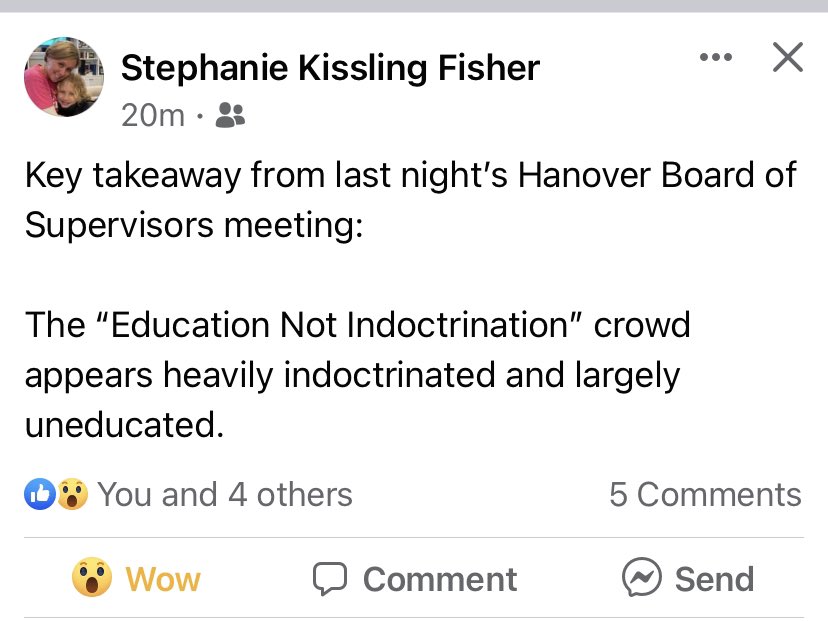
I immediately thought of this iconic Shatner scene from the Jerry Zucker-Jim Abrahams-David Zucker film when I saw a brilliant and urgently serious post on Facebook from a former student of mine currently advocating for all that is Good and Right in her crumbling state of Virginia:

While Stephanie hits succinctly right at the heart of the irony surrounding the current push by Republicans to mandate educational gag orders, parental trigger bills, and a wide range of censorship for not only school and colleges but also throughout society, I want to highlight how the irony is a veneer for the Republican long game.

Many people have now exposed that the Republican use of “Critical Race Theory” is an orchestrated lie for larger political goals since their definitions of CRT are distortions and misinformation.

But what exactly is that end game?

First, let’s unpack the monumental irony in the “Education Not Indoctrination” claims of Republicans.

A related element of the anti-CRT movement is linking CRT to “Marxism” (itself a distortion bordering on a lie), but the more telling aspect of that connection is that Marxist and critical educators forefront a genuine and resolute rejection of indoctrination. As Joe Kincheloe details, seeking out and exposing those who indoctrinate is a “central tenet” of being critical:

Thus, proponents of critical pedagogy understand that every dimension of schooling and every form of educational practice are politically contested spaces. Shaped by history and challenged by a wide range of interest groups, educational practice is a fuzzy concept as it takes place in numerous settings, is shaped by a plethora of often-invisible forces, and can operate even in the name of democracy and justice to be totalitarian and oppressive….

Recognition of these educational politics suggests that teachers take a position and make it understandable to their students. They do not, however, have the right to impose these positions on their students. This is a central tenet of critical pedagogy.

In this context it is not the advocates of critical pedagogy who are most often guilty of impositional teaching but many of the mainstream critics themselves. When mainstream opponents of critical pedagogy promote the notion that all language and political behavior that oppose the dominant ideology are forms of indoctrination, they forget how experience is shaped by unequal forms of power. To refuse to name the forces that produce human suffering and exploitation is to take a position that supports oppression and powers that perpetuate it. The argument that any position opposing the actions of dominant power wielders is problematic. It is tantamount to saying that one who admits her oppositional political sentiments and makes them known to students is guilty of indoctrination, while one who hides her consent to dominant power and the status quo it has produced from her students is operating in an objective and neutral manner. Critical pedagogy wants to know who’s indoctrinating whom. (pp. 2, 11)

JOE KINCHELOE, CRITICAL PEDAGOGY PRIMER

Therefore, if an educator is leftist, Marxist, or critical, they are dedicated to not only seeking out and contesting anyone who indoctrinates, but also working continuously to avoid allowing their own teaching to devolve into indoctrination.

To indoctrinate is to be authoritarian (see Paulo Freire’s distinction between “authoritarian” and “authoritative” in the context of critical pedagogy).

Along with the foundational strategy of using lies and mischaracterized terms to advance a political agenda, Republicans also are guilty of projection: Almost everything Republicans attribute to the “Left” is what they actually do (Republicans decry a false specter of “cancel culture” while actually passing legislation that censors, cancels, and bans materials and ideas) or what they would do given the opportunity and the power.

And that leads to the end game.

To understand the Republican end game, you must address that “Education Not Indoctrination” is yet another Orwellian misdirection. Republicans are not anti-indoctrination; in fact, Republicans are actually seeking a world in which they completely control the indoctrinating.

In short, Kincheloe’s “who’s indoctrinating whom” can be addressed simply by acknowledging that given the opportunity and power (see legislation in Republican-led states) the “who” will always be Republicans and the “whom” will be the rest of us.

Republicans are organizing and enacting a broad campaign to create their dystopia, IndoctriNation.

They are counting on a common flaw in the U.S.: “The best lack all conviction, while the worst/Are full of passionate intensity” (“The Second Coming,” William Butler Yeats).

Gag Orders, Loyalty Oaths, and the New McCarthyism

Out of the rack and ruin of our gangster death,
The rape and rot of graft, and stealth, and lies,
We, the people, must redeem
The land, the mines, the plants, the rivers.

“Let America Be America Again,” Langston Hughes

An avalanche of gag order bills are being proposed in South Carolina—H.4325H.4343H.4392H.4605, and H.4799. While my home state of SC often likes to brag about being the first state to secede in order to maintain slavery (an uncomfortable fact many of these laws would ban from being taught), these bills represent the sort of crass copy-cat legislation that is also sweeping across other Republican-led states.

Not only is there nothing original in these bills (or even evidence-based or logical), but also there is a profoundly disturbing repetition of one of the lowest points in U.S. history—the New McCarthyism.

Let’s start with facts, which Republican legislation seeks to censor:

  • “Critical Race Theory” as it is mischaracterized by Republicans does not exist in K-12 schools.
  • CRT as properly defined (a scholarly theory created primarily by Black scholars for the the field of law and adapted in a few other fields such as education and sociology) does not exit in K-12 schools.
  • Systemic racism is a fact of the founding of the U.S. and a fact of the U.S. in 2022, supported by irrefutable evidence that defies simplistic explanations (such as individual racism).
  • Race is a social construct and not a matter of biology.
  • History is a living field for considering the facts of the past; there is no one true history.
  • Intellectual discomfort is often a necessary aspect of new learning when anyone must confront misconceptions or missing knowledge in order to better understand and navigate the world.

The gag orders such as those listed above in SC are blunt partisan politics driven by orchestrated lies that have nothing to do with protecting students or with teaching factual history or excellent literature/texts.

Curriculum and book censorship in 2022 is our New McCarthyism because the CRT veneer is being used to promote ideological agendas aimed at Black people and LGBTQ+ people.

The McCarthy Era, also known as the Red Scare, was confronted in The Crucible by Arthur Miller, who uses allegory to warn the U.S. at mid-twentieth century that McCarthy’s cries of “communism” were partisan lies similar to the Salem witch trials.

There were no witches.

There were no lists of communists.

There is no CRT poisoning U.S. schools.

Yet, in their extreme forms, some gag orders include requirements for loyalty oaths and mechanisms for withholding state funding for a decade. Even for private organizations.

The ultimate horror of these gag orders from Republicans is that by legislating censorship of what history and texts students are allowed to learn, we will be insuring the most damning of ideas about history itself—those who ignore history are doomed to repeat it, often the very worst of it.

Yesterday I saw the following Tweet about the Russia invasion of Ukraine:

While I endorse the sentiment, I have been watching for over a year while most of the U.S. fails to resist censorship right here in the so-called land of the free and home of the brave.

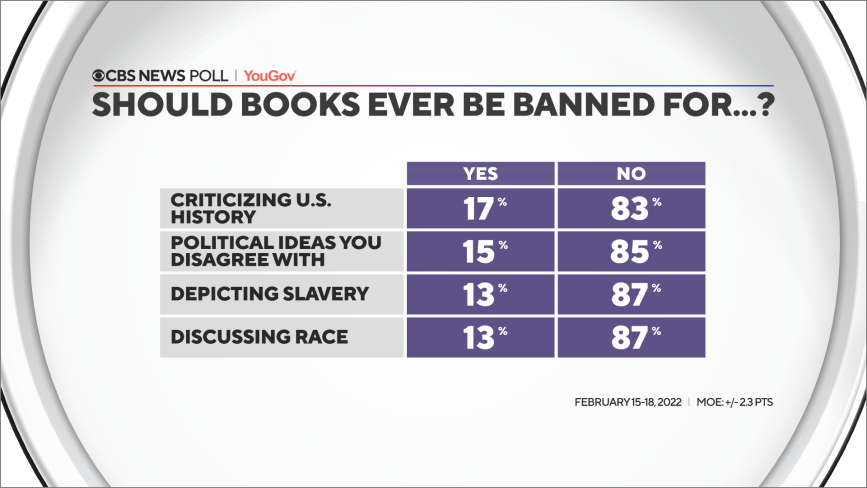
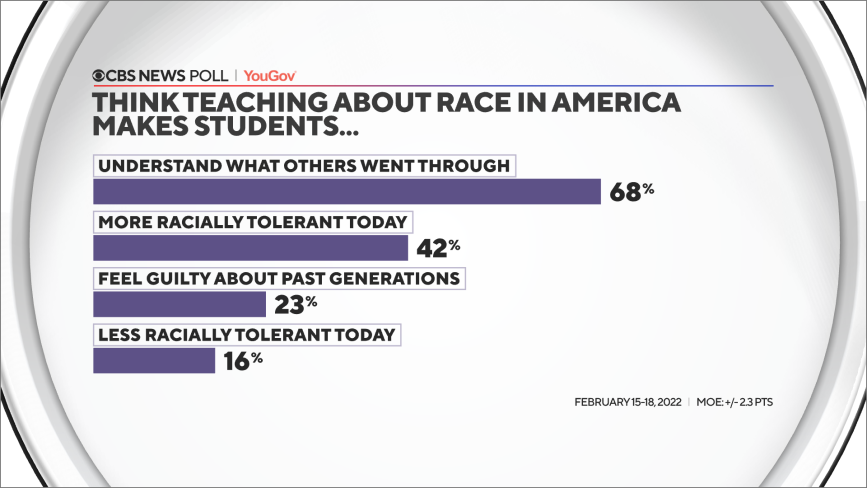
Republicans are running roughshod over freedom, pushing the U.S. toward banning abortion (despite a majority of Americans supporting maintaining Roe v. Wade) and enacting curriculum and book bans (despite large majorities of Americans rejecting censorship):

CBS news poll

Ultimately, gag orders, loyalty oaths, and censorship are un-American and anti-democratic, as ALAN notes in their Intellectual Freedom Statement:

We know that intellectual freedom is foundational to an educated citizenry and essential to the preservation and practice of democracy. We are dedicated to protecting this natural human right, and therefore, we insist on open access to all school reading materials for all students.

Intellectual Freedom Statement

The New McCarthyism exposes the Republican Party as a party of oppression, the exact sort of fact that should make everyone of us uncomfortable.


Teaching in a Time of Conservative Tyranny

My spring 2022 schedule includes three classes, two sections of upper-level writing/research and one first-year writing seminar. During my second class today, while students were completing individual work before a class discussion, I scrolled through Twitter and found this:

I quickly Googled the poem, and decided to interject an impromptu mini-lesson between students completing the individual assignment and the class discussion.

Although I have been a teacher educator (and first-year writing professor) for twenty years now, I quickly put on my high school English teacher hat and conducted a lesson on Dunbar’s poem, reading it aloud and asking students questions along the way.

I repeated the lesson (also not on the schedule) in my third class, where students offered similar responses to the discussion.

Overwhelmingly, students identified the mask motif as an exploration of putting on an emotional front, noting, for example, the juxtaposition of “smile” and “cry” in the line “We smile, but, O great Christ, our cries.” (Interestingly, one student immediately contextualized the mask motif in the current Covid era.)

When I directly asked students to identify the “we,” most immediately spoke about a universality of the poem being about “society” or anyone who identifies with the speaker in the poem.

After walking through the poem (and confirming that students were not familiar with the poem or Dunbar), I pulled up the Wikipedia page on the poem to highlight that it had been published in 1895 and that Dunbar was a Black poet who was born during U.S. Reconstruction and published in the Jim Crow Era.

I then noted the poem is about Black people masking for white people—the core of Chanea Bond‘s Tweet and the student’s awareness that at least 4 out of 10 students in the U.S. are now being taught in states with educational gag orders, a growing list of state-level legislation being proposed and passed by Republicans from Florida to Virginia to Texas to Oklahoma to Indiana and anywhere Republicans have unlimited power.

These educational gag orders include curriculum bans (often directly and indirectly invoking Critical Race Theory), book/text bans, and so-call parental rights bills that allow any parent to trigger censorship or reprimanding a teacher. While this legislation is devastating to public institutions (K-16), some bills include potential fines for private schools who take any public funds.

Attacks on books have spread beyond assigned reading, classroom libraries, and school libraries to include public libraries as well.

This wave of gag orders and censorship has included violence and threats as well as overwhelmingly impacting Black texts and topics along with any writers or works that deal with LGBTQ+ topics or experiences.

The mask being used to hide the racism and bigotry of these complaints and legislation is an insincere claim that student discomfort must be curtailed.

Some of the most extreme versions of gag order bills include requirements that teachers provide a year of lesson plans before the academic year in order for parents and others to review and approve them.

First, let me confront that last point; my impromptu lesson today was one of the best I have done in recent memory. Students were engaged, and I watched in real time as my students confronted ideas, as my students learned and became different people than when they walked into class today.

While lesson plans are important, they simply are not as valuable as being prepared to teach, and being prepared to engage with your students; a fundamental misunderstanding about teaching is that (as these gag orders and parental rights bills reveal) too many people think the job of the teacher is to transfer knowledge/content to students.

As most any teacher will tell you, we teach students—not lessons, not history or English or even The Great Gatsby.

As students and as future educators, my students today needed and deserved the lesson that came from a teacher’s Tweet. They also benefitted from a brief experience with how to read and engage with poetry along with the tyranny of partisan politics that is shutting the door on their lives as free individuals.

But my impromptu lesson today grounded in a text that may soon be banned from classrooms exposes the catastrophic misunderstanding of texts. Not a single student today recognized the powerful racial message intended by Dunbar because those students lacked historical and literacy context that is already missing from their formal education without the educational gag orders.

As I have stressed during this manufactured outrage from the Right, traditional education is already incredibly conservative.

Reading Dunbar’s poem, in fact, for its universal appeal strips it of its radical power—and cheats students from confronting the historical realities of Reconstruction and Jim Crow for Black Americans.

In 2022, students, teachers, teaching/learning, and academic freedom are under assault by conservative tyranny. There is nothing American or noble about censorship.

“A mind is a terrible thing to waste” is a seven-decades long slogan of the UNCF, and with the greatest of ironies, it now seems a central goal of Republicans to insure all minds are wasted.

Bond’s student is our canary in a coal mine, and soon, every classroom may be just as dangerous, literally, as a coal mine if we refuse to heed that student’s concern.

A Response to NCTE Statement on the Doublespeak Award and Anti-Censorship Efforts

Today is 8 February 2022. One year ago today the National Council for the Social Studies (NCSS) released a pointed and powerful statement: “Saving” American History? Start by Teaching American History.

This public statement by NCSS was bold and proved the organization was willing to place professional commitments to the fields of history and social studies over the fear of taking so-called “political” risks.

Labeled “A Current Events Response,” the statement begins: “National Council for the Social Studies (NCSS), the largest professional association in the country devoted solely to social studies education, strongly rejects the recent development of proposed bills in state legislatures which are designed to censor specific curricular resources from being used for instruction in K-12 schools.”

On 7 February 2022, the National Council of Teachers of English (NCTE) released NCTE Statement on the Doublespeak Award and Anti-Censorship Efforts, a reaction to a series of concerns raised by former members of NCTE’s Public Language Awards Committee and others (including my blog post and an Open Letter now soliciting signatures of support).

After I posted my blog raising concerns about NCTE’s silence and inaction during the rise of book/text and curriculum censorship as well as the controversy over putting the Doublespeak Award on hiatus (resulting in some committee members resigning), I have heard from many NCTE members, former NCTE members, and even past presidents of NCTE—all agreeing with the concerns being raised.

In the context of NCSS’s direct and early response, I want to address a few of the points in NCTE’s statement from 7 February 2022, a year after NCSS’s public stance.

First, this statement is a reaction to criticism, not a proactive stance against book/text and curriculum censorship. Others and I have been calling for proactive and public statements.

Second, the statement, ironically in the context of the Doublespeak and Orwell Awards, seems to be massaging if not rewriting the history of putting the Doublespeak Award on hiatus; I am not aware of a single person claiming NCTE “canceled” the award (their first bullet point). The concern was clearly that the hiatus seems to have been an effort to avoid making NCTE look “political,” again an ironic context given the awards.

Next, the statement feels to many of us as an unfair framing of the committee members who resigned on principle; we do not have to agree with those members (I do), but I think we must respect the professional ethics involved in resigning.

Ideally, NCTE would have better served the Council by simply admitting that the hiatus and how it occurred was a mistake that would be corrected—instead of putting so much focus on the principled committee members.

Finally, I want to address a comment in the statement’s penultimate paragraph: “We want NCTE members to know—NCTE has not remained on the sidelines in regard to intellectual freedom and censorship matters, and has no intention of doing so in the future.”

Let me be very clear again: I deeply respect and appreciate my colleagues who signed the statement as the faces and names of leadership for NCTE; however, I respectfully disagree and think the statement as a reaction to criticism and the continued lack of a public statement similar to NCSS (a year later) are proof that NCTE leadership continues to fail the larger fields of literacy and literature, students across the U.S., and all teachers of English/ELA.

Yes, as some NCTE members have noted on social media, NCTE has been a stellar organization inwardly with powerful position statements and a diversity-rich 2021 annual convention. But that serves and speaks to a very small fraction of teachers of English/ELA—and likely has no impact on public opinion/discourse or political policy.

NCTE needs to back up and re-address the Doublespeak mistake again, but also, NCTE must acknowledge the larger concern about remaining on the sidelines because that is where the organization is while our classrooms are being dismantled and our professions are being destroyed.

Many NCTE members are frustrated because NCTE has a powerful infrastructure to speak Truth to power the way NCSS did. Currently, we are in the final days of members voting on a new and important resolution: Resolution on Supporting Educators’ Right and Responsibilities to Engage in Antiracist Teaching.

But what good is all this if NCTE keeps the work inward and refuses to take the principled stands needed to change the public and political narratives about books, texts, and curriculum?

Laws are being passed; books are being removed from classrooms, school libraries, and public libraries because of the complaint of a single parent; teachers are being fired; and board members have called for book burnings.

If you Google “governor” and “pornography” today, you do not find articles on scandal but dozens of media articles on multiple governors across the U.S. (Texas and South Carolina, notably) calling award-winning literature “pornography.”

And as the report from UCLA clearly notes, the anti-CRT movement is itself an Orwellian attack on facts as well as teaching and learning:

We put “CRT” in quotation marks throughout this report because so often the conflict campaign’s definition of “CRT” (like its description of actual K–12 practice) is a caricatured distortion by loud opponents as self-appointed “experts.” The conflict campaign thrives on caricature — on often distorting altogether both scholarship and K–12 educators’ efforts at accurate and inclusive education, deeming it (and particularly K–12 efforts to discuss the full scope of racism in our nation) wholly inappropriate for school. (Pollock, & Rogers, et al., 2022, p. vi)

Pollock, M., & Rogers, J., et al. (2022, January). The conflict campaign: Exploring local Experiences of the campaign to ban “Critical Race Theory” in public K-12 education in the U.S., 2020-2021. UCLA’s Institute for Democracy, Education, and Access. https://idea.gseis.ucla.edu/publications/the-conflict-campaign/

Regretfully, 2021 and now 2022 are demanding principled stands such as the Doublespeak and Orwell Awards from NCTE; but students, teachers, literacy, and literature need NCTE to take a principled stand beyond the NCTE bubble.

Many of us remain concerned that NCTE is content with being reactionary and, yes, there on the sidelines.

O NCTE, NCTE, Wherefore Art Thou NCTE? [Update]

[UPDATE: Please see and support this open letter to NCTE Executive Committee.]

[UPDATE 2: NCTE Statement on the Doublespeak Award and Anti-Censorship Efforts.]

[UPDATE 3: Public statement from NCSS 8 February 2021: “Saving” American History? Start by Teaching American History]

I have been a literacy educator for 38 years and counting; throughout the 1980s and 1990s, I taught high school English in rural South Carolina, and then I moved to higher education in 2002, where I am in teacher education and teach first-year and upper-level writing.

Along with being a career educator, I am a writer. I can identify the beginning of my real life as a writer and scholar with three publications: first, Oregon English (published by a state affiliate of the National Council of Teachers of English [NCTE]) in 1989, and then English Journal (a flagship journal of NCTE) in 1991 and 1998.

When I made my move to higher education, I also began a twenty-year and counting relationship with NCTE that has been among the most rewarding elements of my career as teacher and writer/scholar.

While my colleagues and friends discovered through NCTE are too many to list here, at NCTE San Francisco (2003), I attended a presentation and met Ken Lindblom; we began talking, and eventually our connection led to my editing/co-editing a column in English Journal for 10 years under several editors (also counted among my friends and colleagues), including Ken.

In 2013, NCTE named me recipient of their George Orwell Award—one of the proudest moments of my career—acknowledging not only my work that spoke truth to power but highlighting the significance of my public work (blogging, which is often marginalized in academia). Then, after my work on the committee preparing for NCTE’s Centennial at the Chicago annual convention (2011), I served as the Council Historian from 2013-2015.

Until the interruptions of Covid, one of the highlights of each year included attending and presenting at NCTE’s annual conventions.

I share all this not to aggrandize myself, but to establish a fact of my life and career: I love NCTE and the people who have enriched my life because NCTE brought us together.

And thus, I write here in the spirit of James Baldwin: “I love America more than any other country in this world, and, exactly for this reason, I insist on the right to criticize her perpetually” (Notes of a Native Son).

Since I do love NCTE, and since I am troubled at this moment of literary and educational crisis, I feel obligated to criticize NCTE, asking, Wherefore art thou, NCTE?

Novices to Shakespeare often misread “wherefore” as simply “where,” but, of course, Juliet is asking “why” Romeo exists, specifically why is she being confronted with the challenge of Romeo’s family name.

Why, I am asking, does NCTE exist? And more pointedly, why is NCTE choosing silence, why is NCTE choosing to take a false apolitical pose—at this moment of literary and educational crisis?

First, let me stress the context of my question.

Across the U.S., Pollock and Rogers, et al., have authored a report from UCLA that analyses the wildfire spreading across the U.S.—curriculum, instruction, and book/text bans:

We found that at least 894 school districts, enrolling 17,743,850 students, or 35% of all K–12 students in the United States, have been impacted by local anti “CRT” efforts. Our survey and interviews demonstrate how such restriction efforts have been experienced inside schools as well as districts. We found that both state action and local activity have left many educators afraid to do their work.

(Pollock, & Rogers, et al., 2022, p. vi)

As I have been cataloging, censorship and even calls for book burnings are nearly a daily event into 2022.

Notable, these attacks on what and how teachers teach, on what and how students learn, are grounded in dishonest claims and misrepresentations, as the UCLA report notes:

We put “CRT” in quotation marks throughout this report because so often the conflict campaign’s definition of “CRT” (like its description of actual K–12 practice) is a caricatured distortion by loud opponents as self-appointed “experts.” The conflict campaign thrives on caricature — on often distorting altogether both scholarship and K–12 educators’ efforts at accurate and inclusive education, deeming it (and particularly K–12 efforts to discuss the full scope of racism in our nation) wholly inappropriate for school.

(Pollock, & Rogers, et al., 2022, p. vi)

The news reports are chilling: A teacher fired in Tennessee for teaching Ta-Nehisi Coates (a featured speaker at an annual NCTE convention); a superintendent of education in North Carolina banning a book from one parent complaint, and without reading the book; and high-profile coverage by NBC and The Atlantic detailing the magnitude of the censorship movement, which has included bans of one of the most celebrated graphic novels ever, Maus.

With that context in mind, I want to add I am guided by two more commitments.

Martin Luther King Jr., in Strength to Love (1963), warned: “The ultimate measure of a man is not where he stands in moments of comfort and convenience, but where he stands at times of challenge and controversy. The true neighbor will risk his position, his prestige, and even his life for the welfare of others.”

And Howard Zinn [1], whose work has been prominent at NCTE’s annual convention, who titled his memoir, You Can’t Be Neutral on a Moving Train, argued:

This mixing of activism and teaching, this insistence that education cannot be neutral on the critical issues of our time, this movement back and forth from the classroom to the struggles outside by teachers who hope their students will do the same, has always frightened the guardians of traditional education. They prefer that education simply prepare the new generation to take its proper place in the old order, not to question that order.

You Can’t Be Neutral on a Moving Train

As of today, I am deeply concerned that NCTE, as the premiere national professional organization for literacy and literature in the U.S., has chosen the path of neutrality, of silence, to strike an apolitical pose in order to avoid risk.

In November before the 2021 annual convention, I reached out to some leaders of NCTE and implored that NCTE take a leadership role in speaking out against the creeping threat of state legislation banning curriculum and the rising number of books being banned across the country.

Although I was assured this would happen, there has only been silence.

And then, this: Members of NCTE’s Public Language Awards Committee posted on social media that NCTE has put the Doublespeak Award on hiatus indefinitely in order to avoid looking “political.”

Some members have resigned in protest.

The disappointment and irony of this move is that the Doublespeak Award, a companion of the Orwell Award, is designed to offer an “ironic tribute to public speakers who have perpetuated language that is grossly deceptive, evasive, euphemistic, confusing, or self-centered.”

If you return to the report from UCLA, it is obvious we are in the midst of an educational and literary/literature crisis that screams for the Doublespeak Award (“[t]he conflict campaign thrives on caricature”), that demands public-facing, risk-embracing leadership from NCTE.

Why does NCTE exist, if not for this moment?

The current anti-CRT/book banning movement is politically partisan only because Republicans have chosen to make it so. And as King and Zinn noted throughout their careers, taking a neutral pose, pretending to be apolitical, is a political concession to support the status quo.

Since curriculum bans, book censorship, and parental oversight legislation are occurring exclusively among Republican-controlled states, the teachers and students impacted are mostly in right-to-work (non-union) situations; therefore, they are the most vulnerable, and most in need of advocacy from organizations and people with power.

NCTE is the collective voice of literacy educators, scholars, and creators.

I want to remain hopeful, but I am deeply disappointed and increasingly skeptical of that hope.

NCTE’s leaders must look in the mirror, ask “why,” and then act.

Returning to Baldwin, I end with this: “There is never time in the future in which we will work out our salvation. The challenge is in the moment, the time is always now” (Nobody Knows My Name).


[1] Trying to confirm if/when Zinn spoke at an annual NCTE convention [edit].

What Are the Real Problems with Teaching Reading and Reading Achievement among Students in the U.S.?

We are now in Year 4 of the “science of reading” (SoR) movement.

The SoR movement has directly influenced many states introducing new or revising existing reading legislation. However, the SoR movement is characterized by mostly misinformed, misleading, and over-simplified claims.

Similar to the larger accountability movement begun in the 1980s, the SoR influence on reading legislation and instruction is doomed to fail because it misidentifies the problems with teaching reading and learning to read.

Here, then, briefly, I outline the real problems with teaching reading and reading achievement among students in the U.S.:

  • The greatest barriers to all formal learning are out-of-school (OOS) factors such as household poverty, parental job security, food security, access to healthcare, and access to books/texts in the home. Decades of research have shown that about 60%-80+% of measurable student achievement is casually related to OOS factors; this holds true for reading achievement as well.
  • In-school barriers to reading achievement include teaching/learning conditions (class size, teacher expertise and experience) and inequitable access to learning (tracking, gate-keeping for so-called advanced programs—gifted and talented, Advanced Placement, International Baccalaureate, etc.).
  • Teacher education being bound to accountability mandates for accreditation and then teachers being held accountable for standards and high-stakes test scores are powerful barriers to individual student reading achievement.
  • The most important negative instructional barrier to reading achievement is holding teachers accountable for implementing reading programs instead of providing teachers support for addressing individual student needs.
  • Because of many of the barriers noted above, reading instruction is standards- and program-centered, not student-centered, and thus, many unique and complex needs of students are not addressed (special needs such as dyslexia, for example).
  • A significant cultural barrier to reading achievement is the ahistorical “crisis” rhetoric around student reading achievement; for well over a century, media, public, and political narratives have claimed that students are failing to read. We have never paused to ask why there is not one single year in which we declared reading achievement adequate.
  • Another conceptual barrier to reading achievement is a blind faith in grade-level reading. We have failed to recognize that decades of flat high-stakes test scores and a wide variety of rates among students for reading development refute a narrow technocratic view of reading development occurring in a prescribed sequence and conforming to biological age.

Similar to several Reading War movements reaching back to the 1940s, the current SoR movement is misidentifying barrier to teaching reading and reading achievement, and thus, the proposed changes to instruction and legislation are misguided, ultimately causing far more harm than good.

Privilege as a Barrier to Learning

I am deeply skeptical about two things—criticism of “young people today” as if this younger generation is somehow significantly less capable than older generations and student evaluations of teaching (SETs).

So nothing would be worse, in my opinion, than launching into a “young people today” screed based on SETs. Therefore, what follows is intended as an evidence-based observation toward understanding, not a criticism, grounded in both recent SETs and my 20 years teaching at a selective liberal arts university (after teaching 18 years at a rural high school).

My almost four decades of teaching have been in two contexts with significant social class differences. My high school students were mostly working class and poor; my university students are quite privileged in terms of social class but also in terms of the quality of education they received before entering high education (many are from private school backgrounds).

Across both populations, I often am perceived (at first) as extremely demanding, and even harsh (or “mean”).

My high school students, many working class as I was (and I also attended the school where I taught), within a few weeks tended to flip in their opinion of my courses and even me. Many years later, I have very warm relationships with many of those students; and even those who still openly express that they aren’t fans of me as a person confirm that they appreciate the work I did as a teacher.

Achieving that level of connection and warmth with my university students has been rare to mostly absent. My university students, overwhelmingly privileged in many ways, are quite unlike me, having grown up working class and receiving my BA, MEd, and EdD from state universities.

I just reviewed my fall 2021 SETs, and despite efforts to address the negativity (and even antagonism) in my spring 2021 SETs, I once again read a significant amount of negative, angry, and harsh responses to my courses.

A few things are going on, I think. First, I believe the Covid-era has in many ways inflated student stress, which is reflected in the increase of negative comments (a point I am making not to criticize students, but to acknowledge the larger forces at work and how SET data are rarely about teacher quality).

Second, while I reject the credibility and validity of SETs (as reflected in research on the practice), I do think the data say less about teacher quality and more about the students themselves.

Now, putting those two points together allows me to draw some important conclusions about privilege as a barrier to learning.

Before I explore that thought, let me offer a few caveats.

Socioeconomic status is the strongest correlation to measurable student achievement; therefore, wealthy and white students disproportionately are labeled as “good” or “excellent” students.

However, if you dig deeper in that data, you discover that eduction is not the “great equalizer” but a marker for privilege; privilege itself actually trumps having more and so-called better education (extensive research supports that claim); for one example, see the following data:

People born into socioeconomic and/or race privilege tend to navigate and achieve advanced education degrees, but the privilege itself is the primary driver of their “success” (attaining high-paying jobs), not the education.

My university students often have backgrounds in selective private schools, and almost all of them have completed high school as top students (many having made As throughout their schooling).

When I examine the types of things students are critical of and even angry about, I am increasingly concerned that privilege is a barrier to learning even as these students successfully navigate college and continue to earn high grades.

Here are the types of things privileged students are critical of in my courses recently (again, I am not criticizing these students but offering this as a way to describe and understand why they are struggling):

  • Privileged students are disproportionately offended by feedback and requirements for revision*. Living in privilege that contributes to years of praise and success have created students who are very thin-skinned and frail. As I have examined before, many students perceive all feedback as negative. Many of these students want to submit work once and have it immediately praised, and assigned an A. Being show ways to revise and improve, being asked to revise—these approaches trigger students of privilege.
  • Privileged students have a “banking” concept of teaching and learning (that Paulo Freire criticized). In other words, my privileged students view my job as dispensing for them knowledge as capital; I, however, reject the “banking” concept of teaching and see the role of teacher as facilitator. Privileged students tend to resist having their autonomy as learners increased, viewing a teacher-as-facilitator as negligent or even lazy (not doing their job).
  • Privileged students are very skeptical of and often paralyzed by de-grading practices. Grades for privileged students have been positive experiences that confirm their belief that they are “good” students who have earned those grades. People in privilege often interpret success as mostly a reflection of their effort—and not their privilege. Removing grades removes their safety blanket. (One student from last fall claimed they were reduced to crying often in my course due to my non-grading practices.)
  • Privileged students prefer knowledge-based courses to process-and-product-based courses. Although certainly not exclusively so, privileged students seem to view knowledge as “objective” and process/product as “subjective”; therefore, the latter creates anxiety in them that they will not be successful (not make an A).
  • Privileged students perceive “being smart” as something you achieve and not a journey. Since they have often been told they are smart, they can misinterpret “smart” as their being “finished”; being challenged to learn more or, especially, to re-think their learning is perceived as an attack on their Selves.
  • Privileged students are hyper-sensitive to decorum, formality, and tone. While I recognize some of this point is grounded in my personality, I am increasingly aware that some of the tone tension between my students and me is class-based. I despise formality and do my work at a very high level of efficiency; my emails and my written feedback are terse and direct. Privileged students tend to interpret that style as mean, harsh, and discouraging. This issue with tone overlaps, I think, with my efforts to shift responsibility away from me doing work for students and toward students taking agency over their own learning (many students dislike my use of highlighting when I return written work, for example). As one of the most unexpected examples from my fall SETs, a student recommended I start using “Hi” to start my emails.
  • Privileged students cling desperately to playing school and performing as students. Tests, grades, assignment rubrics and grade scales/weights, lectures, etc., are the environment where they have flourished; anything that deviates from these traditional practices creates anxiety—and skepticism about the teacher.
  • Privileged students (like their conservative parents) fear radical ideas and change. This is basic human nature; when the world works for you, you fear change to that system. I am a critical educator and scholar so my approach to ideas and the world are perceived as not just radical, but threatening to their way of life.

In the grand scheme of my career as a teacher, I realize the folly in SETs because, once again, my fall SETs included dramatically contradictory responses side-by-side—praise for my feedback and willingness to help students learn followed by claims that my feedback is “vague” and “mean,” ultimately discouraging the student to learn.

Again, the feedback says far more about the students than my work as a teacher.

None the less, I believe I have turned a corner in my understanding of the complex nature of privilege in the teaching/learning dynamic.

Yes, on balance, of course, privilege is an incredible advantage, but like being labeled gifted, privilege can also be a barrier to learning—and being happy.


*

On Transitions and Students as Writers

Two decades ago, I left K-12 teaching for higher education. After 18 years as a high school English teacher, I found myself wearing a wrist brace, my right hand overwhelmed by year upon year of hand writing comments on about 4000 student essays a year.

I still hear from my high school students, many on their 30s, 40s, and even 50s. They remain kind and praise my class for helping them become successful student writers, and thinkers.

Although I moved from the field of English (and I always primarily saw myself as a composition teacher who happened to teach literature) to education, I have been fortunate to also teach first-year writing as well as an upper-level writing/research course. Much of my schedule now includes writing-intensive courses at the undergraduate and graduate levels, even though I no longer teach literature-based courses.

One confession I must admit is that the transition from K-12 to higher education allowed the physical toll of teaching writing to 100+ students each year to alleviate, but the cumulative almost 40 years of teaching writing is wearing me down psychologically.

I am tired, and I am occasionally exasperated.

But I persist because I still feel the urge to teach, to teach better, and to learn along side my students. Fall 2021 has been another round of important lessons for me because I have been teaching two first-year writing (FYW) seminars in conjunction with a literacy course in our relatively new MAT program.

Both my FYW and graduate students are in transition, and both have overlapping challenges with those transitions.

One of the first activities we do in FYW seminars is to discuss a handout I created just a few semesters ago, Checklist: Making the Transition from Writing in High School to Writing in College [1].

Also relatively new for my FYW students is our final essay assignment; a few semesters ago because of the stress of Covid, I revised Essay 4 by combining it with the reflection I used to require for the final portfolio assignment.

The new assignment is as follows:

Essay 4 Assignment

Submit a showcase essay (approx. 4 pages) reflecting on what you have learned as a writer and what you see as the key weaknesses you need to continue to address. Include direct references to your essays (examples) and any significant connections to Warner or Style (quotes and page numbers are encouraged; include proper citing and references page if needed). Take great care to show in the essay the key elements about writing and essays you have learned in this course.

When this fall’s students submitted Essay 4, I read essay after essay that actively reflected that students have not learned many of the key concepts of writing in college that we emphasized throughout the semester. Something that all teachers of writing will recognize occurred: After students demonstrate “learning” through revision of one essay, they revert and fail to apply that learning in the next essay.

Scholars of grammar, for example, have identified that phenomenon with surface features (see Connie Weaver here and here), but this is also common as students are learning and making significant transitions as students as writers.

My FYW students were struggling with the transition from successful high school students/writers to writing as college students; my MAT students faced moving from being very successful undergraduates to performing as graduate students.

One reflection from a FYW student included a key observation, I think:

Students learned in high school several practices that actively work against their ability to make transitions, their understanding that at each level of education, the expectations change and evolve.

This student’s comment highlights the importance of students in K-12 having rich and authentic experiences with feedback and revision (I recently posted about the problem with students viewing feedback on their writing as “negative”). But the comment also reveals the problem with grades trumping a student’s ability to focus on growth and engaging in an assignment once a grade is assigned.

For both my FYW and MAT students, making the transition to different expectations and different requirements for scholarly writing (specifically moving from MLA to APA) has (too) often resulted in antagonism and paralysis.

I am having some difficulty separating the source of why my students struggled this semester because I am suspicious that some of the challenge lies with the cumulative effect of Covid fatigue.

For example, my FYW students typically submit more than 90% of their writing assignments on time although I do not grade or deduct for late work. This semester, however, only 8 of 22 students submitted all essays fully and on time (although 21 of 22 did complete all work fully ultimately).

None the less, I am certain that a key problem for both my FYW and MAT students has been that their experiences with writing in school and with the writing process (or lack there of) were static (template- and rules-based) instead of developmental and conceptual.

For example, as I have noted before, students in my FYW often acknowledge that they were taught MLA in high school as a monolithic only way to cite that would continue through college. When I note that most of my students will never again use MLA, and will certainly be required to use discipline-specific citation style sheets among their college courses, they are often angry and frustrated.

While teaching my FYW students, I am preparing them for the demands of disciplinary writing and ultimately for writing as scholars in potentially any field once they declare a major; I also anticipate that several of my undergraduates will move to graduate degrees, where scholarly writing includes even greater demands.

I ask my FYW and MAT students to rethink how they integrate sources in their scholarly writing by moving them away from over-quoting (noting that textual analysis requires direct quoting, but many style sheet in several disciplines discourage quoting) and away from walking their reader through one source at a time (many FYW students admit this is how they have written all of their “research papers”) and toward synthesizing source material in sophisticated ways that create an original scholarly essay in their own voice and with own authority.

My writing-intensive courses are demanding, and some of the responses this semester have included very open frustration and even anger as well as some signs that those demands are beyond students’ capacity to engage fully and effectively in the process.

I have a few thoughts on why—beyond the recognition that Covid-fatigue is certainly part of the problem.

Some students expressed concerns that since I am an active, professional writer, I am asking them to perform as “writers” beyond what they can or even want to do. Here, I need to make a better case that we are in a writing-intensive course in college because they will have to perform as writer/scholars throughout undergraduate and graduate education.

The more difficult problem, one we do not acknowledge enough, is that 3-months of writing instruction is unlikely to be long enough for students to demonstrate what they have learned.

Once again, John Warner’s The Writer’s Practice was a hit with FYW students, and as Warner emphasizes, when anyone is learning to write, there is no finish line. As I have noted in previous semesters, students do hear and appreciate Warner’s message that learning to write is about progress, and not perfection. However, putting that to practice is extremely hard for students legitimately concerned about what grade they will receive in a course.

Finally, what I heard my FYW and MAT students say often is that they struggled to see the substance behind some of the concepts my courses stressed; students were trapped inside viewing many of the requirements and lessons as “just formatting”; therefore, I made a list connecting those requirements with the substance—hoping that in the coming semesters, their writing will eventually demonstrate the learning that some of their current work does not:

Key Concepts for Writing in College

1. Openings/introductions should be specific and compelling. Avoid overstatements and huge claims, and be sure to include a clear and specific focus/thesis (can be multiple sentences and/or questions you will answer).

2. Take care with your word choice/diction. Prefer specific and clear language. Make sure the diction/tone of your word choice matches the seriousness of your topic. Concrete and specific word choice is always preferred.

3. Your writing should have purposeful structure and organization. Use subheads to provide that structure and organization. and keep those subheads balanced (more than one paragraph and about equal in length).

4. Make fewer claims and always provides evidence for your claims; develop the evidence and explanations/elaborations. Any time your evidence is from a source, you must fully cite.

5. Focus on purposeful sentence and paragraph formation; length variety shows purpose.

6. Integrate sources into your writing in sophisticated ways, focusing on the content of the sources (write about the patterns found in your sources, and not the sources). Avoid using one source at a time, and recognize that one source is not proof your claim is true.

7. Create a compelling closing that does more than restate your opening. Recognize that the closing is after your reader has read your essay. Give the reader vivid and specific language, and emphasize what the reader should now understand better or do with the new knowledge/understanding. your closing is the last thing in your reader’s mind; make it count.

8. Edit and review your essay submissions for formatting and citation expectations (every discipline has different citation expectations; be sure to refer to a credible style guide). Run spelling/grammar check before submitting and never submit an essay with spelling/grammar alerts active on your document.

On the last class session of my FYW seminars, we discussed this list, and I emphasized that they should review each final version of their four essays within these parameters before submitting their final portfolio/exam.

Today is exam day, and I will soon find out what they can demonstrate.

Just as my students must remain grounded in the understanding that learning to write is a journey, I too must assign their grades recognizing they are on that journey—and for me too, teaching others to write is a journey.


[1] Checklist: Making the Transition from Writing in High School to Writing in College

Writing Process and Drafting

  • Writing a couple quick drafts the night before an essay is due is not drafting, and likely will not be effective in college (even if you received high grades in high school for doing this).
  • Drafting from an approved, direct thesis (common in high school) may be a less effective writing strategy than other drafting approaches, such as the following: (1) “vomit” drafting (free writing as much as you can to create text you can reorganize and revise) or (2) discovery drafting (writing with a general idea of your topic and focus, but allowing yourself to discover and evolve your topic and focus).
  • Planning for several days to draft is necessary, and establishing a routine for revising that commits to one revision focus at a time (diction and tone, paragraphing, etc.) is often effective.
  • Read and use as models published academic and scholarly essays along with public and creative nonfiction essays in order to increase your toolbox as a writer.

Essay Writing

  • A five-paragraph essay with a one-paragraph introduction (and direct thesis), three body paragraphs, and a one-paragraph conclusion that restates the introduction is inadequate in college; the form is simplistic (most topics have more than only 3 points) and guarantees you will under-develop your discussion.
  • Write to a clear audience (not your teacher or professor), recognizing that academic writing often has a well-informed audience and that a public audience can range from being poorly informed or misinformed to being highly experienced and knowledgeable.
  • Avoid overstatements, especially in the first sentences of the essay and in the last few sentences. Overstatements include “since the beginning of time” (or suggesting long periods of time such as “throughout history”), “many/most people argue/debate,” and “[topic x] is important [or unique or a hot topic].”
  • Your word choice (diction) creates the tone of your essay; many scholarly/academic topics are serious so take great care that your diction/tone matches the seriousness of your topic. The relationship between your tone to your topic impacts your credibility as a writer.
  • Always prefer specific, vivid, and concrete over vague or general; “anger” instead of “how he felt,” for example: “John was upset that he couldn’t control his anger” is more effective than “John was upset that he couldn’t control how he felt.”
  • Rethink the essay form and paragraphing not as a set number of sentences but as important and purposeful parts of engaging your reader/audience while establishing your credibility. Your essays should have a multiple-paragraph opening the engages and focuses your reader by being specific and vivid, several body paragraphs with purposeful paragraph lengths (sentence and paragraph length variety are effective), and a multiple-paragraph closing that leaves the reader with specific and vivid language that parallels the opening (framing) but doesn’t simply repeat your initial thoughts.
  • Learn to use the tools available in Word (or other word processors): formatting using menus (and not simply inserting spaces, returns, and tabs), running your essay through the grammar and spell check (be careful not to leave your essay with the colored underlining when submitting an assignment), and saving your text files purposefully (include your last name and assignment type in the file name) and in an organized way on your computer system (making sure you have a back-up process for all files).
  • Most academic essay writing is built from claims, evidence, and elaboration; however, the types of evidence required varies a great deal in writing among the many disciplines of the academy (history, sociology, economics, physics, etc.). For example, direct quotes are often necessary as evidence when writing a text-based analysis (examining a poem or an essay in philosophy), but many disciplines (social sciences and hard sciences) expect evidence that is data or paraphrasing/synthesis of concepts and conclusions from multiple sources at a time (synthesis). When writing a text analysis, quotes are necessary, but your own claims and elaboration should be the majority of the essay, and take great care to integrate quotes with your own words (avoid stand-alone sentences that are quotes only and be careful to limit block quoting).; writing about topics or making arguments should limit quoting.
  • Academic citation (MLA, APA, etc.) is different among the disciplines (you may not use MLA again after entering college, for example), and expectations for high-quality sources also vary among disciplines. Some fields such as literature and history require older sources, yet social (sociology, psychology, education) and hard (physics, biology, chemistry) sciences tend to prefer only peer-reviewed journal articles from within 5-10 years. Across most of academia, however, journal articles and peer-reviewed publications are preferred to books and public writing.
  • File formatting impacts your credibility as a writer; set your font preferences to one standard font and size (Times New Roman, 12 pt.) and maintain that formatting throughout a document (only using bold or italics as appropriate for subheads or emphasis), including headers/footers.
  • Always submit essays with vivid and specific titles and your name where required on the document itself.

When I think about final grades in a writing-intensive course, here are some guiding principles:

  • A work: Participating by choice in multiple drafts and conferences beyond the minimum requirements as well as revising and editing beyond responding only to feedback; essay form and content that is nuanced, sophisticated, and well developed (typically more narrow than broad); a high level demonstrated for selecting and incorporating source material in a wide variety of citation formats; submitting work as assigned and meeting due dates (except for illness, etc.); attending and participating in class-based discussion, lessons, and workshops; completing assigned and choice reading of course texts and mentor texts in ways that contribute to class discussions and original writing.
  • B work: Submitting drafts and attending conferences as detailed by the minimum requirements but attending primarily to feedback without revising/editing independently; essay form and content that is solid and distinct from high school writing (typically more narrow than broad); a basic college level demonstrated for selecting and incorporating source material in a wide variety of citation formats; submitting work as assigned and meeting most due dates; attending and participating in class-based discussion, lessons, and workshops; completing assigned and choice reading of texts and mentor texts in ways that contribute to class discussions and original writing.

Freedom and the Politics of Canceling Teachers and Curriculum

By mid-December of 2021, Matthew Hawn, a former teacher in Tennessee, will once again have his appeal heard after being fired for violating the state’s restrictions on curriculum:

The Tennessee General Assembly has banned the teaching of critical race theory, passing a law at the very end of the legislative session to withhold funding from public schools that teach about white privilege.

Republicans in the House made the legislation a last-minute priority, introducing provisions that ban schools from instructing students that one race bears responsibility for the past actions against another, that the United States is fundamentally racist or that a person is inherently privileged or oppressive due to their race.

Tennessee bans public schools from teaching critical race theory amid national debate, Natalie Allison

As Allison reported in May, several states across the U.S. have filed or passed copy-cat legislation aimed at banning the teaching of Critical Race Theory.

By October and November, the consequences of Tennessee’s law have moved from silencing and canceling teachers to attempts to cancel curriculum [1]:

The Tennessee Department of Education recently declined to investigate a complaint filed under a new state law prohibiting the teaching of certain topics regarding race and bias.

The complaint, the first directed to the state under the new law passed this spring, was filed by Robin Steenman, chair of the Moms for Liberty Williamson County chapter, a conservative parent group sweeping the nation. 

The 11-page complaint alleged that the literacy curriculum, Wit and Wisdom, used by Williamson County Schools and at least 30 other districts, has a “heavily biased agenda” that makes children “hate their country, each other and/or themselves.”

Tennessee Department of Education rejects complaint filed under anti-critical race theory law, Meghan Mangrum

Although the complaint was rejected, Mangrum noted, “The group detailed concerns with four specific books on subjects like the Rev. Martin Luther King Jr.’s March on Washington, the integration of California schools by advocate Sylvia Mendez and her family, and the autobiography of Ruby Bridges, adapted for younger learners.”

A teacher fired for teaching Ta-Nehisi Coates, parents calling for bans on MLK and teaching about Ruby Bridges—these events are not unique to Tennessee, but they reflect a pattern of efforts to control not only teachers, but what students are allowed to learn and read.

Notable in these examples is that many of the consequences of legislation are canceling Black writers and key aspects of Black history; additionally, legislation and calls for book banning are targeting LGBTQ+ writers and topics.

Teaching and curriculum in the U.S. are being systematically and politically whitewashed.

One aspect not being addressed often is that political dynamic. Parents, political activists, and politicians are impacting who teaches and what is being taught in the context of a historical and current demand that teachers themselves remain apolitical, both in their classrooms and their lives beyond school.

As I have discussed often, teaching is necessarily political, and teaching as well as writing are necessarily types of activism.

For teachers, then, we must recognize that calls for teachers to be objective, neutral, and apolitical are themselves political acts. Currently, laws being passed and parents/activists confronting school boards are exercising their political power at the expense of teachers and schools—both of which are required to remain somehow politically neutral.

From historian/activist Howard Zinn to critical scholars such as Joe Kincheloe and to poet Adrienne Rich, we have ample evidence that taking a neutral stance is a political act that passively endorses the status quo and that silencing words is an act of canceling thought, eradicating ideas.

Zinn’s commitment to transparency as a teacher and activist is hauntingly relevant to the current political attack on teachers and curriculum:

This mixing of activism and teaching, this insistence that education cannot be neutral on the critical issues of our time, this movement back and forth from the classroom to the struggles outside by teachers who hope their students will do the same, has always frightened the guardians of traditional education. They prefer that education simply prepare the new generation to take its proper place in the old order, not to question that order [emphasis added]….

From the start, my teaching was infused with my own history. I would try to be fair to other points of view, but I wanted more than “objectivity”; I wanted students to leave my classes not just better informed, but more prepared to relinquish the safety of silence, more prepared to speak up, to act against injustice wherever they saw it. This, of course, was a recipe for trouble.

You Can’t Be Neutral on a Moving Train: A Personal History of Our Times, Howard Zinn

And Kincheloe confronted not only who is actually indoctrinating students but the imperative that teachers recognize teaching as inherently political:

Thus, proponents of critical pedagogy understand that every dimension of schooling and every form of educational practice are politically contested spaces. Shaped by history and challenged by a wide range of interest groups, educational practice is a fuzzy concept as it takes place in numerous settings, is shaped by a plethora of often-invisible forces, and can operate even in the name of democracy and justice to be totalitarian and oppressive [emphasis added].

Critical Pedagogy Primer, Joe L. Kincheloe

The great irony is that critical educators (often smeared as “Marxists”) are committed, as Kincheloe asserts, to a foundational concern: “Critical pedagogy wants to know who’s indoctrinating whom.”

The Orwellian named “Moms for LIberty,” then, by calling for canceling curriculum are in fact being “totalitarian and oppressive,” calling for not education, but indoctrination. To ban words and ideas is to ban the possibility of thinking, of learning:

The study of silence has long engrossed me. The matrix of a poet’s work consists not only of what is there [emphasis in original] to be absorbed and worked on, but also of what is missing, desaparecido [emphasis in original], rendered unspeakable, thus unthinkable.

Arts of the Possible, Adrienne Rich

A final powerful point is that many of these political acts to silence teachers and cancel curriculum are occurring in right-to-work states controlled by Republicans. Teachers not only are expected to be neutral, objective, and apolitical, but also work with a distinct awareness they have almost no job security.

Hawn fired in Tennessee simply taught a text and now is fighting for his career; the text in most ways just a year ago was considered non-controversial and even celebrated as Coates had attained recognition as one of the country’s leading Black voices.

During this holiday season at the end of 2021, teachers honestly have no decision about whether or not to be political. We are faced with only two political choices: conform to the demand that we take a neutral pose, resulting in endorsing whatever status quo legislators and parents/activist impose on schools; or recognize and embrace the essential political nature of being a teacher by actively opposing efforts to cancel teachers and curriculum.


[1] Twitter thread: