Category Archives: Teaching

Student Evaluations of Teaching: Research and Commentary [Updated]

One of the prevalent contradictions in higher education is the high-stakes use of student evaluations of teaching (SET) despite the overwhelming evidence that SETs are flawed measures of teacher/teaching quality and are often harmful for faculty already marginalized in society and academia.

Here is a collection of research and commentary highlighting those flaws and calling for ending this traditional practice:

The Real Reading Debate and How We Fail to Teach Reading

Sometimes cliches hit the nail on the head: It’s deja vu all over again.

Sometimes hackneyed metaphors paint the best picture: When you find yourself in a hole, keep digging.

And that brings us to the “science of reading” version of the Reading War.

Here, I want to address the often misunderstood real reading debate as well as outline how there has been a historical failure in teaching reading that continues today.

First, let’s clarify some facts about reading.

For over a century, measurable reading achievement (test scores) has been mostly correlated with socio-economic factors (the students home, community, and school) and not significantly correlated with how students are being taught to read.

In that same time period, there has never been a moment when the U.S. hasn’t declared “reading crisis.” And as a result of this myopic view of reading achievement, the U.S. has a recurring Reading War; some notable moments include the 1940s, the 1950s-1960s, and the 1990s (see especially McQuillan).

Throughout the history of reading instruction, phonics instruction has always been a key component of how students are taught to read in school. The Urban Legend that in some eras (such as the 1990s) and that some philosophies/theories of literacy (whole language, balanced literacy) have rejected completely phonics instruction has been compelling to the media and the public, but it is factually false.

The Real Reading Debate

Phonics instruction, however, is at the core of the real and enduring reading debate. That debate includes three approaches to phonics instruction detailed by Krashen: “(1) intensive, or heavy phonics, (2) basic, or light phonics, and (3) zero phonics.”

Here is where mainstream media, the public, and politicians fumble the debate; the popular framing is that the Reading War is about phonics versus zero phonics.

The real debate is between intensive phonics (systematic intensive phonics for all students or phonics first for all students to be able to read) and basic phonics (phonics as one component of teaching reading among many). But as Krashen clarifies: “Zero Phonics. This view claims that direct teaching is not necessary or even helpful. I am unaware of any professional who holds this position.”

From late 2018 until today, the “science of reading” movement has promoted intensive phonics and misrepresented the current field of teaching reading as being in the nonexistent zero phonics camp (this is how whole language and balanced literacy are typically mischaracterized, especially in media coverage).

This intensive phonics/phonics first advocacy also misrepresents that position as settled science, which it isn’t.

The basic phonics position (whole language, balanced literacy) embraces the following:

  • Phonics instruction is one of many instructional practices that can be effective in teaching early reading, but many students enter formal schooling already able to read without any formal instruction in phonics; therefore, formal reading instruction must be guided by student needs, not commitments to instructional practices (such as systematic intensive phonics for all students).
  • In-school reading instruction should include direct phonics instruction for students who need that, but reading instruction should recognize those students for whom direct phonics is ineffective or unnecessary. Broadly, beware any one-size-fits-all claims about teaching reading.
  • Phonics must always be an instructional means (never phonics for phonics’ sake), but evaluating the role of phonics in fostering fluency, comprehension, joy, and critical literacy is often incomplete or absent.

The current “science of reading” movement is also misguided in its claims about research. Systematic intensive phonics must be evaluated in terms of its effectiveness for student reading fluency and comprehension (not simply does systematic intensive phonics produce phonemic awareness, pronunciation).

The research base, in fact (and including the National Reading Panel), suggests that systematic intensive phonics is limited in effectiveness to first grade and only when that direct instruction is grounded in holistic and authentic literacy instruction. Isolated systematic intensive phonics is ineffective for fostering comprehension and necessarily wastes time better spent on other literacy instruction and practices.

There also is a large and compelling research base that shows out-of-school factors and access to books in the home and school are far more important in students learning to read than how much phonics they receive in formal schooling.

The paradox, then, is that every time the Reading War reignites, the media misrepresent the debate (phonics v. no phonics) while the real debate (intensive phonics v. basic phonics) is never really addressed.

How We Fail to Teach Reading

And thus, the paradox about how we fail to teach reading.

Historically and currently, we have mostly failed U.S. public education and reading in the same ways (but not how most mainstream critics claim).

The first level failure is that we consistently ignore the impact of out-of-school factors on all student learning and measurable achievement, including especially reading. Poverty, racism, sexism, and all sorts of systemic inequities are reflected in reading scores on tests such as NAEP.

Yet, most education reform, including reading legislation, targets in-school policies only, misdiagnosing the problem but also setting up the reforms for appearing to fail.

Next, responses to reading as a crisis are clouded by presentism, a lack of historical context. The reading crisis always includes the same flawed arguments and offer the same solutions that have never succeeded in the past.

However, the third level is grounded in more recent history, the accountability era in education begun in the 1980s and 1990s and driven by standards and high-stakes testing. This recent historical trend has failed reading instruction because student needs have been ignored because schools and teachers have been hyper-focused on standards (always changing) and high-stakes tests (always changing).

Connected to those distractions is that over the last 40 years districts and schools have overcommitted to reading programs that are correlated with those standards and high-stakes tests; most teachers have been held accountable for implementing those prescriptive reading programs, instead of being professional stewards of student literacy needs.

A key lesson we are not learning is that standards, high-stakes testing, and reading programs have been incredibly harmful for student learning and reading achievement. Changing the reading programs to ones that are systematic intensive phonics will not correct this flaw.

Finally, and cumulatively, we fail to teach reading well in the U.S. because we are negligent about the conditions of our students’ lives and then negligent about the teaching and learning conditions of our students’ schools.

Here is a very sad fact: It is easier for most people to say for the hundredth time that all students need systematic intensive phonics than to admit and then address the following:

  • All children deserve universal health care.
  • All children deserve food security.
  • All children deserve to have parents with work security.
  • All children deserve a stable and safe home.
  • All students deserve the highest quality learning environment (low student/teacher ratios, experienced certified teachers, well funded supplies and school).
  • All students deserve access to reading materials in their homes, their communities, and their schools.
  • All students deserve individual and patient instruction from their teachers and their schools.
  • No student is merely a test score.

Once again, however, we are faced with a very real reading debate and with how we are still failing to teach reading.

Once again, we are failing both.

What Federal and State Reading Legislation Should and Should Not Do

Since the early 1980s, a significant role of state government has included funding and mandating public school practices and policies. Spurred by A Nation at Risk under Ronald Reagan, most states committed to the accountability era in U.S. public education grounded in state standards and high-stakes testing.

Bringing that state-based process to the federal level, George W. Bush ushered in the federal role in the accountability era with No Child Left Behind in the early 2000s.

The federal and state templates for education policy and reform have been fairly consistent for forty years, and currently, most political leaders and media pundits continue to claim that public education is failing, specifically targeting reading achievement by students.

Since most states have passed or are rushing to pass education legislation targeting reading practices and policies, here are guiding principles for what any federal or state legislation directly or indirectly impacting reading should and should not do:

  • Should not publicly fund private vendor comprehensive reading programs.
  • Should not endorse private vendor reading programs or reading materials.
  • Should not adopt “ends justify the means” policies aimed at raising reading test scores in the short term (for example, 3rd-grade retention policies).
  • Should not prescribe a narrow definition of “scientific” or “evidence-based.”
  • Should not prescribe a “one-size fits all” approach to teaching reading, addressing struggling readers or English language learners, identifying and serving special needs students, or teacher education and preparation of teachers of reading.
  • Should not ignore the limited impact in-school only practices have on measurable student outcomes (test scores).
  • Should not prioritize reading test scores over a wide range of targets and types of evidence to insure all students have high-quality access to learning to read.
  • Should not teacher-proof reading instruction or de-professionalize teachers of reading or teacher educators through narrow prescriptions of how to teach reading and serve struggling readers, English language learners, or students with special needs.
  • Should not prioritize advocacy by parents and non-educators over the expertise and experiences of K-12 educators and university-based scholars of reading and literacy.
  • Should not conflate general reading instruction policy with the unique needs of struggling readers, English language learners, and special needs students.
  • Should not over-react to short-term measurements of reading achievement (test data).

And thus,

  • Should fully fund and guarantee to all students the highest quality teaching and learning conditions for learning to read: low student/teacher ratios, well funded and supported instructional materials for learning to read chosen by teachers to fit the needs of their unique populations of students (prioritizing authentic texts for students in the classroom and in their homes), guaranteed and extensive time to read and learn to read daily.
  • Should reduce significantly the amount of and consequences for standardized testing and adopt accountability structures that include a wide range of types of evidence of student learning over a long period of time.
  • Should support the professionalism of K-12 teachers and teacher educators.
  • Should adopt a complex and robust definition of “scientific” and “evidence-based.”
  • Should embrace a philosophy of “first, do no harm.”
  • Should acknowledge that students needs across the general population, struggling readers, English language learners, and special needs students are varied and complex.
  • Should acknowledge the teacher as the reading expert in the care of unique populations of students and prioritize evidence-based student needs over complying with uniform standards or prescriptive programs.
  • Should provide funding and oversight for guaranteeing all students access to high-quality teachers (certified, experienced) and challenging, rich reading/literacy experiences regardless of student background or geographical setting (equity [input] standards over accountability [output] standards).
  • Should recognize that the research base and evidence base on reading and teaching reading is diverse and always in a state of change (i.e., there is no settled science of reading).
  • Should acknowledge and support that the greatest avenue to reading for all students is access to books and reading in their homes, their schools, and their access to libraries (school or community).
  • Should prioritize longitudinal data (test scores) on reading achievement as guiding evidence among a diversity of evidence for supporting instruction and teaching/learning conditions.
  • Should guarantee that all students are served based on their identifiable needs in the highest quality teaching and learning conditions possible across all schools.

Education legislation targeting reading needs to be guiding concepts and not prescriptions. But the overarching guiding principle should be grounded in the abundant evidence of failure by education reform over the past four decades; at the very least, federal and state legislation should not continue to do the same things over and over while expecting different outcomes.

Education Reform De-professionalizes Women Educators

Who were your teachers?

In elementary school, nearly 9 of 10 teachers are women; by high school, about 6 of 10 are women. And nearly all of your teachers, 80%, were white (see NCES data).

As a student and a teacher, then, I have spent a great deal of my life in spaces where women are the overwhelmingly majority; often I am the only man in the room.

Recently, while I was presenting at two education conferences (South Carolina Council of Teachers of English and Wisconsin State Reading Association), I had several important experiences with recognizing teaching as a profession constituted by mostly women.

At SCCTE, I attended a session led by SC for Ed, making eye contact with one of the organization’s leaders at one point in recognition that I was the only man in the room. This session was on teacher activism and the need to inform state legislators about education while the state considers a major education bill.

As the discussion focused on many of the state representatives being condescending, I offered to the group that many of the problems faced in education can be traced to men in political leadership (and administration) not trusting or allowing the full professionalism of teachers since the field is primarily women.

Alia Wong explains that teaching continues to see a rise in the percentage of women in the field while other professions have the opposite gender trajectory:

Ingersoll and his research team highlight the rising proportion of women who are, for example, physicians (from 10 percent in 1972 to 40 percent in 2018, according to Bureau of Labor Statistics data and federal surveys), lawyers (from 4 percent to 37 percent over the same time period), and pharmacists (13 percent to 63 percent).

Wong then confirms what we confronted at the SC for Ed session at SCCTE:

What explains these contradictory trends? Much of it comes down to misunderstandings of what teaching entails and how those assumptions intersect with gender norms. Unlike in many other countries, in the United States, teaching has long been seen as a relatively low-status profession. In 2018, a survey of people in roughly three dozen countries asked respondents to rank 14 different professions—including teaching, medicine, law, social work, and website engineering—by each career’s perceived social status. On the one hand, survey participants in the United States gave teachers a middling ranking, and tended to liken them to librarians; respondents in countries such as China and Malaysia, on the other hand, put teachers in first place, analogizing them to doctors.

This cultural disregard for teaching has a gendered consequence: The status of a given career tends to correlate with the share of men in that profession—higher status equals more men, generally speaking. And that has its own consequence: Research has found that employers place less value on work done by women than on that done by men. These trends reinforce each other in perpetuity.

Even in education, as the status of the position within education rises, so does the proportion of men, Wong notes: “Notably, close to half of all principals today, including two-thirds of those serving high schools, are men, as are more than three-quarters of school-district superintendents.”

Administration also reflects greater power and higher pay than classroom teachers.

I gave a presentation and spoke on a panel just a week later at WSRA; my session was attended by almost all women, and then I was the only man on a 6-person panel.

During my presentation, Misreading Reading Again and Again: The Media, Reading Policy, and Teaching Reading, two comments by teachers and the discussions around them help navigate the nearly constant state of reform occurring in education and more directly the current “science of reading” movement that is driving many states to adopt new reading legislation.

First, as I was discrediting the myth that whole language failed in California in the 1980s and 1990s—when the state experienced a significant drop in education funding and an increase in English language learners—a woman interjected that she taught in California during this time.

Her class was 32 second graders, including 6 ELL students (hers was an inclusion/ELL class). Her direct statement was that the teaching and learning conditions made effective teaching of reading (or anything) nearly impossible, regardless of the reading program or philosophy she implemented.

Here, we must recognize that teaching and learning conditions can and often do de-professionalize teachers.

Later, I was discussing the recent attacks on Lucy Calkins Units of Study reading program, emphasizing first that I do not endorse any reading programs (including Calkins’s). Many attending the session clapped for the idea that schools should not spend funding on programs, but provide teachers all the books and materials needed to teach reading.

But as we interrogated the problem with Calkins’s program, several teachers enthusiastically announced their hatred for not only the program but Calkins herself, as the name on the program.

What we unpacked was that even despite Calkins own warning not to implement the program as a structured mandate to teachers, many administrators have turned this and other reading programs into a way to manage and monitor teacher practice.

In other words, the valid anger felt by teachers about Unit of Study is their awareness that the program is used to further de-professionalize them.

And that brings us back to the “science of reading” movement that has some disturbing elements. First is the argument that the “science of reading” is settled (suggesting that science is a fixed prescription)—even though the evidence on teaching reading is rightfully described as compelling even as that evidence base is diverse (both in types of research and what that evidence supports).

Next, building off that misrepresentation of science, this movement is calling for systematic intensive phonics (phonics first) for all students; without too much imagination here, we can see that this is a blanket mandate that de-professionalizes teachers and certainly will have the same negative impact on teacher attitudes that misguided implementation of Calkins’s program currently exposes.

But the most disturbing aspect of the “science of reading” movement is that it is the next step feeding the over forty years of education reform that has plagued U.S. education.

Public education has experienced relentless political intrusion since the early 1980s, mandates standards, testing, and programs that have erased nearly every aspect of professionalism from the field of teaching.

And political intrusion, we must recognize, is almost entirely the work of men.

Think of the recent anti-abortion laws in Alabama. While the press highlighted a woman governor signing the bill, Alabama has 23 women out of 140 legislators, a mere 16.4% (see gender balances in state government here).

As has been dramatized brilliantly in Margaret Atwood’s The Handmaid’s Tale (and the Netflix adaptation), tokenized women, such as the governor of Alabama, often work in the service of men.

While many faces on the “science of reading” movement are women, their agenda is being used mostly by men in political power to mandate education policy and further de-professionalize teachers.

My home state of South Carolina has about the same gender imbalance as Alabama (28 women out of 170 legislators, 16.5%), and many of the SC for Ed teachers interacting with state representatives and senators are receiving angry and condescending responses that demonstrate a lack of respect for teachers.

What people fail to recognize about the systematic intensive phonics movement as an attack on balanced literacy is that phonics programs fit well into the top-down authority model implemented in many schools and driven by accountability mandates (legislation included). Balanced literacy, on the other hand, is intended as a guiding philosophy of literacy that depends on teacher autonomy and professionalism to provide all students what they need to learn.

Balanced literacy does not mandate any practice for all students, and does not bar any practice where students demonstrate a need.

Accountability, education legislation, and reading programs have mostly worked against teacher professionalism, against the autonomy and professionalism of women.

Teachers need teacher and learning conditions that make their work as professionals possible, but the current movement to legislate the “science of reading” will further erode teacher autonomy and distract from the real work needed.

Teachers do not need yet more reform; teachers need their profession to be respected and supported.

“We did not have to stress about our grade but instead we were able to just work”: Student Evaluations of Learning

The evidence on student evaluations of teaching (SET) suggests that this sort of feedback is deeply biased in the U.S. against women educators, Black educators, and international educators; in other words, using SETs for evaluation in higher education is a misguided tradition that cannot be justified by the sort of scientific inquiry and research that the academy claims to embrace.

In both my levels of teaching—about two decades each as a high school teacher and now in higher education—I have always sought student voices and feedback. Those reflections, however, prompt students’ perceptions of their learning. And the validity and reliability of that feedback, of course, is best determined by me through the lens of what learning goals we were pursuing in any course.

Each fall, I teach two sections of my first-year writing seminar, Reconsidering James Baldwin in the Era of #BlackLivesMatter, which culminates in a portfolio assessment for their final exam grounded in minimum requirements for receiving a grade in the course:

Exam/ Final Writing Portfolio

Resubmit all REFLECTIONS (1-15) on exam date noted above. You may include any other artifacts of work throughout the semester to support the grade you deserve in the course.

Submit the following through email attachments:

  • Final drafts of E.1, E.2, E.3, and E.4 as email attachments; be sure to submit CLEAN files (no track changes or comments visible).
  • Label files with your last name, essay number, “final,” and the date of submission, such as Thomas.E1final.121715.docx
  • Attach also a reflection (1-2 pages) on what you have learned as a writer and what you see as the key weaknesses you need to continue to address. Label the file your last name and final reflection, such as Thomas.finalreflection.docx
  • In the body of the email, RANK your four essays from the best to the weakest.

URGENT: Reminder

Minimum Requirements for course credit:

  • Submit all essays in MULTIPLE DRAFTS per schedule before the last day of the course; initial drafts and subsequent drafts should be submitted with great care, as if each is the final submission, but students are expected to participate in process writing throughout the entire semester as a minimum requirement of this course—including a minimum of ONE conference per major essay.
  • Demonstrate adequate understanding of proper documentation and citation of sources through a single well-cited essay or several well-cited essays. A cited essay MUST be included in your final portfolio.

Final Grade Sheet—FYW 1259 (Fall 2019)/Thomas

Some of the challenges students face in a first-year writing course as well as unique features of courses I teach include not receiving grades on assignments, submitting multiple drafts of essays (and engaging significantly in revising those essays), participating in peer reviewing, and moving beyond the “research paper” and “memorizing MLA” toward scholarly writing in which incorporating high-quality sources and a wide variety of citation styles are the norm of essay writing.

When I read the students’ reflections, I focus on my two overarching goals for the course: Students thinking (and behaving) differently about writing and language (the two text books are designed to address these), and students developing their own agency as writers and students.

This fall, students were very enthusiastic about John Warner’s The Writer’s Practice (the first time I have assigned it) and often pleased with Style: Lessons in Clarity and Grace, 12th Edition, by Joseph M. Williams and Joseph Bizup (a text I have used for many years through many editions). I recommend them both highly.

Below, I want to offer some of the selected feedback, in my students’ own words (anonymously), that reflects the most important patterns from their learning this fall. Again, I want to emphasize these are reflections on learning, not intended to be any sort of proof about my teaching or the structure of my course. None the less, I am as pleased as I have ever been with this group of students and who they have become and are becoming—which is proof, I think, of how important the students themselves are to any claims we make about teacher or professor quality.

I am highlighting feedback about the nature of first-year writing courses, students navigating a course without grades, students coming to embrace feedback for revising their writing, the transition from high school to college writing, and student perceptions of writing and being writers along with many other significant comments by these students.

It is a powerful thing, to me, that these comments below are rich with the language and concepts found in the two text books, noting as well that students read and reflected on these texts throughout the semester with no graded form of assessment or accountability such as tests.

In their own words, below are excerpts of reflections about their learning:

Student 1: This semester has been hard. In high school, I was very weak in writing, and sadly, I never sought out the help I needed. Before college, I would tell myself that I could wait till college, and then, I will learn proper writing and receive the help I was in need of. Thankfully, I was able to take an FYW class that would aid in my college writing and teach me the skills to become a strong writer.

Student 2: The in-class conferences were very significant in my progression throughout the course as I got to see first-hand from my teacher on what I did wrong and what I could do to improve my writing. The Writer’s Practice and Style helped me a numerous amount with my writing, such as ways to approach certain types of essays and how to connect with your audience in the best possible ways. There were many different forms of writing that helped me improve my weaknesses, such as communication, concision, clarity, complexity, and many other forms.

Student 3: This semester, I have grown as a writer and as a student. Coming out of high school, one of my main concerns was my ability to write at a college level. I took AP classes in high school and those are supposed to simulate a college level course. However, now taken actual college courses, I see that AP is nothing but a different form of standardized testing. The First Year Writing course has greatly improved my ability as a writer and made me enjoy writing again….

Overall, I believe Furman provides a unique opportunity to students through the First Year Writing classes. Not many universities are concerned with every individual student’s ability to write. The class allows a student to explore their own writing in depth and properly address the issues they consistently make. If every college student was given a similar opportunity, their writing ability would improve greatly. I’ll admit, I was hesitant when I first saw that I would have to take a required writing class in college. However, I would now gladly recommend to other colleges and universities to implement a similar style of course in their institution.

Student 4: This ties into a larger area of focus for me: concision. I fall victim to large paragraphs and sentences at times. This can confuse the audience and make my arguments hard to follow. It took some training for me realize where I lose readers, but through the readings we have in class, I’ve seen it is not a bad thing to use short sentences. It used to come across as choppy to me, but it’s just direct. Short sentences don’t necessarily mean bad ones. Often, short sentences are more effective at conveying points I would want to make. I would definitely say my concision and clarity are areas I intend to improve upon….

All things considered, I think you gave us the best possible FYW experience. This isn’t meant as flattery, but rather, my true opinion. You gave us the tools necessary to succeed, and allowed us to work independently to reach our goals. You didn’t hold our hand through every process, and you didn’t leave us out to dry when help was needed. I look forward to writing, I look forward to improving my writing.

Student 5: Throughout the year, I have learned many different techniques and styles that have improved my writing. The most improvement I noticed in my actual writing was the improvement of clarity and focusing on the audience. The Writers Practice book helped my writing with focusing on the audience, and the Style book helped me with making my writing more concise.

Student 6: Having to submit multiple rewrites has been a very helpful tactic for me. In each rewrite I would notice similar patterns in my mistakes. It has even come to the point where when I am writing a paper, and something doesn’t sound write I can picture a sentence from a previous essay that Dr. Thomas highlighted in green and I am able to fix my mistake based on a previously made mistake.

I also appreciate the in-class conferences. I feel like many professors simply markup student papers and send them back with vague explanations. This leaves students curious on what they need to fix and how to fix it. Having the in-class conferences after receiving feedback helps to solidify the problems with my essay and learn from my mistakes. After I have my conference, I am confident that I have a clear understanding on how to fix my paper.

Student 7: After developing my first “vomit draft” to this essay, the ideas came flowing rapidly. This leads me into something else that I have learned as a writer, which is the importance of “vomit drafting” and the pre-writing stage. In high school, I always had to force the drafting stage. Yet in this class, I had the freedom to hold off on drafting until I was in the mood or I had an idea that made me want to start drafting right away. I also discovered ways to get into the writing mood, and the main strategy I used this semester was reading Bad Feminist (Roxane Gay). Reading good writing inspires me to attempt to do the same thing….

I am glad that I have founded a passion for writing and confidence in my ability to write effectively while conveying a purpose. To add on, [a] general notion that has been brought to my attention in this class was that my opinions matter, and writing is one of the best ways to demonstrate my thoughts to the world. Some of the discussions we have had allowed me to make initial opinions on them, and I have been able to control that energy through my writing. This class has had a variety of benefits to it, and I am excited to see where my new passion for writing takes me in the future.

Student 8: What I appreciated most about this course was our ability to choose our own topics for essays. It was because of this process that I realized my [excitement] towards writing when it was about topics that I actually cared about. Generally, in all of the writing I did in the past, it felt like such a chore. Preparing keyhole five paragraph essays was so formulaic and boring, I absolutely never enjoyed the writing process. Being able to experience the opposite and having the creative freedom to choose anything I wanted to write about made my experience that much more enjoyable. A new experience I hope to be able to carry with me on journey at Furman.

Student 9: I had also previously thought that fancy wording was more formal in writing, but reading Style taught me that simpler writing is actually better. Another important lesson Style taught me was that most grammar “rules” are not really rules but choices writers make for clearer writing. This way of thinking of grammar is a lot less intimidating, and I feel better knowing that sometimes my grammatical “mistakes” are really just someone’s personal preference.

The Writer’s Practice helped me to find a writing process that works for me, rather than forcing me to use one process, like in high school. It also taught me to consider the audience more in my writing and think about answering their questions. John Warner allowed me to think of writing as a never ending journey of improvement, rather than one with a final destination and made me realize that despite not feeling like I’m improving, I’m actually making a lot of progress in my writing.

Student 10: Over this semester, I have learned to address writing in a completely new way. The best thing I will take from this course is that my writing should not just be defined by the grade I receive, but by the amount I have improved each time I write. Additionally, I will never become a perfect writer because I can always learn more and improve.

Moreover, I have learned the importance of rewriting essays. In my high school classes, as well as my other classes at Furman thus far, I was not given the opportunity to rewrite essays as many times as I want, so I was never able to see how much they could improve each time. In the future, I plan to write early assigned essays as soon as possible so that I can have them reviewed by my classmates and complete rewrites to make the essay the best it can be.

Student 11: There are no rules in writing, but there are consequences. This idea has nagged at me since it was planted in my mind at the beginning of the semester. The best writers can artfully break or bend the “rules” of writing, but they also are fully prepared to handle the consequences.

Student 12: This class has helped me pay closer attention to how I am writing, as I used to mostly pay attention only to what I was writing. I have learned more things from this semester-long course than I learned in all four years of high school. It is shocking how much I have learned from this class….

Writing essays and then receiving them with comments, not a grade, was very helpful. This is a class solely focused on teaching freshman college students how to write academically, so to grade students without any feedback or opportunities to fix their essays would be pointless and not beneficial.

Student 13: I first notice my style. Back then I was fairly confident I could just write things as they were in my head and that would be enough. That quickly turned out to be false. Apparently not everyone thinks the same way I do and writing in that stream of consciousness sort of way does not work. I have to write to my audience and my audience is not just the voices in my head. Doing this is complex and has multiple aspects but perhaps the most important is writing clearly. I think learning this was one of the most game changing things for me.

Student 14: At the beginning of this course, I was nervous and unsure of my writing abilities.  At orientation, I remember someone saying, “You may think you know how to write, but you really don’t.”  This terrified me, so I was determined to do my absolute best in this course.  In high school, I was very self-conscious about my writing and would become defensive when someone would give me feedback.  The main thing this course taught me was to accept feedback with open arms, since that is the only way your writing will improve.

Student 15: Over the course of the semester I have been pushed in my writing skills through practicing different styles, and continually writing pieces that were much longer than the average of what I used to consistently write. I have enjoyed being able to write about topics that I am passionate about, and I think that it made the transition to college level writing easier, because I had more to say and was not opposed to doing research to learn more about the topic….

I know that I will have to continue writing with citations, so one way that I plan on improving my weakness in them is to go to the writing lab for help and clarification. Going into a science field it is crucial that I master this skill before I graduate. My midterm interview with Dr. Anderson gave me insight as to how important it is in sustainability science. I’ve learned that I can write much more that I thought I could, and the readings helped me to consider my audience much more than I used to.

Student 16: One thing in particular that I think I learned that will be very helpful in the future was through Essay 3. Before this essay, I had never written an APA style research paper. Going into this essay, I had only written one cited paper in the past but did not give much thought into picking specific sources and evaluating their validity. Learning the style of an APA paper will be very helpful in the future, as one subject that I am interested in majoring in is economics. One factor in writing a research paper I still need to work on is synthesizing multiple sources.

I have learned how to organize information well and concisely through Essay 2 and 4. This was my first time writing a hyperlink paper so the idea of writing in short paragraphs was a new to me. Writing these papers taught me how to write in this different style. This was definitely my favorite type of essay to write. It gave me the opportunity to write about something that I was passionate about and also to learn in detail about a specific subject matter.

Student 17: Overall, the main lesson I learned is to give more attention to detail. Every part of an essay should be intentional. The introduction should connect to the conclusion without summarizing the essay completely. Similarly, word choice, sentence structure, and paragraphing can play a major role in the meaning of the essay. Dr. Thomas’ feedback made me realize how important every decision is. It’s also important to maintain the balance between caution and overthinking every decision. In The Writer’s Practice, the author explained that being afraid to write is one of the main inhibitors of good writing. I am still working on finding that balance myself.

Student 18: The structure of this class forced independent learning and I believe that is the best type of learning for me specifically. My first essay exposed my overuse of some sayings and structures. In addition, I wrote in a vague high school-like way. By the end of this course, I tried to shy away from my common tendencies and in my opinion, it ended in success. At the end of the last essay, I felt more confident and ready to move on in my writing career.

In addition, the variety in types of papers written helped me explore the types of writing and made me a more versatile writer. Although I found the APA format annoying and tedious, it made me think in a different, yet still creative, way when compared to the personal narrative. Overall, I learned how to write from these specific perspectives and what the goal of each of these types of writings were.

Student 19: Through this First Year Writing class, I have learned the importance of rewriting and continuing to go back and reflect on what I have written. Reflection is important as no matter how good I think a paper might be, there is always room for improvement. Even the greats have to go back and revise. I really liked what Dr. Thomas said, “if Baldwin had another day, he would’ve gone back and changed some things in even his greatest works.”

Student 20: I have enjoyed this course and it has helped me develop in my writing skills. I enjoyed the class discussions that we had, and I really liked the laid-back feel of it. This feel gave me, and my classmates the feeling that we could truly work on developing our writing skills. We did not have to stress about our grade but instead we were able to just work….

One of the first things I learned to do in this class was to create my own writing process. I have my own process now where I plan a paper and the direction that I want to go in by the end of the paper. I have used this process all semester long and in my other classes as well. There have been areas that I have been challenged in this class as well.

Student 21: Throughout the semester, I believe that my writing improved tremendously. The combination of reflecting on the books that teach writing and writing my own works alongside this. I was trying to actively use my learnings from the reflections and apply them to my papers while writing them.

Something specific that I have learned as as writer is considering audience. This may seem fairly straightforward, but deciding whether or not your audience has prior information on the topic is key. For example, in my paper about Pokémon Go, I should have assumed that none of my readers would have much previous Pokémon Go knowledge besides the fact that it was once very popular. Though, in my paper about Amazon, that was probably not the case. Amazon is one of the biggest companies in the world and is commonplace on the Furman campus.

Student 22: The most influential and beneficial skill that I have improved on is my ability to take criticism. When you returned our first essay, I was absolutely mortified because I had expectations that I would not have much to change resulting from the praise that I received throughout high school for my writing. It honestly took until essay 3 for me to get over the feeling of embarrassment I felt due to the critiques on my essays, but it was an incredibly beneficial realization. I now understand that I should not take academic criticism to heart as much as I did in the beginning of the year because being so sensitive just hinders my ability to improve. The thicker skin that I have developed throughout this class has translated into my other classes as well and has allowed me to be more satisfied with my best effort despite criticism.

Student 23: When writing my first reflection I stated, “I have never been a fan of anything I have written.” I was not well informed in the process of writing and never felt fully prepared by any English teacher to write. That statement is no longer true after finishing my FYW with Dr. Thomas. I enjoy writing, I enjoy my peers work, and for once I am proud of what I have written. John Warner’s, The Writers Practice, was instrumental in the development of my writing. I learned that I will never become a perfect writer, and neither will anyone else. A quote in The Writers Practice by Jeff O’Neal stated, “You are going to spend your whole life learning to write, and then you are going to die.” Although the two books in class we have read have provided me with an incredible amount of guidance when it comes to my writing, I will be continuously learning to write throughout my life. I will never reach a peak perfection in my writing and I am okay with that….

This college level writing class has removed most of my preconceived notions about writing that were drilled into my head in high school. Writing is much different than my high school classes were, I was taught a very structured style of writing to obtain all points on a standardized exam. Writing can be more expressional, it does not always to conform to a certain set of standards and isn’t mathematical.

Mississippi Miracle, Mirage, or Political Lie?: 2019 NAEP Reading Scores Prompt Questions, Not Answers [Update September 2023]

Update September 2023

Grade Retention Harms Children, Corrupts Test Data, But Not a Miracle: Mississippi Edition

UPDATE

CRUMBLING SCHOOLS, DISMAL OUTCOMES: Alexander v. Holmes County Board of Education was supposed to change everything for Southern black children, Bracey Harris

UPDATE 15 February 2022

Opinion: Reeves’ Education Mirage

Key points:

To make his case, Reeves — much like the Mississippi Department of Education itself — is chronically selective in his statistics, telling only part of the story and leaving out facts that would show that many of these gains are either illusory or only seem to be impressive because the state started so far behind most of the rest of the nation….

Even the state’s impressive improvement on the National Assessment of Educational Progress may not be quite all that it seems.

From 2013 to 2019, the latest year for which results are available, Mississippi students rose faster in fourth grade reading than anyone on the national test. They improved their ranking from 49th to 29th. The gains in math were even more impressive, jumping from 50th to 23rd during that same time frame.

Reeves attributes the progress to “third grade gate,” the reform pushed through by Republicans in 2013 that requires third graders to demonstrate they are at least minimally proficient in reading before they advance to fourth grade.

The Republican belief is that the threat of having to repeat a grade has prompted students, their families and teachers to work harder to be sure that doesn’t happen.

Another interpretation has been offered, though. It’s that because of third grade gate, Mississippi’s lowest performing students get an extra year of instruction before they take the fourth grade test. With the state failing more than twice as many students in their early years as the national average, that could create a significant advantage, though probably a short-lived one.

The research remains inconclusive on this point. It’s not on the others.

REEVES’ EDUCATION MIRAGE

UPDATE 7 December 2022

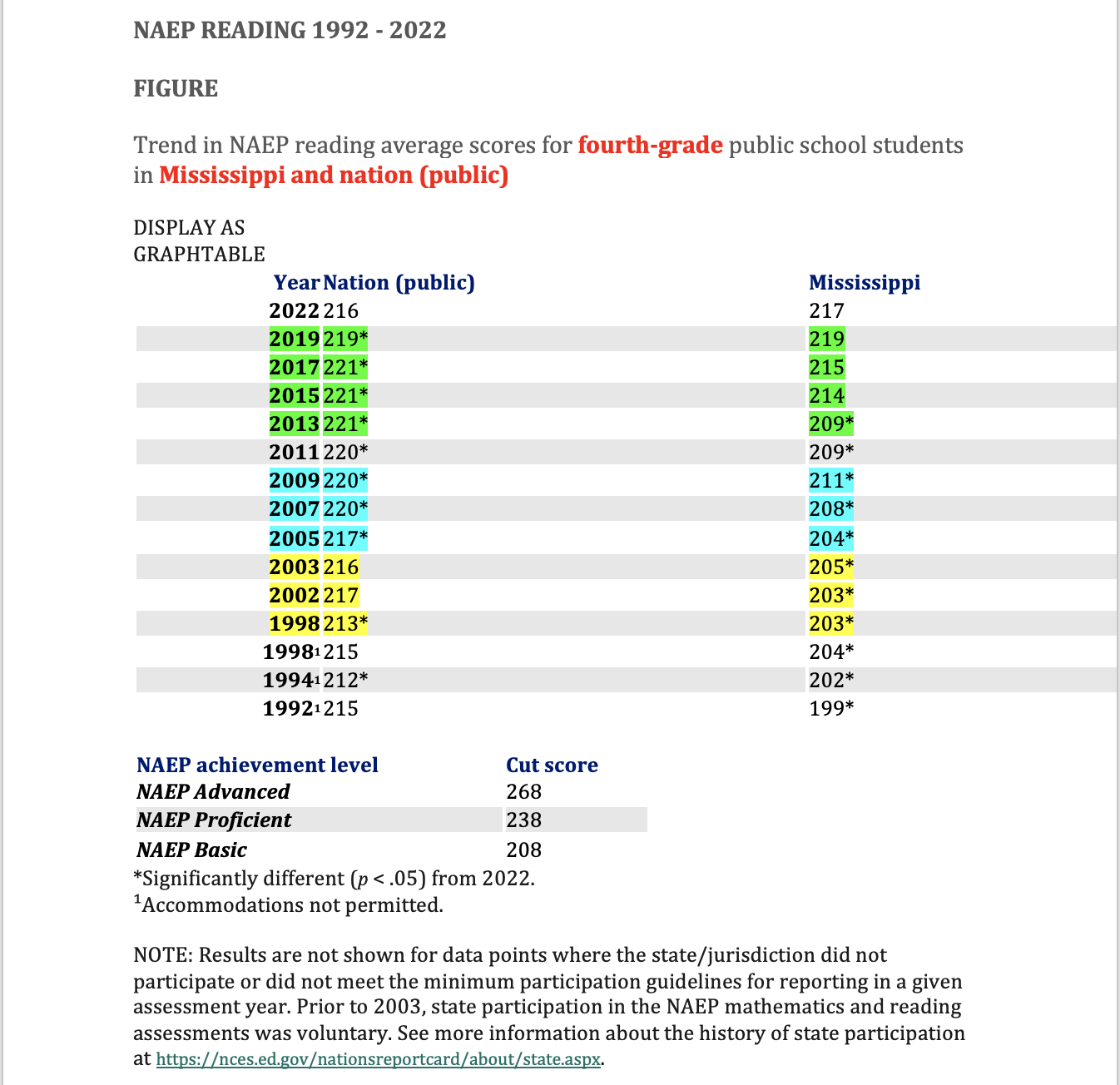
Note the trends in Mississippi’s NAEP Reading scores from 1992 through 2022 and the contrast between grade 4 and grade 8:

Note that Mississippi’s grade 4 reading scores on NAEP show:

  1. MS has steadily improved scores over thirty years despite adopting different reading programs, implementing different state standards, and reforming with multiple reading policies.
  2. MS has had two large gains—one from 2005 to 2009, 7 points, and one from 2013 to 2019, 10 points, dropping to 8 with 2022—raising a question about the role of SOR legislation since that first large gain is pre-SOR.
  3. MS remains well below proficient on average, similar to other high-poverty states.

Note that Mississippi’s grade 8 reading scores on NAEP show:

  1. Apparent “gains” made in grade 4 have disappeared by grade 8 (consistent with research on systematic phonics instruction for reading).
  2. MS grade 8 scores on reading have remained relatively flat for 24 years.
  3. MS grade 8 larger increases happened in 2002-2003 and 2017-2019, again one well before and another after SOR legislation.

UPDATE 4 July 2023

Column: How Mississippi gamed its national reading test scores to produce ‘miracle’ gains (see HERE also)

MISSISSIPPI’S MIRACLE: Do we really have a “Mississippi mirage?”

MISSISSIPPI’S MIRACLE: Has the revolution reached the eighth grade?

UPDATE: Mississippi reading isn’t so miraculous after all


Mississippi Miracle, Mirage, or Political Lie?: 2019 NAEP Reading Scores Prompt Questions, Not Answers

There is a disturbing contradiction in the predicted jubilant response to Mississippi’s outlier 4th-grade results from the 2019 NAEP reading test. That contradiction can be found in a new article by Emily Hanford, using Mississippi to recycle her brand, a call for the “science of reading.”

This is a great deal to ask of the average reader, but Hanford’s argument is grounded in a claim that most students in the U.S. are being taught reading through methods that are not supported by scientific research (code for narrow types of quantitative research that can identify causal relationships and thus can be generalized to all students).

However, the contradiction lies in Hanford’s own concession about the 2019 NAEP reading data from Mississippi:

The state’s performance in reading was especially notable. Mississippi was the only state in the nation to post significant gains on the fourth-grade reading test. Fourth graders in Mississippi are now on par with the national average, reading as well or better than pupils in California, Texas, Michigan and 18 other states.

What’s up in Mississippi? There’s no way to know for sure what causes increases in test scores [emphasis added], but Mississippi has been doing something notable: making sure all of its teachers understand the science of reading.

To be fair, there is a way to know, and that would be conducting scientific research that teases out the factors that can be identified as causing the test score changes in the state.

In her missionary zeal for the “science of reading,” Hanford contradicts herself by taking most of the article to imply without any scientific evidence, without any research, that Mississippi’s gains are by her fervent implication a result of the state’s embracing the “science of reading”: “In 2013, legislators in Mississippi provided funding to start training the state’s teachers in the science of reading.”

Let me stress here a couple points.

First, scientific research connecting classroom practices to NAEP test scores is rare, but in the 1990s, comparative data were released on 1992 scores in 1997. That research showed a possible link between whole language practices and higher NAEP scores—something that Hanford and her “science of reading” followers may find shocking since they routinely claim that whole language and balanced literacy are not scientifically supported.

Therefore, it is simply far too soon after the release of the 2019 NAEP scores to suggest any relationship between classroom practices (as if they are uniform across an entire state) and NAEP scores. Any implications about Mississippi are premature and irresponsible to make for journalists, politicians, or advocates for education.

Premature and irresponsible.

Second, data from Mississippi are more than 4th-grade 2019 reading—if we genuinely want to know something of value about teaching children to read.

Mississippi’s outlier 4th-grade reading scores are way more complicated once we frame them against longitudinal NAEP scores as well as 8th-grade reading scores. These, then, are more data we should using to ask questions about Mississippi instead of making rash and unscientific claims:

MS reading grade 4 trend

4th grade reading trends

MS score gaps grade 4

4th grade score gaps

MS reading grade 8 trend

8th grade reading trends

MS score gaps grade 8

8th grade score gaps

Here are some complicated takeaways from this larger picture:

  • If the “science of reading” is the cause of recent gains in 4th-grade reading in MS, how do we explain that MS has seen a trend of increased scores since 1998 and pretty significant jumps between 2005 and 2009[1], well before the shift identified by Hanford in 2013?
  • Why does MS still show about the same gaps between Black and white students as well as between socioeconomic classes of students since 1998 if how we teach reading is the key factor in achievement?
  • And a really powerful question concerns 8th grade: Are any 4th-grade gains by MS (or any state) merely mirages since many states with 4th-grade gains see a drop by 8th grade and since longitudinal 8th-grade scores are mostly flat since 1998?
  • UPDATE: Todd Collins has raised another important caveat to the 4th-grade reading gains in Mississippi because the state has the highest 3rd-grade retention percentages in the country:

But Mississippi has taken the concept further than others, with a retention rate higher than any other state. In 2018–19, according to state department of education reports, 8 percent of all Mississippi K–3 students were held back (up from 6.6 percent the prior year). This implies that over the four grades, as many as 32 percent of all Mississippi students are held back; a more reasonable estimate is closer to 20 to 25 percent, allowing for some to be held back twice. (Mississippi’s Department of Education does not report how many students are retained more than once.)

This last concern means that significant numbers of students in states with 3rd-grade retention based on reading achievement and test scores are biologically 5th-graders being held to 4th-grade proficiency levels. Grade retention is not only correlated with many negative outcomes (dropping out, for example), but also likely associated with “false positives” on testing; as well, most states seeing bumps in 4th-grade test scores also show that those gains disappear by middle and high school.


UPDATE

(USDOE/Office of Civil Rights) – Data 2017-2018

Sources


Ultimately, if anyone wants to argue that how we teach reading in the U.S. must be grounded only in a narrow view of “scientific” (and that is a terrible argument, by the way), then any claims we make about the effectiveness of those practices must also be supported by scientific research.

Despite efforts to make Mississippi a shining example of how all states should address reading policy, we should be using Mississippi (and the 29 states scoring higher) to examine all the factors contributing to why students achieve at the levels they do on NAEP reading.

Unless of course we have real political courage and are willing to admit that NAEP and any form of standardized testing are the wrong way to make these decisions.

Here’s something to think about in that regard: As long as we use this sort of testing, we will always have some states above the average, several at the average, and some below the average—resulting in the same nonsensical hand wringing we see today that is no different than any decade over the last 100 years.

I recommend instead of all the scientific research needed to make any fair claim, we stop the testing, make teaching and learning conditions better, make the lives of children and their families in the U.S. better, and do the complicated daily work it requires to serve the needs of all students.


NOTE

[1] Hanford contradicts herself again and open the door to another question:

For years, everyone assumed Mississippi was at the bottom in reading because it was the poorest state in the nation. Mississippi is still the poorest state, but fourth graders there now read at the national average. While every other state’s fourth graders made no significant progress in reading on this year’s test, or lost ground, Mississippi’s fourth-grade reading scores are up by 10 points since 2013, when the state began the effort to train its teachers in the science of reading. Correlation isn’t causation* [emphasis added], but Mississippi has made a huge investment in helping teachers learn the science behind reading.

There is an 8-point jump in 4th-grade reading in MS from 2002 to 2009—well before the 2013 shift to the “science of reading”—thus how is that explained? [UPDATED]

* For the record, causation is a key component of “scientific,” which Hanford espouses for reading, yet she stoops to correlation (not scientific) to make her argument.

FYW Students Respond to Warner’s The Writer’s Practice: Progress, Not Perfection

When John Warner released The Writer’s Practice: Building Confidence in Your Nonfiction Writing soon after his Why They Can’t Write, I highly recommended both volumes for those teaching writing (here and here). Of course, a much better barometer of the value of books on how to write and how to teach writing is to put them in the hands of students and teachers.

A bit past midway through this fall semester of 2019, my first-year writing students have just finished reading and reflecting on The Writer’s Practice; the final reflections and our in-class debrief yesterday revealed high praise and key lessons we who teach writing can learn from what my students valued about the book, and how they framed those lessons for them as students and writers.

One student began her reflection as follows:

As I opened up The Writer’s Practice to read the final section, I felt myself experiencing emotions similar to those when I am about to finish a really wonderful piece of fictional writing. This feeling for me is more guttural, and it comes about when I am truly sad or upset to be finishing a piece. Most of the time it is because there is a change in the plot that I didn’t enjoy, or I just truly don’t want the happily ever after to conclude. But I was genuinely confused as to why I experienced this feeling when reading the final few sentences of this piece. Never in my life has I been saddened by the conclusion of reading a book for school, fiction or nonfiction, besides The Catcher and the Rye and now this book. Because of this, I have come to the conclusion that I truly did enjoy reading this book. And I believe it was mostly because of the informal language used throughout. The way in which Warner speaks to the audience is something very intriguing to me, and it made me feel like I was holding a conversation with an actual person instead of reading a boring and monotonous book for school.

In the two sections of FYW I teach, I read in reflections and heard in our discussion some powerful patterns throughout the student endorsements of Warner’s book as an effective textbook for teaching writing. Those patterns include the following:

  • One student expressed relief that Warner encouraged progress, and not perfection. In fact, many students recognized that Warner’s lessons combined with my approach to teaching writing had significantly reduced their levels of stress and anxiety about writing. The overwhelming result of reducing stress and anxiety for students as writers is that they are more eager to write, they produce better early drafts of their essays, and they are also more motivated to revise (and even begin again) in order to produce the essays they want to write. In short, Warner’s messages resonate with and compliment my commitment to having students choose their topics and types of essays as well as my low-stakes approached to teaching (delaying grades, emphasizing feedback and revision, and fostering a writing and learning community among students and with me as a mentor/teacher).
  • Several students responded directly to Warner speaking from his own humble authority as a practicing writer, an authority grounded in his recognition that becoming a writing is a journey, and not a destination. Here, I think, was one of the most powerful aspects of how students praised Warner’s book: students valued that Warner did not speak down to them; they felt respected and appreciate the casual and empathetic tone Warner maintains throughout the book. A common response was that teaching and textbooks can too often be condescending, and students have found that this book and some of the different aspects of my teaching and writing instruction honored their basic human dignity.
  • In terms of nuts-and-bolts writing lessons that were effective because of Warner’s text, I would highlight that students almost universally came to recognize and value the role of having a clear audience at the center of their work as writers. I have always struggled with helping students move away from writing for the teacher/professor (working mostly as compliant students) and toward thinking and working more as writers (drafting for real audiences). Students reading and engaging with Warner’s text while completing my second essay assignment, a public essay that incorporates hyperlinks for citation, was mentioned as very effective experiences for a number of students, especially in terms of writing with an audience in mind and writing by choice about a topic that interests and even invigorates the writer/students.
  • Broader and foundational lessons (ones that are essential for students making the transition from high school to college, from writing like a student to writing as a scholar) include students rethinking what essay writing entails (different disciplines have different expectations for essays), students moving away from rules-based thinking to conventional awareness, and students thinking and working more purposefully through their writing process. The one-size-fits-all effect of the five-paragraph essay (which all of my students bring to the class in some form) and the tyranny of grammar rules and writing mandates definitely were at least strongly confronted if not entirely debunked through the combination of students reading Warner and receiving similar messages in my class.

As a teacher, specifically of writing, this experience with assigning Warner’s The Writer’s Practice has reinforced the importance of the relationship among the teacher, students, and the textbook. When the messages and learning environment are cohesive, like a good piece of writing, everything is more effective.

My initial recommendation for this book is now strongly supported by actually incorporating it into my FYWs, but I must hasten to add a final word of caution as well.

This really positive experience with teaching writing and with students showing real and  often observable learning as writers also exposes one of the most challenging aspects of formal writing instruction and learning in formal schooling: Even as first-year college students, these young writers are at a very early stage of development as writers, and thinkers.

Once again, placing too much emphasis on evaluating my teaching, evaluating the students’ writing, or evaluating the effectiveness of an FYW course is quite dangerous and likely very misleading.

Many of the students expressing effusive praise for Warner stumbled mightily in the writing of those reflections, and continue to struggle in their formal essay assignments. People evaluating as outsiders those students’ writing would likely find it hard to identify the growth (or quality), especially the changes in attitudes these students have experienced about writing forms and the writing process.

For students as writers and me as a teacher of writing, it remains as issue of progress, not perfection.

Students as Writers and Thinkers: Another Grading Dilemma

A high school ELA teacher who completed the certification program where I teach was telling me recently about one of her students. The student, the teacher explained, had submitted an essay that the student worked diligently on, completing multiple drafts.

The teacher noted that the final essay showed marked improvement in the writing, but grading the essay also posed a dilemma because despite substantive feedback on the content from the teacher, the student simply made very little progress in thinking well about the topic.

person holding ballpoint pen writing on notebook
Photo by Thought Catalog on Unsplash

Having taught high school ELA and then at the college level for 18 years each, I quipped, “That’s what Bs are for,” adding, “Maybe a B+.”

I wasn’t being as cavalier as it seems because I have navigated this problem hundreds of times since most of my teaching of writing has been situated in the lives of teenagers and young adults. Compounding the concern for brain development—that this age group is still developing the ability to think critically and deeply—is, for me, my own practice of de-grading and de-testing my classes.

In other words, this scenario is one of dozens that highlights why grading is often misleading and almost always harmful to the learning process.

In a reasonable world, this teacher would be allowed simply to express to the student this reality—the writing is exceptional for showing improvement, but the thinking on the topic remains trapped in simplistic and unsupported ways.

And that assessment in the form of expository feedback can be shared in this spirit: This is not a negative criticism of your effort, or your ability, but a fair reflection of your current growth, a snapshot of your journey to writing and thinking more complexly and in more compelling ways.

For teachers of writing, this problem also asks us to face key elements of giving students feedback and grading when required. The challenge revolves around having clear goals for the writing assignment, and then being able to contextualize those goals by student characteristics such as brain development (a really challenging concern).

Here are some of the common issues teachers of writing face when working with teenagers and young adults, problems that occur at the intersection of writing proficiency and thinking well:

  • Students make a large number of extreme claims, rarely offering credible evidence in compelling ways. Yet, the students have a high command of the language and construct effective sentences and paragraphs as well as relatively cohesive essays.
  • Students submit a jumbled draft, seemingly carelessly constructed (surface features, formatting), but includes several strong claims linked to solid evidence. Sentence structure, paragraphing, and essay coherence are spotty at best.
  • Students submit a well structured essay with solid sentence and paragraph formation; surface features are also solid. The essays pose a manageable number of reasonable claims linked to evidence in traditional ways (for example, all claims about a text are connected to quotes from the text); however, that evidence is thin, from sources that are not credible, or doesn’t support the claim (the quote doesn’t support the claim).

Just to name a few common challenges above, but the focus here is that each of these situations is common and made complicated by the need to grade; each is, in fact, not as challenging for offering feedback, especially to support revision.

The evaluation culture of schooling works against both student growth as writers and thinkers, in fact, because summative evaluation de-contextualizes artifacts of learning from the larger realities of human development.

Grades also stunt some of the essential elements of learning, notably that errors are often not to be avoided, but are essential for growth.

For example, many of my students in first-year college writing submit work that is mostly claims, no evidence, or work that is narrowly grounded in the “all evidence is quoting” trap they have mis-learned from writing too much literary analysis in high school (such as in Advanced Placement Literature and Composition).

Less of my instruction is about writing in those cases, although I tend to find that young writers are lazy and careless with word choice, sentence formation, and paragraphing, but more about the substance of their claims and their ability to find, choose, and incorporate effective evidence.

Young people, we must remember, live in experiences outside of schooling where being persistent, loud, or assertive results in simplistic or even false claims being viewed as credible. And young people often have not reached a level of brain development to investigate critically claims and evidence.

To teach writing is inextricable from teaching thinking. Simultaneously, those of us teaching writing can distinguish between something like good writing that can sit next to poor thinking, and flawed writing that includes important aspects of complex thinking.

Much to our chagrin, we almost always have to grade the submitted writing sample—even when we are aware that many of our teenagers and young adults simply will not think complexly for several more years despite our best effort to nudge them along that path.

Ultimately, assigning, responding to, and then assessing/grading student writing requires that we very clearly identify what our goals are for the writing assignment and the students, that we acknowledge the tension between responding to and assessing/grading both the writing and thinking in writing samples, and that we find ways to resolve how assessment/grading inhibits and even deforms those learning goals (such as delaying grades).

As I approach forty years of teaching teenagers and young adults to write and think, I have remained fairly vigilant in my demands for their ability to grow as writers while also becoming more and more patient with the time it takes for them to become the critical thinkers I hope they will be.

Hall Pass

I noticed I had been tagged by a former high school student on Facebook a few days ago. “While looking for pictures of my Daddy in some old memory and picture boxes that I forgot existed,” she began, “I came across this WHS [Woodruff High School] artifact that became the deciding factor on whether or not I was punished with demerits for a week out of every month.”*

She posted these pictures of the artifacts, hall passes from my class:

No photo description available.

Image may contain: drink and indoor

The high school where I taught English for 18 years was the same high school I had attended. By the time I was reaching the end of my time there, the school had morphed into an extremely authoritarian environment—demerits issued to students for being late to class, simply going to the restroom during class (for any reason), eating in class or chewing gum, and the usual assortment of what most people would deem disciplinary issues such as fighting or causing a disturbance during class (“holding court” and talking back being the major offenses).

These strict rules meant some students found themselves issued in-school suspension (ISS) for nothing more than very minor infractions, such as needing to use the restroom several times.

As this student noted, and as is typical of school dress codes, for example, these policies were very harsh and disproportionate for young women during their menstrual cycles:

I was 15 years old and hated getting demerits for needing to use the restroom. (you know——that unfair rule that is a blatant disregard for females and the needs we biologically have zero control over. The one that punishes females because periods refuse to schedule themselves around a 12 minute break or that 4 minutes we were given to change classes.) 

Early in my career as a teacher, which began in the fall of 1984, I recognized that teaching English was often about far more than reading, writing, and literacy. My classroom, my teaching, and the school environment—all of these projected daily lessons to students about who they were and who they should be.

Frankly, I found those lessons to be extremely problematic.

One principal allowed prayer over the intercom and boldly announced that he would be proud to be punished for flagrantly breaking the law—all while expecting students to meticulously follow every rule imposed on them by the administration and teachers.

The first decade of teaching, in fact, taught me that formal education is often a way to reflect and perpetuate the very worst aspects of sexism, racism, and classism grounded in a community. In my doctoral program, I came to recognize I had been thinking and practicing critical pedagogy without any real awareness it had a formal name and philosophy.

But the restroom pass, I think, and how I navigated school and classroom rules with my students stand today as (using my former student’s language) powerful artifacts of a more basic grounding for how formal education and teaching should be guided—maintaining an awareness of and respect for basic human dignity among all students.

While the school policy for restroom visits mandated that all students were turned in for any trip during class, I initiated a policy that allowed students simply to take a prepared pass (see the artifacts above) and go to the restroom if needed, no demerits issued. Students did not need to ask and were expected to leave and return with a minimum of disruption to class.

I explained my policy and stressed to students that it was their responsibility to honor what I was offering—that using my policy to sneak a smoke, vandalize the restroom, or simply to wander the halls would put them at great risk of being punished harshly if caught by another teacher or an administrator. In other words, I could offer grace from embarrassment and demerits, but I could not control what happened once they left my room.

Throughout much of those 18 years, I was almost daily reprimanded by administration for not issuing demerits for students coming late to class, using the restroom during class, and eating or chewing gum in class. This was stressful (and petty, I felt) and genuinely helped bring my career as a public school teacher to an end.

Human dignity and professionalism also cannot be partitioned.

Another aspect of how I managed my class in opposition to school rules I found dehumanizing and (using every chance to teach) draconian included that I always explained to my students that I was not sneaking or hiding my practices as a teacher from anyone. I was openly challenging these rules and I was also willing to pay the consequences.

Once the assistant principal and athletic director/football coach stood at my door and began to yell at me since several students were eating while working on their essays. That day, I walked out of the class, past him, and to the principal, explaining what happened and noting it needed to be the last time it did.

How can we, I asked, expect students to maintain a level of behavior, tone, and deference to authority that the people charged with authority in the school flaunted daily?

I simply have never been able to separate my personal aversion to hypocrisy from my roles as teacher, coach, or parent. As I have noted in posts before, I had a sign on my wall that read: “Any fool can make a rule and any fool will mind it” (Henry David Thoreau).

The more I taught, the more I recognized that my role as a teacher of literacy was about power and human autonomy. I could not compartmentalize classroom discipline, interacting with students, and the so-called ELA curriculum from each other.

Ethically and philosophically, all of my behavior as the teacher and as a person had to be consistent with the ideals I believed in—central to that being the need to respect the human dignity and autonomy of the students assigned to my class, and all of the students in our school.

Of course, over 18 years, I made many mistakes in both how I treated students and in my teaching; I failed students from time to time as people, and I did occasional great harm to reading and writing (sigh).

But much of the time, my classroom was a safe haven for young people to be honest and genuine, for learning to be a community experience, and for lessons that were healthy and fair but not simply about Nathaniel Hawthorne or writing literary analysis.

And my classroom was a work-in-progress, searching for ways to meet Paulo Freire‘s idea of teacher/student working with students/teachers as well as creating my teaching role as authoritative, not authoritarian.

Reading the Facebook post from a former student, written 20 years after the fact, helped me understand that the hall pass was more than a loophole or a pass to use the restroom. It was a pass for a student to be fully human as a 15 year old young woman.

How often as adults, especially in schools, do we deny children and teens access to their humanity as if they need a pass for that? As if each of us is not born with inalienable rights to life, liberty, and the pursuit of happiness?

When we as adults are charged with roles of authority, our first directive should be always to see and to hear the humanity of those assigned to that authority.

It has been two decades since I left teaching high school, and one of my students reached out with kindness and once again taught me a lesson.

And a reminder for me as a person and a teacher: “But I have promises to keep,/ And miles to go before I sleep.”


* The full post reads:

While looking for pictures of my Daddy in some old memory and picture boxes that I forgot existed, I came across this WHS artifact that became the deciding factor on whether or not I was punished with demerits for a week out of every month.

I feel like I need to make this confession——20 years later. When you were my teacher in tenth grade, I accidentally brought this hall pass home in my coat pocket on like the first or second day of school. I had every intention of returning it and apologizing for the accidental theft, but I was 15 years old and hated getting demerits for needing to use the restroom. (you know——that unfair rule that is a blatant disregard for females and the needs we biologically have zero control over. The one that punishes females because periods refuse to schedule themselves around a 12 minute break or that 4 minutes we were given to change classes.)

I wasn’t searching for a loophole, but a loophole found me. I held onto to this hall pass for my entire sophomore year. I went from having to attend Saturday school regularly to have demerits erased to stave off ISS to never getting another demerit.

This hall pass did the same thing my junior and senior years. I used to look at it and remember there was at least one teacher at WHS that refused to enforce such bullshit. Tonight I looked at it and saw a symbol of how indoctrinated and conditioned we are/were to the archaic rules and punishments that infringe on our very basic needs.

Thank you for being a teacher that absolutely refused to punish girls for having functional ovaries.

From Thesis to Focus: In Pursuit of Coherence

Having spent nearly four decades teaching high school and college students to write, I have also during that time talked with and listened to many colleagues also either teaching writing or assigning writing in their courses.

As teachers are prone to do, these teachers often complain about their students; I am apt to argue that teachers of writing are even more prone to complaining because teaching writing is labor-intensive work that often fails to produce short-term evidence that the teaching has been effective.

If we don’t complain, well, there simply may not be enough wine to buoy us through the weekends and stacks upon stacks of essays.

While I have a great deal of compassion and empathy for all teachers, and especially teachers of writing, I often shudder at the usual complaints about “students today”—complaints that often are grounded in deficit views of students and misguided perceptions of what teaching writing means, much less what sorts of writing outcomes we should be expecting of teens and young adults.

Howe Professor and Director of Roger and Joyce Howe Center for Writing Excellence, Elizabeth Wardle offers four important challenges to the most common complaints about students as writers:

First, students are what they have always been: learners. There is no evidence that student writing over all is any better or worse than it has ever been. What is true is that faculty members have been complaining about student writing for as long as students have been writing….

Second, to improve as writers, students need to write frequently, for meaningful reasons, to readers who respond as actual readers do — with interest in ideas, puzzlement over lack of clarity or logic, and feedback about how to think more deeply and write more clearly to accomplish the writer’s purposes. There is no shortcut….

The third point: All writers struggle with new genres and conventions; learning to write in new situations always requires instruction and practice because there is no singular “writing in general” and certainly no singular “good” writing in general….

Which brings me to a final point: Teaching writing is everyone’s responsibility, but it’s not any one person’s responsibility to teach all kinds of writing. We are each responsible for helping students understand the written practices that we use in our fields and professions.

These are powerful broad challenges to some of the most common complaints I hear. Therefore, I want to focus here on her third point by addressing a persistent refrain from teachers of writing—students can’t (or don’t) write effective thesis statements.

While many K-12 and higher education teacher and professors uncritically view the thesis statement as an essential aspect of what Wardle refutes (“singular ‘good’ writing in general”), I do not teach students to write thesis sentences (within a broader effort to have them move beyond the introduction/body/conclusion template of the essay), but instead, we seek writing that develops a focus over the opening paragraphs (usually about 2-5 paragraphs) and an essay that has coherence.

This approach is grounded in helping students develop essay awareness along with a broader awareness of the many conventions of essays across academic disciplines as well as writing beyond the academy.

What guides this practice is, first, my experiences as a writer, and then important challenges to the negative consequences of thesis-driven writing offered by Duxbury and Ballinger.

But I also have students move away from the thesis sentence and toward focus and coherence because I witness in every course that most students have been misguided by the tyranny of the thesis sentence. Students write badly trying to accomplish the very thing many teachers complain they cannot do.

Most students in K-12 writing experiences have been required to submit an introduction and thesis before they can draft an essay. This practice ignores the power of discovery drafting but it also suggests that very young writers must always write from the perspective of making direct and fixed claims, to assume a stance of authority they simply do not (and cannot) have.

Conversely, especially for young writers still developing their awareness of writing craft, their understanding of conventions, and their content knowledge, writing that raises questions or interrogates ideas is far more compelling and effective than students making grand pronouncements beyond the scope of their authority.

And nearly all writers come to understand their focus while drafting because the best drafting is a form of thinking.

As a teacher of writing, I more often than not while responding to early drafts point to a sentence or two late in the essay and respond, “This is your opening,” because the student has wandered into a strong essay focus.

Focus and coherence, while both are complex concepts, prove to be better guiding principles than thesis sentences as well as stilted introductions and conclusions (the template approach found in the five-paragraph essay and its cousins).

Warner and many others note, however, that template writing (the five-paragraph essay) is both very bad writing and really lazy thinking. Few topics worthy of discussion, especially in formal education, can be neatly reduced to three points.

In the 1990 edition of Style, Joseph Williams dedicates two chapters to coherence because, as he explains:

All of us have stopped in the middle of a memo, an article, or a book realizing that while we may have understood its words and sentences, we don’t quite know what they should all add up to. …[W]e will offer some principles that will help you diagnose that kind of writing and then revise it. …No one or two of [the principles] is sufficient to make a reader feel a passage is coherent. They are a set of principles that writers have to orchestrate toward that common end.

Williams speaks here to the third point Wardle is making—that writers achieve “good writing” in many different ways to fulfill many different purposes.

As teachers of writing, we are left with helping students “orchestrate” the many and varied conventions, forms, and purposes that they face. But templates cannot and do not serve those needs.

Like the five-paragraph template, the thesis statement is a pale and flawed way for writers of any age to create and achieve focus and coherence.

Moving away from thesis sentences and toward writing that establishes focus and coherence can best be achieved by inviting students to draft as an act of discovery and allowing students to interrogate ideas instead of seeking ways to make fixed claims that they then must support.

All of this must be supported by helping students understand achieving coherence conceptually (principles) and then connecting those principles to craft and strategies that students mine from mentor texts and then apply (through experimentation) in their own original writing expressing their own original (and evolving) thinking.