Category Archives: Testing

Recommended: Hope Against Hope, Sarah Carr

I just read and reviewed Hope against Hope: Three Schools, One City, and the Struggle to Educate America’s Children by Sarah Carr, to be released February 26, 2013. I urge you to pre-order it.

Books on education tend to be deeply misguided and self-promoting or trapped in the “miracle” school/ “no excuses” memes that also dominate flawed education reform.

Diane Ravitch’s recent and upcoming books as well as Kathleen Nolan’s Police in the Hallways are rare exceptions.

I am surprised, then, and eager to recommend Carr’s wonderful narrative of post-Katrina education reform in New Orleans, a crucible of the keynotes of the newest reform movement invested in charter schools and Teach for America.

If you are skeptical of the new reforms and frustrated with the status quo of public education’s failure to address children and neighborhoods most in need, Carr’s book is a perfect story of three people living the reality of both.

See an excerpt at The Atlantic: “The Real Reason More Low-Income Students Don’t Go to College”

While reading, I also compiled a companion reading list, below:

Police in the Hallways: Discipline in an Urban High School, Kathleen Nolan

http://www.upress.umn.edu/book-division/books/police-in-the-hallways

“More Challenges to Kirp’s ‘Miracle’ Narrative,” @ The Chalk Face, P. L. Thomas

http://atthechalkface.com/2013/02/15/more-challenges-to-kirps-miracle-narrative/

“Final Words of Advice,” “Where Do We Go from Here?” Martin Luther King Jr. (1967)

http://www.wealthandwant.com/docs/King_Where.htm

Other People’s Children: Cultural Conflict in the Classroom and “Multiplication Is for White People”: Raising Expectations for Other People’s Children, Lisa Delpit

http://thenewpress.com/index.php?option=com_catalog&task=author&author_id=P14893

“Murky Waters: The Education Debate in New Orleans,” Truthout, Adam Bessie and Dan Archer

http://truth-out.org/opinion/item/10061-the-disaster-capitalism-curriculum-the-high-price-of-education-reform-episode-2

“The Teaching Profession as a Service Industry,” Daily Censored, P. L. Thomas

http://www.dailycensored.com/the-teaching-profession-as-a-service-industry/

“Is There a Christmas Miracle in School Reform Debate?” The Answer Sheet/The Washington Post, P. L. Thomas

http://www.washingtonpost.com/blogs/answer-sheet/post/is-there-a-christmas-miracle-in-school-reform-debate/2011/12/21/gIQA4FocCP_blog.html

“Unpacking TFA Support: Twisted Logic and Assumptions,” Schools Matter, P. L. Thomas

http://www.schoolsmatter.info/2011/12/unpacking-tfa-support-twisted-logic-and.html

“Current Education Reform Perpetuating, Not Curbing, Inequity,” the becoming radical, P. L. Thomas

https://radicalscholarship.wordpress.com/2013/02/19/current-education-reform-perpetuating-not-curbing-inequity/

“Lessons from the Zombie Apocalypse,” the becoming radical, P. L. Thomas

https://radicalscholarship.wordpress.com/2013/02/11/lessons-from-the-zombie-apocalypse/

“Reconsidering Education ‘Miracles,’” OpEdNews, P. L. Thomas

http://www.opednews.com/articles/Reconsidering-Education-M-by-P-L-Thomas-100816-438.html

“The New Layoff Formula Project,” The Shanker Blog, Matthew Di Carlo

http://shankerblog.org/?p=2377

The Mis-Education of the Negro, Carter Woodson

http://www.amazon.com/Mis-Education-Negro-Carter-Godwin-Woodson/dp/1440463506

“Poor Teaching for Poor Children in the Name of Reform,” Education Week, Alfie Kohn

http://www.alfiekohn.org/teaching/edweek/poor.htm

“The Pedagogy of Poverty Versus Good Teaching,” Phi Delta Kappan, Martin Haberman

https://www.ithaca.edu/compass/pdf/pedagogy.pdf

“’They’re All Our Children,’” AlterNet, P. L. Thomas

http://www.alternet.org/education/theyre-all-our-children

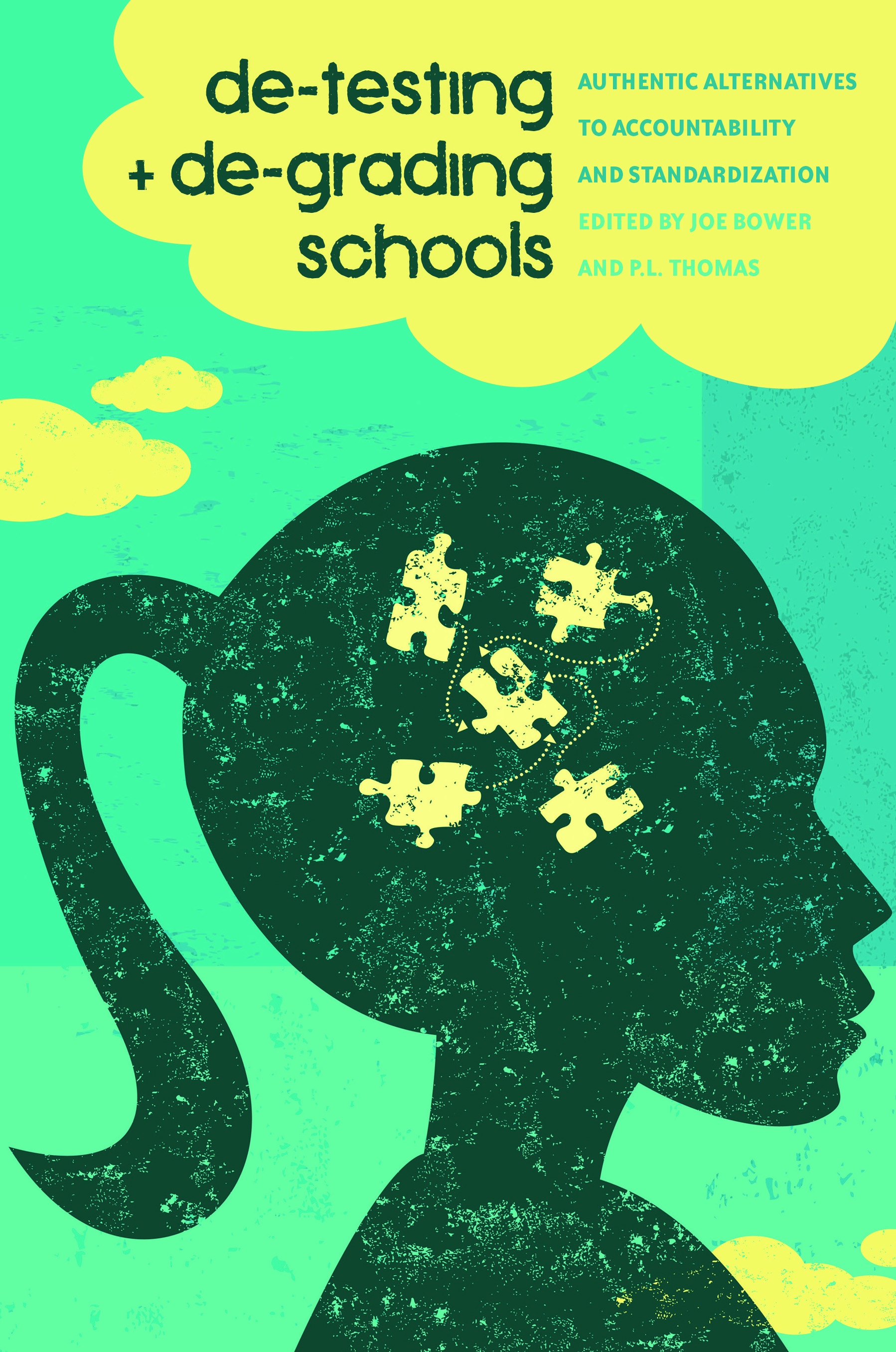
IN PRESS: De-Testing and De-Grading Schools (Peter Lang)

De-Testing and De-Grading Schools: Authentic Alternatives to Accountability and Standardization
Joe Bower and P. L. Thomas, editors

Introduction by Alfie Kohn

Peter Lang USA
Counterpoints Series

cover

Author(s)

Title

Alfie Kohn Introduction: “The Roots of Grades-and-Tests”

Part I: Degrading Learning, Detesting Education: The Failure of High-Stake Accountability in Education

Lisa Guisbond, Monty Neill, and Bob Schaeffer (FairTest.org) Chapter One “NCLB’s Lost Decade for Educational Progress: What Can We Learn from this Policy Failure?”
Fernando F. Padró Chapter Two “High-stakes Testing Assessment: The Deus Ex Machina of Quality in Education”
Anthony Cody Chapter Three “Technocratic Groupthink Inflates the Testing Bubble”
Lawrence Baines and Rhonda Goolsby Chapter Four “Mean Scores in a Mean World”
Julie Gorlewski and David Gorlewski Chapter Five “Degrading Literacy: How New York State Tests Knowledge, Culture, and Critical Thinking”
Morna McDermott Chapter Six “The aesthetics of social engineering: How high stakes testing dehumanizes/desensitizes education”
Richard Mora Chapter Seven “Standardized Testing and Boredom at an Urban Middle School”
Brian Beabout and Andre Perry Chapter Eight “Reconciling Student Outcomes and Community Self-Reliance in Modern School Reform Contexts”
David Bolton and John Elmore Chapter Nine “The Role of Assessment in Empowering/ Disempowering Students in the Critical Pedagogy Classroom”
Part II: De-Grading and De-Testing in a Time of High-Stakes Education Reform
Alfie Kohn Chapter Ten “The Case Against Grade”
Joe Bower Chapter Eleven “Reduced to Numbers: From Concealing to Revealing Learning”
John Hoben Chapter Twelve “Assessment Technologies as Wounding Machines: Abjection, the Imagination and Grading”
Peter DeWitt Chapter Thirteen “No Testing Week: Focusing on Creativity in the Classroom”
Hadley Ferguson Chapter Fourteen “Creating an Ungraded Classroom”
James Webber and Maja Wilson Chapter Fifteen “’Parents Just Want to Know the Grade’: Or Do They?”
P. L. Thomas Chapter Sixteen “De-grading Writing Instruction in a Time of High-stakes Testing: The Power of Feedback in Workshop”
Brian Rhode Chapter Seventeen “Demoralizing, Disengaging, Non-Actualizing Education”
Lisa William-White Conclusion “Striving Towards Authentic Teaching for Social Justice”

Recommended Reading for Educators Trapped in the Machine

from World War Z, Max Brooks

“From that moment on we lived in true freedom, the freedom to point to someone else and say, ‘They told me to do it! It’s their fault, not mine.’ The freedom, God help us, to say ‘I was just following orders.'” (p. 83)

from Engel, M. (2000). The struggle for control of public education: Market ideology vs. democratic values. Philadelphia, PA: Temple University Press.

“[I]t is nothing short of disastrous that more than ever before, one antidemocratic system of ideas—market ideology—almost exclusively defines the terms of educational politics and charts the path of education reform

“…[I]deology is important in understanding educational change….Ideology is nonetheless often overlooked or at best misapplied by mainstream social scientists as a factor in politics. This is due in part to the dominance of quantitative methodologies in political science, which leads to the trivialization of the concept into conveniently measurable but irrelevant labels….Market ideology has triumphed over democratic values not because of its superiority as a theory of society but in part because in a capitalist system it has an inherent advantage.” (pp. 3, 8-9)

from Callahan, R. E. (1962). Education and the cult of efficiency: A study of the social forces that have shaped the administration of the public schools. Chicago: The University of Chicago Press.

“For while schools everywhere reflect to some extent the culture of which they are a part and respond to forces within that culture, the American public schools, because of the nature of their pattern of organization, support, and control, were especially vulnerable and responded quickly to the strongest social forces. . . .The business influence was exerted upon education in several ways: through newspapers, journals, and books; through speeches at educational meetings; and, more directly, through actions of school boards. It was exerted by laymen, by professional journalists, by businessmen or industrialists either individually or in groups. . ., and finally by educators themselves. Whatever its source, the influence was exerted in the form of suggestions or demands that the schools be organized and operated in a more businesslike way and that more emphasis by placed upon a practical and immediately useful education….

“The tragedy itself was fourfold: that educational questions were subordinated to business considerations; that administrators were produced who were not, in any true sense, educators; that a scientific label was put on some very unscientific and dubious methods and practices; and that an anti-intellectual climate, already prevalent, was strengthened.” (pp. 1, 5-6, 246)

Educators: “[N]ot the Time. . .to Follow the Line of Least Resistance”

In a major journal from the National Council of Teachers of English (NCTE), a teacher and scholar laments the current state of implementing the research in language: “A brief consideration will indicate reasons for the considerable gap between the research currently available and the utilization of that research in school programs and methods” (p. 87). [1]

And the discussion of that gap between research and classroom practices leads to this conclusion:

“Most thinking persons agree that the existence of civilized man is threatened today. While language is not food or drink, and will not satisfy the hungry and thirsty, it is the medium by which we must do much of our learning and panning, and by which we must think out solutions to our problems if we are not to solve them by the direct method of force. No sensible person believes that language will cure all difficulties; but the thoughtful person will certainly agree that language is a highly important factor in promoting understanding, and a most dangerous factor in promoting understanding between individuals and between the countries individuals represent. Moreover, language is a significant factor in the psychological adjustment of the individual. This is not the time for the teacher of any language to follow the line of least resistance, to teach without the fullest possible knowledge of the implications of his medium [emphasis added]. Before we, either as individuals or as a Council, experiment with methods of doing specific things or block out a curriculum, let us spend some time with the best scholars in the various fields of language study to discover what they know, what they believe uncertain and in need of study. Let us go to the best sources and study the answers thoughtfully. The game of Gossip is not for us.” (p. 94)

While those of us living our lives as teachers, especially teachers of literacy in K-12 settings or in teacher education, may recognize many points above in our current debates about education reform—including some of the debates that simmer below the surface of the workings of NCTE—this piece is by Lou LaBrant and was published in the January 1947 issue of Elementary English (now Language Arts).

More than six decades after LaBrant wrote about the gap between research and practice, More than six decades after she implores us that “[t]his is not the time for the teacher of any language to follow the line of least resistance,” educators across the U.S. are faced with the failure of leaders, the public, and professional organizations in the face of the promise of universal public education and its potential to drive the great hope we call democracy.

The Locus of Authority: Our Time for Resistance

At the 100th anniversary annual convention for NCTE in Chicago (November 2011), I presented during a panel on the Council’s century of leadership in the field of literacy—reading from the essay above by LaBrant and suggesting how she would have responded to the current calls for Common Core State Standards (CCSS), increased testing, intensified value-added methods (VAM) for teacher accountability linked to those tests, and accelerating mandates driving teacher preparation and accreditation of colleges and departments of education.

I know from my work as the biographer of LaBrant that she was a powerful voice for the professionalism, scholarship, and teacher autonomy—including herself and every teacher with whom she interacted. LaBrant, in fact, during the early 1930s when enrolled in her doctoral program at Northwestern University, faced pressure while teaching English to implement required reading lists, textbooks, and benchmark testing, all of which she knew to be flawed practices.

What did LaBrant do?

She fabricated lesson plans with her roommate, the foreign language teacher, and submitted them each week while practicing the pedagogy she embraced—student choice in what they read and wrote, holistic instruction and assessment of literacy. At the end of the year, LaBrant and her students (yes, in the early 1930s) faced end-of-course testing, and LaBrant’s students received top scores. Consequently, she was praised by the principal in front of the entire faculty for her dedication to the prescribed policies.

This tension between bureaucratic mandates that seek to shift the locus of authority (consider Freire’s distinction between “authoritarian” and “authoritative”) away from the teacher and within the standards and tests designed and prescribed by the state is not entirely new (except for the intensity), but neither is the need for teachers to own their autonomy, their professionalism—to be that resistance.

Also at the 2011 NCTE annual convention, a convention of celebration, Susan Ohanian, Stephen Krashen, Carol Mikoda, Bess Altwerger, Joanne Yatvin, and Richard J. Meyer proposed a resolution: NCTE will oppose common core standards and national tests. [2] This act of resistance, this act of teacher autonomy and professionalism resulted in what Catherine Gewertz in the Curriculum Matters blog at Education Week describes as: “The National Council of Teachers of English was asked by a group of its members to take a strong stand against the common standards, but it declined to do so.”

This is a time when political leaders, the public, and national organizations have abdicated their moral obligation to create and maintain universal public education for all children as a sacred trust between a free people and the promise of democracy.

As the faculty of Garfield High School (Seattle, WA) take a principled stand against MAP testing as a beacon of hope in the fog of corporate education reform, this is also a time for all educators to shine every light of our autonomy on what is right and what is wrong in the day-to-day pursuit of teaching children.

“This is not the time for the teacher of any [student] to follow the line of least resistance, to teach without the fullest possible knowledge of the implications of his medium.”

References

Freire, P. (2005). Teachers as cultural workers: Letters to those who dare to teach. Trans. D. Macedo, D. Koike, & A. Oliveira. Boulder, CO: Westview Press.

Freire, P. (1993). Pedagogy of the oppressed. New York: Continuum.

Freire, P. (1998). Pedagogy of freedom: Ethics, democracy, and civic courage. Trans. P. Clarke. Lanham, MD: Rowman and Littlefield Publishers, Inc.

LaBrant, L. (1947, January). Research in language. Elementary English, 24(1), 86-94.

[1] Originally posted at Daily Kos (November 21, 2011) and cross-posted at Truthout (November 28, 2011). Reposting here as a call for solidarity among educators inspired by the resistance of Garfield High School faculty (Seattle, WA) to the corrosive impact of MAP and other elements of high-stakes testing in U.S. education. The original piece has been revised.

[2] Revised resolution passed: Resolution Proposal to Support: No Confidence in United States Department of Education Secretary Arne Duncan

NFL again a Harbinger for Failed Education Reform?

During the impending NFL strike in 2011—the act of a union—I drew a comparison between how the public in the U.S. responds to unionization in different contexts:

“I am speaking about the possible NFL strike that hangs over this coming Super Bowl weekend: a struggle between billionaires and millionaires, which, indirectly, shines an important light on the rise of teacher and teacher union-bashing in the US. Adam Bessie, in Truthout, identifies how the myth of the bad teacher has evolved.”

Once again, the NFL is facing a situation that I believe and even hope is another harbinger of how education reform can be halted: A suit filed by the family of Junior Seau:

“The family said the league not only ‘propagated the false myth that collisions of all kinds, including brutal and ferocious collisions, many of which lead to short-term and long-term neurological damage to players, are an acceptable, desired and natural consequence of the game,’ but also that ‘the N.F.L. failed to disseminate to then-current and former N.F.L. players health information it possessed’ about the risks associated with brain trauma.”

This law suit has prompted a considerable amount of debate concerning whether or not the NFL as we currently know it could be dramatically reconfigured under the pressure of more law suits. In other words, the inherent but often ignored or concealed dangers of football are now being exposed by legal action, in much the same way as the tobacco industry was unmasked and thus the entire culture of smoking has radically changed in the last couple decades.

With the release of the Education Policy Analysis Archives (EPAA) Special Issue on “Value-Added Model (VAM) Research for Educational Policy,” a similar question should now be raised about the future of implementing high-stakes accountability policies that focus on teacher evaluation and retention through VAM-style metrics.

“High-Stakes Implementation of VAM,…Premature”

Two articles in the special issue from EPAA examines the validity and reliability of VAM-based teacher evaluation in high-stakes settings and then places these policies in the context of legal ramifications faced by districts and states for those policies.

“The Legal Consequences of Mandating High Stakes Decisions Based on Low Quality Information: Teacher Evaluation in the Race-to-the-Top Era” (Baker, Oluwole, & Green, 2013) identifies the current trend: “Spurred by the Race-to-the-Top program championed by the Obama administration and a changing political climate in favor of holding teachers accountable for the performance of their students, many states revamped their tenure laws and passed additional legislation designed to tie student performance to teacher evaluations” (p. 3). Because of the political and public momentum behind reforming teacher evaluation, Baker, Oluwole, and Green seek “to bring some urgency to the need to re-examine the current legislative models that put teachers at great risk of unfair evaluation, removal of tenure, and ultimately wrongful dismissal” (p. 5).

While Baker, Oluwole, and Green offer a detailed and evidence-based examination of the VAM-based and student growth model approaches to high-stakes teacher accountability, they ultimately place the weaknesses of reform policies in the context of potential challenges from teachers who believe they have been wrongfully evaluated or dismissed:

“In this section, we address the various legal challenges that might be brought by teachers dismissed under the rigid statutory structures outlined previously in this article. We also address how arguments on behalf of teachers might be framed differently in a context where value-added measures are used versus one where student growth percentiles are used. Where value-added measures are used, we suspect that teachers will have to show that while those measures were intended to attribute student achievement to their effectiveness, the measures failed to do so in a number of ways. That is, where value-added measures are used to assign effectiveness ratings, we suspect that the validity and reliability, as well as understandability of those measures would need to be deliberated at trial. However, where student growth percentiles are used, we would argue that the measures on their face are simply not designed for attributing responsibility to the teacher, and thus making such a leap would necessarily constitute a wrongful judgment. That is, one would not necessarily even have to vet the SGP measures for reliability or validity via any statistical analysis, because on their face they are invalid for this purpose.”

The analysis ultimately discredits both the use of narrow metrics to determine teacher quality and the high-stakes policies being implemented using those metrics, concluding with the ironic consequences of these policies: “Overly prescriptive, rigid teacher evaluation mandates, in our view, are likely to open the floodgates to new litigation over teacher due process rights. This is likely despite the fact that much of the policy impetus behind these new evaluation systems is the reduction of legal hassles involved in terminating ineffective teachers” (pp. 18-19).

In “Legal Issues in the Use of Student Test Scores and Value-added Models (VAM) to Determine Educational Quality” (Pullin, 2013), the rapid increase of VAM-based accountability is further examined in the context of “a wide array of potential legal issues [that] could arise from the implementation of these programs” (p. 2).

Pullin notes the motivation for reforming teacher evaluation:

“VAM initiatives are consistent with a highly publicized press from the business community and many politicians to make government services more like private business, data-driven to measure productivity and accountability (Kupermintz, 2003). VAM approaches are in part a response to concerns that the current system of selecting and compensating teachers based their education and credentials is insufficient for insuring teacher quality (Corcoran, 2011; Gordon, Kane & Staiger, 2006; Hanushek & Rivkin, 2012; Harris, 2011). There have been increasing expressions of concern that teacher evaluation practices are not robust and do not improve practice (Kennedy, 2010). In the contemporary public policy context, much of the support for the use of student test scores for educator evaluation comes from a concern that the current system for evaluation is ineffective and that the current legal protections for teachers are too cumbersome for schools seeking to terminate teachers (Harris, 2009, 2011).”

While a business model for addressing quality control of a work force may seem efficient, Pullin highlights that legal ramifications are likely with these new models.

Pullin’s analysis offers a detailed and useful examination of previous court cases involving the use of test scores to evaluate educators, including recent cases involving VAM, concluding that the picture is not clear on how the courts may rule in the future, but that a pattern exists of “heavy judicial deference to state and local education policymakers and the allure of using test scores to make decisions about education quality” (p. 5).

Further, Pullin notes “there are differences of perspective among social scientists about VAM and the defensibility of using it to make high-stakes decisions about educators,” further complicating the concerns of legal action (p. 9).

While raising many other complications, Pullin also notes that students and parents may enter legal battles using VAM metrics “to substantiate their own legal claims that schools are not meeting their obligations to provide education” (p. 14).

Pullin concludes with a sobering look at teacher quality reform built on VAM and implemented in high-stakes environments:

“In the broad contemporary public policy context for education reform, the desire for accountability and transparency in government, coupled with heavily financed criticisms of public school teachers and their unions, may mean that VAM initiatives will prevail. The concerns of education researchers about VAM, coupled with legal obligations for the validity and reliability of education and evaluation programs should require judges and education policymakers to take a closer look for future decision-making. At the same time, the social science research community should be generating substantial new and persuasive evidence about VAM and the validity and reliability of all of its potential uses. For public policymakers, there are strong reasons to suggest that high-stakes implementation of VAM is, at best, premature and, as a result, the potential for successful legal challenge to its use is high. The use of VAM as a policy tool for meaningful education improvement has considerable limitations, whether or not some judges might consider it legally defensible.” (p. 17)

Like the NFL, federal and state governments may soon be compelled to reform the reform movement under the threat of legal action from a variety of stakeholders since the science of teacher evaluation remains far behind the curve of implementation, particularly when teacher evaluation is high-stakes and based on VAM and other metrics linked to student test scores.

The special issue from EPAA is yet another call for political leadership to pause if not end wide-scale teacher evaluation and retention models that pose legal, statistical, and funding challenges that those leaders appear unwilling to acknowledge or address.

“A Realistic, Pragmatic Approach” to Rejecting CCSS

“Should Teachers Resist the Common Core?” asks a blog post at Education Week, continuing the debate about CCSS among Larry Ferlazzo, Stephen Krashen, David Cohen, and me.

This posting highlights a point made by David that I want to return to (again) because I agree strongly with David’s focus: “And as for the critics I’ve cited, to my knowledge, none of them is currently a K-12 teacher. That fact does not invalidate their criticisms, but I think it colors their perceptions regarding a realistic, pragmatic approach, here and now, for those of us trying to serve our current students and schools most productively.”

I have argued repeatedly that the central flaw with the current education reform movement and its major elements—CCSS, new high-stakes testing, Teach for America (TFA), value-added methods (VAM) of teacher evaluation, and charter school advocacy, such as Knowledge Is Power Program (KIPP) and the Harlem Children’s Zone (HCZ)—is that these reforms-as-solutions are not based on any clearly identified problems and that the leading advocates themselves have no (or very little) experience and expertise in education.

Let me repeat: I have almost thirty years of combined public high school teaching (18 years), college teaching, teacher education, and scholarship in education that all have occurred during the thirty-year cycle of accountability-driven education reform.

I have ample experience with state standards, state and national (SAT) high-stakes testing, teacher certification, and education accreditation. A central thread of my scholarship over those years has included the negative impact of accountability, standards, and testing on literacy instruction (notably writing) and high-poverty students and schools.

Also let me repeat my answer to the blog title above: Yes, teachers should resist CCSS.

I have already argued for our resistance as part of our teacher agency so I want here to address the obligation teachers have to resist CCSS grounded firmly in our classroom experiences.

I began teaching in the fall of 1984, the exact academic year South Carolina first introduced accountability based on state standards and high-stakes testing. Over the next thirty years, SC has revised those standards three or more times, as well as reformulating our testing at least three times—from BSAP to PACT to PASS (with part of that testing reform driven by a desire to move beyond “basic” [the “B” of BSAP] and to the glory of “challenge” [the “C” of PACT]). In education, it seems, it is all about the branding.

SC and virtually every state in the nation has had decades and multiple versions of standards and high-stakes tests implemented. What is the result? Today no one is satisfied with the outcomes, and the dominant solution is to try the exact same strategy, except at the federal level.

And here is where I wish to assert David’s point as support for my argument: Teachers across the U.S. know from their lived experiences as educators that the bureaucracy of implementing and revising standards and tests over the past thirty years has wasted a tremendous amount of time and funding as well as inhibited our ability to teach and ruined learning opportunities for students—especially in high-needs schools.

Three decades of the accountability era with its standards and high-stakes testing have not improved teaching, have not increased learning, have not closed the achievement/opportunity gap, have not solved the drop-out problem, and have not succeeded in a single claim of made by political advocates of any aspect of this movement.

Why? Because the accountability model built on standards and high-stakes testing is the wrong solution and a complete failure of acknowledging the problem. Educational problems in the U.S. are not a lack of accountability, a lack of standards, or a lack of testing. In fact, increasing all three has increased the real problems because they are distractions from facing the tremendous inequity of opportunity facing children in the U.S. both in their lives and then in their schools.

Teachers must reject CCSS, and we must do so in a collective voice of our experiences in the exact environments of accountability that we know have done more harm than good to the children we serve every day.

Nothing is more real or practical than that.

Fatalism and Teacher Professionalism

Blogging at Education Week, Larry Ferlazzo posted a series of blogs addressing ways to prepare students for Common Core State Standards (CCSS) in English/Language Arts. In a response post, Ferlazzo and Stephen Krashen—an outspoken scholar, along with Susan Ohanian, who steadfastly rejects implementing CCSS and the inevitable tests to follow—shared a series of exchanges.

Krashen, in part, argues that implementing flawed practice simply because CCSS requires them is inexcusable:

No. There is no evidence supporting this view. There is massive evidence for the superiority of comprehensible input/reading as by far the best way (really the only way) to develop academic vocabulary and academic writing. Just because the common core demands these competencies, doesn’t mean we should use ineffective and painful methods to try to teach them.

Ferlazzo takes a different view, one committed to implementing CCSS as well as possible since their adoption is a done deal, he believes:

I can think of no realistic political scenario that would stop Common Core from being implemented for at least ninety percent of millions of teachers and students in the United States. I have also not heard anyone else share one, though I am all ears….

Given that political reality on the ground, I think the political capital of teachers, students and their families is better spent on other issues that also affect the working and learning conditions in our schools and the living conditions in our communities — teacher evaluation procedures, adequate funding for schools, class size, parent engagement — just to name a few. In my political judgment, teachers and their allies are much more likely to be able to influence those issues.

While I think it’s useful to debate which instructional strategies might be most engaging and effective for our students and also enable teachers to say they are implementing Common Core, I just [think] it’s less useful to fight a battle that has already been lost.

Given the tremendous political, professional, and commercial momentum behind CCSS, Ferlazzo appears to have a solid point. But this exchange raises an important question about fatalism and teacher professionalism that is much larger than just debating CCSS

Fatalism and Teacher Professionalism

The debate between Ferlazzo and Krashen mirrors a similar debate within the National Council of Teachers of English, one in which Krashen, Ohanian, and I have had little success as we have argued for teacher professionalism and autonomy instead of implementing CCSS and preparing students for the tests with commercial materials focusing on those standards and the new tests.

Concurrent with the debate at EdWeek, as well, has been faculty at Garfield High School refusing to implement MAP testing. Jesse Hagopian, a teacher at Garfield, explains:

America faces incredible challenges: endless war, climate change and worldwide economic implosion. Our kids will need both traditional academic abilities and innovative critical-thinking skills to solve these real problems. If we inundate our students with standardized testing year-round, these larger lessons are lost.

Garfield’s teachers are preparing students for the real-life tests they will face, and reject the computer multiple-choice rituals that fail to measure grade-level content — not to mention character, commitment, courage or talent.

Since this act of professional conscience by Garfield teachers, a group of educators has issued a statement of support, rejecting the misuse and abuse associated with high-stakes standardized tests.

If implementing CCSS is inevitable as Ferlazzo claims and if school, district, state, or federal mandates will continue to support those standards and the related high-stakes tests, teaching is reduced to an act of fatalism, and in effect, teachers are de-professionalized and students are similarly reduced to passive recipients of state-mandated knowledge, what Paulo Freire (1998) labeled as “the bureaucratizing of the mind” (p. 102).

Fatalism about inevitable education reform or current policy and practices benefits neither students nor teachers—and ultimately devalues education in a free society.

For students, Freire challenges the prescriptive nature of standards and high-stakes testing stemming from a neoliberal ideology:

If I am a pure product of genetic, cultural, or class determination, I have no responsibility for my own action in the world and, therefore, it is not possible for me to speak of ethics….It means that we know ourselves to be conditioned but not determined. It means recognizing that History is time filled with possibility and not inexorably determined—that the future is problematic and not already decided, fatalistically….The most dominant contemporary version of such fatalism is neoliberalism….From the standpoint of such an ideology, only one road is open as far as educative practice is concerned: adapt the student to what is inevitable, to what cannot be changed. In this view, what is essential is technical training, so that the student can adapt and, therefore, survive. This book…is a decisive NO to an ideology that humiliates and denies our humanity. (pp. 26-27)

If teachers, then, see CCSS implementation or fulfilling ploicies to implement MAP testing as requirements of their role as compliant workers, they have succumbed to “conformity in the face of situations considered to be irreversible because of destiny,” Freire explains (1998, p.102). Then, “To that degree, there is no room for choice. There is only room for well-behaved submission to fate. Today. Tomorrow. Always,” Freire believes, adding, “I have always rejected fatalism. I prefer rebelliousness because it affirms my status as a person who has never given in to the manipulations and strategies designed to reduce the human person to nothing” (pp. 102-103).

And here is where I must side with Krashen.

To see CCSS or MAP testing as inevitable, to see our roles as educators being reduced to technicians working to implement CCSS or MAP testing as well as possible, to allow students to be reduced to “a pure product of genetic, cultural, or class determination” is to render both teachers and students fatalistic—both as tools of others’ determinations and as products of those who create the inevitable system.

The financial, cultural, and human costs of fatalism are simply too high.