Category Archives: Testing

My Transition to Emergency Remote Teaching

Across my undergraduate and graduate courses in education, I stress the importance that all educators have a detailed understanding of the educational philosophies and theories that they claim to embrace as well as if their practices match those claims.

Teachers, however, are a practical lot, and most pre-service and in-service teachers resist my argument.

The somewhat abrupt move to remote teaching that has occurred during the Covid-19 pandemic has emphasized for me, again, that the value in educational philosophy/theory and how that matches practice cannot be overemphasized.

While my philosophy/theory and practice are well outside the norms of mainstream, traditional schooling—and that causes stress and anxiety for many of my students, at least temporarily—I was incredibly well prepared to shift my courses to remote and individualized structures within an hour of addressing my schedules (see foundations of education and scholarly reading and writing).

The entire transition is now being handled by email, smart phones (text, Facetime, phone calls), and the blogs linked above. I prepared no Zoom meetings and no video lectures.

In fact, the scholarly reading and writing course is not much different than it would have been without the shift except that we no longer sit together in the same room every Monday evening.

Here are the ways in which my educational philosophy/theory and practice have provided the foundation for moving quite easily to remote asynchronous learning:

  • While I am just noticing the online terminology (asynchronous v. synchronous), I have practiced individualized instruction (asynchronous) for the vast majority of my 36 years of teaching. Throughout my 18 years teaching high school English, I experimented with and refined workshop methods with both writing and literature instruction; therefore, my courses are often designed around students working on holistic and authentic products of learning that are developed over drafts.
  • Individualized instruction that focuses on authentic artifacts of learning is nested inside my larger commitment to student-centered teaching. I start with each student and genuinely place content and so-called skills secondary. I try to begin with student reactions (reflections on readings, drafts of assignments) and then drive instruction with what students know, what students do not yet know, and student misconceptions.
  • As a writing/composition instructor, I tend to function as a teacher by responding to student work as submitted; being “on” for students throughout the day and responding to student work as it is submitted may be stressful for some teachers, but I already function that way, which lends itself well to the necessary asynchronous nature of remote teaching.
  • My courses are supported by checklists, models, and support material that I always prompt students to use before they rely on my help; I see my overarching goal as a teacher as making myself unneeded, fostering intellectual autonomy in my students. “Take your time. You can do this on your own” is essentially the soft message I am whisper behind all that I do.
  • All of my courses are managed by a low-technology commitment; I am neither a no-tech Luddite, nor a technology evangelist. My courses are all on WordPress platforms, easily and freely accessible to anyone, not just students. My students and I already interact by email and through a fairly sophisticated use of Word (comments, track changes, etc.). This low-technology approach allowed me to shift remotely in minutes, sacrificing only a few elements of my teaching (which I discuss below).
  • I teach by inviting students to have shared experiences, but I do not suffer the illusion that those experiences can or will guarantee the same outcomes. I feel far more concerned about fostering ways of learning than covering and asking students to perform to a set of disciplinary knowledge. Thus, I have no standard lectures to video for students to view, although I often ask students to read shared texts that give us some foundation for thinking deeply or at least harder about topics.
  • Throughout my career I have been anti-grades/tests, but in the reality of traditional schooling, my approach is best described as delaying grades—although I do not give any sorts of tests. While many teachers are struggling with assessment (implementing tests, assigning grades on assignments) when moving to remote teaching, my portfolio approach (course grade assigned based on a final portfolio submitted of all work) hasn’t needed to be adjusted for my shift to remote teaching.

Yes, I have made the transition to remote teaching fairly easily; however, I am not suggesting that there haven’t been costs, things lost in the shift. Those losses and concerns include the following:

  • A key aspect of my educational philosophy/theory is that I am solidly anti-online courses; I remain a strong advocate for the traditional classroom structures in which teachers and students interact face-to-face. I am not convinced that the amount of face-to-face class time traditionally practiced is necessary, and I certainly practice a great deal of one-on-one conferencing. However, remote instruction can never match the power of in-person classroom dynamics.
  • Class sessions for me include two major structures: workshop or discussion. Workshop has transitioned remotely quite well, but I have abandoned the discussion element, recognizing that is a major sacrifice. Here, I must distinguish between remote teaching in a crisis and creating a course online (in which synchronous sessions over some App would allow discussion). In the Covid-19 crisis, I have elected not to add the stress of designated days/times to meet as a class. However, I genuinely cannot imagine that online discussions can meet the level of in-person class dynamics create, when we all can make eye contact and be “in the moment” together of discussions.

In one way, the sudden shift to remote teaching also fit well into my educational philosophy/theory that requires me to be vigilant about critical reflection on my role as a teacher, and a human being. I never see any of my practices as “fixed,” always in reflective flux.

The Covid-19 pandemic forced me to reconsider a course mid-stream, but I am prone to doing that most of the time any way.

My teacher personae is a contradictory mix of external self-assurance tempered by a pervasive fear that I am failing my students. As I worked diligently to transform my classes, I monitored my own practices against my educational philosophy/theory (checking what I had planned as well as what I revised and expected of students).

I remain, then, resolute in this belief: Our day-to-day teaching in so-called normal times always benefits from recognizing what our educational philosophy/theory is and how well our practices remain grounded in those commitments.

Standards in K-12 Education: A Reader

Recently, Gerald Coles confronted the newest round of the Reading War that once again centers phonics instruction. One of Coles’s points is how keeping the education reform gaze on an instructional practice (phonics) allows reform to ignore the more substantial and causal elements surrounding teaching and learning—socio-economic, racial, and gender inequities.

The now four-decades long venture into accountability grounded in standards and high-stakes testing has revealed one paradoxical and often ignored fact: The problems with teaching and learning have almost nothing to do with the presence or quality of high-stakes standards.

Currently, we are seeing a wave of acknowledgements that Common Core now has fallen into that pattern of failure.

The research base on standards has been consistent in showing that the accountability process fails; see below:

Mississippi Miracle, Mirage, or Political Lie?: 2019 NAEP Reading Scores Prompt Questions, Not Answers [Update September 2023]

Update September 2023

Grade Retention Harms Children, Corrupts Test Data, But Not a Miracle: Mississippi Edition

UPDATE

CRUMBLING SCHOOLS, DISMAL OUTCOMES: Alexander v. Holmes County Board of Education was supposed to change everything for Southern black children, Bracey Harris

UPDATE 15 February 2022

Opinion: Reeves’ Education Mirage

Key points:

To make his case, Reeves — much like the Mississippi Department of Education itself — is chronically selective in his statistics, telling only part of the story and leaving out facts that would show that many of these gains are either illusory or only seem to be impressive because the state started so far behind most of the rest of the nation….

Even the state’s impressive improvement on the National Assessment of Educational Progress may not be quite all that it seems.

From 2013 to 2019, the latest year for which results are available, Mississippi students rose faster in fourth grade reading than anyone on the national test. They improved their ranking from 49th to 29th. The gains in math were even more impressive, jumping from 50th to 23rd during that same time frame.

Reeves attributes the progress to “third grade gate,” the reform pushed through by Republicans in 2013 that requires third graders to demonstrate they are at least minimally proficient in reading before they advance to fourth grade.

The Republican belief is that the threat of having to repeat a grade has prompted students, their families and teachers to work harder to be sure that doesn’t happen.

Another interpretation has been offered, though. It’s that because of third grade gate, Mississippi’s lowest performing students get an extra year of instruction before they take the fourth grade test. With the state failing more than twice as many students in their early years as the national average, that could create a significant advantage, though probably a short-lived one.

The research remains inconclusive on this point. It’s not on the others.

REEVES’ EDUCATION MIRAGE

UPDATE 7 December 2022

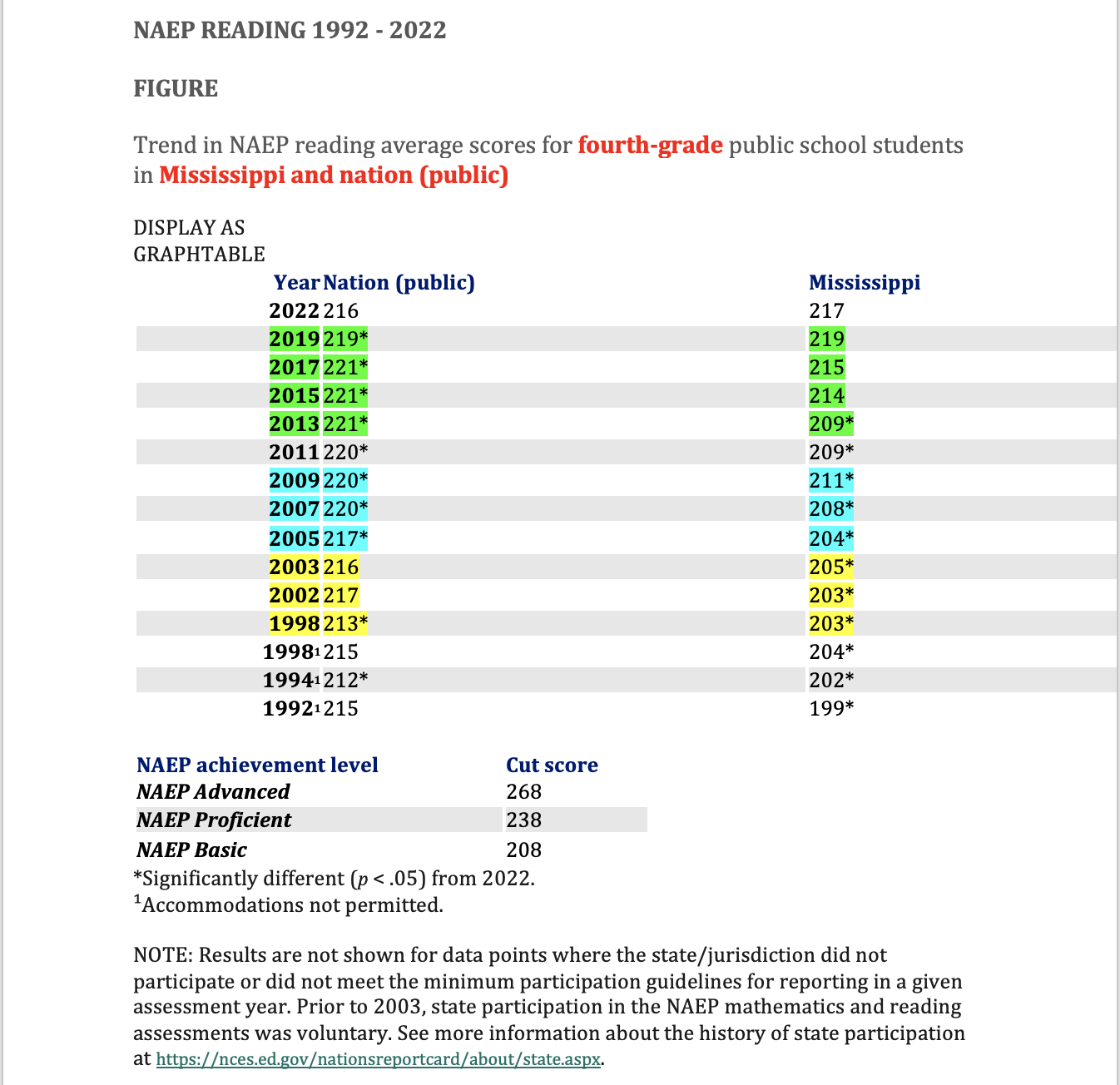
Note the trends in Mississippi’s NAEP Reading scores from 1992 through 2022 and the contrast between grade 4 and grade 8:

Note that Mississippi’s grade 4 reading scores on NAEP show:

  1. MS has steadily improved scores over thirty years despite adopting different reading programs, implementing different state standards, and reforming with multiple reading policies.
  2. MS has had two large gains—one from 2005 to 2009, 7 points, and one from 2013 to 2019, 10 points, dropping to 8 with 2022—raising a question about the role of SOR legislation since that first large gain is pre-SOR.
  3. MS remains well below proficient on average, similar to other high-poverty states.

Note that Mississippi’s grade 8 reading scores on NAEP show:

  1. Apparent “gains” made in grade 4 have disappeared by grade 8 (consistent with research on systematic phonics instruction for reading).
  2. MS grade 8 scores on reading have remained relatively flat for 24 years.
  3. MS grade 8 larger increases happened in 2002-2003 and 2017-2019, again one well before and another after SOR legislation.

UPDATE 4 July 2023

Column: How Mississippi gamed its national reading test scores to produce ‘miracle’ gains (see HERE also)

MISSISSIPPI’S MIRACLE: Do we really have a “Mississippi mirage?”

MISSISSIPPI’S MIRACLE: Has the revolution reached the eighth grade?

UPDATE: Mississippi reading isn’t so miraculous after all


Mississippi Miracle, Mirage, or Political Lie?: 2019 NAEP Reading Scores Prompt Questions, Not Answers

There is a disturbing contradiction in the predicted jubilant response to Mississippi’s outlier 4th-grade results from the 2019 NAEP reading test. That contradiction can be found in a new article by Emily Hanford, using Mississippi to recycle her brand, a call for the “science of reading.”

This is a great deal to ask of the average reader, but Hanford’s argument is grounded in a claim that most students in the U.S. are being taught reading through methods that are not supported by scientific research (code for narrow types of quantitative research that can identify causal relationships and thus can be generalized to all students).

However, the contradiction lies in Hanford’s own concession about the 2019 NAEP reading data from Mississippi:

The state’s performance in reading was especially notable. Mississippi was the only state in the nation to post significant gains on the fourth-grade reading test. Fourth graders in Mississippi are now on par with the national average, reading as well or better than pupils in California, Texas, Michigan and 18 other states.

What’s up in Mississippi? There’s no way to know for sure what causes increases in test scores [emphasis added], but Mississippi has been doing something notable: making sure all of its teachers understand the science of reading.

To be fair, there is a way to know, and that would be conducting scientific research that teases out the factors that can be identified as causing the test score changes in the state.

In her missionary zeal for the “science of reading,” Hanford contradicts herself by taking most of the article to imply without any scientific evidence, without any research, that Mississippi’s gains are by her fervent implication a result of the state’s embracing the “science of reading”: “In 2013, legislators in Mississippi provided funding to start training the state’s teachers in the science of reading.”

Let me stress here a couple points.

First, scientific research connecting classroom practices to NAEP test scores is rare, but in the 1990s, comparative data were released on 1992 scores in 1997. That research showed a possible link between whole language practices and higher NAEP scores—something that Hanford and her “science of reading” followers may find shocking since they routinely claim that whole language and balanced literacy are not scientifically supported.

Therefore, it is simply far too soon after the release of the 2019 NAEP scores to suggest any relationship between classroom practices (as if they are uniform across an entire state) and NAEP scores. Any implications about Mississippi are premature and irresponsible to make for journalists, politicians, or advocates for education.

Premature and irresponsible.

Second, data from Mississippi are more than 4th-grade 2019 reading—if we genuinely want to know something of value about teaching children to read.

Mississippi’s outlier 4th-grade reading scores are way more complicated once we frame them against longitudinal NAEP scores as well as 8th-grade reading scores. These, then, are more data we should using to ask questions about Mississippi instead of making rash and unscientific claims:

MS reading grade 4 trend

4th grade reading trends

MS score gaps grade 4

4th grade score gaps

MS reading grade 8 trend

8th grade reading trends

MS score gaps grade 8

8th grade score gaps

Here are some complicated takeaways from this larger picture:

  • If the “science of reading” is the cause of recent gains in 4th-grade reading in MS, how do we explain that MS has seen a trend of increased scores since 1998 and pretty significant jumps between 2005 and 2009[1], well before the shift identified by Hanford in 2013?
  • Why does MS still show about the same gaps between Black and white students as well as between socioeconomic classes of students since 1998 if how we teach reading is the key factor in achievement?
  • And a really powerful question concerns 8th grade: Are any 4th-grade gains by MS (or any state) merely mirages since many states with 4th-grade gains see a drop by 8th grade and since longitudinal 8th-grade scores are mostly flat since 1998?
  • UPDATE: Todd Collins has raised another important caveat to the 4th-grade reading gains in Mississippi because the state has the highest 3rd-grade retention percentages in the country:

But Mississippi has taken the concept further than others, with a retention rate higher than any other state. In 2018–19, according to state department of education reports, 8 percent of all Mississippi K–3 students were held back (up from 6.6 percent the prior year). This implies that over the four grades, as many as 32 percent of all Mississippi students are held back; a more reasonable estimate is closer to 20 to 25 percent, allowing for some to be held back twice. (Mississippi’s Department of Education does not report how many students are retained more than once.)

This last concern means that significant numbers of students in states with 3rd-grade retention based on reading achievement and test scores are biologically 5th-graders being held to 4th-grade proficiency levels. Grade retention is not only correlated with many negative outcomes (dropping out, for example), but also likely associated with “false positives” on testing; as well, most states seeing bumps in 4th-grade test scores also show that those gains disappear by middle and high school.


UPDATE

(USDOE/Office of Civil Rights) – Data 2017-2018

Sources


Ultimately, if anyone wants to argue that how we teach reading in the U.S. must be grounded only in a narrow view of “scientific” (and that is a terrible argument, by the way), then any claims we make about the effectiveness of those practices must also be supported by scientific research.

Despite efforts to make Mississippi a shining example of how all states should address reading policy, we should be using Mississippi (and the 29 states scoring higher) to examine all the factors contributing to why students achieve at the levels they do on NAEP reading.

Unless of course we have real political courage and are willing to admit that NAEP and any form of standardized testing are the wrong way to make these decisions.

Here’s something to think about in that regard: As long as we use this sort of testing, we will always have some states above the average, several at the average, and some below the average—resulting in the same nonsensical hand wringing we see today that is no different than any decade over the last 100 years.

I recommend instead of all the scientific research needed to make any fair claim, we stop the testing, make teaching and learning conditions better, make the lives of children and their families in the U.S. better, and do the complicated daily work it requires to serve the needs of all students.


NOTE

[1] Hanford contradicts herself again and open the door to another question:

For years, everyone assumed Mississippi was at the bottom in reading because it was the poorest state in the nation. Mississippi is still the poorest state, but fourth graders there now read at the national average. While every other state’s fourth graders made no significant progress in reading on this year’s test, or lost ground, Mississippi’s fourth-grade reading scores are up by 10 points since 2013, when the state began the effort to train its teachers in the science of reading. Correlation isn’t causation* [emphasis added], but Mississippi has made a huge investment in helping teachers learn the science behind reading.

There is an 8-point jump in 4th-grade reading in MS from 2002 to 2009—well before the 2013 shift to the “science of reading”—thus how is that explained? [UPDATED]

* For the record, causation is a key component of “scientific,” which Hanford espouses for reading, yet she stoops to correlation (not scientific) to make her argument.

In the News

These SC colleges don’t require SAT, ACT scores for admission. Here’s why, Ariel Gilreath (The Greenville News)

Gatekeepers of college education

Paul Thomas, a professor of education at Furman University and educator for 36 years, said that although creators of standardized tests have been working against bias for decades, they are still biased.

“There’s quite a lot of body of research that standardized tests are far more strongly correlated with out-of-school factors than they are to in-school factors,” Thomas said. “Standardized tests are a stronger reflection of factors beyond a child’s control than they are of a child’s ability.”

Among Thomas’ critiques of using standardized tests like the SAT are flaws that other critics have pointed out — that some students are bad test-takers, that poorer students are less likely to have access to test preparation materials and tutors, that the outcome of a high-stakes test could be determined on whether the student slept well the night before.

“The SAT is one data point from one time period. GPA is dozens of data points over years,” Thomas said. “GPA is a single number that is a richer data point.”

But Thomas’ biggest critique of the SAT and ACT is their use as gatekeepers for college education.

“The SAT and ACT are gatekeepers that are not good data for student ability, and they’re not good data for who deserves to go to college,” Thomas said.

The weight of SAT and ACT scores in admissions decisions also make it an easy target for misuse — a test administrator in Los Angeles was central to a lucrative scheme discovered earlier this year where student scores were fixed by a tutor who took the test for them or corrected their incorrect answers.

While the number of test-optional schools in the country are rising, Thomas said the path to reducing standardized testing in education is a difficult one — annual standardized scores are widely published and often used to rank state education systems and even individual schools.

“The SAT and the ACT are very powerful. These are organizations that generate a huge amount of money,” Thomas said. “Americans believe in this stuff.”

Swastikas and ‘sexually explicit’ graffiti found at Furman University dorm, Ariel Gilreath (The Greenville News)

Paul Thomas, a professor of education at the school, said in an email to his students that the graffiti was “neither funny nor inconsequential.”

“Where you live these four years and where you learn, I think, are sacred spaces – and while no one can promise these spaces will be perfect, we must all work diligently to insure they are safe and inclusive,” Thomas said in the statement.

The Great Accountability Scam: High-Stakes Testing Edition

Among other teachers and education scholars, I have been making a case throughout my 36 years in education that has prompted mostly derision from edureformers, politicians, the media, and “no excuses” advocates; the position grounded in evidence includes:

  • Standardized and high-stakes tests are weak proxies for student achievement and teacher/school quality but powerful proxies for the socioeconomic status of students’ homes and communities.
  • And thus, important contributions made by teachers and schools to student learning are very difficult to measure or identify in any direct or singular way (either in a one-sitting test or linked to one teacher over one course, etc.).
  • Accountability structures do not and cannot reform in any substantive way teaching and learning; in fact, high-stakes standards and testing are likely to impact negatively complex and powerful teaching and learning in the name of democracy, human agency, and equity.
  • All in-school-only education reform, then, will appear to (and actually) “fail” as long as public policy does not first or concurrently address socioeconomic inequities such as healthcare, work quality and stability, food insecurity, safety and justice, etc.
  • Social and educational reforms are extremely complex and take far more time than political and public impatience allows; however, the proper political will should shift the U.S. social and educational reform toward an equity structure (not an accountability structure) in order to see observable positive change over time.
  • In-school equity reform must address teacher assignments, de-tracking course access, fully funding all in-school meals, fully publicly funding K-16 education, school discipline and dress codes grounded in restorative justice and race/class/gender equity, and student/teacher ratios.

Historically and currently, public education—as well as charter schools and private schools—serve well the students with the most race, class, and gender privileges and mis-serve inexcusably the most vulnerable students—black and brown students, English language learners, special needs students, and impoverished students.

Accountability does not and cannot address that gap; high-stakes testing measures that gap and often increases the inequity since the stakes are tied to gatekeeping in education and society.

Formal education in the U.S. has mostly reflected and perpetuated our national and regional inequities, and the claim that schooling is a “game changer” remains a deforming myth.

As a recent additional source of evidence for my claims, please see this study by Kenneth Shores, Pennsylvania State University and Matthew P. Steinberg, George Mason University:

The Great Recession was the most severe economic downturn in the United States since the Great Depression. Using data from the Stanford Education Data Archive (SEDA), we describe the patterns of math and English language arts (ELA) achievement for students attending schools in communities differentially affected by recession-induced employment shocks. Employing a difference-in-differences strategy that leverages both cross-county variation in the economic shock of the recession and within-county, cross-cohort variation in school-age years of exposure to the recession, we find that declines in student math and ELA achievement were greater for cohorts of students attending school during the Great Recession in communities most adversely affected by recession-induced employment shocks, relative to cohorts of students that entered school after the recession had officially ended. Moreover, declines in student achievement were larger in school districts serving more economically disadvantaged and minority students. We conclude by discussing potential policy responses. (Abstract)

Minus 5: How a Culture of Grades Degrades Learning

About midway through my first 18 years in education as a high school English teacher, I had mostly de-graded and de-tested my courses except, of course, for having to comply with mandates such as midterm/final exams and course grades.

At some point, my students and I began to openly parody grade culture in a sort of wink-wink-nod-nod way that included my saying “Minus 5!” any time a student offered an incorrect answer during a class discussion.

We all smiled and laughed.

As I approach the same amount of time in the second wave of my career as an educator, now a university professor at a selective college, I continue to use that skit, adding at times a “Plus 10!” with exuberance when someone offers something really thoughtful.

My college students are hyper-students, having been very successful in school for many years while receiving as well as expecting high grades because of the student-skills they have developed.

Despite my careful and detailed explanations upfront that I do not grade and do not give tests, these college students struggle, some times mightily, in a de-graded classroom. Once, for example, a student emailed me about how to make up the “minus 5” I had taken away in the class discussion.

This semester in my educational foundations course and an upper-level writing/research course, many of the greatest flaws with grading culture have sprung up once again.

Even as we approach the end of the semester, I have had several students email me asking for extensions on submitting their major essay. I have to carefully reply that the concept of an extension isn’t relevant in a course that doesn’t grade and is grounded in the requirement that all assignments must be completed fully (and ideally on time) and resubmitted in a final portfolio.

In all of my courses, essays must also be submitted in multiple drafts or I cap the final course grade.

I explain repeatedly to my students that we are here to learn and that if I focus on artifacts of their learning while requiring that all work be completed fully, I have no option other than accepting late work, and they have no real option except to submit work late if they cannot meet deadlines.

Yet, my college students often cannot fathom any other system except the culture of grading that they have navigated quite well for many years.

Broadly, as an educator, I am daily disturbed by witnessing my students trapped in a grade mentality and not a learning mentality. As I have explored many times, the rewards/punishments elements of grading discourages risk and even effort in students and thus weakens the learning process that often requires a series of flawed efforts by students combined with mentoring from a teacher who requires and encourages informed revised efforts.

School at all levels, however, is just a statistical wrestling match between students and grade culture in which some students persist, hoping to excel, and many students simply try to survive in order to find some sort of freedom at the end.

Over the past couple of weeks, my educational foundations students have been submitting their major essay. I purposefully scaffold this assignment by having students present in groups earlier in the semester; those group presentations include focusing on students finding high-quality research for their topics and (for many) learning some basics of APA citation (the preferred style sheet in education).

I refuse to provide groups feedback on the group presentations until the group submits a correct and adequate references list for their sources used. This strategy lays the groundwork for each member having a start on sources for their individual essay and for my students to become somewhat acclimated to my minimum requirements approach to assignments (contrasted with grading).

Major cited essays are powerful windows into how a culture of grades degrades learning.

Students are provided a sample APA cited essay with notes and several checklists for preparing and revising an essay using APA citation; much of this is meticulously covered in class as well.

I also schedule some workshop time in class to help students with both trivial and significant elements of preparing a document in Word (headers can be a nightmare using APA). Then, as the first submission due date approaches, I stress that I will not provide feedback unless students submit a full first draft that includes some fundamental elements of formatting and citation [1].

However, as I experience every semester, several students submitted essays that were unacceptable (let me emphasize here, that when I reject these essays, the only recourse is that students address this problem by submitting a minimally acceptable draft as soon as possible, and I will meet with them if they are unsure how to do that despite the ample support I have already provided).

This included essays submitted without adequate sources (I stress the need to use peer-reviewed journal articles as the foundation of their sources, but also encourage a variety of sources), without a references list on the document, with a reference list but no citations in the essay, with some jumbled hybrid of MLA (usually the references list labeled “Works Cited” and then the bibliographies a wild Frankenstein’s monster of formatting), or as a document clearly in an early stage of brainstorming—what they would consider drafting—such as huge gaps between paragraphs, different colored fonts, and their own comments to themselves scattered throughout.

I have this happen despite stressing repeatedly they should submit the first draft of the essay as if they can never revise.

These dynamics in a degraded class that emphasizes authentic artifacts of learning and provides students ample opportunities to revise their work with my feedback in the form of comments on their work and conferences highlight that many students are unable to break free from a culture of grading, even when provided the opportunity.

Most students simply have their grades lowered when they fail to format and cite properly; that process tells them that these things really do not matter.

Yet, in my work as a scholar, I know that part of the authority a writer gains if from the trivial (formatting documents) and the essential (finding, understanding, and incorporating high-quality sources).

A culture of grading allows both students and teachers to be lazy about the things we claim to care about the most, such as authentic learning that translates into the so-called real world.

Once again, I have watched as several students have become angry at me and deeply frustrated by a process that is both requiring and supporting them to learn, in some cases for the first time, aspects of being a scholar that benefits them across their work as students and then in their lives after that.

What some are framing as “mean,” however, is a tenacity on my part that often results in students coming to understand and then apply the very things we sought to learn. But that process is unnecessarily painful because of the culture of grades that, in fact, asks less of students and teachers.

The culture of grades remains incredibly powerful in formal schooling, and as I discover time and time again, it makes the work of teaching and learning nearly impossible.

In the wake of this essay assignment and many of my formerly happy students struggling, my “Minus 5” rings a bit hollow these days among the tense faces of really bright young people more concerned about their grades than anything class has to offer.


[1] From my checklist, for example:

Checklist for Revising Cited Essay

Format in APA

[ ] Entire Word document (including header) is in Times New Roman, 12 pt. font, and double-spaced

[ ] Cover page has “Different First Page” checked, and running head formatted as follows:

Running head: RUNNING HEAD IN ALL CAPS                                                                1

[ ] Page 2 and beyond has running head only, as in:

RUNNING HEAD IN ALL CAPS                                                                                        2

[ ] Except for new paragraphs, do NOT format page breaks (cover page to page 2 and final page to references) with returns and do NOT format hanging indents or block quotes with return>tab.

[ ] Include a few subheads to organize the essay, but a subhead should be several paragraphs (not one), and avoid “Conclusion” as your final subhead (be interesting and specific).

Style and Citation in APA

[ ] Do not announce sources (avoid referring to the author[s] and titles of your sources when citing research) in your discussion.

[ ] Prefer synthesis of multiple sources and discussing the conclusions (patterns) from those sources—and thus, avoid quoting and simply cataloging one source at a time.

[ ] Take care with proper APA parenthetic citation; note the use of commas, page numbers with quotes only, and the placement of periods, for example:

Ironically, of course, we almost never hear a word of protest about the abundant misinformation found in our U. S. history textbooks (Loewen, 1996; Zinn, 1995), primarily because the misinformation better supports the meritocracy myth our schools are obligated to promote for the good of the society.

While Greene (1978) argues that “democracy is and has been an open possibility, not an actuality”—thus requiring “the kinds of action [by teachers] that make a difference in the public space” (pp. 58, 59)—the reality of school’s focus on socialization is that we are committed to capitalism above all else, even at the expense of democracy (Engel, 2000).

Recent scholarship on this concern for diversity and the achievement gap among races and socioeconomic groups has shown that when we attempt institutional approaches to “critical issues,” the result is corrupted by the system itself, resulting in a widespread acceptance of the work of Ruby Payne (1996), work that has no research supporting the “framework” and work that reinforces the assumptions (deficit thinking) about race and diversity that are common in our society (Bomer, Dworin, May, & Semingson, 2008; Bomer, Dworin, May, & Semingson, 2009; Dudley-Marling, 2007; Gorski, 2006a; Gorski, 2006b; Gorski, 2008; Thomas, 2009).

[ ] Parenthetical citation of paraphrased or synthesized sources require including the author(s) last name and publication year the FIRST time in each new paragraph, but multiple uses after that include ONLY the last name. Do not have several in-text citations over multiple paragraphs if all of the citations are paraphrasing. For example:

Greene (1978) is exploring the central dilemma offered by John Dewey, a dilemma that has been misunderstood at best and ignored at worst: Dewey “knew that optimism, demands for conformity, and ‘riotous glorification of things “as they are”’ discouraged critical thought” (p. 62). In U.S. society, and thus schools, critical challenges are popularly viewed as outright rejections. Within critical pedagogy, the challenges to assumptions are seen as fruitful, an essential part of process toward emancipatory practice, toward the ideal of democracy as “an open possibility” (Greene, p. 58).

[ ] Do NOT include hyperlinks in bibliographies in your references lists from your library searches (ebsco, galegroup links) or from jstor for hard-copy sources (includes page numbers).

Operation Varsity Blues: One Corrupt Tree in the Forest of White Wealth Privilege

It’s called the American Dream because you have to be asleep to believe it.

George Carlin

Andrew Lelling, the US attorney for Massachusetts, made a nearly laughable opening claim in his press conference about a college admissions scandal named “Operation Varsity Blues”:

“This case is about the widening corruption of elite college admissions through the steady application of wealth combined with fraud,” Lelling said. “There can be no separate college admission system for the wealthy, and I’ll add that there will not be a separate criminal justice system either.”

He added, “For every student admitted through fraud, an honest, genuinely talented student was rejected.”

Nearly laughable, in part, because this grandstanding of justice wants to proceed from the position that discovering the wealthy gaming a system they already control is somehow shocking (it isn’t), and nearly laughable as well because Lelling offered as context and with a straight face the following:

We’re not talking about donating a building so that a school’s more likely to take your son or daughter.

We’re talking about deception and fraud – fake test scores, fake athletic credentials, fake photographs, bribed college officials.

The layers of bullshit in what is being called a “massive admissions scandal” are nearly as complicated as the story itself, an intricate web of complicit parents, college and athletics officials, SAT/ACT shenanigans, and a charlatan mastermind at the controls—as reported by Kirk Carapezza:

Here’s how Lelling says it worked. Between 2011 and 2018, wealthy parents paid Rick Singer, the head of a foundation and a for-profit admissions consulting service, more than $25 million. Singer would then use that money to pay a ringer to take the SAT or ACT for children or correct their answers. He’d also bribe Division 1 coaches.

Here’s one layer: Despite the very serious tone and facial expressions at the Department of Justice’s press conference, Lelling’s rhetoric remains complete bullshit. In the U.S., these has always been and continues to be two distinct admissions processes for college and two distinct justice systems.

In fact, in every way possible there are two Americas [1], neatly divided by wealth and race. Being wealthy and being white provide significant privileges and then those who enjoy those privileges routinely and without consequence leverage that privilege for even more advantages at the expense of everyone else.

The great irony of the so-called college admission scandal is that the wealthy in the U.S. promote false narratives about merit and rugged individualism while actively perpetuating their own privilege, which buoys mediocrity, at best, and a complete absence of merit or effort at worst.

The wealthy are driven to maintain the veneer of “well-educated” because it provides cover for that mediocrity and privilege.

To be white and wealthy allows them to skip college and still thrive while people of color and the poor scramble to gain more and more eduction even as the rewards remain beneath the truly lazy and undeserving rich:

[F]amilies headed by white high school dropouts have higher net worths than families headed by black college graduates.

…First, understand that blacks and Hispanics have lower incomes than whites up and down the educational spectrum.

On average, black families at a given level of educational attainment receive incomes that are just 66% of what white families at the same level of educational attainment receive. For Hispanic families, that figure is 79%. Naturally, when education-controlled income disparities like this exist, education-controlled wealth disparities will exist.

Second, understand that even blacks, Hispanics, and whites with the same incomes have dramatically different net worths.

On average, black wealth is 26% of white wealth, even controlling for income. For Hispanics, the figure is 31%. Peruse the studies above to try to tease out why. Note here though that, according to Gittelman and Wolff, this is not because blacks have lower savings rates. Inheritance and in-life wealth transfers also appear, in all of the studies, to play a non-trivial role. (Bruenig, 2014)

Lori Loughlin and her social media star daughter are not some sort of outlier evil geniuses who found a loop-hole in the system; they are the faces of the system.

This is how America works.

Ivanka Trump, also, is no evil genius, no outlier, and also not a deeply delusional woman. She believes the narrative that she has been taught even as her life completely contradicts those myths of meritocracy and bootstrapping.

I imagine those parents implicated—and the many more who will skirt by this time as wealthy people most often do—have convinced themselves they used their means for the good of their own children, as anyone would do if having those same means.

And this is the myopia of white wealth privilege in the U.S., the blindness of rugged individualism that allows some to believe they are either above or somehow disconnected from everyone else.

As reported by Cydney Henderson, Loughlin’s daughter used her celebrity and a dorm room someone else more deserving did not have to promote her brand, and make money of course:

Olivia Jade moved into her college dorm in September 2018, documenting the milestone on Instagram through a paid partnership with Amazon’s Prime Student. It’s a standard practice for social media influencers to earn money from companies by advertising products to their followers.

“Officially a college student! It’s been a few weeks since I moved into my dorm and I absolutely love it,” she captioned the post. “I got everything I needed from Amazon with @primestudent and had it all shipped to me in just two-days.”

This is America, at least one of the Americas, the one we worship despite it being a gigantic lie, as Carlin says, the club we will not be allowed to join.

“Operation Varsity Blues” is not a surprise, then, but we must guard against it being yet another gear in the privilege machine, a distraction.

This so-called college admissions scandal is but one tree in the much larger and more powerful forest of white wealth privilege.

As we become fixated on Aunt Becky, we continue to ignore legacy admissions, a criminal justice system best understood as the New Jim Crow, the lingering racism and sexism in high-stakes standardized testing, the school-to-prison pipeline and schools as prisons, and a list far too long to include here.

Like whiteness itself, wealth must remain invisible in the ways it perpetuates privilege and inequity.

This college admissions scandal is an opportunity to pull back and take a long and critical look at the whole forest, a much uglier reality than we have been led to believe.


[1] See the following:

Delaying Grades, Increasing Feedback: Adventures from the Real-World Classroom

Each time there is a flurry of comments about grades on social media, I am compelled to advocate for de-grading and de-testing the classroom. Also, each time I make my case, many people offer lukewarm support wrapped in a great deal of skepticism about those practices in real-world classrooms.

My career as an educator has had two nearly equal spans of about two decades each—first as a high school English teacher in a rural public school, and second as a current professor in a selective university where I teach in the education department but also have two first-year writing seminars each fall.

I both learned and practiced over my first decade of teaching the need to de-grade and de-test my classes, notably to support effective writing instruction. So I must stress here that my endorsing de-grading, or at least delaying grading, is grounded in my work as a teacher in a very traditional high school setting where I still had to issue interim reports and quarterly, mid-term, and final grades.

And my entire career, of course, has been working with students who expect grades, students who are often disoriented by and even disturbed by my atypical approaches to grades and assessment.

Virtually all of us who teach, regardless of level or type of school, will have to issue grades at some point. Even as an avid proponent of no grades and no tests, I must assign course grades, and I must fulfill obligations for assessments, such as midterm and final exams.

In our real-world classrooms, then, I am practicing and calling for delaying grades, while also increasing significantly feedback on authentic assessments that require and allow students to revisit their work as a journey to greater understanding and deeper learning.

And, yes, my practices and arguments are primarily grounded in my commitment to literacy instruction, mostly writing, and my educational philosophy, critical pedagogy, as well as my skepticism about knowledge acquisition (I embrace content as a means, not an ends, of teaching).

While I am no fan of compromise, I do have a deeply pragmatic streak; therefore, I try to be very clear that I am not advocating some idealistic set of practices from a rarified teaching situation that isn’t applicable to other educators.

Here I want to outline what real-world practices I have for many years implemented and currently implement that merge well, I think, with my belief in de-grading and de-testing with entrenched and often non-negotiable expectations of teaching.

Establish minimum requirements of participation and artifact production as mandatory for course/class credit. My syllabus and daily schedules clearly state that students must complete assignments and submit all artifacts both throughout the course/class and then as a final portfolio. Those minimum requirements I establish are non-negotiable and students are not allowed to pick and choose which to fulfill. In other words, I do not average grades and I do record an F for any student who fails to complete and submit all of the minimum requirements. (See minimum requirements detailed in my first-year writing syllabus.)

Delay grading of assignments and eliminate high-stakes of grades and rubrics. Once participation is required (for example, students must draft, submit essays, meet for conferences, and submit rewrites) for course/class credit (a final grade), teachers are given more space to offer feedback without grading—thus delaying a grade until students have had opportunities to take risks while practicing new learning. One example from teaching Advanced Placement Literature helps illustrate how even numerical feedback can work in this context. I shared with students A.P. Literature rubrics for previous test writing prompts, and then I did assign practice essay responses the appropriate 9-point scale grade; however, students knew these were recorded but did not factor into their course grade (other than needing to be completed). The 9-scale number was feedback for their understanding of where their work stood and how we could improve for the actual test in the spring. Overwhelmingly, my students participated fully in the practice sessions (they had an authentic goal of doing well on the A.P. test), and noted that other teachers translating these A.P. scale scores to class grades inhibited their work and attitudes about the assignments. I learned in these classes that my rejecting grades and rubrics could be translated into more authentic uses of grades and rubrics as feedback and tools for learning by simply eliminating the stakes with those grades and rubrics.

Invite students into conversations about grades. The best concession I have made to de-grading my classes is to acknowledge that for students grades are a powerful reality. Now I invite students to initiate conferences with me about their current grade in my classes at any point and as often as they need throughout a course. While I give no grades on assignments, even as they revise, I will discuss with students what grade an assignment would deserve, and why, and what their grade status is in a course at any point along the way. The caveat, always, is that we do this in conversation (not by email or in writing) and that we recognize these estimations could change significantly as the course and their revisions progress.

Negotiate grade scales with required grade submissions in your school. My de-grading and de-testing practices have always been complicated by interim reports, midterm and final exam requirements, final grades, and the expectation that grading policies, scales, and calculations be posted on my syllabi. Most of my strategies in these contexts remain grounded in my minimum requirements approach. For interim reports and midterm grades, I submit only S (satisfactory) or I (incomplete) based on each student’s current status in relationship to minimum requirements at that point in the course; S is for students who have fully complied and I is for those missing work. I remind students and others that the I will become an F at the end of the course/class if students fail to fulfill the assignments. Midterm and final exams—both required at my university—have become different types of assessment: group and whole-class discussions, presentations, and portfolio assessment. And instead of posting how I calculate and average grades, and what grade scale I use, I include my minimum requirements statement on my syllabus.

I offer the above as no template or even demand, but one example of how I have tried to blend my educational philosophy with real-world expectations and non-negotiables.

I live under no delusion I can transform our formal education system into my ideal where we have no grades and no tests. But I do practice what I believe are more effective versions on these norms by delaying grades and lowering the stakes when students receive both rich and even numerical/grade feedback on assignments while they are exploring new or complex learning.

In short, this is my argument against those who brush away my de-grading and de-testing arguments as not realistic; they are.

But I also must push against those who believe my practices somehow encourage students not to be engaged in their assignments. I have witnessed for almost four decades now that the opposite is, in fact, true.

One reason I began this journey to minimum requirements instead of grading is that I watched students routinely take zeros (not do assignments at all) and still receive course credit. They were playing and manipulating the grade/averaging game of school.

Easily over my career, most of my students have participated fully and punctually with my assignments; overwhelmingly, they have shared that they feel more relaxed and engaged with their assignments without the immediate threat of grades.

While the novelty of my teaching and assessment practices cause some distress for students, traditional grades and the finality of summative assessments are far more harmful to student engagement and learning.

There is no perfect world—neither the world of traditional grading nor the ideal world without grades and tests.

But we can create a better world for our students, one in which they produce work and learn in a supportive environment where our primary role is mentoring through feedback instead of being the dreaded agent of evaluation.

My argument, then, is not for perfect or ideal, but better, better for our teaching, better for our students’ learning.

Dear Media, Stop Misrepresenting Reading Instruction, Please

From Education Week to the Hechinger Report to The Answer Sheet (the latter two typically good sources for education journalism), the media simply cannot resist publishing misguided takes on how we do and should teach reading.

Citing the National Reading Panel as credible (it isn’t), misrepresenting whole language and balanced literacy (as somehow anti-phonics), hand-wringing about third-grade reading ability, and taking broad uneven swipes at teacher education—these are the hallmarks of bad journalism and garbled takes (usually with ulterior motives) on the reading wars.

Since I simply cannot continue to make the same points over and over, I suggest below a bit of actual reading to clarify why the media continually misrepresents the reading wars:

Here is a final note worth emphasizing: Phonics-intense and phonics-only reading instruction is a gold mine for textbook publishers, reading program shills, and the testing industry.

Consider carefully the who and why of public commentaries screeching about reading instruction, especially when the arguments are full of easily identifiable holes in their credibility and logic.

Chicken-Little Politics and the Curse of Testing (and Standards) in South Carolina

I entered education as a high school teacher in South Carolina in the 1984-1985 academic year, the first year of a significant teacher pay raise and a pivotal ground zero in the state’s accountability era established in late 1970s legislation.

Over about four decades, SC has revised or changed educational standards six or seven times and implemented about the same number of different state and national tests.

And what hath this curse of testing and standards wrought for SC?

South Carolina students bomb the ACT, falling behind Mississippi, announces an article by Paul Bowers explaining:

South Carolina’s graduating class of 2018 came close to dead-last in the nation on the ACT college readiness test, painting a grim picture of a state that has languished near the bottom of education rankings for decades.

This year’s graduates placed 50th among the states and Washington, D.C., on the ACT, according to composite scores based on the test’s English, Reading, Math and Science sections.

Only Nevada’s students did worse.

The chicken-little politics of accountability has been fulfilled in ways that assure politicians, the public, and the media will declare schools, teachers, and students a failure. Yet again, and again, ad nauseam.

Let’s try something different here, ways to interpret better this data from the ACT.

The first key point about these scores is that SC is experiencing bureaucratic insanity—doing the same thing over and over while expecting different results.

The problem with eduction in SC has little to do with test scores, which overwhelmingly reflect what the problem is: Poverty and inequities grounded in that poverty as well as racism.

In fact, this response to the article exposes how misguided the entire process is:

While political and popular gazes remain fixed on test scores and standards (curriculum), we have failed to acknowledge that the quality—or even presence—of standards (and the concurrent curriculum) have no clear impact on measurable student outcomes.

The accountability era has not worked in SC, and it never will.

Ever-new standards and ever-new tests are simply rearranging deck chairs on the Titanic.

Here, then, are a couple more ways we can and should respond to the ACT scores.

Why is SC requiring all students to take a test to measure college readiness when a much smaller percentage of those students plan to enter college? And why this rush to prepare all students for college when it remains unaffordable for many, if not most, SC residents?

What assures that test scores on the ACT are mostly about teaching and learning, instead of poverty, racism, or even student effort (in other words, what assurance do we have that students have taken this test seriously)?

And finally, a significant failure of the chicken-little politics of test scores in SC is the misguided urge to rank (see the problems here).

What if we consider that SC is in the bottom quartile of states by poverty, and then, what if we concede that standardized tests are at least 60% and possibly over 80% linked to out-of-school factors (not any quality of schools, standards, or teaching) such as poverty and affluence? SC should be near or at the bottom of any rankings because of the state’s abysmal record of class and rank inequity as well as a very long history of underfunding and ignoring public education—especially in the most vulnerable communities.

This most recent sky-is-falling media report is our own hellish Groundhog Day experience; this article has been written dozens of times over the past four decades, and it can be recycled dozens of more times in the future.

Unlike the befuddled Phil (Bill Murray) in the movie, we actually can bring this nightmare to a stop.

If we have the political and public will, the media will be able to give this dark fairy tale a rest.