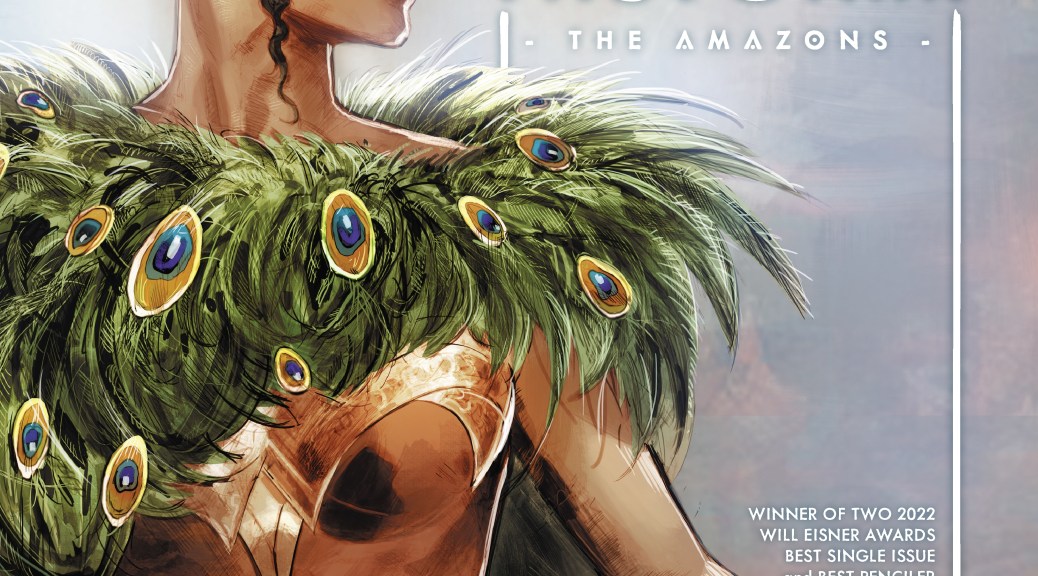
“What would I write if I could write literally anything in the DC Universe?” writes Kelly Sue DeConnick in her preface to The Pitch for Wonder Woman Historia (the hardback collecting the three volume series), adding, “What was the comic I had always wanted to read?”
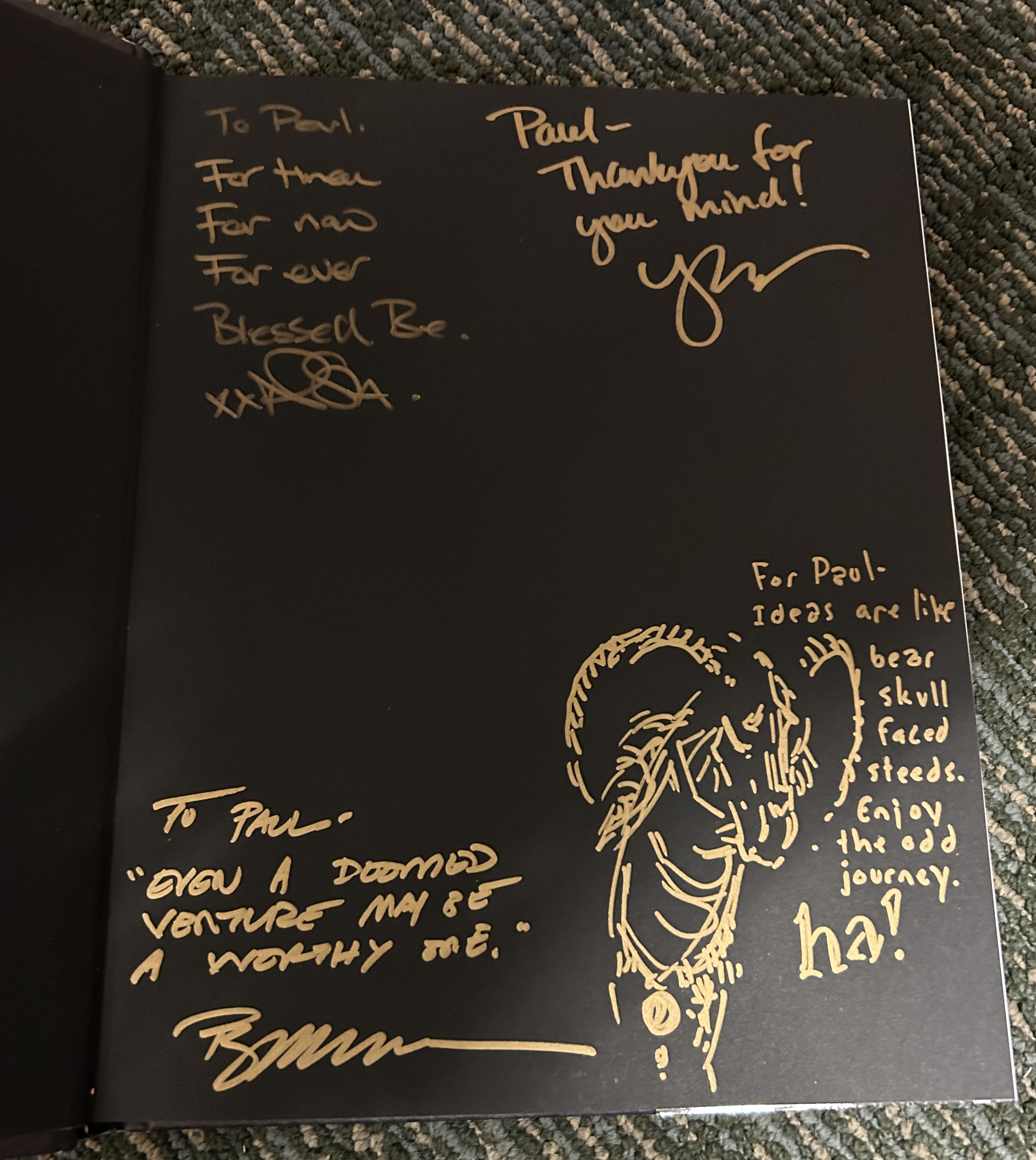
A very fortunate 62-year-old reader and collector of comic books, I am reading a copy signed by the wonderful creative team including DeConnick, Phil Jimenez, Gene Ha, and Nicola Scott:
In the second point DeConnick makes about The Pitch, she focuses on what I think must be acknowledged about this thoughtful interrogation of the Wonder Woman myth as well as much of what makes us human (especially issues related to gender):
I honestly don’t think any of my favorite moments appear in the pitch—they were all discovered later, in the writing, the rewriting, or the alchemy of collaboration.
As an avid reader, a writer, and a teacher of writing, I wish I could bottle that thought and pour it into my students—and anyone who seeks to be a writer, to be creative.
That’s it, that’s the path to the beautiful that is Wonder Woman Historia, a work that she be read and reread, a work that should be careful savored by looking carefully at the stunning artwork at both the close-up and at the widest possible angels that reveal some of the best work ever done in comic books.
I cannot recommend this work enough, both for readers but also for anyone who has the opportunity to bring this text into a classroom.
There isn’t much new I can offer so I collect below the four posts I have written already hoping you find a moment to read—but after you read, and reread Wonder Woman Historia.
At my core, I remain an English teacher, and in that role, I have always loved inviting students into interrogating paired texts, especially texts that mix and blend various genres and media/forms.
I essentially do not go to the theater any more to see movies, having become pretty content to view films on streaming services. But I splurged and found myself in a nearly empty theater yesterday to watch Barbie.
I have been agnostic about the social buzz around the film, but I must confess that many years ago I accepted that any movie with Ryan Gosling in it is likely worth the time of viewing.
The film not only fulfilled all my expectations from what I have read, but far exceeded what I anticipated. The short response is Barbie is a very smart and purposeful film, filled with excellent writing, filming, and acting. But most of all, Barbie confronts complex topics in simple but not simplistic ways.
And the topics are quite extensive:
Gender
Social norms
Capitalism and materialism
Democracy
Idealism and reality
Patriarchy
Family
Self-awareness, identity, and the existential crisis of being human
Certainly, the film isn’t exhaustive on these topics, and there are moments that feel shallow. But it works so well at making the viewer able to enter into a consideration of issues that are, frankly, extremely difficult to maneuver because the human condition is complex and these topics are fraught with ideological and political triggers.
I suspect, however, that the people who need the invitation Barbie offers are still not likely to reconsider or even consider what the film graciously offers.
If you don’t feel compassion for the close ups of stereotypical Barbie after she is crying and you can see the tears have created little rivers of no make up on her face, well, I dont’ have much hope for you.
But the people I remain forever hopeful about are students.
As sequential art (comic book/graphic novel), this reimagining of Wonder Woman and the Amazons overlaps with Barbie as a feminist text that refuses to be simplistic.
What pairing the texts add is how the works use mythology as an entry point to interrogate gender, norms, and human frailty in ways that are deeply compelling. And of course, at the heart of both works is the insidious influence of power that can be arbitrary and corrosive to human dignity.
The Ken/patriarchy motif of Barbie is brilliant and provides an excellent space for discussing Historia and the Amazons.
The Barbies and the Amazons represent a woman-centered culture, but both are juxtaposed to the real world that is man-centric. And Historia weaves in classic mythology which is a wonderful pairing with the use of Barbies (women) and Kens (men) as types, even as the main Barbie expresses, stereotypes.
The two works also allow discussions of genres and media/forms since the film is primarily satire and has strong fantasy elements that contrast with the darker and more -hyper-realism of Historia.
Both, although in different ways, provide excellent texts for discussing the impact of the visual on engaging with and understanding these texts. Both works are visually stunning.
And finally, the most important aspect of pairing Barbie and Wonder Woman Historia: The Amazons as a unit for students is that the texts are the antithesis of the caricatures conservatives are attacking in the culture war against anything diverse, what they slur as “woke.”
Education is about asking hard and complex questions and coming to know what we don’t know, what we don’t yet fully understand.
Barbie and Wonder Woman Historia: The Amazons never stoop to indoctrination, never slip into unfair or sweeping ideological pandering.
Especially when experienced together, it is hard to be on the other side with more answers than questions. And that might be the most beautiful gifts they offer us as their audience.
Thomas, P.L. (2018). Wonder Woman: Reading and teaching feminism with an Amazonian princess in an era of Jessica Jones. In S. Eckard (ed.), Comic connections: Reflecting on women in popular culture (pp. 21-37). New York, NY: Rowman and Littlefield.
Wonder Woman Historia: The Amazons (Book Three) continues exploring the tensions between gods and mortals as well as between men and women. “Born to die” proves to be a chilling and powerful refrain (establishing the duality of birth/death) throughout this chapter concluding a three-issue arc written by Kelly Sue DeConnick with art from Nicola Scott.
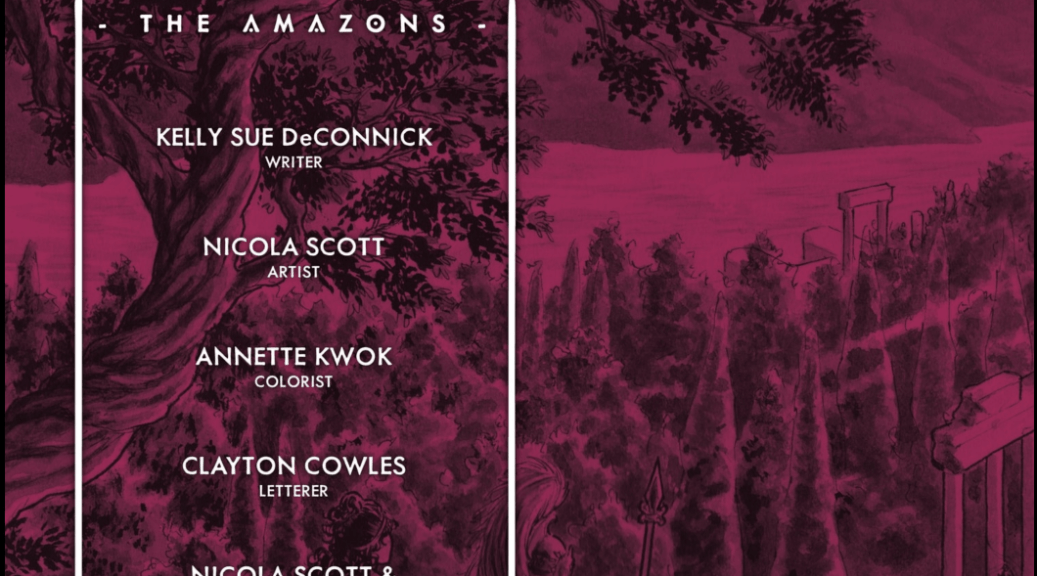
Kelly Sue DeConnick (writer), Nicola Scott (artist), Annette Kwok (colorist), Clayton Cowles (letterer)
Scott continues the awe inspiring artwork by Phil Jimenez (Book One) and Gene Ha (Book Two) with DeConnick weaving an allusive and powerful re-imagining of the Amazons as well as speaking to enduring themes about humanity and human frailties as well as triumphs.
“She Believes Her Sin Set the War in Motion”
While Book Three offers an incredibly compelling narrative both in the writing and the visual dynamics, here I want to focus on the rich allusive and referential elements that reach out beyond that story.
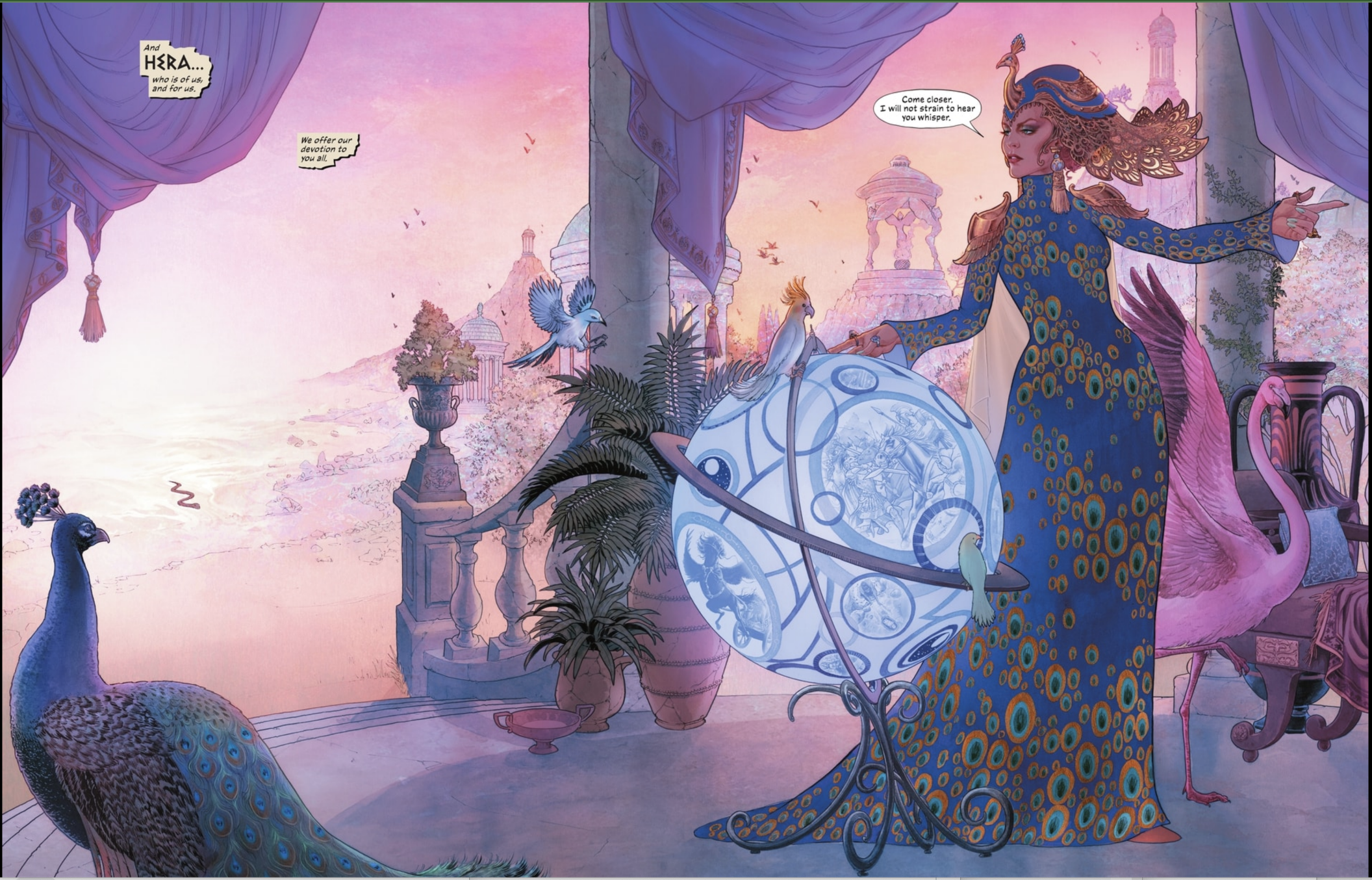
Book Three opens with stunning spreads, the artwork and coloring invite the reader to linger on pages in order to grasp the grandeur that envelopes this world, this story of the Amazons.
The opening scenes include a serpent theme, complicating and flipping the Garden of Eden iconography with Demeter as the serpent transforming to talk with Hera and then the ultimate human frailty, sin, and of course human guilt: “She believes her sin set the war in motion.”
Dualities build, then, throughout adding innocence versus experience to birth/death, gods/mortals, and men/women. And now, “[s]omething terrible is coming.”
The next duality is both a dramatic element of this story and a new duality that reinforces the man/woman tensions—the rugged individual versus collective power wrapped in the classic theme of hubris. DeConnick works elegantly within mythological archetypes and turns them into lenses for our contemporary realities.
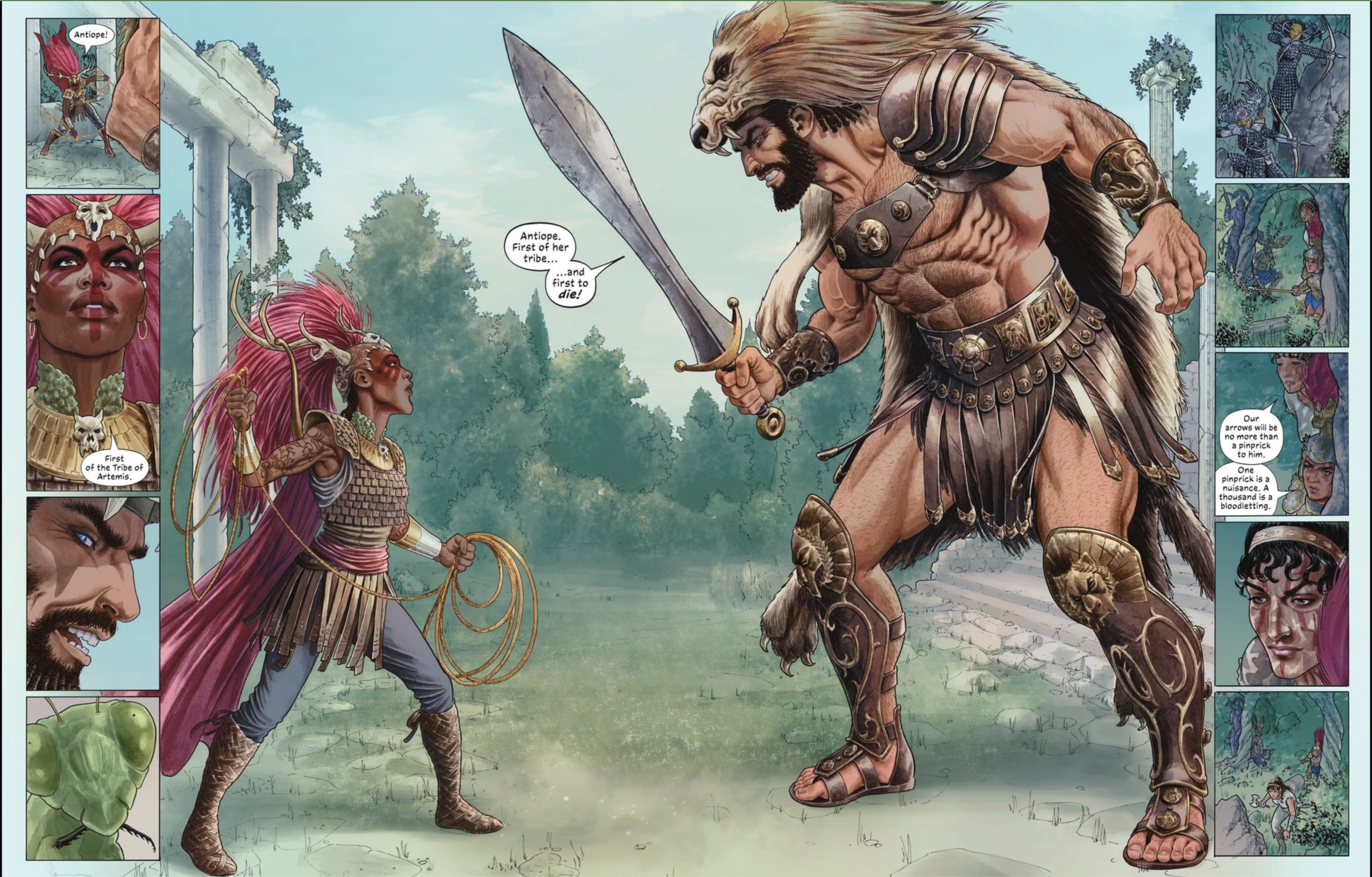
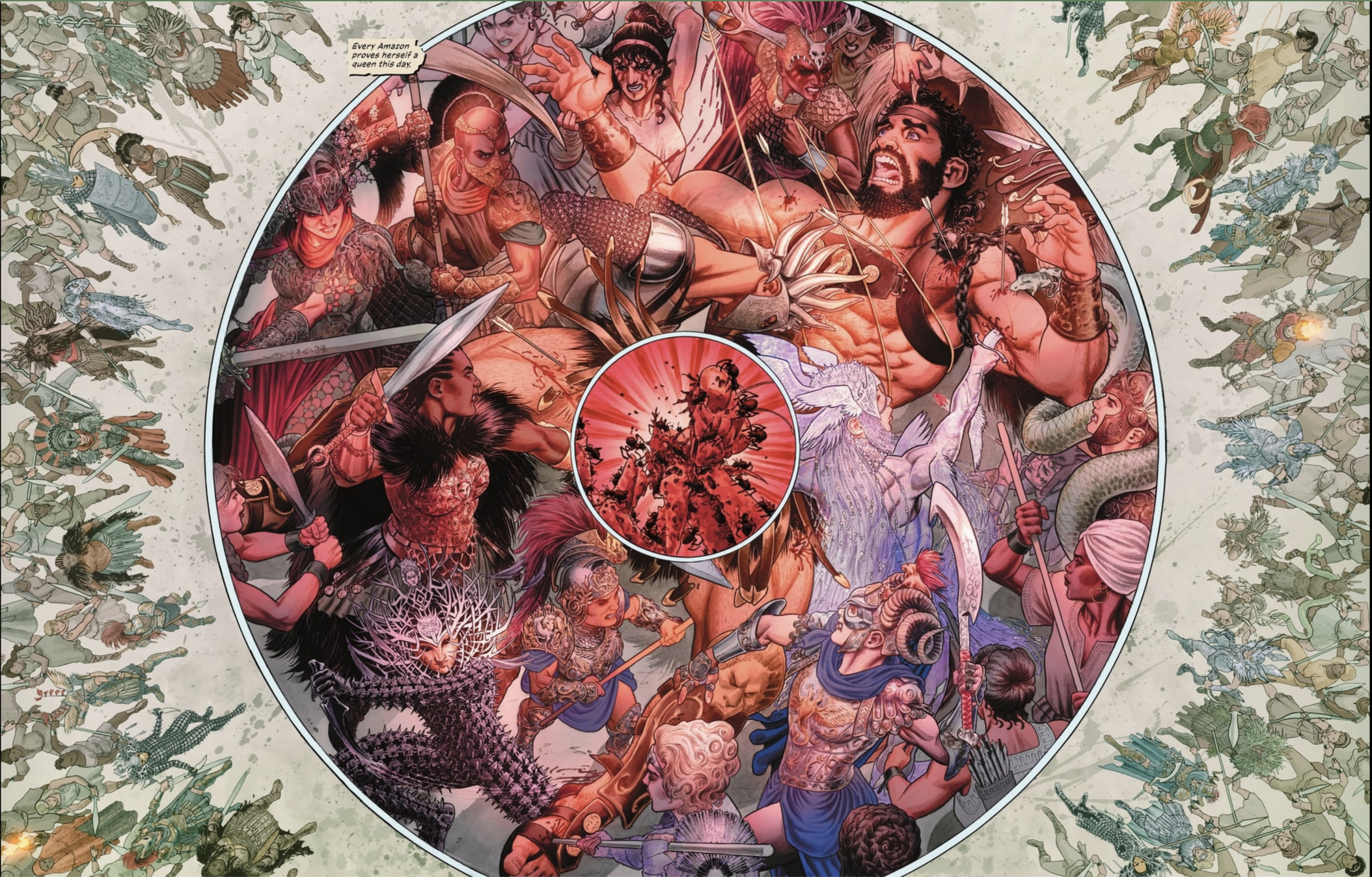
Heracles, son of Zeus, represents masculine hubris and serves as a catalyst for the disaster to come because the Amazons embody a higher form of power in their shared commitments.
Using dynamic ant imagery, this scene reminds me of Adrienne Rich’s poem confronting “the book of myths” and masculine/feminine power:
my mask is powerful it pumps my blood with power the sea is another story the sea is not a question of power
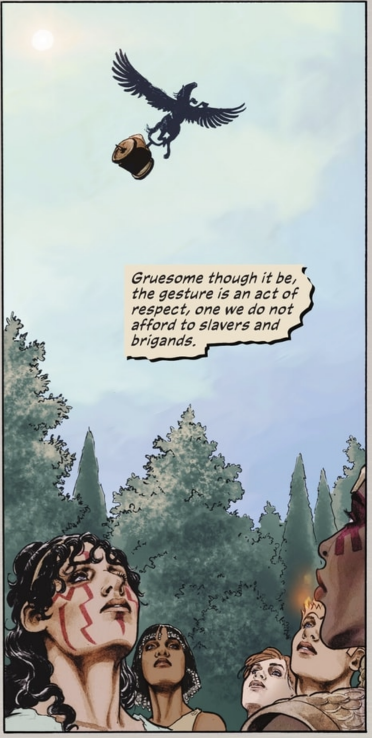
In victory, the Amazons show respect and care for the vanquished:
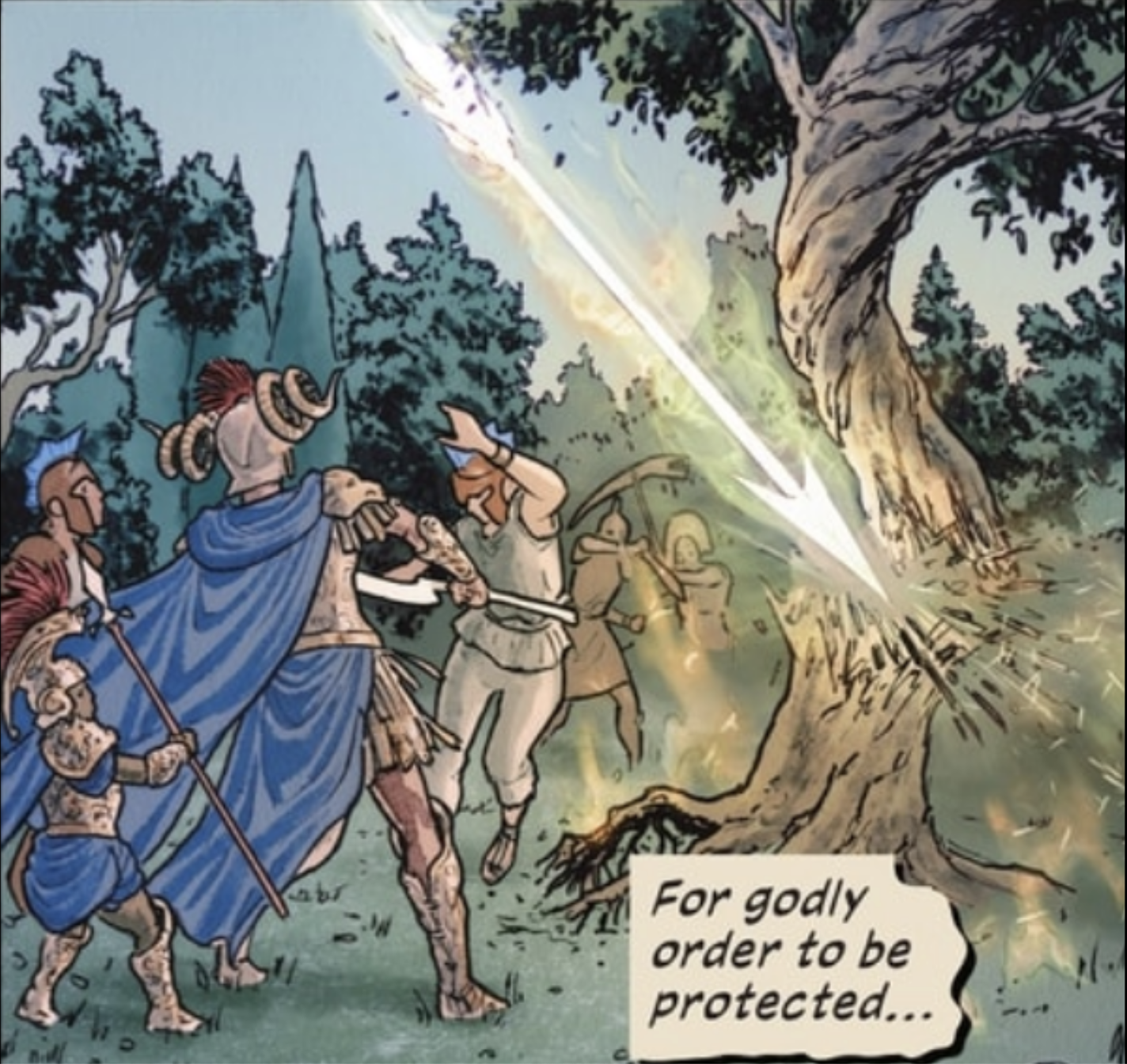
But the consequences of these women and their power are monumental since they invoke the ire of the god of gods:
Scott’s use of silhouette throughout adds a chilling element to the central tensions of Book Three.
At the core of the story of gods versus mortals, DeConnick and Scott show readers that death begets death—and that “might makes right” remains when men rule over all, especially when women assert their power.
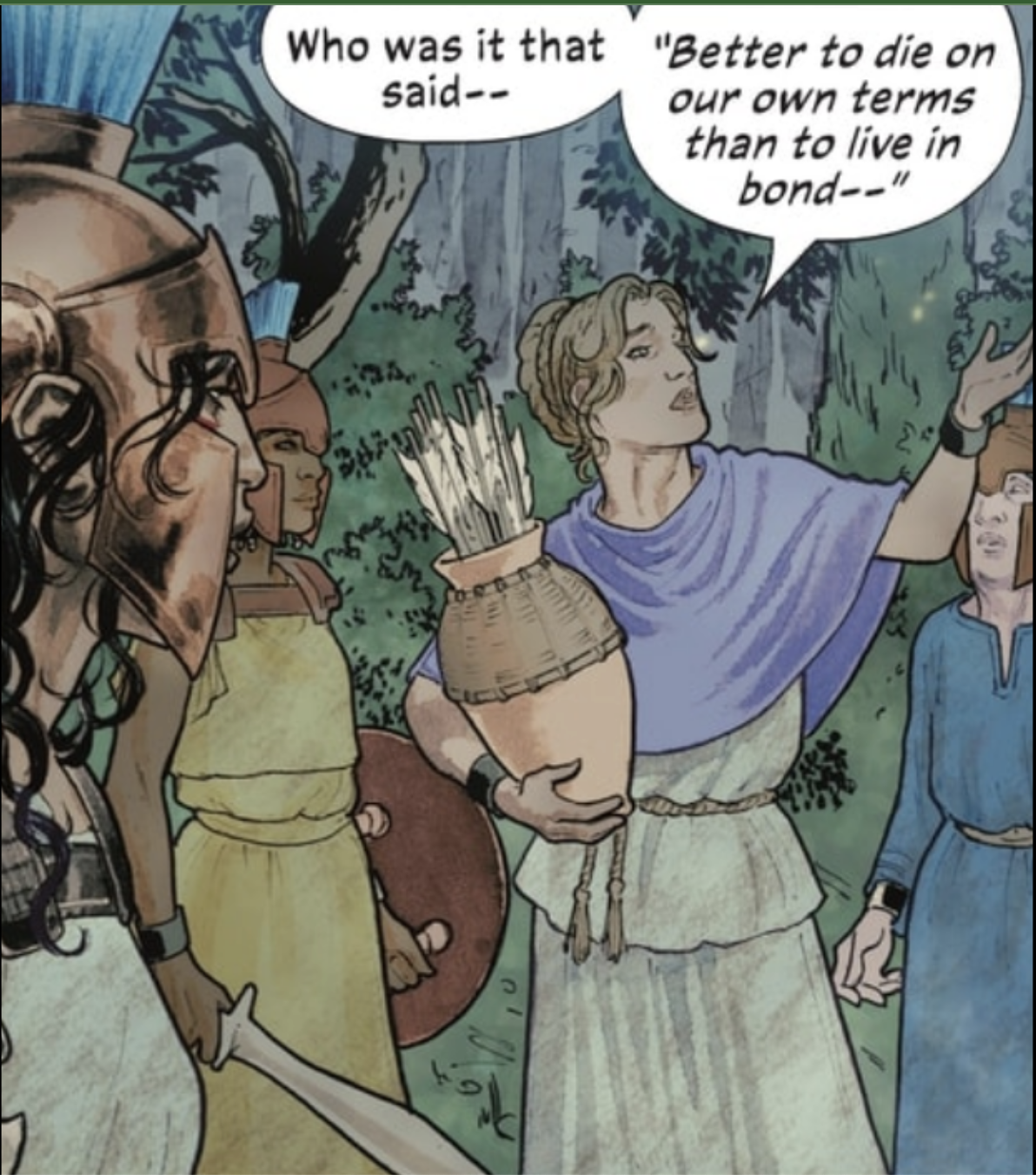
DeConnick also includes literary nods to Aristophanes, with the Amazons performing Thesmophoriazusae, a play about women subverting patriarchy, and quoting Euripides:
Death and honor are framed against the greatest of powers, the will of the gods, echoing the Garden of Eden allusion from the beginning and raising the issue of power again:
This leads us to the key refrain: “We are—all of us—born to die.”
“You Treat Us as Livestock”
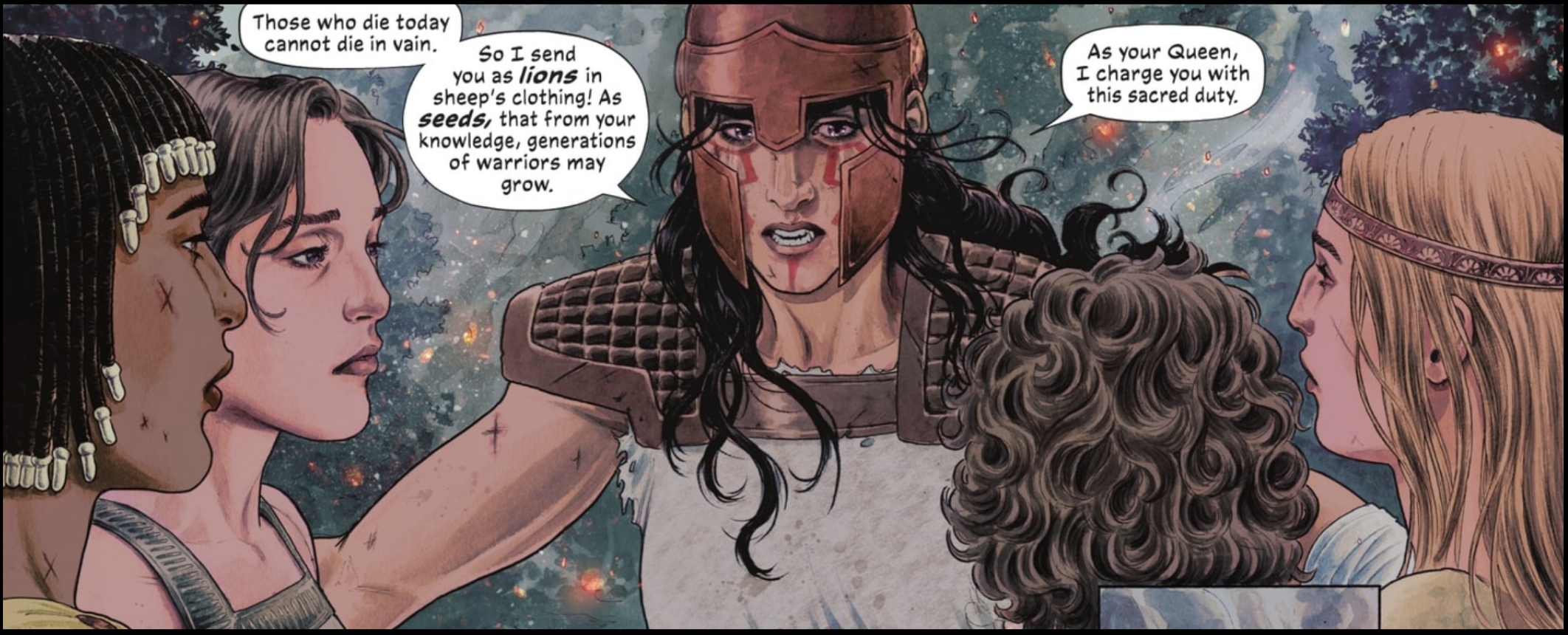
It is this issue of power within masculine/feminine dualities that DeConnick continues to explore through the lion/sheep duality:
The Amazons find power in being a community but also in the mentoring relationship (not antagonism) between those who are innocent and those with experience.
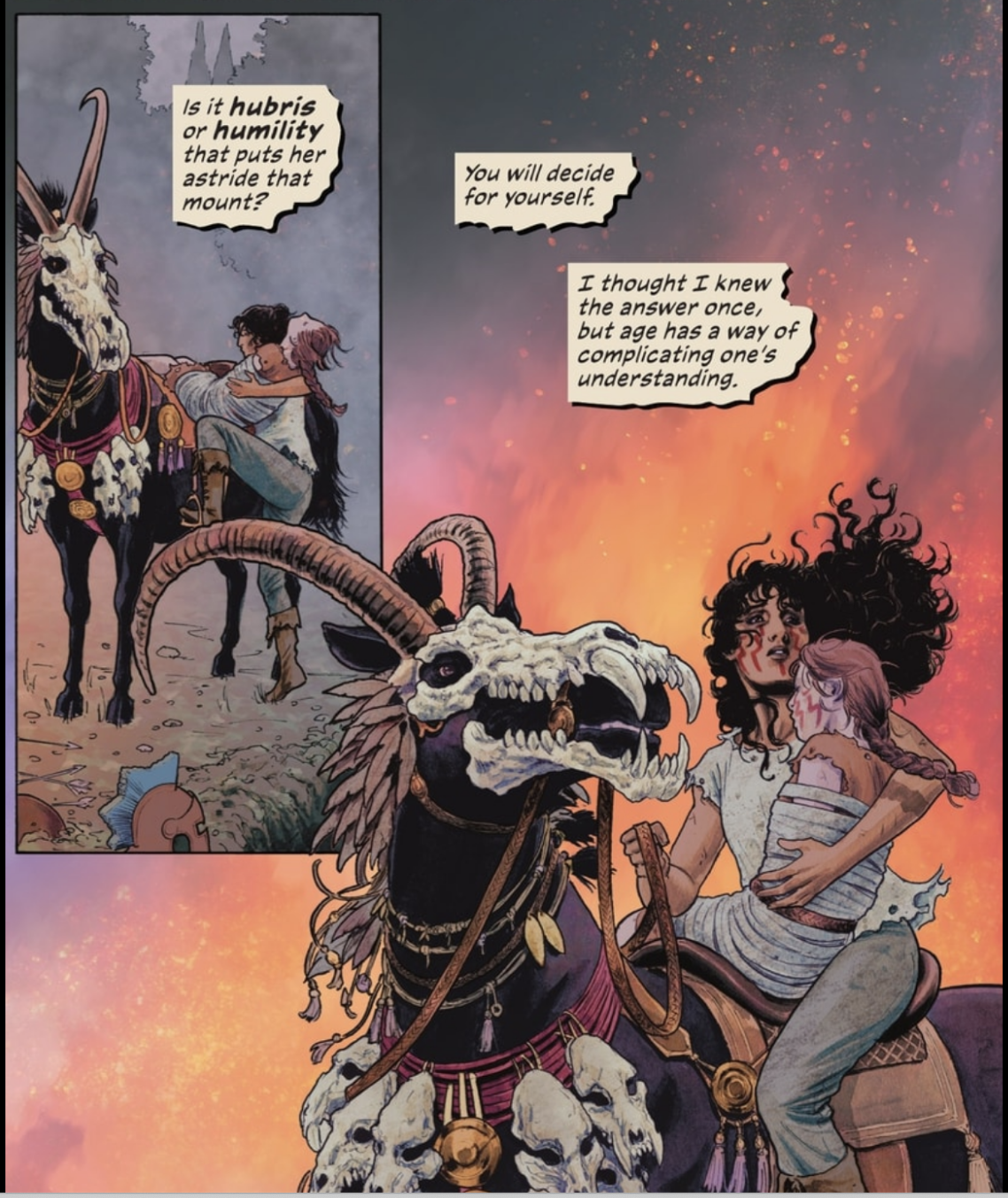
Just as a different kind of power is detailed among the women, the Amazons, so is a different way to interrogate the classic motif of hubris found in Greek tragedy:
The hubris/humility duality reveals the “complicating” consequences of aging, experience, which sets adults apart from children.
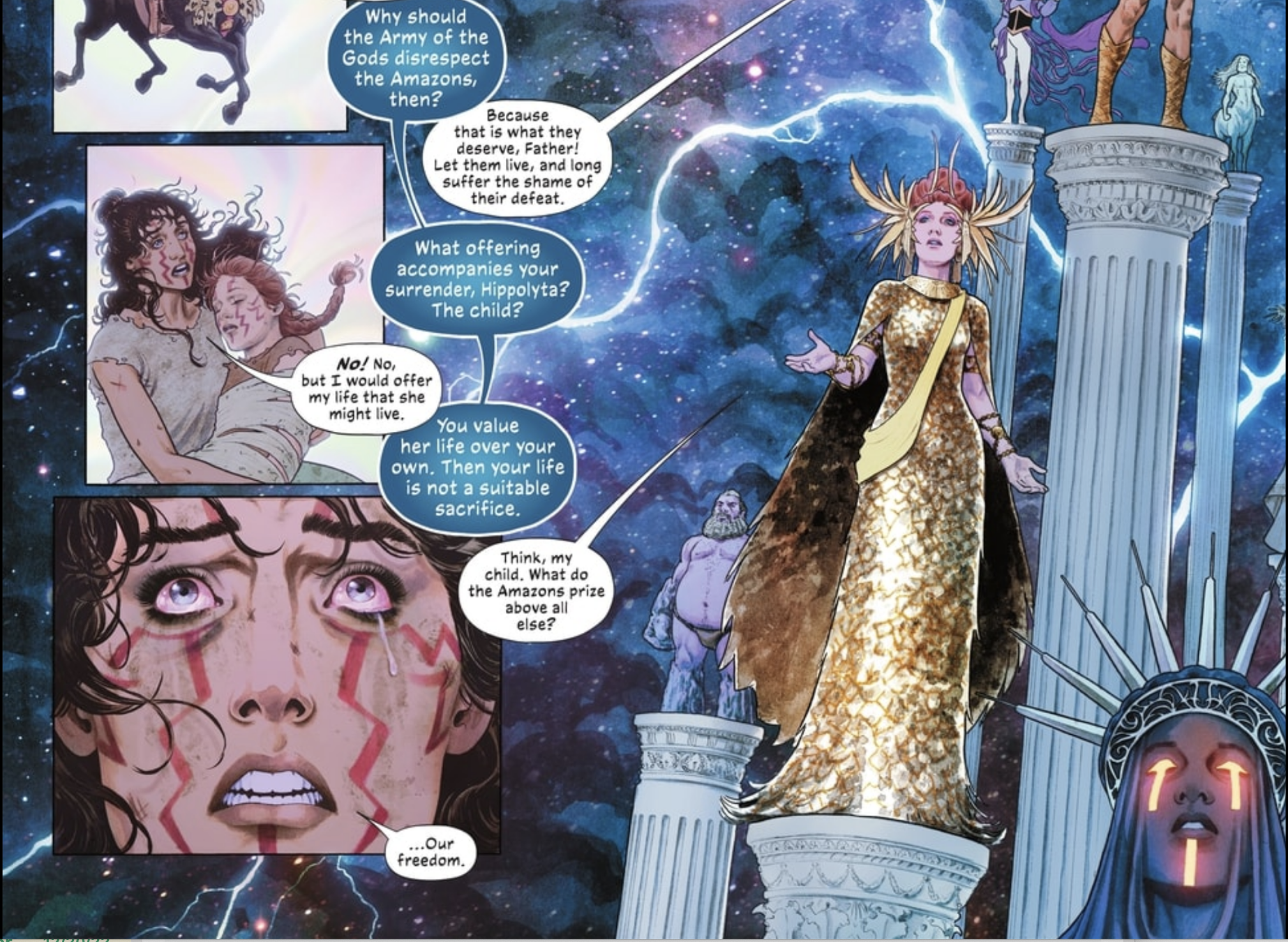
The central tension of Book Three is the wrath of Zeus and the consequences of the Amazons’ power and resistance. This ultimately creates the duality of life versus freedom:
Of course this is a fabricated duality because of the capriciousness and shallowness of a god who represents patriarchy and misogyny:
The shepherd/sheep duality fits into a literary history of confronting patriarchy and misogyny through using women-as-animal imagery (see Zora Neale Hurston’s mule imagery in Their Eyes Were Watching God).
Power in the hands of gods, the patriarchy, is exposed as capricious and cruel versus the contrast of justice and mercy:
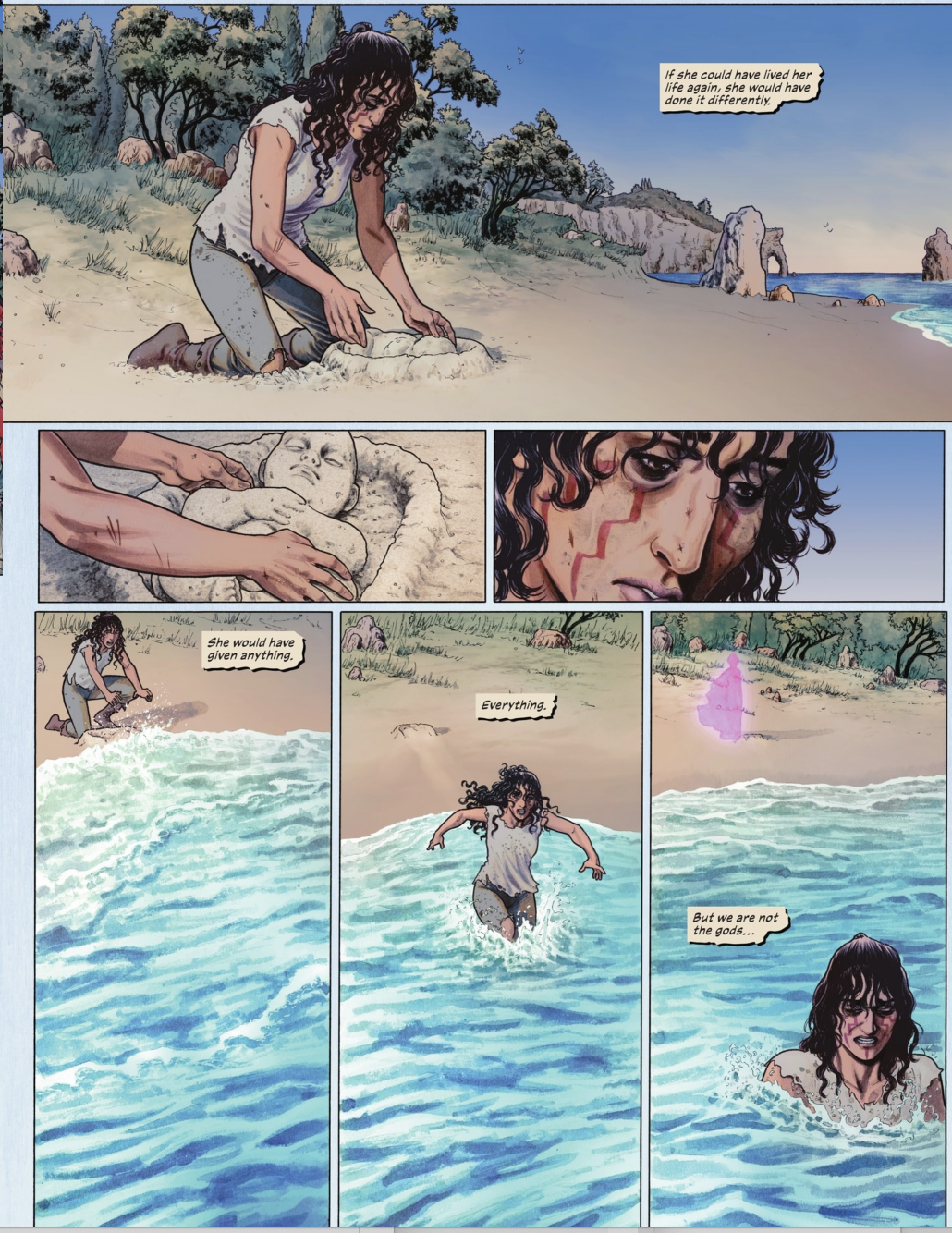
Here the sacrificing nature of women along with the death/birth duality begins to build to the climax of these tensions:
Wonder Woman Historia across three books proves to be a work that portrays and confronts dualities in ways that force readers to rethink enduring motifs and themes within and beyond mythology.
While there is great loss and often violence, Book Three ends with triumph, hope, and birth/rebirth rising out of that loss:
By the end of Book Three, even “born to die” is turned onto itself as a superhero is born into the matriarchy of goddesses and Amazons—although the very real threats of the world and beyond remain ever in the background.
Books 1-3 of Wonder Woman Historia offer a compelling and visually stunning exploration of heroism that is solidly situated in superhero royalty (Wonder Woman among DC’s Big Three), yet this is not predictable superhero story.
DeConnick along with Jimenez, Ha, and Scott tells stories of dualities and confrontations by turning those dualities around and inviting readers to rethink those tensions in ways that speak to the very real world we walk in today.
Thomas, P.L. (2018). Wonder Woman: Reading and teaching feminism with an Amazonian princess in an era of Jessica Jones. In S. Eckard (ed.), Comic connections: Reflecting on women in popular culture (pp. 21-37). New York, NY: Rowman and Littlefield.
Throughout my childhood, my father told the stories of him growing up, and life before my sister and me, so many times, with so much detail, I can retell them myself today—several years past his death, many decades since I was a child.
Not a literary person, my father returned again and again to telling us about his courtship with my mother. They married in secret during her lunch break from her job working at a Winn-Dixie checkout counter.
We tell stories, often over and over, in an effort to understand better our lives, understand better what it means to be human. But I think, especially for my father, we tell stories of our lives to hold onto those moments and years that slip farther and farther into our past, fading.
As I read Wonder Woman Historia: The Amazons (Book Two), Kelly Sue DeConnick’s telling and retelling of mythology grounded in the Wonder Woman universe, I thought about my father’s storytelling as well as why we have myths. I explained that Book One, with artist Phil Jimenez, offers not just a beautiful and compelling superhero narrative, but also vivid and urgent messages for our lives today.
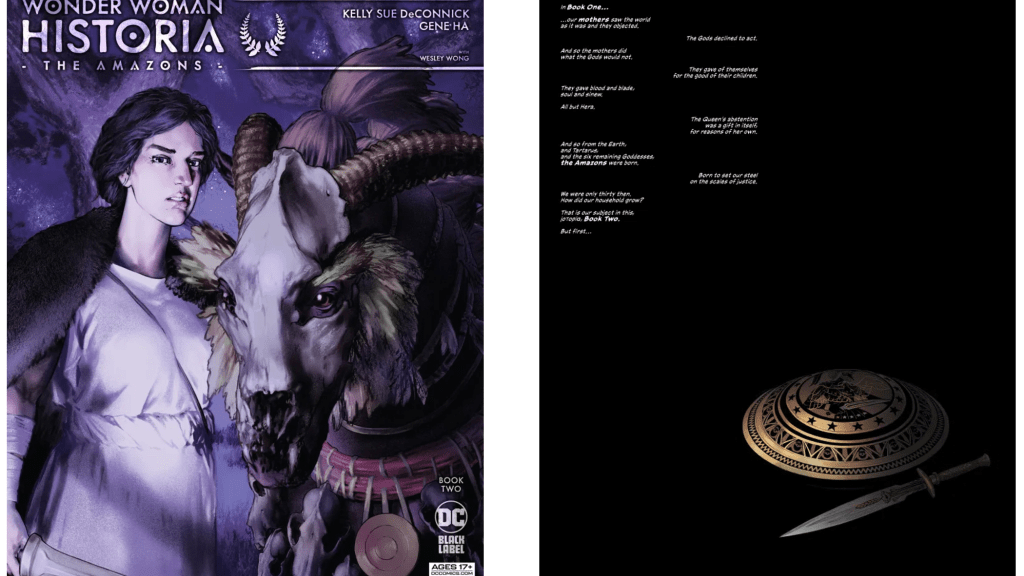
DeConnick joins artist Gene Ha in Book Two. Ha’s “Behind the Panels” shares DeConnick’s charge for Ha and her as co-creators of Book Two: “The scripts that follow should be considered more of a roadmap than a set of blueprints.”
Cover: Gene Ha.
DeConnick continues: “I’ve beaten this metaphor into the ground but my point is this: this is a collaborative process.”
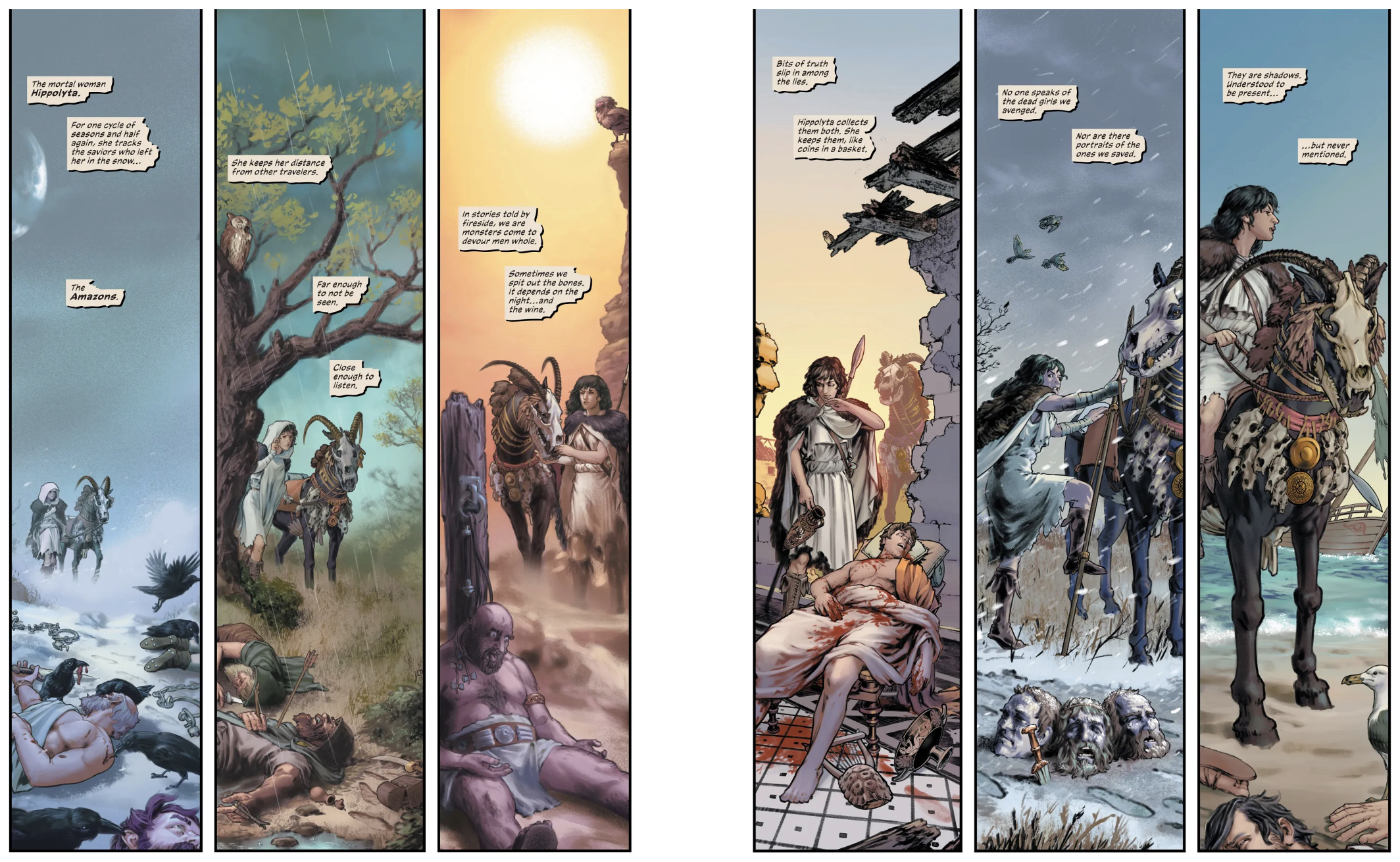
This continuing story of Hippolyta and the Amazons, then, begins with the tensions of stories told (lies) and stories not told (truths).
Book Two: DeConnick, writer; Ha, artist; Wesley Wong, colorist; Clayton Cowles, letterer.
Amazons demonized as monsters overshadows Amazons as savior-warriors: “No one speaks of the dead girls we avenged. Nor are there portraits of the ones we saved.”
Representation matters also.
This narrative tension speaks, of course, to the cultural tensions in the U.S. in 2022—an aggressive political Right running roughshod across the country decrying manufactured threats (Critical Race Theory) and demonizing educators as “groomers” in their Holy War against LGBTQ+ humanity.
Stories matter. But power matters more.
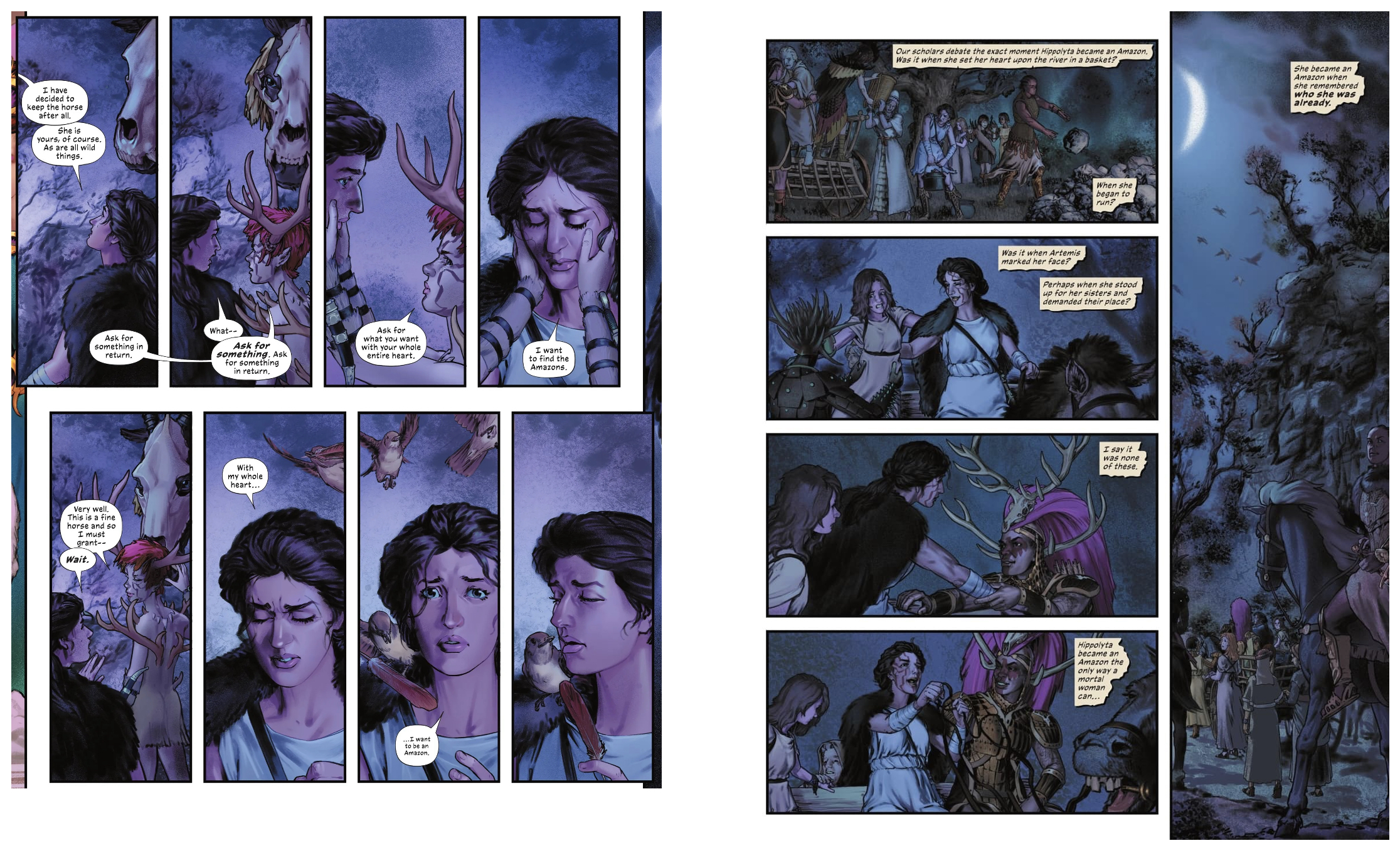
Hippolyta’s story is a story about stories, but it also is a story about another tension between Goddesses/Gods and mortals. When she comes upon Artemis, Hippolyta confesses her ultimate goal: “I need to be an Amazon.”
Book Two: DeConnick, writer; Ha, artist; Wesley Wong, colorist; Clayton Cowles, letterer.
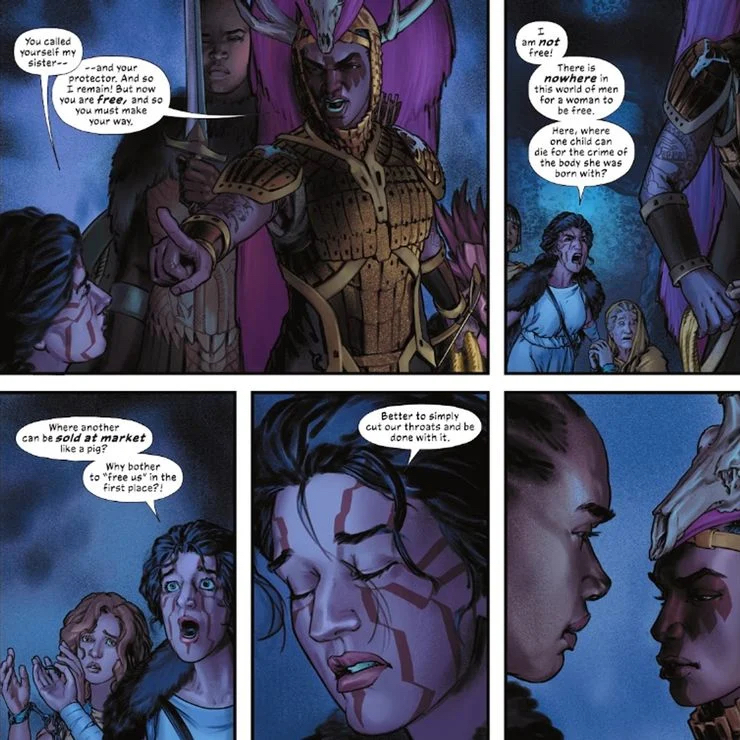
Marked by Artemis, Hippolyta is left to confront enslavers, introducing central themes of Book Two—the conditions of being women and children. Saved by Amazons, the enslaved children and Hippolyta are set free. However, Hippolyta challenges that freedom—not just for this moment, but “There is nowhere in this world of men for a woman to be free.”
Book Two: DeConnick, writer; Ha, artist; Wesley Wong, colorist; Clayton Cowles, letterer.
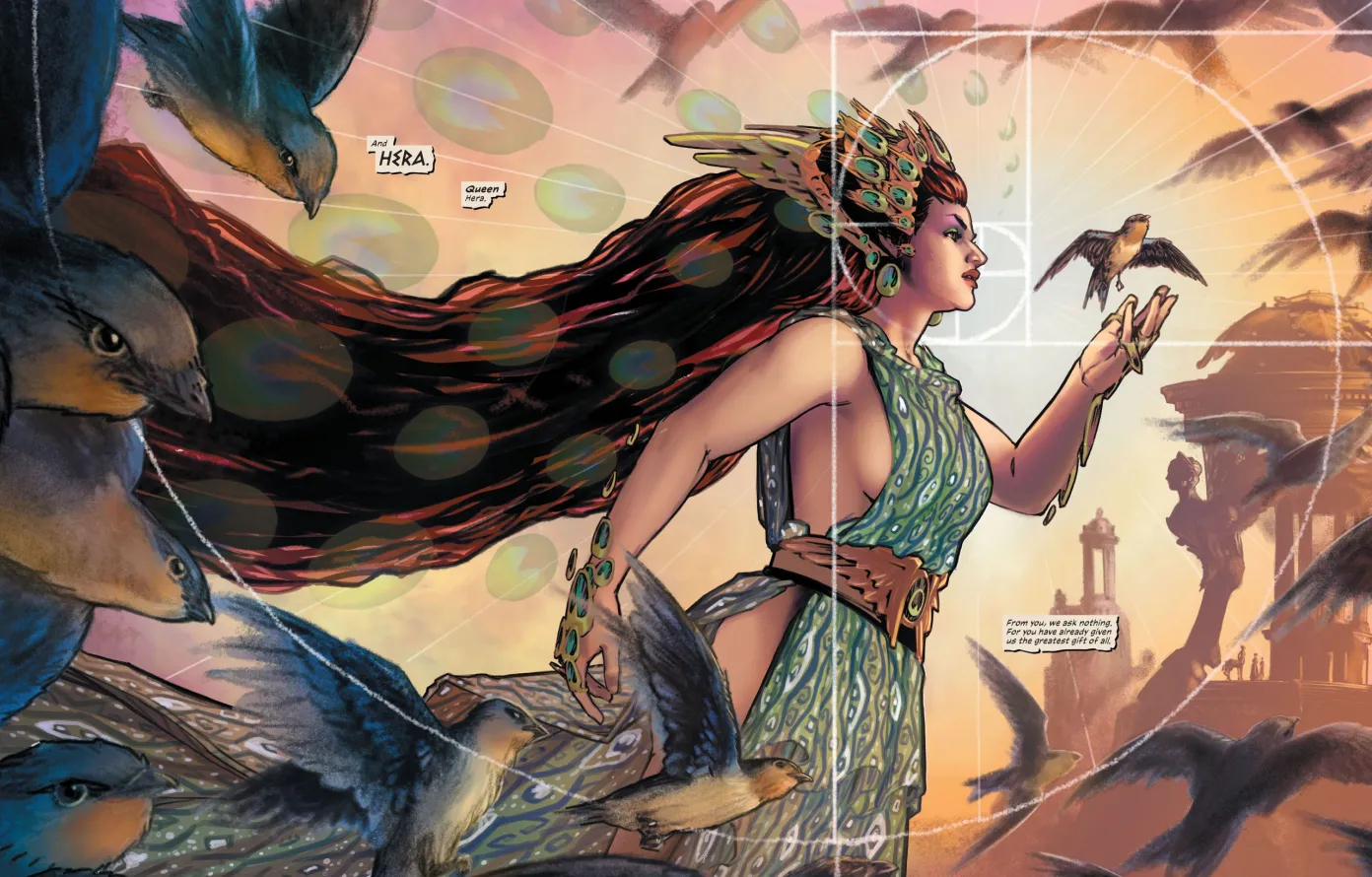
Hippolyta’s outburst echoes Queen Hera’s anger earlier in Book Two: “There will be no justice for women. Not now. Not a hundred years from now. Not a thousand!”
Book Two: DeConnick, writer; Ha, artist; Wesley Wong, colorist; Clayton Cowles, letterer.
Goddesses and mortal women, women and children—for them, Book Two establishes elements of shared existential realities around justice and freedom.
The plot of Book Two builds to a new Seventh Tribe of Amazons with Hippolyta as the leader, chosen by “consensus,” fitting seamlessly into the “collaboration” commitment from DeConnick in Ha’s “Behind the Panels.”
The new tribe, mortals, train and then experience their own mission against enslavers. Those who were freed now free others, but also confront the weight of “great power,” the ability to take life. Tarpeia, however, is restrained from killing a boy. “But he is one of them. He would have killed me!” she argues.
The Amazonian response is powerful and haunting: “He’s just a boy. He shouldn’t die for the sins of his father.”
In terms of contemporary relevance, I find this focus one of the key moments of Book Two.
Book Two: DeConnick, writer; Ha, artist; Wesley Wong, colorist; Clayton Cowles, letterer.
A cultural and political narrative in the U.S. in 2022 involves centering parental rightsover their children, an idealized view of parenting paired with denying the autonomy and humanity of children. States are passing legislation directly pronouncing that parents have primary authority over their children’s education.
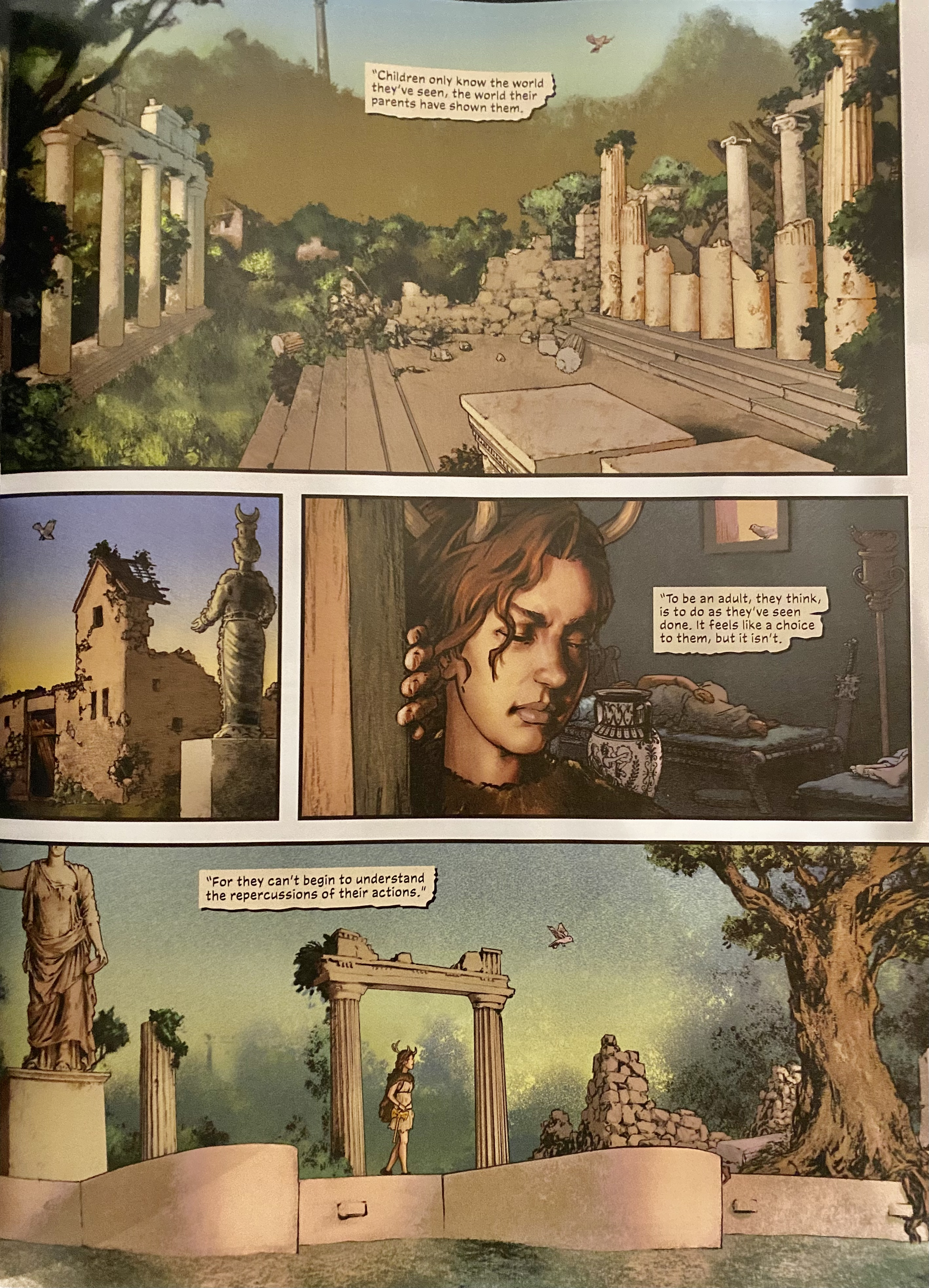
However, as Book Two dramatizes, “Children only know the world they’ve seen, the world their parents have shown them. To be an adult, they think, is to do as they’ve seen done. It feels like a choice to them, but it isn’t.”
The fate of the boy becomes the ominous final conflict of Book Two, harkening Book Three with “Unleash hell upon them.”
Here, I come back to my father, and mother, and the “world” they showed me. As I have written about often, I was told many wrong stories, corrupting stories, and I could have been trapped in those narratives of racism and ignorance.
Until I learned otherwise—in science fiction and comic books, in comedy albums, and in classrooms where teachers were free to teach.
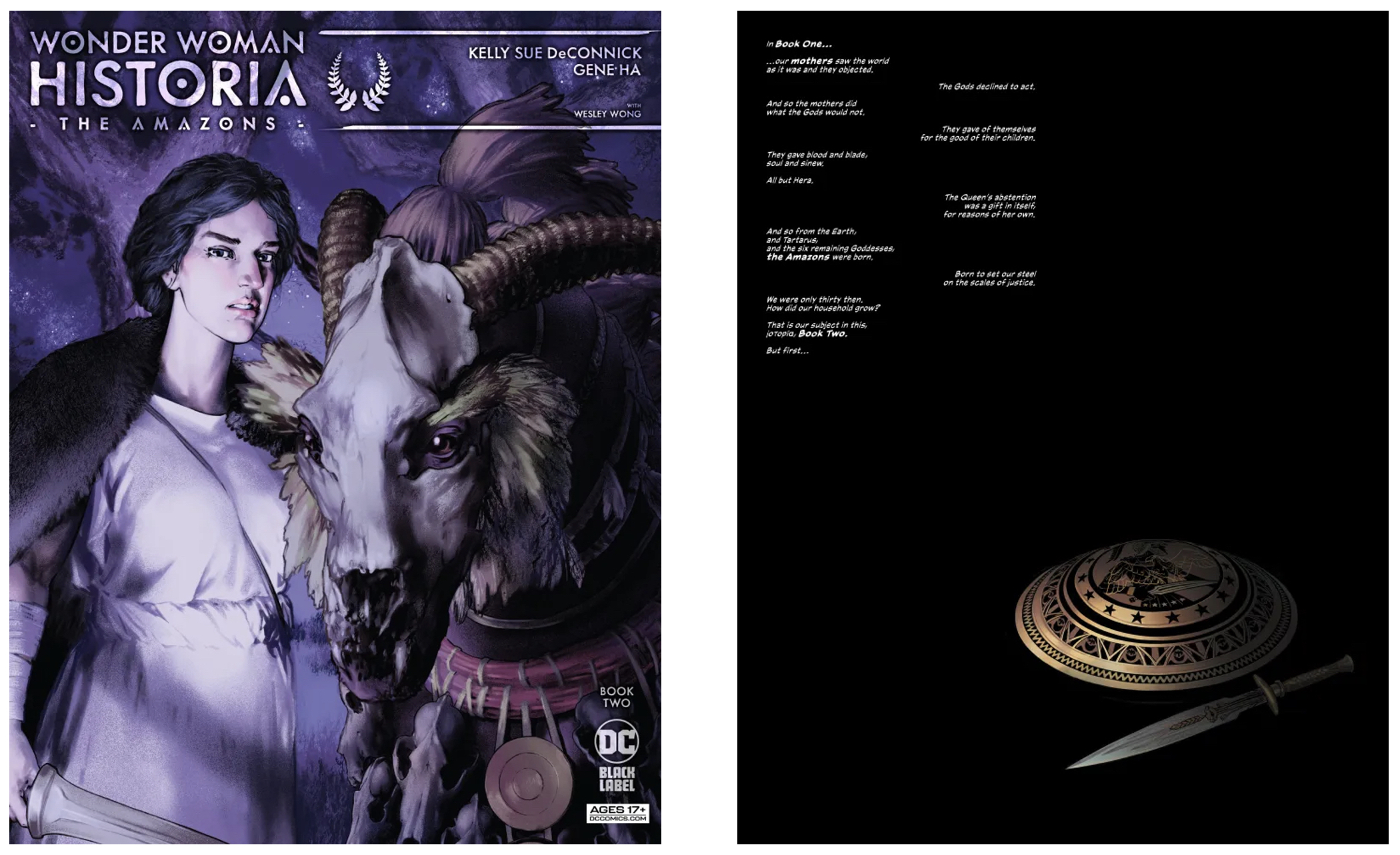
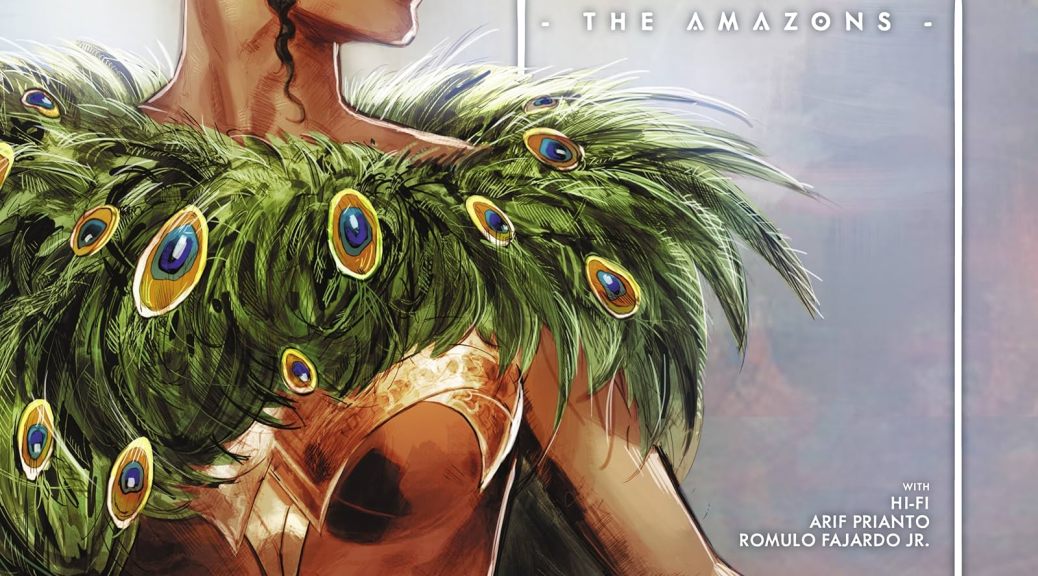
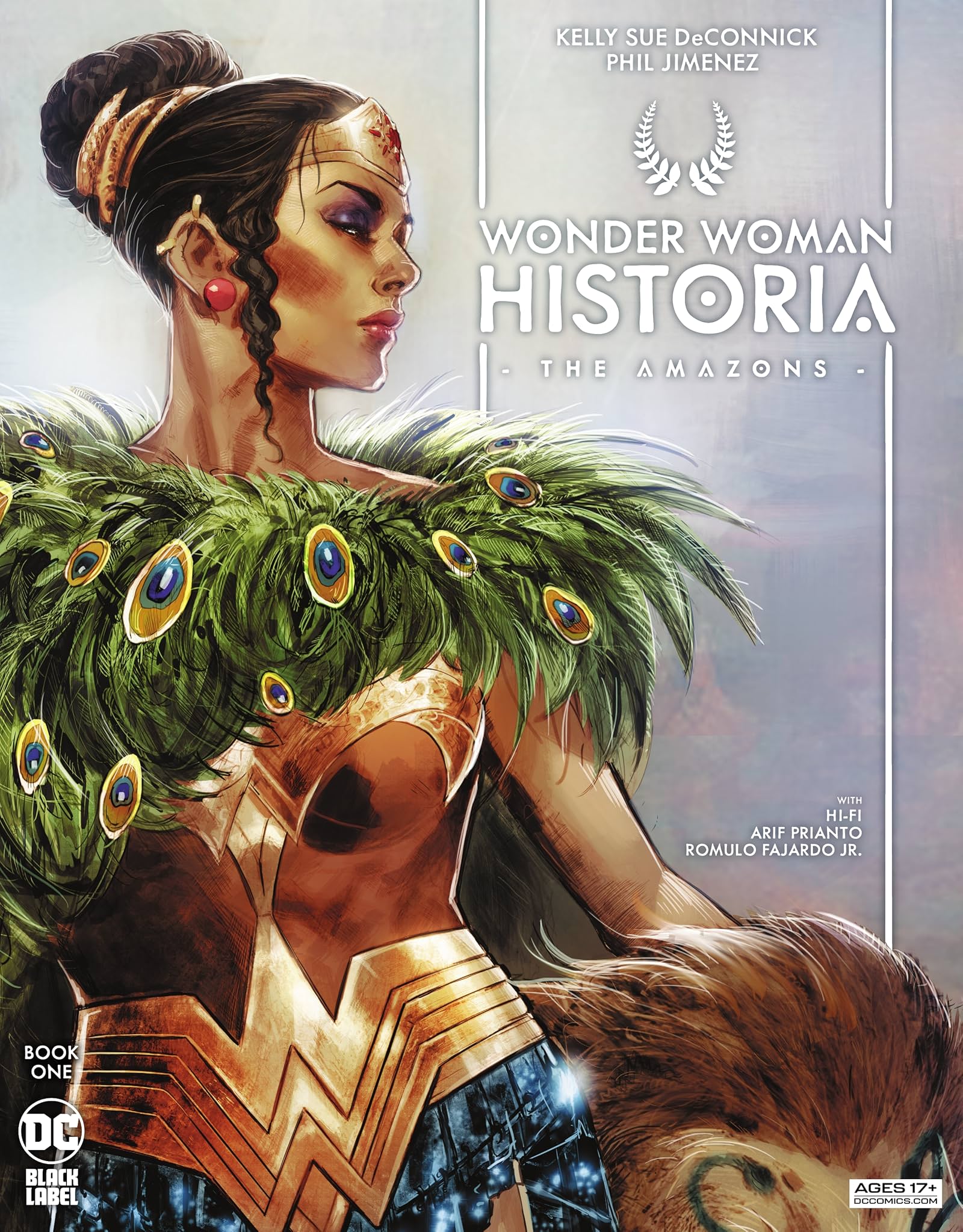
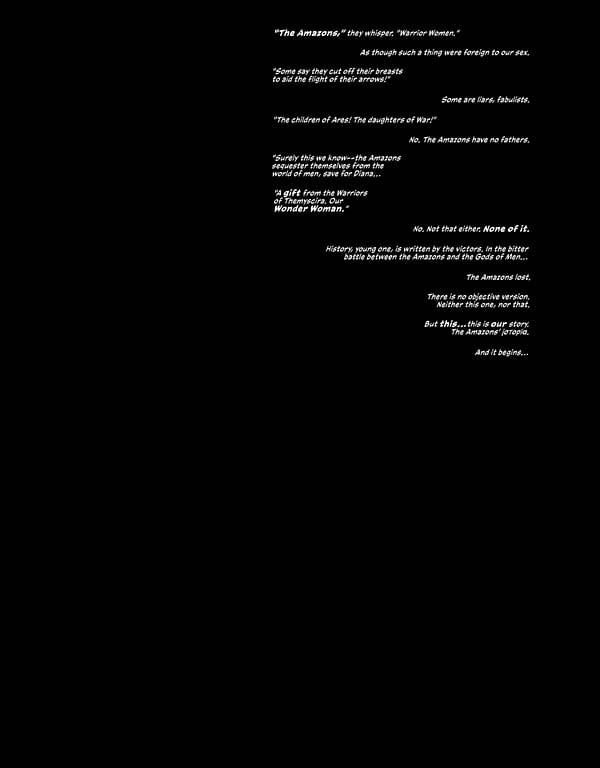
The oversized format and stunning cover by Phil Jimenez and Romulo Fajardo Jr. suggest something special from DC Black Label, but the black text-only first page signals Kelly Sue DeConnick’s Wonder Woman Historia: The Amazons has arrived just in time:
The “Some say…” reply of “Some are liars, fabulists” can be read as a critique of the Trump-poisoned Right today. But the most powerful lines speak to the exact source of why conservatives in 2021 are seeking to control what children are taught and how, echoing the essence of Critical Race Theory and vilified historians such as Howard Zinn:
History, young one, is written by the victors. In the bitter battle between the Amazons and the Gods of Men…
The Amazons lost.
There is no objective version. Neither this one, nor that.
The creative team of DeConnick (writer); Jimenez (artist); Hi-Fi, Arif Prianto, and Fajardo (colorists); and Clayton Cowles (letterer) remind me of J.H. Williams III and Kelly Thompson’s run on Black Widow—although in many ways, Historia proves to be dramatically unique.
Occasionally calling a work a feminist read on a topic can seem reductive, or insubstantial—how many feminist reads [1] has there been of Wonder Woman?—but in a world darkened by censorship and the looming threat of overturning women’s reproductive rights nearly 50 years after Roe v. Wade, a feminist manifesto is not just in time, but essential.
“For the Institutions of Men Care Not for the Weal of Women“: Just in Time?
After a beautifully rendered introduction of Goddesses, the narrator admits, “The subjugations and abuses of not-men by men are too numerous to catalog in a library…let alone a book.”
This powerful refrain not only sets the focus of Historia, but carries an eerie weight in a time of book censorship—books ripped from classrooms and libraries, school board members calling for book burnings—as well as the threat of of the State denying women reproductive rights, “the subjugations and abuses of not-men by men” and the women who do men’s bidding.
Next, an admission more sober: “For the institutions of men care not for the weal of women. You don’t have to be the Queen of Gods to recognize injustice.”
Book One moves from introduction to an exchange between Hera and Zeus, where Hera requests the elimination of not humankind but all men.
“The history of men is a chronicle of crimes against women,” Hera proclaims to protestations that history too includes “tales of love and beauty,” followed by:
“Herodotus 1.93. Every daughter of Lydia will work as a prostitute until she has raised sufficient money for a dowry and can secure a husband.”
The arguments are an excellent dramatization of concepts such as justice as well as privilege. Hera, indignant, asks, “Do you mean to suggest that women have done something to deserve this station?” Zeus concedes, condescendingly, “You’ve made your point, girls. Women do suffer—historically and undeniably—at the hands of men. But their world is not justice.”
Finally, the main narrative of Book One focuses on childbirth and vividly portrays Hera’s protestations—in short, “Hell is a state of being,” and we can add for women.
An unwanted girl is birthed, an excessively bloody event confirming:
In every birth, there is risk and pain. This is true of creatures, ideas, and tragedies.
Mortal births are particularly gruesome. They enter the world unprotected, screaming, suited for inevitable suffering.
But the birth itself is not the only “pain”; Hippolyta is tasked with discarding the unwanted baby girl.
After leaving the baby in the river—”‘The Gods will decide, as they decide the fates of us all. They will choose wisely. Yes.'”—Hippolyta balks on that faith and runs until collapsing in hopes of saving the child.
This tale of the burden of women and the inescapable fate of women as self-sacrificing builds to her being saved by the Amazons, setting up Book Two in a dramatic final page:
Historia is beautiful and compelling as another contribution to the long history of Wonder Woman, but this is a work that speaks to “not-men” and “men” in the U.S. during the final month of 2021. It is a call to confront the “the institutions of men [that] care not for the weal of women.”
Just in time?
[1] Thomas, P.L. (2018). Wonder Woman: Reading and teaching feminism with an Amazonian princess in an era of Jessica Jones. In S. Eckard (ed.), Comic connections: Reflecting on women in popular culture (pp. 21-37). New York, NY: Rowman and Littlefield.
By sheer coincidence, or at the bidding of the book gods [1], I discovered a connection between U.S. poet E.E. Cummings and Wonder Woman creator William Moulton Marston:
And then, on Thursday, June 24, 1915, an unseasonably cold day, Marston graduated from Harvard. In exercises held at Sanders Theatre, E.E. Cummings, a member of Marston’s class, delivered a speech about modernism called “The New Art.” (Lepore, p. 42)
After reading Susan Cheever’s compact and engaging E.E. Cummings: A Life, I turned to Jill Lepore’s The Secret History of Wonder Woman, completely unaware of the connection. Paired, however, these well written and researched books are also powerful histories that reveal the (possibly distorted) influence of Harvard in the U.S. as well as insight into the intersection of early twentieth century intelligentsia, art, and pop culture.
My initial interest in Lepore’s examination of Wonder Woman rested on my comic book background—although I was a Marvel collector in the day and quite not DC. However, Lepore’s volume is much more than about Wonder Woman or even a solid biography of Marston; this is a somewhat shocking story about U.S. feminism and sexual politics, commercialization, pop culture, and the enduring power of myth.
As a lifelong educator who essentially hid my comic book reading/collecting throughout junior and high school, I was initially sympathetic to Marston, who struggled at Harvard:
“I had to take a lot of courses that I hated,” [William Moulton Marston] explained. English A: Rhetoric and Composition was a required course for freshmen. “I wanted to write and English A, at Harvard, wouldn’t let you write,” he complained. “It made you spell and punctuate. If you wrote anything you felt like writing, enjoyed writing, your paper was marked flunk in red pencil.” (p. 6)
Especially in the wake of reading again about how Cummings developed while at Harvard, I recognized in Marston’s life (among his proclivities for living with and fathering children by multiple women) the development of creativity as an act against the norms of one’s time or community.
The short version of Lepore’s work is that Marston stumbled—often badly—through a career as a scholar/academic and inventor of the lie detector test until he created Wonder Woman in the foundational years of superhero comic books, the 1930s-1940s. However, what Lepore details well is that Marston’s creation grew significantly from the U.S. feminism movement in the early twentieth century and his relationships with Sadie Elizabeth Holloway, Margaret Sanger, and Olive Byrne.
While comic books and superheroes in the early decades of the medium from the 1930s and into the 1950s were often discounted and even savagely attacked as corrupting of children, Lepore builds a case not for Marston (who certainly comes off poorly as often a charlatan and essentially a self-centered hypocrite) but for the potential of pop culture as social activism.
Wonder Woman was created and written by Marston (with significant help, it appears, from the many women in his life) as a manifesto for women’s liberation, equality—sexual liberation, reproductive rights, work-place equality.
The farther Wonder Woman drifted from Marston, who wrote most of her comic book adventures from the early to late 1940s, the less that ideal held against the influence of the market, where traditional womanhood sold better than radical feminism (or least, that is what publishers believed).
Superheroes as pop icons have entered the U.S. consciousness through many media—comic books, television (Batman, The Hulk, and Wonder Woman, notably), and film. At any given moment in history, then, the “hot” superhero is often dictated by the medium of prominence. As a result, few people are likely aware that Wonder Woman was among the first big three in superhero comics, along with Superman and Batman.
Wonder Woman then: Sensation Comics #1 (January 1942) and Wonder Woman #1 (Summer 1942). Art by Harry G. Peter.
And while all three have endured 70-plus years in pop culture—with all three having peaks, valleys, and fairly dramatic reboots—Wonder Woman has certainly not maintained either Marston’s original intent or the same weight as Superman and Batman.
That in itself is a message about how far women have yet to go in the journey to equality so well detailed by Lepore in her portrayals of Holloway, Sanger, Byrnes, and others.
Regretfully, after reading Secret History, I have a parallel concern I raised about a black Captain America: If Wonder Woman reinforces female stereotypes, objectifies women, what good a woman superhero?
Wonder Woman now: Art by David Finch
Hugh Ryan shares this concern by considering both the new team writing and drawing Wonder Woman, David and Meredith Finch, and how that essentially spits in the face of Wonder Woman as feminist ideal:
That comics are a bastion of sexism is a truism so banal it almost goes without saying. But it is particularly galling to watch the feminist superhero be treated in such a way. The Finches have made no small point of the fact that Meredith is one of only a handful of women to ever write Wonder Woman. “I love the idea that it’s a woman writing a woman,” David said in an interview with USA Today, “because we’re trying to appeal to more female readers now.”
Seeking to be celebrated for simply hiring a woman is tokenizing and offensive. From writer Gail Simone to artist Fiona Staples, there are incredible women already working in the industry. Let’s celebrate them. The Finch’s ideas of feminism, strength, and what appeals to women today seem retrograde, borderline misogynistic, and—to be frank—boring. Wonder Woman deserves better.
Cheever’s biography of Cummings and Lepore’s exploration of Wonder Woman reveal that truly flawed men (in these two cases) are often behind genuinely marvelous creation. And thus, the irony increases: Just as Cummings and Marston created as often flawed reactionaries, in spite of their environments, against the norms, we are now faced with rejecting a popular media failing not just Wonder Woman, but women once again.














/cdn.vox-cdn.com/uploads/chorus_asset/file/23052578/IMG_9DE4BA30332E_1.jpeg)


 dr. p.l. (paul) thomas