

The story is simple and may sound obvious: Poor children suffer from a significant “word gap” (WG) when compared to middle-class and affluent children.
Miller, Sperry, and Sperry explain in A deficit story in motion: How marginalized youngsters are defined out of the educational game before they enter school:
To re-cap, the WG Story runs as follows: Parents from lower-class backgrounds do not talk enough to their children in the early years of life, in contrast to affluent European American parents who talk a great deal. This relative deficit impedes children’s vocabulary development, which, in turn, leads them to under achieve in school. It is a small step from this narrative to a rationale for intervention: If these parents could be taught to behave more like their privileged counterparts, marginalized children would develop larger vocabularies, which would boost their success in school.
As is typical in the Big Lies of Education, compelling and enduring stories do not necessarily prove to be accurate. And the resilience of Big Lies often rests on a complex matrix of causes, detailed by Miller, Sperry, and Sperry:
In sum, nearly 20 years after its inception, the WG Story had gone from academic obscurity to celebrity status. Biases of class, race, and method paved the way for this juggernaut, which gathered force with the convergence of two events, NCLB and LENA, in its Life History. The WG Story flourished by traveling back and forth between academic, policy, and public spheres, illustrating the permeability of discourses (Bakhtin,1981), and inadvertently reproducing the educational inequality it was intended to reduce.
The WG Story and its impact are driven by deficit ideologies (what most people believe regardless of empirical evidence) despite flawed methodology in the foundational research, which, according to Miller, Sperry and Sperry, “did not arise from virgin ground but rather from soil already cultivated with the language deprivation story” that began in the 1960s.
They also acknowledge the role of the media and advocacy:
But the WG Story did not remain sealed off in the academy (Bakhtin, 1981, 1986). It was widely covered in the popular press, and high-profile foundations amplified the Story by funding initiatives to close the Gap.
Again, uncritically embracing the WG Story reflects core deficit beliefs: “The most fundamental historical through-line between the WG Story and its backstory is the fixation on the language defects of marginalized families.”
There is an enduring and false set of beliefs that link deficit ideologies about social class and language: So-called nonstandard or underdeveloped literacy reflects moral and intelligence deficits in not just individual people but entire classifications of people.
In short, any person’s functional vocabulary is not a measure of that person’s character or intelligence, particularly when framed against a norm or standard based on cultural and ideological beliefs instead of valid empirical evidence.
Here, then, is the credible counter-story:
- Pathologizing the Language and Culture of Poor Children, Curt Dudley-Marling and Krista Lucas
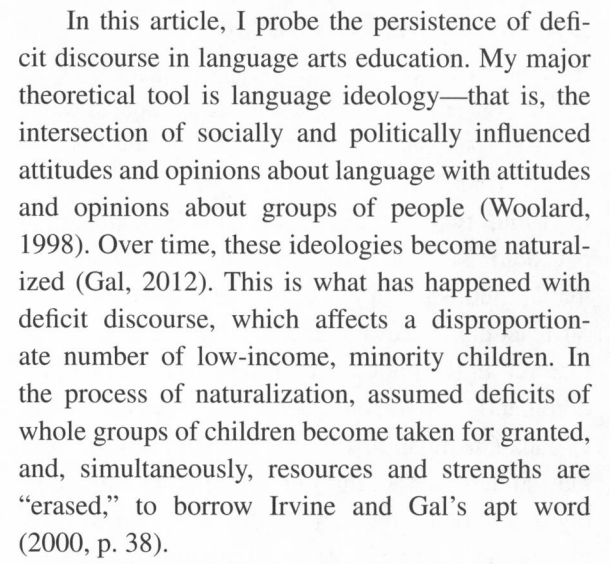
- Dyson, A. H. (2015). Research and Policy: The Search for Inclusion: Deficit Discourse and the Erasure of Childhoods. Language Arts, 92(3), 199-207. http://www.jstor.org/stable/24575568
- Déjà Vu All Over Again: What’s Wrong With Hart & Risley and a “Linguistic Deficit” Framework in Early Childhood Education?, Sarah Michaels
- A brief critique of Hart, B. & Risley, T. (1995). Meaningful differences in the everyday experience of young American children. Baltimore: Paul H. Brookes Publishing.
- Return of the Deficit, Curt Dudley-Marling
- Unequal Childhoods: Class, Race, and Family Life, Annette Lareau (see online)
- Author Curt Dudley-Marling Continues the Conversation on Deficit Thinking and the Pathologizing of Children, their Parents, and their Community
- The New Year Continues our Discussion between Authors Paul Thomas and Curt Dudley-Marling
- Stop blaming poor parents for their children’s vocabulary
- “What These Children Are Like”: Rejecting Deficit Views of Poverty and Language
- Our Enduring Deficit Gaze: Misreading Poverty (Again)
- Shifting Our Deficit Gaze, Asking Different Questions about Literacy
- The Middle Class (Thinks It) Knows Best: Daring to Intervene in Disadvantaged Households, Susan D. Blum, Lizzie Fagen, and Kathleen C. Riley
- Social in/justice and the deficit foundations of oracy by Ian Cushing
- Teaching Reading to African American Children (AFT)
- Tiered vocabulary and raciolinguistic discourses of deficit: from academic scholarship to education policy, Ian Cushing
- This Ain’t Another Statement! This is a DEMAND for Black Linguistic Justice! (Conference on College Composition and Communication)
- What These Children Are Like, Ralph Ellison
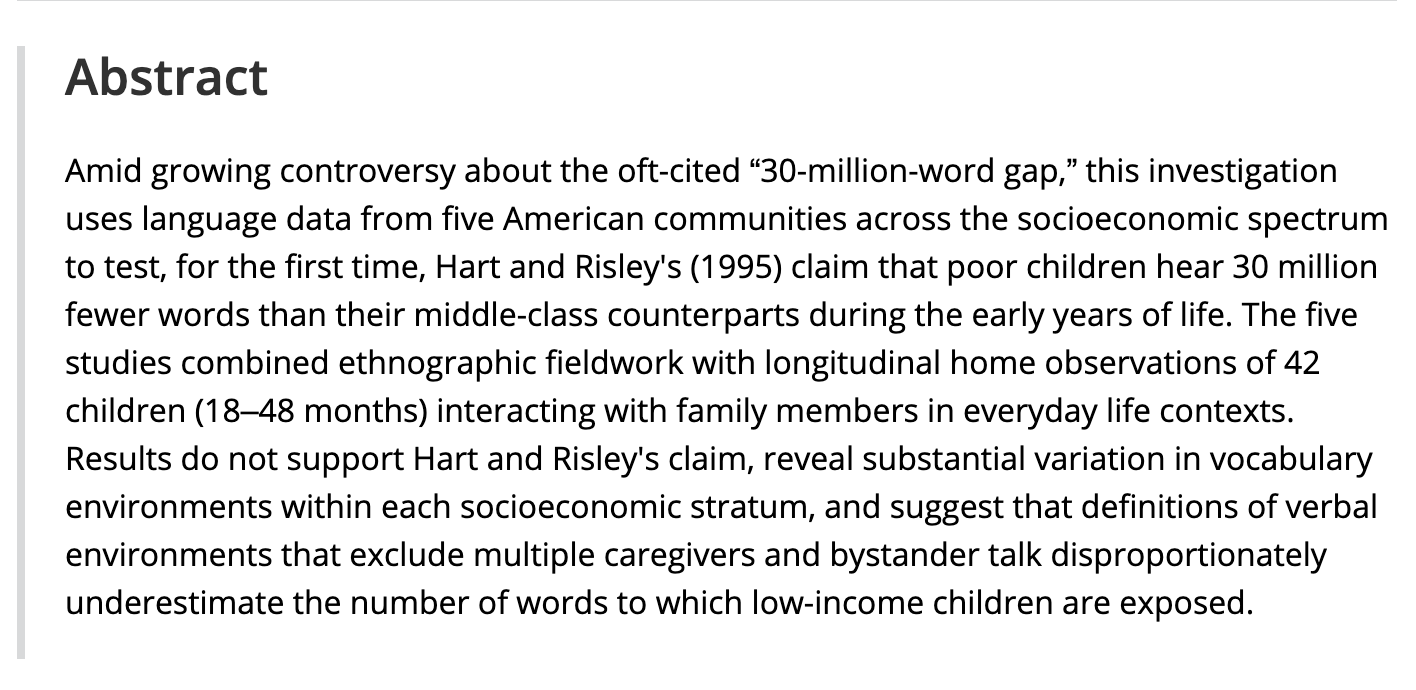
- Reexamining the Verbal Environments of Children From Different Socioeconomic Backgrounds – Sperry – 2019 – Child Development – Wiley Online Library
- A deficit story in motion: How marginalized youngsters are defined out of the educational game before they enter school, Miller, Sperry, and Sperry (2024)
 dr. p.l. (paul) thomas