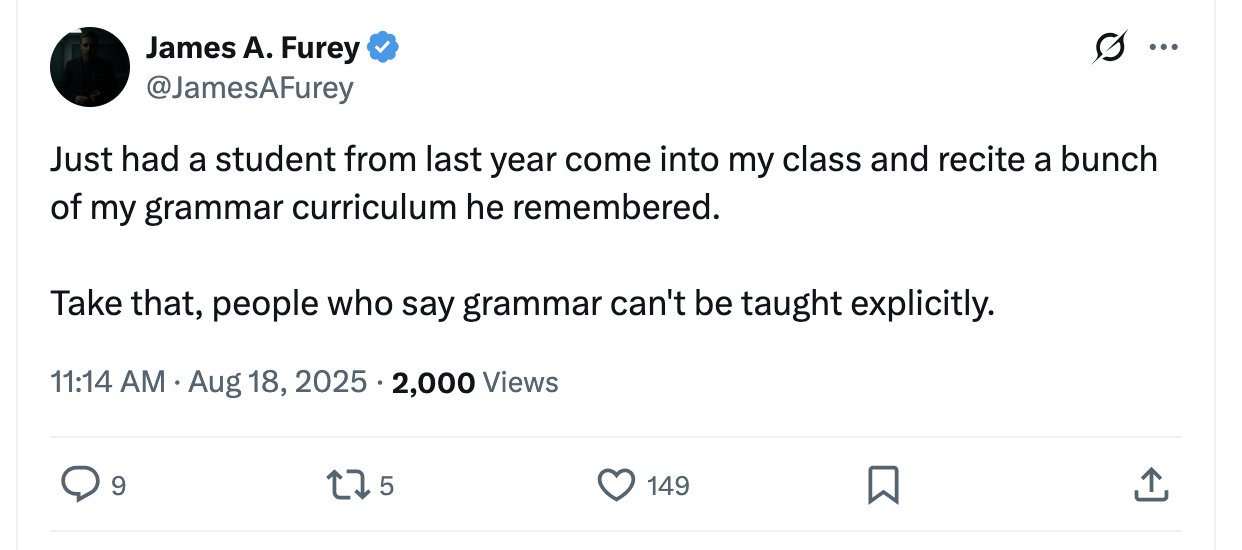
Since the “science of reading” (SOR) has now expanded into a “science of learning” (SOL) movement, the same problems among SOR advocates have appeared among SOL advocates—misinformation and misunderstanding about teaching and learning combined with a bait-and-switch approach that offers anecdotes as if they prove the so-called “science,” for example:
There is so much wrong with this that it is mind boggling, but let’s focus on, first, this is merely an anecdote, which proves nothing except that it happened.
Second, that direct instruction can be effective for students demonstrating simple recall is not very shocking; in fact, many would recognize that direct instruction/recall is asking far too little of students, especially in literacy instruction.
At one point in my education, I could name all the presidents in order as well as all the state capitals. It would have been better if I had developed a more sophisticated understanding of the presidency and the political realities of the US.
Through direct instruction over a brief amount of time, I can say one word, “inside,” and my poodle will happily trot into our apartment. I didn’t let her discover that; direct instruction produced pretty reliable recall in that sweet dog.
But she isn’t smarter; she is well trained.
Here, then, I am going to expand some on a third point: Furey clearly does not understand the issue he seems to be attacking, grammar instruction (with the implied agents being woke progressives who worship at the alter of discovery learning).
Intensive Phonics. This position claims that we learn to read by first learning the rules of phonics, and that we read by sounding out what is on the page, either out-loud or to ourselves (decoding to sound). It also asserts that all rules of phonics must be deliberately taught and consciously learned.
Basic Phonics. According to Basic Phonics, we learn to read by actually reading, by understanding what is on the page. Most of our knowledge of phonics is subconsciously acquired from reading (Smith, 2004: 152)….
Zero Phonics. This view claims that direct teaching is not necessary or even helpful. I am unaware of any professional who holds this position.
Furey seems to be posting a Gotcha! aimed at what he believes is a Zero Grammar view so let me follow Krashen’s lead and clarify: “I am unaware of any professional who holds this position.”
The Big Irony of a “science of” advocate attacking a straw man position on grammar is that there is pretty solid body of research/science on grammar instruction (note that many people use “grammar” to encompass grammar, mechanics, and usage).
To understand the research on direct (and isolated) grammar instruction, we first must clarify our instructional goal. If a course is a grammar course, and the goal is for student to acquire grammar knowledge, then some or even a significant amount of direct instruction can be justified and effective.
Even in the context of teaching students to acquire distinct grammar knowledge, however, many would caution against viewing grammar as “rules” and instead would encourage seeing grammar as a set of contextualized conventions that also carry some degree of power coding.
For example, subject/verb usages are a feature of so-called standard English, and some dialects can be identified by varying from those standards. It is important to acknowledge that one is not “right” or “better” linguistically, although the so-called standard forms tend to carry some cultural or social capital. And there may be cultural/social negative consequences for using dialects considered not standard.
As an analogy, direct (isolated) grammar instruction can be effective for teaching students grammar knowledge just as having students diagram sentences can be effective for teaching students how to diagram sentences.
The problem is when we make our instructional goal teaching students to write with purpose and with awareness of language conventions (grammar, mechanics, usage).
There is a long and deep research base reaching back into the early 1900s showing that direct (isolated) grammar instruction fails to transfer into student writing and can even have negative outcomes for the quality and amount of student writing.
For example, LaBrant (1946) noted: “We have some hundreds of studies now which demonstrate that there is little correlation (whatever that may cover) between exercises in punctuation and sentence structure and the tendency to use the principles illustrated in independent writing” (p. 127).
This does not mean “do not teach grammar,” but does mean that direct grammar instruction needs to in the context of student writing.
Students who are writing by choice and with purpose are much more likely to engage with and understand (and thus apply) language conventions (grammar, mechanics, usage) than when we directly teach those in isolation.
So let me be clear: Teaching students to write without direct instruction would be inexcusable, but teaching grammar through direct and isolated instruction is malpractice when our goal is teaching writing.
Here, then, are some ways to insure direct grammar instruction in the context of student writing is effective:
Establish direct instruction of grammar in context based on student writing and demonstration of need. This can be effective for both individual student writing conferences and whole-class instruction (if most student demonstrate the same needs).
Recognize that some language conventions are abstractions that may be difficult to grasp for students at early stages of brain development; holding students accountable for usage should be tempered by their development (see Weaver below).
Avoid the “error hunt” (see Weaver below) and do not frame language conventions as “right/wrong” or revising and editing as “correcting.” The goal is language convention awareness and purposeful writing by students.
Avoid traditional grammar textbook and exercises. Prefer instead research-based direct instruction that transfers to writing such as sentence combining and lessons on the history of the English language (see Style below).
Adopt either a workshop approach to writing or integrate workshop elements (choice, time, and feedback) into the course.
Forefront and help students understand that revising writing is their primary responsibility as writers in order to communicate as well as possible; however, editing (addressing language conventions) is a part of that process, although it may be delayed until a piece is worthy of editing and before publishing or submitting. As LaBrant (1946) cautioned: “I am not willing to teach the polishing and adornment of irresponsible, unimportant writing” (p. 123).
The surface features of student writing need not be perfect when writing is part of a course. Seeking perfect surface features can and often is a goal for published writing.
As this discussion shows, another failure of the “science of” movement is the urge to attack caricatures and to oversimplify.
Teaching grammar is not a simple thing to address, and, again, I will note using Krashen, there simply is no credible professional saying teachers should not teach grammar. In fact, no credible educator would reject direct instruction of grammar as long as that instruction is in the context of student writing.
LaBrant (1947) made an assertion about teaching almost 80 years ago that may sound familiar: “A brief consideration will indicate reasons for the considerable gap between the research currently available and the utilization of that research in school programs and methods” (p. 87).
I have always regarded this as accurate, and have repeated the claim myself for decades.
Straw man fallacies, caricature, and anecdotes, I fear, are not the path to making this less true.
The “science of” movement is failing here, and the consequences are to the detriment of students and teachers who deserve better.
“Did you write this?” I once asked a sophomore in my advanced English class. The student was one of three siblings I would teach, and their mother was a colleague of mine in our English department.
With students and my own daughter, I have asked questions like that one often, and I always knew the answer. The question was an opportunity for the student to confront what I already knew.
This student, you see, had turned in a cited essay that her older sister had turned in just a few years earlier. I had the paper in my files, and since I immediately recognized it, I had the copy with her sister’s name on the cover page waiting for her reply.
English and writing teachers especially, but all teachers are constantly seeking ways to insure students do their own work.
As long as there have been students, teachers, and formal schooling, however, students have sought ways to pass off writing and reading that they, in fact, had not done.
This student cold-face lied, and I handed her the paper by her sister.
Something like that has occurred several times over my forty-plus years of teaching.
A non-traditional aged woman in a night composition class for a local junior college became enraged when I asked her “Did you write this?”
I had been reading her writing for several weeks, and this essay she submitted wasn’t her work. There was no doubt and no need to prove it.
She became loud and angry, steadfast in her claim the writing was hers. After that night, I never saw her again.
Several years ago in my first-year writing seminar, a basketball player submitted a teammate’s essay from a few semesters earlier. The essay rang a bell, and after a search on my laptop, I found the original essay on my hard drive.
Plagiarism and passing off other people’s work as their own have not been rampant throughout my career, in part because I have implemented reading and writing workshop in courses. Students have been reading and writing in front of me for decades.
Lots of cheating can been avoided by daylight and surveillance.
Part of the workshop approach, as well, stresses for students that the reading and writing processes are acts of learning; further, the emphasis on process helps lessen the importance of the product as a mechanism for acquiring a grade.
“It ought to be unnecessary to say that writing is learned by writing; unfortunately there is need,” wrote Lou LaBrant in 1953. LaBrant then continued and this may sound familiar:
Again and again teachers or schools are accused of failing to teach students to write decent English, and again and again investigations show that students have been taught about punctuation, the function of a paragraph, parts of speech, selection of “vivid” words, spelling—that students have done everything but the writing of many complete papers. Again and again college freshmen report that never in either high school or grammar school have they been asked to select a topic for writing, and write their own ideas about that subject. Some have been given topics for writing; others have been asked to summarize what someone else has said; numbers have been given work on revising sentences, filling in blanks, punctuating sentences, and analyzing what others have written….Knowing facts about language does not necessarily result in ability to use it. (p. 417)
Over the seventy-plus years since LaBrant’s article, students have written original texts far too rarely; in fact, as writers and students in general, students sit in classrooms where the teacher does much of the work the student should be doing as part of learning.
Writing prompts and rubrics have done far more harm to students as writers than any technology work around, but technology has also joined in the fun over those eight decades.
ChatGPT and other forms of AI are the current miracle/crisis forms of technology in education. Seemingly, many people in education, surprisingly, are jumping on the AI bandwagon, much like the coding wave and cellphone bans.
You see, we are trapped in a love/hate binary with technology in education that too often isn’t based in evidence.
Tech and AI products like Grammarly and Turnitin.com have ridden high waves of use despite both products, to be blunt, just being very poor quality. Grammarly gives really bad writing advice, and Turnitin.com is less effective detecting plagiarism than a simple (and free) Google search.
The broader technology problem in education, which parallels the AI problem, is that technology in education is often like a microwave; something can be completed quicker but the product is either hard to stomach or simply ruined.
A recent study, in fact, shows that students using AI to draft tend to produce very similar texts that are shallow at best. Further, students who use AI to compose struggle to recall any of their writing.
Why? Let’s invoke LaBrant again: Writing is learned by writing.
Better worded, we should think of “writing” as composing. Composing is the art of simultaneously creating meaning, developing understanding, and drafting communication in words, sentences, and paragraphs.
AI generating functional text in some real-world contexts may be a time saver, a net positive. But for students, scholars, and writers, using AI at any point of the composing process is a new form of plagiarism.
Let me be clear, this is about the composing process because AI has long been useful for surface editing; grammar and spell check is not cheating, and AI can relieve the writer some of the burden of editing (a role humans often play for other people in the world of writing an publishing).
Maybe AI will prove valuable in many ways for humans, but AI that does for students the very behaviors students must perform to learn is never justified—just as teachers doing the work for students has never been justified.
“As citizens we need to be able to write and to understand the importance and difficulty of being honest and clear. We will learn to do this by doing it,” LaBrant offers bluntly.
“Did you write this?” is an enduring question between teacher and student.
In 2025, using AI is just as damning as putting your name on your sister’s essay before turning it in as your own.
So that’s why you cannot spell “plagiarism” without “AI.”
As a literacy educator for over 40 years, specifically as a teacher of writing, I have stated a solid “no AI” policy both in my courses and as a public stance.
While I am certainly not anti-technology, I am a technology skeptic and have acknowledged that popular technology used in education tends to be quite bad—for example, Turnitin.com.
My core reason for a “no AI” policy in my courses, specifically my writing courses, is that AI such as ChatGPT tends to do for students the very behaviors they need to be practicing in order to learn.
As a comparison, I have a “no AI” policy for the same reason I reject rubrics and writing prompts for teaching writing since rubrics and prompts, again, are making decisions for students that they need to be making as developing writers.
Here are key findings that support my “no AI” policy:
I want to stress that my experience with students is that they often either fail to use useful technology (such as the grammar and spelling check in Word) or they are quite bad at using technology, despite being seen as technology natives.
That students need help in formal education with being better at using technology is a given, but it is not a contradiction to acknowledge that some technology is counter-educational; and that is the case with AI/ChatGPT.
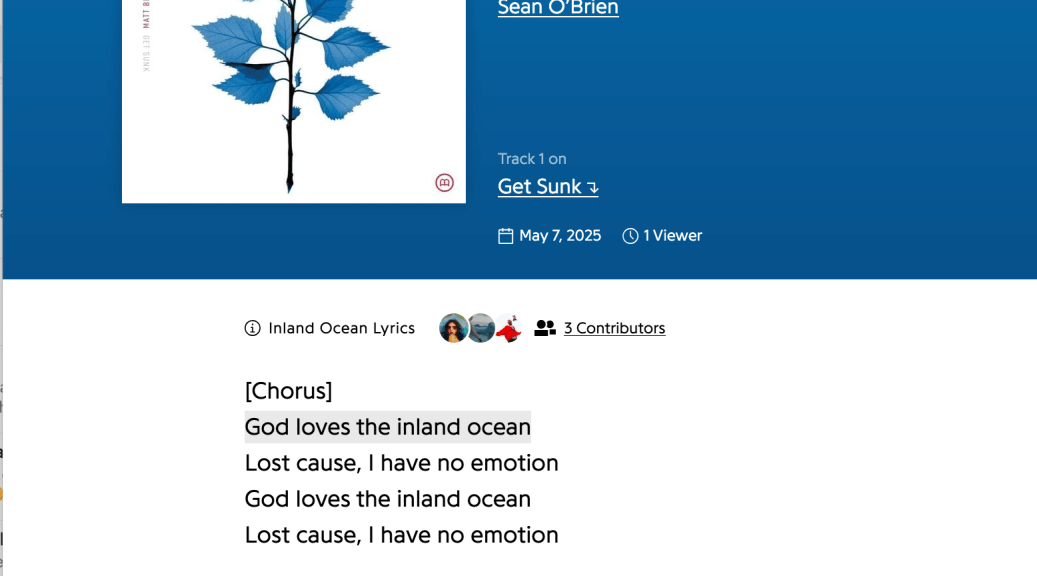
[Header image via Genuis, lyrics by Matt Berninger]
As I have noted often, over my forty-plus years teaching students to write, a few patterns remain constant, one of which is students lacking genre awareness.
On the first day of class, I often ask students what novels they read in high school English, and invariably, students include The Crucible or simply say “Shakespeare.”
They read these plays in book form, and have conflated anything in book form with “novel.”
Also, they mostly are experienced in being students who write, not writers.
So I spend a great deal of time and effort in my writing courses helping students become engaged with authentic writing practices, specifically fostering stronger writing purposes (and understanding writing forms/genres) and processes.
As a fan of The National and lead singer/lyricist Matt Berninger, I was particularly struck by this new interview [1] as Berninger begins promoting his second solo album, Get Sunk:
I think this interview is a really wonderful and brief entry point to discussing writer purpose and process (note that Berninger does use some profanity and references pot smoking).
Berninger is an endearing and quirky as his lyrics. And while he may seem flippant at first (“I’ll start fucking around with stuff”), he makes some very sophisticated and accessible observations about purposeful writing and the importance of the writing process (he has begun scribbling lyrics on baseballs instead of his standard journal, for example).
When the interviewer mentions his favorite lyric from Boxer (The National), Berninger offers a brief window into the importance of being a reader as well as the recursive nature of texts: “I stole that from Jonathan Ames.”
Berninger’s lyrics often pull from books, authors, and other song lyrics. Here is an ideal place to discuss with students the conventions of allusion and references as that creates tension with plagiarism (a great opportunity to tie in so-called canonized writers such as Marianne Moore and T.S. Eliot).
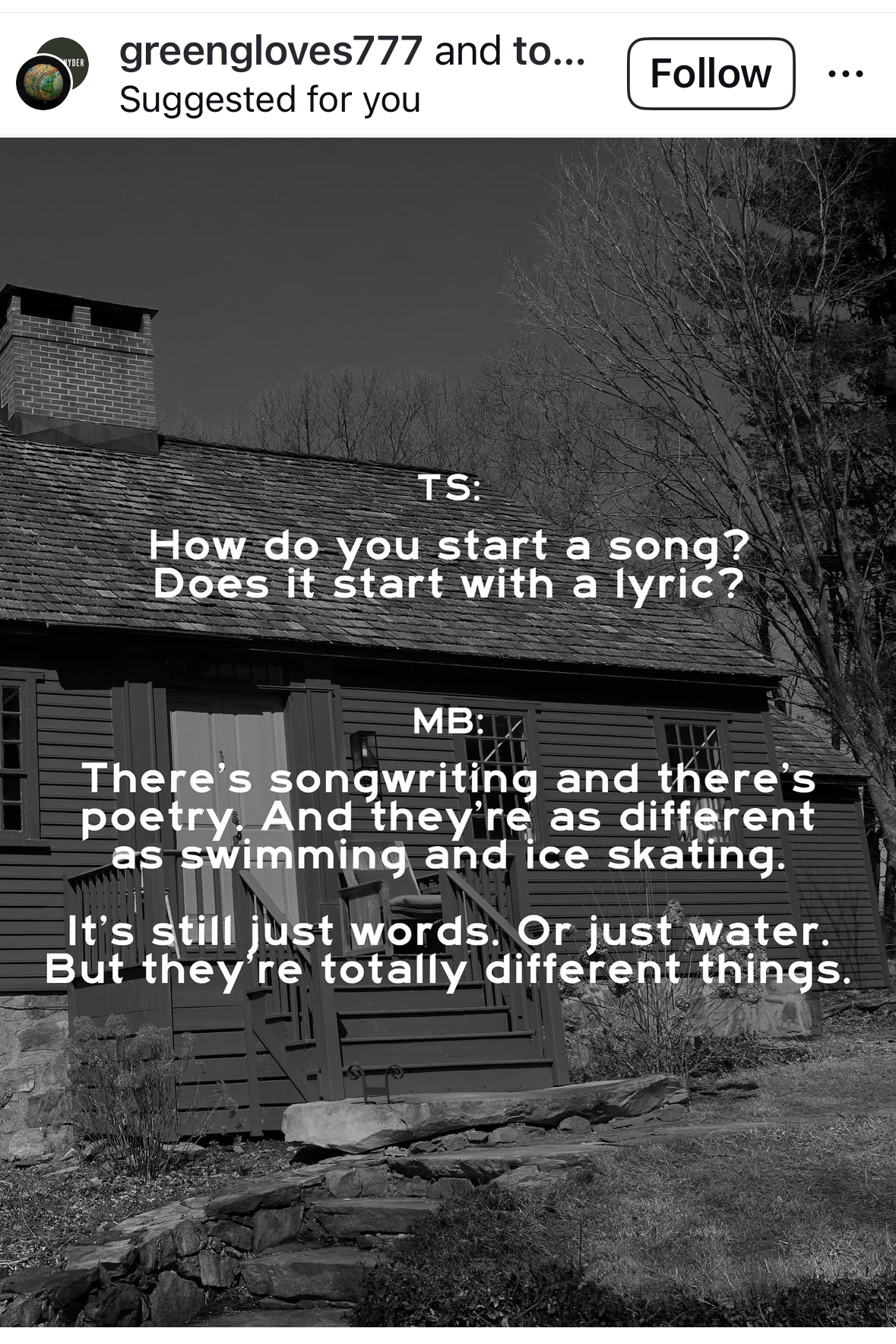
But the core comments I think students need to hear and then practice in the writing are about understanding different writing purposes/forms:
I do think songwriting is a very specific kind of thing…. It’s not—there’s poetry and there’s songwriting…. And I think they’re as different as like swimming and ice skating…. It’s like it’s still just words or just water but they’re totally different things.
This distinction and metaphor are powerful because they acknowledge the complexity of choosing and writing in different ways, for different purposes, and for different audiences.
Berninger also talks about his use of scribbling on baseballs for writing ideas. While quirky, this really captures the writing process in an authentic way (not the scripted way often taught in school).
As a teacher of writing and a writer (as well as avid reader), I want students to be fully engaged as writers—not as students performing a stilted essay for the teacher/professor.
We want for our students a sense of purpose, a demonstration of intent, an awareness of form and audience, and ultimately, a writing product of their choosing and for their purposes.
And in the era of intensified AI, I want to stress that AI has no place in these goals because students need and deserve opportunities to experience all of these aspects of brainstorming, drafting, and presenting a final product.
It may seem crude, careless, and flippant, but if we listen carefully, Berninger’s “fucking around” demonstrates the power and complexity of being a writer—and thus, being a teacher of writing.
[1] I highly recommend this blog post on Bon Iver/Justin Vernon as a companion to the Berninger interview.
Having taught now an on-going 41 years—about half that time as a high school English teacher and now a college professor—if there is one thing I know very well, it is the student.
While I love teaching and my students, there is also one thing I have worked diligently to discourage, young people in classrooms performing like students.
Most student behavior is artificial (hand raising to speak, sitting in neat rows, walking in single-file lines) and often dehumanizing (asking permission to go to the bathroom). And since the core of my work as a teacher has focused on teaching writing, few aspects of being a student are worse than writing like a student.
Much of my writing instruction focuses on moving students away from writing like students and toward writing like scholars (or, ideally, like writers).
While I cringe a bit focusing with the negative, let’s consider what writing like a student looks like (and what young writers should avoid):
Starting essays with and punctuating the discussion throughout with Big Claims that are often inaccurate or mostly empty and then nearly never proven or cited.
One of the best examples of this rhetorical patterns is from The Onion: “For as far back as historians can go, summer vacations have been celebrated by people everywhere as a time for rest and relaxation.”
Many students are drawn to the “throughout history” claims or framing a topic as “people have always debated,” “many people today debate,” or this topic is “controversial.” Scholars and writers avoid the Big Claims and especially the “throughout history,” “debate,” or “controversy” framing of a topic.
Student writing is often too big and overstated while scholars tend to work in very small and nuanced spaces around a topic; students seek to draw definitive and black-and-white conclusions while scholars deal in questions to be considered and reach tentative conclusions that are qualified.
Writing about doing the writing or research assignment.
Student papers are often filled with references to being a student writing an essay: “The sources I analyzed show,” “In the essay, I am going to,” “The research that I found explains,” “Most of the sources used,” “Many articles and papers done on these topics,” etc.
While there may be some charm to this accidental postmodernist approach to writing (alas, most students are not Kurt Vonnegut intruding on his own fiction narrative), for students, these meta-writing rhetorical moves do not accomplish anything substantive for the purpose of the essay or the content; these phrases simply add to the word count as empty calories.
For example consider the following and the revision (by removing the meta-writing, the word counts drops, and the writing is more direct and clear):
Student writing: Extensive scientific research has been conducted to determine if ADHD is the result of genetics or environmental factors. While this research has shown some correlation between certain genes or environmental factors and the onset of ADHD, the results remain inconclusive (Thapar et al., 2012).
Revised: While some correlation exists between certain genes or environmental factors and the onset of ADHD, the results remain inconclusive (Thapar et al., 2012).
[Note that students can and should use “I” in writing when first person is appropriate and drives the content and purpose of the essay. Typically, students are apt to use “I” in empty and performative ways instead of powerfully and appropriately.]
In cited writing assignments, producing a very narrow form of the “research paper.”
I now include on essay assignments “Do not write a research paper on …” as part of the assignment. The artificial “research paper” that many students have acquired from K-12 schooling is a mechanical and prompted essay form that results in students writing about their sources instead of writing a purposeful essay with a clear audience: “One article I read pushed for dialogue in their congregational community surrounding the mental health of black parishioners.”
Also, as another example: “John Dewey (1953) wrote a book about progressive education. In his book, Dewey (1953) states, ‘The educator is responsible for a knowledge of individuals and for a knowledge of subject-matter that will enable activity ties to be selected which lend themselves to social organization, an organization in which all individuals have an opportunity to contribute something, and in which the activities in which all participate are the chief carrier of control’ (pp. 23-24).”
Many students simply walk the reader through their “sources” one-by-one, essentially writing about their sources and not their topic. This includes text that increases word count and nothing else, empty calories: “Various studies and scholarly research conducted surrounding the pipeline expose the oppressive and discriminatory systems and beliefs involving law enforcement and unforgiving disciplinary policies within schools that are continually pushing students, especially students of color, out of schools.”
Consider a more direct and powerful version: “Oppressive and discriminatory systems and beliefs involving law enforcement and unforgiving disciplinary policies within schools are continually pushing students, especially students of color, out of schools.”
Excessive or inappropriate quoting.
You may be noticing a trend here since a great deal of what makes something “student writing” increases word count without contributing to the content of the writing.
Excessive and inappropriate quoting is a hallmark of student writing grounded in learning to cite and provide evidence in their writing primarily in their high school English classes where they are using MLA and often doing textual analysis (literary analysis).
Students have learned in the context of literary analysis for English courses that the (only) way to prove a point is by quoting. This is essentially true when writing textual analysis, but students turn that into a universal technique whereby they quote excessively from sources in all types of writing.
And thus, students (as noted above) simply write about their sources, quoting excessively from each and providing little of their own thoughts and almost no synthesis of information. One of the most ineffective but common examples is the floating quote in which the student as writer never exists: “’A democratic and inclusive sexuality education balances risk and resiliency and recognizes that they are on a continuum and are influenced by social and cultural factors in the environment’ (Elia & Eliason, p. 25).”
Scholars, when writing in forms and purposes other than textual analysis, tend to quote rarely or not at all; when quoting in scholarly writing that isn’t textual analysis, the guideline is something like quote when the “how” of the passage is as powerful as the “what.”
We may be justified in quoting James Baldwin while not so much when using information from a peer-reviewed journal articles on social mobility or racism in policing.
Mechanical essay form and thesis sentences (declarative and conclusive statements).
If you have been wondering, the 5-paragraph essay is alive and well. Students overwhelmingly believe an introduction is one paragraph that ends with a declarative thesis statement, that essay bodies have three paragraphs or sections to correlate with the three points in that thesis, and that the conclusion is one paragraph that, yes, restates the thesis.
At no point of a student’s development is a 5-paragraph essay justifiable; it is the paint-by-numbers of composition. It is not just bad writing, it is also bad thinking.
Scholars write all sorts of essay forms and construct them around much broader concepts of openings, bodies, and closing with the thesis focus often in the form of questions to be considered and not definitive assertions made at the beginning and then proven.
As with many of the examples so far, the 5-paragraph essay template is a distraction for the student-as-writer, focusing their writing on filling in the template and not addressing and developing their writing purpose for a clear audience. [As a note, I still have students occasionally label their thesis sentence in their essays.]
Essay purpose/form and audience directed at either at no audience or the teacher/professor.
Related to the 5-paragraph essay template is that students are trapped in the context of writing an essay is a form of assessment that is being assigned and graded by the teacher. As a consequence, the purpose is just doing the assignment, and the audience is either no one in particular or simply for the teacher/professor.
While the essay form for scholarly and academic writing is narrower than the entire array of what we call essays, students must be introduced to the broader essay form that involves them as writers making decisions about how to organize, to engage the readers, and to develop the purpose of the essay.
Some of the elements I introduce is the multiple-paragraph opening and closing, subheadings, the thesis as question(s), and abandoning the closing as a restating of the introduction.
Paragraphing that is very long or lacking purpose.
One thing students as writers simply cannot do is paragraphing. They have lived in a world of prescribed number-of-sentences mandates for paragraphing, and those prescriptions have been, to say the least, really bad guidelines.
Students have learned that longer is better.
While academic and scholarly writing suffer from the long-paragraph syndrome, here I do push students toward how non-academic writers use paragraphing.
Broadly speaking, readers prefer shorter paragraphs (or at least balk at long ones). And fields such as journalism use very short paragraphing.
Since a foundational part of teaching writing for me is students learning to be purposeful instead of following templates and rules, I focus on purposeful and varied paragraphing. We read and examine many effective essays that use one-sentence paragraphs and explore how paragraphing impacts the reader/audience of the text.
Word choice and tone contradicting the content and tone of the essay topic and purpose.
Students as writers are, of course, developing and expanding their vocabulary. But the diction problem that most characterizes student writing is a lack of awareness of tone—using words that have a contradictory tone to the level of seriousness of their topic.
Lots of “thing,” “good,” “bad,” and 8-color crayon box of words when they are exploring complicated and serious issues: “Sex education in the United States is all over the place, and for some students, their sex ed is almost exactly like the students in Mean Girls” or “This article was also pretty on par with the tone of the research papers” or “Because each employee’s salaries are not posted on the front desk for everyone to read, many women don’t even realize they are being gipped until someone blabs during their break at the water cooler or they hear the specifics of their associate’s raise.”
So here we are after a pretty extensive list of what student writing tends to entail. This, by the way, is no criticism of students.
Student writing is a reflection of how students have been taught, assigned, and graded. Students often learn what they are taught despite the hand wringing to the contrary.
I have two thoughts now.
First, students deserve better writing instruction and expectations throughout K-16. That instruction needs to come from teachers who are writers, not just “English teachers,” and more educators need better experiences with being writers themselves (that is the foundation of the National Writing Project).
Next, students are capable of making this transition, although the unlearning is often not fun for them or the instructor.
And thus the paradox remains: I love students but work daily to deprogram them from behaving like students.
Dominic Wyse and Charlotte Hacking present a ground-breaking account of teaching phonics, reading, and writing. Created from a landmark study, new research, new theory, and cutting-edge teacher professional development, this balanced approach to teaching seeks to improve all children’s learning, and therefore life chances.
The book dismantles polarised debates about the teaching of phonics and analyses the latest scientific evidence of what really works. It shows, in vivid detail, how phonics, reading, and writing should be taught through the creativity of some of the best authors of books for children. By describing lessons inspired by ‘real books’, it showcases why the new approach is more effective than narrow phonics approaches.
The authors call for a paradigm shift in literacy education. The chapters show how and why education policies should be improved on the basis of unique analyses of research evidence from experimental trials and the new theory and model the Double Helix of Reading and Writing. It is a book of hope for the future in the context of powerful elites influencing narrow curricula, narrow pedagogy, and high stakes assessments.
The Balancing Act will be of interest to anyone who is invested in young children’s development. It is essential reading for teachers, trainee teachers, lecturers, researchers, and policy makers world-wide who want to improve the teaching of reading and writing in the English language.
I haven’t seen the memo, but it appears that there is a mandate whenever anyone discusses Taylor Swift they must include at least that she is a good songwriter, although usually the claim is that she is a great songwriter, possibly the greatest songwriter ever (although Rolling Stone would beg to differ).
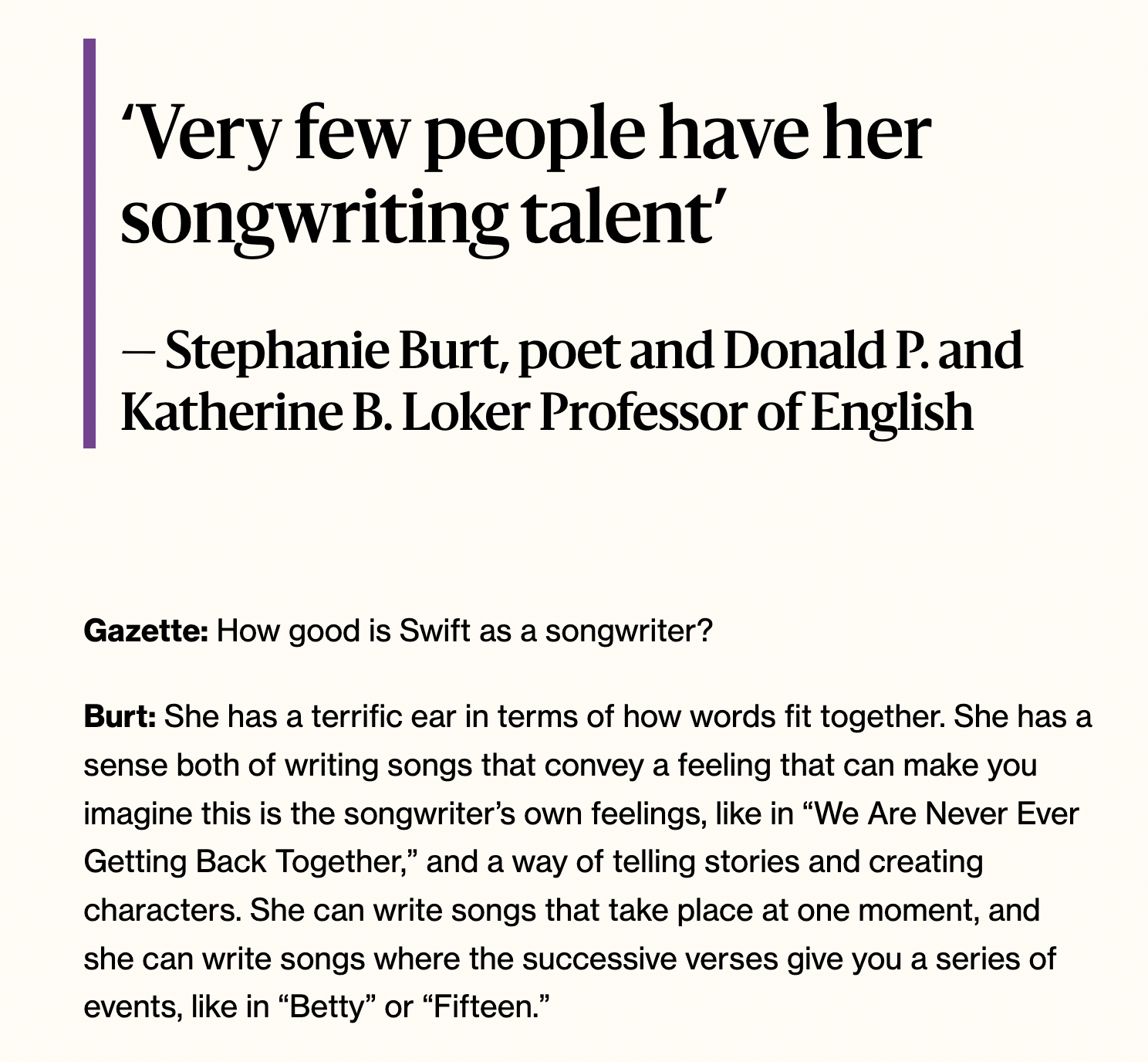
This interview with poet Stephanie Burt typifies the sort of effusive praise Swift elicits for her writing even outside pop culture among so-called serious writers:
Burt continues and makes a key point about Swift being accessible as well:
She has a lot of different gifts as a songwriter, both at the macro level, how the song tells a story or presents an attitude, and at the micro level, how the vowels and consonants fit together, and she’s able to exercise that range, along with quite a lot of melodic gifts, and in a way that does not make her seem highbrow or alienate potential audience members.
So let’s consider a simple question that seems to have already been definitely answered—Are Swift’s lyrics “good writing”?—but only as a context for answering, Just what is “good writing”?
And the short answer is, Yes, and probably not.
Because it all depends on what we mean by “good writing.”
I have been myself a “serious” writer (writing almost daily) since college, about 44 years. For 40 years, I have also been a writing teacher.
I also love popular music, and consider pop art valid art—a craft and genre all its own that shouldn’t be discounted simply for being popular.
My adult life is richer because of my love for The National (and other popular bands) and my renewed life as a comic book collector.
I am drawn myself to pop culture with “good writing”—song lyrics and narratives of comic book writers and artists (yes, I consider comic book artists “writers” as well).
What I want to emphasize, then, is that this isn’t intended to be a snob post that takes a passive aggressive swipe at pop culture icons.
That said, I think we can make fair assessments such as distinguishing song lyrics from poetry; in that, they are not the same but share some of the same characteristics that help us understand what good writing is.
It seems pedantic (like using the word “pedantic”) and even petty to announce that Swift, in fact, isn’t a good songwriter since her success as an artist is elite if not unique.
But for writers and teachers of writing and literature, often “good writing” focuses on the how of expression as well as the what.
I have noticed the general public will say something is well written if the film or book or series is engaging and interesting—regardless of the actual craft of the writing. There is definitely something to accessibility for the general audience—Burt’s writing “in a way that does not make [Swift] seem highbrow or alienate potential audience members.”
Here, then, I want to focus on good writing as craft—the writer’s choices about diction (word choice), sentence formation, and most importantly, the writer’s purposefulness and control.
Swift’s lyrics clearly resonate with a large percentage of listeners, and Swift is consciously composing those lyrics with attention to technique (metaphor and other types of figurative language).
In that respect, her lyrics are good writing in terms of purposefulness.
For example consider Swift’s “Love Story” as a craft lesson on using the Romeo and Juliet narrative. But, for this discussion, I want to offer that your consideration of Swift as a good writer should be posed beside another song also incorporating the same mythology: “Romeo and Juliet” by Dire Straits (lyrics by Mark Knopfler).
I don’t mean this as a negative criticism, but Swift’s use of craft often reads as a music performer purposefully inserting craft into her lyrics—which I would distinguish from writers who incorporate craft elements in the service of the writing and expression. [1]
The opening of the two songs are distinct with Swift framing the Romeo and Juliet reference as a overlay of an actual relationship; her opening, for me, is too direct and a bit clunky:
We were both young when I first saw you I close my eyes and the flashback starts
Knopfler re-imagines Romeo and Juliet, the narrative creating what John Gardner always emphasized that writing should be a “vivid and continuous dream”—the goal being that the writing is so engaging that the reader forgets they are reading (think also of a viewer forgetting they are watching a film).
Yes, Swift is using figurative language and even allusion (“scarlet letter”); this is clearly writing with craft and purpose.
Not to again be pedantic, but this is about degree of what counts as “good writing” and an argument that there is a range of sophistication in writing.
For example, the use of “like” in a simile is considered more direct (and clunky) than a metaphor. Emily Dickinson’s “Hope” is the thing with feathers remains at the level of metaphor simply by avoiding simile “‘Hope’ is like a bird.”
So that range of sophistication can be seen in the following:
Bryan can’t pay attention. His brain is like a squirrel.
Karin is squirrely a lot of the time.
We’ve always called him “Squirrely Matt.”
Or think about the word “boomerang.” Even in day-to-day speech we tend not to say “That moved like a boomerang” because we have adopted the simile into a metaphorical verb, “That boomeranged.”
It is here that I acknowledge that Swift’s lyrics seem to be pale or under-developed examples of good writing because I am distracted when listening to the lyrics often by a lack of control in terms of word choice and tone.
This will seem like a negative criticism, but part of the accessibility of Swift as a good writer is that her use of craft is still in an adolescent stage (which doesn’t mean “worse” or “bad”).
A poet I found who was accessible for my high school students was James Dickey; not his use of both direct comparisons (similes) in “The Hospital Window” and then the never directly mention comparison (lifeguard like Jesus/savior) in “The Lifeguard”.
This is not intended to be about Swift as much as a plea that we make claims of “good writer” and “good writing” a bit more carefully in terms of acknowledging the craft and, again, the purposefulness and control.
What is the writer doing and how is that craft in the service of expression? And then, ultimately, is that expression itself something novel or unique and, probably more importantly, is the expression a thing we should embrace, endorse, or consider seriously?
Craft in the service of bad ideas, I think, isn’t worthy of considering as “good writing,” for example (in fact, powerful writing and expression that leads humans astray is a horrible thing with too many examples dotting history).
I have to end in teacher mode by offering a smattering of poems that allow you to put my thoughts here into practice; these are glorious examples of “good writing” (I think) because of the craft, the purposefulness and the control (specifically, look closely at the word choice in Plath’s “Daddy” in the service of expression):
Those, I believe rise to the level of “good writing” while remaining mostly accessible. If you want to dip your toe in “good writing” that may be a bit less accessible, you should spend some time on Emily Dickinson (and likely not the poems you have been assigned before:
[1] After the release of Swift’s 2025 The Life of a Showgirl, this analysis of that album adresses some of my concerns about the lyrics—No Good Art Comes From Greed.
Over my 40-year (so far) career as a teacher, I have spent the bulk of that time teaching adolescents and adults to write.
An inordinate amount of that effort focuses on a great deal of unlearning since many writing assignments for students are exclusively student behaviors, not authentic practices or producing authentic artifacts.
This semester I am teaching two first-year writing seminars and an upper-level writing/research course. All of these students are in the midst of submitting cited essays.
This is the time of unlearning the “research paper.”
For the upper-level course, students work through an authentic process of choosing a topic, searching for their primary and secondary sources, submitting an annotated bibliography, and then submitting a cited essay (an analysis of media coverage of an educational topic).
Throughout that process, I note that, for example, the annotated bibliography is for them, a sort of prewriting of the cited essay (not an assignment to submit for a grade). This is an effort to lay the foundation for an authentic process of writing an original analysis grounded in evidence.
Despite my repeated warnings, students in this course still often turn in a first submission that is not a media analysis but a “research paper” on the educational topic. For example, instead of submitting their original analysis of how the media covers dyslexia, they submit a “research paper” on dyslexia.
Concurrent with that assignment, my first-year students are preparing their first formally cited essay (using APA). The essay before this assignment requires them to cite using hyperlinks, again emphasizing an authentic and more common approach to evidence in the world outside of formal schooling.
For both first-year and upper-level students, however, the urge to write a reductive and stilted “research paper” is deeply engrained from their K-12 schooling.
One consequence of that artificial experience and template is extremely cumbersome style that includes students writing about their “sources” instead of using their sources as either the focus of their analysis or evidence for their claims.
For example, these sorts of sentences are common:
Extensive scientific research has been conducted to determine if ADHD is the result of genetics or environmental factors. While this research has shown some correlation between certain genes or environmental factors and the onset of ADHD, the results remain inconclusive (Thapar et al., 2012).
Various studies and scholarly research conducted surrounding the pipeline expose the oppressive and discriminatory systems and beliefs involving law enforcement and unforgiving disciplinary policies within schools that are continually pushing students, especially students of color out of schools.
One article I read pushed for dialogue in their congregational community surrounding the mental health of black parishioners.
Journalists for mainstream media sources have argued that standardized testing adds a lot of stress and without many benefits.
Published scholarly work has concluded that testing is necessary, and journalists Donnelly (2015) and Silva (2013) back up these views.
This sort of meta-writing—identifying that scholars do research, treating the sources for an assignment as “my sources,” acknowledging that the student has done the research or reading—is a failure of the students to understand both the nature of cited writing and their own obligation as a writer of scholarship.
The upper-level course has a very challenging assignment that requires students to understand different types of sources and to write in different styles within the cited essay.
For these students, they have to gather evidence of media coverage of an education topic (the primary evidence of their analysis) while also having a body of scholarly sources that serve as the foundation of that analysis.
The brief literature reviews forces them to focus on the patterns in those scholarly articles, which provides the lens for analyzing the media coverage.
In the media analysis and evaluation sections, then, students must incorporate textual analysis, which requires a much greater sophistication than the examples above.
Here is the expanded guide I have created for those students to navigate the stylistic shifts and the use of evidence in cited essays:
Media Analysis Guidelines (EDU 250)
For 8-10 pages, a proposed structure:
Opening – about 1 page (2-4 paragraphs); be sure to include essay focus on media
[ ] Open with a specific narrative that focuses reader on your educational topic (and possibly use a media example).
[ ] Prefer shorter paragraphs (throughout essay).
[ ] Thesis must focus on media analysis. Prefer identifying questions you will answer about media portrayal of educational topic. [Do not refer to “the literature” or “research.”]
Literature Review – 2 pages; focus on *patterns* in the sources (write about your topics, not the sources); must be fully cited (prefer synthesis and avoid presenting one source at a time) and address all scholarly sources included in references
[ ] Discuss the patterns found in the scholarly evidence. [Do not refer to “the literature” or “research.”]
[ ] Do not write about your “sources”; write about what the evidence shows concerning your educational topic.
[ ] Primarily focus on a synthesis of your scholarly sources; do not walk through one source at a time.
[ ] All scholarly sources must be included, and you must fully cite using APA.
Media Analysis– 2 pages; focus on *patterns* in the media and include several examples; directly identify media outlets and journalists
[ ] Discuss the patterns found in media coverage of your educational topic.
[ ] Identify journalists and media sources specifically; choose some key quotes to show readers evidence of media coverage patterns.
[ ] Must cite fully in APA.
Media Evaluation(identify if media claims are valid or not) – 2 pages; this is the most important goal of the essay so evaluate the media coverage by implementing your knowledge of the scholarship (do not refer to “research” or “sources”); must be fully cited
[ ] This is the key section where you show whether or not the media coverage is valid (supported by research) or not. You must connect media patterns with the scholarly research.
[ ] Do not refer to “my sources,” the “research,” or the “literature.” Use your scholarly sources to evaluate media coverage.
[ ] Must fully cite throughout in APA.
Closing/Conclusion – about 1 page (2-4 paragraphs); must emphasize essay focus, media analysis
[ ] Return to a concrete or specific example from media.
[ ] Maintain focus on media analysis and give your reader something to do with your analysis/evaluation.
This assignment seeks to offer students an experience with what is common in academic and scholarly writing (graduate-level work and published scholarship). The assignment guidelines are too much of a template for my liking, but I am aware that many real-world scholarly works conform to such template or narrow guidelines (see this work of mine written to a strict template).
For both my first-year and my upper-level students, however, what I am seeking is how to foster in them greater autonomy and authority as writers and scholars.
My students’ cited essays are never called “research papers,” students always have choice about topics for their essays and must generate their own thesis/focus for the assignment, and my feedback supports these students incorporating evidence (sources) as ways to build their authority as writer and scholars.
For example, we work on fairly simple stylistic shifts that create authority and move cited essays beyond the research paper:
From this:
Research has shown that standardized testing interferes with both teaching and learning, increases student frustration, and leads to a classroom mindset focused more on grades than on actual learning of material (Wilson, 2022).
To this:
Standardized testing interferes with both teaching and learning, increases student frustration, and leads to a classroom mindset focused more on grades than on actual learning of material (Wilson, 2022).
Students have far too many experiences at the K-12 level that use inauthentic writing assignments (such as the “research paper”) as a mechanism for assessing if students have acquired skills—finding and analyzing sources, implementing academic citation, etc.
Those approaches have the goals reversed.
Students as developing writers and scholars need to acquire those skills in the service of their writing and expression; the cited essay is the thing we are seeking, and their authority as writers/scholars is the most important aspect of our feedback and (if necessary) assessment.
Can a student organize and focus an examination of a topic or idea in ways that are compelling and grounded in valid claims?
To do that well, academic and scholarly writing demands citation that serves to support the authority of the writer.
Ultimately, the urge in students to write about their sources is a reflection of their not yet understanding their autonomy as humans, writers, or scholars.
Students as writers must be allowed the full experiences of being a writer and thinker, guided of course by teachers of writing. But we as teachers of writing often do far too much for the student and ask far too little of those students.
Few students will move on from formal schooling and be academic or scholarly writers. What we must provide them with, then, is writing experiences that support their coming to embrace their autonomy and authority as thinkers along with the ability to express themselves in ways that are credible and compelling.
My midterm exam for first-year writing invites students to interview a professor in a discipline they are considering as a major. The discussion is designed to explore those professors as researchers and writers.
On exam day, we have small and whole-class discussions designed to discover the wide variety of activities that count as research in various disciplines, and more importantly, what writing as a scholar looks like across disciplines.
The outcomes of this activity are powerful since students learn that research and writing are context-based and far more complicated that they learned in K-12 schooling.
Two points that I often emphasize are, first, that many (if not most) of the professors confess that they do not like to write, and second, I help them see that a profoundly important distinction between their K-12 teachers and professors is that professors practice the fields they teach.
This brings me to two posts on Twitter (X):
As an ELA teacher 12 years in, I am beginning to wonder if we have done students a disservice in K-12 by placing too much emphasis on the differences between genres of writing for students (expository, argumentative, narrative, etc.)
I care about a lot of writing that is academic but I don’t care really care about academic writing as academic writing nor could I actually define what that is.
(Feels like much of our understanding of writing in academia has debunked the idea of academic writing.)
First, Luther is confronting a foundational failure of K-12 writing instruction—students being taught the “4 Types/Genres of Writing” (narration, description, exposition, persuasion).
That framing is deeply misleading and overly simplistic, but that framing is grounded in two realities: most K-12 teachers who teach writing are not writers, and the so-called “4 Types/Genres of Writing” are rooted in the rise of state-level accountability testing of writing (not any authentic or research-based approach to teaching composition).
Second, so I don’t appear to be beating up unfairly on K-12 teachers (I was one for 18 years and love K-12 teachers), Dowell is then confronting the often careless and reductive ways in which “academic writing” is both taught and even practiced (academic norms of published writing ask very little of scholars as writers and even impose reductive templates that cause lifeless and garbled writing).
The 1980s and 1990s saw a rise in state accountability testing that asked very little of students. The “4 Types/Genres of Writing” quickly supplanted the gains made with authentic writing instruction grounded in writer’s workshop and the influence of the National Writing Project in the 1970s and 1980s.
Those writing tests prompted students to write narrative or expository essays (for example) that were only a few paragraphs long (likely the 5-paragraph essay). These were scored based on state-developed rubrics that teachers taught to throughout the year.
In other words, as Gerald Bracey warned, writing instruction became almost exclusively teaching to the test. And since K-12 teachers of writers were primarily not writers themselves, this reductive and mechanical way to teach and assess writing was rarely challenged.
Let’s be blunt. K-12 teachers not resisting this dynamic is a logical response to an impossible learning and teaching environment that is dominated by accountability and high-stakes testing.
My criticism is that teachers and students were (and are) put in this situation; I am not criticizing teachers and students, who are the victims of the accountability era of education reform.
Further, while students who move from K-12 to higher ed discover that their K-12 preparation in writing is inadequate and often deeply misleading for how they are expected to write in academia, this new situation is not some idealistic wonderland of authentic writing (as Dowell confronts).
The K-12 to higher ed transition makes students feel unfairly jerked around (many are exasperated when they find out they didn’t need to “memorize” MLA and may never use it again), but navigating academic expectations for writing is equally frustrating (one first-year student this spring noted that my first-year writing seminar is unique, they said, because I teach writing while other professors simply assign and grade writing).
Students deserve better at both the K-12 and higher ed levels so here I want to offer a few thoughts on how to move past the traps I have noted above about teaching writing.
Johns argues for fostering “genre awareness” (addressing in complex and authentic ways Dowell’s concern) and not “genre acquisition” (for example, the reductive “4 Types/Genres of Writing” approach):
The first is GENRE ACQUISITION, a goal that focuses upon the students’ ability to reproduce a text type, often from a template, that is organized, or ‘staged’ in a predictable way. The Five Paragraph Essay pedagogies, so common in North America, present a highly structured version of this genre acquisition approach.
A quite different goal is GENRE AWARENESS, which is realized in a course designed to assist students in developing the rhetorical flexibility necessary for adapting their socio-cognitive genre knowledge to ever-evolving contexts. …After my many years of teaching novice tertiary students who follow familiar text templates, usually the Five Paragraph Essay, and who then fail when they confronted different types of reading and writing challenges in their college and university classrooms, I have concluded that raising genre awareness and encouraging the abilities to research and negotiate texts in academic classrooms should be the principal goals for a novice literacy curriculum (Johns 1997).
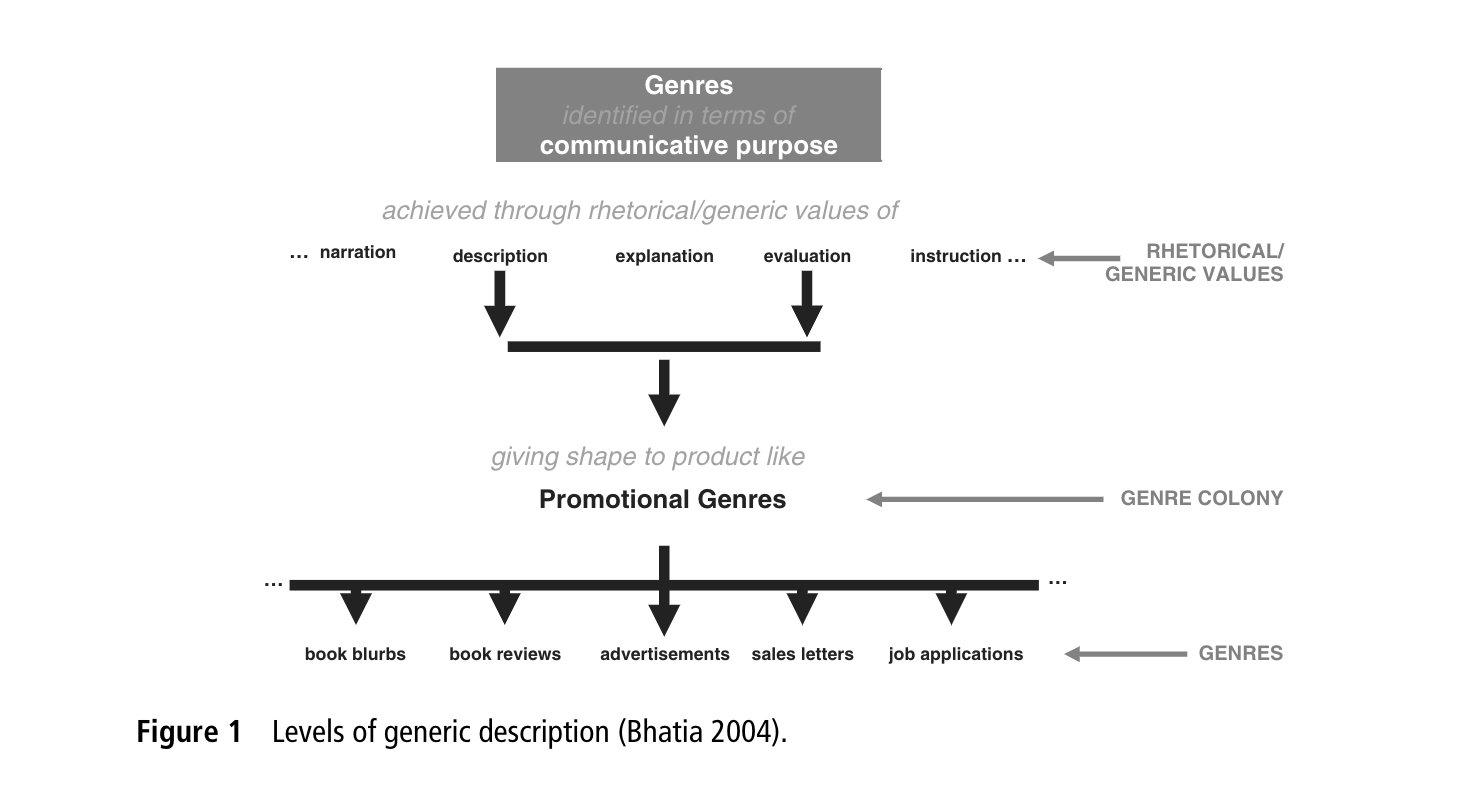
Here I think is an outstanding graphic (Johns draws from Bhatia) of moving past confusing modes of writing (narration, description, exposition, persuasion) with genres of writing (OpEd, memoir, meta-analysis, literature review, etc.):
At both the K-12 and higher ed levels, then, teaching writing has been reduced to serving something other than students—either the mandates of high-stakes testing or the nebulous and shifting expectations of “academic writing,” which include very dangerous traps such as a maze of citation expectations among disciplines.
My first-year writing students and I are at midterm this spring, and we just held our conferences for Essay 2 with a scholarly cited essay looming once we return from spring break.
In those conferences, we have been discussing the huge learning curve they are facing since I ask them to choose their essay topic and thus develop their own thesis within a genre of writing.
They are making all the decisions writers do in authentic contexts.
Before my class, they have had most of their writing prompted, most of their thesis sentences assigned to them, and most of their genre experiences entirely reduced or erased.
So I explain this to them, assuring them that their struggles are reasonable and not a product of them failing or being inadequate.
These are new and complex expectations of young writers.
But is the only fair thing to offer them, this experience of becoming a writer as an act of them as humans and not as a performance for a test or to fill in a template.












 dr. p.l. (paul) thomas