Category Archives: Writing

Ken Lindblom’s “Is Interesting to Read” and the Rubric Dilemma Redux

At the 2003 National Council of Teachers of English annual conference in San Francisco, I met Ken Lindblom, then a column editor for English Journal and later an outstanding editor for the same.

Ken is among an important nucleus of NCTE colleagues and friends who have enriched my professional life in ways I can never repay; I have served as a column editor for EJ under two different tenures of editors and as the Council Historian just after the centennial along with being awarded the 2013 George Orwell Award—just to name some of the personal accomplishments that I cherish as examples of the collegiality and kindness found in the NCTE community of teachers and scholars.

So Ken’s The Rubric Criterion That Changed Everything has put me in a predicament since I value Ken as one of my go-to thinkers on teaching writing but I also have a long and firm stance against grades, tests, and rubrics (see my chapter on de-grading writing instruction).

The central point addressed by Ken captures exactly why his post inspires me and gives me pause:

Once I was reading a stack of papers, and I remember thinking, “Man, I wish these papers were more interesting!” Then it hit me: Students will work on what’s listed on a rubric. In my next paper assignment, I added this to the rubric: “Is Interesting to Read.”

Rubrics—as Maja Wilson and Alfie Kohn deconstruct—often become the chore to fulfill when students write, and while they can provide structure and clarity in grading for both students and teachers, rubrics can often be nightmares for those same teachers when student writing flounders but fulfills the rubric or soars in ways that the rubric never addresses.

Instead of rubrics, then, I offer students guiding questions, and do agree that students need structure (see these concepts and questions [1] grounded in developing genre awareness).

Regardless of using rubrics or guiding question, I want to stress that raising student awareness of being interesting is both powerful and essential. That awareness, however, must be fostered by examining with students the many ways in which writers accomplish being interesting.

First, we must highlight that embedded in “Is Interesting to Read” is a focus on audience. In my first-year writing seminars, I stress that I want students to stop writing for me, and to develop essays with clear and real audiences in mind. This is part of my on-going goal of encouraging students to stop thinking as students and to start thinking as writers.

Some of the concrete strategies that we focus on that contribute to being interesting as a writer include the following:

  • Creating openings, instead of writing mechanistic introductions, that are compelling first and then focus the reader on the central purpose of the essay. We do several reading like a writer activities (here and here) throughout the semester, but focus on openings in the first few weeks.
  • Expanding tone beyond the faux academic pose of objectivity, and acknowledging the power of humor. Notably in our reading of Kingsolver, for example, students notice that essays are often humorous (especially in the opening), and thus, more interesting.
  • Emphasizing the power of narrative (and description) as a mode that creates interest. Drawing on Style, we think about nonfiction essays in terms of fiction—character, plot, and setting. Inherent in narrative, as well, is the importance of details (see Flannery O’Connor).
  • Allowing drafting to be an act of discovery, brainstorming. Another key aspect of resisting the traditional introduction/thesis approach is helping students recognize that the act of drafting often leads writers to their purpose; in other words, drafting as discovery opens the door to finding the interesting instead of trying to fulfill the obligation of a predetermined thesis.
  • Reimagining the essay form not as an introduction/thesis, body, and conclusion but as a cohesive form better served by framing—developing a few opening and closing paragraphs that share a story, detail, or compelling element that both engages and compels the reader (thus, interesting).

I remain less optimistic than Ken that rubrics can serve our goal to foster students as writers who are aware of their audience and committed to being interesting. I do believe, however, seeking ways to encourage specific strategies for being interesting as a writer is achievable, but it is also essential, as Ken argues, not simply something extra.


[1] Prompt Analysis for Genre Awareness*

To the students: As you prepare to write, revise, and edit, consider these questions, particularly if you are given a writing task in your academic classroom:

[Note: If you cannot answer these questions from the task you have been given, how do you find out the answers?]

  1. GENRE NAME: What is this text called (its genre name)? What do you already think you know about what a text from this genre looks and ‘sounds’ like? For example, how should the text be organized? What kind of language do you need to use?
  1. PURPOSE: What are you supposed to DO as a writer when completing this task? Are you asked to make an argument? To inform? To describe or list?
  1. CONTEXT: If you are writing this task in, or for, a classroom, what do you know about the context? What does the discipline require for a text? Under what conditions will you be writing? For example, are you writing a timed, in-class response?
  1. WRITER’S ROLE: Who are you supposed to BE in this prompt? A knowledgeable student? Someone else?
  1. AUDIENCE: Is your audience specified? If it is your instructor, what are his or her expectations and interests? What goals for students does the instructor have?
  1. CONTENT: What are you supposed to write about? Where do you find this content? In your textbook? In lectures? Are you supposed to relate what you have heard or read in some way?
  1. SOURCES: What, and how many, sources are you supposed to draw from to write your text? Have the sources been provided in the class? Are you supposed to look elsewhere? Are the sources primary or secondary?
  1. OTHER SPECIFICATIONS: What else do you know about the requirements for this text? How long should it be? What referencing style (MLA, APA) should you use? What font type?
  1. ASSESSMENT: How will your paper be graded? What does the instructor believe is central to a good response? How do you know? If you don’t know, how can you find out?
  1. MAKING THE TEXT YOUR OWN: What about the paper you write can be negotiated with the instructor? Can you negotiate the topic? The types of sources used? The text structure? If you can negotiate your assignment, it might be much more interesting to you.

* Created and published in Johns, A. M. (2008). Genre awareness for the novice academic student: An on-going questLanguage Teaching, 41(2), 237-252.

Research and Miscellaneous Roundup

Selective Exposure to Misinformation: Evidence from the consumption of fake news during the 2016 U.S. presidential campaign, Andrew Guess, Brendan Nyhan, and Jason Reifler

Abstract

Though some warnings about online “echo chambers” have been hyperbolic, tendencies toward selective exposure to politically congenial content are likely to extend to misinformation and to be exacerbated by social media platforms. We test this prediction using data on the factually dubious articles known as “fake news.” Using unique data combining survey responses with individual-level web traffic histories, we estimate that approximately 1 in 4 Americans visited a fake news website from October 7-November 14, 2016. Trump supporters visited the most fake news websites, which were overwhelmingly pro-Trump. However, fake news consumption was heavily concentrated among a small group — almost 6 in 10 visits to fake news websites came from the 10% of people with the most conservative online information diets. We also find that Facebook was a key vector of exposure to fake news and that fact-checks of fake news almost never reached its consumers.

Educational opportunity in early and middle childhood: Variation by place and age, Sean F. Reardon

Abstract

I use standardized test scores from roughly 45 million students to describe the temporal structure of educational opportunity in over 11,000 school districts—almost every district in the US. For each school district, I construct two measures: the average academic performance of students in grade 3 and the within-cohort growth in test scores from grade 3 to 8. I argue that third grade average test scores can be thought of as measures of the average extent of educational opportunities available to students in a community prior to age 9. Growth rates in average scores from grade 3 to 8 can be thought of as reflecting educational opportunities available to children in a school district between the ages of 9 and 14.

I document considerable variation among school districts in both average third grade scores and test score growth rates. Importantly, the two measures are uncorrelated, indicating that the characteristics of communities that provide high levels of early childhood educational opportunity are not the same as those that provide high opportunities for growth from third to eighth grade. This suggests that the role of schools in shaping educational opportunity varies across school districts. Moreover, the variation among districts in the two temporal opportunity dimensions implies that strategies to improve educational opportunity may need to target different age groups in different places. One additional implication of the low correlation between growth rates and average third grade scores is that measures of average test scores are likely very poor measures of school effectiveness. The growth measure I construct does not isolate the contribution of schools to children’s academic skills, but is likely closer to a measure of school effectiveness than are measures of average test scores.

Tax Bill Would Increase Abuse of Charitable Giving Deduction, with Private K-12 Schools as the Biggest Winners, Carl Davis

From Executive Summary

In its rush to pass a major rewrite of the tax code before year’s end, Congress appears likely to enact a “tax reform” that creates, or expands, a significant number of tax loopholes. One such loophole would reward some of the nation’s wealthiest individuals with a strategy for padding their own bank accounts by “donating” to support private K-12 schools. While a similar loophole exists under current law, its size and scope would be dramatically expanded by the legislation working its way through Congress.2 This report details how, as an indirect result of capping the deduction for state income taxes paid, the bill expected to emerge from the House-Senate Conference Committee would enlarge a loophole being abused by taxpayers who steer money into private K-12 school voucher funds. This loophole is available in 10 states: Alabama, Arizona, Georgia, Kansas, Montana, Oklahoma, Pennsylvania, Rhode Island, South Carolina, and Virginia.

The Sound of White Silence, @michaelharriot

White is a blank space.

It is the unwritten adjective that filled the infinite and simultaneously minuscule void between “all” and “men” when our founding fathers so eloquently declared their independence. The word “white” is not included in the Constitution, but it is understood by all to be the unmentioned modifier in “we the people.” It is our national equivalent to the aphonic letter “e.” We could always see it, but as a country we agreed to adhere to the first rule of American phonetics:

The “white” is silent.

The Nature and Aim of Fiction, Flannery O’Connor

People have a habit of saying, “What is the theme of your story?” and they expect you to give them a statement: “The theme of my story is the economic pressure of the machine on the middle class”—or some such absurdity. And when they’ve got a statement like that, they go off happy and feel it is no longer necessary to read the story.

Some people have the notion that you read the story and then climb out of it into the meaning, but for the fiction writer himself the whole story is the meaning, because it is an experience, not an abstraction.


The Nearly Impossible: Teaching Writing in a Culture of Grades, Averages

A former student and second-year English teacher and I (having taught high school English 18 years and then in higher education another on-going 16 years) have something in common when teaching students to write: A nearly paralyzing frustration with students’ resistance to draft and revise their essays.

While discussing this problem with the early-career teacher, I was once again reminded of how the traditional culture of grades and averaging makes the teaching of writing nearly impossible, especially for beginning teachers.

I have wrestled with the problems with grades and averaging before (here and here) and co-edited a volume on de-testing and de-grading education. But the essential problem remains: When teachers of writing are denied professional autonomy in their assessment and feedback practices, their writing pedagogy and the learning of their students are inevitably eroded.

As long as students are allowed to play the averaging game (completing assignments rendered irrelevant as long as the math produces a passing grade in the end), authentic learning and holistic outcomes are moot.

To offer an example outside of literacy and the teaching of writing, I noticed while teaching high school that many students in math courses never passed a single math test, but passed the course because they accumulated enough extra credit to have a passing final grade (through averaging) for the course.

I also had students tell me directly that they had simply taken zeroes for all their essay assignments the year before my class, but passed by making high enough grades on vocabulary, grammar, and literature tests.

This second-year teacher—as many of my former students have done once they entered the classroom—has implemented many of my strategies for encouraging students to draft: setting deadlines for drafts, linking participating in drafting to possible final grades on essays, etc.

Still, she admitted that students could skip the drafting, or even completing essays at all, and still because of school and district policies pass the course—without ever really engaging in the learning processes that the course was intended to address.

As is common with young and excellent teachers, she has taken on the bulk of the blame for this problem. “What can I do?” has become her refrain.

First, I want to stress that if and when I have been an effective teacher of writing, much of that success has been grounded in my assessment autonomy at both the secondary and university levels. While teaching high school and as a college professor, I have been afforded the professional support to require that students complete all essays and fulfill the obligation of drafting and revising those essays; if and when students do not meet those minimum requirements, they have failed.

I have always made the analogy that a sick patient must follow a doctor’s orders, including taking prescribed medicines, in order to heal. If that patient refuses to follow orders, the doctor is not responsible. (The doctor, of course, is responsible for a valid diagnosis.)

Since I cannot magically afford most teachers the sort of autonomy I have enjoyed, I want to consider below some real-world strategies for making the teaching of writing more authentic in the counter-productive culture of grades and averaging:

  • Seek colleague (and department) support for assessment and feedback policies that model the importance of drafting and writing essays. One aspect of the negative impact of grades and averaging is that students receive a powerful and consistent message across all their teachers and courses that playing the average game is not only all right, but what education is. Good writing pedagogy among teachers and within a department is more powerful than when any teacher works on an island.
  • Identify clearly for students, parents, and administrators that drafting is a primary instructional goal within the larger writing unit. This is a Sisyphean battle, but teachers of writing must create a culture in which drafting is embraced as an essential part of writing—not that drafting is some sort of option or busy work assigned by the teacher.
  • Design grading scales, assessment weights, rubrics, and assignments so that they all accurately reflect the primary importance of essay writing and drafting in the course. Yes, I abhor all of those traditional structures, but I also recognize they are often not negotiable for most teachers; and thus, we must manage traditional grading in a way that is least corrosive. The number of grades and the weight of grades in averaging can and should be shifted so that drafting and completing essays is essential for students to pass, or to do well.
  • Resist evaluating good assessment and writing practices by the “100% compliance or failure” formula. Throughout my career, I have routinely been confronted with the teacher who rejects my proposals for teaching with “Not all of my students will….” No practice need be 100% effective to be the right practice, but what is also puzzling with this argument is that traditional approaches can be dismissed with the same argument.
  • Periodically review teaching and assessment practices against specific writing goals. Here is a common question I pose to teachers struggling: What is your main instructional goal? Then I ask them to evaluate what they are doing against that goal—and to determine what their threshold is for standing firm on those practices and goals. If drafting is an essential student practice and instructional goal, lessons and assessment practices and policies must reflect that fact.
  • Ultimately all educators must have reasonable expectations for themselves, their students, and their instructional goals. It is not ours to do everything for every student, and it profits no one for any teacher to be a martyr. While I recognize the power of holistic behaviors and artifacts of learning (and am skeptical of the analysis bias of traditional schooling), I do urge a baby-steps approach to teaching and learning. Patience for the teacher and the student. Literacy broadly and writing more narrowly are journeys, not to be fixed with inoculations.
  • Spend as little psychological energy as possible on policies that are not negotiable. District and school policies for grading—usually entrenched traditional approaches to testing, assessment, averaging, and grades—certainly deserve critique by teachers of conscience. But that advocacy for change cannot become a constant source of fretting and self-flagellation. I wish more educators would advocate for de-testing and degrading the classroom, for rejecting averaging grades in favor of portfolios, revision, and effective teacher feedback. But day-to-day teaching must focus on the autonomy that teachers have, not what they are denied. Teaching is necessarily a tremendous psychological drain; we need not spend our energy on that over which we have no immediate control.

While teaching English and seeking to foster our students as writers, we must be concerned when students can pass or make Bs/ Cs in our courses while avoiding or refusing to draft or submit essays.

But when faced with that dilemma, we must first carefully identify the source of that possibility. A culture of grades and averaging works against us in many schools, and thus, we must then work within the autonomy we do have to make our writing pedagogy and assessment practices more closely aligned—even when we cannot achieve perfect.

Teaching Writing as Journey, Not Destination

You’d think after thirty-four years of teaching writing at both the high school and college levels, I would have a pretty firm handle on everything.

You’d think that, maybe, but not me.

On the last class session of my first-year writing seminars this semester, I asked my students what has worked and not worked over the course of four or so months. They were amazing in what they shared, and as a result, I am now redesigning significantly both my schedule and the time spent on many of my practices.

Their feedback, thankfully, was mostly positive—as this student shared in her final reflection that is colored with a bit of hyperbole:

I will never use any of the writing techniques that I was taught all four years of high school. My high school teachers failed me as a college writer. I am grateful that I got Dr. Thomas as a teacher considering that he was very willing to help you and was understanding that we are freshman and will make many mistakes. Talking to my friends outside of my class who have writing seminars this semester their professors expected them to know everything that needed to make them a strong college writer.

Confirming the gap between how students view writing after high school and the expectations of academic writing for undergraduates and scholars, her feedback also speaks to a truism about learning to write and learning to teach writing: both are journeys, and not destinations.

Here, I want to discuss the patterns expressed by my two seminars, and consider briefly how that will impact my practice in future first-year writing and other writing-intensive courses. Their feedback included the following:

  • Students emphasized the effectiveness of professor/student essay conferencing. I have at the college level greatly adjusted how I respond to essays compared to my previous career teaching high school English (note that now I have about 24 first-year students over two courses that meet M, W, F, and my high school load was 100-125 students over five classes that met M-F). I have all essays submitted as electronic Word files, and I then offer some track change edits/revisions and include comments. However, I now provide very brief, and never exhaustive, feedback on these drafts, and instead require students to conference (at least once after the first final draft submitted and my feedback returned) so we can discuss the essay and create a revision plan. I have always felt this is more effective so when these two seminars overwhelming confirmed the power of conferences, I am now planning more class time dedicated to conferencing since requiring additional out-of-class conferences, they said, would be burdensome (scheduling these now are a bit of a challenge).
  • However, students noted peer-conferencing was less effective as currently implemented. My standard process has been to have students bring hard copies of their first final essay submission on the due date (the electronic version is due by email attachment before that class session) in order to have peer-conferencing in class. These students felt this process was not effective, and instead, want peer feedback after my feedback. I have always struggled with peer conferencing, and this means I have work left to do.
  • Students recognized the value of writing teachers sharing their own writing as models for student writing. One of the most conscientious students shared quickly in our debrief that she appreciated my sharing my writing and talking through what and how I write in order to model for them how to draft their essays. The other students were enthusiastic in agreement, and I feel this was a strong endorsement of the power of teaching writing as a writer. While I am happy with this part of my teaching, I think I can increase the intentionality of this approach—sharing an ongoing draft of a piece, for example, instead of all final pieces.
  • Students valued writing workshop time in class because they could interact immediately with the professor while drafting. My course daily schedule and overarching course pattern tend toward the first half of the course being more traditional (class lessons and discussion, especially reading like a writer with mentor texts), and then the second half includes quite a few class sessions devoted to workshop time for students to draft, research, read, conference, etc., during the class hour. Although I have always valued workshop time for students, the expectations, especially at the college level, that class is about professor-oriented and content-based instruction still weigh on my own consideration about effective use of class time. These students confirmed the value of workshop time in class, noting especially having me there to help.
  • Students appreciated a composition course remaining primarily focused on learning to write and not on content acquisition and traditional practices such as taking tests. A problem for the first-year writing seminars at my university, since switching away from more traditional composition courses anchored in the English department, has been professors outside of English teaching the writing seminar as an introductory disciplinary content course. When talking with their first-year peers in other first-year writing seminars, my students came to appreciate the writing focus of my courses—mentioning, for example, that other students have been taking tests and involved in other activities (such as very narrowly prompted essays) more common in disciplinary content courses.
  • Students asked for more class sessions dedicated to brainstorming for every essay assigned. One definite improvement I will incorporate is providing a more structured class session for brainstorming of all four essays. This set of students noted they very much benefitted from the one intense brainstorm session for the cited scholarly essay, and added that they felt this process would have been effective for all of the assignments.
  • Students both appreciated and struggled with choice in types of essays and topics. I have been a strong proponent and practitioner of allowing students choice in both the kinds of essays they write and their topics. The problem I have encountered teaching college students at an academically selective college is that these students prefer prompt-driven writing, and most of their experiences have been absent any choice. An on-going goal for my practice remains how to help students build the writer’s toolbox necessary for being capable of the choice they deserve as scholars and writers.
  • Students admitted that drafting, and required drafts, were helpful for improving the quality of their essays and thinking. One of the most shocking lessons I have learned with my current university students is their resistance to drafting. But that resistance is grounded not in any sort of laziness or even procrastination (although they bring the procrastination-still-allows-A’s habit from high school); it is mostly their fear of turning in work, in their words, “that isn’t perfect yet.” Because I employ a minimum requirements approach (instead of traditional grades) that emphasizes drafting, most of my students do comply with those minimum expectations; however, far fewer students embrace the unlimited opportunity for drafting essays that would certainly improve their grades and improve them as writers. While I have been fairly successful with students drafting as required, I must continue to find strategies for helping them appreciate drafting more fully (I will touch on this below).
  • Students viewed feedback on their drafts positively and appreciated prompt replies and thorough feedback. The same student I quoted above also embraced one of the foundational jokes of all the classes I teach: I tell students if I do not respond immediately to an email (or text) or if they do not have their essays returned in less than one day of submission, I didn’t receive the email, text, or essay—or I am dead. There is a scene in the film version of Mosquito Coast in which the Harrison Ford character is whipping up the locals in the land he has bought, noting that he wants them to work hard but he will always be working harder. That is a teacher commitment I have always worked by. While I have learned to temper the amount of feedback I offer (but still have some tone problems), I remain prompt in how I respond to students and their work. Students respond well to my standards for myself by embodying higher standards for themselves.

Not directly addressed by my students’ feedback, I have an additional broad concern that I plan to address as I revise these seminars. My minimum requirement technique meets some of my instructional goals, but it fails at helping students develop their own sense of the quality of their work and their deserved grades (which I must assign despite not grading throughout the semester).

I have long rejected rubrics, but I also do appreciate the need for teachers at all levels to make expectations clear for students—both in how the teacher states explicit expectations and how students identify their own expectations.

“Minimum” seems to be less effective for the population of students I teach (the “do all this or fail” is a a deficit approach and does not really match the aspiration of high-achieving students who are mostly in courses for the A).

This is quite tentative, but here are some initial thoughts on how to help students understand the A/B divide in the quality of their essays and their overall course grade:

  • A work: Participating by choice in multiple drafts and conferences beyond the minimum requirements; essay form and content that is nuanced, sophisticated, and well developed (typically more narrow than broad); a high level demonstrated for selecting and incorporating source material in a wide variety of citation formats; submitting work as assigned and meeting due dates (except for illness, etc.); attending and participating in class-based discussion, lessons, and workshops; completing assigned and choice reading of course texts and mentor texts in ways that contribute to class discussions and original writing.
  • B work: Submitting drafts and attending conferences as detailed by the minimum requirements; essay form and content that is solid and distinct from high school writing (typically more narrow than broad); a basic college level demonstrated for selecting and incorporating source material in a wide variety of citation formats; submitting work as assigned and meeting most due dates; attending and participating in class-based discussion, lessons, and workshops; completing assigned and choice reading of texts and mentor texts in ways that contribute to class discussions and original writing.

Just as my students should come to embrace writing as a journey, I discover every time I teach writing that, yes, teaching writing is also a journey and not a destination.

I have much left to do.

Yes, We Teach English, But What Is It? (Or Better Yet, What Should It Be?)

Throughout her long career, Lou LaBrant consistently confronted and defined the profession and field often simply called “English.”

Her work appeared regularly in major journals for the National Council of Teachers of English (NCTE), where she was president in the 1950s. But her tour-de-force volume on teaching English appeared in 1951, We Teach English, which I reconsider in the November 2017 English Journal.

Having taught high school English for 18 years and now preparing future English teachers as well as teaching first-year writing for an on-going 16 years, I am often guided by one moment in the early years of teaching high school when a student had reached her limit of frustration with my English class.

In mid-class, this student blurted out: “When are we going to do English? All we do is read and write!”

This sophomore had been through junior high a straight-A student in English, grades primarily built on traditional aspects of English classes—vocabulary tests and grammar tests.

While that moment was three decades ago, I see little evidence that her definition of what counts as “English” remains robust among many people, including English teachers.

In 2017, defining English, I believe, remains a problem that should be resolved by re-imagining the course itself.

Let me note here, however, that the greatest burden on the teaching of English is that the course too often carries disproportionate demands when compared to other courses; English tends to be a core course at all levels, but it also is expected to teach (primarily or even exclusively) literacy skills needed in all courses and disciplines.

With that caveat, I also believe we too often fail to examine the nuanced differences among teaching literacy (reading, writing, speaking, listening), teaching literature (as a field), and teaching composition/writing (possibly the most marginalized field among the disciplines).

Any and all three of these can be and often are simply lumped under “English,” and these courses are routinely taught by “English teachers/professors” as if the expertise to teach each is somehow generic or simply of the same kind.

In K-12 education, this broad demand is excessive, and unfair to both teachers and their students. Higher education remains careless about just who has the expertise to teach composition/writing, but is hyper-attentive to the field of literature (consider the narrowness of expertise among English faculty, and thus, what courses they feel qualified to teach).

On the last class of my first-year writing seminars this semester, I asked students to consider what has worked and not worked during the course in the context of understanding that the course was a composition/writing seminar. Much of the semester had been devoted to deprogramming these students from thinking the class was English and from the narrow, and often misleading, habits they had formed by learning to write (and analyze text) almost exclusively in high school English courses (such as Advanced Placement).

One notable comment from a student was that she appreciated my using my own writing to model for them how to write their essays, adding she had never had any teacher do this before.

The point here is that teaching composition/writing requires both the expertise of being a writer and the expertise of pedagogy (teaching)—and this is not lost on students.

My own career is certainly eclectic and multi-disciplinary, but that is a cumulative and on-going effort that is often itself overwhelming. At my core, though, I am a teacher of composition/writing, and after the two class discussions about my first-year seminar, I plan to redesign significantly my daily schedule for the course next fall.

It is in that spirit of reconsidering and redesigning, that I want here to suggest a few ways in which we should likely rethink what it means to teach English:

  • Acknowledge, support, and better appreciate, early literacy educators. Teaching beginning and emerging literacy is complex, and those teaching early literacy need to be better prepared, solely burdened with addressing literacy with much fewer students than is traditionally expected, and better rewarded and appreciated as professionals.
  • Expect all teacher/professors at every level to continue literacy instruction grounded in their disciplines. Literacy is a journey, and not a goal, but as literacy becomes more sophisticated, it also becomes more nuanced and more grounded in the context of that literacy. Reading and writing in history or literature are quite distinct from reading and writing in chemistry and economics. As a colleague has perfectly noted, we must rise above believing that any literacy instruction at any age is somehow an inoculation, and thus, students can take Course X and then no other teacher/professor has to address A, B, or C.
  • At the secondary level and in higher education, clarify the distinction between literature courses and composition/writing courses as well as teachers/professors of both. Of all the inane things about formal education, among the most for me is that high school English teachers are routinely asked to teach American literature along with a hundred other standards related to literacy, but I once took an upper-level English course in college on William Butler Yeats—one author, and we really only read a few works by one author. Similarly, my university about a decade ago decided any and all professors can teach first-year writing. All of this is nonsense. We must become more careful and purposeful about the teaching of literature and composition/writing—both of which are important fields that require specialized preparation and then the sort of professional support, conditions, and appreciation that other disciplines receive.

Among friends and acquaintances, I am often still introduced as an English teacher, although I haven’t been once since 2002.

People often cringe and mumble something about needing to watch how they speak.

I clarify that I am no longer an English teacher, and that they need not fret over their grammar—but I also want people to know I will always first and foremost consider proudly myself to be an English teacher.

But I also feel just as strongly that there is much work to be done about exactly what that means, and what that should mean for teachers/professors and our students.

Helping Students Navigate Disciplinary Writing: The Quote Problem

As the semester winds down, I have been leading classroom discussions with my first-year writing and education foundations students about the elements of writing we have explored over the past few months. Most, if not all, academic writing at the college level requires students to ground their claims in credible evidence.

This last point is something I allow my students to discover over the semester in first-year writing, but as the final drafts of essays loom in their not-so-distant futures with the submission of their final writing portfolio, I stress to them some guiding concepts to carry throughout their undergraduate and graduate experiences: Identify and check all claims made in writing, and then provide strong evidence those claims are valid.

Since satire is often more incisive than the drudgery of writing or grammar texts, I have shared with students two pieces, one from McSweeney’s one from The Onion: Student Essay Checklist and Since The Beginning Of Time, Mankind Has Discussed What It Did On Summer Vacation.

The former includes two brilliant—and accurate—jokes about student writing:

Misattribution of quotation: “As Abraham Lincoln said, ‘Do unto others as you would have them do unto you.’”

Broad declaration about the characteristics of all people: “Everyone loves pizza!” “No one likes Minnesota!”

And the latter, broadly, parodies that second habit above in the introduction:

For as far back as historians can go, summer vacations have been celebrated by people everywhere as a time for rest and relaxation. Many advancements have been made in summer breaks since these early times, but it is also true that many different traditions have lived on and continue to remain with us today. This is why, since the beginning of time, mankind has discussed what it did on its summer vacation.

Despite my best efforts, college students are drawn to making huge indefensible claims, and then they fail those claims in two ways—the absence of any proof (I assume they believe these claims are so obvious, no proof is needed), or the most rudimentary and inadequate efforts at providing proof (almost always providing one quote from one source).

Here I want to focus on the quote problem and how we can better foster the use of evidence in student writing.

The Quote Problem

It’s 2017, and the president of the United States has spurred a national concern for fake news, often directly stirring that debate through his reckless use of Twitter. After the president Tweeted a discredited video slurring Muslims, White House press secretary Sarah Sanders offered this response:

“It’s important to talk about national security and national security threats,” Sanders said. “The president sees different things to be a national security threat and he sees having strong borders as being one of the things that helps protect people in this country from some real threats we face.”

“Whether it’s a real video, the threat is real and that is what the president is talking about, that’s what the president is focused on, is dealing with those real threats and those are real no matter how you’re looking at it,” she said.

For those of us who teach students to write in ethical and credible ways, we witness in this exchange many of the elements parodied above: overstated claims and the careless use of evidence.

While it seems fruitless to confront this habit with our Tweeter in Chief and his staff, I believe there are some important ways we can better address the use of evidence, and the quote problem, with out students at all grade levels.

Similar to the example about the bogus video used to push a baseless ideology, students are in fact often driven to a similar strategy through what they are taught directly and by implication. Simply put, students learn to quote simply to quote.

Consider as one example, Thomas Newkirk in 2005 confronting the problems with the writing section in the SAT:

When I first read this essay, I imagined some free spirit, some rebel, flaunting the ethics of composition and inventing evidence to the point of parody. But when I shared this letter with a teacher from Texas, she assured me that students were coached to invent evidence  [bold added] if they were stuck. In my most cynical moment, I hadn’t expected that cause. And what is to stop these coached students from doing the same on the SAT writing prompt? Who would know?

This corruption of writing linked to high-stakes testing is extreme, but students also are routinely taught in more subtle ways that quoting is somehow the goal itself when writing in school. It is that dynamic I want to confront, and suggest ways around.

The problem is that students tend to write throughout K-12 schooling in English, and by middle and high school, they are mostly writing text-based (literary or historical analysis) essays that require them to quote extensively from the primary text(s) being examined.

As a result, students extrapolate narrow disciplinary conventions of English and history to generic rules for all school-based writing.

Disciplinary Writing: The Solution

I teach first-year writing as a transition from high school to the more complex and demanding expectations of the disciplines.

One technique for that transition is helping students come to see citation and style sheets (MLA, APA, Chicago, etc.) as discipline-based systems that serve the different and purposeful conventions of the disciplines; in other words, none of those guidelines is universally sacred, and thus, not to be memorized, but applied as appropriate.

But a more powerful technique is helping students step back from their quote problem (Just quote it!) in order to reconsider both the claims they make and how they support those claims with evidence.

First, we discuss why they are so obsessed with quoting by unpacking the conventions of text-based analysis common in the fields of English and history. In those contexts, the exact wording and the content of those passages are often equally important to the analysis in writing.

Literary analysis tends to address writer technique and message, how they interact. And when a historian claims Thomas Jefferson held certain beliefs in private, quoting extensively from his letters is not only effective but also essential to the credibility of the claims.

Concurrent with students becoming fixated on quotes, students also learn the importance of paraphrasing when many are required to write cited essays using MLA and then grounding their work primarily in published literary analysis, secondary sources.

In both student experiences with literary analysis on the Advanced Placement Literature exam and then writing research papers on literary texts, students have extremely narrow views of evidence as either quoting or paraphrasing one source at a time.

Again, these conventions of writing may often serve students well in English, history or philosophy at the college level, but the same strategies are ineffective in the hard and social sciences.

Since my field is education, I ask my students in first-year writing to use APA citation and style while also guiding them through disciplinary writing outside of the humanities because students as scholars are likely throughout college not ever again to write a literary analysis—are likely to write mostly in disciplines with conventions unlike English and history.

Throughout the semester, I take care to emphasize that any conventions we use must be appropriate to the purpose of the writing, the audience, and the discipline within which the work is framed. We eschew seeing anything as a universal rule.

Our students, then, would be better served at all grade levels in K-12 and then in college if we grounded our teaching of writing in disciplinary conventions beyond the humanities and, for English teachers, beyond literary analysis and MLA citation and style. Here, then, are some ways to do just that:

  • Foster in students a nuanced awareness of making claims in writing. As the parodies above suggest, we must purposefully help students avoid making grand and often unsupportable claims based on what they  believe is true—and seek to make claims based on studying and researching before developing their claims in writing. (Having students draft as discovery instead of requiring students provide introductions with a thesis statement before drafting is also recommended.)
  • Expand student awareness of evidence to include three levels that are driven by disciplinary conventions: quoting, paraphrasing, and synthesizing. Quotes are important if the how (craft) is as important as the what (content) of the passage, but quoting also must be credible and a valid representation of the generalization being made (in other words, students must evaluate the source quality and insure the passage is not an outlier). Paraphrasing serves as evidence in disciplines that value the use of individual secondary sources (when the what is important but the craft of passage isn’t relevant), such as published literary analysis. However, a tremendous array of disciplinary writing in the hard and social sciences prefers synthesis over quoting or paraphrasing; synthesis requires that students express ideas found in several sources that are credible and valid.*
  • Guide students through the different discipline-based expectations for incorporating sources in original writing. Direct references to authors and titles in the flow of discussion are common in literary analysis, but a synthesis of ideas from multiple peer-reviewed studies in psychology places references in parentheses or foot/endnotes, without announcing any author names or titles of those published studies.*

Teachers of writing, then, will serve our students better if we pull back from literary analysis, MLA, and demanding students quote in order to foster in them a more sophisticated sense of making claims and providing evidence within the conventions appropriate to the topic and discipline.

Especially high school English teachers must acknowledge that the majority of our students who attend college will never write another literary analysis and will likely use a citation style other than MLA.

Grounding writing instruction in disciplinary conventions helps our students avoid the quote problem, and  if we are effective, become better equipped to make credible claims and over valid evidence in ways that our political leaders seem unable to accomplish.


* In both cases, two sections from a scholarly essay using APA serve as good examples of synthesis versus paraphrasing:

For this volume on comic books, then, interrogating the medium in the context of race is extremely complex because comic books are a significant subset of popular culture (increasingly so with the rise of superhero films based on comic books throughout the late twentieth and into the early twenty-first centuries), which necessarily both reflects and perpetuates all aspects of the culture it serves—including bigotries such as sexism, racism, classism, jingoism, and homophobia (McWilliams, 2009; Rhoades, 2008a, 2008b; Singer, 2002; Thomas, 2010; Wright, 2001).

And:

From the 1980s (a hot decade for rebooting origins, highlighted by Frank Miller’s Batman) and into the early 2000s, Captain America’s origin continued to be reshaped. Notable for a consideration of race is Truth: Red, White and Black from 2003, which details a remarkable alternate origin as a medical experiment on black men (echoing Tuskegee), resulting in Isaiah Bradley ascension as the actual first Captain America (Connors, 2013; Hack, 2009; McWilliams, 2009; Nama, 2011).

Resources for Integrating Evidence in Writing

(44) Integrate Source Support Smoothly

Using Source Materials Effectively

Purdue OWL: Quoting, Paraphrasing, and Summarizing

Real-World Citation versus the Drudgery of Academic Writing

Throughout my 34-plus years as a teacher, my life as a writer has powerfully informed my work as a writing teacher. Often, however, my teaching of writing has lagged just behind my writer self.

For example, my two most distinct writer selves are as a poet and (for lack of better labels) as a scholar/public scholar. Despite my early urge to write short fiction and novels, my career as a writer took a much different turn once I completed my doctorate and moved to higher education.

I have a robust publishing record as an academic and blog as well as publish public work as a regular part of my daily writing life.

As a first-year writing professor, I remain deeply committed to teach more effectively writing to students, and one aspect of that has been inviting students to write on-line essays that use hyperlinks for citation and as a scaffolding process for their submitting a traditionally cited essay using APA and sources anchored with high-quality peer-reviewed journal articles.

So when I found David Theriault’s The Missing Link In Student Writing, I was inspired to examine here more fully both my process and reasoning for teaching citation, and to address my own use of hyperlinks in my poetry, much as the student assignment in Theriault’s post.

Citation as a Concept and Real-World Essays

Currently, I ask students to produce four multi-draft essays over a semester. That requirement includes a first full submission of the essay (with evidence of rough drafting), a conference with me after I provide written feedback (using Word, track changes, and comments), and then at least one revision (students are allowed to revise as often as they like until the final portfolio).

The four essay are broadly scaffolded: the first grounded in personal narrative and coming to rethink what the essay form is; the second, an on-line essay that incorporates hyperlinks for citation and images/video; the third, a scholarly essay using APA citation and format guidelines, and then the fourth, a choice essay that helps me see what students have learned about the essay form, writer choices, and audience.

Let me focus here on Essay 2.

Students, I find, come to college with a distorted concept of the essay as a form (usually something akin to the five-paragraph essay and mostly an act driven by a prompt and limited to literary analysis). Students also tend to see MLA as a universal, not discipline-based, approach to citation and essay formatting.

On-line essays using hyperlinks as citation help expand students’ awareness of form and purpose, but it also forces students to become better at evaluating on-line sources, which too often are simply banned in many classrooms. Requiring students to incorporate images or video also addresses copyright, fair use, and what counts as “text” in communication.

This on-line essay assignment allows students to focus on choosing and incorporating support and evidence without the tedium of scholarly citation formats that govern in-text citations and bibliographies.

The unique and important aspects of hyperlinking, however, offer something scholarly citing does not: stylistic concerns about what words to hyperlink (and how hyperlinking actually emphasizes words for effect) and writing in a way that assumes readers do not click the links (links are essential as evidence but the writer must write in a way that readers do not need to click the link).

The on-line essay continues my emphasis on openings and closings begun in the first essay and then transitions the students on their journey to so-called academic citation and library-based research for scholarly support for their own original writing.

As well, the on-line essay assignment affords students a wide and engaging range of mentor texts [ 1] that help build their form awareness about what sorts of essays people write: movie, book, and music reviews; analysis of current events; Op-Eds and commentary; personal essays and thought pieces; examination for the public of research from many different disciplines, etc.

One interesting aspect of my process is that many students choose to do an on-line essay for their fourth, choice essay.

Another important element of hyperlinking and asking students to focus on the unique formatting requirements of on-line text (single spacing, block paragraphing [no indents], etc.) is fostering students’ word processor skills, something they sorely lack (see Theriault’s post, which guides students through hyperlinking in a Word document).

In both the on-line and then the formal APA essay, students in my class are required to use Word effectively (margins, spacing, block quoting, paragraphing, font style and size, etc.) as well as learning how to navigate track changes and comments when they revise.

And while students often find all formatting requirements drudgery, the on-line essay and formal scholarly essay assignments help them develop their own care for submitting work as required and understanding that formatting is context-based (my samples for them are my on-line and scholarly submission files, for example).

Poetry and Hyperlinks

The process above reflects my own journey as a writer who teaches writing and how that has informed my teaching writing since I do much more public and on-line writing than traditional scholarship. Further, Theriault’s lesson asking students to incorporate hyperlinks in original poetry also overlaps with my own work as a poet.

While I mostly abandoned my pursuits as a fiction writer, I have been an active poet for over thirty years, publishing occasionally, but focusing primarily, as with my public writing, on posting my poetry through a blog.

One experiment because of that on-line medium has been incorporating hyperlinks into my poetry. A recent poem, ‘Merica (Charles Manson is dead),  shows how hyperlinks can weave in current events and literary/ historical allusions.

I also often use hyperlinks in opening quotes from music, essays, and poetry as well.

The use of hyperlinks as a craft elements, then, as Theriault argues, is both a powerful and real-world aspect of writing that all students should have incorporated into their journeys as writers, and thinkers.

With any luck, hyperlinking—more elegant and immediate—will soon replace the drudgery and mind-numbing variety that academic citation poses for even the most seasoned scholar.


[1] Essay 2 assignment from my syllabus:

Essay 2: Compose and draft an essay of about 1250-1500 words in blog/online format (see examples below) that offers an expository or argumentative mode for a general public audience from the perspective of expertise. Incorporate images, video, or other media.

SAMPLE submission format.

Examples:

Should We Marvel at a Black Captain America?

[See scholarly version: Can Superhero Comics Defeat Racism?]

There is no debate about hitting children – it’s just wrong

Corporations Are Behind The Common Core State Standards — And That’s Why They’ll Never Work

Gaiman’s Mythical Folding of Childhood into Adulthood

28 November 2017 Education Reader

I am the teacher South Carolina wants to retain, and I am barely hanging on, Rachel Caulder

Teachers need autonomy. Thankfully, I teach in a school that does not use curriculum alignment documents or strict pacing guides, and my administration values the judgment of teachers within our classrooms. Teachers in districts that are solely focused on numbers are restricted, and students suffer because no allowance is made for differentiation or reteaching for content-mastery. In districts with strict pacing guides, teachers are left with no option but to stay the course — even when they know they are failing their students.

Why do schools use grades that teach nothing? Jonathan Lash

At the college where I serve as president, we do evaluate student work; we just use a higher-quality method. Our students receive written evaluations not only on every assignment, but also for every course and learning activity. These evaluations are designed to be formative teaching tools.

For similar reasons, we completely stopped accepting SAT and ACT for admissions two years ago, after an internal study revealed standardized test scores are poor predictors of student success at Hampshire. We also recognized the bias of standardized tests against low-income students, and the negative influence of standardized testing on education.

A North Carolina Teacher’s Guest Post on His/Her EVAAS Scores

NEPC Review: Tackling Gaps in Access to Strong Teachers: What State Leaders Can Do (The Education Trust, October 2017)

The Every Students Succeeds Act (ESSA) directs states and districts to identify equity gaps in students’ access to excellent educators and transformative school leaders. States are encouraged to use Title II funds strategically in order to identify and remedy these gaps. A new report from The Education Trust draws on ESSA documents and state teacher equity plans to provide guidance to state leaders, including some sound advice—but with significant omissions. The report does not engage with thorny issues around alternative pathways into teaching, and it largely skirts issues around incentives for supporting teacher recruitment and retention in hard-to-staff schools. The report also does not consider what attracts teachers into the profession and into particular school environments. Likewise, the report fails to draw on the explicit remedies sought by ESSA to link high-quality leadership with strong teacher recruitment and retention. Instead, the report casts the teacher equity problem primarily in terms of labor supply shortages and treats teachers like interchangeable widgets. Relying heavily on advocacy sources, it misses an opportunity to unpack the root causes of the teacher retention problem, particularly the corrosive impact of past federal and state policies on the teaching profession. The report does not help state leaders understand how they might build incentives and cultures that draw strong teachers into high-need schools, and they will thus be left with an incomplete and insufficient set of tools for ensuring that all students have equitable access to excellent educators.

Go public and perish? Supporting the engaged scholar, Jennifer Ditchburn

Despite the fact that university presidents and the people who run university communication departments are only too happy to have their scholars out building a profile, the academic system is not set up to help them connect with the public. Writing a piece for Maclean’s or appearing on CBC’s The National doesn’t count toward tenure or get you a promotion: publish or perish is about peer-reviewed journals and books.

Time for public engagement is not often budgeted into a professor’s employment – scholars do this on top of their personal and academic responsibilities (I always feel a bit sheepish when I approach a busy prof to write something for me). The challenges are arguably tougher for some women in academia, whose pursuit of tenure or awards is already interrupted by maternity leave or childcare responsibilities.

The Missing Link In Student Writing

The Tyranny of Canonical Texts

I, too, dislike it: there are things that are important beyond
all this fiddle.

“Poetry,” Marianne Moore

As a sophomore in high school, I was a nerdy good student who had succeeded in schooling by transferring his mama’s-boy skills into teacher-pleasing dexterity. I was, however, enamored with math and science and just tolerated English and history.

My sophomore and junior years with the same English teacher, Lynn Harrill, were wonderful because of Lynn—not English, which to me was a mind-numbing series of vocabulary tests and a lot of reading I couldn’t have cared less about.

English in junior high had been torture, years and years of grammar book exercises and sentence diagramming.

Once while my tenth-grade peers were suffering through a week-long exploration of Charles Dickens’s A Tale of Two Cities, I was home on the couch, sick. That unit on Tale culminated in a long multiple-choice test, which my classmates scored very low on.

When I returned to class, I had never read that book—started it, of course being a good student, but found it insufferable (I still loath Dickens, much as I do Shakespeare, Austen, and a whole host of canonical authors). Before taking a make-up exam, I chose the Cliff’s Notes route, and scored a sweet 96 on the test—best by far in the class.

Over the next four or so years, a weird thing happened: I graduated high school planning to be a physics major, was enlisted by an English professor to tutor a survey course my first year of college, and then became an English education major at the beginning of my junior year—along the way discovering I was a writer and someone who loves literature as much or more than any other person I have ever met.

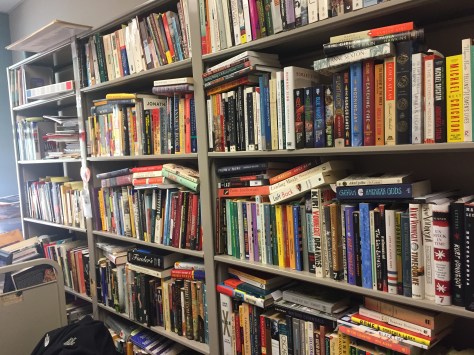
books
When my college students enter my office for the first time, they invariably pause at this view of my bookshelf, asking, “Have you read all these books?”

I also love English majors; they say things like “canonical” and “epistolary” without any hint that this is not the way humans communicate.

But I have to confront that the biggest obstacle to my life of words was English courses throughout my junior and senior high school years, and a key element of that negative influence was being assigned canonical texts, most of which I found then and continue to find to be dreadful reading.

Concurrent with those cloying experiences with texts, I was collecting and reading thousands of comic books (I had about 7000 Marvel comics when I graduated high school) as well as science fiction novels by Arthur C. Clarke and others.

As I have examined before, my very serious experiences with William Faulkner in high school set me up to be embarrassed when I rediscovered Faulkner in upper-level college English courses.

While teaching high school English for 18 years and then moving to teacher education for 16 years-and-counting now (primarily working with future teachers of English), I remain powerfully aware of the me who was alienated from the things I would come to love—the things that mostly define who I am as a human—by the very environment that should have been the place I discovered what I love.

That alienation I call the tyranny of the canonical text, and it hurts me to watch as many English teachers continue to be agents of that tyranny or co-victims of that tyranny with their students.

As chair of the English department while teaching high school, I worked for years to end or at least modify the required novel and play lists we used in our department. Those efforts were met with a great deal of resistance from my colleagues.

My argument then (and now) was grounded in the fact that between me and the most ardent advocate for canonical texts and required reading lists, we had vastly different reading backgrounds, and none the less were both highly literate, well-read people.

I have read every work by Milan Kundera, Haruki Murakami, Franz Kafka, William Faulkner, Margaret Atwood, Kurt Vonnegut, and many others—but only  a few pages of many of the books canon advocates would argue are essential. I have written and edited volumes on Barbara Kingsolver, Kurt Vonnegut, Ralph Ellison, Margaret Atwood, Haruki Murakami, and James Baldwin.

My literary life is an example of literacy triumphing over the tyranny of canonical texts. However, I wonder why anyone should have to fight through that tyranny to discover the joy and value of the written word.

Yes, I understand and appreciate the allure of teaching a valued text; I, too, have works that I love to teach, several of which were pure tyranny for my students.

Yes, I understand that reasonable people can agree that some works of literature are, in fact, superior to others; I, too, cringe at the Twilight and 50 Shades of Grey sorts of popular novels.

And, yes, I recognize that teaching English includes both an obligation to the discipline (composition and literature) and our students.

Ultimately, I have committed in my career to begin with (and to seek never to fail) my obligations to students and their literacy (both the so-called practical aspects of that literacy and the much more important role literacy plays in any person’s full humanity, agency, and joy for living)—some times necessarily sacrificing the finer points of covering canonical texts and authors.

An important element in that commitment is coming to see that when any student balks at a text, I first challenge the text selection, and resist assuming some problem lies in the student.

My deeply insecure self in junior and high school, mortified in the full body brace I wore for scoliosis, would have appreciated greatly someone offering me that opportunity then; instead, my life in literacy came later and only because I somehow fought through the tyranny of canonical texts.

Adventures in Classroom Discussions: “Because she’s older and the teacher, she’s right and I’m not”

My career as an educator now includes about equal parts but different roles as first a high school English teacher, for nearly two decades, and now a college professor of education and composition/first-year writing, approaching two decades quickly.

My high school students were like family and friends, young people who were growing up in my hometown; therefore, my classes were energetic with lots of discussion—often rambling—and plenty of laughter. Those conversations carried over into non-class times of the day, after school, and during extracurricular activities, such as the years I was a coach.

When I switched to higher education, however, I encountered very silent classes—students who still tend to request that I talk most of the class because, as they say, they enjoy hearing someone knowledgable discuss the topics of the courses. This silence bothered me so early on I conducted several years of questionnaires asking students about why they tended not to talk in class.

Students openly confessed two reasons: (1) fear of being wrong in front of the professor, and thus hurting their status (re: grades), and (2) not wanting to “give away” the work they had done to peers in the class who had not prepared (a disturbing sort of capitalistic view of knowledge rejected by Paulo Freire as the “banking concept”).

As a result of this change in student behavior from high school to college teaching, I have had to work much more diligently and think much more deeply about classroom discussions in this last half of my career so far. Here I want to offer some guiding principles I have developed for classroom discussions and place them against one of my favorite lessons, using “Eleven” by Sandra Cisneros—a story set in the classroom so it fits well in all the courses I now teach.

First, here are some guiding principles that I continue to wrestle with as I implement them to encourage student engagement and improve the effectiveness of classroom discussions:

  • Create opportunities for students to offer artifacts of being fully engaged in a class lesson and discussion that expand beyond only speaking aloud in class: Allow students to share in small groups before whole group discussions, provide students handouts that allow them to annotate on text to show engagement, and establish discussion journals that provide students spaces to write comments and responses that they would prefer not to say aloud. Traditional approaches to classroom discussion can be distinctly unfair to students who are less assertive or naturally vocal—students who are introverted, student still navigating their understanding and not ready to assert any claims.
  • Anticipate and then “deprogram” students from a common dynamic they have experienced with teacher-centered class discussions: When students reply correctly, teachers confirm (often interrupting the student) and move on; when students are off-base, teachers redirect, ask another question, etc. Therefore, students learn to use the teacher as the only/primary locus of authority, and (worse of all) are trained not to elaborate through providing evidence and explanation (two academic moves far more important than having the “right” answer). All student responses should be prompted to support and elaborate so that students (not the teacher) can tease out the validity of the response. If students need basic information, that should not be the goal of class discussions, but provided as a foundation before a discussion occurs.
  • Create a classroom environment around open-ended questions instead of “guess what the teacher wants you to say”: Who is the most interesting character in this story (and why)? v. Who is the protagonist in this story? Or, what is the best (most effective) sentence in this story for you (and why)? v. What are some metaphors and similes in this story? Open-ended questions are not, however, allowing students to say anything they please, but a way to avoid just filling in the blanks and asking students to provide evidence and elaborate.
  • Arrange the class so that students are looking at each other (not the teacher), and then foster a collaborative discussion in which students respond to each other and work through “confirming” as a class (a community) instead of relying on the teacher to confirm or reject. One way to move toward that is after a student replies, ask another student to restate what the first student said, and then to either defend it or help reframe it. This helps students see that knowledge is communal and constructed, not some divine pronouncement.
  • And a pet-peeve caveat: Do not get trapped in the misguided Bloom’s Taxonomy approach to questions; Bloom never intended for the taxonomy to be used as a linear/sequential guide to how we teach (it was designed for assessment). The six elements are valuable if we see them as holistic and interrelated aspects of how we learn and interrogate the world: Remembering, understanding, and analyzing contribute to evaluating and synthesizing while applying.

As I mentioned above, “Eleven” is often a powerful text for a class discussion—one that can be framed around effective writing and craft; around thinking about teaching, learning, teachers, and students; around understanding family and peer dynamics; or around identifying and confronting cultural tensions.

One key to vibrant class discussions is to be sure students are primed and not cold on the elements of the discussion. Therefore, I give students some guiding activities for them to complete as I read “Eleven” aloud to the class.

Some of those are:

  • Mark key sentences or passages that stand out to you because they are well written, interesting, problematic, or confusing. After the story is completed, pick the one you would most like to share.
  • Identify your mood in the margin of the story as I read aloud, noting when your mood shifts. Mark key words or sections that create the shift.
  • Pick the best single word in the story.

These activities while I read aloud help create something for students to say during a discussion. Next, I ask students to form small groups (I prefer three to a group) and to share one item with the group from the actions above.

I use that time to walk around and listen to the small group discussions and to look at the annotated stories on their desks. This allows me to confirm engagement so when we go to a whole-class discussion, the students who remain silent still can be identified as engaged.

Students can also be prompted to annotate the text further while discussing or to make entries in a class discussion journal they maintain throughout the course—even asking for those copies to be turned in for informal assessment.

Once we begin whole-class discussion, I implement the above principals by asking them to turn desks so they are facing inward and each other. I begin with asking for a volunteer to share any of the ideas prompted by the during-reading activities.

Once a student shares, I usually ask, “Can you show us where that is in the story? And can you elaborate on that for us?” Next, I typically ask another student to react to the first share—confirm, reframe, or build on the point made.

Here, I want to emphasize that this strategy and text are always successful in the context of my instructional goal: I am not trying to make students expert on Cisneros, this story, or literary terms/analysis, but I am helping students develop a set of important academic moves that translate into their writing—making credible claims and then providing valid evidence for the claims before elaborating on the importance of those claims to a wider purpose.

In other words, the discussion is student-centered, not allowing students just to say whatever they want, and grounded in the content in a way that uses content as a means and not the ends of the discussion.

For example, students often identify this passage as key: “Because she’s older and the teacher, she’s right and I’m not.”

The important aspect of the discussion, however, is not that they identify the passage I have decided is key, but that they are able to explain in a detailed way what makes the passage key.

Students often share their own personal experiences similar to Rachel’s with her math teacher—feelings of anger and being insignificant. And from that we explore student/teacher dynamics and the often oppressive nature of schooling.

While I don’t want to oversimplify, vibrant class discussions are rarely about identifying and acquiring content knowledge, but are best when designed to foster powerful student behaviors that contribute to their development as critical thinkers, engaged listeners, and responsive speakers.

For this discussion as blog post, that key passage—”Because she’s older and the teacher, she’s right and I’m not”—can serve as an overarching guiding principle for orchestrating class discussions since it warns us about the failures of class discussions being more about students guessing what the teacher wants (and thus the teacher is the primary or sole arbiter of right and wrong) than about fostering students as critical and engaged thinkers.