
Category Archives: Writing

Not How to Enjoy Grading But Why to Stop Grading

I have spent this morning carefully placing copies of the revised edition of De-testing and de-grading schools: Authentic alternatives to accountability and standardization in envelopes to mail to chapter authors.

313058_cover

It is a bittersweet task since we lost my co-editor Joe Bower during the process of creating a revised edition.

Concurrently as well, I read a post from John Warner, in which he opens with a confession: “Like a lot of college instructors, I have, from time to time, expressed my dislike of grading.”

First, let me urge you to read Warner’s blogs, especially about his work as a teacher of writing (he is a professional writer as well). But this post in particular has hit home because of my own 34+-year journey as a teacher of writing and a much less successful life as a writer as well.

In my updated chapter of our de-testing and de-grading book, I examine in detail my own reasons for and approaches to not grading student writing, but instead to focus my time and energy on giving ample feedback while students brainstorm and then draft original essays they find compelling. In part, I explain:

Along with the pedagogical and assessment autonomy I experience as a professor (now tenured), the university’s transition to first-year seminars has influenced greatly my practices and offered ample evidence about how de-grading a writing classroom works, and doesn’t. In all of my university courses, in fact, I refuse to put grades on assignments throughout the semester. Instead, I have two practices: (1) I provided ample feedback as well as require and allow students to revise most assignments until students are pleased with the work, and (2) I invite and urge students to arrange conferences as often as desired throughout the semester to discuss their grades (what their grades would be if assigned, what they would assign themselves, and what I anticipate they will be assigned at the end of the course).

De-grading the writing class and encouraging a conversation about grades instead of labeling assignments with grades have combined to lift the effectiveness of my writing instruction significantly because these practices reinforce the autonomy and agency of the students and shift the focus of the classes to the quality of the compositions and the growth of the students as writers and away from courses as credentialing.

I want to stress again here that I began de-grading my classroom while still a K-12 teacher without the protection of tenure (I have always worked in a right-to-work state without union protection) so I am not suggesting that de-grading is reserved for the rarified air of high education [1].

I urge all teachers of writing, then, to set aside the urge to grade essays, and instead, to embrace a process in which the teacher/professor is a collaborator in helping novice writers grow through drafting their own work as real-world writer do—as Warner details:

The final assignment is different. It asks them to craft an argument of their own design aimed at an audience of their choosing. Their is to use the skills they’ve practiced earlier, and I am instead reading to discover what they have learned about the subjects they’ve chosen.

Instead of a teacher, assessing skills, I am a reader, responding to ideas, and in many cases the students are presenting ideas and arguments I wasn’t aware existed.

The path to de-grading the classroom is difficult because we face traditional hurdles of teaching being inseparable from evaluating students, and then we must help our student shake off the shackles of being evaluated students in order to explore the opportunities afforded being an apprentice.

Teachers/professors too must cast off the shackles of grading. Consider Warner’s epiphany that addresses how he has taught and graded essay writing in his first-year courses versus how he has taught and responded to writing in fiction courses:

By accepting the flaws as inevitable before I begin, my fundamental orientation changes, both in how I read and respond to the work, but more importantly, my own emotional experience when grading. In fact, I’ve never even called what I do in a fiction class “grading.” It is simply reading and responding, which is a lot more fun.

Finally, then, from my chapter in the de-testing and de-grading volume, I want to share here a few “guiding principles for de-grading the writing classroom”:

  1. Reductive responses to student writing (grades, rubric scores) fail to enrich the writing process (see Gould, 1996, regarding singular quantification of complex processes). Teacher feedback must be rich, detailed, and targeted to support revision. The most powerful feedback includes identifying key strengths in a students work (“Do this more often!”) and questions that help guide students toward revision (“Why are you omitting the actual names of your family members in your personal narrative?”). To share with students the specific and contextualized characteristics that constitute an evaluation (such as an A) provides students as writers the evidence needed to build their own rubrics of expertise for future writing, and learning.
  2. Teacher and student roles in the de-graded writing classroom must be revised—teachers as authoritative, not authoritarian; teacher as teacher/student; and student as student/teacher (Freire, 1993). The de-graded writing classroom allows a balancing of power that honors the teacher’s agency as a master writer and master teacher of writing without reducing the status of the student as beneath her/his agency and autonomy, both of which are necessary for the growth of any writer.
  3. De-grading the writing classroom increases the importance and impact of peer conferencing by removing from the teacher the primary or pervasive role of evaluator. Feedback from peers and from the teacher becomes options for students as they more fully embrace their roles as process writers.

The teaching of writing, in my opinion, is not unique compared to teaching anything—so I am a strong advocate for de-testing and de-grading all education.

However, as Warner has discussed so well, the teaching of writing as authentic practice is impossible to separate from the corrosive impact of grading on both the teacher/professor and the students.

The de-graded writing classroom seeks to honor the sanctity of teaching and mentoring, the autonomy of students as writers-to-be, and the act of writing itself as essential to human liberation.

[1] Please see this post and below from my de-testing and de-grading chapter:

I want to emphasize, also, that these are not idealistic practices or claims; I do practice concessions to the reality of grades in formal schooling. The “de-” in de-grading of my classes is best framed as “delayed” because I do invite students to discuss the grades their works-in-progress deserve throughout the process and, of course, I do assign grades at the end of each course.

While delaying grades, however, I am increasing the quality and quantity of feedback my students receive and of student engagement in learning for the sake and advantages of learning

Reclaiming “Direct Instruction”

After I posted two blogs on authentic literacy instruction (see here and here), several readers tripped over my use of the term “direct instruction.”

Before examining the value in that term (and what it means), let me offer a couple of anecdotes.

While I was teaching high school English, a colleague teaching math had a classroom directly across from my room, separated by a court yard. With, I think, equal parts joking and judgment, that teacher used to say often, “I wish I could teach while sitting at my desk.”

Not unimportant here is the distinct pedagogical differences among math and English teachers—one that I believe we can fairly say is a tension between math teachers being teacher-centered and sequential while English teachers can lean more often toward student-centered and workshop approaches (although my caveat here is that English teachers can be some of the most traditional teachers I have ever met).

In my story above, the math teacher’s comment is an excellent example of the confusion over “direct instruction.” Yes, many people see direct instruction as lecture—thus, mostly if not exclusively teacher-centered with students relatively passive.

For this colleague, my students working in a writing workshop with me responding to drafts, conferencing, and the other purposeful elements of workshopping did not meet her definition of “teaching.”

Another illustrative story involves my daughter.

Her second grade teacher was a colleague of my wife, who teaches PE at the primary school. One day in passing my daughter’s second grade teacher told my wife that my daughter had been doing extremely well on her spelling tests until she began intensive and direct phonics instruction. Since then, she noted, my daughter’s spelling grades had suffered significantly.

This second example represents the ultimate failure of a narrow view of teaching having to be a certain limited type of direct instruction.

Now, when I use the term “direct instruction,” as one person perfectly commented about my blog post, I am addressing purposeful and structured or organized instruction, but I am not using the term as only teacher-centered practices.

To be direct, or purposeful, then, I see teaching as an act with several goals: curricular (including standards and high-stakes tests addressing those standards), disciplinary, and student-centered.

In any given class, teachers must address all three, but pedagogically, teachers often have some degree of autonomy over how to address these goals.

As I champion “direct instruction,” I am cautioning against placing curriculum and discipline above student, but I am also calling for building all instruction on some evidence of need.

Curriculum guides and standards justify a need; the discipline (ELA as literacy, literature, and composition) justifies a need; and students come to all courses with needs.

“Direct instruction,” then, is purposeful and organized teaching targeting one or all of these needs.

As a critical constructivist, I maintain that we must start with allowing students to produce artifacts demonstrating what they know, what they don’t know, and what they are confused about in the context of our curricular and disciplinary obligations.

Direct instruction is simply teaching with purpose to address those needs.

A failed view of direct instruction is grounded in covering the curriculum or the obligations of the discipline regardless of the students in the course.

Teaching algebra sequentially, likely with the textbook determining the structure, in order to document that you taught algebra; teaching a phonics program, again, in order to document that you taught reading—this is the failure of a narrow view of “direct instruction” that supplants the needs of the students with the needs of curriculum and the discipline.

If and when a child is spelling and decoding well, to go over phonics is a waste of time, but also very likely harmful—just as many studies of isolated grammar instruction show students becoming more apt to make “errors” after the instruction.

So here we can begin to unpack that the problem is not with “direct,” but with “isolated.”

The problem is with teaching the discipline, teaching a program, teaching to the standards and/or high-stakes tests instead of teaching students.

I am advocating for direct instruction built primarily on student needs—purposeful and structured lessons designed after gathering evidence of student strengths, weaknesses, and confusions.

And I must stress that my argument here is wonderfully confronted and unpacked by Lisa Delpit, who came to this debate because she recognized the other side of the coin I haven’t addressed yet: so-called student-centered practices that cheat students (mostly our vulnerable populations of students) by misunderstanding the role of direct instruction, by misreading progressive and critical practices as “naturalistic” or unstructured.

Writing and reading workshop are not about giving students free time to read and write; workshops are about time, ownership, and response that is purposeful and structured.

Student-centered practices are not about letting children do whatever the hell they want.

As Delpit has addressed, that isn’t teaching, and it certainly cheats students in similar ways that bullheaded and narrow uses of teacher-centered practices harm students.

If a teacher isn’t guided by needs and grounding class time in purpose, that teacher isn’t teaching.

But until you have a real breathing student in front of you, you cannot predict what that direct (purposeful) instruction will (should) look like.

Ultimately, I believe narrow uses of the term “direct instruction” are designed to shame student-centered and critical educators.

I refuse to play that game because I am directly (purposefully) teaching when I place the needs of my students before but not exclusive of the needs of the curriculum and the discipline.

And, yes, while I also hope someday more teachers can teach while sitting at their desks, I am more concerned about how we can come to embrace teaching as purposeful and structured without reducing it to a technocratic nightmare for both teachers and students.

Formal Schooling and the Death of Literacy

My privilege is easily identified in my being white and male, but it is the story of my life that better reveals my enormous privilege established by my mother when I was a child.

I entered formal schooling with such a relatively high level of literacy and numeracy that from those first days I was labeled “smart”—a misnomer for that privilege.

From Green Eggs and Ham to Hop on Pop, from canasta to spades, from Chinese checkers to Scrabble—games with my mother and often my father were my schooling until I entered first grade. And none of that ever seemed to be a chore, and none of that involved worksheets, reading levels, or tests.

Formal schooling was always easy for me because of those roots, but formal schooling was also often tedious and so much that had to be tolerated to do the things I truly enjoyed—such as collecting, reading, and drawing from thousands of comic books throughout my middle and late teens. I was also voraciously reading science fiction and never once highlighting the literary techniques or identifying the themes or tone.

During my spring semester, I spend a great deal of time observing pre-service English/ELA teachers, and recently I had an exchange on Twitter about the dangers of grade retention, notably connected to third-grade high-stakes testing.

And from those, I have been musing more than usual about how formal school—how English/ELA teachers specifically—destroy literacy, even when we have the best of intentions.

From the first years of K-3 until the last years of high school, students have their experiences of literacy murdered by a blind faith in and complete abdication to labeling text by grade levels and narrow approaches to literary analysis grounded in New Criticism and what I call the “literary technique hunt.”

Misreading the Importance of Third-Grade Reading

As I have addressed often, reading legislation across the U.S. is trapped in a simplistic crisis mode connected to research identifying the strong correlation between so-called third-grade reading proficiency and later academic success.

Let’s unpack that by addressing the embedded claims that rarely see the light of day.

The first claim is that labeling a text as a grade level is as valid as assigning a number appears. While it is quite easy to identify a text by grade level (most simply calculate measurables such as syllables per word and words per sentence), those calculations entirely gloss over the relationship between counting word/ sentence elements and how a human draws meaning from text—key issues such as prior knowledge and literal versus figurative language.

A key question, then, is asking in whose interest is this cult of measuring reading levels—and the answer is definitely not the student.

This technocratic approach to literacy can facilitate a certain level of efficiency and veneer of objectivity for the work of a teacher; it is certainly less messy.

But the real reason the cult of measuring reading levels exists is the needs of textbook companies who both create and perpetuate the need for measuring students’ reading levels and matching that to the products they sell.

Reading levels are a market metric that are harmful to both students and teaching/learning. And they aren’t even very good metrics in terms of how well the levels match any semblance of reading or learning to read.

The fact is that all humans are at some level of literacy and can benefit from structured purposeful instruction to develop that level of literacy. In that respect, everyone is remedial and no one is proficient.

Those facts, however, do not match well the teaching and learning industry that is the textbook scam that drains our formal schools of funding better used elsewhere—almost anywhere else.

Remaining shackled to measuring and labeling text and students murders literacy among our students; it is inexcusable, and is a root cause of the punitive reading policies grounded in high-stakes testing and grade retention.

The Literary Technique Hunt

By middle and high school—although we continue to focus on whether or not students are reading at grade level—we gradually shift our approach to text away from labeling students/ texts and toward training students in the subtle allure of literary analysis: mining text for technique.

Like reading levels, New Criticism’s focus on text in isolation and authoritative meaning culled from calculating how techniques produce a fixed meaning benefits from the veneer of objectivity, lending itself to selected-response testing.

And thus, the great technique hunt, again, benefits not students, but teachers and the inseparable textbook and testing industries.

The literary technique hunt, however, slices the throat of everything that matters about text—best represented by Flannery O’Connor:

I prefer to talk about the meaning in a story rather than the theme of a story. People talk about the theme of a story as if the theme were like the string that a sack of chicken feed is tied with. They think that if you can pick out the theme, the way you pick the right thread in the chicken-feed sack, you can rip the story open and feed the chickens. But this is not the way meaning works in fiction.

When you can state the theme of a story, when you can separate it from the story itself, then you can be sure the story is not a very good one. The meaning of a story has to be embodied in it, has to be made concrete in it. A story is a way to say something that can’t be said any other way, and it takes every word in the story to say what the meaning is. You tell a story because a statement would be inadequate. When anybody asks what a story is about, the only proper thing is to tell him to read the story. The meaning of fiction is not abstract meaning but experienced meaning, and the purpose of making statements about the meaning of a story is only to help you experience that meaning more fully.

In other words, “A poem should not mean/But be,” as Archibald MacLeish explains.

Texts of all genres and forms are about human expression, about the aesthetic possibilities of creativity.

No writer, like no visual artist, writes in order to have the words or artwork replaced by the reductive act of a technocratic calculating of meaning through the algebra of New Criticism.

To continue the hokum that is “reading level” and to continue mining text for techniques—these are murderous practices that leave literacy moribund and students uninspired and verbally bankrupt.

The very best and most effective literacy instruction requires no textbooks, no programs, and no punitive reading policies.

Literacy is an ever-evolving human facility; it grows from reading, being read to, and writing—all by choice, with passion, and in the presence of others more dexterous than you are.

Access to authentic text, a community or readers and writers, and a literacy mentor—these are where our time and funds should be spent instead of the cult of efficiency being sold by textbook and testing companies.

John Warner Swears Off Essays, and Students? (Yes, And So Should Everyone)

John Warner, writer and visiting instructor of first-year writing, posted yesterday the provocatively titled I’m Never Assigning an Essay Again [1]. And kept the ball rolling this morning on Twitter:

That’s right, it appears Warner is swearing off essays and students in his role as a writing instructor for first-year college students.

I immediately pounced on Warner’s post and Tweets by sharing a key article I come back to often—especially in my work at a selective liberal arts university: The Good Student Trap by Adele Scheele.

“The odd thing about life is that we’ve been taught so many life-less lessons,” Scheele laments, and then hits the key point about how school creates the “good student trap”:

We were learning the Formula.

• Find out what’s expected.
• Do it.
• Wait for a response.

And it worked. We always made the grade. Here’s what that process means: You took tests and wrote papers, got passing grades, and then were automatically promoted from one year to the next. That is not only in elementary, junior, and senior high school, but even in undergraduate and graduate school. You never had to compete for promotions, write résumés, or rehearse yourself or even know anyone for this promotion. It happened automatically. And we got used to it.

Until the formula doesn’t work, of course. “All that changes once you find that studying history or art or anthropology can be so much more than just jumping through hoops,” Scheele explains. “Your academic pursuits can lead to new experiences, contacts, and jobs. But so much disappointment has resulted from misusing college, treating it as school instead of life [emphasis added].”

And here is where my work as an educator significantly overlaps with Warner’s two assertions: (1) the need to end the template-approach to essays that exists almost exclusively in formal classroom settings, and (2) the inherent failure of training young people in student behaviors, which are like the canned essay, unlike human behaviors in the real world.

So in most of my classes, we start by having frank discussions about behaviors of students and how they appear if we step back from them. For incoming first-year students, I typically start with the need to use the restroom during class.

K-12 formal schooling has equated normal human urinary and bowel needs with something just short of a high crime. In K-12 schooling, your restroom needs must be conditioned to the school’s schedule, and when that fails, you must raise your hand and ask permission.

In college, however, you simply get up and go to the restroom.

This transition away from the K-12 dehumanizing of students to normal adult behavior helps my students begin to investigate how we (professor/students) behave in class settings, how they should view their roles in learning (doing assignments instead of “homework,” and completing the learning experiences for themselves and not the professor), and what scholarship means instead of “being a student.”

I have linked the end of the school essay and the call for my students to drop student behaviors as essential for the sort of education I believe all young people deserve, a liberatory one.

These goals merge in my writing-intensive courses in which I ask students to stop behaving as students and to begin to behave as writers (and what that entails is a long process we explore throughout the semester)—so that we can learn to write together in ways that serve their personal, academic, and career wants and needs.

I hope more educators follow Warner’s lead—although these sorts of transitions I ask of my students are painful—and that we can all soon come together by swearing off essays and students.

[1] See his post from the next day also: Kill the 5-Paragraph Essay

Investigating Zombi(e)s to Foster Genre Awareness

My initiation into the fiction of Roxane Gay was a wonderful moment of disequilibrium when I read her short story “There is No ‘E’ in Zombi Which Means There Can Be No You Or We.” The opening of the story is a staccato tease that sets the stage for even greater disorientation:

[A Primer]

[Things Americans do not know about zombis:]

They are not dead. They are near death. There’s a difference.
They are not imaginary.
They do not eat human flesh.
They cannot eat salt.
They do not walk around with their arms and legs locked stiffly.
They can be saved.

“So what were zombies, originally?” asks Victoria AndersonVisiting Researcher in Cultural Studies, Cardiff University, explaining:

The answer lies in the Caribbean. They weren’t endlessly-reproducing, flesh-eating ghouls. Instead, the zombie was the somewhat tragic figure of a human being maintained in a catatonic state – a soulless body – and forced to labour for whoever cast the spell over him or her. In other words, the zombie is – or was – a slave. I always find it troubling that, somewhere along the line, we forgot or refused to acknowledge this and have replaced the suffering slave with the figure of a mindless carnivore – one that reproduces, virus-like, with a bite.

The zombie narrative has captivated pop culture in the U.S. now for several years, notably the AMC series The Walking Dead and the comic book it is based on and novels such as World War Z. With the release of Pride and Prejudice and Zombies, Anderson expects this popularity to continue—along with the reimagined but mischaracterized zombie conventions.

For the classroom—especially when we are addressing reading and writing—the zombie narrative in its many iterations is an ideal entry point into investigating genre. Zombie narratives are a specialized sub-genre and blending of horror and science fiction.

Since zombie narratives in print and film have been in U.S. pop culture for about 8 decades, teachers can expect students at all levels to come to class with some existing assumptions about what zombies are and what zombie narratives entail—in other words, the conventions of zombie narratives as a genre.

As a writing teacher, I ascribe to Johns’s emphasis on building genre awareness (as opposed to genre acquisition) in developing writers and readers. Here, then, I want to outline briefly how to use zombie narratives as part of fostering genre awareness in students.

First, I would have students in small groups identify their own experiences with zombie narratives—naming what they have read or viewed. From that, students would then construct “what we know about zombies.”

This focus on starting with what conventions students already possess helps generate engagement and context for the larger lesson on genre awareness.

Next, I would ask students to read Gay’s short story (or another that is age appropriate since Gay’s story is for older readers) as a model text for comparing how that story matches or contrasts with the “what we know about zombies” list each group has created.

Finally, I would share Anderson’s article above in order to have a discussion about the concept of conventions—how expectations for a certain type of writing (or film) are shifting but bound to a time and place. The concept of zombies is much different now than in its origin.

Since superhero films are now also all the rage, a companion activity to support helping students investigate the concept of conventions and genre is to allow them to research the many different versions for key superheroes—such as Spider-Man or Batman—that have existed over the 50-70 years of mainstream comic book superheroes.

Some key caveats about fostering genre awareness are helpful for designing and implementing many lessons such as the one above:

  • Fostering genre awareness as part of the writing and/or reading curriculum is an ongoing process. You can never “finish” that process, and all students at all levels need to be engaged continually with the questions of genre, form, and mode. Above, for example, asking: What makes a short story, a short story, or what makes Anderson’s essay, an essay, and how might the public piece of hers compare to a scholarly essay on zombies?
  • Genre awareness helps students build their own emerging and developing “rubrics” about how to tackle a writing project or interrogate a text. For example, a student learns to start with “what I know about X,” and then while writing or reading to use that to inform how she/he proceeds in making meaning through composing or reading.
  • Conventions serve communication as fluid frames that texts conform to or break; in other words, the structure helps create meaning, but the specifics of that structure are not as important as the structure itself.

“It’s a call to memory because the zombie – the actual zombie – reminds us of something very important,” Anderson concludes:

It reminds us to remember – who we are, and where we came from, and how we came to be – individually and collectively – especially for those of us whose personal and community histories are caught up in the blanketing fog of cultural amnesia. The zombie reminds us to taste salt.

Anderson’s meditation on the shifting conventions of zombies, I think, speaks to the power of conventions themselves since how we construct our genres and what genres we embrace in pop culture are as much about us as about the narratives themselves.

Ultimately fostering genre awareness is about helping students know who they are as well as about the world in which they live.

Student Choice, Engagement Keys to Higher Quality Writing

Let’s not tell them what to write. (p. 301)

LaBrant, L. (1936, April). The psychological basis for creative writingThe English Journal, 25(4), 292-301.

As a teacher of writing, I immediately connected Nine Ways to Improve Class Discussions with George Hillocks’s Teaching Writing as Reflective Practice. Not to oversimplify, but Hillocks’s work emphasizes several key points about effective writing instruction, captured well in a chart at the end of the volume:

chart.jpg

Hillocks revealed that many so-called traditional approaches to writing instruction were far less effective than many of the practices at the core of writing workshop—notably that direct, isolated grammar instruction has a negative impact on student writing while free writing (without direct instruction) improves student writing.

At all grade levels, then, if our goals of instruction include improving students as writers, we must acknowledge and then implement practices that honor first student choice and engagement.

There exists a historical research base as well as a more complex research base that all elements of student writing are improved (grammar/mechanics, content, organization, claims/evidence) if students choose the topics they write about and the forms/genres their writing takes—especially when that choice is grounded in classroom activities that engage them in the topics before they compose (see Hillocks).

Assigning students a literary analysis essay on The Scarlet Letter after weeks in which the students are guided through the novel has two potential outcomes that are both problematic: (1) students write horrible essays or (2) students produce clone essays.

The problem with (1) is that we typically place the blame for the horrible essays in the students although the source of those horrible essays is mostly the assignment.

The problem with (2) is that these clone essays probably reflect compliance, not high quality writing abilities.

Our students need and deserve the time and space to become writers through choice and engagement—not by parroting what we tell them text is about, not by filling in the templates we provide.

Our students need and deserve rich reading experiences in which they begin to gather mentor texts that inform the choices they make, how they engage in forming words about the topics that matter to them.

As writing teachers, then, we must design classroom discussions that put students at the center through choice and engagement as a powerful way to increase the quality of student writing.

What Makes Poetry, Poetry?

It is Valentine’s Day 2016, and I have been spending the morning with poetry. So when I came across Peter Anderson’s Line and Stanza Breaks in Free Verse Poetry – NVWP Summer Institute – Day 5 pt. 1, I was suitably primed to do something I believe I have failed to do here on my blog—write about teaching poetry as a poet.

A couple years before I would discover that I am a teacher (the fall of my junior year of college), I was sitting in my first-year dorm room in the spring when I wrote my first real poem, and thus, had that quasi-religious experience of becoming a poet.

Being a poet is not something I chose to do, not something I can control. There are weeks, maybe months, when no poems come, and then there are manic days and days and days when they come like tidal waves, avalanches—unbidden but gathered frantically out of the writer’s fear that at any moment this may end, abrupt as a fatal aneurism.

Now comes the really embarrassing part, where poet/writer intersects with teacher.

The first moment my foot touched the floor of my classroom, I envisioned myself as a teacher of writing, but also a teacher who would instill in my students my love for reading (devouring) literature, especially poetry.

I worked hard, intensely—as I am prone to do—to teach my students to write, willing all the while the love of literature and poetry into their adolescent hearts and minds.

Yet—this is embarrassing—I was casually murdering everything I loved, and scrubbing the life and blood from my students’ possibilities as writers, poets, and the sorts of joyous readers I had envisioned.

My godawful teaching of poetry and efforts at having my students write poetry—despite my precious poetry unit built around the music of R.E.M.—were all mind and no heart.

The most important aspect of ending these horrible practices as a teacher who had divorced himself uncritically from his Poet Self was dropping my transactional methods (opening the poetry unit by giving students “the four characteristics of poetry” [all nonsense, by the way] and then asking them to apply those to their analysis of a poem they chose [I thought the choice part was awesome]) and embracing an overarching discovery approach driven by a broad essential question: What makes poetry, poetry?

Early and often as we meandered through dozens of poems and R.E.M. lyrics, my students and I kept returning to a Thoreau moment: “Simplify, simplify, simplify.”

No matter how hard we tried, we could discover nothing a poet did that writers of other types of writing didn’t also do—except for the purposeful formation of lines and stanzas (including that prose poets create poetry by the negative of avoiding the conventions of lines and stanzas in poetry).

Prose, we recognized, is driven by the formation of sentences and paragraphs, as a contrast, but poetry is almost exclusively as well composed of complete sentences (despite the argument by most students that poetry is a bunch of “fragments,” leading to examinations of enjambment).

Reading and writing poetry became investigations, opportunities to play with words and witness the joy they can bring.

All writing, including the work of the poet, including the work of any artist, is a creative act endured in the context of some structures that the writer/artist either embraces or actively reaches beyond.

What makes poetry, poetry? The purposeful construction of words into lines and stanzas.

“A poem should not mean/But be,” poses Archibald MacLeish. But as a young teacher, I sullied that simple dictum.

Instead, I committed the act of teaching, about which Marianne Moore declares: “I, too, dislike it: there are things that are important beyond/all this fiddle.”

School and teaching can and often are the death of poetry, of writing, of the magnificent joy of human expression.

As poet/writer and teacher, mine is to resist “all this fiddle,” and to allow for students the moment when poetry comes, unexpectedly while your dog sleeps on your feet.

A Community of Writing Teachers

The purposeful teaching of writing that led to and then sprang from the formation of the National Writing Project (NWP) and its affiliated sites has always emphasized the importance of a community of writers.

And while the summer institutes offered through NWP sites—where I was saved as a writing teacher and then fortunate to be a co-lead instructor for two summers years later—create over several weeks for teachers writing workshop experiences that include forming communities of writing teachers, I fear that in the high-stakes environment of most K-12 public schools and then in the departmentalized environments of higher education the existence of those communities of writing teachers are rare, if not entirely absent.

I entered full-time teaching in the fall of 1984 as a beginning teacher and want-to-be writer. On that first day, I saw my job as a public school English teacher primarily focusing on the teaching of writing.

While my students over the next 18 years would be quick to admit I had high expectations, possibly too high, for them—demanding a great deal of writing as well as significant growth as writers and thinkers—I also had high expectations for me as a writing teacher.

Every day, I feared I was doing that work less effectively than I could, and I was constantly evolving, growing, changing—notably after attending the Spartanburg Writing Project (SWP) summer institute.

Several years after I entered higher education as a teacher educator, my university moved to a first year seminar format, opening the door for professors from any discipline to teach first-year writing—but the university failed to consider that the teaching of writing is a complex skill set, not something just anyone can do because she/he has an advanced degree.

Just shy of a decade into the first year seminar commitment, then, the university has made curricular changes (including requiring one additional upper-level writing course), and I am currently a part of the first Faculty Writing Fellows (FWF) program that includes professors from English, Education, Psychology, Biology, Computer Science, Philosophy, Sociology, and History.

This year-long faculty seminar has allowed us to spend our time thinking deeply about the challenges of teaching writing at the university level.

The faculty members in this seminar have a wide range of experiences and backgrounds in teaching writing, and that diversity has significantly opened my eyes wider to the challenges of teaching writing.

Since I am working my way into the fourth decade as a teacher of writing, I have a much different perspective than early-career professors in disciplines such as psychology or computer science.

When I discuss my strategies for reading like a writer where I highlight the rhetorical and aesthetic aspects of writing, professors from philosophy or biology, for example, say “I can’t do that” or “I don’t do that.”

From these exchanges, then, we begin to discuss how professors can and do address first-year writing differently—but that those differences are not a problem because no writing teacher can accomplish everything in one writing course.

To paraphrase Thoreau, a writing teacher is not charged with doing everything, but something. As John Warner has explained, “I do my best to help students succeed for the future writing occasions they’ll confront in college and beyond, but the truth is, I cannot properly prepare them for what’s coming.”

And thus, we have begun to stress among our faculty that any one writing course is not an inoculation that will cure writing ills. In fact, we are working hard to dissuade professors of deficit views about students, grammar, writing, and such.

Just as any writer is always a writer-in-progress, all teachers of writing are writing-teachers-in-progress.

As a writer and writing teacher, I am still learning, and here are some of the lessons I have begun to see during our FWF experience:

  1. Regardless of background or level of experience, everyone teaching writing needs purposeful preparation for writing instruction.
  2. To teach writing, we must all be willing to investigate our attitudes about language as well as our own experiences as both student writers and writers in our disciplines.
  3. We should form a community of writers for our students, but our schools must provide for all teachers of writing that same ongoing community of writing teachers.
  4. Writing is a complex skill that can and should be taught at all levels of formal education with the full recognition that no one can ever be finished learning to write.
  5. Teaching writing is a discipline itself, a field rich in evidence but mostly defined by the perpetual problems of how to foster writers in hundreds of different writing situations. Each writing student is a new and unique challenge, not a flawed or incomplete student to be “fixed.”
  6. The pursuits of writing and teaching writing are greatly enhanced by equal parts passion and humility.

Finally, what has been most rewarding about the FWF experience and our community of writing teachers is that I am chomping at the bit for my fall 2016 first-year writing courses where for the 35th year, I will be doing some things differently, and I trust, better.

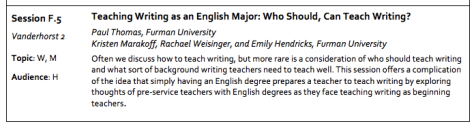
#2016SCCTE: Teaching Writing as an English Major: Who Should, Can Teach Writing?

Reading and Writing for Change

South Carolina Council of Teachers of English

Annual Conference

January 29-30, 2016

Kiawah Island Resort

Program

SCCTE January 29-30, 2016: Teaching Writing as an English Major: Who Should, Can Teach Writing?

Emily Hendricks, Kristen Marakoff, Rachael Weisinger, Madelyn Wojnisz, P.L. Thomas, Furman University

Session F: Saturday January 30, 10:45-11:30

SCCTE 16

Often we discuss how to teach writing, but more rare is a consideration of who should teach writing and what sort of background writing teachers need to teach well. Composition, in fact, is a field, but taking courses in literacy or having a degree in English are often seen as adequate preparation for teaching writing.

This session offers a complication of the idea that simply having an English degree prepares a teacher to teach writing by exploring thoughts of pre-service teachers with English degrees as they face teaching writing as beginning teachers.

“We need to talk…”: Conferring with High School Writers

Emily Hendricks

Students of all levels of academia have often identified conferring as the technique that most improved their writing. These meetings of criticism and commendation offer significantly more feedback than returning a bleeding, red-inked paper. However, many high school writers graduate without experiencing a single writing conference. It’s not hard to guess why this happens: too many students and not remotely enough time. So, how can we adapt to these challenges? This section will briefly review the positive impacts of conferring with writers, while also exploring the varieties of how teachers can realistically implement the technique in their classrooms.

Teaching Whiteness (and Writing)

Kristen Marakoff

As white teachers, there are innumerable ways that we assume the universality of a white perspective and impose white thinking processes on children of color. Specifically, when teaching writing, white teachers are often blind to differences between spoken dialects and written, formal English: a difference that dramatically affects a student’s ability to learn conventional grammar and sentence structure. As a student teacher who will soon be expected to teach students the fundamentals of writing, I am painfully aware that teaching them “correct” writing is imposing white culture on my students. This presentation examines culturally responsive approaches to teaching writing.

How the 5-Paragraph Essay Murders Us All—Slowly and Surely

Rachael Weisinger

From preparing students for state testing to summarizing their readings of Moby Dick, the 5-paragraph essay is drilled into students over and over again. Despite the efficiency of this standard format, students hardly experience another form of writing by the time they graduate from high school. “How the 5-Paragraph Essay Murders Us All—Slowly and Surely” will look at the need to foster love and creativity of writing, while still respecting the expectation to teach analytical essays.

To Thesis or Not To Thesis: The Question of Teaching Writing In the English Discipline

Madelyn Wojnisz [non-attending; PowerPoint available]

Many high school students struggle with varying writing expectations among different disciplines (English, history, science, etc.). Writing literary analysis requires different criteria than writing in history or science. Therefore, in this presentation, I explore and clarify, both for myself and for others, what challenges teachers and students face when writing within the discipline of English.

Fostering the Transition from Student to Writer

Just past midterm in my first year writing seminar, I asked my two sections of students to brainstorm about what behaviors that worked for them in high school have failed to work for them in the first semester of college—focusing specifically on their roles as academic writers.

Part of this exercise has been supported by my adopting Keith Hjortshoj’s The Transition to College Writing as well as my instructional commitment to providing my students overt opportunities to set aside their student behaviors and adopt writer (scholar) behaviors.

The responses were illuminating about both how often high school fails students and that many of my students have in fact begun to understand the important transition from high school to college. Several students confronted the need to start their essays much earlier, spending more time on drafting their work (and adding not to write the night before the work is due), but one student offered an excellent recognition about the need for writers to have a primary audience and then to shape their purpose with that audience in mind; he framed that response against the superficial ways in which he had been allowed to consider audience as a reader in high school.

Just a few days after this exercise with my first year students, as a co-leader of a year-long faculty seminar on teaching writing, my colleagues had an equally enlightening discussion about our experiences with learning to write throughout our formal education, reaching from K-12 through graduate school.

Some key patterns included that many of us had our writing graded, but received little feedback designed to prompted revision, and that many of us had some of the best direct writing instruction during our graduate school experiences, notably while writing a thesis/dissertation.

Ultimately, we noted that many professors were attempting to teach courses (first year composition) that we never took ourselves and teach pedagogy that we had never experienced as students.

And then came a really key discussion: We acknowledged that our own writing—and especially our own engagement in writing—was at its best when we had authentic audiences and were working with topics of our choice. Of course, we then moved to recognizing that these are the qualities our own students need (even deserve) to become the sort of young writers and scholars that we envision.

These discussion pushed me, after over thirty years teaching writing, to think about a recent conference I had with a first-year student whose work/writing and classroom behavior remain trapped in high school. He is not engaged in class, and when we conferenced about his essay 2—I was compelled to note in my comments on the paper that few professors would accept the essay since the formatting was shoddy and the work did not meet the basic requirements of the assignment—I first asked if he had read the sample essays I provided for the assignment. He immediately said that he had not, and seemed completely unconcerned that he hadn’t.

I have no desire to ascribe blame, but this student (and most of my students about whom I have concern for their success this semester) is almost completely disengaged from the course except to comply and move on. In other words, the quality of his writing and behavior in class are not necessarily representations of his ability but are reflections of the absence of what we discussed in our faculty seminar—he doesn’t see anything authentic about his audience or purposes as a writer in this class.

Here I must stress the warning I often share with teachers-to-be and current teachers in my graduate courses: We must not require 100% success in order to embrace a practice.

Now, that said, here are the strategies I have developed over those 30-plus years that are designed to foster the transition from student to writer/scholar:

  • Balance giving students choice with providing them the sort of structure that builds toward the larger writing goals of the course. My first year writing seminar is a semester-long course that requires students to submit four original essays of about 1000-1500 words each. For several years, the essays were all open-ended assignments with students deciding the type and content of each essay. That was a failed approach. Now, I move the student from a personal narrative (see the essay assignments on my syllabus) to an on-line essay that uses hyperlinks for citation and incorporates images and/or videos to a disciplinary-based traditionally cited (APA, MLA, etc.) essay and then to a final essay that we determine the type based on the student’s needs once we have the first essays to consider.
  • Focus investigations of texts in class on reading like a writer (see here and here) so that we always acknowledge the primary audience of the text and how the writer shapes the purpose of the writing to that primary audience. Students are provided many authentic models for the types of writing they are writing (see my daily schedule as well as posts on the main page of our course blog). Both our class sessions examining text and then the essay assignments are anchored in real-world essays (including published academic essays) that we mine for how writers write.
  • Provide feedback on essays and in individual conferences that support revision strategies that are actionable and manageable. Increasingly, I have reduced markings and comments on essay drafts, and then dedicated individual conferences to asking students about their essays while working toward making sure the student has a clear revision plan once the conference is completed. It is during these conferences that I can confront whether or not the student is authentically engaged in an essay—and seek ways to make sure the student has a genuine reason to write and revise further.

Again, nothing in teaching will be 100% successful, but I believe we are doing our students a great disservice if we simply give into fatalism and continue to allow writing to be assignments that student dutifully complete in order to receive course credit.

My commitment as a teacher of writing is to foster a transition from student to writer that serves my students well as young people on a journey to their own autonomy— and even happiness.

That means I am on a journey as well as a teacher of writing.