This Is Not My Opinion

“Many people call for an end to politics in the classroom, as this is seen as the source of the problem,” writes Nicole Truesdell, concluding: “Now is not the time to side with neutrality.”

Mainstream and rightwing pundits have long promoted the idea that K-12 and higher education in the US are rife with liberal indoctrination. One of my long-time colleagues often told the story of his own father periodically lamenting that he had allowed my colleague to go to college because the experience had turned him into a liberal.

Evidence, however, is another thing when framed against these standard railings against a Left in the US that simply does not exist.

As the country stumbles toward its first year in Trumplandia, a new but also misleading mantra is lamenting fake news in post-truth America. The misleading part is that these phenomena are somehow new or spawned by Trump and his serial lies as well as his ability to avoiding any consequences for his outlandish racism, sexism, and xenophobia.

The US has a long and disappointing history with choosing ideology over evidence, and public discourse has often been grounded in framing opinion in a cloak of false equivalence.

The term “opinion” itself has worked throughout modern history to suggest that no person has any more credibility than another since “both sides” are simply sharing their opinion. How often do we listen as debate is resolved with “Let’s just agree to disagree”?

So as 2017 comes to an end, and the Trumplandia nightmare of the unreasonable continues, I want to take this opportunity to state clearly: This is not my opinion.

While socializing with good friends just yesterday, I was reminded once again that to be informed places anyone in a stressful situation throughout our day-to-day life since the vast majority of people are uninformed about the many things they none the less feel compelled and justified to weigh in on.

I, on the other hand, have the annoying habit of reserving comments unless I am well informed and being disturbingly honest and blunt when I do weigh in myself.

Yes, I do hold my tongue often in social situations—but that is quite challenging since most people spend their lives in the actual realm of “opinion” as it is commonly used to suggest that no evidence exists to confirm if that “opinion” is valid or not.

Formal schooling traditionally reinforces this lazy approach to how we explore ideas by plodding students through overly simplistic “fact v. opinion” worksheets.

What we should be teaching instead is that all of us make claims (not that everyone has an opinion) and that we are all ethically responsible for making claims that are credible, supported by evidence or solid logic.

As two examples, I often contribute to public discussions about the so-called “word gap” and corporal punishment—both of which are illustrative of the problems inherent with seeing the world as awash in “opinion.”

The “word gap” represents an interesting phenomenon since those who appeal to the term and the idea that social class is strongly correlated to literacy (wealthy children are exposed to and know more words than poor children) do take the initiative to cite evidence, almost always one study by Hart and Risley.

This appeal to the “word gap,” however, has two critical flaws: it is driven by a social class and racist bias hiding beneath a flawed view of literacy (number of words in any person’s vocabulary is not a valid single proxy for literacy), and since the “word gap” appeals to a common-sense view of how to support better children in poverty, the average person and journalist have failed to investigate Hart and Risley, whose study has itself been discredited.

Understanding the complex relationship between social class/race and literacy and then how to educate better vulnerable populations of students are not served well by a culture of “opinions.” Here is an important context for why expertise (making claims grounded in evidence) is important—and how all discourse is political.

Journalists perpetuating the “word gap” without critically unpacking the concept or confronting Hart and Risley are themselves being political—even as they hide behind the veneer of “just reporting” and “both sides” journalism.

As a literacy professor, I cannot avoid being political—there is no neutral pose—when I teach literacy courses. But I have an ethical obligation to be well informed on the topics I teach. And thus, just as when I blog or weigh in on topics in public spaces, when I teach, this is not my opinion.

While the “word gap” continually is reanimated as a fact that isn’t true, the corporal punishment debate is a disturbing example of how “both sides” discourse and “just an opinion” have real and negative consequences—especially for the powerless (such as children).

As I have explained before, public debate about domestic violence is quite distinct from public debate about corporal punishment—the former is always examined as something no one can support or defend, but the latter is always framed as a “both sides” argument.

If we consider the rush to cite Hart and Risley when promoting the “word gap,” we must wonder how domestic violence is universally rejected in mainstream discussions (and with no need to cite research[1]) but corporal punishment remains a debate—despite decades of research and virtually all medical and psychological professional organizations clearly showing there is no acceptable amount of physical punishment.

This often ignored distinction between how we frame domestic violence and corporal punishment again highlights that all human discourse is political.

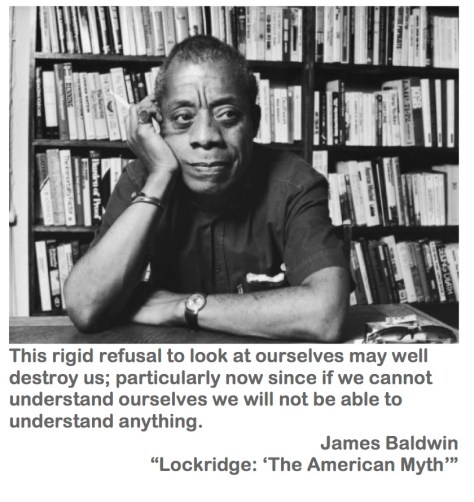
In her rejecting calls for classrooms that are somehow not political, Truedell offers the words of James Baldwin so here I want to make my case by merging their ideas myself:

While Truesdell argues, “Now is not the time to side with neutrality,” Baldwin admonished us: “The challenge is in the moment, the time is always now.”

A democracy cannot afford teachers, professors, journalists, or public intellectuals who choose the veneer of neutrality as long as inequity and injustice rule the day.

This is not my opinion.


[1] Note that discussions of domestic violence often do include statistics about who is involved and how many women suffer domestic violence, corporal punishment debates may note how may states allow it in schools, but rarely identify the number of actual children impacted; thus, domestic violence is more humanized than corporal punishment even in the numbers. This is political; this is about power.
The Nearly Impossible: Teaching Writing in a Culture of Grades, Averages

A former student and second-year English teacher and I (having taught high school English 18 years and then in higher education another on-going 16 years) have something in common when teaching students to write: A nearly paralyzing frustration with students’ resistance to draft and revise their essays.

While discussing this problem with the early-career teacher, I was once again reminded of how the traditional culture of grades and averaging makes the teaching of writing nearly impossible, especially for beginning teachers.

I have wrestled with the problems with grades and averaging before (here and here) and co-edited a volume on de-testing and de-grading education. But the essential problem remains: When teachers of writing are denied professional autonomy in their assessment and feedback practices, their writing pedagogy and the learning of their students are inevitably eroded.

As long as students are allowed to play the averaging game (completing assignments rendered irrelevant as long as the math produces a passing grade in the end), authentic learning and holistic outcomes are moot.

To offer an example outside of literacy and the teaching of writing, I noticed while teaching high school that many students in math courses never passed a single math test, but passed the course because they accumulated enough extra credit to have a passing final grade (through averaging) for the course.

I also had students tell me directly that they had simply taken zeroes for all their essay assignments the year before my class, but passed by making high enough grades on vocabulary, grammar, and literature tests.

This second-year teacher—as many of my former students have done once they entered the classroom—has implemented many of my strategies for encouraging students to draft: setting deadlines for drafts, linking participating in drafting to possible final grades on essays, etc.

Still, she admitted that students could skip the drafting, or even completing essays at all, and still because of school and district policies pass the course—without ever really engaging in the learning processes that the course was intended to address.

As is common with young and excellent teachers, she has taken on the bulk of the blame for this problem. “What can I do?” has become her refrain.

First, I want to stress that if and when I have been an effective teacher of writing, much of that success has been grounded in my assessment autonomy at both the secondary and university levels. While teaching high school and as a college professor, I have been afforded the professional support to require that students complete all essays and fulfill the obligation of drafting and revising those essays; if and when students do not meet those minimum requirements, they have failed.

I have always made the analogy that a sick patient must follow a doctor’s orders, including taking prescribed medicines, in order to heal. If that patient refuses to follow orders, the doctor is not responsible. (The doctor, of course, is responsible for a valid diagnosis.)

Since I cannot magically afford most teachers the sort of autonomy I have enjoyed, I want to consider below some real-world strategies for making the teaching of writing more authentic in the counter-productive culture of grades and averaging:

  • Seek colleague (and department) support for assessment and feedback policies that model the importance of drafting and writing essays. One aspect of the negative impact of grades and averaging is that students receive a powerful and consistent message across all their teachers and courses that playing the average game is not only all right, but what education is. Good writing pedagogy among teachers and within a department is more powerful than when any teacher works on an island.
  • Identify clearly for students, parents, and administrators that drafting is a primary instructional goal within the larger writing unit. This is a Sisyphean battle, but teachers of writing must create a culture in which drafting is embraced as an essential part of writing—not that drafting is some sort of option or busy work assigned by the teacher.
  • Design grading scales, assessment weights, rubrics, and assignments so that they all accurately reflect the primary importance of essay writing and drafting in the course. Yes, I abhor all of those traditional structures, but I also recognize they are often not negotiable for most teachers; and thus, we must manage traditional grading in a way that is least corrosive. The number of grades and the weight of grades in averaging can and should be shifted so that drafting and completing essays is essential for students to pass, or to do well.
  • Resist evaluating good assessment and writing practices by the “100% compliance or failure” formula. Throughout my career, I have routinely been confronted with the teacher who rejects my proposals for teaching with “Not all of my students will….” No practice need be 100% effective to be the right practice, but what is also puzzling with this argument is that traditional approaches can be dismissed with the same argument.
  • Periodically review teaching and assessment practices against specific writing goals. Here is a common question I pose to teachers struggling: What is your main instructional goal? Then I ask them to evaluate what they are doing against that goal—and to determine what their threshold is for standing firm on those practices and goals. If drafting is an essential student practice and instructional goal, lessons and assessment practices and policies must reflect that fact.
  • Ultimately all educators must have reasonable expectations for themselves, their students, and their instructional goals. It is not ours to do everything for every student, and it profits no one for any teacher to be a martyr. While I recognize the power of holistic behaviors and artifacts of learning (and am skeptical of the analysis bias of traditional schooling), I do urge a baby-steps approach to teaching and learning. Patience for the teacher and the student. Literacy broadly and writing more narrowly are journeys, not to be fixed with inoculations.
  • Spend as little psychological energy as possible on policies that are not negotiable. District and school policies for grading—usually entrenched traditional approaches to testing, assessment, averaging, and grades—certainly deserve critique by teachers of conscience. But that advocacy for change cannot become a constant source of fretting and self-flagellation. I wish more educators would advocate for de-testing and degrading the classroom, for rejecting averaging grades in favor of portfolios, revision, and effective teacher feedback. But day-to-day teaching must focus on the autonomy that teachers have, not what they are denied. Teaching is necessarily a tremendous psychological drain; we need not spend our energy on that over which we have no immediate control.

While teaching English and seeking to foster our students as writers, we must be concerned when students can pass or make Bs/ Cs in our courses while avoiding or refusing to draft or submit essays.

But when faced with that dilemma, we must first carefully identify the source of that possibility. A culture of grades and averaging works against us in many schools, and thus, we must then work within the autonomy we do have to make our writing pedagogy and assessment practices more closely aligned—even when we cannot achieve perfect.

“Minimally Adequate” in SC: Funding and Understanding Public Education

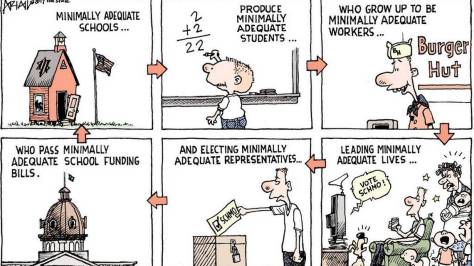
At first blush, Robert Ariail’s political cartoon in The State (15 December 2017) warrants praise for unpacking South Carolina’s historical political and judicial negligence in terms of public education:

aria171215_cmykx

Taken at the most basic level, a case for equitably funding all public schools in the state so that all students receive what has become the bar—”minimally adequate”—seems beyond reproach.

However, looking panel-by-panel at the implications and assumptions in Ariail’s cartoon exposes that too often the media and public argument for public school funding are also “minimally adequate.”

First, I want to acknowledge that the political cartoon as a form is a challenge that depends on concision, like poetry and Op-Eds. That concision in visual form works through representation and symbolism.

My concerns here are not with Ariail’s skills as a political cartoonist or his broad intentions (advocacy for equitable school funding), but my recurring criticism is that even the best and most ardent in the media have fundamental misunderstandings about education that mars their efforts to support public education, reform, and funding.

The first panel captures the essential flaw with “minimally adequate” through showing a school house in disrepair. This triggers another sincere but deeply flawed effort to support public schools in SC—The Corridor of Shame documentary that proves to be mostly emotional pandering and itself a vehicle for perpetuating horrible stereotypes and misinformation about public education, children and families in poverty, and the role of teachers in high-quality education.

None the less, panel 1 confronts the current and historical problems with “minimally adequate” funding as that approach remains inequitable across the state, primarily for children of color and the poor. But while fully funding school buildings is neglected in the state, the greatest funding issues remain hiring and retaining high-quality teachers and then insuring that all students have access to small class sizes as well as veteran certified teachers.

Panels 2, 3, and 4 offer a much more complicated and flawed case for funding schools.

First, panel 2 suggests that schools alone produce student quality. The truth is far more complicated since measurable student quality is driven mostly (60%) by out-of-school (OOS) factors—the home and community—with teacher (10-15%) and school quality (20%) constituting a much smaller role that cannot counter the greater OOS influences.

Panel 3 is a popular, but misguided belief that formal schooling and worker quality are directly and causally related; they are not. Gerald Bracey and others have documented for years the myth that so-called educational quality, workforce quality, and the economy are strongly inter-related. Here, the problem is seeing formal education as mostly about preparing workers (instead of the larger call for schools contributing to our democracy) and failing to recognize that worker quality and the economy are much more influenced by public policy than schools.

While SC is negligent about equitable funding of schools, the state is horribly negligent about workers’ rights, creating high-quality and stable jobs, and sustaining a stable economy for all levels of workers—regardless of the education they receive in the first 18-22 years of their lives.

So by panel 4, our entire gaze is on the impact of schools on the lives of everyone; the myth of education as the “great equalizer” is perpetuated by the cartoon—a belief that is fully discredited by the evidence that being white and relatively affluent trump effort (educational attainment) and that the US remains significantly inequitable by race, social class, and gender (again, regardless of education attained).

Ariail is being clever in panels 5 and 6, and the cyclic message of the entire cartoon. I am, however, ultimately troubled by how often even sincere advocates for public education and equitable funding of our schools tend to depend on false and misleading arguments in their advocacy.

The media, especially edujournalism, in fact, are too often both willing and unaware accomplices in the political and judicial negligence in SC and across the US in terms of failing to acknowledge the foundational purpose of universal public education (to create and preserve the democracy) and to advocate for human agency and the broader need for social equity in the state and the country.

It is simultaneously true that states and the country as a whole have failed public education (it has not failed us) and that education will never be the great equalizer or a silver bullet for the entrenched social and political failures of America.

The time is far past due to focus on equitable funding and support for all schools as a social contract with every family and child in every state of the US. But with that, we must also begin to be honest and clear with our advocacy—schools are not now and have never been an institution we can treat as separate from all of society or one that drives the entire society.

Our schools both reflect and perpetuate what matters to the political leadership of the state, but formal education is rarely revolutionary or a change agent since it is a mechanism of the political system.

Schools are being neglected, and then some children are being neglected in SC as they have been for decades; those children and their families are the most vulnerable among us because of racism and extreme poverty, and it is unconscionable that we persist in that negligence.

Sentiment without accuracy ultimately is part of the problem and not a path to the solution.

A Town that Starts with “L” in North Carolina

My mother’s death coming about five months after my father’s led my nephews and me to believe this second time would be better informed than the first. But we were wrong.

Issues such as power of attorney and of course money took turns we didn’t know about, one of which included my sister and I had to sign for my mother’s cremation. I arrived at the mortuary the morning after her death and completed a barrage of paperwork.

Grandparents’ names gave me pause, but I knew everything—or so I thought.

When the obituary appeared online, my sister challenged what I had offered as my mother’s town of birth: Lumberton, NC.

I immediately texted my mother’s oldest sister who shared the story I knew: My mother being born in her grandparents’ house—but that was Lexington, NC, my aunt explained, and the family moved to Lumberton many years later.

I knew about my mother’s childhood in Lexington; we were told stories of her bicycling down steep hills many times as children. But I still feel like she spoke of Lumberton as where she was born.

And then my middle nephew had reached out to my mother’s only brother, who shared the same story but added the home was in Linwood, NC.

I was sitting in the floor of my bedroom about to stretch when the flurry of texts exposed my error about my mother’s birth—and the obituary set to be in print in a couple of days.

I thought of how this is what we come to, after almost 8 decades of life—four brief paragraphs in a newspaper and loved ones who have your town of birth narrowed down to a town that starts with “L” in NC.

While I am not certain this is universal, I have struggled through many layers of guilt during the deaths of my parents. My entire adulthood as their son has been a constant wave of guilt for not being a better son (my feelings; not theirs), and then as they both slipped at the end, I cannot shake the sense of being powerless in their dying.

Having been a mama’s boy, the angst and guilt that accompanied my struggles with being by her side and maintaining my life along with my not being there the night she died have been exponential when compared to my father’s death.

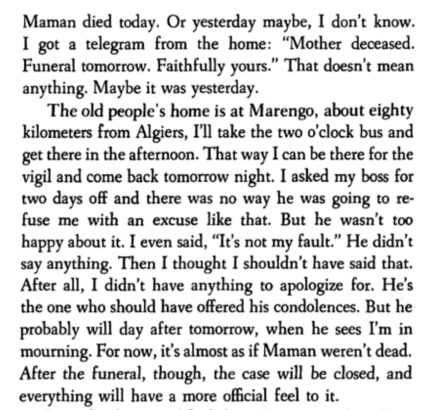
And so, as  literary person, I have been haunted by one of the most notable (and jumbled) opening lines of a novel dealing with a mother’s death—Albert Camus’s The Stranger:

The Stranger opening
The Stranger, Albert Camus

The novel’s main character, Meursault, embodies a dramatization of existentialism as expressed by Camus—and the reader witnesses Meursault’s eventual execution by the State, which appears to ground his guilt in his antisocial nature and negligence as a son (by social standards) as much as in his actual crime.

Like Meursault, I too have felt the tensions between my nature and the expectations of society—two contexts that for me are mostly out of kilter.

The hyperawareness and insecurity that accompany not being religious becomes amplified during dying and death since virtually everyone approaches both through their faith.

Ministers darted into her room at the hospital, one touching and praying loudly over her before I could even speak.

For those of us who view death as biological and chemical—not spiritual—we risk appearing to be cold and harsh. But we still cry, and ache, and catch ourself worrying about people who are now dead and need no longer for us to worry.

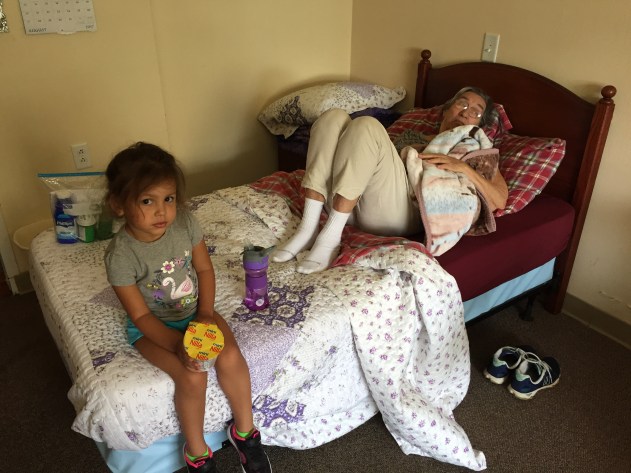
Last night I came home to a card of condolence and a framed picture of my granddaughter sitting on the bed at the feet of my mother when she was in assisted living. I cried so hard I had to rush by my granddaughter—who I was eager to see—to sit in the bathroom behind a closed door until the wave of sorrow passed.

Sky Mom

But I am also emotionally and psychologically drained. The living must continue living.

I know my maternal grandmother’s maiden name was Mize and my maternal grandfather—who went by Tu-Daddy and Slick—was named Harold Graham. But somehow the details of my mother’s birth had become jumbled in my mind.

As I wrestle with setting aside the urge to call my parents, no longer at the other end of any phone, I sense that fumbling my mother’s obituary will linger as well—this woman who gave me life and was born, we think, in a town that starts with “L” in NC.


Postscript

This post was scheduled for 13 December, my mother’s birthday. She was often celebrating her birth on Friday the 13th, an omen to her, I think, that fed her anxiety.

Today, I will visit the mortuary for her ashes, which I will leave on the counter in her home.

Ashes to ashes …

Segregation Surprise?: How Public and Charter Schools Have (Always) Failed

On social media, I witnessed charter advocates try to justify the exact failures Andre Perry unmasks in his Charter school leaders are complicit with segregation, and it’s hurting their movement, where he concludes:

Make no mistake, segregated schools of the past and present are a result of horrible policy choices that most people are willing to accept. There is a reason that after more than 20 years, the research is mixed on charter schools. Schools in black and brown communities were built on broken foundations — i.e., segregation. By not addressing segregation, reformers are turning off the stove when the house is going up in flames.

Perry was having none of it, the apologists’ dissembling, but was far more patient and willing to engage this nonsense than I.

I also have no energy left to revisit this again, except to point out that finding it surprising that both traditional public schools and charter schools are failing the most vulnerable populations of students—often black, brown, poor, speakers of home languages other than English, and having special needs—requires being willfully ignorant of decades of evidence.

And thus, what the rabid edureformers have willfully ignored for quite some time:

Made in America: Segregation by Design

Segregation and Charter Schools: A Reader

Public School, Charter Choice: More Segregation by Design

Endgame: Disaster Capitalism, New Orleans, and the Charter Scam

Racial segregation returns to US schools, 60 years after the Supreme Court banned it

Education Reform in the New Jim Crow Era

As Perry confronts, edureformers are embodiments of one of the most powerful warnings from James Baldwin:

Women’s Voices: A Reader

Fear of the Female Voice, Sarah Gailey

This story is a great summary of the cultural fear of female voices. In a society where men hold power, the most powerful thing a woman can do is to have influence over men. The idea of a member of an oppressed class influencing the powerful is fundamentally threatening to the existing order of society, because it puts some degree of power into the hands of those oppressed people. So, when the Sirens sing and Odysseus can’t resist being drawn in by their song, the reader sees an epic hero displaying a rare weakness: these women are so potent and dangerous that they can bring down a figure as powerful as Odysseus.

This is just one example of a significant theme in Greek mythology. Sirens appear in several different stories from Greek myth, and those stories all reflect and reinforce our societal terror of the influence of women on powerful men.

Truth Matters, Roxane Gay

Words matter. The truth matters. It is incomprehensible that this needs to be said, but this needs to be said. Donald Trump has long been a liar. Mendacity is as familiar to him as breathing. When he was simply a bloviating reality television star, his lies were easy to dismiss because he was simply a man with a bad tan, a bad toupee, and bad business acumen. Then he was running for president. His lies mattered more but were somewhat easy to dismiss because politicians lie. Now, though, Trump is the president of the United States. He is supposed to represent not only the minority of people who voted him into office but the rest of America, too. He is supposed to represent the United States throughout the world. He is shamefully inadequate for what his office demands. There is so much money cannot buy.

When Trump lies, it cannot be dismissed, no matter how frequently he does indeed lie about everything. He lies about his predecessor Barack Obama. He lies about the size of crowds who come to see him speak. He lies about his taxes. He lies about former opponent Hillary Clinton. He lies about the FBI, the environment, healthcare, America’s standing in the world, foreign policy, the economy, what he thinks, what he believes, and even what he says. The frequency and scope of his lies are such that we could easily be numbed to it all but words matter. The truth matters. Most of us still recognize that.

A year in fucking men, Joana Ramiro

You see, I met a lot of men this year. Many of them I wanted for a night, some I came to want terribly, with more than just my body. But all the men I met this year, those who lied with me and those who merely held me close, the ones whose affectations I came to know and the ones who flashed through my life, those I gave my body to and those I gave my all, all of them I cared about.

Women fuck. And they like it too. Our enjoyment doesn’t have to stand in direct opposition to how much we cared for the men we fucked, much like the reverse isn’t true either.

If in the second half of the 20th century the West fought for free love and the uncoupling of sex from its romantic associations, the first half of the 21st century might be about learning how to understand sex as nonetheless a profoundly binding act between us and others. A human act, if not the most human act of all.

This Moment Isn’t (Just) About Sex, Rebecca Traister

But in the midst of our great national calculus, in which we are determining what punishments fit which sexual crimes, it’s possible that we’re missing the bigger picture altogether: that this is not, at its heart, about sex at all — or at least not wholly. What it’s really about is work, and women’s equality in the workplace, and more broadly, about the rot at the core of our power structures that makes it harder for women to do work because the whole thing is tipped toward men.

Sexual assault is one symptom of that imbalance, but it is not the only one. The can-opener here — the sharp point that pierced the aluminum that had sealed all this glop in — was indeed a story about a man, Harvey Weinstein, who committed professional harm that was also terrible sexual violence. And yes, many of the stories that have poured forth since — from James Toback’s unsolicited ejaculations, to the playwright Israel Horovitz’s alleged forced encounters with much younger women — have turned on nonconsensual contact, violent physical and sexual threat, the stuff of sex crimes. But even those tales — the ones about rape and assault — have been told by accusers who first interacted with these men in hopes of finding professional opportunity, who were looking not for flirtation or dates, but for work. And they have reported — they have taken care to clearly lay out — the impact of the sexual violence not just on their emotional well-being, not just on their bodies, but on their careers, on their place in the public sphere.

In the Maze, Dayna Tortorici

Women, too, felt the pressure. “Your generation is so moral,” a celebrated novelist said to an editor my age. Another friend, a journalist in her fifties, described the heat she got from online feminists for expressing skepticism toward safe spaces. “I’m conservative now,” she said, meaning to the kids. But the most persistent and least logical complaint came from men — men I knew and men in the media. They could not speak. And yet they were speaking. Near the end of 2014, I remember, the right to free speech under the First Amendment had been recast in popular discourse as the right to free speech without consequence, without reaction.

The Year in Collaboration, Helena Fitzgerald

My idea of literature is one absolutely circumscribed by the concerns of white male gatekeepers, both the dead and the living. From as early as I can remember, I have always sought out maximalism in art and literature. I love things that take up enormous space, that break rules, that put their feet on the furniture. I love art that has bad manners, art that’s too big, too loud, too much. Most of this art—at least what is made readily available to a very young person, what is easiest to find when you’ve only just started looking—is by old white men, because that’s who’s allowed to be too big and too loud and too much. They are the only ones not hideously punished for bigness of any kind.

Growing up as a woman I was made acutely aware that I was not allowed to be big or loud. I am naturally both those things, but my life has been an attempt to shrink myself, because smallness is rewarded above all else in women. I longed for writing that broke out away from confined spaces because I was at every juncture shepherded into them. It is important to see ourselves in art, but it is important to see an alternative to ourselves as well, to dream something beyond the strictures by which we are confined and the obligations to which we are indebted. I always ended up at men first, work men made on the subject of being men. It was a failure of my own imagination and circumstances, and it was also quite simply that this was so much the majority of what was available, and what I was taught was good. I ran toward further embracing these gatekeepers instead of seeing that their primacy and the system that made them primary was the same one that punished me for bigness, was the reason there was so much from which to run.

Teaching Writing as Journey, Not Destination

You’d think after thirty-four years of teaching writing at both the high school and college levels, I would have a pretty firm handle on everything.

You’d think that, maybe, but not me.

On the last class session of my first-year writing seminars this semester, I asked my students what has worked and not worked over the course of four or so months. They were amazing in what they shared, and as a result, I am now redesigning significantly both my schedule and the time spent on many of my practices.

Their feedback, thankfully, was mostly positive—as this student shared in her final reflection that is colored with a bit of hyperbole:

I will never use any of the writing techniques that I was taught all four years of high school. My high school teachers failed me as a college writer. I am grateful that I got Dr. Thomas as a teacher considering that he was very willing to help you and was understanding that we are freshman and will make many mistakes. Talking to my friends outside of my class who have writing seminars this semester their professors expected them to know everything that needed to make them a strong college writer.

Confirming the gap between how students view writing after high school and the expectations of academic writing for undergraduates and scholars, her feedback also speaks to a truism about learning to write and learning to teach writing: both are journeys, and not destinations.

Here, I want to discuss the patterns expressed by my two seminars, and consider briefly how that will impact my practice in future first-year writing and other writing-intensive courses. Their feedback included the following:

  • Students emphasized the effectiveness of professor/student essay conferencing. I have at the college level greatly adjusted how I respond to essays compared to my previous career teaching high school English (note that now I have about 24 first-year students over two courses that meet M, W, F, and my high school load was 100-125 students over five classes that met M-F). I have all essays submitted as electronic Word files, and I then offer some track change edits/revisions and include comments. However, I now provide very brief, and never exhaustive, feedback on these drafts, and instead require students to conference (at least once after the first final draft submitted and my feedback returned) so we can discuss the essay and create a revision plan. I have always felt this is more effective so when these two seminars overwhelming confirmed the power of conferences, I am now planning more class time dedicated to conferencing since requiring additional out-of-class conferences, they said, would be burdensome (scheduling these now are a bit of a challenge).
  • However, students noted peer-conferencing was less effective as currently implemented. My standard process has been to have students bring hard copies of their first final essay submission on the due date (the electronic version is due by email attachment before that class session) in order to have peer-conferencing in class. These students felt this process was not effective, and instead, want peer feedback after my feedback. I have always struggled with peer conferencing, and this means I have work left to do.
  • Students recognized the value of writing teachers sharing their own writing as models for student writing. One of the most conscientious students shared quickly in our debrief that she appreciated my sharing my writing and talking through what and how I write in order to model for them how to draft their essays. The other students were enthusiastic in agreement, and I feel this was a strong endorsement of the power of teaching writing as a writer. While I am happy with this part of my teaching, I think I can increase the intentionality of this approach—sharing an ongoing draft of a piece, for example, instead of all final pieces.
  • Students valued writing workshop time in class because they could interact immediately with the professor while drafting. My course daily schedule and overarching course pattern tend toward the first half of the course being more traditional (class lessons and discussion, especially reading like a writer with mentor texts), and then the second half includes quite a few class sessions devoted to workshop time for students to draft, research, read, conference, etc., during the class hour. Although I have always valued workshop time for students, the expectations, especially at the college level, that class is about professor-oriented and content-based instruction still weigh on my own consideration about effective use of class time. These students confirmed the value of workshop time in class, noting especially having me there to help.
  • Students appreciated a composition course remaining primarily focused on learning to write and not on content acquisition and traditional practices such as taking tests. A problem for the first-year writing seminars at my university, since switching away from more traditional composition courses anchored in the English department, has been professors outside of English teaching the writing seminar as an introductory disciplinary content course. When talking with their first-year peers in other first-year writing seminars, my students came to appreciate the writing focus of my courses—mentioning, for example, that other students have been taking tests and involved in other activities (such as very narrowly prompted essays) more common in disciplinary content courses.
  • Students asked for more class sessions dedicated to brainstorming for every essay assigned. One definite improvement I will incorporate is providing a more structured class session for brainstorming of all four essays. This set of students noted they very much benefitted from the one intense brainstorm session for the cited scholarly essay, and added that they felt this process would have been effective for all of the assignments.
  • Students both appreciated and struggled with choice in types of essays and topics. I have been a strong proponent and practitioner of allowing students choice in both the kinds of essays they write and their topics. The problem I have encountered teaching college students at an academically selective college is that these students prefer prompt-driven writing, and most of their experiences have been absent any choice. An on-going goal for my practice remains how to help students build the writer’s toolbox necessary for being capable of the choice they deserve as scholars and writers.
  • Students admitted that drafting, and required drafts, were helpful for improving the quality of their essays and thinking. One of the most shocking lessons I have learned with my current university students is their resistance to drafting. But that resistance is grounded not in any sort of laziness or even procrastination (although they bring the procrastination-still-allows-A’s habit from high school); it is mostly their fear of turning in work, in their words, “that isn’t perfect yet.” Because I employ a minimum requirements approach (instead of traditional grades) that emphasizes drafting, most of my students do comply with those minimum expectations; however, far fewer students embrace the unlimited opportunity for drafting essays that would certainly improve their grades and improve them as writers. While I have been fairly successful with students drafting as required, I must continue to find strategies for helping them appreciate drafting more fully (I will touch on this below).
  • Students viewed feedback on their drafts positively and appreciated prompt replies and thorough feedback. The same student I quoted above also embraced one of the foundational jokes of all the classes I teach: I tell students if I do not respond immediately to an email (or text) or if they do not have their essays returned in less than one day of submission, I didn’t receive the email, text, or essay—or I am dead. There is a scene in the film version of Mosquito Coast in which the Harrison Ford character is whipping up the locals in the land he has bought, noting that he wants them to work hard but he will always be working harder. That is a teacher commitment I have always worked by. While I have learned to temper the amount of feedback I offer (but still have some tone problems), I remain prompt in how I respond to students and their work. Students respond well to my standards for myself by embodying higher standards for themselves.

Not directly addressed by my students’ feedback, I have an additional broad concern that I plan to address as I revise these seminars. My minimum requirement technique meets some of my instructional goals, but it fails at helping students develop their own sense of the quality of their work and their deserved grades (which I must assign despite not grading throughout the semester).

I have long rejected rubrics, but I also do appreciate the need for teachers at all levels to make expectations clear for students—both in how the teacher states explicit expectations and how students identify their own expectations.

“Minimum” seems to be less effective for the population of students I teach (the “do all this or fail” is a a deficit approach and does not really match the aspiration of high-achieving students who are mostly in courses for the A).

This is quite tentative, but here are some initial thoughts on how to help students understand the A/B divide in the quality of their essays and their overall course grade:

  • A work: Participating by choice in multiple drafts and conferences beyond the minimum requirements; essay form and content that is nuanced, sophisticated, and well developed (typically more narrow than broad); a high level demonstrated for selecting and incorporating source material in a wide variety of citation formats; submitting work as assigned and meeting due dates (except for illness, etc.); attending and participating in class-based discussion, lessons, and workshops; completing assigned and choice reading of course texts and mentor texts in ways that contribute to class discussions and original writing.
  • B work: Submitting drafts and attending conferences as detailed by the minimum requirements; essay form and content that is solid and distinct from high school writing (typically more narrow than broad); a basic college level demonstrated for selecting and incorporating source material in a wide variety of citation formats; submitting work as assigned and meeting most due dates; attending and participating in class-based discussion, lessons, and workshops; completing assigned and choice reading of texts and mentor texts in ways that contribute to class discussions and original writing.

Just as my students should come to embrace writing as a journey, I discover every time I teach writing that, yes, teaching writing is also a journey and not a destination.

I have much left to do.

The Vulnerable Are Expendable in the Free Market

…[T]hey all understand that their happiness, the beauty of their city, the tenderness of their friendships, the health of their children, the wisdom of their scholars, the skill of their makers, even the abundance of their harvest and the kindly weathers of their skies, depend wholly on this child’s abominable misery.

“The Ones Who Walk Away from Omelas,” Ursula K. Le Guin (p. 282)

But he wanted to justify himself, so he asked Jesus, “And who is my neighbor?”

Luke 10:25-37

I am driving my deceased father’s truck, the bed loaded with toys and my grandson in the extended cab, to Goodwill before dropping off my grandson to be watched while I go to my mother’s former assisted living facility to remove all of her things, mostly clothes and her recliner.

My mother is lying in the hospital oncology wing with, as we are just informed, hours or days to live.

Since my one sudden hard cry the morning the doctor told me on the phone about my mother’s cancer, I have been mostly numb, or empty, functioning through, along with my nephews, the necessary burden of managing my mother’s affairs as her body gradually shuts down.

As I leave her things crammed into two large black trash bags beside the recliner separated into two parts, I have a near-moment of tears as I pause to look into the living area of her house, the home I lived in from the age of 10 into my early 20s. My nephews have cleaned the area to an eerie tidiness that never existed when the house was lived in.

The finality of that tidiness, that emptiness, that none of us would ever live there again—this rekindled the sadness that has been resting beneath the necessary resignation that allows the living to navigate the dying.

My mother actually left us when she suffered a stroke about six months ago—with this day just one week from my mother’s birthday, a woman born on Friday the 13th.

Over that half year, she has been nearly in constant poor health, in and out of hospitals. And if possible, our experiences with the current healthcare system and the inexcusably inadequate Medicare, Medicaid, and insurance charade have been nearly as low a level of hell as being told my mother has stage 4, incurable, cancer.

To add insult to injury, these experiences with my parents’ failing health and their dying has coincided with a Republican-led federal government working furiously to dismantle the anemic Affordable Care Act, demonized as Obamacare, mostly with claims that the free market would be better suited to care for the vulnerable in our country that shamelessly waves flags and calls itself a Christian nation.

Of course, those making these claims and creating laws and policy all are wealthy and have all the essentials that their laws and policies deny everyone else, especially the vulnerable:

[M[ore than 80% of the officially poor are either children, elderly, disabled, students, or the involuntarily unemployed (while the majority of the remaining officially poor are carers or working people who didn’t face an unemployment spell). I bring up these 80%+ because these are the classic categories of people that are considered vulnerable populations in capitalist economies. These are the categories of people that all welfare states target resources to in one form or another, the good ones very heavily.

I believe my parents represent a fair claim that in the free market, being sick and dying are extremely (and unnecessarily) expensive, and if you happen to not have the capital, being sick and dying are incredibly undignified experiences no person really deserves.

To survive her stroke, my mother was airlifted to a nearby larger hospital, a life-saving transfer costing tens of thousands of dollars. That life-and-death moment involved doctors and family having to discuss and calculate the insurance implications, ones that linger for months since the second hospital, unlike the first, no longer accepts my mother’s supplemental policy.

That hellish (and unnecessary) scenario has repeated itself multiple times since then: my father’s death beside my mother in a rehabilitation facility, my mother being forcibly discharged from that facility and denied the high-level rehab her doctors requested, my mother being placed in assisted living, and then the multiple hospital stays leading up to her now lying in Hospice.

My mother’s death will come similar to my father’s—with only a few thousand dollars to her name.

White and working class, my parents grew up and graduated in the idealized 1950s, married in 1960, and gave birth to their obligatory two children in 1961 and 1962. They were the embodiment of aspirational, reaching hard and often for the white-washed American Dream without a hint of skepticism, without any recognition that promise was never really being extended to people not like them.

Dad worked his ass off, and mom raised me and my sister until we were in elementary school, when she re-entered the work force herself. All of that good old American work ethic was aimed at buying the largest lot at a new golf course just north of my hometown where they eventually built their dream home; it cost less in 1971 than the first Honda Accord I bought new, but that house also has more square footage than the home I own now—although my annual salary among the professional class my parents only dreamed about (and lived vicariously through) is many times more than my father’s best annual income.

My parents were politically conservative like much of the South in the latter half of the twentieth century, and therefore, I lived through Watergate, for example, in a household where my parents routinely ranted against the liberal media and felt compassion for the Dan Rather-crucified Richard Nixon.

And for all of their adult and married lives, my parents worked, my father grinding himself into an early grave, I believe. Both also smoked, as people did then, and for my mother, those 3+-packs a day were certainly the root of her dying breaths being taken in the coming days.

And what have my parents reaped for being obedient soldiers for the free market and the American Way? Truly awful final days on this planet because healthcare is a nightmare and the insurance maze is worse than anything Dante could have imagined.

My parents voted solidly Republican their entire lives, and were very much like the white majority that elected Trump. Like those deplorables, that ideological commitment eroded virtually every aspect of their dignity as their grew old and unhealthy.

Yet, this government that they hated, voted against, is all that sustained them toward the end, through publicly funded programs—Social Security, Medicare, Medicaid.

My nephews and I have been scrambling over these six months to protect and preserve their dignity, if not their lives, but it has been an exhausting fight—one that people in the medical field shake their heads about, powerless it seems, and one that people in the insurance game on the distant other ends of phone calls simply just don’t give a damn about.

For all my parents’ faults, and there were many, I can’t imagine they deserve this, being among the vulnerable in the U.S. who are expendable in the free market because they passed their time to be productive.

The vulnerable, you see, in a free market always become the faces of takers, and no market likes takers who no longer produce.

That market was free, in fact, to squeeze the lives out of my parents and then toss them aside when nothing was left.

It is here I must add—imagine how this is amplified, magnified for others among the vulnerable who do not enjoy the privileges my parents had, being white and achieving a pretty solid middle-class living during the golden years of their productive lives.

Yes, my parents suffered the Libertarian delusion that their material achievements were mostly their hard work and solid character, but despite that delusion, they did work hard, and they did deserve better at the end.

Because almost everyone deserves better than the Social Darwinism of the free market; children do, the infirm do, the elderly do, carers do, the working poor do, and even the lazy and the meek do simply by being human.

The problem? This is the sentiment of a socialist, a humanist, and (here is the Big Reveal) Jesus Christ himself.

Here in the good ol’ U.S. of A. we won’t be having any of that bullshit; you know, respecting the basic human dignity of every living being.

Nope, we are all about the middle finger to the vulnerable who don’t have the common decency to pull on their bootstraps and all that.

Yes, We Teach English, But What Is It? (Or Better Yet, What Should It Be?)

Throughout her long career, Lou LaBrant consistently confronted and defined the profession and field often simply called “English.”

Her work appeared regularly in major journals for the National Council of Teachers of English (NCTE), where she was president in the 1950s. But her tour-de-force volume on teaching English appeared in 1951, We Teach English, which I reconsider in the November 2017 English Journal.

Having taught high school English for 18 years and now preparing future English teachers as well as teaching first-year writing for an on-going 16 years, I am often guided by one moment in the early years of teaching high school when a student had reached her limit of frustration with my English class.

In mid-class, this student blurted out: “When are we going to do English? All we do is read and write!”

This sophomore had been through junior high a straight-A student in English, grades primarily built on traditional aspects of English classes—vocabulary tests and grammar tests.

While that moment was three decades ago, I see little evidence that her definition of what counts as “English” remains robust among many people, including English teachers.

In 2017, defining English, I believe, remains a problem that should be resolved by re-imagining the course itself.

Let me note here, however, that the greatest burden on the teaching of English is that the course too often carries disproportionate demands when compared to other courses; English tends to be a core course at all levels, but it also is expected to teach (primarily or even exclusively) literacy skills needed in all courses and disciplines.

With that caveat, I also believe we too often fail to examine the nuanced differences among teaching literacy (reading, writing, speaking, listening), teaching literature (as a field), and teaching composition/writing (possibly the most marginalized field among the disciplines).

Any and all three of these can be and often are simply lumped under “English,” and these courses are routinely taught by “English teachers/professors” as if the expertise to teach each is somehow generic or simply of the same kind.

In K-12 education, this broad demand is excessive, and unfair to both teachers and their students. Higher education remains careless about just who has the expertise to teach composition/writing, but is hyper-attentive to the field of literature (consider the narrowness of expertise among English faculty, and thus, what courses they feel qualified to teach).

On the last class of my first-year writing seminars this semester, I asked students to consider what has worked and not worked during the course in the context of understanding that the course was a composition/writing seminar. Much of the semester had been devoted to deprogramming these students from thinking the class was English and from the narrow, and often misleading, habits they had formed by learning to write (and analyze text) almost exclusively in high school English courses (such as Advanced Placement).

One notable comment from a student was that she appreciated my using my own writing to model for them how to write their essays, adding she had never had any teacher do this before.

The point here is that teaching composition/writing requires both the expertise of being a writer and the expertise of pedagogy (teaching)—and this is not lost on students.

My own career is certainly eclectic and multi-disciplinary, but that is a cumulative and on-going effort that is often itself overwhelming. At my core, though, I am a teacher of composition/writing, and after the two class discussions about my first-year seminar, I plan to redesign significantly my daily schedule for the course next fall.

It is in that spirit of reconsidering and redesigning, that I want here to suggest a few ways in which we should likely rethink what it means to teach English:

  • Acknowledge, support, and better appreciate, early literacy educators. Teaching beginning and emerging literacy is complex, and those teaching early literacy need to be better prepared, solely burdened with addressing literacy with much fewer students than is traditionally expected, and better rewarded and appreciated as professionals.
  • Expect all teacher/professors at every level to continue literacy instruction grounded in their disciplines. Literacy is a journey, and not a goal, but as literacy becomes more sophisticated, it also becomes more nuanced and more grounded in the context of that literacy. Reading and writing in history or literature are quite distinct from reading and writing in chemistry and economics. As a colleague has perfectly noted, we must rise above believing that any literacy instruction at any age is somehow an inoculation, and thus, students can take Course X and then no other teacher/professor has to address A, B, or C.
  • At the secondary level and in higher education, clarify the distinction between literature courses and composition/writing courses as well as teachers/professors of both. Of all the inane things about formal education, among the most for me is that high school English teachers are routinely asked to teach American literature along with a hundred other standards related to literacy, but I once took an upper-level English course in college on William Butler Yeats—one author, and we really only read a few works by one author. Similarly, my university about a decade ago decided any and all professors can teach first-year writing. All of this is nonsense. We must become more careful and purposeful about the teaching of literature and composition/writing—both of which are important fields that require specialized preparation and then the sort of professional support, conditions, and appreciation that other disciplines receive.

Among friends and acquaintances, I am often still introduced as an English teacher, although I haven’t been once since 2002.

People often cringe and mumble something about needing to watch how they speak.

I clarify that I am no longer an English teacher, and that they need not fret over their grammar—but I also want people to know I will always first and foremost consider proudly myself to be an English teacher.

But I also feel just as strongly that there is much work to be done about exactly what that means, and what that should mean for teachers/professors and our students.

educator, public scholar, poet&writer – academic freedom isn't free