There Are No Innocent Men: Sacrificed/ Sacred Women and Children

In The Washington Post—not The Onion or McSweeney’sMichelle Boorstein reports:

“Take Joseph and Mary. Mary was a teenager and Joseph was an adult carpenter. They became parents of Jesus,” Alabama State Auditor Jim Zeigler told The Washington Examiner. “There’s just nothing immoral or illegal here. Maybe just a little bit unusual.”

Mary, Joseph, and Jesus as Christian mythology are being contorted into a disturbing Trumplandian justification of Roy Moore. While the overwhelming evidence against Moore appears quite likely to have no effect in the same way as video evidence of Trump as sexual predator slipped by, there are problems with the traditional story of Mary, Joseph, and Jesus that have served this new abnormal.

The Mary used to justify Moore is framed both as a teenager and a virgin—an idealizing of womanhood that erases huge elements of any woman’s full humanity.

The Moore controversy and its unmasking of evangelical Christianity is a growing subset of the larger confrontation of how many men fail women and children as sexual predators, abusers, and aggressors—names now without any need for elaboration: Harvey Weinstein, Woody Allen, Louis CK, Bill Cosby.

Like politics, entertainment and especially comedians have carried the brunt of the unmasking so far. As some reconsider comedy routines of Louis CK, for example, many things once considered funny now seem horrifyingly missed.

Mary as sacred teen virgin—and Jesus as superhuman because he was born of the sacred teen virgin—is a parallel problem to “the Sacred Soldier, nameless and faceless, used as both sword and shield against the enemies of power and the status quo,” as William Rivers Pitts explains.

There is, in fact, no ultimate difference between treating anyone (or any group) as subhuman and treating anyone (or any group) as worthy only in the ideal.

The very ugly open secret of white evangelical Christianity includes grooming girls in childhood and during puberty to be a perverse mix of sexual and virginal, but fully in the service of a man.

Physical and sexual violence against women and children has its roots in both seeing women and children as less than human and framing women and children as sacred.

Both are dehumanizing and both are the consequence of the male gaze.

In his stand-up comedy heydays of the late 1970s and early 1980s, Steve Martin was a staple of Saturday Night Live. One of his routines, “What I Believe,” has kernels of deeply disturbing realities being confronted now. The first half goes as follows:

I believe in rainbows and puppy dogs and fairy tales.

And I believe in the family – Mom and Dad and Grandma.. and Uncle Tom, who waves his penis.

And I believe 8 of the 10 Commandments.

And I believe in going to church every Sunday, unless there’s a game on.

And I believe that sex is one of the most beautiful, wholesome and natural things.. that money can buy.

And I believe it’s derogatory to refer to a woman’s breasts as “boobs”, “jugs”, “winnebagos” or “golden bozos”… and that you should only refer to them as “hooters”.

And I believe you should put a woman on a pedestal.. high enough so you can look up her dress.

Martin’s satire of belief imbued with both a passing image of the predatory man in everyone’s (?) family as well as harsh critiques of religion and the dark underbelly of idealizing women captures the open secrets being dismantled in 2017.

If manipulating the foundational story of Mary, Joseph, and Jesus to protect a predatory man isn’t enough—and I would argue this is beyond enough—consider novelist John Grisham’s egregious defense of men like him:

“We have prisons now filled with guys my age. Sixty-year-old white men in prison who’ve never harmed anybody, would never touch a child,” he said. “But they got online one night and started surfing around, probably had too much to drink or whatever, and pushed the wrong buttons, went too far and got into child porn.”

This rests inside the same genre as Woody Allen’s fear of witch hunts.

But Grisham’s argument exposes how the sacrificed and sacred coin works to render women and children as less than human while maintaining a culture in which men are always fully human regardless of even the most inexcusable failures.

Grisham, Allen, and Louis CK (using child molestation as fodder for humor) may sound extreme, but only if we remain trapped in a narrative of women and children as either sacrificed or sacred while all men are fully human, every flaw forgiven.

So I return to Martin’s “Uncle Tom, who waves his penis” and offer Richard Dreyfuss exposing himself and his own rebuttal that he “thought it was a ‘consensual seduction ritual,'” adding:

The fact that “I did not get it”, he said, “makes me reassess every relationship I have ever thought was playful and mutual.”

Louis CK, in his apology, also claimed he had never felt he was harming women since he always asked before exposing himself.

Like Kevin Spacey, Louis CK’s career is in jeopardy, his newest film’s distributor has dropped the project. But in that film, one scene offers yet another out for what appears to be an essential flaw in men:

The movie, which premiered at the Toronto Film Festival in September, is about a TV writer (played by C.K.) whose 17-year-old daughter forms a relationship with a 68-year-old filmmaker.

“I mean, everybody’s a pervert. I’m a pervert. We’re all perverts. Who cares?” one character says in the trailer.

“Men have not succeeded in spite of their noxious behavior or disregard for women; in many instances, they’ve succeeded because of it,” writes Rebecca Traister, adding later: “That’s because this world is stacked in favor of men, yes, in a way that is so widely understood as to be boring, invisible, just life.”

Invisible like the women and children rendered either less than fully human or sacred, the first of which Traister confronts:

But here’s a crucial reason he behaved so brazenly and badly for so long: He did not consider that the women he was torturing, much less the young woman who was mutely and nervously watching his performance (that would be me), might one day have greater power than he did. He didn’t consider this because in a basic way, he did not think of us as his equals.

Traister then concludes: “The only real solution may be one that is hardest to envision: equality.”

A solution still ironically controlled by men.

Traister explores how she and other women have been complicit in the culture being exposed by #metoo, admitting, “as a young woman I could never truly believe that members of the opposite sex could be as cartoonishly grotesque as they sometimes were.”

Now, the question appears to be about the fundamental nature of men and how they navigate those weaker than them—perceived as or actually weaker such as women and children.

What is without question, however, is there are no innocent men.
Confessions of a Born Again Agnostic

I am a humanist, which means, in part, that I have tried to behave decently without any expectation of rewards or punishments after I’m dead.

Kurt Vonnegut, God Bless You, Dr. Kevorkian

Born November 11, 1922, Kurt Vonnegut has been dead a few months more than a decade now. For all his dark humor and fantastic stories, it seems impossible to believe he could have imagined the U.S. in 2017.

President George W. Bush left Vonnegut in a near-constant state of exasperation so a country now led by Trump with Republicans and conservative Christians scrambling to excuse every indecency known to humanity, including crimes against women and children, would make even Vonnegut shrug, “Nobody would buy it.”

On this day of Vonnegut’s birth, I am witnessing a world I could have never imagined—especially considering my lifelong mostly closeted existence as an atheist/agnostic.

I came to recognize that atheism/agnosticism in the first years of college, and I also realized this was no choice, but who I am to the bone.

During intense years of reading Sartre, Camus, Kierkegaard, and other existentialists mostly, I was an aggressive atheist, mostly outing myself and obnoxiously confronting peers who were themselves equally obnoxious as witnessing Christians.

Being born, growing up, and living in the deep South, the Bible Belt, I was confronting this aspect of my Self with a great deal of angst, fear, and self-loathing. Once I graduated and entered my profession as a public school English teacher—at the same high school I had attended in my home town—this important aspect of who I was as a young adult was quickly packed back into the closet.

The four schools of the district I taught in literally surrounded the dominant church in the small town, the steeple towering above the horizon when looking from any of the school buildings.

Many students attended that church, but everyone in the school confronted everyone about what church they attended.

The great paradox about my early years teaching was that I was adamant about not sharing my atheism with my students, about not in any way imposing my nontraditional beliefs on my students who were in most ways as I was growing up in that town.

Yet, gradually and increasingly, students were more and more aggressive about asking and even explicitly pushing me to confirm or deny a rumor I was an atheist.

This was incredibly stressful for my early years. I literally feared for my job each time these situations popped up, some of them reaching administration and causing me to be quizzed by the principal as well.

Later in my time at that school for almost two decades, this became something of a joke, that I refused to answer what I did or did not believe. But it lingered as a threat none the less.

I tried to play along; it was a defense mechanism about the closeted life.

Once, when one of the office staff asked me just to tell her the truth, I looked around to make sure we were alone, and then whispered, “I am an agrarian,” before walking away with a smile.

The next day when I saw her, she apparently had shared my confession with someone, unaware of the joke, so I followed up with, “That’s right. I work the land!”

Being atheist/agnostic, however, has never been anything other than stress for me, as an outlier, someone who simply sees the world unlike the vast majority of people. Even moving to higher education, I am moment by moment confronted by traditionally religious students and the norm of being Christian and attending church.

Once while in a diversity training session for faculty, the facilitator had people stand by their religious identities. The list worked through virtually every faith and many Christian denominations, but non-believers were excluded by omission.

In my row were two colleagues who are atheists as well. We made eye contact, one shaking her head, and I simply stood, leaving the session.

From those early days of college, my embarrassing certainty and in-your-face atheism, to my much more reserved and comfortable understanding that I am a born again agnostic, I have continued to suffer under the weight of how angry traditional Christians make me with their conservative politics and egregious hypocrisy.

I want to bite my tongue, but it is challenging, especially in political discussions.

The Moral Majority, the Religious Right, and the Reagan era—these were the sort of perverse marriages of politics and religion that confirmed by humanistic commitments, ones espoused by Vonnegut, and my inability to commit to the petty God and spurious dogma of organized religion, often brilliantly skewered by George Carlin.

So I sit here on Vonnegut’s birthday genuinely stunned at the U.S., this bastardized Christian nation in which white evangelicals overwhelmingly voted for a sexual predator and continue to support him.

This bastardized Christian nation in which so-called Christians contort themselves in whatever way necessary to justify child abusers and sexual abusers, abdicating any semblance of moral or ethical beliefs for crass political affiliation.

This, then, is what I could have never imagined: The religious right is so morally bankrupt that I am for the first time in my nearly six decades entirely comfortable to be out of the closet as a born again agnostic committed, as Vonnegut wrote, “to behave decently without any expectation of rewards or punishments after I’m dead.”

With the current unmasking of very awful men living their lives mostly without any consequences for being very awful, I must admit Vonnegut himself was a flawed man, embodying the tension in the spotlight now between artist and his art.

In Vonnegut’s case, I do not justify or excuse his flaws as a man—just as I admit my own—but I do hold tight to the many wonderful and enduring codes he at least promoted with his writing, and best expressed in God Bless You, Mr. Rosewater, where the titular character of the novel, Eliot Rosewater, implores:

“Go over to her shack, I guess. Sprinkles some water on the babies, say, ‘Hello, babies. Welcome to Earth. It’s hot in the summer and cold in the winter. It’s round and wet and crowded. At the outside, babies, you’ve got about a hundred years here. There’s only one rule that I know of, babies—:

“‘God damn it, you’ve got to be kind.’” (p. 129)

Everything else, including religion in the service of politics, is, as Carlin charged, bullshit.

“I’m not sure all these people understand”

It’s only been four days since the official concession—the end of Daylight Savings Time (DST) that shifts the world backward an hour, that throws up our collective hands to the cosmic reality that daylight is contracting around us.

Sure, time is arbitrary, and today’s 5 o’clock being yesterday’s 6 o’clock means little except in the bureaucracy of it all. But for some of us, this is catastrophic and overwhelming.

As I have recently written, I am equal parts unhappy and sad—and it is significantly connected to the time change, the waning daylight, and the coincidental multiple days of clouds, rain, and chillier temperatures.

Anxiety, depression, introversion—these I can keep at bay a bit better when the sun is warm and still just above the horizon at 8 and 9 pm. By November and the godawful month of December, however, I am reduced to this—equal parts unhappy and sad.

I am moving closer to the one-year anniversary of an accident also, one that has qualitatively changed my life, and I fear, somehow triggered a frailty in me that lingers, that is permanently who I am.

I am now living, it seems, in the midst of that life I have been fearing and anticipating, a life I have dreaded and that most people call “old age.”

And some of it is simply the accumulation of life—the weight of family and obligations at polar ends of my existence, from an infirm mother to grandchildren as well as everyone in between. To be poetic and to paraphrase, The world is too much with me; late and soon.

The 25th anniversary release of R.E.M.’s Automatic for the People haunts me now, especially “Nightswimming”:

You, I thought I knew you
You I cannot judge
You, I thought you knew me
This one laughing quietly underneath my breath

More personal, I think, and ultimately more beautiful, “Nighhtswimming” wades into familiar ground, confessing similar pain to the personae witnessed in “That’s me in the corner/That’s me in the spotlight/Losing my religion.”

We who are anxious and introverted have a refrain:

I’d rather walk all the way home right now than to spend one more second in this place
I’m exactly like you Valentine, just come outside and leave with me

As I watched the extended video for “Nightswimming,” I had to resist crying as I sat in my office; this is what we do, we who feel ourselves and the world around us too deeply, too vividly.

I am doing the best I can between how I feel and knowing that the world is watching me.

So daylight contracts toward the Winter Solstice, and Stipe’s voice echoes in my mind: “I’m not sure all these people understand.”


There Is No Debate

Recently on social media, Ta-Nehisi Coates has been the focus of debate: a collection of mostly black scholars have debated Coates as a credible black public intellectual 9including why he has an eager white audience), and Coates has been challenged to debate the Civil War.

Here, I don’t want to address the content of either situation above, but focus on the response offered by Coates to debating the Civil War:

Two situations come to mind here. First, in the documentary Flock of Dodos, filmmaker and scientist Randy Olson unmasks how Intelligent Design proponents (a warmed-over version of Creationist recants to evolution) have developed a strategy based on maintaining evolution as a topic of debate, and not a foundational scientific theory.

In other words, by placing evolutionary science within an idealized concept of debate—that all issues have multiple credible sides that must be aired equally—the essence of science itself is corrupted.

This normalizing of “both sides” debate characterized, as a second example, my own experience with mainstream media covering corporal punishment during the Adrienne Peterson controversy.

But, as Coates expressed above, sometimes, there is no debate.

There is simple math for demystifying debate and compromise: To debate or compromise between an informed person and an uninformed person necessarily results in misinformation.

To form panels with equal sides for and against adults striking children, for example, mis-informs an audience conditioned to see the world as composed of people having mere opinions. (Concurrently, we tend to be too careless about distinguishing between “opinion” versus an informed stance.)

Especially in Trumplandia, the call for “both sides” to listen to each other is a larger example of the “teach the debate” approach used to derail the teaching of science to students.

When I entered the larger discussion about Peterson spanking his child, I was routinely invited to debate corporal punishment—a context that I have resisted in other issues related to education reform that would have required me to debate people without credibility who simply make opposing claims (such as advocating for school choice).

In 2017, we are faced with an incredible paradox—democracy (and freedom) are tenuous because political leadership now drives an “all voices matter” agenda that appears to be democratic but is in fact a corrupting of what it means to be an informed and compassionate public.

Democracy is mis-served, in fact, if—as we are witnessing—the act of debating itself trumps the content and credibility of the debate. Hints at this problem occurred when Trump was declared the winner of debates with Clinton, even though those declarations of winning were followed with clear analysis that many of Trumps claims were false, lies.

Democracy is also mis-served when we fail to acknowledge that some issues are beyond debate. As I have noted often, while mainstream media and the public seem comfortable debating corporal punishment (despite an abundance of research fully rejecting it), when domestic violence raised its ugly head around another NFL star, Ray Rice, no one formed panels to debate the pros and cons of men physically abusing women.

We don’t debate rape, and when extreme beliefs exist, such as Holocaust deniers, we tend not to give them any platform, except to discredit them.

There is a certain tyranny of the mobilized uninformed that makes simplistic views of democracy dangerous for a free people.

Consider (with caveats about his idealistic libertarian arguments) Henry David Thoreau:

After all, the practical reason why, when the power is once in the hands of the people, a majority are permitted, and for a long period continue, to rule is not because they are most likely to be in the right, nor because this seems fairest to the minority, but because they are physically the strongest. But a government in which the majority rule in all cases cannot be based on justice, even as far as men understand it.

Thoreau was navigating the contradiction between the law and “right” in the context of slavery being legal (determined by the majority) yet immoral. Even in Thoreau’s time, there was no debate about slavery—although debate was allowed.

Slavery, like corporal punishment today, was propped up by the false and manipulated authority of religious doctrine.

Slavery, like arguments against evolution, was propped up by a non-scientific set of beliefs about human beings and race.

If we dig into Thoreau’s plea, and confront his elitist as well as idealistic perspective, we can unpack a qualified understanding of democracy that requires informed voices for them to matter.

Thoreau’s idealizing of the individual is a projection of his own privileges, including his elite education. And thus his opening assertion (sexist language maintained): “‘That government is best which governs not at all’; and when men are prepared for it, that will be the kind of government which they will have.”

So if we return to Coates at the center of debate, we have a powerful and complex example of what faces a free people: informed scholars debating Coates as a credible public intellectual and Coates himself standing firm against a reductive and idealistic view of “all voices matter.”

A free people and their democracy must find ways to embrace not an idealized view of debate but the political will to admit when there is no debate.

Adventures in Classroom Discussions: “Because she’s older and the teacher, she’s right and I’m not”

My career as an educator now includes about equal parts but different roles as first a high school English teacher, for nearly two decades, and now a college professor of education and composition/first-year writing, approaching two decades quickly.

My high school students were like family and friends, young people who were growing up in my hometown; therefore, my classes were energetic with lots of discussion—often rambling—and plenty of laughter. Those conversations carried over into non-class times of the day, after school, and during extracurricular activities, such as the years I was a coach.

When I switched to higher education, however, I encountered very silent classes—students who still tend to request that I talk most of the class because, as they say, they enjoy hearing someone knowledgable discuss the topics of the courses. This silence bothered me so early on I conducted several years of questionnaires asking students about why they tended not to talk in class.

Students openly confessed two reasons: (1) fear of being wrong in front of the professor, and thus hurting their status (re: grades), and (2) not wanting to “give away” the work they had done to peers in the class who had not prepared (a disturbing sort of capitalistic view of knowledge rejected by Paulo Freire as the “banking concept”).

As a result of this change in student behavior from high school to college teaching, I have had to work much more diligently and think much more deeply about classroom discussions in this last half of my career so far. Here I want to offer some guiding principles I have developed for classroom discussions and place them against one of my favorite lessons, using “Eleven” by Sandra Cisneros—a story set in the classroom so it fits well in all the courses I now teach.

First, here are some guiding principles that I continue to wrestle with as I implement them to encourage student engagement and improve the effectiveness of classroom discussions:

  • Create opportunities for students to offer artifacts of being fully engaged in a class lesson and discussion that expand beyond only speaking aloud in class: Allow students to share in small groups before whole group discussions, provide students handouts that allow them to annotate on text to show engagement, and establish discussion journals that provide students spaces to write comments and responses that they would prefer not to say aloud. Traditional approaches to classroom discussion can be distinctly unfair to students who are less assertive or naturally vocal—students who are introverted, student still navigating their understanding and not ready to assert any claims.
  • Anticipate and then “deprogram” students from a common dynamic they have experienced with teacher-centered class discussions: When students reply correctly, teachers confirm (often interrupting the student) and move on; when students are off-base, teachers redirect, ask another question, etc. Therefore, students learn to use the teacher as the only/primary locus of authority, and (worse of all) are trained not to elaborate through providing evidence and explanation (two academic moves far more important than having the “right” answer). All student responses should be prompted to support and elaborate so that students (not the teacher) can tease out the validity of the response. If students need basic information, that should not be the goal of class discussions, but provided as a foundation before a discussion occurs.
  • Create a classroom environment around open-ended questions instead of “guess what the teacher wants you to say”: Who is the most interesting character in this story (and why)? v. Who is the protagonist in this story? Or, what is the best (most effective) sentence in this story for you (and why)? v. What are some metaphors and similes in this story? Open-ended questions are not, however, allowing students to say anything they please, but a way to avoid just filling in the blanks and asking students to provide evidence and elaborate.
  • Arrange the class so that students are looking at each other (not the teacher), and then foster a collaborative discussion in which students respond to each other and work through “confirming” as a class (a community) instead of relying on the teacher to confirm or reject. One way to move toward that is after a student replies, ask another student to restate what the first student said, and then to either defend it or help reframe it. This helps students see that knowledge is communal and constructed, not some divine pronouncement.
  • And a pet-peeve caveat: Do not get trapped in the misguided Bloom’s Taxonomy approach to questions; Bloom never intended for the taxonomy to be used as a linear/sequential guide to how we teach (it was designed for assessment). The six elements are valuable if we see them as holistic and interrelated aspects of how we learn and interrogate the world: Remembering, understanding, and analyzing contribute to evaluating and synthesizing while applying.

As I mentioned above, “Eleven” is often a powerful text for a class discussion—one that can be framed around effective writing and craft; around thinking about teaching, learning, teachers, and students; around understanding family and peer dynamics; or around identifying and confronting cultural tensions.

One key to vibrant class discussions is to be sure students are primed and not cold on the elements of the discussion. Therefore, I give students some guiding activities for them to complete as I read “Eleven” aloud to the class.

Some of those are:

  • Mark key sentences or passages that stand out to you because they are well written, interesting, problematic, or confusing. After the story is completed, pick the one you would most like to share.
  • Identify your mood in the margin of the story as I read aloud, noting when your mood shifts. Mark key words or sections that create the shift.
  • Pick the best single word in the story.

These activities while I read aloud help create something for students to say during a discussion. Next, I ask students to form small groups (I prefer three to a group) and to share one item with the group from the actions above.

I use that time to walk around and listen to the small group discussions and to look at the annotated stories on their desks. This allows me to confirm engagement so when we go to a whole-class discussion, the students who remain silent still can be identified as engaged.

Students can also be prompted to annotate the text further while discussing or to make entries in a class discussion journal they maintain throughout the course—even asking for those copies to be turned in for informal assessment.

Once we begin whole-class discussion, I implement the above principals by asking them to turn desks so they are facing inward and each other. I begin with asking for a volunteer to share any of the ideas prompted by the during-reading activities.

Once a student shares, I usually ask, “Can you show us where that is in the story? And can you elaborate on that for us?” Next, I typically ask another student to react to the first share—confirm, reframe, or build on the point made.

Here, I want to emphasize that this strategy and text are always successful in the context of my instructional goal: I am not trying to make students expert on Cisneros, this story, or literary terms/analysis, but I am helping students develop a set of important academic moves that translate into their writing—making credible claims and then providing valid evidence for the claims before elaborating on the importance of those claims to a wider purpose.

In other words, the discussion is student-centered, not allowing students just to say whatever they want, and grounded in the content in a way that uses content as a means and not the ends of the discussion.

For example, students often identify this passage as key: “Because she’s older and the teacher, she’s right and I’m not.”

The important aspect of the discussion, however, is not that they identify the passage I have decided is key, but that they are able to explain in a detailed way what makes the passage key.

Students often share their own personal experiences similar to Rachel’s with her math teacher—feelings of anger and being insignificant. And from that we explore student/teacher dynamics and the often oppressive nature of schooling.

While I don’t want to oversimplify, vibrant class discussions are rarely about identifying and acquiring content knowledge, but are best when designed to foster powerful student behaviors that contribute to their development as critical thinkers, engaged listeners, and responsive speakers.

For this discussion as blog post, that key passage—”Because she’s older and the teacher, she’s right and I’m not”—can serve as an overarching guiding principle for orchestrating class discussions since it warns us about the failures of class discussions being more about students guessing what the teacher wants (and thus the teacher is the primary or sole arbiter of right and wrong) than about fostering students as critical and engaged thinkers.

Woody Allen, Hollywood, and the Monsters of Capitalism: “I thought it was funny at the time”

The Woody Allen dilemma, now resurrected in the wake of Harvey Weinstein being exposed as a serial sexual predator, confronts us on two levels.

Level one is an enduring debate about Allen himself: Is Allen merely attracted to young women in his personal and creative lives, a proclivity that pushes at the boundaries of social norms for consent and age-appropriate relationships? Or is Allen a sexual predator, one who has sexually abused a child?

Level two involves how this remains a debate, how keeping alive arguments about who Allen is provides a shield behind which Allen continues to produce films, accumulating wealth and power, and to remain mostly unscathed—much as Weinstein did for years: When women accuse men of sexual harassment, sexual assault, or sexual abuse, men raise the specter of false accusations—Allen himself responding to the Weinstein scandal by cautioning against a witch hunt in Hollywood.

If we return to level one, we must be willing to acknowledge the tension between consent and women’s (especially young women’s) autonomy and human agency.

Consider for example, a parallel situation involving another powerful and celebrated artist, J.D. Salinger, who courted young women; at 18, Joyce Maynard made a decision:

At Salinger’s urging, I left college — left the world, more or less — to be with him. I will state plainly: This was a choice I made, of my own volition, with as much understanding of the world as an 18-year-old may possess.

Maynard forefronts her autonomy, but we must also admit her decision to be with Salinger was prior to his exposing himself as a monster. In other words, a young woman’s autonomy and consent need not be erased, and must not be demonized, if we keep our focus where it belongs—on the men who are monsters.

So that brings us back to level two and why the most damning possibility about Allen—he is a man who sexually abused a child—remains only a possibility, a rumor, because shouting “Witch hunt!” maintains the accusatory gaze on the victims—imbued with their possibility of being false witnesses.

But the false witness argument is at least a distraction if not a lie:

The majority of sexual assaults, an estimated 63 percent, are never reported to the police (Rennison, 2002). The prevalence of false reporting cases of sexual violence is low (Lisak, Gardinier, Nicksa, & Cote, 2010), yet when survivors come forward, many face scrutiny or encounter barriers. For example, when an assault is reported, survivors may feel that their victimization has been redefined and even distorted by those who investigate, process, and categorize cases.

The valid fear, then, about sexual assault includes the following:

Research shows that rates of false reporting are frequently inflated, in part because of inconsistent definitions and protocols, or a weak understanding of sexual assault. Misconceptions about false reporting rates have direct, negative consequences and can contribute to why many victims don’t report sexual assaults (Lisak et al., 2010). To improve the response to victims of sexual violence, law enforcement and service providers need a thorough understanding of sexual violence and consistency in their definitions, policies and procedures.

We must add that men who assault also perpetuate the “frequently inflated” narrative because treating outliers as some sort of rampant phenomenon allows the monsters to survive without scrutiny or consequences.

Despite Courtney Love in 2005 and, apparently, Family Guy for years—the open secret of sexual abuse in Hollywood has remained closeted, from Weinstein to Kevin Spacey and dozens (hundreds?) of men including Allen and Roman Polanski.

Another hint about the open secret, Lana Del Rey’s “Cola,” serves as a powerful entry into the root cause of the Allen dilemma narrowly and the sexual abuse reality broadly:

“When I wrote that song, I suppose I had a Harvey Weinstein/Harry Winston-type of character in mind,” Del Rey told MTV of the “Cola.” “I envisioned, like, a benevolent, diamond-bestowing-upon-starlets visual, like a Citizen Kane or something. I’m not really sure. I thought it was funny at the time, and I obviously find it really sad now. I support the women who have come forward. I think they’re really brave for doing that.”

Del Rey, like Allen, has strong personal and artistic connections with relationships between young women and older men, but Del Rey personifies how gender shapes the consequences of those experiences and themes for women:

This kind of reversal has cemented LDR’s legend: Caught between misogynist dismissal of her art and feminist critiques of same, she appears coolly immune to both forms of attack, which boil down to a common shame over heterosexual cliché. Each camp argues that she presents a superficial, even damaging view of womanhood, minus the talent or veneer of commentary to carry it off. Where Taylor Swift and Katy Perry will belt a breakup anthem as a call to arms, Lana has the audacity to stew in her nihilism and laugh ruefully at the men who mistreat her. Gendered, negative responses just feed into her enveloping aura.

Here, however, let’s pause at “I thought it was funny at the time.”

Comedian and film maker Louis CK has released I Love You, Daddy, a poorly timed film by another man with rumors that linger without any real consequences.

This film is either an homage or garbled analysis of Allen, a work that is blunt pastiche that may ultimately be 21st-century fan fiction—seemingly an artistic extension of Allen’s “witch hunt” mantra.

With Del Ray’s mea culpa in mind about her art, a brief moment in Louis CK’s film trailer is telling:

Louis C.K.’s character is not sure he is ok with his beautiful and carefree daughter dating a man three times her age, and at one point reiterates to Malkovich’s character that she is a minor, to which he responds “a minor what?”

Let’s extrapolate Del Ray’s response to her own song: Maybe Allen seemed funny “at the time,” and maybe Louis CK thinks his Being Woody Allen is funny now—but this was never funny because monsters in real life are never funny.

Hollywood has made billions on fictional monsters, but we must now admit Hollywood has made billions by monsters as well—and they continue by the dozens.

“The evil that men do” (here, the sexism of Shakespeare language is prescient), however, is not a Hollywood real-life story alone; the monsters are everywhere, and if we look carefully at the Hollywood cesspool, we see the root of all evil—”the love of money” that empowers the shield behind which monsters thrive.

Weinstein and Allen, although not alone or unique, depended on their power and wealth to make or break the careers of young women—megalomaniacs who disregarded the humanity of their victims.

I have argued before that Tom and Daisy Buchanan in F. Scott Fitzgerald’s The Great Gatsby are the “careless people,” the wealthy who are themselves monsters, who best represent who America truly is as a country—a people poisoned by capitalism, materialism, and consumerism.

The real world of Hollywood, in fact, trumps Fitzgerald’s fictional unmasking of the America Dream, but nothing can surpass the actual Trump clan now lording over the U.S.

The national indignity of Donald Trump being elected president after being exposed on video as a sexual predator himself is something the country can never erase, or even explain—adding to our long history of propping up men-who-are-monsters as heroes and honorable men.

But we should be just as disgusted by Donald Trump Jr. who recently continued the Trump family tradition of stealing other people’s ideas when he Tweeted (like father, like son) on Halloween, our national celebration of fictional heroes:

Like Allen’s “witch hunt” response to Weinstein, Junior is playing the diversion game in order to maintain the shield behind which the Trumps scuttle along as the monsters they are.

Many have noted that Junior appears clueless about both socialism and his dear capitalism, his shield. Framing socialism as some sort of monster itself is a diversion from how capitalism creates monsters and perpetuates them.

Advocates of amoral systems, capitalism, must hide that socialism is, in fact, a moral system—a people consenting to community and cooperation so that everyone has essential needs that support basic human dignity and agency.

Explaining socialism, Oscar Wilde argued: “It is immoral to use private property in order to alleviate the horrible evils that result from the institution of private property. It is both immoral and unfair”:

Socialism, Communism, or whatever one chooses to call it, by converting private property into public wealth, and substituting co-operation for competition, will restore society to its proper condition of a thoroughly healthy organism, and insure the material well-being of each member of the community….

Private property has crushed true Individualism, and set up an Individualism that is false. It has debarred one part of the community from being individual by starving them. It has debarred the other part of the community from being individual by putting them on the wrong road, and encumbering them….The industry necessary for the making money is also very demoralising. In a community like ours, where property confers immense distinction, social position, honour, respect, titles, and other pleasant things of the kind, man, being naturally ambitious, makes it his aim to accumulate this property, and goes on wearily and tediously accumulating it long after he has got far more than he wants, or can use, or enjoy, or perhaps even know of.

Wilde concludes ( with more prescient sexist language), “The evolution of man is slow. The injustice of men is great.”

The deplorables laugh at Junior’s ignorant Tweet because they think it is funny.

What now? Will we allow “I thought it was funny at the time” to appear on the gravestones of the women and children sacrificed in our quest for the all mighty dollar?

Or like Del Ray can we finally admit it isn’t funny.

It was never funny.

“But this is the way the world has always worked for me”

In his recurring role as White Man Who Doesn’t (Can’t?) Get It, Mike Golic held forth on ESPN’s Mike & Mike the morning after the Texans NFL team nearly unanimously knelt in protest of their owner comparing NFL players to prisoners.

Golic became impassioned about today’s political correctness and gushed that he just didn’t take the “inmates” comment as offensive.

What Golic doesn’t (can’t?) see, of course, is that the NFL is about 70% black professional athletes, and the mass incarceration system of the U.S.—the exact one initially protested by Colin Kaepernick—reflects a disturbing parallel: “Nearly three-quarters of federal inmates, 71.4%, are either of African American or Latino descent. That’s 37.6% and 33.8% respectively. The problem with this is that these two groups collectively only make up 21.3% of the entire population.”

What Golic doesn’t (can’t?) hear is that billionaire owner McNair’s analogy is just a thin veil for “can’t let the slaves run the plantation.”

This is the consequence of white male privilege that blinds and deafens.

During an otherwise casual afternoon, Mary* told a few friends about her experience as a babysitter when she was a few years away from 18. She travelled with a couple for whom she was their regular sitter to watch their child on their vacation.

Mary noted that the husband had been somewhat flirtatious, but she was mostly around the couple together. On this trip, however, Mary experienced her first time being drunk, but the husband’s flirtations in front of his wife while Mary was inebriated sparked a harsh reaction from the wife—while making Mary feel even more vulnerable than usual.

She added that because of the husband’s behavior, she was fired from the babysitting position.

“Huh,” Mary punctuated her story, “sexual assault”—thinking, it seemed, for the first time about the gravity of the incident.

A few years later, Mary found herself with a boyfriend who was physically violent, and she stayed in the relationship for a while after the abuse.

Despite her privileges of race and socioeconomic status, Mary suffered the consequences of being a woman; this story parallels the one by NFL player Michael Bennett, who personifies how race inequity trumps his financial privilege and celebrity.

In response to her experiences, Mary explained: “But this is the way the world has always worked for me. For most women.”

At 18, Joyce Maynard made a decision:

At [J.D.]Salinger’s urging, I left college — left the world, more or less — to be with him. I will state plainly: This was a choice I made, of my own volition, with as much understanding of the world as an 18-year-old may possess.

However, as she detailed in a confessional memoir, that relationship with a celebrity reclusive author 35 years older than her turned abusive:

I name two experiences of damage here — damage, and abuse. Equally painful as what happened when I was 18 is what took place when I was 44 — when, after maintaining silence about my time with Salinger for 25 years, I published a book that told what happened.

As dramatized in Adrienne Rich’s “Rape,” Maynard has experienced the double-abuse of being abused directly by a powerful man and then suffering under the weight of how the world responds to confessing that abuse.

After being vilified for her 1998 memoir, Maynard acknowledges:

Cut to the present. I am 63 years old — the author of 16 books and perhaps a thousand essays. I would like to say things are different now. But 20 years after I published the story of that young experience, my chief identity remains, in the eyes of many, as that of the woman who slept with Salinger 45 years ago.

“But this is the way the world has always worked for me. For most women,” Mary’s matter-of-fact response.

Maynard’s experiences, as well, speak to the opening story:

Many of those same arbiters of culture and political correctness who eviscerated me for telling the story of what happened when I was young, with a man of great power, now express outrage at the years in which Hollywood turned a blind eye to the routine behavior of Harvey Weinstein towards young women in whom he took an interest.

From Maynard’s critics, to Bennett being called a liar by the Las Vegas police department, to Mary losing her babysitting job, to Golic’s bluster about overreacting to the “inmates” comparison—the wider silencing of marginalized and abused people recurs daily at the hands of men, often powerful, often white.

Men who otherwise may appear to be relatively harmless or normal—because, of course, these powerful men have created all the rules about what counts as harm, what is normal, and whose voice matters.

Moment by moment, Arundhati Roy‘s “We know of course there’s really no such thing as the ‘voiceless’. There are only the deliberately silenced, or the preferably unheard” is played out with men as arbiters.

If race and gender equity are genuinely our goals, men who silence and who refuse to hear must themselves be silent and must begin to listen so that they can take action.

The Texans are not overreacting and Maynard has not overshared—as she details:

Let’s consider that term, and what it implies. In my case, it would appear, “oversharing” refers to telling the truth about what happened to us, refusing adherence to a set of unwritten but longstanding rules suggesting that (for a woman, at least; these charges are seldom leveled at men) there is something not simply unseemly but reprehensible about speaking honestly about one’s sexual history, one’s body, the examination of one’s own imperfect self.

To tell the truth, then, must be afforded women who remain victims to men just as it must be afforded to blacks who remain victims to racial discrimination.

“But our voices matter,” argues Breana Stewart, sharing her own #metoo story that resonates with Mary’s “But this is the way the world has always worked for me. For most women.”

With each #metoo story that seems endless, I am haunted by the “worked for me”—words of survival.


* Name and some details have been changed to honor the privacy of the person, but the story is in essence accurate. The person also gave permission to blog about this and was shown a draft for full consent.

Men, Power Must Change

Along the arc of horrors, where we place the abuses of men and power seems a trivial enterprise, as if horrors can be quantified, compared by degrees.

In her 1992 novel, Possessing the Secret of Joy, Alice Walker fictionalized one of those horrors, female genital mutilation; this ritual may seem barbaric, foreign, and somehow not of us to many in the U.S.

However, the expanding spotlight on powerful men who are sexual abusers and predators—Bill Cosby, Harvey Weinstein, Bill O’Reilly—belongs on that same arc of horrors—even if we choose to categorized George H.W. Bush’s behaviors are “harmless” or continue to qualify accusations about Woody Allen and Louis CK because, you know, art.

Reviewing Walker’s novel, Janette Turner Hospital explains:

“Possessing the Secret of Joy” is about the “telling” of suffering and the breaking of taboos. And when taboos are broken, new forms and modes of discourse must evolve to contain that which has previously been unspeakable. Predictable outrage — moral, political, cultural and esthetic — ensues, and the breakers of taboos are both vilified and deified. Alice Walker tackles all these developments head-on in a work that is part myth, part polemic, part drama. It is a work that sits uneasily within the category of “the novel,” though the breakers of taboos must always redefine the terms and the rules of the game. Indeed, Ms. Walker’s book is a literary enterprise whose ancestry runs closer to the Greek chorus and the medieval miracle play than to the modern novel. Its subject matter is ritual clitoridectomy and the genital mutilation of young women.

As James Baldwin witnessed, “the time is always now.” Even though Cosby seems to have survived, and the U.S. elected Donald Trump despite boasting about his own life as a sexual predator, there appears a possibility that we are seeing a crack in the damn behind which men and men with power have ensconced themselves forever.

If Walker’s novel was an attempt to break taboos and prompt change, then now is a moment in the wake of that clarion call about the horrors awaiting all women and girls simply because men are men, and because men are too often too powerful.

Simply stated: How men fundamentally interact with the world must change; how power manifests itself in the world must change. Incremental change is not enough. No longer can men be centered just for being men, and all power must be dispersed, no longer concentrated.

Immediately men must stop placing themselves on the arc of horrors in ways that frame them as somehow not a monster, and therefore, not complicit.

All men are to blame, and all power is corrupt.

We can no longer discount the inherent flaws of men and power as somehow not all men, not all power; and we cannot allow the horrors to be mere celebrity and entertainment—as Joe Berkowitz confronts in a review of Louis CK’s new film (a thinly veiled examination of Woody Allen) despite his own refusal to address years of rumors about his offensive behavior toward women:

In making a case for not believing certain rumors, Louis CK is making a case for not believing women. Bill Cosby is a free man because people didn’t believe women. Donald Trump is the president because people didn’t believe women. Nobody might have believed the case against Harvey Weinstein if not for audio proof of him being disgusting to women. A policy of disregarding these kinds of rumors only protects the powerful men who stand accused. The real Woody Allen is surely aware of how dangerous it is for him if people start believing women. While prominent actors and directors publicly flagellate themselves for not speaking out about Weinstein sooner, even though they knew about his crimes, this man is worried that the avalanche of Weinstein accusers will lead to “a witch hunt.”

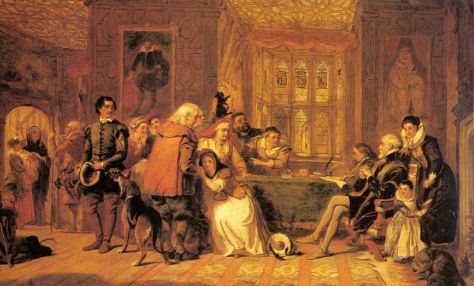
William_Powell_Frith_The_Witch_Trial
The Witch Trial by William Powell Frith (1848)

Not believing women as victims is the abuse that compounds the abuse—as Adrienne Rich captures in “Rape”: “You have to confess/to him, you are guilty of the crime/of having been forced.”

After Trump’s election, at the very least a “boot in the face” of all women and human decency, Maggie Smith’s “Good Bones” resonated with many. Two lines—”The world is at least/fifty percent terrible”—now resonate well beyond her likely intended meaning, or even why the poem spoke to may then.

Men, the “fifty percent terrible,” stand now exposed, hands raised against the widening spotlight as the crack in the dam expands.

More Delusional, White People or Charter Advocates?

Since I often share satirical articles from McSweeney’s and The Onion, and some regularly respond oblivious to the satire, I try to buffer my own knee-jerk reaction to headlines; and thus, at first, I suspected this to be yet another scathing parody: Majority Of White Americans Say They Believe Whites Face Discrimination.

Alas, however, this is serious journalism from NPR about an apparently credible poll— leaving me to consider how delusional white people truly are in the U.S.

White people’s beliefs about whites being discriminated against disappear like tears in the rain when placed against the enormous evidence that whites, in fact, benefit from tremendous benefits for that whiteness in the U.S.

Let’s just catalogue a few significant contradictions in these white beliefs.

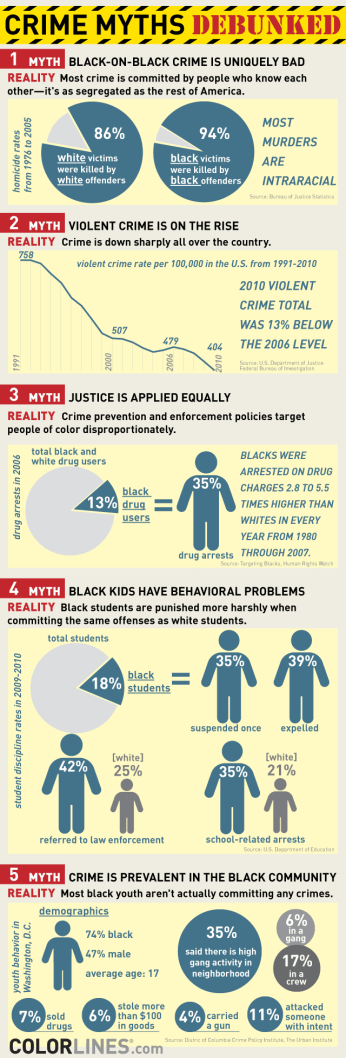
First, whites are likely strongly swayed by the mainstream media’s obsession with black-on-black crime, which sits beside the failure of mainstream media to cover with the same intensity white-on-white crime and this one basic fact: Crime in the U.S. is mostly within race and black-on-black crime rates (94%) are nearly statistically equal to white-on-white crime rates (86%):

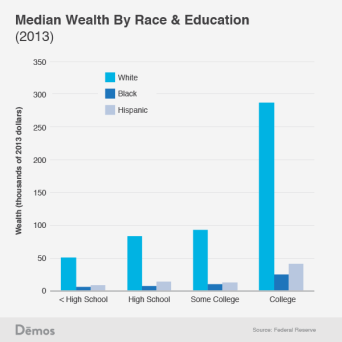
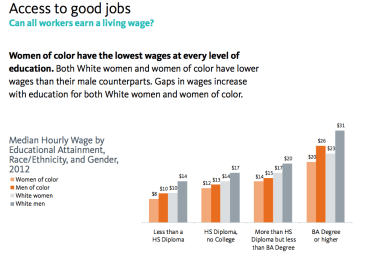
Next, whites reap huge economic benefits compared to black and brown people, even when comparing by race and level of education:

Bruenig, 24 October 2014
median
Matt Bruenig from 24 September 2014
Access to good jobs

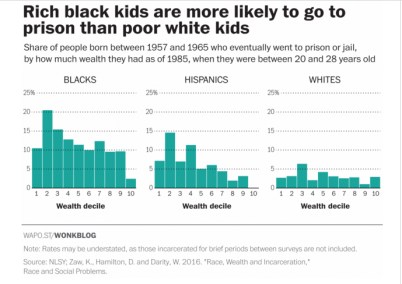
Additionally, whites fair much better than blacks in the judicial system, even when comparing among the same behaviors and despite the claimed advantages of more education:

Poor white kids are less likely to go to prison than rich black kids

And possibly most damning of all, the positive impact of affirmative action—the bane of whites—has mostly fallen to white women:

While people of color, individually and as groups, have been helped by affirmative action in the subsequent years, data and studies suggest women — white women in particular — have benefited disproportionately. According to one study, in 1995, 6 million women, the majority of whom were white, had jobs they wouldn’t have otherwise held but for affirmative action.

Another study shows that women made greater gains in employment at companies that do business with the federal government, which are therefore subject to federal affirmative-action requirements, than in other companies — with female employment rising 15.2% at federal contractors but only 2.2% elsewhere. And the women working for federal-contractor companies also held higher positions and were paid better.

Even in the private sector, the advancements of white women eclipse those of people of color. After IBM established its own affirmative-action program, the numbers of women in management positions more than tripled in less than 10 years. Data from subsequent years show that the number of executives of color at IBM also grew, but not nearly at the same rate.

Racism, willful ignorance, delusion—these are our only explanations for whites holding beliefs dramatically contradicted by an abundance of evidence that in the U.S. white privilege is powerful and the oppression of blacks is pervasive even when blacks attain more education.

One case that rivals white delusion is charter school delusion.

When I published an Op-Ed countering two local news stories on SAT scores—both of which misled readers by ranking schools and suggesting charter schools are somehow superior to traditional public schools—the predictable response appeared, from the state’s superintendent of charter schools no less:

Three levels of delusion in one Tweet.

First, my university is test-optional

We believe that your potential for success cannot be determined solely by standardized test scores. As a result, our admission process is test optional, meaning you are not required to submit SAT or ACT scores.

—as are a growing number of colleges and universities. And thus, the “gotcha” aspect of this Tweet falls flat due to a complete failure to look for the evidence.

Next, high-stakes testing—which remains biased by race, social class, and gender—does in fact cause inequity since these tests often are gatekeepers for scholarships and admissions.

And finally, the greatest delusion of all among charter advocates is pure ideology: “Our expectations of kids cause inequity.”

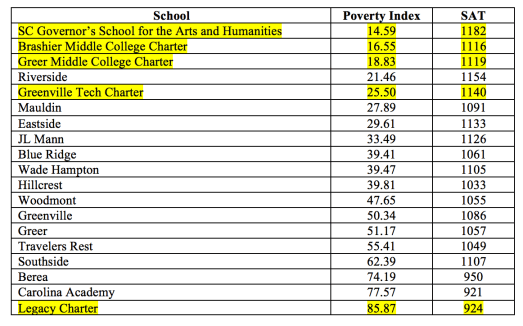
Simply examine the SAT scores along with the Poverty Index (PI) in the chart below (traditional schools, no highlight, and charter schools, highlighted):

SAT comp w charter HL

Both traditional and charter schools fall along a predictable pattern of SAT scores correlating strongly to PI, and thus, charter advocates have a real evidence problem with claims that SAT scores are the result, mostly or only, of expectations.

If there is an expectations problem in the charter school movement, it is that we must have higher expectations for honesty and awareness of evidence among charter school advocates, administrators, and teachers.

Delusion that denies white privilege or misrepresents educational policy is harmful on many levels since it detracts from real problems—such as the cancers that are racism and inequity as well as the tremendous failures of universal public education in the U.S.

In my first-year writing seminar, my constant refrain is urging young people to step back from what they believe is true, to be skeptical of those quick and easy beliefs, and to seek credible and compelling evidence that either confirms or corrects those beliefs.

Just saying something, I warn, doesn’t make it true.

White people and charter advocates, it seems, could use a refresher course in the foundations of composition.


24 October 2017 Reader: Edu Reform, Edu Equity, Technology

Memory Machines and Collective Memory: How We Remember the History of the Future of Technological Change, Audrey Watters

There are powerful narratives being told about the future, insisting we are at a moment of extraordinary technological change. That change, according to these tales, is happening faster than ever before. It is creating an unprecedented explosion in the production of information. New information technologies — so we’re told — must therefore change how we learn: change what we need to know, how we know, how we create knowledge. Because of the pace of change and the scale of change and the locus of change — again, so we’re told — our institutions, our public institutions, can no longer keep up. These institutions will soon be outmoded, irrelevant. So we’re told.

These are powerful narratives, as I said, but they are not necessarily true. And even if they are partially true, we are not required to respond the way those in power or in the technology industry would like us to.

Teacher diversity gaps and their evolution under Trump, Michael Hansen and Diana Quintero

The beginning of a new school year often prompts renewed interest in the diversity of the public teacher workforce, and this year is no different. Minority teachers count for less than 20 percent of all public school teachers, while minority students account for roughly half of all students. And, troublingly, this trend is not likely to reverse anytime soon, based on our report on the topic last year.

There are myriad factors that appear to contribute to the systemic underrepresentation of minority teachers, as well as a variety of proposed solutions to reduce these gaps. Experimenting with these types of policies should be worth it, as the weight of research evidence shows that disadvantaged students stand to benefit most from a more diverse workforce.

7 findings that illustrate racial disparities in education, Liz Sablich

[W]e’ve put together a list of seven findings about racial disparities in education that scholars and contributors at the Brookings Institution have highlighted over the past year.

NEPC Review: Lights Off: Practice and Impact of Closing Low-Performing Schools (CREDO, August 2017), Matthew Gaertner and Ben Kirshner

This report provides an extensive analysis based on the most comprehensive dataset ever assembled for school closure research, including 1,522 low-performing schools that were closed across 26 states between 2006 and 2013. The report finds that even when holding constant academic performance, schools were more likely to be closed if they enrolled higher proportions of minority and low-income students. It also finds test score declines, relative to the comparison group, for two groups of students displaced by closures: those who transferred to schools with a prior record of relatively lower test-score performance and those who transferred to schools with equivalent past test-score performance. The slightly less than half of students who transferred to higher performing schools showed academic improvement relative to their matched peers. In general, although the reviewers found this to be a careful and rigorous study, they see a few missed opportunities. First, the report’s focus on some tenuous analyses (involving pre-closure transfers) obscures its most important findings – disproportionality in school closures and inadequate numbers of higher quality receiving schools, leading to performance declines for most. Second, the reviewers are concerned about statistical modeling choices and matching challenges that may threaten the validity of subgroup analyses (charter school students). Finally, the reviewers would have liked to see the report acknowledge the inescapable moral dimensions of school closure: The communities most likely to be negatively affected are unlikely to have participated in closure decisions.

Neglecting Democracy in Education Policy: A-F School Report Card Accountability Systems, Kevin Murray & Kenneth R. Howe

Sixteen states have adopted school report card accountability systems that assign A-F letter grades to schools. Other states are now engaged in deliberation about whether they, too, should adopt such systems. This paper examines A-F accountability systems with respect to three kinds of validity. First, it examines whether or not these accountability systems are valid as a measure, that is, do these systems validly measure school quality? Second, it examines whether or not they are valid as a policy instrument. or, how far do A-F accountability systems fulfill the stated aims of their proponents—empowering parents, providing “simple” and “common sense” measures of educational quality, and so on? Finally, it examines whether or not A-F systems are valid as a democratic framework:, how well do these systems align with the broader goals of educating students for democratic citizenship and of incorporating parents and community members in democratic deliberation about policies for their public schools? The paper concludes that A-F accountability systems are invalid along each of these lines, and provides recommendations for democratically developing and implementing criteria for school assessment.

educator, public scholar, poet&writer – academic freedom isn't free