Toxic Masculinity, Predatory Men, and Male Paralysis

How can anybody know
How they got to be this way?

“Daughters of the Soho Riots,” The National

This is my sixth decade as a human, as a white, straight male.

Here I want to attempt confession, possibly seeking greater understanding, but fully aware of the huge complexities of making these claims, raising these personal struggles in the context of my many privileges.

I am treading lightly but committed to rise above the problematic satire of Ben Folds’ “Rockin’ the Suburbs”—which both speaks to me and makes me cringe:

Let me tell y’all what it’s like
Being male, middle-class, and white
It’s a bitch, if you don’t believe
Listen up to my new CD

My formative years over the 1960s and 1970s were spent in the redneck South. Just as I was reared to be a racist, I was taught very clearly to objectify women, even as that was tempered in my immediate family by direct and indirect messages about respecting and loving women/girls.

Growing up, I was a Mama’s boy, I was very close to my sister (my only sibling), and I had strong and warm relationships with aunts and my maternal grandmother.

As a so-called pre-sexual boy, then, I genuinely learned to feel deep and healthy affection for women/girls—to whom I have always been drawn more strongly than any male bonds.

As a teen, however, I was significantly enculturated into objectifying women, sowing the seeds for potentially behaving in ways that fed into and participated in predatory masculinity and even the various degrees of rape culture.

My classroom was, at first, superhero comic books and then soft-core pornography (such as Playboy and Penthouse)—but the wider popular culture was always reinforcing the worst possible models for how men treat women.

But as all this colored my attempts to be a sexual person, seeking out romantic relationships throughout high school and college, I was also being shaped in how I interacted with the world aesthetically, notably in that I was actively teaching myself visual art by drawing from both comic books and nude photography in the euphemistically named men’s magazines.

One can see a theme in my adolescent artwork:
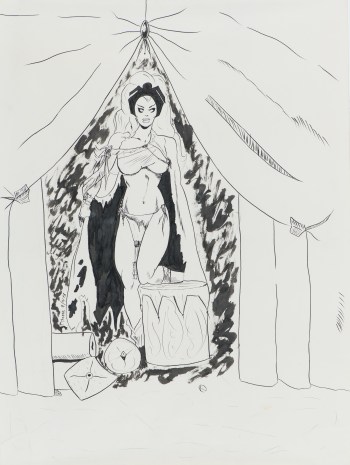
Storm
Storm from the X-Men
Vargas
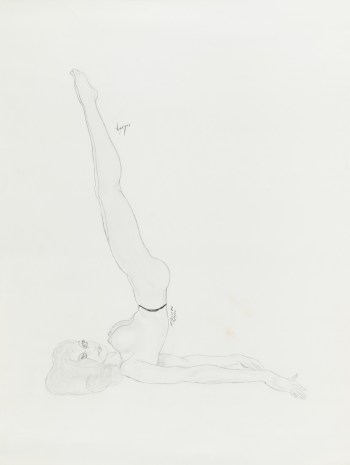
I shifted from comic books to men’s magazines and copying the objectifying artwork of Alberto Vargas, popularized in Playboy.

As a teen and young man, I was certainly trapped in very unhealthy but subtle patterns that could only be overcome by gaining critical awareness over my mid-20s into and my mid-30s (when I completed my doctoral program).

Some of that critical awareness was powerfully acquired through my commitment to learning from and teaching important literature such as Alice Walker’s The Color Purple and Margate Atwood’s The Handmaid’s Tale as well as poetry units I taught on Adrienne Rich, Anne Sexton, and Sylvia Plath.

Ultimately, writing an educational biography grounded in feminist theory stands in hindsight as the crowning experience as I approached 40 for a healthy awakening into fully appreciating toxic masculinity, predatory men, objectifying women, the male gaze, and rape culture.

Just as I would explain about my racial awareness, my sexual and gender awareness remains a journey, and as such, I find myself often paralyzed because, as a man, I represent still the potential for abuse through my status, the threat men pose for women in a society that continues to objectify and marginalize females—especially in terms of failing to listen to women who risk telling of their experiences with predatory men and rape culture.

My adult life has been spent as a partner, friend, parent, grandparent, teacher, and coach—all requiring me to monitor my status of power granted by being male and by my professional and familial positions in relationship with females.

As a coach and teacher, I have been (and continue) to be prone to call young women “darling” in casual moments—rightfully prompting some of my closest friends and colleagues who are women to call me on the language, the positioning.

I remain aesthetically drawn to photography and artwork of women nudes—entirely unsure if I can disentangle my toxic past from what I consider non-objectifying appreciation of art.

And so, as I noted above, I stumble toward 60, a man with good intentions who understands that is never enough; I am often reduced to paralysis in how to navigate the world in ways that are equitable and healthy for everyone regardless of race, gender, sexuality, or class.

I am genuinely terrified of ever making any woman/girl feel discomfort because of my masculine presence, my inadvertent gaze, my language, or the implicit threat of my status in relationship to her.

Often these days, I must confront these tensions as I snuggle with my granddaughter who I dearly want to grow up with healthy views of gender and sexuality, who I want to avoid any sort of predatory world.

My daughter was raised without corporal punishment, and now her children have been gifted that same dignity.

I work hard to practice what I preach and feel I make contributions small and even large to a kinder and more compassionate world—a world in which women and children need not ever fear men.

But even the best men walk in the wake of the worst men have given this world—the worst men continue to give to this world, and the women and children who must suffer for that.

Each man must moment by moment examine how he is culpable, where and how he stands in this world in relationship to women and children.

The dilemma of navigating the world as a man is couched in the unearned privilege, the potential for an abuse of unearned power that shouts out “First, do no harm.”

For a man committed to that, however, how does he live a full life without being paralyzed by the worst of being a man, behaviors that often go unpunished and even masked to protect some men from consequences.

How does any man avoid paralysis reading about the Stanford rape case or the stories of women as victims of predatory men?

This remains a rhetorical question for any man with an ethical imperative for his life—not a question for any woman or any child to offer their compassion.

For any man, for each man, this is ours to confront, to answer, and to act.

As long as men hold most of the power that shapes the world, it is ours to build a consensual environment in which human dignity supersedes the brute force of power.

Between acquiescing to the basest of male behaviors and paralysis is the true way, about which Franz Kafka wrote: “The true way is along a rope that is not spanned high in the air, but only just above the ground. It seems intended more to cause stumbling than to be walked upon.”

Pause. Listen. Look carefully before taking any step.


For Further Reading

Experts in the FieldBonnie Nadzam

Roxane Gay, Aimee Bender, and More on Assault and Harassment

The Predatory Men of Academic Creative Writing, John Warner

“He knows, or thinks he knows”: It’s Still a Man’s (Hostile) World

True Detective: It’s Still a Man’s (Hostile) World, pt. 2

Doubling Down (Again) on the White Man’s World

“Gravity”: The Unbearable Lightness of Being a Woman

In the U.S., Where the Female Nipple Is More Dangerous Than a Gun
“We Teach English” Revisited

At times quaint and oddly misguided but unflinchingly confrontational and assertive—the signature tone of her work—Lou LaBrant’s We Teach English (1951) was a rare book-length text over her 65 years as an educator.

While this text for teachers of ELA/English never garnered the status of Louise Rosenblatt’s Literature as Exploration (LaBrant and Rosenblatt were colleagues at NYU), both works represent a long history of trying to coral the field of ELA/English teaching.

A recent conversation and debate on NCTE’s Connected Community about teaching whole-class, assigned novels has reminded me of the enduring tensions of what it means to teach ELA/English—tensions that span K-12 grade levels as well as being grounded in responsibilities to student needs and interests, the field or discipline of English, and literacy broadly.

Historically and then magnified during the past thirty years of high-stakes accountability, ELA/English has shared with math demands and expectations that are not as pronounced in other disciplines; despite the limitations and problems with the terms, I characterize those demands as addressing disciplinary knowledge (or content) and literacy skills.

Our disciplinary knowledge obligations rest with the compulsion to cover established content, such as identifying the parts of speech, analyzing the main characters in The Scarlet Letter, or explaining the key ideas expressed by Ralph Waldo Emerson and Henry David Thoreau as American Transcendentalism.

Literacy skills comprise reading, writing, speaking, and listening—how we as humans navigate the world through literacy. Some see these skills as a different way to think about content, skills such as comprehension, predicting, narration, and persuasion.

At best, these obligations can and possibly should work in tandem. When we teach a poem, Langston Hughes’s “Harlem,” for example, we are introducing students to key content about American literature and the Harlem Renaissance while also teaching them about the elements poetry, reading skills (such as analysis), and reading like a writer so they can transfer those rhetorical and literary strategies into their own writing.

Let me pause here to stress that at all levels from K-12, this is a damn high bar for any teacher. It takes a great deal of time and expertise to learn to manage all that effectively.

At worst, these obligations become professional and disciplinary battles—ones waged among practitioners often at the expense of students we should be serving.

We must teach phonics, but what about the children acquiring the desire and ability to read?

We must teach grammar, but what about the children acquiring the desire and ability to write?

Everyone must read The Great Gatsby, but what if that requirement creates nonreaders?

When we form ideological camps about disciplinary knowledge or literacy, we often fail both our field of ELA/English and students.

We teach English means something extremely complex and difficult, something that in fact may be too much to expect of any teacher.

But this is what we do, this is who we are.

If we return to the debate and discussion about teaching whole-class novels, we are revisiting an enduring debate that captures exactly what teaching English means.

To resolve that debate, I believe, we must remain focused on our students, and not on whether or not we address either area of demands in our field.

It is not a simple way to resolve the questions, but it is rather simple: When we attend to either disciplinary knowledge (and we should) or literacy skills (and we must), what are the consequences of those lessons in the evidence of learning by our students?

If we require our students to read Charles Dickens, and many do not read because they dislike the work, and many begin or continue the journey to being a nonreader, then we have failed dramatically any obligations as teachers of ELA/English.

If a whole-class unit on Lord of the Flies or The Hunger Games becomes a vibrant adventure in the novel and literacy, and most if not all read the novel, if several become hooked on literature, then we have accomplished everything that can be expected of teaching ELA/English.

In terms of both student reading and writing, there are decades of evidence that show how student choice in what they read and write is most effective in both fostering disciplinary knowledge (because they actually read and write) and literacy skills as well as literacy engagement (because they become eager to read and write).

But we as teachers of ELA/English are confronted with the essential problem beneath the call for student choice: students must have acquired some disciplinary and skills knowledge and proficiencies in order to make those choices.

If we can keep a critical eye on the outcomes of the instructional decisions we make—if we can resist dogged commitments to ideologies—then we can make informed choices about what best serves our students in terms of both what disciplinary knowledge they acquire and whether or not they develop as proficient and eager readers and writers.

Staying big picture is important—always asking what we are trying to accomplish with students and then paying close attention to what our students show us we are teaching.

In 2004, Donald Graves looked over his career seeking ways to teach students writing; he offered some enduring ideas about “what remains the same”:

The following fundamentals have remained unchanged in the teaching of writing:

  1. Children need to choose most of their own topics. But we need to show them all the places writing comes from, that it is often triggered by simple everyday events.
  1. Children need regular response to their writing from both the teacher and other readers.
  1. Children need to write a minimum of three days out of five. Four or five days are ideal.
  1. Children need to publish, whether by sharing, collecting, or posting their work.
  1. Children need to hear their teacher talk through what she is doing as she writes on the overhead or the chalkboard. In this way, the children witness their teacher’s thinking
  2. Children need to maintain collections of their work to establish a writing history. Collections show that history when they are used as a medium for evaluation. (Language Arts, Vol. 82 No. 2, November 2004)

In the same way as the debate over whole-class novel instruction, if we view Graves’s fundamentals as strict rules and teach to these rules—instead of to how we are fostering students as writers—we become lost, and we likely fail.

So, yes, students choosing what they read, especially something as daunting as a novel, is a fundamental, but that doesn’t necessarily discredit the possibility of whole-class novels.

To answer any instructional questions, then, as a teacher of ELA/English is in our students, not our obligations to disciplinary knowledge or literacy skills—and especially not in covering the mandated standards or preparing students for high-stakes tests.

The questions are worthy of discussion and debate among teachers of ELA/English, but ultimately we must each answer them with each unique group of students we teach.

When faced with the debates and questions about teaching ELA/English, LaBrant could be harsh and demanding—often seeming to teeter on the edge of, if not crossing over into, prescription. However, what LaBrant was demanding about in terms of “we teach English” is not that we follow her rules, or any rules, but that we remain committed to our students and their journeys in both literature and literacy.

During war, in 1942, LaBrant became frustrated with national concerns about literacy:

The induction of American youth into the armed forces, and the attendant examinations and classifications have called attention to a matter long of concern to those who teach reading or who are devoted to the cause of democracy: the fact that in a land which purports to offer universal education we have a considerable number of youth who cannot read intelligently. We are disturbed now because we want these men to be able to read military directions, and they cannot. A greater tragedy is that they are and have been unable to read with sufficient understanding to be constructive peace-time citizens.

As is to be expected, immediate explanations have been forthcoming, and immediate pointing-of-fingers has begun. Most of the explanations and pointing have come from those who have had least to do with teaching reading, and who are least conversant with the real problem.

Sound familiar?

LaBrant argued against what became a recurring political and public hand wringing about a reading crisis:

An easy way to evade the question of improved living and better schools for our underprivileged is to say the whole trouble is lack of drill. Lack of drill! Leťs be honest. Lack of good food; lack of well-lighted homes with books and papers; lack of attractive, well equipped schools, where reading is interesting and meaningful; lack of economic security permitting the use of free schools—lack of a good chance, the kind of chance these unlettered boys are now fighting to give to others. Surround children with books, give them healthful surroundings and an opportunity to read freely. They will be able to read military directions—and much more.

Here and for over six decades, LaBrant was a champion of the we who teach English but in the name of those students we teach, especially the most vulnerable students.

To that end, when we teach English, we teach students.

And there is where our commitments must lie.

Rethinking Grading as Instruction: Rejecting the Error Hunt and Deficit Practices

As a first-year English teacher, I joined the department of the high school where I had graduated only five years earlier, becoming a colleague with teachers who had taught me. That introduction to the field allowed me behind the curtain, and one of those secrets was being handed a sheet that detailed every grammar and mechanics error students were likely to make in their writing and the amount of points to be deducted from their grade (writing was assigned the traditional content/grammar grade then).

One fragment, by the way, was an immediate deduction that resulted in an F in grammar.

This was department policy, and my efforts to navigate that system were akin to Sisyphus, his rock, and that damned mountain.

Since then, well over thirty years ago, I have become a non-grader, but I also have investigated and adopted concepts about grading (since we all at some point must grade) that I believe are incredibly important in the context of seeing grading (and feedback) as a part of instruction—and not something we do to students and their work after we teach.

A  teacher recently asked on NCTE’s Connected Community about subtracting points for grammar in student writing, and this is an ideal entry point to rethink how grading (especially of writing) sends instructional messages to our students.

My first caution is about a serious flaw with traditional grading that is grounded in viewing assessment situations in a deficit model whereby we have students start with an unearned 100 points from which we subtract credit by identifying errors. This fosters an atmosphere of risk aversion—which is not a healthy environment for developing literacy.

Specifically when teaching writing, we must abandon the “error hunt” (see Weaver, et al., and Lois Matz Rosen).

Therefore, we can send a much healthier message about student performances of learning if we acknowledge that students begin all assessment situations with zero and then give them credit for what they accomplish, what the artifact of learning demonstrates—and not where they fail.

I learned this concept of grading through my Advanced Placement training that encourages viewing writing holistically and then reading for what students do, not conducting the “error hunt.”

Conceptually, then, we must change our language and then couch our grading in a drafting process that gives students the space to take risks while receiving ample feedback as they revise and edit their writing.

Our language about writing must stop referring to “mistakes” and “errors,” while also not asking students to “correct” their work.

Instead, we should delay addressing if our students are being conventional (grammar, mechanics, and usage) until late in the drafting process when we can agree a piece of writing is worth editing (see LaBrant). The question is not if and how much to deduct for surface features not being conventional, but when to consider those issues relevant to the drafting of the piece of writing.

Our feedback during the drafting process is our instruction, and then, most of us at some point must abandon each assignment, requiring that we assign a grade, an act that also is teaching students lessons—ones that should match our philosophy of teaching/learning as well as what we want them to embrace about writing and literacy.

Here, I recommend that we take a holistic approach (I love the upper-half, lower-half concepts of the AP 9-point scale rubric*), but I also believe we should help students learn that all aspects of writing contribute to that holistic response.

The two categories we should be using to grade writing, I think, are revision (if and how students demonstrate content, organization, diction, style) and editing (grammar, mechanics, and usage). When I have graded, I weighted those categories to reflect my main lessons about what makes writing effective by using a 20-point scale articulated as 10 points for content and organization, 5 points for diction and style, and 5 points for grammar, mechanics, and usage.

In all assessment, we should be seeking ways in which grading is both philosophically matched with our instruction and a seamless aspect of our instruction.

If you are teaching students writing quality is holistic and that surface features are less significant to meaning than content, organization, and diction/style, then calculating a grade based on deducting points for errors contradicts (and probably supersedes) your lessons.

Therefore, reducing the grading of writing by students to a set of points to be deducted fails as assessment and instruction.

While most teachers have no real option to de-grade the classroom, we can step back from deficit views of student work and grading in order to embrace grading and instructional practices that create positive learning environments (where risk is encouraged) and celebrate what our students accomplish in their journey as readers, writers, and thinkers.


* The process for scoring a written response to an AP Literature prompt includes thinking in terms of a range of scores 9-8, 7-6, 5, 4-3, 2-1. Above 5 is upper half, and below, lower half. As you read, you are constantly monitoring holistically if you believe the essay is upper or lower by focusing on in what ways the student is fulfilling the expectations of the prompt and remaining accurate in the analysis of the literature being discussed. Typically, that process allows the reader to return to the rubric to refine the grade after completing the essay. If you know the response is upper half but only marginally so, then returning to the 7 and 6 rubric descriptors help refine the final score.

Writing as a Discipline and in the Disciplines

On the NCTE Connected Community a student teacher asked about teaching students to integrate quotes and evidence into their writing.

Although a direct and specific question, there is a great deal to unpack here.

First, my 18-year career as a high school English teacher as well as my current 15 years as an English educator and first-year writing professor has revealed to me that most teachers of high school ELA have much better preparation for teaching literature than for teaching writing.

Next, my first-year writing students show me the consequences of how writing is taught at the high school level, primarily as the responsibility of ELA teachers.

In order, then, to answer this question from a student teacher, we need to explore writing as a discipline and writing in the disciplines.

Problem 1 embedded in this question is that direct instruction of writing remains primarily the responsibility of English/ELA teachers, who also have disciplinary responsibilities as teachers. This means ELA teachers must address literacy skills (reading and writing as well as speaking and listening) while also covering literature content.

And thus, problem 2 with the question is that it reveals how problem 1 creates muddled teaching and learning for students in high school ELA classes, a failure to distinguish between writing as a discipline and writing in the disciplines.

As a first-year writing professor, I have to unteach the muddled learning that my students bring to college from high school—misconceptions student have about citation (from learning MLA instead of broad and discipline-based concepts about finding and using sources) as well as about writing essays (grounded in disproportionately having written literary analysis and being bound to templates such as the five-paragraph essay).

What, then, should high school ELA teachers do in the context of the student teacher’s question?

Start by being more explicit with students about both the broad qualities of effective writing paired with the narrow conventions of effective writing bound by form and disciplinary expectations.

At the high school and college levels, most writing instruction and assignments are grounded in non-fiction essays, and disciplinary essay writing involves making claims along with providing evidence to support those claims.

Writing assignments, then, at the high school level are far more effective for fostering students as writers and preparing them for college when those assignments are discipline-based, and not merely prompts fitted into templates.

Teaching writing in high school must include a wide range of writing opportunities (not just literary analysis) that help students learn broad concepts of effective writing (such as those in Style). But high school ELA teachers also must continue to teach their discipline—how scholars both read and write about literature.

This means that before we can teach students how to integrate quotes into their writing, we must address in what contexts quotes are appropriate types of evidence.

A writing lesson and assignment addressing disciplinary writing begins by examining the conventions of the disciplines.

When do writers use direct quotes? For students, essays that require quotes to support claims may be common in English and history, for example, when the topic of the essay includes textual analysis of both what the text expresses and how the ideas are constructed in the primary text.

A literary analysis of color imagery in a poem requires a writer to quote from the poem to show both the use of color imagery and how that technique creates some meaning for the reader.

However, in the social sciences, essays often are not about primary texts but about ideas, research findings, and students, like scholars, are tasked with showing that the claims of the essay are supported by a substantial number of sources. Quoting from a single source is not a powerful approach, but synthesizing ideas from several credible sources is.

In both situations, claims are supported by evidence, but the type of essay and the discipline within which the essay is constructed both drive how students would choose evidence and then incorporate that evidence into their original essay.

This sort of discipline-based approach to how we assign and teach writing should inform lessons on citation also; MLA or APA use is a question of discipline, not something assigned (arbitrarily) by a teacher.

Once students are aware of the conventions of essays forms and disciplines, we can then address the narrow concerns of the student teacher—the grammatical and stylistic concerns associated with integrating quotes and other forms of evidence into essays.

In the writing text I wrote and used with my high school students, I highlighted some key concerns about integrating quotes*:

  • When quoting or paraphrasing/synthesizing from sources, writers have an ethical obligation to  represent accurately and fairly the original texts; avoid cherry picking and manipulating quotes/ideas to fit an agenda or claim.
  • Quotes must be integrated while maintaining traditional grammatical and syntactical structures; therefore, using ellipsis, brackets, or other mechanics to shape the quote to match grammatically a sentence is necessary and appropriate if those structures do not change the meaning of the original text.
  • Cut-and-paste quoting—and overuse of block quotes—should be avoided since these are typical of underdeveloped or immature writing.
  • Weaving smaller portions of quoted material into original sentences is typically more effective and reflects a more mature writing style.
  • Using source author/primary text author names with quoted material can be a feature of some disciplinary writing. Care must be taken with those attributions, however. The author of fiction, drama, or poetry may be inappropriate as a tag if a character/speaker is being quoted (Polonius, not Shakespeare, pontificates on brevity and wit); if quoting from a non-fiction essay, then the writer as a tag is appropriate. In the social sciences, the names of the researchers and the titles of the research are typically not addressed in the flow of the essay since the findings of the research are more important than who wrote it.

And with this last point, we come back to how we can better address writing as a discipline and writing in the disciplines.

My college students typically have a one-size-fits-all approach to writing (thinking as students but not as writers or scholars) grounded in MLA and literary analysis; therefore, when they write, for example, in an education course using APA, they struggle with announcing every source in the flow of the essay (not typical in the social sciences) and tend to plod through each source one at a time without a sense of synthesizing the key findings in a body of research.

These symptoms reflect a lack of understanding about writing in the disciplines.

Finally, let me end here with a few additional thoughts.

Preservice and inservice teachers of ELA/English deserve much better preparation and support as teachers of writing, and laying all or most of the responsibility for teaching writing at the feet of ELA/English teachers is a tremendous disservice to them and students.

We all must work to address those problems, but in the mean time, teaching writing as a discipline and writing in the disciplines can be handled with much more care and nuance so that students are served well as developing writers and thinkers while also being better prepared for the expectations of college.


* See also Using Source Material Effectively (Temple University)


A Good Man Is (Still) Hard to Find

The jewel of an ending in Flannery O’Connor’s “A Good Man Is Hard to Find” is nearly as complex as the story itself: “‘Shut up, Bobby Lee,’ The Misfit said. ‘It’s no real pleasure in life.'”

O’Connor, although trapped in the sexist language of “man” meaning “human,” forces readers to consider just who is “good”: Red Sammy Butts must be since he is a veteran, but can The Misfit, murderous and philosophical, be good as well?

The essential question of human goodness interrogated and confronted in O’Connor’s dark and brilliant gem of a short story has been the moral dilemma of my life—a dilemma I have not unknotted in more than 56 years of trying.

The seminal person of that dilemma was my high school’s football coach and athletic director, with whom I would also work when I became a teacher and coach not many years after graduating from that school. He was and continues to be revered as a “good” man although I witnessed as a student and then a teacher that virtually everything afforded the label of “good” with him was veneer.

Like many coaches, he hid behind a suit and tie as well as platitudes about character and hard work; he also hid behind being a “family man” and a church-going Christian.

These are all powerful armor in the South for a certain segment of so-called professional white men.

Although I am skeptical, I hope we may have lost our innocence since the Joe Paterno/Jerry Sandusky abuse of such sacred trusts has been exposed.

But this isn’t just about the racism and hypocrisy that is rampant in big time scholastic and professional sports.

This is about the widespread evil that is white and affluent men in suits with nice hair cuts who hold positions of power all across the U.S.—notably, but not exclusively, in our government.

This is about many of them being Republicans who constantly hold up the God and family shields.

Conservative media pundits and the Ronald-Reagan Republicans have always bothered me in the same way that I have never been comfortable with the hypocrisy surrounding that high school coach.

With the rise of Trump, this discomfort has been intensified beyond expectations.

So as I have been mulling how friends and colleagues have been reaching out to our state’s Republican leaders, several people shared on social media Experts in the Field by Bonnie Nadzam—detailing the predatory patterns of older male writers and the women they’ve abused.

Nazdam’s expose has prompted many other women writers to speak out as well.

“A former teacher and I were discussing these things last week—how the hierarchies of power in the creative writing world resemble the hierarchies of power in Washington,” Nazdam admits.

And so I am nearly paralyzed with what to do with all this as we sit in the U.S. where Donald Trump was elected president, received a majority of votes from white women, despite his horrific and very public record of being the sort of sexual predator that disqualifies him from any position of power or any consideration for being a “good” man.

I am most disturbed, however, by something tangential to Trump, about whom there are calls not to normalize him: We continue to allow so-called mainstream Republicans—smiling, well coiffed, donning expensive suits and ties—to be afforded the mantle of “good,” to be treated with civility and deference, despite their bigoted comments and the inequitable policies they endorse and implement.

Having raised a daughter, an only child, and now regularly providing daycare for a granddaughter, my navigating the world as a man, a white man with considerable privilege, weighs considerably on my conscience.

I carry to this day the guilt I felt as a very young person when I learned about the male gaze—ultimately having to confront my being complicit in that culture and seeking ways to disentangle myself from both that gaze and the larger contexts of rape culture and objectifying women.

These formative years developed along with and after I was strongly immersed in superhero comic books and science fiction—both of which reflected and perpetuated the worst of these phenomena.

As a friend, companion, parent, grandparent, teacher, coach—I have always struggled with whether or not I have fulfilled my own obligations for being “good.” And that concern is often grounded in the sanctity and dignity of the females in my personal and professional lives.

I fear I have failed too often, recognizing good intentions are not enough.

Although I have not solved my essential moral dilemma about what it means to be “good,” I do know a really powerful way to investigate that question: How does someone treat those over whom he/she has power or prestige? How does someone use her/his power in the context of how it affects her/him and then other people?

Obamacare, while terribly inadequate, sought ways to expand healthcare while the proposed Trumpcare has been unmasked for potentially reducing who is covered and transferring tax breaks to the wealthy (and under either, of course, politicians making the rules and their families have the best of healthcare).

And thus, this is a test that Trump and his Republican minions fail—repeatedly.

“We each have a function and role in this culture, whether we acknowledge and are aware of and embrace it or not,” Nazdam argues, concluding: “Whatever your role or roles, at least be aware of your platform and responsibility….[I]n the current environment, it seems radical resistance may be as simple as noticing the truth.”

Therefore, I cannot and will not participate in or tolerate any more the charade that is treating Republican political leaders as if they are “good men” while saying and doing the awful and dehumanizing things they say and do every day.

A good man is (still) hard to find, and we certainly are wasting our time even trying in the Republican Party.

Navigating the Scylla and Charybdis of Research in Education

Teaching children according to their individual ‘learning style’ does not achieve better results,” reports Sally Weale, “and should be ditched by schools in favour of evidence-based practice, according to leading scientists.”

Narrowly about learning styles, but more broadly about the decade’s long tension over what research counts, this argument plays out incessantly in education. Notably in the U.S., calls for scientific teaching, research-based practices, and evidence-based policy have their roots in John Dewey’s progressivism, and then have been intensified throughout the accountability era begun in the 1980s and codified in No Child Left Behind (NCLB) in 2001.

For about a century, education has simultaneously claimed to be driven by science and research while also being criticized for failing to use our research base and being trapped in fads.

This debunking of learning styles, then, is old hat; consider Lou LaBrant lamenting in 1947: “A brief consideration will indicate reasons for the considerable gap between the research currently available and the utilization of that research in school programs and methods.”

And the problem rests with the Scylla and Charybdis of research: on one side, educators must resist the tyranny of a narrow definition of what counts as evidence (the so-called hard view grounded in experimental and quasi-experimental studies), and on the other, educators must resist the trendy and often reductive (lazy) extrapolations of research (within which we may place learning styles).

Let me offer here two powerful examples that I believe address this tension: the poverty materials of Ruby Payne and the “word gap” narrative.

In the wake of federal mandates in NCLB that required public schools to identify and then address the so-called achievement gap, Ruby Payne capitalized on an opportunity to provide schools with manageable workbooks and workshops.

However, after many schools and districts across the U.S. purchased Payne’s materials and seminars, scholars on social class and race began to unmask that Payne was peddling stereotypes, not providing evidence-based claims about children and families in poverty (scholarship debunking Payne as well as the Teachers College Record exchange can be found here).

The Payne phenomenon (one that continues despite her poverty characterizations being thoroughly discredited) reveals several problems with calling for education to be research-based.

First, and possibly most significantly, educational practices are far too influenced by the marketing of materials and the incessant training and re-training of teachers in the field. That market influence and dynamic is made robust since K-12 education is far more bureaucratic than scholarly.

The market influence necessarily creates the need for “new” and manageable, characteristics that often supersede the validity of those materials.

Payne’s success has been built on her self-promotion, not her expertise in poverty. Please note that when critics called her out for lacking research in her work, she immediately began building a case for how student test scores were affected when faculty were trained in her materials—a bait-and-switch of types of evidence; Payne was unable or unwilling to confront that her materials are classist and racist, refuted by the best scholarship on class and race.

Like Payne’s framework of poverty, the “word gap” has remained a robust narrative in the media and education; the claim argues literacy is quantifiable (more words equal greater literacy, and then social classes are correlated strongly with vocabulary; thus, affluent/more words with greater literacy than impoverished/fewer words).

Both Payne’s stereotypes about people in poverty and the “word gap” argument share an essential problem: they are compelling because they feed into popular beliefs that are contradicted by scholarship.

The “word gap” phenomenon, however, is interesting since it relies on essentially one study (by Hart and Risley) that everyone cites (citing research is a powerful appeal)—while ignoring, as with Payne, that a significant body of scholars have debunked the study.

Educators and education, then, are confronted with a real dilemma. Yes, scientific evidence and research are essential to the field of teaching and learning, but what science and research count is fraught with land mines.

From learning styles to Payne’s framework and the “word gap,” advocates and critics both march out evidence, research.

And, for more examples, the current popularity of “grit” and growth mindset research fall into the exact same traps. “Grit” comes with the label of “MacArthur Genius,” and both are all the rage (as has been Payne) in teacher training—despite ample evidence that “grit” and growth mindset are deeply flawed by racist and classist assumptions, and then horribly misapplied in a wide range of educational setting.

In short, education has been a victim for a century of the TED Talk-ification of science and research.

That means education often embraces faulty research (compelling because it matches beliefs/stereotypes/myths, is well marketed, and/or is easily implemented) and routinely oversimplifies and overgeneralizes (the silver-bullet approach) credible research to the point that it too becomes flawed.

By contrast, scholars work slowly and are moored in peer-review—all of which helps resist the corrosive allure of the market as well as the need to be accessible to lay people.

This, I believe, is at the root of LaBrant’s lament about the gap between what science and research reveal and what educators practice.

As a critical educator also committed to evidence-based practices, I can offer some suggestions that allow policy makers and classroom practitioners a way to navigate between the Scylla and Charybdis of research in education:

  • Resist choosing between hard and soft definitions of research. Quantitative and qualitative data have value because in education we should be aware of valid generalizations while also anticipating and being able to address outliers. “Never” and “always” tend to fail us, then. Teaching is about both addressing classrooms of students and each student in that class.
  • Beware heavily marketed programs. Simply put, any research conveniently reduced to a packaged program is either questionable or over-simplified research; our classrooms should not use either.
  • Simultaneously trust your instincts as a practitioner (what has worked, what has failed) while being vigilant to back away from your personal assumptions in order to interrogate your prejudices and beliefs.
  • Do your own literature reviews. The first response by educators to top-down mandates and adopted programs or required workshops is to investigate. The Internet makes this process quite manageable, and healthy skepticism is a powerful tool of any professional.
  • Remain grounded in how messy and unpredictable teaching and learning are as human endeavors. There are no silver bullets, and there likely is nothing new (educational research in the U.S. is a solid century old and much of what we claim to know now—as “new”—we knew many decades ago as well).
  • Reject the mantras of business that invade education such as “innovation.” For education to be evidence-based, we must work from a foundation of experience and expertise (the idealizing of the outsider perspective is bogus) as well as clearly and accurately describing and identifying problems so that we may match appropriate solutions to those complex problems.

So what do we do, then, with learning styles (or “grit” and growth mindset)?

We must admit that education has likely oversold and misapplied the concept, but those of us who teach daily are probably not compelled by hard science’s argument it has no value.

If we are practicing learning styles to meet some mandate about learning styles, we have made a huge bureaucratic mistake. If we ignore the evidence of our students that learning occurs along a spectrum, that some practices match better certain students, then we are making a human error.

As teachers, we must captain our own ships, navigating carefully not to crash into either the rock or the hard place. Ultimately, this is about professionalism—knowing the evidence because we have done the work, not because it is a mandate or an adopted program.

We must remain vigilant in our sacred trust to teach students, and in doing so, resist distracting allegiances to “scientific,” “research,” “evidence,” and especially “programs” to the exclusion of those students.

See Also

Progressivism and Whole Language: A Reader

Teacher Quality: A Reader in 2017

Let me start with a full disclosure: Lawrence Baines is a colleague and friend with whom I have collaborated on several book projects and presentations. So I want to offer some friendly concerns about his thoughtful When ‘Highly Qualified’ Teachers Aren’t in Education Week.

Baines open with: “Recent research confirms that America’s most vulnerable children are being taught by the least-qualified teachers.”

This is incredibly important, but let’s clarify a few points. Vulnerable students include black and brown students, high-poverty students, English language learners, and special needs students. And Baines is highlighting a truly ugly fact about unwritten policies in education: these vulnerable populations of students are assigned disproportionately new and early-career teachers as well as un-/under-certified teachers.

Dozens of studies for many years have confirmed that administrations commonly “reward” veteran teachers by assigning them “good” students and advanced courses such as AP and IB.

Add to that dynamic that the rise of charter schools linked strongly with TFA has increased the likelihood that vulnerable students will be assured a continual stream of uncertified and new teachers.

Confronting the increased bureaucratization of teacher preparation and alternative certification programs, Baines makes his central case: “The continual dumbing-down of the preparation of teachers is not without consequences.”

I would argue that the “dumbing-down” is about the false attack on “bad” teachers as the primary or even single cause of low student achievement among, specifically, vulnerable students.

And the ugly consequence of that assault has been increasing accountability over teacher certification and teacher evaluation (such as using value-added methods) and thus demonizing teachers without improving teaching or learning.

Another repeated fact of education is that measurable student learning (usually test scores) is most strongly correlated with the socioeconomic status of students’ home; see this about Arkansas, which is typical across the U.S.

So here is the teacher quality dilemma: If we demand that teacher quality is the primary mechanism for improving student achievement, and if that is a false claim (which it is), we are doomed to both destroying the profession and discouraging anyone from entering that profession.

And Baines concludes: “All of the highest-performing countries in the world require teachers to obtain advanced degrees, demonstrate pedagogical and subject-matter expertise, accumulate significant teaching experience, and show an aptitude for working with children before stepping into the classroom as full-time teachers.”

Herein we are confronted with what it means to prepare well people to teach. And how do we disentangle teacher preparation and teacher evaluation from corrosive and ill-informed bureaucracy (certification and accreditation) while also providing the context within which we can create robust and challenging teacher education as well as ongoing professional development for teachers?

My short answer is that standards, certification, and accreditation are all the problems, not the solutions. Teacher education needs to be re-envisioned as the other disciplines, which are often self-regulating and robust because of professionalism and fidelity to the discipline among members of that discipline.

Since I have written on these issues often, I offer here a reader to help confront the issues raised by Baines:

Teacher Quality, Wiggins and Hattie: More Doing the Wrong Things the Right Ways

Addressing Teacher Quality Post-NCLB

What We Tolerate (and for Whom) v. What the Rich Demand: On Teacher Quality

Teacher Quality: On Hyperbole and Anecdotes

The Fatal Flaw of Teacher Education: “We have met the enemy and he is us.”

What’s Wrong with Teacher Education?

Confronting, Finally, Obama as Centrist, Incrementalist—Never The Socialist

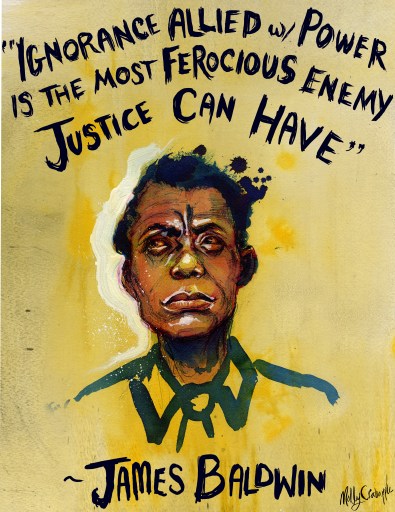
It is certain, in any case, that ignorance, allied with power, is the most ferocious enemy justice can have.

James Baldwin, No Name in the Street (1972)

The Right, specifically the Republican Party, has never been too bright, but it has always depended on the ham-fisted logic of the U.S. public.

As political maneuvering, the Right maintained a persistent drumbeat throughout Obama’s presidency, painting him The Socialist.

Yet, over the past few days, that same Right has unwittingly unmasked both Obama and themselves by noting the similarities between past comments by Obama and recent controversial claims by Ben Carson (slaves as immigrants) and Republican Rep. Jason Chaffetz (iPhones and healthcare).

First, let’s be clear that calling enslaved people “immigrants” and demonizing people trapped in poverty are categorically wrong—regardless of who makes the claims.

And let’s also clarify that although the ends do not justify the means, Obama’s calloused comments were in the context of quite different goals than similar comments made from Republicans: Obama seeking equity and expanding healthcare by working within the system and long-held but false American Myths versus Republicans denying racial inequity (Carson) and working to cast impoverished and working citizens out of the guarantees of publicly funded healthcare and into the dog-eat-dog world of the free market.

But, second, and possibly more importantly, Obama has been unmasked as a centrist, an incrementalist—what we may admit is Ben Carson-light in rhetoric, but not political goals—by the very Right who falsely portrayed him as The Socialist.

As I have detailed in the Big Lie about the Left in the U.S., there simply is no viable or influential Left in this country, not in our two major political parties and not even on our university campuses; the leftwing professor cartoon is just as false as Obama The Socialist.

The Democratic Party in the U.S. is a centrist, leaning right, party; college professors are moderate progressives, comfortable members of the leisure class who are in no way dedicated to upsetting the status quo.

And everyone in power—even Bill Clinton and including Obama—remains trapped in narratives about race and social class that are both enduring and provably false.

Political leadership in the U.S. on both sides of the aisle speak to and perpetuate “get tough on crimes” rhetoric, despite decades of dropping crime rates; “fearing foreigners,” despite ample evidence that homegrown terrorism is far more dangerous; and “lazy minorities” as well as “lazy poor” characterizations beneath bootstrap language, although the bootstrap myth is a lie and systemic inequity remains powerful (racism, classism, sexism) on the lives of many Americas.

We don’t need the Right to pick through Obama’s legacy to highlight that he was never The Socialist, but it certainly would go a long way toward an equitable nation if we all would confront the moral vacuum that exists in U.S. politics because we have no political Left.

Publicly funded—universal healthcare, public education, roads and highways, judicial system and police force, military—is not about giving things to lazy people for free; publicly funded is about the collective will of a people determined to provide everyone access life, liberty, and the pursuit of happiness.

Equity is the political goal of the Left; forced equality is the cartoon version of “communism” that is in fact totalitarianism, fascism. The former is a moral imperative, the latter is heinous and immoral.

The U.S. is an amoral country that claims “democracy” but worships capitalism.

And thus, in typical confrontational and uncomfortable style, James Baldwin wrote in 1967:

It is true that two wrongs don’t make a right, as we love to point out to the people we have wronged. But one wrong doesn’t make a right, either. People who have been wronged will attempt to right the wrong; they would not be people if they didn’t. They can rarely afford to be scrupulous about the means they will use. They will use such means as come to hand. Neither, in the main, will they distinguish one oppressor from another, nor see through to the root principle of their oppression.

There is much to unpack there in 2017.

Obama and Carson, separately and together, are wrong to blur the horror of people enslaved with immigration.

Obama and Chaffetz, separately and together, are wrong to trivialize the basic human right of healthcare by playing to a false stereotype of people trapped in poverty.

But the real problem, the one crystal clear to Baldwin, is the collective work of the Oppressor, the U.S. public that not only allows these wrongs, but creates them.

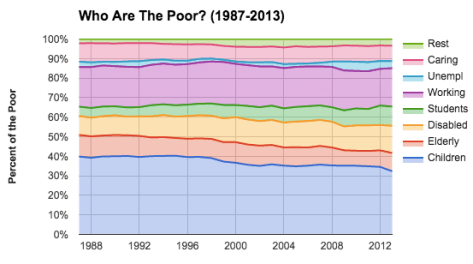
As Stephen Pimpare notes, the largest block of people living in poverty are children, with no political or economic power.

People in poverty are mostly those children, the elderly, the disabled, students, the working poor, and those proving care for others.

Across the U.S., we’d rather play gotcha partisan politics than give a good damn about fulfilling our promises as a people committed to human dignity and equity for all.

Finger pointing across the aisle keeps everyone from the mirror that would require us to admit who we truly are.

And so …

baldwin012
Artwork by Molly Crabapple

Give Me Your Soda, Your iPhone, Your Sick Yearning for Healthcare

The public is stunningly misinformed about issues and concepts that are essential to understand if a democracy is going to thrive.

The Trump candidacy and presidency have exposed a powerful example of that problem since many who support Trump believe that the Affordable Care Act and Obamacare are different programs.

This important policy confusion is grounded, I believe, in larger concepts about which most in the U.S. are just as misinformed: race and social class.

Even among my college students who are well educated, few are aware that race has no basis in biology, but is a social construction. And people in the U.S. routinely over self-identify as middle-class, while also associating ethical and moral qualities to the classes (the poor as deserving their poverty due to character flaws; the wealthy as earning their wealth due to superior work ethics).

Further complicating the national beliefs about race and class is how the two overlap, specifically how lingering racism lurks beneath negative stereotypes about the poor.

Political leadership in the U.S., then, includes two powerful facts: most of those leaders are affluent, often among the very elite of wealth, and virtually all of those leaders speak to the public’s flawed but powerful beliefs about social class and race (although usually in coded ways).

As the Trump administration and Republican Party prepare to end the ACA and offer new healthcare legislation, what is being put disturbingly on display is a resurgence in attacks on the undeserving poor.

Three examples serve well to expose how Republicans and the mainstream media speak to and perpetuate the image of the undeserving poor in order to promote public policy that abandons the vulnerable and rewards the privileged.

As I have examined, just before Trumps inauguration, The New York Times published a damning and false story about people on welfare purchasing soda, In the Shopping Cart of a Food Stamp Household: Lots of Soda.

Joe Soss refuted the article, noting that welfare recipients, the USDA studied actually showed, had very similar purchasing patterns as those not on welfare.

Yet, multiple states have begun legislation to bar soda purchases by any on welfare.

The NYT article, despite being provably flawed, and the proposed legislation reveal a social belief that people trapped in poverty somehow don’t deserve luxuries (sodas), that the poor must have higher standards of self-control than people in other social classes.

This example from the media helps us understand the Republican use of “choice” to mask how their policies benefit the wealthy and ignore the poor.

Next, consider Paul Ryan’s and Mike Pence’s groundwork for repealing the ACA—both of whom Tweeted about choice and freedom as the ideals driving their work.

Market-based healthcare shifts all the responsibility onto individuals, and Republicans are masters at manipulating the misinformed public.

Finally, as Republicans unveil how they will replace ACA, the realities of that plan (shifting the burden to individual medical savings accounts, despite most Americans without healthcare are also without savings or the ability to save) are being masked by the same sort of undeserving poor language found in the NYT:

“Americans have choices. And they’ve got to make a choice. And so maybe rather than getting that new iPhone that they just love and they want to go spend hundreds of dollars on that, maybe they should invest in their own health care. They’ve got to make those decisions themselves,” [Rep. Jason Chaffetz (R-UT)] said on CNN’s “New Day” when pressed on insurance for low-income Americans under the latest draft legislation to replace the Affordable Care Act.

The illogic of such claims—does the cost of an iPhone really equal healthcare costs?—cannot stand up without cultural assumptions about the undeserving poor.

Rep. Chaffetz and the Republican Party depend on most people hearing this nonsense and thinking, “That is not me. That is not anyone I know or care about,” even when the consequences of the legislation is about them, about people they know and care about.

But even more damning is that the healthcare policy of the U.S. will always necessarily effect everyone; in other words, to view policy as “about me,” or not, is the best way to support legislation that will not serve you well.

The ignored truth, for example, about poverty helps expose how misguided the Republican agenda is.

The ignored truth is, Who are the poor?:

poor1987

As you can see, more than 80% of the officially poor are either children, elderly, disabled, students, or the involuntarily unemployed (while the majority of the remaining officially poor are carers or working people who didn’t face an unemployment spell). I bring up these 80%+ because these are the classic categories of people that are considered vulnerable populations in capitalist economies. These are the categories of people that all welfare states target resources to in one form or another, the good ones very heavily.

The poor in the U.S. as vulnerable populations who are not lazy or deserving of their poverty—this is what confronts a people who must make an ethical decision about the role of public policy.

That over 30% of the poor who are children, they should have to depend on a medical savings account, the whims of the market?

In America, we are a misinformed people, and that results in a political dynamic in which many vote against their own best interests.

Welfare is not about purchasing sodas, and healthcare is not about choosing between care and an iPhone.

These are calloused lies driven by the media and political leaders who are trapped themselves in stereotypes about the undeserving poor.

Public policy as well as media and political discourse is much different when we reject the undeserving poor framing and seek ways to practice that all people “are created equal, that they are endowed by their Creator with certain unalienable Rights, that among these are Life, Liberty and the Pursuit of Happiness.”

Unalienable rights for the most vulnerable among us must have nothing to do with competing in a market and everything to do with the collective will of a people who see ourselves in everyone.

The Self-Fulfilling Prophesy: Failing Public Schools

Everything you need to know about the post-truth demonizing of public schools and false promises of charter schools is in these two paragraphs from Education Week, the queen of misinforming edujournalism:

At their best, the most innovative charter schools provide convincing evidence that there are better ways to educate students (especially disadvantaged ones) than now prevail in most traditional district schools. In fact, these pioneering schools bring together most of the innovative policies and practices needed to transform the nation’s traditional schools into the most successful in the world.

And yet, most traditional school districts either ignore or actively resist innovation. And their processes are so ingrained that one significant alteration would inevitably lead to systemic change or even a total redesign. Few public educators can imagine, let alone undertake, such dramatic change.

Edujournalism has been for decades a harbinger of the current threats to democracy posed by, not fake news, but post-truth journalism, the sort of enduring but false claims that drive mainstream media and remain unchecked by the public.

I recently detailed eight post-truth claims about public education that have fueled over three decades of baseless and harmful education reform; we are now poised for a resurgence of school choice schemes as the next wave of more unwarranted policies unsupported by research and not grounded in credible analyses of education failures.

The paragraphs above traffic in very predictable nonsense—”innovative charter schools” and public schools and educators who actively resist change—that resonates only with those who have no real experience in public education.

This nonsense is driven by the self-proclaimed innovators, few of whom are actual educators, and embraced by the public, most of whom have been students in public schools, and thus, believe they know the system.

Let’s here, then, unpack the nonsense.

First, I can offer a perspective that includes gaining my teaching certificate in a traditional program in the early 1980s before teaching public high school English for 18 years in the rural South, a small-town high school in a moderately impoverished areas.

Significant also is that my teaching career began the same year that South Carolina’s accountability system kicked into high gear; SC was an early and eager adopter of the standards and high-stakes testing movement that has driven K-12 public schools for over three decades.

I also have now taught in higher education for the past 15 years, as a teacher educator having one foot still in public schools (and the bureaucracy that controls it) and another in a much more autonomous profession as a tenured professor.

The Great Lie about charter schools versus public schools is very complex. The lie begins with the hollow use of “innovation,” a term that means nothing except in the sort of pyramid-scheme reality now promoted by Trump and newly minted Secretary of Education DeVos.

The lie then falls apart when you unpack the claim that innovative charter schools will save public education; we must ask, if bureaucracy and mandates are crippling public schools, and freedom to be innovative is the key to charter schools, why not just release public schools from the bureaucracy and mandates so that all schools are free to innovate?

The answer reveals the circular and misleading logic of the Great Lie that is charter innovation: For decades, school choice advocates have struggled against the public remaining mostly against school choice, mostly in favor of their local public schools (even when the public holds a negative view of public schools in general). How, then, could the public be turned against public schools?

The solution has been relentless and ever-increasing mandates that guarantee the self-fulfilling prophesy of public schools.

From SOE DeVos to the EdWeek narrative above, relentless education reform has resulted in creating public schools and teachers trapped in mandates and then criticizing them for not being innovative.

If innovation is really the solution to the problem facing public schools (and I suspect it isn’t), teachers need autonomy.

Yet, education reform has systematically de-professionalized teaching, systematically made teaching and learning less effective, and systematically overwhelmed schools with impossible demands so that the public sees only a failing system, one that the innovator-propagandists can smear as resisting change, refusing to innovate, and doomed to failure—with only innovative charter schools to save the day.

When we peel back the post-truth rhetoric, evidence fails to support claims of charter school success, and five minutes in a public school reveal that schools and teachers are not incapable of “imagin[ing] dramatic change,” but are blocked from practicing their professional autonomy by the exact forces accusing them of being against reform.

Public school teachers have never had professional autonomy, and most cannot even go to the restroom when they need to.

Spitting in the face of public school teachers as the paragraphs above do is the worst of post-truth journalism.

I have now spent about the same amount of time as an educator in K-12 public schools and higher education.

The professional autonomy gulf between the two is stunning.

K-12 public schools and teachers are scapegoats in a ridiculous political charade that depends on post-truth journalism and a gullible public.

There is nothing innovative about that.

educator, public scholar, poet&writer – academic freedom isn't free