How We Live, How We Die: On Touch, Intimacy, and Loneliness

“One day in April—” begins John Gardner’s tour-deforce short story, “Redemption,” “a clear, blue day when there were crocuses in bloom—Jack Hawthorne ran over and killed his brother, David.”

A farming accident comes to define Jack, who at 12 decides he is evil and, as a result, removes himself from all of humanity, especially his remaining family—the parents being particularly devastated by the death of the seven-year-old David.

Gardner’s story guides the reader through Jack’s hell, which is not the accidental killing of his brother but ostracizing himself from human contact, human interaction, the intimacy of others.

And as powerfully as he crafts the first sentence, Gardner ends the story symbolically: “Then the crowd opened for him and, with the horn cradled under his right arm, his music under his left, he plunged in, starting home.”

Beautifully and tenderly, but without sentimentality, the story ends with “home,” and marks Jack’s redemption as his return to necessary community of other people, notably his family, in order to be fully human, in order to live.

#

As a high school English teacher, I was fortunate to teach advanced students American literature during their sophomore year and then have the same students again in Advanced Placement Literature their senior year. We read and studied Gardner’s “Redemption” in 10th grade, and it laid important groundwork—the power of craft as well as the central themes—for investigating Margaret Atwood’s The Handmaid’s Tale.

Atwood’s speculative fiction, a dystopian novel, focuses on Offred (June) as the titular handmaid of the tale about a not-so-distant future in which a theocracy arises out of the militant overthrow of the U.S.

Offred (June) is forced into isolation as a handmaid: fertile women assigned to Commanders and designated to repopulate the theocracy, the Republic of Gilead.

Without her husband and daughter, and sequestered in the Commander’s home until each Ceremony (intercourse with the Commander while lying back between the legs of the Commander’s wife) intended to impregnate her, Offred (June) confesses:

Or I would help Rita make the bread, sinking my hands into that soft resistant warmth which is so much like flesh. I hunger to touch something, other than cloth or wood. I hunger to commit the act of touch. (p. 11)

Her loneliness gnaws at her throughout the novel, which includes a recurring motif of touch:

I wanted to feel Luke [her husband] lying beside me. I have them, these attacks of the past, like faintness, a wave sweeping over my head. Sometimes it can hardly be borne. What is to be done, what is to be done, I thought. There is nothing to be done. They also serve who only stand and wait. Or lie down and wait. I know why the glass in the window is shatterproof, and why they took down the chandelier. I wanted to feel Luke lying beside me, but there wasn’t room. (p. 52)

For Offred (June), to touch is to live, and to be denied touch is to die—drawn as she is to suicide.

Later, she admits while recalling “[l]ying in bed, with Luke, his hand on my round belly”:

If I thought this would never happen again I would die.

But this is wrong, nobody dies from lack of sex. It’s a lack of love we die from. There’s nobody here I can love, all the people I could love are dead or elsewhere. Who knows where they are or what their names are now? They might as well be nowhere, as I am for them. I too am a missing person. (p. 103)

Touch, intimacy, love—these are essential for being fully human, to live.

Ultimately, this lack of touch, intimacy, drives Offred (June) past her own humanity to a violent inhumanity as she fantasizes:

I think about how I could approach the Commander, to kiss him, here alone, and take off his jacket, as if to allow or invite something further, some approach to true love, and put my arms around him and slip the lever out from the sleeve and drive the sharp end into him suddenly, between his ribs. I think about the blood coming out of him, hot as soup, sexual, over my hands. (pp. 139-140)

An inverse of Jack’s killing his brother driving him to believe himself evil and to isolate himself from others, Offred (June) suffers a forced seclusion that breeds at least disturbing urges toward murder.

And as she confronts, becoming a “missing person.”

#

“American men,” writes Mark Greene, “in an attempt to avoid any possible hint of committing unwanted sexual touch, are foregoing gentle platonic touch in their lives. I’ll call it touch isolation.” [1]

Greene offers a historical perspective on the culturally shifting attitudes toward platonic touching between men that has been rendered taboo due to the rise of homophobia in the twentieth century. Greene also notes how touch is common between adults and babies, but for boys, that intimacy is gradually replaced “with the introduction of [a] ‘get tough’ narrative.”

Addressing the taboo of touch in schools, Jessica Lahey asks, Should Teachers Be Allowed to Touch Students?:

The sensory experience of touch can’t be divorced from the emotional experience, [David J. Linden] explained, because the way humans perceive touch depends on its social context. An arm thrown over your shoulders by a domineering boss is perceived very differently than an arm thrown around your shoulders by a trusted friend, for example. “The sensation is perceived differently because the emotional touch centers in the brain are receiving signals about social nuances, even if the touching is identical,” and these nuances, Linden explained, are one of the reasons it’s so hard for schools to create rules governing touch.

And then, my colleague, Melinda Menzer, English professor and avid swimmer, blogged about searching the “swim” category in the menu of Sports Illustrated:

When I see the word “swim” on a sports website, I expect to find coverage of the sport of swimming. I’m crazy like that. But if you know anything about Sports Illustrated or their annual swimsuit edition, you can guess what I found: photos of models in bikinis, sitting on beaches and lounging in meadows and perching in groups on convertibles, but none of them actually swimming.

Further, she muses about her experiences with people talking about being hesitant to swim:

The whole matter wouldn’t be worth mentioning except that I know people — many people — who tell me that they don’t swim or that they feel uncomfortable swimming because they don’t want to be looked at.

It makes me very sad. I love swimming. I would like other people to love swimming. But these people don’t swim. And they are not unusual; Body Positive Athletes reports, “93% of people have identified a fear of judgement about their size, shape, or level of fitness as a barrier to starting physical activity.”…

I don’t know how to make uncomfortable people feel comfortable about putting on a swimsuit, how to combat our obsession about how we look and how other people look.

From touch taboos to paralyzing body image phobias—is this not the tyranny of the Puritanical James Baldwin deplored?

Are there not messages here about the power of radical love (self-love, love of others) that Baldwin dramatizes in Tell Me How Long the Train’s Been Gone?:

[S]ome moments teach one the price of the human condition: if one can live with one’s pain, then one respects the pain of others, and so, briefly, but transcendentally, we can release each other from pain.

There is a sadness to these questions, ones that remain with Baldwin’s words echoing in the background—words that seem not to touch us.

In his All Those Strangers: The Art and Lives of James BaldwinDouglas Field turns to Baldwin’s “Nothing Personal,” where Baldwin too seems resigned: “I have always felt that a human being could only be saved by another human being. I am aware that we do not save each other very often” (p. 98).

In “Freaks and the American Ideal of Manhood,” Baldwin acknowledges, “This rage for order can result in chaos, and in this country chaos connects with color” (p. 827). And then:

Freaks are called freaks and are treated as they are treated—in the main, abominably—because they are human beings who cause to echo, deep within us, our most powerful terrors and desires.

Most of us, however, do not appear to be freaks—though we are rarely what we appear to be….

We are part of each other. (p. 828)

“[O]ur most powerful terrors and desires,” then, found in all we do not touch, cannot touch, and thus, loneliness.

#

Being Single Is Hard, writes Emma Lindsay.

In her confession about the challenges of being single, Lindsay is eventually drawn to touch:

But anyway, the part I actually find hard about being single is that I never get touched, and this is always overlooked and undervalued. This is where the myth of self sufficiency breaks down.

And here she begins to interrogate both language and the Puritanical roots of the U.S. Like Offred (June), Lindsay challenges the simplistic blurring of sex and intimacy, grounded in touch:

In fact, some of my friends started complaining that I was too independent (I swear, I can’t win) but, at the end of the day, I can’t touch myself. Or, I can touch myself, but it doesn’t have the same impact as when someone else touches me.

Did you chuckle to yourself when you read that because it sounded like I was talking about masturbation? That’s not a coincidence. That is part of the problem.

We don’t even value platonic touch enough for it to exist in our lexicon without a sexual overtone.

“I’m talking about affectionate touch,” Lindsay emphasizes. “And, it is completely reasonable to be afraid of not getting that.” And then she concludes: “Touch matters so much. Why do we keep acting like it doesn’t?”

#

Lindsay’s essay brought me to Baldwin and back to my high school students.

As we discussed The Handmaid’s Tales, one of the topics was the connection between words and the act of making ideas or actions taboo.

I would ask students what word(s) we used for men with many sexual partners, and usually “stud” or similar words were mentioned—and that these words connoted something positive, an accomplishment, a “score.”

I followed with what word(s) we use for women with many sexual partners, and we had many—”slut,” whore,” “tramp.” These, of course, are all negative, about the act of sex defiling the woman, ruining her (by implication “for other men”).

“i like my body when it is with your/body,” writes e.e. cummings in one of his many explicit and beautiful poems that celebrate love, sex, and intimacy without the taboos that render us unable to live, to be fully human. This is a celebration of the flesh otherwise demonized and shunned by social norms and religious dogma:

i like your body. i like what it does,
i like its hows. i like to feel the spine
of your body and its bones, and the trembling
-firm-smooth ness and which I will
again and again and again
kiss, i like kissing this and that of you

To touch, to be touched—gifts offered between and among, whether sexual, platonic, or unidentifiable intimacy.

We mortals in the flesh are only fully human in the flesh, pressed against the one we love so that we both may live.


[1] Adapted from an earlier blog post On Touch, Loneliness, and James Baldwin’s Radical Love 

The Eternal Negligence of the Mainstream Media: “The World Is Not White”

Somewhere among Urban Legend and the sort of fine-detail scholarly bickering that people outside of academia find tedious lies the truth about how many words Eskimo have for “snow.”

What is compelling about Eskimo words for “snow,” I think, is the idea that a people would become increasingly nuanced in proportion to how much something dominated their environment: Eskimo are so daily confronted with snow and the challenges of snow that they have a hundred words for all the ways it pervades their lives and world.

Conversely, in the very human effort to understand our world and human nature, one of our cliches includes a truism (speculative and mostly metaphorical) about fish being completely unaware of water since it is both ever-present and essential for their existence.

So when it comes to so-called mainstream culture in the U.S., we are, regretfully, fish and not Eskimo.

And the daily record of that obliviousness is recorded by the mainstream media.

Exhibit A:

people and black Americans

Exhibit B:

Rapinoe, a World Cup and gold-medal winner with the U.S. women’s national team, becomes the first nonblack professional athlete to join in protesting during the national anthem since Kaepernick gained notoriety for sitting out the anthem in 49ers preseason games.

I could make this a quiz, but it would be one most people would fail for the exact reason I included both examples.

The word that shall not be spoken in the U.S. is “white.”

The New York Times editors apparently believe black people are not people, but they certainly cannot cross the line and confront that it is white people who “fail to understand”—or better yet, refuse to understand—”the lives of black Americans.”

And, really ESPN? Megan Rapinoe is “nonblack”?

And if we dig beneath the “rigid refusal to look at ourselves” (read: white Americans) we are able to unmask that when politicians or the media admit the U.S. continues to have a “race” problem, that is the whitewashed code for a “racism” problem—yet the other word that dare not be uttered.

In an interview from 1984, Julius Lester asked James Baldwin about “the task facing black writers,” and Baldwin replied:

This may sound strange, but I would say to make the question of color obsolete….

Well, you ask me a reckless question, I’ll give you a reckless answer—by realizing first of all that the world is not white. And by realizing that the real terror that engulfs the white world now is visceral terror. I can’t prove this, but I know it. It’s the terror of being described by those they’ve been describing for so long. And that will make the concept of color obsolete.

Baldwin’s confrontation of the power of normalizing white as that marginalizes black in the U.S. is portrayed brilliantly in a scene from Ralph Ellison’s (1952) Invisible Man where the unnamed main character finds himself in a hellish nightmare after being kicked out of college and sent on a cruel quest for work in New York. He then turns to a paint manufacturing plant for employment:

KEEP AMERICA PURE

WITH

LIBERTY PAINTS. (p. 196)

The exchange between the main character and his supervisor, Kimbro, when the main character is first learning his job at the paint factory informs well the current tensions created by #BlackLivesMatter:

“Now get this straight,” Kimbro said gruffily. “This is a busy department and I don’t have time to repeat things. You have to follow instructions and you’re going to do things you don’t understand, so get your orders the first time and get them right! I won’t have time to stop and explain everything. You have to catch on by doing exactly what I tell you. You got that?” (p. 199)

What is important at Liberty Paints is the best-selling paint and the company slogan—”If It’s Optic White, It’s the Right White”—that echoes the racist “white is right.”

The main character learns from Kimbro that Liberty Paints’ prize item, Optic White, requires ten drops of black (a literary harbinger for Baldwin’s argument that whites are defined by blacks in the U.S.). The process makes no sense on many levels to the main character, but he is chastised for questioning instructions: “‘That’s it. That’s all you have to do,’ [Kimbro] said. ‘Never mind how it looks. That’s my worry. You just do what you’re told and don’t try to think about it’” (p. 200).

So white America finds itself in 2016 anesthetized by whiteness to the point that it does not see “white,” and the institutions designed to maintain white privilege—such as the mainstream press—dare not utter the word.

Fish so accustomed to water that they have no concept of water.

Or as Baldwin confronted, the truth may be that as fish white America has now been forced to confront water/whiteness and fears the consequences of the other side of the end to white privilege so desperately as to render itself “nonblack.”

“Share the Road” about More than Bicycles and Cars

A few days ago, a cyclist just recently introduced to the sport, Joshua Edward Duncan, was struck from behind by a motorist. He suffered injuries that led to his death, and the motorist explained that she did not see him.

Duncan was 31, married, and the father of a 13-month-old infant.

In 1989, a friend and I were cycling in the northern part of the county where I live when a drunk driver hit me from behind before speeding off. I was knocked into my riding partner and suffered a shattered ankle bone. At that moment, my daughter was 3-months old—as I lay in the road, coincidentally one road over from where my sister-in-law lived.

Since a cycling friend of mine who was riding with Duncan texted me about Duncan being struck and killed, I have been unable to stop thinking of two things: back in 1989, I could have very easily lost my life, and the motorist who has not been charged (just as the hit-and-run drunk driver who hit me was never charged even though he was apprehended) explained that she did not see Duncan.

South Carolina has strong cycling laws that guarantee cyclists the right to “Share the Road” in our state, and the signs are nearly everywhere:

I have been an avid cyclist in the Upstate of SC since the early/mid-1980s, many years logging as many as 10,000 miles on roads throughout rural SC and North Carolina.

Along with being hit by the drunk driver in 1989, I have been in two other accident with cars—one in which a motorist dragged a fellow cyclist under the car for a quarter mile leaving him permanently injured.

This motorist also didn’t see us, and despite being elderly, retained his license after the accident.

I live, work, and cycle in SC—the state of my birth. And I cannot ignore that I witness everyday the hollowness of the “Share the Road” signs against the behavior of people.

SC is a stark microcosm of the U.S.—where word does not equal deed.

We in the South are quick to shout that we are pro-life, that we are a Christian people.

And then we drive while texting, we make no effort to allow merging cars onto the interstate, we behave at traffic lights as if we are the only car on the road.

I also cannot ignore that this inexcusable accident taking a young man’s life occurred within days of a local high school coming under fire for banning the U.S. flag at the traditional Friday night football game.

The uproar is a powerful but misrepresented lesson about us as people. The media and the public anger have focused on the flag being “banned,” but almost no one has confronted the real issue: students have in the past and intended at this game to use the U.S. flag to taunt Mexican students at a rival high school.

I taught high school for nearly two decades in this area, and I am not suggesting we overreact to this adolescent behavior; it happens everywhere, and in many ways, it is simply really poor behavior that is the consequence of being young.

And the school had an undeniable moral obligation to teach these young people that bullying and hatred are wrong, unacceptable.

The lesson here is not about the behavior of a few teens, but about, once again, the willingness of adults to wrap ourselves in words and symbolism while refusing to translate those ideals into behavior.

How do we teach young people lessons (do unto others) about hatred while a presidential candidate behaves the same way yet suffers no real consequences—in fact, garners support?

As an educator, parent, and coach, I have always been acutely aware of the danger of hypocrisy—and how it corrodes the authority of any adult seeking to influence young people.

In his “Lockridge: ‘The American Myth,'” James Baldwin rightfully proclaimed:

This rigid refusal to look at ourselves may well destroy us; particularly now since if we cannot understand ourselves we will not be able to understand anything.

“Share the Road” as hollow sloganism and the motorist admitting that she did not see the cyclist she struck and killed with her car—these raise a concurrent truth to Baldwin’s: the rigid refusal to see the other.

And it is destroying us—literally and figuratively.

#BlackLivesMatter is a confrontation of the fact that white America refuses to see black America and the inequities they suffer.

A presidential campaign built on slandering Mexicans as rapist and murderers; on building a wall; and on casting out Muslims—this is a rigid refusal to see ourselves and the other, and it is breeding another generation of hatred.

A couple of springs ago, a friend and I met for our weekly Tuesday evening ride on the westside of town. We rolled out early to do a warm up lap and chat.

As we rolled two-abreast down a small country road, a highway patrolman parked there and apparently monitoring speeding stepped out of his car and stopped us, telling us to ride single-file.

I politely told him that SC law is two-abreast, and he replied, “Really?”

He was neither aware of the law, nor willing to see our right to be on the road as cyclists.

Law enforcement unaware of the law, unaware of the larger concept of justice, and unwilling to see the other—this is now in front of us in disturbing ways, and this is why many people are raising voices.

And many years ago, on a Sunday morning like the one today, I was riding my bicycle from my home to my in-laws to have lunch with my family.

A car zoomed by me, nearly clipping me, swerved immediately in front of me, slowing dramatically, and then turned onto an exit ramp as I raised my hand in the “what in the world” manner (and, no, I did not offer a one-finger salute).

The car suddenly stopped on the exit ramp, and I saw clearly it was a family dressed for church, children in the back seat. The diver, a man in a nice suit, stepped out shouting profanities at me for being on the road because they had to get to church.

Punctuality for church mattered more than my life—and his children were there to witness this. I have never forgotten that moment.

“Share the Road” is about more than bicycles and cars.

It is a message to be heeded every moment: See the other in a way that is listening to the other, in a way that honors the dignity of every human being.

Driving a car as if only your life matters reveals a great deal about the driver, but the consequences are often suffered by the innocent other.

“But I know now that there is not a chance in hell of America’s becoming humane and reasonable,” lamented author Kurt Vonnegut in “Cold Turkey,” adding:

For some reason, the most vocal Christians among us never mention the Beatitudes. But, often with tears in their eyes, they demand that the Ten Commandments be posted in public buildings. And of course that’s Moses, not Jesus. I haven’t heard one of them demand that the Sermon on the Mount, the Beatitudes, be posted anywhere.

“Blessed are the merciful” in a courtroom? “Blessed are the peacemakers” in the Pentagon? Give me a break!

And in his novel, Slapstick or Lonesome No More!, Vonnegut included:

I wish that people who are conventionally supposed to love each other would say to each other, when they fight, “Please—a little less love, and a little more common decency.”

What if “common decency” were a real American value—one we not only voiced, but also practiced daily?

What if we set aside our rigid refusal to see ourselves and to see the other?

What is a people who fervently claimed to be a “Christian nation” truly began to live as such?

Yes, what if …?

Matthew 5:3-10

Blessed are the poor in spirit, for theirs is the kingdom of heaven.

Blessed are those who mourn, for they will be comforted.

Blessed are the meek, for they will inherit the earth.

Blessed are those who hunger and thirst for righteousness, for they will be filled.

Blessed are the merciful, for they will be shown mercy.

Blessed are the pure in heart, for they will see God.

Blessed are the peacemakers, for they will be called children of God.

10 Blessed are those who are persecuted because of righteousness, for theirs is the kingdom of heaven.

Educators, Be Neither Martyrs, Nor Missionaries

While discussing with a colleague strategies for responding to first-year students’ essays, I stressed the importance of giving students feedback, but only when students are required to respond to that feedback in some way—such as revising essays.

My standard line on this is: “Don’t be a martyr.”

In other words, too often educators work long and hard just to work long and hard—without monitoring if and how that work translates into student learning.

Teaching writing and handling the paper-load are incredibly demanding teaching tasks even when done efficiently.

Earlier that same day in my foundations class, a student raised a question about Teach For America—leading to my pointed criticisms and rejection of TFA. Much of my concerns about TFA are grounded in the program’s attracting young, smart, and idealistic college graduates and then using their “missionary zeal” in dehumanizing ways that negatively impact TFA recruits and their students.

Just this morning, I noticed Walt Gardner treading on the same topics, asking Is Martyrdom Necessary to Improve Schools?

Historically and currently, teaching cannot be separated from the broader sexism and misogyny in the U.S. Most K-12 teachers continue to be women, and in many subtle and blunt ways, teaching is burdened by sexist stereotypes and expectations.

While women labor under social pressures to be subservient wives and sacrificial mothers, teachers also feel compelled—and often perpetuate themselves—the twin burdens of martyrdom and missionary zeal.

Paradoxically, TFA as a non-traditional source of teachers is the most extreme example of why all educators must resist being martyrs or missionaries.

Two excellent works of scholarship—one by Sarah Matsui and one edited by T. Jameson Brewer and Kathleen deMarrais—investigate how TFA exploits the idealism of recruits (often framed positively by TFA as “missionary zeal”) and then demands martyrdom from these young and idealistic candidates, made even more disturbing since the program depends on only 2 years of service, thus creating an expendable revolving door of teachers in the field.

Despite the warranted criticisms of TFA by traditional teacher education and critical scholars, we must not ignore that these demands of TFA core members are disturbingly common among traditional teachers as well—some from the norms of teaching, and some among teachers themselves. And demands that teachers be martyrs and missionaries have been intensified over the past thirty years of accountability as political and public discourse has increasingly blamed teachers for low test scores among impoverished and minority students.

Let’s consider, then, why both martyrdom and missionary zeal are the wrong poses of any educators.

Broadly, crisis discourse about school and teacher quality that marginalizes and ignores social factors—such as poverty—driving measurable learning outcomes works to justify extreme and impossible expectations for teachers. However, education is not in crisis, but is an incremental process over a long period of time.

Yes, ER doctors often work in crisis conditions, and having extreme expectations for their profession may be appropriate, but education requires patience and the fostering of relationship over time.

Impoverished and minority students are being mis-served far more significantly from cumulative neglect—limited access to challenge courses and experienced/certified teachers—than from urgent harm (although, regretfully, some students still are exposed to such harms).

That cumulative neglect does not need martyrdom nor missionary zeal—both of which, ultimately, are damaging, psychologically and physically, for teachers directly and then their students indirectly (see Matsui).

While many with professions identify themselves strongly with their professions, especially teachers, allowing your profession to consume you (martyrdom) is self-defeating—just as missionary zeal as extreme idealism will ultimately be deflating.

Having idealism and lofty goals are powerful. And while fatalism is corrosive, having unattainable and unrealistic goals-as-demands is just as destructive.

Both martyrdom and missionary zeal are often grounded in good intentions, but as Paul Gorski explains, good intentions cannot justify harmful and misguided practices.

And finally, missionary zeal like colonialism ultimately fails students because, Gorski argues, “despite overwhelmingly good intentions, most of what passes for intercultural education practice, particularly in the US, accentuates rather than undermines existing social and political hierarchies.”

As I offer my beginning and early teachers, teaching is an evolving practice—it is about baby steps.

Ultimately, educators must resist martyrdom—working long and hard just to show we are working long and hard—and must reject missionary zeal, particularly in our work with vulnerable populations of students.

Our profession and our students will be better served if we are fully and richly human, diverse in who we are and how we be. To teach is to more forward carefully, with purpose, and intentionally.

Let us leave martyrdom to the mythologies and missionary zeal to a history we have learned to rise above.

New from Sense: Fantasy Literature: Challenging Genres

New from Sense

Fantasy Literature: Challenging Genres

Free Preview Fantasy Literature Fantasy Literature

Fantasy literature, often derided as superficial and escapist, is one of the most popular and enduring genres of fiction worldwide. It is also—perhaps surprisingly—thought-provoking, structurally complex, and relevant to contemporary society, as the essays in this volume attest. The scholars, teachers, and authors represented here offer their perspectives on this engaging genre.

Listening to Langston Hughes about “Make America Great Again”

When an individual is protesting society’s refusal to acknowledge his dignity as a human being, his very act of protest confers dignity on him.

Bayard Rustin

It’s called the American Dream because you have to be asleep to believe it.

George Carlin

When I met with my first-year writing seminar, Reconsidering James Baldwin in the Era of #BlackLivesMatter, this Monday, I noted that the weekend had provided for us local and national examples of why the course matters: locally, one high school restricted students from having U.S. flags at a football game because of patterns of using that flag to taunt and harass rival students who are Latinx/Hispanic, and nationally, Colin Kaepernick was questioned about his sitting during the National Anthem at the beginning of NFL preseason games.

As entry points into the work of Baldwin as well as the long history of racism in the twentieth and twenty-first centuries, I read aloud and we discussed Langston Hughes‘s “Theme for English B” [1] and “Let America Be America Again.”

I stressed to these first-year college students that Hughes lived and wrote in the early to mid-1900s—nearly a century ago in terms of the college student personae in “Theme for English B.”

As we examined the professor/student and race-based aspects of power in “Theme,” students were quick to address the relevance of Hughes today—emphasizing as well part of my instructional purpose to expose these students to the lingering and historical racism in the U.S.

But the real meat of this class session revealed itself as we explored “Let America Be America Again.”

Hughes: “(America never was America to me.)”

Written and published about 80 years ago, “Let America Be America Again” represents a racialized dismantling of the American Dream myth—a poetic companion to the skepticism and cynicism of F. Scott Fitzgerald, Ernest Hemingway, and other writers/artists works throughout the early to mid-twentieth century.

Hughes begins with a celebratory stanza that easily lulls readers into an uncritical response to the American Dream, but then offers a brilliant device, the use of parentheses, to interject a minority voice (parenthetical, thus representing the muted voices of the marginalized in the U.S.) after several opening stanzas:

(America never was America to me.)…

(It never was America to me.)…

(There’s never been equality for me,
Nor freedom in this “homeland of the free.”)

And then the poem turns on two italicized lines followed by:

I am the poor white, fooled and pushed apart,
I am the Negro bearing slavery’s scars.
I am the red man driven from the land,
I am the immigrant clutching the hope I seek—
And finding only the same old stupid plan
Of dog eat dog, of mighty crush the weak.

My students soon recognized a disturbing paradox: Hughes and Donald Trump’s “Make America Great Again” campaign slogan share a foundational claim but for starkly different reasons.

Trump has built political capital on anti-immigrant and anti-Muslim (both as “Others”) sentiment that the media and pundits often mask behind what is being called legitimate white working-class angst.

Parallel racist anger has been sparked when Michelle Obama, for example, confronted that the White House was built in part with slave labor—raising the issue of just who did build this country. Upon whose backs? we must ask.

Eight volatile decades ago, Hughes named “the poor white, fooled and pushed apart” now courted by Trump’s coded and blatant racism and xenophobia.

However, Hughes’s poem celebrates the diverse workers who created the U.S. while reaping very little if any of the benefits. Hughes offers a different coded assault, his on capitalism and the ruling elites, but not the rainbow of U.S. workers “fooled,” it seems, by the hollow promise of the American Dream.

In Whitmanesque style, Hughes raises throughout the poem a collective voice of immigrants and slaves as the foundation of the U.S.:

I’m the man who sailed those early seas
In search of what I meant to be my home—
For I’m the one who left dark Ireland’s shore,
And Poland’s plain, and England’s grassy lea,
And torn from Black Africa’s strand I came
To build a “homeland of the free.”

But as he returns to the poem’s refrain, Hughes unmasks the promise and tempers the hope:

O, let America be America again—
The land that never has been yet—
And yet must be—the land where every man is free.

In the final stanza, there is hope, built on “We, the people, must redeem.”

In a time of Trump’s cartoonish stereotype of the empty politician, his “Built a Wall” and “Make America Great Again” sloganism, we must reach back almost a century to Hughes’s often ignored voice that merges races through our shared workers’ remorse.

Hughes calls out the robber baron tradition of U.S. capitalism—”those who live like leeches on the people’s lives”—as the “fooled and pushed apart” line up to support those very leeches.

“Let America Be America Again” is a warning long ignored, but truths nonetheless facing us. Silence and inaction are endorsements of these truths.

“To be afraid,” Bayard Rustin acknowledged, “is to behave as if the truth were not true.”

It remains to be seen if we are brave enough as a people to “Let America Be America Again.”


[1] See also Revisiting “Theme for English B” by Langston Hughes.

One-Time
Monthly
Yearly

Make a one-time donation

Make a monthly donation

Make a yearly donation

Choose an amount

$5.00
$15.00
$100.00
$5.00
$15.00
$100.00
$5.00
$15.00
$100.00

Or enter a custom amount

$

Your contribution is appreciated.

Your contribution is appreciated.

Your contribution is appreciated.

DonateDonate monthlyDonate yearly

Allegory of the Life Jackets

In Randlandia—people of the Pearl Clan and the Onyx Clan—each morning all the children gathered at the Great Pool for Lessons.

Once, the Tribe of Rosewater—a nomadic people without clans—wandered into Randlandia, and since Lessons at the Great Pool were an honored Tradition of Randlandia, the Tribe of Rosewater was invited to gather and watch.

Children of the Pearl Clan arrived in bathing suits and Life Jackets, slipping into the water and swimming about gracefully and quickly as if this is what they were meant to do.

Children of the Onyx Clan came to the Great Pool with bathing suits only, no Life Jackets—and they gathered in a tight bobbing mass, treading water as the children of the Pearl Clan darted and glided here and there around the Great Pool.

A member of the Tribe of Rosewater asked a member of Randlandia, smiling with pride as they watched the Lessons, “What do you do for the children of the Onyx Clan?”

“What do you mean?” came the blank reply.

“That these children must tread water while the children of the Pearl Clan have Life Jackets,” explained the member of the Tribe of Rosewater in a voice filled with compassion.

“Let me show you,” followed with a finger upraised. “Children of the Onyx Clan, what have you learned?”

In unison and loudly while treading water dutifully, the children of the Onyx Clan chanted, “Treading water is not an excuse!”

The Randlandian beamed with pride and added: “We are instilling grit in the children of the Onyx Clan so that they too someday can glide through the water as effortlessly as these children of the Pearl Clan!”

“But—” stammered the member of the Tribe of Rosewater, “but that is cruel and unfair.”

And this was the day new words were brought to the people of Randlandia by the Tribe of Rosewater—”cruel” and “unfair.”

South Carolina Changes Scale, Shocked at Same Outcomes

Education reform in South Carolina—just like the rest of the U.S.—suffers from a tragic lack of imagination: SC has changed the standards and high-stakes tests during thirty years of accountability about seven times, but the outcomes continue to be disappointing.

This proves that even in the South we are immune to our own cleverness: You can weigh a pig, but it won’t make the pig fatter.

The education reform version of that is that you can keep changing the tests, but the scores are going to tell you the same thing.

Deanna Pan, as a consequence, offers this “sky is falling” of the moment about public schools in SC, Only 14 percent of S.C. graduates are ready for college, according to ACT [1]:

Results on the ACT college entrance exam show recent South Carolina high school graduates are woefully unprepared for college, despite their ambitions for postsecondary education.

Only 14 percent of 51,000 students tested statewide who graduated this year met the ACT’s “college readiness” benchmarks in all four of the exam’s subject areas — English, math, science and reading — yet 83 percent of test takers indicated they wanted to go on to college.

Even more staggering, just 2 percent of black students met the ACT’s benchmarks in all four sub-tests, compared with 9 percent of Latinos, 21 percent of whites and 33 percent of Asians.

After I talked with Pan by phone for 15-20 minutes, here is what made it to her article:

Paul Thomas, an associate professor of education at Furman University, said these results should be “taken with a grain of salt.” Without multiple years of testing data to compare with this year’s batch of scores, he said it’s difficult to draw any definitive conclusions, particularly about the performance of the state’s black students who disproportionately attend high-poverty schools with less access to advanced curriculum and veteran teachers.

“All standardized testing is still extremely biased by race, social class and gender,” Thomas said. “(These results) are more of a reflection of systemic problems, not with students.”

Just for clarities sake—since several charter school advocates took to Twitter to attack me by misrepresenting the above in order to promote charter schools, which annually prove to be no better than traditional public schools in SC—my caution focuses on interpreting ACT scores from one year of data after SC has over the past few years adopted Common Core and the related tests, dropped Common Core, renamed what are essentially Common Core standards to look as if we have our own state standards, and then adopted ACT as our annual testing.

In other words, my concern about shouting that the sky is falling based on the new ACT scores includes the following:

  • The data are certainly depressed due to the curricular/standards shuffling across the state over the past 3-4 years.
  • ACT tests, like all standardized tests, remain more strongly correlated with race, social class, and gender than the quality of the schools or teachers.
  • Virtually all shifts to new high-states standardized tests necessarily begin with a drop in scores; and thus, my point about the need to wait for several years of data.

However, my key point of emphasis, regretfully, during my interview with Pan was omitted: The ACT results are nothing new since SC has a long history of having low, if not the lowest, tests scores in the U.S. (notably our demoralizing residency in the basement of the discredited practice of journalists ranking states by SAT scores), but the single most important lesson from this data is that SC has yet to address the equity gap in the lives and education of vulnerable children.

To persist with misnomers such as the “achievement gap” is to keep our eyes on the outcomes while ignoring the root causes of those outcomes.

SC has spent three decades changing standards, tests, and accountability mandates, but refuses to address directly the race and class inequities facing our state and those same inequities reflected in our schools (both traditional and charter).

Ultimately, then, I am not trivializing that these current ACT scores paint a grim picture about SC education—especially as that relates to black, brown, and poor students—but I am emphasizing that we did not need yet more data from a different test to tell us what we have known and ignored for decades: social and educational inequity is cheating those black, brown, and poor students, and our obsession with changing standards and tests fails to address the root equity problems reflected in low test scores.

The real failure in education reform lies in the ideology of the education reformers, including those committed to accountability, school choice, and charter schools—none of which addresses the root causes directly and all of which increase the actual problems.

As Paul Gorski explains:

It also is why as a teacher educator I attend to ideology. No set of curricular or pedagogical strategies can turn a classroom led by a teacher with a deficit view of families experiencing poverty into an equitable learning space for those families (Gorski 2013; Robinson 2007)….

Just as importantly, what realities does deficit ideology obscure and to what are we not responding when we respond through deficit ideology? Can we expect to eradicate outcome disparities most closely related to the barriers and challenges experienced by people experiencing poverty by ignoring those barriers and challenges – the symptoms of economic injustice?

The lamented results of the recent ACT is not a new revelation, but the callous responses by some who say poverty is an excuse are predictable and remain inexcusable.

The implication of weighing a pig doesn’t make a pig fatter is crucial in our debates about low test scores. That implication is about the need to feed the pig, a metaphor for addressing root causes.

While problematic, recent research suggests that even when some schools can raise test scores, those higher scores do not translate into benefits once students enter the real world. In other words, if education is to have real life-long positive consequences, we must address a wide range of complex root causes and school practices in order to insure equity of opportunity—which unlike test scores is more likely to produce life-long benefits.

In short, instead of changing tests and increasing test-prep, which disproportionately impacts negatively our vulnerable student populations, we need social reform that erases food, health, and work insecurity, and we need education reform that addresses equity of opportunity (for vulnerable students that includes access to experienced and certified teachers as well as access to challenging courses and then affordable college)—and not more accountability driven by ever-new standards and ever-new tests.

If anyone needed the recent ACT scores to confront that our schools, like our society, is negligent with black, brown, and poor students, that is news and cringe worthy.

Now, the real question is, who is willing to do something different and directly about the inequity?


[1] Let’s take a glance at what may be meant by taking this data with a grain of salt.

First, while poverty correlates strongly with standardized test scores, no one claims it is a perfect correlation. If you want to suggest that Tennessee calls into question SC’s low scores, you have to acknowledge that Nevada makes SC scores look quite differently. So only highlighting the TN/SC comparison is the discredited practice of cherry-picking (don’t trust people who cherry pick).

Next, among these 20 states we have no clarification on (1) how many years has the state been using this ACT test (the more years, the higher the scores, typically [reliability]), and (2) how well does this test correlate with what teachers have taught the students over 10-11 years of schooling [validity] (most of which could not have been correlated with this test).

Therefore, ACT test scores tell us about socioeconomic status, race, gender, and test validity/reliability—all of which are not about student learning, teacher quality, or school quality.

Ultimately, however, low ACT scores in SC this year are well within the historical data from every single different standardized test we have ever implemented. That is the lesson—one that I detail above we have no urge to address.

Average composite scores by states requiring ACT (see page 14 here) || Poverty Rank/Percentage

Minnesota 21.1 || 7/ 11.4%

Illinois 20.8  || 24/14.3%

[National Composite Score 20.8]

Colorado 20.6  ||  13/12.1%

Wisconsin 20.5  ||  18/13.2%

Michigan 20.3  || 33/16.2%

Montana 20.3  ||  27/15.2%

North Dakota 20.3  || 5/11.1%

Missouri 20.2  || 30/15.5%

Utah 20.2  12/11.8%

Arkansas 20.2  || 46/18.7%

Kentucky 20.0  || 47/19%

Wyoming 20.0  || 3/10.6%

Tennessee 19.9 || 41/18.2%

Louisiana 19.5  || 49/19.9%

Alabama 19.1  || 48/19.2%

North Carolina 19.1  || 39/17.2%

Hawaii 18.7  ||  9/11.5%

South Carolina 18.5  || 40/17.9%

Mississippi 18.4  || 51/21.9%

Nevada 17.7  || 29/15.4%

Regret

To live is to fail and even to hurt other people—especially the ones you care about, love singularly.

If existential philosophy taught me anything—or to be more accurate, if I recognized in existential philosophy a Truth also in my bones—it has been that our passions are our sufferings; they are inseparable.

To care is to hurt—both as the agent of inflicting hurt and as the recipient of the feelings of being hurt.

But this exploration of regret is not about these tremendous failures, these regrets that are many for me that have been how I have hurt the ones I love.

This is about regret more mundane although no less significant.

My teenaged years of typical angst and self-consciousness were intensified by discovering over the summer between my 8th and 9th grade years that I had scoliosis, resulting in my being fitted for and then wearing throughout the next four years a very visible and restrictive body brace designed to allow my spine to heal itself so that I could avoid very invasive back surgery.

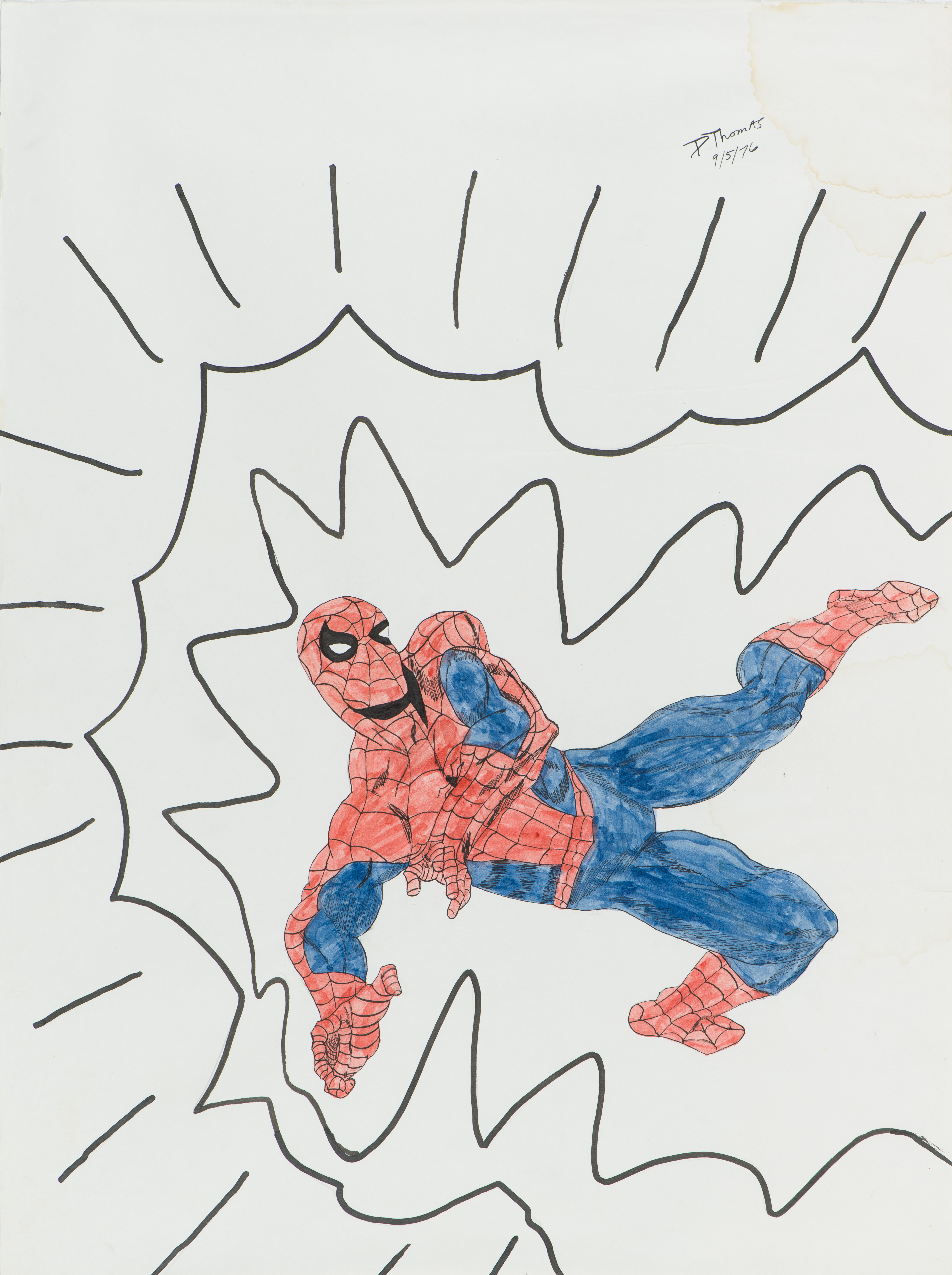
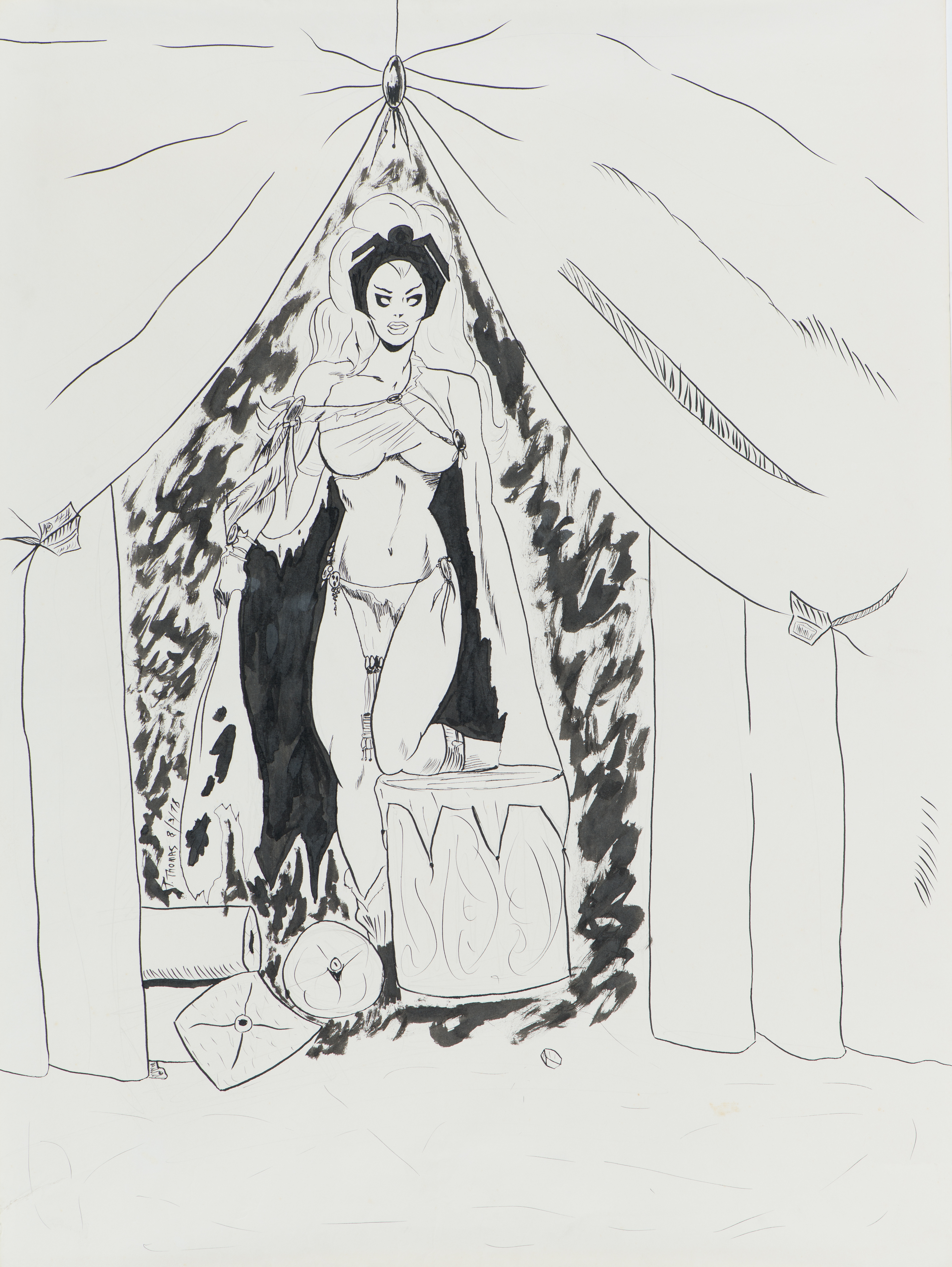
My parents almost immediately began to seek ways to help me navigate this traumatic experience during what were formative, and difficult years. One strategy included my becoming a collector of comic books.

Comic books became my escape, but in an unpredictable way, since I often stood at the end of our bar separating the kitchen and the living room in order to trace and then draw from the comics. Standing, because the brace encased my entire pelvis and anchored my head with three metal rods, was my new state of rest.

For years, I taught myself how to draw superhero comics. I even still have this work from the late 1970s, such as these:

_STH8389

_STH8390

_STH8392

By college, I had drifted to drawing mostly nudes, typically from magazines young men are apt to hide in their bedrooms. But throughout these years, I was teaching myself, and more or less, fumbling through without the sort of foundations in art that I really needed.

I think I had a proclivity, but one never nurtured.

When friends in college discovered I could draw, I was “commissioned” to draw nudes (often), and then after they saw the album covers I had painted on our dorm cinder-block walls, rooms throughout the dorm had similar purposeful graffiti.

It didn’t happen this way, but it feels as if it did. Life is always more gradual, but in our recreations we love the definitive.

At the end of my sophomore year of college, we discovered everyone with my album cover paintings on their walls were going to be fined by housing—so we spray painted over these frantically in the final days of the semester.

And this was the end of my life as a visual artist.

Becoming an adult, a responsible adult, took over. I had to have a career, and I had to get married, have a job, and do life as everyone expected.

Therein lies the regret—but not that I did any of that since setting out dutifully to be an adult has resulted in my daughter and granddaughter as well as a wonderful dual career as teacher/writer that I could have never predicted—and would never relinquish if I could start over.

The regret is becoming so entrapped in the practical—I dropped pursuing visual art because it wasn’t going to be my career—that I lost part of myself, parts of myself.

My visual artist life is now indirect; I follow artists on Instagram, and I covet their work and their lives.

I lust, I long, I pine.

So my regret of a mundane kind—paling still to the regrets of hurting others—is that I allowed the frantic Siren’s call to become the adult expected of me drown out my own voice, my own coming to recognize who I am, instead of who I should be.

Albert Camus reimagines “The Myth of Sisyphus,” explaining, “His rock is his thing.”

Camus guides his readers to Sisyphus pausing at his task, his seemingly futile hell of rolling the rock up the mountain only to have it roll back down for him to push up again, and again, and again.

Yet, as Camus concludes:

I leave Sisyphus at the foot of the mountain! One always finds one’s burden again. But Sisyphus teaches the higher fidelity that negates the gods and raises rocks. He too concludes that all is well. This universe henceforth without a master seems to him neither sterile nor futile. Each atom of that stone, each mineral flake of that night filled mountain, in itself forms a world. The struggle itself toward the heights is enough to fill a man’s heart. One must imagine Sisyphus happy.

Regret of the kind that is not from hurting another is our inability, our refusal to recognize our thing—and then to embrace it as our happiness.

Our thing includes “the price that must be paid for the passions of this earth,” suffering, but it is not ours to seek ways to avoid human suffering, but like Sisyphus, to commit to it with all our body and heart.

Mamas, Don’t Let Your Babies Grow Up to Be Ryan Lochte

At our faculty retreat focusing on diversity, a few lessons grew spontaneously from the keynote and related break-out sessions.

One lesson at the individual level exposed blind spots among faculty related to how language offends, the relationship between intent and impact, and a not-so-veiled resistance to listening and then acting on expanding diversity through culturally responsive behavior among faculty with privilege.

Another lesson at the systemic level was a confrontation of the chasm between words and action: what we say matters, but what we fund and how we act ultimately determine if those words are veneer or genuine principles.

My university is a selective liberal arts college that is a microcosm of the larger tensions of culture and diversity facing the U.S.

White heterosexual male privilege dominates (and even fuels) both our wider society as well as any insular community or institution within our society. James Baldwin deconstructed throughout his career how whiteness and blackness inform each other while whiteness seeks always to keep itself central to the American Way.

As Baldwin argued about language:

Now, I do not know what white Americans would sound like if there had never been any black people in the United States, but they would not sound the way they sound….

The brutal truth is that the bulk of white people in American never had any interest in educating black people, except as this could serve white purposes. It is not the black child’s language that is in question, it is not his language that is despised: It is his experience. A child cannot be taught by anyone who despises him, and a child cannot afford to be fooled. A child cannot be taught by anyone whose demand, essentially, is that the child repudiate his experience, and all that gives him sustenance, and enter a limbo in which he will no longer be black, and in which he knows that he can never become white. Black people have lost too many black children that way.

Today, for example, as #BlackLivesMatter rose out of tragedy after tragedy, the narcissism of whiteness has created a backlash that demands attention to how working-class whites have suffered.

And then, on a smaller scale, during the 2016 Rio Olympics—a time ripe with amazing accomplishments by black athletes from the U.S.—we have been handed Ryan Lochte, a case of arrested development as a consequence of privilege.

Somehow we will not address the white gaze, and we are also committed to keeping the gaze of concern on whiteness because, you know, frat-boy life is funny even when guys are biologically grown:

Cause 32-year-old kids just want to have fun.

But the lesson that perpetually faces us isn’t funny at all. There are dire consequences.

In the U.S., we persist in creating and protecting at all cost these lives.

And we declare in the most calloused ways possible that these lives do not matter.

Mustn’t there be a time of reckoning for a people who see 32-year-old Lochte as a kid just trying to have fun but turn a blind eye to the execution of Tamir Rice, an actual child?

As Baldwin understood all too well, however, lessons remain wasted on those unwilling to learn:

And, after all, finally, in a country with standards so untrustworthy [emphasis added], a country that makes heroes of so many criminal mediocrities [emphasis added], a country unable to face why so many of the nonwhite are in prison, or on the needle, or standing, futureless, in the streets—it may very well be that both the child, and his elder, have concluded that they have nothing whatever to learn from the people of a country that has managed to learn so little.

educator, public scholar, poet&writer – academic freedom isn't free