This is a poem I wrote in 2012, mostly out of a growing cynicism about mainstream politics. However, it appears that this presidential season has proven me to be far more prescient than I intended:
I could write blog after blog about my failures as a parent, failures that my child has apparently mostly decided to ignore.
But I want to take a moment to write about some things I did well, some things that created a new family tradition that will be a legacy about which I can be proud.
Even in our dark periods, my daughter was very quick to let people know two things: we allow no racism and we do not hit children. Her adamant defense of my commitment in these areas always rose above the other failures of mine plaguing us at any moment.
And she made it clear we have no tolerance for racism or violence of any kind toward children in other people. These moments were always judgmental—the sort of daily moments of activism that go mostly unnoticed because they are spontaneous.
My granddaughter is a marvelous biracial child who, like my daughter, will be raised without the threat of physical intimidation in her home and among her family. We, of course, cannot make her that same promise about her community, her state, or her country.
These glorious humans and the legacy we have joined together in creating help me navigate all my failures.
However, that familial promise is not the case for many children—and that is nearly unbearable because this legacy isn’t about only my family.
Your Honor, years ago I recognized my kinship with all living beings, and I made up my mind that I was not one bit better than the meanest on earth. I said then, and I say now, that while there is a lower class, I am in it, and while there is a criminal element I am of it, and while there is a soul in prison, I am not free.
As long as one human suffers under the plague of racism, as long as one child lives under the fear of physical violence, we are not safe or free despite the gifts we may have in our daily lives.
Coming to any personal conclusion requires understanding a deep and very active debate about discipline, race, and the conditions that brought Charlotte Dial, the teacher in the video, to the moment that was caught on camera. Chief among those conditions: an educational philosophy known as “no excuses” that advocates for strict discipline as a critical foundation for learning.
What follows is a long and detailed examination of “no excuses” approaches to education reform, but Green’s analysis is also yet another example of how mainstream “both sides” journalism continues to ignore a critical third way.
Before examining Green’s challenge to “no excuses,” let me offer some context.
Because of high-profile incidences connected with NFL players, public debates about domestic violence toward women and corporal punishment have played out in the mainstream media.
While both topics are important, here I want to stress how mainstream media covered the two topics.
Domestic violence toward women was universally condemned without creating panels or “both sides” debates—although some in the U.S. and throughout the world still hold to men using physical force against women, often citing religious texts to justify their behaviors.
However, corporal punishment received the “both sides treatment”; those advocating for corporal punishment were treated as credible and allowed to argue, again often on religious grounds, for spanking children.
The media took an informed stance against domestic violence, but deferred to “both sides” journalism for corporal punishment. We need far more of the former, and far less of the latter.
I have participated in a similar situation with mainstream media coverage of education policy concerning grade retention. Even though the research is strongly against grade retention, the media tends to lead with advocates of grade retention, directly and indirectly making that stance credible, and then giving a slight nod to “critics” of grade retention—marginalizing the only warranted position.
So let me return here to Green’s very well developed and ambitious work on “no excuses.” And let me emphasize once again—without any snark here—that Green’s work is high-quality mainstream journalism, and she is a very good journalist with good intentions—but that is the problem.
First, what constitutes “complicated” in mainstream journalism?
Green reduces the controversy over discipline and “no excuses” practices to two sides (which really isn’t even complicated as it is the standard approach to nearly all topics in journalism [see corporal punishment]), and then builds to three reasons to abandon and three reasons not to abandon “no excuses.”
This template and her premise about “complicated” highlight why mainstream journalism is doomed to reinforcing social inequity because of the practices that are embraced for the pursuit of objectivity and balance.
The great irony is that the “both sides” approach is a veneer of objectivity, but isn’t objective or informed at all.
Green follows a similar pattern I have examined about NPR’s coverage of “grit”: start with a perspective that is not credible, but by opening with it, making it the default “right” position; and then framing the more credible position as the “critics.”
Even as a confrontation of many of the problems with “no excuses,” Green maintains “no excuses” approaches can be reformed, and then by grounding her polar three reasons to abandon/not to abandon in “no excuses,” she effectively builds to an endorsement of “no excuses.”
This “both sides” tactic of very professional journalism always fails a third critical way; in this case, what is ignored is that both traditional public schools (TPS) and “no excuses” charter schools (NECS) mistreat and shortchange high-poverty children of color—TPS have done this historically and NECS have simply intensified the very worst of those TPS failures.
In short, “no excuses” practices are essentially inexcusable, and cannot be reformed. But that doesn’t mean tossing up our hands and simply ignoring the failures of traditional public schools.
“No excuses” practices and narratives must be entirely rejected for the following reasons:
The slogan itself is nasty and misleading since it implies anyone who highlights the impact of poverty on school/teacher quality and measurable student achievement is making an “excuse.” While those people may exist, the vast majority of education activists concerned with poverty are calling for alleviating the impact of poverty on the lives of children so that education reform can work.
“No excuses” focuses all the “blame” for learning on the child—directly stating that children must simply set aside their lives when they walk in the doors of schools and suck it up. This is a calloused and ugly thing to say to a child—and something that most adults themselves do not do. Many who advocate for “grit” in children are living in privilege and casting their privilege as “grit.” “No excuses” speaks to and reinforces the rugged individualism ideology in the U.S. that refuses to acknowledge or address systemic inequity (an ideology voiced by the privileged and one that benefits mostly those in privilege).
“No excuses” practices all are grounded in deficit views of children and education: The children from poverty or so-called minority races and the teachers/schools dealing with those children are deficient and must be “fixed.” However, a strong body of research suggests that individual behavior is often a reflection of the context; people living in scarcity behave differently than people living in slack. Affluent children have high test scores as a result of their lives in slack; impoverished children have low test scores as a result of their lives in scarcity. The problem is how to insure all children the slack they deserve—not how to harden children doomed to scarcity. TPS and NECS are both complicit in failing that directive.
“No excuses” feeds and builds on racism and classism—the exact racism and classism that have plagued traditional public schools and the U.S. for decades. Segregated schools, tracked class assignments, inequitable teacher assignments, inequitable and harsh discipline policies, and a misguided emphasis on high-stakes testing (itself race/class/gender biased)—these are the failures of both traditional public schools and “no excuses” charter schools.
The critical third way is about admitting social inequity in the U.S.—inequity grounded in racism, classism, sexism, homophobia, etc.—and admitting as well that our institutions mostly reflect that inequity, including out public schools and the so-called reform approaches such as “no excuses” charters.
“No excuses” practices cannot be reformed because they are essentially exaggerated versions of the greatest failures of the public school system they are designed to reform.
The critical third way is about social and educational equity, seeking schools that serve the most vulnerable students first with the opportunities that affluent children have (small classes, experienced teachers, challenging curriculum, supportive discipline, safe and well funded facilities).
The critical third way is about admitting we have broken systems, not broken children.
The Post and Courier (Charleston, SC) has been documenting the rise of advocacy for charter takeover of public schools in South Carolina, paralleling a similar pattern in nearby states such as Georgia and North Carolina.
The problem with takeover models is that advocacy for the model is being strongly refuted by a growing research base showing that takeovers have not achieved the claims of success voiced by advocates and have often replicated the exact problems faced by traditional public schools, such as segregation and inequitable access to high-quality opportunities.
See this reader of research and analyses of that advocacy and evidence:
They expose the irrational expectation of rational behavior.
Several years ago, I was having a casual conversation with an economics professor, and during that exchange, it hit me that his entire premise was based on a belief that consumers are rational—a faith that the market hinges on a careful analysis of Consumer Report before each purchase.
I have since seen some critiques of economics because of the use of rationality in the models, but I also witness this daily: people adamant that zeroes teach children lessons, forcing them to comply; people who call for the death penalty and tougher laws as deterrents; and now seemingly reasonable people espousing a series of reasons for supporting Trump.
And that brings me to the somewhat baffling fact that John Oliver has once again posed through comedy an incredibly rational deconstruction of those pro-Trump claims:
But here is the problem—from demanding we continue to give students zeroes to calls for tougher laws and the death penalty to dispassionately dismantling the lunacy that is Trump—rational has no impact on the irrational, and most people are irrational.
Purchases are often impulse buys, children and teens do not see school or the future in rational ways, crimes are often crimes of passion or desperation, and people supporting Trump are the very embodiments of irrational.
This realization is an ironic gift of having been born and raised in the South where there is no rational connection between what the self-defeating South believes and the reality of the world around us: the Bible-belt is anything but Christian, and our region is crippled by racism and poverty, but we wallow in hating “government.”
None of this makes any rational sense.
Now sitting before us is the Trump phenomenon to make all this desperately clear—Trump is the ultimate Teflon candidate who makes Reagan seem in hindsight less of a cartoon than he was.
If direct associations between the KKK and Trump had no impact on his appeal Super Tuesday, there is no hope that Oliver’s very careful and detailed dismantling of the facade of Trump will resonate—even if the anemic mainstream media would do its job.
Despite what religious texts or science fiction seems to show, the apocalypse is a slow unveiling, something only recognized well past its fruition.
The U.S. has always been an irrational belief culture, and now we are witnessing Trump cashing in on that in a way that makes reality TV, reality.
Considering all the things I like about Twitter, having discussions or debates by Tweeting is not one of them because I often get lost and the character count works against elaboration and nuance.
Yesterday, I was added to a debate that appears to be about the impact of poverty on student achievement—and a central question about why some high-poverty students excel although most do not. One person seems to be seeking research that focuses on comparing high-poverty students against each other to tease out the reasons for why some achieve higher than most.
First, let’s consider that when we talk about student achievement we are almost always defaulting to high-stakes test scores. In that context, we must frame all questions about success, excelling, and/or achievement within some solid facts about what standardized tests reveal (and what they don’t).
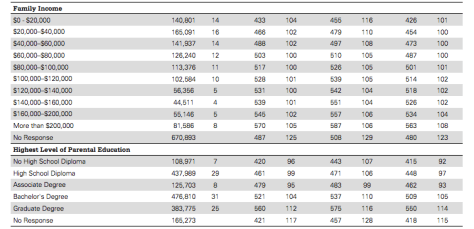
The SAT remains a fair representation of how all student scores on high-stakes standardized testing remain strongly correlated with race, social class, parental education levels, and gender. See for example from the 2015 SAT:
Therefore, in virtually all high-stakes standardized data sets, we find that being affluent, white, and male correlate strongly with high scores while being poor, of color, and female correlate with low scores.
Therefore, when we ask why do some (a few) high-poverty students excel while most do not, we could just as easily ask why do some (a few) wealthy students score low when most do not. And these are in fact the same question for a couple of reasons:
Poor students with high test scores and affluent students with low test scores are statistical outliers, and thus, provide little descriptive power for making decisions about the general populations of students. [As I cannot stress this enough, please reread that sentence until you get it.]
The question about why do some low-income students excel is a loaded question (and that we do not ask the parallel question about the few affluent students who score low is telling) because the real intent of that question is to suggest that student achievement is mostly controlled by the student, her/his teacher, and her/his school. Therefore, by isolating why some low-income students excel, we would be able to “fix” the majority of low income students, their teachers, and their schools.
This second point is huge, and complex, because it is deeply flawed in its essential implication. Student achievement remains in the U.S. a stronger indicator of social realities than student effort/ability, teacher quality, or school effectiveness.
That stated, could student achievement be positively impacted by addressing individual student qualities, teacher quality, or school effectiveness? Of course, and what education reform is attempting in these areas continues to be more harmful than helpful.
For example, charter schools and Teach For America are increasing educational inequity for the vulnerable populations of students (greater segregation and assigning low-income students of color beginning teachers without adequate training).
Now, if I return to the Twitter debate, yes, there are high-quality researchers looking at why low-income students struggle and achieve (see Sean Reardon here, here, and here), but the fundamental question about comparing success and failure within low-income student populations is an inherently flawed process that focuses our gaze almost exclusively on individuals while giving systemic forces a pass—the exact systemic forces that account for the greatest percentage of the scores we use to claim success or failure.
That social class, race, and gender are predictive of student scores on high-stakes standardized testing is not fatalism (using those characteristics as an excuse to do nothing), but a call to shift proportionately our questions to both systemic and individual sources for why some students excel and some struggle in formal schooling.
Race, class, and gender inequity in our society drive low test scores for many students—students who are then too often mis-served by inequitable school practices and policies such as tracking, teacher assignments, and discipline codes.
Why do some high-poverty students excel academically while most do not is one hell of a complicated question. But in most cases, it is the wrong question because of the misguided implications at its root (discussed above) and we remain unwilling to address social inequity and continue to use inequitable tools (high-stakes standardized tests) that create the very gaps we claim we want to close.
We need to prioritize questions about our broken systems before we can even begin to assess why individual students compare differently than their peers—and even then, outliers will never serve as valid gauges for all students.
A century of education and education reform, along with more than three decades of high-stakes testing and accountability, reveals a disturbing paradox: education has a steadfast commitment to testing and grading. This commitment persists despite ample research, theory, and philosophy revealing the corrosive consequences of both testing and grading in an education system designed to support human agency and democratic principles. This revised edited volume brings together a collection of updated and new essays that confronts the failure of testing and grading. The book explores the historical failure of testing and grading; the theoretical and philosophical arguments against testing and grading; the negative influence of tests and grades on social justice, race, class, and gender; and the role that they play in perpetuating a deficit perspective of children. The chapters fall under two broad sections. Part I, Degrading Learning, Detesting Education: The Failure of High-Stake Accountability in Education, includes essays on the historical, theoretical, and philosophical arguments against testing and grading. Part II, De-Grading and De-Testing in a Time of High-Stakes Education Reform, presents practical experiments in de-testing and de-grading classrooms for authentic learning experiences.
Contents: Rick Wormeli: An Unexamined Pedagogy Harms – Lisa Guisbond/Monty Neill/Bob Schaeffer: NCLB’s Lost Decade for Educational Progress: What Can We Learn from This Policy Failure? – Fernando F. Padró/ Michael F. Hawke/Laurie M. Hawke: Assessment and Quality: Policy-Steering and the Making of a Deus ex Machina – Anthony Cody: Technocratic Groupthink Inflates the Testing Bubble – Lawrence Baines/Rhonda Goolsby-Smith: America’s Obsessive-Assessment Disorder – Julie A. Gorlewski/David A. Gorlewski: Solidarity and Critical Dialogue: Interrupting the Degradation of Teacher Preparation – Morna McDermott: Feeding the World = Reading the World: Let Them Eat Tests – Richard Mora: Bubble in B for Boredom – Brian R. Beabout/Andre M. Perry: Reconciling Student Outcomes and Community Self-Reliance in Modern School Reform Contexts – David L. Bolton/John M. Elmore: The Role of Assessment in Empowering/Disempowering Students in the Critical Pedagogy Classroom – Christian Z. Goering: «How Long Does This Have to Be?»: Confronting the Standardization of Writing Instruction with Teachers in National Writing Project Invitational Summer Institutes – Joe Bower: Telling Time with a Broken Clock: Moving Beyond Standardized Testing – John L. Hoben: The Grading Mousetrap: Narcissism, Abjection, and the Politics of Self-Harm – Arnold Dodge/Ruth Powers Silverberg/Katie Zahedi: Leadership Denied: Principal as Compliance Officer – Hadley J. Ferguson: Journey into Ungrading – Jennifer Magee/Mark Dziedzic: An Oath to Stop Degrading Students: A Story of De-grading an Elementary Classroom – P. L. Thomas: De-grading Writing Instruction: Closing the «Considerable Gap» – Brian Rhode: One Week, Many Thoughts – Lisa William-White: Striving Toward Authentic Teaching for Social Justice: Additional Considerations – P. L. Thomas: Yes, to Be Clear, I Am Anti-testing, Anti-grading.
So Ed Boland wrote a really bad edu-book that all the mainstream media adores because, well, you know, nobody gives a crap what a teacher thinks, but let ANYbody dip a toe in education who isn’t an educator and then everyone is all gaga.
Like our old reliable bad journalism source, The New York Times: The Myth of the Hero Teacher (note the very serious and pensive opening photo).
My fear is that this will book will be used as another weapon in assaults on public schools and teacher certification programs. I have no question there are public schools that are not functioning and should be closed, although it would not be fair to make a judgment based on Boland’s report. Boland says he is in no way blaming the students, they are the victims of poverty. He claims the book is about his personal catharsis and is an indictment of the conditions that produce this kind of student behavior. But that is not how it comes across in interviews or what sells books. The focus in “The Battle for Room 314” is on the horrors Boland feels he experienced because of the students and he offers a detailed description of their behavior, at least as he understood it.
The desire for “control” runs through all of our education saviors. Mark Zuckerberg’s well-meaning $100 million gift to the Newark public schools assumed that they could move teachers and families out of the way to make room for his version of “reform.”…
People like Ed Boland and these other reformers are not saviors. They are education tourists. Boland has used his year as an education tourist to launch a book that’s been reviewed everywhere, and is now a sought after public speaker, a supposed expert on education and our educational system.
This is like a student pilot who crashes on his inaugural flight being asked by the FAA about aeronautical safety.
More and more I’m starting to think we need someone who can save us from the saviors.
If you must continue your relationship with mainstream media, add the habit of seeking out the much more nuanced and well informed New Media, please?
Establishing a “no zero” policy is counter-intuitive for most people since it seems to work against a sense of fairness, and as those who oppose the policy typically respond, a “no zero” policy seems to encourage laziness and even passing students along who do no work.
However, a “no zero” policy is the right thing to do both statistically and academically—but only if that policy is part of wider assessment practices that support dropping zeroes as part of the grading system.
First, I recommend reading carefully an analysis that shows why assigning zeroes is flawed in a traditional A-F grading system in which the F range is often 50-60 points while all other grade ranges are 10 or fewer points. As Cristea explains:
The flaw in the system is that a 100-point grading scale does not mathematically equalize zeros to have the same weight as other scores. This paper presents the view that zeros are not fair to anyone including students, parents, teachers, and society as a whole.
The statistical flaw of zeroes and a disproportionate F range lead us to the equity problem. As Rick Wormeli has noted, fair isn’t always equal. So let me lay out briefly the broader assessment practices and concerns that must be in place when a “no zero” policy is adopted (and the “no zero” policy and these issue below should be implemented).
Schools, teachers, parents, and students must set aside grading as a system of rewards and punishments, and begin to see grading as a subset of assessment, which must be used as a system of feedback and student revision to support student learning.
In other words, assessment, tests, and grades must become part of learning and not the conclusion of learning.
In that context, student assignments, tests, and performances must be viewed as obligations by the students; in short, they must be done.
Ideally, all students would complete all assignments with mastery at the same rate, but in the real world, that will never happen. Thus, everyone must begin to worry more about students learning than at what rate they learn or if they learn simultaneously with other students.
Here, I must emphasize that assigning a zero for incomplete or skipped assignments is fundamentally no different than simply passing a student along because both practices prove that the assignment never mattered. The analogy I offer here is student assignments are similar to medicine prescribed by a doctor; neither the student nor the patient benefits if the assignment/medicine is simply ignored. In short, the only option is to do the assignment.
My alternative to the zero is that students must complete fully all work assigned or no credit can be assigned for the course; this approach addresses the problems with both assigning zeroes and simply passing students who do not complete the work.
That said, a key practice supporting all of this is requiring and allowing student revision without belaboring over trying to keep every student at the same pace or number of revisions.
I have implemented this in writing courses for over three decades, and students quickly learn that the sooner they try and the more fully they participate, the sooner they can move on; this is a much more authentic and academically positive and intrinsic motivation than punishing/rewarding with grades.
In the context of so-called content courses (wile problematic, many see writing as process, not content, although I disagree on that point), allowing zeroes or even low grades on assessments of acquiring content sends a message to students that some content simply doesn’t matter—if a student makes a zero or 63, and the class simply moves on to the next topic.
This traditional practice, I believe, has a much more negative impact on learning than any downside to “no zero” policies.
A “no zero” policy, then, is not an isolated issue, but it one important reform within a larger revision of how assessments, tests, and grades can and should be used in formal education to support the learning of all students—a messy and unpredictable process that should not be shackled to a traditional system of grading that is neither statistically nor academically sound.
But Carifio and Carey found the opposite to be true. In a comprehensive 2015 study, they analyzed seven years’ worth of data for more than 29,000 high school students, looking at the impact that minimum grading had on test scores, grade inflation, and graduation rates. Compared with their counterparts in schools with traditional grading schemes, students who benefited from minimum grading actually put more effort into their learning, earning higher scores on state exams and graduating at higher rates.
In fact, for many students, according to the researchers, receiving a zero was demoralizing—not corrective. “The assigning of even a small number of catastrophically low grades, especially early in the marking term, before student self-efficacy can be established, can create this sense of helplessness,” Carifio and Carey explain, putting students in an impossible situation and discouraging them for the rest of the grading period. Giving students a lifeline out of a ruinous situation keeps them engaged and motivated to do better, the research suggests.
The claim about real-life norms is also dubious. There are times when deadlines must be strictly enforced, but for the most part, employers are typically forgiving of extensions and late work, recognizing that “assigned deadlines can be stressfully tight, compromising output quality,” according to a 2022 study, which also found that 53 percent of workplace deadlines were flexible. In fact, “deadline estimates are often overly optimistic,” and adhering to them too stringently can dramatically increase burnout.





 dr. p.l. (paul) thomas