What Makes Poetry, Poetry?

It is Valentine’s Day 2016, and I have been spending the morning with poetry. So when I came across Peter Anderson’s Line and Stanza Breaks in Free Verse Poetry – NVWP Summer Institute – Day 5 pt. 1, I was suitably primed to do something I believe I have failed to do here on my blog—write about teaching poetry as a poet.

A couple years before I would discover that I am a teacher (the fall of my junior year of college), I was sitting in my first-year dorm room in the spring when I wrote my first real poem, and thus, had that quasi-religious experience of becoming a poet.

Being a poet is not something I chose to do, not something I can control. There are weeks, maybe months, when no poems come, and then there are manic days and days and days when they come like tidal waves, avalanches—unbidden but gathered frantically out of the writer’s fear that at any moment this may end, abrupt as a fatal aneurism.

Now comes the really embarrassing part, where poet/writer intersects with teacher.

The first moment my foot touched the floor of my classroom, I envisioned myself as a teacher of writing, but also a teacher who would instill in my students my love for reading (devouring) literature, especially poetry.

I worked hard, intensely—as I am prone to do—to teach my students to write, willing all the while the love of literature and poetry into their adolescent hearts and minds.

Yet—this is embarrassing—I was casually murdering everything I loved, and scrubbing the life and blood from my students’ possibilities as writers, poets, and the sorts of joyous readers I had envisioned.

My godawful teaching of poetry and efforts at having my students write poetry—despite my precious poetry unit built around the music of R.E.M.—were all mind and no heart.

The most important aspect of ending these horrible practices as a teacher who had divorced himself uncritically from his Poet Self was dropping my transactional methods (opening the poetry unit by giving students “the four characteristics of poetry” [all nonsense, by the way] and then asking them to apply those to their analysis of a poem they chose [I thought the choice part was awesome]) and embracing an overarching discovery approach driven by a broad essential question: What makes poetry, poetry?

Early and often as we meandered through dozens of poems and R.E.M. lyrics, my students and I kept returning to a Thoreau moment: “Simplify, simplify, simplify.”

No matter how hard we tried, we could discover nothing a poet did that writers of other types of writing didn’t also do—except for the purposeful formation of lines and stanzas (including that prose poets create poetry by the negative of avoiding the conventions of lines and stanzas in poetry).

Prose, we recognized, is driven by the formation of sentences and paragraphs, as a contrast, but poetry is almost exclusively as well composed of complete sentences (despite the argument by most students that poetry is a bunch of “fragments,” leading to examinations of enjambment).

Reading and writing poetry became investigations, opportunities to play with words and witness the joy they can bring.

All writing, including the work of the poet, including the work of any artist, is a creative act endured in the context of some structures that the writer/artist either embraces or actively reaches beyond.

What makes poetry, poetry? The purposeful construction of words into lines and stanzas.

“A poem should not mean/But be,” poses Archibald MacLeish. But as a young teacher, I sullied that simple dictum.

Instead, I committed the act of teaching, about which Marianne Moore declares: “I, too, dislike it: there are things that are important beyond/all this fiddle.”

School and teaching can and often are the death of poetry, of writing, of the magnificent joy of human expression.

As poet/writer and teacher, mine is to resist “all this fiddle,” and to allow for students the moment when poetry comes, unexpectedly while your dog sleeps on your feet.

Valentine’s Day: A Reader

love is more thicker than forget

e.e. cummings

Love does not begin and end the way we seem to think it does. Love is a battle, love is a war; love is a growing up.

“In Search of a Majority,” James Baldwin

Maybe you should just be single, Laurie Penny

Buried under the avalanche of hearts and flowers is an uncomfortable fact: romantic partnership is, and always has been, an economic arrangement. The economics may have changed in recent decades, as many women have gained more financial independence, but it’s still about the money. It’s about who does the domestic labour, the emotional labour, the work of healing the walking wounded of late capitalism. It’s about organising people into isolated, efficient, self-reproducing units and making them feel bad when it either fails to happen or fails to bring them happiness.

The Truth the Dead Know, Anne Sexton

My darling, the wind falls in like stones
from the whitehearted water and when we touch
we enter touch entirely. No one’s alone.
Men kill for this, or for as much.

I don’t need any help to be breakable, believe me
I know nobody else who can laugh along to any kind of joke
I won’t need any help to be lonely when you leave me

“Slipped,” The National

Love Poems | Academy of American Poets

What Depression Is Really Like

In a piercing letter to his brother, Vincent van Gogh captured the mental anguish of depression in a devastatingly perfect visceral metaphor: “One feels as if one were lying bound hand and foot at the bottom of a deep dark well, utterly helpless.” Anyone who has suffered from this debilitating disease knows that the water in that well is qualitatively, biochemically different from the water in the puddle of mere sadness. And yet, even as scientists are exploring the evolutionary origins of depression and the role REM sleep may play in it, understanding and articulating the experience of the disease remains a point of continual frustration for those afflicted and a point of continual perplexity for those fortunate never to have plummeted to the bottom of the well.

somewhere i have never travelled,gladly beyond, e.e. cummings

(i do not know what it is about you that closes
and opens;only something in me understands
the voice of your eyes is deeper than all roses)
nobody,not even the rain,has such small hands

i carry your heart with me(i carry it in, e.e. cummings

here is the deepest secret nobody knows
(here is the root of the root and the bud of the bud
and the sky of the sky of a tree called life;which grows
higher than soul can hope or mind can hide)

Coda

these boxes (an antiquarian’s Valentine’s Day card)

Fisherman and The Siren (vortex of desire)

Let Us Not in Righteous Indignation Fail to See

Why do you look at the speck of sawdust in your brother’s eye and pay no attention to the plank in your own eye?

Matthew 7:3

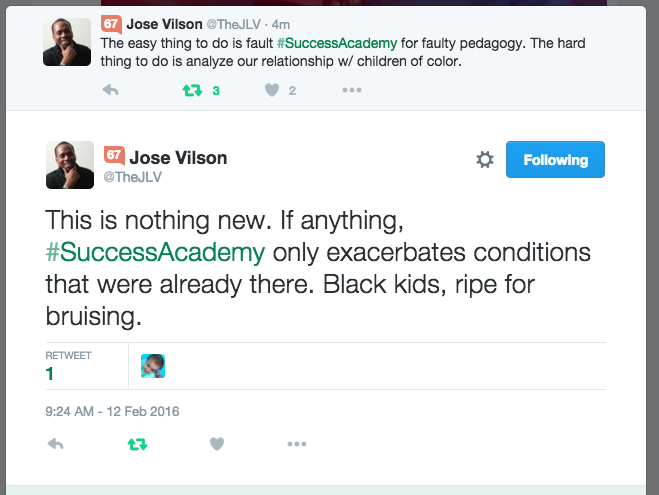
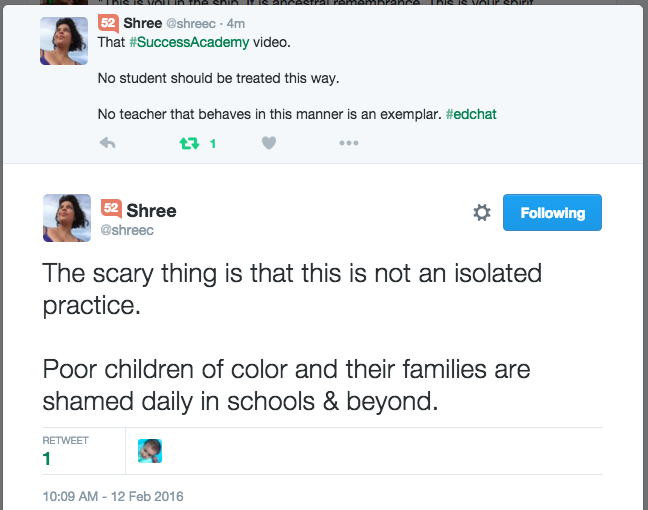
I resist as least weekly, it seems, to name directly yet another disturbing example of how “no excuses” approaches to teaching mostly black/ brown and poor children are inexcusable, abusive, and disgusting.

But a recent video prompted two responses that are important to highlight and need no further explanation—from Jose Vilson and Shree Chauhan:

this is nothing new

daily


The Ugly “Good Teacher” Discussion Few Are Confronting

“The King will reply, ‘Truly I tell you, whatever you did for one of the least of these brothers and sisters of mine, you did for me.'”

Matthew 25:40

The gold standard, I think, for thinking about education reform and more narrow concerns such as teacher quality is the complex and confrontational approach of Lisa Delpit, who anchors her perspective with how we teach and treat “other people’s children”—black and brown children, impoverished children.

And from that perspective we have the ugly “good teacher” discussion few are willing to confront: Vulnerable populations of children and their families are where and how we experiment with education, where and how we adopt policies and practices no affluent and white families would tolerate for their children: Teach For America, “no excuses,” zero tolerance.

High-poverty and majority-minority schools are burdened not just with social inequity hurdles but also with systemic and often unspoken practices that include having incredibly high teacher turn over because these “problem” schools are entry points for teachers to find “better” jobs (see Teachers at Low-Income Schools Deserve Respect).

Just as insidious is the systemic and often unspoken practice in all schools that “low-level” classes of students are assigned new teachers, who must endure those populations of students until they can have the “good” classes within that school.

These ugly practices grounded in racism and classism are at the root of why advocates for education reform who focus on race and class remain mostly dissatisfied with both sides of the mainstream education reform debate.

The edu-reformers are all-in on race and class tone-deaf practices—TFA, “no excuses,” zero tolerance—but the advocates for public education and progressive reform have failed to admit how the traditional public school system has historically failed “other people’s children” through the wink-wink-nod-nod approach to assigning teachers.

Too often, teachers are complicit in and fail to confront the system that marginalizes vulnerable populations of students as collateral damage of teacher advancement.

During my 18 years of public school teaching, even among teachers, the common sense attitude was that “good” teachers were assigned Advanced Placement, and teaching “low-level” classes was a negative commentary on the teacher’s ability. As department chair, I worked to assign each teacher a couple classes she/he requested, and then tried to balance every teacher’s load with a range of class levels and types.

While I was working on my dissertation, writing a biography of educator Lou LaBrant, I was profoundly struck by a point of irritation she expressed in her memoir. LaBrant noted that she had her best teachers in her doctoral program, at the end of her formal education, but that progression, she believed, is backward in that children need their best teachers in the beginning of formal education, not the end.

Our vulnerable populations of students must be served first in our public school system: assigned experienced and qualified teachers, placed in classes with low teacher/student ratios, guaranteed access to the most challenging courses and curriculums, and promised safe, diverse schools with equitable, supportive disciplinary practices.

Everything else is a distraction from what truly matters.

Denying Racism Continues to Have an Evidence Problem: A Reader

The evidence of racism—and not just race as a marker—continues to make denying racism a fool’s errand (yet, it persists). Here are some powerful reads that counter those deniers:

Politics, the Super Bowl, and, of course, the Children

This was supposed to be another post about good teachers because I was invited to speak to a class of 4th graders about writing public opinion pieces and that experience confirmed my recent assertion that to know if a teacher is good just watch and listen to the students.

The short version of that blog: the students were vibrant and smart—reflecting just how wonderful their teacher is.

During that visit, however, the teacher asked if we could have a brief debate so the students could think about how to pose their arguments. When a student asked what I was thinking about writing next, I mentioned the Super Bowl halftime show, specifically Beyoncé’s performance.

For several minutes, I was confronted by a classroom of children adamant that Beyoncé and her backup dancers were inappropriate for the show; their clothing and dancing, the children argued, were not appropriate for children watching on TV and attending the game.

I asked them to consider how we have different standards for how women dress and behave, and I asked about whether it was appropriate for children to watch the NFL, considering the violence of the sport, and the commercials, such as those for beer.

The children never budged, noting that children, in fact, play football (boys are just violent, they argued) and rambling into a very casual acceptance of children having guns and knives (for hunting).

But Beyoncé? Not appropriate for prime time (and the children).

Of course, these students were mostly voicing the opinion of their parents and other adults, highlighting, I think, the influence of every child’s home on who they are and how they think.

These students’ arguments also reflect something that almost no one is addressing about the Super Bowl: everything about the Super Bowl is political. Everything.

Those who criticize Beyoncé for her political performance and chastise the hoodied Cam Newton for over-celebrating throughout the season and his sulking post-Super Bowl defeat are silent during the NFL’s ritualistic flag waving and hiding behind the U.S. military—some of the many shields the NFL hopes mask the orgy of violence that is professional football; are somehow OK with Coldplay and Bruno Mars; and likely didn’t uttered a peep when All-American white hero straight out of Pleasantville, Peyton Manning, spouted a Gronk-like beer comment, pouted and didn’t shake hands after one of his Super Bowl defeats, and (like Cam, who was criticized) kept his helmet on while shaking hands with Russell Wilson, another Super Bowl defeat.

Just as every second of the Super Bowl is political, every moment of the gosh-darn industry that is Peyton Manning is political.

And Manning’s politics is aimed right at your red-white-and-blue bank account.

But the politics of capitalism and consumerism that buoy white male privilege in the U.S. is at least shielded, if not invisible, behind the confetti and celebration of yet another ascension to pinnacle by a Great White Quarterback (Beer and pizza, anyone!).

This is not about Beyoncé being political and Coldplay/Bruno Mars not being political.

This is not about Cam being political and Peyton not being political.

This is about the racialized notion of “political” (and “not appropriate for children”) and the very American and very ugly symbolism of the NFL shield.

Peyton, Coldplay/Bruno Mars (very safe and male pop music), and the NFL’s patriotic posturing are simply the shielded politics of those in power, of white privilege, of male privilege.

Beyoncé—along with her backup dancers and her song—and Cam are complicated elements in the politics of resistance (both real and perceived)—and of course, we can have none of that. You know, the children.

Listen

Super Bowl Aftermath: Beyoncé, Cam Newton, and “Unapologetic Blackness”

A Community of Writing Teachers

The purposeful teaching of writing that led to and then sprang from the formation of the National Writing Project (NWP) and its affiliated sites has always emphasized the importance of a community of writers.

And while the summer institutes offered through NWP sites—where I was saved as a writing teacher and then fortunate to be a co-lead instructor for two summers years later—create over several weeks for teachers writing workshop experiences that include forming communities of writing teachers, I fear that in the high-stakes environment of most K-12 public schools and then in the departmentalized environments of higher education the existence of those communities of writing teachers are rare, if not entirely absent.

I entered full-time teaching in the fall of 1984 as a beginning teacher and want-to-be writer. On that first day, I saw my job as a public school English teacher primarily focusing on the teaching of writing.

While my students over the next 18 years would be quick to admit I had high expectations, possibly too high, for them—demanding a great deal of writing as well as significant growth as writers and thinkers—I also had high expectations for me as a writing teacher.

Every day, I feared I was doing that work less effectively than I could, and I was constantly evolving, growing, changing—notably after attending the Spartanburg Writing Project (SWP) summer institute.

Several years after I entered higher education as a teacher educator, my university moved to a first year seminar format, opening the door for professors from any discipline to teach first-year writing—but the university failed to consider that the teaching of writing is a complex skill set, not something just anyone can do because she/he has an advanced degree.

Just shy of a decade into the first year seminar commitment, then, the university has made curricular changes (including requiring one additional upper-level writing course), and I am currently a part of the first Faculty Writing Fellows (FWF) program that includes professors from English, Education, Psychology, Biology, Computer Science, Philosophy, Sociology, and History.

This year-long faculty seminar has allowed us to spend our time thinking deeply about the challenges of teaching writing at the university level.

The faculty members in this seminar have a wide range of experiences and backgrounds in teaching writing, and that diversity has significantly opened my eyes wider to the challenges of teaching writing.

Since I am working my way into the fourth decade as a teacher of writing, I have a much different perspective than early-career professors in disciplines such as psychology or computer science.

When I discuss my strategies for reading like a writer where I highlight the rhetorical and aesthetic aspects of writing, professors from philosophy or biology, for example, say “I can’t do that” or “I don’t do that.”

From these exchanges, then, we begin to discuss how professors can and do address first-year writing differently—but that those differences are not a problem because no writing teacher can accomplish everything in one writing course.

To paraphrase Thoreau, a writing teacher is not charged with doing everything, but something. As John Warner has explained, “I do my best to help students succeed for the future writing occasions they’ll confront in college and beyond, but the truth is, I cannot properly prepare them for what’s coming.”

And thus, we have begun to stress among our faculty that any one writing course is not an inoculation that will cure writing ills. In fact, we are working hard to dissuade professors of deficit views about students, grammar, writing, and such.

Just as any writer is always a writer-in-progress, all teachers of writing are writing-teachers-in-progress.

As a writer and writing teacher, I am still learning, and here are some of the lessons I have begun to see during our FWF experience:

  1. Regardless of background or level of experience, everyone teaching writing needs purposeful preparation for writing instruction.
  2. To teach writing, we must all be willing to investigate our attitudes about language as well as our own experiences as both student writers and writers in our disciplines.
  3. We should form a community of writers for our students, but our schools must provide for all teachers of writing that same ongoing community of writing teachers.
  4. Writing is a complex skill that can and should be taught at all levels of formal education with the full recognition that no one can ever be finished learning to write.
  5. Teaching writing is a discipline itself, a field rich in evidence but mostly defined by the perpetual problems of how to foster writers in hundreds of different writing situations. Each writing student is a new and unique challenge, not a flawed or incomplete student to be “fixed.”
  6. The pursuits of writing and teaching writing are greatly enhanced by equal parts passion and humility.

Finally, what has been most rewarding about the FWF experience and our community of writing teachers is that I am chomping at the bit for my fall 2016 first-year writing courses where for the 35th year, I will be doing some things differently, and I trust, better.

Confronting “Bad Journalism” in an Era of “Bad Teachers”

A couple of weeks ago, I posted Addressing Teacher Quality Post-NCLB in order to examine the impact of ESSA on the growing “bad teachers” narrative found in political and media commentary on the state of education in the U.S.

My speculations have now been given credence, notably Stephen Sawchuk’s 50 Years of Research Show Good Teaching Matters. Now What? at his Teacher’s Beat blog for Education Week.

Sawchuk’s post confirmed for me that the “bad teachers” drumbeat will continue so I posted a comment, one that expressed my frustration and linked to my post above:

Please let’s stop the bad journalism on teacher quality.

https://radicalscholarship.wordpress.com/2016/01/21/addressing-teacher-quality-post-nclb/

Please let’s stop treating Education Next as a credible publication.

First, we must note that the impact of teacher quality is dwarfed by out-of-school factors (http://www.shankerinstitute.org/blog/teachers-matter-so-do-words):

“But in the big picture, roughly 60 percent of achievement outcomes is explained by student and family background characteristics (most are unobserved, but likely pertain to income/poverty). Observable and unobservable schooling factors explain roughly 20 percent, most of this (10-15 percent) being teacher effects. The rest of the variation (about 20 percent) is unexplained (error). In other words, though precise estimates vary, the preponderance of evidence shows that achievement differences between students are overwhelmingly attributable to factors outside of schools and classrooms (see Hanushek et al. 1998; Rockoff 2003; Goldhaber et al. 1999; Rowan et al. 2002; Nye et al. 2004).”

However, that assessment is relative conservative when compared to Experiences of poverty and educational disadvantage by Donald Hirsch (JRF, 2007) (https://www.jrf.org.uk/sites/default/files/jrf/migrated/files/2123.pdf):

“Just 14 per cent of variation in individuals’ performance is accounted for by school quality. Most variation is explained by other factors, underlining the need to look at the range of children’s experiences, inside and outside school, when seeking to raise achievement.”

Sawchuk himself replied:

This is the kind of comment that makes me crazy. I very explicitly wrote that of the IN-SCHOOL FACTORS affecting achievement, teacher quality seems to matter most. Both Coleman in his study, and Goldhaber in other publications (and me in my own reporting elsewhere) have noted that out-of-school factors account for more of the overall variance in scores. You prepare teachers, Paul — so it seems really strange to argue that we shouldn’t care about what our teachers can and do do to affect learning.

And this prompted two more comments from me:

You are aware of the horribly skewed public and political view of teacher quality, and the brief nod to “in-school” does not identify how small teacher quality is related to measurable student outcomes (less than unexplained/error).

But please identify where I have in my post or any of my work ever taken this position: “so it seems really strange to argue that we shouldn’t care about what our teachers can and do do to affect learning.”

Erodes your credibility further, after treating Education Next as credible, to discredit me with a false characterization of my position.

And (which directly quotes from my own blog calling for addressing teacher quality with vulnerable students):

From my blog post linked (to refute your mischaracterization):

So the caveat for focusing on teacher quality must include that as long as we use measurable data for determining student achievement and teacher quality, failing to address out-of-school factors likely guarantees we’ll see little change in measures such as test scores.

Nonetheless, we must address teacher experience and qualifications/expertise at high-poverty, majority-minority schools; however, without social reform that alleviates the burdens of poverty on the lives of students and their families, we are unlikely to see the sorts of changes in data that would justify any in-school only reforms.

Also, the teacher quality debate often fails to make clear at the outset just how we are designating “good” or “bad” teachers (as well as “good” and “bad” schools). We must make sure that we are not using labels of quality as markers for those out-of-school factors. In other words, we tend to say schools and teachers are “good” when the student population is affluent, and both are “bad” when the student population is high poverty.

All of which resulted in Sawchuk adding:

And moreover, I encourage you try to engage constructively on the blog, rather than beginning with personal attacks.

Here, although Sawchuk has posted again, addressing how to couch teacher impact as an in-school factor, I want to highlight what I think is a very important distinction, one at the root of bad education journalism.

First, I believe Sawchuk is in fact a very good education journalist, and although I do not know him personally, I am confident he is also a good person with good intentions.

I also want to note that I have been confronting for some time now “bad journalism,” but I have never once accused anyone of being a “bad journalist”—attacking the person.

Yet, one of the most prominent aspects of “bad journalism” has in fact been a relentless and often careless narrative about “bad teachers” (the people, the professionals) and not “bad teaching.”

So, as I have argued before, the problem at the core of bad education journalism is ironically that many journalists covering education are good journalists—taking the “objective” pose and refusing to evaluate the credibility of the “both sides” approach to journalism.

For me to confront “bad journalism” (the act and not the people) for demonizing people and a profession, “bad teachers,” is my own effort not to make the same mistake I am challenging.

Sawchuk’s recent blog post, then, I am certain feeds into the “bad teacher” narrative; I also cannot believe he doesn’t realize that.

I think as well it is telling that he had my blog post link, but chose to make a fairly nasty and provably inaccurate swipe at my intentions—to discredit me and not address my argument (thus, personal); and then when was given ample evidence, chose again not to address his actions, but instead accused me , a second time, of something I did not do.

My blog and most of my public work is searchable online. I have been confronting “bad journalism,” but I have not attacked “bad journalists.”

Virtually every mainstream journalist, however, has run with the “bad teacher” narrative.

I am struck by that important distinction, and regret that journalists covering education believe that they have the right to criticize teachers (often without any background in teaching), but are offended when their own journalism is exposed for failing to provide credible investigations of much needed reforms in pubic education as well as our broader society.

Nonetheless, I am sorry Sawchuk read my post as a personal attack, and I regret that his option to respond to that misinterpretation has been to misrepresent my own intentions and public positions on the complicated ways we must address teacher quality.

See Also

In Schools, Teacher Quality Matters Most, Audrey Amrein-Beardsley

My Open Letter to Journalists: A Critical Free Press, pt. 2

On Professionalism and Good Intentions: More on Education and Journalism

Coda

Last night, I watched a segment on the CBS Evening News covering the Zika outbreak in Florida.

What struck me about the coverage is that the report included Dr. Walter Tabachnick, an expert on infectious diseases, and in a follow up story, the reporter is a doctor, Dr. Jon LaPook. That second story also uses a doctor and researcher, experts on transfusions, as the primary sources.

I must emphasize that no business leader or CEO, no think tank leader, and no members of Doctors for America were included in the coverage.

Beware Educational Alphabet: ADHD, RSD, ASD, OSD, EAA

What do a medical diagnosis and education reform have in common?

Two things: (1) complex matters reduced to a few letters, and (2) failing children.

First, consider ADHD. Below are some readings to help interrogate how this diagnosis has many significant problems, misdiagnosis and over-diagnosis among them, some of which are related to the high-stakes accountability movement in education:

Next, a growing list of alphabet (toxic) soup is assaulting our schools and students under the umbrella of “state takeover” approaches, targeting mostly high-poverty and racial minority schools.

RSD, ASD, OSD, and EAA—among others—have gained political momentum built on propaganda and not results. Below is a reader addressing the failures of state takeover plans for schools:

Finally, misdiagnosing and over-diagnosing ADHD along with partisan-political state takeovers of schools are targeting and hurting vulnerable populations of students—students who need the most support to overcome the obstacles of their lives not of their own making.

educator, public scholar, poet&writer – academic freedom isn't free