Should We Marvel at a Woman Ex-Superhero?

“It was money that drove me to the naked girl business,” writes Molly Crabapple, adding:

I got my first regular gigs working as an artist’s model. For ten dollars an hour, I shivered before roomfuls of university students. Poses started at thirty seconds, and by the end, we stayed frozen for twenty minutes at a time. Posing had all the fascination of sitting on a cross-country bus ride with no book….Professionalism meant objectification—not the sexy kind, but the kind that turns you into an object, like a chair.

Crabapple is today a professional artist, a real woman—both like and unlike, I would argue, Jessica Jones, a fictional character given a wider popularity now that she has been drawn from the world of comic books into the Netflix universe.

Crabapple and Jones offer narratives about the world and lives of women—not a complete picture, but a vivid and disturbing one.

I have recently finished the first Netflix season of Jessica Jones and was compelled to include the importance of the series in a chapter I just submitted on comic books and race. I am unable to extricate from each other that popular media represents race and gender as well as sexuality in normative ways that reflect the very worst of U.S. culture while mostly skirting the opportunity to confront and even change the violences suffered by so-called minority populations.

Meredith J.C. Warren explains about efforts to uncover how the historical Jesus looked:

It is no surprise that many contemporary depictions of Jesus show him as representing what is upheld by Western standards of “normative” (that is, culturally imposed and valued) male beauty….

Our images of Jesus, then, say more about us as a society than about his historical appearance.

Religious narratives serve to maintain those norms, just as popular media function.

Yet for black and brown children, the stories they read rarely include them. Walter Dean Myers recalled his own journey to being a beloved black novelist for teens:

But there was something missing. I needed more than the characters in the Bible to identify with, or even the characters in Arthur Miller’s plays or my beloved Balzac. As I discovered who I was, a black teenager in a white-dominated world, I saw that these characters, these lives, were not mine. I didn’t want to become the “black” representative, or some shining example of diversity. What I wanted, needed really, was to become an integral and valued part of the mosaic that I saw around me.

Myers found James Baldwin, he noted, concluding: “Books transmit values. They explore our common humanity. What is the message when some children are not represented in those books?”

“Literature’s job is not to protect young people from the ugly world,” argues Daniel José Older; “it is to arm them with a language to describe difficult truths they already know.” For Older, today, the question is “Do black children’s lives matter if nobody writes about them?”

And here I come back to the very real lived experiences of Crabapple and the fictional world of Jones.

As Emily Nussbaum somewhat reluctantly admits, “[I]n the world of Marvel Comics, a female antihero—a female anything—is a step forward. But a rape survivor, struggling with P.T.S.D., is a genuine leap.”

The superhero genre of comic books in the U.S. has a long history of objectifying women with roots in jingoism and racism. And as the ascension of Sam Wilson/Falcon to the new black Captain America and the lingering sexualizing of Wonder Woman reveal, superhero comic books have yet to shake off much of that dim past.

Should we, then, marvel at Jessica Jones as a woman ex-superhero?

The Netflix series opens by being fairly true to Alias, the graphic series; however, the Netflix adaptation mutes the superhero elements. Focusing on this version is important because the Internet series is reaching a wider audience than the original graphic version.

Jones’s story—a woman with super powers who gives up her superhero gig after horrific trauma at the behest of super-villain Kilgrave to become a private investigator—proves to be a “step forward” after all in terms of both gender and race.

The very complicated and sexually charged relationship between Jones and Luke Cage may be one of the best elements of the adaptation for both the quality of the dialogue and character development as well as the rare depiction of sex between white Jones and black Cage.

But it is the connection between Jones and Kilgrave, running the entire 13 episodes of the first season, that highlights the power of this series to confront the objectification experienced by Crabapple.

Kilgrave is the hyper-embodiment of misogyny, paternalism, and the male gaze; his victims must do whatever he demands when they are breathing the same air, and for Kilgrave, his singular obsession is Jones, who before the action of the series he has controlled, abused, and nearly destroyed.

Many other characters have suffered in ways similar to Jones—often gruesome and the result of Kilgrave’s amoral whims.

Pop culture doesn’t have to be perfect to be good, and Jessica Jones is very often good. But that good is very disturbing.

Jones and Kilgrave are exaggerations of the conditions women must endure under the privilege of men—but those exaggerations are not as extreme as we would like to pretend.

If you doubt this, read Crabapple recounting a dehumanizing video shoot: “Two hundred dollars to writhe around in a bikini for a heavy metal video. While a grip poured live crickets on my tits.”

Jessica Jones holds promise, but as Myers lamented: “There is work to be done.”

Please note the substantive counterarguments by @SonofBaldwin in the Tweets below:


I Don’t Belong Here: My Otherness, My Privilege

I was not born to be what someone said I was. I was not born to be defined by someone else, but by myself, and myself only.

James Baldwin

As I hurtle toward the midpoint of my 50s, I am more acutely aware of the intersection of my redneck past and anxiety.

Wrestling with debilitating and relentless anxiety is, I realize, a journey; there is no finish line where anxiety is left behind.

And there is only a tortured peace in knowing and having the compassion of those who understand because those who understand, we must recognize, share the same prison.

Anxiety, for me, is the tension between who we are in our bones as that contrasts with the expectations of whatever cultural or subcultural norms in which we exist.

This brings me once again to my redneck past.

Born, having grown up, and living as well as working in the South for almost 55 years, I am simultaneously a white, heterosexual man of the South and in many ways an outsider in that same homeland.

In my late teens and early 20s, mostly during the formative years of college, I had to confront who I was in my bones that did not match the racism and fervent, evangelical religiosity of South Carolina.

When I opened my mouth then, when I open my mouth now and utter the same words I write almost daily, anyone within ear shot has the same recognition that my dear friend and brief mentor Joe Kincheloe had the first time we spoke on the phone, “Why, you are from the South aren’t you”—in a drawl that sounded very much like home to me.

Joe passed away far too young in 2008, and we co-authored a book in 2006 as part of his limitless kindness as an academic who had struggled to find his place in academia—where from the South to the Midwest and then the Northeast (before fleeing to Canada), Joe confessed to me that he was routinely marginalized for his Southernness, notably his drawl that I share.

Joe and I share something else that is very important—an Otherness beneath the powerful veneer of our tremendous privileges of race, gender, sexuality, and academic proclivities.

I am not completely sure of how this happened for Joe, but I know that coming to recognize and understand my Otherness began to build in me the humility I needed to avoid falling victim to my privilege—to avoid believing that my accomplishments were more the result of unique effort or qualities in me than my unwarranted privilege.

Like battling anxiety, however, that is a journey, not a destination.

Especially in high school, I found myself nearly physically repelled by organized religion—drawn again by my bones to George Carlin and later Kurt Vonnegut for their artful deconstructing of moral and ethical ways of being that transcend religiosity or even claims of a Higher Power.

I was being told (and still am being told) in the South that without accepting Jesus Christ as my Lord and Savior, I was a sinner destined for hell—living morally and ethically simply wasn’t enough. The baseball bat of dogma batters basic human decency, you see.

These formative years built my lifelong repulsion for hypocrisy and judgment, coercion—both in my own ways of being and in the behavior of others (especially those in power).

My lingering drawl tells people without doubt I am a Southerner, but since at least my teen years, I have been a stranger in that homeland.

And then in 2002, I moved from teaching English in my hometown’s high school to a university less than an hour away.

Unlike my high school students, however, my college students were occasionally not from the South.

In one of those first years, a student who claimed I was her favorite professor told me during a conference in my office, “I know you are smart, but you don’t sound smart.”

And that resonates with me still, when I hear myself teaching in a blur of passion about that day’s discussion turn a one-syllable word into two. I find myself now stopping and confessing how my redneck self just slipped out of my mouth. It has become a self-deprecating joke, one that elicits laughter, but is yet more veneer to cover my anxiety, my low self-esteem born out of that relentless anxiety.

I know I am smart, but I don’t sound smart.

It’s a journey.

I left teaching high school where I was a badgered non-believer and evolving Marxist to find myself a working-class academic in a selective liberal arts university where otherwise enlightened souls trample on that redneck past.

I don’t belong here—this is my internal monologue on repeat, a not-so-soothing soundtrack beneath the other perpetual internal dialogue with myself that is anxiety (I narrate tales of impending doom endlessly to myself).

As I was recently talking with a rare wonderful who understands (remember the tortured peace of that understanding), I shared about my old-man coming to understand that we must not sacrifice the good at the alter of the perfect.

On my journey, I am trying very hard to honor those I love by being my genuine Self, although that still creates bitter anxiety within the cultural and subcultural norms in which I live and breath.

I don’t belong here (I think, hearing two syllables in “here”), but it is the only here I have. And it doesn’t have to be perfect to be good.

And seeing, embracing that good is a rare antidote to the prison of anxiety.

Part of that good for me has been taking the path of recognizing my otherness that has saved me from the callousness of privilege.

I am lucky for the people in my life who see and love the genuine me, but in a perfect world, Joe would still be here so we could talk about this unselfconsciously and laughing.

Joe Kincheloe passed away December 19, 2008.

For Further Reading

With Drawl, Laura Relyea

What These Children Are Like, Ralph Ellison

Tracing the U.S. Deficit in PISA Reading Skills to Early Childhood Evidence from the United States and Canada, Joseph J. Merry

Tracing the U.S. Deficit in PISA Reading Skills to Early Childhood Evidence from the United States and Canada, Joseph J. Merry Sociology, Furman University

Abstract

Why does the United States lag behind so many other countries on international education assessments? The traditional view targets school-based explanations—U.S. schools attract poorer teachers and lack the proper incentives. But the U.S. educational system may also serve children with comparatively greater academic challenges as a result of poorer social conditions. One way of gaining leverage on this issue is to understand when U.S. students fall behind their international counterparts. I first compare reading/vocabulary test scores for U.S. and Canadian children (ages 4-5) using National Longitudinal Study of Youth 1979–Children and Youth (NLSY79) and Canada’s National Longitudinal Study of Children and Youth (NLSCY). I then compare the magnitude of these differences to similar cohorts of students at ages 15 to 16 using data from the Programme for International Student Assessment (PISA). Findings indicate that while the Canadian advantage in PISA is substantial (0.30 standard deviation units), this advantage already existed at ages 4 to 5, before formal schooling had a chance to matter. I discuss the implications of this pattern for interpreting international test score rankings.

Educational Attainment Not “Great Equalizer,” But Deforming Myth

TV tells a million lies
The paper’s terrified to report
Anything that isn’t handed on a presidential spoon

“Ignoreland,” R.E.M.

The educational attainment propaganda starts early in formal education with students being shown the simplistic chart of how directly more education seems to insure higher pay:

ep_chart_001
Source: United States Department of Labor/ Bureau of Labor Statistics

The message, however, that educational attainment is the “great equalizer” proves to be a deforming myth; for example, consider just one level of teasing out the information above by race:

fig_2
Source: Bruenig, 24 October 2014

In fact, data are overwhelming that being born wealthy is far more powerful in determining most people’s lot in life than any degree of educational attainment or other types of effort. White, male privilege trumps almost everything in the U.S., leading to Why Education Does Not Fix Poverty.

Idealized quests for a meritocracy, a society in which effort and such do in fact lead to rewards despite any person’s initial station in life, are just that: a fantasy.

The educational attainment lie has always been a veneer for privilege, and we are well past time to admit this fact.

Greater education should matter, however, and not be reduced to narrow metrics such as earning power.

But the U.S. at the end of 2015 with 2016 just around the corner is not where that is a reality. We are a culture of privilege and Social Darwinism, without compassion for fellow human beings.

And no time each calendar year is more illustrative of those ugly facts than now in the wake of Thanksgiving and the tidal wave of Christmas—when children and young people all over the country are released from the halls of schools to learn how to be good little consumers.

Merry Christmas.


Scalia’s Racism Exposes Higher Education’s Negligence

[Reprinted in part at The Answer Sheet/Washington Post]

It is a nearly imperceptibly short stroll from Donald Trump to Supreme Court Justice Antonin Scalia.

The arrogance of power is disturbing for its privilege and bigotry, but exponentially so for the cavalier brashness and absence of self-awareness.

Regardless of the position of power, Scalia’s racist pronouncements about the proper place of black students in higher education (again, a short stroll from Supreme Court Justice Clarence Thomas’s rejecting affirmative action, which he himself used during his journey to the highest bench) are inexcusable.

However, there is another story Scalia is inadvertently exposing: the negligence of higher education to teach the students who walk the halls and sit in the classrooms after being admitted.

First, let me pull away from that specific claim to a broader pet peeve of mine: remediation.

Throughout formal education at every level from pre-K through undergraduate (and even graduate) education, students are commonly labeled as remedial (a designation that suggests the students are not at the proper level for the course they are taking) and thus need some additional services.

This is total hogwash. All students are remedial, and no students are remedial. You see, the essential role of a teacher and formal education is to identify what knowledge and skills students have as well as what knowledge and skills students lack (or need developing), and then to teach those students in that context.

So let’s return to higher education in the U.S.—where attending college is not a basic right and is often a tremendous burden on students and their families.

A significant number of students are admitted to colleges and universities for the benefit of the institution (full-pay students and athletes, as the most prominent examples). Often, these populations fall into the deficit category of “remedial,” or would be the exact type of student Scalia has now further marginalized with the damning blanket of racism.

From the most accessible (in terms of admissions) public colleges to the most selective private colleges, access to higher education in the U.S. is nonetheless selective. In other words, colleges accept students (and reject others) under the tacit contract that each belongs there and that the university will provide the education for which the student (or someone) is paying.

Again, I have taught public school in the impoverished rural South and a selective liberal arts university. Those two contrasting settings have shown me that I often taught diligently at the high school setting with little concrete evidence I was successful (many students still scored low in standardized testing), but that I could (if I chose to do so) do very little with my college students (extremely bright and motivated) and there would still be ample evidence of success.

And herein lies the issue no one is talking about beneath the embarrassment of Justice Scalia’s comments: vulnerable populations of students admitted to colleges and universities (often black, brown, poor, and English language learners)—those who need higher education the most, in fact—are being neglected by the very institutions who admit them, often after actively recruiting them (again, the athletes).

I teach two sections of writing-intensive first-year seminars each academic year. The greatest difference between my successful and struggling students is their experiences and relative privilege before attending my university.

Successful students have “done school” in ways suitable for college expectations before while struggling students rarely have.

Too often, echoing Scalia, many in higher education shake their collective heads and mutter these students shouldn’t be “at our college.”

Too often, higher education is a place that simply has no interest in teaching—opting instead for gate-keeping (masking privilege with the bigoted allure of measurable qualifications), housing students for a few years, and then taking credit for the outcomes.

Scalia’s bigotry, like Trump’s, is repulsive, but let’s not fool ourselves that it is somehow unique to a few privileged apples (who Ta-Nehisi Coates calls “oafish racist[s]”).

That bigotry is institutionalized all across the U.S., and our places of higher education too often are those institutions.

The United States of Hypocrisy: Scholastic Sports

What would Jesus do?

Jesus would not turn an essentially powerful slogan into a marketing ploy.

Jesus would not participate in capitalism or consumerism, especially around a holiday that uses his name to boost sales.

And Jesus would not play scholastic competitive sports.

The slogan—What Would Jesus Do—has been haunting me since the 2015 ACC championship football game in which head coach of Clemson, Dabo Swinney, was captured on camera twice berating the team’s punter.

There are several important reasons this incident is worth more attention.

First, scholastic coaches screaming and swearing at their players is typical, both historically and currently, in sports; therefore, Swinney’s outbursts need not be singled out as somehow unique (with the important caveat that these moments of unequal chastising are disproportionately between white coaches and black athletes, unlike the Swinney incident).

Second, these fits of rage and profanity are demonstrated by coaches (leaders) who press their players moment by moment to be in control and to display high character.

And third, as someone who has been a high school athlete and coach in the Bible Belt, I have witnessed that scholastic sports are places where no one can hide from Christianity. As Diane Roberts explains:

Christianity and football, according to former Florida State and NFL star Deion Sanders, “go together like peanut butter and jelly” — and they have for a long time. The marriage between the Prince of Peace and America’s most warlike sport predates the Reagan era, when the religious right and the Republican Party became fatally entwined. In fact, it started more than a century ago, in England.

In this twisted conflating of competitive sports and Christian zeal, again, Swinney is not unique, but simply one of the more demonstrative coaches for Christ.

Just as the warmongering and daily intolerances as well as calloused demonizing of the poor and disregard for children in the United States prove that the country is no Christian nation, scholastic sports and the hypocrisy of the leaders are further evidence that the sloganification of Christianity is all word and no deed.

As I have argued before, there is no real or credible connection between academics and athletics, and the pontificating about student-athletes is mostly smoke and mirrors so that coaches, universities, and the NCAA can profit on the backs of young people who at some point loved the game.

This sanctimonious and vapid hand-holding between competitive sports and Christianity is but another piece of the larger United States of Hypocrisy pie.

Jesus wouldn’t berate a young person publicly, humiliating another human being.

But we don’t have to go that far—no one expects anyone to be an idealized personification of perfection.

Adult leaders of young people should have higher standards for themselves than the people they lead.

And there is no way to square Christianity with capitalism without corrupting Christianity.

Just as there is no way to square Christianity with competitive scholastic sports without corrupting Christianity:

kids_dark_tshirt


Doubling Down (Again) by Reverting, Not Changing: The Exponential Failures of Education Legislation

Political grandstanding about education and proposed as well as adopted education legislation make me feel trapped in something between a George Orwell dystopian novel (“WAR IS PEACE, FREEDOM IS SLAVERY, IGNORANCE IS STRENGTH) and a Firesign Theatre skit (“The Department of Redundancy Department”).

One of my most recent experiences with the political process exposed me to the horrors (real, not fictional or comical) of compromise while I witnessed people and organizations typically associated with being strong supporters of public education defer to what became the Read to Succeed act in South Carolina despite the addition of third-grade retention [1]; the justification was that the compromise brought more funding to reading in the state.

Political compromise for education legislation, I regret, results in more dystopian fiction: Ursula K. Le Guin’s allegory of privilege in which she illustrates how some prosper while knowingly sacrificing a child as the “other.”

Now after much sound and fury, public education is poised to be bludgeoned once again as the federal government has committed to doubling down (again) by reverting to state-based accountability and continuing its ominous tradition of Orwellian names for education legislation: the Every Student Succeeds Act [2].

A couple of decades of patchwork state-based accountability throughout the 1980s and 1990s convinced the feds that No Child Left Behind (NCLB) was the answer, and now about a decade and a half of NCLB-style federal accountability has failed just a miserably (mostly causing more harm than good); thus, as Alyson Klein reports, “The ESSA is in many ways a U-turn from the current, much-maligned version of the ESEA law, the No Child Left Behind Act.”

And just as I experienced in SC with Read to Succeed, those we would hope are on the right side of children, families, and public education are scrambling (as many of them did to embrace Common Core) to praise ESSA—although this newest iteration is “really about the same.”

At best, ESSA is a very slight shuffling of the test-mania element of the accountability era; however, this reverting to state-based accountability will guarantee another round of new standards and new tests—all of which will drain state and federal funding for processes that have never and will never achieve what they claim to achieve (Mathis, 2012).

ESSA will be another boondoggle for education-related corporations, but once again, that profit will be on the backs of children and underserved communities.

Yet, ESSA is not all U-turn since it has remnants of the nastiest elements of the snowballing accountability era; while some of the unsavory teacher-bashing is waning, ESSA nudges forward the dismantling of teacher education (a sneaky way to keep bashing teachers, by the way).

ESSA is finding oneself in a hole and continuing to dig. For those who jumped in, it is time to climb out. For those standing at the edge, back away.

Although now tarnished by Obama’s promises of “hope and change” (the Obama administration has been no friend of education), education legislation and policy need change, real substantive change that confronts what is truly wrong with teaching, learning, and teacher education—none of which has anything to do with accountability.

That change rejects accountability based on standards and testing (a “no excuses” ideology) and seeks social context reform that addresses equity in both the lives and schooling of children.

As I have detailed before, those new commitments should include:

  • Food security for all children and their families.
  • Universal healthcare with a priority on children.
  • Stable work opportunities that offer robust wages and are divorced from insurance and other so-called “benefits.”
  • Ending the accountability era based on standards and high-stakes testing.
  • Developing a small-scale assessment system that captures trends but avoids student, teacher, and school labeling and punitive structures.
  • Ending tracking of students.
  • Ending grade retention.
  • Insuring equitable teacher assignments (experience and certification levels) for all students.
  • Decreasing the bureaucracy of teacher certification (standards and accreditation) and increase the academic integrity of education degrees to be comparable with other disciplines.
  • Supporting teacher and school professional autonomy and implement mechanisms for transparency, not accountability.
  • Addressing the inequity of schooling based on race and social class related to funding, class size, technology, facilities, and discipline.
  • Resisting ranking students, teachers, schools, or states.
  • Reimagining testing/assessment and grades.
  • Adopting a culture of patience, and rejecting the on-going culture of crisis.

When will we tire of “finding only the same old stupid plan”?

When “[t]he lone and level sands stretch far away” where public education used to reside, it will be too late.

See Also

There’s a Way to Help Inner-City Schools. Obama’s New Education Law Isn’t It., Kristina Rizga interviews Pedro Noguera

[1] See the National Council of Teachers of English’s Resolution on Mandatory Grade Retention and High-Stakes Testing.

[2] Possibly the greatest flaw with NCLB was the requirement of 100% proficiency by 2014. We have to go no further that the ridiculous name of the act to see politicians (ironically) haven’t learned a thing: “every” is 100%.

What We Have Allowed to Happen to Our Profession: “We’re Terrified”

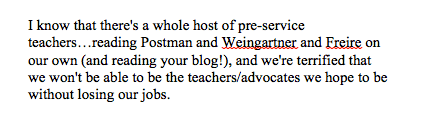
Two conversations—one in person with an early-career teacher, the other through email with a pre-service teacher—can be highlighted by a sentence from the email:

preservice

Pre-service and early career teachers (although not alone) now learn and teach under the weight of “We’re terrified.”

The early-career teacher currently attempts to teach ELA in a high-poverty, majority-minority school, where she has 3 classes with about 50 students each in a team-taught experiment and must work under the incessant requirement of giving students and their parents feedback while planning and teaching in an entirely new school focus.

Again, this is not some unusual circumstance. This is the new normal of being a public school teacher—a new normal that began about thirty years ago and continues to accelerate despite no evidence any of the so-called reforms help and ample evidence those reforms harm students (except those so-called “top students” who are white and affluent but insulated from the reforms), de-professionalize teachers, and demonize schools as well as all of public education.

The pre-service teacher who emailed anticipates the exact conditions new and veteran teachers suffer under daily—conditions that mis-serve students (mostly high-poverty and black/brown students), their parents, and their communities.

I shared with the pre-service teacher by email that being a critical educator is hard—nearly impossible?—for all educators despite status or experience.

But I also offered my regret that we veteran educators have stood by and allowed this to happen to our profession—remained passive and apolitical so that pre-service and early career teachers have been reduced to “We’re terrified” like characters on The Walking Dead.

While the early-career teacher struggles with balancing health and happiness with the relentless and misguided expectations of teaching-as-accountability, the pre-service teacher added: “I’m worried about holding true to the principles that brought me to the profession.”

Today marks the passing of James Baldwin in 1987, and as I spend time with pre-service and early-career teachers, I am haunted by “We’re terrified,” inspired by Baldwin’s “the time is always now,” and disheartened how we educators continue not to heed his call.

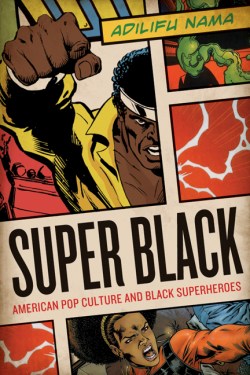
Recommended: Adilifu Nama’s Super Black

In his Introduction of Super Black: American Pop Culture and Black SuperheroesAdilifu Nama, associate professor of African American Studies at Loyola Marymount University, shares his mid-1970s trip to the toy store, where he excitedly anticipated buying superhero figures.

“[I]t was the Falcon that captured my imagination most and cemented my attachment to virtually all things superhero,” he notes. “Why? He was a black man that could fly” (p. 1).

9780292726741
Super Black: American Pop Culture and Black Superheroes, Adilify Nama (University of Texas Press, 2011)

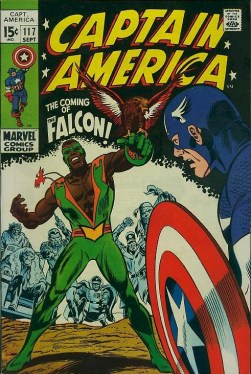
Around the same time, although about a decade older, I was also deeply entrenched in the Marvel Universe, which in hindsight was—along with science fiction novels—one of the doors opening to my stepping beyond my working-class roots in a white community steeped in racism and conservative ideology. I too was fascinated by the Falcon, who brought me back again and again to Captain America, a superhero I found less than compelling.

captain-america-117
The origin of the Falcon in Captain America 117 (Marvel Comics, September 1969).

Nama asserts that Captain America losing his sidekick, Bucky, was part of “events [that] were just an interesting prelude to one of the most remarkable aspects of the Captain America comic book series: his pairing with the first African American superhero, the Falcon” (p. 69).

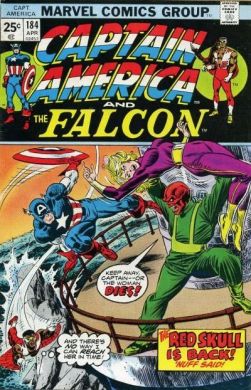
bff94fd3e276dab19192211a4cb876f4
Captain America and the Flacon ran as a co-titled comic from 1971-1978.

Since around 1940, superhero comic books and superheroes have held a solid and important spot in U.S. pop culture, and as pop culture, comic books as a medium (genre) have demonstrated the same sort of flaws and brilliance found in other media, such as film (which Nama addresses in Chapter 5 as well as his Black Space: Imagining Race in Science Fiction Film).

Pop culture often reflects, perpetuates, and confronts the very worst of the culture it serves—in terms of racism, sexism, classism, and the like. Comic books have been, and still are, no different.

Nama’s work is exceptional for his diligent commitment to outlining the role of black superheroes, primarily from Marvel and DC, while avoiding the failures often found in other critiques:

In short, the bulk of analysis concerning black superheroes has come to obvious conclusions, is embarrassingly reductive, and neglects to draw deeper connections across significant cultural dynamics, social trends, and historical events….Either black superheroes are critiqued as updated racial stereotypes from America’s comic-book past, or they are uncritically affixed to the blaxploitation film craze as negative representations of blackness. (p. 3)

tumblr_ngrfi5gdor1u496xso1_500
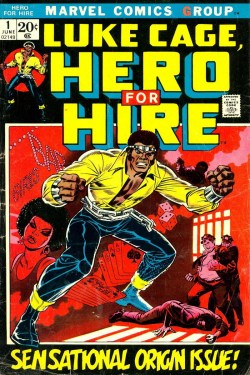
Luke Cage, Hero for Hire, represents the often contradictory representation of black superheroes in the context of blaxploitation film conventions.

Instead, Nama “adopts a poststructural approach that is not beholden to…authorial intent and intensely surface perceptions,” but I must add that despite the scholarly focus, this is an accessible volume for a general readership interested in comic books, pop culture, and race (p. 5).

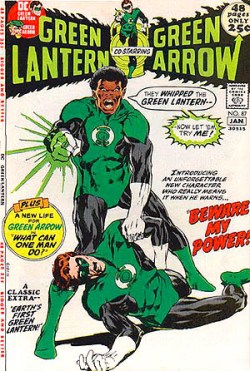
While offering a wonderful assortment of images, including a high-gloss four-page gallery about a third of the way through, Nama weaves an engaging discussion of the rise of socially conscious comic books (Dennis O’Neil and Neil Adam’s Green Lantern Co-Starring Green Arrow, DC, 1970-1972), “seminal black superheroes,” the tension of black and white superhero combinations, “white-to-black makeovers” of superheroes, and as noted about, black superheroes in TV and movies (pp. 6, 7).

gl087
The full-color, gloss insert includes vibrant images such as the original Black Lantern from January 1971-1972 (DC).

Throughout the volume, Nama offers an impressive outline of the black superhero in mainstream comic books while including a powerful examination of the relationship between comic books and the complicated history of race in the U.S.

My own evolving understanding of race in superhero comic books is increasingly informed by James Baldwin and Ta-Nehisi CoatesBaldwin’s confrontation of the specter or whiteness and Coates’s rejecting that “[t]he black freedom struggle is…about raising a race of hyper-moral super-humans.”

In the words of a comic book fan and scholar, Nama, I think, honors both Baldwin and Coates, a perspective that resists judging race in comic books through a white lens or against a distorted bar of perfection:

Where but in superhero comics did black people visit alternative worlds, travel in rocket ships, invent and command futuristic technology, or experience time travel? (p. 66)

By coming neither to glorify nor demonize black superheroes in mainstream comic books and pop culture, Nama succeeds in reaching beyond the pages of those books and showing readers how race joins everyone in the same journey:

American blacks and whites are ultimately bound to one another fused by history and  circumstances, fate and fortune, dreams deferred and hopes realized, and when either party tries to destructively deny or sever the interconnected and interdependent nature of the relationship, both parties suffer. (p. 88)

However, comic books as manifestations of the culture they popularize are inevitably anchored by the white privilege of that real world. “Black superheroes should never be just a colorized version of the original,” Nama argues, adding:

because that would affirm notions that African Americans are at best a passive reflection and at worst a pathological reaction to white America. To the contrary, blacks have simultaneously retained a distinct form of black racial identity and worldview along with absorbing American folkways, mores, and taboos. Black superheroes, like the black folks they symbolize, must express that dynamic, whether they are completely original, an overt imitation of a white figure, or somewhere in between the two. (p. 125)

Ultimately, Nama’s scholarship is lifted by his childhood love for a black man who could fly—the Falcon merging in his boyhood mind with Dr. J—and readers are apt to enjoy this volume as much as the comic books it honors.

See Also

Black Goliath: “Some Black Super Dude,” 

Black Lightning Always Strikes Twice! – Double-Consciousness as a Super-Power

Black Communities of the 30th Century: Racial Assimilation and Ahistoricity in Superhero Comics

The Man Who Lived Twice! (If You Can Call That Living): Marvel’s Brother Voodoo

Humanity Not Included: DC’s Cyborg and the Mechanization of the Black Body, Robert Jones, Jr.

Should We Marvel at a Black Captain America?

The Captain White America Needs

educator, public scholar, poet&writer – academic freedom isn't free