
#Ferguson and #Blacklivesmatter Illustrate How James Baldwin’s Words Resonate More Than 25 Years After His Death, Jessica Moulite
AlterNet: How Our System Creates Criminals to Justify Deadly Force
Creating Crime, Criminals to Justify Deadly Force
“The road to hell is paved with good intentions”—and this I learned while teaching high school (more than) once when I supported a new school policy designed to encourage our students to come to class each day prepared, specifically having done their homework.
Let me offer some context before explaining further.
I taught in the rural high school I had attended, and this was a rules-based public school, reminding many people of the strictest private schools.
Students took each year a handbook test, which they had to pass before they could begin their classes. We had a demerit system and, eventually, in-school suspension—including automatic demerits for being late to class, chewing gum, and having to use the restroom during class.
I found the climate of the school and the rules themselves to be unnecessarily harsh, counter-educational; therefore, I had posted on my wall instead of the required classroom rules, this:
“Any fool can make a rule, and any fool will mind it.” – Henry David Thoreau
But we also were a relatively collaborative school in that the principal came to the department chairs and sought support and consensus for changes or major decisions. One of those changes was creating and implementing homework center.
If students failed to have homework completed for any class, teachers turned those students in (we had elaborate 3-carbon-copy forms for the task), requiring that students serve homework center for 30 minutes after school and present the required homework.
Of course, the intent of homework center was to encourage students to complete their homework.
However, not long after the practice was implemented, we discovered several key things: (i) the number of students assigned to homework center swelled quickly, (ii) students began to embrace showing up for class without homework, openly declaring they would use homework center to complete the assignment, and (iii) students attending homework center tended to be the same students over and over (similar to what we observed with in-school suspension), but not the same students typically in the discipline process.
I also learned a larger lesson: Once we instituted homework center, no matter how much evidence we had that it did not work—that it actually created new problems—no one in authority was willing to end it.
School rules and laws create the boundaries of what constitutes infractions or crime and who is a delinquent or a criminal.
Schooling as preparation for life, in its ugliest form, is how we determine what rules/laws count and who suffers the burdens of both.
As I have noted before, the Reagan administration provided fertile ground for education reform and mass incarceration, increasing racial and class inequity in schools and society.
And just as Berliner and Biddle recognized the manufactured crisis of education reform, we are now faced with the social realities in which crime and criminals are being created in order to justify deadly force.
While we witness a cycle of black young males being shot and killed while unarmed (or holding something mostly harmless but appearing harmful), across the U.S. marijuana is being legalized so that mostly white people can now build businesses around the once-illegal recreational drug that has been the cause of thousands upon thousands of people being labeled as criminals—disproportionately young black males who did not use or sell at higher rates than affluent whites, but suffered the greater weight of arrest, prosecution, and sentencing.
This is no abstraction: One day marijuana possession makes you a criminal; the next day, an entrepreneur.
Too often in the U.S. crimes and policing those crimes are the mechanisms for determining who we demonize (police claimed Tamir Rice looked 20, when the boy was 12; Darren Wilson claimed Michael Brown “look[ed] like a demon”) in order to justify the most extreme responses to created criminals.
Often we are left with no hard proof for what happened when a police officer charged with protecting the public shoots and kills a person later shown to be unarmed, innocent.
We are left then with seeking ways in which those realities are less tragic, and we must consider at least this: What if deadly force was automatically reviewed with complete transparency? And what if police officers in the U.S. were trained differently, as they appear to be in other countries where deadly shootings are rare or nearly non-existent?
Blacks and people in poverty are disproportionately innocent victims in the criminal justice system designed and implemented by the privileged.
That system creates crimes, creates criminals, and creates the powerless who then behave in ways that work in the service of those in power to point to those powerless taking any power they can as justification for the system, an often dead-end and deadly system for those powerless.
The U.S. was born out of lawlessness—and countless crimes against the humanity of native and enslaved peoples. Instead of humility, we have adopted idealism and arrogance, failed in the exact way Thoreau criticized: Too often foolish people with power making foolish laws, creating crimes and criminals.
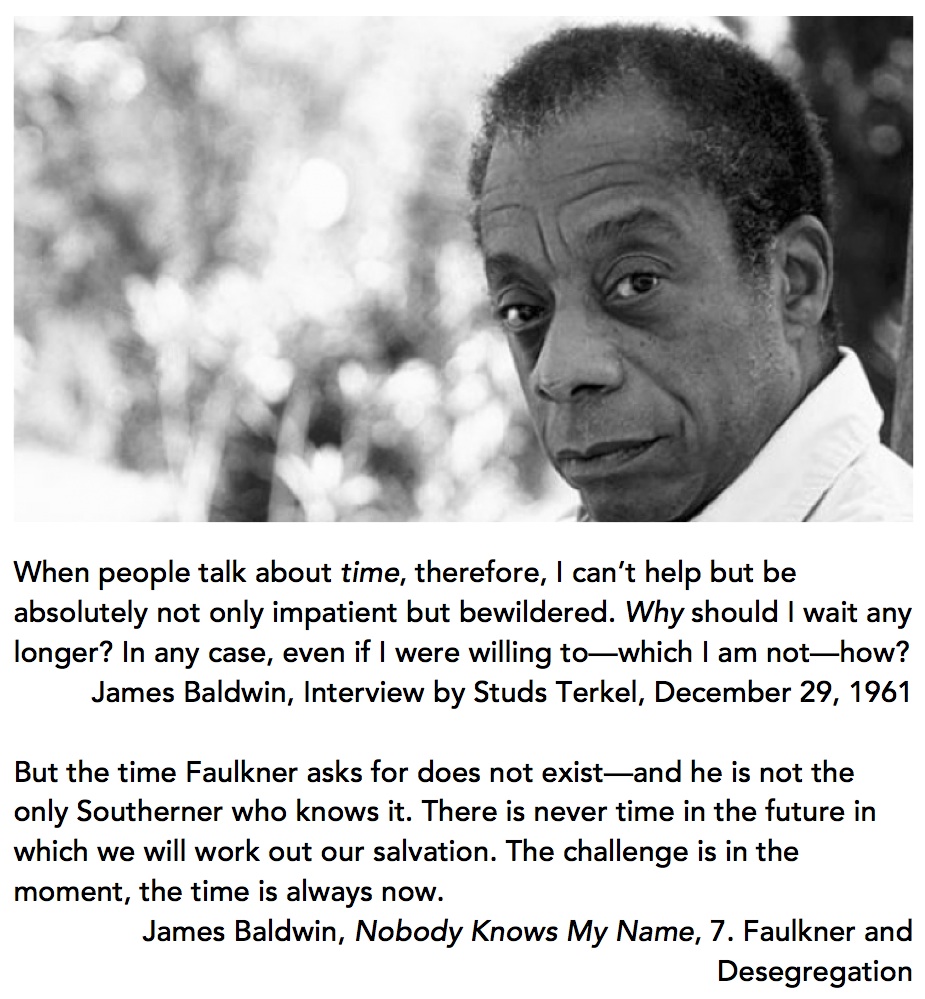
In “We Can Change the Country,” James Baldwin confronts the most damning creation before us:
It is the American Republic—repeat, the American Republic—which created something they call a “nigger.” They created it out of necessities of their own. The nature of the crisis is that I am not a “nigger”—I never was. I am a man….
Now there are several concrete and dangerous things we must do to prevent the murder—and please remember there are several million ways to murder—of future children (by which I mean both black and white children). And one of them, and perhaps the most important, is to take a very hard look at our economic and our political institutions….
We have to begin a massive campaign of civil disobedience. I mean nationwide. And this is no stage joke. Some laws should not be obeyed. (The Cross of Redemption, pp. 60, 61)
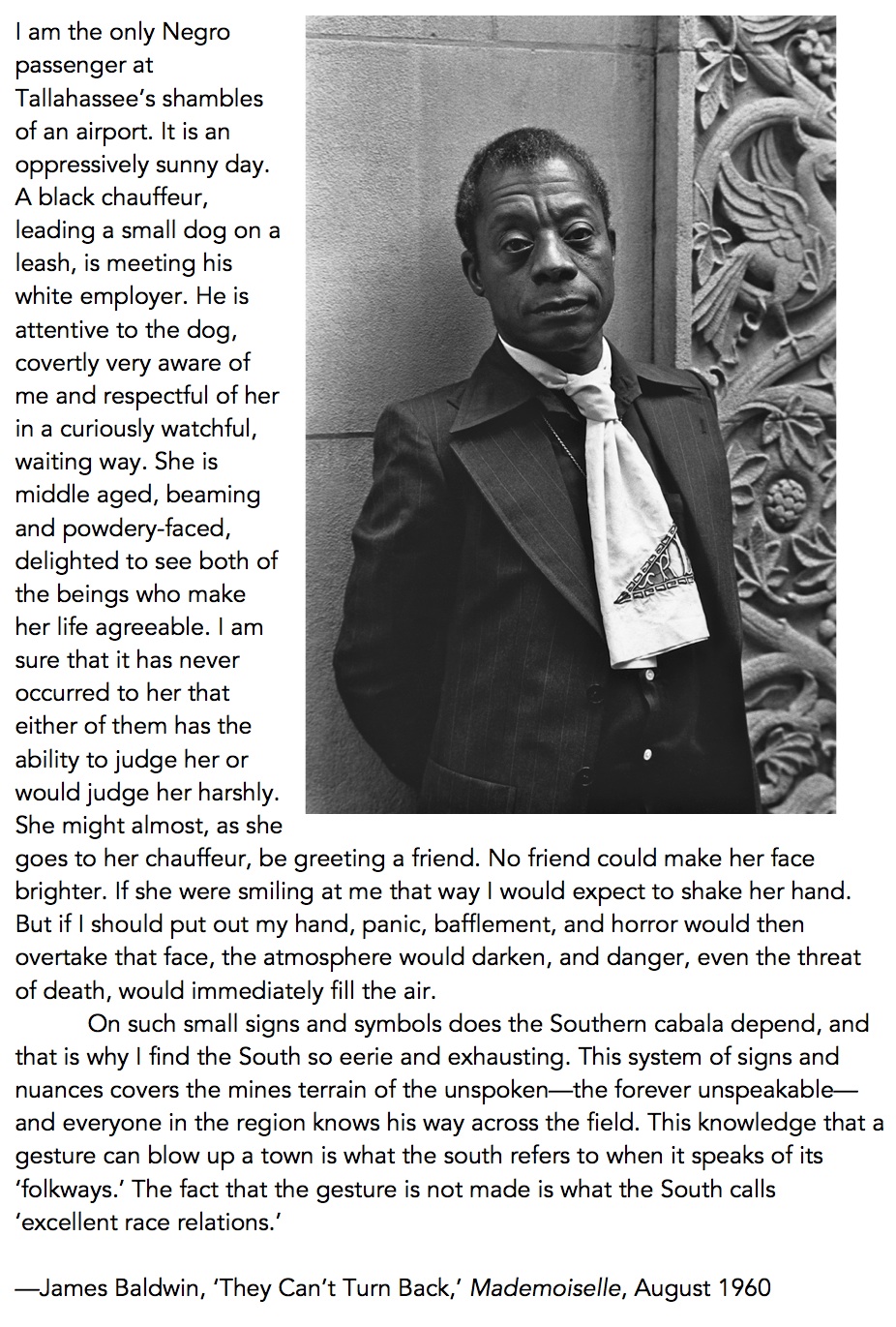
Baldwin recognized that who controls laws creates crime and criminals, and he also recognized “a gesture can blow up a town”—although those left mostly unscathed are the ones making the rules leading to those gestures.
Testing the Education Market, Cashing In, and Failing Social Justice Again
On Black Friday 2014—when the U.S. officially begins the Christmas holiday season, revealing that we mostly worship consumerism (all else is mere decoration)—we are poised to be distracted once again from those things that really matter. Shopping feeding frenzies will allow Ferguson and Tamir Rice to fade away for the privileged—while those most directly impacted by racism and classism, poverty and austerity remain trapped in those realities.
History is proof that these failures have lingered, and that they fade. Listen to James Baldwin. Listen to Martin Luther King Jr.
But in the narrower education reform debate, we have also allowed ourselves to be distracted, mostly by the Common Core debate itself. As I have stated more times that I care to note, that Common Core advocates have sustained the debate is both a waste of our precious time and proof that Common Core has won.
As well, we are misguided whenever we argue that Common Core uniquely is the problem—instead of recognizing that Common Core is but a current form of a continual failure in education, accountability built on standards and high-stakes testing.
With the release of Behind the Data: Testing and Assessment—A PreK-12 U.S. Education Technology Market Report*, we have yet another opportunity to confront that Common Core is the problem, not the solution, because it is the source of a powerful drain on public resources in education that are not now invested in conditions related to racial and class inequity in our public schools.
Richards and Stebbins (2014) explain:
The PreK-12 testing and assessment market segment has experienced remarkable growth over the last several years. This growth has occurred in difficult economic times during an overall PreK-12 budget and spending decline….
Participants almost universally identified four key factors affecting the recent growth of the digital testing and assessment market segment:
1) The Common Core State Standards are Changing Curricula
2) The Rollout of Common Core Assessments are Galvanizing Activity….
(Executive Summary, pp. 1, 2)
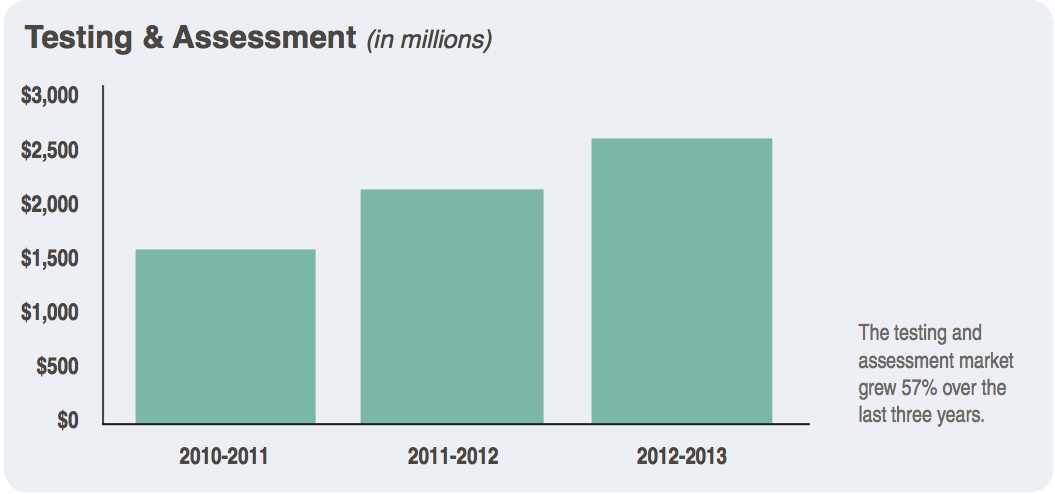
So as I have argued before, Common Core advocacy is market-driven, benefiting those invested in its adoption. But we must also acknowledge that that market success is at the expense of the very students who most need our public schools.
And there is the problem—not the end of cursive, not how we teach math, not whether the standards are age-appropriate.
Common Core is a continuation of failing social justice, draining public resources from needed actions that confront directly the inexcusable inequities of our schools, inequities often reflecting the tragic inequities of our society:
As the absence or presence of rigorous or national standards says nothing about equity, educational quality, or the provision of adequate educational services, there is no reason to expect CCSS or any other standards initiative to be an effective educational reform by itself. (Mathis, 2012, 2 of 5)
Who will be held accountable for the cost of feeding the education market while starving our marginalized children’s hope?
Reference
Richards, J., & Stebbins, L. (2014). Behind the Data: Testing and Assessment—A PreK-12 U.S. Education Technology Market Report. Washington, D.C.: Software & Information Industry Association.
* Thanks to Schools Matter for posting, and thus, drawing my attention to the study.
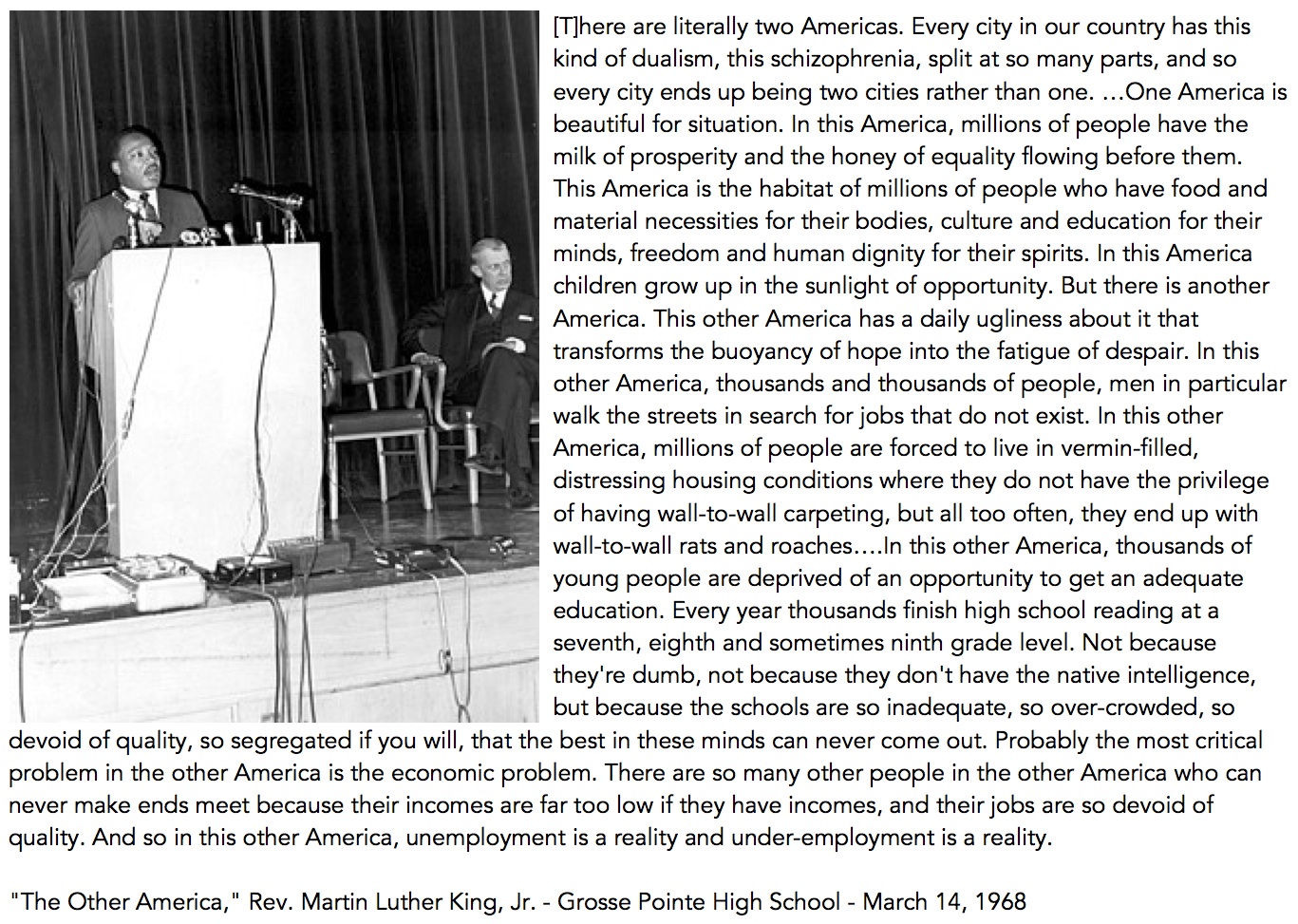
“The Other America,” Martin Luther King Jr. 14 March 1968
Listen 2 and Watch: #Ferguson #FergusonDecision #TamirRice
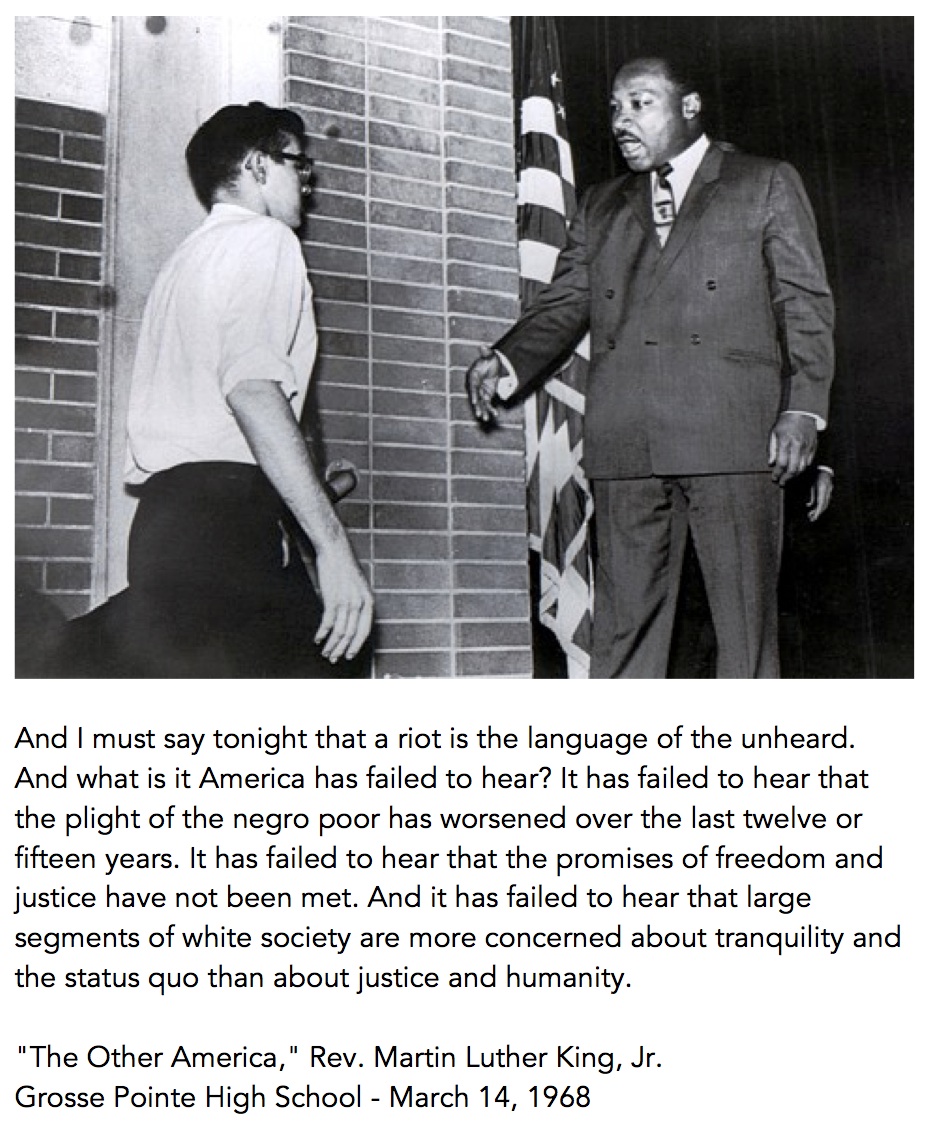
And I must say tonight that a riot is the language of the unheard. And what is it America has failed to hear? It has failed to hear that the plight of the negro poor has worsened…. It has failed to hear that the promises of freedom and justice have not been met. And it has failed to hear that large segments of white society are more concerned about tranquility and the status quo than about justice and humanity.
Rev. Martin Luther King Jr., “The Other America” 14 March 1968
Elahe Izadi and Peter Holley report:
A rookie Cleveland police officer responding to a 911 call jumped out of a cruiser and within seconds shot and killed a 12-year-old boy wielding what later turned out to be a BB gun, according to surveillance video released by authorities Wednesday.
Video of the fatal Saturday shooting of Tamir Rice, 12, by officer Timothy Loehmann, 26, was made public at the request of Tamir’s family. “It is our belief that this situation could have been avoided and that Tamir should still be here with us. The video shows one thing distinctly: the police officers reacted quickly,” reads a statement from the family, who also called on the community to remain calm. [See video at beginning of the report.]
Later in the report, Izadi and Holley add:
The gun turned out to be an Airsoft gun. Authorities had said it resembled a semiautomatic handgun and lacked the orange safety marker intended to signal that it’s a fake.
“Shots fired, male down, um, black male, maybe 20,” one of the officers radioed in. “Black hand gun.”
Stacey Patton’s In America, black children don’t get to be children calls our attention to a historical reality that illuminates the shooting of Tamir Rice:
In 1955, after 14-year-old Emmett Till was beaten and killed by a group of white men, one of his killers said Till “looked like a man.” I’ve found this pattern in news accounts of lynchings of black boys and girls from 1880 to the early 1950s, in which witnesses and journalists fixated on the size of victims who ranged from 8 to 19 years old. These victims were accused of sexually assaulting white girls and women, stealing, slapping white babies, poisoning their employers, fighting with their white playmates, or protecting black girls from sexual assault at the hands of white men. Or they were lynched for no reason at all.
And from the Journal of Personality and Social Psychology, “The Essence of Innocence: Consequences of Dehumanizing Black Children,” the abstract reads:
The social category “children” defines a group of individuals who are perceived to be distinct, with essential characteristics including innocence and the need for protection (Haslam, Rothschild, & Ernst, 2000). The present research examined whether Black boys are given the protections of childhood equally to their peers. We tested 3 hypotheses: (a) that Black boys are seen as less “childlike” than their White peers, (b) that the characteristics associated with childhood will be applied less when thinking specifically about Black boys relative to White boys, and (c) that these trends would be exacerbated in contexts where Black males are dehumanized by associating them (implicitly) with apes (Goff, Eberhardt, Williams, & Jackson, 2008). We expected, derivative of these 3 principal hypotheses, that individuals would perceive Black boys as being more responsible for their actions and as being more appropriate targets for police violence. We find support for these hypotheses across 4 studies using laboratory, field, and translational (mixed laboratory/field) methods. We find converging evidence that Black boys are seen as older and less innocent and that they prompt a less essential conception of childhood than do their White same-age peers. Further, our findings demonstrate that the Black/ape association predicted actual racial disparities in police violence toward children. These data represent the first attitude/behavior matching of its kind in a policing context. Taken together, this research suggests that dehumanization is a uniquely dangerous intergroup attitude, that intergroup perception of children is underexplored, and that both topics should be research priorities.
And thus, if you think “I don’t understand rioters,” or “I’m tired of all this about Ferguson,” or “Why does it always have to be about race,” please do the following: (i) do not say or write any of those thoughts, (ii) open your eyes and your ears, (iii) watch and listen with empathy and not with judgment, and then (iv) ask yourself what you can do to insure that no one feels again the genuine need to protest, a need bred in the toxic soil of powerlessness.
Listen. Watch.
—
Related
Happening Yesterday, Happened Tomorrow: Teaching the ongoing murders of black men, Renee Watson
James Baldwin: “a gesture can blow up a town”
Email to My Students: “the luxury of being thankful”
In addition to the absence of coordination and sufficiency, the programs of the past all have another common failing — they are indirect. Each seeks to solve poverty by first solving something else.
I am now convinced that the simplest approach will prove to be the most effective — the solution to poverty is to abolish it directly by a now widely discussed measure: the guaranteed income.
Martin Luther King Jr., “Final Words of Advice”
“I am a writer, nothing more, nothing less,” begins Roxane Gay in the wake of a grand jury decision not to charge Darren Wilson in the killing of Michael Brown, adding, “In the face of injustice, I only have words and words can only do so much.”
On a much smaller scale, I too am a writer—and I am a teacher, Selves inextricable one from the other. My initial response to the grand jury’s inaction has been near paralysis, especially as a writer who mostly offers this blog; it seems appropriate that I shut up, take a moratorium and do as many have requested—listen.
Gay’s “I only have words and words can only do so much” haunts me, haunts me in the context of Martin Luther King Jr.’s words offered above—that tension between “indirect” and “direct” action.
Teaching and writing often feel merely “indirect”—symbolic, impotent, shouting down an empty well.
This is an awful feeling if, like me, you are compelled to be a writer-teacher, a teacher-writer.
Not as a conscious plan (in the way I am a poet), but typical of my twin compulsions to teach and to write, I finally landed at the keyboard this morning, composing to my three fall classes of students an email—such arrogance, such intrusion while these beautiful and wonderful young people slip away from college for a holiday, Thanksgiving.
Being a writer is the perpetual state of hyperawareness of one’s frailty and inadequacy combined with the relentless inevitable, sharing your words with a mostly anonymous audience. A writer’s writer, J.D. Salinger (flawed possibly to the inexcusable) has already captured how I offer my email below to the readers of this blog: “As nearly as possible in the spirit of Matthew Salinger, age one, urging a luncheon companion to accept a cool lima bean” (dedication for Franny and Zooey).
#
[Email to my students]
I do love you all. It is a very special thing to be given the task of teaching, to have students randomly assigned to your care, your responsibility.
Sometimes, that charge is more than I can handle, but I am only human (and aging, slipping into decrepitude, and thus, not as flawed in some ways as in my youth, but flawed in new and different ways).
Especially at Furman, and especially in our teens and 20s, it is easy to miss the world around us (I did mostly, and often, and well past then)—to empathize fully and genuinely with that world, those people unlike us.
So excuse this intrusion on your holiday … and do not feel obligated in any way to care about this now, or instead of turkey, or instead of just doing nothing, or instead of enjoying family or friends or someone you love … no one should deny you any of those things, and especially not me …
And now, teacher-Me: This essay is wonderfully written (what it says, yes, but how it is written, crafted):
Why We Won’t Wait, Robin D.G. Kelley
And here are some poems of mine pulled out of the rubble of this horrible thing we allow in the US, a callousness about the lives of (especially) young black men:
Four Poems: For Jordan Davis and Trayvon Martin
I think, let us be thankful for we have many people and things that bring us happiness, but could we also find ways to insure that everyone has the opportunities to share the luxury of being thankful?
To you, then, accept as you wish a virtual side-hug, handshake, or your preferred virtual display of affection.
#Ferguson #FergusonDecision Listen
“The law is meant to be my servant and not my master, still less my torturer and my murderer.” James Baldwin. The Nation. July 11, 1966.
“As JRR Tolkien reminded us, the only people who inveigh against escape are jailers.” Neil Gaiman. October 15, 2013
“If you’re not careful, the newspapers will have you hating the people who are being oppressed, and loving the people who are doing the oppressing.” Malcolm X
In several ways, I have seen on social media: “Dear white people, listen” [1]—coming in the wake of the failure to charge Darren Wilson for shooting Michael Brown.
Here, I want to catalogue those voices that speak to that need to listen.
Listen
Harlem, Lanston Hughes
Only Words, Roxane Gay
Ferguson isn’t about black rage against cops. It’s white rage against progress., Carol Anderson
Week 13: Put Your Hands Where My Eyes Can See, Jose Vilson
I am utterly undone: My struggle with Black rage and fear after Ferguson, Brittney Cooper
Ferguson is not a special case, Tony N. Brown
Why We Won’t Wait, Robin D.G. Kelley
Telling My Son About Ferguson, Michelle Alexander
Barack Obama, Ferguson, and the Evidence of Things Unsaid, Ta-Nehisi Coates
The Gospel of Rudy Giuliani, Ta-Nehisi Coates
Urge to ask Ferguson protestors to “be like Martin Luther King,” ignores the how the State actually responded to Martin Luther King.
— Ta-Nehisi Coates (@tanehisicoates) November 25, 2014
Ferguson, goddamn: No indictment for Darren Wilson is no surprise. This is why we protest, Syreeta McFadden
In America, black children don’t get to be children, Stacey Patton
Fury After Ferguson, Charles M. Blow
The Illipsis: Jay Smooth on Ferguson, Riots & Human Limits
Kareem Abdul-Jabbar: White People Feel Targeted by the Ferguson Protests—Welcome to Our World
A Report from Occupied Territory, James Baldwin
The Master’s Tools Will Never Dismantle the Master’s House, Audre Lorde
“To be afraid is to behave as if the truth were not true…” Bayard Rustin
Toni Morrison, the White Gaze, Race, and Writing
“This rigid refusal to look at ourselves may well destroy us” James Baldwin
From Baldwin to Coates: Denying Racism, Ignoring Evidence
James Baldwin (Aug. 2, 1924 – Dec. 1, 1987)
—
[1] Our Silence Means More Violence: An Open Letter to Fellow White People, Carl Gibson
Related

