Pat Tillman (11/6/76 – 4/22/04): A Decade of Forgetting

On the first anniversary of the Boston Marathon bombing, David Zirin highlights a nearly concurrent anniversary:

Two wrenching anniversaries loom in the world of sports. Both are in many respects conjoined by the dominant narratives of the twenty-first century. Both show how the military adventures of the last decade have even breeched the escapist sanctity of the sports page. Both contain elements of tragedy, honor and courage. But you can be sure that one of these anniversaries will get a whole hell of a lot more attention than the other….

April 22 marks ten years since the death of NFL player turned Army Ranger Pat Tillman. Expect the media to take cursory notice and expect a press release from the NFL, but don’t expect much else. That’s because the Pat Tillman narrative doesn’t exactly lend itself to swelling music and sonorous sound bites.

Pat Tillman, if his death is acknowledged at all, will likely be portrayed as a man in uniform—but not as the man he was:

And despite his tragic death being the result of “friendly fire,” despite the now exposed political manipulation of Tillman’s service and death, despite the lies—Tillman, if his death is acknowledged at all, will be misrepresented once again—waved like a flag to keep the public’s gaze distracted:
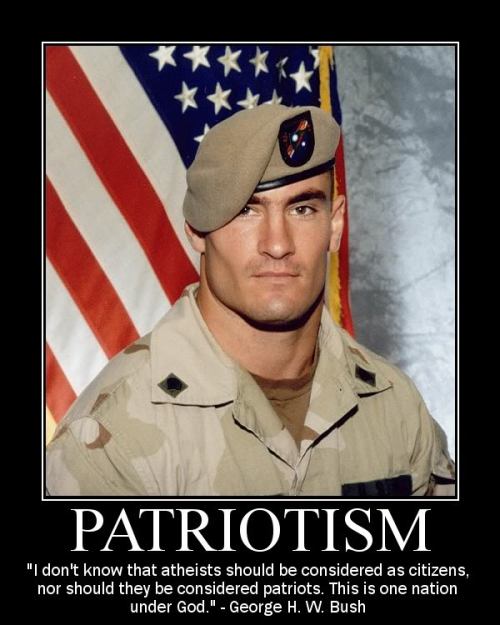
Patriotism?

The truth, however ugly, is available in The Tillman Story (2010), and ESPN offers an Outside the Lines special, Pat Tillman: 10 Years Later an Enduring Tragedy.

The Tillman story, ultimately, is a story about us, about the U.S., about the myths that deform. On the tenth anniversary of Tillman’s death, I invite you to read below a post (revised) from 2012.

“Don’t Ask, Don’t Tell”: There’s a Reason Captain America Wears a Mask

With the release of The Tillman Story (2010), Pat Tillman’s brother, Richard, appeared on Bill Maher’s Real Time and offered yet another narrative of Pat’s life and death, one the Tillman family is willing to tell, but one the American public and political leaders are unwilling to ask about or retell.

Richard was frank and struggling on Maher’s HBO show, which included a clip from Pat’s memorial where Richard made a blunt and impassioned effort to tell the truth about his brother in the face of the political need to maintain American Mythology—even when those myths are deceptive, even when those myths are at the expense of people.

Pat Tillman was a stellar athlete who succeeded in college and rose to unique status in the NFL, where he did a very un-American thing, stepped away from a multi-million dollar contract, to do a very American thing, enlist in the military after 9/11 in order to serve his country. The news and political stories of Tillman’s decision played down the apparent rejection of materialism in Tillman’s volunteering to serve in the military, but the official stories began to craft a narrative starring Pat Tillman as Captain America.

Apparently, we could mask a not-so-subtle challenge to our materialistic existence and consumer culture as long as that masked hero would justify our wars.

Then Tillman died in the line of duty.

Then the U.S. government was exposed for building a story around Tillman’s death that was untrue: Pat was killed by “friendly fire” (a disarming term for an incomprehensible and gruesome fact of wars) and not at the hands of the enemy as officials initially claimed—to Pat’s brother who was also serving and nearby, to Pat’s family, and to the entire country.

Then Richard Tillman, still boiling with anger, said on Maher’s show that Pat should have retaliated in order to save himself against the “friendly fire.”

Beyond the continuing chasm between the real life and death of Pat Tillman and the narratives created around him, the release of the Tillman documentary presents the American public with a story that isn’t very flattering. The Tillman Story depends on the ambiguous meaning of “story,” as a synonym for “narrative” and “lie,” to offer another layer to the growing truths and distortions connected with why Pat Tillman joined the military, how he died, and the complex human being who he was.

Captain America and the Mask of Patriotism

Now, if we place the Tillman stories against the debate in the military over “don’t ask, don’t tell,” we notice that in this culture we endorse masking reality as a good and even honorable thing. We confront the Great American Myth that never allows us to ask, much less tell.

This military policy based on deception is ironically our central cultural narrative, one political leaders perpetuate since their political success depends upon speaking to our cultural myths instead of to reality. We are a country committed to don’t ask, don’t tell.

Pat Tillman’s life story and the corrupted narrative invented by politicians and the military to hide the truth and propagandize at the expense of a man and his life are tragic and personal myths that we are ignoring still. If political leaders will fabricate preferred stories at the expense of a single person, we can expect the same about the institutions central to our democracy, such as our public education system and teachers.

Such is a disturbing confirmation of the “myths that deform” that Paulo Freire cautioned about in his examination of the failures of “banking” concepts of education.

In this new era of hope and change, the Obama administration, we must be diligent to ask and tell, especially when it comes to our public schools. The false dichotomy of Republican and Democrat, conservative and liberal, is a distraction from the reality of political leaders expressing corporate narratives to ensure the balance of power favoring the status quo. Leaders are often compelled to maintain cultural myths because black-and-white messages are politically effective.

President Obama and Secretary of Education Duncan are now leading a renewed assault on public education, and directly teachers, under the banner of civil rights—just as Pat Tillman’s life and death were buried beneath claims of patriotism raised like Captain America’s shield so no one could see behind it.

The reality that Obama and Duncan cannot ask or tell about is poverty—and its impact on the lives and learning of children. Acknowledging poverty is an affront to the American Dream; confronting poverty is political dynamite. Blaming teachers and schools instead without offering the evidence works because this is a message we are willing to acknowledge and hear.

For example, a group from the ruling elite of schools, self-described as “educators, superintendents, chief executives and chancellors responsible for educating nearly 2 1/2 million students in America,” placed themselves squarely in the context of President Obama’s and Secretary Duncan’s charge against teachers and the status quo; their manifesto states: “As President Obama has emphasized, the single most important factor determining whether students succeed in school is not the color of their skin or their ZIP code or even their parents’ income—it is the quality of their teacher.” [1]

The names of the leaders—Klein, Rhee, Vallas—appear impressive, and their sweeping claims are compelling—except that the substance of their message is false.

Narratives are powerful, and telling those narratives requires diligence, a willingness to say something often enough to make the created story sound more credible than reality—until the truth is masked beneath a web of narratives that makes truth harder to accept than the lies that seem to conform to all the myths that deform us (rugged individualism, pulling oneself up by the bootstrap, a rising tide lifts all boats).

“Let’s stop ignoring basic economic principles of supply and demand” speaks to an American faith in the market. “[U]ntil we fix our schools, we will never fix the nation’s broader economic problems” triggers Americans’ blind willingness to compete and an enduring faith in schools as tools of social reform. They are compelling because Americans have been saying them for a century.

Just as the fabricated story of Pat Tillman and his sacrifice justified war.

“I don’t believe that even the best teachers can completely overcome the huge deficits in socialization, motivation and intellectual development that poor students bring to class through no fault of their own” (Walt Gardner) sounds weak, fatalistic, in the face of our myths, the words of soft people eager to shift the blame. It is something we dare not tell.

Just as the smoldering facts of Pat Tillman’s death remain too hard to ask about and too hard to tell.

But only the latter are supported by evidence. But only the latter contradict the Great American Myths about which we dare not ask, we dare not tell.

Captain America wears a mask for a reason: The myth is easier to look at, easier to tell about than the truth hidden underneath—whether we are asking about and looking hard at the death of a complex man, Pat Tillman, or the complex influences of poverty on the lives and learning of children across our country.

[1] See recent evidence to the contrary regarding the claim about zip codes: A Rotting Apple: Education Redlining in New York City, a report from the Schott Foundation for Public Education; and Housing Costs, Zoning, and Access to High-Scoring Schools, a report from Brookings.
The Paradox of Race in the U.S.

The paradox of race in the U.S.: In order to become a culture in which race does not matter, race must always matter.

Due this coming June, my first granddaughter will be born into this world a bi-racial child during the second term of the first bi-racial president of the U.S.

The symbolic power of that coincidence is, I think, significant, but the realities of the U.S.—I regret to add—far outweigh that symbolism (consider that Obama is popularly referred to as “Black,” and not bi-racial, and how that designation reflects not race, but racism).

It is 2014, and the U.S. suffers from a cultural blindness to the lingering scars of racism, sexism, and classism. U.S. mass incarceration disproportionately destroys the lives of African American males: White males outnumber African American males in the U.S. about 6 to 1, yet prisons hold African American males at a 6 to 1 ratio over White males. African Americans and Whites use recreational drugs at about the same rates, as well, but African Americans are overwhelmingly and disproportionately targeted, arrested, and imprisoned for that drug use.

The realities of inequity for women in the U.S. are disturbingly parallel.

However, Zak Cheney-Rice’s National Geographic Concludes What Americans Will Look Like in 2050, and It’s Beautiful details that the U.S. my granddaughter will experience is, in fact, increasingly multi-racial:

The Wall Street Journal reported a few years back that 15% of new marriages in 2010 were between individuals of different races. It’s unclear whether they’ve included same-sex unions in the count, but as currently stated, this number is more than double what it was 25 years ago. The proportion of intermarriages also varied by race, with “9% of whites, 17% of blacks, 26% of Hispanics and 28% of Asians [marrying] outside their ethnic or racial group.” Interracial unions now account for 8.4% of all marriages in the U.S. (please see the images and charts)

As the number of bi-racial and multi-racial children increase in the U.S., we may find that the pervasive blindness to the -isms that deform our culture is replaced by a will to confront as well as end those -isms.

But, what keeps those -isms alive, I think, is the wrong goal—a call for a post-racial U.S.

Humans will always necessarily be, individually and collectively, defined by the coincidences of race, gender, and sexuality—those qualities that we do not choose. And children (as well as adults) will always be defined by the class each is born into through no decision or action of that individual.

What we should be seeking, then, is a post-racism society, not a post-racial society; a post-sexism society, a post-classism society, a post-homophobic, post-heteronormative society.

Much of literature is the artist’s effort to remove blinders from a people.

In American literature, a recurring theme is that the American Dream is a lie (or at best, far from being realized)—even though many in the U.S. remain capable of reading, celebrating, and then completely missing that point with key works such as The Great Gatsby.

Aging and quite likely crumbling under the weight of something like Alzheimer’s, Willy Loman becomes convinced that he literally is worth more dead than alive—because he loses his ability to earn a living but holds a life insurance policy.

Arthur Miller’s Death of a Salesman is a damning work of drama and even more directly challenging the American Dream than Fitzgerald’s modern classic.

But for all the critical insight found in both Salesman and Gatsby, the two works also leave out a great deal—a great deal about the interplay among race, class, gender, and that American Dream as a lie.

However, Lorraine Hansberry returns to the American Dream in A Raisin in the Sun in order to hold up to the U.S. and the world what Salesman and Gatsby mostly ignore.

Walter Younger, like Willy Loman, faces the weight of a “dream deferred,” personifying Langston Hughes’s questions in “Harlem.”

Few if any works of literature surpass Hansberry’s masterful dramatization of race, class, gender, and the “heavy load” that is not just a “dream deferred” but a dream that is reserved for only some (white) people.

Both Willy Loman and Walter Younger are tragic figures in the modernist sense; and these two men share a burden of reaching for and believing in a dream promised that turns out to be a mirage.

But Walter suffers exponentially, not because of his race, but because of racism—how the people with power respond to his race.

In a post-racial world, Walter being African American would be erased, and with that, part of his Being would be erased. The quest for a post-racial world maintains a racialized gaze on Walter, and not the agents of racism.

Walter does not suffer oppression because of his race; he suffers oppression because of racism.

And that, I think, is one of the many nuanced messages of a surprisingly optimistic play (much like Alice Walker’s A Color Purple) that asks audiences to see and even recognize—not ignore—race, class, and gender in the context of social realities that are themselves what must be changed. Not the people who are the consequences of their race, gender, and class.

Having just co-edited a volume on James Baldwin, I cannot imagine Baldwin calling for a post-racial U.S., one in which we pretend race doesn’t exist. I can imagine Baldwin informing anyone willing to listen that the problem remaining in the U.S. is not anyone’s race, but the eye of the beholder.

In the recently published Jimmy’s Blues and Other Poems by Baldwin, the opening poem, “Staggerlee wonders,” begins:

I always wonder
what they think the niggers are doing
while they, the pink and alabaster pragmatists,
are containing
Russia
and defining and re-defining and re-aligning
China,
nobly restraining themselves, meanwhile,
from blowing up that earth
which they have already
blasphemed into dung

And I hear Baldwin, and I imagine him saying we must see each other fully in order to be no longer blinded by our -isms.

My granddaughter will be born a bi-racial child in the U.S. where the half of her which is African American will be the default for calling her “Black” and where women still earn about 3/4s what men do for the same labor.

She is likely to feel the dehumanizing realities about her own worth that send Willy to suicide. She is likely to share the frustrations Beneatha and Ruth Younger personify.

Those realities give me pause, sadden me. And I share with Walter a good deal of anger.

In another modern classic of American drama, Thornton Wilder’s Our TownEmily grows from childhood to falling in love to marriage and to her own too-early death. In the final act, Emily views her life in replay from beyond and exclaims: “I can’t look at everything hard enough.”

She then turns to the Stage Manager and asks, distraught: “Do any human beings ever realize life while they live it—every, every minute?” And the Stage Manager replies, “No—Saints and poets maybe—they do some.”

My hope lies in our ability to “look at everything hard enough.”

To pay attention—not to ignore, not to pretend in the way that calling for a post-racial U.S. is pretending.

The paradox of race in the U.S.: In order to become a culture in which race does not matter, race must always matter.

Devaluing Teachers in the Age of Value-Added

“We teach the children of the middle class, the wealthy and the poor,” explains Anthony Cody, continuing:

We teach the damaged and disabled, the whole and the gifted. We teach the immigrants and the dispossessed natives, the transients and even the incarcerated.

In years past we formed unions and professional organizations to get fair pay, so women would get the same pay as men. We got due process so we could not be fired at an administrator’s whim. We got pensions so we could retire after many years of service.

But career teachers are not convenient or necessary any more. We cost too much. We expect our hard-won expertise to be recognized with respect and autonomy. We talk back at staff meetings, and object when we are told we must follow mindless scripts, and prepare for tests that have little value to our students.

During the 1980s and 1990s, U.S. public schools and the students they serve felt the weight of standards- and test-based accountability—a bureaucratic process that has wasted huge amounts of tax-payers’ money and incalculable time and energy assigning labels, rankings, and blame. The Reagan-era launching of accountability has lulled the U.S. into a sort of complacency that rests on maintaining a gaze on schools, students, and test data so that no one must look at the true source of educational failure: poverty and social inequity, including the lingering corrosive influences of racism, classism, and sexism.

The George W. Bush and Barack Obama eras—resting on intensified commitments to accountability such as No Child Left Behind (NCLB) and Race to the Top (RTTT)—have continued that misguided gaze and battering, but during the past decade-plus, teachers have been added to the agenda.

As Cody notes above, however, simultaneously political leaders, the media, and the public claim that teachers are the most valuable part of any student’s learning (a factually untrue claim), but that high-poverty and minority students can be taught by those without any degree or experience in education (Teach for America) and that career teachers no longer deserve their profession—no tenure, no professional wages, no autonomy, no voice in what or how they teach.

And while the media and political leaders maintain these contradictory narratives and support these contradictory policies, value-added methods (VAM) of evaluating and compensating U.S. public teachers are being adopted, again simultaneously, as the research base repeatedly reveals that VAM is yet another flawed use of high-stake accountability and testing.

When Raj Chetty, John N. Friedman, and Jonah E. Rockoff released (and re-released) reports claiming that teacher quality equates to significant earning power for students, the media and political leaders tripped over themselves to cite (and cite) those reports.

What do we know about the Chetty, et al., assertions?

From 2012:

[T]hose using the results of this paper to argue forcefully for specific policies are drawing unsupported conclusions from otherwise very important empirical findings. (Di Carlo)

These are interesting findings. It’s a really cool academic study. It’s a freakin’ amazing data set! But these findings cannot be immediately translated into what the headlines have suggested – that immediate use of value-added metrics to reshape the teacher workforce can lift the economy, and increase wages across the board! The headlines and media spin have been dreadfully overstated and deceptive. Other headlines and editorial commentary has been simply ignorant and irresponsible. (No Mr. Moran, this one study did not, does not, cannot negate  the vast array of concerns that have been raised about using value-added estimates as blunt, heavily weighted instruments in personnel policy in school systems.) (Baker)

And now, a thorough review concludes:

Can the quality of teachers be measured the way that a person’s weight or height is measured? Some economists have tried, but the “value-added” they have attempted to measure has proven elusive. The results have not been consistent over tests or over time. Nevertheless, a two-part report by Raj Chetty and his colleagues claims that higher value-added scores for teachers lead to greater economic success for their students later in life. This review of the methods of Chetty et al. focuses on their most important result: that teacher value-added affects income in adulthood. Five key problems with the research emerge. First, their own results show that the calculation of teacher value-added is unreliable. Second, their own research also generated a result that contradicts their main claim—but the report pushed that inconvenient result aside. Third, the trumpeted result is based on an erroneous calculation. Fourth, the report incorrectly assumes that the (miscalculated) result holds across students’ lifetimes despite the authors’ own research indicating otherwise. Fifth, the report cites studies as support for the authors’ methodology, even though they don’t provide that support. Despite widespread references to this study in policy circles, the shortcomings and shaky extrapolations make this report misleading and unreliable for determining educational policy.

Similar to the findings in Edward H. Haertel’s analysis of VAM, Reliability and validity of inferences about teachers based on student test scores (ETS, 2013), the American Statistical Association has issued ASA Statement on Using Value-Added Models for Educational Assessment, emphasizing:

Research on VAMs has been fairly consistent that aspects of educational effectiveness that are measurable and within teacher control represent a small part of the total variation in student test scores or growth; most estimates in the literature attribute between 1% and 14% of the total variability to teachers. This is not saying that teachers have little effect on students, but that variation among teachers accounts for a small part of the variation in scores. The majority of the variation in test scores is attributable to factors outside of the teacher’s control such as student and family background, poverty, curriculum, and unmeasured influences.

The VAM scores themselves have large standard errors, even when calculated using several years of data. These large standard errors make rankings unstable, even under the best scenarios for modeling. Combining VAMs across multiple years decreases the standard error of VAM scores. Multiple years of data, however, do not help problems caused when a model systematically undervalues teachers who work in specific contexts or with specific types of students, since that systematic undervaluation would be present in every year of data.

Among DiCarlo, Baker, Haertel and the ASA, several key patterns emerge regarding VAM: (1) VAM remains an experimental statistical model, (2) VAM is unstable and significantly impacted by factors beyond a teacher’s control and beyond the scope of that statistical model to control, and (3) implementing VAM in high-stakes policies exaggerates the flaws of VAM.

The rhetoric about valuing teachers rings hollow more and more as teaching continues to be dismantled and teachers continue to be devalued by misguided commitments to VAM and other efforts to reduce teaching to a service industry.

VAM as reform policy, like NCLB, is sham-science being used to serve a corporate need for cheap and interchangeable labor. VAM, ironically, proves that evidence does not matter in education policy.

Like all workers in the U.S., we simply do not value teachers.

Political leaders, the media, and the public call for more tests for schools, teachers, and students, but they continue to fail themselves to acknowledge the mounting evidence against test-based accountability.

And thus, we don’t need numbers to prove what Cody states directly: “But career teachers are not convenient or necessary any more.”

In Defense of Poetry: “Oh My Heart”

“No, no. You’ve got something the test and machines will never be able to measure: you’re artistic. That’s one of the tragedies of our times, that no machine has ever been built that can recognize that quality, appreciate it, foster it, sympathize with it.”

Paul Proteus to his wife Anita in Kurt Vonnegut’s Player Piano

“So much depends upon a red wheel barrow glazed with rain water beside the white chickens” is, essentially, a grammatical sentence in the English language. While the syntax is somewhat out of the norm, the diction is accessible to small children—the hardest word likely being “depends.” But “The Red Wheelbarrow” by William Carlos Williams is much more than a sentence; it is a poem:

so much depends
upon

a red wheel
barrow

glazed with rain
water

beside the white
chickens.

A relatively simple English language sentence shaped into purposeful lines and stanzas becomes poetry. And like Langston Hughes’s “Harlem” and Gwendolyn Brooks’s “We Real Cool,” it sparks in me a profoundly important response each time I read these poems: [Expletive], I wish I had written that.

It is the same awe and wonder that I felt as a shy and deeply self-conscious teenager when I bought, collected, and read comic books, marveling at the artwork I wish I had drawn.

Will we soon wake one morning to find the carcasses of poems washed up on the beach by the tsunami of the Common Core?

That question, especially during National Poetry Month, now haunts me more every day, notably because of the double-impending doom augured by the Common Core: the rise of nonfiction (and the concurrent erasing of poetry and fiction) from the ELA curriculum and the mantra-of-the-moment, “close reading” (the sheep’s clothing for that familiar old wolf New Criticism):

It seems we have come to a moment in the history of the US when we no longer even pretend to care about that which is the result of the human heart: Art.

And poetry, I contend, is the most human of the arts because—although it is quite challenging often to distinguish humans from other mammals—we have two attributes that do set us apart: our too-big brains and our faculty for language.

Poetry is the very human effort to utter order out of chaos, meaning out of the meaningless: “Daddy, daddy, you bastard, I’m through” (Sylvia Plath, “Daddy”).

The course was Speech, taught by Mr. Brannon. I was a freshman at a junior college just 15-20 miles from my home, the college my parents had attended when they first fell in love and married secretly.

Despite the college’s close proximity to my home, my father insisted that I live on campus. But that class and those first two years of college were more than living on campus; they were the essential beginning of my life.

In one of the earliest classes, Mr. Brannon read aloud and gave us a copy of “[in Just-]” by e. e. cummings. I imagine that moment was, for me, what many people describe as a religious experience.

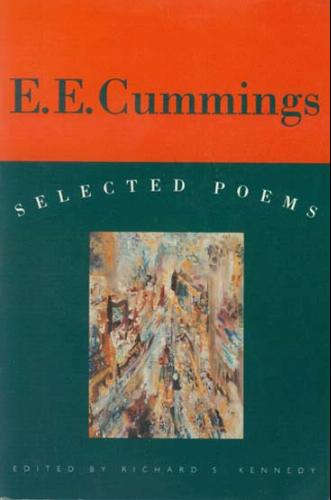
That was more than thirty years ago, but I have two precious books still that followed from that day in class: cummings’s Complete Poems and Selected Poems:

cummings1

Several years later, Emily Dickinson‘s Complete Poems would join my commitment to reading every poem by those poets who made me respond over and over: [Expletive], I wish I had written that.

But that introduction to cummings was more than a young and insecure man finding the poets he wanted to read; it was when I realized I am a poet.

Now, when the words “j was young&happy” come to me, I know there is work to do—I recognize the gift of poetry.

As a high school English teacher, I divided my academic year into quarters by genre/form: nonfiction, poetry, short fiction, and novels/ plays. The poetry quarter, when announced to students, initially received moans and even direct complaints: “I hate poetry.”

To be honest, that always broke my heart, crushed my soul. Life and school had already taken something very precious from these young people:

children guessed(but only a few
and down they forgot as up they grew (“[anyone lived in a pretty how town],” e.e. cummings)

Gradually and then always, I taught poetry in conjunction with popular songs. Although my students in rural South Carolina were overwhelmingly country music fans, I focused my nine weeks of poetry on the songs of alternative group R.E.M.

For the record, that too elicited moans from students in those early days of exploring poetry (see that unit now on the blog “There’s time to teach”).

Concurrently, throughout my high school teaching career, students always gathered in my room during our long mid-morning break and lunch (much to the chagrin of administration). And almost always, we played music.

The epitome of that unspoken norm of my classroom was two students who, after I introduced them to The Violent Femmes, would close my door in order to dance and sing along with their songs.

Many of those students are in their 30s and 40s, but it is common for them to contact me—often on Facebook—and recall fondly R.E.M. and our poetry unit. Those days and years meant something to them that lingers, that matters in ways that cannot be measured.

I can still see and hear those two students dancing, singing, and laughing. It was an oasis of happiness in their days at school, an oasis of happiness in their lives.

e.e. cummings begins “since feeling is first,” and then adds:

my blood approves,
and kisses are better fate
than wisdom
lady i swear by all flowers. Don’t cry
—the best gesture of my brain is less than
your eyelids’ flutter….

And each year when my students and I examined this poem, we would discuss that cummings—in Andrew Marvell fashion—offers an argument that is profoundly unlike what parents, teachers, preachers, and politicians claim.

So I often paired this poem with Coldplay’s “The Scientist,” focusing on:

I was just guessing at numbers and figures
Pulling your puzzles apart
Questions of science, science and progress
Do not speak as loud as my heart

Especially for teenagers, this question, this tension between heart and mind, mattered. Just as it recurs in the words of poets and musicians over decades, centuries.

Poetry, as with all art, is the expressed heart—that human quest to rise above our corporeal humanness:

               Bold Lover, never, never canst thou kiss,
Though winning near the goal yet, do not grieve;
       She cannot fade, though thou hast not thy bliss,
               For ever wilt thou love, and she be fair! (“Ode on a Grecian Urn,” John Keats)

I have loved a few people intensely. So deeply that my love, I believe, resides permanently in my bones. If you read my poetry, you will recognize that motif, I am sure.

One such love is my daughter, and she now carries the next human who will add to that ache of being fully human—loving another beyond words.

And that, I contend, is poetry.

Poetry is not identifying iambic pentameter on a poetry test or discussing the nuances of enjambment in an analysis of a Dickinson poem.

Poems are not fodder for close reading.

Poetry is the ineluctable “Oh my heart” that comes from living fully in the moment of being human, the moment that draws us to words as well as inspires us toward words.

We read a poem, we listen to a song, and our hearts rise out of our eyes as tears.

That is poetry.

And like the picture books of our childhood, poetry must be a part of our learning, essential to our school days—each poem an oasis of happiness that “machines will never be able to measure.”

Will we soon wake one morning to find the carcasses of poems washed up on the beach by the tsunami of the Common Core?

Maybe the doomsayers are wrong, and maybe, just maybe, poetry will not be erased from our classrooms.

School with less poetry is school with less heart. School with no poetry is school with no heart.

Both are tragic mistakes because if school needs anything, it is more heart. And poetry? Oh my heart.

See Also

The Dying of the Light: How Common Core Damages Poetry Instruction

No Place for Poetry on My Son’s Common Core ELA Test

NOTE: This post was drafted in the wake of driving to work while listening to Coldplay’s A Rush of Blood to the Head. Or to be perfectly honest, while singing loudly along with each song and occasionally crying. There. So keep that in mind.

Social Context Reform: A Pedagogy of Equity and Opportunity

Published from Routledge

Social Context Reform: A Pedagogy of Equity and Opportunity

Social Context Reform: A Pedagogy of Equity and Opportunity

Foreword: Education and the Epochal Crisis Peter McLaren

Introduction: Social Context Reform: A Pedagogy of Equity and Opportunity Brad Porfilio, Julie Gorlewski, Paul R. Carr, and P.L. Thomas, Editors

Part 1: Social Reform for Equity and Opportunity

1. Defying Meritocracy: The Case of the Working-Class College Student Allison L. Hurst

2. Reforming the Schooling of Neoliberal, Perpetual Zombie Desire William Reynolds

3. The Pseudo Accountability of Education Reform: Injustice by (False) Proxy Randy Hoover

4. Teacher Education and Resistance within the Neoliberal Regime: Making the Necessary Possible Barbara Madeloni and Kysa Nygreen

Part 2: School-based Reform for Equity and Opportunity

5. Changing the Colonial Context to Address School Underperformance in Nunavut Paul Berger

6. An Injury to All? The Haphazard Nature of Academic Freedom in America’s Public Schools Robert L. Dahlgren, Nancy C. Patterson and Christopher J. Frey

7. Educating, Not Criminalizing, Youth of Color: Challenging Neoliberal Agendas and Penal Populism Mary Christiankis and Richard Mora

Part 3: Classroom-based Reform for Equity and Opportunity

8. Pedagogies of Equity and Opportunity: Critical Literacy, Not Standards P. L. Thomas

9. YouTube University: How an Educational Foundations Professor Uses Critical Media in His Classroom Nicholas D. Hartlep

10. Developing a User-Friendly, Community-Based Higher Education Rebecca Collins-Nelsen and Randy Nelsen

11. Transcending the Standard: One Teacher’s Effort to Explore the World Beyond the Curriculum Chris Leahey

Conclusion: Learning and Teaching in Scarcity P. L. Thomas

Skepticism or Cynicism for Obama Education Agenda?

One response to my Relaxing zero tolerance in schools could be Obama’s boldest civil rights reform is worth highlighting: Readers adamant that the Obama education agenda is beyond such hope.

Let me note here that I have long since slipped past healthy skepticism and resigned myself to unhealthy cynicism with respect to either major political party and their leaders, including Obama.

I have tried before to confront the possibilities and the failures associated with Obama and Secretary Duncan, a set of policies and a series of rhetorical flurries that leave me even more depressed than those dark years under George W. Bush and his Secretaries, Rod Paige and Margaret Spellings:

Paul R. Carr and Brad Porfilio are now preparing a revised edition of The Phenomenon of Obama and the Agenda for Education: Can Hope Audaciously Trump Neoliberalism?—in which I have had and will have chapters.

I must note that my revised chapter is none too rosy; in fact, it is a solid statement of cynicism that has left skepticism in the dust. The revised chapter ends:

This call for change is not being heard, blocked by the din of the crisis discourse and utopian expectations that deform our children, our schools, and our society. The great failure being masked is that bureaucratic calls for school reform are perpetuating the labeling and marginalizing of teachers and students whose conditions in mechanistic schools parallel the inequities that the political elite are willingly ignoring both in their discourse and in their policies.

So when I confront the late but important recognition by the Obama administration that current education policies and practices are indeed racist, classist, and sexist, I believe it is on us to redouble our efforts, remind everyone we have been saying that for many years.

We actually don’t need Obama’s administration to tell us these things. But unless we make an effort to shift the gaze and the discourse in the right direction, on those extremely rare moments when they do, we are losing a moment.

I am not calling for our collective patting of the backs among the Obama administration. I would say the best tactic is to say, “Shame on you all for just noticing, but let’s get to work and stop all that other nonsense that is also doing harm!”

The Obama administration has hidden behind “education reform is the civil rights issue of our time” while promoting the worst possible education policies and maintaining an inexcusable allegiance to Secretary Duncan.

Let’s not forget that, and let’s not forget the “hope and change” rhetoric that lured many of us to have hope for change.

The recent shift driven by the Office of Civil Rights reports, however, is our opportunity to turn the “no excuses” and “zero tolerance” mantras on their heads, raising our voices and our eyes toward those in charge who are failing us and the children in our schools.

If there is hope for that change, it is in our grasp to make it happen.

National Poetry Month: “What is the message when some children are not represented in those books?”

National Poetry Month 2014 comes not on “little cat feet,” like Carl Sandberg’s “Fog,” but in the wake of Walter Dean Myers and his son, Christopher, responding to reports of the whitewashing of books for children. Walter Dean Myers explains:

But there was something missing. I needed more than the characters in the Bible to identify with, or even the characters in Arthur Miller’s plays or my beloved Balzac. As I discovered who I was, a black teenager in a white-dominated world, I saw that these characters, these lives, were not mine. I didn’t want to become the “black” representative, or some shining example of diversity. What I wanted, needed really, was to become an integral and valued part of the mosaic that I saw around me.

Myers identifies James Baldwin as the moment he discovered what was missing, and then Myers asks:

Books transmit values. They explore our common humanity. What is the message when some children are not represented in those books? Where are the future white personnel managers going to get their ideas of people of color? Where are the future white loan officers and future white politicians going to get their knowledge of people of color? Where are black children going to get a sense of who they are and what they can be?

National Poetry Month 2014 also comes just as we have Baldwin’s Jimmy’s Blues and Other Poems, which includes a beautiful and inspired Introduction by Nikky Finney:

Jimmy’s Blues and Other Poems, James Baldwin

As we search for ways in which to insure that students, as Myers did, find what is missing in the texts students are often required to read, I recommend the poetry of Baldwin and Finney. Along with Finney’s full Introduction above, students can access Finney’s Playing by Ear, Praying for Rain: The Poetry of James Baldwin, and then their poetry (see Nikky Fnney at Poetry Foundation).

These entry points to poetry can then lead to multi-genre/mode/form considerations, such as The Most Powerful Piece of Film Criticism Ever Written—about Baldwin’s The Devil Finds Work. Noah Berlatsky’s essay includes two important links as well to another African American writer, Ta-Nehisi Coates, inspired by Baldwin (see Jose Vilson on Baldwin as well):

Along with seeking texts that have people who look like all our students, we must also consider language. A wonderful bi-lingual poetry unit can be developed from two beautiful and powerful books: Barbara Kingsolver’s Another America and Jorge Luis Borges’s Borges: Selected Poems (see Borges at Poetry Foundation), Kingsolver’s translated from English to Spanish and Borges’s translated from Spanish to English:

Another American
Borges: Selected Poems

Myers ends his essay by confronting how texts represent African Americans and how African American males, specifically, are impacted:

And what are the books that are being published about blacks? Joe Morton, the actor who starred in “The Brother From Another Planet,” has said that all but a few motion pictures being made about blacks are about blacks as victims. In them, we are always struggling to overcome either slavery or racism. Book publishing is little better. Black history is usually depicted as folklore about slavery, and then a fast-forward to the civil rights movement. Then I’m told that black children, and boys in particular, don’t read. Small wonder.

“There is work to be done,” Myers concludes, and National Poetry Month is an ideal time to start, or continue that work.

Additional Reading

Reading Out of Context: “But there was something missing,” Walter Dean Myers

From Baldwin to Coates: Denying Racism, Ignoring Evidence

remnant 20: “your absence will sadden other afternoons”

Assorted thoughts on poetry

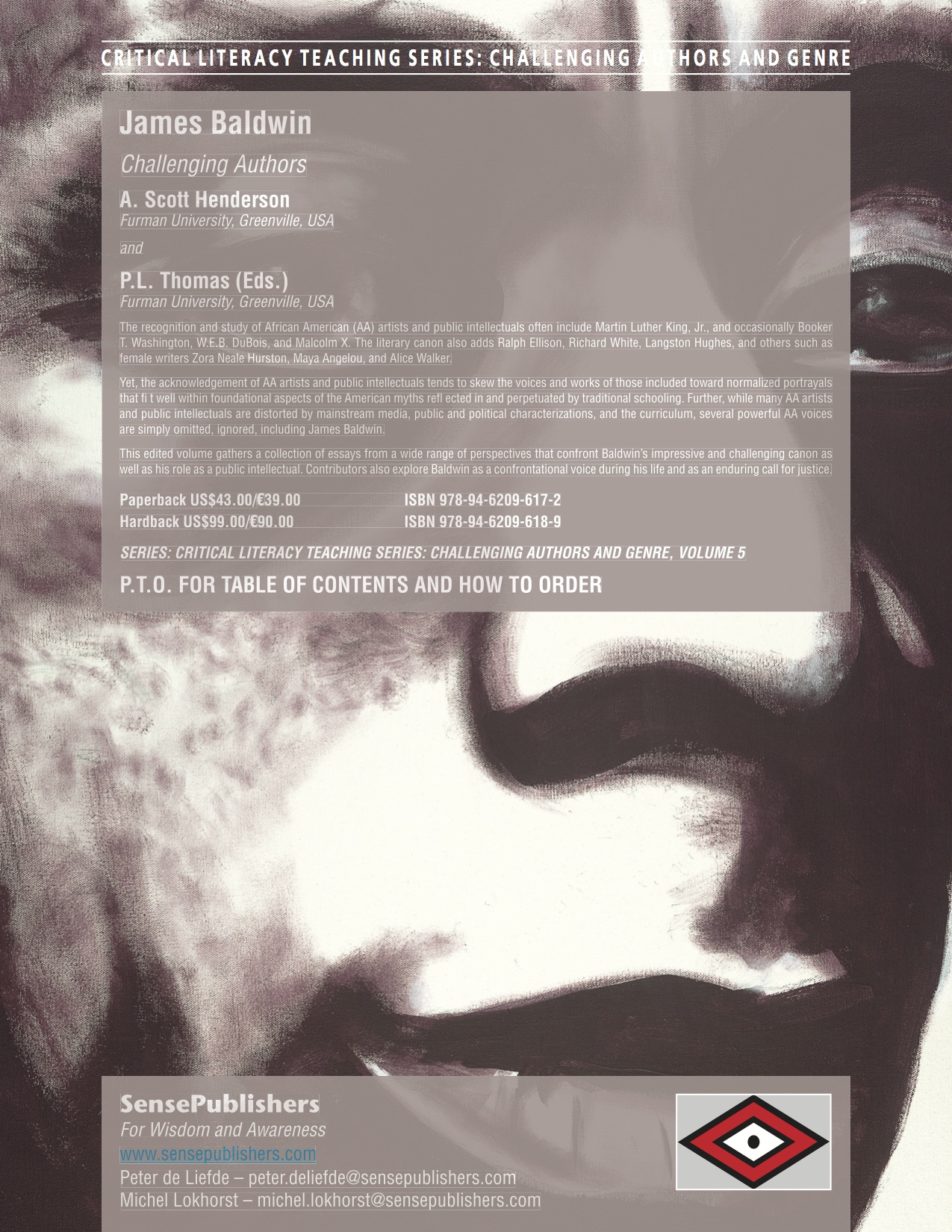
James Baldwin: Challenging Authors

Reading, Learning, Teaching Barbara Kingsolver

On Children and Childhood

children guessed(but only a few
and down they forgot as up they grew

“[anyone lived in a pretty how town],” e.e. cummings

In one of those early years of becoming and being a teacher, when I was still teaching in the exact room where I had been a student (a school building that would eventually be almost entirely destroyed by a fire set by children), it was the first day of school, and I was calling that first roll—a sort of silly but important ritual of schooling for teachers and students.

Toward the back of the room and slightly to my left sat a big young man, a white male student typical of this rural upstate South Carolina high school in my home town; like me, he would accurately be considered in that context as a Redneck.

Just about everyone knows everyone in my hometown, and we are very familiar with the common names of that town. So when I came to this young man’s name—Billy Laughter (it rhymes with “slaughter”)—I said “Billy Laughter” (rhyming the last name with “after”).

Smiling, I scanned the room and then turned my eyes back to Billy; he was red-faced and on the edge of having a very bad first day, one that was likely going to result in his being punished for my having done a very stupid thing. I raised my hand, palm facing him, and said, “Billy, my mistake. I’m sorry. I was trying to be funny but it wasn’t.” And then I said his name correctly.

Billy had suffered a life of people mangling his name, and he wasn’t in any mood for my being clever on the first day of school.

Several years later, when I was teaching a U.S. history class as part of  my usual load as a member and chair of the English department, while I was having students form small groups, two young white males bumped into each other, back to back, while moving their desks. I caught the moment out of the corner of my eye and had to rush over to deter the fight that was about to occur.

I wasn’t surprised—this was typical of my small community, along with fights starting because “he/she looked at me wrong”—but some time after this, I saw a research study that explained how people in the South and North handled personal space differently. In the South, bumping into someone or looking at someone wrong is often interpreted as challenging someone’s honor, requiring a response. People in the North, conditioned by mass transit and crowded cities (I suspect the study was as much about rural and urban, as South and North), are not as apt to find acts of close proximity anything other than that.

So setting aside the urge to examine the Redneck honor code, I want to add just one more event from my coaching life in those middle years of my teaching.

While running a drill at soccer practice, I heard a comment from a player in a group behind me. My mind heard a player with whom I had been having trouble. He was difficult in class and on the team, and worst of all, he was very disruptive at practice.

I turned and, without hesitating, I announced, “You are out of here,” pointing with my finger up the hill. Throwing him out of practice? No, I kicked him off the team.

As the young man was walking up that hill, a timid player on the team said, “Coach, that was me.”

I had just kicked a young man off the team who had, in fact, not said a thing.

A day or so ago, I received an email from Alfie Kohn about his new book, The Myth of the Spoiled Child. Alfie was apologetic about self-promotion so I replied, thanked him for the book, and noted a book I am co-editing that appears to be of a similar mind about children and childhood, Pedagogies of Kindness and Respect: On the Lives and Education of Children.

I also noted that our perspectives on children—on how parents, teachers, and society treat children—appears to be a minority view.

I have been mulling, then, or more likely stewing about this for some time: What makes adults—even the ones who choose to spend their lives with children—so damned negative and hateful about those children?

That, I must admit, is the source of my palpable anger at the “grit,” “no excuses,” and “zero tolerance” narratives and policies.

I grew up and live in the South where the default attitude toward children remains that they are to be seen and not heard, that a child’s role is to do as she/he is told. If a child crosses those lines, then, we must teach her/him a lesson, show her/him who is boss—rightfully, we are told, by hitting that child: spare the rod spoil the child.

That Christ’s love comes in the form of corporal punishment has never made any sort of sense to me, but I find that same deficit view of children is not some backwoods remnant of the ignorant South; it is the dominant perspective of children throughout the U.S.

Barbara Kingsolver explains in “Everybody’s Somebody’s Baby”:

This is not the United States.

For several months I’ve been living in Spain, and while I have struggled with the customs office, jet lag, dinner at midnight and the subjunctive tense, my only genuine culture shock has reverberated from this earthquake of a fact: People here like kids. They don’t just say so, they do. Widows in black, buttoned-down c.e.o.’s, purple-sneakered teen-agers, the butcher, the baker, all have stopped on various sidewalks to have little chats with my daughter. Yesterday, a taxi driver leaned out his window to shout ” Hola, guapa !” My daughter, who must have felt my conditioned flinch, looked up at me wide-eyed and explained patiently, “I like it that people think I’m pretty.”

With a mother’s keen myopia, I would tell you, absolutely, my daughter is beautiful enough to stop traffic. But in Santa Cruz de Tenerife, I have to confess, so is every other person under the height of one meter. Not just those who agree to be seen and not heard. When my daughter gets cranky in a restaurant (and really, what do you expect at midnight?), the waiters flirt and bring her little presents and nearby diners look on with that sweet, wistful gleam of eye that before now I have only seen aimed at the dessert tray. Children are the meringues and eclairs of this culture. Americans, it seems to me now, sometimes regard children as a sort of toxic-waste product: a necessary evil, maybe, but if it’s not their own they don’t want to see it or hear it or, God help us, smell it.

I just don’t get it.

A child is not a small adult, not a blank slate to be filled with our “adult weariness,” or a broken human that must be repaired (I won’t belabor, but the whole Original Sin idea doesn’t help and justifies the drive to use the rod).

But it is also certainly true that children are not angels, not pure creatures suited to be simply set free to find the world on their own.

Seeing children through deficit or ideal lenses does not serve them—or anyone—well.

And within the U.S. culture there is a schizophrenia—we worship young adulthood in popular media, but seem to hate children—that is multiplied exponentially by a lingering racism and classism that compounds the deficit view of childhood. Consider the research showing how people view children of color:

Asked to identify the age of a young boy that committed a felony, participants in a study routinely overestimated the age of black children far more than they did white kids. Worse: Cops did it, too….

The correlation between dehumanization and use of force becomes more significant when you consider that black boys are routinely estimated to be older than they are….

The less the black kids were seen as human, the less they were granted “the assumption that children are essentially innocent.” And those officers who were more likely to dehumanize black suspects overlapped with those who used more force against them.

In the enduring finger-pointing dominant in the U.S.—blaming the poor for their poverty, blaming racial minorities for the burdens of racism, blaming women for the weight of sexism—we maintain a gaze that blinds us to ourselves, allows us to ignore that in that gaze are reflections of the worst among us.

Why do the police sweep poor African American neighborhoods and not college campuses in search of illegal drugs? Why do we place police in the hallways of urban high schools serving mostly poor African American and Latino/a students, demanding “zero tolerance”? Why are “grit” narratives and “no excuses” policies almost exclusively targeting high-poverty, majority-minority schools (often charter schools with less public oversight)?

When I raise these questions, I can rest assured I will inspire the same sort of nasty response I often encounter when cycling. A few motorists make their anger known when we are riding our bicycles, and I am convinced that while some are genuinely frustrated with our blocking temporarily the road, the real reason they are angry is that we are enjoying ourselves as children do.

And nothing angers a bitter adult as much as the pleasures of a child.

Children are not empty vessels to be filled, blank hard drives upon which we save the data we decide they should have. Children are not flawed or wild, needing us neither to repair nor break them.

And children are not to be coddled or worshipped.

They are children, and they are all our children.

Yes, there are lessons to be taught, lessons to be learned. But those driven by deficit or idealized views are corrupted and corrupting lessons.

Each and every child—as all adults—deserves to have her/his basic dignity respected, first, and as adults charged with the care of any child, our initial question before we do anything with or to a child must be about ourselves.

In 31 years of teaching, I can still see and name the handful of students I mis-served, like Billy above. Those faces and names serve as my starting point: With any child, first do no harm.

The ends can never justify the means.

educator, public scholar, poet&writer – academic freedom isn't free