Thomas: Don’t link teacher pay to student test scores

Thomas: Don’t link teacher pay to student test scores 

Linking teacher evaluations to student standardized test scores is a bad idea that will not die.

The S.C. League of Women Voters issued a report in 2013 endorsing a plan to include what are called value-added methods in teacher evaluations, despite the overwhelming evidence that they are unreliable in high-stakes policies.

H.4419, sponsored by Rep. Andy Patrick, requires that half of teacher evaluations must be based on “evidence of growth in student achievement using a student growth model as determined by the department for grade levels and subjects for which student standardized assessment data is available.”

These teacher evaluation methods join grade retention, charter schools and Common Core as bad policies that are refuted by the research base — resulting in a tremendous waste of time and funding that could be better spent for our students and our state.

For example, Edward H. Haertel’s Reliability and validity of inferences about teachers based on student test scores (ETS, 2013) offers yet another analysis that details how value-added methods fail as a credible policy initiative.

Haertel refutes the popular and misguided perception that teacher quality is a primary influence on student test scores. As many researchers have detailed, teachers account for about 10 percent to 15 percent of student test scores. While teacher quality matters, access to experienced and certified teachers as well as addressing out-of-school factors dwarf narrow measurements of teacher quality.

He also concludes that standardized tests create a “bias against those teachers working with the lowest performing or the highest performing classes,” which makes it hard to justify using student test scores as anything more than a modest factor in teacher-evaluation systems.

Instead, Haertel calls for teacher evaluations grounded in three evidence-based “common features”:

“First, they attend to what teachers actually do — someone with training looks directly at classroom practice or at records of classroom practice such as teaching portfolios. Second, they are grounded in the substantial research literature, refined over decades of research, that specifies effective teaching practices…. Third, because sound teacher evaluation systems examine what teachers actually do in the light of best practices, they provide constructive feedback to enable improvement.”

Haertel concedes that value-added methods may have a “modest” place in teacher evaluation. That’s no ringing endorsement, and it certainly refutes the primary — and expensive — role that they play in proposals to reform teacher evaluation in South Carolina and across the country.

Would South Carolina benefit from focusing on teacher quality — as well as ensuring that all children have equitable access to experienced and certified teachers? Absolutely. Teacher effectiveness is strongly connected to the conditions of teaching, however, and value-added-method evaluations promise to erode, not enhance, those conditions.

Linking teacher evaluation in any way to test scores will force teachers to teach to the tests (and thus ask less of all students), expand an already expensive testing regime and discourage teachers from working in the most challenging schools and communities.

The calls to implement policy that is contradicted by a growing body of research are not only misguided but also likely to cause far more harm than good — and drain valuable time and resources from our schools.

Our students, teachers and schools cannot afford doubling down on a failed test-based education culture.

Dr. Thomas is an associate professor at Furman University and a former high school English teacher; contact him at Paul.Thomas@furman.edu or follow him on Twitter @plthomasEdD.

Common Core Costs Too High, Failure Guaranteed

Teaching literacy has been my career and life for over thirty years now. Having grown up in the South with my own peculiar grasp of so-called standard English, I feel fortunate to have rich and lingering struggles with using the language in ways that conform to the ever-shifting conventions of “good English.”

As a teacher, I have watched the field of literacy flounder under this failure of logic: Expert reading and writers demonstrate X, Y, Z skills; thus, the way to move novice readers and writers to expert is to give them X, Y, Z skills.

Yes, that seems compelling and doable, but it is folly.

One of the main areas of that compulsion to teaching literacy in direct and isolated ways is vocabulary instruction, often anchored by the vocabulary book.

Many moons ago when I was a pup of a teacher, my English department was faced with choosing new vocabulary books. The decision came down to selecting the book that the company had cleverly placed in bold letters on the front, “Correlated with the SAT!”

Before the 2005 retooling of the SAT, isolated vocabulary knowledge was embedded in the infamous analogy section of the SAT (since 2005, the value of isolated vocabulary knowledge has been greatly reduced, but instruction has failed to follow suit).

Thus, in the weird and misleading world of the tests-justify-the-means of traditional schooling, isolated vocabulary instruction and vocabulary textbooks have remained robust parts of misguided literacy instruction across the U.S. (By the way, expert readers have extensive vocabularies because they read extensively—not because they learn words from vocabulary lists.)

This anecdote about testing, classroom instruction, and textbooks is offered as context for new research examined in Education WeekResearch Questions Common-Core Claims by Publishers:

Hoping to boost their share of a $9 billion annual market, many publishers now boast that their textbooks are “common-core aligned” and so can help spur the dramatic shifts in classroom instruction intended by the new standards for English/language arts and math.

But in a Feb. 21 presentation of his research at a seminar in Los Angeles hosted by the Education Writers Association, William Schmidt, a professor of statistics and education at Michigan State University in East Lansing, dismissed most purveyors of such claims as “snake oil salesmen” who have done little more than slap shiny new stickers on the same books they’ve been selling for years.

People do not like math, but it is well past time to do the math on Common Core.

Put simply, Common Core is a guaranteed failure because it is a demonstrably failed reform strategy. As I have noted numerous times, the research base is clear that there is no correlation between the existence or quality of standards and student outcomes, and standards have not been shown to address equity (see Mathis, 2012).

Common Core and the related tests accomplish only one real positive outcome: The process creates an ever-revolving door of “new” standards and tests that feed the publishing and materials markets (the standards/testing accountability paradigm is a consumerism model).

While state and federal funds are being drained to re-train teachers, buy new textbooks, invest in new technology, and create and implement new tests (none of which will work and we’ll do this all again in 10 years or so), all of that effort and money could have (should have) been used to address the identifiable problems facing our schools—which have nothing to do with standards or tests (except that we need neither).

Common Core advocacy remains a mirage, a faith-based argument that is driven by commitments that have little to do with education, equity, democracy, or children.

If we have “new” standards and thus “new” tests, we need “new” textbooks, and if we need “new” materials, a few somebodies somewhere make $9 billion dollars.

The next time someone starts to endorse Common Core, superimpose in your mind’s eye “$9 billion taxpayers’ dollars” over her/his face because that is all that really matters.

Finally, the math:

Classroom time – isolated vocabulary instruction and texts = time for students to read

$$$ spent on Common Core – Common Core = $$$ better spent on real problems facing schools

Recommended

Business Opportunities Seen in New Tests, Low Scores, Jason Tomassini

Critical Pedagogy or Core Knowledge?

For those of us committed to critical pedagogy (CP) as scholars and classroom teachers, Tait Coles’s call for CP instead of commitments to core knowledge (CK) is a rare moment in the mainstream press, as Coles concludes:

Education has the power to change social inequality by nurturing a generation with an educated mistrust of everything that has been indoctrinated before. This educational stance is one that we must all strive for as the moral purpose of education.

This call by Coles also prompted Twitter debates and blogs addressing CK (and E.D. Hirsch) and CP—including tweets and blogging from Harry WebbDaisy Christodoulou, and Christina Milos (see here and here), for example.

One important lesson from the debates focusing on CP and CK is that often what scholars such as Hirsch (CK) and Paulo Freire (CP) embrace is either (consciously and unconsciously) misrepresented by critics, never examined by critics, or distorted in its application by practitioners.

In short, that first lesson creates a mess for everyone involved, especially those of us who have very similar educational goals but distinct disagreements about how to achieve those goals.

I embrace CP, and like many who do, I came to CP through the traditional assumptions about teaching, learning, and knowledge. My education conformed far more closely to Hirsch’s vision of education than to Freire’s.

Thus, I began grounded in positivism, behaviorism, cultural literacy, New Criticism, and mastery learning. And as many CP scholars and practitioners have come to understand, all of these societal and educational norms have significant blind spots that work against educational goals related to democracy, liberation, community, and autonomy.

The second lesson from the debate is that CP—as is the case with progressivism—is routinely discredited by straw man claims that confuse CP with reductive versions of postmodernism and existentialism.

Setting aside the cult of personality involved in this debate (adherents to either Hirsch or Freire who feel compelled to protect the honor of the scholars), I want to address several key points about CP so that those who wish to reject CP can do so fairly—not with baseless stereotypes and straw man arguments.

First, CP is philosophical and theoretical, and thus, most of the foundational work on CP reads as philosophy and theory do—the language is often prone to technical terms, if not jargon, and the elaboration of ideas is equally dense, sometimes to the point of being impenetrable.

If we wish to discount CP for those qualities, then we might as well do so for all philosophical and theoretical examinations of knowledge—which strikes me as counter to the entire argument of CK advocates that knowledge is primary, often because that knowledge is complex, challenging.

I wish CP scholars and advocates would work to make the ideas accessible to more people, to all people, so in that part of the debate, I am certainly acknowledging the message problem found in CP.

But to careless claims that CP isn’t credible because it isn’t based on scholarship, research, sound theory, or other expectations for so-called “rigorous” standards is simply inaccurate. CP does acknowledge and include ways of knowing outside the norms critics tend to use to make those charges—which of course, proves CP’s point: Whether or not knowledge matters is controlled by whoever has the power; in other words, knowledge is never a value-free body:

Thus, proponents of critical pedagogy understand that every dimension of schooling and every form of educational practice are politically contested spaces. Shaped by history and challenged by a wide range of interest groups, educational practice is a fuzzy concept as it takes place in numerous settings, is shaped by a plethora of often-invisible forces, and can operate even in the name of democracy and justice to be totalitarian and oppressive. (Kincheloe, 2005, p. 2)

For advocates of CP, then, the question is not about the value of knowledge—or, as many critics of CP carelessly claim, that knowledge doesn’t matter—but about who decides what knowledge matters and that education must never be allowed to be reduced to indoctrination, as Kincheloe explains:

Recognition of these educational politics suggests that teachers take a position and make it understandable to their students. They do not, however, have the right to impose these positions on their students [emphasis in original]….

In this context it is not the advocates of critical pedagogy who are most often guilty of impositional teaching but many of the mainstream critics themselves. When mainstream opponents of critical pedagogy promote the notion that all language and political behavior that oppose the dominant ideology are forms of indoctrination, they forget how experience is shaped by unequal forms of power. To refuse to name the forces that produce human suffering and exploitation is to take a position that supports oppression and powers that perpetuate it. The argument that any position opposing the actions of dominant power wielders is problematic. It is tantamount to saying that one who admits her oppositional political sentiments and makes them known to students is guilty of indoctrination, while one who hides her consent to dominant power and the status quo it has produced from her students is operating in an objective and neutral manner. Critical pedagogy wants to know who’s indoctrinating whom. (p. 11)

And so we come to the key problems found in CK for those of us embracing CP.

CK and cultural literacy are inherently flawed because they rest on claims that CK and cultural literacy can be easily and objectively identified. CP advocates recognize that CK and cultural literacy are suspect, as is all knowledge.

As two brief examples—both of how CP challenges CK and cultural literacy as well as how CP embraces the power of knowledge—are the work of Howard Zinn as a radical historian and Eugene F. Provenzo, Jr. as a critic of Hirsch and cultural literacy.

In Zinn’s A People’s History of the United States, a powerful case is made for both the importance of knowledge and that who tells the story of history determines what that knowledge is. Advocates of CP are not saying knowledge doesn’t matter, but that all knowledge and truth claims are suspect and must be investigated by students, not simply determined for the learner and transmitted to the learners.

All historical claims likely benefit some group over others. Traditional history, Zinn shows us, has been told by the winners and to benefit those winners. History told from the perspective of the people (and including the voices of those people, people who have often been the losers and thus silenced) is much different than the version told from the winners and more likely to be closer to true for the great majority of people.

Provenzo offers a parallel exercise to Zinn’s wider body of work in history by demonstrating that Hirsch’s cultural literacy is bound by cultural assumptions, one of which is that cultural literacy must be passed on from one generation to the next in order to sustain that culture (and here is the most damning aspect of CK/cultural literacy for CP advocates).

In his Critical Literacy: Challenging E. D. Hirsch, Jr. and the Cultural Literacy Movement, Provenzo offers an alternative to Hirsch’s endorsing a Western canon of core knowledge. In other words, no body of knowledge is value-free; change the assumptions about what knowledge matters, and the “core” changes also.

Briefly then, CP does not reject the value of knowledge, but in fact, highlights that knowledge is foundational while always being suspect. The point of education is not to consume or attain knowledge (indoctrination) but to identify and challenge it (critical literacy)—and all students must be provided the exact same opportunities to identify and challenge the knowledge bases of disciplines.

A final misrepresentation of CP concerns the role of teachers. A common criticism of CP is that teachers play a small or even no role in the learning of students. Nothing could be farther from the truth; as well, the role of knowledge is also central to how CP defines the teacher.

CP argues that teachers should guide learning in an authoritative role (authority gained from the teacher’s status built on her/his knowledge and as a model for students) and not an authoritarian role (authority gained from the teacher’s status primarily or solely for being identified as the teacher). In CP, the ideal roles are teacher/student and students/teachers—everyone involved in the teaching-learning process are both learners and teachers, but the teacher has the primary role as authoritative in the discipline being addressed (Paulo Freire, Pedagogy of the Oppressed).

As Freire (1998) argues, “Teachers who do not take their own education seriously, who do not study, who make little effort to keep abreast of events have no moral authority to coordinate the activities of the classroom” (p. 85). In CP, teachers are expected to be experts in their fields. Period.

Teachers must personify authoritative knowledge, then—which contradicts charges CP is somehow promoting ignorance. But another equally false change is how teachers interact with student learning, as in Christodoulou’s misrepresention:  Freire’s “critical pedagogy involves teachers working with the knowledge pupils already have and with the knowledge pupils are able to discover independently.”

What does Freire actually say on this?:

It is in this sense that both the authoritarian teacher who suffocates the natural curiosity and freedom of the student as well as the teacher who imposes no standards at all [emphasis added] are equally disrespectful of an essential characteristic of our humanness, namely, our radical (and assumed) unfinishedness, out of which emerges the possibility of being ethical. (p. 59)

Rejecting CP for not honoring knowledge, refusing some children access to knowledge, and discounting the role of the teacher in learning is simply all false, straw man arguments.

I think the best way to understand CP is to consider that Michel Foucault, a renowned French philosopher, criticized CP for being political and often polemic, but CP scholars likely cite Foucault as much if not more than any other thinker.

As included above from Kincheloe, CP is not about ignoring knowledge or even discrediting all knowledge, but ultimately, CP is this: “Critical pedagogy wants to know who’s indoctrinating whom.”

And to do so cannot happen without authoritative teachers and a rich body of knowledge—one that may of course include CK, but certainly asks that we move beyond that as well.

References

Buras, K.L. (1999). Questioning core assumptions: A critical reading of and response to E. D. Hirsch’s The schools we need and why we don’t have them. Harvard Educational Review, 69(1).

Foucault, M. (1984). The Foucault reader. Ed. P. Rabinow. New York: Pantheon Books.

Freire, P. (1998). Pedagogy of freedom: Ethics, democracy, and civic courage. P. Clarke (Trans.). Lanham, MD: Rowman and Littlefield.

Freire, P. (1993). Pedagogy of the oppressed. M.B. Ramos (Trans.). New York: Continuum.

Greene, M. (1995). Releasing the imagination: Essays on education, the arts, and social change. San Francisco: Jossey-Bass.

Kincheloe, J. L. (2005). Critical pedagogy primer. New York: Peter Lang.

South Carolina and Common Core: A Next Step?

Oran P. Smith, a senior fellow at Palmetto Policy Forum, introduces in The State a new report on Common Core from the conservative think tank:

After the hearing, I concluded that John Hill of the Alabama Policy Institute had it right when he wrote: “Although both sides of the Common Core debate make arguments worth consideration, both the potential benefits and pitfalls related to Common Core have been the subject of exaggeration and error.”

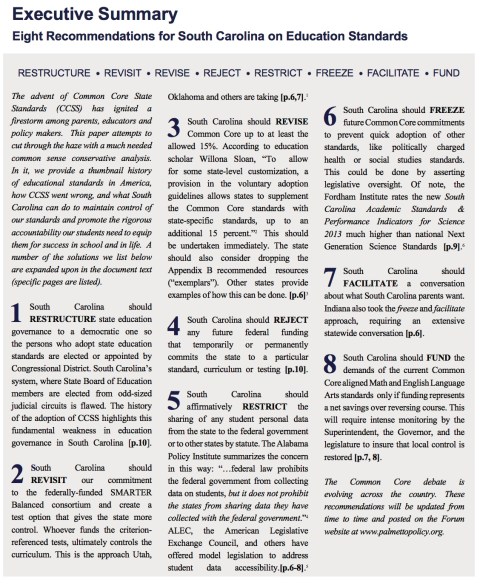
This is why Palmetto Policy Forum recently released a paper we believe cuts through the Common Core fog, outlining an eight-point plan to return unquestioned control of education standards to S.C. parents.

Several points can be taken from the release of this report on CC.

First, the report fails as many ideological think tank reports do because it speaks uncritically to its ideological base (this report has glowing images and commentary on Ronald Reagan and Jeb Bush, for example).

Second, the report also fails by offering an incomplete consideration of the extensive research base on CC and the entire standards movement.

And third, despite these weaknesses, it seems only fair to highlight that the eight recommendations have much to applaud:

8 recs SC copy

[click to see full report; 8 recommendations on page 1]

These recommendations hold some promise but with caveats.

The report must be viewed through the lens of a detailed history of how CC developed as well as the entire standards movement begun under Reagan; see for example:

Whatever Happened to Scientifically Based Research in Education Policy?

Corporations Are Behind The Common Core State Standards — And That’s Why They’ll Never Work

The research base on CC must be examined, noting that CC is unlikely to create outcomes any different than the standards movements preceding the new standards (notably about three different waves in SC); see for example:

What We Know (and Ignore) about Standards, Achievement, and Equity

On Public Schools and Common Core: Graff’s Critique of Ravitch

Should SC Ditch Common Core?

Please note the research base:

  • Hout and Elliott (2011), Incentives and Test-Based Accountability in Education: Most recent decades of high-stakes accountability reform hasn’t work.
  • French, Guisbond, and Jehlen (2013), Twenty Years after Education Reform: High-stakes accountability in Massachusetts has not worked.
  • Loveless (2012), How Well Are American Students Learning?: “Despite all the money and effort devoted to developing the Common Core State Standards—not to mention the simmering controversy over their adoption in several states—the study foresees little to no impact on student learning” (p. 3).
  • Mathis (2012): Existence and/or quality of standards not positively correlated with NAEP or international benchmark test data; “Further, the wave of high-stakes testing associated with No Child Left Behind (NCLB) has resulted in the ‘dumbing down’ and narrowing of the curriculum” (2 of 5).
  • Whitehurst (2009), Don’t Forget Curriculum: “The lack of evidence that better content standards enhance student achievement is remarkable given the level of investment in this policy and high hopes attached to it. There is a rational argument to be made for good content standards being a precondition for other desirable reforms, but it is currently just that – an argument.”
  • Kohn (2010), Debunking the Case for National Standards: CC nothing new, and has never worked before.
  • Victor Bandeira de Mello, Charles Blankenship, Don McLaughlin (2009), Mapping State Proficiency Standards Onto NAEP Scales: 2005-2007: Why does research from the USDOE not show high-quality standards result in higher NAEP scores?
  • Horn (2013): “The 2012 NAEP Long-Term Trends are out, and there is a good deal that we may learn from forty years of choking children and teachers with more tests with higher stakes: IT DOESN’T WORK!”

Smith argues at the end of his Op-Ed, “This is not a time for mutual destruction,” and I agree.

I remain skeptical, but I wonder if this report suggests the possibility that SC is moving toward a reasonable reaction to CC.

I hope so because SC remains a high-poverty state stratified by wealth and poverty; no one in the state, especially the children in our schools, can afford more partisan political grandstanding over education policy.

I am willing to set aside the misleading nods to Reagan and Jeb Bush (both key causes of this problem) in order to enact the 8 recommendations above because at least then we will have a space within which to confront the issues left unaddressed—notably the inordinate cost of yet more commitments to new standards and tests that will, I guarantee, fail our children in SC.

A Brief Meditation on Choice

Deborah Meier reminds us that “one can’t  ‘choose’ to be the children of the wealthy,” adding later:

You and I—or some other somebodies—are deciding the future of “other people’s children” [hyperlink added] unless we provide ways for “them” to have a voice, a vote, and the resources to decide their own future.   We need to restore a better balance between local communal life (with its power to effect some immediate changes like we did at the small self-governing schools I love) and distant, “objective” moneyed power.  It’s our democracy that rests on our rebuilding strength at the bottom.  If we don’t, we induce a passivity that surely cannot be in the self-interest of the least powerful, but might (just might) be in the self-interest of others.  And then we blame them for being passive?

Without consciously deciding to do so, I have just finished reading the novels of Jeffrey Eugenides in reverse chronological order, ending just yesterday with The Virgin Suicides.

In his first novel, the story of five sisters who all commit suicide, the reader is pulled into a collective recollection that feels invasive and obsessive. We are left with many questions about these lost lives. But central to the narrative is the role of the girls’ parents.

One moment in the novel involves the mother forcing one daughter to destroy in a fire and then throw away the girl’s treasured record albums.

This and other scenes in The Virgin Suicides reminded me of the many situations like the one above that my students experienced in their homes—conflicts that hurt and even scarred young people in ways that almost no one would ever recognize.

My daughter is now 24, expecting a child, and if I have learned anything as a teacher, a son, and a parent, it is that parents are apt to make poor choices for their own children—even out of love, but also out of sheer flaws in their own character.

I have parents who gave me an almost idyllic childhood, but they also chose to smoke in the car with my sister and me in the back seat.

A few years ago, I wrote Parental Choice?: A Critical Reconsideration of Choice and the Debate about Choice, a book that approaches the school choice debate from a critical perspective. And I very purposefully did not use “school” in the title since I believe at the root of the school choice movement is the powerful and idealized view of parental choice as a subset of the larger myth in the U.S. about individual choice.

Also during my 18 years teaching public school in the rural Upstate of South Carolina, I was approached every year by students who were preparing to drop out of high school as soon as they reached 16 years of age. They would explain to me that the decision had been prompted by their parents, who explained that either they had dropped out and were doing fine (they often quoted the hourly rate of their parents’ salaries as evidence) or that they now saw no value in what high school graduation gave them.

When choice advocates discuss the primary importance of parental choice, they tend never to mention that dropping out of school is a form of parental choice.

Just as workers in the impoverished South have been manipulated into voting for and embracing ideologies against their own self-interests—where “right to work” resonates even though the law allows employers the right to fire at will—a populist/libertarian refrain that idealizes “choice,” in fact, serves as a mask for maintaining an imbalance of individual freedom in the U.S.

“Poor and minority parents should have the same choices as affluent and white parents” is a compelling refrain.

But it is ultimately a lie.

Idealizing and prioritizing choice renders choice meaningless—but those arguments do insure that the 1% always wins.

Yes, individual choice is an important part of the human condition as well as a central right of a free people in a democracy.

For choice to matter, though, the Commons, the public good must be established first.

Just as Meier notes that no child chooses her or his parents, home, community, or socioeconomic status, we must acknowledge that no one should be required to choose the basics of human existence.

No one should have to choose a good police force.

No one should have to choose a good military.

No one should have to choose good medical care.

And no one should have to choose a good school.

The implication of having to choose the essentials that should be a part of the Commons is that bad alternatives exist—and they must not.

The only way to honor choice as a free people is to first insure the Commons that allow choice to exist in equitable and ethical ways.

Idealizing choice as a primary and universal good is a lie like “right to work.”

The first choice of a free people, ironically, is to insure those conditions that should require no choice—and public education is one of those foundational contracts among a free people that must be guaranteed regardless of to whom or where a child is born.

“Hunting Scapegoats”: WWII Literacy Crisis and Current Education Reform

[Header Photo by Christian Chomiak on Unsplash]

“Historians often mention World War II as a time when expectations for schooling and literacy really took off,” explains Deborah Brandt [1], “when what was considered an adequate level of education moved from fourth grade to twelfth grade in a matter of a few years” (p. 485).

National concerns about literacy can be traced to literacy tests for soldiers in WWI, when 25% of recruits were deemed illiterate. While this data appear to have prompted a greater focus on literacy in U.S. public schools, WWII data on literacy again suggested far too many people in the U.S. struggled with basic literacy. As Brandt notes:

Even more profoundly, though, World War II changed the rationale for mass literacy. Literacy was irrevocably transformed from a nineteenth-century moral imperative into a twentieth-century production imperative—transformed from an attribute of a “good” individual into an individual “good,” a resource or raw material vital to national security and global competition. In the process, literacy was turned into something extractable, something measurable, some-thing rentable, and thereby something worthy of rational investment. (p. 485)

From the early to mid-twentieth century, then, a powerful dynamic was created among racial integration, military-based measurement of IQ and literacy, and changing expectations for public education.

Brandt sees those relationships in current education reform ideologies and claims:

We can find eerie parallels between the selective service system of the mid-twentieth century and the public educational system of the early twenty-first century. There is the atmosphere of high anxiety around literacy, rapidly changing standards, an imposition of those standards onto more and more people, a search (largely futile) for reliable testing, a context of quick technological development, a heightened concern for world dominance, and a linking of literacy with national security, productivity, and total quality control. This is what happens when literacy links up with competition, with the need to win the war. It is this competition that justifies the strip mining of literacy, the ranking of skill, the expendability of human potential, and the production of just-in-time literacy. It is the blueprint for the Knowledge Economy. (p. 499)

Calls of a literacy crisis during WWII are roots of similar cries of education crisis spanning from the early 1980s until today. And throughout either era, the complexities of the problems are ignored in order to force agendas that have less to do with education than with serving larger social and political goals—often ones benefitting the privileged at the expense of the impoverished and marginalized.

In 1942, Lou LaBrant confronted the misleading conclusions drawn about low literacy rates among WWII draftees:

The induction of American youth into the armed forces, and the attendant examinations and classifications have called attention to a matter long of concern to those who teach reading or who are devoted to the cause of democracy: the fact that in a land which purports to offer universal education we have a considerable number of youth who cannot read intelligently. We are disturbed now because we want these men to be able to read military directions, and they cannot. A greater tragedy is that they are and have been unable to read with sufficient understanding to be constructive peace-time citizens.

As is to be expected, immediate explanations have been forthcoming, and immediate pointing-of-fingers has begun. Most of the explanations and pointing have come from those who have had least to do with teaching reading, and who are least conversant with the real problem. Moreover, as is again to be expected, the diagnosis is frequently in terms of prejudice or pet complaint, and could be used in other situations as logically. Many are hunting scapegoats; there are scores of “I-told-you-so’s.” It is best to look at the situation critically. (p. 240)

LaBrant recognized, as a teacher and scholar of literacy, that public blame for the low literacy rates suffered from both a lack of expertise about literacy and a number of complicating factors. For example, the standard for literacy changed from generation to generation, and WWII experienced an expanded pool of recruits due to integration, which of course included African Americans and impoverished men who had been systematically denied educational opportunities.

The political and public response to low literacy rates among the military in WWII included blaming progressive education and calling for a back-to-basics focus, as LaBrant addressed:

Within the past ten years we have made great strides in the teaching of purposeful reading, reading for understanding (the kind of reading, incidentally, which the army and navy want) . Nevertheless, we hear many persons saying that the present group of near-illiterates are results of “new methods,” “progressive schools,” or any deviation from the old mechanical procedures. They say we must return to drill and formal reciting from a text book. (p. 240)

The pattern identified by LaBrant foreshadows the rise of high-quality writing instruction in the 1970s-1980s that was blunted by the accountability era’s focus on standards and high-stakes testing.

But, as LaBrant outlined, public and political blame placed on progressivism was misguided, and ultimately misleading:

Before we jump to such an absurd conclusion, let’s take a minute to think of a few things:

1. Not many men in the army now have been taught by these newer methods. Those few come for the most part from private or highly privileged schools, are among those who have completed high school or college, and have no difficulty with reading.

2. While so-called “progressive” schools may have their limitations, and certainly do allow their pupils to progress at varied rates, above the second grade their pupils consistently show superior ability in reading. Indeed, the most eager critics have complained that these children read everything they can find, and consequently do not concentrate on a few facts. Abundant data now testify to the superior results of purposeful, individualized reading programs.

3. The reading skills required by the military leaders are relatively simple, and cause no problem for normal persons who have remained in school until they are fourteen or fifteen. Unfortunately the large group of non-readers are drop-outs, who have not completed elementary school, come from poorly taught and poorly equipped schools, and actually represent the most conservative and back- ward teaching in the United States. (pp. 240-241)

Again, consider the pattern: Implement new and developing tests (literacy tests during WWII), identify a problem related to education, create a scapegoat, and then call for a return to traditional drill-based education. Does this sound familiar?

Now add what was not being addressed in 1942, as detailed by LaBrant:

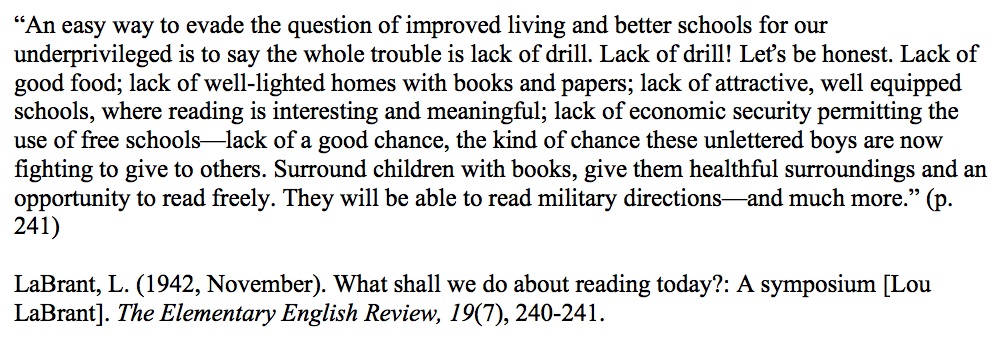
An easy way to evade the question of improved living and better schools for our underprivileged is to say the whole trouble is lack of drill. Lack of drill! Leťs be honest. Lack of good food; lack of well-lighted homes with books and papers; lack of attractive, well equipped schools, where reading is interesting and meaningful; lack of economic security permitting the use of free schools—lack of a good chance, the kind of chance these unlettered boys are now fighting to give to others. Surround children with books, give them healthful surroundings and an opportunity to read freely. They will be able to read military directions—and much more. (p. 241)

Seven-plus decades ago, public and political outrage was willing to attack a straw man, a scapegoat—progressive education—but was unwilling to confront inequity, poverty, and the linger scar of racial segregation.

Again, sound familiar?

Note

[1] Brandt, D. (2004). Drafting U.S. Literacy. College English, 66(5), 485–502. https://doi.org/10.2307/4140731 [https://www.jstor.org/stable/4140731]

Lack 1942

educator, public scholar, poet&writer – academic freedom isn't free