
More on Failing Writing, and Students
Throughout the 1980s and 1990s, I taught English in the rural South Carolina high school I attended as a student. Many of those years, I taught Advanced Placement courses as part of my load (I taught all levels of English and usually sophomores and seniors) and was department chair.
Over the years, I worked hard to create an English department that served our students well. We made bold moves to provide all students in each grade the same literature textbooks (not different texts for different levels, as was the tradition, thus labeling students publicly) and to stop issuing to students grammar texts and vocabulary books (teachers retained classroom sets to use as they chose).
And a significant part of our English classes was the teaching of writing—having students write often and to produce multiple-draft essays. I stressed the need to end isolated grammar instruction (worksheets and textbook exercises) and urged that grammar, mechanics, and usage be addressed directly in the writing process.
Even though the principal was supportive and a former English teacher, at one faculty meeting while the administrators were discussing recent standardized test scores for the school (yes, this test-mania was in full force during the 80s and 90s in SC), the principal prefaced his comments about the English test scores with, “Keep in mind that the English scores may not reflect what we are doing here since we don’t teach grammar.”*
In a nut shell, that sort of mischaracterization and misunderstanding about best practice is at the foundation of my previous post exploring Joan Brunetta’s writing about how standards- and test-based schooling had failed her.
A few comments on the post and a follow up discussion in the comments with Robert Pondiscio—as well as a subsequent post by Pondiscio at Bridging Differences—have prompted me to continue to address not only how we still fail the teaching of writing but also how that failure is a subset of the larger failure of students by traditional approaches to teaching that are teacher-centered and committed to core knowledge.
Revisiting “The Good Student Trap” in the Accountability Era
Adele Scheele has coined the term “the good student trap,” which perfectly captures how schools create a template for what counts as being a good student and then how that template for success fails students once they attend college and step into the real world beyond school. My one caveat to Scheele’s ideas is that especially during the accountability era—a ramping up of traditional practices and norms for education—this trap affects all students, not just the good ones.
And the trap goes something like this, according to Scheele:
Most of us learned as early as junior high that we would pass, even excel if we did the work assigned to us by our teachers. We learned to ask whether the test covered all of chapter five or only a part of it, whether the assigned paper should be ten pages long or thirty, whether “extra credit” was two book reports on two books by the same author or two books written in the same period. Remember?
We were learning the Formula.
• Find out what’s expected.
• Do it.
• Wait for a response.And it worked. We always made the grade. Here’s what that process means: You took tests and wrote papers, got passing grades, and then were automatically promoted from one year to the next. That is not only in elementary, junior, and senior high school, but even in undergraduate and graduate school. You never had to compete for promotions, write résumés, or rehearse yourself or even know anyone for this promotion. It happened automatically. And we got used to it….
What we were really learning is System Dependency! If you did your work, you’d be taken care of. We experienced it over and over; it’s now written in our mind’s eye. But nothing like this happens outside of school. Still, we remain the same passive good students that we were at ten or fourteen or twenty or even at forty-four. The truth is, once learned, system dependency stays with most of us throughout our careers, hurting us badly. We keep reinforcing the same teacher-student dichotomy until it is ingrained. Then we transfer it to the employers and organizations for whom we’ll work.
This model of traditional schooling includes a teacher who makes almost all the decisions and students who are rewarded for being compliant—and that compliance is identified as “achievement.”
In English classes, a subset of this process is reflected in how we teach, and fail, writing. As I noted in my earlier post, Hillocks and others have noted that traditional commitments to the five-paragraph essay (and cousin template-models of essays) and a return to isolated grammar exercises have resulted from the rise of high-stakes testing of writing. As well, the accountability era has included the central place of rubrics driving what students write, how teachers respond to student writing, and how students revise their essays.
So what is wrong with five-paragraph essays, grammar exercises, and rubrics?
Let’s focus on rubrics to examine why all of these are ways in which we fail writing and students. Alfie Kohn explains:
Mindy Nathan, a Michigan teacher and former school board member told me that she began “resisting the rubric temptation” the day “one particularly uninterested student raised his hand and asked if I was going to give the class a rubric for this assignment.” She realized that her students, presumably grown accustomed to rubrics in other classrooms, now seemed “unable to function [emphasis added] unless every required item is spelled out for them in a grid and assigned a point value. Worse than that,” she added, “they do not have confidence in their thinking or writing skills and seem unwilling to really take risks.”
Rubric-based writing and assessment, then, reflect the exact problem I highlighted earlier, one noted by Applebee and Langer: teachers know more today than ever about how to teach writing, but commitments to accountability and testing prevent that awareness from being applied in class; as Kohn explains:
What all this means is that improving the design of rubrics, or inventing our own, won’t solve the problem because the problem is inherent to the very idea of rubrics and the goals they serve. This is a theme sounded by Maja Wilson in her extraordinary new book, Rethinking Rubrics in Writing Assessment. In boiling “a messy process down to 4-6 rows of nice, neat, organized little boxes,” she argues, assessment is “stripped of the complexity that breathes life into good writing.” High scores on a list of criteria for excellence in essay writing do not mean that the essay is any good because quality is more than the sum of its rubricized parts. To think about quality, Wilson argues, “we need to look to the piece of writing itself to suggest its own evaluative criteria” – a truly radical and provocative suggestion.
Wilson also makes the devastating observation that a relatively recent “shift in writing pedagogy has not translated into a shift in writing assessment.” Teachers are given much more sophisticated and progressive guidance nowadays about how to teach writing but are still told to pigeonhole the results, to quantify what can’t really be quantified. Thus, the dilemma: Either our instruction and our assessment remain “out of synch” or the instruction gets worse in order that students’ writing can be easily judged with the help of rubrics.
Once fulfilling the expectations of the rubric becomes the primary if not exclusive goal for the student, we have the SAT writing section and the unintended consequences, as Newkirk explains (English Journal, November 2005) about students writing to prompts and rubrics for high-stakes testing:
George Hillocks Jr. has shown that another persistent problem with these types of prompts concerns evidence—the writer must instantly develop instances or examples to be used for support. In a sample of the released papers from the Texas state assessment, some of this evidence looks, well, manufactured….When I first read this essay, I imagined some free spirit, some rebel, flaunting the ethics of composition and inventing evidence to the point of parody. But when I shared this letter with a teacher from Texas, she assured me that students were coached to invent evidence if they were stuck [emphasis added]. In my most cynical moment, I hadn’t expected that cause. And what is to stop these coached students from doing the same on the SAT writing prompt? Who would know?
As but one example above, “the good student trap” is replicated day after day in the ways in which students are prompted to write and then how teachers respond to and grade that writing. The failure lies in who makes almost all of the decisions, the teacher, and who is rewarded for being mostly compliant, students.
While core knowledge advocates and proponents of rubric-driven assessment tend to misrepresent critical and progressive educators who seek authentic learning experiences for students with charges of “not teaching X” or “So what shall we teach?” (with the implication that core knowledge educators want demanding content but critical and progressive educators don’t), the real question we must confront is not what content we teach and students learn, but who decides and why.
If we return to rubrics, well designed rubrics do everything for students (see Education Done To, For, or With Students? for a full discussion of this failure), everything writers need to do in both college and the real world beyond school.
Rubric-driven writing is asking less of students than authentic writing in a writing workshop.
Traditional core knowledge classrooms are also deciding for students what knowledge matters, and again, asking less of students than challenging students to identify what knowledge matters in order to critique that knowledge as valuable (or not) for each student as well as the larger society. The tension of this debate is about mere knowledge acquisition versus confronting the norms of knowledge in the pursuit of individual autonomy and social justice—making students aware of the power implications of knowledge so that they live their lives with purpose and dignity instead of having life happen to them.
My call is not for ignoring the teaching of grammar, but for confronting the norms of conventional language so that students gain power over language instead of language having power over them. Why do we feel compelled not to end a sentence with a preposition? Where did that claim come from and who benefits from such a convention?
Why does academic writing tend to erase the writer from the writing (“No ‘I’!”) and who benefits from that convention?
You see, critical approaches to teaching go beyond the mere acquisition of knowledge that some authority has deemed worthy (what Freire labels the “banking concept” of teaching). Yes, knowledge matters, but not in the fixed ways core knowledge advocates claim and pursue. Critical approaches to knowledge honor the dignity of human autonomy in children, something that many adults seem at least leery if not fearful of allowing in their classrooms.
Core knowledge, rubrics, templates, prescriptions, and prompts are all tools of control, ways to trap students in the pursuit of compliance. They aren’t challenging (or “rigorous” as advocates like to say), and they aren’t learning.
As Scheele explains:
System dependency is not the only damaging thing we learned in the context of school: We learned our place….
Yet most of us were falsely lulled into a false self labeled “good” by fulfilling the expected curriculum. The alternative was being “bad” by feeling alienated and losing interest or dropping out….
So what’s the problem? The problem is the danger. The danger lies in thinking about life as a test that we’ll pass or fail, one or the other, tested and branded by an Authority. So, we slide into feeling afraid we’ll fail even before we do-if we do. Mostly we don’t even fail; we’re just mortally afraid that we’re going to. We get used to labeling ourselves failures even when we’re not failing. If we don’t do as well as we wish, we don’t get a second chance to improve ourselves, or raise our grades. If we do perform well, we think that we got away with something this time. But wait until next time, we think; then they’ll find out what frauds we are. We let this fear ruin our lives. And it does. When we’re afraid, we lose our curiosity and originality, our spirit and our talent-our life.
Beyond Rigor, Templates, and Compliance
In my position at a small and selective liberal arts university, I now teach mostly good students in my writing-intensive first year seminars. Students are asked to read and discuss Style, a descriptive look at grammar, mechanics, and usage that raises students’ awareness and skepticism about conventional uses of language, but rejects seeing conventions as fixed rules. (We ask why teachers in high school tend to teach students that fragments are incorrect when many published works contain fragments, leading to a discussion of purposeful language use.)
Throughout the course, students are asked to plan and then write four original essays that must be drafted several times with peer and my feedback. The focus, topic, and type of essay must be chosen by the student. To help them in those choices, we discuss what they have been required to do in high school for essays, we explore what different fields expect in college writing, and we read and analyze real-world essays in order to establish the context for the choices, and consequences of those choices, that writers make—specifically when those writers are students.
I offer this here in case you think somehow I am advocating “fluffy thinking” or a “do-your-own-thing philosophy” of teaching, as some have charged. And I invite you to ask my students which they prefer, which is easier—the template, prompt-based writing of high school that created their good student trap or my class. [HINT: Students recognize that five-paragraph essays and rubrics are easier, and they often directly ask me to just tell them what to write and how. As Mindy Nathan noted above, good students are “unable to function [emphasis added] unless every required item is spelled out for them in a grid and assigned a point value.”]
My students reinforce for me every class session that we have failed the teaching of writing and those students by doing everything for them in school. They are nearly intellectually paralyzed with fear about the consequences of their own decisions.
When challenged and supported to be agents of their own learning, their own coming to understand the world, and their own decisions about what knowledge matters and why, however, they are more than capable of the tasks.
And with them in mind, I must ask, who benefits from compliant, fearful students as intellectual zombies, always doing as they are told?
—–
* Although he phrased his comment poorly, my principal was, in fact, making a valid point that a multiple-choice English (grammar) test was unlikely to fairly represent what our students had learned about composing original essays. He intended to make a swipe at the quality of the test, although he did so gracelessly.
Why Are We (Still) Failing Writing Instruction?
We have two recent commentaries that detail how schools and teachers fail students in the teaching of writing—one comes from a college student and the other, from a former teacher. While both reach the same conclusion about the teaching of writing, the reasons for those failures are in conflict, suggesting that we must consider whether schools and teachers are fumbling the teaching of writing, and then why.
Posted at Anthony Cody’s Living in Dialogue, a former Massachusetts student and current college student, Joan Brunetta, confronts the negative consequences of high-stakes accountability driven by standards and testing:
I am currently a student at Williams College, but I grew up in the public school system in Cambridge, MA and was among the first cohort of kids to have every single MCAS test administered, 3rd grade through 10th. Over the course of my years in the Cambridge public school system, I saw the scope of my education narrowed with increased testing, from a curriculum that valued student growth, experiences, and emotions, to one that was often cold and hard and moved on whether or not we were ready.
Brunetta’s experience should not be discounted as anecdotal since an analysis of twenty years of reform in her home state tends to reinforce her claim. As well, her message about how writing instruction distorted by standards and testing failed her is equally compelling:
In the years I attended high school, in which more focus was centered on testing, much more of our learning was directed toward tests. I wrote hardly anything but five-paragraph essays in high school English and history classes before 11th grade….
Some students said that they actually remember more of what they learned in elementary school than of the material they had learned just the last semester in high school, because those pieces of history or literature were taught in a context and were talked about, not glossed over and memorized quickly. Others noted that they had actually read and written more in elementary school than high school….
Here’s a rubric that my 7th and 8th grade teachers used for evaluating our essays. This is what real rigor looks like to me. Our papers were looked at as true pieces of writing, with respect to our ideas, our structure, and our use of language. If you compare this to the rubric for an MCAS essay or an AP essay (both of which apparently test for a “higher” level of critical thinking), the juxtaposition is truly laughable. I would particularly like to point out the 7/8th grade criteria for good organization: “The paper has a thoughtful structure that surfaces from the ideas, more than the ideas feeling constrained by the structure. Paragraphs and examples connect with fluid transitions when necessary to make the relationships between ideas clear. The organization is not predictable but artful and interesting in the way it supports the ideas.” (emphasis my own)
To do this in writing is hard. It is a challenge. It is what real writers do when they write engaging essays, books, and articles. In MCAS essays and all the essays we wrote to prepare for MCAS essays, using an unpredictable structure was wrong. To do anything but constrain your ideas by the structure was very wrong. When we learned essay writing in high school, we were often handed a worksheet, already set up in five paragraphs, telling you exactly where to put the thesis, the topic sentences, and the “hook.” In my freshman history class, I was told that each paragraph should have 5-9 sentences, regardless of the ideas presented in the paragraph. The ideas didn’t matter–structure reigned supreme. There is nothing wrong with learning how to write in a structured and clear way–for many students, having certain structures to rely on or start with is very helpful. But when testing was involved, all of our writing was reduced to a single, simple, and restrictive structure–simply because that structure is simpler (and therefore cheaper) to grade. It is important to note here that I have heard multiple college professors specifically tell all their well-trained, test-ready students never to use this structure in their writing.
Furthermore, in elementary school, we were taught to edit our writing (a skill totally missing from any MCAS standards and tests and generally lacking from high school); we wrote at least 2 or 3 drafts each time. At the end of the year, we created a portfolio presentation, which we gave to parents, teachers, and community members about how we had grown over the year, what we still needed to work on, and what our goals were for next year. Almost all of my writing practices and skills that I use each day in college –and even more so, the ability to evaluate my own work and see what I need to do in the next draft or on the next paper–come from my middle school years in a school that was not following the guidelines and was refusing to prep us for tests.
Again, Brunetta’s experience is one student’s story that is typical of how high school instruction in the U.S. has been decimated by accountability, standards, and testing. Applebee and Langer, in fact, have compiled a powerful examination of the exact experiences Brunetta details: Despite teachers being aware of a growing body of research on how best to teach writing (in ways Brunetta experienced in elementary and middle school), there remains a “considerable gap between the research currently available and the utilization of that research in school programs and methods” (LaBrant, 1947, p. 87), notably in writing instruction in schools today.
However compelling Brunetta’s story is, Robert Pondiscio shares Brunetta’s conclusion while offering a much different source of failing students in the teaching of writing:
Like so many of our earnest and most deeply humane ideas about educating children in general, and poor, urban children in particular, this impulse toward authenticity is profoundly idealistic, seductive, and wrong. I should know. I used to damage children for a living with that idealism.
I taught 5th grade at PS 277 in the South Bronx from several years. It was the lowest-performing school in New York City’s lowest-performing school district. We didn’t believe in the kind of literacy instruction practiced by New Dorp High School, as described by Peg Tyre in her piece, “The Writing Revolution.” It is not an overstatement to say that our failure to help students become good readers and writers is why I became a curriculum reform advocate.
Pondiscio has continued to blame authentic writing instruction as a failure, linking it to the same narrowing effect as accountability:
More recently the muscular brand of test-driven education reform that has come to dominate schooling has ill-served those purposes by hollowing out the curriculum further still. If a child reads on grade level and graduates by age 18 our schools will eagerly pronounce him or her educated and send them off into the world, with diminished agency, fewer options, and less opportunity than their affluent and better-educated brethren. We have conspired—all of us—to make them less than fully free.
This fundamental injustice upset me and upsets me still. I sometimes note that my progressive credentials were in good order until I became a teacher. The education I was trained to give to my students left them less than prepared for self-sufficiency and upward mobility. My complicity in allowing the scope of their education to be narrowed, whether by progressive ideals or test-driven accountability, robbed them of some measure of their liberty. Not just economic liberty, but freedom of thought and expression.
What, then, should we conclude from Brunetta and Pondiscio in the context of what we know about best practice in teaching writing and how writing is being taught in K-12 schools?
First, we are clearly failing the teaching of writing, and as Hillocks warned (see Hillocks, 2003, and Hillocks, 2002), that failure is primarily driven by high-stakes accountability’s influence on the classroom.
As well, the increased high-stakes testing of writing, notably the SAT and ACT along with high-stakes state assessments linked to standards, has eroded effective writing instruction, as NCTE cautioned. A similar warning about machine-scored writing is a harbinger for even more damage to be done to the teaching of writing.
The tension between Brunetta and Pondiscio about authentic writing instruction remains both troubling and important. In order to understand how Brunetta and Pondiscio could reach the same conclusion with such contradictions, we must examine Brunetta’s and Pondiscio’s characterizations of authentic writing instruction, specifically workshop approaches to teaching writing. Brunetta’s description quoted above should be measured against this from Pondiscio:
Every day, for two hours a day, I led my young students through Reader’s and Writer’s Workshop. I was trained not to address my kids as “students” or “class” but as “authors” and “readers.” We gathered “seed ideas” in our Writer’s Notebooks. We crafted “small moment” stories, personal narratives, and memoirs. We peer edited. We “shared out.” Gathered with them on the rug, I explained to my 10-year-olds that “good writers find ideas from things that happened in their lives.” That stories have “big ideas.” That good writers “add detail,” “stretch their words,” and “spell the best they can.”
Teach grammar, sentence structure, and mechanics? I barely even taught. I “modeled” the habits of good readers and “coached” my students. What I called “teaching,” my staff developer from Teacher’s College dismissed as merely “giving directions.” My job was to demonstrate what good readers and writers do and encourage my students to imitate and adopt those behaviors.
Two brief points from Brunetta and Pondiscio offer a window into clarifying why Brunetta’s characterization of writing workshop is more accurate than Pondiscio’s: Brunetta notes, “in elementary school, we were taught to edit our writing…; we wrote at least 2 or 3 drafts each time,” while Poniscio laments, “Teach grammar, sentence structure, and mechanics? I barely even taught.”
Pondiscio has fallen victim to a common mischaracterization of authentic writing instruction, one that suggests no direct instruction occurs, particularly direct instruction addressing grammar, mechanics, and usage.
If Pondiscio was doing no direct instruction, then, in fact, he did fail his students. But that failure cannot be laid at the feet of workshop or authentic writing instruction.
Workshop approaches to teaching writing authentically include direct and purposeful instruction addressing all aspects of writing, including grammar, mechanics, and usage; the issue has never been if we teach grammar, for example, but when and how.
Pondiscio’s characterization of writing workshop is cartoonish, a simplistic distortion of a vibrant field that portrays the teaching of writing as complex and multi-faceted.
For example, Writing Next (2007) highlights “Eleven Elements of Effective Adolescent Writing Instruction”:
1. Writing Strategies, which involves teaching students strategies for planning, revising, and editing their compositions
2. Summarization, which involves explicitly and systematically teaching students how to summarize texts
3. Collaborative Writing, which uses instructional arrangements in which adolescents work together to plan, draft, revise, and edit their compositions
4. Specific Product Goals, which assigns students specific, reachable goals for the writing they are to complete
5. Word Processing, which uses computers and word processors as instructional supports for writing assignments
6. Sentence Combining, which involves teaching students to construct more complex, sophisticated sentences
7. Prewriting, which engages students in activities designed to help them generate or organize ideas for their composition
8. Inquiry Activities, which engages students in analyzing immediate, concrete data to help them develop ideas and content for a particular writing task
9. Process Writing Approach, which interweaves a number of writing instructional activities in a workshop environment that stresses extended writing opportunities, writing for authentic audiences, personalized instruction, and cycles of writing
10. Study of Models, which provides students with opportunities to read, analyze, and emulate models of good writing
11. Writing for Content Learning, which uses writing as a tool for learning content material (pp. 4-5)
These eleven elements in no way discredit direct instruction or addressing grammar, mechanics, and usage; again, teaching writing is about couching direct instruction within students being provided structured, authentic and whole experiences with multi-draft, original writing.
Pondiscio’s misrepresentation of workshop isn’t unusual among educators who embrace teacher-centered and knowledge-based approaches to learning. Part of Pondiscio’s position lies within his embracing grammar, for example, as a body of knowledge worth acquiring as an end to learning, not as a means to better writing.
In writing instruction, grammar and other surface features (mechanics and usage) are important elements of a larger writing context, and research has shown (see Weaver, 1996, and Hillocks, 1995) that isolated direct grammar instruction neither helps students acquire grammatical knowledge nor improves students as writers. In fact, isolated direct grammar instruction tends to impact negatively student writing:

(click to enlarge)
Pondiscio’s knowledge-based view of acquiring grammar and his mischaracterization of writing workshop are powerfully refuted by what we know is best practice in writing instruction:

(click to enlarge)
As the chart above shows, best practice in writing instruction is not a template, but a range of practices that must be navigated by teachers and students dedicated to students becoming writers. If Pondiscio failed his students when teaching writing, he can point to many things I am sure, but writing workshop properly implemented is not one of them.
Ultimately, we must admit that Brunetta and Pondiscio are right about the lingering failure of teaching students to write. To answer why, both Brunetta and Pondiscio offer valuable insight, but for different reasons.
Over the past thirty years, high-stakes accountability and testing have ruined the promise of best practice begun in the first days of the National Writing Project in the late 1970s and early 1980s. Standards-and-test mania have supplanted a rich field of teaching writing, one that is still evolving and one that remains characterized by tensions.
But a second reason we continue to fail the teaching of writing is that English teaching has a long history, as I quoted LaBrant above, of allowing a “considerable gap between the research currently available and the utilization of that research in school programs and methods.” This professional failure has occurred even when the stakes were not high or linked to standardized tests.
Writing remains a powerful and important tool for learning, thinking, and expression. The teaching of writing, although often marginalized and ignored, should be foundational to all education—although it remains a distant cousin to reading and math.
Continuing to seek new standards and better tests will only erode further the failure to teach writing Brunetta and Poniscio identify. Instead of trying to close the achievement gap measured by test scores we have manufactured during the accountability era, we are way past time in our need to address the gap between what we know about teaching writing and what we do with students in our classrooms.
For Further Reading
Writing Instruction That Works: Proven Methods for Middle and High School Classrooms, Arthur N. Applebee and Judith A. Langer
The Testing Trap: How State Writing Assessments Control Learning, George Hillocks
Teaching Grammar in Context, Constance Weaver
Teaching Writing As Reflective Practice: Integrating Theories, George Hillocks
Best Practice (4th ed.), Zemelman, Daniels, and Hyde
Research on Composition: Multiple Perspectives on Two Decades of Change, Peter Smagorinsky, Editor
End Zero-Tolerance Policies: A Reader
What do zero-tolerance policies, “no excuses” practices, and grade retention have in common?
They all negatively and disproportionately impact children from poverty, minority children, English language learners, and boys; and nearly as disturbing, all are discredited by large bodies of research.
Is the tide turning against at least zero-tolerance policies? Lizette Alvarez reports:
Faced with mounting evidence that get-tough policies in schools are leading to arrest records, low academic achievement and high dropout rates that especially affect minority students, cities and school districts around the country are rethinking their approach to minor offenses.
Zero-tolerance policies, “no excuses” practices, and grade retention have something else in common: they should all be eradicated from our schools. And thus, here is a reader to help support calls for ending these practices and policies:
Police in the Hallways: Discipline in an Urban High School, Kathleen Nolan
Review: Police in the Hallways: Confronting the “Culture of Control,” P. L. Thomas
The School-to-Prison Pipeline, Journal of Educational Controversy (vol. 7, issue 1, Fall/2012-Winter 2013)
Hope Against Hope: Three Schools, One City, and the Struggle to Educate America’s Children, Sarah Carr
New Schools, Old Problems [Review: Hope Against Hope], P. L. Thomas
Education Reform in the New Jim Crow Era
Truthout TV Interviews P.L. Thomas About the New “Jim Crow” Era of Education Reform
Just Say No to Just Read, Florida, South Carolina [includes retention research]
Implementing Policies to Reduce the Likelihood of Preschool Expulsion, Walter S. Gilliam, PhD
Prekindergarteners Left Behind: Expulsion Rates in State Prekindergarten Programs, Walter S. Gilliam, PhD
Henry Giroux on the “School to Prison Pipeline”
The Mis-education of the Negro, Carter Godwin Woodson
Arresting Development • Zero Tolerance and the Criminalization of Children, Annette Fuentes
Belief Culture: “We Don’t Need No Education”
“Four in 10 Americans, slightly fewer today than in years past, believe God created humans in their present form about 10,000 years ago.” This December 2010 poll also includes the finding that a scant 16 percent of the U.S. populace accepts evolution without any hand of God involved. [1]
The U.S. is unique compared to the rest of Western world, which tends to accept evolution, but the comparison is less significant than the inference we can draw about the U.S. and the associated impacts visible in our disdain for not only education, but also the well-educated, the informed: the predominant culture in the US is a belief culture.
By “belief,” I do not refer to religious faith per se. This discussion is about a belief culture that is secular, political and, ultimately, ideological, even when belief is connected to religious traditions and stances.
As Einstein offered, both belief and science have value, even as complements to each other: “Science without religion is lame, religion without science is blind” – especially as faith informs our ethics. But in the U.S., we are apt to misuse belief and ignore (or misunderstand) science when we need it most.
While it is unlike the rest of the Western world with regard to its take on evolution, the belief culture does reflect what new science is discovering about the power of belief over fact as a part of some humans’ nature:
Facts don’t necessarily have the power to change our minds. In fact, quite the opposite. In a series of studies in 2005 and 2006, researchers at the University of Michigan found that when misinformed people, particularly political partisans, were exposed to corrected facts in news stories, they rarely changed their minds. In fact, they often became even more strongly set in their beliefs. Facts, they found, were not curing misinformation. Like an underpowered antibiotic, facts could actually make misinformation even stronger.
The U.S. appears, on the surface, to be a scientific society – we consume the newest and best technology dutifully and with voracity; however, US citizens are largely opposed to scientific ways of knowing and understanding the world, to drawing conclusions about the world based on the weight of evidence while reserving a fixed conclusion if contradictory evidence reveals itself in the future. Our split personality about science is, in fact, not contradictory; we love to consume ever-changing technology, but that insatiable appetite is about the consumption, not the science.
Pop Culture and Blind Tradition
Consider the pop culture we also consume endlessly. How have we portrayed intellectuals and who do we love in our entertainment?
From Marlon Brando and James Dean to the Fonz on “Happy Days,” we have adored the uneducated, who prove themselves to be better and even smarter than the educated. In fact, if you look carefully at “Friends,” you see an interesting evolution of that narrative.
Both Joey and Ross are often portrayed as clueless and bumbling, tapping into our love of those who are not smart. But look closer. The audience, as well as the other characters, laugh with Joey (who is apparently uneducated) and at Ross (who has a PhD and is a scientist – a paleontologist, in fact). Look carefully at the episode in which Ross and Phoebe argue about evolution; Ross is shown to be foolish by the cleverer Phoebe, who doesn’t embrace evolution or value evidence.
This is the America of belief. We cherish stubborn doctrine and clever rhetoric even at the expense of fact and we often speak about tradition.
Recently, in my home state of South Carolina – which sits solidly in the Deep South that William Faulkner captured precisely in the macabre “A Rose for Emily” (yes, in the South we cling to the corpse of tradition, and are proud of it) – yet another controversy has recently erupted around the celebration of secession. Just as South Carolina has clung to the Confederate flag, the state is proud of being first to secede and to honor state’s rights (usually omitting that those state’s rights included slavery). “This is not about slavery, but tradition!” is the refrain.
Try to make a reasoned (that is, evidence-based) argument about secession or the flag issue in the South and you are apt to play Ross to the multitudes of Phoebes.
South Carolina is not alone. Secession balls are planned throughout the South, where the calls for tradition and state’s rights drown out any concerns about slavery. Again, just like those who cling to creationism, many in the South are not swayed by evidence – unless it confirms what they already believe.
The truth is that many people in the US are committed to belief over evidence and are simultaneously devoted to consumerism – creating a perfect storm for the political and corporate elites, but also sounding a death knell for the promise of universal public education established by our founders, who happened to be men of reason (although the belief among many Americans is that they were Christian men all; again, don’t bother with the evidence).
As Joe Keohane writes in the Boston Globe about the findings regarding the power of belief over facts:
In an ideal world, citizens would be able to maintain constant vigilance, monitoring both the information they receive and the way their brains are processing it. But keeping atop the news takes time and effort. And relentless self-questioning, as centuries of philosophers have shown, can be exhausting. Our brains are designed to create cognitive shortcuts – inference, intuition, and so forth – to avoid precisely that sort of discomfort while coping with the rush of information we receive on a daily basis. Without those shortcuts, few things would ever get done. Unfortunately, with them, we’re easily suckered by political falsehoods.
Belief Equals Anti-Intellectualism
The line from the Pink Floyd song providing my subtitle, “We don’t need no education,” is followed by, “We don’t need no thought-control.” This equation of education and thought-control is at the heart of the anti-intellectualism supported by the belief culture of the US, which has failed the promise of universal public education for a thriving democracy.
Let’s compare Thomas Jefferson and Secretary of Education Arne Duncan:
In a letter to John Tyler, Jefferson made this argument in 1810:
I have indeed two great measures at heart, without which no republic can maintain itself in strength: 1. That of general education, to enable every man to judge for himself what will secure or endanger his freedom. 2. To divide every county into hundreds, of such size that all the children of each will be within reach of a central school in it.
Many decades before the rise of critical pedagogy, Jefferson recognized the important relationship between access to education for everyone and education’s role in individual empowerment. Writing to George Wythe in 1786, Jefferson addressed tax support for education:
I think by far the most important bill in our whole code, is that for the diffusion of knowledge among the people. No other sure foundation can be devised for the preservation of freedom and happiness…. The tax which will be paid for this purpose is not more than the thousandth part of what will be paid to kings, priests and nobles who will rise up among us if we leave the people in ignorance.
Taxation to support universal education, then, was tied, for Jefferson, to freedom and happiness, but education was also a bulwark against the rise of an elite class – what today we witness as a corporate elite ruling both corporate and political America.
Now compare Jefferson’s comments to Secretary Duncan’s conclusions about Program for International Student Assessment (PISA) scores from 2009:
Here in the United States, we have looked forward eagerly to the 2009 PISA results. But the findings, I’m sorry to report, show that the United States needs to urgently accelerate student learning to remain competitive in the knowledge economy of the 21st century. The United States has a long way to go before it lives up to the American dream and the promise of education as the great equalizer. Every three years, PISA assesses the reading, mathematics, and scientific literacy of 15-year-old students. It provides crucial information about how well our students are prepared to do the sorts of reading, mathematics, and science that will be demanded of them in postsecondary education or the job market, and as young adults in modern society. Unfortunately, the 2009 PISA results show that American students are poorly prepared to compete in today’s knowledge economy.
Duncan gives a brief nod to education as an “equalizer,” but he repeatedly connects education to competitiveness, a strong workforce and as reinforcing our “knowledge economy.”
These differences are significant because they feed into our belief culture and its value of compliance and authority over evidence and skepticism. Jefferson’s hope that universal public education would empower the poor against the oppression of the wealthy has been lost in the tidal wave of education for competitiveness and a world-class workforce.
Instead of experts speaking to the public based on evidence, we have a belief culture guided by celebrity based on wealth (Bill Gates and Oprah) and self-promotion (Michelle Rhee) who speak to our cultural assumptions instead of to the evidence from our society and our schools.
Corporate States of America: The New Big Bang Theory
As we move into the second decade of the 21st century – an era that held great promise for technology so advanced that humanity couldn’t imagine its glories – we are faced with “The Big Bang Theory” on Thursday nights. More sitcom fun focused on an objectified young woman next door who is repeatedly exposed as not very bright – but we love her; we laugh with her because she is a certain kind of pretty (consider the lineage to Marilyn Monroe). She enjoys weekly high jinks with four scientists, all of whom we laugh at like Ross, especially the self-proclaimed brightest, Sheldon.
And don’t discount that this hilarity takes place within a show connected with the evolution controversy -the Big Bang – and four university scientists. (Scientific theory is just a theory, we are reminded by the masses.)
We are not the America Ralph Waldo Emerson evoked when he wrote “Self-Reliance”; we are not a nation that is scientific in the purest sense of the word: “Speak what you think today in hard words and tomorrow speak what tomorrow thinks in hard words again, though it contradict every thing you said today.”
We are a people clinging to belief, and it is a belief that is tied to a certain kind of authority, one that speaks to that belief but can never challenge it. We believe any authority that voices back to us what we already believe.
Duncan’s comments are messages designed to trigger what people already believe about our schools and about international competitiveness, but let’s also look at how the media plays a role parallel to the role of our entertainment industry. Consider a recent headline at The Huffington Post: “SHOCKING: Nearly 1 In 4 High School Graduates Can’t Pass Military Entrance Exam.”
Ironically, this claim isn’t shocking, since it states what the public already believes (because they have been told the story for decades): public schools are failing. But when you read the very first paragraph, you find something that should be shocking: “Nearly one-fourth of the students who try to join the US Army fail its entrance exam, painting a grim picture of an education system that produces graduates who can’t answer basic math, science and reading questions, according to a new study released Tuesday.”
The opening doesn’t confirm the sensational headline. One-in-four “students who try to join the US Army” is a much different population than all high school graduates (the population the headline seems to indicate). Few readers will notice, and few will challenge the headline, because the headline’s claim is something we already believe, just as equating education with readiness for the military appears, although quite different from Jefferson’s charge, perfectly appropriate for most Americans. At the core of the American belief culture is our acceptance of education as training, education as coercion, education as normalizing.
And what about those pesky PISA rankings for the US? Again, a simplistic reporting of the ranking fulfills what we believe about schools, so the media perpetuates the distortion despite evidence from China itself that those rankings don’t warrant the crisis reaction American media and political leaders have perpetuated. As academic and blogger Yong Zhao notes:
Interestingly, this has not become big news in China, a country that loves to celebrate its international achievement. I had thought for sure China’s major media outlets would be all over the story. But to my surprise, I have not found the story covered in big newspapers or other mainstream media outlets.
While the US uses the PISA rankings to bash schools and call for standardization in order to ensure our global competitiveness, many in China are lamenting the corrosive impact of test-driven education. But that message works against our beliefs, and we are unlikely to hear it. China seems poised to recognize the failure of standardization, while the US continues to call for more and more standardization. That should be shocking. (As well, when international comparisons of test scores include considerations of poverty, a different message is revealed about the US.
The belief dynamic has allowed the corporate and political elite in the US to use universal public education to solidify the status quo of their elite positions – reversing Jefferson’s ideal. As Alfie Kohn has argued (and as we have ignored), we use schools to prepare students for a standards- and test-driven system, to perpetuate discipline and self-discipline and to squelch human agency and skepticism.
In the second decade of the 21st century, we do not have liberals and conservatives vying for the votes and minds of America; we have corporate Democrats and corporate Republicans vying through a false dichotomy for the votes and minds of American consumers who are too often eager to hear what they already believe.
Keohane explains that the power of belief threatens the promise of democracy:
This bodes ill for a democracy, because most voters – the people making decisions about how the country runs – aren’t blank slates. They already have beliefs, and a set of facts lodged in their minds. The problem is that sometimes the things they think they know are objectively, provably false. And in the presence of the correct information, such people react very, very differently than the merely uninformed. Instead of changing their minds to reflect the correct information, they can entrench themselves even deeper.
And we have a belief culture mesmerized by celebrity authority that perpetuates the marginalization of education and of being educated and informed.
At the center of this false political dichotomy and celebrity leadership, we have universal public education reduced to serving as both scapegoat – “Schools are failing to maintain America’s place in the global economy!” – and the political/corporate tool of creating a compliant workforce and an electorate eager to score well on multiple-choice testing.
Throughout the first decade of the 21st century, the faith culture in the US fully relinquished expertise to celebrity. Al Gore and Rush Limbaugh have spoken for climate change (the little cousin to the evolution debate), spurred by Davis Guggenheim’s “An Inconvenient Truth.”
And then Guggenheim’s “Waiting for ‘Superman'” built the platform upon which Duncan, Rhee and Gates could lead the charge for education reform supported by Oprah, MSNBC and even Real Time with Bill Maher and The Colbert Report.
Watching, listening and even commenting on the cultural debates over climate change, evolution and education, I come back to the evolution debate and the cavalier discounting of evolutionary theory by the vocal members of the belief culture: evolution is just a theory, they state emphatically. “Just a theory” reveals two very important aspects of the failure of the belief culture.
First, the statement reveals that most people misunderstand the term “theory.” “Theory” is a scientific term (and, thus, a nuanced term) that is analogous to what laypeople would call fact, since a theory is the conclusion drawn from applying the scientific process to credible and extensive evidence. And that leads to the second important aspect we can draw from the statement.
By conflating “theory” with “hypothesis,” the spokespeople for the belief culture are suggesting that “theory” is no better than “belief” – that we shouldn’t accept things without evidence.
And this is the central problem with a belief culture – espousing erroneous and contradictory ideas while discounting reasonable and evidence-based information simply because that knowledge contradicts tradition.
Leaving a society trapped in the most dangerous aspect of belief: entrenched ideology.
Leaving many of us who seek education for empowerment and human agency trapped in an old song: “We don’t need no education / We don’t need no thought-control….”
[1] Posted at Truthout 26 January 2011
See Related Posts
Time as Capital: The Rise of the Frantic Class
Le Guin’s “The Ones Who Walk Away from Omelas”: Allegory of Privilege
Should SC Increase Charter School Investment?
Charter school advocates are calling for more investment from South Carolina, according to Jamie Self at The State (Columbia, SC):
South Carolina’s public charter schools struggle to find and pay for space, and often end up without access to kitchens, libraries, or places for kids to play – a problem the S.C. General Assembly needs to address, according to a new report.
The challenges that the state’s 49 brick-and-mortar public charter schools face are outlined in a new report, published with help from the Public Charter School Alliance of South Carolina by the Charter School Facilities Initiative, a partnership of federal and state charter school organizations.
Charter schools in SC, however, are proving to match the growing body of evidence that charter schools produce similar patterns of measurable student outcomes when compared to public schools and that charter schools share and even increase the rising re-segregation of schools in the U.S.
Should SC increase charter school investment? The short answer is, No. But to answer this question fully a few factors should be considered.
First, charter school advocacy is itself a problem; as I have explained before:
Like medicine, then, education and education reform will continue to fail if placed inside the corrosive dynamics of market forces. Instead, the reform of education must include the expertise of educators who are not bound to advocating for customers, but encouraged, rewarded and praised for offering the public the transparent truth about what faces us and what outcomes are the result of any and every endeavor to provide children the opportunity to learn as a member of a free and empowered people.
Education “miracles” do not exist and market forces are neither perfect nor universal silver bullets for any problem – these are conclusions made when we are free of the limitations of advocacy and dedicated to the truth, even when it challenges our beliefs.
Next, if charter schools are a fiscally responsible investment, they should be producing outcomes that distinguish themselves from traditional public schools. However, analyses from two years of report cards for charter schools in SC reveal the clear picture that more investment is not justified (see below for complete analysis of both years’ comparisons):
- Using 2011 SC state repost cards and the metric “Schools with Students Like Ours,” charter schools performed as follows: 3/53 ABOVE Typical, 17/53 Typical, and 33/53 BELOW Typical.
- Using 2013 SC state repost cards and the metric “Schools with Students Like Ours,” charter schools performed as follows: 2/52 ABOVE Typical, 20/52 Typical, 22/52 BELOW Typical.
In other words, almost all charter schools in SC perform about the same or worse than the public schools they are intended to either motivate through market forces to perform better or offer parents better options; neither is likely occurring.
SC should not invest further in charter schools, but should begin decreasing charters while also seeking ways to fund fully and equitably our community public schools—while also abandoning wasteful investments in new standards and testing.
CHARTER SCHOOLS ANALYSIS AND LINKS TO DATA
How Do Charter Schools Compare to “Schools with Students Like Ours” in South Carolina?
2013 — SC Charter School Report Card Performance Compared to “Schools with Students Like Ours”
Above Typical 2/52, Typical 20/52, Below Typical 22/52 (N/A 6/52, * 2)
SOUTH CAROLINA CHARTER SCHOOLS (COMPOSITE) 2012-2013
2013 SC CHARTER SCHOOL > DISTRICT
| Overall Weighted Points Total | 75.5 |
| Overall Grade Conversion | C |
| Points Total – Elementary Grades | 76.6 |
| Points Total – Middle Grades | 76.8 |
| Points Total – High School Grades | 70.5 |
|
Charter School or District |
ABOVE Typical |
Typical |
BELOW Typical |
| SC Public Charter School District |
|
|
X |
| CAPE ROMAIN ENVIRONMENTAL EDUCATION CHARTER SCHOOL Summary Full |
|
X |
|
| EAST POINT ACADEMY Summary Full |
|
X |
|
| IMAGINE COLUMBIA LEADERSHIP ACADEMY CHARTER Summary Full |
|
|
X |
| LAKE CITY COLLEGE PREP ACADEMY Summary Full |
|
|
X |
| Royal Live Oak Academy of the Arts and Sciences Charter Summary Full |
|
|
X |
| SC CONNECTIONS ACADEMY Summary Full |
|
|
X |
| SC VIRTUAL CHARTER SCHOOL Summary Full |
|
|
X |
| SOUTH CAROLINA CALVERT ACADEMY Summary Full |
|
|
X |
| SPARTANBURG CHARTER SCHOOL Summary Full |
|
X |
|
| YORK PREPARATORY ACADEMY Summary Full |
|
|
X |
| CALHOUN FALLS CHARTER Summary Full |
|
X |
|
| PALMETTO SCHOLARS ACADEMY Summary Full |
|
X |
|
| Youth Leadership Academy Charter Summary Full |
|
X |
|
| Fox Creek High School Summary Full |
|
X |
|
| PALMETTO STATE E-CADEMY Summary Full |
|
|
X |
| PROVOST ACADEMY SOUTH CAROLINA Summary Full |
|
|
X |
| SC WHITMORE SCHOOL Summary Full |
|
N/A |
|
| Academy for Teaching and Learning |
|
|
X |
| Academy of Hope |
|
X |
|
| Aiken Performing Arts Academy |
|
|
X |
| Anderson Five Charter School |
|
N/A |
|
| Brashier Middle College |
X |
|
|
| Bridgewater Academy |
|
X |
|
| Carolina School for Inquiry |
|
X |
|
| Charleston Charter School for Math & Science |
|
|
X |
| Charleston Development Academy |
|
X |
|
| Children’s Attention Home |
|
* |
|
| CHOiCES |
|
X |
|
| Coastal Montessori |
|
|
X |
| Discovery School of Lancaster County |
|
|
X |
| East Montessori Charter School |
|
X |
|
| Legacy Charter School |
|
|
X |
| James Island Charter High School |
|
X |
|
| Langston Charter Middle School |
|
X |
|
| LEAD Academy |
X |
|
|
| Lloyd Kennedy Charter School |
|
|
X |
| Meyer Center for Special Children |
|
X |
|
| Midland Valley Preparatory School |
|
|
X |
| Midlands Math and Business Academy |
|
* |
|
| Orangeburg Consolidated School District Five Charter High School for Health Professions |
|
|
X |
| Orange Grove Elementary Charter School |
|
X |
|
| Palmetto Academy of Learning and Success |
|
X |
|
| Palmetto Academy of MotorSports |
|
N/A |
|
| Palmetto Youth Academy |
|
X |
|
| Pattison’s Academy for Comprehensive Education |
|
N/A |
|
| Phoenix Charter High School |
|
|
X |
| Richland One Middle College |
|
N/A |
|
| Richland Two Charter High School |
|
N/A |
|
| Riverview Charter School |
|
X |
|
| The Apple Charter School |
|
|
X |
| Youth Academy Charter School |
|
|
X |
* no data found
2011 — SC Charter School Report Card Performance Compared to “Schools with Students Like Ours”
Using the South Carolina School Report Card system and the state Poverty Index, the tables below list charter schools within the SC Public School Charter District and additional charter schools within public school districts to identify how charter schools in SC compare with “Schools with Students Like Ours” (a metric established by the SC Department of Education, see notes).
Conclusions
• Charter schools in SC have produced outcomes below and occasionally typical of outcomes of public schools; thus, claims of exceptional outcomes for charter schools in SC are unsupported by the data (3/53 ABOVE Typical, 17/53 Typical, and 33/53 BELOW Typical).
• Charter schools in SC vary widely in student populations relative to the Poverty Index; but high-poverty charter schools appear to function below typical compared to high-poverty public schools, and thus, offer rare examples of meeting the needs of high-poverty students superior to outcomes found in public schools.
• Charter school advocacy in SC should be measured against the available data when that advocacy makes claims of exceptional outcomes or outcomes superior to similar public schools.
• Student populations served, stratification of students, enrollment, attrition, teacher status, and teacher turnover remain areas of concern for current charter schools and considerations of expanding charter schools in the state.
2012 ESEA – SC Public School Charter District
| Overall Weighted Points Total | 69.7 |
| Overall Grade Conversion | D |
| Points Total – Elementary Grades | 80.6 |
| Points Total – Middle Grades | 79.1 |
| Points Total – High School Grades | 36.7 |
SC Public School Charter District – EAA School Report Cards 2011
District Summary District Full
|
Elementary |
Poverty Index |
Relative to “Schools with Students Like Ours” (1) |
| LAKE CITY COLLEGE PREP ACADEMYAt-Risk/Below Average, AYP NM Summary Full |
96.63 |
BELOW Typical 87/161 Average |
| MARY L DINKINS CHARTERAt-Risk/At-Risk, AYP NM Summary Full |
100 |
BELOW Typical 93/115 Average, Below Average |
| SC CONNECTIONS ACADEMYAverage/Below Average, AYP NM Summary Full |
64.7 |
BELOW Typical 68/83 Excellent, Good |
| SC VIRTUAL CHARTER SCHOOLAverage/Below Average, AYP NM Summary Full |
73.22 |
BELOW Typical 68/108 Excellent, Good |
| SOUTH CAROLINA CALVERT ACADEMYBelow Average/Average, AYP NM Summary Full |
55.72 |
BELOW Typical 54/60 Excellent, Good |
| SPARTANBURG CHARTER SCHOOLGood/Good, AYP NM Summary Full |
55.21 |
BELOW Typical 33/58 Excellent |
| YORK PREPARATORY ACADEMYGood/Below Average, AYP NM Summary Full |
29.56 |
BELOW Typical 18/19 Excellent |
|
Middle |
Poverty Index |
Relative to “Schools with Students Like Ours” (2) |
| CALHOUN FALLS CHARTERBelow Average/Below Average, AYP NM Summary Full |
89.34 |
BELOW Typical 30/58 Average |
| LAKE CITY COLLEGE PREP ACADEMYAt-Risk/At-Risk, AYP NM Summary Full |
96.63 |
BELOW Typical 37/62 Average, Below Average |
| MARY L DINKINS CHARTERAt-Risk/At-Risk, AYP NM Summary Full |
100 |
BELOW Typical 18/37 Average, Below Average |
| PALMETTO SCHOLARS ACADEMYExcellent/Good, AYP M Summary Full |
31.82 |
Typical 10/11 Excellent |
| SC CONNECTIONS ACADEMYAverage/Average, AYP NM Summary Full |
64.7 |
BELOW Typical 27/48 Excellent, Good |
| SC VIRTUAL CHARTER SCHOOLAverage/Average, AYP NM Summary Full |
73.22 |
Typical 37/57 Average |
| SOUTH CAROLINA CALVERT ACADEMYBelow Average/Average, AYP NM Summary Full |
55.72 |
BELOW Typical 26/34 Excellent, Good |
| YORK PREPARATORY ACADEMYGood/Average, AYP NM Summary Full |
29.56 |
BELOW Typical 10/11 Excellent |
|
High |
Poverty Index |
Relative to “Schools with Students Like Ours” (3) |
| CALHOUN FALLS CHARTERAverage/N/A, AYP NM Summary Full |
89.34 |
Typical 18/42 Average |
| MARY L DINKINS CHARTERN/A, AYP NM Summary Full |
100 |
N/A |
| PALMETTO STATE E-CADEMYAt-Risk/N/A, AYP NM Summary Full |
65.06 |
BELOW Typical 38/40 Excellent, Good, Average |
| PROVOST ACADEMY SOUTH CAROLINAN/A, AYP NM Summary Full |
71.82 |
N/A |
| SC CONNECTIONS ACADEMYBelow Average/N/A, AYP NM Summary Full |
64.7 |
BELOW Typical 38/40 Excellent, Good, Average |
| SC VIRTUAL CHARTER SCHOOLAt-Risk/N/A, AYP NM Summary Full |
73.22 |
BELOW Typical 23/40 Average |
SC Charter Schools (outside SCPCSD)
|
School |
Poverty Index |
Relative to “Schools with Students Like Ours” (1, 2, 3) |
| FOX CREEK HIGHExcellent/Good, AYP M Summary Full |
45.07 |
Typical 17/21 Excellent |
| CHARTER ACADEMY FOR TEACHING AND LEARNINGAverage/Average, AYP NM Summary Full |
57.41 |
BELOW Typical 30/38 Excellent, Good |
| BRIDGEWATER ACADEMY CHARTERAverage/Excellent, AYP NM Summary Full |
74.36 |
BELOW Typical 65/110 Excellent, Good |
| PALMETTO ACADEMY OF LEARNING (E)Excellent/Average, AYP M Summary Full |
57.25 |
Typical 30/65 Excellent |
| PALMETTO ACADEMY OF LEARNING (M)Good/Average, AYP M Summary Full |
57.25 |
Typical 16/37 Good |
| AIKEN PERFORMING ARTS CHARTERAt-Risk/At-Risk, AYP M Summary Full |
76.27 |
BELOW Typical 23/33 Average |
| KENNEDY/LLOYD CHARTER SCHOOLAt-Risk/Below Average, AYP M Summary Full |
93.75 |
BELOW Typical 51/72 Average, Below Average |
| MIDLAND VALLEY CHARTER PREPARATORY SCHOOLBelow Average/Average, AYP NM Summary Full |
79.63 |
BELOW Typical 43/59 Average |
| BRASHIER MIDDLE COLLEGE CHARTERExcellent/Good, AYP M Summary Full |
18.86 |
Typical 5/5 Excellent |
| LANGSTON CHARTER MIDDLE SCHOOLExcellent/Excellent, AYP M Summary Full |
16.15 |
Typical 4/4 Excellent |
| LEAD ACADEMYBelow Average/Average, AYP NM Summary Full |
88.16 |
BELOW Typical 97/129 Average |
| MEYER CENTER FOR SPECIAL CHILDRENExcellent/Good, AYP M Summary Full |
94 |
Typical 8/10 Excellent |
| CAROLINA SCHOOL FOR INQUIRYBelow Average/Average, AYP NM Summary Full |
85.22 |
BELOW Typical 89/124 Average |
| LEGACY CHARTER (ELEM)Below Average/Below Average, AYP NM Summary Full |
87.31 |
BELOW Typical 97/125 Average |
| LEGACY CHARTER (MID)At-Risk/At-Risk, AYP NM Summary Full |
87.31 |
BELOW Typical 46/49 Average, Below Average |
| GREENVILLE TECHNICAL CHARTERExcellent/Excellent, AYP M Summary Full |
27.49 |
Typical 5/5 Excellent |
| GREER MIDDLE COLLEGE CHARTER SCHOOLExcellent/N/A, AYP M Summary Full |
21.48 |
Typical 5/5 Excellent |
| RICHLAND 1 CHARTER MIDDLE COLLEGEN/A Summary Full |
78.87 |
N/A |
| MIDLANDS MATH & BUSINESS CHARTER ACADEMY (E)Below Average/At-Risk, AYP NM Summary Full |
94.19 |
BELOW Typical 110/191 Average |
| MIDLANDS MATH & BUSINESS CHARTER ACADEMY (M)Below Average/Below Average, AYP NM Summary Full |
94.19 |
Typical 31/71 Below Average |
| CHARLESTON CHARTER SCHOOL FOR MATH AND SCIENCE (H)N/A, AYP NM Summary Full |
57.91 |
N/A |
| CHARLESTON CHARTER SCHOOL FOR MATH AND SCIENCE (M)Average/Average, AYP NM Summary Full |
57.91 |
BELOW Typical 33/41 Excellent, Good |
| CHARLESTON DEVELOPMENTAL ACADEMY CHARTER (E)Good/Excellent, AYP M Summary Full |
91.96 |
ABOVE Typical 104/166 Average |
| CHARLESTON DEVELOPMENTAL ACADEMY CHARTER (M)Average/Average, AYP M Summary Full |
91.96 |
ABOVE Typical 43/70 Below Average, At-Risk |
| GREG MATHIS CHARTERAt-Risk/Below Average, N/A Summary Full |
98.94 |
Typical 6/14 At-Risk |
| JAMES ISLAND CHARTER HIGHExcellent/Excellent, AYP NM Summary Full |
47.22 |
Typical 18/26 Excellent |
| EAST COOPER MONTESSORI CHARTER (E)Excellent/Excellent, AYP M Summary Full |
13.54 |
Typical 7/7 Excellent |
| EAST COOPER MONTESSORI CHARTER (M)Excellent/Excellent, AYP M Summary Full |
13.54 |
Typical 3/3 Excellent |
| ORANGE GROVE CHARTERExcellent/Excellent, AYP NM Summary Full |
61.26 |
ABOVE Typical 32/68 Good |
| PATTISONS ACADEMY (E)N/A, AYP NM Summary Full |
100 |
N/A |
| PATTISONS ACADEMY (M)N/A, AYP NM Summary Full |
100 |
N/A |
| THE APPLE CHARTER SCHOOLAt-Risk/At-Risk, AYP NM Summary Full |
95.73 |
BELOW Typical 99/187 Average |
| CHILDREN’S ATTENTION CHARTER (E)At-Risk/At-Risk, AYP NM Summary Full |
96.77 |
BELOW Typical 87/171 Average |
| CHILDREN’S ATTENTION CHARTER (M)N/A, AYP NM Summary Full |
96.77 |
N/A |
| CHOICES (M)At-Risk/At-Risk, AYP NM Summary Full |
92.73 |
BELOW Typical 47/65 Average, Below Average |
| CHOICES (H) N/A, AYP NM Summary Full |
92.73 |
N/A |
| DISCOVERY CHARTER OF LANCASTERExcellent/Excellent, AYP M Summary Full |
39.81 |
Typical 23/25 Excellent |
| PHOENIX CHARTER HIGH SCHOOLAt-Risk/Excellent, N/A Summary Full |
87.5 |
BELOW Typical 19/40 Average |
| PALMETTO YOUTH ACADEMYBelow Average/Good, AYP M Summary Full |
93.22 |
BELOW Typical 109/182 Average |
| RICHLAND TWO CHARTER HIGHN/A, AYP NM Summary Full |
N/A |
N/A |
| RIVERVIEW CHARTER SCHOOLGood/Good, AYP M Summary Full |
35.31 |
BELOW Typical 22/23 Excellent |
| YOUTH ACADEMY CHARTERN/A, AYP NMSummaryFull |
100 |
N/A |
(1) Ratings are calculated with data available by 11/09/2011. Schools with Students Like Ours are Elementary Schools with Poverty Indices of no more than 5% above or below the index for this school.
(2) Ratings are calculated with data available by 11/09/2011. Schools with Students Like Ours are Middle Schools with Poverty Indices of no more than 5% above or below the index for this school.
(3) Ratings are calculated with data available by 11/09/2011. Schools with Students Like Ours are High Schools with Poverty Indices of no more than 5% above or below the index for this school.
RECOMMENDED: Writing Instruction that Works, Applebee and Langer
Education Reform as Collaboration, Not Competition
At This Week in Poverty, Greg Kaufmann offers Anti-Poverty Leaders Discuss the Need for a Shared Agenda. Taking a similar pose, Diane Ravitch offers her reasoned “dissent” to my post, Secretary Duncan and the Politics of White Outrage, explaining at the end:
My advice to Paul Thomas, whose sense of outrage I share, is to embrace coalition politics. When the white moms and dads realize they are in the same situation as the black and Hispanic moms and dads, they become a force to be reckoned with. The coalition of diverse groups is a source of political power that will benefit children and families of all colors and conditions.
Both pieces raise an important element in the education reform debates, especially as that overlaps with efforts to address and eradicate poverty and inequity: Failure in education and equity reform has be driven by commitments to competition models instead of embracing collaboration and coalitions. To that, I offer the following:
Education Reform as Collaboration, Not Competition
Since the mid- to late-1800s, and especially over the past thirty years, public education has experienced a constant state of reform that can be characterized by one disturbing conclusion—none of that reform appears to work (or, at least, political leaders and the media stay committed, often in conjunction, to that claim).
Despite massive political, public, and financial commitments to creating better schools in the U.S., most people remain concerned that education is not achieving its promise. While debates often focus on issues related to state-to-state or international comparisons of test scores, we have also struggled with issues of equity, such as high drop-out rates and achievement gaps (see HERE and HERE).
Ultimately, the failure of decades of education reform is likely that we have committed to in-school-only reform. “No excuses” and “poverty is not destiny” represent educational policy such as Knowledge Is Power Program (KIPP) charter schools and calls for tougher standards (Common Core) and next-generation tests. Education consultant Grant Wiggins defends this in-school-only focus: “Teachers and schools make a difference, a significant one. And we are better off improving teaching, learning, and schooling than anything else as educators because that’s what is in our control.”
Since three decades of standards-based and test-driven accountability have resulted in the current call for different standards and tests, we are poised at a moment when in-school-only reform and competition models such as school choice and Race to the Top must be examined as part of the problem. Instead, education reform must be an act of collaboration that addresses directly both social and educational reform. That collaboration model should begin by acknowledging that we are failing both the historical promise of public education and the call in No Child Left Behind to create scientifically-based education reform. For example, consider just two powerful research-based reasons to change course.
The Joseph Rowntree Foundation highlights the importance of social reform as a powerful mechanism for educational reform: “The impact of increases in income on cognitive development appears roughly comparable with that of spending similar amounts on school [emphasis added] or early education programmes. Increasing household income could substantially reduce differences in schooling outcomes, while also improving wider aspects of children’s well-being.”
And Sendhil Mullainathan and Eldar Shafir in Scarcity: Why Having Too Little Means So Much show that—despite the in-school reform argument for students needing “grit”—people in abundance succeed because of slack, not grit, and those same people would struggle in scarcity.
Education reform, then, needs to shift away from in-school-only commitments and competition, thus seeking ways in which the lives and schools of children can create the slack all children deserve so that their grit can matter.
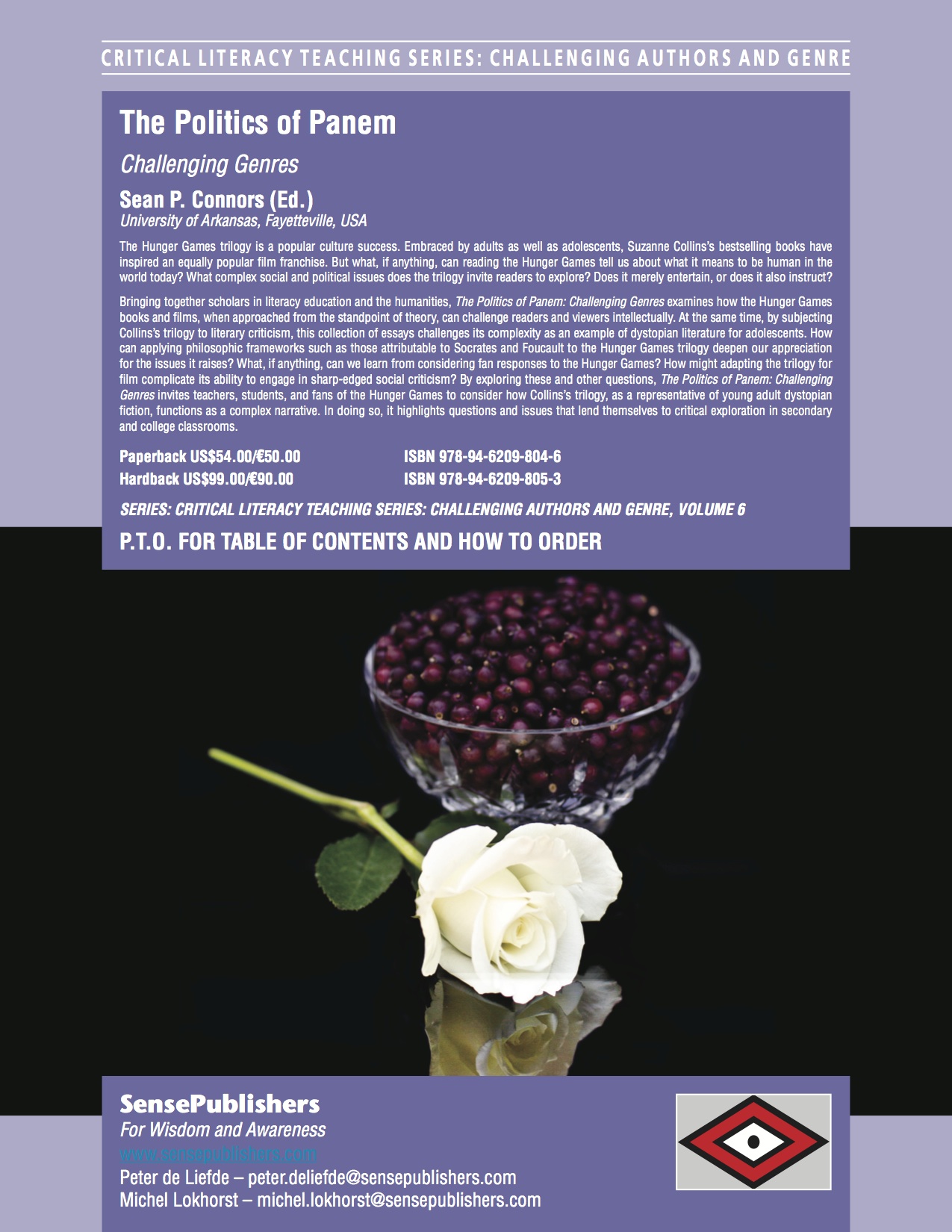
AVAILABLE TO ORDER: The Politics of Panem: Challenging Genres (Sense)
Series: Critical Literacy Teaching Series: Challenging Authors and Genres
Volume Title: The Politics of Panem: Challenging Genres
Editor: Sean P. Connors, University of Arkansas
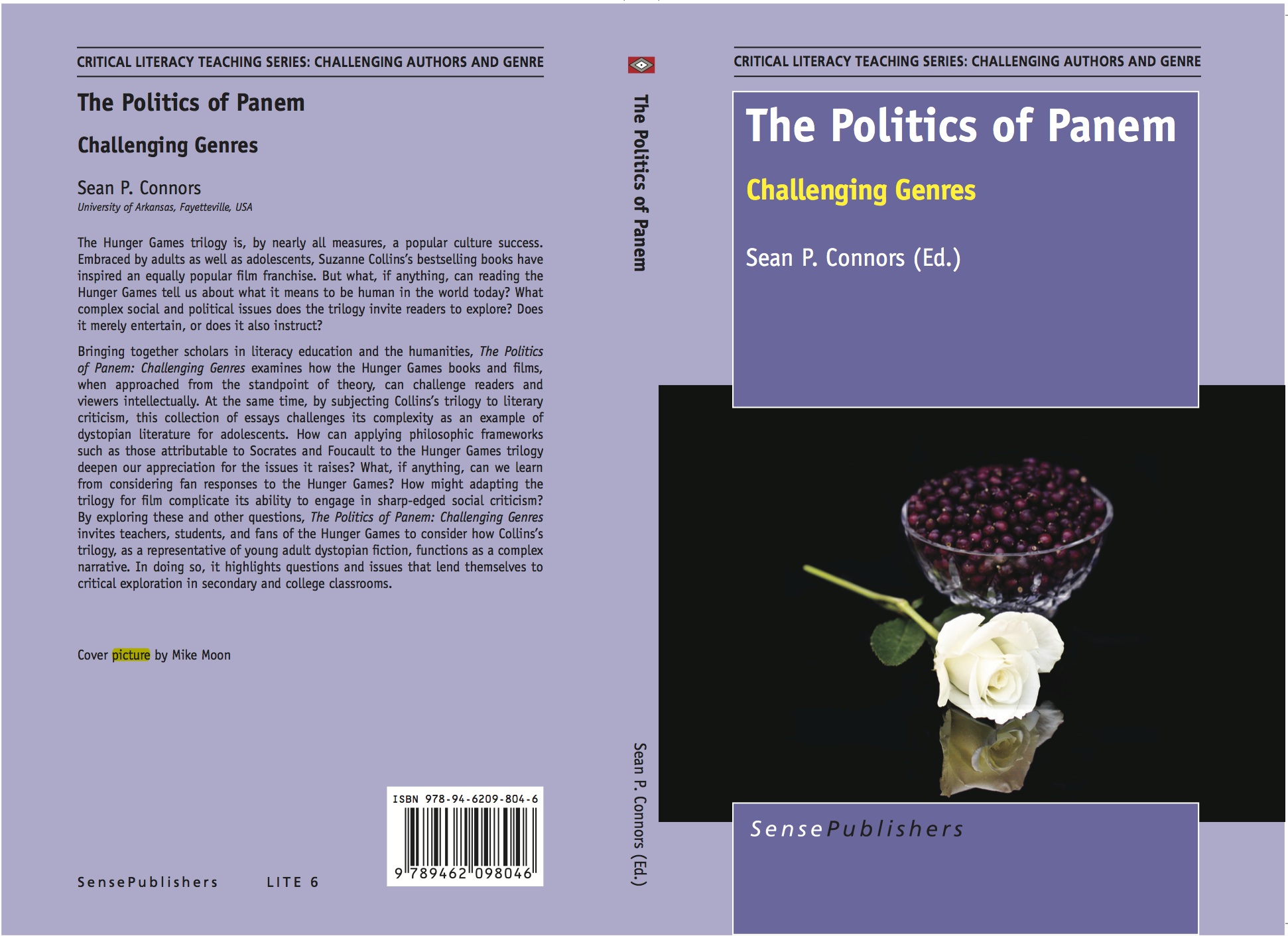
By any measure, Suzanne Collins’ Hunger Games series is a commercial success. In 2012, the bookselling behemoth Amazon reported that the trilogy outsold the Harry Potter series, no small accomplishment considering that the latter has the distinct advantage of consisting of seven novels. A filmic adaptation of the eponymous first novel in the Hunger Games trilogy premiered in the same year, and a sequel, Catching Fire, is scheduled for release later this fall. Still, in spite of its crossover appeal with audiences of all ages, and its subsequent blurring of the distinction between “adolescent” and “adult” literature, the novels that comprise Collins’ trilogy have received surprisingly little critical attention, a result, perhaps, of their status as young adult literature, a genre that is stigmatized in academic settings. Read from the perspective of critical theory, it is possible to appreciate Collins’ series as a multilayered narrative that lends itself to close reading, and which challenges readers to examine complex themes and social issues.
What does reading the Hunger Games series from a Marxist perspective reveal about the material basis of culture? Read from a feminist perspective, how does the trilogy illuminate power relations between men and women? In what ways does the trilogy instantiate, or subvert, dystopian genre conventions, and to what effect? To what extent might adapting the series for film complicate its ability to participate in sharp-edged social criticism? Most importantly, what does a decision to read Collins’ novels from the standpoint of theory reveal about the potential complexity and sophistication of young adult literature? By asking questions of this sort, this edited collection challenges the lingering perception that literature for adolescents is plot driven, superficial fare by making visible the complex readings that are available when readers examine works such as those that comprise the Hunger Games trilogy from the perspective of critical theory. In doing so, it reveals Collins’ series to be a complex narrative that, in the words of Aristotle, instructs at the same time that it delights.
This volume is currently in press with Sense Publishers.
Table of Contents
Acknowledgements
Introduction: Challenging the Politics of Text Complexity, Sean P. Connors
Part One: “It’s All How You’re Perceived”: Deconstructing Adolescence in Panem
1 — “Some Walks You Have to Take Alone”: Ideology, Intertextuality, and the Fall of the Empire in The Hunger Games Trilogy, Roberta Seelinger Trites
2 — Worse Games To Play?: Deconstructing Resolution in The Hunger Games, Susan S. M. Tan
3 — Hungering for Middle Ground: Binaries of Self in Young Adult Dystopia, Meghann Meeusen
Part Two: “I Have A Kind of Power I Never Knew I Possessed”: What Philosophy Tells Us about Life in Panem
4 — The Three Faces of Evil: A Philosophic Reading of The Hunger Games, Brian McDonald
5 — “I Was Watching You, Mockingjay”: Surveillance, Tactics, and the Limits of Panopticism, Sean P. Connors
6 — Exploiting the Gaps in the Fence: Power, Agency, and Rebellion in The Hunger Games, Michael Macaluso and Cori McKenzie
Part Three: “Look at the State They Left Us In”: The Hunger Games as Social Criticism
7 — “It’s Great to Have Allies As Long As You Can Ignore the Thought That You’ll Have to Kill Them”: A Cultural Critical Response to Blurred Ethics in the Hunger Games Trilogy, Anna O. Soter
8 — “I Try to Remember Who I Am and Who I Am Not”: The Subjugation of Nature and Women in The Hunger Games, Sean P. Connors
9 — “We End Our Hunger for Justice!”: Social Responsibility in the Hunger Games Trilogy, Rodrigo Joseph Rodríguez
Part Four: “That’s a Wrap”: Films, Fandom, and the Politics of Social Media
10 — “She Has No Idea. The Effect She Can Have”: A Rhetorical Reading of The Hunger Games, Hilary Brewster
11 — Are the –Isms Ever in Your Favor?: Children’s Film Theory and The Hunger Games, Iris Shepard and Ian Wojcik-Andrews
12 — The Revolution Starts With Rue: Online Fandom and the Racial Politics of the Hunger Games, Antero Garcia and Marcelle Haddix
Afterward: Why Are Strong Female Characters Not Enough?: Katniss and Lisbeth Salander, from Novel to Film, P. L. Thomas
Author Biographies
How to Order

 dr. p.l. (paul) thomas