
POEM: Gono on the verge
I’ve seen things you people wouldn’t believe. Attack ships on fire off the shoulder of Orion. I watched C-beams glitter in the dark near the Tannhauser gate. All those moments will be lost in time… like tears in rain… Time to die.
Roy Batty, Blade Runner
Gono had a name with two long O’s
And a distinctive way of talking
When a friend asked What are you doing?
Gono would reply About to make lunch
Or About to go to work
Never Eating lunch
Or Working
Those close to Gono
Grinned at the quirk for decades
About the number of years most humans
Are allowed to answer friends’ questions
And then
When Gono found himself in the hospital
A friend asked How are you doing?
About to die Gono replied
About to die
—P.L. Thomas
Gaming the System with Grade Retention: The Politics of Reading Crisis Pt. 3
Michael Hiltzik’s How Mississippi gamed its national reading test scores to produce ‘miracle’ gains is the first national media to challenge the Mississippi “miracle,” recently perpetuated again by Nicholas Kristof in the NYT.
Below is a reader that links the key components of the politics of reading crisis:
- The Politics of Reading Crisis: From the FL Model to the MS “Miracle” and the TN Disaster
- Disaster Reform and Shadow Reading Legislation: The Politics of Reading Crisis pt. 2 [UPDATED]
- Mississippi Miracle, Mirage, or Political Lie?: 2019 NAEP Reading Scores Prompt Questions, Not Answers [Update 4 July 2023]
- Test-Based Achievement Mirages: Florida Edition
- A Critical Examination of Grade Retention as Reading Policy (OEA)
- Grade Retention Advocacy Fails by Omission
- SOR Movement Maintains Conservative Assault on Teachers and Public Schools [Updated]
Note that the connections include policy in Florida (often called the “Florida Model” and anchored by third grade retention) and Mississippi and the influence of Jeb Bush’s ExcelinEd (which funded the report on retention in MS that Kristof cited).
Here are some of the ugly numbers concerning grade retention and its disproportionate impact on Black students:
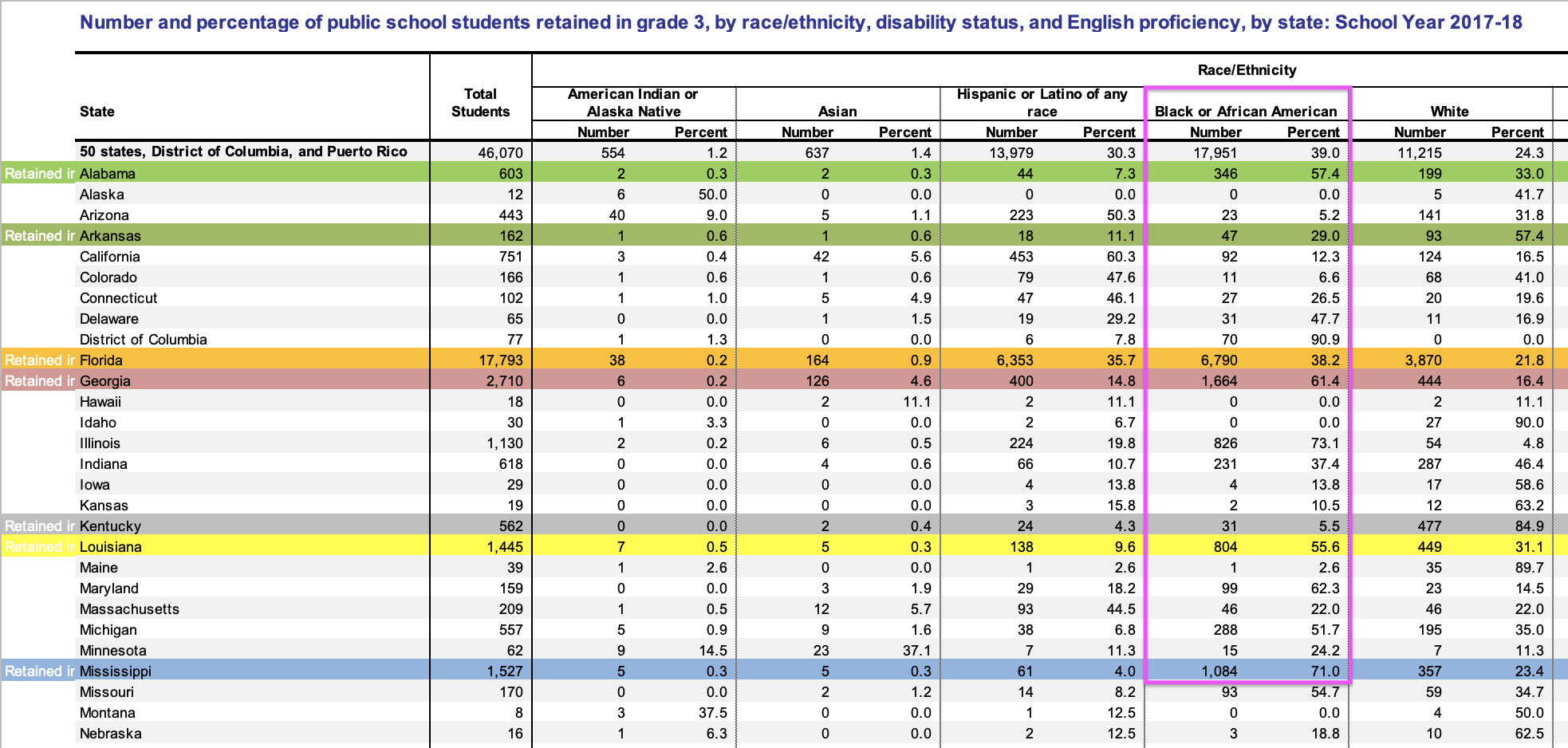
The short response to all this must be that grade retention is gaming the system and it is harmful to children, disproportionately harmful to Black, brown, and poor children.
POEM: a sad woman
I do my crying underwater
“Demons,” The National
he met a sad woman
she was often incredibly sweet
and she was always
disorientingly beautiful
and disarmingly smart
but also always very very sad
and from time to time
when he looked at her
he couldn’t disentangle
the sad from the beautiful
so he had to find places
to cry hard and silently
until the ache at the center
of him settled into something gentle
like tossing a ball
over and over
to an overeager puppy
in a mulch-filled dog park
—P.L. Thomas

Podcast: The Science of Reading Movement and The Never-Ending Debate: A Conversation with Paul Thomas
Open Letter to Teachers of Young Children: Dr. Diane Stephens
Open Letter to Teachers of Young Children
Dr. Diane Stephens
June 23, 2023
I have become increasingly concerned about states (and, in the past, the federal government) making decisions/passing laws about the practices associated with teaching reading and writing. I believe that teachers should step up and assert their right to be treated as professionals. To accomplish this, teachers need to
- make a life-long commitment to broadening and deepening their knowledge base so their curricular decisions are consistently based on current peer-reviewed research which appears in top-tier reading journals, their own experiences, and their knowledge of each child in their classroom
- keep track of legislative bills and laws that attempt to curtail their curricular decision-making and
- take action (write, call, protest) so that their rights as teachers as not dictated by legislation.
In so doing, we will honor our responsibility to ensure that, in turn, children have rights as readers and writer. We are the only ones who can do this.
We need to stand up and demand that decision-makers at the local, state and national level resist what has been a long-established practice of telling one professional group, teachers, what to do while honoring the right of every other profession to establish their own standards and scientifically based practices.
Below I have drafted a list of the rights of children as readers and writers. If you have classroom footage to go with #2, #3, #4, #5, and/or #11 and consent from parents to use that footage for educational purposes, please send the videos and copy of the consent forms and I will select one for each of those rights. Also please weigh in on your thoughts about books to name for #10. You can contact me at stephens.diane@gmail.com.
The Rights of Children as Readers and Writers
in Pre-K, K and 1st grade Classrooms
1. Children have the right to fall in love with books (if they haven’t already) and know that books make sense, so teachers read books to and with children (this is called an Interactive Read-Aloud). The teacher chooses books that are easy for the children to understand. This is referred to as their Listening Comprehension. Via Read Aloud, children also learn that Reading is a Meaning-Making Process. To see an Interactive Read Aloud in Brooke Bridges’ Kindergarten classroom, see Additional Video #2: Interactive Read-Alouds https://www.scholastic.com/content/educators/en/pro/readingrevealed.html#additionalvideos. The password is learners.
2. Children have the right to understand how books work so teachers read large-sized versions of books which allow every child see the pages clearly and then teachers read the books to them, pointing to words as they read. This is called Interactive Shared Reading. This helps children learn that books in English are read top to bottom and right to left. This is referred to as Book Knowledge. It also helps the children understand that there is a relationship between what the teacher “says” and what is written on the page. This is often referred to as Print-to-Speech Matching.
3. Children have the right to understand that oral and written language can be segmented and blended so teachers teach them songs, rhymes, and word games – oral and written. This is referred to as Phonemic Awareness.
4. Children have the right to understand how language works e.g., that some sound/symbol relationships are constant. Teachers help young children learn this through alphabet cards with pictures of objects the children have brought in and pictures of each other under the first letter of their names, through songs and rhymes and large group discussion of Morning Message, and via word hunts for words that contain consistent patterns, e.g., /an/, /am/, /at/ and also for words in which two letters make the one sound like /th/, /sh/, /ch/. Children also learn about this by reading and writing. This particularly understanding is referred to as Phonics.
5. Children have the right to understand that written language is as predictable as the oral language they hear around them, so teachers read and provide access to books that sound like the language they know. This reinforces the idea that Reading is a Meaning-Making Process and it helps children develop Fluency – the ability to read smoothly and meaningfully, in thought units.
6. Children have the right to understand that writing (and therefore reading) are ways of communicating, so teachers encourage children to use their emergent understanding of sound/symbol relationships to write labels, letters, and books. This allows students to understand that Writing is a Meaning-Making Process. To see kindergarten teacher Brooke Bridges introduce and carry out book-making early in the third month of school, see Additional Video #9 – Creating Books with Children https://www.scholastic.com/content/educators/en/pro/readingrevealed.html#additionalvideos. The password is learners.
7. Children have the right to believe in their ability to make sense of text, so teachers provide books with which they will be successful and, as children’s skills and strategies develop, teachers ensure that those books are matched to children’s evolving strengths. This helps children develop Agency – a belief that they are capable of making sense of print. Children without a sense of agency often stop trying and claim they do not “like” reading. These students all too often eventually drop out of school. To see kindergartners reading together in Resi Suehiro’s Kindergarten classroom, see Additional Video #1 – Buddy Reading in Kindergarten https://www.scholastic.com/content/educators/en/pro/readingrevealed.html#additionalvideos. The password is learners.
8. Children have the right to choose books during an independent reading time. This increases their interest in books and in their Motivation to read. To see how Nicole Bishop helps her first graders choose books, see Additional Video #5 – Look, Think, Pass https://www.scholastic.com/content/educators/en/pro/readingrevealed.html#additionalvideos. The password is learners.
9. Children have the right to have ample time to read because volume of reading is directly related to Reading Achievement. To see Independent Reading in Brooke Bridges’ Kindergarten classroom, see Additional Video #18 – Independent Reading in Kindergarten https://www.scholastic.com/content/educators/en/pro/readingrevealed.html#additionalvideos. Password is learners.
10. Children have the right to have their uniqueness recognized, so their teachers provide whole group support based on the strengths and needs of the whole group, flexible small group support for children with similar strengths and one-on-one support. This means not subjecting children to one-size-fits-all instruction. This insures Authenticity of Instructional Support to each child as opposed to fidelity to a program that may help only a few children.
To get an idea of the diversity of one kindergarten classroom in which there seems to be little ethnic diversity, listen to this intro by Brooke Bridges about the characteristics of her students during academic year 2018-2019: https://drive.google.com/file/d/1FyZpkm4tAg8glex7khLzPnK5U_VYY8Rs/view?usp=sharing.
To see how Ms. Bridges responses to children vary (a) during independent reading, see Additional Video #18 – Independent Reading in Kindergarten https://www.scholastic.com/content/educators/en/pro/readingrevealed.html#additionalvideos and (b) during independent writing, see Additional Video #9 – Creating Books with Children https://www.scholastic.com/content/educators/en/pro/readingrevealed.html#additionalvideos.
Both of these videos show how she supports children based on her knowledge of them.
The password for the last two videos is learners.
11. Children have the right to learn problem-solving skills and strategies to figure out unfamiliar words, see, for example, Scanlon and Anderson’s (2010) Interactive Strategies List (below). This fosters Reading Independence.
Interactive Strategies:
- Check the pictures
- Think about the sounds in the word
- Think of words that might make sense
- Look for word families or other parts you know
- Read past the puzzling word
- Go back to the beginning of the sentence and start again
- Try different pronunciations of some of the letters, particularly the vowels.
- Break the word into smaller parts
It would be great if legislators (and some publishers of reading materials for pre-K to 3), already understood that they should be stepping back from mandating or selling curriculum to teachers – that they should instead be encouraging teachers to make their own informed curricular decisions and to choose materials based on their knowledge of the broad field of research on reading and writing and on their knowledge of children in their classrooms.
But that’s not going to happen spontaneously. It is only going to happen if informed teachers get themselves involved in the decision-making process by writing letters, making phone calls, and scheduling appointments with decision-makers.
I realize that taking political action is not comfortable. If it helps just think of it as having a conversation (through the mail, on the phone, in an office) with someone who does not yet know enough about teaching reading and writing.
Think of legislators as learners who need our help.
It is our responsibility to ensure that children have the at least the eleven rights outlined in this letter. If a law limiting these rights has already been passed in your state, learn the process for submitting amendments and propose them. If a bill is in process (see, for example South Carolina Senate Bill 518), write, call, visit your legislator and the members of the House and Senate Education Committees. And be sure to be in contact with the legislative aide for both Committees. Those individuals are lawyers who put pen to paper. And, in my experience, they really listen.
Please, step up for your rights as professionals and for the rights of the children you serve. If enough of us stand up, there is no limit to how much we can improve our own lives and the lives of children.
Thanks.
Diane Stephens, Ph.D.
Distinguished Professor Emerita
John E. Swearingen, Sr. Professor Emerita in Education
University of South Carolina
Reference
D.M. Scanlon and K.L. Anderson (2010). “Using the Interactive Strategies Approach to Prevent Reading Difficulties in an RTI Context” (p. 49). In M.Y. Lipson and K.K. Wixson (Eds.), Successful Approaches to RTI: Collaborative Practices for Improving K–12 Literacy, Newark, DE: International Reading Association.
NAEP LTT 2023: A Different Story about Reading
“The Nation’s Report Card” has released NAEP Long-Term Trend Assessment Results: Reading and Mathematics for 2023.
The LTT is different than regularly reported NAEP testing, as explained here:
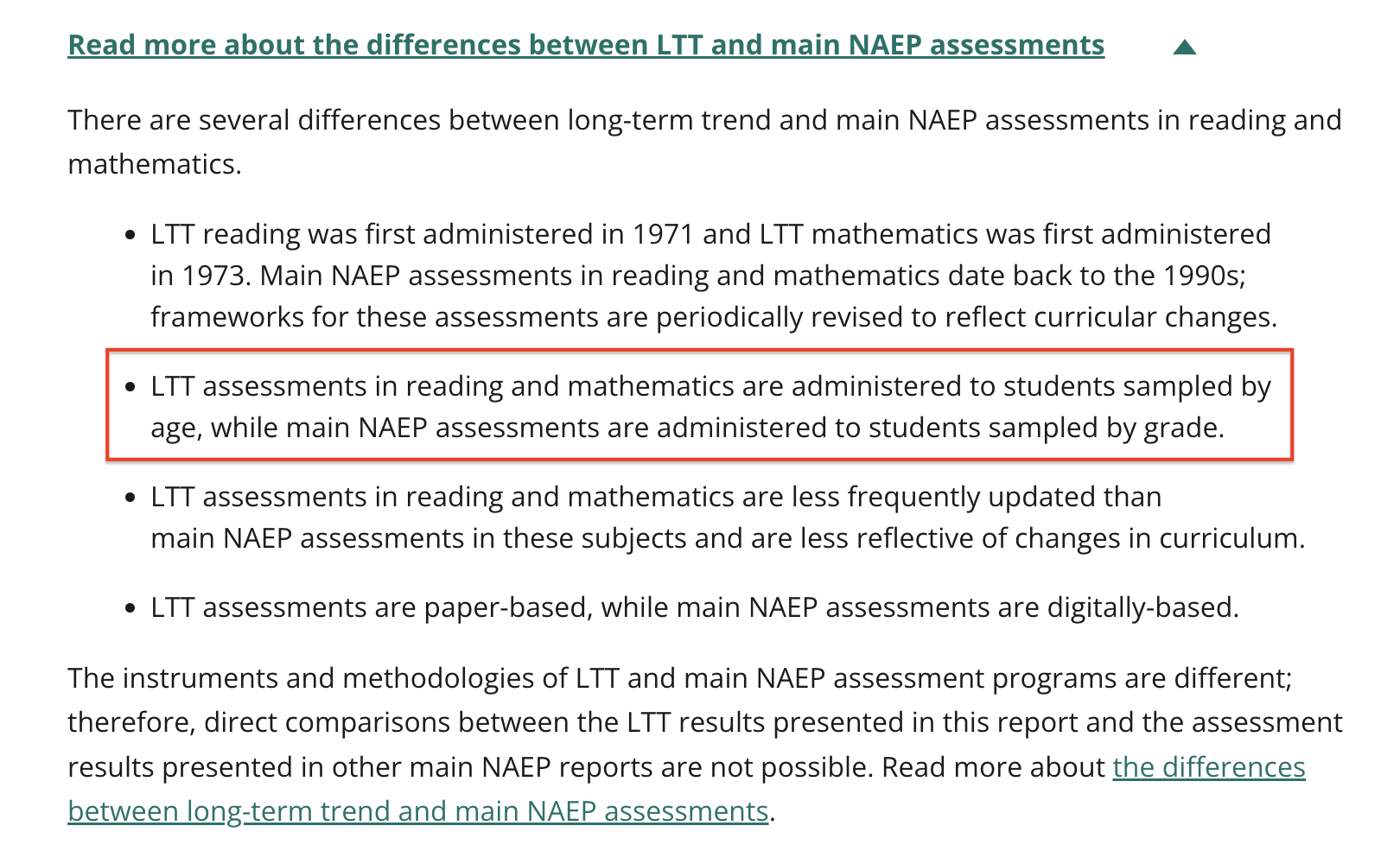
As I will highlight below, it is important to emphasize LTT is age-based and NAEP is grade-based.
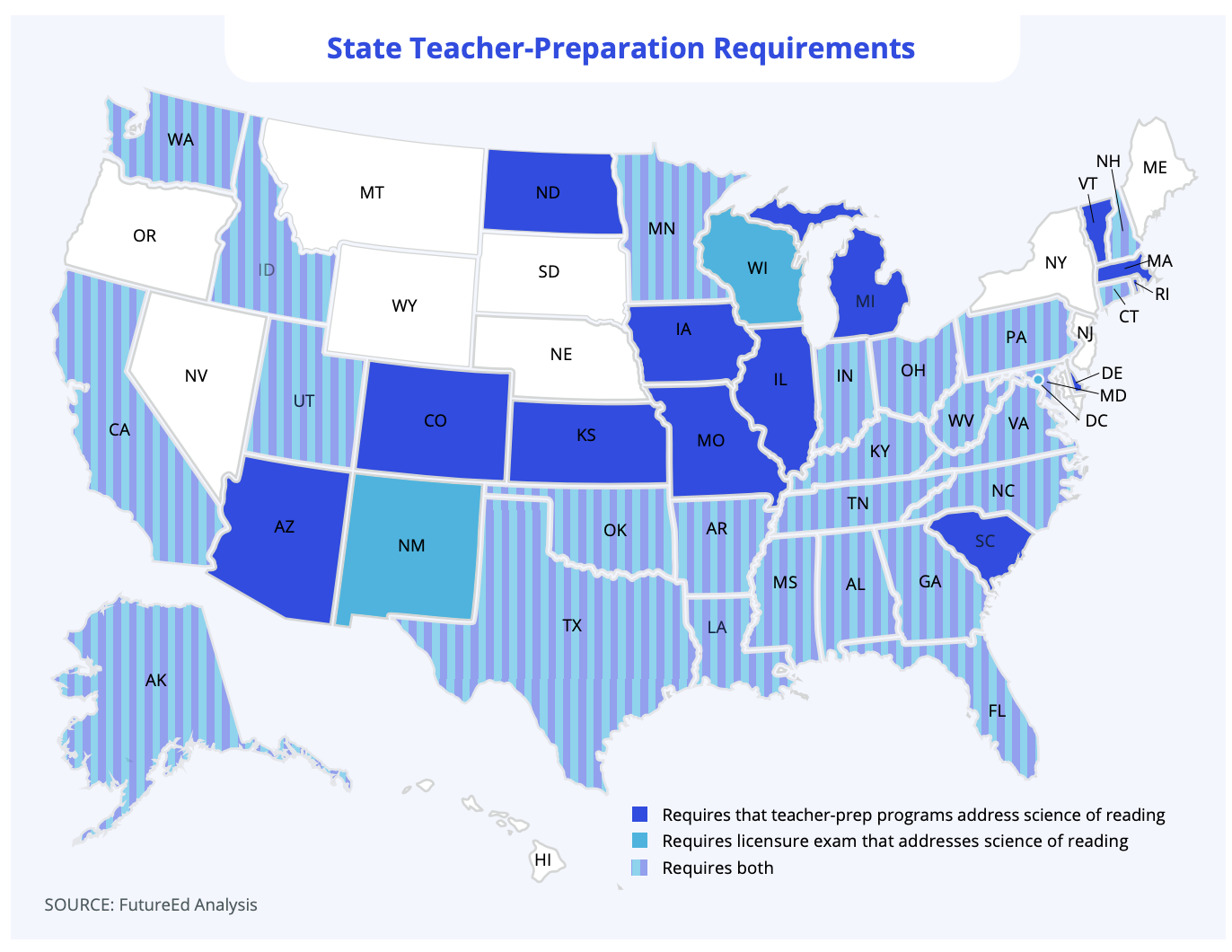
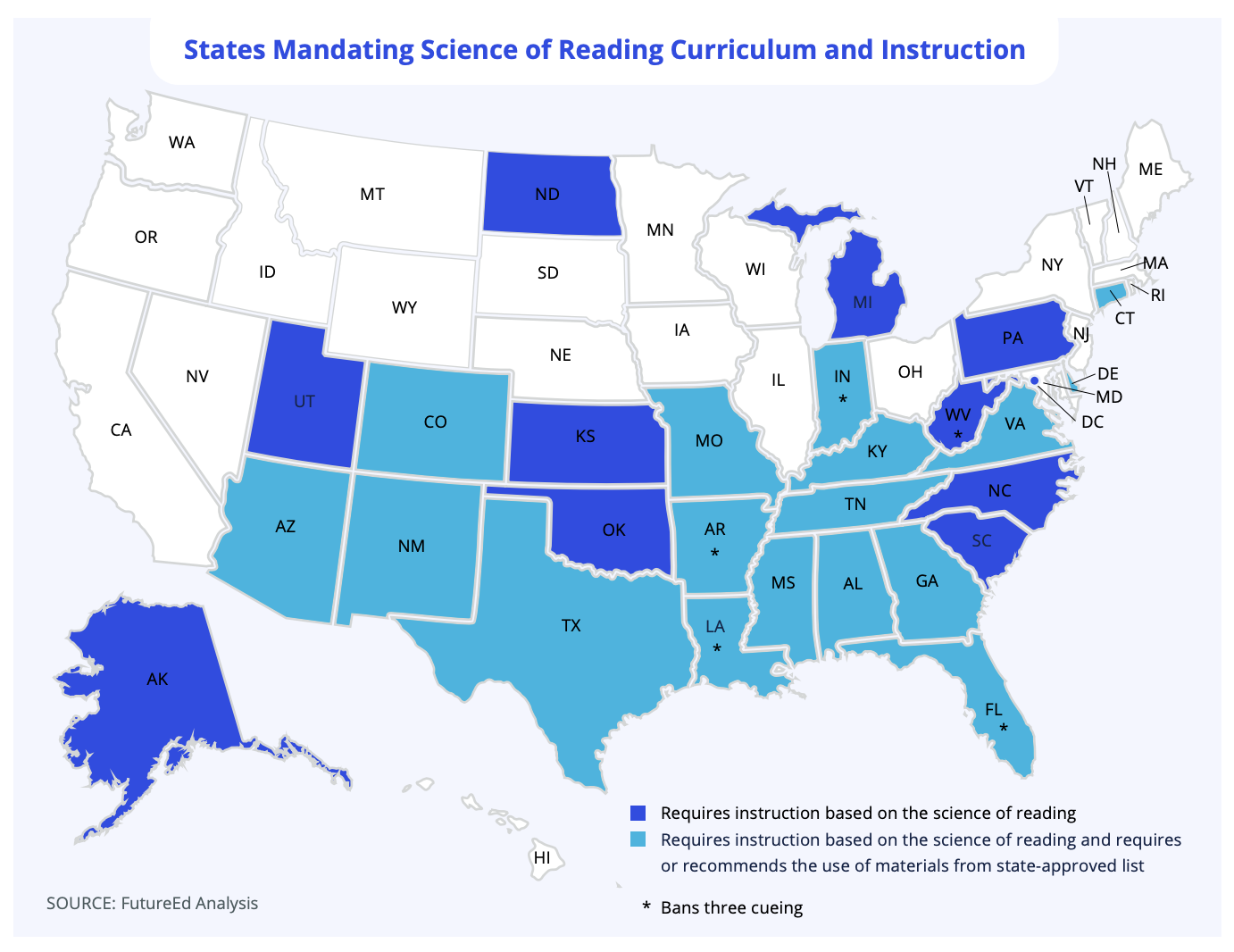
LTT assesses reading for 13-year-old students, and by 2023, these students have experienced school solidly in the “science of reading” (SOR)-legislation era, which can be traced to 2013 (30+ states enacting SOR legislation and growing to almost every state within the last couple years [1]).
Being age-based (and not impacted by grade retention), the trends tell a much different story than the popular and misleading SOR movement.
Consider the following [2]:
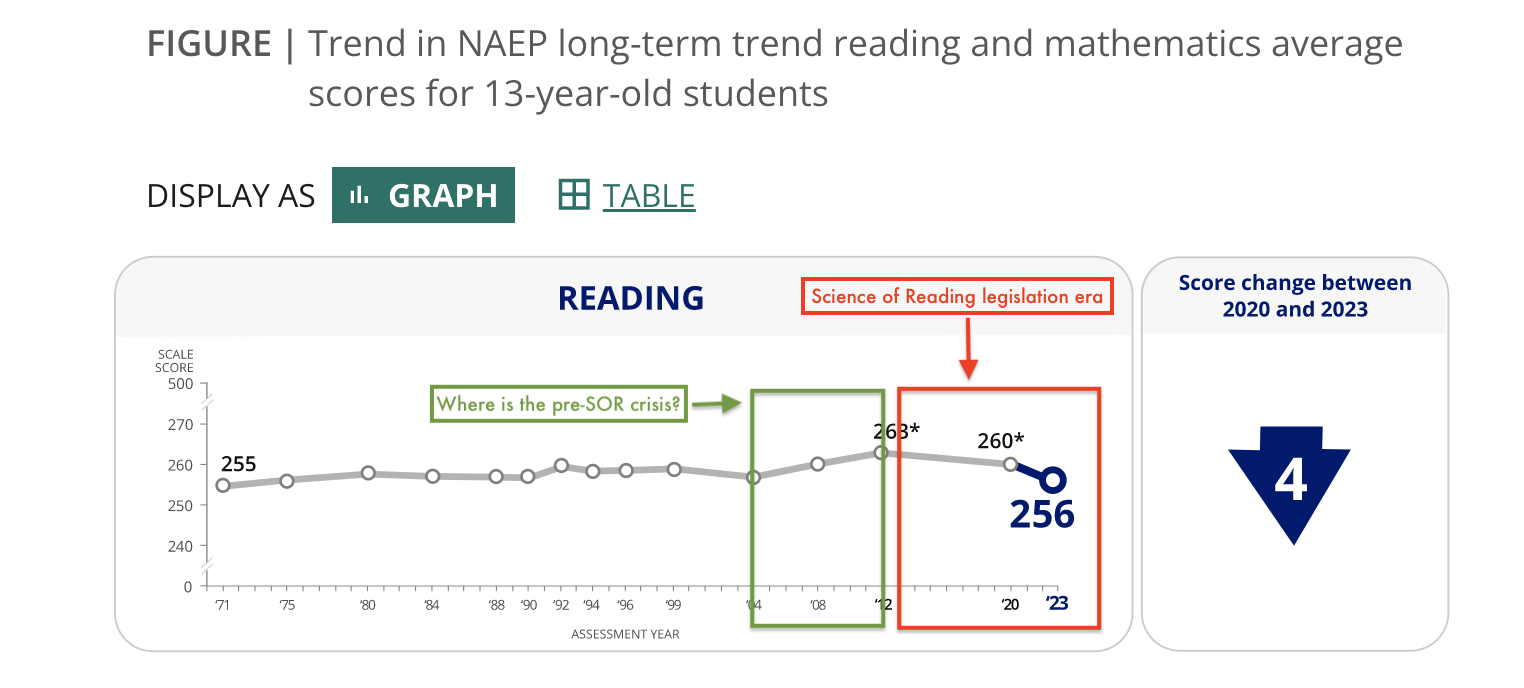
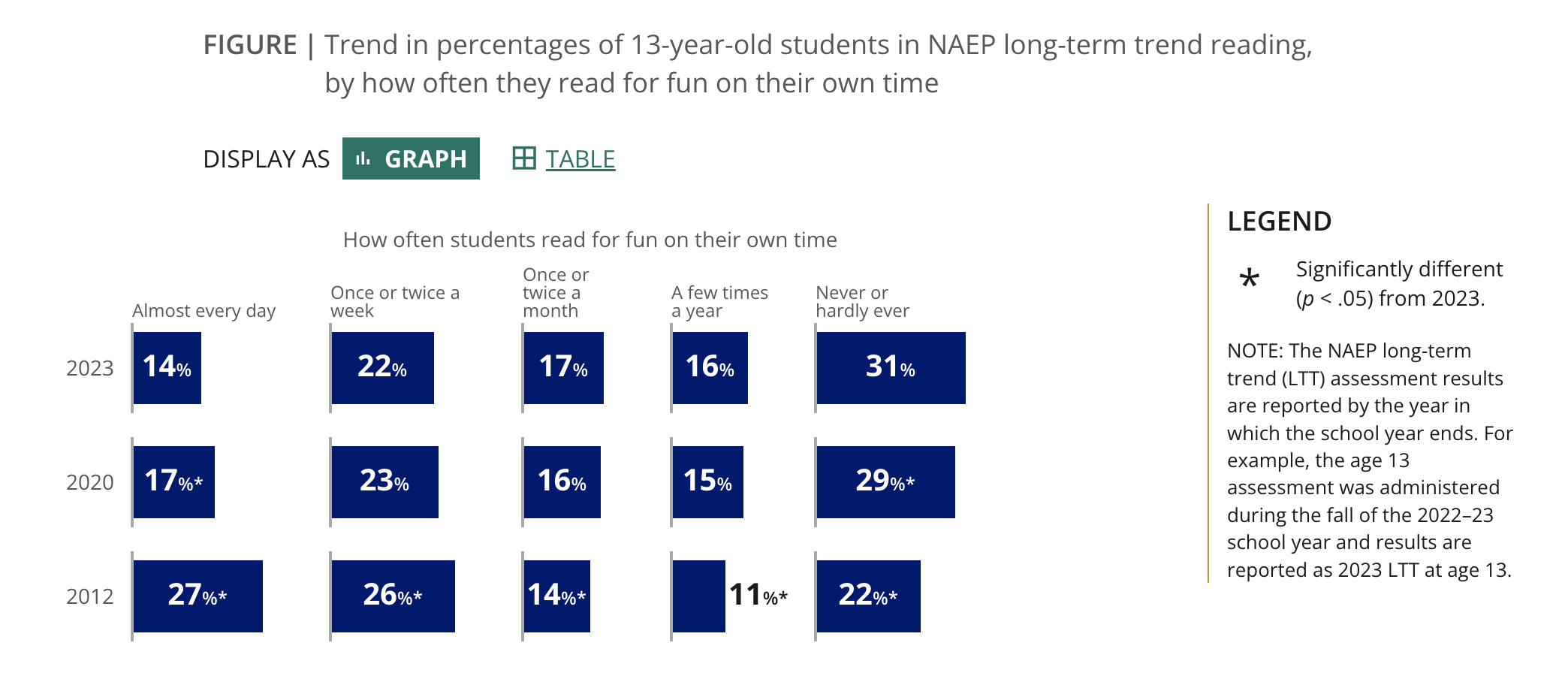
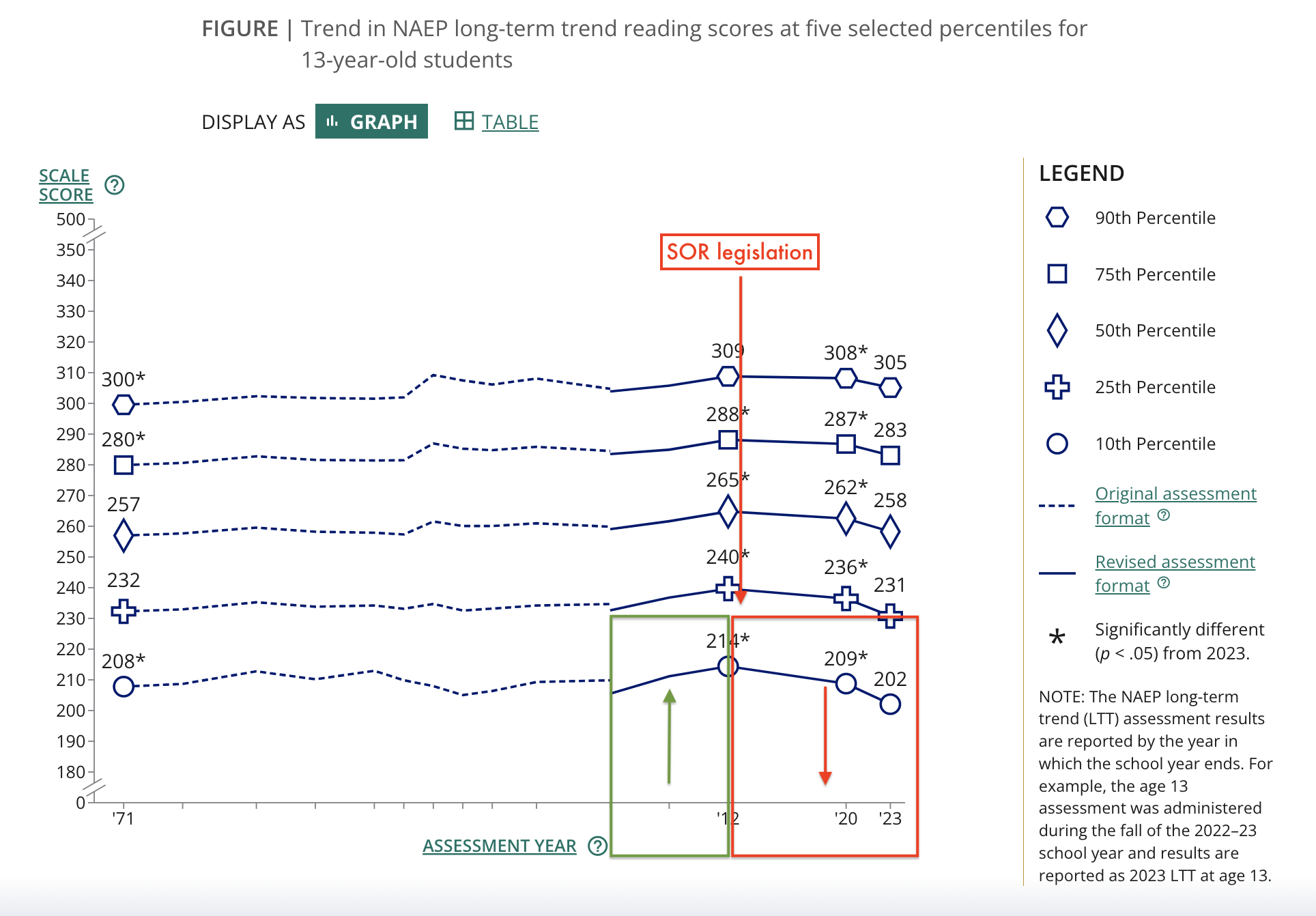
Here is the different story:
- There is no reading crisis.
- Test-based gains in grades 3 and 4 are likely mirages, grounded in harmful policies and practices such as grade retention.
- Age 13 students were improving at every percentile when media and politicians began crying “crisis,” but have declined in SOR era, notably the lowest performing students declining the most.
- Reading for fun and by choice have declined significantly in the SOR era (a serious concern since reading by choice is strongly supported by research as key for literacy growth).
Here are suggested readings reinforced by the LTT data:
- Open Letter to the Biden Administration, USDOE, and Secretary of Education Miguel Cardona
- SAT Lessons Never Learned: NAEP Edition
- Understanding and Reforming the Reading Proficiency Trap
- Grade Retention Advocacy Fails by Omission
The US has been sold a story about reading that is false, but it drives media clicks, sells reading programs and materials, and serves the rhetorical needs of political leaders.
Students, on the other hand, pay the price for false stories.
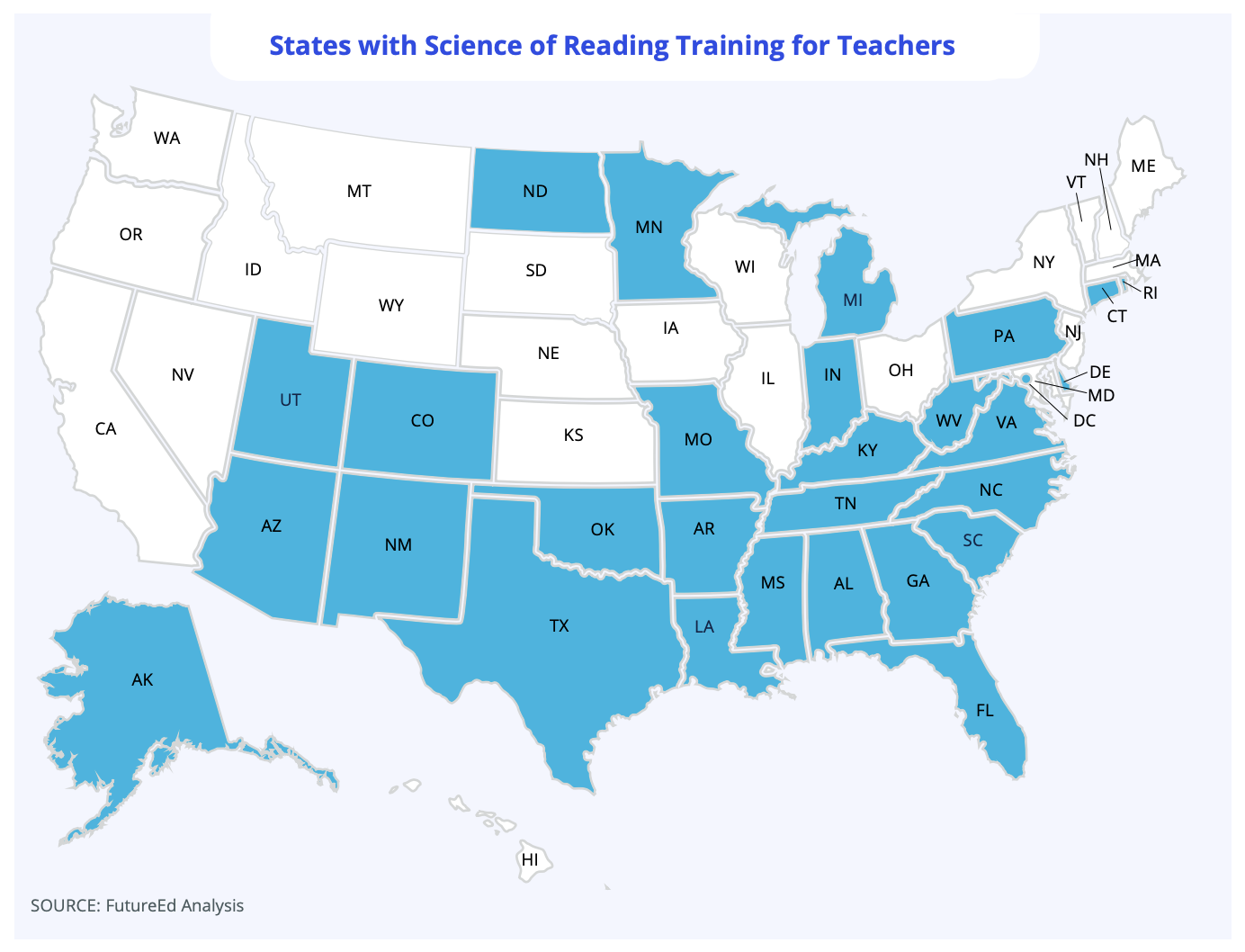
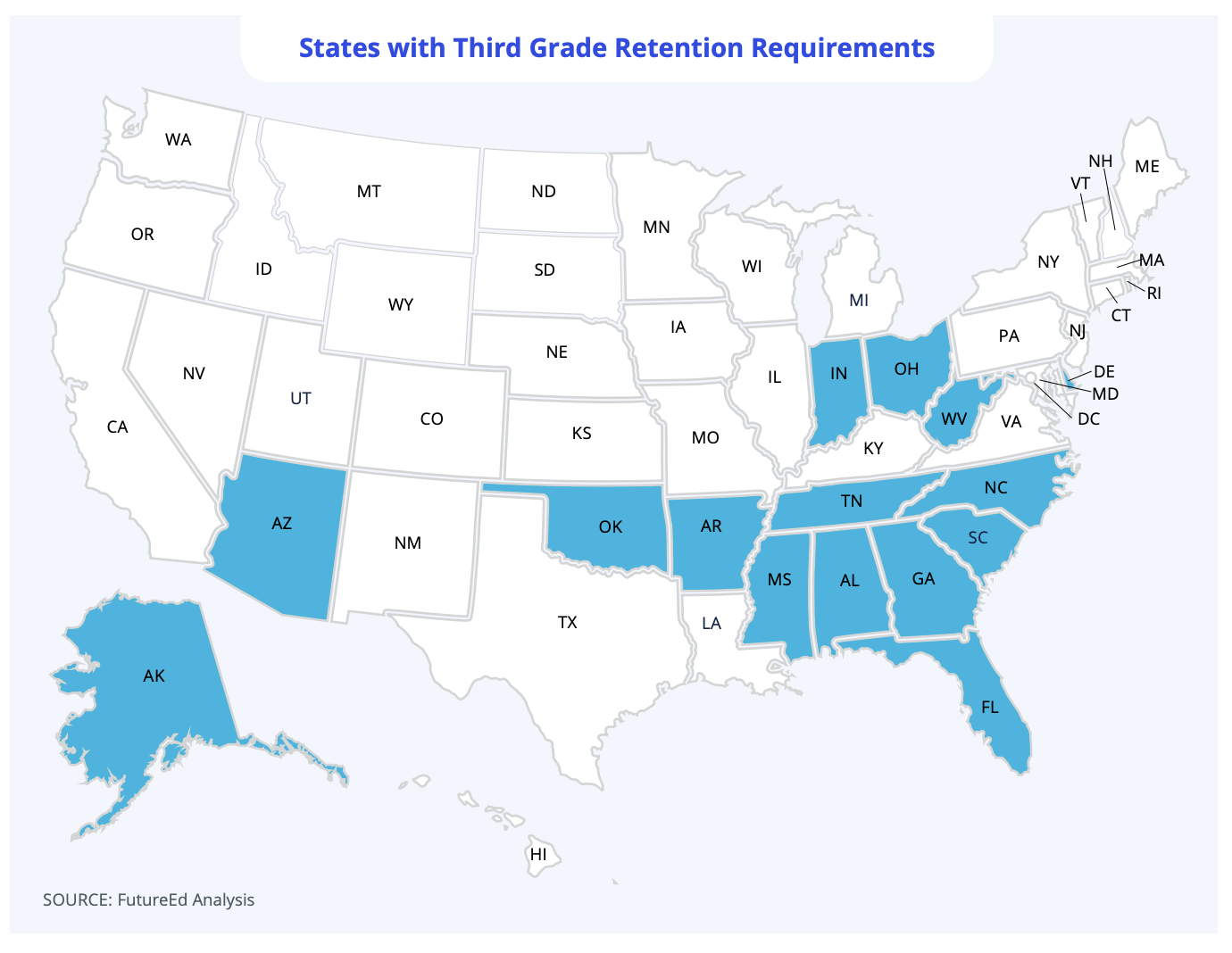
[1] Documenting SOR/grade-three-intensive reading legislation, connected to FL as early as 2002, but commonly associated with 2013 as rise of SOR-labeled legislation (notably in MS):
Olson, L. (2023, June). The reading revolution: How states are scaling literacy reform. FutureEd. Retrieved June 22, 2023, from https://www.future-ed.org/teaching-children-to-read-one-state-at-a-time/
Cummings, A. (2021). Making early literacy policy work in Kentucky: Three considerations for policymakers on the “Read to Succeed” act. Boulder, CO: National Education PolicyCenter. Retrieved May 18, 2022, from https://nepc.colorado.edu/publication/literacy
Cummings, A., Strunk, K.O., & De Voto, C. (2021). “A lot of states were doing it”: The development of Michigan’s Read by Grade Three law. Journal of Educational Change. Retrieved April 28, 2022, from https://link.springer.com/article/10.1007/s10833-021-09438-y
Collet, V.S., Penaflorida, J., French, S., Allred, J., Greiner, A., & Chen, J. (2021). Red flags, red herrings, and common ground: An expert study in response to state reading policy. Educational Considerations, 47(1). Retrieved July 26, 2022, from https://doi.org/10.4148/0146-9282.2241
Reinking, D., Hruby, G.G., & Risko, V.J. (2023). Legislating phonics: Settle science of political polemic? Teachers College Record. https://doi.org/10.1177/01614681231155688
Schwartz, S. (2022, July 20). Which states have passed “science of reading” laws? What’s in them? Education Week. Retrieved July 25, 2022, from https://www.edweek.org/teaching-learning/which-states-have-passed- science-of-reading-laws-whats-in-them/2022/07
Thomas, P.L. (2022). The Science of Reading movement: The never-ending debate and the need for a different approach to reading instruction. Boulder, CO: National Education Policy Center. http://nepc.colorado.edu/publication/science-of-reading
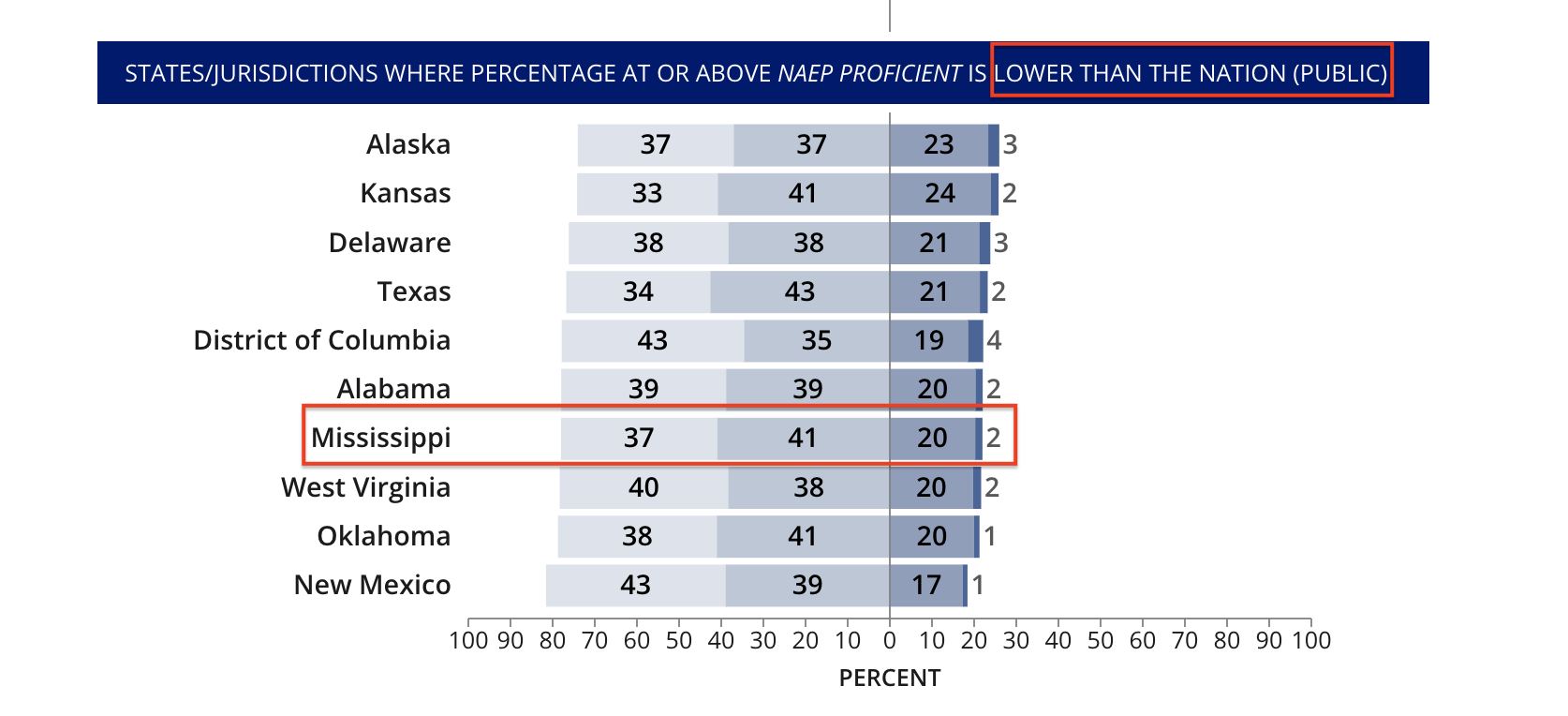
[2] Despite claims of a “miracle” MS grade 8 NAEP in reading remains at the bottom after a decade of SOR legislation:
Open Letter to the Biden Administration, USDOE, and Secretary of Education Miguel Cardona
Reporting for NPR in 2018 about A Nation at Risk, Anya Kamenetz noted:
When it appeared in April 1983, the report received widespread coverage on radio and TV. President Reagan joined the co-authors in a series of public hearings around the country.
The report’s narrative of failing schools — students being out-competed internationally and declining educational standards — persists, and has become an entrenched part of the debate over education in the U.S.
What ‘A Nation At Risk’ Got Wrong, And Right, About U.S. Schools
In 2023, writing for The Answer Sheet in The Washington Post, James Harvey explains that the report under Reagan was “gaslighting” for political purposes, and not the clarion call to address education reform that media, the public, and political leaders claimed.
In short, A Nation at Risk was a “manufactured crisis.”
Yet, education reform has become a central part of the political process for governors and presidents since the 1980s, reaching a critical peak under George W. Bush who turned the discredited “Texas Miracle” into groundbreaking and bipartisan federal legislation, No Child Left Behind (NCLB).
In fact, public education in the US has been under an intense public and political microscope for forty years of high-stakes accountability. For educators, that accountability is indistinguishable regardless of the political party in the White House.
The Obama administration in many ways continued and even doubled-down on the crisis/miracle rhetoric found under W. Bush.
At the core of education crisis/miracle rhetoric has been the use and misuse of standardized test data.
For many decades, the media and public fretted over public education based on SAT data (and then ACT data), which represents the central issue of misunderstanding test scores (the College Board warns of not ranking states by SAT averages, yet the media persists) and misusing test data (SAT/ACT tests are designed to predict college success, not evaluate the quality of public education).
With the decrease in the influence of SAT/ACT testing, however, the media, public, and political leaders have focused more on National Assessment of Educational Progress (NAEP) data.
Since 2019, there have been NAEP-inspired claims of educational crisis based on 2019 reading scores, 2022 math scores, and 2022 history/civics scores.
As one powerful example, high-profile media, The New York Times, and journalist, Nicholas Kristof, proclaim:
One of the most bearish statistics for the future of the United States is this: Two-thirds of fourth graders in the United States are not proficient in reading.
Two-Thirds of Kids Struggle to Read, and We Know How to Fix It
However, despite warnings from 2016, Tom loveless explains:
In February, 2023 Bari Weiss produced a podcast, “Why 65% of Fourth Graders Can’t Really Read” and Nicholas Kristof, New York Times columnist, wrote “Two-Thirds of Kids Struggle to Read, and We Know How to Fix It.” Both headlines are misleading. The 65% and two-thirds figures are referring to the percentage of 4th graders who scored below proficient on the last reading test of the National Assessment of Educational Progress (NAEP), administered in 2022.
The problem is this: scoring below proficient doesn’t mean “can’t really read” or “struggling to read.” It also does not mean “functionally illiterate” or identify “non- readers” as some of the more vituperative descriptions on social media have claimed. It doesn’t even mean “below grade level in reading,” one of the milder distortions.
Literacy and NAEP Proficient
Further, scholars Reinking, Hruby and Risko (2023), in fact, assert: “[T]here is no indisputable evidence of a national crisis in reading, and even if there were a crisis, there is no evidence that the amount of phonics in classrooms is necessarily the cause or the solution.”
Two problems currently exist with the stories being told about schools and the education reform movement—the data do not support claims of “crisis” and NAEP perpetuates the “crisis” myth by design.
Touted as the “Nation’s Report Card,” NAEP developed achievement levels that were designed to hold states accountable for having high standards, and as a result, “proficiency” on NAEP is “aspirational” but not representative of “grade-level proficiency.”
The US is now mired in decades of punitive education legislation (standards and high-stakes testing as well as third-grade retention and VAM-based teacher evaluation) that has not worked because the central claim of “crisis” is simply not supported by the evidence.
Especially in the wake of the devastating impact of Covid on public education, students, and teachers, the Biden Administration has the historic opportunity to change direction in US public education reform.
This open letter, then, is an urgent call to do the following:
- Acknowledge and reject the false narratives of manufactured public education “crises” and media-created education “miracles.”
- Declare accountability-based, punitive reform a failure—despite good intentions—and call for equity-based, supportive reform that forefronts the impact of systemic forces outside and inside our public schools.
- Reform dramatically NAEP testing so that test data better supports learning and instruction instead of driving a false story of education crisis (for example, reform the use of NAEP “proficiency” to represent “age-level proficiency”).
US public education has a long and inexcusable history of political negligence in terms of supporting the most vulnerable children in our society; that includes negligence of vulnerable students in our public education system.
Our children and the country deserve robust and substantive education reform, not false stories of failure and misguided blame and punishment.
Regretfully, the last forty years have been a perpetual cycle of manufactured crisis and punitive policy.
The Biden Administration—notably a rhetorical “friend” of education embodied by Dr. Jill Biden—can and should chose a different story about our schools, our students, and our teachers.
As celebrated author James Baldwin urged: “The challenge is in the moment, the time is always now.”
What We Don’t Talk about When We Talk about Teacher Education
How can anybody know
Daughters of the Soho Riots, The National
How they got to be this way?
I graduated high school 8th out of 150 students and took with me a great deal of affection and respect for two life-changing teachers—Harold Scipio (chemistry/physics) and Lynn Harrill (English).
My academic success was bolstered by making mostly As in math and science courses, but I puttered along with Bs in English (resisting the drudgery of vocabulary tests and assigned novels). Therefore, I left high school intending to major in physics.
School had taught me I was good with numbers, and I learned that the field of English was grammar book exercises and diagramming sentences (junior high school) or vocabulary tests and assigned novels I had no interest in reading (high school).
Those experiences with English in school were in stark contrast to my ignored and marginalized literary life at home—collecting and reading comic books as well as reading voraciously science fiction and thriller novels.
In fact, that closeted life of reading was teaching me that genre literature was wonderful while English courses and teachers indirectly and directly told me genre writing was trash, that I should read real literature.
I entered a junior college less than thirty minutes from my home with those perceptions of school and myself as well as a youthfully distorted view of my abilities as a golfer and a want-to-be comic book artist.
There a few interesting things happened, notably linked again to teachers for whom I developed affection and respect—Steve Brannon (speech) and Dean Carter (British literature).
Mr. Brannon re-introduced me to e.e. cummings (in a speech course of all places) and sparked my first-year realization that I am a poet and writer; it was during the spring of that first year of college that I began writing seriously.
The other pivotal moment was when Dean Carter (who regularly berated me for my shoes and clothing in front of the class) approached me, asking if I’d like to start tutoring for the course. I clarified for him that I was a math and science person, not an English person.
After Dean Carter explained to me that I was the strongest student in that British literature survey class, however, I began tutoring and soon discovered that I was good at helping other students and I also enjoyed it.
Somehow I didn’t quite get it yet, and I was still mulling options for when I transferred to a four-year university, toying with architecture and pre-law.
A friend with whom I had gone to all 12 years of public school and then junior college and I were set to transfer to the main campus of the state university, but he had a paralyzing accident that summer. I panicked and chose to attend the satellite state university near my home instead of venturing to the main campus.
Having spent over 20 years now in higher education, this next part is something we rarely talk about—how people really chose their majors and how coincidental and haphazard that life-shifting decision can be.
With my friend’s accident and my late change of universities, I was rushed through registration where I was asked (as a rising junior) my major so courses could be chosen for that fall.
At that point I had no real idea but my thinking had shifted to majoring in English (still possibly as a path to law school). Coming from a working class family where neither parent had attended a four-year college, I was hyper-practical, however.
So on the spot I decided I would major in education because that would prepare me for a job and a career. When I said “education,” the advisor nudged me by asking what kind.
Having no idea what that meant, I shrugged and then was prompted with elementary or high school. I immediately said high school only to be asked what kind of high school teacher.
It was at that moment I chose secondary English education as a major; three years later, I entered as a high school English teacher the same classroom that Lynn Harrill had taught me in.
That full circle, I eventually recognized, helped me reconsider what I believed when I left high school, notably that Mr. Scipio and Mr. Harrill had set me on course to be a teacher.
Now here is what we don’t talk about when we talk about teacher education.
Once again, over the last 2.5 years of undergraduate education, I had some really influential professors.
Dr. Tom Hawkins was my secondary English advisor and teacher, and he planted the seeds of how I would eventually think about teaching and learning, specifically about grading (and he introduced me to triathlons, which set me on course to be a life-long serious cyclist).
But I was also an eager English student, taking extra English courses beyond what was required by my education certification; English professors Dr. Richard Predmore and Dr. Nancy Moore profoundly shaped me as a writer and as a potential scholar.
My student teaching was divided between two schools and two teachers, one middle school and one high school.
Here is the really complicated part.
I was greatly motivated to become a teacher so that I could create English classes unlike what most English classes were (no grammar book exercises and tests, no diagramming sentences, no vocabulary tests). And student teaching mostly proved to me all the ways in which I did not want to teach.
Once I was firmly in schooling from the teacher side, I also realized that virtually all the literature I had studied in college would never be works I could teach. In fact, I had to scramble to be prepared to teach the texts assigned and in textbooks during student teaching.
My teaching career began the fall of 1984, right at the beginning of the current 40-year accountability era sparked by the manufactured crisis of Reagan’s A Nation at Risk.
I was handed over a dozen textbooks (grammar, literature, and vocabulary texts) and the journalism course (school newspaper and literary magazine).
Now this is what people really do not want to talk about: I was almost entirely unprepared to teach that fall.
I had no background in journalism (I was a writer, sure, but I had been on the annual staff in high school and dabbled in college newspapers very slightly), and, as I noted above, I was not familiar with almost all of the required literature across four different English courses (mostly British literature) in the textbooks and the required novels/plays.
Most significantly, although my central goal for being an English teacher was to teach my students to write, I soon realized I had almost no composition pedagogy—other than I was myself an accomplished writer in school and college as well as a practicing professional writer (submitting a great deal of writing for publication without success).
Much of that first decade of teaching was spent teaching myself to teach; that journey was supported by also working through my MEd during those years.
But one of the most significant moments was entering the Spartanburg Writing Project (SWP) housed where I had received my undergraduate degree.
I had been teaching (frantically) for several years when I took the SWP summer institute, and it is there, once again, that a teacher changed my life.
The director, Brenda Davenport, essentially took me aside and set me straight, metaphorically kicked my butt.
I had been teaching myself to teach writing with a missionary zeal that had driven me down the wrong road; certainty and arrogance were quickly replaced with humility and patience.
Brenda helped me learn the one thing that we almost never talk about when talking about teacher education and teaching: teaching is learning to teach, and there is no finish line.
I spent much of my first decade of teaching trying to perfect The Way to teach. But each different Way I designed fell just as flat as the Way before.
After SWP, I embraced a true Deweyan approach, recognizing that each new class is a new experiment, informed by all the experiments before but its own different set of humans and requiring different ways of teaching and learning.
You see, there is no One Right Way to prepare people to teach (just as there is no One Right Way to teach reading, for example) because nothing can prepare a person to start teaching.
This fall I start year 40 as a teacher. It will not be like that fall in 1984 when I was first called a teacher.
But it is entirely new, and like that first fall, this is another experiment where I learn how to teach by teaching.
Critically Reconsidering Teacher Education (and NCTQ’s Shoddy Reports): A Reader
In 2018, a simplistic but compelling story was established: Teachers do not know how to teach children to read (60+% are not proficient readers!) because teacher educators have failed to teach the “science of reading” (SOR) in teacher prep programs.
These false narratives about teacher ed, NAEP data, and reading have gained momentum and now drive reading policy and legislation in practically every state in the US.
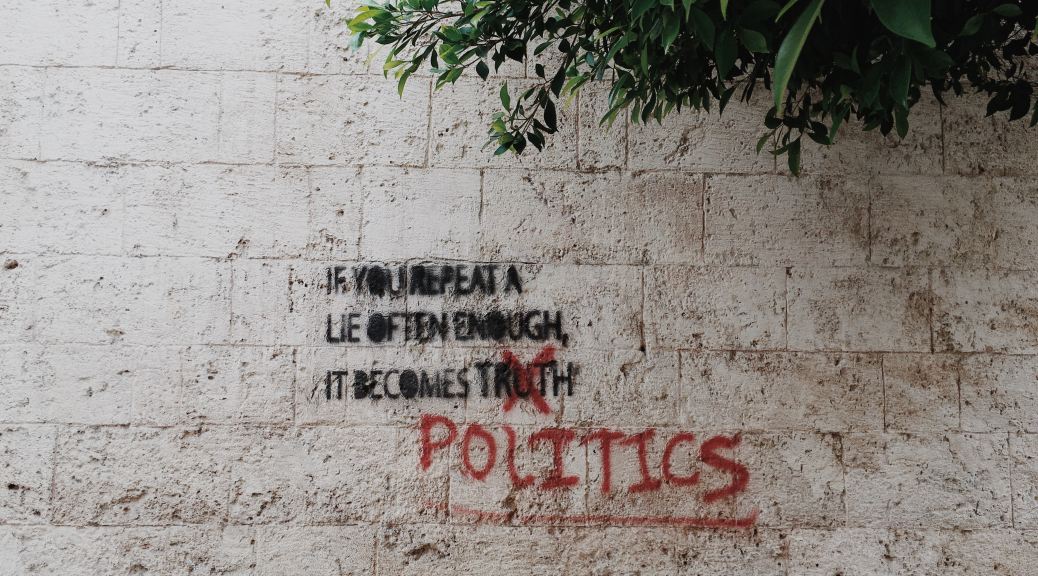
There is an ironic truism—“a lie can travel halfway around the world while the truth is still putting on its shoes”—most often misattributed to Mark Twain that certainly describes the misguided SOR movement’s central claims wrapped up in the initial mantra that SOR is both simple and settled.
Here are two complicated counter-points that are supported by the full body of evidence:
- Reading instruction can and should be significantly reformed (in the context of addressing wider systemic inequities), but the SOR version of causes and solutions are false.
- Teacher education can and should be significantly reformed , but the SOR version of causes and solutions are false.
I have been a strong advocate for education reform, beginning with my entering the field in 1984, and subsequently a strong advocate for teacher education reform, starting with entering higher education and teacher education in 2002.
In “Of Rocks and Hard Places—The Challenge of Maxine Greene’s
Mystification in Teacher Education,” I wrote about teacher education: “As teacher educators, we are trapped between the expectations of a traditional and mechanistic field and the contrasting expectations of best practice guided by critical pedagogy.”
Below, then, I offer a reader about critically reconsidering teacher education and why the use of NCTQ “reports” are misguided and fail the test of scientific evidence.
Teacher Education
- Of Rocks and Hard Places—The Challenge of Maxine Greene’s
Mystification in Teacher Education - The Fatal Flaw of Teacher Education: “We have met the enemy and he is us.”
- If Teacher Education Is Failing Reading, Where Is the Blame?
- Hoffman, J.V., Hikida, M., & Sailors, M. (2020). Contesting science that silences: Amplifying equity, agency, and design research in literacy teacher preparation. Reading Research Quarterly, 55(S1), S255–S266. Retrieved July 26, 2022, from https://doi.org/10.1002/rrq.353
NCTQ
- NCTQ: “The data was effectively useless”
- Fact-checking Phonics, NRP, and NCTQ
- GUEST POST by Peter Smagorinsky: Response to the new NCTQ Teacher Prep Review
- UPDATED: NCTQ: “their remedies are part of the disease”
- Which Is Valid, SOR Story or Scholarly Criticism?: Checking for the “Science” in the “Science of Reading”
- NEPC Review: 2020 Teacher Prep Review: Clinical Practice and Classroom Management (National Council on Teacher Quality, October 2020)
- NEPC Review: 2018 Teacher Prep Review (National Council on Teacher Quality, April 2018)
- NEPC Review: Learning about Learning: What Every New Teacher Needs to Know (National Council on Teacher Quality [NCTQ])
- Thomas, P.L. (2023, September). NEPC review: Teacher prep review: Strengthening elementary reading instruction. Boulder, CO: National Education Policy Center. https://nepc.colorado.edu/review/teacher-prep
 dr. p.l. (paul) thomas