The Unbearable Whiteness of Being: The Permanent Vacation from Race

landscape photo of white living room
Photo by Samuel Zeller on Unsplash

Over my spring break last week, I made a trip to IUPUI in Indianapolis to present as part of a series spanning their academic year, White Racial Literacy Project Speakers Series, addressing whiteness as part of their diversity and inclusion initiatives.

One controversial aspect of this approach has been providing separate spaces for white faculty, staff, and students as well as people of color to investigate whiteness. That sits inside a larger paradox of this series—an effort to center whiteness as a process for de-centering whiteness.

During the session for people of color, I addressed how I often navigate issues of race from the context of my own life, specifically framing my discussion of race by self-identifying as a redneck (see my PowerPoint here).

This racial identification, I note, is important because I have the privilege of stepping into a racial discussion of whiteness indirectly, using “redneck” and still not actually saying “white.”

A woman in that session responded by acknowledging my privilege in controlling the narrative of myself—I can ignore (or as I say, take a vacation from being white) my whiteness almost all the time, and even when I confront it, I can maintain some level of invisibility (normalcy). She added that both race and gender are imposed on her, leaving her no option for similar vacations from race or gender.

This woman’s response spoke directly to the video in my presentation of author Toni Morrison calmly checking Charlie Rose’s question about her writing about something other than race since her writing is designated as racial because she is a black author writing about black characters.

Morrison poses to Rose if anyone ever asks a similar question of Tolstoy, or any white authors who tend to write exclusively about white characters but are not framed as writing about race.

Here is the essential problem with centering whiteness, as being male or heterosexual is also centered.

Centering is the result of characteristics correlated with power, dominance, becoming both normal and invisible/unspoken.

In literature, as Morrison explains, white male authors are allowed to produce literature that avoids being racial or gendered through claims of being universal or allegorical (see Cormac McCarthy).

F. Scott Fitzgerald is no less writing about race (whiteness) than Morrison is about race (blackness), or Ernest Hemingway, no less about gender (being male) than Kate Chopin or Alice Walker about gender (being female).

Fitzgerald and Hemingway, however, are allowed permanent vacations from race and gender by virtue of their privileges while Morrison, Chopin, and Walker exist always under the burden of being writers of race and gender—unless they achieve the lofty status of being themselves writers of universality or allegory (in other words, writing like Fitzgerald and Hemingway).

As DiAngelo details (see below in resources):

White people in North America live in a social environment that protects and insulates them from race-based stress. This insulated environment of racial protection builds white expectations for racial comfort while at the same time lowering the ability to tolerate racial stress, leading to what I refer to as White Fragility. White Fragility is a state in which even a minimum amount of racial stress becomes intolerable, triggering a range of defensive moves. These moves include the outward display of emotions such as anger, fear, and guilt, and behaviors such as argumentation, silence, and leaving the stress-inducing situation. These behaviors, in turn, function to reinstate white racial equilibrium.

Interrupting the centering (making invisible, unspoken) of whiteness is interrupting the vacation-as-normal for white people, and that disruption is often met with anger and resistance since whiteness means a permanent vacation, unlike the permanent burden of race (or gender, sexuality, etc.) for those rendered as “other” against the centered whiteness, often so-called people of color.

White fragility reveals itself in microagressions that seem reasonable, not offensive, and even rational (another veneer for privilege) to white people: “I don’t see race,” “All lives matter,” “There is only one race, the human race,” “How about black-on-black crime or the absent black father?,” “Why does it always have to be about race?” (see below in resources).

That final question is a powerful example because white people are always existing in unacknowledged/unexamined whiteness—their lives are always about race—but the centering of whiteness means whiteness (race) remains invisible and unspoken (how I can identify as a redneck as a code for “white”).

For example, historically, Miss America pageants produced only white winners, and as a consequence, Miss Black America was born in protest of the centering of whiteness, for example. Until the fact of whiteness was confronted by Miss Black America (or consider Black History Month as a recognition that U.S. History is mostly white history), white fragility was not triggered, hibernating; whiteness was allowed its permanent vacation.

James Baldwin faced a parallel experience with Morrison’s, being interviewed as a black writer. In that interview from 1984Julius Lester asked James Baldwin about “the task facing black writers,” and Baldwin replied:

This may sound strange, but I would say to make the question of color obsolete….

Well, you ask me a reckless question, I’ll give you a reckless answer—by realizing first of all that the world is not white. And by realizing that the real terror that engulfs the white world now is visceral terror. I can’t prove this, but I know it. It’s the terror of being described by those they’ve been describing for so long. And that will make the concept of color obsolete.

Whiteness in the U.S. created racism as much as it spring from racism, and then whiteness rendered itself invisible—the manufacturing of the permanent vacation from race.

And thus the paradox confronting initiatives such as the one at IUPUI: Centering whiteness by naming it in order to de-center whiteness.

As someone with tremendous privilege who has the luxury to worry about equity—often in abstract ways, too rarely in ways that change policy or structural dismantle privilege—I am left uncomfortable with the fact that white people must do the work of equity and de-centering whiteness and that this fact means a different sort of centering whiteness.

One of my luxuries is I can be a different kind of reckless than Baldwin voiced; one of my privileges is I can choose to work through awareness to allyship and then to abolitionist, the delicate recklessness of dismantling privilege—centering myself and my whiteness as levers for de-centering whiteness.


Recommended Resources

White Fragility, Robin DiAngelo (essay)

White Fragility: Why It’s So Hard for White People to Talk About Racism, Robin DiAngelo (book)

Examples of Racial Microaggressions

Good intentions are not enough: a decolonizing intercultural education, Paul C. Gorski

Racism Scale

Can Scholars Be Too Literal in Post-Truth Trumplandia?

Recently, I was invited to join a class discussion of Margaret Atwood’s The Handmaid’s Tale in a local International Baccalaureate (IB) high school class. For many years, I taught the novel in my Advanced Placement course, and in 2007, I published a volume on teaching Atwood’s writing.

During the discussion, one very bright and engaged student eagerly noted that Atwood evokes elements of communism in her novel. The use of the term “communism” prompted me to offer a gentle reframing—that the student probably was recognizing elements of totalitarianism, elements often blurred into the mainstream American pejorative use of the word “communism” (see also “socialism” and “Marxism”).

This is an important moment, I think, in understanding how academia works: Language and the teasing out of ideas are often laborious, if not tedious. While teaching first-year writing especially, but in most of my courses, I stress that college students need disciplinary awareness—how each discipline functions and why—and typically emphasize that academics are prone to carefully defining terms, and then holding everyone to those precise meanings.

Political, media, and public discourse, however, tend along a much different path. Language and terminology are treated with a cavalier disregard for meaning. Misusing a term or making a false claim is quickly glossed over before railing against the initial false claim.

Because of that gap between academia and the so-called real world, some educators and scholars call for the importance of public intellectuals grounded in academia. Public scholarship, however, remains controversial within the academia and tends to be received with disdain and condescension by politicians, the media, and the public.

It is at those last two points that I want to emphasize why Sam Fallon’s The Rise of the Pedantic Professor has been so eagerly embraced by some in the academy and many in the public sphere. At its core, Fallon’s argument poses this:

To read the work of humanities scholars writing for a general audience is to be confronted by dull litanies of fact: a list of the years in which Rome’s walls were breached by invaders (take that, Trump), an exhaustive inventory of historians who have dunked on Dinesh D’Souza, a bland recounting of witch-hunting in 17th-century New England.

These public humanities scholars, Fallon argues, “tend to collapse discursive arguments into data dumps,” and are failing their mission with “academic literalism.”

In the traditional norms of the academy, Fallon’s charges reinforce arguments that scholars should remain (somehow) above activism and public engagement, often expectations for being apolitical, objective, or neutral. Fallon also is providing ample fodder for politicians, the media, and the public who marginalize professors and scholars as merely academic, pointy-headed intellectuals making much ado about nothing.

As an educator, scholar, and writer, a career spanning four decades, I have strongly rejected both of these norms, and I have increasingly recognized that public work by scholars is far more important than our traditional scholarship, which is often behind paywalls and read by only inners, if at all.

I think that the gap between the academy and the public not only can be bridged in terms of how we navigate language and ideas, but it must be bridged—especially now that we have entered post-truth Trumplandia.

Consider the current uses and framing of the terms “socialism” and “infanticide.”

The bright IB student mentioned above is a typical example I confront in all of my students, and throughout public debates, especially social media.

While I absolutely recognize that academics can be pedantic, so precise that all meaning and discourse are rendered meaningless to day-to-day existence, I believe Fallon is making a serious mistake of extremes: Academics have obligations to their disciplines and the public, but their public discourse must always remain in any scholar’s lane while balancing the norms of disciplinary discourse with public accessibility.

Do some academics fail at this tightrope act? Of course.

But words matter, and starting with jumbled terms and meanings serves no one well. The public academic is poised to slow down debate while also clarifying what exactly we are saying in terms of cultural ideologies and public policy.

Doesn’t it seem important to confront that a significant numbers of voters in 2016 angrily voted against Obamacare while themselves benefitting from the Affordable Care Act—casting votes grounded in a garbled and self-defeating state of not knowing what terms mean?

Doesn’t it seem dangerous for one political party to drum up fear of infanticide, when infanticide isn’t occurring? Wouldn’t this country benefit from a fact-based (even literal) discussion of women’s health and reproductive rights, prenatal care, and abortion?

I find it troubling that all throughout formal education from K-12 through undergraduate and graduate education, we hold students to higher standards of discourse than we do politicians and the media.

I also have little patience for people who cannot accurately define “socialism,” “communism,” or “Marxism,” but feel compelled to reject these ideologies with unwavering certainty.

It seems, in fact, that no one can be too literal when most public discourse wallows in the mud of being both wrong in the use of language and dishonest in the ideologies and arguments being made for promoting public policy that directly impacts how any of us navigate our lives.

If we need more evidence, the rising public responses to the new tax codes pushed through by Republicans and Trump offer a jumbled and disturbing picture.

Many tax-paying U.S. citizens have a weak understanding of taxes, one oversimplified as the “refund” (let me nudge here: this isn’t any different than oversimplifying and misusing “socialism”).

Many in the U.S. should be angry about the new tax code, but most complaining about the consequences of those changes are doing so in ways that are lazy and simply flawed.

If we backed up this outrage over lower tax refunds, we could have a much more substantive and possibly effective discussion about payroll deductions (most were reduced under the tax changes, thus people received more money per check over the year, which itself would lead to lower refunds), tax burdens among different income brackets, and the needlessly complex industry of preparing and submitting our taxes.

Not unrelated, Republicans have misrepresented calls for 70% marginal tax rates for the very wealthy (about 16,000 Americans out of 127 million households)—again an effective strategy because most people do not understand the literal (and tedious) reality about how marginal tax rates work.

And this brings me back to Atwood’s novel and the class discussion.

Much of Atwood’s work as a writer is about language, the use of language to control and the possibility of language to unmask, to liberate not only ideas but people.

In The Handmaid’s Tale, a few select women control other women through language manipulation. The handmaid’s are trained by Aunts, who instill the propaganda:

There is more than one kind of freedom, said Aunt Lydia. Freedom to and freedom from. in the days of anarchy, it was freedom to. Now you are being given freedom from. Don’t underrate it….

We were a society dying, said Aunt Lydia, of too much choice. (pp. 24, 25)

But it may be more important here to emphasize Atwood’s examination of how Gilead came about. Offred explains about her life before Gilead:

We lived, as usual, by ignoring. Ignoring isn’t the same as ignorance, you have to work at it.

Nothing changes instantaneously: in a gradually heating bathtub you’d be boiled to death before you knew it….The newspaper stories were like dreams to us, bad dreams dreamt by others. How awful, we would say, and they were, but they were awful without being believable. They were too melodramatic, they had a dimension that was not the dimension of our lives.

We were the people who were not in the papers. We lived in the blank white spaces at the edges of the print. It gave us more freedom.

We lived in the gaps between the stories. (pp. 56-57)

This is a novel about people being cavalier about language and thus about the human condition. This novel is a call for the dangers of not being literal enough.

Humanities professors wading into the public debate and their “dull litanies of fact” are simply not the problem facing us today.

Can scholars be too literal in post-truth Trumplandia?

O, hell no, and beware anyone who would argue otherwise.

Nolite te bastardes carborundorum.

Politics of Compliance v. Politics of Resistance: “We don’t need no education”

We don’t need no education
We don’t need no thought control
No dark sarcasm in the classroom
Teacher leave the kids alone

“Another Brick in the Wall, Pt. 2,” Pink Floyd

The December 2018 incident involving high school wrestler Andrew Johnson being forced to cut his hair in order to compete continues to draw attention. Erik Ortiz reports:

But following outcry from the community and the opening of a state civil rights investigation, an attorney for wrestler Andrew Johnson claims officials and referees are still giving him grief over his hair and have an “unrelenting fixation” with him….

Then, on Monday, an official with the state association that regulates athletics and conducts tournaments sent an email to state wrestling officials detailing which hairstyles require the hair to be covered. One image, according to NJ Advance Media, which reviewed the email, was of an unidentified black person with short, braided or dreadlocked hair and closely shaved sides.

More recently, Josh Magness details:

Police say the 11-year-old student at Lawton Chiles Middle Academy in Lakeland said he wouldn’t stand for the Pledge of Allegiance because the flag is “racist,” according to WTSP.

Ana Alvarez, a substitute teacher in the classroom, said she was offended by this comment and asked the student, who is black, why he didn’t leave the country, as reported by The Washington Post.

A teacher from Los Angeles, Larry Strauss, has subsequently weighed in on how the 11-year-old was treated:

When children in a class — of any age — assert their political views, they are giving you an opportunity to teach. Not to teach them to shut up and obey you, but to teach them that they live in a free country where everyone has a say in how we govern and where criticism is welcome, or supposed to be.

Both of these instances represent a truism about formal schooling that works against our claimed beliefs about formal schooling: Although many argue education is a “game changer,” in fact, formal schooling mostly reflects and perpetuates social norms, including the inequities such as racism, classism, and sexism.

Tracking, gate-keeping in elite programs, teacher assignments, standardized testing, discipline, and school funding all reflect that public school policies are grounded in racism and classism.

School dress codes remain biased, as well, by gender and race, disproportionately impacting girls and young women, particularly those of color.

The drivers of these realities, and essentially what erases the ideal of education being revolutionary, are embedded in what appears to be a defense of the 11-year-old refusing to do the pledge of allegiance—Strauss’s framing of “[w]hen children in a class — of any age — assert their political views.”

Consider here that Strauss is positioning a child’s act of not complying with the pledge as political, and in effect, asserting that those administrators, teachers, and students participating in the pledge are somehow not being political.

Here, we have evidence that formal schooling reflects and perpetuates society since this pledge controversy is nearly identical to the National Anthem controversy in the NFL involving, notably, Colin Kaepernick.

We must not ignore that these events are deeply racial (and racist) and reflect that power and normalization treat compliance as invisible (not political) and resistance as not just hyper-visible, but offensive (political).

Here is another truism about formal schooling: Everything everyone does in any school is inherently political, some negotiation of power, some acknowledged or ignored act of compliance or resistance. Yet, in school, as in society, only acts of resistance are seen as “political,” and thus, triggers for punishment, even being ostracized (denied the right to compete, ushered from the school by law enforcement).

Poet Adrienne Rich (2001) fears that what is “rendered unspeakable, [is] thus unthinkable” (p. 150)—and let’s recognize how this is often reflected in formal schooling.

Educator and activist Bill Ayers (2001) confronts the silencing purposes of education:

In school, a high value is placed on quiet: “Is everything quiet?” the superintendent asks the principal, and the principal the teacher, and the teacher the child. If everything is quiet, it is assumed that all is well. This is why many normal children—considering what kind of intelligence is expected and what will be rewarded here—become passive, quiet, obedient, dull. The environment practically demands it. (p. 51)

Cutting the wrestler’s hair and arresting an 11-year-old seem extreme, but to understand these reactions as representative of how power (often white or in the service of whiteness) functions, Robin DiAngelo’s White Fragility explains:

In a white dominant environment, each of these challenges becomes exceptional. In turn, whites are often at a loss for how to respond in constructive ways….

Whites are taught to see their perspectives as objective and representative of reality (McIntosh, 1988). The belief in objectivity, coupled with positioning white people as outside of culture (and thus the norm for humanity), allows whites to view themselves as universal humans who can represent all of human experience. This is evidenced through an unracialized identity or location, which functions as a kind of blindness; an inability to think about Whiteness as an identity or as a “state” of being that would or could have an impact on one’s life.

Unspoken, invisible—and thus rendered not political against the spoken and visible as political. Not political as right, preferred against political as wrong, to be punished, banished.

The compliant students (and teachers, administrators) are being just as political as the ones who are resisting. Calls for anyone—student, teacher, or citizen (including NFL players)—to be not political is itself a political act and a failure to acknowledge that the offended are not against being political, but against someone else’s politics.

As a critical educator, then, I am grounded in another kind of idealism expressed by Ayers, the ideal that current formal education not only refuses to seek but tends to erase, silence, render invisible:

Education tears down walls; training is all barbed wire.

What we call education is usually no more than training. We are so busy operating schools we have lost sight of learning. We mostly participate in certification mills, institutions founded on notions of control and discipline, lifeless and joyless places where people serve time and master a few basic skills on their way to a plain piece of paper that justifies and sanctions the whole affair. Sometimes, these places are merely mindless, and sometimes they are expressly malevolent.

“Malevolent,” like the wrestler’s hair being sheered, like a child being arrested.

We are faced, then, with the politics of being another brick in the wall or joining in with the politics of resistance: “Tear down the wall!”


References

Ayers, W. (2001). To teach: The journey of a teacher. 2nd ed. New York: Teachers College Press.

Rich, A. (2001). Arts of the possible: Essays and conversations. New York: W. W. Norton and Company.

Centering Whiteness and “Green Book”: A Reader (Updated)

The Oscars as an event represents the failed obsession in the U.S. with celebrities, but it also has become a powerful and disturbing window into how too often those with the most power are unable to address race except in terms of centering whiteness.

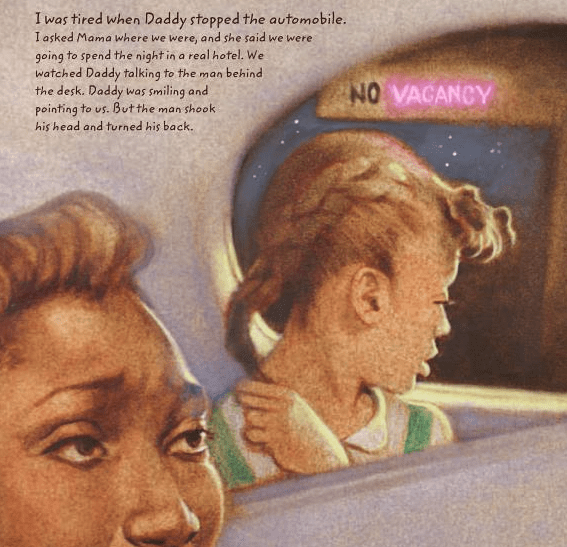
Ruth and the Green Book

Once I challenged Green Book on social media, several white people rushed to support the film, often, they argued, because it includes excellent acting.

My essential claim, however, was expressed as the following:

Green Book centers whiteness to appear to care about blackness, as a condition of caring about blackness.

Black Panther centers blackness.

This isn’t about being perfect on race but about a fundamental difference.

I also must note that the same white people who rush to support Green Book also embraced equally racially flawed films such as The Help and The Blind Side (see also Radio and Driving Miss Daisy).

Embracing uncritically Green Book and rejecting criticism of the film are the result of “white fragility,” as Robin DiAngelo explains:

White Fragility is a state in which even a minimum amount of racial stress becomes intolerable, triggering a range of defensive moves. These moves include the outward display of emotions such as anger, fear, and guilt, and behaviors such as argumentation, silence, and leaving the stress-inducing situation. These behaviors, in turn, function to reinstate white racial equilibrium. Racial stress results from an interruption to what is racially familiar. These interruptions can take a variety of forms and come from a range of sources, including:…

  • Being presented with information about other racial groups through, for example, movies in which people of color drive the action but are not in stereotypical roles, or multicultural education (challenge to white centrality).

White savior narratives and framing the value in blackness only in relationship to whiteness are, disturbingly, the essence of Hollywood “diversity and inclusion.” [1]

How many white people claiming quality acting in Green Book also rushed to support the Netflix series Luke Cage, also well-acted, notably by Mahershala Ali?

Or Black Panther?

Luke Cage and Black Panther center blackness, mostly resisting to suggest these narratives mattered only in relationship to whiteness.

Blackness must not be rendered invisible or unspeakable, but allowing blackness to be seen and spoken only if and when whiteness acknowledges it is not the providence of celebration, not any real sort of advancement.

Green Book is essentially a film version of Columbus claiming he discovered a land already inhabited by native peoples, erasing them and their narratives, their history and destiny.

I offer here a reader, primarily for white readers of this blog, and ask that those of us who are white learn to listen and see (actually re-see) the world without centering our whiteness.


[1] Or as well the garbled cultural appropriation fetish, such as Whiplash.

Downloadable file

See Also

To Kill a Mockingbird, White Saviors, and the Paradox of Obama and Race

Super Sex: Body Objectification and Superhero Narratives

I want a perfect body

“Creep,” Radiohead

She’s suddenly beautiful
And we all want something beautiful
Man, I wish I was beautiful

“Mr. Jones,” Counting Crows


Superhero comic books have a long and troubling history of xenophobia, racism, cultural appropriation, sexism, and nearly any negative -ism you can imagine.

The comic book industry is obsessed as well with rebooting as an industry mechanism and rebirth as a recurring plot element. Whether reboot, resurrection, or adaptation, however, superhero narratives seem unable to shake the very worst aspects of cliche and reductive storytelling.

The adaptation of The Punisher (Netflix) and yet another rebooting of Daredevil, volume 6 (2019), share even more examples of failing to take advantage of starting over.

Season 2 Episode 1 of The Punisher puts Frank Castle, masquerading as Pete, in a dive-bar in Michigan.

Ever stoic, Frank cannot avoid trouble, interjecting himself between a crude bar patron and the bartender, Beth, who has remained nearly equally as distant as Frank. When the bar bouncer moves to expel both the creep and Frank, Beth intervenes, and despite her protestation that she doesn’t need any help, she ultimately makes the move on her knight in shining armor, offering a nightcap at her place.

As Beth and Frank (Pete) walk to her car, Beth asks Frank to assure her he isn’t an “asshole”; Frank replies, “Isn’t that the kind of thing an asshole would do?”

Soon, Beth and Frank are entwined in Hollywood montage sex, interspersed with some dialogue where Frank confesses his name is Frank, and not Pete as he has told her.

Once again, Beth struggles with a reasonable concern about whether or not Frank is an asshole, just another creep, one whose body is riddled with scars.

And for the second time, Beth just goes with a feeling and accepts Frank is essentially a good guy.

Not blessed/cursed with superhero powers, Frank is one of the mostly human superheroes although gifted with skills and the prerequisite rage-motivation: a well-trained killing machine spawned by the military and then driven to incessant vigilanteism by the slaughter of his entire family.

Castle and Mad Max were cast from the same mold.

The Hollywood montage sex of E1 is much less about the sort of sex people have on one-night stands and more about the objectification of bodies in superhero narratives. And these narratives never stray too far from the unexplainable magnetism of the white male saviors that nearly always sit in the center.

Superhero sex is a compelling topic when those superheroes have exceptional powers like Superman needing to be human to be with Lois (see the Christopher Reeves films) or the violent and destructive coupling of Jessica Jones and Luke Cage in the Netflix adaptation of Jessica Jones.

But Castle, The Punisher, is all rage and training so the super sex is titillating but mostly secondary to the standard messages being sent about Frank as white male savior and sexually irresistible.

In both the Marvel comic book universe and the Netflix universe, Castle/The Punisher and Daredevil/ Matt Murdock are paired as different sides of the same vigilante coin—Frank the-ends-justify-the-means Castle juxtaposed with Matt Batman-lite Murdock.

With Daredevil being resurrected once again in the comic book with 2019’s volume 6, on the heels of the Death of Daredevil and three seasons of Daredevil on Netflix, we are immediately confronted with super sex and body objectification.

While superheroes such as The Punisher and Batman are essentially humans with super abilities gained through training and trauma, Murdock is a step above since he does possess super powers, although his physical strengths are mostly acquired. In other words, Murdock/Daredevil does not pose the same sexual threats as Superman or, say, the Hulk.

Fresh from the edge of death and the hospital, like Frank in S2 E1, Matt in issue 1 (2019) moves from the bar to the bedroom:

IMG_1892.JPG

The panels preceding these are the comic book version of Hollywood montage sex, but this dialogue is significant for the ways this reboot approaches well and then fails the super sex motif.

In the early episodes of Netflix’s Daredevil, Foggy chuckles about Matt’s being blind but always attracting beautiful women. This adaptation remains uncritical in its use of the blind motif in Daredevil, which the comic book has tended to do since the early 1960s.

The scene above does complicate the blind motif when Matt implores: “Please don’t make my disability your fetish.”

However by the final panels of that page, the dialogue and artwork paint a disturbing, and far too predictable picture.

Matt’s partner in a one-night stand is aggressively establishing her seeking out his body. But she is drawn pencil-thin, and both she and Matt concur—despite her being attracted to Matt’s blindness (“I picked you up with my charm“): “I don’t have to worry if I am pretty enough,” she explains. “And yet,” Matt parries, “you’re beautiful.”

“And yet,” she echoes, “I’m beautiful.”

Superhero narratives remain compelling because they have potential, often underachieved potential, but potential none the less.

The Punisher and Daredevil are characters with moral and ethical imperatives about justice, but also embodiments of vigilante themes that are pursued uncritically.

They share as well the lazy super sex plot elements and body objectification that is reductive for women characters who are equally diminished by their capitulation to the irresistible white savior appeal of Castle and Murdock—stoic, scarred, and chiseled.

Real-life sex is almost nothing like Hollywood montage sex, and superhero narratives could benefit from realizing that as well as exploring the full physical and emotional complexity of humans, even when they have superpowers or especially when they are merely human in the presence of the superhuman.

Some People Call Me Maurice

I’m a joker, I’m a smoker
I’m a midnight toker

“The Joker,” Steve Miller Band

I’m mixing weed with wine

Walk It Back,” The National

The universe occasionally can be quite trippy.

Over coffee I was telling a friend about Don Nelson’s recent admission about what he has been doing lately: “I’ve been smoking some pot.”

Then, I realized the coffee shop was wafting over their music system Steve Miller Band’s “The Joker.” I sang quietly a bit of the lyrics because this song was ever-present during my adolescence spent in the 1970s.

“Man,” I said, joking a bit, “I should have been smoking pot when I was listening to this stuff in high school. I really wasted an opportunity.”

Here’s the irony: It was during high school that I switched to contact lenses from my glasses, but these were some heavy-duty hard lenses of the time. As a result, my eyes were almost always bloodshot.

In the 1970s, this signaled pot smoker. So people were often convinced I was high—although I was never a pot smoker throughout high school or college in the late 1970s and early 1980s.

Many if not most of my friends smoked pot. I often was the designated driver for my high friends jonesing for munchies. Trips to Chick-fil-a were common with my red and white 1973 Gran Torino slammed full of giggling and stoned teenagers singing to the Ohio Players, Steve Miller Band, or Pink Floyd blaring over my stereo.

It wasn’t just my eyes signaling marijuana.

Deeply introverted and nearly paralyzed by undiagnosed anxiety (and likely ADHD/OCD), I was mostly terrified of pot as an illegal drug, a fear engrained by my working-class and conservative parents.

Another irony: My defense mechanisms for all this included a reputation for World-Class use of profanity (I was a devoted student of Richard Prior and George Carlin) and an elite tolerance for drinking alcohol.

Later in life I developed a joke about not being a pot smoker as a teen: I was too often drunk in high school and college and was afraid of holding something burning while intoxicated.

I first saw the Don Nelson clip on ESPN. The typical frat-culture of those sports shows included several mostly white men yucking it up about Nelson and smoking pot. In the clip, Nelson, approaching 80, has long hair, a beard, and gold chains around his neck; a couple black men beside him on the dais howl with laughter at his comment, and his smirk.

Also in the 1970s, I played basketball, loved basketball, and despite my initial disdain for the Boston Celtics (an urge grounded in the natural compulsion to reject anything our father likes), I became a Celtics fan. Over the years, I came to appreciate Celtics legends, notably Bill Russell.

Nelson was a Celtics player before he had a long career as an NBA coach.

Part of me wanted to say that Nelson has joined Russell as models of life goals for aging. I do, in fact, admire Russell for his career and his life in a way that is important to me.

And Nelson seems a happy man; I would never deny him that.

I can’t, however, ignore that as a very wealthy white man, Nelson has made his wealth with and on the backs of gifted black men in the NBA. I can’t, however, ignore that all this yucking up about smoking pot late in life because it is now plentiful and legal in some states takes place along side mass incarceration that disproportionately impacts black men.

How many people are unseen and unheard in our prisons or denied employment in their free lives because they too wanted to smoke some pot but got busted?

More than half of drug busts are for marijuana.

Marijuana usage is about the same for black and white people, but “Blacks Are 3.73 Times More Likely Than Whites to Be Arrested for Marijuana Possession” (ACLU).

I really wish the Nelson clip could be funny, but it isn’t.

The clip is yet another documentation of the fruits of privilege—some people have access to living that other people are denied.

The access and denial are arbitrary and have nothing to do with merit.

The Joker in the Steve Miller Band song is a toker and he swears, “I sure don’t want to hurt no one.”

He seems like the sort of guys I hung out with in high school and college, stoners, all white and mostly insulated from any real harm, especially any fear of the criminal justice system.

“I ain’t hurtin’ nobody, man,” I can hear in my memory’s ear because my pothead friends always wanted me to join in.

I was, however, irrationally terrified.

And a part of me find Nelson’s peaceful easy feeling very compelling.

But I am reminded of a sobering refrain as I watch Nelson:

Your Honor, years ago I recognized my kinship with all living beings, and I made up my mind that I was not one bit better than the meanest on earth. I said then, and I say now, that while there is a lower class, I am in it, and while there is a criminal element I am of it, and while there is a soul in prison, I am not free. (E. V. Debs: Statement to the Court)

What Shall We Do About Reading Today?: Looking Back to See Now More Clearly

The November 1942 issue of The Elementary English Review (National Council of Teachers of English) included a provocative piece: What Shall We Do About Reading Today?: A Symposium.

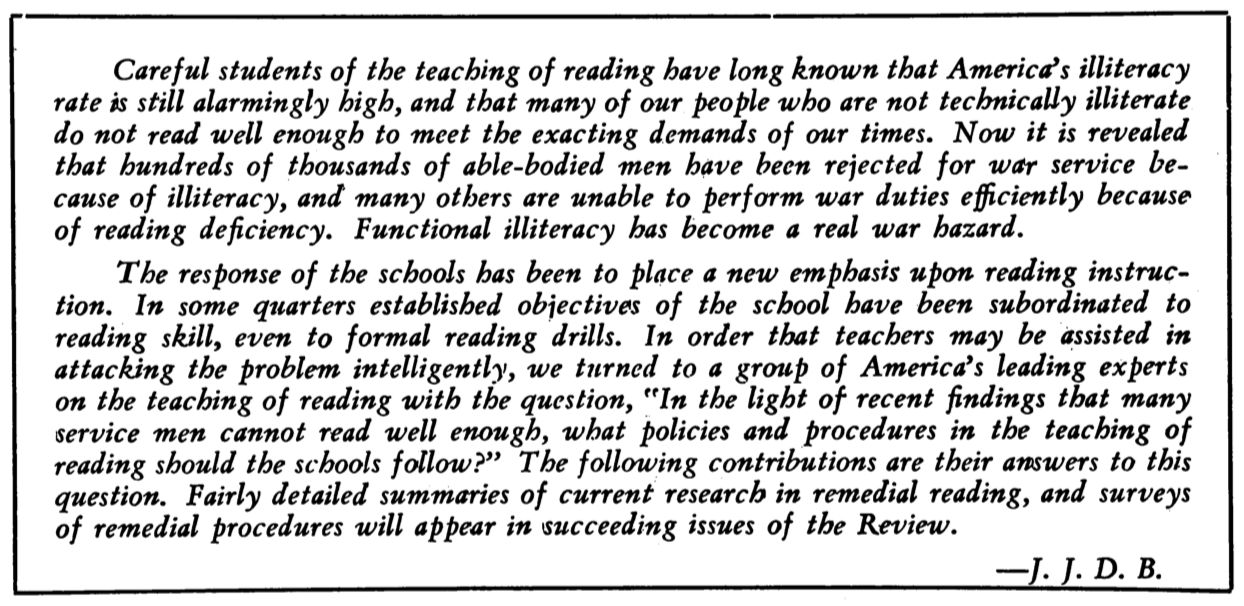
The opening editorial comment frames the need for the question:

Editorial blurb 1942.png

This symposium offers answers to the titular question from leading literacy experts of the time: Emmett A. Betts, E.W. Dolch, Arthur I. Gates, William S. Gray (first IRA president), Ernest Horn, Lou LaBrant (former president of NCTE and focus of my dissertation, an educational biography), Holland Roberts, Dora V. Smith (former NCTE president), Nila Banton Smith, and Paul Witty (key figure in the career and life of LaBrant).

Unlike most cries of educational “crisis,” this national focus on reading was nested in World War II—a genuine crisis. But, according to the assembled experts on literacy, this 1942 version of the Reading Wars was a harbinger of how these debates are mostly misinformed, misguided, and driven by ideology instead of evidence.

Betts, in the opening piece, notes an important fact drawn from a report by First Lady Eleanor Roosevelt: “One of the students had only four months of schooling, another was foreign born, some came from sections of the country where educational opportunities were meager, and so on. In short, the First Lady’s report emphasized the lack of educational opportunity [emphasis added] rather than the questionable quality of instruction” (p. 225).

Before detailing the problems and the possible solutions—including recognizing shortages and shifts in teacher availability—Betts makes a powerful claim: “In a democracy, the people get the kind of schools they want….In a democracy, the quantity and quality of educational opportunity is a product of what people want, and what they want is to no small degree conditioned by the educational leadership they have elected to follow” (pp. 225-226).

While I recommend reading the symposium responses in full, I focus below on two key answers from Gray and LaBrant.

Gray offers a solid framing of the debate spurred by claims of illiteracy among those called to serve, including this:

Gray second attitude.png

Along with refuting these standard false charges, Gray builds to a powerful closing argument:

A common error on the part of those who modify their reading programs is to adopt one or more reforms, such as the provision of much free reading, and neglect other aspects of reading that are in need of specific attention…

If the discussion thus far has achieved its purpose, it should be clear that current deficiencies in reading are not the product of “pseudo-scientific fumbling” or the use of progressive reforms, as some would have us believe. They are due in large measure either to the continued use of traditional patterns of teaching or to failure to provide a well-balanced [emphasis in original] program of reading activities that harmonize with progressive trends. (pp. 236-237)

LaBrant, in her typical style, takes a much more direct approach:

Within the past ten years we have made great strides in the teaching of purposeful reading, reading for understanding (the kind of reading, incidentally, which the army and navy want). Nevertheless, we hear many persons saying that the present group of near-illiterates are results of “new methods,” “progressive schools,” or any deviation from the old mechanical procedures. They say we must return to drill and formal reciting from a text book. (p. 240)

However, LaBrant completely discredits that blame:

1. Not many men in the army now have been taught by these newer methods [emphasis in original]. Those few come for the most part from private or highly privileged schools, are among those who have completed high school or college, and have no difficulty with reading.

2. While so-called “progressive” schools may have their limitations, and certainly do allow their pupils to progress at varied rates, above the second grade their pupils consistently show superior ability in reading. Indeed, the most eager critics have complained that these children read everything they can find, and consequently do not concentrate on a few facts. Abundant data now testify to the superior results of purposeful, individualized reading programs [emphasis in original].

3. The reading skills required by the military leaders are relatively simple, and cause no problem for normal persons who have remained in school until they are fourteen or fifteen. Unfortunately the large group of non-readers are drop-outs, who have not completed elementary school, come from poorly taught and poorly equipped schools, and actually represent the most conservative and backward teaching in the United States [emphasis in original]. (pp. 240-241)

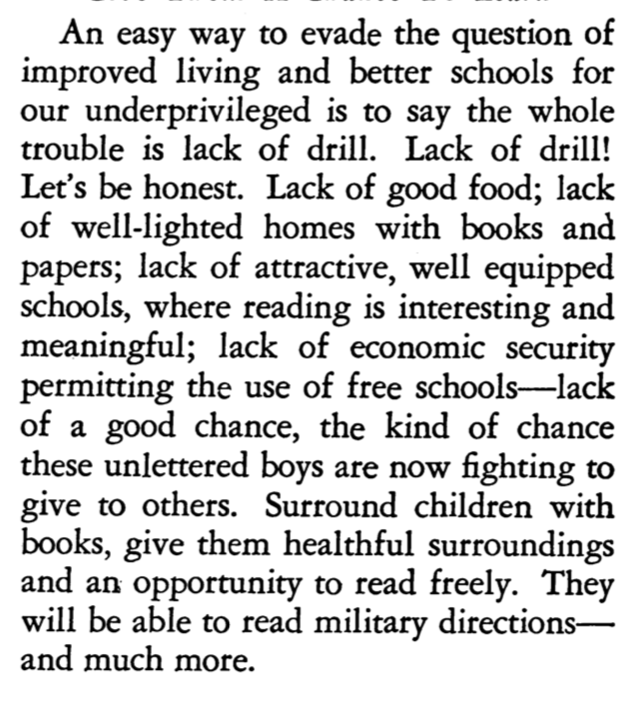
In her conclusion, LaBrant is passionate and unyielding:

lack of drill

Within five years, LaBrant penned what would become a refrain of her six-plus decades as an educator: “A brief consideration will indicate reasons for the considerable gap between the research currently available and the utilization of that research in school programs and methods” (p. 87).

The question about reading raised in the 1940s suffered from the same failures to recognize the problem in order to shape effective and credible answers that we are confronting in 2019.

The fumbling today of the Reading Wars is yet another snapshot of a tired truism: “Those who cannot remember the past are condemned to repeat it” (George Santayana).

Teaching and Learning: The Dysfunctional Celebrity Couple

I am deeply torn about the obsession with celebrities in the U.S. because seeking to be a celebrity brings with the rewards of fame a sort of 24-hour surveillance that no human deserves, or can survive.

When I see a media report on Celebrity X finally finding the love of their life, I immediately anticipate the cheating or break-up coverage to come. And then, the next story years later about Celebrity X finally finding the love of their life.

There exists in the U.S. a fundamental misunderstanding about the causal relationship between celebrity and happiness—that celebrity causes happiness.

I think teaching and learning suffer from both an over-exaggerated media and public focus as well as the same misunderstanding.

Let me share here that over the first few years of my becoming a high school English teacher I was racked with doubt about my work as a teacher because I routinely noticed that despite my teaching student often failed to demonstrate learning.

But something else bothered me as well.

Those first years in the early and mid-1980s included a common practice of issuing to students and then teaching from Warriner’s grammar text. Although I knew isolated grammar instruction was at least problematic, if not harmful (which George Hillocks showed within a decade of this experience), I tried to somehow follow the expectations of my department (use the grammar book!) and teach well my students to write.

Here’s the concern: Students were driven dutifully through, for example, “who/whom” chapters of Warriner’s, exercises and tests, from about 5th grade through 12th grade.

I watched as my students scored poorly on the “who/whom” assessments, waded through the worksheets.

Looking back, I connect this “who/whom” foolishness with my own high school adventures with “shall/will” exercises and tests.

First, “whom” is nearly dead, soon to join dear-departed “shall.” In a weird way, student ambivalence about “who/whom” will eventually be justified—just as those of us who failed to care about “shall/will” have won out.

More importantly, however, I realized in those first few years of teaching that there is in fact a very weak causal relationship between teaching and learning.

That I teach cannot guarantee learning, and students demonstrating (or not) learning often is not proof they have or haven’t been taught.

I have been brought back to this because so much of the current phonics fundamentalism I witness on social media is grounded in two deeply flawed premises.

Phonics fundamentalists are mired in anecdote. Broach the topic of reading on social media and legions will weight in with “I know a student” or “I have a child,” which leads to the second problem.

Phonics fundamentalists are trapped in weak evidence that students can’t read and then are convinced that lack of reading ability is caused by a failure of teaching.

A middle schooler reads poorly, they argue, and it is because that middle schoolers has weak decoding skills—because nobody teaches phonics anymore!

This resonates with me because as a literacy educator focusing mainly on the teaching of writing for 35 years and counting, I hear regularly the “nobody teaches grammar anymore” refrain—posed similarly by those making rash claims based on flimsy evidence.

Both phonics and grammar fundamentalism suffer as well from a serious lack of historical perspective.

Since at least 1900, roughly a beginning point of broad formal public education (although that promise was marred for about 7 more decades by all sorts of failures in assuring racial and gender equity), there has not been a moment when the media and the public was not lamenting that “kids today can’t read or write.”

When intensive phonics had its heyday: The media and public screamed students couldn’t read.

When isolated grammar was all the rage: The media and public screamed students couldn’t write correctly.

In this fourth decade of being a teacher, I am weary of fundamentalism and missionary zeal.

I have little patient for adults who have lower standards for themselves than the children and young people they claim to be serving.

I also have a heaping helping of humility.

I am a teacher.

However, teaching is no guarantee of learning.

Students failing to demonstrate learning is no proof they haven’t been taught before they entered my classroom—or while they have been in my classroom.

Teaching and learning are a dysfunctional celebrity couple.

We must stop staring and expecting them to fulfill some idealistic vision we are imposing on the universe.

And we would all be better off checking our fundamentalism and missionary zeal.

You know, kids today, they are wonderful, and to be perfectly honest, they make me happy to be alive to witness their becoming.

They can do without the worksheet, phonics and grammar rules. Maybe patience and adults who are kind and attentive.

You see, I, too, dwell in idealism, of a different kind.


educator, public scholar, poet&writer – academic freedom isn't free