
Tag Archives: Alice Walker

Banned in the U.S.A.

When students come to my university office for the first time, they typically utter, “You have a lot of books,” followed by noting the clutter.

For those students, they cannot see the lineage I can now recognize: Go, Dog. Go!, Green Eggs and Ham, One Fish Two Fish Red Fish Blue Fish, Stuart Little, Charlotte’s Web, 7000 Marvel comic books, Arthur C. Clarke, and then that day in my high school sophomore English teacher’s classroom during break.

In the mid- and late-1970s, I was a so-called good student, making mostly As and some Bs, but I considered myself solidly a math and science student, planning upon graduation to major in physics in college. Sitting in my English teacher’s room during breaks, we would talk. On one occasion when I was a tenth grader, Mr. Harrill began recommending that I read real literature, and not the science fiction (SF) I was consuming at high rates.

Since he knew my parents and what they allowed me to read, he nudged me toward D.H. Lawrence—and thus my transition to literary fiction began.

During those same formative years in my teens, my mother and her family had introduced me to The Firesign Theatre, George Carlin, and Richard Pryor.

It was books and comedians, then, who have been and continue to be banned that who I am was built on—the reason I have an office packed with books (and even more on shelves at home, and even more stacked here and there waiting to be read since I buy at a rate with which I cannot keep pace) and write every day.

So during Banned Book Week 2014, I am compelled to recall some of my experiences with books being challenged during my 18 years as a public high school English teacher in rural South Carolina.

Likely my first experience came relatively early in my career when I taught American literature to advanced sophomores tracking into Advanced Placement. I was deeply into John Gardner and learning to write myself so I assigned Gardner’s Grendel.

This was a powerful learning experience because it combined a young and idealistic teacher, bright and excited students, the power of a few angry parents, and the essentially conservative nature of public school administration.

Several years later, when I was English department chair, we revisited our required reading list, seeking ways to add female and minority authors to the Old White Male canon. We did add Zora Neale Hurston’s Their Eyes Were Watching God, to be taught primarily by our African American female teacher in the department.

The first time we assigned Hurston’s classic, a challenge was submitted by a parent, a parent who was a leader of a local KKK chapter. It wasn’t difficult to see through the challenge to the ugliness driving the complaint, but nonetheless, this challenge also exposed the power of parents despite their lack of credibility in traditional schooling.

And my final example of the threat of censorship while I was teaching remains the most troubling since the school’s own librarian considered challenging my use of Alice Walker’s The Color Purple in my AP Literature course for seniors, a course her child was scheduled to take the next year. Again, the concerns were being raised by the librarian, who argued with me that the work wasn’t literature despite her own library shelves holding several books of criticism addressing The Color Purple as just as credible as the so-called classics (again, mostly authored by Old White Men).

Censorship to shield children. Censorship as a weapon of racism. Censorship as a conservative ideal.

I must add here that censorship is even more insidious and pervasive in our public schools in the form of self-censorship—teachers seeking works that will not cause complaints and avoiding works that may be controversial.

So banned in the U.S.A. remains powerful often in forms that are mostly invisible, mostly part of the norm feared by Ray Bradbury and dramatized in his Fahrenheit 451.

In the 60th anniversary edition of Fahrenheit 451, several of Bradbury’s essays (and a brilliant introduction by Neil Gaiman) are included, one of which notes: “There is more than one way to burn a book. And the world is full of people running about with lit matches” (p. 209).

Like Bradbury, Kurt Vonnegut and Sherman Alexie have confronted the power of censorship as well as the misguided desire of a free people to ban not just books, but ideas.
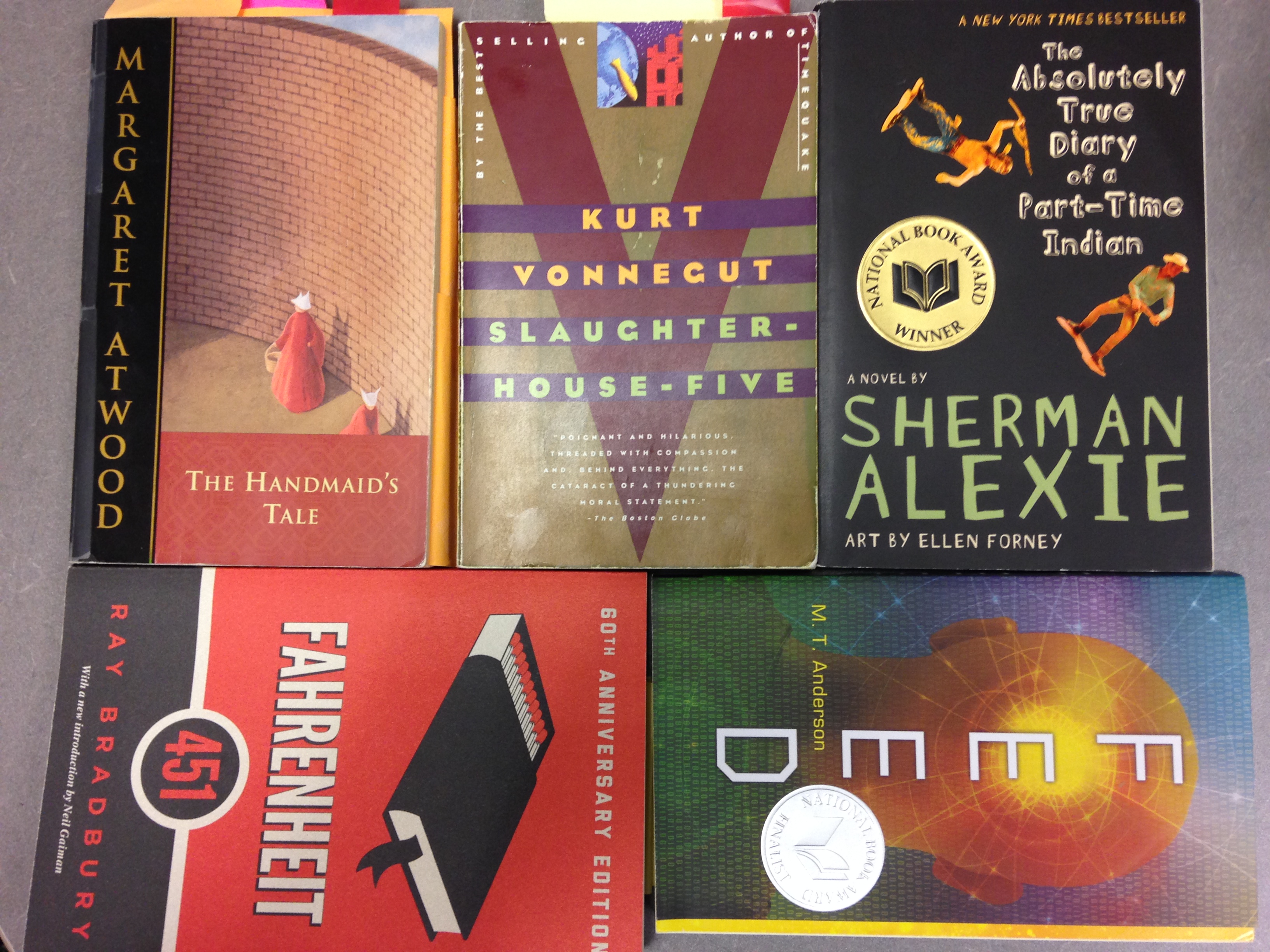
ban2

Vonnegut’s letter to those who sought to ban his work explains:

If you were to bother to read my books, to behave as educated persons would, you would learn that they are not sexy, and do not argue in favor of wildness of any kind. They beg that people be kinder and more responsible than they often are. It is true that some of the characters speak coarsely. That is because people speak coarsely in real life. Especially soldiers and hardworking men speak coarsely, and even our most sheltered children know that. And we all know, too, that those words really don’t damage children much. They didn’t damage us when we were young. It was evil deeds and lying that hurt us.

Alexie’s powerful Why the Best Kids Books Are Written in Blood builds to his personal defense of books:

And now I write books for teenagers because I vividly remember what it felt like to be a teen facing everyday and epic dangers. I don’t write to protect them. It’s far too late for that. I write to give them weapons–in the form of words and ideas-that will help them fight their monsters. I write in blood because I remember what it felt like to bleed.

As a lover of books, as a writer, and as a life-long teacher, I am indebted to my childhood and teenage freedom to read, to listen to, and to consider ideas other than the ones endorsed by my home, my community, and my school.

George Carlin and Richard Pryor talked about the world in ways that my parents, my peers, and my community never did; they both praised Muhammad Ali with language both profane and poetic as was fitting for their comedy and for Ali’s own bravado against an inequitable world to which he would not bend a knee—a quality admirable and shared among Ali, Carlin, and Pryor.

“A book must be the axe for the frozen sea within us,” Franz Kafka wrote in his Letter to Oskar Pollak 1904.

Books are sacred because ideas are sacred, or must be if a people truly seeks to be free. Talking about Fahrenheit 451 in 1993, Bradbury said, “You don’t have to burn books to destroy a culture. Just get people to stop reading them.”

Banning books has no place in a free society, but each time we remain passive, allowing a book to be silenced, we are “running about with lit matches.”

Preserving access to all books for all people, especially children, is at the core of our humanity because the only dangerous idea is the one not allowed.

Education in Black and White: Beware the Roadbuilders

Nettie sees the world in a stark black and white once she faces and confronts the missionary zeal being done to the people who are native to Africa. The letters exchanged between Nettie and Celie, which constitute The Color Purple, are literally the lived stories of oppression and the oppressed right there in black and white for readers:

The first thing I should tell you about is the road. The road finally reached the cassava fields about nine months ago and the Olinka, who love nothing better than a celebration, outdid themselves preparing a feast for the roadbuilders who talked and laughed and cut their eyes at the Olinka women the whole day. In the evening many were invited into the village itself and there was merrymaking far into the night. I think Africans are very much like white people back home, in that they think they are the center of the universe and that everything that is done is done for them. The Olinka definitely hold this view. And so they naturally thought the road being built was for them [emphasis added]. And, in fact, the roadbuilders talked much of how quickly the Olinka will now be able to get to the coast. With a tarmac road it is only a three-day journey. By bicycle it will be even less. Of course no one in Olinka owns a bicycle, but one of the roadbuilders has one, and all the Olinka men covet it and talk of someday soon purchasing their own.

Well, the morning after the road was “finished” as far as the Olinka were concerned (after all, it had reached their village), what should we discover but that the roadbuilders were back at work. They have instructions to continue the road for another thirty miles! And to continue it on its present course right through the village of Olinka. By the time we were out of bed, the road was already being dug through Catherine’s newly planted yam field. Of course the Olinka were up in arms. But the roadbuilders were literally up in arms. They had guns, Celie, with orders to shoot!

It was pitiful, Celie. The people felt so betrayed! They stood by helplessly—they really don’t know how to fight, and rarely think of it since the old days of tribal wars—as their crops and then their very homes were destroyed. Yes. The roadbuilders didn’t deviate an inch from the plan the headman was following. Every hut that lay in the proposed roadpath was leveled. And, Celie, our church, our school, my hut, all went down in a matter of hours. Fortunately, we were able to save all of our things, but with a tarmac road running straight through the middle of it, the village itself seems gutted.

Immediately after understanding the roadbuilders’ intentions, the chief set off toward the coast, seeking explanations and reparations. Two weeks later he returned with even more disturbing news. The whole territory, including the Olinkas’ village, now belongs to a rubber manufacturer in England. As he neared the coast, he was stunned to see hundreds and hundreds of villagers much like the Olinka clearing the forests on each side of the road, and planting rubber trees. The ancient, giant mahogany trees, all the trees, the game, everything of the forest was being destroyed, and the land was forced to lie flat, he said, and bare as the palm of his hand.

And there is a scene in the problematic film Gandhi (itself both an unmasking of imperialism and the embodiment of paternalism and privilege) when Gandhi expresses his idealism about the potential for non-violent resistance to overcome oppression:

Brigadier: You don’t think we’re just going to walk out of India!

Gandhi: Yes. In the end, you will walk out. Because 100,000 Englishmen simply cannot control 350 million Indians, if those Indians refuse to cooperate.

As a work of art (The Color People) and a film recreation (and appropriation) of history (Gandhi), these scenes speak to the current state of education and education reform, especially as those contexts are being viewed through the lens of the 60th anniversary of Brown v. Board.

Unlike Gandhi, I am not optimistic that oppressive privilege will simply walk away. Like Nettie, I watch as the roadbuilders court the people they plan to bulldoze.

In New Orleans, the roadbuilders are charter school advocates and Teach For America are the missionaries filled with zeal.

And 60 years after Brown v. Board, New Orleans has replaced its public schools in the wake of firing all of the public school teachers with charter schools—a 21st century separate but equal, as Lyndsey Layton reports:

White students disproportionately attend the best charter schools, while the worst are almost exclusively populated by African American students. Activists in New Orleans joined with others in Detroit and Newark last month to file a federal civil rights complaint, alleging that the city’s best-performing schools have admissions policies that exclude African American children. Those schools are overseen by the separate Orleans Parish School Board, and they don’t participate in OneApp, the city’s centralized school enrollment lottery.

Privilege remains white and inequity remains black.

I invite you, then, to read.

Andre Perry in The education-reform movement is too white to do any good:

But let’s also stipulate that overwhelmingly white movements pursuing change for black and brown communities are inherently paternalistic. The great educator Benjamin E. Mays famously said, “I would rather go to hell by choice than to stumble into heaven.” Reform is being done to communities of color. That’s why saying you’re a black education reformer effectually elicits charges of “acting white” from black communities….

Diversity removes doubt of racial bias, explicit or implicit. So when black and brown people are largely absent from positions of power, the entire reform movement loses credibility and accrues suspicion. Black education reformers struggle to connect with the very communities we’re members of. The overarching sentiment among attendees at the aforementioned meeting was that black leadership is missing from education reform. Consequently, “reform” has become a dirty word in some communities….

We need less “reform” and more social justice.

Tressie McMillan Cottom (and Ta-Nehisi Coates) in No, college isn’t the answer. Reparations are:

For some, reparations to African Americans for enslavement and state-sanctioned apartheid (more benignly known as “Jim Crow”) is a shocking case to make. I am a sociologist whose training has been, in part, with economists like Sandy Darity at Duke University and Darrick Hamilton at The New School. For Darity, Hamilton, and many other serious scholars of race, history, and inequality, the matter of reparations is anything but novel or shocking. Neither is it hyperbolic. There are real programs, with feasibility studies and implementation suggestions, and they move far beyond Coates’ call for a spiritual reckoning of the body politic. If you have never heard of them, that is likely by design [emphasis added]. Few powerful persons or institutions have ever been willing to seriously put a reparations program before the American people.

But I wager that you have heard a lot about how education and opportunity can be, through hard work and moral fortitude, the path to greater equality for African Americans. In many ways, when the formerly enslaved asked first for a national program to redress the forced, free labor that made the United States the nation we know it to be, they were given schooling instead of redress; opportunity instead of compensation. It is an attitude that persists in our policy and our cultural lexicon. When the demand is for justice, we are most likely to respond with an appeal, instead, to fairness. And in no institution is that more clearly evident than education. There’s just one problem: It’s not good enough.

Mia McKenzie in The White Teachers I Wish I Never Had:

Black children need teachers who can reflect the history of our people to them in an honest and empowering way. They also need teachers who see them, who don’t think of them as deficient, as problems to solve, or as thugs-in-training, when they are really just children, innocent and eager and as capable of learning as anyone else. They need teachers who can love them. In a world that tells them they are less, having authority figures, from an early age, who believe in their humanity, in their goodness, in their extraordinariness, is everything.

Ms. Reisman was the first terrible white teacher I had, but after her there were others. Mr. Fleischman, my seventh-grade homeroom and math teacher, was one. He disliked me and he showed it. He punished me for things more popular kids got away with daily. He seemed to like only the Black kids who were hip and cool but not smart, and then only if they were also boys. My awkward girl presence bugged him, particularly because I wasn’t silent or invisible. I was still confident, in spite of not being cool, or a boy, and he seemed to loathe it, his misogynoir showing quite clearly. I battled him, too.

Margaret Kimberley in Police Target Black Children:

Americans should take a long look in the mirror before criticizing other nations for human rights abuses. The law enforcement system in the United States ranks among the worst in the world in the cruel treatment meted out to its citizens. Even children in this country are not safe if they are black and unlucky enough to interact with the police. Of all the various ethnic and national groups in the United States, only black people have to worry that their child may be pushed through a glass window by officers of the law.

A recent study published in the Journal of Personality and Social Psychology demonstrated what black people have always known. Black children are dehumanized to such an extent that they aren’t perceived as children at all. They are assumed to be older, less innocent and inherently guilty of some wrong doing. Study co-author Matthew Jackson said, “With the average age overestimation for black boys exceeding four-and-a-half years, in some cases, black children may be viewed as adults when they are just 13 years old.” Two recent cases involving the New York City police department show the truth of these words and the perils black people face even in childhood.

Beware the roadbuilders. They are not here to serve you, they are on their way to bulldoze right over you.

See Also

Education Reform in the New Jim Crow Era

Endgame: Disaster Capitalism, New Orleans, and the Charter Scam

From Baldwin to Coates: Denying Racism, Ignoring Evidence

Paternalism, Old or New, Blinds

22 Wives, be subject to your own husbands, as to the Lord. 23 For the husband is the head of the wife, as Christ also is the head of the church, He Himself being the Savior of the body. 24 But as the church is subject to Christ, so also the wives ought to be to their husbands in everything.

Ephesians 5:22-24

Wives, submit yourselves to your husbands, as is fitting in the Lord.

Colossians 3:18

The Olinka do not believe that girls should be educated. When I asked a mother why  she thought this, she said: A girl is nothing to herself; only to her husband can she become something.

Nettie to Celie, The Color Purple, Alice Walker

Slaves, obey your earthly masters with respect and fear, and with sincerity of heart, just as you would obey Christ.

Ephesians 6:5

Slaves, obey your earthly masters in everything; and do it, not only when their eye is on you and to curry their favor, but with sincerity of heart and reverence for the Lord.

Colossians 3:22

The road to hell is paved with good intentions.

No one is more dangerous than he who imagines himself pure in heart: for his purity, by definition, is unassailable.
― James Baldwin, Nobody Knows My Name

I spent the last third of my career as a high school English teacher also serving as the soccer coach for the school’s boys and girls soccer programs. The reasons I took the coaching position included my own concerns about how public school coaches often behaved in ways that no one would have tolerated by teachers in the classroom—although most of those coaches were also classroom teachers.

Coaches routinely berated players, including the use of profanity, and in the South, the line between church and state simply did not exist since coaches always led players in prayer, especially just before a game or match started in full view of the fans.

For most of my life and career in my small hometown, the head football coach—who worked as athletic director and assistant principal—blared profanity over the stadium intercom during practices and even swore at students while issuing them demerits for profanity.

That coach won football games, state championships, and thus, essentially not a soul ever uttered a concern—even in those moments when the profanity was joined with racial slurs.

I did complain so when I became a coach, I set out to change the culture of my teams both in my behavior and in the messages I sent.

When I notified my team that I would not lead them in prayer—explaining why—and that before games teammates who wanted to pray needed to organize that and then join the team for a pre-game huddle, that change did prompt complaints. But that change also brought players to me in private who thanked me—players who had never spoken a word about coach-led prayers making them uncomfortable before.

So when I heard about the controversy surrounding Clemson University and whether or not head coach Dabo Swinney is coercing his players with his religious beliefs, I was certain of two things: (1) local public opinion would overwhelming support Swinney, and (2) despite Swinney’s good intentions (I do trust he has only good intentions), the situation is, in fact, inappropriate in the context of Swinney’s power as head coach and Clemson being a state university.

But the Clemson football/religion controversy is much more than the narrow situation because at its source, the controversy is about a recurring human flaw: the allure and failure of paternalism, both on grand and small scales.

Nettie and Celie are sisters who exchange letters in Alice Walker’s The Color Purple. Nettie reveals to Celie throughout the correspondence Nettie’s own awakening to the dangers of missionary zeal during her experience in Africa. Celie, who remains home in the Deep South, confronts her own awakening about the traditional view of women in the South—the subservience of women and wives occurring, however, in both sisters’ worlds.

As a work about racism and sexism, The Color Purple ultimately is a confrontation of paternalism. And paternalism is the driving force behind the justifications for misogyny and slavery: Women were to be protected because of their inherent frailties and slaves were to be taken care of by their owners because of Blacks’ inherent inadequacies.

Subjugating women to the control of men and Blacks to the control of Whites was repeatedly framed as acts of good intentions and then linked to the ultimate paternalism—the Word of God.

When the U.S. came against the bombing of Pearl Harbor, the political response was something that—looking back—seems nearly impossible to believe. Japanese-Americans were subjected to internment:

In 1942, still reeling from the attack on Pearl Harbor, the U.S. government ordered thousands of Japanese Americans to leave their homes behind and take up residence in remote detainment camps. About two thirds of them were U.S. citizens.

The most famous of the camps, located in California’s Owens Valley, was called the Manzanar War Relocation Center.

History reveals this pattern at a stunning rate: At the time, the unjustifiable appears justifiable and the acts are with good intentions, designed to protect everyone involved.

Treating women as second-class humans, U.S. slavery, the Japanese Internment—grand human errors all—are daily matched on smaller scales, however, in the pervasive paternalism that drives people in power to control those within their authority.

To suggest that Swinney and Clemson is a unique or isolated failure of paternalism, or that this crossing of the line between church and state is a lingering failure of the South is to miss the real message of the controversy.

And the controversy isn’t just about sports—although an easy scapegoat.

Consider education broadly. As Whitman notes: “In the narrowest sense, all American schools are paternalistic.” This comment, however, rests in a larger piece serving to endorse “no excuses” schools—a central justification being Whitman’s argument that a new paternalism deserves to be embraced:

Paternalistic programs survive only because they typically enforce values that “clients already believe,” Mead notes. But many paternalistic programs remain controversial because they seek to change the lifestyles of the poor, immigrants, and minorities, rather than the lifestyles of middle-class and upper-class families. The paternalistic presumption implicit in the schools is that the poor lack the family and community support, cultural capital, and personal follow-through to live according to the middle-class values that they, too, espouse.

Women must be subservient to men and wives to husbands because women lack certain qualities (that men have). The same with slaves. The same with the poor (who tend to be people of color).

And therein is the problem—a problem not unrelated to the Clemson/Swinney controversy: beware justifications of paternalism on grand and small scales, especially when the person in authority is above reproach.

Parents, teachers, and coaches all face a tremendous paradox: Those roles are by their nature prone to paternalism (and maternalism) by necessity because (unlike stereotypes of females, African Americans, and people in poverty) children in fact lack some qualities that adults (literally as parents or in locos parentis) are obligated to monitor and even control.

The paradox grows from when anyone in authority confronts her/his paternalism, the fact of that authority and the possibility of coercion must check that paternalism against some moral imperatives: (1) Is the paternalistic drive based in a deficit view of those subjected to the authority? (2) Is the paternalistic drive grounded in a moment of crisis? and (3) Is that crisis genuine or fabricated as a circular argument for justifying the acts?

Public education embracing “no excuses” ideologies and Dabo Swinney infusing his football program with Christianity (small scale paternalism) are in no way the Japanese Internment, U.S. slavery, or the historical weight of misogyny (grand scale paternalism), but they fail young people in ways that are just as hard to justify as much larger social scars facing humanity.

Our ability to see in hindsight historically grand failures of paternalism should help sharpen our ability to recognize the failure of paternalism on smaller scales.

People in authority—such as coaches—often get passes they don’t deserve, and acts grounded in assumed positive contexts—such as religion—are often above reproach.

Authority, religion, paternalism, and missionary zeal, combined, are dangerous and likely to fail us all, regardless of anyone’s good intentions. (Allow me to point back to Nettie’s experience in The Color Purple.)

Authority and its necessary paternalistic impulses must always be tempered with humility and the ability to see the world with other people’s eyes—particularly when those other people are likely intimidated and coerced by that authority.

I think it is not ours to cast stones at Swinney because he is us. Every time anyone thinks “what is right for me is right for you,” she/he is falling into the same trap of paternalism that we must recognize and avoid. And although I cannot guarantee a line has been crossed at Clemson, I am deeply suspicious it has because the responses from all involved remain righteous, and I know we all are prone to being trapped in the amber of the moment, the amber of our assumptions.

Let’s not cast stones, but let’s ask some important questions:

  1. Do we want our athletic coaches to also serve as our athletes’ spiritual leaders?
  2. How do we justify Christianity (or any religion) in the context of competitive and violent sport?
  3. If the exact same situation were occurring but Swinney was as devout about being Hindu, not Christian, would public reaction be the same?
  4. And how do we treat as sacred the wall between church and state in our public institutions so that both church and state remain honored?

And let’s be sure to answer these recognizing that paternalism on scales grand and small tends to blind us from the answers we seek.