
Tag Archives: Captain America

Should We Marvel at a Black Captain America?

[See an expanded version here: Should We Marvel at a Black Captain America?]

Technically, in order to celebrate the first black Captain America, we’d have to resort to the sort of contortions common in the comic book universe—the time machine.

Truth: Red, White & Black was a seven-issue series in 2003 with, yes, a black Captain America [1], as Joshua Yehl noted when the more recent announcement of a black Captain America surfaced: “While it is notable that this will be a black Captain America, it turns out that he’s not the first. Isaiah Bradley was not only the first black Captain America, but he held the mantle even before Steve Rogers.”

But the comic book universe is also noted for acting as if the same-old-same-old is NEW!!! for decades—with reboots (and more reboots), renumbering long-standing titles, killing superheroes, having those superheroes’ sidekicks take over for the dead superheroes, and then resurrecting the superheroes.

It’s exhausting.

But in 2012, Marvel rebooted Captain America (again) after recently killing off Steve Rogers, having his sidekick (Bucky Barnes aka The Winter Soldier) take over, and then bringing Rogers back (sound familiar?), building a two-year journey to issue #25 announcing the new Captain America, as Yehl explains:

Tonight on The Colbert Report, Marvel Comics’ Chief Creative Officer Joe Quesada revealed that the new Captain America is Sam Wilson aka The Falcon.

With Steve Rogers losing his super powers in the pages of his solo series written by Rick Remender, readers have been guessing who the new Captain America would be, and now we have our answer. General audiences will recognize Falcon from this summer’s Captain America: The Winter Soldier movie with Anthony Mackie playing the winged superhero.

The new Captain America by Stuart Immonen

A few aspects of this move to have a black Captain America are worth noting. First, as the announcement above shows, Marvel’s commitment to films is significantly impacting their comics.

As well, making Sam Wilson/The Falcon the new Captain America takes a step further a decision by Marvel in 2011 with creating a bi-racial Spider-Man in the alternate universe Ultimate Spider-Man.

Sam Wilson/Captain America appears to be solidly in the mainstream Marvel Universe, and Captain America as superhero comic character reaches back to 1941.

Should We Marvel at a Black Captain America?

My serious comic book collecting years were mainly in the 1970s, and I was drawn always to Captain America because The Falcon was one of my favorite characters. The series featured The Falcon by name and image on each issue’s cover for most of the 1970s, in fact.
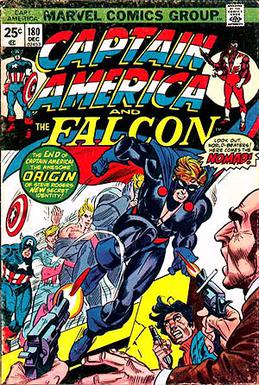
Captain America #180 (Dec. 1974). Art by Gil Kane and Frank Giacoia.

My teenaged self lurking below a few decades of the 50+ self is, then, quite excited about Sam Wilson/Captain America; however, that adolescent nerd-glee is significantly tempered by the social justice adult I have become, leaving me to ask: Should we marvel at a black Captain America?

Captain America #25 opens with Steve Rogers remembering Sam Wilson—Wilson’s warrior nature, his losing both parents (minister and community organizer) and raising a brother and sister, his resilience in the face of prejudice. Notably as well, Sam Wilson was, according to Rogers, “just a man. A man dedicated to showing what one person could accomplish after a lifetime of misfortune.”

Too often, comic book narratives remain firmly entrenched in the cliche (of course, if your audience is primarily children/teens, most anything can seem new to them, and is), but where comic book narratives have failed over about eight decades is that they mostly reflect social norms, even the biases and stereotypes (see Hugh Ryan on Wonder Woman), uncritically.

Readers in the first pages of issue #25 are led to believe (as the surrounding superheroes do) that Wilson has died heroically—and Rogers is about to pronounce Wilson a martyr. Until Wilson speaks.

The issue then turns to the aging Steve Rogers, no longer invigorated by super-soldier serum, who speaks to The Avengers in order to announce Sam Wilson/Captain America. This reboot ends with Wilson/Captain America in a hybrid uniform—red, white, and blue, Captain’s shield, and Falcon wings—shouting, “Avengers assemble!”

The All-New Captain America #1, interestingly, comes in a variant edition—all-white cardboard cover with only the title blazoned across the top. And with a somber and powerful opening page in which Sam Wilson recalls his father’s sermons and death, and his mother’s murder soon after, building to a refrain alluding the Martin Luther King Jr.’s dream, the black Captain America takes flight.

I mentioned Wonder Woman above because I am now reading Jill Lepore’s The Secret History of Wonder Woman. If Wonder Woman was born out of the rise of twentieth century feminism, as Lepore details, and then the series itself in action and image contradicts those feminist ideals, what good a female superhero?

And there I am stuck about the black Captain America, built up in Captain America #25 as the rugged individual, the exceptional human (superhuman) who lifted himself up by the bootstraps (wings didn’t hurt, there) and overcame every obstacle, including racism.

And there I am haunted by Ta-Nehisi Coates:

There is no evidence that black people are less responsible, less moral, or less upstanding in their dealings with America nor with themselves. But there is overwhelming evidence that America is irresponsible, immoral, and unconscionable in its dealings with black people and with itself. Urging African-Americans to become superhuman is great advice if you are concerned with creating extraordinary individuals. It is terrible advice if you are concerned with creating an equitable society. The black freedom struggle is not about raising a race of hyper-moral super-humans. It is about all people garnering the right to live like the normal humans they are.

If a black Captain America reinforces the “terrible advice” confronted by Coates, if black Captain American continues to perpetuate crass militarism and unbridled vigilante violence, I am left to ask, what good a black superhero?

[1] See Sean P. Connors on this series in Chapter 9 of Thomas, P. L. (ed.). (2013). Science fiction and speculative fiction: Challenging genres. Netherlands: Sense Publishers.
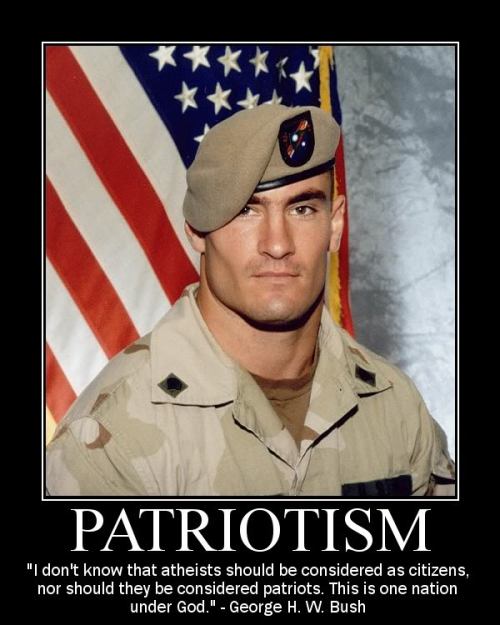
Pat Tillman (11/6/76 – 4/22/04): A Decade of Forgetting

On the first anniversary of the Boston Marathon bombing, David Zirin highlights a nearly concurrent anniversary:

Two wrenching anniversaries loom in the world of sports. Both are in many respects conjoined by the dominant narratives of the twenty-first century. Both show how the military adventures of the last decade have even breeched the escapist sanctity of the sports page. Both contain elements of tragedy, honor and courage. But you can be sure that one of these anniversaries will get a whole hell of a lot more attention than the other….

April 22 marks ten years since the death of NFL player turned Army Ranger Pat Tillman. Expect the media to take cursory notice and expect a press release from the NFL, but don’t expect much else. That’s because the Pat Tillman narrative doesn’t exactly lend itself to swelling music and sonorous sound bites.

Pat Tillman, if his death is acknowledged at all, will likely be portrayed as a man in uniform—but not as the man he was:

And despite his tragic death being the result of “friendly fire,” despite the now exposed political manipulation of Tillman’s service and death, despite the lies—Tillman, if his death is acknowledged at all, will be misrepresented once again—waved like a flag to keep the public’s gaze distracted:

Patriotism?

The truth, however ugly, is available in The Tillman Story (2010), and ESPN offers an Outside the Lines special, Pat Tillman: 10 Years Later an Enduring Tragedy.

The Tillman story, ultimately, is a story about us, about the U.S., about the myths that deform. On the tenth anniversary of Tillman’s death, I invite you to read below a post (revised) from 2012.

“Don’t Ask, Don’t Tell”: There’s a Reason Captain America Wears a Mask

With the release of The Tillman Story (2010), Pat Tillman’s brother, Richard, appeared on Bill Maher’s Real Time and offered yet another narrative of Pat’s life and death, one the Tillman family is willing to tell, but one the American public and political leaders are unwilling to ask about or retell.

Richard was frank and struggling on Maher’s HBO show, which included a clip from Pat’s memorial where Richard made a blunt and impassioned effort to tell the truth about his brother in the face of the political need to maintain American Mythology—even when those myths are deceptive, even when those myths are at the expense of people.

Pat Tillman was a stellar athlete who succeeded in college and rose to unique status in the NFL, where he did a very un-American thing, stepped away from a multi-million dollar contract, to do a very American thing, enlist in the military after 9/11 in order to serve his country. The news and political stories of Tillman’s decision played down the apparent rejection of materialism in Tillman’s volunteering to serve in the military, but the official stories began to craft a narrative starring Pat Tillman as Captain America.

Apparently, we could mask a not-so-subtle challenge to our materialistic existence and consumer culture as long as that masked hero would justify our wars.

Then Tillman died in the line of duty.

Then the U.S. government was exposed for building a story around Tillman’s death that was untrue: Pat was killed by “friendly fire” (a disarming term for an incomprehensible and gruesome fact of wars) and not at the hands of the enemy as officials initially claimed—to Pat’s brother who was also serving and nearby, to Pat’s family, and to the entire country.

Then Richard Tillman, still boiling with anger, said on Maher’s show that Pat should have retaliated in order to save himself against the “friendly fire.”

Beyond the continuing chasm between the real life and death of Pat Tillman and the narratives created around him, the release of the Tillman documentary presents the American public with a story that isn’t very flattering. The Tillman Story depends on the ambiguous meaning of “story,” as a synonym for “narrative” and “lie,” to offer another layer to the growing truths and distortions connected with why Pat Tillman joined the military, how he died, and the complex human being who he was.

Captain America and the Mask of Patriotism

Now, if we place the Tillman stories against the debate in the military over “don’t ask, don’t tell,” we notice that in this culture we endorse masking reality as a good and even honorable thing. We confront the Great American Myth that never allows us to ask, much less tell.

This military policy based on deception is ironically our central cultural narrative, one political leaders perpetuate since their political success depends upon speaking to our cultural myths instead of to reality. We are a country committed to don’t ask, don’t tell.

Pat Tillman’s life story and the corrupted narrative invented by politicians and the military to hide the truth and propagandize at the expense of a man and his life are tragic and personal myths that we are ignoring still. If political leaders will fabricate preferred stories at the expense of a single person, we can expect the same about the institutions central to our democracy, such as our public education system and teachers.

Such is a disturbing confirmation of the “myths that deform” that Paulo Freire cautioned about in his examination of the failures of “banking” concepts of education.

In this new era of hope and change, the Obama administration, we must be diligent to ask and tell, especially when it comes to our public schools. The false dichotomy of Republican and Democrat, conservative and liberal, is a distraction from the reality of political leaders expressing corporate narratives to ensure the balance of power favoring the status quo. Leaders are often compelled to maintain cultural myths because black-and-white messages are politically effective.

President Obama and Secretary of Education Duncan are now leading a renewed assault on public education, and directly teachers, under the banner of civil rights—just as Pat Tillman’s life and death were buried beneath claims of patriotism raised like Captain America’s shield so no one could see behind it.

The reality that Obama and Duncan cannot ask or tell about is poverty—and its impact on the lives and learning of children. Acknowledging poverty is an affront to the American Dream; confronting poverty is political dynamite. Blaming teachers and schools instead without offering the evidence works because this is a message we are willing to acknowledge and hear.

For example, a group from the ruling elite of schools, self-described as “educators, superintendents, chief executives and chancellors responsible for educating nearly 2 1/2 million students in America,” placed themselves squarely in the context of President Obama’s and Secretary Duncan’s charge against teachers and the status quo; their manifesto states: “As President Obama has emphasized, the single most important factor determining whether students succeed in school is not the color of their skin or their ZIP code or even their parents’ income—it is the quality of their teacher.” [1]

The names of the leaders—Klein, Rhee, Vallas—appear impressive, and their sweeping claims are compelling—except that the substance of their message is false.

Narratives are powerful, and telling those narratives requires diligence, a willingness to say something often enough to make the created story sound more credible than reality—until the truth is masked beneath a web of narratives that makes truth harder to accept than the lies that seem to conform to all the myths that deform us (rugged individualism, pulling oneself up by the bootstrap, a rising tide lifts all boats).

“Let’s stop ignoring basic economic principles of supply and demand” speaks to an American faith in the market. “[U]ntil we fix our schools, we will never fix the nation’s broader economic problems” triggers Americans’ blind willingness to compete and an enduring faith in schools as tools of social reform. They are compelling because Americans have been saying them for a century.

Just as the fabricated story of Pat Tillman and his sacrifice justified war.

“I don’t believe that even the best teachers can completely overcome the huge deficits in socialization, motivation and intellectual development that poor students bring to class through no fault of their own” (Walt Gardner) sounds weak, fatalistic, in the face of our myths, the words of soft people eager to shift the blame. It is something we dare not tell.

Just as the smoldering facts of Pat Tillman’s death remain too hard to ask about and too hard to tell.

But only the latter are supported by evidence. But only the latter contradict the Great American Myths about which we dare not ask, we dare not tell.

Captain America wears a mask for a reason: The myth is easier to look at, easier to tell about than the truth hidden underneath—whether we are asking about and looking hard at the death of a complex man, Pat Tillman, or the complex influences of poverty on the lives and learning of children across our country.

[1] See recent evidence to the contrary regarding the claim about zip codes: A Rotting Apple: Education Redlining in New York City, a report from the Schott Foundation for Public Education; and Housing Costs, Zoning, and Access to High-Scoring Schools, a report from Brookings.